研究论文

饲粮添加维生素D3对产蛋后期蛋鸭产蛋性能、蛋品质、脂质代谢和盲肠微生物的影响

  • 夏焕婷 , 1, 2 ,
  • 金永燕 1, * ,
  • 陈伟 1 ,
  • 王爽 1 ,
  • 夏伟光 1 ,
  • 金成龙 1 ,
  • 黄雪冰 1 ,
  • 李凯潮 1 ,
  • 王胜林 1 ,
  • 郑春田 1 ,
  • 张亚男 , 1, **
展开
  • 1 广东省农业科学院动物科学研究所,猪禽种业全国重点实验室,农业农村部华南动物营养与饲料重点实验室,广东省动物育种与营养公共实验室,广东省畜禽育种与营养研究重点实验室,广州 510640
  • 2 仲恺农业工程学院,广州 510225
**张亚男,副研究员,硕士生导师,E-mail:

* 同等贡献作者

夏焕婷(1998—),女,河南濮阳人,硕士研究生,从事动物营养与饲料科学研究。E-mail:

Copy editor: 田艳明

收稿日期: 2023-12-22

  网络出版日期: 2024-07-09

基金资助

国家水禽产业技术体系(CARS-42-13)

广东省水禽产业技术创新团队(2023KJ137)

广东省农业农村厅-畜禽全产业链标准化示范基地创建项目

蛋鸭笼养与精准营养供给技术研究与示范推广项目

广东省农业科学院高水平科技创新战略建设专项资金(202106TD)

广东省农业科学院高水平科技创新战略建设专项资金(R2021PY-QY005)

猪禽种业全国重点实验室开放课题(2023GZ12)

猪禽种业全国重点实验室开放课题(2021GZ05)

猪禽种业全国重点实验室开放课题(YDWS202106)

Effects of Dietary Vitamin D3 Supplementation on Laying Performance, Egg Quality, Lipid Metabolism and Cecal Microflora of Laying Ducks in Late Laying Period

  • XIA Huanting , 1, 2 ,
  • JIN Yongyan 1 ,
  • CHEN Wei 1 ,
  • WANG Shuang 1 ,
  • XIA Weiguang 1 ,
  • JIN Chenglong 1 ,
  • HUANG Xuebing 1 ,
  • LI Kaichao 1 ,
  • WANG Shenglin 1 ,
  • ZHENG Chuntian 1 ,
  • ZHANG Ya'nan , 1, **
Expand
  • 1 Guangdong Key Laboratory of Animal Breeding and Nutrition, Guangdong Public Laboratory of Animal Breeding and Nutrition, Key Laboratory of Animal Nutrition and Feed Science (South China) of Ministry of Agriculture and Rural Affairs, State Key Laboratory of Swine and Poultry Breeding, Institute of Animal Science, Guangdong Academy of Agriculture Sciences, Guangzhou 510640, China
  • 2 Zhongkai University of Agriculture and Engineering, Guangzhou 510225, China
**E-mail:

* Contributed equally

Received date: 2023-12-22

  Online published: 2024-07-09

摘要

本试验旨在研究饲粮添加维生素D3(VD3)对产蛋后期蛋鸭产蛋性能、蛋品质、脂质代谢和盲肠微生物的影响。选用432只健康、产蛋率相近的产蛋后期(58周龄)龙岩山麻鸭,随机分为6组,每组6个重复,每个重复12只鸭。对照组饲喂基础饲粮(不添加VD3),试验组分别饲喂在基础饲粮中添加800、1 600、2 400、3 200和4 000 IU/kg VD3的饲粮。预试期2周,正试期16周。结果表明:1)饲粮添加VD3可显著提高产蛋后期蛋鸭产蛋率和日产蛋重(P<0.05),并显著降低料蛋比(P<0.05)。其中,第1~16周,与对照组相比,试验组产蛋率和日产蛋重(1 600 IU/kg VD3添加组除外)均显著提高(P<0.05),料蛋比均显著降低(P<0.05)。2)与对照组相比,饲粮添加1 600 IU/kg VD3显著降低产蛋后期蛋鸭第12周蛋黄重和整个试验期蛋黄重平均值(P<0.05),且整个试验期蛋黄比例和蛋清比例平均值随饲粮VD3添加水平的提高呈线性和二次变化(P<0.05)。3)饲粮添加VD3具有降低产蛋后期蛋鸭肝脏甘油三酯和总胆固醇含量的趋势(P>0.05),且肝脏总胆固醇和低密度脂蛋白含量随饲粮VD3添加水平的提高呈先降低后升高的二次变化(P<0.05)。4)与对照组相比,饲粮添加2 400 IU/kg VD3显著降低产蛋后期蛋鸭十二指肠隐窝深度(P<0.05),显著提高十二指肠绒隐比(P<0.05),且十二指肠绒隐比随饲粮VD3添加水平的提高呈先升高后降低的二次变化(P<0.05)。5)饲粮添加VD3对产蛋后期蛋鸭盲肠微生物丰富度和多样性无显著影响。在属水平上,饲粮添加VD3能够显著提高短链脂肪酸(SCFA)合成菌如布劳特氏菌属(Blautia)、另枝菌属(Alistipes)和Lachnoclostridium相对丰度(P<0.05)。综上所述,饲粮添加VD3可改善产蛋后期蛋鸭产蛋性能、脂质代谢和肠道形态,促进盲肠SCFA合成菌富集,建议产蛋后期蛋鸭饲粮VD3添加水平为2 400~3 200 IU/kg。

本文引用格式

夏焕婷 , 金永燕 , 陈伟 , 王爽 , 夏伟光 , 金成龙 , 黄雪冰 , 李凯潮 , 王胜林 , 郑春田 , 张亚男 . 饲粮添加维生素D3对产蛋后期蛋鸭产蛋性能、蛋品质、脂质代谢和盲肠微生物的影响[J]. 动物营养学报, 2024 , 36(7) : 4350 -4364 . DOI: 10.12418/CJAN2024.375

Abstract

This experiment was conducted to investigate the effects of dietary vitamin D3(VD3) supplementation on laying performance, egg quality, lipid metabolism and cecal microflora of laying ducks in late laying period. A total of 432 healthy Longyanshan Ma ducks at 58 weeks of age with similar laying rate were randomly divided into 6 groups with 6 replicates per group and 12 ducks per replicate. Ducks in the control group were fed a basal diet (without adding VD3), and those in experimental groups were fed the basal diets supplemented with 800, 1 600, 2 400, 3 200 and 4 000 IU/kg VD3, respectively. The pre-trial period was 2 weeks, and the experimental period was 16 weeks. The results showed as follows: 1) dietary VD3 supplementation significantly increased the laying rate and daily egg weight of laying ducks in late laying period (P<0.05), and significantly decreased the feed to egg ratio (P<0.05). Among them, from weeks 1 to 16, compared with the control group, the laying rate and daily egg weight (except for 1 600 IU/kg VD3 supplemental group) of experimental groups were significantly increased (P<0.05), and the feed to egg ratio was significantly decreased (P<0.05). 2) Compared with the control group, dietary supplementation of 1 600 IU/kg VD3 significantly decreased the yolk weight at week 12 and the average yolk weight during the whole experiment period (P<0.05), and the average yolk ratio and average albumen ratio during the whole experiment period had linear and quadratic changes with the increase of dietary VD3 supplemental level (P<0.05). 3) Dietary VD3 supplementation had a trend of decreasing the contents of triglyceride and total cholesterol in liver of laying ducks in late laying period (P>0.05), and the contents of total cholesterol and low-density lipoprotein in liver were firstly decreased and then increased with dietary VD3 supplemental level increasing (P<0.05). 4) Compared with the control group, dietary supplementation of 2 400 IU/kg VD3 significantly decreased the crypt depth in duodenum of laying ducks in late laying period (P<0.05), significantly increased the villus height to crypt depth ratio in duodenum (P<0.05), and the villus height to crypt depth ratio in duodenum was firstly increased and then decreased with the increase of dietary VD3 supplemental level (P<0.05). 5) Dietary VD3 supplementation had no significant effects on the richness and diversity of cecal microflora of laying ducks in late laying period. At the genus level, dietary VD3 supplementation significantly increased the relative abundances of short-chain fatty acid (SCFA) synthetic bacteria such as Blautia, Alistipes and Lachnoclostridium (P<0.05). In conclusion, dietary VD3 supplementation can improve the laying performance, lipid metabolism and intestinal morphology of laying ducks in late laying period, and promote the enrichment of SCFA synthetic bacteria in cecum. It is suggested that dietary VD3 supplementation level is 2 400 to 3 200 IU/kg for laying ducks in late laying period.

维生素D3(vitamin D3,VD3)是家禽饲粮的必需维生素之一。家禽在饲粮中摄取VD3后,经血液进入肝脏,被维生素D 25-羟化酶(CYP2R1)催化,生成25-羟基维生素D3[25(OH)D3],后与维生素D结合蛋白结合转运至肾脏,在肾脏中,25(OH)D3被维生素D 1α-羟化酶(CYP27B1)催化,转化为有活性的1,25-二羟基维生素D3 [ 1,25 ( O H ) 2 D 3 ] [ 1 ]。1,25(OH)2D3可以激活维生素D受体(VDR)影响肝脏脂质代谢[2],从而发挥特定的生物学功能。不同时期蛋禽因其生长发育和生产需求不同,饲粮VD3适宜添加水平差异较大。蛋雏鸭饲粮添加400~5 000 IU/kg VD3可提高育雏和育成期平均日增重,降低料重比[3];产蛋期(21周龄)蛋鸭饲粮添加3 500 IU/kg VD3可提高产蛋率[4]。在罗曼灰蛋鸡(60周龄)饲粮中添加5 000 IU/kg VD3可改善蛋壳品质[5]。本课题组前期重点探究了VD3对蛋鸭蛋壳品质的影响,结果发现饲粮添加VD3可提高产蛋后期蛋鸭的蛋壳强度、蛋壳厚度以及蛋壳比例,且随着添加水平的提高(0~4 000 IU/kg)呈线性或二次提高。为充分发挥VD3对钙、磷利用以及对蛋壳和骨骼质量的改善作用,通常产蛋期蛋禽饲粮VD3添加水平较高;但饲粮过高VD3水平易造成VD3利用效率低下,甚至导致蛋禽生长速度减缓、产蛋性能下降等不良影响[6]。因此,在蛋禽饲粮中添加VD3应格外注意添加水平。
集约化高强度生产下,蛋禽容易诱发肠道功能障碍和脂肪肝,尤其是在产蛋后期。研究表明,维生素D缺乏是导致非酒精性脂肪肝的危险因素之一,可引起肝脏胰岛素抵抗、脂质过量沉积[7],这可能与VDR的表达降低有关;当维生素D缺乏时,肝脏VDR表达降低,会导致胆固醇7α-羟化酶(CYP7A1)mRNA和蛋白表达降低,从而使得胆固醇水平升高[8]。CYP7A1是胆汁酸合成经典途径的限速酶[9],催化胆固醇在肝脏分解为胆汁酸,维持体内胆汁酸合成和胆固醇稳态[10]。补充VD3通过抑制肝脏脂质合成和促进脂肪酸氧化分解,可缓解高脂饲粮诱导的大鼠脂肪肝[11]。此外,VD3还可调节肠道微生物的组成和功能,增加有益菌(如普雷沃氏菌)的数量[12],缓解高脂肪饮食诱导的肠道微生物群落失调和脂质代谢紊乱[11]。因此,探究饲粮VD3水平对蛋鸭脂质代谢和肠道微生物的影响,可为后期蛋鸭VD3的应用提供理论依据。
基于此,本研究旨在探究饲粮添加不同水平VD3对产蛋后期蛋鸭产蛋性能、蛋品质、脂质代谢和盲肠微生物的影响,并确定其在产蛋后期蛋鸭饲粮中的适宜添加水平,为VD3在产蛋后期蛋鸭生产中的合理应用提供科学依据。

1 材料与方法

1.1 试验设计和饲粮

试验选用432只健康、产蛋正常的产蛋后期(58周龄)龙岩山麻鸭,随机分为6组,每组6个重复,每个重复12只鸭。对照组饲喂基础饲粮(不添加VD3),试验组分别饲喂在基础饲粮中添加800、1 600、2 400、3 200和4 000 IU/kg VD3的饲粮。预试期2周,正试期16周。预试期间,所有试验鸭均饲喂基础饲粮。
基础饲粮参照《蛋鸭营养需要量》(GB/T 41189—2021)[13]配制,其组成及营养水平见表1。饲粮代谢能以及氨基酸和非植酸磷含量参考《中国饲料成分及营养价值表(2020年第31版)》[14]计算;饲粮粗蛋白质、钙和总磷含量分别参照GB/T 6432—2018[15]、GB/T 6436—2018[16]和GB/T 6437—2018[17]方法进行测定。
表1 基础饲粮组成及营养水平(风干基础)

Table 1 Composition and nutrient levels of the basal diet (air-dry basis)%

原料 Ingredients 含量 Content 营养水平 Nutrient levels2) 含量 Content
玉米 Corn 53.90 代谢能 ME/(MJ/kg) 10.46
豆粕 Soybean meal 25.30 粗蛋白质 CP 16.89
麦麸 Wheat bran 8.93 钙 Ca 3.73
石粉 Limestone 8.90 总磷 TP 0.66
DL-蛋氨酸 DL-Met 0.16 非植酸磷 NPP 0.37
L-赖氨酸 L-Lys 0.03 赖氨酸 Lys 0.42
磷酸氢钙 CaHPO4 1.43 蛋氨酸 Met 0.88
氯化钠 NaCl 0.35
预混料 Premix1) 1.00
合计 Total 100.00

1)预混料为每千克饲粮提供 The premix provided the following per kg of the diet:VA 7 500 IU,VE 20.00 mg,VK3 2.50 mg,VB1 3.45 mg,VB2 6.00 mg,VB6 2.50 mg,VB12 0.02 mg,氯化胆碱 choline chloride 600.00 mg,泛酸 pantothenic acid 20.58 mg,叶酸 folic acid 1.00 mg,生物素 biotin 0.20 mg,烟酸 nicotinic acid 27.13 mg,Fe 75.00 mg,Cu 10.00 mg,Mn 50.00 mg,Zn 43.75 mg,Se 0.30 mg,I 0.44 mg。

2)粗蛋白质、钙和总磷为实测值,其他为计算值。CP, Ca and TP were measured values, while the others were calculated values.

1.2 饲养管理

试验采用3层阶梯式笼养,蛋鸭单笼单养,以层数为单位,每层的各组均设置2个重复。试验期间蛋鸭自由采食和饮水,每天08:30和15:30各饲喂1次,使用乳头式饮水器供水。

1.3 样本采集与指标测定

1.3.1 产蛋性能

试验期间以重复为单位,每天记录蛋鸭产蛋数、蛋重、破蛋数和耗料量。每4周统计并计算蛋鸭产蛋率、平均蛋重、日产蛋重、平均日采食量、料蛋比和破蛋率。

1.3.2 蛋品质

正试期第4、8、12和16周末,每个重复取3枚接近平均蛋重的鸭蛋,测定蛋品质,采集当天测定。采用万分位电子天平(PWN124ZH/E)测定蛋重;采用全自动蛋品分析仪(EA-01)测定蛋白高度、哈氏单位和蛋黄颜色;分离蛋清和蛋黄,采用万分位电子天平(PWN124ZH/E)测定蛋清和蛋黄重,并计算蛋清和蛋黄比例。

1.3.3 脂质代谢相关指标

正试期第16周末,每个重复选取2只蛋鸭,称重后,翅下静脉采血于抗凝管内,2 300×g离心10 min,分离血浆,采用试剂盒(南京建成生物工程研究所)测定血浆甘油三酯(triglyceride,TG)、总胆固醇(total cholesterol,TC)、高密度脂蛋白(high-density lipoprotein,HDL)和低密度脂蛋白(low-density lipoprotein,LDL)含量。
将采血后的蛋鸭颈动脉放血屠宰,采集肝脏并称重,用于计算肝脏指数。计算公式为:
肝脏指数(%)=100×肝脏重(g)/体重(g)。
取0.5 g左右肝脏组织于1.5 mL EP管中,-80 ℃保存,待制备匀浆液;采用试剂盒(南京建成生物工程研究所)测定肝脏TG、TC、HDL和LDL含量。
取约1 g肝脏称重(样品重),放入105 ℃烘箱中烘干,同时将脱脂滤纸在105 ℃烘箱中烘至恒重。取出样品磨碎,包在滤纸中,再次烘至恒重,称量滤纸包重(滤纸+样品重);将滤纸包放入索氏提取器中,用无水乙醚抽提脂肪,待乙醚挥发后,将滤纸包烘干、冷却、称重(脱脂后样包重),计算肝脂率。计算公式为:
肝脂率(%)=100×[滤纸包重(g)-脱脂后样包重(g)]/样品重(g)。

1.3.4 十二指肠形态

分离十二指肠,剥除肠壁的脂肪,取中段约1 cm置于福尔马林固定液中并制作切片,采用苏木精-伊红(HE)染色后在显微镜下观测肠道绒毛高度和隐窝深度,并计算绒隐比(绒毛高度/隐窝深度)。

1.3.5 盲肠微生物

分离2侧的盲肠,取盲肠内容物于1.5 mL的EP管中,用液氮冷冻,-80 ℃保存,采用16S rRNA技术检测盲肠微生物组成。

1.4 数据统计与分析

采用SPSS 26.0的Explore过程检验数据的正态分布和方差齐性,采用单因素方差(one-way ANOVA)分析饲粮VD3添加水平的效应,差异显著时采用Tukey检验进行多重比较,并采用回归法分析各指标随饲粮VD3添加水平的提高而呈现的线性和二次变化。试验结果数据采用平均值和均值标准误(SEM)表示,P<0.05为差异显著。

2 结果与分析

2.1 饲粮添加VD3对产蛋后期蛋鸭产蛋性能的影响

表2可知,饲粮添加VD3可显著提高产蛋后期蛋鸭产蛋率和日产蛋重(P<0.05),并显著降低料蛋比(P<0.05)。其中,第1~16周,与对照组相比,试验组产蛋率和日产蛋重(1 600 IU/kg VD3添加组除外)均显著提高(P<0.05),料蛋比均显著降低(P<0.05)。随着饲粮VD3添加水平的提高,除第1~4周外,其他阶段产蛋率、日产蛋重和料蛋比均呈线性和二次变化(P<0.05)。第5~8周,与对照组相比,饲粮添加3 200 IU/kg VD3显著提高平均日采食量(P<0.05),且平均日采食量随饲粮VD3添加水平的提高呈线性和二次变化(P<0.05)。饲粮添加VD3对平均蛋重和破蛋率均无显著影响(P>0.05)。
表2 饲粮添加VD3对产蛋后期蛋鸭产蛋性能的影响

Table 2 Effects of dietary VD3 supplementation on laying performance of laying ducks in late laying period

项目
Items
对照组
Control
group
VD3添加水平
VD3 supplemental levels/(IU/kg)
SEM PP-value
方差分析
ANOVA
线性
Linear
二次
Quadratic
800 1 600 2 400 3 200 4 000
产蛋率 Laying rate/%
第1~4周 Weeks 1 to 4 83.9 88.5 85.6 87.9 86.8 88.7 0.795 0.473 0.197 0.414
第5~8周 Weeks 5 to 8 74.5b 86.4a 85.1a 84.7a 87.4a 87.5a 1.102 <0.001 0.002 <0.001
第9~12周 Weeks 9 to 12 67.8b 78.8a 78.2ab 78.2ab 78.9a 84.1a 1.263 0.004 <0.001 0.003
第13~16周
Weeks 13 to 16
60.3b 75.8a 71.8ab 72.3ab 72.7ab 79.5a 1.543 0.004 0.004 0.012
第1~16周
Weeks 1 to 16
71.6b 82.4a 80.2a 80.8a 81.4a 85.0a 1.001 <0.001 <0.001 0.002
平均蛋重 Average egg weight/g
第1~4周 Weeks 1 to 4 69.0 69.6 70.4 69.8 68.9 70.2 0.222 0.277 0.482 0.678
第5~8周 Weeks 5 to 8 70.2 70.3 71.0 72.1 69.7 70.5 0.289 0.219 0.836 0.387
第9~12周 Weeks 9 to 12 69.3 70.0 71.6 70.2 69.7 70.5 0.299 0.296 0.564 0.390
第13~16周
Weeks 13 to 16
69.1 70.5 70.8 70.1 69.5 70.6 0.283 0.472 0.521 0.571
第1~16周
Weeks 1 to 16
69.4 70.1 70.9 70.5 69.5 70.4 0.229 0.290 0.534 0.386
日产蛋重 Daily egg weight/(g/d)
第1~4周 Weeks 1 to 4 57.8 61.7 60.0 61.3 59.4 62.2 0.555 0.193 0.142 0.309
第5~8周 Weeks 5 to 8 52.1b 60.5a 58.2ab 59.5ab 60.8a 61.5a 0.882 0.013 0.005 0.008
第9~12周 Weeks 9 to 12 46.9b 55.1a 55.2a 54.9a 54.5ab 59.2a 0.918 0.002 <0.001 0.002
第13~16周
Weeks 13 to 16
41.5b 54.5a 49.6ab 50.7ab 50.5ab 56.0a 1.145 0.002 0.007 0.019
第1~16周
Weeks 1 to 16
49.6b 58.0a 55.8ab 56.6a 56.3a 59.7a 0.765 <0.001 0.002 0.004
平均日采食量 ADFI/(g/d)
第1~4周 Weeks 1 to 4 166.4 168.7 167.4 168.9 166.6 168.8 0.431 0.311 0.415 0.647
第5~8周 Weeks 5 to 8 161.7b 168.5ab 166.2ab 167.4ab 169.7a 169.4ab 0.827 0.043 0.009 0.020
第9~12周 Weeks 9 to 12 161.9 167.8 165.3 165.9 165.4 168.2 0.924 0.444 0.193 0.408
第13~16周
Weeks 13 to 16
152.6 161.2 159.5 159.5 160.3 161.8 1.088 0.158 0.050 0.086
第1~16周
Weeks 1 to 16
160.7 166.6 164.6 165.4 165.5 167.1 0.666 0.066 0.027 0.058
料蛋比 F/E
第1~4周 Weeks 1 to 4 2.89 2.74 2.80 2.76 2.81 2.72 0.023 0.307 0.134 0.288
第5~8周 Weeks 5 to 8 3.13a 2.79b 2.87ab 2.83b 2.80b 2.76b 0.033 0.007 0.005 0.006
第9~12周 Weeks 9 to 12 3.48a 3.05b 3.01b 3.04b 3.04b 2.84b 0.043 <0.001 <0.001 <0.001
第13~16周
Weeks 13 to 16
3.69a 2.97b 3.26ab 3.17b 3.19b 2.91b 0.060 <0.001 0.005 0.014
第1~16周
Weeks 1 to 16
3.30a 2.89b 2.99b 2.95b 2.96b 2.81b 0.034 <0.001 <0.001 <0.001
破蛋率 Broken egg rate/%
第1~4周 Weeks 1 to 4 4.11 2.69 3.08 3.30 2.71 2.88 0.226 0.483 0.210 0.337
第5~8周 Weeks 5 to 8 5.16 3.46 4.51 3.85 3.55 3.90 0.344 0.736 0.355 0.541
第9~12周 Weeks 9 to 12 5.45 4.15 4.84 6.26 4.33 3.84 0.374 0.451 0.436 0.560
第13~16周
Weeks 13 to 16
5.08 2.95 5.10 3.68 4.63 4.09 0.434 0.701 0.886 0.943
第1~16周
Weeks 1 to 16
4.95 3.31 4.38 4.27 3.80 3.68 0.294 0.684 0.416 0.706

同行数据肩标无字母或相同小写字母表示差异不显著(P>0.05),不同小写字母表示差异显著(P<0.05)。下表同。

In the same row, values with no letter or the same small letter superscripts mean no significant difference (P>0.05), while with different small letter superscripts mean significant difference (P<0.05). The same as below.

2.2 饲粮添加VD3对产蛋后期蛋鸭蛋品质的影响

表3可知,与对照组相比,饲粮添加1 600 IU/kg VD3显著降低产蛋后期蛋鸭第12周蛋黄重和整个试验期蛋黄重平均值(P<0.05),且第12周蛋黄比例随饲粮VD3添加水平的提高呈二次变化(P<0.05),第16周蛋黄比例和整个试验期蛋黄比例平均值随饲粮VD3添加水平的提高呈线性和二次变化(P<0.05)。随着饲粮VD3添加水平的提高,整个试验期蛋清比例平均值呈线性和二次变化(P<0.05)。第4周,与800 IU/kg VD3添加组相比,2 400 IU/kg VD3添加组蛋白高度显著提高(P<0.05);且第4周蛋白高度和整个试验期蛋白高度平均值随饲粮VD3添加水平的提高呈线性变化(P<0.05),第12周蛋白高度随饲粮VD3添加水平的提高呈二次变化(P<0.05)。第16周,与2 400 IU/kg VD3添加组相比,3 200 IU/kg VD3添加组哈氏单位显著提高(P<0.05)。饲粮添加VD3对蛋重和蛋黄颜色无显著影响(P>0.05)。
表3 饲粮添加VD3对产蛋后期蛋鸭蛋品质的影响

Table 3 Effects of dietary VD3 supplementation on egg quality of laying ducks in late laying period

项目
Items
对照组
Control
group
VD3添加水平
VD3 supplemental levels/(IU/kg)
SEM PP-value
方差分析
ANOVA
线性
Linear
二次
Quadratic
800 1 600 2 400 3 200 4 000
蛋重 Egg weight/g
第4周 Week 4 69.6 68.9 70.4 69.4 68.0 68.3 0.311 0.224 0.107 0.174
第8周 Week 8 71.8 70.2 71.2 70.2 70.1 70.2 0.280 0.391 0.117 0.235
第12周 Week 12 71.4 69.4 70.6 71.6 70.8 71.8 0.335 0.344 0.295 0.391
第16周 Week 16 69.3 68.0 66.9 68.1 69.6 69.1 0.541 0.731 0.658 0.447
平均值 Mean 70.5 69.1 69.8 69.8 69.6 69.9 0.213 0.630 0.690 0.574
蛋黄重 Yolk weight/g
第4周 Week 4 22.9 22.8 22.1 22.7 21.9 22.1 0.189 0.520 0.096 0.249
第8周 Week 8 23.6 22.5 23.1 22.8 23.0 22.9 0.170 0.631 0.538 0.548
第12周 Week 12 24.3a 22.7ab 22.4b 23.5ab 22.8ab 23.3ab 0.188 0.037 0.359 0.065
第16周 Week 16 24.2 22.8 22.6 22.2 22.0 23.1 0.302 0.362 0.191 0.070
平均值 Mean 23.7a 22.7ab 22.5b 22.8ab 22.4b 22.8ab 0.122 0.018 0.191 0.070
蛋清重 Albumen weight/g
第4周 Week 4 40.2 40.8 41.7 42.7 39.7 39.9 0.470 0.442 0.696 0.239
第8周 Week 8 41.7 41.2 41.5 40.9 40.7 40.7 0.238 0.798 0.163 0.377
第12周 Week 12 41.2 40.3 41.8 41.8 41.7 42.4 0.292 0.473 0.088 0.232
第16周 Week 16 38.8 39.2 38.3 39.5 41.3 39.9 0.411 0.421 0.131 0.318
平均值 Mean 40.5 40.4 40.8 41.2 40.8 40.7 0.192 0.876 0.131 0.318
蛋清比例 Albumen ratio/%
第4周 Week 4 57.6 57.3 59.1 57.7 58.4 58.3 0.277 0.467 0.367 0.572
第8周 Week 8 58.1 58.6 58.2 58.3 58.0 58.0 0.212 0.971 0.618 0.618
第12周 Week 12 57.6 58.1 59.1 58.1 58.9 58.5 0.226 0.386 0.190 0.250
第16周 Week 16 56.2 57.6 57.5 58.0 59.4 57.7 0.381 0.293 0.083 0.118
平均值 Mean 57.4 57.9 58.5 58.0 58.7 58.1 0.141 0.101 0.048 0.034
蛋黄比例 Yolk ratio/%
第4周 Week 4 33.0 33.2 31.5 32.7 32.3 32.3 0.278 0.593 0.421 0.575
第8周 Week 8 32.9 32.1 32.4 32.5 32.8 32.7 0.212 0.918 0.739 0.743
第12周 Week 12 33.9 32.8 31.6 32.8 32.2 32.2 0.235 0.085 0.057 0.044
第16周 Week 16 35.1 33.5 33.9 32.6 31.5 33.3 0.383 0.135 0.036 0.046
平均值 Mean 33.7 32.9 32.3 32.6 32.2 32.6 0.152 0.051 0.020 0.007
蛋白高度 Albumen height/mm
第4周 Week 4 8.03ab 7.68b 8.37ab 8.45a 8.12ab 8.40ab 0.079 0.026 0.043 0.114
第8周 Week 8 7.76 7.85 7.85 8.17 7.63 8.24 0.100 0.475 0.321 0.605
第12周 Week 12 7.67 7.57 7.26 7.45 7.73 7.80 0.059 0.072 0.277 0.023
第16周 Week 16 7.61 7.42 7.81 7.26 7.86 7.65 0.068 0.068 0.479 0.682
平均值 Mean 7.77 7.63 7.82 7.83 7.84 8.02 0.042 0.171 0.025 0.051
蛋黄颜色 Yolk color
第4周 Week 4 4.39 4.50 4.61 4.42 4.70 4.14 0.066 0.206 0.540 0.166
第8周 Week 8 4.72 4.72 5.06 4.78 5.00 4.67 0.068 0.474 0.846 0.390
第12周 Week 12 4.61 4.72 4.89 4.95 4.94 4.95 0.055 0.376 0.033 0.064
第16周 Week 16 5.06 4.89 4.72 5.05 5.00 5.06 0.059 0.525 0.588 0.439
平均值 Mean 4.69 4.71 4.82 4.80 4.91 4.70 0.031 0.261 0.340 0.168
哈氏单位 Haugh unit
第4周 Week 4 87.2 84.3 88.4 88.5 87.2 89.3 0.566 0.138 0.093 0.243
第8周 Week 8 85.0 86.0 84.9 87.8 84.4 87.7 0.562 0.363 0.314 0.600
第12周 Week 12 84.9 84.2 81.8 83.1 84.6 84.5 0.348 0.073 0.946 0.052
第16周 Week 16 84.1ab 82.6ab 85.2ab 82.0b 85.9a 84.0ab 0.391 0.024 0.454 0.714
平均值 Mean 85.3 84.3 85.1 85.3 85.5 86.4 0.255 0.328 0.069 0.069

2.3 饲粮添加VD3对产蛋后期蛋鸭脂质代谢相关指标的影响

表4可知,与800、1 600和2 400 IU/kg VD3添加组相比,3 200 IU/kg VD3添加组产蛋后期蛋鸭肝脏LDL含量显著提高(P<0.05),且肝脏LDL含量随饲粮VD3添加水平的提高呈先降低后升高的二次变化(P<0.05)。与2 400 IU/kg VD3添加组相比,3 200 IU/kg VD3添加组肝脏HDL含量显著降低(P<0.05)。随着饲粮VD3添加水平的提高,肝脏TC含量呈线性和二次变化(P<0.05)。饲粮添加VD3对肝脏指数、肝脂率以及血浆脂质代谢相关指标均无显著影响(P>0.05)。
表4 饲粮添加VD3对产蛋后期蛋鸭脂质代谢相关指标的影响

Table 4 Effects of dietary VD3 supplementation on lipid metabolism related indices of laying ducks in late laying period

项目
Items
对照组
Control
group
VD3添加水平
VD3 supplemental levels/(IU/kg)
SEM PP-value
方差分析
ANOVA
线性
Linear
二次
Quadratic
800 1 600 2 400 3 200 4 000
体重 Body weight/kg 1.32 1.36 1.42 1.40 1.38 1.35 0.018 0.666 0.615 0.224
肝脏重 Liver weight/g 43.7 38.2 40.3 38.3 46.1 38.9 1.001 0.105 0.900 0.812
肝脏指数 Liver index/% 3.33 2.82 2.84 2.74 3.34 2.89 0.075 0.050 0.640 0.279
肝脂率 Liver fat rate/% 33.1 32.3 28.4 30.5 27.9 30.4 1.512 0.092 0.430 0.601
血浆 Plasma/(mmol/L)
甘油三酯 TG 8.13 9.64 9.76 9.31 9.80 9.09 0.263 0.462 0.376 0.179
总胆固醇 TC 3.71 5.13 3.63 3.49 3.21 3.40 0.340 0.656 0.293 0.572
低密度脂蛋白 LDL 1.62 1.83 1.77 1.65 1.66 1.69 0.100 0.993 0.898 0.959
高密度脂蛋白 HDL 11.9 10.7 11.1 10.6 9.6 10.2 0.471 0.822 0.206 0.430
肝脏 Liver/(μmol/g prot)
甘油三酯 TG 76.6 72.8 66.3 70.7 73.7 64.0 1.409 0.076 0.051 0.147
总胆固醇 TC 5.89 5.96 4.93 4.37 4.39 4.53 0.211 0.055 0.004 0.009
低密度脂蛋白 LDL 34.0ab 23.5b 22.6b 23.3b 38.2a 32.3ab 1.588 0.004 0.270 0.025
高密度脂蛋白 HDL 3.03ab 2.58ab 2.91ab 4.41a 1.98b 3.69ab 0.221 0.018 0.510 0.806

2.4 饲粮添加VD3对产蛋后期蛋鸭十二指肠形态的影响

表5可知,与对照组相比,饲粮添加2 400 IU/kg VD3显著降低产蛋后期蛋鸭十二指肠隐窝深度(P<0.05),饲粮添加800、1 600和2 400 IU/kg VD3显著提高十二指肠绒隐比(P<0.05);此外,十二指肠绒隐比随饲粮VD3添加水平的提高呈先升高后降低二次变化(P<0.05)。饲粮添加VD3对十二指肠绒毛高度没有显著影响(P>0.05)。
表5 饲粮添加VD3对产蛋后期蛋鸭十二指肠形态的影响

Table 5 Effects of dietary VD3 supplementation on duodenal morphology of laying ducks in late laying period

项目
Items
对照组
Control
group
VD3添加水平
VD3 supplemental levels/(IU/kg)
SEM PP-value
方差分析
ANOVA
线性
Linear
二次
Quadratic
800 1 600 2 400 3 200 4 000
绒毛高度
Villus height/×103 μm
1.18 1.26 1.30 1.18 1.27 1.23 0.027 0.318 0.764 0.797
隐窝深度
Crypt depth/μm
262a 219ab 221ab 194b 240a 216ab 7.393 0.022 0.213 0.114
绒隐比 V/C 4.62b 5.81a 5.91a 6.35a 5.40ab 5.68ab 0.165 0.014 0.180 0.020

2.5 饲粮添加VD3对产蛋后期蛋鸭盲肠微生物的影响

2.5.1 盲肠菌群测试深度及操作分类单元(OTU)分析
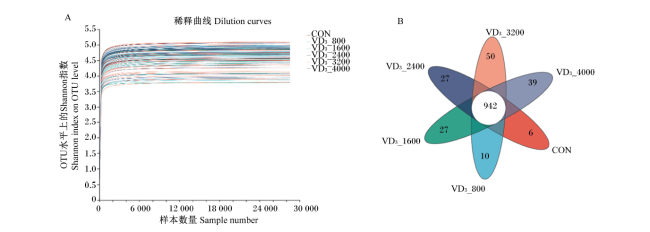
图1-A所示,随着抽取的样本数据量的增加,稀释曲线趋近平缓,说明测序数据量足够大,可覆盖样本中的绝大部分物种。如图1-B所示,对照组和试验组之间有942个共同OTU,对照组特有6个OTU,800、1 600、2 400、3 200和4 000 IU/kg VD3添加组分别特有10、27、27、50和39个OTU。
图1 产蛋后期蛋鸭盲肠菌群稀释曲线(A)和维恩图(B)

CON:对照组 control group;VD3_800:800 IU/kg VD3添加组 800 IU/kg VD3 supplemental group;VD3_1600:1 600 IU/kg VD3添加组 1 600 IU/kg VD3 supplemental group;VD3_2400:2 400 IU/kg VD3添加组 2 400 IU/kg VD3 supplemental group;VD3_3200:3 200 IU/kg VD3添加组 3 200 IU/kg VD3 supplemental group;VD3_4000:4 000 IU/kg VD3添加组 4 000 IU/kg VD3 supplemental group。下图同 the same as below。

Fig.1 Dilution curves (A) and Venn diagram (B) of cecal microflora of laying ducks in late laying period

2.5.2 盲肠菌群alpha多样性分析

alpha多样性分析是研究环境中微生物的多样性,通过单样本的多样性分析反映微生物群落的丰富度和多样性。由表6可知,与对照组相比,饲粮添加VD3对产蛋后期蛋鸭盲肠菌群Sobs、Chao、Ace、Shannon、Simpson指数以及覆盖度均无显著影响(P>0.05),表明盲肠微生物的丰富度、多样性以及覆盖度无显著变化。
表6 饲粮添加VD3对产蛋后期蛋鸭盲肠菌群alpha多样性的影响

Table 6 Effects of dietary VD3 supplementation on alpha diversity of cecal microflora of laying ducks in late laying period

项目
Items
对照组
Control
group
VD3添加水平
VD3 supplemental levels/(IU/kg)
SEM PP-value
方差分析
ANOVA
线性
Linear
二次
Quadratic
800 1 600 2 400 3 200 4 000
Sobs指数 Sobs index 661.2 717.8 685.6 672.8 640.5 668.0 10.623 0.437 0.341 0.533
Shannon指数
Shannon index
4.59 4.69 4.65 4.48 4.65 4.66 0.037 0.567 0.820 0.726
Simpson指数
Simpson index
0.026 0.030 0.031 0.029 0.035 0.030 0.002 0.873 0.383 0.567
Ace指数 Ace index 805.8 894.1 848.8 828.2 815.5 855.0 12.248 0.349 0.966 0.921
Chao指数 Chao index 815.8 902.4 821.2 850.4 815.3 865.3 14.643 0.477 0.960 0.999
覆盖度 Coverage 0.994 0.994 0.994 0.994 0.994 0.994 <0.001 0.412 0.831 0.891

2.5.3 盲肠菌群beta多样性分析

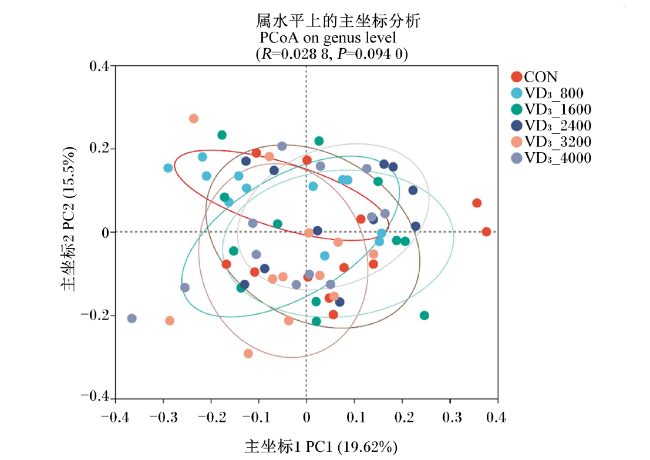
beta多样性分析是探索不同分组样本间群落组成的相似性或差异性,样本距离越近表明样本组成越相似。本试验采用主坐标分析(principal coordinate analysis,PCoA)方法,通过Bray-Curtis距离来比较菌群的相似性。如图2所示,各组蛋鸭盲肠微生物组成相互重合,具有相似性(P>0.05)。
图2 产蛋后期蛋鸭盲肠菌群beta多样性分析

Fig.2 Beta diversity analysis of cecal microflora of laying ducks in late laying period

2.5.4 盲肠菌群差异性分析

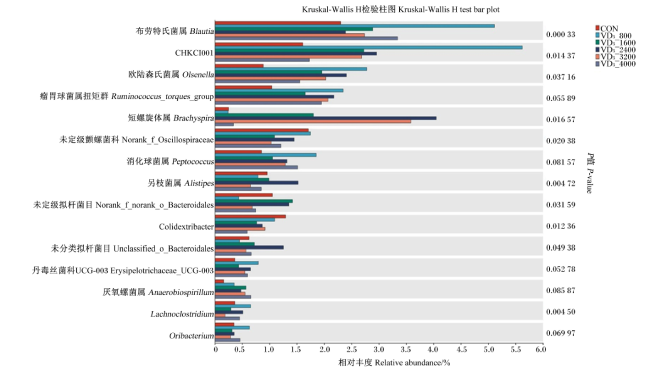
图3所示,饲粮添加VD3影响了蛋鸭盲肠微生物在属水平上的组成,其中饲粮添加VD3显著提高了盲肠布劳特氏菌属(Blautia)、CHKCI001、欧陆森氏菌属(Olsenella)、短螺旋体属(Brachyspira)、另枝菌属(Alistipes)、未分类拟杆菌目(unclassified_o_Bacteroidales)和Lachnoclostridium相对丰度(P<0.05),显著降低了未定级颤螺菌科(norank_f_Oscillospiraceae)、未定级拟杆菌目(norank_f_norank_o_Bacteroidales)和Colidextribacter相对丰度(P<0.05)。
图3 产蛋后期蛋鸭盲肠菌群差异性分析

Fig.3 Difference analysis of cecal microflora of laying ducks in late laying period

2.5.5 盲肠菌群线性判别分析效应大小(LEfSe)多级物种差异分析

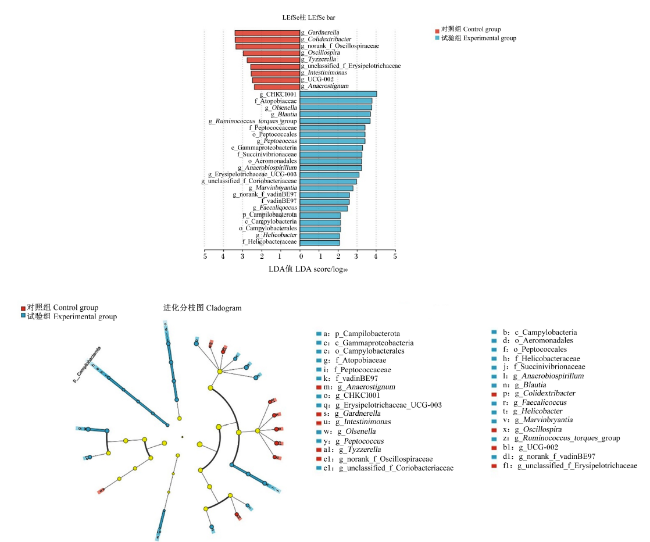
为了进一步探索盲肠菌群的变化,采用LEfSe分析来确定2组之间在相对丰度上有显著差异的物种。如图4-A所示,颜色代表对应分组,柱状图的长度代表差异物种的贡献度大小,默认参数为LDA值>2和P<0.05的条件下不同组间相对丰度有显著差异的物种。如图4-B所示,由内至外辐射的圆圈代表了由门至属的分类级别,无显著差异的物种统一着色为黄色,差异物种跟随组进行着色,红色节点表示在红色组别中起到重要作用的微生物类群,绿色节点表示在绿色组别中起到重要作用的微生物类群。从图中可以看出,试验组组有23个特异菌,包括CHKCI001、奇异菌科(Atopobiaceae)和欧陆森氏菌属等。
图4 基于LEfSe分析产蛋后期蛋鸭盲肠菌群差异物种LDA值分布图(A)和进化分枝图(B)

p_:门 phylum;c_:纲 class;o_:目 order;f_:科 family;g_:属 genus;Gardnerella:加德纳菌属;norank_f_Oscillospiraceae:未定级颤螺旋菌科;Oscillospira:颤螺菌属;unclassified_f_Erysipelotrichaceae:未分类丹毒丝菌科;Atopobiaceae:奇异菌科;Olsenella:欧陆森氏菌属;Blautia:布劳特氏菌属;Ruminococcus_torques_group:瘤胃球菌属扭矩群;Peptococcaceae:消化球菌科;Peptococcales:消化球菌目;Peptococcus:消化球菌属;Gammaproteobacteria:γ-变形菌纲;Succinivibrionaceae:琥珀酸弧菌科;Aeromonadales:气单胞菌目;Anaerobiospirillum:厌氧螺菌属;Erysipelotrichaceae_UCG-003:丹毒丝菌科UCG-003;unclassified_f_Coriobacteriaceae:未分类红蝽菌科;Campilobacterota:弯曲杆菌门;Campylobacteria:弯曲杆菌纲;Campylobacterales:弯曲杆菌目;Helicobacter:螺杆菌属;Helicobacteraceae:螺杆菌科。

Fig.4 Analysis of LDA score distribution map (A) and cladogram (B) of differential species in cecal microflora of laying ducks in late laying period based on LEfSe

3 讨论

3.1 饲粮添加VD3对产蛋后期蛋鸭产蛋性能的影响

本试验发现,饲粮添加VD3可改善产蛋后期蛋鸭的产蛋性能,提高产蛋率和日产蛋重,降低料蛋比。康乐[18]在60周龄的罗曼粉壳蛋鸡饲粮中添加VD3(2 500和5 000 IU/kg),可以提高蛋鸡的产蛋率和日采食量,降低料蛋比。此外,饲粮添加25(OH)D3可缓解45周龄蛋鸡高饲养密度引起的蛋鸡产蛋性能下降[19]。VD3对产蛋性能的改善作用可能与VD3调节肠道形态及生理功能,促进营养物质的吸收利用有关。本试验中,饲粮添加VD3改善了蛋鸭十二指肠的形态,提高了绒隐比,并且促进了盲肠内短链脂肪酸(SCFA)合成菌的定植,可能由此提高了蛋鸭对营养物质的吸收和利用,进而改善了产蛋性能。

3.2 饲粮添加VD3对产蛋后期蛋鸭蛋品质的影响

本试验中,饲粮添加VD3降低了蛋黄重,且有降低蛋黄比例的趋势;与对照组相比,饲粮添加1 600 IU/kg VD3显著降低蛋黄重。康乐[18]在饲粮添加2 500 IU/kg VD3显著降低了第12周蛋黄重和第1~16周蛋黄重平均值。卵黄的生成需要大量的脂质沉积,卵黄前体主要由母禽的肝脏合成,分泌到血液经由循环系统运输到卵巢,并转移至卵泡中[20],LDL对于组装形成蛋黄颗粒具有重要作用[21]。本试验中,与对照组相比,饲粮添加VD3降低了蛋鸭肝脏LDL含量,并且肝脏LDL含量随饲粮VD3添加水平的提高呈先降低后升高的二次变化趋势,这与蛋黄比例的变化趋势一致,且在1 600 IU/kg VD3添加组最低,此时可能抑制了蛋黄颗粒的形成,从而影响蛋黄重。

3.3 饲粮添加VD3对产蛋后期蛋鸭脂质代谢相关指标的影响

脂质代谢紊乱,引发脂肪肝,是蛋禽生产中的常见问题[22]。当饲粮缺乏维生素D时,参与脂质代谢的VDR表达下降[7],肝脏中与氧化应激、炎症反应相关基因的表达下降,导致肝脏的胰岛素抵抗及脂肪沉积[23]。本试验中,饲粮添加VD3具有降低产蛋后期蛋鸭肝脏指数以及肝脏TG和TC含量的趋势,并降低了肝脏LDL含量,提高了肝脏HDL含量,表明VD3可改善蛋鸭的脂质代谢,减少肝脏脂质沉积,这主要可能与VD3可调节脂质合成及分解相关基因表达有关。研究发现,饲粮缺乏VD3会导致肌肉中脂肪堆积,以及肝脏中过氧化物酶体增殖物活化受体α(PPARα)表达量提高[24]。1,25(OH)2D3可下调脂肪生成相关基因如固醇调节元件结合蛋白1(SREBP1)和过氧化物酶体增殖物活化受体γ(PPARγ)表达,从而减少肝脏脂质合成,抑制脂肪沉积[25]。相似地,有研究证明,超过50%的非酒精性脂肪性肝病(NAFLD)患者出现维生素D缺乏症,肥胖大鼠的维生素D缺乏症也会加剧NAFLD的严重程度[26];饲粮添加VD3后,NAFLD大鼠的肝脏指数降低[27],并可改善NAFLD[28]。上述结果表明,VD3参与蛋鸭的肝脏脂质代谢,降低肝脏脂质沉积,本试验中,以2 400 IU/kg VD3添加组的脂质代谢改善效果较好。

3.4 饲粮添加VD3对产蛋后期蛋鸭肠道形态的影响

肠道形态决定了营养物质吸收能力,也与免疫密切相关[29]。肠道绒毛高度越高,吸收面积就越大,有利于刺激肠道消化酶分泌,从而提高营养物质消化吸收率[30]。隐窝深度反映细胞的生成率,隐窝深度变浅表明细胞成熟率上升,分泌功能增强[31]。小肠的绒毛高度与隐窝深度的比值(绒隐比)反映小肠的功能状况,比值增大,绒毛吸收能力变强[32]。本试验中,饲粮添加2 400 IU/kg VD3提高了产蛋后期蛋鸭十二指肠绒隐比,改善了肠道形态,进而改善了蛋鸭对营养物质的吸收利用,从而提高了产蛋性能。与前期研究结果相似,在罗曼粉壳蛋鸡饲粮中添加2 760 IU/kg 25(OH)D3显著提高了十二指肠和空肠绒毛高度,有提高十二指肠绒隐比的趋势[33];在四川山地乌骨鸡饲粮中添加1 600 IU/kg VD3,可显著提高空肠绒毛高度和绒隐比[34]。上述研究均表明,饲粮添加VD3可促进肠绒毛的发育,这可能由于VD3能提高肠道黏膜上皮细胞中紧密连接蛋白-1(ZO-1)基因的表达[35],并且VDR信号可通过肌球蛋白轻链激酶参与控制肠道屏障的完整性[36],进而改善肠道形态。

3.5 饲粮添加VD3对产蛋后期蛋鸭盲肠微生物的影响

肠道微生物群在宿主肠道功能及维持肠道微环境稳态中起着非常重要的作用。肠道微生物可以通过其代谢产物,如乙酸、丁酸等促进胆汁酸的转化,从而调节PPARα等基因表达,改善脂质代谢[24]。家禽的肠道菌群主要存在于盲肠中,在营养物质的消化和吸收中起着关键作用[37]。研究表明,盲肠微生物群可以促进营养代谢,维持肠道黏膜屏障,增强机体的免疫反应[38]。本试验中,饲粮添加VD3并没有影响蛋鸭盲肠中微生物的多样性和丰富度,但在属水平上,提高了盲肠中能够促进肠道SCFA合成的布劳特氏菌属、另枝菌属和Lachnoclostridium相对丰度。布劳特氏菌属是一类具有益生菌特性的菌属,经代谢可产生乳酸和乙酸[39],显著影响小鼠血清代谢物包括色氨酸、酪氨酸等在内的多种氨基酸代谢通路,并与脂质代谢有明显的相关性[40]。另枝菌属是拟杆菌门的亚分支属[41],可生成丙酸盐,促进甲基丙二酰辅酶A差向异构酶形成[42],从而调控SCFA生成。研究表明,NAFLD患者的肠道内另枝菌属相对丰度降低,并可能导致丙酸盐等SCFA减少以及脂肪肝病程的发展[43]Lachnoclostridium中如梭状芽孢杆菌簇ⅩⅣa(Clostridial cluster ⅩⅣa)可产生丁酸等代谢物,而丁酸能促进肝脏脂质氧化而降低脂质沉积[44]。此外,SCFA还是维持肠上皮细胞增殖分化的重要能量来源,参与维持肠道形态及吸收功能。因此,饲粮添加VD3提高了盲肠SCFA合成菌的相对丰度,从而改善了肠道形态和肝脏脂质代谢。

3.6 产蛋后期蛋鸭饲粮VD3适宜添加水平

以日产蛋重、产蛋率和料蛋比为评价指标,通过回归分析得出拟合方程分别为:Y=-4.8×10-7X2+3.58×10⁻³X+51.627[决定系数(R2)=0.281,P=0.004],Y=-6.9×10-7X2+5.08×10⁻³X+74.135(R2=0.317,P=0.002)和Y=3.0×10-7X2-1.84×10⁻⁴X+3.198(R2=0.345,P=0.001),并由此得出产蛋后期蛋鸭饲粮VD3适宜添加水平分别为3 554、3 478和3 391 IU/kg。不过,由于方程的R2较小,可在一定程度上提供参考。同时,结合多重比较结果,饲粮添加2 400 和3 200 IU/kg VD3使得蛋鸭产蛋性能、脂质代谢和肠道形态均得到改善。这一结果与《蛋鸭营养需要量》(GB/T 41189—2021)[13]小型蛋鸭和蛋种鸭产蛋后期饲粮VD3推荐添加水平为3 000 IU/kg一致。此外,产蛋后期罗曼粉壳蛋鸡(60周龄)饲粮VD3添加水平为2 500 IU/kg时,可提高蛋鸡产蛋率和日采食量,降低料蛋比[18]。育成期蛋鸡(12~20周龄)饲粮添加2 500 IU/kg VD3可改善蛋鸡(20周龄)体重均匀度[1]。综上所述,本试验条件下,建议产蛋后期蛋鸭饲粮VD3的添加水平为2 400~3 200 IU/kg。

4 结论

① 饲粮添加VD3可提高产蛋后期蛋鸭产蛋率和日产蛋重,降低料蛋比和蛋黄重,改善产蛋性能。
② 饲粮添加VD3可改善产蛋后期蛋鸭脂质代谢,减少肝脏TG和TC沉积,提高肝脏HDL含量。
③ 饲粮添加VD3可促进产蛋后期蛋鸭盲肠SCFA合成菌如布劳特氏菌属、另枝菌属和Lachnoclostridium富集,参与改善脂质代谢和肠道形态。
④ 本试验条件下,建议产蛋后期蛋鸭饲粮VD3的添加水平为2 400~3 200 IU/kg。
[1]
李东东. 维生素D水平、来源和饲喂阶段对产蛋鸡生产性能和骨骼质量的影响及可能机制[D]. 博士学位论文. 雅安: 四川农业大学, 2022.

LI D D. Effects of vitamin D level,source and feeding stage on production performance and bone quality of laying hens and possible mechanisms[D]. Ph.D. Thesis. Ya'an: Sichuan Agricultural University, 2022. (in Chinese)

[2]
NAGPAL S, NA S Q, RATHNACHALAM R. Noncalcemic actions of vitamin D receptor ligands[J]. Endocrine Reviews, 2005, 26(5):662-687.

DOI PMID

[3]
解俊美. 饲粮维生素D对蛋雏鸭生长性能及生化指标的影响[D]. 硕士学位论文. 哈尔滨: 东北农业大学, 2013.

XIE J M. Effects of dietary vitamin D on growth performance and biochemical indexes of egg-type ducklings[D]. Master's Thesis. Harbin: Northeast Agricultural University, 2013. (in Chinese)

[4]
佚名. 25-羟基VD3对樱桃谷种鸭生产性能的影响[J]. 水禽世界, 2009(3):47-48.

Anon. Effects of 25-hydroxy VD3 on performance of Cherry Valley breeding ducks[J]. Waterfowl World, 2009(3):47-48. (in Chinese)

[5]
JING X Q, WANG Y W, SONG F L, et al. A comparison between vitamin D3 and 25-hydroxy vitamin D3 on laying performance,eggshell quality and ultrastructure,and plasma calcium levels in late period laying hens[J]. Animals, 2022, 12(20):2824.

[6]
WEN J, LIVINGSTON K A, PERSIA M E. Effect of high concentrations of dietary vitamin D3 on pullet and laying hen performance,skeleton health,eggshell quality,and yolk vitamin D3 content when fed to W36 laying hens from day of hatch until 68 wk of age[J]. Poultry Science, 2019, 98(12):6713-6720.

[7]
LIU T, XU L, CHEN F H, et al. Association of serum vitamin D level and nonalcoholic fatty liver disease:a Meta-analysis[J]. European Journal of Gastroenterology & Hepatology, 2020, 32(2):140-147.

[8]
GONZALEZ F J, MOSCHETTA A. Potential role of the vitamin D receptor in control of cholesterol levels[J]. Gastroenterology, 2014, 146(4):899-902.

DOI PMID

[9]
HUBACEK J A, BOBKOVA D. Role of cholesterol 7alpha-hydroxylase (CYP7A1) in nutrigenetics and pharmacogenetics of cholesterol lowering[J]. Molecular Diagnosis & Therapy, 2006, 10(2):93-100.

[10]
LI T G, MATOZEL M, BOEHME S, et al. Overexpression of cholesterol 7α-hydroxylase promotes hepatic bile acid synthesis and secretion and maintains cholesterol homeostasis[J]. Hepatology, 2011, 53(3):996-1006.

DOI PMID

[11]
ZHANG X L, SHANG X Y, JIN S, et al. Vitamin D ameliorates high-fat-diet-induced hepatic injury via inhibiting pyroptosis and alters gut microbiota in rats[J]. Archives of Biochemistry and Biophysics, 2021, 705:108894.

[12]
ZHANG X L, CHEN L, YANG J, et al. Vitamin D alleviates non-alcoholic fatty liver disease via restoring gut microbiota and metabolism[J]. Frontiers in Microbiology, 2023, 14:1117644.

[13]
国家市场监督管理总局, 国家标准化管理委员会.蛋鸭营养需要量:GB/T 41189—2021[S]. 北京: 中国标准出版社, 2021.

State Administration for Market Regulation, Standardization Administration.Nutritional requirements of egg duck:GB/T 41189—2021[S]. Beijing: Standards Press of China, 2018. (in Chinese)

[14]
中国饲料数据库. 中国饲料成分及营养价值表(2020年第31版)[EB/OL].(2020-10-10)[2023-12-22]. https://www.chinafeeddata.org.cn/admin/Zylist/slcfb_ml?ver=31.

China Feed Database. Tables of feed composition and nutritive values in China (31st edition,2020)[EB/OL].(2020-10-10)[2023-12-22]. https://www.chinafeeddata.org.cn/admin/Zylist/slcfb_ml?ver=31. (in Chinese)

[15]
国家市场监督管理总局, 中国国家标准化管理委员会.饲料中粗蛋白的测定凯氏定氮法:GB/T 6432—2018[S]. 北京: 中国标准出版社, 2018.

State Administration for Market Regulation, Standardization Administration of the People's Republic of China.Determination of crude protein in feeds-Kjeldahl method:GB/T 6432—2018[S]. Beijing: Standards Press of China, 2018. (in Chinese)

[16]
国家市场监督管理总局, 中国国家标准化管理委员会.饲料中钙的测定:GB/T 6436—2018[S]. 北京: 中国标准出版社, 2015.

State Administration for Market Regulation, Standardization Administration of the People's Republic of China.Determination of calcium in feeds:GB/T 6436—2018[S]. Beijing: Standards Press of China, 2015. (in Chinese)

[17]
国家市场监督管理总局, 中国国家标准化管理委员会.饲料中总磷的测定分光光度法:GB/T 6437—2018[S]. 北京: 中国标准出版社, 2018.

State Administration for Market Regulation, Standardization Administration of the People's Republic of China.Determination of phosphorus in feeds-spectrophotometry:GB/T 6437—2018[S]. Beijing: Standards Press of China, 2018. (in Chinese)

[18]
康乐. 不同钙水平饲粮添加维生素D3对产蛋后期蛋鸡生产性能、蛋品质和钙代谢的影响[D]. 硕士学位论文. 成都: 四川农业大学, 2018.

KANG L. Effects of different calcium levels diet supplemented with vitamin D3 on performance,egg quality,calcium metabolism of laying hens in late laying period[D]. Master's Thesis. Chengdu: Sichuan Agricultural University, 2018. (in Chinese)

[19]
WANG J P, QIU L Y, GONG H J, et al. Effect of dietary 25-hydroxycholecalciferol supplementation and high stocking density on performance,egg quality,and tibia quality in laying hens[J]. Poultry Science, 2020, 99(5):2608-2615.

[20]
DEELEY R G, MULLINIX D P, WETEKAM W, et al. Vitellogenin synthesis in the avian liver.Vitellogenin is the precursor of the egg yolk phosphoproteins[J]. The Journal of Biological Chemistry, 1975, 250(23):9060-9066.

[21]
BURLEY R W, EVANS A J, PEARSON J A. Molecular aspects of the synthesis and deposition of hens' egg yolk with special reference to low density lipoprotein[J]. Poultry Science, 1993, 72(5):850-855.

PMID

[22]
姚宏, 胡艳, 饶开晴, 等. 雌激素-雌激素受体通路影响母鸡脂肪肝发生的可能机制[J]. 动物营养学报, 2021, 33(1):85-94.

DOI

YAO H, HU Y, RAO K Q, et al. Possible mechanism of estrogen-estrogen receptor pathway affecting fatty liver of hens[J]. Chinese Journal of Animal Nutrition, 2021, 33(1):85-94. (in Chinese)

[23]
曾义岚, 韩源平, 王丽, 等. 维生素D缺乏与非酒精性脂肪性肝病的关系及机制[J]. 中国肝脏病杂志(电子版), 2019, 11(1):12-16.

ZENG Y L, HAN Y P, WANG L, et al. Relationship between vitamin D deficiency and non-alcoholic fatty liver disease and its mechanism[J]. Chinese Journal of Liver Diseases (Electronic Version), 2019, 11(1):12-16. (in Chinese)

[24]
LI J R, MIHALCIOIU M, LI L F, et al. Vitamin D prevents lipid accumulation in murine muscle through regulation of PPARγ and perilipin-2 expression[J]. The Journal of Steroid Biochemistry and Molecular Biology, 2018, 177:116-124.

[25]
CHANG E, KIM Y. Vitamin D decreases adipocyte lipid storage and increases NAD-SIRT1 pathway in 3T3-L1 adipocytes[J]. Nutrition, 2016, 32(6):702-708.

[26]
ROTH C L, ELFERS C T, FIGLEWICZ D P, et al. Vitamin D deficiency in obese rats exacerbates nonalcoholic fatty liver disease and increases hepatic resistin and Toll-like receptor activation[J]. Hepatology, 2012, 55(4):1103-1111.

DOI PMID

[27]
赵文欣, 李佳潞, 项恋, 等. 维生素D3对非酒精性脂肪性肝病大鼠血脂代谢的影响[J]. 西南医科大学学报, 2022, 45(4):308-314.

ZHAO W X, LI J L, XIANG L, et al. Effects of vitamin D3 intervention on blood lipid metabolism in rats with nonalcoholic fatty liver disease[J]. Journal of Southwest Medical University, 2022, 45(4):308-314. (in Chinese)

[28]
NAKANO T, CHENG Y F, LAI C Y, et al. Impact of artificial sunlight therapy on the progress of non-alcoholic fatty liver disease in rats[J]. Journal of Hepatology, 2011, 55(2):415-425.

DOI PMID

[29]
WANG J P, DING X M, ZENG Q F, et al. Dietary 25-hydroxyvitamin D improves productive performance and intestinal health of laying hens under Escherichia coli lipopolysaccharide challenge[J]. Poultry Science, 2023, 102(3):102371.

[30]
张利环, 张若男, 贾浩, 等. 3种不同益生菌对肉鸡生长性能、肠道消化吸收功能的影响[J]. 中国畜牧杂志, 2021, 57(5):188-192.

ZHANG L H, ZHANG R N, JIA H, et al. Effects of three different probiotics on growth performance and intestinal digestion and absorption function of broiler chickens[J]. Chinese Journal of Animal Science, 2021, 57(5):188-192. (in Chinese)

[31]
魏小兵, 张秀林, 王秋霞, 等. 无抗发酵饲粮对猪小肠黏膜形态和杯状细胞的影响[J]. 动物营养学报, 2019, 31(4):1797-1805.

WEI X B, ZHANG X L, WANG Q X, et al. Effects of fermentation diet without antibiotic on intestinal mucosal morphology and goblet cells of piglets[J]. Chinese Journal of Animal Nutrition, 2019, 31(4):1797-1805. (in Chinese)

[32]
高雅松, 王健, 卫佳丽, 等. 金针菇菇脚对肉鸡小肠绒毛形态及黏膜免疫指标的影响[J]. 中国兽医杂志, 2017, 53(10):51-54.

GAO Y S, WANG J, WEI J L, et al. Effects of flammulina velutipes stembase on morphology and immune indexes of broilers small intestinal mucosa[J]. Chinese Journal of Veterinary Medicine, 2017, 53(10):51-54. (in Chinese)

[33]
邱凌云. 饲养密度和饲粮添加25-羟基维生素D3对蛋鸡生产性能、蛋品质和肠道健康的影响[D]. 硕士学位论文. 雅安: 四川农业大学, 2019.

QIU L Y. Effect of stocking density and dietary 25-OH-D3 supplementation on production performance,egg quality and intestinal health of laying hens[D]. Master's Thesis. Ya'an: Sichuan Agricultural University, 2019. (in Chinese)

[34]
雷荣苹. 饲粮中添加VD3对四川山地乌骨鸡生长性能和免疫功能的影响[D]. 硕士学位论文. 雅安: 四川农业大学, 2009.

LEI R P. Effects of added VD3 in the diet on growth performance and immune function in Sichuan black-bone chickens[D]. Master's Thesis. Ya'an: Sichuan Agricultural University, 2009. (in Chinese)

[35]
LEE C, LAU E, CHUSILP S, et al. Protective effects of vitamin D against injury in intestinal epithelium[J]. Pediatric Surgery International, 2019, 35(12):1395-1401.

DOI PMID

[36]
KELLERMANN L, JENSEN K B, BERGENHEIM F, et al. Mucosal vitamin D signaling in inflammatory bowel disease[J]. Autoimmunity Reviews, 2020, 19(11):102672.

[37]
OUYANG J, LI Y H, WU Y F, et al. Microbial diversity and community composition of fecal microbiota in dual-purpose and egg type ducks[J]. Frontiers in Microbiology, 2023, 14:1092100.

[38]
LIU L, ZHAO X, WANG Q, et al. Prosteatotic and protective components in a unique model of fatty liver:gut microbiota and suppressed complement system[J]. Scientific Reports, 2016, 6:31763.

[39]
LIU X M, MAO B Y, GU J Y,et. Blautia—a new functional genus with potential probiotic properties?[J]. Gut Microbes, 2021, 13(1):1875796.

[40]
任婧. 三种肠道微生物调控肠道上皮屏障功能的研究[D]. 硕士学位论文. 武汉: 华中农业大学, 2023.

REN J. Study on regulatory roles of three intestinal microbes in intestinal epithelial barrier function[D]. Master's Thesis. Wuhan: Huazhong Agricultural University, 2023. (in Chinese)

[41]
PARKER B J, WEARSCH P A, VELOO A C M, et al. The genus Alistipes:gut bacteria with emerging implications to inflammation,cancer,and mental health[J]. Frontiers in Immunology, 2020, 11:906.

[42]
POLANSKY O, SEKELOVA Z, FALDYNOVA M, et al. Important metabolic pathways and biological processes expressed by chicken cecal microbiota[J]. Applied and Environmental Microbiology, 2015, 82(5):1569-1576.

DOI PMID

[43]
RAU M, REHMAN A, DITTRICH M, et al. Fecal SCFAs and SCFA-producing bacteria in gut microbiome of human NAFLD as a putative link to systemic T-cell activation and advanced disease[J]. United European Gastroenterology Journal, 2018, 6(10):1496-1507.

DOI PMID

[44]
YUTIN N, GALPERIN M Y. A genomic update on clostridial phylogeny:Gram-negative spore formers and other misplaced clostridia[J]. Environmental Microbiology, 2013, 15(10):2631-2641.

文章导航

/