研究论文

稀土壳糖胺螯合盐对湖羊生长性能、血液生理生化指标和瘤胃细菌群落结构的影响

  • 张菊 , 1 ,
  • 何孟莲 1 ,
  • 田慧丽 1 ,
  • 础鲁 2 ,
  • 包全喜 3 ,
  • 王广敬 4 ,
  • 都振玉 , 1, *
展开
  • 1 山东畜牧兽医职业学院,潍坊 261061
  • 2 阿拉善左旗农牧业综合行政执法大队,阿拉善 750300
  • 3 内蒙古通辽市科尔沁左翼中旗动物疫病预防控制中心,通辽 029307
  • 4 潍坊市寒亭区畜牧业发展中心,潍坊 261100
*都振玉,副教授,E-mail:

张菊(1981—),女,山东泰安人,讲师,硕士,从事畜禽养殖研究。E-mail:

Copy editor: 菅景颖

收稿日期: 2024-01-18

  网络出版日期: 2024-07-09

基金资助

山东省科技特派员创新创业共同体潍坊羊产业服务团

山东省现代羊产业体系(SDAIT-10-04)

Effects of Rare Earth-Chitosan Chelate on Growth Performance, Blood Physiological and Biochemical Indexes and Rumen Bacterial Community Structure of Hu Sheep

  • ZHANG Ju , 1 ,
  • HE Menglian 1 ,
  • TIAN Huili 1 ,
  • CHU Lu 2 ,
  • BAO Quanxi 3 ,
  • WANG Guangjing 4 ,
  • DU Zhenyu , 1, *
Expand
  • 1 Shandong Vocational Animal Science and Veterinary College, Weifang 261061, China
  • 2 Agriculture, Animal Husbandry, Integrated Administrative and Law Enforcement Unit of Alxa Left Banner, Alax 750300, China
  • 3 Animal Disease Prevention and Control Center of Keerqin Zuozhong Banner in Tongliao Inner Mongolia, Tongliao 029307, China
  • 4 Animal Husbandry Development Center of Hanting District in Weifang City, Weifang 261100, China
*E-mail:

Received date: 2024-01-18

  Online published: 2024-07-09

摘要

本试验目的是通过研究不同剂量稀土壳糖胺螯合盐(RECC)对湖羊生长性能、血液生理生化指标和瘤胃细菌群落结构的影响,为RECC在湖羊饲粮中的添加提供参考。选择体重相近、体质健康的断奶湖羊公羔160只,随机分为4组,每组4个重复,每个重复10只。A组为对照组,饲喂基础饲粮;B组、C组和D组为试验组,在基础饲粮中分别添加250、500和750 mg/kg RECC。预试期为7 d,正试期为60 d。结果显示:1)与A组相比,B组和D组湖羊的平均日增重有所增加,B组、C组和D组的平均日采食量均有所提高,B组的料重比降低,但各组间差异不显著(P>0.05)。2)B组的淋巴细胞计数最高,与A组差异显著(P<0.05),但与其他组差异不显著(P>0.05)。3)B组、C组和D组血清尿素含量均显著低于A组(P<0.05)。4)在门水平上,各组优势菌门均为拟杆菌门和厚壁菌门,排名前10位的菌门的相对丰度各组之间差异不显著(P>0.05);在属水平上,各组的优势菌属均为普雷沃氏菌属、理研菌科RC9肠道群、密螺旋体属,排名前10位的菌属的相对丰度各组之间差异不显著(P>0.05);B组纤维杆菌门和理研菌科RC9肠道群的相对丰度高于其余3组。综合断奶湖羊生长性能、血液生理生化指标和瘤胃细菌群落结构的测定结果可知,本试验条件下,断奶湖羊饲粮中RECC的适宜添加量为250 mg/kg。

本文引用格式

张菊 , 何孟莲 , 田慧丽 , 础鲁 , 包全喜 , 王广敬 , 都振玉 . 稀土壳糖胺螯合盐对湖羊生长性能、血液生理生化指标和瘤胃细菌群落结构的影响[J]. 动物营养学报, 2024 , 36(7) : 4462 -4472 . DOI: 10.12418/CJAN2024.383

Abstract

This experiment was conducted to investigate the effects of different doses of rare earth-chitosan chelate (RECC) on growth performance, blood physiological and biochemical indexes and rumen bacterial community structure of Hu sheep, and to provide reference for the addition of RECC in the diet of Hu sheep. A total of 160 weaned male lamb of Hu sheep with similar body weight and physical health were selected and randomly divided into 4 groups with 4 replicates per group and 10 lamb per replicate. Lamb in group A (control group) were fed a basal diet. Groups B, C and D were the experimental groups, and the diets of them were supplemented with 250, 500 and 750 mg/kg RECC based on the basal diet, respectively. The pre-trial period lasted for 7 days and the trial period lasted for 60 days. The results showed as follows: 1) compared with the group A, the average daily gain of Hu sheep was increased in the groups B and D, the average daily feed intake was increased in the groups B, C and D, and the feed to gain ratio was decreased in the group B, but there were no differences in those indexes among groups (P>0.05). 2) The number of leukomonocyte in the group B was the highest, and the difference was significant compared with the group A (P<0.05), while there was no significant difference among other groups (P>0.05). 3) The serum urea content in the groups B, C and D was significantly increased compared with the group A (P<0.05). 4) At the phylum level, Bacteroidota and Firmicutes were the dominant phyla in all groups, and there were no significant differences in the relative abundances of the top ten phylum among all groups (P>0.05). At the genus level, the dominant genus in all groups were Prevotella, Rikenellaceae_RC9_gut_group and Treponema, and there were no significant differences in the relative abundances of the top ten genus among all groups (P>0.05). The relative abundances of Fibrobacterota and Rikenellaceae_RC9_gut_group in the group B were higher than those in the other three groups. Based on the results of growth performance, blood physiological and biochemical indexes and rumen bacterial community structure of Hu sheep, the optimal supplemental level of RECC in the diet of Hu sheep is 250 mg/kg.

随着经济的发展和人们生活水平的提高,对绿色、安全、无残留的动物性食品的需求不断增加。此外,随着集约化养殖的发展,对养殖提出了新的挑战,目前通过饲喂添加剂增强动物的体质是方便有效的途径之一。稀土壳糖胺螯合盐(rare earth-chitosan chelate,RECC)由稀土和壳糖胺经过特殊的电化学工艺螯合而成,是一种新型绿色饲料添加剂[1]。稀土可以调节消化酶以及抗氧化酶等的活性;抑制大肠杆菌、金黄色葡萄球菌等有害菌的生长,调控胃肠道菌群;影响下丘脑-垂体轴激素的分泌;调节某些免疫细胞的活性,提高动物的免疫功能[2-4]。壳糖胺又名壳聚糖,是一种动物纤维,被誉为生命第六要素,具有提高机体免疫功能、抗氧化和清除体内毒素等作用,同时壳糖胺是一种良好的网状载体[5-8]。RECC是以壳糖胺作为载体,稀土离子逐渐释放至动物体内发挥其调节作用[9-10]。RECC由于同时具备稀土元素和壳糖胺的众多生理功能,适量添加能够促进动物体内生长因子和激素的释放、影响机体的代谢功能、促进机体对营养物质的消化和吸收,从而提高动物的生长性能和免疫功能等[11-12]。目前,RECC在猪、禽和牛中的应用研究表明,RECC在生产性能、营养物质消化率、免疫功能、抗氧化和抗热应激等方面具有良好的促进作用[13-15],但其在羊生产中的应用研究还相对滞后。在参考猪、禽和牛上RECC应用的相关研究的基础上设计本试验,旨在通过探究RECC对湖羊生长性能、血液生理生化指标和瘤胃细菌群落结构的影响,探索其在湖羊饲粮中的适宜添加量,为RECC在湖羊饲粮中的应用提供理论参考。

1 材料与方法

1.1 试验材料

RECC产品中主组分RECC含量≥68%,有效稀土成分为铈和镧,载体为硅藻土和石粉。

1.2 试验动物

本试验采用单因素试验设计。选择遗传背景一致、2~3月龄的健康断奶湖羊公羔160只,随机分为4组,每组4个重复,每个重复10只。A组为对照组,饲喂基础饲粮;B组、C组和D组为试验组,在基础饲粮中分别添加250、500和750 mg/kg RECC。预试期为7 d,正试期为60 d。预饲前对羊进行驱虫、免疫和剪毛,对羊舍进行消毒。预试期对照组和试验组均饲喂基础饲粮,每天喂料2次,自由饮水。进入正试期后,各组试验羊按试验设计饲喂对应的饲粮,饲喂制度和方式不变。

1.3 试验饲粮

基础饲粮由精料和粗饲料组成,参照《肉羊营养需要量》(NY 816—2021)配制,其组成及营养水平见表1
表1 基础饲粮组成及营养水平(风干基础)

Table 1 Composition and nutrient levels of the basal diet (air-dry basis)%

项目 Items 含量 Content
原料 Ingredients
玉米青贮 Corn silage 30.00
花生秧 Peanut vine 10.00
玉米 Corn 32.40
麸皮 Wheat bran 3.60
豆粕 Soybean meal 19.80
食盐 NaCl 0.96
碳酸氢钙 Ca(HCO3)2 0.24
小苏打 NaHCO3 0.60
预混料 Premix1) 2.40
合计 Total 100.00
营养水平 Nutrient levels2)
消化能 DE/(MJ/kg) 10.18
粗蛋白质 CP 13.75
粗纤维 CF 13.06
钙 Ca 0.82
总磷 TP 0.36

1)每千克预混料含有One kilogram of premix contained the following:VE 500 mg,VA 17 5000~50 0000 IU,VD3 62 000~200 000 IU,烟酰胺 nicotinamide 375 mg,Fe 1~1.75 g,Zn 1~6 g,Mn 0.5~6.2 g,Cu 0.2~0.37 g,I 10~125 mg,Se 4~12.5 mg,Co 12~50 mg。

2)消化能为计算值,其余为实测值。DE was a calculated value, while the others were measured values.

1.4 测定指标及测定方法

1.4.1 营养成分

饲粮中粗蛋白质含量的测定参照GB/T 6432—2018;粗纤维含量的测定参照GB/T 6434—2022;钙含量的测定参照GB/T 6436—2018;总磷含量的测定参照GB/T 6437—2018;消化能(DE)参照《中国饲料成分及营养价值表(2020年第31版)》进行计算。

1.4.2 生长性能

在正式试验开始的第1天和试验结束的当天,晨饲前(08:00)进行空腹称重;每天观察湖羊的采食情况,记录投料量与剩料量;根据记录的数据计算平均日采食量、平均日增重和料重比。

1.4.3 血液生理生化指标

试验结束当天,每组随机选择6只羊,颈静脉采集全血10 mL,分别装入5 mL抗凝管和5 mL无抗凝剂的干燥EP管中,抗凝管4 ℃保存,备测血常规指标;无抗凝剂的EP管室温下静置2~4 h,1 000×g离心5 min后分离出血清,4 ℃保存备测血清生化指标。
采用全自动血常规分析仪测定血常规指标,包括红细胞计数(RBC)、血红蛋白浓度(HGB)、红细胞比容(HCT)、平均红细胞体积(MCV)、平均红细胞血红蛋白含量(MCH)、平均红细胞血红蛋白浓度(MCHC)、红细胞分布宽度标准差(RDW-SD)、红细胞分布宽度变异系数(RDW-CV)、血小板计数(PLT)、血小板平均体积(MPV)、血小板压积(PCT)、白细胞计数(WBC)、中性粒细胞计数(NEUT#)、淋巴细胞计数(LYMPH#)、单核细胞计数(MONO#)、嗜酸性粒细胞计数(EO#)、嗜碱性粒细胞计数(BASO#)、中性粒细胞百分比(NEUT%)、淋巴细胞百分比(LYMPH%)、单核细胞百分比(MONO%)、嗜酸性粒细胞百分比(EO%)、嗜碱性粒细胞百分比(BASO%)。
采用全自动生化分析仪测定血清生化指标,包括白蛋白(ALB)、碱性磷酸酶(ALP)、谷丙转氨酶(ALT)、谷草转氨酶(AST)、总胆红素(TBIL)、钙(Ca)、胆固醇(CHOL)、氯(Cl)、肌酐(CREA)、直接胆红素(DBIL)、谷氨酰基转肽酶(GGT)、铁(Fe)、钾(K)、镁(Mg)、钠(Na)、磷(P)、总蛋白(TP)、甘油三酯(TG)、尿素(UREA)含量或活性。

1.4.4 瘤胃细菌群落结构

试验最后1天08:00,采用口腔瘤胃液采集器采集湖羊瘤胃液。弃去初始流出的约50 mL瘤胃液,收集约100 mL瘤胃液,过滤后将瘤胃液送至北京诺禾致源科技股份有限公司,选择16S rDNA V4区的通用引物(515F和806R),采用Illumina NovaSeq平台进行扩增子测序,通过生物信息化技术分析湖羊瘤胃细菌群落多样性和组成结构。

1.5 数据统计与分析

采用SPSS 20.0软件对试验结果进行单因素方差分析(one-way ANOVA),并采用Duncan氏法进行组间多重比较检验,试验数据用“平均值±标准差”表示,P<0.05表示差异显著,P<0.01表示差异极显著。

2 结果与分析

2.1 RECC对湖羊生长性能的影响

表2可知,与A组相比,B组和D组湖羊的平均日增重有所增加,B组、C组和D组的平均日采食量均有所提高,但差异均不显著(P>0.05);料重比以B组最低,但各组间差异不显著(P>0.05)。
表2 RECC对湖羊生长性能的影响

Table 2 Effects of RECC on growth performance of Hu sheep

项目
Items
A组
Group A
B组
Group B
C组
Group C
D组
Group D
初始均重 IBW/kg 26.00±0.30 25.83±0.44 25.30±0.34 25.81±0.34
终末均重 FBM/kg 35.94±0.95 36.71±0.59 35.63±0.40 35.83±0.87
平均日增重 ADG/g 184.30±6.67 201.80±5.40 182.00±22.82 185.50±14.25
平均日采食量 ADFI/g 1 614.80±28.77 1 749.30±64.23 1 726.00±14.36 1 705.80±74.00
料重比 F/G 8.76±0.34 8.67±0.54 9.18±0.55 9.19±0.35

同行数据肩标无字母或相同字母表示差异不显著(P>0.05),不同小写字母表示差异显著(P<0.05),不同大写字母表示差异极显著(P<0.01)。下表同。

In the same row, values with no letter or the same letter superscripts mean no significant difference (P>0.05), while with different small letter superscripts mean significant difference (P<0.05), and with different capital letter superscripts mean extremely significant difference (P<0.01). The same as below.

2.2 RECC对湖羊血常规指标的影响

表3可知,B组的MCV最高,与C组的差异显著(P<0.05),与A组和D组的差异不显著(P>0.05);B组的RDW-SD最低,与C组的差异显著(P<0.05),与A组和D组的差异不显著(P>0.05);B组的PLT最低,与A组和D组的差异显著(P<0.05),与C组的差异不显著(P>0.05);B组的PCT最低,与A组的差异显著(P<0.05),与C组和D组的差异不显著(P>0.05);B组的LYMPH#最高,与A组的差异显著(P<0.05),与C组和D组的差异不显著(P>0.05)。
表3 RECC对湖羊血常规指标的影响

Table 3 Effects of RECC on blood routine indexes of Hu sheep

项目
Items
A组
Group A
B组
Group B
C组
Group C
D组
Group D
红细胞计数 RBC/(×1012个/L) 15.55±1.65 14.83±1.73 16.44±0.67 14.71±1.09
血红蛋白浓度 HGB/(g/L) 12.88±0.74 12.88±0.89 13.63±0.57 12.65±1.48
红细胞比容 HCT/% 45.50±7.29 44.03±3.37 43.23±3.48 41.45±5.93
平均红细胞体积 MCV/fL 29.15±1.87ab 29.80±1.33b 26.37±2.71a 28.10±2.38ab
平均红细胞血红蛋白含量 MCH/pg 8.33±0.85 8.73±0.46 8.28±0.46 8.57±0.46
平均红细胞血红蛋白浓度 MCHC/(g/L) 28.72±3.58 29.28±0.38 31.63±2.22 30.06±2.28
红细胞分布宽度标准差 RDW-SD/fL 29.08±1.32ab 26.37±2.38a 30.97±3.28b 28.68±2.35ab
红细胞分布宽度变异系数 RDW-CV/% 43.20±2.33 44.60±4.26 47.95±3.30 43.57±1.04
血小板计数 PLT/(×109个/L) 191.75±50.66b 96.75±74.92a 173.00±69.01ab 188.75±34.07b
血小板平均体积 MPV/fL 8.83±0.22 8.35±0.90 8.40±0.63 8.03±0.50
血小板压积 PCT/% 0.17±0.04b 0.08±0.06a 0.14±0.05ab 0.15±0.03ab
白细胞计数 WBC/(×109个/L) 11.23±3.07 14.41±1.07 14.67±4.32 14.55±3.37
中性粒细胞计数 NEUT#/(×109个/L) 4.68±1.81 5.21±1.41 5.88±2.87 7.20±3.89
淋巴细胞计数 LYMPH#/(×109个/L) 3.39±0.95a 5.22±0.58b 3.89±0.60ab 3.93±0.23ab
单核细胞计数 MONO#/(×109个/L) 1.98±0.66 2.31±0.45 3.27±1.45 2.09±0.73
嗜酸性粒细胞计数 EO#/(×109个/L) 1.01±0.44 1.57±0.61 1.49±0.38 1.24±0.63
嗜碱性粒细胞计数 BASO#/(×109个/L) 0.09±0.10 0.08±0.04 0.08±0.05 0.09±0.04
中性粒细胞百分比 NEUT%/% 42.18±7.65 35.80±7.86 38.62±8.26 47.02±4.86
淋巴细胞百分比 LYMPH%/% 31.08±7.26 36.60±6.23 28.95±9.38 28.42±8.00
单核细胞百分比 MONO%/% 17.35±1.90 16.28±4.07 21.40±5.60 14.72±5.50
嗜酸性粒细胞百分比 EO%/% 8.27±1.80 10.77±2.73 10.55±2.61 9.22±2.94
嗜碱性粒细胞百分比 BASO%/% 0.68±0.76 0.55±0.26 0.48±0.29 0.58±0.40

2.3 RECC对湖羊血清生化指标的影响

表4可知,各组血清中ALB、ALP、ALT、AST、TBIL、Ca、CHOL、Cl、CREA、DBIL、GGT、Fe、K、Mg、Na、P、TP、TG含量或活性的差异均不显著(P>0.05);B组、C组和D组血清中UREA含量均显著低于A组(P<0.05)。
表4 RECC对湖羊血清生化指标的影响

Table 4 Effects of RECC on serum biochemical indexes of Hu sheep

项目
Items
A组
Group A
B组
Group B
C组
Group C
D组
Group D
白蛋白 ALB/(g/L) 35.80±2.22 34.80±2.02 34.90±1.51 35.72±4.26
碱性磷酸酶 ALP/(U/L) 449.50±55.61 328.50±88.72 293.00±69.55 328.50±97.82
谷丙转氨酶 ALT/(U/L) 14.65±3.37 14.07±4.26 19.27±3.52 15.27±4.35
谷草转氨酶 AST/(U/L) 99.25±20.63 94.02±7.28 98.57±23.57 94.65±12.33
总胆红素 TBIL/(umol/L) 2.00±0.35 2.75±0.40 2.28±0.26 2.92±1.18
钙 Ca/(mmol/L) 2.55±0.04 2.55±0.10 2.53±0.13 2.54±0.20
胆固醇 CHOL/(mmol/L) 1.79±0.26 1.74±0.29 1.82±0.11 1.74±0.18
氯 Cl/(mmol/L) 93.73±1.03 95.58±2.26 95.45±1.72 93.20±1.80
肌酐 CREA/(umol/L) 50.75±10.34 50.00±7.21 51.75±7.54 63.50±17.80
直接胆红素 DBIL/(umol/L) 0.18±0.15 0.40±0.26 0.40±0.22 0.53±0.40
谷氨酰基转肽酶 GGT/(U/L) 56.75±15.41 60.25±26.59 63.50±7.32 65.25±4.92
铁 Fe/(umol/L) 36.00±10.46 41.37±7.35 36.19±7.07 28.90±11.36
钾 K/(mmol/L) 5.48±0.71 5.63±0.42 6.48±1.94 6.75±1.67
镁 Mg/(mmol/L) 0.95±0.09 0.91±0.08 0.88±0.04 0.94±0.08
钠 Na/(mmol/L) 136.25±1.26 135.50±1.29 136.25±1.71 135.75±2.22
磷 P/(mmol/L) 2.85±0.47 2.52±0.39 2.58±0.12 2.76±0.19
总蛋白 TP/(g/L) 71.67±1.80 75.45±3.71 73.58±5.69 75.92±4.82
甘油三酯 TG/(mmol/L) 0.25±0.06 0.29±0.02 0.23±0.05 0.23±0.04
尿素 UREA/(mmol/L) 10.78±1.03b 8.68±1.41a 7.73±1.10a 8.18±1.26a

2.4 RECC对湖羊瘤胃细菌群落结构的影响

2.4.1 操作分类单元(OTUs)聚类
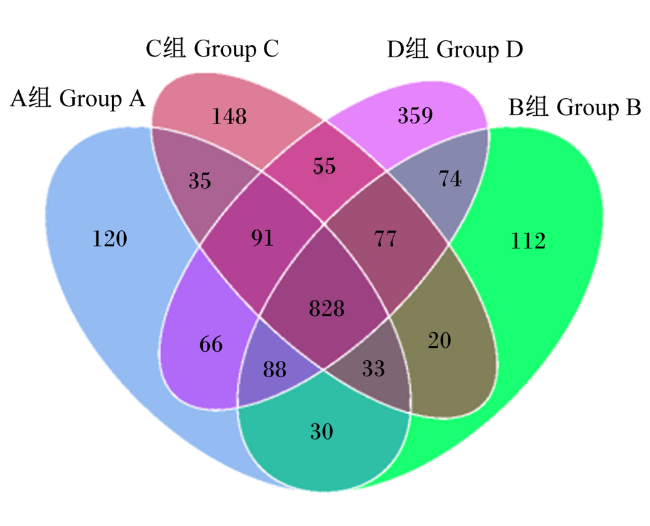
对所有样本的Effective Tags以97%的一致性聚类成为OTUs,然后对OTUs的序列进行物种注释。根据聚类分析得到OTUs的韦恩图,见图1。A组中OTUs有1 291个,特有OTUs为120个;B组中OTUs有1 261个,特有OTUs为112个;C组中OTUs有1 287个,特有OTUs为148个;D组中OTUs有1 639个,特有OTUs为359个。上述结果说明添加RECC改变了瘤胃细菌群落的OTUs组成。
图1 韦恩图

Fig.1 Venn graph

2.4.2 物种相对丰度分析

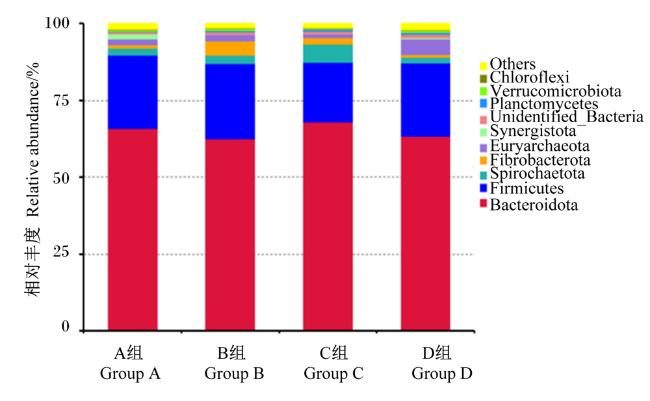
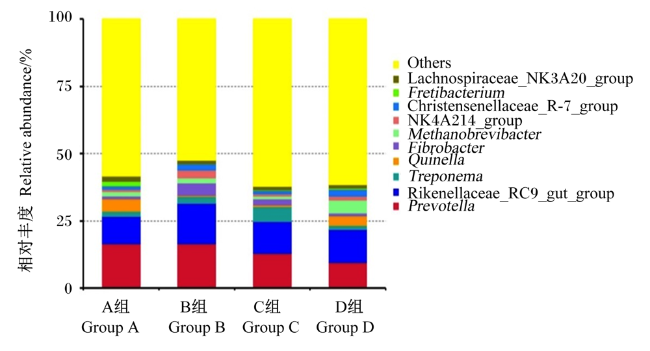
经比对分析,所有样本注释到2个界,20个门,40个纲,77个目,102个科,149个属,80个种。在门水平上,各组的优势菌门均为拟杆菌门和厚壁菌门,占所有菌门的87.04%~89.81%。排名前10位的菌门的相对丰度各组之间差异不显著(P>0.05,分析结果未列出);B组纤维杆菌门的相对丰度(4.59%)高于其余3组(A组为1.13%、C组为2.24%、D组为0.91%),C组螺旋菌门的相对丰度(5.90%)高于其余3组(A组为2.28%、B组为2.73%、D组为1.86%),D组广古菌门的相对丰度(5.08%)高于其余3组(A组为1.79%、B组为2.14%、C组为1.12%)(图2)。在属水平上,优势菌属主要包括普雷沃氏菌属、理研菌科RC9肠道群、密螺旋体属等。排名前10位的菌门相对丰度各组之间差异不显著(P>0.05,分析结果未列出);B组理研菌科RC9肠道群的相对丰度(14.98%)高于其余3组(A组为9.98%、C组为11.86%、D组为12.09%),C组密螺旋体属的相对丰度(5.54%)高于其余3组(A组为2.06%、B组为2.55%、D组为1.60%),D组普雷沃氏菌属的相对丰度(9.61%)低于其余3组(A组为16.55%、B组为16.53%、C组为12.78%)(图3)。
图2 不同组瘤胃细菌门水平上的相对丰度

Bacteroidota:拟杆菌门;Firmicutes:厚壁菌门;Spirochaetota:螺旋菌门;Fibrobacterota:纤维杆菌门;Euryarchaeota:广古菌门;Synergistota:互养菌门;Unidentified_Bacteria:未鉴定细菌门;Planctomycetes:浮霉菌门;Verrucomicrobiota:疣微菌门;Chloroflexi:绿弯菌门;Others:其他。

Fig.2 Relative abundances of rumen bacteria at phylum level in different groups

图3 不同组瘤胃细菌属水平上的相对丰度

Prevotella:普雷沃氏菌属;Rikenellaceae_RC9_gut_group:理研菌科RC9肠道群;Treponema:密螺旋体属;Quinella:奎因氏菌属;Fibrobacter:纤维杆菌属;Methanobrevibacter:甲烷短杆菌属;NK4A214_group:NK4A214群;Christensenellaceae_R-7_group:克里斯滕森菌科R-7群;Fretibacterium:依赖杆菌属;Lachnospiraceae_NK3A20_group:毛螺菌科NK3A20群;Others:其他。

Fig.3 Relative abundances of rumen bacteria at genus level in different groups

2.4.3 Alpha多样性分析

湖羊瘤胃细菌Alpha多样性分析结果见表5。与A组相比,B组、C组和D组的Observed_species指数、Shannon指数、Simpson指数、Chao1指数、ACE指数和PD whole tree指数均有变化,但是差异均不显著(P>0.05)。
表5 RECC对湖羊瘤胃细菌Alpha多样性的影响

Table 5 Effects of RECC on rumen bacterial Alpha diversity of Hu sheep

项目
Items
A组
Group A
B组
Group B
C组
Group C
D组
Group D
Observed_species指数
Observed_species index
987.00±39.00 968.00±44.00 944.50±77.50 1 098.33±17.55
Shannon指数 Shannon index 6.73±0.98 7.51±0.15 6.75±0.10 7.32±0.16
Simpson指数 Simpson index 0.94±0.68 0.98±0.00 0.95±0.00 0.98±0.01
Chao1指数 Chao1 index 1 141.99±23.99 1 014.86±8.97 1 015.52±76.52 1 170.81±23.49
ACE指数 ACE index 1 143.98±9.64 1 023.49±24.96 1 035.03±70.69 1 184.51±23.96
PD whole tree指数 PD whole tree index 69.03±0.52 66.43±2.93 65.79±4.36 74.51±1.37

2.4.4 Beta多样性分析

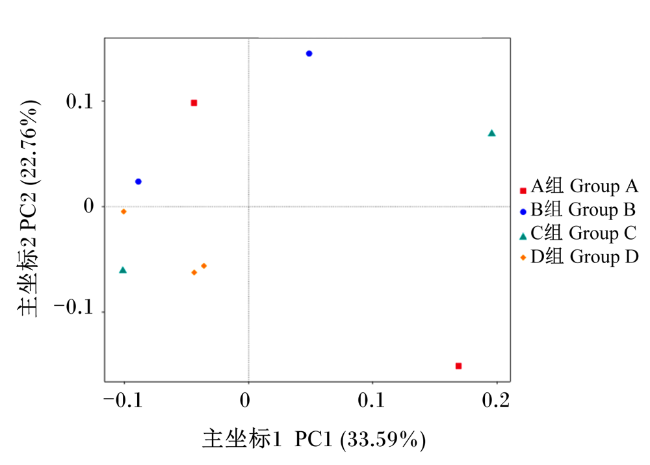
Beta多样性是对不同样本的细菌群落构成进行比较分析,可用主坐标分析(PCoA)来展示样本的Beta多样性分析结果。由图4可知,主坐标1(PC1)的贡献率为33.59%,主坐标2(PC2)的贡献率为22.7%,各组间相对分离,组内相对分离,表明饲粮中添加RECC对湖羊瘤胃细菌落群结构有一定的影响。
图4 瘤胃细菌的PCoA

Fig.4 PCoA of rumen bacteria

3 讨论

3.1 RECC对湖羊生长性能的影响

RECC作为一种新型绿色饲料添加剂,在羊生产上的研究还很少,但有关于稀土的添加效果已有报道。于静等[16]研究显示,在绵羊饲粮中添加稀土可以显著提高营养物质在小肠中的消化率。康晓冬等[17]研究发现,在滩羊饲粮中添加15 mg/kg硝酸稀土时,滩羊增重效果最好,日增重较对照组提高29.41%。王菊花等[14]研究发现,RECC可改善热应激对肉鸡日增重的影响,提高饲料利用率。李方方等[13]研究发现,饲粮中添加0.02%和0.03%的RECC均能改善断奶仔猪的生长性能。本试验结果表明,湖羊饲粮中添加RECC,B组的平均日增重有较大提高,B组、C组和D组的平均日采食量均有较大提高,说明添加RECC在一定程度上可以提高湖羊的食欲;B组的料重比最低,C组和D组的料重比不理想。综合成本等因素考虑,以B组即在基础饲粮的基础上添加250 mg/kg RECC时湖羊的生长效果最好。

3.2 RECC对湖羊血常规指标的影响

血常规检查是对动物外周血中红细胞、白细胞、血小板和血红蛋白等进行检测,对动物的基本健康状况予以判断。其中,白细胞在机体损伤治愈、抗御病原入侵和疾病免疫等方面起着重要的作用[18-19]。Renner等[20]发现,添加稀土元素会促进肉牛淋巴细胞和单核细胞的增殖。壳糖胺是一种新的巨噬细胞激活因子,通过影响碱性磷酸酶A2的活性,从而影响巨噬细胞参与的机体免疫反应,提高机体的免疫功能[21]。本研究结果与上述报道一致,各试验组和对照组的血常规指标均在正常参考范围之内,但是从试验结果中可以看出各试验组中绝大多数与白细胞相关的指标(白细胞、中性粒细胞、淋巴细胞、单核细胞、嗜酸性粒细胞、嗜碱性粒细胞计数或百分比)均有所升高,说明RECC对湖羊的免疫系统产生了积极的促进作用,提高了湖羊的免疫功能。

3.3 RECC对湖羊血清生化指标的影响

血清生化指标的高低可反映动物营养代谢和机体健康状况。血清中ALT和AST活性是反映肝实质细胞损伤为主的酶类;ALP和GGT是反映肝脏纤维化为主的酶类;TBIL和DBIL反可映肝脏分泌和排泄功能[22-24]。各组血清生化指标均处在正常范围内,说明添加RECC后湖羊的肝脏功能、脂肪代谢和水盐代谢均正常,湖羊的营养代谢处在正常状态[25]
血清中ALB和UREA含量是反映机体蛋白质代谢的重要指标[26]。本试验中,B组、C组和D组湖羊血清TP含量较A组增加,说明RECC对湖羊的蛋白质沉积和合成具有一定的促进作用。UREA是动物蛋白质的分解代谢产物,主要受肾脏功能及蛋白质摄入量以及分解代谢情况影响,血清中UREA含量能较准确地反映动物机体内蛋白质的代谢和利用情况,当机体对氨基酸和蛋白质的利用率提升时,血清中UREA含量就会相应下降[27-28]。万辉等[29]研究表明,蛋鸡饲粮中添加0.2%的RECC能显著提高粗蛋白质的表观代谢率;与对照组相比,小肠食糜中胰蛋白酶和淀粉酶的活性分别提高了36.01%和56.57%。李方方等[13]研究发现,断奶仔猪饲粮中添加0.02%和0.03%的RECC均能显著提高断奶仔猪干物质、粗蛋白质和粗脂肪的消化率,其中粗蛋白质的消化率分别比对照组提高8.81%和7.15%。RECC能够提高动物机体对蛋白质的利用率,得益于稀土元素和壳糖胺的共同作用。动物饲粮中补充稀土元素,其在胃肠道内积累,可以促进消化液分泌,影响肠道通透性,从而提高营养物质的吸收和消化[4]。Wada等[30]认为壳糖胺能够使小肠绒毛增加,小肠吸收面积增大,进而增强小肠对营养物质的吸收。目前,关于RECC对反刍动物血清中UREA含量的影响报道很少,本试验中B组、C组和D组湖羊血清中UREA含量均显著低于A组,且均处在正常范围内,表明适量添加RECC可能对蛋白质合成和氮沉积有促进作用,具体的作用机理有待进一步试验研究。

3.4 RECC对湖羊瘤胃细菌群落结构的影响

瘤胃菌群的多样性和相对丰度是影响瘤胃功能的关键性因素,很多文献中报道瘤胃中的优势菌门为厚壁菌门和拟杆菌门[31-32]。拟杆菌门是反刍动物利用碳水化合物和发酵有机物的最主要菌群,厚壁菌门含有丰富的代谢酶,是反刍动物利用和分解纤维素以及半纤维素的最主要菌群[33]。普雷沃氏菌属是公认的拟杆菌门数量最多的属,能够利用瘤胃中的很多底物[34]。普雷沃氏菌属是湖羊瘤胃中的优势菌属,其通过提高对饲料的消化能力,从而提高饲料效率和日增重[35]。理研菌科RC9肠道群与挥发性脂肪酸(VFA)、乙酸和丙酸的浓度呈负相关,与脂肪代谢密切相关,也是反刍动物瘤胃中非常重要的菌群[36]。本研究通过对湖羊瘤胃细菌进行测序分析发现,厚壁菌门、拟杆菌门、普雷沃氏菌属和理研菌科RC9肠道群是湖羊瘤胃中的优势菌群,这与上述文献所得结果一致。
稀土元素有类似激素的作用,低浓度下可以促进微生物生长,高浓度下则抑制微生物生长,浓度越高,抑菌效果越强[37-38]。稀土元素可能在胃肠道与细菌相互作用,最终调节营养物质的吸收、消化和利用[39-40]。研究表明,稀土元素可有效调节肉牛瘤胃微生物群,促进瘤胃纤维消化率和利用率,增加氮元素的沉积及微生物氮的流动,同时抑制脂肪沉积,最终提高肉牛增重[41-42]。壳糖胺对细菌、霉菌和酵母菌具有抗菌作用[43-44]。RECC具有稀土和壳糖胺两者的功能。RECC对胃肠道微生物的影响,在猪[13]和牛[15]上均有相关报道,在羊上尚未见相关报道。本试验发现,RECC的添加量会影响瘤胃细菌的种类和相对丰度。通过OTUs物种聚类分析发现,A组与B组、C组、D组有共同的OTUs,也有特有的OTUs,添加RECC改变了湖羊瘤胃细菌的OTUs组成。在门水平上,各组优势菌门均为拟杆菌门和厚壁菌门,但是排名前10的菌门的相对丰度各组之间均无显著差异,B组纤维杆菌门的相对丰度(4.59%)高于A组(1.13%)、C组(2.24%)和D组(0.91%)。纤维杆菌门只含有纤维杆菌属1个属,在哺乳动物胃肠道中能够分解木质纤维素[45]。在属水平上,优势菌属为普雷沃氏菌属、理研菌科RC9肠道群、密螺旋体属等,B组理研菌科RC9肠道群的相对丰度(14.98%)高于A组(9.98%)、C组(11.86%)和D组(12.09%)。本试验中B组的平均日采食量最高,料重比最低,与其瘤胃细菌的组成密切有关,但具体是否受到纤维杆菌属和理研菌科RC9肠道群的影响,需要进一步的试验验证。
Alpha多样性用于分析样本内的微生物群落多样性,从而反映样本内的微生物群落的丰富度和多样性。群落丰富度常用Chao1指数和ACE指数反映,群落多样性常用Shannon指数,Simpson指数和PD whole tree指数反映。本试验中B组的Shannon指数最高,说明其细菌群落多样性最高,物种分布最均匀;B组和D组的Simpson指数较高,说明其细菌群落内物种分布的多样性和均匀度较高;D组的Chao1指数和ACE指数高于A组、B组和C组,说明D组的细菌群落丰富度最高。上述结果说明RECC对湖羊瘤胃细菌群落的丰富度和多样性有一定影响。Beta多样性是分析不同样本(组)间微生物群落的差异,PCoA发现各组间相对分离,组内相对分离;D组的聚合性较高,群落结构相似性较高,B组、C组和D组3组间聚合性相对较高,说明添加RECC对瘤胃细菌群落结构有一定影响。

4 结论

在断奶湖羊饲粮中添加RECC对湖羊的生长性能、血液生理生化指标和瘤胃细菌群落结构均有一定影响。综合断奶湖羊的生长性能、血液生理生化指标和瘤胃细菌群落结构测定结果,本试验条件下,饲粮中RECC的添加量为250 mg/kg时效果最佳。
[1]
谢祎, 金晓, 徐元庆, 等. 稀土壳糖胺螯合盐的生物学功能及其在动物生产中应用的研究进展[J]. 饲料研究, 2021, 44(19):146-149.

XIE W, JIN X, XU Y Q, et al. Biological function of rare earth-chitosan chelate and the research progress on its application in animal production[J]. Feed Research, 2021, 44(19):146-149. (in Chinese)

[2]
周芳芳, 俞文靓, 林波. 稀土元素在动物营养及生产中应用研究进展[J]. 饲料研究, 2020, 43(2):94-97.

ZHOU F F, YU W L, LIN B. Research progress on application of rare earth elements in animal nutrition and production[J]. Feed Research, 2020, 43(2):94-97. (in Chinese)

[3]
ABDELNOUR S A, ABD EL-HACK M E, KHAFAGA A F, et al. Impacts of rare earth elements on animal health and production:highlights of cerium and lanthanum[J]. Science of the Total Environment, 2019, 672:1021-1032.

[4]
TARIQ H, SHARMA A, SARKAR S, et al. Perspectives for rare earth elements as feed additive in livestock—a review[J]. Asian-Australasian Journal of Animal Sciences, 2020, 33(3):373-381.

[5]
YUAN X B, ZHENG J P, JIAO S M, et al. A review on the preparation of chitosan oligosaccharides and application to human health,animal husbandry and agricultural production[J]. Carbohydrate Polymers, 2019, 220:60-70.

[6]
MA Z X, GARRIDO-MAESTU A, JEONG K C. Application, mode of action, and in vivo activity of chitosan and its micro- and nanoparticles as antimicrobial agents:a review[J]. Carbohydrate Polymers, 2017, 176:257-265.

[7]
PEREIRA T L, FERNANDES A R M, OLIVEIRA E R, et al. Serum metabolomic fingerprints of lambs fed chitosan and its association with performance and meat quality traits[J]. Animal, 2020, 14(9):1987-1998.

DOI PMID

[8]
YU T, WANG Y, CHEN S C, et al. Low-molecular-weight chitosan supplementation increases the population of Prevotella in the cecal contents of weanling pigs[J]. Frontiers in Microbiology, 2017, 8:2182.

[9]
AHMAD M, MANZOOR K, IKRAM S. Versatile nature of hetero-chitosan based derivatives as biodegradable adsorbent for heavy metal ions:a review[J]. International Journal of Biological Macromolecules, 2017, 105(Pt 1):190-203.

[10]
谢祎, 金晓, 徐元庆, 等. 稀土壳糖胺螯合盐的生物学功能及其在动物生产中应用的研究进展[J]. 饲料研究, 2021, 44(19):146-149.

XIE Y, JIN X, XU Y Q, et al. Biological function of rare earth-chitosan chelate and the research progress on its application in animal production[J]. Feed Research, 2021, 44(19):146-149. (in Chinese)

[11]
李晓丽, 李方方, 朱宇旌, 等. 壳糖胺微量元素螯合盐的生物学功能及其在动物生产中的应用[J]. 饲料工业, 2015, 36(S2):17-20.

LI X L, LI F F, ZHU Y J, et al. Functions of chitosan-metal complexes and its applications in animal production[J]. Feed Industry, 2015, 36(S2):17-20. (in Chinese)

[12]
LU X X, CHANG X Y, ZHANG H J, et al. Effects of dietary rare earth chitosan chelate on performance,egg quality,immune and antioxidant capacity,and intestinal digestive enzyme activity of laying hens[J]. Polymers, 2023, 15(7):1600.

[13]
李方方, 周晶, 朱宇旌, 等. 稀土壳糖胺螯合盐对断奶仔猪生长性能、血清生化指标、营养物质消化率及粪中微生物菌群的影响[J]. 动物营养学报, 2016, 28(2):498-506.

DOI

LI F F, ZHOU J, ZHU Y J, et al. Effects of rare earth-chitosan chelate on growth performance,serum biochemical indices,nutrient digestibility and fecal microbial flora of weaned piglets[J]. Chinese Journal of Animal Nutrition, 2016, 28(2):498-506. (in Chinese)

[14]
王菊花, 刘琦, 董静, 等. 稀土壳糖胺螯合盐对热应激肉鸡生长性能和肉品质的影响[J]. 中国农业大学学报, 2019, 24(7):104-111.

WANG J H, LIU Q, DONG J, et al. Effects of rare earth-chitosan chelate on the growth performance and meat quality of yellow-feathered broilers under heat stress[J]. Journal of China Agricultural University, 2019, 24(7):104-111. (in Chinese)

[15]
李浩, 吴宇航, 张洁, 等. 稀土壳糖胺螯合盐对水牛犊牛生长性能、养分表观消化率和瘤胃细菌菌群结构的影响[J]. 动物营养学报, 2023, 35(5):3119-3129.

DOI

LI H, WU Y H, ZHANG J, et al. Effects of rare earth-chitosan chelate on growth performance,nutrient apparent digestibility and rumen bacterial flora structure of buffalo calves[J]. Chinese Journal of Animal Nutrition, 2023, 35(5):3119-3129. (in Chinese)

[16]
于静, 雒秋江, 古丽尼沙, 等. 添喂稀土对绵羊消化代谢的影响[J]. 新疆农业大学学报, 2010, 33(4):281-288.

YU J, LUO Q J, GULINISHA, et al. The effect of supplement of rare earth on the digestion and metabolism of sheep[J]. Journal of Xinjiang Agricultural University, 2010, 33(4):281-288. (in Chinese)

[17]
康晓冬, 王川, 马青, 等. 稀土添加剂饲喂滩羊的试验[J]. 饲料研究, 2011(2):63-64,67.

KANG X D, WANG C, MA Q, et al. Experiment on feeding rare earth additive to Tan sheep[J]. Feed Research, 2011(2):63-64,67. (in Chinese)

[18]
赵正伟, 陈茂良, 张连全, 等. 有氧运动对滩羊生产性能、血常规、血液生化指标及免疫和抗氧化性能的影响[J]. 黑龙江畜牧兽医, 2023(12):38-44.

ZHAO Z W, CHEN M L, ZHANG L Q, et al. Effects of aerobic exercise on production performance,blood routine,blood biochemical indexes,immune and antioxidant properties of Tan sheep[J]. Heilongjiang Animal Science and Veterinary Medicine, 2023(12):38-44. (in Chinese)

[19]
滑静. 动物生理学[M]. 2版. 北京: 化学工业出版社, 2016:31-33.

HUA J. Animal physiology[M]. 2nd ed. Beijing: Chemical Industry Press, 2016:31-33. (in Chinese)

[20]
RENNER L, SCHWABE A, DÖLL S, et al. Effect of rare earth elements on beef cattle growth performance,blood clinical chemical parameters and mitogen stimulated proliferation of bovine peripheral blood mononuclear cells in vitro and ex vivo[J]. Toxicology Letters, 2011, 201(3):277-284.

[21]
BIANCO I D, BALSINDE J, BELTRAMO D M, et al. Chitosan-induced phospholipase A2 activation and arachidonic acid mobilization in P388D1 macrophages[J]. FEBS Letters, 2000, 466(2/3):292-294.

[22]
ZHANG K K, HAN M M, DONG Y Y, et al. Low levels of organic compound trace elements improve the eggshell quality,antioxidant capacity,immune function,and mineral deposition of aged laying hens[J]. Animal, 2021, 15(12):100401.

[23]
周根来, 陶勇, 殷洁鑫, 等. 大麦虫粉对育肥猪生长性能、血清生化指标和激素水平的影响[J]. 动物营养学报, 2023, 35(7):4247-4255.

DOI

ZHOU G L, TAO Y, YIN J X, et al. Effects of Zophobas morio meal on growth performance,serum biochemical indices and hormone levels of finishing pigs[J]. Chinese Journal of Animal Nutrition, 2023, 35(7):4247-4255. (in Chinese)

[24]
王华, 周华林, 陈洪博, 等. 微贮笋壳对湖羊生长性能、肉品质及血液生理生化指标的影响[J]. 中国畜牧杂志, 2021, 57(1):153-157.

WANG H, ZHOU H L, CHEN H B, et al. Effects of microbial stored bamboo shoot shell on growth performance,meat quality and blood physiological and biochemical indexes of Hu sheep[J]. Chinese Journal of Animal Science, 2021, 57(1):153-157. (in Chinese)

[25]
杜新瑜, 刘梅, 李建涛, 等. 沙棘黄酮对肉兔生长性能、屠宰性能、血清生化指标、抗氧化能力和免疫功能的影响[J]. 动物营养学报, 2023, 35(6):3910-3920.

DOI

DU X Y, LIU M, LI J T, et al. Effects of seabuckthorn flavonoids on growth performance,slaughtering performance,serum biochemical indexes,antioxidant capacity and immune function of meat rabbits[J]. Chinese Journal of Animal Nutrition, 2023, 35(6):3910-3920. (in Chinese)

[26]
赵耀光, 娄渊志. 香椿提取物对肉兔生长性能、肉品质和血清生化指标的影响[J]. 中国饲料, 2023(6):61-64.

ZHAO Y G, LOU Y Z. Effects of Toona sinensis extract on growth performance,meat quality and serum biochemical indexes of meat rabbit[J]. China Feed, 2023(6):61-64. (in Chinese)

[27]
BEATSON P R, MEIER S, CULLEN N G, et al. Genetic variation in milk urea nitrogen concentration of dairy cattle and its implications for reducing urinary nitrogen excretion[J]. Animal, 2019, 13(10):2164-2171.

DOI PMID

[28]
郭荣, 呼格吉乐图, 毕力格吐, 等. 舍饲和放牧模式对阿尔巴斯绒山羊血清生化指标的影响及其与绒毛品质相关性的分析[J]. 黑龙江畜牧兽医, 2021(9):6-10.

GUO R, HUGEJILETU, BILIGETU, et al. Effect of yard-feeding and grazing mode on serum biochemical indexes of Arbas cashmere goats and their correlation with villus quality[J]. Heilongjiang Animal Science and Veterinary Medicine, 2021(9):6-10. (in Chinese)

[29]
万辉, 赵胜军, 任莹, 等. 稀土壳糖胺螯合盐对蛋鸡代谢率和肠道消化酶活性的影响[J]. 中国粮油学报, 2008, 23(6):177-180.

WAN H, ZHAO S J, REN Y, et al. Effects of rare earth-chitosan chelate on nutrient utilization and digestive enzyme activity in small intestine for laying hens[J]. Journal of the Chinese Cereals and Oils Association, 2008, 23(6):177-180. (in Chinese)

[30]
WADA M, NISHIMURA Y, WATANABE Y, et al. Accelerating effect of chitosan intake on urinary calcium excretion by rats[J]. Bioscience,Biotechnology,and Biochemistry, 1997, 61(7):1206-1208.

[31]
XIE F, JIN W, SI H Z, et al. An integrated gene catalog and over 10,000 metagenome-assembled genomes from the gastrointestinal microbiome of ruminants[J]. Microbiome, 2021, 9(1):137.

DOI PMID

[32]
WANG Z, YU Y N, LI X Y, et al. Fermented soybean meal replacement in the diet of lactating Holstein dairy cows:modulated rumen fermentation and ruminal microflora[J]. Frontiers in Microbiology, 2021, 12:625857.

[33]
CALLAWAY T R, DOWD S E, EDRINGTON T S, et al. Evaluation of bacterial diversity in the rumen and feces of cattle fed different levels of dried distillers grains plus solubles using bacterial tag-encoded FLX amplicon pyrosequencing[J]. Journal of Animal Science, 2010, 88(12):3977-3983.

DOI PMID

[34]
CHEN H, WANG C J, HUASAI S, et al. Effects of dietary forage to concentrate ratio on nutrient digestibility,ruminal fermentation and rumen bacterial composition in Angus cows[J]. Scientific Reports, 2021, 11(1):17023.

[35]
CHENG J B, ZHANG X X, XU D, et al. Relationship between rumen microbial differences and traits among Hu sheep,Tan sheep,and Dorper sheep[J]. Journal of Animal Science, 2022, 100(9):skac261.

[36]
FAN Q S, WANAPAT M, HOU F J. Chemical composition of milk and rumen microbiome diversity of yak,impacting by herbage grown at different phenological periods on the Qinghai-Tibet Plateau[J]. Animals, 2020, 10(6):1030.

[37]
刘志龙, 蒋昊, 李美, 等. 稀土在抗菌材料应用中的研究进展[J]. 有色金属工程, 2022, 12(4):20-30.

LIU Z L, JIANG H, LI M, et al. Research progress of rare earth in antibacterial materials[J]. Nonferrous Metals Engineering, 2022, 12(4):20-30. (in Chinese)

[38]
杨军, 张赫, 王甲辰, 等. 稀土抑菌作用研究[J]. 稀土, 2009, 30(1):35-39.

YANG J, ZHANG H, WANG J C, et al. Inhibition of rare earth on bacteria and fungi[J]. Chinese Rare Earths, 2009, 30(1):35-39. (in Chinese)

[39]
HE M L, WANG Y Z, XU Z R, et al. Effect of dietary rare earth elements on growth performance and blood parameters of rats[J]. Journal of Animal Physiology and Animal Nutrition, 2003, 87(5/6):229-235.

[40]
KRAATZ M, TARAS D, MÄNNER K, et al. Weaning pig performance and faecal microbiota with and without in-feed addition of rare earth elements[J]. Journal of Animal Physiology and Animal Nutrition, 2006, 90(9/10):361-368.

[41]
XU L J, WEN L H, GE Y, et al. Metagenomic insights into the effects of rare-earth elements supplementation on rumen digestibility and meat quality of beef cattle[J]. Frontiers in Microbiology, 2020, 11:1933.

DOI PMID

[42]
LIN S X, WEI C, ZHAO G Y, et al. Effects of supplementing rare earth element cerium on rumen fermentation,nutrient digestibility,nitrogen balance and plasma biochemical parameters in beef cattle[J]. Journal of Animal Physiology and Animal Nutrition, 2015, 99(6):1047-1055.

[43]
BELANCHE A, PINLOCHE E, PRESKETT D, et al. Effects and mode of action of chitosan and ivy fruit saponins on the microbiome,fermentation and methanogenesis in the rumen simulation technique[J]. FEMS Microbiology Ecology, 2016, 92(1):fiv160.

[44]
SIMUNEK J, BRANDYSOVÁ V, KOPPOVÁ I, et al. The antimicrobial action of chitosan,low molar mass chitosan,and chitooligosaccharides on human colonic bacteria[J]. Folia Microbiologica, 2012, 57(4):341-345.

[45]
WANG Z, ZHAO Y, LAN X Y, et al. Tannic acid supplementation in the diet of Holstein bulls:impacts on production performance,physiological and immunological characteristics,and ruminal microbiota[J]. Frontiers in Nutrition, 2022, 9:1066074.

文章导航

/