研究论文

饲养密度对断奶羔羊生长性能及血清激素、生化和抗氧化指标的影响

  • 左权 , 1, 2, 3 ,
  • 吴启超 3, 4 ,
  • 杨开伦 1 ,
  • 杨红建 2 ,
  • 邓先德 , 3, 4, *
展开
  • 1 新疆农业大学动物科学学院,乌鲁木齐 830052
  • 2 中国农业大学动物科学技术学院,北京 100193
  • 3 农业农村部规划设计研究院,北京 100125
  • 4 农业农村部农业设施结构设计与智能建造重点实验室,北京 100125
*邓先德,研究员,E-mail:

左权(1997—),男,河北保定人,硕士研究生,动物营养与饲料科学专业。E-mail:

Copy editor: 菅景颖

收稿日期: 2024-01-18

  网络出版日期: 2024-07-09

基金资助

农业农村部规划设计研究院“双化”项目羊舍智能逆向通风系统研发与推广应用(SH202103)

设施养殖工艺与装备科技创新团队项目(CHXTY-2021-07)

内蒙古重点研发与成果转化计划(2023YFDZ0082)

Effects of Stocking Density on Growth Performance and Serum Hormonal, Biochemical and Antioxidant Indicators of Weaned Lambs

  • ZUO Quan , 1, 2, 3 ,
  • WU Qichao 3, 4 ,
  • YANG Kailun 1 ,
  • YANG Hongjian 2 ,
  • DENG Xiande , 3, 4, *
Expand
  • 1 College of Animal Science, Xinjiang Agricultural University, Urumqi 830052, China
  • 2 College of Animal Science and Technology, China Agricultural University, Beijing 100193, China
  • 3 Academy of Agricultural Planning and Engineering, Ministry of Agriculture and Rural Affairs, Beijing 100125, China
  • 4 Key Laboratory for Agricultural Facility Structure Design and Intelligent Construction of the Ministry of Agriculture and Rural Affairs, Beijing 100125, China

Received date: 2024-01-18

  Online published: 2024-07-09

摘要

本试验旨在研究饲养密度对2~4月龄断奶羔羊生长性能及血清激素、生化和抗氧化指标的影响。选取2月龄、平均体重为(14.86±1.24) kg的健康澳洲白公羔72只,随机分为3组,分别命名为试验Ⅰ组、试验Ⅱ组和试验Ⅲ组,每组3个重复,每个重复8只羊。试验Ⅰ组、试验Ⅱ组和试验Ⅲ组的饲养密度分别为0.875、0.625和0.375 m2/只。试验期60 d。结果表明:1)随着饲养密度的增大,各组羔羊终末体重(FW)、平均日采食量(ADFI)、平均日增重(ADG)和料重比(F/G)均没有显著差异(P>0.05),但试验Ⅲ组、试验Ⅱ组的F/G较试验Ⅰ组有降低的趋势(P=0.091)。2)试验第40天,试验Ⅲ组羔羊血清中甲状腺素(T4)浓度显著高于试验Ⅱ组、试验Ⅰ组(P<0.05);试验Ⅲ组羔羊血清中三碘甲状腺原氨酸(T3)浓度显著高于试验Ⅰ组(P<0.05)。试验第60天,试验Ⅲ组羔羊血清中T3浓度显著高于试验Ⅱ组、试验Ⅰ组(P<0.05);试验Ⅲ组、试验Ⅱ组羔羊血清中生长激素(GH)和胰岛素样生长因子-Ⅰ(IGF-Ⅰ)浓度均显著低于试验Ⅰ组(P<0.05)。3)试验第40天,试验Ⅲ组羔羊血清中球蛋白(GLB)、葡萄糖(GLU)、甘油三酯(TG)、总胆固醇(TC)、高密度脂蛋白(HDL)、低密度脂蛋白(LDL)浓度均显著高于试验Ⅱ组、试验Ⅰ组(P<0.05);试验Ⅲ组羔羊血清中总蛋白(TP)浓度较试验Ⅱ组、试验Ⅰ组有升高的趋势(P=0.086)。试验第60天,试验Ⅲ组羔羊血清中GLB浓度显著高于试验Ⅰ组(P<0.05);试验Ⅲ组羔羊血清中TC、HDL和LDL浓度均显著高于试验Ⅱ组、试验Ⅰ组(P<0.05)。4)试验第40天,各组羔羊血清中抗氧化指标没有显著差异(P>0.05)。试验第60天,试验Ⅲ组羔羊血清中总抗氧化能力(T-AOC)与过氧化氢酶(CAT)、谷胱甘肽过氧化物酶(GSH-Px)、超氧化物歧化酶(SOD)活性均显著低于试验Ⅱ组、试验Ⅰ组(P<0.05),血清中丙二醛(MDA)含量显著高于试验Ⅱ组、试验Ⅰ组(P<0.05)。由此可见,试验Ⅲ组羔羊有应激反应发生。从经济效益和动物福利的角度考虑,建议2~4月龄断奶羔羊的饲养密度为0.625 m2/只,羊舍栏位宽度可以设置成2 m。

本文引用格式

左权 , 吴启超 , 杨开伦 , 杨红建 , 邓先德 . 饲养密度对断奶羔羊生长性能及血清激素、生化和抗氧化指标的影响[J]. 动物营养学报, 2024 , 36(7) : 4544 -4553 . DOI: 10.12418/CJAN2024.390

Abstract

This study aimed to examine the effects of stocking density on the growth performance and serum hormonal, biochemical and antioxidant indicators of weaned lambs aged 2 to 4 months. A total of 72 healthy Australian white male lambs with an average weight of (14.86±1.24) kg were randomly divided into three groups, namely, experimental groups Ⅰ, Ⅱ and Ⅲ, with each group having three replicates and eight sheep in each replicate. The stocking densities in experimental groups Ⅰ, Ⅱ and Ⅲ were 0.875, 0.625 and 0.375 m2/lamb, respectively. The experimental period lasted for 60 days. The results showed as follows: 1) there were no significant differences in final body weight (FW), average daily feed intake (ADFI), average daily gain (ADG) and feed/gain (F/G) of lamb among the groups (P>0.05). However, the F/G of lamb in the experimental group Ⅲ and the experimental group Ⅱ showed a decreasing trend compared with the experimental group Ⅰ (P=0.091). 2) On the 40th day of the experiment, the concentration of thyroxine (T4) in serum of lambs in the experimental group Ⅲ was significantly higher than that in the experimental group Ⅱ the and experimental group Ⅰ (P<0.05); additionally, the concentration of triiodothyronine (T3) in serum of lamb in the experimental group Ⅲ was significantly higher than that in the experimental group Ⅰ (P<0.05). On the 60th day of the experiment, the concentration of T3 in serum of lamb in the experimental group Ⅲ was significantly higher than that in the experimental group Ⅱ and the experimental group Ⅰ (P<0.05); furthermore, the serum growth hormone (GH) and insulin-like growth factor-Ⅰ (IGF-Ⅰ) concentrations of lamb in the experimental group Ⅲ and the experimental group Ⅱ were significantly lower than those in the experimental group Ⅰ (P<0.05). 3) On the 40th day of the experiment, the serum globulin (GLB), glucose (GLU), triglyceride (TG), total cholesterol (TC), high density lipoprotein (HDL) and low density lipoprotein (LDL) concentrations of lambs in the experimental group Ⅲ were significantly higher than those in the experiment group Ⅱ and the experimental group Ⅰ (P<0.05); moreover, there was an increasing trend in the concentration of total protein (TP) in serum of lamb in the experimental group Ⅲ compared with that in the experimental group Ⅱ and the experimental group Ⅰ (P=0.086). On the 60th day of the experiment, the concentration of serum GLB of lamb in the experimental group Ⅲ was significantly higher than that in the experimental group Ⅰ (P<0.05); furthermore, the concentrations of TC, HDL and LDL in serum of lambs in the experimental group III were significantly higher than those in the experimental group Ⅱ and the experimental group Ⅰ (P<0.05). On the 40th day of the experiment, there was no significant change in serum antioxidant indicators of lamb among the groups (P>0.05). However, on the 60th day of the experiment, the total antioxidant capacity (T-AOC) and the activities of catalase (CAT), glutathione peroxidase (GSH-Px) and superoxide dismutase (SOD) in serum of lamb in the experimental group Ⅲ were significantly lower than those in the experimental group Ⅱ and the experimental group Ⅰ (P<0.05), while the serum malondialdehyde (MDA) content was significantly higher than that of the experimental group Ⅱ and the experimental group Ⅰ (P<0.05). Based on the results, the lambs in the experimental group Ⅲ exhibit a stress reaction. Therefore, from the standpoint of animal welfare and economic benefits, it is recommended to provide 0.625 m2 per lamb for stocking density of 2- to 4-month-old weaned lambs, and the width of the sheep pens should be set to 2 meters.

畜禽集约化养殖是现代化畜牧业发展的必然趋势,而饲养密度是集约化饲养重点关注的问题之一。为节约生产成本,提高饲养密度的情况屡见不鲜,这容易导致动物在拥挤环境中自然行为无法正常表达以及舍内环境条件恶化,从而影响动物的健康和生产性能[1]。国家标准《规模猪场建设》推荐的育肥猪饲养密度为0.8~ 1.2 m 2 / [ 4 ]。Cho等[2]研究报道,随着饲养密度由1.0 m2/头增大到0.6 m2/头,育肥猪的争斗行为(咬伤)显著增加,平均日增重、饲料转化效率以及干物质、粗蛋白质和总能消化率显著降低。Jang等[3]研究发现,随着饲养密度(0.96、0.80、0.69 m2/头)增大,生长育肥猪的肉品质降低(背最长肌pH呈线性降低,剪切力呈线性升高),免疫力降低(血清免疫球蛋白G浓度呈线性降低)。
饲养密度是影响绵羊福利和生产力的重要因素,母羊对饲养密度更加敏感[5]。Sevi等[6]研究发现,当饲养密度从2.0 m2/只增大到1.5和1.0 m2/只时,泌乳母羊亚临床乳腺炎患病率增加。Caroprese等[7]研究表明,随着饲养密度由3.0 m2/只增大到1.5 m2/只,泌乳母羊免疫力和产奶量显著降低,羊奶品质下降(pH和体细胞计数显著升高)。Yusof等[8]报道,饲养密度(2.50、1.27 m2/只)对妊娠母羊的行为和下丘脑-垂体-肾上腺轴反应没有持续的影响,但与产多胎的母羊相比,初产母羊的适应能力更差。目前国内外关于断奶羔羊饲养密度的研究较少,因此本试验拟对不同饲养密度对断奶羔羊生长性能及血清激素、生化和抗氧化指标的影响进行研究,以期为提高断奶羔羊生长性能、合理利用土地资源以及羔羊羊舍的规划设计提供技术参考。

1 材料与方法

1.1 试验设计与饲养管理

选取2月龄、平均体重为(14.86±1.24) kg的健康澳洲白公羔72只,采用单因素完全随机区组设计,随机分为3组,分别命名为试验Ⅰ组、试验Ⅱ组和试验Ⅲ组,每组3个重复,每个重复8只羊。试验Ⅰ组、试验Ⅱ组和试验Ⅲ组的饲养密度分别为0.875、0.625和0.375 m2/只。根据NY/T 816—2021《肉羊营养需要量》中断奶羔羊的营养需求配制全混合日粮(TMR),其组成及营养水平见表1。饲料原料包括玉米秸秆、玉米和浓缩料,由当地饲料市场购买。每天08:00和17:00饲喂断奶羔羊,自由饮水和舔食盐砖。试验持续60 d。
表1 TMR组成及营养水平(风干基础)

Table 1 Composition and nutrient levels of the TMR (air-dry basis)%

项目 Items 含量 Content
原料 Ingredients
玉米秸秆 Corn stalk 40.00
玉米 Corn 42.00
浓缩料 Concentrate1) 18.00
合计 Total 100.00
营养水平 Nutrient levels2)
干物质 DM 89.90
粗蛋白质 CP 12.23
粗脂肪 EE 1.92
粗灰分 Ash 5.38
中性洗涤纤维 NDF 42.10
酸性洗涤纤维ADF 19.69
钙 Ca 0.74
磷 P 0.32
代谢能ME/(MJ/kg) 8.66

1) 每千克浓缩料含有Each kilogram of concentrate contained the following:粗蛋白质 crude protein 360 g,粗纤维 crude fiber 120 g,钙 calcium 30 g,总磷 total phosphorus 5 g,粗灰分 ash 180 g,氯化钠 NaCl 50 g,赖氨酸 lysine 13 g。

2) 代谢能为依据NY/T 816—2021所得计算值,其余营养水平均为实测值。ME was a calculated value according to NY/T 816—2021, while the other nutrient levels were measured values.

1.2 试验时间、地点和羔羊舍介绍

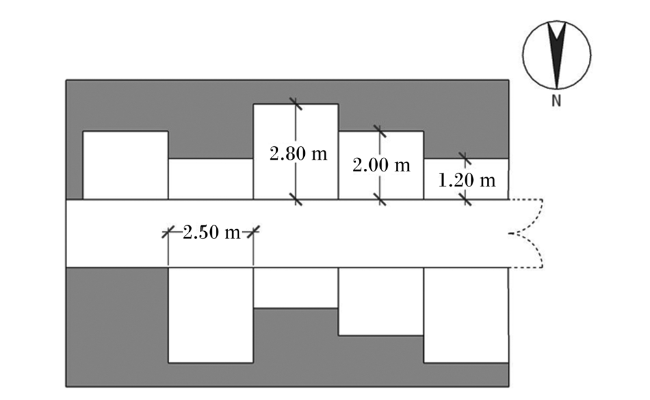
试验开始前对内蒙古巴林左旗1栋长13 m、宽8 m的羊舍进行改造,该羊舍为双列式,饲喂通道宽2 m,羊床地面为漏缝地板。将每个圈栏的饲槽长度设置为2.5 m(含1个25 cm的水槽),另一条边分别设置为1.20、2.00和2.80 m,见图1。试验于2023年8月1日至2023年9月29日进行,该地区8和9月份平均高温分别为28和26 ℃。
图1 试验羊舍圈栏布置平面图

Fig.1 Layout plan of experimental sheep house fence

1.3 样品采集和指标测定

1.3.1 饲粮营养成分测定

分别参照GB/T 6435—2014、GB/T 6432—2018、GB/T 6433—2006、GB/T 6438—2007、GB/T 6436—2018、GB/T 3437—2018、GB/T 20806—2022、NY/T 1459—2022测定饲粮中干物质(DM)、粗蛋白质(CP)、粗脂肪(EE)、粗灰分(Ash)、钙(Ca)、磷(P)、中性洗涤纤维(NDF)和酸性洗涤纤维(ADF)含量。

1.3.2 生长性能

每天饲喂前记录各组投料量和剩料量,分别于试验第1和60天08:00以重复为单位称量并记录羔羊重量,称重前禁食12 h。根据原始数据计算出每组羔羊的平均日增重(ADG)、平均日采食量(ADFI)及料重比(F/G)。

1.3.3 血清激素、生化和抗氧化指标

试验第40和60天称取羔羊重量前采集血液样本。从每个重复选取体重接近均重的羔羊2只,使用含有肝素钠的负压采血管从羊颈静脉采集血液10 mL,完毕后立即离心10 min(1 095×g),取上清液分装到1.5 mL离心管中。处理后的样本临时保存在-20 ℃环境中,用于后续血清指标的测定。根据酶联免疫吸附检测试剂盒(上海酶联生物科技有限公司)说明书,使用RT-6500型酶标记仪测定血清中促肾上腺皮质激素(ACTH)、皮质醇(COR)、肾上腺素(EPI)、去甲肾上腺素(NE)、甲状腺素(T4)、三碘甲状腺原氨酸(T3)、生长激素(GH)、胰岛素样生长因子-Ⅰ(IGF-Ⅰ)、总蛋白(TP)、白蛋白(ALB)、球蛋白(GLB)、葡萄糖(GLU)、尿素(UREA)、甘油三酯(TG)、总胆固醇(TC)、高密度脂蛋白(HDL)、低密度脂蛋白(LDL)浓度以及总抗氧化能力(T-AOC)与过氧化氢酶(CAT)、谷胱甘肽过氧化物酶(GSH-Px)、超氧化物歧化酶(SOD)活性和丙二醛(MDA)含量。

1.4 数据整理与分析

试验数据采用SPSS 20.0软件进行单因素方差分析(one-way ANOVA),达到显著水平时,再采用Duncan氏法进行组间多重比较,以P<0.05作为检验各项数据显著性的标准。数据以“平均值±标准误”的形式表示。

2 结果与分析

2.1 饲养密度对断奶羔羊生长性能的影响

表2可知,3组的羔羊初始体重差异不显著(P>0.05),符合随机分组的原则。从羔羊的平均日增重来看,试验Ⅲ组、试验Ⅱ组分别较试验Ⅰ组增加20.9%和13.3%,但组间差异不显著(P>0.05);从羔羊的平均日采食量来看,试验Ⅰ组略高于其他2组,但组间差异不显著(P>0.05);从羔羊的料重比来看,试验Ⅲ组、试验Ⅱ组分别较试验Ⅰ组降低17.6%和11.6%(P=0.091)。由此可以看出,随着饲养密度的增大,断奶羔羊生长性能有增加的趋势。
表2 饲养密度对断奶羔羊生长性能的影响

Table 2 Effects of stocking density on growth performance of weaned lambs

项目
Items
试验Ⅰ组
Experimental group Ⅰ
试验Ⅱ组
Experimental group Ⅱ
试验Ⅲ组
Experimental group Ⅲ
P
P-value
初始体重 IW/kg 15.04±1.61 15.53±0.87 14.46±1.21 0.376
终末体重 FW/kg 23.07±1.88 24.63±2.69 24.17±1.51 0.448
平均日采食量 ADFI/g 876.59±52.62 862.50±14.79 867.71±30.21 0.825
平均日增重 ADG/g 133.83±17.10 151.67±30.47 161.85±22.58 0.129
料重比 F/G 6.63±0.81 5.86±1.16 5.46±0.80 0.091

同行数据肩标无字母或相同字母表示差异不显著(P>0.05),不同小写字母表示差异显著(P<0.05)。下表同。

In the same row, values with no letter or the same letter superscripts mean no significant difference (P>0.05), while with different small letter superscripts mean significant difference (P<0.05). The same as below.

2.2 饲养密度对羔羊血清激素指标的影响

表3可知,试验第40天,试验Ⅲ组羔羊血清中T3浓度显著高于试验Ⅰ组(P<0.05);试验Ⅲ组羔羊血清中T4浓度显著高于试验Ⅱ组、试验Ⅰ组(P<0.05);3组羔羊血清其他激素浓度差异不显著(P>0.05)。试验第60天,试验Ⅲ组羔羊血清中EPI浓度显著低于试验Ⅰ组(P<0.05);试验Ⅱ组羔羊血清中NE浓度显著低于试验Ⅰ组(P<0.05);试验Ⅲ组羔羊血清中T3浓度显著高于试验Ⅱ组、试验Ⅰ组(P<0.05);试验Ⅲ组、试验Ⅱ组羔羊血清中GH和IGF-Ⅰ浓度均显著低于试验Ⅰ组(P<0.05)。
表3 饲养密度对断奶羔羊血清激素指标的影响

Table 3 Effects of stocking density on serum hormonal indicators of weaned lambs

项目
Items
试验Ⅰ组
Experimental
group Ⅰ
试验Ⅱ组
Experimental
group Ⅱ
试验Ⅲ组
Experimental
group Ⅲ
P
P-value
第40天 Day 40
促肾上腺皮质激素 ACTH/(pg/mL) 45.58±2.83 47.94±6.71 53.43±6.72 0.193
皮质醇 COR/(ng/mL) 15.15±1.45 16.33±2.02 17.67±1.62 0.169
肾上腺素 EPI/(ng/mL) 2.95±0.16 2.99±0.11 3.20±0.24 0.154
去甲肾上腺素 NE/(ng/mL) 1.13±0.12 1.18±0.14 1.26±0.11 0.418
甲状腺素 T4/(ng/mL) 21.45±2.03b 20.03±1.88b 23.17±0.66a 0.034
三碘甲状腺原氨酸 T3/(ng/mL) 1.10±0.19b 1.28±0.20ab 1.57±0.21a 0.026
生长激素 GH/(ng/mL) 2.68±0.35 2.65±0.25 2.73±0.17 0.906
胰岛素样生长因子-Ⅰ IGF-Ⅰ/(ng/mL) 285.03±32.25 295.88±38.31 306.00±14.02 0.629
第60天 Day 60
促肾上腺皮质激素 ACTH/(pg/mL) 47.48±3.24 41.56±4.31 40.94±7.14 0.129
皮质醇 COR/(ng/mL) 17.95±1.79 16.67±2.10 16.47±1.51 0.188
肾上腺素 EPI/(ng/mL) 3.47±0.27a 3.11±0.42ab 2.99±0.24b 0.047
去甲肾上腺素 NE/(ng/mL) 1.21±0.12a 1.01±0.14b 1.10±0.05ab 0.044
甲状腺素 T4/(ng/mL) 23.04±2.39 22.54±3.06 24.87±3.72 0.414
三碘甲状腺原氨酸 T3/(ng/mL) 1.18±0.13b 1.12±0.28b 1.58±0.19a 0.024
生长激素 GH/(ng/mL) 2.52±0.24a 2.18±0.16b 2.20±0.20b 0.020
胰岛素样生长因子-Ⅰ IGF-Ⅰ/(ng/mL) 308.51±24.12a 272.36±31.03b 259.61±27.45b 0.041

2.3 饲养密度对断奶羔羊血清生化指标的影响

表4可知,试验第40天,试验Ⅲ组羔羊血清中GLB、GLU、TC、TG、HDL和LDL浓度均显著高于试验Ⅱ组、试验Ⅰ组(P<0.05);试验Ⅲ组羔羊血清中TP浓度较试验Ⅱ组、试验Ⅰ组有升高的趋势(P=0.086)。试验第60天,试验Ⅲ组羔羊血清中GLB浓度显著高于试验Ⅰ组(P<0.05);试验Ⅲ组羔羊血清中TC、HDL和LDL浓度均显著高于试验Ⅱ组、试验Ⅰ组(P<0.05)。
表4 饲养密度对断奶羔羊血清生化指标的影响

Table 4 Effects of stocking density on serum biochemical indicators of weaned lambs

项目
Items
试验Ⅰ组
Experimental
group Ⅰ
试验Ⅱ组
Experimental
group Ⅱ
试验Ⅲ组
Experimental
group Ⅲ
P
P-value
第40天 Day 40
总蛋白 TP/(g/L) 65.02±2.70 65.21±5.11 69.65±3.04 0.086
白蛋白 ALB/(g/L) 40.16±1.40 38.77±2.27 40.38±0.98 0.215
球蛋白 GLB/(g/L) 24.86±1.43b 25.51±2.69b 29.26±2.27a 0.007
葡萄糖 GLU/(mmol/L) 4.00±0.42b 4.03±0.22b 4.72±0.57a 0.017
尿素 UREA/(μmol/L) 134.24±8.73 122.57±11.80 137.67±14.31 0.181
甘油三酯 TC/(mmol/L) 1.31±0.12b 1.10±0.09b 1.65±0.15a <0.001
总胆固醇 TG/(mmol/L) 0.35±0.08b 0.39±0.05b 0.56±0.03a 0.013
高密度脂蛋白 HDL/(mmol/L) 0.44±0.07b 0.37±0.09b 0.54±0.08a 0.010
低密度脂蛋白 LDL/(mmol/L) 0.82±0.08b 0.68±0.09c 0.97±0.08a <0.001
第60天 Day 60
总蛋白 TP/(g/L) 64.74±1.53 66.67±5.24 69.21±1.49 0.137
白蛋白 ALB/(g/L) 40.31±1.25 39.41±3.36 41.57±0.91 0.287
球蛋白 GLB/(g/L) 24.04±0.82b 25.89±2.89ab 27.17±1.88a 0.040
葡萄糖 GLU/(mmol/L) 4.39±0.38 4.44±0.32 4.75±0.34 0.266
尿素 UREA/(μmol/L) 130.06±14.17 128.91±13.67 147.13±14.29 0.112
甘油三酯 TC/(mmol/L) 1.37±0.20b 1.16±0.40b 1.80±0.23a 0.013
总胆固醇 TG/(mmol/L) 0.39±0.11 0.33±0.06 0.46±0.06 0.114
高密度脂蛋白 HDL/(mmol/L) 0.38±0.08b 0.31±0.08b 0.56±0.07a 0.001
低密度脂蛋白 LDL/(mmol/L) 0.82±0.09b 0.62±0.06c 1.05±0.12a 0.001

2.4 饲养密度对断奶羔羊血清抗氧化指标的影响

表5可知,试验第40天,3组羔羊血清中各抗氧化指标均没有显著差异(P>0.05)。试验第60天,试验Ⅲ组羔羊血清中T-AOC及CAT、GSH-Px、SOD活性均显著低于试验Ⅱ组、试验Ⅰ组(P<0.05),血清中MDA含量显著高于试验Ⅱ组、试验Ⅰ组(P<0.05)。
表5 饲养密度对断奶羔羊血清抗氧化指标的影响

Table 5 Effects of stocking density on serum antioxidant indicators of weaned lambs

项目
Items
试验Ⅰ组
Experimental
group Ⅰ
试验Ⅱ组
Experimental
group Ⅱ
试验Ⅲ组
Experimental
group Ⅲ
P
P-value
第40天 Day 40
总抗氧化能力 T-AOC/(U/mL) 6.72±0.76 6.83±0.75 6.55±0.08 0.844
过氧化氢酶 CAT/(U/mL) 8.76±0.95 8.62±0.55 8.22±0.77 0.465
谷胱甘肽过氧化物酶 GSH-Px/(U/mL) 1 021.07±27.25 1 013.08±53.39 992.40±71.49 0.644
超氧化物歧化酶 SOD/(U/mL) 124.99±8.25 125.76±8.35 122.51±9.40 0.797
丙二醛 MDA/(nmol/mL) 4.94±0.45 4.83±0.55 5.17±0.47 0.544
第60天 Day 60
总抗氧化能力 T-AOC/(U/mL) 7.90±0.74a 7.58±0.77a 6.79±0.62b 0.046
过氧化氢酶 CAT/(U/mL) 9.88±0.69a 9.62±0.61a 8.88±0.51b 0.031
谷胱甘肽过氧化物酶 GSH-Px/(U/mL) 1 118.82±56.33a 1 120.83±75.30a 1 037.28±35.37b 0.039
超氧化物歧化酶 SOD/(U/mL) 141.46±6.88a 138.62±7.07a 127.29±7.68b 0.009
丙二醛 MDA/(nmol/mL) 3.90±0.36b 4.03±0.40b 5.02±0.16a <0.001

3 讨论

3.1 饲养密度对断奶羔羊生长性能的影响

通常来说,提高饲养密度会降低动物福利和生产力,在肉鸡[9]和育肥猪[10]上均发现高饲养密度会降低动物体增重和采食量。这可能是因为高饲养密度使动物处于应激状态,下丘脑-垂体-肾上腺轴被激活,与食欲调节有关的信号受体被改变,导致厌食症[11];此外,COR等应激激素分泌增多,导致了营养物质重新分配和生长相关的分解代谢增加[12]。然而,本试验发现,试验Ⅲ组、试验Ⅱ组羔羊较试验Ⅰ组羔羊有更高的生长性能。研究表明,肠道微生物在宿主脂肪沉积中起重要作用,如厚壁菌门与拟杆菌门丰度比值增加是导致肥胖的因素,与宿主能量吸收和脂肪沉积有关[13]。Chen等[14]研究报道,饲养密度会影响小鼠肠道菌群组成,并且与低、高饲养密度组相比,中饲喂密度组小鼠的脂肪合成能力显著增强。赵育国等[15]的研究结果表明,肉牛拴系组肋脂厚、背膘厚较散养组分别提高4.41%、6.90%。本试验中,饲养密度可能影响了羔羊消化道菌群组成,导致试验Ⅲ组、试验Ⅱ组脂肪沉积速率加快;另一种解释是试验Ⅰ组羔羊活动空间较大,运动量和能量消耗更多。同样,邓先德等[16]的研究发现,饲养密度为1.05 m2/只时育成公羊的平均日增重、饲料转化效率均显著高于饲养密度为0.70、1.40和1.75 m2/只时。

3.2 饲养密度对断奶羔羊血清激素指标的影响

研究表明,不同应激原引起的应激反应大致相同,因此,机体在发生应激时应激激素浓度变化基本相同[17]。长期和过度的应激反应会增加COR、NE和EPI的释放,以及生长、甲状腺和生殖轴的抑制[18]。Li等[19]研究发现,与中、低饲养密度(12.5、6.25只/m2)组相比,高饲养密度(18.75只/m2)组肉鸡血清中COR浓度显著升高,血清中T4和IGF-Ⅰ浓度显著降低。应激反应主要通过下丘脑-垂体-肾上腺轴来实现,血清中COR浓度的升高可作为应激反应的标志[20]。本试验并没有发现试验Ⅲ组羔羊血清中糖皮质激素和儿茶酚胺类激素浓度显著升高,反而试验Ⅲ组羔羊血清中甲状腺激素浓度显著高于试验Ⅱ组、试验Ⅰ组。Shehata等[21]的研究结果表明,与低饲养密度(10只/m2)组相比,中、高饲养密度(15、17只/m2)组肉鸡血浆中COR、T3和T4浓度显著升高,肝脏中GHIGF-Ⅰ表达水平显著下调。这与本试验结果一致。不同的应激源对血浆甲状腺激素浓度都有着不同的影响,但总体而言,短期应激使甲状腺激素浓度升高,而长期应激则使之下降[22]。此外,本研究发现,试验第60天,试验Ⅲ组、试验Ⅱ组羔羊血清中GH和IGF-Ⅰ浓度显著低于试验Ⅰ组。运动是垂体分泌GH的强大生理刺激因素[23]。因此,中、高饲养密度的羔羊血清中GH和IGF-Ⅰ浓度降低可能与活动量减少有关。

3.3 饲养密度对断奶羔羊血清生化指标的影响

血清代谢物可以反映动物的即时营养状况。据报道,暴露于高饲养密度应激条件下的动物在血液生化谱中表现出代谢改变。Li等[24]的研究结果表明,与中、低饲养密度(1.23、2.46 m2/只)相比,高饲养密度(0.82 m2/只)生长育肥猪血清中尿素氮(UN)浓度显著升高,TC、ALB浓度和ALB/GLB显著降低,GLU浓度呈下降趋势。El-Garhy[25]研究发现,与正常饲养密度(10只/m2)相比,高饲养密度(16只/m2)肉鸡血浆中TP、ALB、GLB、TG和TC浓度显著降低。与以上结果不同,Jeong等[26]报道,随着饲养密度(7.5、15只/m2)增大,高饲养密度组肉鸡血清中TG、HDL、TP、ALB和GLB浓度显著增加。血清代谢物浓度改变可能是由于动物机体内激素浓度发生了变化,例如,应激性高血糖的发生与皮质醇和胰岛素浓度有关,并伴随细胞因子和脂质代谢的异常[27];甲状腺激素可以增加内源性葡萄糖的产生和利用,脂质的合成、动员和降解也都受到甲状腺激素的影响[28]。动物应对环境刺激的神经体液调节十分复杂,血清代谢物浓度的变化可以反映动物机体内环境的稳定状态。本研究中,试验Ⅲ组羔羊血清中GLB、GLU、TC、TG、HDL和LDL浓度显著增加,说明试验Ⅲ组羔羊生理稳态受到了影响。

3.4 饲养密度对断奶羔羊血清抗氧化指标的影响

过度的压力源会增加活性氧(ROS)的浓度,缺乏足够的抗氧化剂来消除ROS将导致氧化损伤和炎症[29]。机体抗氧化系统中,T-AOC是反映机体抗氧化系统功能状况的综合指标[30];SOD、CAT和GSH-Px是抗氧化酶,是抗氧化反应的第1道防线[31]。SOD催化内源性细胞毒性超氧自由基分解为过氧化氢(H2O2),然后H2O2在GSH-Px和CAT的共同作用下解毒为水和氧[32]。MDA是脂质过氧化的最终产物之一,因此可以通过测定血清MDA含量来检测自由基生成增加导致氧化损伤的严重程度[33]。2,2-二苯基-2-三硝基苯肼(DPPH)自由基清除活性作为一项相关指标,被广泛用于评价不同条件下的抗氧化活性[34]。Son等[35]研究发现,随着饲养密度(16、18、21、23、26只/m2)增大,23、26只/m2组肉鸡(28~35日龄)血清SOD活性显著降低,肝脏MDA含量显著升高,胸肉DPPH自由基清除活性显著降低。Zhang等[36]研究表明,与低饲养密度(28 kg/m2)相比,高饲养密度(46 kg/m2)肉鸡血清T-AOC和SOD活性显著下降。本研究发现,试验第60天,试验Ⅲ组羔羊血清中T-AOC及CAT、GSH-Px、SOD活性均显著降低,MDA含量显著升高,说明试验Ⅲ组羔羊可能有氧化损伤和炎症反应的发生。

4 结论

综上所述,试验Ⅲ组断奶羔羊血清激素和生化指标出现了异常,并且机体氧化应激水平升高。从经济效益和动物福利的角度考虑,建议2~4月龄断奶羔羊的饲养密度为0.625 m2/只,羊舍的栏位宽度可以设置成2 m。
[1]
李永振, 王朝元, 黄仕伟, 等. 饲养密度和玩具对育肥猪生产性能、行为和生理指标的影响[J]. 农业工程学报, 2021, 37(12):191-198.

LI Y Z, WANG C Y, HUANG S W, et al. Effects of stocking density and toy provision on production performance,behavior and physiological indexes of finishing pigs[J]. Transactions of the Chinese Society of Agricultural Engineering, 2021, 37(12):191-198. (in Chinese)

[2]
CHO H A, SONG M H, LEE J H, et al. Effects of different stocking density and various phytogenic feed additives dosage levels on growing-finishing pigs[J]. Journal of Animal Science and Technology, 2023, 65(3):535-549.

DOI PMID

[3]
JANG J C, JIN X H, HONG J S, et al. Effects of different space allowances on growth performance,blood profile and pork quality in a grow-to-finish production system[J]. Asian-Australasian Journal of Animal Sciences, 2017, 30(12):1796-1802.

[4]
中华人民共和国国家市场监督管理总局, 中国国家标准化管理委员会.规模猪场建设:GB/T 17824.1—2022[S]. 北京: 中国标准出版社, 2022.

State Administration for Market Regulation, Standardization Administration of the People's Republic of China.Construction for intensive pig farms:GB/T 17824.1—2022[S]. Beijing: Standards Press of China, 2022. (in Chinese)

[5]
EL SABRY M I, MOTSEI L E, ABDEL-MAGEED I I, et al. Space allowance impacts behavior,productivity,reproductivity and immunity of sheep—a review[J]. Tropical Animal Health and Production, 2023, 55(3):207.

[6]
SEVI A, MASSA S, ANNICCHIARICO G, et al. Effect of stocking density on ewes' milk yield, udder health and microenvironment[J]. Journal of Dairy Research, 1999, 66(4):489-499.

PMID

[7]
CAROPRESE M, ANNICCHIARICO G, SCHENA L, et al. Influence of space allowance and housing conditions on the welfare,immune response and production performance of dairy ewes[J]. Journal of Dairy Research, 2009, 76(1):66-73.

[8]
YUSOF N N M, RUTHERFORD K M D, JARVIS S, et al. Parity and housing effects on the behavioural and hypothalamic-pituitary-adrenal axis responses of pregnant ewes[J]. Animal, 2023, 17(11):101006.

[9]
BAI D Y, LIU K X, HE X L, et al. Effect of dietary chlorogenic acid on growth performance,antioxidant function,and immune response of broiler breeders under immune stress and stocking density stress[J]. Veterinary Sciences, 2022, 9(10):582.

[10]
POTTER M L, TOKACH M D, DEROUCHEY J M, et al. Effects of increasing stocking density on finishing pig performance[J]. Kansas Agricultural Experiment Station Research Reports, 2010(10):24.

[11]
LUO H, BAI S P, ZHANG K Y, et al. Effects of stocking density on the performance,tibia mineralization,and the expression of hypothalamic appetite genes in broiler chickens[J]. Annals of Animal Science, 2021, 21(3):1103-1117.

[12]
LIN H, DECUYPERE E, BUYSE J. Oxidative stress induced by corticosterone administration in broiler chickens (Gallus gallus domesticus) 1.Chronic exposure[J]. Comparative Biochemistry and Physiology Part B:Biochemistry and Molecular Biology, 2004, 139(4):737-744.

[13]
MOINARD A, PAYEN C, OUGUERRAM K, et al. Effects of high-fat diet at two energetic levels on fecal microbiota,colonic barrier,and metabolic parameters in dogs[J]. Frontiers in Veterinary Science, 2020, 7:566282.

[14]
CHEN Q Y, LI X H, CUI J R, et al. Effects of stocking density on fatty acid metabolism by skeletal muscle in mice[J]. Animals, 2022, 12(19):2538.

[15]
赵育国, 史彬林, 闫素梅, 等. 拴系与散栏饲养方式对肉牛屠宰性能及肉品质的影响[J]. 中国畜牧杂志, 2012, 48(9):60-63.

ZHAO Y G, SHI B L, YAN S M, et al. Comparative study between the tethered-type feeding and scattered-type feeding styles on slaughter performance and meat quality in beef cattle[J]. Chinese Journal of Animal Science, 2012, 48(9):60-63. (in Chinese)

[16]
邓先德, 宋魁, 付秀珍, 等. 冬季不同饲养密度对湖羊育成公羊生长发育和舍内CO2、NH3浓度的影响[J]. 中国畜牧兽医, 2017, 44(10):2923-2930.

DOI

DENG X D, SONG K, FU X Z, et al. Effects of different stocking density on growth and development and CO2,NH3 concentration of Hu rams in winter[J]. China Animal Husbandry & Veterinary Medicine, 2017, 44(10):2923-2930. (in Chinese)

[17]
韦宝玲, 杨静. 应激激素在肝衰竭中的临床意义综述[J]. 世界最新医学信息文摘, 2018, 18(38):95-97.

WEI B L, YANG J. Review of the clinical significance of stress hormones in liver failure[J]. World Latest Medicine Information, 2018, 18(38):95-97. (in Chinese)

[18]
KAZAKOU P, NICOLAIDES N C, CHROUSOS G P. Basic concepts and hormonal regulators of the stress system[J]. Hormone Research in Paediatrics, 2023, 96(1):8-16.

[19]
LI X M, ZHANG M H, LIU S M, et al. Effects of stocking density on growth performance,growth regulatory factors,and endocrine hormones in broilers under appropriate environments[J]. Poultry Science, 2019, 98(12):6611-6617.

[20]
MÖSTL E, PALME R. Hormones as indicators of stress[J]. Domestic Animal Endocrinology, 2002, 23(1/2):67-74.

[21]
SHEHATA S F, BALOZA S H, ELSOKARY M M M, et al. Effect of stocking density and vitamin E or zinc supplementation on growth,physiology,gene expression,and economic efficiency of growing broiler chicks[J]. Tropical Animal Health and Production, 2022, 54(6):403.

[22]
李舍予, 李佳, 岳利民. 应激对血浆甲状腺激素水平的影响[J]. 四川生理科学杂志, 2007, 29(4):176-178.

LI S Y, LI J, YUE L M. Influence of stress on serum thyroid hormone[J]. Sichuan Journal of Physiological Sciences, 2007, 29(4):176-178. (in Chinese)

[23]
DROR N, PANTANOWITZ M, NEMET D, et al. High-intensity interval exercise test stimulates growth hormone secretion in children[J]. Growth Hormone & IGF Research, 2021, 57/58:101388.

[24]
LI X, XIONG X, WU X, et al. Effects of stocking density on growth performance,blood parameters and immunity of growing pigs[J]. Animal Nutrition, 2020, 6(4):529-534.

[25]
EL-GARHY O H. Effect of stocking density,dietary vitamin D3 and probiotic supplementation on carcass traits and blood parameters of broiler chickens[J]. Annals of Agricultural Science Moshtohor, 2021, 59(2):51-60.

[26]
JEONG S B, KIM Y B, LEE J W, et al. Role of dietary gamma-aminobutyric acid in broiler chickens raised under high stocking density[J]. Animal Nutrition, 2020, 6(3):293-304.

[27]
李佩青, 廖欣, 陶建平, 等. 危重症患儿应激性高血糖相关及伴随指标与预后分析[J]. 中国循证儿科杂志, 2011, 6(3):215-219.

LI P Q, LIAO X, TAO J P, et al. Analysis on the association of stress hyperglycemia accompanied markers with prognosis in critically ill children[J]. Chinese Journal of Evidence Based Pediatrics, 2011, 6(3):215-219. (in Chinese)

[28]
PUCCI E, CHIOVATO L, PINCHERA A. Thyroid and lipid metabolism[J]. International Journal of Obesity and Related Metabolic Disorders, 2000,24(Suppl.2):S109-S112.

[29]
CHRISTAKI E, GIANNENAS I, BONOS E, et al. Chapter 2-innovative uses of aromatic plants as natural supplements in nutrition[M]// FLOROU-PANERIP, CHRISTAKIE, GIANNENASI. Feed additives. London: Academic Press, 2020:19-34.

[30]
WU Q C, CHEN H W, ZHANG F, et al. Cysteamine supplementation in vitro remarkably promoted rumen fermentation efficiency towards propionate production via Prevotella enrichment and enhancing antioxidant capacity[J]. Antioxidants, 2022, 11(11):2233.

[31]
SURAI P F, KOCHISH I I, FISININ V I, et al. Antioxidant defence systems and oxidative stress in poultry biology:an update[J]. Antioxidants, 2019, 8(7):235.

[32]
EL-SENOUSEY H K, CHEN B, WANG J Y, et al. Effects of dietary vitamin C, vitamin E, and alpha-lipoic acid supplementation on the antioxidant defense system and immune-related gene expression in broilers exposed to oxidative stress by dexamethasone[J]. Poultry Science, 2018, 97(1):30-38.

[33]
IGHODARO O M, AKINLOYE O A. First line defence antioxidants-superoxide dismutase (SOD),catalase (CAT) and glutathione peroxidase (GPX):their fundamental role in the entire antioxidant defence grid[J]. Alexandria Journal of Medicine, 2018, 54(4):287-293.

[34]
WETTASINGHE M, SHAHIDI F. Scavenging of reactive-oxygen species and DPPH free radicals by extracts of borage and evening primrose meals[J]. Food Chemistry, 2000, 70(1):17-26.

[35]
SON J, KIM H J, HONG E C, et al. Effects of stocking density on growth performance,antioxidant status,and meat quality of finisher broiler chickens under high temperature[J]. Antioxidants, 2022, 11(5):871.

[36]
ZHANG H Y, PIAO X S, ZHANG Q, et al. The effects of Forsythia suspensa extract and berberine on growth performance,immunity,antioxidant activities,and intestinal microbiota in broilers under high stocking density[J]. Poultry Science, 2013, 92(8):1981-1988.

文章导航

/