综述

白腐真菌预处理农作物秸秆的研究进展

  • 周晓洁 , 1 ,
  • 赵国琦 1, 2 ,
  • 程志强 1 ,
  • 林淼 , 1, 2, *
展开
  • 1 扬州大学动物科学与技术学院,扬州 225009
  • 2 扬州大学动物营养与饲料工程研究中心,扬州 225009
*林 淼,副教授,硕士生导师,E-mail:

周晓洁(1999—),女,河北承德人,硕士研究生,研究方向为饲料资源加工及高效利用。E-mail:

收稿日期: 2024-03-04

  网络出版日期: 2024-08-12

基金资助

国家奶牛产业技术体系(CARS36)

江苏省高校优势学科建设工程自助项目(PAPD)

Research Progress on Pretreatment of Crop Straw with White Rot Fungi

  • ZHOU Xiaojie , 1 ,
  • ZHAO Guoqi 1, 2 ,
  • CHENG Zhiqiang 1 ,
  • LIN Miao , 1, 2, *
Expand
  • 1 College of Animal Science and Technology, Yangzhou University, Yangzhou 225009, China
  • 2 Animal Nutrition and Feed Engineering Research Center, Yangzhou University, Yangzhou 225009, China
*associate professor, E-mail:

Received date: 2024-03-04

  Online published: 2024-08-12

摘要

农作物秸秆资源丰富,对反刍动物来说是一种低成本的可再生粗饲料来源,但秸秆在饲喂动物时其高含量的木质纤维素限制了反刍动物瘤胃微生物的作用,以致不能被有效利用,在实际生产中缺乏理想的处理方式,没有开发出其应有的营养价值。白腐真菌预处理可以提高农作物秸秆的消化率,该菌能够在营养价值相对较低的秸秆上生长,可以通过分泌1种或多种木质纤维素降解酶以及自由基等,将木质纤维素分解为能够被反刍动物消化的糖类等小分子化合物。本文就农作物秸秆的饲料化应用现状、处理方式展开讨论,并对白腐真菌处理木质纤维素的作用机制和影响因素以及在动物生产上的应用进行了综述,旨在为提高农作物秸秆的营养价值提供理论参考。

本文引用格式

周晓洁 , 赵国琦 , 程志强 , 林淼 . 白腐真菌预处理农作物秸秆的研究进展[J]. 动物营养学报, 2024 , 36(8) : 4823 -4834 . DOI: 10.12418/CJAN2024.413

Abstract

Crop straw is rich in resources, which is a low-cost and renewable roughage source for ruminants. However, the high content of lignocellulose in straw when feeding animals limits the function of rumen microorganisms in ruminants, so it cannot be effectively used. Its nutritional value has not been developed due to a short of ideal treatment method in practice. White rot fungus pretreatment is considered to be one of the methods that can effectively improve the nutritional value of crop straw. The fungi can grow on the lack of nutrition straw and decompose lignocellulose into small molecular compounds, such as saccharides, that can be digested by ruminants by secreting one or more lignin degrading enzymes and free radicals. In this paper, the application status and treatment methods of crop straw as feedstuff were discussed, and the mechanism and influencing factors of white rot fungi in the treatment of lignocellulose, as well as their application in vivo and in vitro were reviewed, which provided a theoretical reference for improving the nutritional value of crop straw.

随着经济社会的发展和人民生活水平的提高,我国农产品的消费量显著提升,尤其是奶类和肉类产品已经成为城乡居民的重要消费品,这将会刺激畜牧业的发展[1],而畜牧业产品的大规模生产将会对动物饲料的生产、加工和应用提出更加严格的要求。《国家中长期科学和技术发展规划纲要(2021—2035)》文件指出,将“推进资源总量管理、加强固体废弃物综合利用、加快发展种养有机结合的循环农业”等作为加快发展方式绿色转型的重要策略。我国当前的饲料供给还处于相对不平衡状态,“人畜争粮”矛盾突出、草畜供应不平衡,这使畜牧业的绿色、健康、可持续发展受到严重制约[2]。此外,很多养殖场主要依靠饲料进口来解决饲料短缺问题,对于本土非常规饲料资源的开发利用不足,导致养殖成本增高,这更造成了非常规饲料资源的浪费[3]
农作物秸秆是农业生产中的主要副产物,也是养殖业中重要的粗饲料资源[4]。据统计,我国农作物秸秆年产量可达8.65×10⁸ t,综合利用率为81.68%[5],而在实际生产中,秸秆资源的饲用化程度并不高,有很大一部分秸秆经粉碎还田或直接还田,不仅利用效果差还降低了土壤肥力。秸秆饲用化能够提高生态资源的经济价值和社会价值,并有效解决环境污染等问题[6],但是秸秆类饲料木质化程度高,主要由纤维素、半纤维素和木质素组成次生细胞壁[7],营养价值相对较低。研究发现,存在于反刍动物瘤胃中的细菌、原虫和真菌等微生物可以有效降解纤维素和半纤维素,但对木质素的降解效果并不明显[8]。木质纤维素的结构十分复杂,需要在特定的条件下才能够降解[9],只有采用特殊的处理方法来破坏这种结构,才能够达到提高秸秆利用效率的目的。
大多数腐生真菌如白腐真菌(white rot fungi,WRF)、褐腐真菌(brown rot fungi,BRF)和软腐真菌(soft rot fungi,SRF)以木质纤维素为碳源,能够在腐烂的木质上生长。WRF可以分泌1种或多种酶,如木质素过氧化物酶、锰过氧化物酶、多功能过氧化物酶和漆酶等[10]。在有氧的情况下,这些酶可以通过催化木质素中相关化学键断裂来将其降解[11]。选择性降解木质素是WRF用于木质纤维素材料预处理的主要优势,真菌预处理与其他预处理方法相比,不但可以减少整个操作过程所需要的时间,还可以降低成本[12],因此真菌预处理农作物秸秆的固态发酵降解纤维素已经成为近几年的研究热点。

1 作物秸秆饲料化应用现状

1.1 作物秸秆资源分析

目前,我国秸秆的主要来源有粮食作物、油料作物及棉花等。我国秸秆资源分布有着明显的地域特征,北方的秸秆产量高,尤其以东北等大量种植玉米等粮食作物的地区最为突出。南方地区的秸秆产量相对较低,该地区的农作物以水稻为主。此外,我国西北地区由于气候干燥、地下水矿化度高对作物生长不利,秸秆总产量也相对较低[13-14]。秸秆系数表示为作物秸秆产量与作物经济产量的比值,是用来评估作物秸秆产量的重要参数,更是作物产出率的关键指标,作物秸秆系数越高代表作物秸秆产量相对籽实产量较高。谷物、小麦、玉米、豆类以及花生的秸秆系数在1.00~1.60,薯类秸秆系数相对较低,约为0.57,而油菜籽秸秆系数可高达2.87[5]

1.2 农作物秸秆利用存在的问题

近年来,我国通过推进秸秆的综合利用,不但缓解了环境污染问题,还带动了部分劳动力就业,在农业增效和农民增收方面起到了积极作用,但是秸秆整体利用水平并不理想,因此,促进农作物秸秆资源化利用具有重大意义。秸秆具有季节性、易腐烂、密度低、分散和难收集的特点,并且相应的监管机制缺乏专业的技术指导和服务,导致秸秆的回收成本居高不下[15]。我国秸秆收储运机械化程度低,多采用人工收集,农民劳动强度大,秸秆由于质地松散、运输成本高、回收利润低,导致农民收集秸秆的积极性不高[16]。大部分秸秆被还田、焚烧等,造成资源的浪费和环境的污染,只有小部分应用于工业材料和基料化、燃料化等高附加值方式上[17]

1.3 限制秸秆饲用化的主要原因

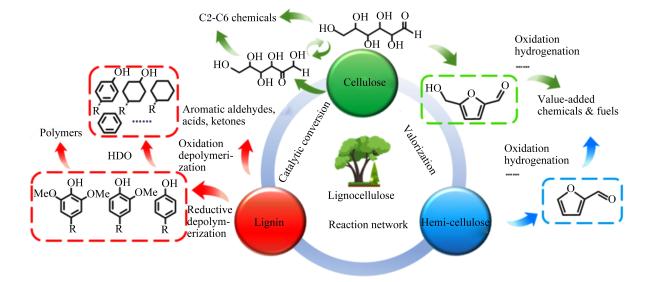
农作物秸秆利用受限的主要原因是木质纤维素的结构。木质纤维素是一种天然高分子化合物,主要由纤维素、半纤维素和木质素组成。纤维素是葡萄糖单元通过β-1,4-糖苷连接成的聚合物,是大多数木质纤维素分子的主要组成部分[18]。半纤维素是由不同类型单糖不规则组合成的杂聚多糖[19],木质素分子结构中富含氧代苯丙醇或其衍生结构单元的芳香性高聚物[20],主要有3种结构单元:羟基苯基、愈创木酰和丁香酚基[21]。纤维素分子中的共价键在植物细胞壁中起着机械抗性和保护细胞内部稳态的作用[22]。半纤维素作为纤维素和木质素之间的连接媒介,将整个木质纤维素组合成为纤维素-半纤维素-木质素刚性结构,这种结构是天然的生物质顽固性物质,极大地限制了它的生物利用效率[23],只有打破这种结构,木质纤维素才能够更好地被利用。木质纤维素的结构如图1所示[24]
图1 木质纤维素结构图

Polymers:聚合物;Aromatic aldehydes, acids, ketones:芳香醛,酸,酮;HDO:加氢脱氧 hydrodeoxygenation;Oxidation depolymerization:氧化解聚作用;Reductive depolymerization:还原解聚作用;C2-C6 chemicals:C2~C6化学物质;Lignin:木质素;Catalytic conversion:催化转化;Cellulose:纤维素;Valorization:稳定;Hemi-cellulose:半纤维素;Lignocellulose:木质纤维素;Reaction network:反应网络;Oxidation hydrogenation:氧化加氢;Value-added chemicals & fuels:增值化学物质和燃料。

Fig.1 Structure diagram of lignocellulose[24]

表1 秸秆原料预处理方法比较

Table 1 Comparison of pretreatment methods for straw raw materials

处理方法
Processing
methods
增加表面积
Increase
surface area
降低
结晶度
Reduce
crystallinity
降解纤维素
Degrades
cellulose
降解半
纤维素
Degrades
hemicellulose
降低木
质素含量
Reduce
lignin content
营养价值
Nutritional
value
参考文献
Reference
切短研磨
Short cut grinding
+ + + Li等[25]
蒸汽爆破
Steam explosion
+ + + - + He等[26]
氨纤维爆破
Ammonia fiber
explosion
+ + - + + Ashour等[27]
热喷技术
Thermal spray
technology
+ - + + - Singh等[28]
酸化处理
Acidification
treatment
+ + + Cai等[29]
离子辐射
Ionizing radiation
- - + + + Prasad等[30]
碱化处理
Alkalization
treatment
+ - + + Xiong等[31]
细菌处理
Bacterial
treatment
+ + + + Bugg等[32]
Ahmad等[33]
真菌处理
Fungal
treatment
+ + + + Ahmad等[33]
Martens等[34]
酶处理
Enzyme
treatment
+ + + + Sujani等[35]

“+”为正相关,“-”为负相关,空白为未知。

“+” indicated positive correlation, “-” indicated negative correlation, and blank indicated unknown.

2 作物秸秆常见处理方法

农作物秸秆的常见处理方法包括物理处理法、化学处理法、物理化学结合处理法和生物处理法。秸秆原料预处理效果比较见表2[25-35]。切短研磨、蒸汽爆破和氨纤维爆破可以增加表面积并降低结晶度,其中蒸汽爆破主要是降低纤维素含量,而氨纤维爆破可以降低木质素含量。热喷技术、酸化处理在增加表面积的同时还可以降低纤维素含量,其中热喷技术还可以降低半纤维素含量。离子辐射可以同时降低纤维素和木质素含量,碱化处理可以增加表面积并且降低木质素的含量。细菌处理、真菌处理和酶处理都可以通过破坏木质纤维素结构来降低纤维素、半纤维素和木质素含量,进而提高秸秆的消化率。

2.1 物理处理法

物理处理法主要是对秸秆进行切短、研磨、揉丝、热喷、蒸煮或离子辐射等。通过切短或研磨可以使粒径和结晶度减小从而达到增加表面积的作用[36]。这种方法能够破坏木质纤维素的晶体结构,但是不能改善秸秆的营养价值。揉丝技术是通过将秸秆切丝后揉搓破坏其表皮结构而达到高效利用的效果。热喷技术是利用机械能与热能(如等离子喷涂或燃烧火焰等)的相互结合,如Singh等[28]用一种新型稻草捆燃烧器与燃料喷射系统和用于大规模水加热的嵌入式炉内水热交换器相结合,在高温和蒸汽的作用下,改变了木质纤维素的内部结构,半纤维素被水解并且释放出的少量有机酸进一步促进了半纤维素的水解。当处理温度超过160 ℃时,木质素也会被水解,但是会产生抑制瘤胃微生物活性的酚类物质[37]。蒸煮是让木质素在高温和高湿的条件下受热膨胀,使木质纤维素中的氢键断裂,实现生物质表面蜡质结构与细胞壁的分离,进而提高酶解率[38]。离子束照射秸秆时,纤维素会产生与氧气结合的自由基形成超氧自由基,破坏其中的氢键进而降低纤维素的结晶度,从而达到易被酶解的效果[39]。不过,物理处理法对环境和设备的要求高,同时较高的能耗和经济成本也制约着其工业化推广。

2.2 化学处理法

化学处理法是通过酸、碱或其他溶剂与秸秆发生化学反应,破坏木质素和半纤维素之间的化学键。化学处理法主要包括酸化、碱化、氨化、催化及氧化处理等,进而打破木质纤维素之间的牢固结构[40-41]。酸化处理通常用稀硫酸、稀硝酸等破坏木质纤维原料中的半纤维素,这种方法还可以破坏原纤维之间的氢键来打破细胞壁的坚固和层次结构[42]。碱化处理是用一定浓度的碱液处理来降低木质纤维素的硬度,使饲喂动物时更有助于消化。Rahmani等[43]用热水和热碱预处理小麦秸秆后,其促进厌氧消化得到了显著的效果。氨化处理是一种相对简单且成本低廉的处理方法,一般在实践生产中用铵盐、尿素等处理木质纤维素。Thabo-Frans等[44]用无水氨处理农作物秸秆,秸秆中粗蛋白质的含量显著提高。催化处理是在催化剂参与下改变反应所需的活化自由能。Wang等[45]利用磷酸锆辅助磷酸共催化水解木质纤维素,由于磷酸基团的存在,磷酸锆具有较强的活性中心和较高的催化活性,因而可以达到有效降解的目的。氧化处理一般是用臭氧,它与具有共轭双键的化合物具有很高的反应性,木质素在水中(85%干物质)可以被氧化产生富含羧酸基团的水溶性木质素从而提高其消化率[46]。总体而言,化学处理可以通过改变秸秆的化学组成提高其可利用性。但是对微生物生存不利,处理过程中产生的酸碱如不能及时处理还会造成污染。

2.3 物理化学结合处理法

常见的物理化学结合处理方法包括蒸汽爆破、氨纤维爆破和高温热解等。蒸汽爆破是利用高温高压下汽化蒸煮和瞬间解压对纤维的剪切作用改变纤维结构。He等[26]用蒸汽爆破研究了5种典型作物副产品(玉米芯、稻草、花生壳、小米茎和甘蔗尖)的形态结构、碳水化合物蛋白质组分和瘤胃发酵特性,结果表明,这些作物副产物具有不同的理化性质和瘤胃发酵特性,其中大部分可以通过蒸汽爆破处理得到改善,即形态表面更粗糙,结构更破碎,可消化碳水化合物含量更多。氨纤维爆破是在蒸汽爆破的基础上,利用高压液氨瞬间释放压力,从而降低纤维素的结晶度、增加无定形区域[47],通过增加多糖的可及性来提高作物残留物的可降解性,在提高作物残渣的饲料价值方面具有潜力。高温热解技术是在高温高压条件下,通过水解半纤维素和破坏木质纤维素的结构增加酶与底物的接触面积。其主要过程是,首先将生物质原料置于高于300 ℃高温条件下使纤维素分解得到气体和残渣,再经过酸水解,纤维素会转化成还原糖,再在200 ℃以下的温度下让细胞壁的木质素-碳水化合物复合体连接键断裂[48]。总而言之,物理化学结合处理是通过定向改变操作条件,再通过化学物质破坏木质素和半纤维素,从而改变木质纤维素的结构。

2.4 生物处理法

生物处理法主要是利用1种或多种微生物制剂诸如各种细菌、真菌以及一些酶制剂等处理秸秆。比较常见的细菌处理法包括青贮和黄贮,青贮又包括常规青贮、半干青贮和添加剂青贮[49]。常规青贮是指厌氧条件下,青绿饲料原料中的乳酸菌大量繁殖将易发酵碳水化合物转化为乳酸等有机酸,随着乳酸的积累,酸度不断增强。当pH达到3.8~4.2时,便可以抑制霉菌等腐败菌的生长,以此达到长期保存的效果。半干青贮原料中水分低,某些腐败菌在干燥状态下生长受到抑制,压缩后的饲料密度高,可以更好地保留养分;添加剂青贮多为接种乳酸菌、加入酶制剂等,可以促进或抑制某种微生物的生长,保存饲料的品质,微贮也是添加剂青贮的一种。黄贮是相对青贮而言的饲料发酵方法,主要以干秸秆做原料[50-51]。酶制剂处理是通过各种酶来催化降解植物的细胞壁结构,将多聚糖转化为单糖,再经发酵后转化为菌体蛋白,提高饲料中蛋白质的含量并且提高消化率[52]
近些年来,WRF、BRF和SRF等真菌的应用越来越受到关注,它们通过分泌降解酶类将难分解的碳水化合物转化为糖类,这些糖类可以继续转化为乳酸或挥发性脂肪酸进而提高利用率[53-55]。WRF固态发酵可以降解木质素,提高木质纤维素的瘤胃微生物可及性,是物理化学途径处理秸秆的一种有效的替代方法[34]。在发酵过程中,微生物一方面通过分泌各种降解酶类从而提高秸秆中纤维素、半纤维素分解的酶解糖化率[56],另一方面还可以提供品质优良的菌体蛋白。生物处理法是一种条件温和、环境友好的农作物秸秆处理方式,该方法在处理过程中操作简单而且不需要使用化学试剂,因此在环境保护与治理方面显示出广阔的应用前景[57]

3 WRF对木质纤维素的作用机制

3.1 WRF降解木质纤维素的原理

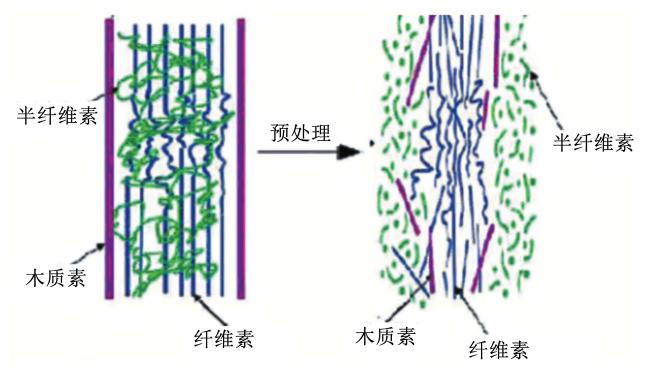
在20世纪80年代,有报道指出活性氧参与了WRF培养物中木质素结构的裂解,黄孢原毛菌的木质素降解活性与过氧化氢的产生有关[58]。木质素降解的过程就是一个以自由基为基础所进行的链式反应过程,WRF可以通过分泌4种主要酶系来降解细胞壁中的木质素:木质素过氧化物酶、锰过氧化物酶、多功能过氧化物酶和漆酶。这些酶作为木质素生物降解的潜在催化剂已经引起人们的广泛关注[59]。预处理就是破坏木质纤维素的结构将其分解为易被微生物利用的成分,木质纤维素结构以及WRF降解原理如图2所示[60]
图2 木质纤维素预处理作用

Fig.2 Pretreatment effect of lignocellulose[60]

木质素过氧化物酶是一种糖蛋白,它可以催化过氧化氢依赖性木质素的氧化解聚[61]。锰过氧化物酶是一种糖基化血红素蛋白,它几乎代表了所有定殖担子菌(WRF和土壤定殖菌)产生和分泌的常见木质素修饰过氧化物酶[62]。在0.2 mmol/L锰离子(Mn2+)、pH 4.5和37 ℃的条件下,木质素过氧化物酶和锰过氧化物酶可以解聚和重新聚合由针叶树醇和/或辛纳醇产生的木质素分子[63]。多功能过氧化物酶是一类含亚铁血红素的过氧化物酶,它具有广泛的底物偏好,并具有锰过氧化物酶和过氧化氢酶等过氧化物酶家族的典型特征。例如多功能过氧化物酶和过氧化氢酶都能够氧化酚和非酚木质素单元,且后者表现出更高的亲和力和效率,而多功能过氧化物酶还可以改善纤维素的酶促水解作用[64]。漆酶是一种多酚氧化酶,在有氧的条件下生产苯丙半醌和水,漆酶可以缓慢的氧化2,2-苯并噻唑-6-磺酸从而降解非酚木质素同时也能够氧化大分子物质[65]

3.2 WRF对木质纤维素的降解效果

木质纤维素是地球上最丰富的可再生生物质资源之一,其中纤维素是生物质材料、燃料及生物化工产品的重要原料,但是木质素的复杂结构限制了木质纤维的应用[66]。早在19世纪70年代,国外就已经展开了对WRF的研究。近年来,我国对WRF的研究日益增多,WRF通过分泌木质素降解酶类有效降解木质素[67]。秸秆中富含氮、磷、钾等各种营养元素,但是蛋白质含量低、粗纤维含量高。大量研究表明,WRF处理后的木质纤维素中,纤维素和半纤维素降解率分别提高15%~30%和10%~20%[68-69]。经过WRF处理的秸秆,木质素被降解质地变得柔软,适口性改善,且显著提高了干物质消化率。

4 影响WRF发酵秸秆的主要因素

4.1 秸秆的组成成分

农作物秸秆由无机物、有机物及水组成,有机物主要包括纤维性碳水化合物和少量的蛋白质及脂肪,无机物包括氰化物和无机盐等,利用WRF固态发酵的降解过程中需要满足其进行各项生命活动所需要的碳源和氮源条件[70]。有研究表明,通过氮源的富集可以显著提高秸秆中粗蛋白质的含量[71],氮和粗蛋白质含量呈正相关,但与WRF的生长呈负相关,在氮源耗尽的自然条件下,木质素降解酶才能产生[72]。碳源是构成微生物细胞和其代谢产物所必需的,在碳源的充分供应下,微生物才能够正常生长,而木质纤维素的降解是一个次生代谢过程,必须要在碳源的支撑下才能够发挥作用[73]。Huang等[74]以葡萄糖为碳源,以酒石酸铵为氮源研究了环境中不同碳氮比对黄孢原毛平革菌产生的木质素过氧化物酶和锰过氧化物酶活性的影响,结果表明,氮源浓度越高,菌丝团老化越快,菌丝干重增加越快,木质素过氧化物酶和锰过氧化物酶活性越高;高碳氮比是木质素过氧化物酶或锰过氧化物酶分泌的必要条件。

4.2 秸秆种类以及WRF菌种

研究表明,不同种类的WRF降解木质纤维素的效果不同。表2汇总了不同种类WRF处理不同农作物秸秆后养分含量的差异[75-79]。例如,用平菇分别处理水稻、小麦、玉米后,玉米的半纤维素含量最高;但比较平菇、盖囊侧耳、白耙齿菌处理时,白耙齿菌处理组纤维素的含量最高。
表2 不同种类WRF处理不同农作物秸秆后养分含量的差异

Table 2 Differences in nutrient contents of different crop straw treated with different WRF

菌种名称
Strain
names
秸秆
种类
Straw
types
干物质
DM/%
粗蛋
白质
CP/%
DM
中性洗
涤纤维
NDF/%
DM
酸性洗
涤纤维
ADF/%
DM
半纤维素
HCL/%
DM
纤维素
CL/%
DM
参考文献
References


平菇
Pleurotus ostreatus
水稻Rice 55.80 6.95 61.97 37.57 Khonkhaeng等[75]
小麦Wheat 80.50 4.71 70.79 55.73 15.06 48.74 Sufyan等[76]
玉米Corn 77.10 3.87 76.60 48.89 27.71 41.56 Sufyan等[76]

盖囊侧耳
Pleurotus cystidiosus
水稻Rice 81.58 6.57 54.44 39.39 15.08 33.21 Osmond[77]
玉米Corn 84.10 7.46 61.95 41.25 20.70 33.10 Zuo等[78]

白耙齿菌
Irpex lacteus
小麦Wheat 88.13 5.35 67.20 46.62 20.4 42.7 Niu等[79]
玉米Corn 78.70 7.67 54.3 38.00 16.30 30.20 Zuo等[78]

4.3 WRF发酵时间

WRF不同发酵时间显著影响着秸秆的降解效果,WRF先分泌纤维氧化酶分解秸秆表面的蜡质层,然后菌丝进入秸秆内部合成多种酶并排到细胞外[80],因此WRF降解的初始阶段只是菌丝在木质纤维素内部的繁殖和蔓延。如果微生物发酵时间过短,WRF对秸秆的降解效果并不明显甚至还没有进行降解;相反,如果微生物发酵时间过长,其他一些易于被降解的糖类可能会伴随着木质素的降解而降解,不仅会影响适口性还会降低消化率[81]。Zang等[82]将白桦茸(Inonotus obliquus)定植在小麦秸秆上,发酵15 d后消耗了45%的木质素,在发酵第5、15和25天分别产生了最多的木质素过氧化物酶、锰过氧化物酶和漆酶,发酵15 d后小麦秸秆的粗蛋白质含量增加了约132%。关于最佳发酵时间存在着不同的报道,Van Kuijk等[83]发现用虫拟蜡菌(Ceriporiopsis subvermispora)发酵5周以后木质素降解效果最佳;而Owen等[84]用同样一株菌建议最长发酵时间为6~8 d,可以在一定程度上减少有机物质的损失。Neifar等[85]研究显示,在发酵第7天时黑木蹄层孔菌(Fomes fomentarius)产生最大的漆酶降解活性,而后活性开始下降,这可能是由于底物的溶解度降低。

5 WRF在动物生产中的应用

5.1 WRF处理后的饲料对反刍动物体外瘤胃发酵参数的影响

WRF可以显著降低木质纤维素的含量,研究者在其降解粗饲料中的木质素、提高饲料的利用率方面展开了研究。反刍动物瘤胃是一个十分复杂的微生态系统,是饲粮消化的主要场所。体外瘤胃发酵法是一种模拟动物瘤胃环境的实验方法,该方法通过将动物的瘤胃液与饲粮或添加剂混合进而研究瘤胃微生物对底物的发酵特性[86]。Astudillo-Neira等[87]在粉碎的干草中加入平菇,占比分别为0、3%和6%,发酵24 h,结果发现体外干物质消化率在3%和6%添加组分别提高了10%和12%,且随着菌剂含量的提高,甲烷的产量显著降低,说明平菇处理可能有助于减少温室气体的排放。Niu等[79]将白耙齿菌接种在8个不同品种的麦秸上,在28 ℃条件下培养56 d,处理过的麦秸体外干物质消化率和产气量分别提高了21%和32%,乙酸与丙酸的比值从3.68降低到2.99。为了确定真菌处理后的木质纤维素生物量是否稳定,Mao等[81]将真菌处理过的小麦秸秆在不同温度下厌氧储存10周,每2周分析底物pH、纤维组成、体外产气和气体成分以及代谢物的变化;结果表明,真菌处理过的小麦秸秆虽然化学成分发生了改变,但是不影响其在动物瘤胃中的发酵潜力。

5.2 WRF处理秸秆后饲喂动物的效果研究

使用WRF对秸秆进行固态发酵处理可以显著降低木质素含量,提高粗蛋白质含量和饲粮适口性及动物的采食量等。El-Fallal等[88]用WRF处理麦秸后将麦秸磨碎加入到獭兔的饲粮中,结果发现试验组獭兔的饲粮营养物质消化率和胴体性状变化不显著,但是体重、体增重和饲料系数较对照组显著提高。Xiang等[89]将真菌预处理过的玉米秸秆饲喂羔羊,该处理为羔羊提供了额外的饲粮蛋白质并分泌出灭虫代谢物,这些代谢物在一定程度上减少了胃肠道线虫的感染并且提高了血浆铁含量,改善了羔羊肉品质。Agustinho等[90]在每千克全株玉米青贮中分别添加0、10和30 mg侧耳科侧耳属真菌平菇,固态发酵60 d,发酵结束后每个剂量分别饲喂3头泌乳山羊,结果发现底物的含量与体内酸性洗涤纤维消化率呈二次变化规律,羊奶中多酚的含量随底物含量的增加呈线性增加。虽然WRF降解秸秆的研究报道较多,但是到目前为止,WRF发酵秸秆用于动物饲喂的研究相对较少,而且结果有一定的差异,关于WRF在饲料生产中的规模化应用还缺乏报道。

6 小结与展望

农作物秸秆中含有粗蛋白质、纤维素以及半纤维素等营养物质,可以为动物养殖业提供丰富的粗饲料资源,是一种非常重要的生物质能源。在利用秸秆的实际生产中,各种处理方法经常结合使用,生物处理方法尤其是WRF处理具有不错的发展趋势。秸秆在经WRF预处理之后木质化程度降低,并且处理的过程中能耗低、成本小,对环境没有污染。因此,将WRF应用于实际生产中具有十分广阔的前景。在以后的发展中可以从以下几个方面展开研究:1)在不灭菌的条件下评估WRF固态发酵秸秆对木质素降解效果以及安全性能;2)将不同菌种混合使用,研究相关降解酶的协同作用,更好地提高秸秆的降解效率;3)将真菌与细菌相结合,研究两者混合对农作物秸秆木质纤维素的降解效率。
[1]
张云华, 张诩, 赵俊超. 农产品消费侧的引导与管理研究[J]. 重庆理工大学学报(社会科学), 2022, 36(10):1-7.

ZHANG Y H, ZHANG X, ZHAO J C. Research on the guidance and management of the consumption side of agricultural products[J]. Journal of Chongqing University of Technology (Social Science), 2022, 36(10):1-7. (in Chinese)

[2]
张婷, 周睿, 陈雨生. 我国饲料粮供需缺口估算研究[J]. 山东农业科学, 2022, 54(8):158-165.

ZHANG T, ZHOU R, CHEN Y S. Estimation of supply-demand gap of feed grain in China[J]. Shandong Agricultural Sciences, 2022, 54(8):158-165. (in Chinese)

[3]
陈雨生, 周睿, 张婷. 中国饲料粮进口替代研究[J]. 农业技术经济, 2022(7):64-77.

CHEN Y S, ZHOU R, ZHANG T. Research on import substitution of feed grain in China[J]. Journal of Agrotechnical Economics, 2022(7):64-77. (in Chinese)

[4]
张晓庆, 王梓凡, 参木友, 等. 中国农作物秸秆产量及综合利用现状分析[J]. 中国农业大学学报, 2021, 26(9):30-41.

ZHANG X Q, WANG Z F, CAN M Y, et al. Analysis of yield and current comprehensive utilization of crop straws in China[J]. Journal of China Agricultural University, 2021, 26(9):30-41. (in Chinese)

[5]
SARNKLONG C, CONE J W, PELLIKAAN W, et al. Utilization of rice straw and different treatments to improve its feed value for ruminants:a review[J]. Asian-Australasian Journal of Animal Sciences, 2010, 23(5):680-692.

[6]
李景玉, 赖宪明, 李达, 等. 吉林西部地区农作物秸秆饲料化利用研究进展[J]. 农业与技术, 2023, 43(1):1-5.

LI J Y, LAI X M, LI D, et al. Research progress on the utilization of crop straw as feed in the western region of Jilin province[J]. Agriculture & Technology, 2023, 43(1):1-5. (in Chinese)

[7]
PANAHABADI R, AHMADIKHAH A, MCKEE L S, et al. Genome-wide association study for lignocellulosic compounds and fermentable sugar in rice straw[J]. The Plant Genome, 2022, 15(1):e20174.

[8]
WANG S Q, ZHANG G M, ZHANG P Y, et al. Rumen fluid fermentation for enhancement of hydrolysis and acidification of grass clipping[J]. Journal of Environmental Management, 2018,220:142-148.

[9]
RUSSELL J B, MUCK R E, WEIMER P J. Quantitative analysis of cellulose degradation and growth of cellulolytic bacteria in the rumen[J]. FEMS Microbiology Ecology, 2009, 67(2):183-197.

DOI PMID

[10]
ZHANG Y, CHEN X X, FANG L X, et al. Fenton-reaction-aid selective delignification of lignocellulose by Inonotus obliquus to improve enzymatic saccharification[J]. Fuel, 2023, 333(Part 1):126355.

[11]
MUNK L, SITARZ A K, KALYANI D C, et al. Can laccases catalyze bond cleavage in lignin?[J]. Biotechnology Advances, 2015, 33(1):13-24.

DOI PMID

[12]
TANIGUCHI M, SUZUKI H, WATANABE D, et al. Evaluation of pretreatment with Pleurotus ostreatus for enzymatic hydrolysis of rice straw[J]. Journal of Bioscience and Bioengineering, 2005, 100(6):637-643.

[13]
钟磊, 栗高源, 陈冠益, 等. 我国农作物秸秆分布特征与秸秆炭基肥制备应用研究进展[J]. 农业资源与环境学报, 2022, 39(3):575-585,643.

ZHONG L, LI G Y, CHEN G Y, et al. Research progress on the distribution characteristics of crop straws and the preparation and application of straw carbon-based fertilizers in China[J]. Journal of Agricultural Resources and Environment, 2022, 39(3):575-585,643. (in Chinese)

[14]
冯保清, 崔静, 吴迪, 等. 浅谈西北灌区耕地盐碱化成因及对策[J]. 中国水利, 2019(9):43-46.

FENG B Q, CUI J, WU D, et al. Preliminary studies on causes of salinization and alkalinization in irrigation districts of northwest China and countermeasures[J]. China Water Resources, 2019(9):43-46. (in Chinese)

[15]
WU T, LIU K, CHENG X X, et al. Analysis of energy,carbon emissions and economics during the life cycle of biomass power generation:case comparison from China[J]. Biomass and Bioenergy, 2024,182:107098.

[16]
WU J J, ZHANG J, YI W M, et al. Economic analysis of different straw supply modes in China[J]. Energy, 2021,237:121594.

[17]
SHANG X Y, SONG S Q, YANG J W. Comparative environmental evaluation of straw resources by LCA in China[J]. Advances in Materials Science and Engineering, 2020,2020:4781805.

[18]
WU C L, MCCLEMENTS D J, HE M Y, et al. Preparation of okara cellulose hydrogels using Ionic liquids:structure,properties, and performance[J]. Journal of Molecular Liquids, 2021,331:115744.

[19]
HROMÁDKOVÁ Z, EBRINGEROVÁ A. Ultrasonic extraction of plant materials-investigation of hemicellulose release from buckwheat hulls[J]. Ultrasonics Sonochemistry, 2003, 10(3):127-133.

[20]
CHEN Y P, DANG B K, FU J Z, et al. Bioinspired construction of micronano lignocellulose into an impact resistance “wooden armor” with Bouligand structure[J]. ACS Nano, 2022, 16(5):7525-7534.

[21]
DAI L X, WANG J J, LIU X E, et al. In-situ visualizing selective lignin dissolution of tracheids wall in reaction wood[J]. International Journal of Biological Macromolecules, 2022, 222(Pt A):691-700.

[22]
MONLAU F, BARAKAT A, TRABLY E, et al. Lignocellulosic materials into biohydrogen and biomethane:impact of structural features and pretreatment[J]. Critical Reviews in Environmental Science and Technology, 2013, 43(3):260-322.

[23]
DU B Y, ZHU H W, CHAI L F, et al. Effect of lignin structure in different biomass resources on the performance of lignin-based carbon nanofibers as supercapacitor electrode[J]. Industrial Crops and Products, 2021,170:113745.

[24]
WANG S Y, CHENG A H, LIU F H, et al. Catalytic conversion network for lignocellulosic biomass valorization:a panoramic view[J]. Industrial Chemistry & Materials, 2023, 1(2):188-206.

[25]
LI Y X, LU C Y, LI H W, et al. Design and experiment of spiral discharge anti-blocking and row-sorting device of wheat no-till planter[J]. Agriculture, 2022, 12(4):468.

[26]
HE L W, HUANG Y C, SHI L, et al. Steam explosion processing intensifies the nutritional values of most crop byproducts:morphological structure,carbohydrate-protein fractions,and rumen fermentation profile[J]. Frontiers in Nutrition, 2022,9:979609.

[27]
ASHOUR T, MORSY M, KORJENIC A, et al. Engineering parameters of rice straw concrete with granulated blast furnace slag[J]. Energies, 2021, 14(2):343.

[28]
SINGH B, SETHI V P, DHIMAN M, et al. Design, evaluation and heat transfer analysis of novel forced draft paddy straw bale combustor using heat sink pipe networks for greenhouse heating[J]. Energy Conversion and Management, 2018,173:244-261.

[29]
CAI Z J, YANG C H, CARSWELL A M, et al. Co-amelioration of red soil acidity and fertility with pig manure rather than liming[J]. Soil Use and Management, 2023, 39(1):441-455.

[30]
PRASAD B R, PADHI R K, GHOSH G. A review on key pretreatment approaches for lignocellulosic biomass to produce biofuel and value-added products[J]. International Journal of Environmental Science and Technology, 2023, 20(6):6929-6944.

[31]
XIONG X Q, YUAN Y Y, NIU Y T, et al. Effects of different treatments on surface activity of rice straw particleboard[J]. Science of Advanced Materials, 2020, 12(2):289-295.

[32]
BUGG T D H, AHMAD M, HARDIMAN E M, et al. The emerging role for bacteria in lignin degradation and bio-product formation[J]. Current Opinion in Biotechnology, 2011, 22(3):394-400.

DOI PMID

[33]
AHMAD M, TAYLOR C R, PINK D, et al. Development of novel assays for lignin degradation:comparative analysis of bacterial and fungal lignin degraders[J]. Molecular bioSystems, 2010, 6(5):815-821.

[34]
MARTENS S D, WILDNER V, GREEF J M, et al. Growth and influence of white-rot fungi on the chemical composition of wheat straw inoculated under varying pre-conditions[J]. Fermentation, 2022, 8(12):695.

[35]
SUJANI S, PIYASENA T, SERESINHE T, et al. Supplementation of rice straw (Oryza sativa) with exogenous fibrolyticenzymes improves in vitro rumen fermentation characteristics[J]. Turkish Journal of Veterinary & Animal Sciences, 2017, 41(1):25-29.

[36]
ADAPA P, TABIL L, SCHOENAU G. Grinding performance and physical properties of non-treated and steam exploded barley,canola,oat and wheat straw[J]. Biomass and Bioenergy, 2011, 35(1):549-561.

[37]
HENDRIKS A T W M, ZEEMAN G. Pretreatments to enhance the digestibility of lignocellulosic biomass[J]. Bioresource Technology, 2009, 100(1):10-18.

DOI PMID

[38]
LEROY A, FALOURD X, FOUCAT L, et al. Evaluating polymer interplay after hot water pretreatment to investigate maize stem internode recalcitrance[J]. Biotechnology for Biofuels, 2021, 14(1):164.

DOI PMID

[39]
POURJAFAR M, KHOSRAVANI A, BEHROOZ R. Fiber fines for fabricating lignocellulose films and the effect of lignin[J]. BioResources, 2020, 15(2):4417-4433.

[40]
ZHANG J Z, ZHOU H F, LIU D H, et al. Chapter 2-pretreatment of lignocellulosic biomass for efficient enzymatic saccharification of cellulose[M]//YOUSUF A,PIROZZI D,SANNINO F. Lignocellulosic biomass to liquid biofuels. New York: Academic Press,2020:17-65.

[41]
VERARDI A, LOPRESTO C G, BLASI A, et al. Chapter 3-bioconversion of lignocellulosic biomass to bioethanol and biobutanol[M]//YOUSUF A,PIROZZI D,SANNINO F. Lignocellulosic biomass to liquid biofuels. New York: Academic Press,2020:67-125.

[42]
JIANG J G, ZHU Y L, JIANG F. Sustainable isolation of nanocellulose from cellulose and lignocellulosic feedstocks:recent progress and perspectives[J]. Carbohydrate Polymers, 2021,267:118188.

[43]
RAHMANI A M, TYAGI V K, GUNJYAL N, et al. Hydrothermal and thermal-alkali pretreatments of wheat straw:co-digestion,substrate solubilization,biogas yield and kinetic study[J]. Environmental Research, 2023, 216(Pt 1):114436.

[44]
THABO-FRANS B, LEBOGANG EZRA M, CAVEN MGUVANE M, et al. Effect of anhydrous ammonia gas treatment of low-quality cereal straws on chemical composition and in vitro ruminal fermentation[J]. Range Management and Agroforestry, 2021, 42(1):150-156.

[45]
WANG H C, WU J Y, LIAN Y, et al. Zirconium phosphate assisted phosphoric acid co-catalyzed hydrolysis of lignocellulose for enhanced extraction of nanocellulose[J]. Polymers, 2023, 15(2):447.

[46]
SUTRADHAR S, ALAM N, CHRISTOPHER L P, et al. KOH catalyzed oxidation of kraft lignin to produce green fertilizer[J]. Catalysis Today, 2022,404:49-62.

[47]
BEAUCHEMIN K A, RIBEIRO G O, RAN T, et al. Recombinant fibrolytic feed enzymes and ammonia fibre expansion (AFEX) pretreatment of crop residues to improve fibre degradability in cattle[J]. Animal Feed Science and Technology, 2019,256:114260.

[48]
YU S J, YANG X X, LI Q H, et al. Breaking the temperature limit of hydrothermal carbonization of lignocellulosic biomass by decoupling temperature and pressure[J]. Green Energy & Environment, 2023, 8(4):1216-1227.

[49]
YAN J, SUN Y B, KANG Y H, et al. An innovative strategy to enhance the ensiling quality and methane production of excessively wilted wheat straw:using acetic acid or hetero-fermentative lactic acid bacterial community as additives[J]. Waste Management, 2022,149:11-20.

[50]
MA J, FAN X, WU T T, et al. Lactic acid bacteria and cellulase improve the fermentation characteristics,aerobic stability and rumen degradation of mixed silage prepared with amaranth and rice straw[J]. Fermentation, 2023, 9(9):853.

[51]
GHOSH M, GORAIN J, PAL A K, et al. Study of seed morphology and influence of ageing and storage conditions on germination and seedling vigour of non-basmati aromatic rice[J]. Journal of Stored Products Research, 2021,93:101863.

[52]
RAZZAK A, KHIARI R, MOUSSAOUI Y, et al. Cellulose nanofibers from schinus molle:preparation and characterization[J]. Molecules, 2022, 27(19):6738.

[53]
SINGH R, SINGH B J, KUMARMUKHERJEE T, et al. Biochemical changes during solid state fermentation of wheat crop residues by Aspergillus flavus link and Aspergillus niger van Tieghem[J]. Biointerface Research in Applied Chemistry, 2022, 13(3):231.

[54]
CLOCCHIATTI A, HANNULA S E, HUNDSCHEID M P J, et al. Utilizing woody materials for fungal-based management of soil nitrogen pools[J]. Applied Soil Ecology, 2023,181:104663.

[55]
KUMAR V P, SRIDHAR M, RAO R G. Biological depolymerization of lignin using laccase harvested from the autochthonous fungus Schizophyllum commune employing various production methods and its efficacy in augmenting in vitro digestibility in ruminants[J]. Scientific Reports, 2022, 12(1):11170.

[56]
ZHAO D Q, LING J, WU G, et al. The incorporation of straw into the subsoil increases C,N,and P enzyme activities and nutrient supply by enriching distinctive functional microorganisms[J]. Land Degradation & Development, 2023, 34(5):1297-1310.

[57]
PICCITTO A, SCORDIA D, CORINZIA S A, et al. Advanced biomethane production from biologically pretreated giant reed under different harvest times[J]. Agronomy, 2022, 12(3):712.

[58]
FORNEY L J, REDDY C A, TIEN M, et al. The involvement of hydroxyl radical derived from hydrogen peroxide in lignin degradation by the white rot fungus Phanerochaete chrysosporium[J]. Journal of Biological Chemistry, 1982, 257(19):11455-11462.

[59]
ASGHER M, SHAHID M, KAMAL S, et al. Recent trends and valorization of immobilization strategies and ligninolytic enzymes by industrial biotechnology[J]. Journal of Molecular Catalysis B:Enzymatic, 2014,101:56-66.

[60]
张元晶, 魏刚, 张小冬, 等. 木质纤维素生物质预处理技术研究现状[J]. 中国农学通报, 2012, 28(11):272-277.

ZHANG Y J, WEI G, ZHANG X D, et al. Status in pretreatment technologies of lignocellulosic biomass[J]. Chinese Agricultural Science Bulletin, 2012, 28(11):272-277. (in Chinese)

DOI

[61]
WONG D W S. Structure and action mechanism of ligninolytic enzymes[J]. Applied Biochemistry and Biotechnology, 2009, 157(2):174-209.

DOI PMID

[62]
BURNOW G. Method to reveal the structure of lignin.Part 1.Lignin,humic substances and coal[M/OL]//Biopolymers Online. Weinheim:Wiley-VCH, 2005[2024-02-11].https://doi.org/10.1002/3527600035.bpol1003.

[63]
WARIISHI H, VALLI K, GOLD M H. In vitro depolymerization of lignin by manganese peroxidase of Phanerochaete chrysosporium[J]. Biochemical and Biophysical Research Communications, 1991, 176(1):269-275.

[64]
HOFRICHTER M, ULLRICH R, PECYNA M J, et al. New and classic families of secreted fungal heme peroxidases[J]. Applied Microbiology and Biotechnology, 2010, 87(3):871-897.

DOI PMID

[65]
BOURBONNAIS R, LEECH D, PAICE M G. Electrochemical analysis of the interactions of laccase mediators with lignin model compounds[J]. Biochimica et Biophysica acta, 1998, 1379(3):381-390.

PMID

[66]
LIU Q, NIU S Y, HU S J, et al. Lignocellulose degradation pattern and structural change of the sawdust substrate and enzyme secretion by Lentinula edodes during its production[J]. Wood Science and Technology, 2023, 57(2):389-405.

[67]
HU K D, SARRÀ M, CAMINAL G. Oak wood provides suitable nutrients for long-term continuous pesticides removal by Trametes versicolor in a pilot plant trickle bed reactor[J]. Journal of Cleaner Production, 2022, 380(Part 1):135059.

[68]
XU C, ZHANG X, HUSSEIN Z, et al. Influence of the structure and properties of lignocellulose on the physicochemical characteristics of lignocellulose-based residues used as an environmentally friendly substrate[J]. Science of the Total Environment, 2021,790:148089.

[69]
WANG B, SUN H Z, WANG D M, et al. Constraints on the utilization of cereal straw in lactating dairy cows:a review from the perspective of systems biology[J]. Animal Nutrition, 2022,9:240-248.

[70]
FUKASAWA Y. Ecological impacts of fungal wood decay types:a review of current knowledge and future research directions[J]. Ecological Research, 2021, 36(6):910-931.

[71]
ABO-DONIA F M, AHMED EL-SHORA M, ABD-ELAZIZ RIAD W, et al. Improve the nutritional value and utilization of rice straw via an ensiling process with different sources of energy and nitrogen enrichment[J]. Journal of Applied Animal Research, 2022, 50(1):333-341.

[72]
KIRAN S, HUMA T, JALAL F, et al. Lignin degrading system of Phanerochaete chrysosporium and its exploitation for degradation of synthetic dyes wastewater[J]. Polish Journal of Environmental Studies, 2019, 28(3):1749-1757.

[73]
LAO M, ALFAFARA C, DE LEON R. Screening of Fusarium moniliforme as potential fungus for integrated biodelignification and consolidated bioprocessing of napier grass for bioethanol production[J]. Catalysts, 2022, 12(10):1204.

[74]
HUANG S H, HUANG D Y, WU Q T, et al. Effect of environmental C/N ratio on activities of lignin-degrading enzymes produced by Phanerochaete chrysosporium[J]. Pedosphere, 2020, 30(2):285-292.

[75]
KHONKHAENG B, CHERDTHONG A. Pleurotus ostreatus and Volvariella volvacea can enhance the quality of purple field corn stover and modulate ruminal fermentation and feed utilization in tropical beef cattle[J]. Animals, 2019, 9(12):1084.

[76]
SUFYAN A, AHMAD N, SHAHZAD F, et al. Improving the nutritional value and digestibility of wheat straw,rice straw,and corn cob through solid state fermentation using different Pleurotus species[J]. Journal of the Science of Food and Agriculture, 2022, 102(6):2445-2453.

[77]
OSMOND D. Effects of white rot fungi on rice straw nutrients and carbon and nitrogen on cellulase activity and mycelial biomass[D]. Ph.D. Thesis. Yangzhou: Yangzhou university, 2022.

[78]
ZUO S S, NIU D Z, ZHENG M L, et al. Effect of irpex lacteus,Pleurotus ostreatus and Pleurotus cystidiosus pretreatment of corn stover on its improvement of the in vitro rumen fermentation[J]. Journal of the Science of Food and Agriculture, 2018, 98(11):4287-4295.

[79]
NIU D Z, ZUO S S, REN J J, et al. Effect of wheat straw types on biological delignification and in vitro rumen degradability of wheat straws during treatment with Irpex lacteus[J]. Animal Feed Science and Technology, 2020,267:114558.

[80]
HAN M L, LIN L, GUO X X, et al. Comparative analysis of the laccase secretion ability of five white-rot fungi in submerged fermentation with lignocellulosic biomass[J]. BioResources, 2023, 18(1):584-598.

[81]
MAO L, SONNENBERG A S M, VAN ARKEL J, et al. Storage temperature and time and its influence on feed quality of fungal treated wheat straw[J]. Animal Feed Science and Technology, 2021,272:114749.

[82]
ZANG Q, CHEN X X, ZHANG C, et al. Improving crude protein and methionine production, selective lignin degradation and digestibility of wheat straw by Inonotus obliquus using response surface methodology[J]. Journal of the Science of Food and Agriculture, 2022, 102(3):1146-1154.

[83]
VAN KUIJK S J A, SONNENBERG A S M, BAARS J J P, et al. Fungal treatment of lignocellulosic biomass:importance of fungal species,colonization and time on chemical composition and in vitro rumen degradability[J]. Animal Feed Science and Technology, 2015,209:40-50.

[84]
OWEN E, SMITH T, MAKKAR H. Successes and failures with animal nutrition practices and technologies in developing countries:a synthesis of an FAO e-conference[J]. Animal Feed Science and Technology, 2012, 174(3/4):211-226.

[85]
NEIFAR M, KAMOUN A, JAOUANI A, et al. Application of asymetrical and Hoke designs for optimization of laccase production by the white-rot fungus Fomes fomentarius in solid-state fermentation[J]. Enzyme Research, 2011,2011:368525.

[86]
THORSTEINSSON M, WEISBJERG M R, LUND P, et al. Effects of seasonal and interspecies differences in macroalgae procured from temperate seas on the Northern hemisphere on in vitro methane mitigating properties and rumen degradability[J]. Algal Research, 2023,73:103139.

[87]
ASTUDILLO-NEIRA R, SUESCUN-OSPINA S, VERA-AGUILERA N, et al. Biodegraded hay with graded addition of Pleurotus ostreatus improves dry matter disappearance and reduces methane production of diets incubated in vitro[J]. Italian Journal of Animal Science, 2023, 22(1):347-358.

[88]
EL-FALLAL A A, EL-DEIN M M N, EL-MAATY H M A A, et al. Effect of biologically treated wheat straw with white-rot fungi on performance,digestibility and oxidative status of rabbits[J]. Pakistan Journal of Biological Sciences, 2020, 23(12):1551-1562.

[89]
XIANG H, ZHAO X L, FANG Y, et al. Feeding fungal-pretreated corn straw improves health and meat quality of lambs infected with gastrointestinal nematodes[J]. Animals, 2020, 10(9):1659.

[90]
AGUSTINHO B C, DANIEL J L P, ZEOULA L M, et al. Enzymatic effects of Pleurotus ostreatus spent substrate on whole-plant corn silage and performance of lactating goats[J]. Journal of Dairy Science, 2021, 104(11):11660-11672.

文章导航

/