研究论文

肉桂醛对热应激肉鸡生长性能、抗氧化能力和肠道健康的影响

  • 陈乐乐 ,
  • 陈博 ,
  • 伍新珍 ,
  • 郅可欣 ,
  • 龚番文 ,
  • 李泽政 ,
  • 郜璐瑶 ,
  • 黄明海 ,
  • 贺建华 , *
展开
  • 湖南农业大学动物科学技术学院,长沙 410125
* 贺建华,教授,博士生导师,E-mail:

陈乐乐(1998—),女,河南沈丘人,硕士研究生,从事畜禽健康养殖研究。E-mail:

Office editor: 田艳明

收稿日期: 2024-03-21

  网络出版日期: 2024-09-08

基金资助

国家重点研发计划(2023YFD1301200)

Effects of Cinnamaldehyde on Growth Performance, Antioxidant Capacity and Intestinal Health of Broilers Under Heat Stress

  • CHEN Lele ,
  • CHEN Bo ,
  • WU Xinzhen ,
  • ZHI Kexin ,
  • GONG Fanwen ,
  • LI Zezheng ,
  • GAO Luyao ,
  • HUANG Minghai ,
  • HE Jianhua , *
Expand
  • College of Animal Science and Technology, Hunan Agricultural University, Changsha 410125, China
* professor, E-mail:

Received date: 2024-03-21

  Online published: 2024-09-08

摘要

本试验旨在研究饲粮中添加肉桂醛对热应激肉鸡生长性能、血清生化指标、抗氧化能力和肠道健康的影响。选取288只21日龄健康、体重接近的817肉公鸡,随机分成6组,每组6个重复,每个重复8只。热中性组(TN组)环境温度设置为(24±2) ℃(24 h/d),饲喂基础饲粮;另外5组遭受热应激,环境温度每天09:30—17:30设置为(33±2) ℃(8 h/d),其余时间设置为(24±2) ℃(16 h/ d),并分别饲喂在基础饲粮中添加0(HT组)、100(HT100组)、200(HT200组)、400(HT400组)和800 mg/kg(HT800组)肉桂醛的饲粮。试验期21 d。结果表明:1)与TN组相比,HT组肉鸡终末体重(FBW)、平均日增重(ADG)和平均日采食量(ADFI)显著降低(P<0.05),料重比(F/G)显著提高(P<0.05);HT组第3天以后直肠温度显著提高(P<0.05);HT组血清谷丙转氨酶(ALT)活性显著提高(P<0.05),血清碱性磷酸酶(ALP)活性以及葡萄糖(GLU)、总蛋白(TP)、白蛋白(ALB)和尿素氮(UN)含量显著降低(P<0.05);HT组血清总超氧化物歧化酶(T-SOD)活性显著提高(P<0.05),血清总抗氧化能力(T-AOC)显著降低(P<0.05);HT组血清D-乳酸(D-LA)和脂多糖(LPS)含量以及二胺氧化酶(DAO)活性均显著提高(P<0.05),十二指肠和空肠绒毛高度以及空肠绒隐比(V/C)值显著降低(P<0.05)。2)在热应激条件下,与HT组相比,HT400组和HT800组肉鸡FBW和ADG显著提高(P<0.05),F/G显著降低(P<0.05);各肉桂醛添加组第21天17:30时直肠温度均显著降低(P<0.05);HT800组血清ALT活性显著降低(P<0.05),HT400组血清ALP活性显著提高(P<0.05);HT200组、HT400组和HT800组血清T-SOD活性显著提高(P<0.05),HT100组、HT200组和HT800组血清丙二醛(MDA)含量显著降低(P<0.05),各肉桂醛添加组血清T-AOC显著提高(P<0.05);HT100组、HT400组和HT800组血清D-LA和LPS含量显著降低(P<0.05),HT400组空肠绒毛高度显著提高(P<0.05)。综上所述,饲粮中添加肉桂醛可以缓解热应激下肉鸡直肠温度的升高,提高机体抗氧化能力,改善肠道通透性和形态结构来维持肠道健康,进而提高肉鸡生长性能,且以添加400 mg/kg效果较佳。

本文引用格式

陈乐乐 , 陈博 , 伍新珍 , 郅可欣 , 龚番文 , 李泽政 , 郜璐瑶 , 黄明海 , 贺建华 . 肉桂醛对热应激肉鸡生长性能、抗氧化能力和肠道健康的影响[J]. 动物营养学报, 2024 , 36(9) : 5642 -5655 . DOI: 10.12418/CJAN2024.481

Abstract

This experiment was conducted to investigate the effects of dietary cinnamaldehyde on growth performance, serum biochemical indices, antioxidant capacity and intestinal health of broilers under heat stress. A total of 288 healthy 817 broilers of 21-day-old with similar body weight were randomly divided into 6 groups with 6 replicates per group and 8 broilers per replicate. Broilers in the thermoneutral group (TN group) were fed a basal diet with the ambient temperature set at (24±2) ℃ (24 h/d); those in the other five groups were subjected to heat stress with the ambient temperature set at (33±2) ℃ (8 h/d) from 09:30 to 17:30 and (24±2) ℃ (16 h/d) for the rest of the day, and were fed the basal diet supplemented with 0 (HT group), 100 (HT100 group), 200 (HT200 group), 400 (HT400 group) and 800 mg/kg (HT800 group) cinnamaldehyde, respectively. The experiment lasted for 21 days. The results showed as follows: 1) compared with TN group, the final body weight (FBW), average daily gain (ADG) and average daily feed intake (ADFI) of broilers in HT group were significantly decreased (P<0.05), and the feed to gain ratio (F/G) was significantly increased (P<0.05); the rectal temperature in HT group was significantly increased after day 3 (P<0.05); the serum alanine aminotransferase (ALT) activity in HT group was significantly increased (P<0.05), and the alkaline phosphatase (ALP) activity and contents of glucose (GLU), total protein (TP), albumin (ALB) and urea nitrogen (UN) in serum were significantly decreased (P<0.05); the serum total superoxide dismutase (T-SOD) activity in HT group was significantly increased (P<0.05), and the serum total antioxidant capacity (T-AOC) was significantly decreased (P<0.05); the contents of D-lactic acid (D-LA) and lipopolysaccharide (LPS) and the diamine oxidase (DAO) activity in serum in HT group were significantly increased (P<0.05), and the villus height of duodenum and jejunum and the villus height to crypt depth ratio (V/C) of jejunum were significantly decreased (P<0.05). 2) Under the heat stress conditions, compared with HT group, FBW and ADG of broilers in HT400 and HT800 groups were significantly increased (P<0.05), and F/G was significantly decreased (P<0.05); the rectal temperature in each cinnamaldehyde supplemental group was significantly decreased at 17:30 on day 21 (P<0.05); the serum ALT activity in HT800 group was significantly decreased (P<0.05), and the serum ALP activity in HT400 group was significantly increased (P<0.05); the serum T-SOD activity in HT200, HT400 and HT800 groups was significantly increased (P<0.05), the serum malondialdehyde (MDA) content in HT100, HT200 and HT800 groups was significantly decreased (P<0.05), and the serum T-AOC in each cinnamaldehyde supplemental group was significantly increased (P<0.05); the contents of D-LA and LPS in serum in HT100, HT400 and HT800 groups were significantly decreased (P<0.05), and the villus height of jejunum in HT400 group was significantly increased (P<0.05). In conclusion, dietary cinnamaldehyde can alleviate the increase in rectal temperature of broilers under heat stress, increase the body antioxidant capacity, improve intestinal permeability and morphological structure to maintain intestinal health, and then improve the growth performance of broilers. The supplementation of 400 mg/kg cinnamaldehyde has the best effect.

热应激是由从动物身体流向周围环境的净能量和动物产生的热能之间的负平衡引起的[1]。随着全球气候变暖的加剧和肉鸡高密度、集约化饲养模式的转变,由高温造成的热应激将成为肉鸡养殖业发展中最具有挑战性的环境应激之一[2]。肉鸡由于皮肤上缺乏汗腺,耐热性较差,在热应激下则会出现多种生理紊乱,如内分泌失调、全身免疫失调和电解质失衡,表现出体温升高、采食量下降以及营养消化吸收不良等[1,3]。Hu等[4]研究表明,由高温胁迫产生的活性氧(ROS)会造成氧化应激,打破机体氧化还原平衡,从而导致多器官的氧化损伤;家禽的小肠组织结构还会因热应激而受损,这不仅损害小肠的消化吸收能力,还会使家禽出现腹泻炎症[5],从而对肉鸡生长性能产生不利影响。因此,通过营养调控来缓解热应激对肉鸡生长的危害具有重要的实践意义,如在肉鸡饲粮中添加维生素[6]、矿物质[7]、有机酸[8]、氨基酸[9]、益生菌[10]、中草药[11]以及植物精油[12]等来减轻热应激带来的负面影响。
肉桂醛(cinnamaldehyde),又称桂醛,系芳香族醛类有机化合物,是肉桂油中主要的有效成分(占75%~95%)[13],其因安全、易降解以及具有抑菌、抗炎、抗氧化及调控糖和脂代谢等作用,已被作为替抗产品在畜牧业中广泛使用。研究表明,饲粮中添加肉桂醛可以促进肉仔鸡的生长,改善营养生化代谢,增强机体免疫[14];饲粮中添加600 mg/kg肉桂醛制剂能够提高保育猪平均日增重(ADG)和平均日采食量(ADFI),降低料重比(F/G),有效控制腹泻发生,并提高机体抗氧化能力,且其效果优于金霉素和杆菌肽锌两剂联用[15];肉桂醛还可以提高肉鸡消化道中有益菌的数量,减轻大肠杆菌对肠道的损伤,进而有效控制肠道病变发生[16]。热应激会造成畜禽机体代谢增强,产生过量的ROS和脂多糖(LPS)而引起应激反应。研究发现,肉桂醛能减轻细胞应激损伤,提高小肠绒毛高度,并有力抵御自由基和毒素的侵袭[17]。由此可知,肉桂醛对畜禽的生理功能具有积极作用,然而在热应激下肉桂醛对肉鸡生理功能的影响还少有报道。因此,本试验旨在探究饲粮中添加不同水平肉桂醛对热应激肉鸡生长性能、血清生化指标、抗氧化能力及肠道健康的影响,并进一步确定肉桂醛的适宜添加水平,以期为肉桂醛应用于缓解肉鸡养殖上的热应激提供参考。

1 材料与方法

1.1 试验材料

包被肉桂醛为市售产品,其中有效成分肉桂醛含量为25%,由脂肪类壁材包被。

1.2 试验设计

试验选用400只1日龄817肉公鸡,饲养(饲喂基础饲粮)到21日龄时,再选取288只健康、体重接近的肉鸡,随机分成6组,每组6个重复,每个重复8只。其中,热中性组(TN组)环境温度设置为(24±2) ℃(24 h/d),饲喂基础饲粮;另外5组遭受热应激,环境温度每天09:30—17:30设置为(33±2) ℃(8 h/d),其余时间设置为(24±2) ℃(16 h/ d),分别饲喂在基础饲粮中添加0、100、200、400和800 mg/kg肉桂醛(具体添加物为包被肉桂醛)的饲粮,并分别记为HT组、HT100组、HT200组、HT400组和HT800组。试验期21 d。

1.3 试验饲粮

基础饲粮参考《鸡饲养标准》(NY/T 33—2004)[18]配制为粉状饲料,其组成及营养水平见表1。饲粮中代谢能、有效磷和氨基酸含量参照《中国饲料成分及营养价值表(2020年第31版)》[19]计算,粗蛋白质和钙含量分别参照GB/T 6432—2018和GB/T 6436—2018的方法测定。
表1 基础饲粮组成及营养水平(风干基础)

Table 1 Composition and nutrient levels of basal diets (air-dry basis) %

项目
Items
1~21日龄
1 to 21
days of age
22~42日龄
22 to 42
days of age
原料Ingredients
玉米Corn 53.12 57.00
豆粕Soybean meal 22.50 13.36
大豆粉Soybean flour 20.00 25.75
赖氨酸Lys 0.17 0.08
DL-蛋氨酸DL-Met 0.18 0.10
磷酸氢钙CaHPO4 1.62 1.39
石粉Limestone 1.11 1.02
氯化钠NaCl 0.30 0.30
预混料Premix1) 1.00 1.00
合计Total 100.00 100.00
营养水平Nutrient levels2)
代谢能ME/(MJ/kg) 12.43 12.86
粗蛋白质CP 21.35 20.01
赖氨酸Lys 1.32 1.14
蛋氨酸Met 0.53 0.44
钙Ca 1.02 0.90
有效磷AP 0.50 0.45

1)预混料为每千克饲粮提供 The premix provided the following per kg of diets:VA 16 500 IU,VD3 6 000 IU,VE 40 IU,VK3 4 mg,VB1 3 mg,VB2 12.5 mg,VB6 5 mg,VB12 0.03 mg,叶酸 folic acid 2 mg,烟酸 nicotinic acid 60 mg,泛酸 pantothenic acid 16 mg,Mn (as manganese sulfate) 79.5 mg,Fe (as ferrous sulfate) 54 mg,Zn (as zinc sulfate) 62.1 mg,Cu (as copper sulfate) 7.5 mg,Se (as sodium selenite) 0.30 mg,I (as potassium iodide) 1.2 mg。

2)粗蛋白质和钙为实测值,其余为计算值。CP and Ca were measured values, while the others were calculated values.

1.4 饲养管理

饲养试验在湖南省怀化市某基地进行,采用3层笼养,每笼8只鸡,全天24 h光照。试验鸡每天饲喂2次(08:00和16:00各1次),自由饮水,按常规程序免疫。热应激温度控制模型参照何邵平[20],并稍有修改,利用空调及电热管加热的方式来提高温度并维持温度范围,同时采用加湿器控制鸡舍相对湿度保持在50%~70%。

1.5 样品采集及处理

在热应激处理结束的第22天早上08:00,从每个重复中取1只接近该重复平均体重的肉鸡,翅静脉采血5 mL后屠宰,室温静置30 min,在4 ℃、1 006.2×g下离心15 min分离血清,于-80 ℃保存。取十二指肠、空肠和回肠中间部位约1 cm,经生理盐水轻轻冲洗后于4%多聚甲醛溶液中固定。

1.6 测定指标与方法

1.6.1 生长性能及直肠温度

生长性能:将22~42日龄肉鸡在热应激试验前后禁食过夜,于次日06:00称重,记录每天各重复采食量和各组初始体重(IBW)、终末体重(FBW),计算ADG、ADFI和F/G。
直肠温度:分别于热应激处理第1天09:00和17:30、第3天17:30、第7天17:30、第14天17:30和第21天17:30,从每个重复中随机选取1只鸡,用数字摄氏温度计分别测量直肠温度。

1.6.2 血清生化指标

采用卓越450型全自动生化分析仪(上海科华实验系统有限公司)测定血清谷丙转氨酶(ALT)、谷草转氨酶(AST)、碱性磷酸酶(ALP)活性以及葡萄糖(GLU)、总蛋白(TP)、白蛋白(ALB)、尿素氮(UN)含量。试剂盒购自南京建成生物工程研究所。

1.6.3 血清抗氧化指标

按照试剂盒(南京建成生物工程研究所)说明书的方法测定血清总超氧化物歧化酶(T-SOD)活性、丙二醛(MDA)含量和总抗氧化能力(T-AOC)。

1.6.4 肠道通透性指标

采用商用的鸡属酶联免疫吸附试验(ELISA)试剂盒(湖南微威酶妙生物技术有限公司)说明书的方法测定血清二胺氧化酶(DAO)活性以及D-乳酸(D-LA)和LPS含量。

1.6.5 肠道形态结构

将固定的肠段经冲水、二甲苯透膜、石蜡包埋、切片和苏木精-伊红(HE)染色后,在光学显微镜下选取多个绒毛和隐窝图像,采用明美显微数码测量分析系统V1.6.1测定绒毛高度、隐窝深度及绒隐比(V/C)。

1.7 数据统计分析

试验数据采用SPSS 26.0软件进行统计分析,采用t检验比较TN组和HT组的差异显著性;采用单因素方差分析(one-way ANOVA)和Duncan氏多重比较分析各热应激组间的差异显著性,并对5个热应激组进行线性和二次分析。P<0.05表示差异显著,结果数据采用“平均值±标准误”形式表示。

2 结果

2.1 肉桂醛对热应激肉鸡生长性能的影响

表2可知,与TN组相比,HT组肉鸡FBW、ADG和ADFI显著降低(P<0.05),F/G显著提高(P<0.05)。在热应激条件下,与HT组相比,HT400组和HT800组肉鸡FBW和ADG显著提高(P<0.05),F/G显著降低(P<0.05);HT800组FBW和ADG显著高于HT100组(P<0.05)。随着饲粮中肉桂醛添加水平的提高,热应激下肉鸡FBW和ADG呈线性提高(P<0.05),F/G呈线性降低(P<0.05)。
表2 肉桂醛对热应激肉鸡生长性能的影响

Table 2 Effects of cinnamaldehyde on growth performance of broilers under heat stress

项目
Items
组别Groups PP-value
TN HT HT100 HT200 HT400 HT800 t检验
t-test
方差分析
ANOVA
线性
Linear
二次
Quadratic
初始体重
IBW/g
373.33
±3.75
373.54
±0.82
371.46
±2.47
376.04
±2.13
371.88
±2.47
376.25
±2.46
0.958 0.387 0.402 0.612
终末体重
FBW/g
1 261.46
±9.60*
1 056.25
±18.74c
1 088.13
±21.33bc
1 122.92
±31.68abc
1 167.92
±43.20ab
1 206.50
±15.87a
0.001 0.006 0.001 0.824
平均日增重
ADG/g
42.29
±0.34*
32.51
±0.90c
34.12
±1.01bc
35.57
±1.57abc
37.91
±2.08ab
39.54
±0.77a
0.001 0.008 0.001 0.856
平均日采食量
ADFI/g
88.95
±0.74*
74.64
±1.03
74.61
±2.28
74.97
±1.94
76.97
±2.18
79.27
±3.43
0.001 0.552 0.123 0.472
料重比
F/G
2.10
±0.01*
2.31
±0.06a
2.19
±0.04ab
2.12
±0.08ab
2.05
±0.07b
2.01
±0.09b
0.007 0.045 0.003 0.581

*表示TN组与HT组之间差异显著(P<0.05);在5个热应激组中,同行数据肩标无字母或相同字母表示差异不显著(P>0.05),不同小写字母表示差异显著(P<0.05)。下表同。

* indicated significant difference between TN group and HT group (P<0.05); in the five heat stress groups, values in the same row with no letter or the same letter superscripts mean no significant difference (P>0.05), while with different small letter superscripts mean significant difference (P<0.05). The same as below.

2.2 肉桂醛对热应激肉鸡直肠温度的影响

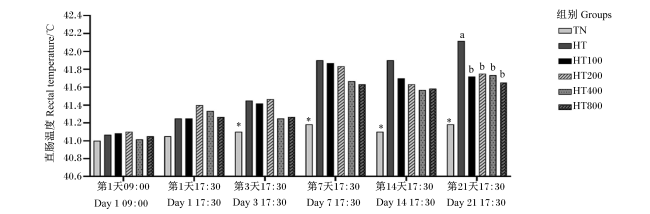
图1所示,热应激开始前(第1天09:00),6组肉鸡的直肠温度趋于一致。除第1天17:30这一时间点外,在其余的不同时间点,与TN组相比,HT组肉鸡直肠温度均显著提高(P<0.05);第21天17:30时,与HT组相比,饲粮中添加100、200、400和800 mg/kg肉桂醛均能显著降低肉鸡直肠温度(P<0.05),但各肉桂醛添加组之间差异不显著(P>0.05)。
图1 肉桂醛对热应激肉鸡直肠温度的影响

*表示TN组与HT组之间差异显著(P<0.05);在5个热应激组中,数据柱标注无字母或相同字母表示差异不显著(P>0.05),不同字母表示差异显著(P<0.05)。

Fig.1 Effects of cinnamaldehyde on rectal temperature of broilers under heat stress

* indicated significant difference between TN group and HT group (P<0.05); in the five heat stress groups, value columns with no letter or the same letters mean no significant difference (P>0.05), while with different small letters mean significant difference (P<0.05).

2.3 肉桂醛对热应激肉鸡血清生化指标的影响

表3可知,与TN组相比,HT组肉鸡血清ALT活性显著提高(P<0.05),血清AST和ALP活性以及GLU、TP、ALB和UN含量显著降低(P<0.05)。与HT组相比,HT800组肉鸡血清ALT活性显著降低(P<0.05),HT400组血清ALP活性显著提高(P<0.05);HT800组血清ALT活性显著低于HT200组(P<0.05),HT400组血清ALP活性显著高于HT100组(P<0.05)。随着饲粮中肉桂醛添加水平的提高,热应激下肉鸡血清ALT活性呈线性降低(P<0.05),血清ALP活性呈线性提高(P<0.05),血清AST活性呈二次变化(P<0.05)。
表3 肉桂醛对热应激肉鸡血清生化指标的影响

Table 3 Effects of cinnamaldehyde on serum biochemical indices of broilers under heat stress

项目
Items
组别Groups PP-value
TN HT HT100 HT200 HT400 HT800 t检验
t-test
方差分析
ANOVA
线性
Linear
二次
Quadratic
谷丙转氨酶
ALT/(U/L)
2.30
±0.55*
5.49
±0.89a
3.90
±0.69ab
5.05
±0.62a
3.59
±0.41ab
2.81
±0.41b
0.015 0.037 0.009 0.683
谷草转氨酶
AST/(U/L)
355.76
±13.82*
280.50
±13.63
336.76
±32.39
351.76
±15.82
368.07
±26.47
315.15
±15.26
0.003 0.077 0.160 0.014
碱性磷酸酶
ALP/(U/L)
2 235.50
±226.54*
1 465.23
±68.87bc
1 370.44
±156.69c
1 944.33
±138.62ab
2 061.82
±254.91a
1 957.58
±237.68ab
0.018 0.039 0.008 0.497
葡萄糖
GLU/(mmol/L)
14.17
±0.49*
12.01
±0.36
13.38
±0.59
12.51
±0.40
12.94
±0.75
12.38
±0.67
0.005 0.506 0.862 0.242
总蛋白
TP/(g/L)
43.26
±0.58*
40.18
±1.17
39.83
±2.10
38.19
±1.12
40.86
±2.01
35.07
±1.80
0.041 0.147 0.099 0.309
白蛋白
ALB/(g/L)
14.94
±0.29*
13.21
±0.39
13.91
±0.82
12.62
±0.55
14.37
±0.79
12.30
±0.79
0.005 0.209 0.533 0.341
尿素氮
UN/(mg/dL)
0.24
±0.03*
0.14
±0.02
0.19
±0.05
0.16
±0.05
0.20
±0.05
0.23
±0.04
0.027 0.641 0.184 0.902

2.4 肉桂醛对热应激肉鸡血清抗氧化指标的影响

表4可知,与TN组相比,HT组肉鸡血清T-SOD活性显著提高(P<0.05),血清T-AOC显著降低(P<0.05)。与HT组相比,HT200组、HT400组和HT800组肉鸡血清T-SOD活性显著提高(P<0.05),HT100组、HT200组和HT800组血清MDA含量显著降低(P<0.05),HT100组、HT200组、HT400组和HT800组血清T-AOC显著提高(P<0.05)。随着饲粮中肉桂醛添加水平的提高,热应激下肉鸡血清T-SOD活性和T-AOC呈线性提高(P<0.05)。
表4 肉桂醛对热应激肉鸡血清抗氧化指标的影响

Table 4 Effects of cinnamaldehyde on serum antioxidant indices of broilers under heat stress

项目
Items
组别Groups PP-value
TN HT HT100 HT200 HT400 HT800 t检验
t-test
方差分析
ANOVA
线性
Linear
二次
Quadratic
总超氧化物
歧化酶
T-SOD/(U/mL)
287.78
±13.62*
329.60
±11.11b
359.95
±18.43ab
376.88
±10.40a
379.25
±8.17a
383.11
±8.86a
0.039 0.024 0.003 0.144
丙二醛
MDA/
(nmol/mL)
3.33
±0.38
4.73
±1.20a
2.39
±0.34b
2.07
±0.23b
3.42
±0.24ab
2.61
±0.55b
0.307 0.042 0.118 0.054
总抗氧化能力
T-AOC/
(mmol/L)
0.51
±0.03*
0.35
±0.06b
0.49
±0.06a
0.52
±0.03a
0.51
±0.04a
0.57
±0.03a
0.036 0.030 0.005 0.261

2.5 肉桂醛对热应激肉鸡肠道通透性的影响

表5可知,与TN组相比,HT组肉鸡血清D-LA和LPS含量以及DAO活性均显著提高(P<0.05)。与HT组相比,HT100组、HT400组和HT800组肉鸡血清D-LA和LPS含量显著降低(P<0.05);HT100组血清DAO活性和LPS含量显著低于HT200组(P<0.05)。随着饲粮中肉桂醛添加水平的提高,热应激下肉鸡血清D-LA和LPS含量呈线性降低(P<0.05)。
表5 肉桂醛对热应激肉鸡肠道通透性的影响

Table 5 Effects of cinnamaldehyde on intestinal permeability of broilers under heat stress

项目
Items
组别Groups PP-value
TN HT HT100 HT200 HT400 HT800 t检验
t-test
方差分析
ANOVA
线性
Linear
二次
Quadratic
D-乳酸
D-LA/
(nmol/L)
19.52
±3.49*
54.92
±6.28a
32.46
±3.96b
45.11
±1.79ab
41.35
±5.89b
34.28
±2.32b
0.001 0.010 0.029 0.394
二胺氧化酶
DAO/(ng/mL)
11.51
±1.90*
23.00
±2.13a
13.69
±2.04b
20.77
±1.79a
18.14
±2.01ab
16.93
±2.58ab
0.002 0.046 0.263 0.423
脂多糖
LPS/(EU/mL)
279.60
±84.67*
640.55
±33.68a
382.00
±55.38c
536.97
±35.15ab
482.21
±51.02bc
426.74
±54.99bc
0.006 0.007 0.037 0.275

2.6 肉桂醛对热应激肉鸡肠道形态结构的影响

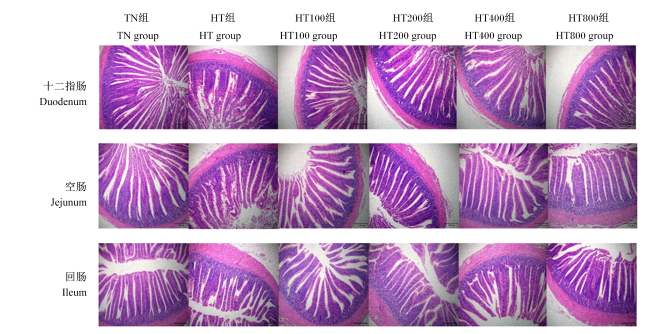
图2表6可知,与TN组相比,HT组肉鸡十二指肠和空肠绒毛高度显著降低(P<0.05),空肠V/C值显著降低(P<0.05)。与HT组相比,HT400组肉鸡空肠绒毛高度显著提高(P<0.05);HT400组空肠绒毛高度显著高于HT200组(P<0.05)。
图2 肉桂醛对热应激肉鸡肠道形态结构的影响

Fig.2 Effects of cinnamaldehyde on intestinal morphological structure of broilers under heat stress (40×)

表6 肉桂醛对热应激肉鸡肠道形态结构的影响

Table 6 Effects of cinnamaldehyde on intestinal morphological structure of broilers under heat stress

项目
Items
组别Groups PP-value
TN HT HT100 HT200 HT400 HT800 t检验
t-test
方差分析
ANOVA
线性
Linear
二次
Quadratic
十二指肠Duodenum
绒毛高度Villus height/μm 933.78
±36.02*
807.17
±41.65
813.44
±46.26
793.63
±17.04
801.81
±40.31
822.21
±42.01
0.044 0.988 0.882 0.702
隐窝深度
Crypt depth/μm
121.98
±13.39
115.67
±3.77
116.13
±6.25
115.03
±5.54
105.92
±2.99
116.99
±6.01
0.660 0.537 0.642 0.494
绒隐比
V/C
7.93
±0.53
6.98
±0.26
7.04
±0.34
6.96
±0.27
7.60
±0.42
7.06
±0.32
0.141 0.624 0.495 0.697
空肠Jejunum
绒毛高度
Villus height/
μm
791.50
±50.58*
642.36
±20.74b
696.92
±38.07ab
673.94
±28.07b
771.13
±25.03a
690.63
±22.99ab
0.021 0.040 0.062 0.160
隐窝深度
Crypt depth/
μm
118.04
±12.47
125.17
±7.74
113.38
±7.36
110.56
±5.23
112.41
±5.33
123.28
±9.53
0.637 0.494 0.836 0.076
绒隐比
V/C
6.88
±0.47*
5.26
±0.45
6.24
±0.45
6.22
±0.56
6.94
±0.39
5.81
±0.56
0.031 0.202 0.251 0.068
回肠Ileum
绒毛高度
Villus height/
μm
595.49
±26.21
527.30
±32.49
544.30
±29.98
538.16
±47.63
555.96
±28.17
552.48
±25.21
0.133 0.975 0.565 0.893
隐窝深度
Crypt depth/
μm
120.26
±6.62
110.38
±3.29
115.93
±6.48
112.42
±10.58
126.87
±6.07
124.99
±4.15
0.211 0.311 0.066 0.901
绒隐比
V/C
5.03
±0.38
4.77
±0.21
4.74
±0.25
4.96
±0.61
4.45
±0.37
4.46
±0.29
0.560 0.848 0.452 0.644

3 讨论

3.1 肉桂醛对热应激肉鸡生长性能的影响

由环境高温导致的热应激会引起机体氧化损伤,从而降低肉鸡采食量和养分吸收能力[21]。有研究报道,30~33 ℃热应激会使22~42日龄肉鸡采食量降低21.51%,体增重降低24.46%[22]。Meng等[23]研究发现,28日龄肉鸡在热应激[(37±2) ℃,8 h/d,09:00—17:00]下饲喂14 d后,FBW、ADG和ADFI显著降低。本研究中,21日龄肉鸡在(33±2) ℃(8 h/d,09:30—17:30)热应激下饲喂21 d后,FBW、ADG和ADFI分别显著降低了16.27%、23.13%和16.09%,F/G显著提高,这与前人研究结果基本一致,这都表明了不同的热应激模型会对肉鸡的生长产生负面影响。Mohammed等[24]研究表明,15日龄肉鸡在持续28 d的热应激(32 ℃,9 h/d,08:00—17:00)过程中会表现展翅、摄食和站立减少以及气喘和饮水增加的行为。在本试验热应激过程中,也观察到了与之相似的热应激行为,这些负面行为可能是影响肉鸡正常采食的一个原因。热应激下肉鸡生长迟缓的原因可能一方面是由于热应激能够激活下丘脑-垂体-肾上腺(HPA)轴,影响肉鸡摄食中枢和消化交感神经,从而降低了食欲基因神经肽Y(NPY)的表达[25];另一方面,热应激下肉鸡体温升高会加快血液循环和外周血流速度,并减缓内脏血流速度,导致养分吸收利用率低;此外,热应激会使肉鸡的健康状态受到影响,包括内分泌失调、免疫力低下和氧化损伤等[26]
研究表明,热应激下在饲粮中添加200 mg/kg肉桂醛饲喂42 d能够提高21日龄肉鸭ADG,显著降低F/G[27];在持续28 d的热应激(34 ℃,9 h/d)下在饲粮中添加125 mg/kg肉桂醛和香芹酚提取物的植物精油混合物能够显著降低肉鸡采食量[28];在热应激[(32±1) ℃,8 h/d]下,饲粮中添加1%肉桂粉能使25~42日龄肉鸡的体重和采食量显著提高,F/G显著降低[29]。同样,在本研究中,与HT组相比,在热应激期间饲粮中添加400或800 mg/kg肉桂醛饲喂21 d后,能显著提高肉鸡FBW和ADG,显著降低F/G,并且有提高ADFI的趋势,这表明肉桂醛有效缓解了热应激引起的生长抑制。肉桂醛能提高热应激下肉鸡的生长性能这可能与其自身的抗氧化特性和能够维持肠道健康有关。在本试验持续21 d的热应激下,肉鸡体内ROS会不断产生并触发氧化应激,引起组织细胞的氧化损伤[30],而肉桂醛可以清除过多的ROS,降低ROS水平,使抗氧化酶活性提高,促进机体正常新陈代谢[31];热应激下,肠道黏膜屏障功能也会受损,这为细菌及毒素易位、侵入机体创造条件,会导致全身性多器官功能紊乱,机体内环境稳定失衡[32],而肉桂醛能通过减少胞内氧化损伤和提高肠绒毛高度,来防止毒素和自由基的入侵[17]

3.2 肉桂醛对热应激肉鸡直肠温度的影响

当环境温度达到28 ℃时,肉鸡体表温度会逐渐上升,使机体处于热应激状态。直肠温度是衡量热应激的指标之一,在肉鸡中表示机体热量获得和热量损失之间的平衡[33]。在高温环境下,恒温动物的体温将超过其热中性区[34],随后体温调节机制遭到破坏。研究表明,在21 d的热暴露期间,32 ℃下肉鸡的体温明显高于21 ℃下饲养禽类的体温0.5~1.0 ℃[35]。本试验对6个不同时间点肉鸡的直肠温度进行了测量,结果显示,与TN组相比,HT组肉鸡直肠温度从第3天17:30起至热应激结束均显著提高,直肠温度的升高表明热应激模型建立成功,这与前人的研究结果[36]基本一致。此外,本研究结果表明在热应激第21天时,饲粮中添加不同水平肉桂醛均能显著肉鸡降低直肠温度,这表明肉桂醛可能会对某些与温度调节有关的激素发挥潜在的调控作用。

3.3 肉桂醛对热应激肉鸡血清生化指标的影响

血清代谢酶和常规代谢指标的变化反映了热应激所引起的机体氧化损伤。血清ALT、AST、乳酸脱氢酶(LDH)和ALP活性异常可作为肝脏和肌肉损伤的标志[37]。正常情况下,AST和ALT都在细胞中,只有一少部分才会流入到血液中,当细胞遭受损害后,细胞膜通透性会增加,大量的物质就被释放到了血液中[38]。有研究表明,在热应激下,血清ALT和AST活性显著提高,血清ALP活性显著降低[39-40]。在本试验条件下,热应激会显著提高肉鸡血清ALT活性,显著降低血清ALP活性,这表明经过热应激处理的肉鸡可能出现了肝脏损伤和肌肉组织ATP分解能力的下降。此外,本研究发现,饲粮中添加肉桂醛可以降低热应激下肉鸡血清ALT活性,提高血清ALP活性。同样,有研究表明,肉桂醛可以显著降低鼠伤寒沙门氏菌感染小鼠血清ALT和AST活性[41],这均说明肉桂醛可以缓解热应激对肝脏的损伤,且这可能与其本身的抗氧化特性有关。
GLU、TP和甘油三酯(TG)这三大物质代谢指标反映了机体糖、蛋白质和脂肪的代谢状况。Luo等[42]研究表明,14日龄肉鸡在热应激(35 ℃,07:00—19:00)下饲喂21 d后,血清GLU和TP含量显著降低。然而,有研究发现,28日龄肉鸡始终暴露于32 ℃热应激下持续7 d后,血浆GLU和TG含量显著提高[43]。在本研究中,持续21 d(33±2) ℃(8 h/d,09:30—17:30)的热应激后,肉鸡血清GLU、TP和ALB含量均显著降低。由以上结果可以看出,关于热应激对血清GLU含量的影响研究并不一致,GLU含量变化的差异可能是由于热应激持续的时长、饲喂的时间以及试验动物的品种和日龄的不同所导致的,但均反映了热应激能扰乱机体内GLU代谢。本试验中,血清GLU含量的显著降低可能是由于机体内的糖酵解会随着热应激的延长而增强,糖原被分解利用所导致;而血清TP和ALB含量显著降低,可能是由于肉鸡在热应激下采食量减少、饮水过多,排出稀粪过多,蛋白质在体内形成尿素随尿液排出体外,以及蛋白质合成减少所导致。

3.4 肉桂醛对热应激肉鸡抗氧化能力的影响

在机体正常生理状态下,ROS通常被严格调控在一个非常低的水平上,并被认为是一种重要的信号分子,参与多种细胞信号转导途径。在热应激条件下,ROS的不断生成会引发机体基因突变、蛋白质变性和脂质过氧化发生[30,44]。有大量研究表明,热应激会使肉鸡血清MDA含量提高,血清T-SOD、过氧化氢酶(CAT)、谷胱甘肽过氧化物酶(GSH-Px)活性和T-AOC降低,进而损害体内抗氧化防御体系和脂质过氧化功能[45-46]。本研究结果也表明,热应激会使肉鸡血清MDA含量提高,血清T-AOC显著降低,但血清T-SOD活性显著提高。本试验中,血清T-SOD活性的升高可能是由于持续21 d的热应激使肉鸡遭受了足够的热刺激,体内ROS处于一个升高的状态,而机体突然升高的ROS会刺激到抗氧化酶系统,进而提高机体本身清除自由基抵御氧化应激的能力,导致血清T-SOD活性升高[47-48]
本研究结果表明,饲粮中添加200、400和800 mg/kg肉桂醛能使热应激下肉鸡血清T-SOD活性和T-AOC显著提高,血清MDA含量显著降低。这与宋文静等[27]的研究结果相一致,该研究表明,饲粮中添加200 mg/kg肉桂醛可以通过提高肉鸭血清超氧化物歧化酶(SOD)、GSH-Px活性和T-AOC,以及降低血清MDA含量来减轻肉鸭的热应激。姚佳等[49]研究表明,饲粮中添加300 mg/kg肉桂醛能提高东北白鹅血清T-SOD活性,降低血清MDA含量。Gowder等[50]研究表明,肉桂醛可以提高大鼠肾脏GSH-Px和SOD活性。肉桂醛作为一种潜在的抗氧化剂,能够为自由基提供氢或自由电子,使游离电子离开芳环结构[51],这决定了其具有较强的体外和体内抗氧化能力,其结构式中与羰基直接相连的α-碳原子上的氢具有较强还原性,可通过氧化还原反应使ROS成为稳定物,从而减少ROS对细胞的损伤,进而在一定程度上减轻高温胁迫对肉鸡的氧化损伤,增强机体的抗氧化能力。

3.5 肉桂醛对热应激肉鸡肠道健康的影响

3.5.1 肉桂醛对热应激肉鸡肠道通透性的影响

血清D-LA和LPS含量以及DAO活性通常是被用来作为评价肠道黏膜屏障完整性和通透性的标志物指标[52]D-LA来源于丙酮酸,主要是肠道内大肠杆菌、克雷伯氏菌和乳酸杆菌等发酵的代谢物,机体一旦发生热应激引起肠黏膜缺血缺氧时,D-LA会在肠黏膜受损早期透过肠黏膜进入血液门静脉循环中[53]。DAO是由肠上皮细胞合成的具有较高活性的胞内酶,其活性的高低与肠绒毛高度和黏膜细胞内核酸蛋白的合成有关[54],在肠绒毛受损后会易位进入血液。LPS是革兰氏阴性细菌外膜的一类内毒素,在菌体裂解时被大量释放出来[55],当肠道通透性增加时会从肠道入侵血液。Li等[56]研究发现,21日龄肉鸡在热应激(35 ℃,8 h/d)下饲喂7 d后血清D-LA含量显著提高,饲喂21 d后血清LPS含量显著提高。Cheng等[57]研究发现,1日龄肉鸡处于32~33 ℃(8 h/d)的热应激下饲喂21和42 d后,血清D-LA含量和DAO活性均显著提高。同样,本研究中,热应激下肉鸡血清D-LA和LPS含量以及DAO活性均显著提高。这表明热应激会损害机体外周血液循环,局部剥夺小肠的氧气,导致组织缺氧、ATP储存耗尽和细胞内酸中毒,并改变离子泵活性增加小肠上皮紧密连接的通透性,进而损害肠道屏障功能[58]
本试验结果发现,饲粮中添加肉桂醛可以抑制热应激引起的肉鸡血清D-LA和LPS含量以及DAO活性的升高,这说明肉桂醛对热应激引起的肠道屏障损伤和肠道通透性增加有潜在的缓解作用。推测可能是肉桂醛能通过清除过量的ROS来缓解热应激引起的肠黏膜损害,这是降低血清LPS含量的关键;此外,肉桂醛对多种细菌有抑制和杀灭作用,可防止大肠杆菌的增殖和黏附,进而降低热应激导致的血清D-LA含量的升高;有研究发现,肉桂醛能限制半胱氨酸天冬氨酸特异性蛋白酶-9/3(caspase-9/3)活性,调控B细胞淋巴瘤-2相关X蛋白(Bax)和B细胞淋巴瘤-2(Bcl-2)表达来降低谷氨酸诱导的PC12细胞凋亡[59],这提示肉桂醛降低血清DAO活性可能是由于其对黏膜细胞的损伤具有潜在保护作用。

3.5.2 肉桂醛对热应激肉鸡肠道形态结构的影响

肠道结构的完整是维护肠黏膜正常功能的关键,绒毛高度和隐窝深度是代表肠道健康状况的重要指标[60]。热应激会引起肠道缺血,导致上皮细胞脱落和损伤,黏膜层绒毛易发生断裂,主要表现为绒毛高度变短和隐窝深度提高,V/C值降低[61]。He等[62]研究发现,28日龄肉鸡始终保持在32 ℃热应激下14 d后,空肠绒毛高度显著降低,隐窝深度显著提高。Du等[45]研究发现,21日龄肉鸡在持续21 d 33 ℃、8 h/d的热应激模型下,空肠的形态结构变化与He等[62]的试验结果相一致。本试验结果表明,与TN组相比,热应激降低了肉鸡十二指肠和空肠的绒毛高度。肠道形态结构的变化说明肠道吸收养分的能力受到了影响,这也是热应激影响肉鸡生长性能下降的一个重要原因。
本试验结果表明,饲粮中添加400 mg/kg肉桂醛能显著提高热应激肉鸡空肠绒毛高度,有提高空肠V/C值的趋势。宋文静等[27]研究表明,饲粮中添加200 mg/kg肉桂醛可以提高热应激肉鸭空肠绒毛高度和V/C值。段瑞[63]研究发现,饲粮中添加300 mg/kg肉桂油能使肉鸡十二指肠绒毛高度和空肠V/C值显著提高。肉桂醛对肠道形态的改善可能得益于其自身的抑菌和抗氧化作用,肉桂醛对大肠杆菌和沙门氏菌等有着显著的抑制作用[64-65],可通过减少致病菌的数量来提高肠绒毛的再生能力。研究表明,肉桂醛能阻止细胞氧化,使肠绒毛免受毒素和过氧化代谢物的损伤,进而使肠绒毛得到稳定生长[17]。除此之外,肉桂醛能提高肉鸡小肠内丁酸含量,而丁酸能给肠道提供能量,并刺激肠上皮细胞的增生与分化[66]。因此,肉桂醛对维持肠道形态的完整性具有一定的积极作用。

4 结论

饲粮中添加肉桂醛可以缓解热应激下肉鸡直肠温度的升高,提高机体抗氧化能力,并通过改善肠道通透性和形态结构来维持肠道健康,进而提高肉鸡生长性能;综合考虑以上结果和生产实际,推荐肉鸡饲粮中抗热应激的肉桂醛适宜添加水平为400 mg/kg。
[1]
LARA L J, ROSTAGNO M H. Impact of heat stress on poultry production[J]. Animals, 2013, 3(2):356-369.

DOI PMID

[2]
HE S P, AROWOLO M A, MEDRANO R F, et al. Impact of heat stress and nutritional interventions on poultry production[J]. World’s Poultry Science Journal, 2018, 74(4):647-664.

[3]
NAWAB A, IBTISHAM F, LI G H, et al. Heat stress in poultry production:mitigation strategies to overcome the future challenges facing the global poultry industry[J]. Journal of Thermal Biology, 2018, 78:131-139.

[4]
HU R Z, HE Y J, AROWOLO M A, et al. Polyphenols as potential attenuators of heat stress in poultry production[J]. Antioxidants, 2019, 8(3):67.

[5]
LAURIDSEN C. From oxidative stress to inflammation:redox balance and immune system[J]. Poultry Science, 2019, 98(10):4240-4246.

[6]
SHAKERI M, OSKOUEIAN E, LE H H, et al. Strategies to combat heat stress in broiler chickens: unveiling the roles of selenium,vitamin E and vitamin C[J]. Veterinary Sciences, 2020, 7(2):71.

[7]
DEL B A S, MANSILLA W D, NAVARRO V A, et al. Effect of mineral and vitamin C mix on growth performance and blood corticosterone concentrations in heat-stressed broilers[J]. Journal of Applied Poultry Research, 2020, 29(1):23-33.

[8]
GOUDA A, AMER S A, GABR S, et al. Effect of dietary supplemental ascorbic acid and folic acid on the growth performance,redox status,and immune status of broiler chickens under heat stress[J]. Tropical Animal Health and Production, 2020, 52(6):2987-2996.

[9]
欧阳经鑫. 饲粮添加色氨酸对热应激肉鸡抗氧化能力,线粒体生物合成作用及炎症反应的影响[D]. 硕士学位论文. 南昌: 江西农业大学, 2023.

OUYANG J X. Effects of dietary tryptophan supplementation on antioxidant capacity,mitochondrial biogenesis and inflammatory response of heat-stressed broilers[D]. Master’s Thesis. Nanchang: Jiangxi Agricultural University, 2023. (in Chinese)

[10]
王喜峰. 枯草芽孢杆菌和乳酸菌对热应激肉鸡生产性能、肉品质、免疫器官和盲肠菌群的影响[D]. 硕士学位论文. 蚌埠: 安徽科技学院, 2020.

WANG X F. Effects of Bacillus subtilis and Lactobacillus on production performance,meat quality,immune organs and cecal microflora of heat-stressed broilers[D]. Master’s Thesis. Bengbu: Anhui Science and Technology University, 2020. (in Chinese)

[11]
HU H, BAI X, XU K X, et al. Effect of phloretin on growth performance,serum biochemical parameters and antioxidant profile in heat-stressed broilers[J]. Poultry Science, 2021, 100(8):101217.

[12]
YILMAZ E, GUL M. Effects of dietary supplementation of cumin (Cuminum cyminum L.) essential oil on expression of genes related to antioxidant,apoptosis,detoxification,and heat shock mechanism in heat-stressed broiler chickens[J]. Animal Biotechnology, 2023, 34(7):2766-2777.

[13]
许勇, 程必强, 丁靖凯, 等. 中国广西、云南肉桂资源及其生长发育习性、出油率的调查[J]. 热带农业科技, 2004, 27(3):4-7,26.

XU Y, CHENG B Q, DING J K, et al. Investigation on cinnamon resource,growth and yield of oil in Guangxi and Yunnan[J]. Tropical Agricultural Science & Technology, 2004, 27(3):4-7,26. (in Chinese)

[14]
周明, 吴东, 王孟春, 等. 肉桂醛替代肉用仔鸡日粮中抗生素的使用效果[J]. 中国农业大学学报, 2019, 24(4):94-101.

ZHOU M, WU D, WANG M C, et al. Substitution effects of cinnamylaldehyde for antibiocs in broiler diet[J]. Journal of China Agricultural University, 2019, 24(4):94-101. (in Chinese)

[15]
周明, 王恩典, 汪炳红, 等. 肉桂醛替代保育猪饲粮中金霉素和杆菌肽锌[J]. 动物营养学报, 2016, 28(7):2106-2112.

DOI

ZHOU M, WANG E D, WANG B H, et al. Substitution of cinnamyl aldehyde for aureomycin and bacitracin zinc in nursery pig diet[J]. Chinese Journal of Animal Nutrition, 2016, 28(7):2106-2112. (in Chinese)

[16]
JAMROZ D, WILICZKIEWICZ A, WERTELECKI T, et al. Use of active substances of plant origin in chicken diets based on maize and locally grown cereals[J]. British Poultry Science, 2005, 46(4):485-493.

DOI PMID

[17]
CASTILLO M,MARTÍN-ORÚE S M,ROCA M,et al. The response of gastrointestinal microbiota to avilamycin,butyrate,and plant extracts in early-weaned pigs[J]. Journal of Animal Science,2006,84(10):2725-2734.

[18]
中华人民共和国农业部. 鸡饲养标准:NY/T 33—2004[S]. 北京: 中国农业出版社, 2004.

Ministry of Agriculture of the People’s Republic of China. Feeding standard of chicken:NY/T 33—2004[S]. Beijing: China Agriculture Press, 2004. (in Chinese)

[19]
熊本海, 罗清尧, 郑姗姗, 等. 中国饲料成分及营养价值表(2020年第31版)制订说明[J]. 中国饲料, 2020(21):87-97.

XIONG B H, LUO Q Y, ZHENG S S, et al. Formulation of China feed composition and nutritional value table (31st edition 2020)[J]. China Feed, 2020(21):87-97. (in Chinese)

[20]
何邵平. 白藜芦醇对热应激黄羽肉鸡免疫功能调控及分子机制研究[D]. 博士学位论文. 长沙: 湖南农业大学, 2019.

HE S P. Research on the regulation and molecular mechanism of resveratrol on immune function of yellow-feather broilers under heat stress[D]. Ph.D. Thesis. Changsha: Hunan Agricultural University, 2019. (in Chinese)

[21]
KHAN R U, NAZ S, ULLAH H, et al. Physiological dynamics in broiler chickens under heat stress and possible mitigation strategies[J]. Animal Biotechnology, 2023, 34(2):438-447.

[22]
KIKUSATO M, XUE G D, PASTOR A, et al. Effects of plant-derived isoquinoline alkaloids on growth performance and intestinal function of broiler chickens under heat stress[J]. Poultry Science, 2021, 100(2):957-963.

DOI PMID

[23]
MENG T T, DENG J Y, XIAO D F, et al. Protective effects and potential mechanisms of dietary resveratrol supplementation on the spleen of broilers under heat stress[J]. Frontiers in Nutrition, 2022, 9:821272.

[24]
MOHAMMED A A, JACOBS J A, MURUGESAN G R, et al. Effect of dietary synbiotic supplement on behavioral patterns and growth performance of broiler chickens reared under heat stress[J]. Poultry Science, 2018, 97(4):1101-1108.

DOI PMID

[25]
HE X F, LU Z, MA B B, et al. Chronic heat stress alters hypothalamus integrity,the serum indexes and attenuates expressions of hypothalamic appetite genes in broilers[J]. Journal of Thermal Biology, 2019, 81:110-117.

[26]
HABASHY W S, MILFORT M C, FULLER A L, et al. Effect of heat stress on protein utilization and nutrient transporters in meat-type chickens[J]. International Journal of Biometeorology, 2017, 61(12):2111-2118.

DOI PMID

[27]
宋文静, 韦启鹏, 赵品, 等. 包被肉桂醛对夏季高温条件下肉鸭生长性能、屠宰性能、血清抗氧化指标及空肠形态结构的影响[J]. 动物营养学报, 2020, 32(3):1188-1195.

DOI

SONG W J, WEI Q P, ZHAO P, et al. Effects of coated cinnamaldehyde on growth performance,slaughter performance,serum antioxidant indexes and jejunum morphology of meat ducks under high temperature in summer[J]. Chinese Journal of Animal Nutrition, 2020, 32(3):1188-1195. (in Chinese)

[28]
金淑霞, 张俊文, 魁海刚. 植物提取物对循环热应激肉鸡生长性能、肠绒毛形态及消化酶活性的影响[J]. 中国饲料, 2022(6):41-44.

JIN S X, ZHANG J W, KUI H G. Effects of plant extracts on growth performance,intestinal villus morphology and digestive enzyme activities of broilers under cyclic heat stress[J]. China Feed, 2022(6):41-44. (in Chinese)

[29]
KHAN K, AHMAD N, TAHIR M, et al. Alleviation of negative effect of heat stress through supplementations of cinnamon (Cinnamomum zeylanicum) and turmeric (Curcuma longa L) powders in diets of broiler chickens[J]. Animal Biotechnology, 2023, 34(9):4457-4465.

[30]
VENDITTI P, DI MEO S. The role of reactive oxygen species in the life cycle of the mitochondrion[J]. International Journal of Molecular Sciences, 2020, 21(6):2173.

[31]
LIU M, XU L C, LIU W J, et al. Cinnamaldehyde regulates the synthesis of Alternaria alternata non-host selective toxins by influencing PKS gene expression and oxidoreductase activity[J]. Industrial Crops and Products, 2020, 145:112074.

[32]
ZHANG Q, EICHER S D, AJUWON K M, et al. Development of a chicken ileal explant culture model for measurement of gut inflammation induced by lipopolysaccharide[J]. Poultry Science, 2017, 96(9):3096-3103.

DOI PMID

[33]
EDGAR J L, NICOL C J, PUGH C A, et al. Surface temperature changes in response to handling in domestic chickens[J]. Physiology & Behavior, 2013, 119:195-200.

[34]
BERNABUCCI U, LACETERA N, BAUMGARD L H, et al. Metabolic and hormonal acclimation to heat stress in domesticated ruminants[J]. Animal, 2010, 4(7):1167-1183.

DOI PMID

[35]
COOPER M A, WASHBURN K W. The relationships of body temperature to weight gain,feed consumption,and feed utilization in broilers under heat stress[J]. Poultry Science, 1998, 77(2):237-242.

[36]
LU Z, HE X F, MA B B, et al. The alleviative effects and related mechanisms of taurine supplementation on growth performance and carcass characteristics in broilers exposed to chronic heat stress[J]. Poultry Science, 2019, 98(2):878-886.

DOI PMID

[37]
XUE B, SONG J, LIU L Z, et al. Effect of epigallocatechin gallate on growth performance and antioxidant capacity in heat-stressed broilers[J]. Archives of Animal Nutrition, 2017, 71(5):362-372.

DOI PMID

[38]
CHENG P, WANG T, LI W, et al. Baicalin alleviates lipopolysaccharide-induced liver inflammation in chicken by suppressing TLR4-mediated NF-κB pathway[J]. Frontiers in Pharmacology, 2017, 8:547.

DOI PMID

[39]
WANG M C, ZHANG J K, HUANG X Q, et al. Effects of dietary Macleaya cordata extract on growth performance,biochemical indices,and intestinal microbiota of yellow-feathered broilers subjected to chronic heat stress[J]. Animals, 2022, 12(17):2197.

[40]
YANG Q H, WANG X X, WANG C, et al. Effects of taurine on serum indexes of broilers with chronic heat stress[M]. Cham: Springer International Publishing, 2022:153-160.

[41]
WANG R J, LI S L, JIA H, et al. Protective effects of cinnamaldehyde on the inflammatory response,oxidative stress,and apoptosis in liver of Salmonella typhimurium-challenged mice[J]. Molecules, 2021, 26(8):2309.

[42]
LUO J X, SONG J, LIU L Z, et al. Effect of epigallocatechin gallate on growth performance and serum biochemical metabolites in heat-stressed broilers[J]. Poultry Science, 2018, 97(2):599-606.

DOI PMID

[43]
LU Z, HE X F, MA B B, et al. Increased fat synthesis and limited apolipoprotein B cause lipid accumulation in the liver of broiler chickens exposed to chronic heat stress[J]. Poultry Science, 2019, 98(9):3695-3704.

DOI PMID

[44]
MISHRA B, JHA R. Oxidative stress in the poultry gut: potential challenges and interventions[J]. Frontiers in Veterinary Science, 2019, 6:60.

DOI PMID

[45]
DU M F, CHENG Y F, CHEN Y P, et al. Correction to: dietary supplementation with synbiotics improves growth performance,antioxidant status,immune function,and intestinal barrier function in broilers subjected to cyclic heat stress[J]. Environmental Science and Pollution Research International, 2023, 30(7):18039.

[46]
YANG T, LIU B F, WANG Y J, et al. Ellagic acid improves antioxidant capacity and intestinal barrier function of heat-stressed broilers via regulating gut microbiota[J]. Animals, 2022, 12(9):1180.

[47]
AKBARIAN A, MICHIELS J, DEGROOTE J, et al. Association between heat stress and oxidative stress in poultry;mitochondrial dysfunction and dietary interventions with phytochemicals[J]. Journal of Animal Science and Biotechnology, 2016, 7:37.

[48]
BELLEZZA I, GIAMBANCO I, MINELLI A, et al. Nrf2-Keap1 signaling in oxidative and reductive stress[J]. Biochimica et Biophysica Acta:Molecular Cell Research, 2018, 1865(5):721-733.

[49]
姚佳, 肖世平, 徐昊翔. 肉桂醛对1-21日龄东北白鹅生长性能、免疫器官指数和血清抗氧化功能的影响[J]. 饲料广角, 2016(20):38-40.

YAO J, XIAO S P, XU H X. Effects of cinnamaldehyde on growth performance,immune organ index and serum antioxidant function of Northeast White geese aged 1 to 21 days[J]. Feed China, 2016(20):38-40. (in Chinese)

[50]
GOWDER S J T, DEVARAJ H. Effect of the food flavour cinnamaldehyde on the antioxidant status of rat kidney[J]. Basic & Clinical Pharmacology & Toxicology, 2006, 99(5):379-382.

[51]
FERNANDEZ-PANCHON M S, VILLANO D, TRONCOSO A M, et al. Antioxidant activity of phenolic compounds:from in vitro results to in vivo evidence[J]. Critical Reviews in Food Science and Nutrition, 2008, 48(7):649-671.

[52]
雷小文, 颜语, 吴丽娟, 等. 饲粮添加蚯蚓液对高温环境下肉鸡生长性能、小肠抗氧化能力和屏障功能的影响[J]. 江苏农业科学, 2023, 51(10):163-167.

LEI X W, YAN Y, WU L J, et al. Effects of dietary earthworm solution on growth performance,intestinal antioxidant capacity and barrier function of broilers under high temperature environment[J]. Jiangsu Agricultural Sciences, 2023, 51(10):163-167. (in Chinese)

[53]
程源. 血清D-乳酸、I-FABP在腹部大手术后不同时间点肠屏障功能障碍中的预警价值研究[D]. 硕士学位论文. 昆明: 昆明医科大学, 2019.

CHENG Y. Research on early warning value of serum D-lactate and I-FABP in the intestinal barrier dysfunction at different time after abdominal operation[D]. Master’s Thesis. Kunming: Kunming Medical University, 2019. (in Chinese)

[54]
李军. 多发伤患者二胺氧化酶的变化及与胃肠功能的相关性研究[D]. 硕士学位论文. 石河子: 石河子大学, 2017.

LI J. Changes of plasma diamine oxidase levels in multiple-injury patients And its relation with gastrointestinal dysfunction[D]. Master’s Thesis. Shihezi: Shihezi University, 2017. (in Chinese)

[55]
吴彪, 王春友. 急性胰腺炎肠道屏障功能损伤时血浆内毒素和D-乳酸的变化[J]. 中国普通外科杂志, 2009, 18(3):224-227.

WU B, WANG C Y. Changes of plasma endotoxin and D-lactate during intestinal mucosal barrier injury of acute pancreatitis[J]. Chinese Journal of General Surgery, 2009, 18(3):224-227. (in Chinese)

[56]
LI Q F, WAN G, PENG C Y, et al. Effect of probiotic supplementation on growth performance,intestinal morphology,barrier integrity,and inflammatory response in broilers subjected to cyclic heat stress[J]. Animal Science Journal, 2020, 91(1):e13433.

[57]
CHENG Y F, CHEN Y P, CHEN R, et al. Dietary mannan oligosaccharide ameliorates cyclic heat stress-induced damages on intestinal oxidative status and barrier integrity of broilers[J]. Poultry Science, 2019, 98(10):4767-4776.

DOI PMID

[58]
RAZA M, DEO C, MANDAL A, et al. Effect of dietary supplementation of selenium and vitamin E on growth performance and hematology of broiler chicken under heat stress[J]. Indian Journal of Poultry Science, 2018, 53:171-176.

[59]
LV C, YUAN X, ZENG H W, et al. Protective effect of cinnamaldehyde against glutamate-induced oxidative stress and apoptosis in PC12 cells[J]. European Journal of Pharmacology, 2017, 815:487-494.

DOI PMID

[60]
HE X F, LU Z, MA B B, et al. Effects of chronic heat exposure on growth performance,intestinal epithelial histology,appetite-related hormones and genes expression in broilers[J]. Journal of the Science of Food and Agriculture, 2018, 98(12):4471-4478.

[61]
ROSTAGNO M H. Effects of heat stress on the gut health of poultry[J]. Journal of Animal Science, 2020, 98(4):skaa090.

[62]
HE X F, LU Z, MA B B, et al. Effects of dietary taurine supplementation on growth performance,jejunal morphology,appetite-related hormones,and genes expression in broilers subjected to chronic heat stress[J]. Poultry Science, 2019, 98(7):2719-2728.

[63]
段瑞. 包被肉桂油对肉鸡生长性能影响的机制研究[D]. 硕士学位论文. 武汉: 武汉轻工大学, 2018.

DUAN R. The Influence of coated cinnamon oil on the growth performance of broilers and the related mechanism[D]. Master’s Thesis. Wuhan: Wuhan Polytechnic University, 2018. (in Chinese)

[64]
何学文, 戴雨芸, 李欣越, 等. 肉桂醛体外对鼠伤寒沙门氏菌的抑菌机制[J]. 江西农业大学学报, 2020, 42(1):150-156.

HE X W, DAI Y Y, LI X Y, et al. Antibacterial mechanism of cinnamaldehyde on Salmonella typhimurium in vitro[J]. Acta Agriculturae Universitatis Jiangxiensis, 2020, 42(1):150-156. (in Chinese)

[65]
HE T F, ZHANG Z H, ZENG X A, et al. Determination of membrane disruption and genomic DNA binding of cinnamaldehyde to Escherichia coli by use of microbiological and spectroscopic techniques[J]. Journal of Photochemistry and Photobiology B:Biology, 2018, 178:623-630.

[66]
TIIHONEN K, KETTUNEN H, BENTO M H L, et al. The effect of feeding essential oils on broiler performance and gut microbiota[J]. British Poultry Science, 2010, 51(3):381-392.

DOI PMID

文章导航

/