研究论文

鞣花酸对大口黑鲈生长与肠道健康的影响

  • 孔秋宏 , 1 ,
  • 袁菁菁 1 ,
  • 周贤君 , 1, * ,
  • 施晓丽 1 ,
  • 张建宇 2 ,
  • 曲德鹏 3
展开
  • 1 贵州大学动物科学学院,贵阳 550025
  • 2 贵阳市农产品质量安全监督检验测试中心,贵阳 550009
  • 3 贵阳市乡村振兴中心,贵阳 550081
* 周贤君,副教授,硕士生导师,E-mail:

孔秋宏(1997—),男,贵州遵义人,硕士研究生,从事水产动物营养学研究。E-mail:

Office editor: 武海龙

收稿日期: 2024-03-15

  网络出版日期: 2024-09-08

基金资助

野生大刺鳅人工扩繁驯养技术研究与应用(701836222104)

Effects of Ellagic Acid on Growth and Intestinal Health of Largemouth Bass (Micropterus salmoides)

  • KONG Qiuhong , 1 ,
  • YUAN Jingjing 1 ,
  • ZHOU Xianjun , 1, * ,
  • SHI Xiaoli 1 ,
  • ZHANG Jianyu 2 ,
  • QU Depeng 3
Expand
  • 1 College of Animal Science, Guizhou University, Guiyang 550025, China
  • 2 Guiyang Agricultural Products Quality and Safety Supervision, Inspection and Testing Center, Guiyang 550009, China
  • 3 Guiyang Rural Revitalization Center, Guiyang 550081, China
* associate professor, E-mail:

Received date: 2024-03-15

  Online published: 2024-09-08

摘要

本试验旨在探究鞣花酸对大口黑鲈生长与肠道健康的影响。选取初始体重为(59.17±0.06) g的大口黑鲈450尾,随机分成5个组,每组3个重复,每个重复30尾。各组分别投喂鞣花酸添加水平为0(对照组)、0.01%(EA1组)、0.02%(EA2组)、0.03%(EA3组)、0.04%(EA4组)的5种等氮等脂试验饲料。试验期为56 d。结果表明:1)EA4组的终末体重、增重率和特定生长率显著高于对照组(P<0.05)。各组之间肝体比、肥满度、饲料系数、摄食率和存活率无显著差异(P>0.05)。2)各组之间全鱼水分、粗灰分、粗蛋白质、粗脂肪含量及肝脏粗脂肪含量无显著差异(P>0.05)。3)各组之间血清补体3、补体4含量和酸性磷酸酶、溶菌酶活性无显著差异(P>0.05)。EA4组的血清碱性磷酸酶活性显著高于对照组(P<0.05)。4)各组之间肠道胰蛋白酶、脂肪酶和淀粉酶活性无显著差异(P>0.05)。5)与对照组相比,试验组的肠道绒毛高度、绒毛宽度和绒毛数量均有所增长,且排列更为紧密。6)与对照组相比,EA1、EA2和EA4组的肠道梭杆菌门相对丰度显著升高(P<0.05),EA2和EA4组的肠道支原体属相对丰度显著降低(P<0.05),EA1、EA2和EA4组的肠道鲸杆菌属相对丰度显著升高(P<0.05)。综上所述,饲料中添加鞣花酸可有效提高大口黑鲈的生长性能,改善肠道组织结构,在降低有害菌相对丰度的同时提高有益菌相对丰度,保护肠道健康。以增重率和特定生长率为评价依据,大口黑鲈饲料中鞣花酸的适宜添加水平为0.04%。

本文引用格式

孔秋宏 , 袁菁菁 , 周贤君 , 施晓丽 , 张建宇 , 曲德鹏 . 鞣花酸对大口黑鲈生长与肠道健康的影响[J]. 动物营养学报, 2024 , 36(9) : 5872 -5882 . DOI: 10.12418/CJAN2024.499

Abstract

The objective of this study was to investigate the effect of ellagic acid on growth and intestinal health of largemouth bass (Micropterus salmoides). A total of 450 largemouth bass with an initial body weight of (59.17±0.06) g were randomly selected and divided into 5 groups with 3 replicates in each group and 30 fish in each replicate. Fish in 5 groups were fed five kinds of equal nitrogen and equal fat experimental diets which the ellagic acid supplemental levels were 0 (control group), 0.01% (EA1 group), 0.02% (EA2 group), 0.03% (EA3 group) and 0.04% (EA4 group), respectively. The experiment lasted for 56 days. The results showed as follows: 1) the final body weight, weight gain rate and specific growth rate of EA4 group were significantly higher than those of the control group (P<0.05). There were no significant differences in hepatopancreas somatic index, condition factor, feed conversion ratio, feeding rate and survival rate among all groups (P>0.05). 2) There were no significant differences in whole fish moisture, crude ash, crude protein and ether extract contents and liver ether extract content among all groups (P>0.05). 3) There were no significant differences in serum complement 3, complement 4 contents and acid phosphatase, lysozyme activities among all groups (P>0.05). 4) There were no significant differences in activities of trypsin, lipase and amylase in intestine among all groups (P>0.05). 5) Compared with the control group, the intestinal villus height, villus width and villus number of experimental groups were increased, and the arrangement was closer. 6) Compared with the control group, the intestinal Fusobacteriota relative abundance of EA1, EA2 and EA4 groups was significantly increased (P<0.05), the intestinal Mycoplasma relative abundance of EA2 and EA4 groups was significantly decreased (P<0.05), and the intestinal Cetobacterium relative abundance of EA1, EA2 and EA4 groups was significantly increased (P<0.05). In conclusion, the addition of ellagic acid in the diet can effectively improve the growth performance of largemouth bass, improve the intestinal tissue structure, reduce the relative abundance of harmful bacteria and increase the relative abundance of beneficial bacteria, thereby promoting intestinal health. Based on the weight gain rate and specific growth rate, the suitable supplemental level of ellagic acid in diet for largemouth bass is 0.04%.

大口黑鲈(Micropterus salmoides)原产于美国加利福尼亚州,又被称为加州鲈,具有生长快、抗病力强、适温性强等特点,加之肉质鲜美、营养价值高,因此广受养殖者和消费者的喜爱。从20世纪80年代引入我国以来,大口黑鲈养殖量逐年增长,目前大口黑鲈产量已达到70万t[1]。随着水产业集约化、规模化养殖模式的推广,大口黑鲈在高密度养殖过程中生长缓慢、病害频发,加之许多国家对抗生素添加剂的限制[2],因此,寻求绿色、高效、安全的饲料添加剂保护水产动物健康及改善生长性能迫在眉睫,以实现水产养殖业的可持续发展。
鞣花酸(ellagic acid,EA)是一种天然多酚类化合物,在自然界中多以鞣花酸单宁形式存在于五倍子、石榴、柿子、覆盆子、坚果等植物中[3],具有提高生长性能[4]、抗氧化[5-6]、抗炎[7]和抗微生物[8]等功能,受到研究者广泛关注。目前,在畜牧业已有鞣花酸作为饲料添加剂的研究报道,但在水产动物上是否具有相关作用仍有待研究。因此,本试验以大口黑鲈为研究对象,探究饲料中添加不同水平鞣花酸对大口黑鲈生长性能、体成分、血清免疫指标及肠道消化酶活性、组织形态、菌群组成的影响,以期为鞣花酸作为水产动物饲料添加剂的开发和研究提供参考依据。

1 材料与方法

1.1 试验设计和试验饲料

选取健康、体型和体重[(59.17±0.06) g]相近的大口黑鲈450尾,随机分为5个组,每组3个重复,每个重复30尾。各组分别投喂鞣花酸添加水平为0(对照组)、0.01%(EA1组)、0.02%(EA2组)、0.03%(EA3组)、0.04%(EA4组)的5种等氮等脂试验饲料。试验期为56 d。试验由贵州大学实验动物伦理分委员会审批,批准编号:EAE-GZU-2024-T118。
在基础饲料中分别添加0、0.01%、0.02%、0.03%、0.04%的鞣花酸(纯度为90%),配制5种等氮等脂试验饲料,配方中全部原料过80目筛,逐级混匀后再加入大豆油和水混合均匀,然后经制粒机制成3.5 mm颗粒饲料,在烘箱中65 ℃干燥6 h,保存于-18 ℃冰箱中备用。试验饲料组成及营养水平见表1
表1 试验饲料组成及营养水平(风干基础)

Table 1 Composition and nutrient levels of experimental diets (air-dry basis) %

项目
Items
组别Groups
对照Control EA1 EA2 EA3 EA4
原料Ingredients
鱼粉Fish meal 50.00 50.00 50.00 50.00 50.00
豆粕Soybean meal 28.40 28.40 28.40 28.40 28.40
木薯淀粉Tapioca 6.60 6.60 6.60 6.60 6.60
大豆油Soybean oil 8.00 8.00 8.00 8.00 8.00
维生素预混料Vitamin premix1) 0.50 0.50 0.50 0.50 0.50
矿物质预混料Mineral premix2) 0.50 0.50 0.50 0.50 0.50
羧甲基纤维素Carboxymethyl cellulose 3.50 3.49 3.48 3.47 3.46
鞣花酸Ellagic acid 0.01 0.02 0.03 0.04
氯化胆碱Choline chloride 0.50 0.50 0.50 0.50 0.50
磷酸二氢钙Ca(H2PO4)2 2.00 2.00 2.00 2.00 2.00
合计Total 100.00 100.00 100.00 100.00 100.00
营养水平Nutrient levels3)
干物质DM 91.88 92.43 92.74 91.53 92.74
粗灰分Ash 14.36 14.22 13.81 14.35 14.47
粗蛋白质CP 47.64 47.95 48.34 47.66 48.16
粗脂肪EE 15.42 14.87 14.43 15.07 14.74

1)每千克维生素预混料含 One kg of vitamin premix contained the following:核黄素 riboflavin 45 mg,次粉 secondary powder 18.67 g,硫胺素 thiamine 25 mg,烟酸 niacin 200 mg,生物素 biotin 1.20 mg,泛酸 pantothenic acid 60 mg,VK 310 mg,VB12 0.1 mg,VD 5 mg,盐酸吡哆醇 pyridoxine hydrochloride 20 mg,VA 32 mg,叶酸 folic acid 20 mg,肌醇 inositol 800 mg。

2)每千克矿物质预混料含 One kg of mineral premix contained the following:Fe2(SO4) 380 mg,ZnSO4 50 mg,沸石粉 zeolite powder 15.51 g,NaCl 100 mg,NaF 2 mg,CoCl2 50 mg,CuSO4 10 mg,KI 0.8 mg,MgSO4 1 200 mg。

3)实测值 Measured values。

1.2 饲养管理

养殖试验在贵州欣胜渔业科技有限公司室内微流水养殖池进行。用基础饲料每日2次投喂大口黑鲈,使大口黑鲈适应饲料和环境7 d后,选取健康、体型和体重[(59.17±0.06) g]相近的大口黑鲈450尾,按照试验设计进行分组。养殖缸为圆形养殖缸,直径3.0 m,高0.8 m,养殖时水深0.6 m。采用微流水养殖,水流速度为22.5 L/min。每天分别在09:00和17:00各投喂1次,投喂后1 h采用虹吸法清理残饵粪便。养殖期间水温为(21±1) ℃,pH为7.5,氨氮浓度≤0.25 mg/L,溶氧浓度≥6.5 mg/L。

1.3 样品采集

试验结束后禁食24 h,记录每缸试验鱼存活数量和总重量;从每缸中随机选取3尾试验鱼,分别测量其肝脏重、体长和体重,用于生长和形体指标计算。然后使用1 mL医用注射器在试验鱼尾静脉处抽取血样,将血样在4 ℃静置4 h后,使用高速冷冻离心机4 ℃、1 347.5×g离心10 min,取上清液液氮速冻后转移至-80 ℃保存,用于血清免疫指标测定。使用无菌剪刀和镊子剪取肝脏和肠道,液氮速冻后转移至-80 ℃保存,用于肠道消化酶活性和肝脏粗脂肪含量测定。从每缸中随机取3尾试验鱼,使用无菌剪刀和镊子剪取肠道,使用4%多聚甲醛浸泡保存,用于肠道组织形态测定。每组随机收集3尾试验鱼的肠道内容物,液氮速冻后转移至-80 ℃保存,用于肠道微生物分析。每个缸中随机选取3尾试验鱼,放于密封袋中,在-20 ℃冰箱中保存,用于全鱼体成分测定。

1.4 指标测定

1.4.1 生长性能

生长和形体指标的计算公式如下:
增重率(WGR,%)=[(Wt-W0)/W0]×100;
特定生长率(SGR,%/d)=[(lnWt-lnW0)/t]×100;
肝体比(HIS,%)=(WL/Wt)×100;
肥满度(CF,g/cm3)=(Wt/L3)×100;
饲料系数(FCR)=F/(Wt-W0);
摄食率(FR)=F/[t×(W0+Wt)/2]×100;
存活率(SR,%)=(Nt/N0)×100。
式中:W0为初始体重(g);Wt为终末体重(g);WL为肝脏重量;t为试验天数(d);L表示体长(cm);F为试验期内摄食的饲料量(g);N0表示初始尾数;Nt表示终末尾数。

1.4.2 饲料营养成分和体成分

使用105 ℃常压干燥法(GB 5009.3—2016)测定饲料和全鱼水分含量,使用马弗炉灼烧法(GB 5009.4—2016)测定饲料和全鱼粗灰分含量,使用索氏抽提法(GB 5009.6—2016)测定饲料和全鱼粗脂肪含量,使用凯氏定氮法(GB 5009.5—2016)测定饲料和全鱼粗蛋白质含量。肝脏粗脂肪含量采用氯仿-甲醇抽提法测定。

1.4.3 血清免疫指标和肠道消化酶活性

采用试剂盒测定血清补体3(C3)、补体4(C4)含量和溶菌酶(LZM)、碱性磷酸酶(AKP)、酸性磷酸酶(ACP)活性以及肠道脂肪酶(LPS)、淀粉酶(AMS)、胰蛋白酶活性,试剂盒均购自南京建成生物工程研究所。

1.4.4 肠道组织形态

肠道在4%多聚甲醛溶液中固定24 h后,进行脱水、包埋、切片、染色和封片等处理后,将切片拍照和扫描,使用CaseViewer 2.4软件分析肠道组织形态。

1.4.5 肠道菌群多样性分析

大口黑鲈肠道样品委托南京集思慧远生物科技有限公司进行16S rDNA扩增子测序,采用Illumina NovaSeq 6000平台,测序得到2×250 bp的paired-end数据,通过拼接,可以得到较长序列,从而进行16S分析。Illumina PE测序得到的PE reads首先根据overlap关系进行拼接,同时对序列质量进行质控和过滤,区分样本后进行扩增子序列变体(ASV)聚类分析和物种分类学分析。

1.5 数据统计与分析

使用SPSS 22.0软件对数据进行单因素方差分析(one-way ANOVA)和Duncan氏法多重比较检验,P<0.05为差异显著。结果以平均值±标准差(mean±SD)表示。

2 结果

2.1 鞣花酸对大口黑鲈生长性能的影响

表2可知,各组之间大口黑鲈的肝体比、肥满度、饲料系数、摄食率和存活率无显著差异(P>0.05)。EA4组的终末体重显著高于对照组(P<0.05),EA4组的增重率显著高于其他各组(P<0.05),EA3、EA4组的特定生长率显著高于对照组(P<0.05)。
表2 鞣花酸对大口黑鲈生长性能的影响

Table 2 Effects of ellagic acid on growth performance of largemouth bass

项目
Items
组别Groups
对照Control EA1 EA2 EA3 EA4
初始体重IBW/g 59.22±0.05 59.16±0.04 59.16±0.03 59.21±0.05 59.14±0.02
终末体重FBW/g 120.26±1.91a 123.01±1.59a 122.68±2.02a 125.40±0.74ab 129.98±1.16b
增重率WGR/% 103.07±3.08a 107.92±2.57a 107.35±3.43a 111.80±1.32a 119.78±1.97b
特定生长率SGR/(%/d) 1.26±0.03a 1.31±0.02ab 1.30±0.03ab 1.34±0.01bc 1.41±0.02c
饲料系数FCR 1.20±0.02 1.17±0.06 1.17±0.08 1.13±0.07 1.22±0.08
摄食率FR 1.45±0.03 1.47±0.05 1.46±0.08 1.44±0.07 1.63±0.10
肥满度CF/(g/cm3) 6.18±0.07 6.39±0.17 6.29±0.17 6.27±0.12 6.52±0.20
肝体比HSI/% 1.67±0.12 1.51±0.12 1.43±0.16 1.58±0.07 1.64±0.09
存活率SR/% 100 100 100 100 100

同行数据肩标无字母或相同字母表示差异不显著(P>0.05),不同小写字母表示差异显著(P<0.05)。下表同。

In the same row, values with no letter or the same letter superscripts mean no significant difference (P>0.05), while with different small letter superscripts mean significant difference (P<0.05).The same as below.

2.2 鞣花酸对大口黑鲈体成分的影响

表3可知,各组之间大口黑鲈的全鱼水分、粗灰分、粗蛋白质、粗脂肪含量及肝脏粗脂肪含量无显著差异(P>0.05)。
表3 鞣花酸对大口黑鲈体成分的影响

Table 3 Effects of ellagic acid on body composition of largemouth bass %

项目
Items
组别Groups
对照Control EA1 EA2 EA3 EA4
全鱼Whole fish
水分Moisture 70.73±0.30 70.64±0.30 70.37±0.37 70.88±0.33 70.18±0.32
粗灰分Ash 3.86±0.05 3.71±0.08 3.69±0.07 3.80±0.09 3.85±0.06
粗蛋白质CP 15.06±0.07 15.14±0.05 15.29±0.10 15.15±0.03 15.24±0.16
粗脂肪EE 8.34±0.03 8.17±0.32 8.32±0.17 7.99±0.42 8.79±0.54
肝脏Liver
粗脂肪EE 10.18±0.21 9.65±0.35 9.71±0.25 9.71±0.26 9.61±0.24

2.3 鞣花酸对大口黑鲈血清免疫指标的影响

表4可知,各组之间大口黑鲈的血清补体3、补体4含量和酸性磷酸酶、溶菌酶活性无显著差异(P>0.05)。EA4组的血清碱性磷酸酶活性显著高于对照组(P<0.05)。
表4 鞣花酸对大口黑鲈血清免疫指标的影响

Table 4 Effects of ellagic acid on serum immune indexes of largemouth perch

项目
Items
组别Groups
对照Control EA1 EA2 EA3 EA4
酸性磷酸酶ACP/(U/mL) 0.11±0.01 0.12±0.01 0.12±0.01 0.11±0.01 0.14±0.02
碱性磷酸酶AKP/(U/mL) 0.15±0.01a 0.17±0.01a 0.17±0.02ab 0.19±0.01ab 0.21±0.01b
补体C3/(μg/mL) 427.76±16.10 441.69±11.24 405.44±11.83 419.22±11.45 407.82±16.06
补体C4/(μg/mL) 188.62±3.94 174.93±4.43 168.19±11.85 192.44±5.72 176.25±10.48
溶菌酶LZM/(U/mL) 501.76±24.73 505.16±14.72 494.48±18.92 489.94±13.62 493.28±3.55

2.4 鞣花酸对大口黑鲈肠道消化酶活性的影响

表5可知,各组之间大口黑鲈的肠道胰蛋白酶、脂肪酶和淀粉酶活性无显著差异(P>0.05)。
表5 鞣花酸对大口黑鲈肠道消化酶活性的影响

Table 5 Effects of ellagic acid on intestinal digestive enzyme activities of largemouth bassU/g

项目
Items
组别Groups
对照Control EA1 EA2 EA3 EA4
脂肪酶Lipase 1.27±0.03 1.37±0.03 1.44±0.13 1.30±0.06 1.24±0.16
淀粉酶Amylase 14.15±0.99 13.12±1.00 13.60±3.72 13.31±0.49 12.70±0.46
胰蛋白酶Trypsin 2.87±0.25 2.90±0.06 2.74±0.28 2.81±0.06 2.83±0.08

2.5 鞣花酸酸对大口黑鲈肠道组织形态的影响

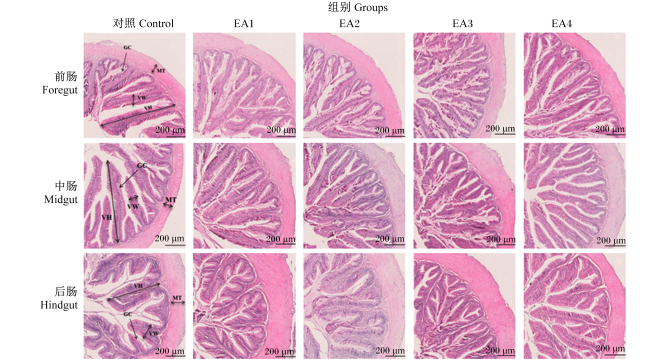
图1表6可知,与对照组相比,试验组的肠道绒毛高度、绒毛宽度、绒毛数量均有所增长,且排列更加紧密,形态完好,杯状细胞有所增加。其中,EA4组的前肠绒毛宽度显著高于EA3组(P<0.05),EA1组的后肠绒毛数量显著高于其他各组(P<0.05)。
图1 鞣花酸对大口黑鲈肠道组织形态的影响

VH:绒毛高度 villus height;VW:绒毛宽度 villus width;MT:肌层厚度 muscular layer thickness;GC:杯状细胞 goblet cell。

Fig.1 Effects of ellagic acid on intestinal tissue morphology of largemouth bass

表6 鞣花酸对大口黑鲈肠道组织形态的影响

Table 6 Effects of ellagic acid on intestinal tissue morphology of largemouth bass

项目
Items
组别Groups
对照Control EA1 EA2 EA3 EA4
前肠Foregut
绒毛高度Villus height/μm 983.87±102.22 1 036.42±60.21 1 057.91±33.91 943.86±25.77 1 017.68±58.00
绒毛宽度Villus width/μm 193.02±5.24ab 196.30±7.64ab 182.19±10.72ab 170.00±17.73a 210.16±8.37b
肌层厚度
Muscular layer thickness/μm
166.50±5.63 178.98±12.35 174.25±12.85 211.33±29.69 182.23±11.74
隐窝深度Crypt depth/μm 21.17±1.95 22.32±1.93 25.40±1.25 22.76±0.25 23.41±3.54
绒毛数量Villus number/根 36.00±3.79 36.67±2.33 37.00±1.53 32.00±1.73 34.00±3.21
中肠Midgut
绒毛高度Villus height/μm 745.01±68.97 860.06±33.02 909.74±52.33 897.62±32.76 814.20±43.90
绒毛宽度Villus width/μm 179.49±6.77 173.75±10.87 171.40±12.77 169.68±18.58 172.74±14.56
肌层厚度
Muscular layer thickness/μm
172.61±18.00 184.91±7.41 152.20±10.50 167.58±7.73 174.64±11.09
隐窝深度Crypt depth/μm 22.74±1.04 21.94±1.86 21.07±2.11 19.16±0.20 21.90±1.15
绒毛数量Villus number/根 33.00±2.52 32.00±2.00 35.00±1.00 37.67±0.67 32.33±1.67
后肠Hindgut
绒毛高度Villus height/μm 585.35±27.15 573.02±41.67 633.33±20.18 672.62±68.02 523.39±63.50
绒毛宽度Villus width/μm 170.65±7.88 180.29±15.39 196.42±14.70 194.15±10.11 194.37±2.48
肌层厚度
Muscular layer thickness/μm
166.53±18.73 140.31±31.20 162.46±5.67 162.79±16.47 185.17±21.65
隐窝深度Crypt depth/μm 28.83±2.45 21.82±1.99 27.87±1.88 22.35±1.69 27.95±2.87
绒毛数量Villus number/根 26.67±0.88a 35.33±2.96b 28.00±0.58a 25.67±1.86a 24.00±3.06a

2.6 鞣花酸对大口黑鲈肠道菌群组成的影响

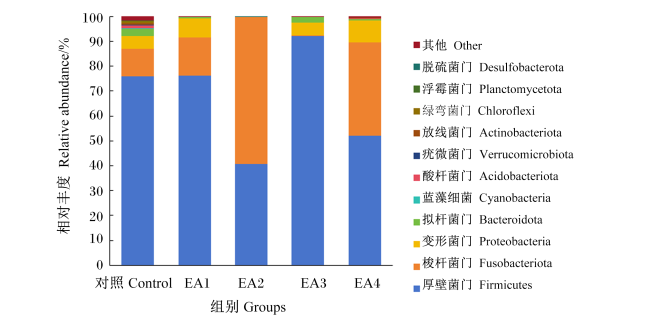
图2可知,在门水平上,大口黑鲈肠道微生物组成主要以厚壁菌门(Firmicute)为主,其次是梭杆菌门(Fusobacteriota)、变形菌门(Proteobacteria)和拟杆菌门(Bacteroidota)。由表7可知,与对照组相比,EA2和EA4组的肠道厚壁菌门相对丰度显著降低(P<0.05),EA3组的肠道厚壁菌门相对丰度显著升高(P<0.05);EA1、EA2和EA4组的肠道梭杆菌门相对丰度显著升高(P<0.05),EA3组的肠道梭杆菌门相对丰度显著降低(P<0.05);EA1、EA2、EA3和EA4组的肠道拟杆菌门相对丰度显著降低(P<0.05)。各组之间肠道变形菌门和放线菌门相对丰度无显著差异(P>0.05)。
图2 大口黑鲈肠道微生物组成(门水平)

Fig.2 Intestinal microbial composition of largemouth bass (phylum level)

表7 鞣花酸对大口黑鲈肠道菌群在门和属水平上相对丰度的影响

Table 7 Effects of ellagic acid on relative abundance of intestinal microbiota at phylum and genus levels of largemouth bass %

项目
Items
组别Groups
对照Control EA1 EA2 EA3 EA4


门水平
Phylum level
变形菌门Proteobacteria 5.08±1.36 7.51±4.43 0.17±0.04 4.92±1.81 8.85±4.86
厚壁菌门Firmicutes 75.83±4.16c 76.34±3.60c 40.59±0.25a 92.10±1.85d 51.97±3.03b
梭杆菌门Fusobacteriota 11.23±0.50b 15.31±0.87c 59.16±0.28e 0.41±0.02a 37.69±1.63d
拟杆菌门Bacteroidota 2.91±0.17d 0.64±0.07b 0.06±0.01a 2.31±0.16c 0.60±0.06b
放线菌门Actinobacteriota 0.71±0.50 0.09±0.01 0.00±0.00 0.04±0.01 0.10±0.05


属水平
Genus level
支原体属Mycoplasma 75.57±4.21c 76.27±3.60c 40.58±0.25a 92.01±1.85d 50.29±3.13b
鲸杆菌属Cetobacterium 11.23±0.50b 15.31±0.87c 59.16±0.28e 0.41±0.02a 37.69±1.63d
金黄杆菌属Chryseobacterium 1.15±0.09d 0.34±0.06b 0.02±0.01a 0.88±0.08c 0.20±0.02ab
不动杆菌属Acinetobacter 0.29±0.04b 0.35±0.04b 0.05±0.01a 0.64±0.03c 0.32±0.03b
水杆菌属Aquabacterium 0.02±0.01 0.42±0.23 0.58±0.28 0.32±0.20 0.21±0.09
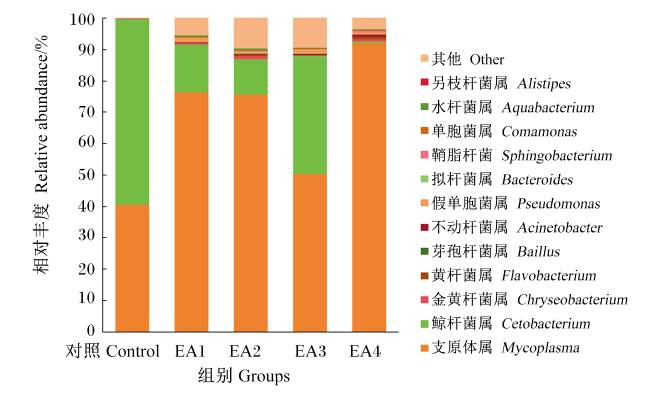
图3可知,在属水平上,大口黑鲈肠道微生物组成主要以支原体属(Mycoplasma)、鲸杆菌属(Cetobacterium)、金黄杆菌属(Chryseobacterium)、不动杆菌属(Acinetobacte)和水杆菌属(Aquabacterium)等组成。由表7可知,与对照组相比,EA2和EA4组的肠道支原体属相对丰度显著降低(P<0.05),EA3组的肠道支原体属相对丰度显著升高(P<0.05);EA1、EA2和EA4组的肠道鲸杆菌属相对丰度显著升高(P<0.05),EA3组的肠道鲸杆菌属相对丰度显著降低(P<0.05);EA1、EA2、EA3和EA4组的肠道金黄杆菌属相对丰度显著降低(P<0.05);EA2组的肠道不动杆菌属相对丰度显著降低(P<0.05),EA3组的肠道不动杆菌属相对丰度显著升高(P<0.05)。各组之间肠道水杆菌属相对丰度无显著差异(P>0.05)。
图3 大口黑鲈肠道微生物组成(属水平)

Fig.3 Intestinal microbial composition of largemouth bass (genus level)

3 讨论

3.1 鞣花酸对大口黑鲈生长性能及肠道消化酶活性的影响

研究发现,植物多酚具有促进动物生长发育的作用[9],而鞣花酸作为常见的植物多酚类化合物,不仅可以促进动物生长发育,还可以降低腹泻率[10]。Mişeyonar[11]研究发现,饲料中添加0.01%和0.02%的鞣花酸可显著提高虹鳟的生长性能。李佳豪等[12]研究发现,用0.003%的鞣花酸饲喂1岁纯血马匹可显著提高其生长性能。研究表明,饲料中添加1.0%、1.5%和3.0%的鞣花酸对鲤的全鱼粗蛋白质和粗灰分含量无显著差异,粗脂肪含量显著降低,但增重率和特定生长率显著降低[13];在育肥猪饲粮中添加5%的鞣花酸,饲喂30 d后可降低其脂肪率,但不影响体重和平均日增重[14]。这可能是因为鞣花酸的代谢生成物尿石素通过促进腺苷酸激活蛋白激酶(AMPK)信号通路的磷酸化,可显著减少肝脏及脂肪细胞中甘油三酯的聚集[15],因此鞣花酸具有降低脂肪含量的作用。在本试验中,饲料中添加鞣花酸对大口黑鲈全鱼粗灰分、粗蛋白质和粗脂肪含量无显著影响,肝脏粗脂肪含量有所降低但差异不显著;与对照组相比,各组的增重率和特定生长率有所增加,且EA4组的增重率和特定生长率显著高于对照组。这表明在大口黑鲈饲料中添加鞣花酸可有效提高其生长性能。
消化酶活性是反映鱼体消化吸收营养物质能力的重要指标。魏欢[16]在饲料中添加鞣花酸,发现绵羊的肠道蛋白酶活性显著降低,但Wang等[4]研究发现,黄羽肉鸡在摄入0.02%的鞣花酸后肠道蛋白酶和脂肪酶活性显著提高。在本试验中,饲料中添加鞣花酸对大口黑鲈肠道蛋白酶、脂肪酶和淀粉酶活性无显著影响。而研究结果有所差异的原因可能是研究对象或鞣花酸添加水平的不同。

3.2 鞣花酸对大口黑鲈血清免疫指标的影响

免疫稳态是指鱼类机体内免疫系统在不受外界病原菌侵袭时,能够维持在一个相对稳定的状态,既能有效识别和清除潜在的病原体,又能避免过度反应导致机体损伤。鱼类机体免疫稳态的维持依赖于先天性免疫和特异性免疫之间的平衡。先天性免疫是鱼类机体对病原体的第1道防线,能够快速识别和清除病原体。而特异性免疫则能够针对特定的病原体产生长期记忆和特异性反应。研究显示,鞣花酸可激活特异性、非特异性免疫应答和增强组织抗氧化能力[17]。Mişeyonar[11]在饲料中添加50~150 mg/kg的鞣花酸,显著提高了虹鳟血清总蛋白和免疫球蛋白M含量,这表明鞣花酸可能具有提高机体免疫力的作用。但贺林娇等[18]在饲料中添加30 mg/kg的鞣花酸对哺乳马匹的血清碱性磷酸酶活性无显著影响。在本试验中,饲料中添加0.01%~0.04%的鞣花酸对大口黑鲈血清酸性磷酸酶、补体3、补体4和溶菌酶活性无显著影响。由于鞣花酸的吸收率极低,未被吸收的化合物经过肠道菌群进一步代谢,最终转化为为尿石素,这种有限的生物利用度和肠道内代谢均表明,尿石素是发挥实际生物学活性的小分子物质[19-20],而肠道微生物组成的差异会影响尿石素的产生[14]。因此,不同研究对象的肠道微生物组成可能会影响尿石素的生成,进而表现为鞣花酸的作用差异。

3.3 鞣花酸对大口黑鲈肠道健康的影响

肠道是消化吸收营养物质的场所,肠道健康是鱼类正常生长发育的前提,也是鱼类抵御食物病菌的防线[21]。而肠道绒毛的数量、长度、宽度和肌层厚度直接影响着肠道消化吸收营养物质的面积大小。研究发现,饲粮中添加鞣花酸可增加断奶仔猪肠道绒毛长度和隐窝深度[10],饲粮中添加0.02%的鞣花酸可增加黄羽肉鸡肠道绒毛长度[4]。在本试验中,与对照组相比,各试验组前肠、中肠绒毛高度均有所增加,后肠绒毛宽度也有所增加。这说明饲料中添加鞣花酸可通过改善肠道组织形态,增加肠道消化吸收营养物质的面积,以此促进大口黑鲈的生长发育。
稳定和有益的肠道菌群对宿主的生长和健康十分重要[22]。鱼类肠道菌群的数量和组成结构受许多因素的影响,其中饲料对肠道微生物的影响最大[23]。Zhao等[24]和李鸣霄等[25]研究结果显示,大口黑鲈的肠道菌群主要以厚壁菌门、梭杆菌门、变形菌门和拟杆菌门为主,与本研究结果一致。肠道中变形菌门相对丰度的增加反映了肠道菌群的失衡,可能会引起一定的炎症反应[26];厚壁菌门是参与短链脂肪酸合成的重要菌门[27-28];拟杆菌门可作为衡量动物肠道健康的指标[29];梭杆菌门是鱼类中的有益菌,可以发酵碳水化合物产生维生素B12以及乙酸、丁酸等,进而调节鱼体的新陈代谢[30-31]。在本试验中,在门水平上,各组之间肠道变形菌门相对丰度无显著差异,与对照组相比,EA1、EA2和EA4组的肠道梭杆菌门相对丰度显著升高;在属水平上,与对照组相比,EA2和EA4组的肠道支原体属相对丰度显著降低,EA1、EA2和EA4组的肠道鲸杆菌属相对丰度显著升高。有研究认为支原体属可能是致病菌[31],而鲸杆菌属是肠道有益菌群的一种,可以利用食物中的碳水化合物合成维生素B12等营养物质,对鱼类的生长发育至关重要[32-33]。因此,本试验的研究结果表明,饲料中添加鞣花酸可降低有害菌相对丰度,增加有益菌相对丰度,有效优化肠道菌群结构,从而保护肠道健康,促进机体生长发育。

4 结论

饲料中添加鞣花酸可有效提高大口黑鲈的生长性能,改善肠道组织结构,在降低肠道有害菌相对丰度的同时提高有益菌相对丰度,保护肠道健康。以增重率和特定生长率为评价依据,大口黑鲈饲料中鞣花酸的适宜添加水平为0.04%。
[1]
刘昕. 低鱼粉饲料中添加茶树精油对大口黑鲈生长性能和生理健康的影响[D]. 硕士学位论文. 荆州: 长江大学, 2024.

LIU X. Effects of tea tree essential oil supplementation in low fish meal diet on growth performance and physiological health of largemouth bass,micropterus salmoides[D]. Master’s Thesis. Jingzhou: Yangtze University, 2024. (in Chinese)

[2]
SANTOS L, RAMOS F. Antimicrobial resistance in aquaculture:current knowledge and alternatives to tackle the problem[J]. International Journal of Antimicrobial Agents, 2018, 52(2):135-143.

[3]
AISHWARYA V, SOLAIPRIYA S, SIVARAMAKRISHNAN V. Role of ellagic acid for the prevention and treatment of liver diseases[J]. Phytotherapy Research, 2021, 35(6):2925-2944.

DOI PMID

[4]
WANG F, CHEN J S, YIN Y X, et al. The effects of dietary ellagic acid supplementation on growth performance,immune response,antioxidant activity,digestive enzyme activities,and intestinal functions in yellow-feathered broilers[J]. Journal of Animal Science, 2022, 100(12):skac301.

[5]
刁玉林, 朱冬青, 刘斌. 秀丽莓中鞣花酸的含量测定和抗氧化活性评测及对接研究[J]. 西北药学杂志, 2018, 33(1):1-5.

DIAO Y L, ZHU D Q, LIU B. Content determination,antioxidant activity estimation and docking study of ellagic acid in Rubus amabilis[J]. Northwest Pharmaceutical Journal, 2018, 33(1):1-5. (in Chinese)

[6]
SINGH B, SINGH J P, KAUR A, et al. Antimicrobial potential of pomegranate peel:a review[J]. International Journal of Food Science & Technology, 2019, 54(4):959-965.

[7]
GAO X, HUANG C J, GENG T, et al. Serum and urine metabolomics based on UPLC-Q-TOF/MS reveals the antipyretic mechanism of reduning injection in a rat model[J]. Journal of Ethnopharmacology, 2020, 250:112429.

[8]
黄宇宸, 曹晶, 代重山. 鞣花酸的生物学功能及其在动物生产中的应用[J]. 中国饲料, 2024(1):12-16.

HUANG Y C, CAO J, DAI C S. Biological functions of ellagic acid and its application in animal production[J]. China Feed, 2024(1):12-16. (in Chinese)

[9]
彭凯, 罗春彦, 黄文, 等. 植物多酚的解毒作用及其在动物生产中的应用[J]. 饲料研究, 2022, 45(2):127-130.

PENG K, LUO C Y, HUANG W, et al. Detoxification of plant polyphenols and their application in animal production[J]. Feed Research, 2022, 45(2):127-130. (in Chinese)

[10]
赵铭伟, 奉玲丽, 张琰芳, 等. 鞣花酸对断奶仔猪小肠黏膜形态及肠黏膜屏障功能的影响[J]. 黑龙江畜牧兽医, 2020,(11):126-130,135,177.

ZHAO M W, FENG L L, ZHANG Y F, et al. The effect of ellagic acid on the intestinal mucosal morphology and intestinal barrier function in weaned piglets[J]. Heilongjiang Animal Husbandry and Veterinary Medicine, 2020,(11):126-130,135,177. (in Chinese)

[11]
MIŞEYONAR S. Growth performance,haematological changes,immune response,antioxidant activity and disease resistance in rainbow trout (oncorhynchus mykiss) fed diet supplemented with ellagic acid[J]. Fish & Shellfish Immunology, 2019, 95:391-398.

[12]
李佳豪, 黄新新, 李晓斌, 等. 补喂鞣花酸对1岁纯血马营养物质消化代谢和体重、体尺增加的影响[J]. 饲料工业, 2022, 43(7):42-47.

LI J H, HUANG X X, LI X B, et al. Effects of ellagic acid supplementation on nutrient digestion and metabolism,body weight and body size increase of 1-year-old thoroughbred horses[J]. Feed Industry, 2022, 43(7):42-47. (in Chinese)

[13]
余维鹏. 鞣花酸对鲤体成分、肝胰脏脂质代谢和氧化应激的影响[D]. 硕士学位论文. 新乡: 河南师范大学, 2022.

YU W P. Effects of ellagic acid on body compossition,lipid metabolism and oxidative stress in hepatopancreas of common carp (Cyprinus carpio L.)[D]. Master’s Thesis. Xinxiang: Henan Normal University, 2022. (in Chinese)

[14]
夏博. Urolithin A对小鼠脂肪沉积的作用及机制研究[D]. 博士学位论文. 杨凌: 西北农林科技大学, 2021.

XIA B. The role and mechanism of Urolithin A on fat deposition in mice[D]. Ph.D.Thesis. Yangling: Northwest A&F University, 2021. (in Chinese)

[15]
KANG I, KIM Y E, TOMÁS-BARBERÁN F A, et al. Urolithin A,C,and D,but not iso-urolithin A and urolithin B,attenuate triglyceride accumulation in human cultures of adipocytes and hepatocytes[J]. Molecular Nutrition & Food Research, 2016, 60(5):1129-1138.

[16]
魏欢. 添加几种酚类化合物及核桃青皮提取物对绵羊瘤胃发酵的影响[D]. 硕士学位论文. 乌鲁木齐: 新疆农业大学, 2018.

WEI H. Effect of several phenolic compounds and walnut green husk extracts on rumen fermentation in sheep[D]. Master’s Thesis. Urumqi: Xinjiang Agricultural University, 2018. (in Chinese)

[17]
MIŞEYONAR S, YONAR M E, YÖNTÖRK Y, et al. Effect of ellagic acid on some haematological,immunological and antioxidant parameters of rainbow trout (Oncorhynchus mykiss)[J]. Journal of Animal Physiology and Animal Nutrition, 2014, 98(5):936-941.

[18]
贺林娇, 李佳豪, 经宏鑫, 等. 母马补喂鞣花酸对哺乳马驹生长发育和血液生化指标的影响[J]. 中国畜牧杂志, 2024, 60(1):295-302.

HE L J, LI J H, JING H X, et al. The effect of supplementing tannic acid to mares on the growth,development,and blood biochemical indicators of lactating foals[J]. Chinese Journal of Animal Science, 2024, 60(1):295-302. (in Chinese)

[19]
CERDÁ B, ESPÍN J C, PARRA S, et al. The potent in vitro antioxidant ellagitannins from pomegranate juice are metabolised into bioavailable but poor antioxidant hydroxy-6H-dibenzopyran-6-one derivatives by the colonic microflora of healthy humans[J]. European Journal of Nutrition, 2004, 43(4):205-220.

[20]
CERDÁ B, LLORACH R, CERÓN J J, et al. Evaluation of the bioavailability and metabolism in the rat of punicalagin,an antioxidant polyphenol from pomegranate juice[J]. European Journal of Nutrition, 2003, 42(1):18-28.

[21]
SONNENBURG J L, BÄCKHED F. Diet-microbiota interactions as moderators of human metabolism[J]. Nature, 2016, 535(7610):56-64.

[22]
MENG X L, WU S K, HU W P, et al. Clostridium butyricum improves immune responses and remodels the intestinal microbiota of common carp (Cyprinus carpio L.)[J]. Aquaculture, 2021, 530:735753.

[23]
WANG A R, RAN C, RINGØ E, et al. Progress in fish gastrointestinal microbiota research[J]. Reviews in Aquaculture, 2018, 10(3):626-640.

[24]
ZHAO L L, HE K, LUO J, et al. Co-modulation of liver genes and intestinal microbiome of largemouth bass larvae (Micropterus salmoides) during weaning[J]. Frontiers in Microbiology, 2020, 11:1332.

[25]
李鸣霄, 强俊, 徐钢春, 等. 不同养殖阶段的大口黑鲈肠道结构和肠道微生物组成变化的比较[J]. 动物营养学报, 2023, 35(9):5886-5903.

DOI

LI M X, QIANG J, XU G C, et al. Comparison of gut structure and microbial composition changes in largemouth bass (Micropterus salmoides) at different breeding stages[J]. Chinese Journal of Animal Nutrition, 2023, 35(9):5886-5903. (in Chinese)

[26]
SHIN N R, WHON T W, BAE J W. Proteobacteria:microbial signature of dysbiosis in gut microbiota[J]. Trends in Biotechnology, 2015, 33(9):496-503.

[27]
MACHATE D J, FIGUEIREDO P S, MARCELINO G, et al. Fatty acid diets:regulation of gut microbiota composition and obesity and its related metabolic dysbiosis[J]. International Journal of Molecular Sciences, 2020, 21(11):4093.

[28]
KIMURA I, OZAWA K, INOUE D, et al. The gut microbiota suppresses insulin-mediated fat accumulation via the short-chain fatty acid receptor GPR43[J]. Nature Communications, 2013, 4:1829.

DOI PMID

[29]
马德英. 不同形式复合微量元素预混料在美洲鳗鲡饲料中应用效果比较研究[D]. 硕士学位论文. 厦门: 集美大学, 2021.

MA D Y. Comparison of the application effects of different forms of compound trace elements premix in diets of American eel (Anguilla rostrata)[D]. Master’s Thesis. Xiamen: Jimei University, 2021. (in Chinese)

[30]
胡娟, 高辰辰, 药园园, 等. 饲用枯草芽孢杆菌HGcc-1对鲤肠肝健康、血清补体及肠道菌群的影响[J]. 水产学报, 2021, 45(10):1753-1763.

HU J, GAO C C, YAO Y Y, et al. Effects of dietary Bacillus subtilis HGcc-1 on gut and liver health,serum com-plement and gut microbiota of common carp fingerlings (Cyprinus carpio)[J]. Journal of Fisheries of China, 2021, 45(10):1753-1763. (in Chinese)

[31]
CHAUDHRY R, GHOSH A, CHANDOLIA A. Pathogenesis of mycoplasma pneumoniae: an update[J]. Indian Journal of Medical Microbiology, 2016, 34(1):7-16.

[32]
孔娟, 范博雅, 原居林, 等. 环境浓度氧四环素与聚苯乙烯微塑料对黄颡鱼幼鱼肠道的联合毒性效应[J]. 生态毒理学报, 2023, 18(1):426-439.

KONG J, FAN B Y, YUAN J L, et al. Combined effects of environmental concentration of oxytetracycline and polystyrene microplastics on intestinal tract of juvenile yellow catfish (Pelteobagrus fulvidraco)[J]. Asian Journal of Ecotoxicology, 2023, 18(1):426-439. (in Chinese)

[33]
LI T T, LONG M, GATESOUPE F J, et al. Comparative analysis of the intestinal bacterial communities in different species of carp by pyrosequencing[J]. Microbial Ecology, 2015, 69(1):25-36.

DOI PMID

文章导航

/