研究论文

饲料中添加丁酸钠对斑点叉尾鮰幼鱼生长性能、血清生化和抗氧化指标以及肠道健康的影响

  • 刘佳玮 ,
  • 李小勤 ,
  • 游宇海 ,
  • 成子涵 ,
  • 刘浩楠 ,
  • 冷向军 , *
展开
  • 上海海洋大学水产科学国家级实验教学示范中心,农业农村部鱼类营养与环境生态研究中心,水产动物遗传育种中心上海市协同创新中心,上海 201306
* 冷向军,教授,博士生导师,E-mail:

刘佳玮(2003—),女,山西晋中人,本科生,水产养殖专业营养与饲料方向。E-mail:

Office editor: 田艳明

收稿日期: 2024-02-27

  网络出版日期: 2024-09-08

基金资助

国家重点研发计划“蓝色粮仓科技创新-水产养殖动物新型蛋白源开发与高效饲料研制”(2019YFD0900200)

Effects of Dietary Sodium Butyrate on Growth Performance, Serum Biochemical and Antioxidant Indices and Intestinal Health of Juvenile Channel Catfish (Ictalurus punctatus)

  • LIU Jiawei ,
  • LI Xiaoqin ,
  • YOU Yuhai ,
  • CHENG Zihan ,
  • LIU Haonan ,
  • LENG Xiangjun , *
Expand
  • Shanghai Collaborative Innovation for Aquatic Animal Genetics and Breeding, Centre for Research on Environmental Ecology and Fish Nutrition of the Ministry of Agriculture and Rural Affairs, National Demonstration Center for Experimental Fisheries Science Education, Shanghai Ocean University, Shanghai 201306, China
* professor, E-mail:

Received date: 2024-02-27

  Online published: 2024-09-08

摘要

本试验旨在研究饲料中添加丁酸钠对斑点叉尾鮰幼鱼生长性能、血清生化和抗氧化指标以及肠道健康的影响。试验选取初始体质量为(4.37±0.03) g的健康斑点叉尾鮰幼鱼480尾,随机分为4组,每组3个重复,每个重复40尾鱼。对照组饲喂基础饲料(不添加丁酸钠),试验组分别饲喂在基础饲料中添加0.06%、0.12%和0.18%丁酸钠的饲粮。试验期8周。结果表明:1)与对照组相比,0.12%丁酸钠添加组饲料系数显著降低(P<0.05),增重率有提高的趋势(P>0.05),蛋白质和脂肪沉积率显著提高(P<0.05),肠道蛋白酶和淀粉酶显著提高(P<0.05)。2)与对照组相比,各试验组血清超氧化物歧化酶(SOD)和过氧化氢酶(CAT)活性均显著提高(P<0.05);0.12%丁酸钠添加组血清谷胱甘肽过氧化物酶(GSH-Px)活性显著提高(P<0.05),血清丙二醛(MDA)含量显著降低(P<0.05);0.12%和0.18%丁酸钠添加组血清总胆固醇(TCHO)含量显著降低(P<0.05)。3)与对照组相比,0.06%和0.12%丁酸钠添加组前肠绒毛宽度显著提高(P<0.05),0.12%和0.18%丁酸钠添加组前肠绒毛高度、肌层厚度和肠壁厚度均显著提高(P<0.05);各试验组后肠肌层厚度和肠壁厚度均显著提高(P<0.05)。4)与对照组相比,0.12%和0.18%丁酸钠添加组肠道菌群Ace指数和Chao1指数显著提高(P<0.05)。在门水平上,与对照组相比,0.12%和0.18%丁酸钠添加组变形菌门相对丰度显著降低(P<0.05),而0.12%丁酸钠添加组螺旋体门相对丰度显著提高(P<0.05),0.18%丁酸钠添加组梭杆菌门相对丰度显著提高(P<0.05)。综上所述,饲料中添加丁酸钠可以提高斑点叉尾鮰幼鱼对饲料的利用率,增强抗氧化能力,改善肠道组织形态,正向调节肠道微生物组成,以添加0.12%为宜。

本文引用格式

刘佳玮 , 李小勤 , 游宇海 , 成子涵 , 刘浩楠 , 冷向军 . 饲料中添加丁酸钠对斑点叉尾鮰幼鱼生长性能、血清生化和抗氧化指标以及肠道健康的影响[J]. 动物营养学报, 2024 , 36(9) : 5895 -5909 . DOI: 10.12418/CJAN2024.501

Abstract

This study was conducted to investigate the effects of dietary sodium butyrate on growth performance, serum biochemical and antioxidant indices and intestinal health of juvenile channel catfish (Ictalurus punctatus). A total of 480 healthy juvenile channel catfish with an initial body weight of (4.37±0.03) g were randomly divided into 4 groups with 3 replicates per group and 40 fish per replicate. Fish in the control group were fed a basal diet (without sodium butyrate supplementation), and the others in the experimental groups were fed the basal diets supplemented with 0.06%, 0.12% and 0.18% sodium butyrate, respectively. The trial lasted for 8 weeks. The results showed as follows: 1) compared with the control group, the feed conversion ratio in 0.12% sodium butyrate supplemental group was significantly decreased (P<0.05), the weight gain rate had a tendency to be increased (P>0.05), the protein and lipid deposition rates were significantly increased (P<0.05), and the intestinal protease and amylase activities were significantly increased (P<0.05). 2) Compared with the control group, the activities of serum superoxide dismutase (SOD) and catalase (CAT) in experimental groups were significantly increased (P<0.05); the serum glutathione peroxidase (GSH-Px) activity in 0.12% sodium butyrate supplemental group was significantly increased (P<0.05), and the serum malondialdehyde (MDA) content was significantly decreased (P<0.05); the serum total cholesterol (TCHO) content in 0.12% and 0.18% sodium butyrate supplemental groups was significantly decreased (P<0.05). 3) Compared with the control group, the villus width of foregut in 0.06% and 0.12% sodium butyrate supplemental groups was significantly increased (P<0.05), and the villus height, muscular thickness and wall thickness of foregut in 0.12% and 0.18% sodium butyrate supplemental groups were significantly increased (P<0.05); the muscular thickness and wall thickness of hindgut in experimental groups were significantly increased (P<0.05). 4) Compared with the control group, the Ace index and Chao1 index of intestinal microbiota in 0.12% and 0.18% sodium butyrate supplemental groups were significantly increased (P<0.05). At the phylum level, compared with the control group, the Proteobacteria relative abundance in 0.12% and 0.18% sodium butyrate supplemental groups was significantly decreased (P<0.05), the Spirochaetota relative abundance in 0.12% sodium butyrate supplemental group was significantly increased (P<0.05), and the Fusobacteriota relative abundance in 0.18% sodium butyrate supplemental group was significantly increased (P<0.05). In conclusion, dietary sodium butyrate can improve the diet utilization rate, enhance antioxidant capacity, improve intestinal tissue morphology, and positively regulate the intestinal microbiota composition of juvenile channel catfish (Ictalurus punctatus), and the optimum supplemental level is 0.12%.

斑点叉尾鮰(Ictalurus punctatus)属鲶形目、鮰科、真鮰属,生长迅速,环境适应性强,是全球水产养殖领域重要的养殖品种之一,也是我国重要的淡水养殖品种。据统计,2022年我国的斑点叉尾鮰产量达416 200 t[1]。在斑点叉尾鮰的养殖中,肠道疾病是危害最严重的病害之一。过去,通常利用抗生素来解决此类病害问题。近年来,食品安全问题引起了社会的广泛关注,人们对于抗生素引发的耐药性和残留等问题更加重视[2]。所以,寻找绿色饲料添加剂改善斑点叉尾鮰的肠道健康,对于斑点叉尾鮰的健康养殖具有重要意义。
丁酸钠是丁酸的钠盐,其有效物质为丁酸。据研究显示,丁酸能被分解成丁酸根离子,并进一步转化为二氧化碳及酮体,向肠道上皮细胞供给大约75%的能量[3]。然而,丁酸是液体,具特殊气味,可能会对饲料口感造成负面影响,所以一般采用丁酸钠的形式应用。丁酸钠是固体,不容易挥发,方便加入和使用[4]。Chen等[5]报道,饲料中分别添加0.05%和0.20%丁酸钠后,大口黑鲈(Micropterus salmoides)的增重率(weight gain rate,WGR)分别提高了18.80%和25.87%;用含有500 mg/kg丁酸钠的饲料饲喂黄颡鱼(Pelteobagrus fulvidraco),也显著提高了鱼体增重,降低了饲料系数(feed conversion ratio,FCR)[6]。在刺参(Apostichopus japonicus)的研究中,饲料中添加0.2%~0.6%丁酸钠提高了肠道超氧化物歧化酶(SOD)和过氧化氢酶(CAT)活性[7],饲料中添加0.2%~0.5%丁酸钠提高了肠道淀粉酶和蛋白酶活性[8]。在黄鳝(Monopterus albus)[9]、巨骨舌鱼(Arapaima gigas)[10]和大口黑鲈[5]的研究中也有相似的结果。
此外,丁酸钠对于鱼类的肠道组织形态和微生物也具有一定的正向调节作用。在饲料中加入0.2%丁酸钠显著提高了虹鳟(Oncorhynchus mykiss)肠绒毛高度(villus height,VH)[11]。当草鱼(Ctenopharyngodon idella)摄食含0.1%丁酸钠的饲料后,肠道中益生菌的数量明显增多[12],而致病性微生物如气单胞菌和大肠杆菌的数量则显著减少[13]。赵锡蝶等[14]研究发现,饲料中添加0.3%丁酸钠显著提高了凡纳滨对虾(Litopenaeus vannamei)肠道梭杆菌门(Fusobacteriota)的相对丰度。
目前,在斑点叉尾鮰饲料中尚未见应用丁酸钠的报道。为了探究饲料中补充丁酸钠是否可以改善斑点叉尾鮰的生长性能,是否对其肠道组织形态和微生物会产生有益的影响,本试验采用斑点叉尾鮰幼鱼作为研究对象,通过在饲料中添加不同水平的丁酸钠,研究其对生长性能、血清生化和抗氧化指标以及肠道组织形态、消化酶活性和微生物群落等的影响,旨在为丁酸钠在水产饲料中的应用提供参考。

1 材料与方法

本试验经过上海海洋大学动物实验伦理委员会的正式批准。在试验过程中,所有操作及规程严格遵守中国实验动物科学协会所颁布的实验动物福利相关规定。

1.1 试验材料

本试验所用丁酸钠为市售产品,其中丁酸钠有效含量为98%。

1.2 试验设计和饲料

饲养试验在上海海洋大学滨海水产养殖基地室内养殖车间中进行,从市场购买斑点叉尾鮰幼鱼,在室内循环水养殖系统中饲养2周后,禁食24 h,挑选初始体质量为(4.37±0.03) g的健康斑点叉尾鮰幼鱼480尾,随机分为4组,每组3个重复,每个重复40尾鱼。对照组饲喂基础饲料(不添加丁酸钠),试验组分别饲喂在基础饲料中添加0.06%、0.12%和0.18%丁酸钠的饲粮。试验期8周。
本试验以鱼粉和豆粕为主要蛋白质源、鱼油和大豆油为脂肪源配制成粗蛋白质和粗脂肪含量相等的4种饲料。所有饲料原料都先经过粉碎机的精细处理,并通过60目筛进行筛选;然后将原料逐级混合,采用河北隆尧县龙翔食品机械厂生产的LX-75型单螺杆挤压机,在90 ℃条件下,加工成直径为2 mm的沉水硬颗粒饲料。随后,这些颗粒饲料在60 ℃的环境中进行烘干处理,存放在阴凉且干燥的地方以备后续使用。饲料组成及营养水平见表1
表1 饲料组成及营养水平(风干基础)

Table 1 Composition and nutrient levels of diets (air-dry basis) %

项目
Items
丁酸钠添加水平Sodium butyrate supplemental levels/%
0 (对照Control) 0.06 0.12 0.18
原料Ingredients
鱼粉Fish meal 10.00 10.00 10.00 10.00
豆粕Soybean meal 26.00 26.00 26.00 26.00
棉籽粕Cottonseed meal 10.00 10.00 10.00 10.00
菜籽粕Rapeseed meal 20.00 20.00 20.00 20.00
麦麸Wheat bran 4.70 4.64 4.58 4.52
面粉Wheat flour 22.00 22.00 22.00 22.00
鱼油Fish oil 2.00 2.00 2.00 2.00
大豆油Soybean oil 2.00 2.00 2.00 2.00
维生素预混料Vitamin premix1) 0.50 0.50 0.50 0.50
矿物质预混料Mineral premix2) 2.50 2.50 2.50 2.50
氯化胆碱Choline chloride 0.30 0.30 0.30 0.30
丁酸钠Sodium butyrate 0.06 0.12 0.18
合计Total 100.00 100.00 100.00 100.00
营养水平Nutrient levels3)
粗蛋白质CP 37.78 38.28 38.17 38.22
粗脂肪EE 6.10 6.08 6.00 6.05
粗灰分Ash 6.99 6.92 6.93 7.08
水分Moisture 5.97 5.93 5.65 5.55

1)维生素预混料为每千克饲料提供 The vitamin premix provided the following per kg of diets:VA 6 000 IU,VB1 15 mg,VB2 15 mg,VB3 30 mg,VB5 35 mg,VB6 5 mg,VB12 0.03 mg,VD 2 000 IU,VE 55 IU,VK 5 mg,生物素 biotin 2 mg,叶酸 folic acid 4 mg。

2)矿物质预混料为每千克饲料提供 The mineral premix provided the following per kg of diets:FeSO4·H2O 0.443 g,ZnSO4·H2O 0.233 g,MnSO4·H2O 0.062 g,MgSO4·7H2O 0.647 g,Ca(IO3)2 0.03 g,CoCl2·6H2O 0.01 g,NaSeO3·5H2O 0.01 g。

3)营养水平均为实测值。Nutrient levels were all measured values.

1.3 饲养管理

4组试验鱼共置于12个网箱(1.0 m×1.0 m×1.2 m)中,网箱分别悬挂于3口室内水泥池(5.0 m×3.0 m×1.2 m)中,光照为自然光源。
在养殖期间,每日于07:00和18:00分别进行1次表观饱食投喂,日投喂量为体质量的4%~6%。投喂2 h后捞出残饵,烘干,用于校正采食量。试验过程中,每3天吸污1次,换水1/3左右。在饲养过程中,水的温度为26~30 ℃,溶解氧含量大于6.0 mg/L,pH为7.5~8.2,水体氨氮浓度不超过0.2 mg/L,亚硝酸盐含量保持在0.1 mg/L以下。

1.4 样品采集及处理

饲养试验开始前,取10条鱼作为初始样本,在-20 ℃的条件下保存,以便后续测定其初始状态下的常规营养成分。饲养试验结束后,对试验鱼进行24 h的禁食处理,然后对每个网箱内的所有斑点叉尾鮰进行称重和数量清点,并从每个网箱中随机选取10条鱼麻醉,其中每个重复取3尾鱼,于-20 ℃冷冻保存,以备后续测定全鱼常规营养成分。同时,每个重复选择3尾鱼进行体长和体质量的测量,并通过尾静脉采集血液样本,放置在4 ℃的环境中静置24 h,然后以3 287.27×g离心10 min分离血清,冻存于-80 ℃的冰箱内,以备后续测定血清抗氧化指标。完成抽血步骤后,分离鱼的内脏和肝脏,精确称重;分离肠道,取部分前肠和后肠(1~2 cm),去除肠系膜脂肪组织,保存在波恩氏液中。每个重复再取4尾鱼在无菌环境中取肠,移除肠系膜脂肪组织,剔除肠道内容物,获得完整的前肠,用于检测肠道消化酶活性;然后取出后肠,于-80 ℃下储存,用于肠道菌群的分析。

1.5 测定指标及方法

1.5.1 生长性能

生长性能指标计算公式如下:
成活率(survival rate, SR, %)=100×Nt/Ng;
增重率(%)=100×(Wt-Ws)/Ws;
特定生长率(specific growth rate,SGR,%/d)=100×(lnWt-lnWs)/N;
饲料系数(FCR)=Wf/(Wt-Ws);
肝体比(hepatosomatic index, HSI, %)=100×Wh/Wb;
脏体比(viscerosomatic index, VSI, %)=100×Wv/Wb;
肥满度(condition factor, CF, g/cm3)=100×Wb/L3
式中:Nt为每个网箱终末尾数;Ns为每个网箱初始尾数;Wt为终末体质量(g);Ws为初始体质量(g);N为养殖天数(d);Wf为摄入饲料量(g);Wh为鱼肝脏重(g);Wv为鱼内脏重(g);Wb为鱼体质量(g);L为鱼体长(cm)。

1.5.2 饲料和全鱼常规营养成分含量和营养物质沉积率

首先采用105 ℃烘干法(GB/T 6435—2014)测定饲料和全鱼样品中的水分含量,之后采用凯氏定氮法(GB/T 6432—2018)测定粗蛋白质含量,采用氯仿-甲醇抽提法(GB/T 6433—2006)测定粗脂肪含量,以及采用马弗炉灰化法(GB/T 6438—2007)测定粗灰分含量。基于这些测定数据,进一步计算营养物质沉积率(蛋白质沉积率和脂肪沉积率),计算公式为:
营养物质沉积率=100×(Wt×Ct-Ws×Cs)/(F×Cf)。
式中:Wt为终末体质量(g); Ws为初始体质量(g); Ct为终末全鱼各营养成分含量(%);Cs为初始全鱼各营养成分含量(%); Cf为饲料中各营养成分含量(%); F为饲料投喂量(g)。

1.5.3 肠道消化酶活性

将前肠样品与9倍生理盐水混合,匀浆后离心(4 ℃、2 739.40×g离心10 min),取出上层液体,使用南京建成生物工程研究所的试剂盒测定淀粉酶和蛋白酶活性。

1.5.4 血清生化和抗氧化指标以及肠道、肝脏组织形态

血清超氧化物歧化酶(SOD)、谷胱甘肽过氧化物酶(GSH-Px)、过氧化氢酶(CAT)活性,总抗氧化能力(T-AOC)和丙二醛(MDA)含量,以及总胆固醇(TCHO)、甘油三酯(TG)和总蛋白(TP)含量委托上海顺实生物科技有限公司检测。
对肠道和肝脏组织样本进行乙醇脱水处理,随后利用二甲苯对其进行透明化;完成透明化步骤后,将这些组织样本嵌入石蜡中,并细致地切成薄片;然后,采用苏木精-伊红染色方法对这些薄片进行染色处理,之后妥善封片,并进行再次的切片操作;最终,在光学显微镜下对这些肠道和肝脏组织切片的形态进行细致观察,并进行拍照记录。在拍照的过程中,特别关注并测量肠道绒毛高度、绒毛宽度(villus width,VW)、肌层厚度(muscular thickness,MT)以及肠壁厚度(wall thickness,WT)

1.5.5 肠道菌群

依据E.Z.N.A.® SOIL试剂盒的操作指南获取后肠全部DNA样本后,利用NanoDrop2000对其质量及含量进行评估;在Illumina MiSeq平台上使用2%琼脂糖凝胶法完成测序任务,并从PCR产物中分离出纯化的部分,对其进行进一步清洁与检查;最后,在MiSeq PE300平台(上海美吉生物医药科技有限公司)上进行高通量测序。

1.6 数据统计分析

采用SPSS 27.0软件对试验数据进行因素方差分析(one-way ANOVA),针对显著差异的结果,采用Duncan氏法进行进一步的多重比较,试验结果数据以“平均值±标准差(mean±SD)”的形式展现,P<0.05为显著差异。

2 结果与分析

2.1 饲料中添加丁酸钠对斑点叉尾鮰幼鱼生长性能的影响

表2可知,试验期间,各组斑点叉尾鮰生长良好,所有组试验鱼存活率均达到了100%。与对照组相比,0.12%丁酸钠添加组饲料系数显著降低(P<0.05),增重率有提高的趋势(P>0.05);各试验组肥满度均显著提高(P<0.05)。各组间脏体比和肝体比无显著差异(P>0.05)。
表2 饲料中添加丁酸钠对斑点叉尾鮰幼鱼生长性能的影响

Table 2 Effects of dietary sodium butyrate on growth performance of juvenile channel catfish (Ictalurus punctatus)

项目
Items
丁酸钠添加水平Sodium butyrate supplemental levels/%
0 (对照Control) 0.06 0.12 0.18
初始体质量IBW/g 4.37±0.02 4.37±0.02 4.37±0.02 4.37±0.02
终末体质量FBW/g 21.67±2.87 23.15±2.15 26.68±1.13 25.37±2.14
饲料系数FCR 1.54±0.06ab 1.60±0.15a 1.19±0.02c 1.27±0.11bc
增重率WGR/% 407.62±47.35 431.52±50.25 509.02±25.83 479.94±53.58
采食量FI/g 27.26±2.28 29.50±0.90 26.38±0.79 26.53±0.54
特定生长率SGR/(%/d) 2.85±0.2 2.98±0.17 3.23±0.08 3.14±0.17
存活率SR/% 100 100 100 100
肥满度CF/(g/cm3) 1.33±0.14b 1.51±0.11a 1.56±0.07a 1.56±0.08a
脏体比VSI/% 7.20±0.98 7.03±0.81 7.25±0.99 7.10±0.79
肝体比HSI/% 1.38±0.21 1.30±0.18 1.11±0.21 1.07±0.17

同行数据肩标不同字母表示显著差异(P<0.05),下表同。

Values in the same row with different letter superscripts mean significant difference (P<0.05), the same as below.

2.2 饲料中添加丁酸钠对斑点叉尾鮰幼鱼全鱼常规营养成分含量和营养物质沉积率的影响

表3可知,各组间斑点叉尾鮰幼鱼全鱼水分、粗蛋白质、粗脂肪和粗灰分含量均无显著差异(P>0.05);与对照组相比,0.12%丁酸钠添加组蛋白质和脂肪沉积率显著提高(P<0.05)。
表3 饲料中添加丁酸钠对斑点叉尾鮰幼鱼全鱼常规营养成分含量(湿重)和营养物质沉积率的影响

Table 3 Effects of dietary sodium butyrate on whole body conventional nutrient contents (wet weight) and nutrient deposition rates of juvenile channel catfish (Ictalurus punctatus) %

项目
Items
丁酸钠添加水平Sodium butyrate supplemental levels/%
0 (对照Control) 0.06 0.12 0.18
水分Moisture 70.88±0.52 71.49±0.29 71.47±0.57 71.30±0.18
粗蛋白质CP 16.02±0.59 15.51±0.54 15.80±0.31 15.81±0.12
粗脂肪EE 2.86±0.14 2.83±0.05 3.18±0.45 2.85±0.47
粗灰分Ash 3.06±0.32 3.34±0.27 3.27±0.32 3.25±0.23
蛋白质沉积率Protein deposition rate 27.58±0.63b 27.28±4.13b 35.56±0.87a 33.82±2.17ab
脂肪沉积率Lipid deposition rate 31.66±3.59b 32.15±4.26b 45.14±0.53a 36.06±2.68b

2.3 饲料中添加丁酸钠对斑点叉尾鮰幼鱼肠道消化酶活性的影响

表4可知,与对照组相比,0.12%和0.18%丁酸钠添加组斑点叉尾鮰幼鱼肠道蛋白酶活性以及0.12%丁酸钠添加组肠道淀粉酶活性均显著提高(P<0.05)。
表4 饲料中添加丁酸钠对斑点叉尾鮰幼鱼肠道消化酶活性的影响

Table 4 Effects of dietary sodium butyrate on intestinal digestive enzyme activities of juvenile channel catfish (Ictalurus punctatus)U/mg prot

项目
Items
丁酸钠添加水平Sodium butyrate supplemental levels/%
0 (对照Control) 0.06 0.12 0.18
蛋白酶Protease 75.58±12.23c 77.33±7.91c 179.07±21.31a 129.07±13.49b
淀粉酶Amylase 1.60±0.21b 1.23±0.23b 3.24±0.26a 1.84±0.14ab

2.4 饲料中添加丁酸钠对斑点叉尾鮰幼鱼血清生化和抗氧化指标的影响

表5可知,与对照组相比,各试验组斑点叉尾鮰幼鱼血清SOD和CAT活性均显著提高(P<0.05),血清T-AOC和TP含量均无显著差异(P>0.05);0.12%和0.18%丁酸钠添加组血清TCHO含量显著降低(P<0.05);0.06%和0.12%丁酸钠添加组血清GSH-Px活性显著提高(P<0.05);0.12%丁酸钠添加组血清MDA含量显著降低(P<0.05);0.18%丁酸钠添加组血清TG含量显著降低(P<0.05)。
表5 饲料中添加丁酸钠对斑点叉尾鮰幼鱼血清生化和抗氧化指标的影响

Table 5 Effects of dietary sodium butyrate on serum biochemical and antioxidant indices of juvenile channel catfish (Ictalurus punctatus)

项目
Items
丁酸钠添加水平Sodium butyrate supplemental levels/%
0 (对照Control) 0.06 0.12 0.18
超氧化物歧化酶SOD/(U/mL) 131.19±13.25c 226.24±11.90b 290.50±32.18a 262.83±25.20ab
谷胱甘肽过氧化物酶GSH-Px/(U/mL) 253.40±14.77b 331.78±28.94a 337.87±31.16a 266.19±9.48b
过氧化氢酶CAT/(U/mL) 14.45±0.92b 19.48±2.44a 23.22±1.66a 22.04±3.32a
总抗氧化能力T-AOC/(U/mL) 44.03±0.87 52.05±0.70 47.61±5.51 49.21±5.76
丙二醛MDA/(nmol/mL) 4.91±0.45a 4.63±0.58ab 3.12±0.39b 5.69±0.78a
总胆固醇TCHO/(mmol/L) 3.47±0.40a 3.04±0.28ab 2.31±0.08c 2.38±0.03bc
甘油三酯TG/(mmol/mL) 1.72±0.18ab 1.76±0.21a 1.40±0.04b 1.02±0.16c
总蛋白TP/(g/L) 37.29±1.86 36.37±1.38 35.14±0.66 35.75±1.11

2.5 饲料中添加丁酸钠对斑点叉尾鮰幼鱼肠道组织形态的影响

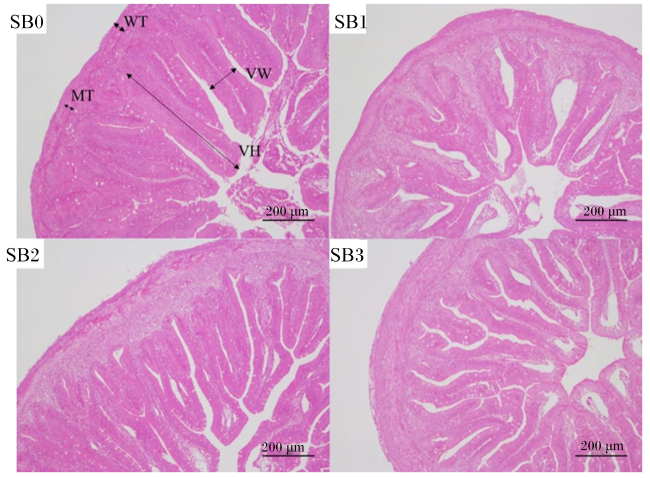
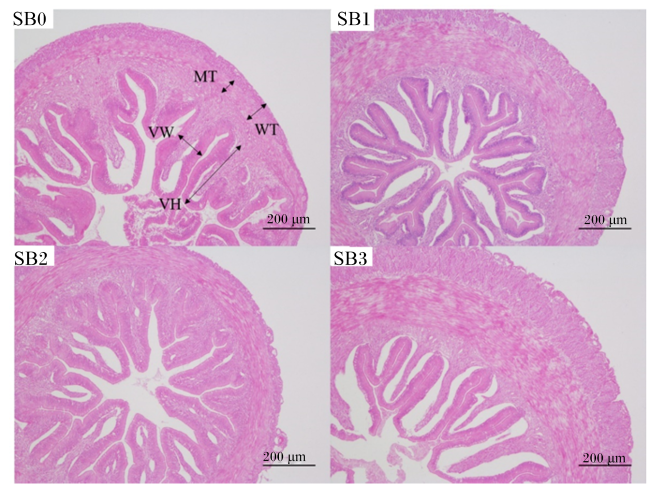
图1图2所示,各组斑点叉尾鮰幼鱼肠道结构完整,肠绒毛排列整齐。由表6可知,与对照组相比,0.06%和0.12%丁酸钠添加组前肠绒毛宽度显著提高(P<0.05),0.12%和0.18%丁酸钠添加组前肠绒毛高度、肌层厚度和肠壁厚度均显著提高(P<0.05);各试验组后肠肌层厚度和肠壁厚度均显著提高(P<0.05),但后肠绒毛高度和绒毛宽度无显著差异(P>0.05)。
图1 斑点叉尾鮰幼鱼前肠组织切片

VH:绒毛高度;VW:绒毛宽度;MT:肌层厚度;WT:肠壁厚度。图中SB0~SB3分别表示饲料中添加0(对照)、0.06%、0.12%和0.18%丁酸钠。下图同。

Fig.1 Foregut tissue sections of juvenile channel catfish (Ictalurus punctatus)

VH: villus height; VW: villus width; MT: muscular thickness; WT: wall thickness. SB0 to SB3 in figures represented dietary 0 (control), 0.06%, 0.12% and 0.18% sodium butyrate, respectively. The same as below.

图2 斑点叉尾鮰幼鱼后肠组织切片

Fig.2 Hindgut tissue sections of juvenile channel catfish (Ictalurus punctatus)

表6 饲料中添加丁酸钠对斑点叉尾鮰幼鱼肠道组织形态的影响

Table 6 Effects of dietary sodium butyrate on intestinal tissue morphology of juvenile channel catfish (Ictalurus punctatus)μm

项目
Items
丁酸钠添加水平Sodium butyrate supplemental levels/%
0 (对照Control) 0.06 0.12 0.18
前肠Foregut
绒毛高度VH 534.02±18.44b 534.84±12.24b 579.48±9.43a 590.46±23.86a
绒毛宽度VW 104.27±7.94c 146.69±9.51a 124.33±0.58b 112.54±4.85bc
肌层厚度MT 39.38±7.41b 48.10±6.40b 69.40±6.61a 78.52±3.36a
肠壁厚度WT 72.63±4.37c 77.33±1.60c 105.86±4.45b 116.25±2.59a
后肠Hindgut
绒毛高度VH 351.52±26.21 349.80±7.21 351.61±4.69 342.40±11.11
绒毛宽度VW 143.77±8.05 139.30±15.49 143.22±12.83 140.62±21.59
肌层厚度MT 59.85±5.01d 163.82±8.61b 96.51±6.54c 197.52±14.15a
肠壁厚度WT 171.86±6.03c 256.00±7.94b 248.98±4.23b 335.66±3.95a

2.6 饲料中添加丁酸钠对斑点叉尾鮰幼鱼肝脏组织形态的影响

图3所示,各组斑点叉尾鮰幼鱼肝脏细胞结构基本正常,肝脏组织形态结构无明显差异。
图3 斑点叉尾鮰幼鱼肝脏组织切片

Fig.3 Liver tissue sections of juvenile channel catfish (Ictalurus punctatus)

2.7 饲料中添加丁酸钠对斑点叉尾鮰幼鱼肠道菌群的影响

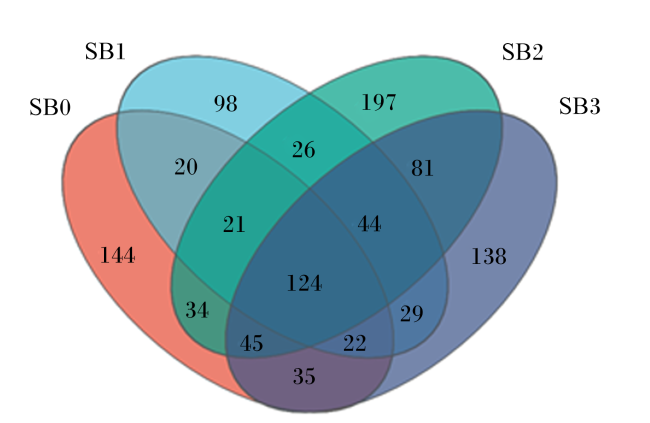
表7可知,各组斑点叉尾鮰幼鱼肠道菌群覆盖度均接近1,说明微生物群落得到了充分的采样,数据可以代表微生物种群。此外,0.12%和0.18%丁酸钠添加组Ace指数和Chao1指数(菌群丰富度)显著高于对照组和0.06%丁酸钠添加组(P<0.05);Shannon指数值越大,Simpson指数值越小,表明菌群多样性越高,0.18%丁酸钠添加组Shannon指数显著高于0.06%丁酸钠添加组(P<0.05),而Simpson指数显著低于0.06%丁酸钠添加组(P<0.05)。在4组肠道菌群中共检测到649个操作分类单元(OTU),其中4组共有OTU数目为124个,各组独有OTU数目分别为144、98、197和138个(图4)。
表7 饲料中添加丁酸钠对斑点叉尾鮰幼鱼alpha多样性的影响

Table 7 Effects of dietary sodium butyrate on alpha diversity of intestinal microbiota of juvenile channel catfish (Ictalurus punctatus)

项目
Items
丁酸钠添加水平Sodium butyrate supplemental levels/%
0 (对照Control) 0.06 0.12 0.18
覆盖度Coverage 0.999 0.999 0.999 0.999
Ace指数Ace index 138.92±6.77b 134.60±11.89b 187.29±11.69a 189.30±28.54a
Chao1指数Chao1 index 139.95±13.64b 141.32±19.69b 190.53±14.81a 191.69±29.26a
Shannon指数Shannon index 1.94±0.40a 1.20±0.37b 1.61±0.37ab 1.93±0.14a
Simpson指数Simpson index 0.26±0.07b 0.56±0.09a 0.35±0.11b 0.24±0.00b
Sobs指数Sobs index 120.33±7.64b 128.75±8.38b 178.33±9.50a 179.00±9.97a
图4 斑点叉尾鮰幼鱼肠道菌群OTU韦恩图

Fig.4 Venn diagram of OTU of intestinal microbiota of juvenile channel catfish (Ictalurus punctatus)

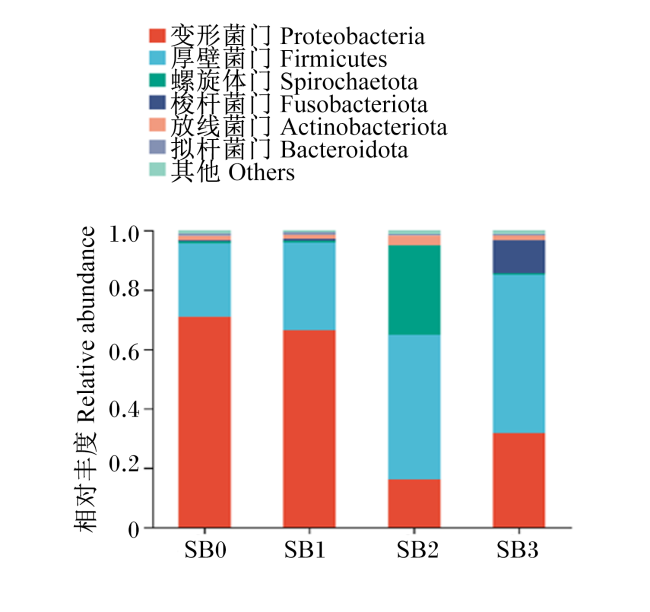
图5所示,在门水平上,对照组和0.06%丁酸钠添加组优势菌门为变形菌门(Proteobacteria)和厚壁菌门(Firmicutes),0.12%丁酸钠添加组优势菌门为厚壁菌门和螺旋体门(Spirochaetota),0.18%丁酸钠添加组中厚壁菌门和梭杆菌门具有较大优势。与对照组相比,0.12%和0.18%丁酸钠添加组变形菌门相对丰度显著降低(P<0.05),而0.12%丁酸钠添加组螺旋体门相对丰度显著提高(P<0.05),0.18%丁酸钠添加组梭杆菌门相对丰度显著提高(P<0.05)。
图5 斑点叉尾鮰幼鱼肠道菌群在门水平上的组成

Fig.5 Composition of intestinal microbiota of juvenile channel catfish (Ictalurus punctatus) at phylum level

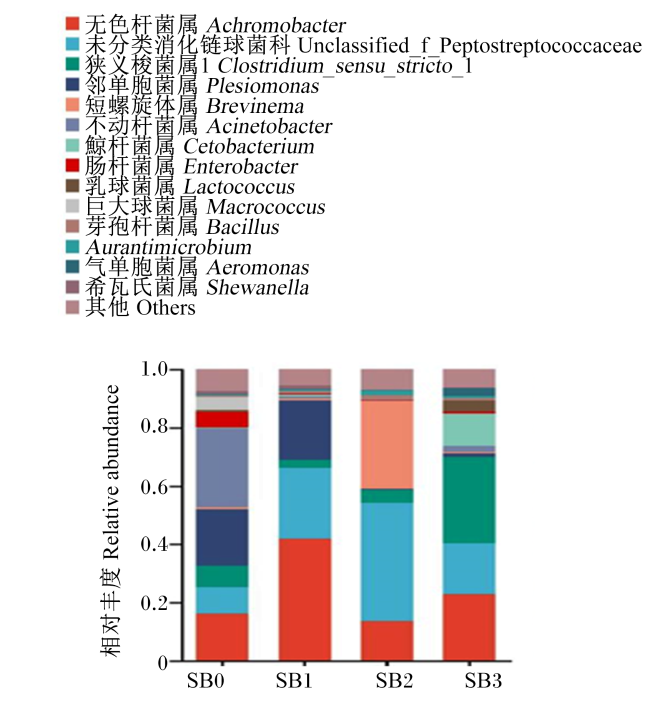
图6所示,在属水平上,肠道微生物主要由无色杆菌属(Achromobacter)和未分类消化链球菌科(unclassified_f_Peptostreptococcaceae)组成。对照组优势菌属为不动杆菌属(Acinetobacter)和邻单胞菌属(Plesiomonas);0.06%丁酸钠添加组优势菌属为无色杆菌属、未分类消化链球菌科和邻单胞菌属;0.12%丁酸钠添加组优势菌属为未分类消化链球菌科和短螺旋体属(Brevinema);0.18%丁酸钠添加组优势菌属为狭义梭菌属1(Clostridium_sensu_stricto_1)、未分类消化链球菌科和无色杆菌属。与对照组相比,各试验组不动杆菌属相对丰度显著降低(P<0.05),0.06%丁酸钠添加组无色杆菌属和未分类消化链球菌科、0.12%丁酸钠添加组短螺旋体属和未分类消化链球菌科以及0.18%丁酸钠添加组鲸杆菌属(Cetobacterium)、狭义梭菌属1和乳球菌属(Lactococcus)相对丰度均显著提高(P<0.05)。
图6 斑点叉尾鮰幼鱼肠道菌群在属水平上的组成

Fig.6 Composition of intestinal microbiota of juvenile channel catfish (Ictalurus punctatus) at genus level

3 讨论

3.1 饲料中添加丁酸钠对斑点叉尾鮰幼鱼生长性能的影响

研究表明,饲料中添加0.2%和0.4%丁酸钠提高了彭泽鲫(Carassius auratus Pengze)幼鱼生长性能,降低了体脂含量[15];Monier等[16]研究证实,饲料中添加纳米丁酸钠对尼罗罗非鱼(Oreochromis niloticus)增重效果具有线性和二次效应;同样,当金头鲷(Sparus aurata)摄取含有0.3%丁酸钠的饲料时,其体重显著增加[6]。此外,饲料中添加丁酸钠对多鳞片白甲鱼(Onychostoma macrolepis)幼鱼[17]、卵形鲳鲹(Trachinotus ovatus)幼鱼[18]以及大菱鲆(Scophthalmus maximus L.)[19]等的生长性能均有改善作用。此外,在黄颡鱼幼鱼[6]饲料中添加0.05%和0.10%丁酸钠,在卵形鲳鲹幼鱼[18]饲料中添加0.2%丁酸钠,均显著降低了饲料系数。然而,饲料中添加丁酸钠对大西洋鲑鱼(Salmo salar)[20]、虹鳟[21]和草鱼[2]生长性能并无显著影响。在本试验中,饲料中添加0.12%丁酸钠显著降低了斑点叉尾鮰幼鱼饲料系数,显著提高了肥满度,并提高了增重率,这可能是由于环境条件差异,导致组内误差较大,故未达到显著水平。今后,可进一步在可控环境条件下开展试验,可能会观察到对增重率的显著改善。不同鱼类对丁酸钠的反应效果不同,这可能与食性、丁酸钠剂型和饲料组成有关。Lin等[11]提出,肉食性、杂食性和草食性鱼类对饲料丁酸钠有不同的反应,冷水鱼类对饲料丁酸钠的敏感性不如温热鱼。

3.2 饲料中添加丁酸钠对斑点叉尾鮰幼鱼全鱼常规营养成分含量和营养物质沉积率的影响

在本研究中,各组斑点叉尾鮰幼鱼在全鱼水分、粗蛋白质、粗脂肪以及粗灰分含量方面并未表现出显著的区别。同样地,在草鱼[2]、虹鳟[11]和大口黑鲈[22]的研究中,饲料中添加丁酸钠对全鱼组成也没有显著影响。
本试验中,饲料中添加0.12%丁酸钠显著提高了斑点叉尾鮰幼鱼蛋白质和脂肪沉积率,这与生长性能的表现基本一致。蛋白质为机体生命的物质基础,饲料蛋白质在体内的沉积率大,通常意味着鱼体增重大,饲料利用率高[23]。脂肪沉积率过高可能导致鱼类脂肪肝的发生,但适度的脂肪沉积率提升却可以促进鱼类的增重和生长[24]。在本试验中,尽管0.12%丁酸钠添加组具有最高脂肪沉积率,但其体脂含量、肝体比与其他组并无显著差异,肝脏组织学观察也基本正常,所以丁酸钠在提升斑点叉尾鮰幼鱼脂肪沉积率的同时并没有引起脂肪肝。本研究中斑点叉尾鮰幼鱼蛋白质和脂肪沉积率的提高,主要是来于饲料利用率的提高和增重率的提高,而不是来自于机体蛋白质和脂肪含量的提高。

3.3 饲料中添加丁酸钠对斑点叉尾鮰幼鱼肠道消化酶活性的影响

本研究发现,饲粮中添加0.12%和0.18%丁酸钠可以显著提高斑点叉尾鮰幼鱼肠道蛋白酶活性,饲粮中添加0.12%丁酸钠可以显著提高肠道淀粉酶活性。丁酸钠转化为有机酸,可降低肠道pH,激活蛋白原,提高消化酶活性[25]。同时,丁酸钠还可以为肠道细胞提供能量,其短链脂肪酸进入线粒体后,通过传递乙酰辅酶A进行β-氧化,参与三羧酸循环并产生ATP[9]。据报道,在草鱼饲料中添加0.03%丁酸钠能显著提高肠道胰蛋白酶和淀粉酶活性[13];在高脂肪饲料中添加0.2%丁酸钠提高了多鳞白甲鱼(Onychostoma macrolepis)幼鱼肠道胰蛋白酶活性[17];在巨骨舌鱼的试验中,饲粮中添加丁酸钠的试验组有着较高的淀粉酶和非特异性碱性蛋白酶活性[10];此外,在黄颡鱼[25]、凡纳滨对虾[26]、薄唇灰鲻鱼(Liza ramada)幼鱼[27]以及卵形鲳鲹幼鱼[18]等的研究中也有相似结果。然而,饲料中添加包被丁酸钠却降低了虹鳟的肠道淀粉酶活性,这可能与不同食性鱼类的消化器官结构不同有关[11]

3.4 饲料中添加丁酸钠对斑点叉尾鮰幼鱼血清生化和抗氧化指标的影响

血清生化和抗氧化指标可以反映鱼体的生理功能和代谢状况。自由基会损伤DNA,干扰细胞功能[28]。SOD作为机体抗氧化能力的参与者,是细胞抗氧化酶体系中的关键组成部分,其活性的增强与自由基清除能力的提升呈正相关关系。换言之,SOD活性越高,其对自由基的清除效力也就越显著[2]。CAT可通过催化超氧自由基生成过氧化氢来降低活性氧水平,具备解毒和修复细胞损伤的能力[25],是清除自由基并保护组织免受氧化伤害的关键因素[26]。GSH-Px可以消除细胞外的过氧化氢,参与谷胱甘肽的运输,催化脂质过氧化物的分解并生成相应的醇,从而减轻过氧化物对机体的损害。研究表明,黄羽肉鸡摄取了含有0.05%丁酸钠的饲粮后,血清SOD、GSH-Px和CAT活性显著提高[29]。黄颡鱼摄食含有0.1%丁酸钠的饲料后,血清SOD活性显著提高;摄取含有0.2%丁酸钠的饲料后,血清CAT和GSH-Px活性均显著提高[30]。此外,有研究表明,在饲料中添加丁酸钠后,凡纳滨对虾血清CAT活性也呈现出显著提高的趋势[26]。在本研究中同样观察到了类似的现象,饲料中添加丁酸钠提高了斑点叉尾鮰幼鱼血清SOD、CAT和GSH-Px活性,这表明丁酸钠有助于提升鱼体的抗氧化能力和自由基清除效率。
脂质过氧化主要会生成MDA,研究表明,MDA含量能够直接体现生物体内脂质过氧化的状况,从而间接地揭示氧化损伤的程度[31]。研究表明,当在黄鳝幼鱼的饲料中添加丁酸钠时,可以观察到其血清MDA含量显著降低[32],本试验中0.12%丁酸钠添加组血清MDA含量也显著低于对照组,表明饲料中添加适宜水平丁酸钠可以减轻机体的氧化损伤程度。
胆固醇在鱼类营养代谢中具有重要的功能。李锐鑫[33]研究发现,胆固醇的蓄积会造成鱼体肝脏健康损伤和代谢紊乱,肝脏脂肪变性通常伴有血清TG含量升高[22]。Yin等[34]认为,丁酸钠存在与胆汁酸类似的功能。丁酸钠可以通过下调脂肪生成基因和上调过氧化物酶体增殖物活化受体α(PPARα,脂肪分解基因)mRNA的表达来减少草鱼肝脏脂质沉积[35]。在大口黑鲈的研究中,血清TG含量随饲料丁酸钠添加水平的提高而降低[34],而卵形鲳鲹幼鱼血清胆固醇含量则随着丁酸钠添加水平的提高而提高[18]。本试验中,0.18%丁酸钠添加组血清TCHO含量低于对照组,这表明丁酸钠对鱼类血清胆固醇含量影响可能因鱼种不同而不同。

3.5 饲料中添加丁酸钠对斑点叉尾鮰幼鱼肠道组织形态的影响

鱼类肠道作为主要的营养吸收器官,其组织学形态特征的优化对于促进营养物质的吸收具有重要意义。这些特征包括绒毛高度和宽度、肌层厚度以及肠壁厚度等,肠道绒毛高度和宽度与吸收能力直接相关[15],通过改善这些肠道形态学指标,可以有效地提升鱼类对营养的吸收效率,进而促进鱼类生长[30]。研究表明,丁酸钠可以为肠上皮细胞提供能量[10-11,30,36],同时,它还能促进肠道对水分和钠离子的吸收,同时激发细胞内mRNA和蛋白质的合成过程[37],提高肠绒毛细胞的增殖速度[11],并提高肠绒毛高度[27]。丁酸钠还能够抑制肠道细胞凋亡[10],促进营养物质的吸收利用。本试验发现,饲料中添加丁酸钠能够提高斑点叉尾鮰幼鱼前肠绒毛高度和宽度以及肌层厚度和肠壁厚度,同时也能够提高后肠的肌层厚度和肠壁厚度,其中0.12%丁酸钠添加组别改善效果最明显。研究表明,通过给黄颡鱼投喂含有0.05%丁酸钠的饲料,可以显著促进其前肠绒毛的生长,包括绒毛高度和宽度的提高,以及肌层的加厚,同时对后肠肌层厚度也有明显的正面影响[30]。类似地,饲料中添加丁酸钠对于多鳞白甲鱼幼鱼[17]和草鱼[2]而言,也能够显著地提高其肠道绒毛高度和肌层厚度。同样地,对彭泽鲫[11]、尼罗罗非鱼[36]、大口黑鲈[38]等鱼类的研究中也显示出了丁酸钠在改善肠道组织学方面的作用。此外,丁酸钠还有利于维护肠道黏膜层的完整性,其机制是诱导肠上皮细胞黏蛋白基因的表达,促进黏蛋白的生成,从而保护肠道黏膜层[37]

3.6 饲料中添加丁酸钠对斑点叉尾鮰幼鱼肠道菌群的影响

肠道菌群的生物多样性和群落组成与鱼类生长具有密切的联系[39],微生物群落的丰富度和多样性可以在一定程度上反映机体的营养代谢和免疫功能[40]
肠道微生物组成不仅在个体之间有着较大的差异,还会受到外界养殖环境的影响。本研究显示,斑点叉尾鮰幼鱼肠道微生物群落主要由变形菌门、厚壁菌门、螺旋体门、梭杆菌门、放线菌门(Actinobacteriota)和拟杆菌门(Bacteroidota)组成。其中,各组主要优势菌门为厚壁菌门和变形菌门,此外,0.12%丁酸钠添加组的优势菌门还有螺旋体门,0.18%丁酸钠添加组的优势菌门还有梭杆菌门。向丹[41]研究发现,梭杆菌门是斑点叉尾鮰肠道的优势菌门;周丽颖等[42]认为,斑点叉尾鮰肠道中的优势菌门包括厚壁菌门、放线菌门、变形菌门和梭杆菌门;何明等[40]研究表明,斑点叉尾鮰的肠道微生物群落主要由梭杆菌门、厚壁菌门、变形菌门以及拟杆菌门构成。许多研究显示,变形菌门是鱼类肠道中的有害菌门[38],一些属于变形菌门的微生物可以利用外部环境增殖,从而增加鱼类肠道的发病风险[19]。厚壁杆菌门中的部分菌群有促进食物消化的功能[42]。Semova等[43]对斑马鱼(Danio rerio)的研究表明,厚壁菌门可以通过修饰胆汁盐刺激宿主代谢并且提高脂肪酸的有效利用。螺旋体门具有将碳水化合物发酵为乙酸、丙酸和丁酸等短链脂肪酸的能力,这一过程有助于降低肠道的酸碱度,进而有效阻止有害细菌的附着与生长;同时,短链脂肪酸还能刺激B细胞产生抗体,从而强化肠道的免疫功能[44]。梭杆菌门与低密度脂蛋白胆固醇的含量呈正相关,是鱼类的有益菌群,能够促进动物肠道内容物分解和代谢,维持肠道的微生态平衡并抑制有害菌[40]。本试验中,饲料中添加0.12%丁酸钠降低了斑点叉尾鮰幼鱼肠道变形菌门相对丰度,提高了螺旋体门相对丰度;饲粮中添加0.18%丁酸钠也降低了变形菌门相对丰度,并提高了梭杆菌门相对丰度。由此可见,丁酸钠对肠道微生物具有正向调节作用,这在大菱鲆[19]、大口黑鲈[38]和镜鲤(Cyprinus carpio)[45]上也有类似报道。
Chapagain等[46]研究发现,消化链球菌属(Peptostreptococcus)是快速生长虹鳟的肠道微生物指示类群。梭状芽孢杆菌、消化链球菌等细菌可以参与不同氨基酸、乳酸和糖的发酵[47],从而促进鱼体对相关营养物质的吸收。鲸杆菌属是一种普遍存在于肉食性鱼类肠道中的细菌,具有代谢纤维、发酵蛋白质和碳水化合物以及合成维生素B12的能力[38]。乳球菌属是一种常见的微生物,能够促进肠道绒毛的生长并提升消化酶活性,从而增加肠道内菌群的多样性[48]。有研究发现,乳球菌属与斑点叉尾鮰的生长性能和鱼体非特异性免疫有关[49]。在健康的鱼类肠道中,短螺旋体属相对丰度较高,是鱼类的有益菌[44]。Sugita等[50]认为,不动杆菌属中不含具有抗菌活性的菌株,然而,当前关于肠道内不动杆菌属的信息较少,还需进一步研究。Lin等[38]报道,大口黑鲈摄取含有0.1%丁酸钠的饲料,肠道内鲸杆菌属相对丰度明显提高;然而,在镜鲤的饲料中添加0.05%和0.20%丁酸钠降低了肠道鲸杆菌属相对丰度[45],这可能与试验动物的食性不同有关。Liu等[19]研究发现,在大菱鲆饲料中添加0.2%丁酸钠显著提高了肠道不动杆菌属相对丰度。此外,丁酸钠还提升了大口黑鲈[5]和草鱼[13]幼鱼肠道乳球菌属的相对丰度。本试验中,各试验组肠道不动杆菌属相对丰度较对照组显著降低,0.06%丁酸钠添加组无色杆菌属和未分类消化链球菌科、0.12%丁酸钠添加组短螺旋体属和未分类消化链球菌科以及0.18%丁酸钠添加组鲸杆菌属、狭义梭菌属1和乳球菌属相对丰度均显著提高,这表明在属水平上,饲料中补充丁酸钠提高了有益微生物的丰度。

4 结论

① 饲料中添加丁酸钠能提高斑点叉尾鮰幼鱼对饲料的利用率,增强抗氧化能力,改善肠道组织形态,正向调节肠道微生物组成。
② 斑点叉尾鮰幼鱼饲料中丁酸钠的适宜添加水平为0.12%。
[1]
农业农村部,渔业渔政管理局. 中国渔业统计年鉴2023[M]. 北京: 中国农业出版社, 2023.

Ministry of Agriculture and Rural Affairs,Fisheries Administration of the People’s Republic of China. China fishery statistical yearbook 2023[M]. Beijing: China Agricuture Press, 2023. (in Chinese)

[2]
徐凯慧, 陈云峰, 章玉贵, 等. 饲料中添加丁酸钠对草鱼生长、消化酶活性、血清生化指标和肠道组织学的影响[J]. 水产学报, 2023, 47(10):23-32.

XU K H, CHEN Y F, ZHANG Y G, et al. Effects of sodium butyrate on growth,digestive enzyme activity,serum biochemical indices and intestinal histology of grass carp (Ctenopharyngodon idella)[J]. Journal of Fisheries of China, 2023, 47(10):23-32. (in Chinese)

[3]
李祥, 何金环, 潘春梅, 等. 丁酸钠对鱼类肠道消化吸收的影响研究进展[J]. 中国畜牧兽医, 2022, 49(1):131-139.

DOI

LI X, HE J H, PAN C M, et al. Research progress on effects of sodium butyrate on intestinal digestion and absorption of fish[J]. China Animal Husbandry & Veterinary Medicine, 2022, 49(1):131-139. (in Chinese)

[4]
侯冬强, 赵红霞, 彭凯, 等. 丁酸钠的生物学功能及其在动物生产中的应用[J]. 动物营养学报, 2023, 35(4):2119-2128.

DOI

HOU D Q, ZHAO H X, PENG K, et al. Biological functions of sodium butyrate and its application in animal production[J]. Chinese Journal of Animal Nutrition, 2023, 35(4):2119-2128. (in Chinese)

DOI

[5]
CHEN W J, GAO S Y, CHANG K, et al. Dietary sodium butyrate supplementation improves fish growth,intestinal microbiota composition,and liver health in largemouth bass (Micropterus salmoides) fed high-fat diets[J]. Aquaculture, 2023, 564:739040.

[6]
ZHAO H X, WANG G X, WANG H R, et al. Effects of dietary sodium butyrate on growth,digestive enzymes,body composition and nutrient retention-related gene expression of juvenile yellow catfish (Pelteobagrus fulvidraco)[J]. Animal Nutrition, 2021, 7(2):539-547.

[7]
王成强, 李宝山, 孙永智, 等. 包膜丁酸钠对大规格刺参生长性能、消化、抗氧化和相关基因表达的影响[J]. 广东海洋大学学报, 2023, 43(6):28-36.

WANG C Q, LI B S, SUN Y Z, et al. Effects of coated sodium butyrate on growth performance,digestive capacity,antioxidant capacity and related-gene mRNA expression of large-size sea cucumber (Apostichopus japonicus)[J]. Journal of Guangdong Ocean University, 2023, 43(6):28-36. (in Chinese)

[8]
高永刚, 赵浩, 徐玉珊. 不同水平包膜丁酸钠对刺参生长性能、消化酶活性、非特异性免疫和抗病力的影响[J]. 河北渔业, 2023(7):1-8.

GAO Y G, ZHAO H, XU Y S. Effects of different levels of microencapsulated sodium butyrate (MSB) on the growth performance,digestive enzyme activity,non-specific immunity and disease resistance of sea cucumber (Apostichopus japonicus)[J]. Hebei Fisheries, 2023(7):1-8. (in Chinese)

[9]
张俊智. 饲料中添加丁酸钠对黄鳝生长、免疫及肠道健康的影响[D]. 硕士学位论文. 长沙: 湖南农业大学, 2015.

ZHANG J Z. Effects of dietary sodium butyrate on growth,immune and intestinal health in rice filed eel (Monopterus albus)[D]. Master’s Thesis. Changsha: Hunan Agricultural University, 2015. (in Chinese)

[10]
LUZ J R, RAMOS A P S, MELO J F B, et al. Use of sodium butyrate in the feeding of Arapaima gigas (Schinz,1822) juvenile[J]. Aquaculture, 2019, 510:248-255.

[11]
LIN X, ZHANG C Y, CAO K L, et al. Dietary sodium butyrate changed intestinal histology and microbiota of rainbow trout (Oncorhynchus mykiss),but did not promote growth and nutrient utilization[J]. Aquaculture Nutrition, 2023, 2023:3706109.

[12]
ZHOU J S, GUO P, YU H B, et al. Growth performance,lipid metabolism,and health status of grass carp (Ctenopharyngodon idella) fed three different forms of sodium butyrate[J]. Fish Physiology and Biochemistry, 2019, 45(1):287-298.

[13]
TIAN L, ZHOU X Q, JIANG W D, et al. Sodium butyrate improved intestinal immune function associated with NF-κB and p38 MAPK signalling pathways in young grass carp (Ctenopharyngodon idella)[J]. Fish & Shellfish Immunology, 2017, 66:548-563.

[14]
赵锡蝶, 郑海玲, 刘明明, 等. 豆粕替代鱼粉并添加有机酸对凡纳滨对虾生长、免疫和肠道菌群的影响[J]. 大连海洋大学学报, 2021, 36(6):966-975.

ZHAO X D, ZHENG H L, LIU M M, et al. Effects of dietary fish meal replaced by soybean meal and supplemented with different organic acids on growth,immunity and intestinal microflora of Pacific white leg shrimp (Litopenaeus vannamei)[J]. Journal of Dalian Fisheries University, 2021, 36(6):966-975. (in Chinese)

[15]
FANG L, WANG Q, GUO X Z, et al. Effects of dietary sodium butyrate on growth performance,antioxidant capacity,intestinal histomorphology and immune response in juvenile Pengze crucian carp (Carassius auratus Pengze)[J]. Aquaculture Reports, 2021, 21:100828.

[16]
MONIER M N, ABD EL-NABY A S, SAMIR F, et al. Positive effects of dietary nanosized sodium butyrate on growth performance,immune,antioxidant indices,and resistance of Nile tilapia to waterborne copper toxicity[J]. Aquaculture Reports, 2022, 26:101323.

[17]
GOU N N, JIN T Z, YANG B, et al. Influences of dietary sodium butyrate on growth,digestion,antioxidant capacity and health in juvenile Onychostoma macrolepis fed on high-fat diet[J]. Aquaculture Reports, 2023, 33:101808.

[18]
ZHOU C P, LIN H Z, HUANG Z, et al. Effect of dietary sodium butyrate on growth performance,enzyme activities and intestinal proliferation-related gene expression of juvenile golden pompano Trachinotus ovatus[J]. Aquaculture Nutrition, 2019, 25(6):1261-1271.

[19]
LIU Y, CHEN Z C, DAI J H, et al. Sodium butyrate supplementation in high-soybean meal diets for turbot (Scophthalmus maximus L.):effects on inflammatory status,mucosal barriers and microbiota in the intestine[J]. Fish & Shellfish Immunology, 2019, 88:65-75.

[20]
BJERKENG, STOREBAKKEN, WATHNE. Cholesterol and short-chain fatty acids in diets for Atlantic salmon Salmo salar (L.):effects on growth,organ indices,macronutrient digestibility,and fatty acid composition[J]. Aquaculture Nutrition, 1999, 5(3):181-191.

[21]
GAO Y L, STOREBAKKEN T, SHEARER K D, et al. Supplementation of fishmeal and plant protein-based diets for rainbow trout with a mixture of sodium formate and butyrate[J]. Aquaculture, 2011, 311(1/2/3/4):233-240.

[22]
GE Y Y, YAO S B, SHI Y, et al. Effects of low or high dosages of dietary sodium butyrate on the growth and health of the liver and intestine of largemouth bass,Micropterus salmoides[J]. Aquaculture Nutrition, 2022, 2022:6173245.

[23]
夏先林, 汤丽琳. 网箱商品鲤鱼蛋白质沉积率与其生长速度和饲料系数的关系[J]. 贵州畜牧兽医, 1992(4):4.

XIA X L, TANG L L. Relationship between protein deposition rate and growth rate and feed coefficient of commercial carp in cages[J]. Guizhou Animal Husbandry and Veterinary Medicine, 1992(4):4. (in Chinese)

[24]
向枭, 周兴华, 陈建, 等. 饲料脂肪水平对白甲鱼幼鱼形体指数、脂肪沉积和脂肪代谢酶活性的影响[J]. 水产学报, 2013, 37(9):1349-1358.

XIANG X, ZHOU X H, CHEN J, et al. Effect of dietary lipid level on body index,lipid deposition and lipid metabolic enzyme activities of juvenile Onychostoma sima[J]. Journal of Fisheries of China, 2013, 37(9):1349-1358. (in Chinese)

[25]
LI X, WANG S D, ZHANG M Z, et al. Sodium butyrate improves the growth performance,intestinal immunity,and ammonia tolerance of yellow catfish Pelteobagrus fulvidraco by increasing the relative abundance of Candidatus_Arthromitus[J]. Aquaculture, 2024,580,Part 2:740359.

[26]
YARAHMADI P, MIRGHAED A T, SHEKARABI S P H. Zootechnical performance,immune response,and resistance to hypoxia stress and Vibrio harveyi infection in Pacific white shrimp (Litopeneaus vannamei) fed different fishmeal diets with and without addition of sodium butyrate[J]. Aquaculture Reports, 2022, 26:101319.

[27]
EL-SHARKAWY E A, EL-RAZEK I M A, AMER A A, et al. Effects of sodium butyrate on the growth performance,digestive enzyme activity,intestinal health,and immune responses of thinlip grey mullet (Liza ramada) juveniles[J]. Aquaculture Reports, 2023, 30:101530.

[28]
ASHRY A M, HABIBA M M, EL-ZAYAT A M, et al. Effects of ginger (Zingiber officinale) on the growth performance,digestive enzyme activity,antioxidative response,and antibacterial capacity of striped catfish (Pangasianodon hypophthalmus) reared in outdoor conditions[J]. Aquaculture Reports, 2023, 33:101760.

[29]
侯金旺, 连丽娜, 孙寒雪, 等. 包被丁酸钠对黄羽肉鸡生长性能、屠宰性能、肉品质及血清抗氧化指标的影响[J]. 动物营养学报, 2022, 34(7):4349-4358.

DOI

HOU J W, LIAN L N, SUN H X, et al. Effects of coated sodium butyrate on growth performance,slaughter performance,meat quality and serum antioxidant indices of yellow-feathered broilers[J]. Chinese Journal of Animal Nutrition, 2022, 34(7):4349-4358. (in Chinese)

[30]
王海瑞, 胡俊茹, 赵红霞, 等. 饲料中添加丁酸钠对黄颡鱼幼鱼非特异性免疫、抗氧化指标及肠道黏膜形态的影响[J]. 动物营养学报, 2021, 33(9):5379-5390.

DOI

WANG H R, HU J R, ZHAO H X, et al. Effects of dietary sodium butyrate on non-specific immune,antioxidant indices and intestinal mucosal morphology of juvenile yellow catfish (Pelteobagrus fulvidraco)[J]. Chinese Journal of Animal Nutrition, 2021, 33(9):5379-5390. (in Chinese)

[31]
王宁, 郑尧, 刘祝萍, 等. 三种投入品对克氏原螯虾抗氧化酶、丙二醛、磷酸酶和溶菌酶的影响[J]. 淡水渔业, 2023, 53(3):87-92.

WANG N, ZHENG Y, LIU Z P, et al. Effects of three inputs on antioxidant enzymes,MDA,phosphatase and LZM of Procambarus clarkii[J]. Freshwater Fisheries, 2023, 53(3):87-92. (in Chinese)

[32]
ZHANG J Z, ZHONG L, CHI S Y, et al. Sodium butyrate supplementation in high-soybean meal diets for juvenile rice field eel (Monopterus albus):effects on growth,immune response and intestinal health[J]. Aquaculture, 2020, 520:734952.

[33]
李锐鑫. 胆固醇在鱼类营养代谢中的功能与调控作用研究[D]. 博士学位论文. 上海: 华东师范大学, 2023:64-81.

LI R X. Function and regulatory role of cholesterol in the nutrient metabolism of fish[D]. Ph.D. Thesis. Shanghai: East China Normal University, 2023:64-81. (in Chinese)

[34]
YIN P, XIE S W, ZHUANG Z X, et al. Dietary supplementation of bile acid attenuate adverse effects of high-fat diet on growth performance,antioxidant ability,lipid accumulation and intestinal health in juvenile largemouth bass (Micropterus salmoides)[J]. Aquaculture, 2021, 531:735864.

[35]
GAO S Y, ZHAO X Y, NIU B, et al. Dietary sodium butyrate supplementation attenuates the detrimental effects of high-fat diets on growth performance,liver health,and disease resistance in grass carp[J]. North American Journal of Aquaculture, 2022, 84(3):392-401.

[36]
ALVES JESUS G F, OWATARI M S, PEREIRA S A, et al. Effects of sodium butyrate and Lippia origanoides essential oil blend on growth,intestinal microbiota,histology,and haemato-immunological response of Nile tilapia[J]. Fish & Shellfish Immunology, 2021, 117:62-69.

[37]
张含乐, 解绶启, 贠彪, 等. 低鱼粉饲料中添加丁酸钠对黄颡鱼生长性能、饲料利用和肠道组织结构的影响[J]. 中国饲料, 2021(1):96-101.

ZHANG H L, XIE S Q, YUAN B, et al. Effects of sodium butyrate on the growth performance,feed utilization and intestinal morphology of yellow catfish (Pelteobagrus fulvidraco) fed low fish meal diet[J]. China Feed, 2021(1):96-101. (in Chinese)

[38]
LIN X, CHEN Y F, RUENKOED S, et al. Dietary effects of supplementing Clostridium butyricum culture or sodium butyrate in low fishmeal diet on growth,serum indicators,intestinal histology and microbiota of largemouth bass (Micropterus salmoides)[J]. Aquaculture Reports, 2023, 33:101827.

[39]
SCHRYVER P D, VADSTEIN O. Ecological theory as a foundation to control pathogenic invasion in aquaculture[J]. The ISME Journal, 2014, 8:2360-2368.

[40]
何明, 贠彪, 钱雪桥, 等. 酶解棉籽蛋白替代鱼粉及添加单宁酸对斑点叉尾鮰生长性能和肠道健康的影响[J]. 饲料工业, 2024, 45(2):93-101.

HE M, YUAN B, QIAN X Q, et al. Effects of fish meal replaced by cottonseed protein hydrolysate and dietary supplementation of tannic acid on growth performance and intestinal health of channel catfish (Ictalurus punctatus)[J]. Feed Industry, 2024, 45(2):93-101. (in Chinese)

[41]
向丹. 转基因大豆饲料对斑点叉尾鮰生长、免疫及肠道菌群影响[D]. 硕士学位论文. 荆州: 长江大学, 2022.

XIANG D. Effects of different varieties of transgenic soybean on the growth,immune responses and gut microbes of channel catfish (Ictalurus punctatus)[D]. Master’s Thesis. Jingzhou: Yangtz University, 2022. (in Chinese)

[42]
周丽颖, 钟立强, 张世勇, 等. 发酵饲料投喂方式对斑点叉尾鮰生长、肠道菌群及代谢组学的影响[J]. 渔业科学进展, 2024, 45(3):140-148.

ZHOU L Y, ZHONG L Q, ZHANG S Y, et al. Effects of fermented feed feeding mode on intestinal flora and metabolomics of channel catfish (Ictalurus punctatus)[J]. Progress In Fishery Sciences, 2024, 45(3):140-148. (in Chinese)

[43]
SEMOVA I, CARTEN J D, STOMBAUGH J, et al. Microbiota regulate intestinal absorption and metabolism of fatty acids in the zebrafish[J]. Cell Host & Microbe, 2012, 12(3):277-288.

[44]
DUAN Z P, CHEN Y F, LI X Q, et al. An evaluation of yeast culture in diet of hybrid snakehead (Channa argus ♂×Channa maculate ♀):growth,serum biochemical parameters,intestinal histology and microorganisms[J]. Aquaculture Reports, 2023, 32:101711.

[45]
DU Y, CHENG L, ZHAO J H, et al. Effects of Clostridium butyricum and sodium butyrate on growth performance,immunity,and gut microbiota of mirror carp Cyprinus carpio fed with soybean meal based diet[J]. Aquaculture Reports, 2023, 29:101501.

[46]
CHAPAGAIN P, ARIVETT B, CLEVELAND B M, et al. Analysis of the fecal microbiota of fast- and slow-growing rainbow trout (Oncorhynchus mykiss)[J]. BMC Genomics, 2019, 20(1):788.

DOI PMID

[47]
NEIS E P J G, DEJONG C H C, RENSEN S S. The role of microbial amino acid metabolism in host metabolism[J]. Nutrients, 2015, 7:2930-2946.

DOI PMID

[48]
刘祥, 易新文, 胡毅, 等. 不同蛋白及喷浆玉米皮水平对斑点叉尾鮰生长性能、体色及肠道健康的影响[J]. 中国饲料, 2023(3):95-102.

LIU X, YI X W, HU Y, et al. Effects of different protein and corn gluten feed levels on growth performance,body color and intestinal health of channel catfish (Ictalurus punctatus)[J]. China Feed, 2023(3):95-102. (in Chinese)

[49]
郭勇, 胡毅, 易新文, 等. 棉粕替代豆粕对斑点叉尾鮰生长、血清生化、体色、肉色以及肠道菌群的影响[J]. 上海海洋大学学报, 2023, 32(2):339-347.

GUO Y, HU Y, YI X W, et al. Effects of cottonseed meal replacing soybean meal on growth,serum biochemistry,skin color,flesh color and intestinal flora of channel catfish (Ictalurus punctatus)[J]. Journal of Shanghai Ocean University, 2023, 32(2):339-347. (in Chinese)

[50]
SUGITA H, SHIBUYA K, SHIMOOKA H, et al. Antibacterial abilities of intestinal bacteria in freshwater cultured fish[J]. Aquaculture, 1996, 145(1/2/3/4):195-203.

文章导航

/