研究论文

发酵饲料对牛蛙生长性能、肌肉营养成分及肠道菌群的影响

  • 向述辉 , 1 ,
  • 朱波 1 ,
  • 蔡明浪 1 ,
  • 邵闯 1 ,
  • 桂飞 1 ,
  • 刘庄鹏 2, 3 ,
  • 胡毅 , 1, * ,
  • 陈开健 , 1, *
展开
  • 1 湖南农业大学水产学院,长沙 410128
  • 2 青岛玛斯特生物技术有限公司,青岛 266061
  • 3 张家界市新瑞生物饲料有限公司,张家界 427200
*胡 毅,教授,博士生导师,E-mail: ;
陈开健,副教授,硕士生导师,E-mail:

向述辉(1998—),男,湖南邵阳人,硕士研究生,研究方向为水产动物营养与饲料。E-mail:

Copy editor: 菅景颖

收稿日期: 2024-04-25

  网络出版日期: 2024-10-14

基金资助

发酵饲料在牛蛙养殖中的应用技术研究(2021kjc-js160)

张家界新瑞生物特种水产饲料研发(xczx-2024090)

Effects of Fermented Diet on Growth Performance, Muscle Nutritional Composition and Intestinal Flora of Bullfrogs

  • XIANG Shuhui , 1 ,
  • ZHU Bo 1 ,
  • CAI Minglang 1 ,
  • SHAO Chuang 1 ,
  • GUI Fei 1 ,
  • LIU Zhuangpeng 2, 3 ,
  • HU Yi , 1, * ,
  • CHEN Kaijian , 1, *
Expand
  • 1 Fisheries College, Hunan Agricultural University, Changsha 410128, China
  • 2 Qingdao Master Biotechnology Co., Ltd., Qingdao 266061, China
  • 3 Zhangjiajie Xinrui Biological Feed Co., Ltd., Zhangjiajie 427200, China
*HU Yi, professor, E-mail: ;
CHEN Kaijian, associate professor, E-mail:

Received date: 2024-04-25

  Online published: 2024-10-14

摘要

为研究投喂不同比例发酵饲料对牛蛙的生长性能、肌肉营养成分及肠道菌群的影响,将960只初始体重为(46.98±0.05) g的牛蛙随机分为4组,每组3个重复,每个重复80只牛蛙。4组牛蛙使用4种饲料进行投喂,具体为100%基础饲料(F1组)、75%基础饲料+25%发酵饲料(F2组)、50%基础饲料+50%发酵饲料(F3组)和100%发酵饲料(F4组)。牛蛙在网箱微流水中养殖,每日投喂2次(08:00、16:00),每日定量投喂牛蛙体重的2%~3%,投喂饲料重以干物质计算,每周依据体重及摄食情况调整投饵量,试验持续8周。结果显示:1)与F1组相比,3个发酵饲料组(F2、F3、F4组)牛蛙终末重和增重率显著增加(P<0.05),饲料系数显著降低(P<0.05);高发酵饲料组(F3、F4组)牛蛙存活率显著提高(P<0.05)。2)相较于F1组,F3、F4组牛蛙肠道脂肪酶(LPS)、淀粉酶(AMS)活性显著上升(P<0.05)。3)与F1组相比,F4组牛蛙肌肉粗蛋白质含量及必需氨基酸、非必需氨基酸、风味氨基酸、氨基酸总量均显著增加(P<0.05)。4)随着发酵饲料添加量的增加,牛蛙血清中碱性磷酸酶(AKP)、酸性磷酸酶(ACP)、超氧化物歧化酶(SOD)活性和总抗氧化能力(T-AOC)呈现先上升再下降的趋势,丙二醛(MDA)含量则先下降后上升,极值均出现在F3组,且上述指标F3组与F1组之间均存在显著差异(P<0.05)。5)发酵饲料对牛蛙肠道菌群的丰富度与多样性均有影响,其中,F3组变形菌门相对丰度显著低于其他组(P<0.05),而梭杆菌门相对丰度则显著高于其他组(P<0.05)。由此可得,在本试验条件下,50%基础饲料和50%发酵饲料为最适配比,能有效提高牛蛙的生长性能,改善其肌肉品质,增强机体免疫力和抗氧化能力,且对牛蛙肠道菌群结构及稳态平衡具有正向调控作用。

本文引用格式

向述辉 , 朱波 , 蔡明浪 , 邵闯 , 桂飞 , 刘庄鹏 , 胡毅 , 陈开健 . 发酵饲料对牛蛙生长性能、肌肉营养成分及肠道菌群的影响[J]. 动物营养学报, 2024 , 36(10) : 6643 -6655 . DOI: 10.12418/CJAN2024.565

Abstract

This study was aimed to investigate the effects of different proportions of fermented diet on growth performance, muscle nutritional composition and intestinal flora of bullfrogs. A total of 960 bullfrogs with an initial body weight of (46.98±0.05) g were randomly divided into 4 groups with 3 replicates per group and 80 bullfrogs per replicate. Four diets were prepared to feed bullfrogs in the 4 groups, they were 100% basal diet (F1 group), 75% basal diet+25% fermented diet (F2 group), 50% basal diet+50% fermented diet (F3 group) and 100% fermented diet (F4 group). The bullfrogs were raised in cages over 8 weeks, fed twice a day (08:00, 16:00), and fed 2% to 3% of their body weight every day. The weight of diet was calculated as dry matter, and the amount of diet was adjusted according to the body weight and feeding situation every week. The results showed as follows: 1) compared with F1 group, the final average weight and weight gain rate of bullfrogs in fermented diet groups (F2, F3 and F4 groups) were significantly increased (P<0.05), while the feed conversion rate was significantly decreased (P<0.05). The survival rate of bullfrogs in high fermented diet groups (F3 and F4 groups) was significantly increased (P<0.05). 2) Compared with F1 group, the intestinal lipase (LPS) and amylase (AMS) activities of bullfrog in F3 and F4 groups were significantly increased (P<0.05). 3) Compared with F1 group, the contents of crude protein, essential amino acids, non-essential amino acids, flavor amino acids and total amino acids in muscle of bullfrog in F4 group were significantly increased (P<0.05). 4) With the additive proportion of fermented diet increasing, the activities of alkaline phosphatase (AKP), acid phosphatase (ACP), superoxide dismutase (SOD) and total antioxidant capacity (T-AOC) in serum of bullfrogs showed a trend of first rising and then falling, while the content of malondialdehyde (MDA) firstly decreased and then increased, and the F3 group had the extreme values, with significant difference compared with F1 group (P<0.05). 5) Fermented diet had effects on the richness and diversity of intestinal flora, among which the relative abundance of pathogenic bacteria such as Proteobacteria in F3 group was significantly lower than that in other groups (P<0.05), and the relative abundance of beneficial bacteria such as Fusobacteria was significantly higher than that in other groups (P<0.05). In conclusion, under the conditions of this experiment, the optimal proportion of 50% basal diet and 50% fermented diet is recommended, which can effectively improve the growth performance of bullfrogs, improve its muscle quality, enhance the immunity and antioxidant capacity, and have a positive regulating effect on the structure and steady balance of intestinal flora of bullfrogs.

牛蛙(Aquarana catesbeiana)属两栖纲(Amphibian),无尾目(Anura),蛙科(Ranidae),因生长周期短、个体较大、养殖密度高、适应力强、肉质鲜嫩等特点,深受市场喜爱[1]。近年来牛蛙产业发展迅速,养殖量迅速增涨,因此牛蛙饲料需求量急剧上升。饲料成本占养殖成本的70%左右,近年饲料原料价格持续上涨,导致养殖成本不断增加[2]。为降低饲料成本,生产中使用豆粕及植物蛋白质源替代鱼粉[3],但这样会使饲料中生物碱、凝集素、蛋白酶抑制剂、植酸盐、皂苷和单宁等抗营养因子(ANF)的含量增加,赖氨酸和蛋氨酸等必需氨基酸缺乏以及对消化率和适口性产生负面影响[4]。目前主要通过酶解[5]、发酵[6]和补充氨基酸[7]等方法对饲料提质增效。
微生态制剂已广泛应用于养殖业中,发酵饲料通常是以基础饲料为底物,用益生菌在适宜环境下发酵而来的产品[8]。饲料发酵后,有机酸、维生素、小肽、氨基酸等含量相对提高,这些物质相比于大分子营养素更容易被水产动物吸收,且具有重塑肠道菌群的功能[8-9]。目前用于发酵的主要菌属有芽孢杆菌属(Bacillus)[10]、肠球菌属(Enterococcus)[11]、乳杆菌属(Lactobacillus)[12]和酵母菌属(Saccharomyces)[13]等,不同的益生菌发酵效果不同。将不同的益生菌组合在一起联合发酵,可以充分利用各菌株的优势[14]。目前在猪(Sus scrofa)[15]、鸡(Gallus gallus)[167]等畜禽,大口黑鲈(Micropterus salmoides)[9]、鲤鱼(Cyprinus carpio)[17]等鱼类,日本沼虾(Macrobrachium nipponense)[18]、中华绒螯蟹(Eriocheir sinensis)[19]等甲壳动物中已有使用复合菌发酵饲料的研究。这些研究表明复合菌发酵饲料可提高养殖动物的生长性能、肌肉品质、免疫和抗氧化能力以及改善肠道菌群结构。鉴于此,本试验用枯草芽孢杆菌(Bacillus subtilis)、酿酒酵母(Saccharomyces cerevisiae)、植酸酶(phytase)和中性蛋白酶(neutral protease)等益生菌及酶制剂联合发酵基础牛蛙饲料,通过对比发酵前后饲料中营养物质含量的变化,探讨不同配比发酵饲料和基础饲料对牛蛙生长性能、肌肉营养成分及肠道菌群的影响,并确定发酵饲料和基础饲料的适宜配比,为发酵饲料在牛蛙养殖生产中的应用提供理论依据。

1 材料与方法

1.1 试验饲料

试验所用基础饲料为膨化饲料(干物质中粗蛋白质含量≥40.0%,粗脂肪含量≥6.0%),其以豆粕、鸡肉粉为主要蛋白质源,豆油为主要脂肪源,具体组成及营养水平见表1
表1 基础饲料组成(干物质基础)

Table 1 Basal diet composition (DM basis)%

原料 Ingredients 含量 Content
鸡肉粉 Chicken meal 30.00
豆粕 Soybean meal 40.00
面粉 Flour 24.95
豆油 Soybean oil 2.00
预混料 Premix 1.00
磷酸二氢钙 Ca(H2PO4)2 1.50
氯化胆碱 Choline chloride 0.50
抗氧化剂 Antioxidant 0.02
防霉剂 Mould inhibitor 0.03
合计 Total 100.00

预混料为每千克饲料提供 Premix provides the following per kg of the diet:KCl 400 mg,KI (1%) 120 mg,CoCl2·6H2O (1%) 100 mg,CuSO4·5H2O 60 mg,FeSO4·H2O 800 mg,ZnSO4·H2O 800 mg,MnSO4·H2O 300 mg,Na2SeO3·5H2O (1%) 130 mg,MgSO4·H2O 400 mg,沸石粉 zeolite powder 891.70 mg,VB1 24 mg,核黄素 riboflavin 24 mg,VB6 16 mg,VB12 0.10 mg,VK3 16 mg,肌醇 inositol 200 mg,泛酸 pantothenic acid 80 mg,烟酸 niacin 100 mg,叶酸 folic acid 10 mg,生物素 biotin 1.6 mg,VA 50 mg,VD 70 mg,VE 100 mg,VC 200 mg,乙氧基喹啉 ethoxyquinoline 300 mg,面粉 flour 4 806.60 mg。

利用复合菌和酶制剂对基础饲料进行发酵处理,以制备发酵饲料。复合菌和酶制剂中包含枯草芽孢杆菌、酿酒酵母、植酸酶和中性蛋白酶,每千克复合菌和酶制剂中枯草芽孢杆菌活菌数≥25.00×10² CFU,酿酒酵母活菌数≥4.00×10¹² CFU,植酸酶活性≥28.00×10⁶ U,中性蛋白酶活性≥28.00×10⁶ U。发酵饲料具体制备过程为:将复合菌和酶制剂与基础饲料混合,复合菌和酶制剂的添加量为饲料干重的0.5%,发酵底物用灭菌水调节水分含量为29%,用有单向出气阀门发酵袋密封发酵,于35 ℃恒温箱中恒温发酵,发酵5 d后放置于-20 ℃冰柜储存,每周取1袋使用,使用前测定pH,确保每袋pH一致,使用后剩余发酵饲料放置阴凉处(4 ℃恒温室)密封储存,试验全程使用同一批发酵饲料。基础饲料与发酵饲料的常规营养成分、水解氨基酸和酸溶性蛋白含量以及pH见表2
表2 基础饲料与发酵饲料的常规营养成分、水解氨基酸和酸溶性蛋白含量(干物质基础)及pH

Table 2 Contents of conventional nutrients, hydrolyzed amino acids and acid-soluble protein (DM basis), and pH of basal diet and fermented diet

项目
Items
基础饲料
Basal
diet
发酵饲料
Fermented
diet
常规营养成分 Conventional nutrients/%
粗蛋白质 Crude protein 40.16 41.25
粗脂肪 Crude lipid 6.12 6.09
水解氨基酸 Hydrolyzed amino acids/%
必需氨基酸 Essential amino acids
缬氨酸 Val 1.50 1.66
蛋氨酸 Met 0.40 0.61
异亮氨酸 Ile 1.21 1.33
亮氨酸 Leu 3.11 3.15
苯丙氨酸 Phe 1.82 1.86
赖氨酸 Lys 1.92 1.97
组氨酸 His 0.87 0.92
精氨酸 Arg 2.51 2.82
苏氨酸 Thr 1.50 1.52
非必需氨基酸 Non-essential amino acids
天冬氨酸 Asp 3.51 3.70
谷氨酸 Glu 6.69 6.97
胱氨酸 Cys 0.30 0.34
丝氨酸 Ser 1.87 1.89
甘氨酸 Gly 2.44 2.64
丙氨酸 Ala 2.34 2.24
脯氨酸 Pro 2.60 2.61
酪氨酸 Tyr 1.33 1.32
必需氨基酸总量 ΣEAA 14.83 15.86
非必需氨基酸总量 ΣNEAA 21.08 21.72
氨基酸总量 ΣAA 35.91 37.57
酸溶性蛋白
Acid soluble protein/%
14.63 15.92
pH 6.04 5.79

1.2 试验动物及养殖管理

牛蛙取自湖南省常德市澧县澧南镇长湖村牛蛙养殖场,分苗前在大棚帆布池(6.00 m×3.00 m×0.65 m)流水养殖模式中暂养10 d。试验共设计4个组,每组3个重复,每个重复80只牛蛙,初始均重为(46.98±0.05) g,分别使用4种饲料进行投喂,具体为100%基础饲料(F1组)、75%基础饲料+25%发酵饲料(F2组)、50%基础饲料+50%发酵饲料(F3组)和100%发酵饲料(F4组)。试验牛蛙在网箱微流水中养殖,网箱规格为0.8 m×0.8 m×0.6 m,每日投喂2次(08:00、16:00),每日定量投喂,投喂量为牛蛙体重的2%~3%,投喂饲料重以干物质计算,每周依据体重及摄食情况调整投喂量,试验持续8周。整个试验期平均气温30.9 ℃、养殖水体平均温度在24.5 ℃,氨氮浓度≤0.8 mg/L、亚硝酸盐氮浓度≤0.01 mg/L、溶氧浓度≥4.0 mg/L,pH 7.2~7.6。

1.3 样本采集

在养殖试验结束后停食24 h,捞出所有牛蛙统计每个试验网箱存活数量,沥干体表水分后再称重。每个网箱随机取3只牛蛙采血,用2 mL无菌注射器在心腔采血后装入2 mL无菌离心管中,4 ℃静置过夜,590×g离心10 min后,吸取上层血清,同一网箱的所有血清混合后分装于0.5 mL无菌离心管;每个网箱随机取3只牛蛙的后腿肌肉装入5号自封袋;每个网箱随机取3只牛蛙的肠道内容物装于1.5 mL无酶管。以上样品均用液氮速冷后再放入-80 ℃超低温冰箱储存,分别用于测定相应酶活性、肌肉营养成分及分析肠道菌群组成等。

1.4 指标检测及方法

饲料与肌肉的常规营养成分及水解氨基酸含量测定:水分含量采用烘箱在105 ℃下烘至恒重的方法(GB/T 6435—2006)测定;粗蛋白质含量是将样品消煮后用凯氏定氮法(GB/T 6432—2018)使用福斯8400全自动凯氏定氮仪进行测定;粗脂肪含量是将样品包在滤纸中用乙醚抽提的方法(GB/T 6433—2006)使用索氏抽提仪测定;水解氨基酸含量参照国标(GB/5009.124—2003)的方法测定。
饲料酸溶蛋白含量依据NY/T 3801—2020《饲料原料中酸溶蛋白的测定》方法测定。
肠道中胰蛋白酶(trypsin,TPS)、脂肪酶(lipase,LPS)与淀粉酶(amylase,AMS)活性以及血清中酸性磷酸酶(acid phosphatase,ACP)与碱性磷酸酶(alkaline phosphatase,AKP)活性、总抗氧化能力(total antioxidant capacity,T-AOC)、超氧化物歧化酶(superoxide dismutase,SOD)活性及丙二醛(malondialdehyde,MDA)含量检测试剂盒均购自南京建成生物工程研究所,测定步骤按说明书进行。
肠道菌群结构分析:采用Illumina平台对肠道细菌群落DNA片段进行双端(paired-end)测序,委托上海派森诺生物科技股份有限公司进行测定,后续利用派森诺基因云进行数据分析。

1.5 计算公式

增重率(weight gain rate,WGR,%)=[(Wt-W0)/W0]×100;

存活率(survival rate,SR,%)=(Nt/N0)×100;

饲料系数(feed conversation rate,FCR)=F1/(Wt-W0);

摄食率(feeding rate,FR,%/d)={F1/[(Wt+W0)/2]/t}×100。

式中:W0为牛蛙初始重;Wt为牛蛙终末重;N0为初始牛蛙数;Nt为总存活牛蛙数;F1为牛蛙摄食饲料总量;t为牛蛙饲养天数。

1.6 统计分析

采用SPSS 24.0软件对数据进行处理及分析。对符合正态分布的试验数据进行单因素方差分析(one-way ANOVA),否则采用Kruskal-Wallis秩和检验。若方差分析显著,则采用Duncan氏法进行事后多重比较,以P<0.05表示差异显著。数据均采用平均值±标准误(mean±SE)表示。

2 结果

2.1 发酵饲料对牛蛙生长性能的影响

表3可知,发酵饲料可以提高牛蛙的终末重、增重率和存活率,降低饲料系数。与F1组相比,3个发酵饲料组(F2、F3和F4组)的终末重与增重率显著提高(P<0.05),而饲料系数显著降低(P<0.05)。与F1组和低发酵饲料组(F2组)相比,高发酵饲料组(F3与F4组)的存活率显著增加(P<0.05)。
表3 发酵饲料对牛蛙生长性能的影响

Table 3 Effects of fermented diet on growth performance of bullfrogs

项目
Items
组别 Groups 自由度
Degree of
freedom
F
F-value
P
P-value
F1 F2 F3 F4
初始重 IBW/g 46.98±0.05 46.77±0.17 46.91±0.02 47.07±0.02 8 2.03 0.188
终末重 FBW/g 111.00±1.69a 120.81±3.81b 127.75±2.37b 121.98±1.22b 8 7.91 0.009
增重率 WGR/% 136.96±8.12a 158.26±7.57b 172.31±5.17b 159.12±2.58b 8 8.67 0.007
存活率 SR/% 76.25±0.72a 79.58±3.25a 87.08±4.20b 85.83±1.10b 8 20.30 <0.001
摄食率 FR/(%/d) 1.92±0.06 1.73±0.08 1.62±0.11 1.59±0.03 8 3.70 0.062
饲料系数 FCR 1.32±0.01b 1.12±0.03a 1.08±0.03a 1.10±0.02a 8 7.35 0.011

同行数据肩标无字母或相同字母表示差异不显著(P>0.05),不同字母表示差异显著(P<0.05)。下表同。

In the same row, values with no letter or the same letter superscripts mean no significant difference (P>0.05), while with different letter superscripts mean significant difference (P<0.05). The same as below.

2.2 发酵饲料对牛蛙肌肉常规营养成分含量及氨基酸组成的影响

表4可知,牛蛙肌肉中检测出16种氨基酸,随着发酵饲料添加量的增加,牛蛙肌肉粗蛋白质、粗脂肪含量以及必需氨基酸、风味氨基酸、氨基酸总量均呈现上升趋势。与F1组相比,F2、F3和F4组牛蛙肌肉粗蛋白质含量、非必需氨基酸总量和风味氨基酸总量显著增加(P<0.05),F3与F4组必需氨基酸总量显著增加(P<0.05);与F1和F2组相比,F3和F4组牛蛙肌肉氨基酸总量显著增加(P<0.05)。
表4 发酵饲料对牛蛙肌肉常规营养成分含量及氨基酸组成的影响(干物质基础)

Table 4 Effects of fermented feed on conventional nutrient contents and amino acid composition in muscle of bullfrogs (DM basis)%

项目
Items
组别 Groups 自由度
Degree of
freedom
F
F-value
P
P-value
F1 F2 F3 F4
常规营养成分 Conventional nutrients
粗蛋白质 Crude protein 71.70±0.05a 72.84±0.05b 73.21±0.16c 73.25±0.06c 8 61.17 <0.001
粗脂肪 Crude lipid 6.61±0.01 6.65±0.02 6.65±0.15 6.68±0.02 8 2.59 0.126
水解氨基酸 Hydrolysis amino acids
必需氨基酸 Essential amino acids
缬氨酸 Val 3.50±0.04a 3.79±0.14b 4.00±0.09b 4.00±0.05b 8 7.33 0.011
蛋氨酸 Met 1.03±0.05 1.02±0.05 1.00±0.05 1.00±0.02 8 0.09 0.963
异亮氨酸 Ile 3.47±0.05a 3.55±0.16ab 3.79±0.06bc 3.97±0.07c 8 5.91 0.020
亮氨酸 Leu 5.37±0.04a 5.50±0.07a 5.96±0.04b 6.11±0.04b 8 57.31 <0.001
苯丙氨酸 Phe 2.99±0.08 3.11±0.12 3.14±0.05 3.25±0.02 8 1.86 0.214
赖氨酸 Lys 6.73±0.04a 7.31±0.12b 7.41±0.06bc 7.57±0.05c 8 24.37 <0.001
组氨酸 His 2.31±0.02 2.39±0.05 2.28±0.06 2.29±0.03 8 1.29 0.342
精氨酸 Arg 4.51±0.03a 4.51±0.12a 5.03±0.05b 5.11±0.04b 8 20.13 <0.001
苏氨酸 Thr 2.63±0.05 2.70±0.17 2.82±0.11 2.97±0.04 8 2.08 0.181
非必需氨基酸 Non-essential amino acids
天冬氨酸 Asp* 6.19±0.13a 6.49±0.09a 6.92±0.11b 7.11±0.04b 8 18.39 0.001
谷氨酸 Glu* 12.55±0.04a 13.11±0.04b 14.15±0.03c 14.33±0.07d 8 361.02 <0.001
甘氨酸 Gly* 2.92±0.05 3.11±0.12 3.15±0.05 3.24±0.06 8 2.89 0.102
丙氨酸 Ala* 3.67±0.02a 3.86±0.04b 4.00±0.07bc 4.08±0.02c 8 17.01 0.001
脯氨酸 Pro* 2.58±0.04a 2.73±0.12ab 2.93±0.05bc 3.00±0.07c 8 5.92 0.020
丝氨酸 Ser 2.48±0.04 2.46±0.16 2.65±0.06 2.56±0.06 8 0.88 0.489
酪氨酸 Tyr 1.57±0.12 1.67±0.11 1.86±0.14 1.83±0.07 8 1.50 0.288
必需氨基酸总量 ΣEAA 32.55±0.35a 33.88±0.97ab 35.43±0.39bc 36.27±0.21c 8 8.65 0.007
非必需氨基酸总量
ΣNEAA
31.96±0.40a 33.43±0.65b 35.66±0.43c 36.15±0.11c 8 19.68 <0.001
风味氨基酸总量
ΣDAA
27.92±0.25a 29.30±0.39b 31.15±0.24c 31.76±0.04c 8 44.45 <0.001
氨基酸总量 ΣAA 64.51±0.73a 67.31±1.62a 71.09±0.81b 72.42±0.24b 8 13.41 0.002

*:风味氨基酸。

*: flavor amino acid.

2.3 发酵饲料对牛蛙肠道消化酶活性的影响

表5可知,各组间肠道胰蛋白酶活性无显著差异(P>0.05);与F1组相比,F3和F4组肠道脂肪酶、淀粉酶活性显著升高(P<0.05),而F2组则无显著变化(P>0.05)。
表5 发酵饲料对牛蛙肠道消化酶活性的影响

Table 5 Effects of fermented diet on intestinal digestive enzyme activities of bullfrogs

项目
Items
组别 Groups 自由度
Degree of
freedom
F
F-value
P
P-value
F1 F2 F3 F4
胰蛋白酶
TPS/(U/g prot)
69.62±0.89 73.47±3.23 77.93±2.21 74.35±2.30 8 2.17 0.169
脂肪酶
LPS/(U/g prot)
15.47±1.52a 28.20±3.20ab 30.78±2.96b 28.47±2.87b 8 6.50 0.015
淀粉酶
AMS/(U/mg prot)
2.93±0.74a 4.37±0.02ab 5.57±0.57b 4.63±0.33b 8 4.85 0.033

2.4 发酵饲料对牛蛙血清生化指标的影响

表6可知,与F1组相比,F3和F4组血清中AKP活性显著升高(P<0.05),F2组则无显著变化(P>0.05);F2、F3和F4组血清中ACP和SOD活性显著升高(P<0.05)。与F1和F2组相比,F3与F4组血清中T-AOC显著升高(P<0.05),而MDA含量显著降低(P<0.05)。
表6 发酵饲料对牛蛙血清生化指标的影响

Table 6 Effects of fermented diet on serum biochemical indices of bullfrogs

项目
Items
组别 Groups 自由度
Degree of
freedom
F
F-value
P
P-value
F1 F2 F3 F4
碱性磷酸酶
AKP/(U/mL)
0.43±0.02a 0.45±0.00ab 0.50±0.00c 0.49±0.02bc 8 4.19 0.047
酸性磷酸酶
ACP/(U/mL)
0.96±0.00a 0.98±0.00b 1.01±0.00d 1.00±0.00c 8 0.00 <0.001
超氧化物歧化酶
SOD/(U/mL)
10.95±0.10a 12.23±0.20b 17.91±0.14d 15.43±0.07c 8 537.39 <0.001
总抗氧化能力
T-AOC/(U/mL)
0.77±0.03a 0.80±0.01a 0.92±0.01b 0.90±0.00b 8 30.15 <0.001
丙二醛
MDA/(nmol/mL)
4.18±0.34b 3.39±0.45b 1.47±0.22a 1.69±0.35a 8 14.06 <0.001

2.5 发酵饲料对牛蛙肠道菌群结构的影响

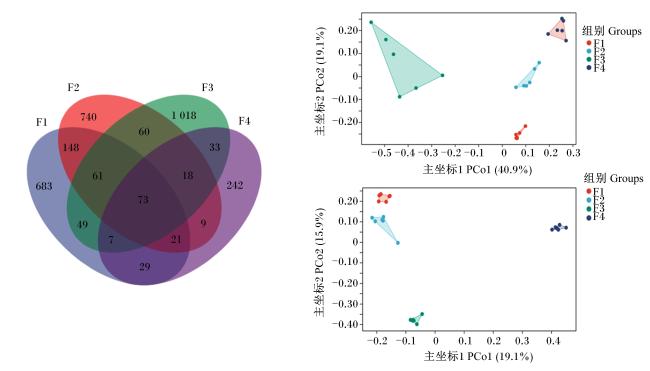
图1可知,F1、F2、F3和F4组操作分类单元(OTU)数目分别为1 071、1 130、1 319、432个,4组共有的OTU数目为73个,各组特有OTU数目分别为683、740、1 018和242个。从牛蛙肠道菌群主坐标分析来看,各组间单独成簇,组间总体群落结构相似性低。
图1 基于OTU韦恩图(左图)、Bray_curtis (右图上)与jaccard(右图下)距离的肠道菌群beta多样性主坐标分析

Fig.1 Principal coordinate analysis of beta diversity of intestinal flora based on OTU Venn diagram (left) and distance between Bray_curtis (top right) and jaccard (bottom right)

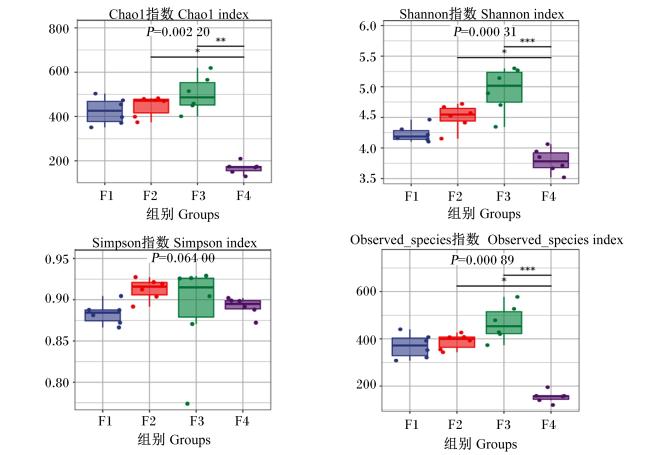
图2可知,随着发酵饲料添加量的增加,牛蛙肠道菌群alpha多样性中的Chao1、Observed_species、Shannon和Simpson指数呈现先上升再下降的趋势,其中Chao1、Observed_species和Shannon指数均有显著变化(P<0.05),而Simpson指数无显著变化(P>0.05)。
图2 发酵饲料对牛蛙肠道菌群alpha多样性的影响

Fig.2 Effects of fermented diet on intestinal flora alpha diversity of bullfrogs

*:P<0.05;**:P<0.01;***:P<0.001。

通过对牛蛙肠道菌群门水平物种组成进行分析发现,牛蛙肠道菌群中的优势菌门(相对丰度由高到低)为变形菌门(Proteobacteria)、厚壁菌门(Firmicutes)、梭杆菌门(Fusobacteria)、拟杆菌门(Bacteroidetes)和放线菌门(Actinobacteria)等。对门水平上相对丰度排名前5的物种进行分析(表7)发现,发酵饲料添加量对牛蛙肠道中变形菌门、梭杆菌门、拟杆菌门和放线菌门相对丰度产生了显著影响(P<0.05),其中,F3组变形菌门相对丰度显著低于其他组(P<0.05),而梭杆菌门相对丰度则显著高于其他组(P<0.05);F2组拟杆菌门和放线菌门相对丰度显著高于其他组(P<0.05)。
表7 发酵饲料对牛蛙肠道菌群门水平上排名前5的分类群相对丰度的影响

Table 7 Effects of fermented diet on relative abundances of top five taxonomic groups at phylum level of intestinal flora of bullfrogs%

项目
Items
组别 Groups 自由度
Degree of
freedom
F
F-value
P
P-value
F1 F2 F3 F4
变形菌门 Proteobacteria 55.77±0.93b 62.57±3.19b 25.69±1.57a 60.86±3.84b 20 42.25 <0.001
厚壁菌门 Firmicutes 40.69±0.96 31.13±2.23 38.80±3.91 38.92±3.81 20 2.03 0.142
梭杆菌门 Fusobacteria 3.15±0.92a 5.14±1.19a 34.89±5.28b 0.04±0.01a 20 34.87 <0.001
拟杆菌门 Bacteroidetes 0.19±0.04a 0.80±0.19b 0.31±0.11a 0.02±0.01a 20 8.91 <0.001
放线菌门 Actinobacteria 0.11±0.01a 0.23±0.04b 0.11±0.02a 0.06±0.02a 20 8.41 <0.001
通过对牛蛙肠道菌群属水平物种组成进行分析发现,牛蛙肠道菌群中相对丰度排名前5的菌属依次为乳球菌属(Lactococcus)、哈夫尼菌属(Hafnia)、魏斯氏菌属(Weissella)、梭杆菌属(Fusobacterium)和鲸杆菌属(Cetobacterium)。由表8可知,发酵饲料添加量对牛蛙肠道菌群中乳球菌属、哈夫尼菌属、魏斯氏菌、梭杆菌属和鲸杆菌属相对丰度均产生了显著影响(P<0.05),其中,F3组哈夫尼菌属相对丰度显著低于其他组(P<0.05),而梭杆菌属相对丰度则显著高于其他组(P<0.05);相较于F1组,F4组乳球菌属和鲸杆菌属相对丰度显著下降(P<0.05),而哈夫尼菌属和魏斯氏菌相对丰度显著增加(P<0.05),梭杆菌属相对丰度则无显著变化(P>0.05)。
表8 发酵饲料对牛蛙肠道菌群属水平排名前5的分类群相对丰度的影响

Table 8 Effects of fermented diet on relative abundances of top five taxonomic groups at genus level of intestinal flora of bullfrogs%

项目
Items
组别 Groups 自由度
Degree of
freedom
F
F-value
P
P-value
F1 F2 F3 F4
乳球菌属 Lactococcus 35.80±1.27c 23.94±1.36b 27.06±3.41b 4.58±0.60a 20 44.82 <0.001
哈夫尼菌属 Hafnia 19.69±0.52b 25.44±1.85c 7.41±1.15a 25.15±2.24c 20 28.38 <0.001
魏斯氏菌属 Weissella 0.32±0.04a 0.66±0.11a 4.64±1.69a 29.62±3.90b 20 43.55 <0.001
梭杆菌属 Fusobacterium 0.34±0.04a 0.11±0.02a 28.34±5.76b 0.00±0.00a 20 23.92 <0.001
鲸杆菌属 Cetobacterium 2.74±0.91b 5.01±1.16b 3.92±0.82b 0.03±0.01a 20 6.41 0.003

3 讨论

3.1 发酵饲料对牛蛙生长性能的影响

饲料经益生菌发酵处理后,其中的抗营养因子被有效降解,小肽和有机酸含量相对升高,并增加了饲料的营养价值和提高了饲料利用率,进而促进动物生长[20]。Zhang等[17]与李正中等[18]的研究发现,添加适量的发酵饲料可以提高养殖动物的生长性能,但过量添加则导致生长性能下降。本试验结果与前人研究结果类似,随着发酵饲料添加量的增加,牛蛙生长性能呈现先上升后下降的趋势,F3组的增重率最高,饲料系数最低,这说明发酵饲料添加量与牛蛙生长性能不呈正相关,添加适量发酵饲料能显著提升牛蛙的生长性能,但过量添加并不会带来生长性能的持续上升,这可能与消化酶活性以及肠道有益菌相对丰度有关[21-22]。消化酶活性能影响动物的生长性能和饲料效率,消化酶活性也是评判饲料消化程度的重要指标,其活性升高意味着机体对饲料的消化更充分[21]。本试验中F3和F4组牛蛙肠道脂肪酶和淀粉酶活性显著升高,以F3组的各消化酶活性最高。该结果表明添加50%发酵饲料能显著提高牛蛙肠道消化酶活性,进而提高牛蛙的生长性能和饲料效率。

3.2 发酵饲料对牛蛙肌肉常规营养成分含量和氨基酸组成的影响

发酵会消解抗营养因子,并且可以将饲料中的蛋白质分解成易吸收的菌体蛋白、氨基酸和小肽等小分子物质,从而提高饲料的营养价值[9]。本试验中,基础饲料在经过微生物发酵后,发酵饲料中氨基酸、酸溶性蛋白、粗蛋白质等含量均升高,说明枯草芽孢杆菌和酿酒酵母利用基础饲料在发酵过程中将大分子营养物质转化成菌体蛋白和分解成小肽、氨基酸等小分子物质,从而增提高了饲料的营养价值。有研究表明,饲料经过发酵后粗蛋白质和氨基酸含量相对提高,这是因为枯草芽孢杆菌和酿酒酵母发酵能在化学和物理上分解难以消化的植物性蛋白质中的涂层和细胞壁,从而增加发酵饲料中的菌体蛋白含量[22],并且酿酒酵母发酵能增加底物粗蛋白质、必需氨基酸和非必需氨基酸含量[23]
肌肉营养成分含量是评价水产品质量的重要指标之一,其变化与饲料成分密切相关[24]。特别地,肌肉氨基酸的营养价值取决于必需氨基酸的种类、数量和比例[25]。本试验结果表明,F4组的肌肉氨基酸含量增加,同时风味氨基酸含量也得到提高,说明用菌和酶联合发酵饲料能影响肌肉氨基酸组成。其主要原因可能是饲料经过微生物发酵后不仅可以提高粗蛋白质的消化率,同时还可以提高牛蛙对氨基酸的吸收率和沉积效率,从而提高肌肉中风味氨基酸的含量[26]。研究表明,饲料中添加植酸酶和蛋白酶可以改善肌肉风味,这是由于植酸酶可以通过分解植物性蛋白质中的植酸来提高氨基酸和蛋白质的有效性;同时,蛋白酶可以提高植物饲料中蛋白质的利用率[27],饲料中蛋白质利用率可以改变动物肌肉中的氨基酸含量,进而改善其肌肉风味[28]

3.3 发酵饲料对牛蛙血清生化指标的影响

抗氧化酶活性在动物的生理状况和外部刺激中起着重要作用,是抵御氧化损伤的防御机制,在抗氧化系统中MDA含量、T-AOC、SOD活性等是重要参考指标[29]。本研究结果表明,投喂发酵饲料显著增加了牛蛙血清中SOD活性和T-AOC,显著降低了MDA含量,说明发酵饲料能有效改善牛蛙的抗氧化能力,缓解牛蛙的氧化应激,进而提高牛蛙的存活率,其主要原因可能是发酵饲料中枯草芽孢杆菌细胞壁的多糖含量较高,使机体具有较强的抗炎和抗氧化活性[30]。AKP和ACP是维持身体健康所必需的酶,ACP在酸性条件下可以催化磷酸单酯,主要参与体内的免疫调节和其他过程;AKP主要通过催化有机磷酸盐水解为磷酸,促进机体吞噬细胞对细菌的吞噬和降解,参与机体的免疫机制[31]。投喂发酵饲料显著提高了牛蛙血清中ACP和AKP活性,说明发酵饲料能增强牛蛙的免疫能力,进而提高牛蛙的存活率。这与中华绒螯蟹[30]、克氏原螯虾(Procambarus clarkii)[32]、大口黑鲈[9]上的研究结果类似。有研究表明,酵母细胞壁含有β-葡聚糖和甘露聚糖寡糖,它们在免疫刺激中发挥重要的作用[33]

3.4 发酵饲料对牛蛙肠道菌群结构的影响

肠道菌群在各种生理过程中起着至关重要的作用,包括新陈代谢、营养吸收、生长发育和免疫功能[34]。因此,研究肠道菌群的变化对机体健康非常重要。本研究发现,各组共有OTU数目73个,表明在同一养殖环境中,饲喂不同添加量的发酵饲料仍会存在定植的菌群;各组特有OTU数目分别为683、740、1 018和242个,表明发酵饲料可以改变牛蛙肠道菌群丰富度与多样性,这或许与发酵饲料中丰富的益生菌有关,但饲喂过量发酵饲料会降低肠道菌群多样性。这与鱼[34]、虾[35]、蟹[19]和畜禽[36-38]等上所得结果相似。
肠道菌群与宿主生理状态密切相关[39]。本研究中,牛蛙肠道菌群中优势菌门为变形菌门、厚壁菌门、梭杆菌门、拟杆菌门和放线菌门;而从属水平上来看,相对丰度排名前5的菌属依次为乳球菌属、哈夫尼菌属、魏斯氏菌属、梭杆菌属和鲸杆菌属,其中哈夫尼菌属是属于变形菌门,乳球菌属和魏斯氏菌属是属于厚壁菌门,梭杆菌属和鲸杆菌属是属于梭杆菌门。变形菌门是肠道菌群中不稳定的门之一[40],其相对丰度的增加反映了肠道菌群的失衡,可能会引起一定的炎症反应,可作为鱼体健康的指标[41]。厚壁菌门中有部分细菌能促使短链脂肪酸合成,提高机体的代谢[42]。梭杆菌门可以发酵多糖和蛋白质,从而增加短链脂肪酸含量,提高营养物质利用率[43]。拟杆菌门中的部分菌种为条件致病菌,当肠道微生态失调时,将导致内源性感染[44]。放线菌门能产生多种抗生素,具有抑制致病菌的活性[45]。本试验中,发酵饲料添加量对牛蛙肠道菌群组成产生了影响。有趣的是,F4组肠道菌群丰富度与多样性下降,变形菌门等有害菌相对丰度增加,却未爆发疾病,这可能是肠道有益菌增殖,未导致肠道菌群失衡[46],但具体作用机理还有待研究,这与姚海行等[32]的研究结果类似。F3组牛蛙肠道菌群中变形菌门相对丰度下降,梭杆菌门相对丰度上升,这对牛蛙肠道菌群稳态和饲料的消化与利用有正向作用[22]。这里进一步解释了投喂适量的发酵饲料可以改善牛蛙肠道菌群多样性,促进有益菌在肠道内增殖,从而调节肠道微生态平衡,进而提高牛蛙的生长性能与机体健康水平。

4 结论

综上所述,在本试验条件下,50%基础饲料和50%发酵饲料为最适配比,能提高牛蛙的增重率与存活率,降低饲料系数,能有效改善肌肉品质,还能增强机体免疫力和抗氧化能力,同时对肠道菌群结构及稳态平衡具有正向调控作用。
[1]
邵闯, 秦守旺, 朱波, 等. 投喂策略对牛蛙蝌蚪生长发育及肝肠功能的影响[J]. 水产学报, 2023, 47(10):70-81.

SHAO C, QIN S W, ZHU B, et al. Effects of feeding strategies on growth and development,liver and intestinal function of Lithobates catesbeiana tadpoles[J]. Journal of Fisheries of China, 2023, 47(10):70-81. (in Chinese)

[2]
陈丽军. 饲料原料价格对生猪养殖经济效益的影响分析[D]. 硕士学位论文. 哈尔滨: 东北林业大学, 2023.

CHEN L J. Analysis of the influence of feed raw material price on economic benefit of pig breeding[D]. Master’s Thesis. Harbin: Northeast Forestry University, 2023. (in Chinese)

[3]
于永宁, 刘昊昆, 韩冬, 等. 新型蛋白源在水产饲料中替代鱼粉和豆粕的研究进展[J]. 中国饲料, 2023(22):129-136.

YU Y N, LIU H K, HAN D, et al. Research progress of novel proteins replacing fishmeal and soybean meal in aquafeed[J]. China Feed, 2023(22):129-136. (in Chinese)

[4]
GUPTA S K, FOTEDAR R, FOYSAL M J, et al. Impact of varied combinatorial mixture of non-fishmeal ingredients on growth,metabolism,immunity and gut microbiota of Lates calcarifer (Bloch,1790) fry[J]. Scientific Reports, 2020, 10(1):17091.

[5]
HOU Y Q, WU Z L, DAI Z L, et al. Protein hydrolysates in animal nutrition:industrial production,bioactive peptides,and functional significance[J]. Journal of Animal Science and Biotechnology, 2017,8:24.

[6]
MUGWANYA M, DAWOOD M A O, KIMERA F, et al. Replacement of fish meal with fermented plant proteins in the aquafeed industry:a systematic review and Meta-analysis[J]. Reviews in Aquaculture, 2023, 15(1):62-88.

[7]
WANG J, WU G, GATLIN D M, et al. Dietary fishmeal replacement by methanol-extracted cottonseed meal with amino acid supplementation for juvenile cobia Rachycentron canadum[J]. Journal of Marine Science and Engineering, 2024, 12(2):235.

[8]
ZHANG M Z, PAN L Q, FAN D P. Study of fermented feed by mixed strains and their effects on the survival,growth,digestive enzyme activity and intestinal flora of Penaeus vannamei[J]. Aquaculture, 2021,530:735703.

[9]
YANG Z, LIU P, KONG Q, et al. Effects of co-fermented feed using Lactobacillus acidophilus,Limosilactobacillus reuteri and Lactiplantibacillus plantarum on growth,antioxidant capacity,fatty acids and gut microbiota of largemouth bass (Micropterus salmoides)[J]. Fishes, 2023, 8(9):433.

[10]
KUEBUTORNYE F K A, ABARIKE E D, LU Y S. A review on the application of Bacillus as probiotics in aquaculture[J]. Fish & Shellfish Immunology, 2019,87:820-828.

[11]
LI C Q, ZHANG B L, LIU C D, et al. Effects of dietary raw or Enterococcus faecium fermented soybean meal on growth,antioxidant status,intestinal microbiota,morphology,and inflammatory responses in turbot (Scophthalmus maximus L.)[J]. Fish & Shellfish Immunology, 2020,100:261-271.

[12]
LUO K, LIU Y, QIN G C, et al. A comparative study on effects of dietary three strains of lactic acid bacteria on the growth performance,immune responses,disease resistance and intestinal microbiota of Pacific white shrimp,Penaeus vannamei[J]. Fish & Shellfish Immunology, 2023,136:108707.

[13]
LI Q P, YI P H, ZHANG J Z, et al. Bioconversion of food waste to crayfish feed using solid-state fermentation with yeast[J]. Environmental Science and Pollution Research International, 2023, 30(6):15325-15334.

[14]
VAZIRZADEH A, ROOSTA H, MASOUMI H, et al. Long-term effects of three probiotics,singular or combined,on serum innate immune parameters and expressions of cytokine genes in rainbow trout during grow-out[J]. Fish & Shellfish Immunology, 2020,98:748-757.

[15]
YANG Y Z, YAN G H, MENG X H, et al. Effects of Lactobacillus plantarum and Pediococcus acidilactici co-fermented feed on growth performance and gut microbiota of nursery pigs[J]. Frontiers in Veterinary Science, 2022,9:1076906.

[16]
XU F, WU H Z, XIE J J, et al. The effects of fermented feed on the growth performance,antioxidant activity,immune function,intestinal digestive enzyme activity,morphology,and microflora of yellow-feather chickens[J]. Animals, 2023, 13(22):3545.

[17]
ZHANG Q S, JING X F, ZHAO Y J, et al. Partial replacement of pelleted feed by moist fermented feed improved the feed conversion efficiency,liver and intestine health,and gut microbiota structure in common carp (Cyprinus carpio)[J]. Aquaculture Reports, 2023,32:101690.

[18]
李正中, 刘波, 刘志桦, 等. 发酵饲料对日本沼虾生长性能、抗氧化能力及肠道微生物的影响[J]. 水生生物学报, 2023, 47(9):1435-1445.

LI Z Z, LIU B, LIU Z H, et al. Fermented feed on growth performance,antioxidant capacity and intestinal microorganisms of Macrobrachium nipponense[J]. Acta Hydrobiologica Sinica, 2023, 47(9):1435-1445. (in Chinese)

[19]
JIANG W B, JIA X Y, XIE N J, et al. Aquafeed fermentation improves dietary nutritional quality and benefits feeding behavior,meat flavor,and intestinal microbiota of Chinese mitten crab (Eriocheir sinensis)[J]. Animal Nutrition, 2023,14:1-19.

[20]
YANG H, BIAN Y H, HUANG L L, et al. Effects of replacing fish meal with fermented soybean meal on the growth performance,intestinal microbiota,morphology and disease resistance of largemouth bass (Micropterus salmoides)[J]. Aquaculture Reports, 2022,22:100954.

[21]
李会峰, 李二超, 徐畅, 等. 饲料中添加水飞蓟素对低盐度下凡纳滨对虾生长、免疫、肝胰腺组织结构及肠道菌群的影响[J]. 水产学报, 2021, 45(1):98-114.

LI H F, LI E C, XU C, et al. Effects of silymarin on growth,activities of immune-related enzymes,hepatopancreas histology and intestinal microbiota of the Pacific white shrimp (Litopenaeus vannamei) at low salinity[J]. Journal of Fisheries of China, 2021, 45(1):98-114. (in Chinese)

[22]
SIDDIK M A B, JULIEN B B, ISLAM S M M, et al. Fermentation in aquafeed processing:achieving sustainability in feeds for global aquaculture production[J]. Reviews in Aquaculture, 2024, 16(3):1244-1265.

[23]
SHARAWY Z, GODA A M A S, HASSAAN M S. Partial or total replacement of fish meal by solid state fermented soybean meal with Saccharomyces cerevisiae in diets for Indian prawn shrimp,Fenneropenaeus indicus,postlarvae[J]. Animal Feed Science and Technology, 2016,212:90-99.

[24]
王裕玉, 付宁, 安美玲, 等. 发酵鲭鱼加工副产物替代鱼粉对大口黑鲈幼鱼生长、肝脏抗氧化能力及肠道结构的影响[J]. 动物营养学报, 2024, 36(3):1782-1794.

DOI

WANG Y Y, FU N, AN M L, et al. Effects of replacement of fish meal with fermented fish processing wastes on growth,hepatic antioxidant ability and intestinal structure of juvenile largemouth bass (Micropterus salmoides)[J]. Chinese Journal of Animal Nutrition, 2024, 36(3):1782-1794. (in Chinese)

DOI

[25]
周聃, 刘梅, 房伟平, 等. 池塘混养和专养条件下罗氏沼虾营养品质的比较[J]. 上海海洋大学学报, 2024, 33(3):581-589.

ZHOU D, LIU M, FANG W P, et al. Comparative study on nutritional quality of Macrobrachium rosenbergii under mixed culture and exclusive culture conditions[J]. Journal of Shanghai Ocean University, 2024, 33(3):581-589. (in Chinese)

[26]
方小双, 袁茜, 李勇霞, 等. 发酵饲料对生长肥育猪生长性能及猪肉风味物质含量的影响[J/OL]. 中国饲料, 2024:1-6[2024-04-01].https://doi.org/10.15906/j.cnki.cn11-2975/s.2023110063-03.

FANG X S, YUAN Q, LI Y X, et al. Effects of fermented feed on growth performance and pork flavor substance content of growing-finishing pigs[J/OL]. China Feed, 2024:1-6[2024-04-01].https://doi.org/10.15906/j.cnki.cn11-2975/s.2023110063-03.(in Chinese)

[27]
XU S D, ZHENG X, DONG X J, et al. Beneficial effects of phytase and/or protease on growth performance,digestive ability,immune response and muscle amino acid profile in low phosphorus and/or low fish meal gibel carp (Carassius auratus gibelio) diets[J]. Aquaculture, 2022,555:738157.

[28]
XU J, FENG L, JIANG W D, et al. Different dietary protein levels affect flesh quality,fatty acids and alter gene expression of Nrf2-mediated antioxidant enzymes in the muscle of grass carp (Ctenopharyngodon idella)[J]. Aquaculture, 2018,493:272-282.

[29]
DING Z L, ZHANG Y X, YE J Y, et al. An evaluation of replacing fish meal with fermented soybean meal in the diet of Macrobrachium nipponense:growth,nonspecific immunity,and resistance to Aeromonas hydrophila[J]. Fish & Shellfish Immunology, 2015, 44(1):295-301.

[30]
HE C F, XIONG W, LI X F, et al. The P4’ peptide-carrying Bacillus subtilis in cottonseed meal improves the Chinese mitten crab Eriocheir sinensis innate immunity,redox defense,and growth performance[J]. Aquaculture Nutrition, 2024,2024:3147505.

[31]
ZHOU S, LIN H, KONG L, et al. Effects of mulberry leaf extract on the liver function of juvenile spotted sea bass (Lateolabrax maculatus)[J]. Aquaculture Nutrition, 2023,2023:1-14.

[32]
姚海行, 陈效儒, 袁汉文, 等. 发酵饲料对克氏原螯虾生长性能、肌肉品质、抗氧化能力和肠道微生物群落的影响[J]. 水产学报, 2023, 47(12):121-134.

YAO H H, CHEN X R, YUAN H W, et al. Effects of fermented feed on growth performance,muscle quality,antioxidant capacity and intestinal microflora in Procambarus clarkii[J]. Journal of Fisheries of China, 2023, 47(12):121-134. (in Chinese)

[33]
DAN Z J, ZHANG W C, ZHENG J C, et al. Effects of fishmeal substitution by four fermented soybean meals on growth,antioxidant capacity and inflammation responses of turbot juveniles (Scophthalmus maximus L.)[J]. Aquaculture, 2022,560:738414.

[34]
WANG Z, LIAO S, WANG J, et al. Effects of fermented cottonseed meal substitution for fish meal on intestinal enzymatic activity,inflammatory and physical-barrier-related gene expression,and intestinal microflora of juvenile golden pompano (Trachinotus ovatus)[J]. Fishes, 2023, 8(9):466.

[35]
张来荣. 发酵颗粒饲料对克氏原螯虾生长和肠道菌群的影响及其代谢组学分析[D]. 硕士学位论文. 扬州: 扬州大学, 2023.

ZHANG L R. Effects of fermented pellet feed on growth and intestinal microflora of Procambarus clarkii and its metabolomics analysis[D]. Master’s Thesis. Yangzhou: Yangzhou University, 2023. (in Chinese)

[36]
HE Y Y, MAO C X, WEN H, et al. Influence of ad libitum feeding of piglets with Bacillus subtilis fermented liquid feed on gut flora,luminal contents and health[J]. Scientific Reports, 2017,7:44553.

[37]
ZHU X, TAO L J, LIU H Y, et al. Effects of fermented feed on growth performance,immune organ indices,serum biochemical parameters,cecal odorous compound production,and the microbiota community in broilers[J]. Poultry Science, 2023, 102(6):102629.

[38]
LIU S, XIAO H, XIONG Y X, et al. Effects of fermented feed on the growth performance,intestinal function,and microbiota of piglets weaned at different age[J]. Frontiers in Veterinary Science, 2022,9:841762.

[39]
BONOS E, GIANNENAS I, SIDIROPOULOU E, et al. Effect of Bacillus pumilus supplementation on performance,intestinal morphology,gut microflora and meat quality of broilers fed different energy concentrations[J]. Animal Feed Science and Technology, 2021,274:114859.

[40]
SHIN N R, WHON T W, BAE J W. Proteobacteria:microbial signature of dysbiosis in gut microbiota[J]. Trends in Biotechnology, 2015, 33(9):496-503.

[41]
李姗姗, 王俊保, 简永慧, 等. 饲料中添加过氧化氢酶对日本沼虾生长性能、抗氧化能力、免疫性能和肠道菌群结构的影响[J]. 动物营养学报, 2024, 36(1):464-477.

DOI

LI S S, WANG J B, JIAN Y H, et al. Effects of fermented pellet feed on growth and intestinal microflora of Procambarus clarkii and its metabolomics analysis[J]. Chinese Journal of Animal Nutrition, 2024, 36(1):464-477. (in Chinese)

[42]
ZHANG Y, SUN K, LI Z Y, et al. Effescts of acute diclofenac exposure on intestinal histology,antioxidant defense,and microbiota in freshwater crayfish (Procambarus clarkii)[J]. Chemosphere, 2021,263:128130.

[43]
付豪, 梁艺馨, 牟希东, 等. 发酵南极磷虾粉对锦鲤生长性能、血清生化指标、肠道结构及菌群的影响[J]. 广东海洋大学学报, 2023, 43(5):34-42.

FU H, LIANG Y X, MU X D, et al. Effects of fermented Antarctic krill meal on growth performance,serum biochemical indices and intestinal microbiota of koi carp (Cyprinus carpio)[J]. Journal of Guangdong Ocean University, 2023, 43(5):34-42. (in Chinese)

[44]
魏孟申, 郑涛, 路思琪, 等. 氨氮胁迫对大口黑鲈幼鱼组织结构、酶活及肠道微生物的影响[J]. 水生生物学报, 2024, 48(1):10-22.

WEI M S, ZHENG T, LU S Q, et al. Ammonia-n stress on tissue structure,enzyme activity and intestinal microbiota of Macropterus salmoides[J]. Acta Hydrobiologica Sinica, 2024, 48(1):10-22. (in Chinese)

[45]
BROWN E M, KE X B, HITCHCOCK D, et al. Bacteroides-derived sphingolipids are critical for maintaining intestinal homeostasis and symbiosis[J]. Cell Host & Microbe, 2019, 25(5):668-680.e7.

[46]
CHEN J, WU G, PANG H, et al. Effect of mixed Lactiplantibacillus plantarum-and Bacillus subtilis-fermented feed on growth,immunity,and intestinal health of weaner pigs[J]. Fermentation-Basel, 2023, 9(12):1005.

文章导航

/