综述

植物单宁的提取方法、生物学功能及其在动物营养中的应用

  • 王妍 , 1, 2 ,
  • 郭长征 1 ,
  • 黎观红 2 ,
  • 施寿荣 , 1, *
展开
  • 1 江苏省家禽科学研究所,扬州 225125
  • 2 江西农业大学动物科学技术学院,南昌 330045
* 施寿荣,研究员,博士生导师,E-mail:

王 妍(1999—),女,甘肃白银人,硕士研究生,从事动物营养与饲料研究。E-mail:

Copy editor: 武海龙

收稿日期: 2024-05-17

  网络出版日期: 2024-11-09

基金资助

江苏省农业科技自主创新资金(CX(23)1030)

国家重点研发计划项目(2022YFE0111100-03)

现代农业产业技术体系建设专项资金(CARS-41-G01)

Extraction Methods and Biological Functions of Plant Tannins and Their Application in Animal Nutrition

  • WANG Yan , 1, 2 ,
  • GUO Changzheng 1 ,
  • LI Guanhong 2 ,
  • SHI Shourong , 1, *
Expand
  • 1 Jiangsu Institute of Poultry Science, Yangzhou 225125, China
  • 2 College of Animal Science and Technology, Jiangxi Agricultural University, Nanchang 330045, China
* professor, E-mail:

Received date: 2024-05-17

  Online published: 2024-11-09

摘要

单宁是一类来源于多种植物的天然多酚类化合物,其结构复杂,可以分为水解单宁和缩合单宁。研究表明,单宁具有抗腹泻、抑菌、抗氧化和抗炎等生物学功能。同时,单宁的功能与其结构、来源和提取方法等密切相关。近年来,植物单宁因有望作为一种天然的替抗添加剂而受到广泛关注,且在动物生产上进行了一定的应用。因此,本文主要综述了植物单宁的提取方法、生物学功能及其在动物营养中的应用,以期为植物单宁替抗添加剂产品的进一步开发、研究和应用提供理论参考。

本文引用格式

王妍 , 郭长征 , 黎观红 , 施寿荣 . 植物单宁的提取方法、生物学功能及其在动物营养中的应用[J]. 动物营养学报, 2024 , 36(11) : 6942 -6957 . DOI: 10.12418/CJAN2024.592

Abstract

Tannin is a kind of natural polyphenolic compounds derived from a variety of plants. Tannin structure is complex, which can be divided into hydrolysable tannins and condensed tannins. Studies have shown that tannins have biological functions such as anti-diarrhea, antibacterial, antioxidant and anti-inflammatory. At the same time, the function of tannin is closely related to its structure, source and extraction method. In recent years, plant-derived tannins have attracted wide attention since they are expected to be used as a natural alternative to antibiotics, and have been applied in animal production. Therefore, this study mainly reviews the extraction method and biological function of plant tannins and its application in animal nutrition, in order to provide theoretical reference for the further development, research and application of plant tannins as an alternative to antibiotics.

动物饲料中长期大量使用抗生素,不仅会导致病原菌产生抗药性,还会使动物机体及肉蛋奶等畜禽产品中药物残留超标,产生的耐药性细菌会对人类健康造成威胁。我国已经禁止在畜禽饲料中添加除中药外的所有促生长类药物饲料添加剂[1]。饲料禁抗后,生产性能下降、腹泻率上升及生产成本提高成为畜牧业生产上突出的问题,直接影响动物健康和畜禽产品供应。目前,研究代替抗生素的饲料添加剂产品已经成为热点题目。目前国内外使用的替抗产品主要包括抗菌肽[2]、益生菌[3]、酶制剂[4]、酸化剂[5]及中草药和植物提取物[6]等。相比于抗生素,替抗产品虽然具有绿色无污染、无毒无害、无药物残留等优点[7],但这些产品还存在成本较高、生产工艺繁琐、成分复杂、活性不稳定及抗菌效率低等不足之处[8]
植物单宁作为在五倍子、栗木、橡椀、高粱、小麦和石榴等植物中广泛存在的天然多酚类化合物,具有抗氧化和收敛作用。单宁根据结构分为缩合单宁和水解单宁。缩合单宁长期以来被认为是动物饲料的抗营养因子,会降低动物采食量和营养物质消化率[9-10]。近年来研究发现,水解单宁具有抗腹泻、抑菌、抗病毒、抗氧化和促进免疫的作用[11],有望作为一种新型替抗饲料添加剂。目前单宁仅能通过植物提取的方法获得,不同植物来源和提取方法获得的单宁成分存在差别,其中,提取方法主要有溶剂浸渍法、超声波辅助法、微波辅助提取法、超临界二氧化碳(CO2)萃取法[12]等。因此,本文综述了植物单宁的提取方法、生物学功能及其在动物营养中的应用等方面,为其在畜牧生产中的进一步开发和应用提供理论参考。

1 单宁概述

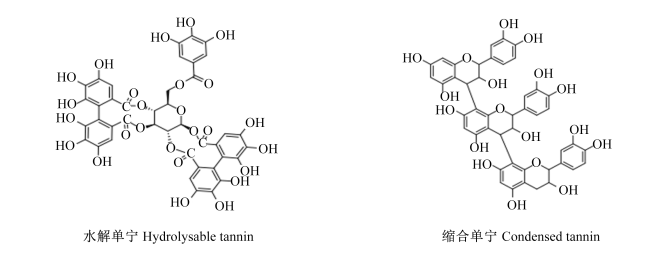
单宁又称鞣质,是一类广泛存在于天然植物中、结构较为复杂的多酚类化合物,属于植物的次生代谢产物[13]。单宁根据其化学结构可以分为水解单宁和缩合单宁[14](图1)。水解单宁由没食子酰基、葡萄糖、六羟基二苯甲酰基和其他衍生物组成,分子质量为500~3 000 u,在酸、碱和酶的作用下容易分解为多元醇或酚酸[15],主要存在于石榴、草莓、漆树、橡树和栗子中(表1)。水解单宁由于其多元酚羟基结构,具有收敛、抗腹泻、抑菌和抗氧化等功能,可以作为饲料添加剂应用到动物生产中,对动物生长性能及肠道健康都有积极的作用[16-17]。缩合单宁又称聚黄烷醇类单宁,是羟基黄烷-3-醇和黄烷-3,4-二醇的聚合物,分子质量为2 900~28 000 u,在水溶液中不易分解,在强酸的作用下会发生聚合,产生棕色沉淀[15],主要存在于茶、葡萄、苹果、浆果、花生、李子和肉桂中。缩合单宁分子质量较大,结构较为复杂,因此具有降低饲料消化率的作用[18]。富含单宁的植物及其分类见表1
图1 单宁的结构

Fig.1 Structure of tannin

表1 富含单宁的植物及其分类

Table 1 Plants enriched in tannins and their class types

项目
Items
单宁种类
Tannin types
参考文献
References
水解单宁Hydrolysable tannins Seeram等[19]
石榴Punica granatum 鞣花单宁 Truchado等[20]
草莓Fragaria ananassa Cerdá等[21]和Okuda等[22]
橡树和栗子Quercus and Castanea Ren等[23]
五倍子Galla chinensis 没食子单宁 Okuda等[22]和Moctezuma等[24]
漆树Rhus semialata
缩合单宁Condensed tannins
Camellia sinensis 单体 Stoupi等[25]
苹果Malus pumila
葡萄Vitis vinifera
浆果Vaccinium sp.
花生Arachis hypogaea
柿子Diospyros lotus
李子Prunus sp. 二聚体 Deprez等[26]
鳄梨Persea americana
肉桂Cinnamomum sp. 三聚体

2 单宁的提取方法

2.1 溶剂浸渍法

溶剂浸渍法是指用适宜的溶剂浸渍提取出有效成分的方法,植物单宁易溶于水、甲醇、乙醇、乙酸乙酯、丙酮及其混合液中[27]。柳世萍等[28]以水为溶剂提取,通过正交试验优化,五倍子单宁的最佳提取工艺为:料液比1∶7、提取温度60 ℃、浸提6次、每次1 h,提取率达50%以上。Autor等[29]以杨树皮为原料,分别以正己烷、二氯甲烷、乙酸乙酯、甲醇和水为溶剂提取多酚化合物,其中正己烷提取率为2.1%,二氯甲烷提取率为1.1%,乙酸乙酯提取率为2.8%,水提取率为2.6%,甲醇提取率最高,为15.6%。溶剂浸渍法操作简单方便,但提取时间长,且提取液中含有杂质,不适合大规模提取。

2.2 超声波辅助提取法

超声波辅助提取法是指在常规提取的基础上利用超声波振动能量破碎植物细胞壁,从而释放出其中的有效成分,实现快速、高效的提取方法。Thilakarathna等[30]以葡萄籽为原料,采用超声波辅助法提取其中的原花青素,得出最佳提取工艺为:料液比1∶10、乙醇体积分数47%、超声时间53 min、提取温度60 ℃,原花青素的产量为(25.3±1.26) mg/g。Zhou等[31]采用超声波辅助法,研究不同提取参数对柿叶中总酚和单宁含量的影响,得出提取时间2 h、提取温度75 ℃、甲醇浓度80%和料液比1∶15是生产柿单宁粗品的最佳条件,总酚和单宁含量分别为2.36%和6.75%。超声波辅助提取法提取率高、时间短、应用广泛,容易实现产业化。

2.3 微波辅助提取法

与常规溶剂浸提法相比,微波辅助提取法产生的高频电磁波穿透作用可以加速植物细胞的破裂,更有利于成分的溶出[32]。刘凤云等[33]以核桃树叶为原料,采用微波辅助纤维素酶提取核桃树叶单宁,选择酶解温度为60 ℃、pH 4.0,最佳提取工艺条件为:微波功率250 W、微波处理时间10 min、酶液用量1.1%、酶解时间100 min,核桃树叶单宁的得率可达6.08%。曹一波等[34]以白桦树皮为原料,通过响应面试验设计,采用微波辅助的方法提取单宁,确定了最佳工艺条件为:乙醇百分比33%、提取时间92 s、提取温度80 ℃、微波功率75 W,桦树单宁的得率为5.61%,纯度为51.18%。微波辅助提取法加热均匀、快速高效、节省溶剂,是一种新兴的提取方法,但是微波设备相对较贵。

2.4 超临界CO2萃取法

超临界CO2萃取法是指在超临界状态下,将渗透性良好和溶解能力较强的超临界CO2与植物接触后,将其有效成分萃取出来的方法。袁英良等[35]采用超临界CO2萃取法萃取红豆草缩合单宁,确定其最佳的工艺条件为:萃取压力34.8 MPa、萃取夹带剂流量2.0 mL/min、提取温度为40.3 ℃、提取时间123.0 min、夹带剂为50%的乙酸乙酯,红豆草缩合单宁的得率达89.23%。超临界CO2萃取法节能、无毒无害、提取的产品质量好,适合热敏性强的化合物,但是设备昂贵。

2.5 负压空化提取法

负压空化提取法是通过在常规提取器上引入真空系统,将植物组织中有效成分溶出的提取方法[36-37]。闵凡芹等[38]以五倍子为原料,采用负压空化提取法提取五倍子单宁,得出最佳工艺条件为:料液比1∶24、提取温度55 ℃、提取时间30 min,五倍子单宁的得率为66.56%。负压空化提取法实现了低温、快速提取,是一种新型的提取方法。
单宁常见的提取方法及提取率见表2。综合植物单宁的提取方法,发现单宁的不同提取方法都有不同的优缺点,溶剂浸渍法虽然操作简单方便,但提取时间长,不适合大规模提取。而超声波辅助提取法提取率高,时间短,容易实现产业化。微波辅助提取法加热均匀、快速高效、节省溶剂,但是微波设备相对较贵。超临界CO2萃取法节能,提取的产品质量好,适合热敏性强的化合物。负压空化提取法实现了低温、快速提取,是一种新型的提取方法。此外,相同植物原料通过不同工艺提取,其提取率也存在差异。例如,提取五倍子单宁时,溶剂浸渍法提取率为50%,超声波辅助法提取率为60%,微波辅助法提取率为65.13%,超临界CO2萃取法提取率为57.83%,负压空化法提取率为66.56%。因此,利用负压空化法和微波辅助法提取五倍子单宁的提取率更高。
表2 单宁常见的提取方法及提取率

Table 2 Common extraction methods and extraction rates of tannins

提取原料
Extracting
raw materials
提取方法
Extraction
method
提取溶剂
Extraction
solvent
提取条件
Extraction
condition
提取率
Extraction
rate/%
参考文献
References
橡子
Acorn
浸渍法 乙醇 料液比1∶20、提取温度60 ℃、
提取时间3 h
80 刘瑞亮[39]
橡实壳
Acorn shell
超声波辅助法 丙酮 料液比1∶55、超声时间12 min、
超声波功率320 W、物料粒径100目
31.92 朱文婷等[40]
五倍子
Galla chinensis
超声波辅助法 料液比1∶38、超声时间32 min,
超声波功率250 W
66.0 张宗和等[41]
五倍子
Galla chinensis
微波辅助法 微波功率600 W、料液比1∶32、
提取时间7 min、提取温度62 ℃
65.13 秦清等[42]
五倍子
Galla chinensis
超临界CO2
萃取法
乙酸乙酯 萃取温度44 ℃、压力25 MPa、夹带剂为
乙酸乙酯、萃取时间120 min
57.83 姜萍等[43]
香蕉皮
Banana peel
微波辅助法 乙醇 乙醇体积分数75%、料液比1∶30、
提取时间80 s、微波功率375 W
87.04 王虹玲等[44]
葡萄梗
Grape stem
超临界CO2
萃取法
乙酸乙酯 CO2流速12.5 mL/min、萃取压力25 MPa、
萃取时间90 min、萃取温度37 ℃
88.40 张建[45]
银杏叶
Ginkgo leaf
负压空化法 乙醇 提取压力-0.05 MPa、料液比1∶10.1、
乙醇体积分数50%、反应时间40 min
5.54 王燕芹等[46]

3 单宁的生物学功能

3.1 抗腹泻作用

腹泻问题一直是制约我国畜牧业发展的重要因素之一,而不同来源或形式的单宁对多种因素导致的腹泻均有一定的改善作用。水解单宁具有收敛作用,可以延长食糜在小肠内的停留时间,减少小肠过料现象,降低腹泻率[47]。Bonelli等[48]在犊牛饮水中添加栗子单宁(5 g/L),发现添加栗子单宁后犊牛腹泻持续时间减少了4 d,表明栗子单宁在犊牛中具有明显的收敛作用。水解单宁抗腹泻的原因可能是其分子内存在疏水键,可以与胃黏膜蛋白质分子结合形成鞣酸蛋白,进入小肠后在碱性环境下分解释放出鞣酸[49]。鞣酸使炎症表面的蛋白质凝固形成保护膜,减少炎性物质的渗出,从而起到收敛止泻作用[50]。Song等[51]研究表明,在基础饲粮中添加0.05%~0.40%的五倍子单宁,显著降低了断奶仔猪腹泻率和腹泻指数,并改善了断奶仔猪的肠道完整性和形态、盲肠微生物稳态和发酵,且适宜的添加水平为0.1%~0.2%。王思甜等[52]研究发现,灌喂190 mg/kg BW五倍子单宁能缓解猪流行性腹泻病毒感染造成的仔猪腹泻,提高仔猪的平均日增重和抗氧化能力,缓解肠道损伤。其机制可能是单宁通过抑制病毒对细胞的吸附、对细胞核的渗透以及抑制病毒的逆转录酶,最终阻碍了病毒的脱壳,以达到缓解病毒性腹泻的效果。因此,单宁可以有效地预防多种因素导致的动物腹泻,其分子机制仍需进一步研究。

3.2 抑菌作用

近年来的研究发现,一些单宁对致病菌的生长有抑制作用,对共生、非致病菌的生长没有负面影响,甚至有积极影响,如调节动物肠道菌群丰度的相对稳定性[53]。鞣花单宁对大肠杆菌、金黄色葡萄球菌、蜡样芽孢杆菌和沙门氏菌具有抑菌活性[54],可以改变感染产肠毒素大肠杆菌(ETEC)仔猪肠道微生物的组成。在仔猪饲粮和饮水中加入葡萄籽单宁提取物和蔓越莓单宁提取物,分别显著降低了ETEC F4和F18+的脱落,并降低了腹泻的发生率[55-56]。Choi等[57]研究发现,单宁在体外条件下对鼠伤寒沙门氏菌具有较强的抑菌作用,在肉鸡体内对鼠伤寒沙门氏菌也表现出很强的抑菌作用,而且添加单宁可以正向调节感染鼠伤寒沙门氏菌肉鸡的菌群。Puljula等[58]通过对22种鞣花单宁研究发现,鞣花单宁可以抑制金黄色葡萄球菌、大肠杆菌、产气荚膜梭菌,而对植物乳酸杆菌的抑制作用非常弱,表明鞣花单宁可能特异性地抑制有害菌,而不会抑制益生菌。欧阳龙等[59]选取6株鲍曼不动杆菌研究发现,单宁酸对6株鲍曼不动杆菌的最低抑菌浓度为128~256 μg/mL,单宁酸与头孢哌酮钠/舒巴坦钠(1∶1)联合用药对鲍曼不动杆菌的抑菌浓度指数为0.375~0.750,表现为协同作用。有研究认为,单宁抑菌的作用机制包括:1)单宁可以渗透细菌细胞壁进入内膜并干扰微生物代谢。2)通过螯合蛋白质和铁等来剥夺微生物的必需营养物质。3)与细胞表面成分(包括结构成分和受体)相互作用,增加细菌细胞壁的通透性,抑制细胞黏附[60]。单宁能特异性地抑制有害菌,对于调节动物肠道微生态具有重要的应用潜力。

3.3 抗氧化作用

研究表明,单宁可通过消除活性氧(ROS)或自由基,从而表现出有效的抗氧化作用。陶勇等[61]在断奶仔猪饲粮中添加不同水平的氧化锌和单宁,发现氧化锌和单宁组合使用可以提高仔猪血清中还原性谷胱甘肽的含量,增强断奶仔猪的抗氧化能力。单宁还可以通过提高抗氧化酶的活性来减轻氧化应激对机体的影响[62]。Fang等[63]在仔猪饲粮中添加葡萄籽原花青素发现,原花青素显著提高了仔猪血清、肝脏和肌肉中的总抗氧化能力及超氧化物歧化酶和谷胱甘肽过氧化物酶活性,并显著降低了丙二醛含量。单宁作为一种天然的抗氧化剂,有研究表明其抗氧化性能可能通过以下机制介导:1)清除自由基或与金属离子螯合抑制活性氧的形成。2)增强抗氧化防御机制。3)抑制某些可以产生自由基的酶[64]。此外,单宁的抗氧化能力与其酚羟基的个数也有关,酚羟基越多对自由基的抑制作用就越强,抗氧化能力也就越强[65]

3.4 抗炎作用

炎症是机体重要的生物反应,是移除体内有害病原体和毒素的过程,通常是有益的,但当炎症反应过度或持续时间过长,就会导致机体组织器官功能障碍。研究发现,单宁在动物模型中发挥抗炎作用,可以作为食源性生物活性物质来预防或治疗慢性炎症性疾病。Lin等[66]在尿酸钠诱导的小鼠痛风性关节炎模型中发现,没食子酸可以增强核因子E2相关因子2(Nrf2)表达,减少线粒体ROS的产生,从而阻止核苷酸结合寡聚化结构域样受体蛋白3(NLRP3)炎症小体活化和细胞焦亡,并减少巨噬细胞中白细胞介素(IL)-1β的分泌。这表明没食子酸可以通过减少炎性细胞因子的表达和免疫细胞的浸润,缓解急性痛风性关节炎。Park等[67]研究表明,在小鼠模型中,缩合单宁(多花蔷薇根)能够调节炎症介质酶、诱导一氧化氮合酶和环氧合酶2的表达。Wu等[68]用单宁处理脂多糖(LPS)诱导的BV2小胶质细胞时发现,单宁能够以剂量依赖的方式抑制LPS诱导的细胞中ROS、一氧化氮(NO)、前列腺素E2(PGE2)、IL-6和IL-1β的产生,单宁主要通过抑制ROS的形成和核因子-κB通路的激活发挥其抗炎作用。

3.5 抗寄生虫作用

寄生虫对集约化和规模化养殖的动物生产性能和健康具有较大影响,感染寄生虫会导致机体免疫功能下降、营养不良甚至死亡,最终造成一定的经济损失。植物单宁在体内和体外试验中对寄生虫均有一定的抑制作用。Tonda等[69]和Kaleem等[70]研究发现,五倍子单宁和余甘子单宁可以减少艾美耳球虫肉鸡的卵囊脱落,表明植物单宁可作为抗球虫剂减少球虫在鸡群中的持续暴露[71]。Molan等[72]研究表明,黄烷-3-醇和黄烷-3-醇没食子酸酯在体外条件下对毛圆线虫虫卵的孵化、幼虫发育和三期毛圆线虫(L3)都具有抑制作用。Marzoni等[73]在意大利慢速生长肉鸡饲粮中添加1%和2%的白坚木单宁,发现白坚木单宁可以显著减少肉鸡粪便中线虫卵和球虫卵数量,且2%的白坚木单宁减少了肉鸡粪便中的含水量。单宁抑制寄生虫感染的机制有2种可能:1)单宁可以与蛋白质结合破坏寄生虫的正常生理过程[74],或抑制寄生虫生长所需蛋白酶的活性,并与有性生殖相关的蛋白相互作用[75],从而降低寄生虫在机体内的繁殖。2)单宁可以提高机体自身的免疫力和抗氧化特性以及对寄生虫的抵抗力[76-77]。因此,单宁作为天然的饲料添加剂在动物饲料中应用具有减少寄生虫感染和减轻寄生虫感染后对机体损伤的潜力。

4 单宁在动物营养中的应用

4.1 在家禽上的应用

单宁作为天然饲料添加剂在预防腹泻和改善肠道健康等方面有很大的应用潜力[78]。近年来研究发现,在畜禽饲料中添加单宁可以减少抗生素的使用,对动物生长性能无负面影响,而且可以改善肠道健康[79]。Tong等[80]在肉鸡饲粮中添加100、400、800 mg/kg化香果单宁(单宁酸含量 65%),发现化香果单宁可以改善肉鸡的生长性能,提高血清中总抗氧化能力和过氧化氢酶活性以及空肠绒毛高度,添加100 mg/kg化香果单宁可显著提高肉鸡盲肠中优势菌副拟杆菌属(Parabacteroides)的丰度。Choi等[81]研究单宁对大肠杆菌的抗寄生虫作用,在感染大肠杆菌的肉鸡饲粮中添加500、2 750、5 000 mg/kg的单宁酸,结果表明,添加500、2 750 mg/kg的单宁可减少卵囊脱落、激活免疫系统、增强肠道屏障完整性,并改善感染大肠杆菌肉鸡的肠道形态和营养物质消化率,而添加5 000 mg/kg的单宁会降低肉鸡生长性能、营养物质消化率、抗氧化能力和肠道屏障完整性。这可能是因为高剂量的单宁与机体内的蛋白质形成复合物,会降低营养物质消化率[82],并表现出细胞毒性损害肠道健康,降低肉鸡生长性能[83]。Tong等[84]在黄羽肉鸡饲粮中添加水解没食子酸(有效含量为50%),结果表明,饲粮中添加300、450 mg/kg水解没食子酸可以提高黄羽肉鸡的屠宰性能、肝脏总抗氧化能力以及血清IL-10、IL-4、IL-6、免疫球蛋白(Ig)A和IgM的含量,对生长性能没有负面影响。Guo等[85]在肉鸡饲粮中添加150、300、450 mg/kg的水解没食子酸(五倍子含量为50%),发现150 mg/kg的水解没食子酸可提高21日龄肉鸡十二指肠IL-6、IL-4以及回肠IL-4的表达,450 mg/kg的水解没食子酸可以增强21、63日龄肉鸡肠道屏障功能,提高21日龄肉鸡未分类产粪甾醇真杆菌组(norank Eubacterium coprostanoligenes group)和63日龄肉鸡未鉴定毛螺菌科(unclassified Lachnospiraceae)的相对丰度。产粪甾醇真杆菌(Eubacterium coprostanoligenes)可以将吸收的胆固醇转化为粪甾醇以降低血清胆固醇含量,在胆固醇代谢稳态中起着关键作用[86-87]。此外,毛螺菌科(Lachnospiraceae)家族通过产生短链脂肪酸并将初级胆汁酸转化为次级胆汁酸来改变其宿主的免疫状态[88]。因此,推测单宁可能通过调节肠道微生物群落结构而对肠道健康有益。综上所述,植物单宁在家禽营养中的应用已初见成效,水解单宁及其降解产物没食子酸可以提高肉鸡抗氧化能力、免疫功能和肠道健康,并对生产性能没有负面影响,由于单宁结构复杂,发挥作用的具体分子结构及其适宜的添加剂量还有待进一步确定。

4.2 在猪上的应用

单宁在猪生产中主要用于促进仔猪生长、改善断奶仔猪腹泻以及替代氧化锌。Yu等[89]在断奶仔猪饲粮中添加0.2%和1.0%的五倍子单宁(单宁酸含量为51%)可以缓解腹泻,且不会降低生长性能。此外,饲粮中添加五倍子单宁可降低肠道通透性,减轻肠黏膜损伤,上调肠上皮紧密连接蛋白的表达,表明五倍子单宁可能通过改善肠道屏障完整性和功能对断奶仔猪发挥抗腹泻作用。Girard等[90]研究发现,在仔猪中建立ETEC F4断奶后腹泻模型后,饲粮中添加1%栗木单宁降低了腹泻仔猪发病率和腹泻的严重程度,并对生长性能没有影响。仔猪饲粮中添加高剂量的氧化锌会导致大量锌不能被吸收而释放到环境中,增加了环境中重金属污染的风险[91]。欧盟于2022年6月26日起禁止氧化锌在饲料中的添加,我国农业农村部第2625号公告规定,进一步下调仔猪饲料中锌的含量。Liu等[92]发现,在断奶仔猪饲粮中添加1 000 mg/kg栗木单宁和栗木单宁+氧化锌组合,可以提高断奶仔猪抗氧化能力、免疫力和肠道消化酶活性,改善肠道形态并降低腹泻率。郑灿阳等[93]在仔猪饲粮中添加丁酸钠+单宁酸包被制剂,发现与氧化锌对比,丁酸钠+单宁酸包被制剂可以提高断奶仔猪血清总蛋白含量和生长性能,降低腹泻率和腹泻指数。这表明水解单宁有潜力成为止泻剂并且取代氧化锌来预防和治疗仔猪断奶后腹泻,缓解肠道损伤并减少环境中锌负荷。单宁可以缓解腹泻的原因可能是:1)单宁能够防止一些消化系统紊乱,并防止液体从机体组织泄漏到肠腔以预防腹泻[94]。2)消化道中的单宁可以在肠壁上形成一层薄膜,从而降低肠道中的刺激物对肠道的刺激作用[95]

4.3 在反刍动物上的应用

反刍动物经常摄入的牧草、树木、灌木和豆类中含有丰富的单宁。因此,有大量的研究探讨了单宁对反刍动物营养、健康和生产性能的影响[96]。单宁对反刍动物的影响,主要取决于其数量、类型、化学结构和饲料成分,特别是饲料中粗蛋白质的含量[97]。Aguerre等[98]在泌乳奶牛饲粮中添加0.45%和1.80%的坚木单宁和栗木单宁(2∶1),发现根据其添加剂量的不同具有不同的效果,在饲粮中添加0.45%的坚木单宁和栗木单宁时,牛奶中蛋白质含量会增加,且在不影响产奶量的情况下减少环境中不稳定的尿氮排泄;当饲粮中添加1.80%的坚木单宁和栗木单宁时,奶牛体重会增加;此外,坚木单宁和栗木单宁线性增加了奶牛的采食量,但降低了饲料效率、氮利用效率。坚木单宁可能会通过抑制消化酶活性和瘤胃微生物的生长来降低营养物质的消化率[99]。范晶[100]在绵羊饲粮中添加0.15%和0.30%的单宁,发现单宁能够增加绵羊的平均日增重和末重,并提高抗氧化能力和改善肠道健康。Aboagye等[101]在含有苜蓿青贮饲料的肉牛饲粮中添加不同形式的水解单宁(95%单宁酸、栗木单宁和来源于五倍子的没食子酸),发现单宁酸和栗木单宁对肉牛甲烷的产生没有影响,但降低了蛋白质的消化率,并将氮从尿液转移到粪便中;而没食子酸减少了甲烷的产生,并降低了尿液中尿素氮的比例,而不影响蛋白质的消化。这表明没食子酸可能会减少反刍动物对环境的影响(较低的甲烷和氨排放),且不会降低生长性能。单宁酸和栗木单宁降低蛋白质的消化率可能是由于其分子质量较大,与蛋白质形成复合物的能力较大,因此,不同形式的水解单宁对反刍动物的影响可能与其化学结构有关。综上所述,单宁可以改善反刍动物的生长性能,维持瘤胃稳态,减少甲烷、氨气和氮的排放,但单宁在瘤胃中的真正作用机制尚不清楚。

4.4 在水产动物上的应用

研究表明,单宁对水产动物的生长和健康有一定改善作用。彭凯等[102]研究五倍子单宁和栗木单宁对南美白对虾的影响,结果显示,五倍子单宁可以降低南美白对虾脂质过氧化水平,提高肠道胰蛋白酶活性;栗木单宁会降低南美白对虾的生长性能,影响糖、脂和蛋白质的代谢,增强免疫能力。Imperatore等[103]评估了来源于栗木和白坚木的水解单宁和缩合单宁对由植物源饲料引起的斑马鱼肠道炎症的影响,结果发现,添加1.7、3.4 g/kg单宁部分恢复了肠道形态,下调了细胞因子的表达,改善了肠道微生物群。由于缩合单宁在体内不易水解、难吸收,因此,缩合单宁与水解单宁混合物在高剂量的情况下可以改善斑马鱼肠道炎症。同样,Orso等[104]使用k-卡拉胶诱导斑马鱼肠道炎症,在饲料中添加栗壳单宁,发现栗壳单宁可以减少促炎因子的产生,激活抗炎因子IL-10,并提高肠道有益菌肠杆菌科(Enterobacteriaceae)和假单胞菌属(Pseudomonas)的相对丰度,以改善肠道炎症。栗壳提取物以缩合单宁为主,会诱导肠道微生物群落发生变化[105],并通过调节免疫因子和肠道微生物群而缓解肠道炎症。Van Doan等[106]研究栗木单宁对尼罗罗非鱼生长性能、皮肤黏液和血清免疫指标的影响,发现添加0、1、2、4和8 g/kg的栗木单宁会促进尼罗罗非鱼生长性能,降低饲料转化率,提高皮肤黏液和血清免疫功能。在水产类饲料中加入单宁可能有助于保持鱼类健康,但是单宁在水产类饲料中的应用研究较少,有待进一步的研究。单宁在动物生产中的添加剂量及其应用效果见表3
表3 单宁在动物营养中的添加剂量及其应用效果

Table 3 Added dosage and application effects of tannins in animal nutrition

动物
Animals
年龄及品种
Age and
breed
添加物
Additive
添加剂量
Added
dosage
应用效果
Application
effects
参考文献
References
肉鸡
Broilers
1日龄
文昌鸡
植物单宁
(98%)
250 mg/kg 降低料重比、死亡率和
放线菌门相对丰度
李想等[107]
1日龄爱拔
益加肉鸡
五倍子单宁
(40%)
300 mg/kg 通过阻断Toll样受体4/核因子-κB
通路,提高肉鸡免疫功能,缓解脂多糖
诱导的肝脏炎症
Yuan等[108]
1日龄罗斯
308肉鸡
栗木单宁 2 000 mg/kg 在育成期添加栗木单宁可增加绒毛
高度,而在开食期添加栗木单宁会
增加隐窝深度
Buyse等[109]
蛋鸡
Hens
34周龄罗
曼粉蛋鸡
五倍子单宁
(40%)
100、
300 mg/kg
改善蛋黄着色,下调血糖和血脂水平,
提高产蛋后期产蛋率,抑制炎症因子和
肝脏自由基生成,改变肝脏脂质组成
孙澄慧[110]

Pigs
(26±2)日龄
杂交仔猪
板栗单宁和
坚木单宁
1.25% 对采食量、生长性能和肠道细胞活力
没有影响,可以调节血清肌酐和
尿素含量,调节肠道的消化能力
Caprarulo等[111]
(125±5)日龄
育肥猪
塔拉单宁
(87%)
10 g/kg 对猪的生长性能没有不良影响,
可以减少肉中的脂质氧化
Menci等[112]
21日龄
断奶小猪
水解单宁
(75%)
1 000 mg/kg 提高保育阶段平均日采食量和平均
日增重,改善肠道微环境,减少保育
猪的腹泻发生,降低死淘率
胡成等[113]

Cattle
安格斯育肥牛 坚木单宁
( 75%)
30 g/d 提高生长性能,增强机体
免疫力,提高经济效益
梅宁安等[114]
荷斯坦公牛 五倍子水解
单宁( 75%)
0.3%、0.9%、
2.7%
瘤胃液中的乙酸含量升高,
丁酸含量降低,提高机体免疫功能
赵渊[115]
英国杂交
公牛
白坚木单宁
(77.99%)
0、1.5%、
3%、4.5%
干物质、有机物、氮消化率降低,
改变了氮排泄途径,排泄的平均
粪便氮与总氮的比率增加
Norris等[116]

Sheep
3月龄
育肥滩羊
栗木单宁
(76%)
0、2 000、
4 000 mg/kg
提高育肥滩羊的生长性能、
消化代谢和屠宰性能
温红瑞等[117]
湖羊 单宁酸 39.47、
78.94 g/kg
降低瘤胃氨氮和总挥发性脂肪酸
浓度,保持瘤胃内环境稳态,
提高抗氧化能力
张振东等[118]
3月龄湖羊 单宁
(97%)
0.1% 促进了营养物质的消化、肝蛋白的
合成和肠道发育,从而改善了生长
性能和胴体特性
Zhao等[119]
水产动物
Aquatic animals
草鱼 水解单宁 0、30%、
50%、70%
可诱导肝胰腺和肠道的氧化
应激和抗氧化能力受损
Yao等[120]
凡纳滨对虾 栗木单宁 300、600、
900 mg/kg
对生长性能和消化酶活无显著的影响,
降低肠道菌群中变形菌门比例,
增加拟杆菌门比例
陈啟康等[121]

5 小结

植物单宁作为天然饲料添加剂,可以促进动物生长性能、预防腹泻并改善肠道健康,在替代氧化锌和抗生素等方面具有很大的应用前景。部分试验结果显示,缩合单宁可能受其理化特性的影响对动物生长具有抑制作用,而水解单宁具有收敛、抑菌和抗氧化作用,作为添加剂应用到饲料中,对动物的生长性能和肠道健康都有积极的影响。但是,植物单宁在肠道内的代谢过程、作用机理仍需要进一步探究。综上所述,植物单宁作为新型的饲料添加剂,在畜禽生产应用方面已经有一定的研究成果,特别是在缓解仔猪腹泻、改善肠道健康方面。因此,植物单宁有作为绿色添加剂应用于动物生产中的潜力。
[1]
中华人民共和国农业农村部. 中华人民共和国农业农村部公告第194号[EB/OL].(2019-07-09)[2024-05-01]. http://www.xmsyj.moa.gov.cn/zcjd/201907/t20190710_6320678.htm.

Ministry of agriculture and rural affairs of the people’s republic of China.Announcement No. 194 of the ministry of agriculture and rural affairs of the people’s republic of China[EB/OL].(2019-07-09)[2024-05-01]. http://www.xmsyj.moa.gov.cn/zcjd/201907/t20190710_6320678.htm. (in Chinese)

[2]
SILVEIRA R F, ROQUE-BORDA C A, VICENTE E F. Antimicrobial peptides as a feed additive alternative to animal production,food safety and public health implications:an overview[J]. Animal Nutrition, 2021, 7(3):896-904.

[3]
AGHAMOHAMMAD S, ROHANI M. Antibiotic resistance and the alternatives to conventional antibiotics:the role of probiotics and microbiota in combating antimicrobial resistance[J]. Microbiological Research, 2023,267:127275.

[4]
于志凯, 来宁洁, 张伟, 等. 酶制剂作用及其在家兔生产中的应用研究进展[J]. 中国养兔, 2022(6):22-24.

YU Z K, LAI N J, ZHANG W, et al. Research progress on the function of enzyme preparation and its application in rabbit production[J]. Chinese Journal of Rabbit Farming, 2022(6):22-24. (in Chinese)

[5]
PEARLIN B V, MUTHUVEL S, GOVIDASAMY P, et al. Role of acidifiers in livestock nutrition and health:a review[J]. Journal of Animal Physiology and Animal Nutrition, 2020, 104(2):558-569.

[6]
YANG C B, CHOWDHURY M A K, HUO Y Q, et al. Phytogenic compounds as alternatives to in-feed antibiotics:potentials and challenges in application[J]. Pathogens, 2015, 4(1):137-156.

[7]
刘薇, 丁雪, 杨运玲, 等. 替抗产品在畜牧生产中应用的研究进展[J]. 饲料博览, 2022(4):14-18.

LIU W, DING X, YANG Y L, et al. Research progress of antibiotic substitute products in animal production[J]. Feed Review, 2022(4):14-18. (in Chinese)

[8]
郭洪伟. 常见饲料替抗产品的作用及优缺点[J]. 畜牧兽医科技信息, 2023(3):189-191.

GUO H W. The role advantages and disadvantages of common feed substitute products[J]. Chinese Journal of Animal Husbandry and Veterinary Medicine, 2023(3):189-191. (in Chinese)

[9]
BHAT T K, KANNAN A, SINGH B, et al. Value addition of feed and fodder by alleviating the antinutritional effects of tannins[J]. Agricultural Research, 2013, 2(3):189-206.

[10]
MAKKAR H P S, FRANCIS G, BECKER K. Bioactivity of phytochemicals in some lesser-known plants and their effects and potential applications in livestock and aquaculture production systems[J]. Animal, 2007, 1(9):1371-1391.

DOI PMID

[11]
钟瑜, 胡健, 刘阿静, 等. 植物单宁的生理作用[J]. 陕西农业科学, 2008, 54(4):98-99,104.

ZHONG Y, HU J, LIU A J, et al. Physiological function of plant tannins[J]. Shaanxi Journal of Agricultural Sciences, 2008, 54(4):98-99,104. (in Chinese)

[12]
王磊, 陈一宁, 但年华, 等. 植物单宁的提取纯化方法及其发展[J]. 西部皮革, 2015, 37(12):12-19.

WANG L, CHEN Y N, DAN N H, et al. The extraction and purification methods of vegetable tannin and their development[J]. West Leather, 2015, 37(12):12-19. (in Chinese)

[13]
KHANBABAEE K, VAN REE T. Tannins:classification and definition[J]. Natural Product Reports, 2001, 18(6):641-649.

[14]
SERRA V, SALVATORI G, PASTORELLI G. Dietary polyphenol supplementation in food producing animals:effects on the quality of derived products[J]. Animals, 2021, 11(2):401.

[15]
黄文. 橡椀单宁生物降解及其机理研究[D]. 博士学位论文. 成都: 四川大学, 2002.

HUANG W. Study on approach and mechanism of biodegradation of valonia tannin[D]. Ph.D.Thesis. Chengdu: Sichuan University, 2002. (in Chinese)

[16]
何子煜, 张佩华. 单宁酸的生理功能及其在畜禽生产中的研究进展[J]. 湖南饲料, 2018(1):40-42.

HE Z Y, ZHANG P H. The physiological functions of tannic acid and its research progress in livestock and poultry production[J]. Hunan Feed, 2018(1):40-42. (in Chinese)

[17]
FRASCA G, CARDILE V, PUGLIA C, et al. Gelatin tannate reduces the proinflammatory effects of lipopolysaccharide in human intestinal epithelial cells[J]. Clinical and Experimental Gastroenterology, 2012,5:61-67.

[18]
MCSWEENEY C S, PALMER B, MCNEILL D M, et al. Microbial interactions with tannins:nutritional consequences for ruminants[J]. Animal Feed Science and Technology, 2001, 91(1/2):83-93.

[19]
SEERAM N P, HENNING S M, ZHANG Y J, et al. Pomegranate juice ellagitannin metabolites are present in human plasma and some persist in urine for up to 48 hours[J]. The Journal of Nutrition, 2006, 136(10):2481-2485.

[20]
TRUCHADO P, LARROSA M, GARCÍA-CONESA M T, et al. Strawberry processing does not affect the production and urinary excretion of urolithins,ellagic acid metabolites,in humans[J]. Journal of Agricultural and Food Chemistry, 2012, 60(23):5749-5754.

[21]
CERDÁ B, TOMÁS-BARBERÁN F A, ESPÍN J C. Metabolism of antioxidant and chemopreventive ellagitannins from strawberries,raspberries,walnuts,and oak-aged wine in humans:identification of biomarkers and individual variability[J]. Journal of Agricultural and Food Chemistry, 2005, 53(2):227-235.

[22]
OKUDA T K, ITO H. Tannins of constant structure in medicinal and food plants-hydrolyzable tannins and polyphenols related to tannins[J]. Molecules, 2011, 16(3):2191-2217.

[23]
REN Y Y, ZHANG X R, LI T N, et al. Galla chinensis,a traditional Chinese medicine:comprehensive review of botany,traditional uses,chemical composition,pharmacology and toxicology[J]. Journal of Ethnopharmacology, 2021,278:114247.

[24]
MOCTEZUMA C, HAMMERBACHER A, HEIL M, et al. Specific polyphenols and tannins are associated with defense against insect herbivores in the tropical oak Quercus oleoides[J]. Journal of Chemical Ecology, 2014, 40(5):458-467.

[25]
STOUPI S, WILLIAMSON G, DRYNAN J W, et al. Procyanidin B2 catabolism by human fecal microflora:partial characterization of ‘dimeric’ intermediates[J]. Archives of Biochemistry and Biophysics, 2010, 501(1):73-78.

[26]
DEPREZ S, MILA I, HUNEAU J F, et al. Transport of proanthocyanidin dimer,trimer,and polymer across monolayers of human intestinal epithelial Caco-2 cells[J]. Antioxidants & Redox Signaling, 2001, 3(6):957-967.

[27]
李红然, 付大友. 五倍子中有效成分提取方法研究进展[J]. 广东化工, 2010, 37(10):71,79.

LI H R, FU D Y. Study on extraction process of active ingredients from Galla chinensis[J]. Guangdong Chemical Industry, 2010, 37(10):71,79. (in Chinese)

[28]
柳世萍, 李毅. 五倍子提取单宁酸的工艺研究[J]. 河北化工, 2007, 30(10):44-45.

LIU S P, LI Y. Study on the extraction of tannic acid from Chinese gallnut[J]. Hebei Chemical Engineering and Industry, 2007, 30(10):44-45. (in Chinese)

[29]
AUTOR E, CORNEJO A, BIMBELA F, et al. Extraction of phenolic compounds from populus Salicaceae bark[J]. Biomolecules, 2022, 12(4):539.

[30]
THILAKARATHNA W P D W, RUPASINGHE H P V. Optimization of the extraction of proanthocyanidins from grape seeds using ultrasonication-assisted aqueous ethanol and evaluation of anti-steatosis activity in vitro[J]. Molecules, 2022, 27(4):1363.

[31]
ZHOU Z D, HUANG Y, LIANG J T, et al.Extraction, purification and anti-radiation activity of persimmon tannin from Diospyros kaki L.[J]. Journal of Environmental Radioactivity, 2016,162/163:182-188.

[32]
汪文丽, 曲晓营, 朱晓明, 等. 金刚藤多糖的微波辅助提取及体外抗氧化、降血糖活性分析[J]. 湖北科技学院学报(医学版), 2024, 38(1):11-16,29.

WANG W L, QU X Y, ZHU X M, et al. Microwave-assisted extraction and in vitro antioxidant and hypoglycemic activity analysis of polysaccharides from smilax China L[J]. Journal of Hubei University of Science and Technology (Medical Sciences), 2024, 38(1):11-16,29. (in Chinese)

[33]
刘凤云, 谢金枝. 基于响应面法的微波辅助酶法提取核桃树叶单宁[J]. 食品研究与开发, 2018, 39(11):37-42.

LIU F Y, XIE J Z. Microwave-assisted enzyme method extracted walnut leaf tannins based on the response surface methodology[J]. Food Research and Development, 2018, 39(11):37-42. (in Chinese)

[34]
曹一波, 刘永, 张德辉, 等. 白桦树皮单宁的微波辅助提取工艺研究[J]. 现代农业科技, 2013(1):211-212.

CAO Y B, LIU Y, ZHANG D H, et al. Study on the microwave-assisted extraction technology of tannin from bark of Betula platyphylla[J]. Modern Agricultural Science and Technology, 2013(1):211-212. (in Chinese)

[35]
袁英良, 唐丹, 鲁英, 等. 响应面法优化超临界CO2萃取红豆草缩合单宁工艺技术研究[J]. 中国饲料, 2021(21):36-41.

YUAN Y L, TANG D, LU Y, et al. Optimization of supercritical CO2 extraction of condensed tannins in sainfoin by response surface methodology[J]. China Feed, 2021(21):36-41. (in Chinese)

[36]
付玉杰, 赵文灏, 侯春莲, 等. 负压空化提取甘草酸工艺[J]. 应用化学, 2005, 22(12):1369-1371.

FU Y J, ZHAO W H, HOU C L, et al. Vacuum-cavitated technology for glycyrrhizic acid extraction[J]. Chinese Journal of Applied Chemistry, 2005, 22(12):1369-1371. (in Chinese)

[37]
徐连明, 徐桂红, 王振中, 等. 金银花减压提取工艺研究[J]. 中国实验方剂学杂志, 2011, 17(5):31-33.

XU L M, XU G H, WANG Z Z, et al. Study on vacuum extraction process of honeysuckle[J]. Chinese Journal of Experimental Traditional Medical Formulae, 2011, 17(5):31-33. (in Chinese)

[38]
闵凡芹, 张宗和, 秦清, 等. 负压空化法提取五倍子单宁酸的响应面法优化[J]. 天然产物研究与开发, 2013, 25(9):1240-1244.

MIN F Q, ZHANG Z H, QIN Q, et al. Optimization of vacuum cavitation extraction of tannic acid from Chinese gallnut using response surface method[J]. Natural Product Research and Development, 2013, 25(9):1240-1244. (in Chinese)

[39]
刘瑞亮. 栎属橡子单宁提取与淀粉浓醪发酵工艺研究[D]. 硕士毕业论文. 北京: 北京化工大学, 2016.

LIU R L. Study on acorn (Quercus L.) tannin extraction and very high gravity (VHG) fermentation of acorn starch[D]. Master’s Thesis. Beijing: Beijing University of Chemical Technology, 2016. (in Chinese)

[40]
朱文婷, 吴士筠, 杨文婷, 等. 超声波法提取橡实壳多酚的工艺优化[J]. 贵州农业科学, 2016, 44(2):156-158,161.

ZHU W T, WU S J, YANG W T, et al. Optimization of extraction technology of acorn shell polyphenol by ultrasonic method[J]. Guizhou Agricultural Sciences, 2016, 44(2):156-158,161. (in Chinese)

[41]
张宗和, 闵凡芹, 秦清, 等. 超声波辅助提取五倍子单宁酸的响应面优化实验[J]. 生物质化学工程, 2012, 46(6):12-16.

ZHANG Z H, MIN F Q, QIN Q, et al. Optimization of ultrasonic-assisted extraction of tannic acid from Chinese gallnut using response surface method[J]. Biomass Chemical Engineering, 2012, 46(6):12-16. (in Chinese)

[42]
秦清, 闵凡芹, 徐浩, 等. 响应面法优化微波辅助提取五倍子单宁工艺研究[J]. 林产化学与工业, 2012, 32(6):84-88.

QIN Q, MIN F Q, XU H, et al. Optimization of microwave-assisted extraction of tannic acid from Chinese gallnut using response surface method[J]. Chemistry and Industry of Forest Products, 2012, 32(6):84-88. (in Chinese)

[43]
姜萍, 黄娟, 李春福. 超临界CO2萃取单宁酸的研究[J]. 林产化工通讯, 2005, 39(6):17-19.

JIANG P, HUANG J, LI C F. Study on supercritical carbon dioxide extraction of tannin acid[J]. Forestry Chemical Communication, 2005, 39(6):17-19. (in Chinese)

[44]
王虹玲, 武婷茹, 姜诗文, 等. 香蕉皮单宁的提取及其提取物的抑菌抗氧化活性[J]. 食品与发酵工业, 2014, 40(11):253-259.

DOI

WANG H L, WU T R, JIANG S W, et al. Optimum of extraction tannin from banana peel and its antibacterial and antioxidant activities[J]. Food and Fermentation Industries, 2014, 40(11):253-259. (in Chinese)

[45]
张建. 超临界CO2萃取葡萄梗中单宁的研究[J]. 河南工业大学学报(自然科学版), 2010, 31(5):51-54.

ZHANG J. Extraction of tannin from grape stems by supercritical CO2[J]. Journal of Henan University of Technology (Natural Science Edition), 2010, 31(5):51-54. (in Chinese)

[46]
王燕芹, 徐莉, 曹福亮, 等. 负压空化法提取银杏叶中原花青素及其分离纯化[J]. 食品科学, 2013, 34(24):6-10.

WANG Y Q, XU L, CAO F L, et al. Negative pressure cavitation-assisted extraction and purification of proanthocyaidins from Ginkgo biloba leaves[J]. Food Science, 2013, 34(24):6-10. (in Chinese)

[47]
魏昆鹏, 朱子洁. 水解单宁酸对家禽肠道健康的促进作用[J]. 中国动物保健, 2016, 18(7):30-31.

WEI K P, ZHU Z J. The promoting effect of hydrolyzed tannic acid on intestinal health of poultry[J]. China Animal Health, 2016, 18(7):30-31. (in Chinese)

[48]
BONELLI F, TURINI L, SARRI G, et al. Oral administration of chestnut tannins to reduce the duration of neonatal calf diarrhea[J]. BMC Veterinary Research, 2018, 14(1):227.

DOI PMID

[49]
耿文静, 王改琴, 沈波, 等. 水解单宁酸的生理功能及其在单胃动物生产中的应用[J]. 中国饲料, 2017(9):30-34.

GENG W J, WANG G Q, SHEN B, et al. The physiologic function of hydrolysized tannic acid and its application in monogastric animal[J]. China Feed, 2017(9):30-34. (in Chinese)

[50]
秦嘉艺. 动物常用泻药与止泻药的合理选用[J]. 畜牧兽医科技信息, 2015(4):125.

QIN J Y. Rational selection of laxatives and antidiarrheal drugs commonly used in animals[J]. Chinese Journal of Animal Husbandry and Veterinary Medicine, 2015(4):125. (in Chinese)

[51]
SONG Y Y, LUO Y, YU B, et al. Tannic acid extracted from gallnut prevents post-weaning diarrhea and improves intestinal health of weaned piglets[J]. Animal Nutrition, 2021, 7(4):1078-1086.

DOI PMID

[52]
王思甜, 徐朋涛, 郑丽云, 等. 单宁酸对感染猪流行性腹泻病毒仔猪生长性能、肠道屏障功能和抗氧化能力的影响[J]. 动物营养学报, 2023, 35(7):4276-4286.

DOI

WANG S T, XU P T, ZHENG L Y, et al. Effects of tannic acid on growth performance,intestinal barrier function and antioxidant capacity of piglets infected with porcine epidemic diarrhea virus[J]. Chinese Journal of Animal Nutrition, 2023, 35(7):4276-4286. (in Chinese)

[53]
郭慧, 朱旭枫, 陈锦霖, 等. 水解单宁对凡纳滨对虾生长性能和肠道微生物的影响[J]. 中国水产科学, 2019, 26(5):883-892.

GUO H, ZHU X F, CHEN J L, et al. Effects of hydrolyzable tannins on growth performance and intestinal microflora in Litopenaeus vannamei[J]. Journal of Fishery Sciences of China, 2019, 26(5):883-892. (in Chinese)

[54]
KAMIJO M, KANAZAWA T, FUNAKI M, et al. Effects of Rosa rugosa petals on intestinal bacteria[J]. Bioscience, Biotechnology, and Biochemistry, 2008, 72(3):773-777.

[55]
VERHELST R, SCHROYEN M, BUYS N, et al. Dietary polyphenols reduce diarrhea in enterotoxigenic Escherichia coli (ETEC) infected post-weaning piglets[J]. Livestock Science, 2014,160:138-140.

[56]
CODDENS A, LOOS M, VANROMPAY D, et al. Cranberry extract inhibits in vitro adhesion of F4 and F18+ Escherichia coli to pig intestinal epithelium and reduces in vivo excretion of pigs orally challenged with F18+ verotoxigenic E. coli[J]. Veterinary Microbiology, 2017,202:64-71.

[57]
CHOI J, YADAV S, VADDU S, et al. In vitro and in vivo evaluation of tannic acid as an antibacterial agent in broilers infected with Salmonella typhimurium[J]. Poultry Science, 2023, 102(12):102987.

[58]
PULJULA E, WALTON G, WOODWARD M J, et al. Antimicrobial activities of ellagitannins against Clostridiales perfringens,Escherichia coli,Lactobacillus plantarum and Staphylococcus aureus[J]. Molecules, 2020, 25(16):3714.

[59]
欧阳龙, 肖亚雄. 单宁酸与不同配比头孢哌酮钠/舒巴坦钠对耐碳青霉烯鲍曼不动杆菌的体外抑菌作用研究[J]. 实用临床医药杂志, 2023, 27(15):104-107.

OU YANG L, XIAO Y X. In vitro antibacterial roles of carbapenem-resistant Acinetobacter baumannii by tannic acid and different cefoperazone sodium-to-sulbactam sodium ratios[J]. Journal of Clinical Medicine in Practice, 2023, 27(15):104-107. (in Chinese)

[60]
KACZMAREK B. Tannic acid with antiviral and antibacterial activity as a promising component of biomaterials-a minireview[J]. Materials (Basel,Switzerland), 2020, 13(14):3224.

[61]
陶勇, 杨晓志, 王见悠, 等. 单宁和氧化锌组合对断奶仔猪粪便菌群、血清抗氧化及肝脏功能指标的影响[J]. 中国畜牧兽医, 2019, 46(6):1644-1651.

DOI

TAO Y, YANG X Z, WANG J Y, et al. Effects of combinations of tannin and zinc oxide on fecal microflora,serum antioxidant and liver function indexes in weaned piglets[J]. China Animal Husbandry & Veterinary Medicine, 2019, 46(6):1644-1651. (in Chinese)

[62]
王俊锋, 连慧香, 付春胜, 等. 水解单宁酸的生物学功能及其在畜牧生产中的应用[J]. 饲料研究, 2022, 45(19):145-148.

WANG J F, LIAN H X, FU C S, et al. Biological function of tannic acid and its application in animal production[J]. Feed Research, 2022, 45(19):145-148. (in Chinese)

[63]
FANG L Y, LI M Y, ZHAO L Y, et al. Dietary grape seed procyanidins suppressed weaning stress by improving antioxidant enzyme activity and mRNA expression in weanling piglets[J]. Journal of Animal Physiology and Animal Nutrition, 2020, 104(4):1178-1185.

DOI PMID

[64]
COTELLE N. Role of flavonoids in oxidative stress[J]. Current Topics in Medicinal Chemistry, 2001, 1(6):569-590.

PMID

[65]
SIENIAWSKA E. Activities of tannins-from in vitro studies to clinical trials[J]. Natural Product Communications, 2015, 10(11):1877-1884.

[66]
LIN Y Q, LUO T Y, WENG A L, et al. Gallic acid alleviates gouty arthritis by inhibiting NLRP3 inflammasome activation and pyroptosis through enhancing Nrf2 signaling[J]. Frontiers in Immunology, 2020,11:580593.

[67]
PARK K H, JEONG M S, PARK K J, et al. Topical application of Rosa multiflora root extract improves atopic dermatitis-like skin lesions induced by mite antigen in NC/Nga mice[J]. Biological & Pharmaceutical Bulletin, 2014, 37(1):178-183.

[68]
WU Y, ZHONG L M, YU Z R, et al. Anti-neuroinflammatory effects of tannic acid against lipopolysaccharide-induced BV2 microglial cells via inhibition of NF-κB activation[J]. Drug Development Research, 2019, 80(2):262-268.

DOI PMID

[69]
TONDA R M, RUBACH J K, LUMPKINS B S, et al. Effects of tannic acid extract on performance and intestinal health of broiler chickens following coccidiosis vaccination and/or a mixed-species Eimeria challenge[J]. Poultry Science, 2018, 97(9):3031-3042.

DOI PMID

[70]
KALEEM Q M, AKHTAR M, AWAIS M M, et al. Studies on Emblica officinalis derived tannins for their immunostimulatory and protective activities against coccidiosis in industrial broiler chickens[J]. The Scientific World Journal, 2014,2014:378473.

[71]
CHA J O, ZHAO J, YANG M S, et al. Oocyst-shedding patterns of three eimeria species in chickens and shedding pattern variation depending on the storage period of Eimeria tenella oocysts[J]. The Journal of Parasitology, 2018, 104(1):18-22.

[72]
MOLAN A L, MEAGHER L P, SPENCER P A, et al. Effect of flavan-3-ols on in vitro egg hatching,larval development and viability of infective larvae of Trichostrongylus colubriformis[J]. International Journal for Parasitology, 2003, 33(14):1691-1698.

[73]
MARZONI M, CASTILLO A, FRANZONI A, et al. Effects of dietary quebracho tannin on performance traits and parasite load in an Italian slow-growing chicken (white livorno breed)[J]. ANIMALS, 2020, 10(4):684.

[74]
NIEZEN J H, CHARLESTON W A G, ROBERTSON H A, et al. The effect of feeding sulla (Hedysarum coronarium) or lucerne (Medicago sativa) on lamb parasite burdens and development of immunity to gastrointestinal nematodes[J]. Veterinary Parasitology, 2002, 105(3):229-245.

PMID

[75]
ATHANASIADOU S, KYRIAZAKIS I, JACKSON F, et al. Direct anthelmintic effects of condensed tannins towards different gastrointestinal nematodes of sheep: in vitro and in vivo studies[J]. Veterinary Parasitology, 2001, 99(3):205-219.

[76]
WAGHORN G C, MCNABB W C. Consequences of plant phenolic compounds for productivity and health of ruminants[J]. Proceedings of the Nutrition Society, 2003, 62(2):383-392.

DOI PMID

[77]
HAMIZA O O, REHMAN M U, TAHIR M, et al. Amelioration of 1,2 dimethylhydrazine (DMH) induced colon oxidative stress,inflammation and tumor promotion response by tannic acid in wistar rats[J]. Asian Pacific Journal of Cancer Prevention:APJCP, 2012, 13(9):4393-4402.

[78]
张成喜, 张小东. 水解单宁酸在畜禽饲料替抗中的应用研究进展[J]. 饲料博览, 2022(3):13-17.

ZHANG C X, ZHANG X D. Research progress of hydrolyzed tannins on livestock and poultry feed replacement of antibiotics[J]. Feed Review, 2022(3):13-17. (in Chinese)

[79]
王吉, 王湘林, 肖海思, 等. 单宁的生物活性及其在畜禽生产中的应用[J]. 中国农业大学学报, 2022, 27(4):164-178.

WANG J, WANG X L, XIAO H S, et al. Biological activity of tannin and its application in livestock and poultry production[J]. Journal of China Agricultural University, 2022, 27(4):164-178. (in Chinese)

[80]
TONG Z K, LEI F H, LIU L X, et al. Effects of Plotytarya strohilacea Sieb. et Zuce tannin on the growth performance,oxidation resistance,intestinal morphology and cecal microbial composition of broilers[J]. Frontiers in Veterinary Science, 2022,8:806105.

[81]
CHOI J, TOMPKINS Y H, TENG P Y, et al. Effects of tannic acid supplementation on growth performance,oocyst shedding,and gut health of in broilers infected with eimeria maxima[J]. Animals:an Open Access Journal from MDPI, 2022, 12(11):1378.

[82]
REDONDO L M, CHACANA P A, DOMINGUEZ J E, et al. Perspectives in the use of tannins as alternative to antimicrobial growth promoter factors in poultry[J]. Frontiers in Microbiology, 2014,5:118.

[83]
VAN DER AAR P J, MOLIST F, VAN DER KLIS J D. The central role of intestinal health on the effect of feed additives on feed intake in swine and poultry[J]. Animal Feed Science and Technology, 2017,233:64-75.

[84]
TONG Y X, LIN Y, DI B, et al. Effect of hydrolyzed gallotannin on growth performance,immune function,and antioxidant capacity of yellow-feather broilers[J]. Animals:an Open Access Journal from MDPI, 2022, 12(21):2971.

[85]
GUO P T, TONG Y X, YANG R, et al. Effects of hydrolyzed gallotannin on intestinal physical barrier,immune function,and microbiota structure of yellow-feather broilers[J]. Poultry Science, 2023, 102(11):103010.

[86]
LI L, BATT S M, WANNEMUEHLER M, et al. Effect of feeding of a cholesterol-reducing bacterium,eubacterium coprostanoligenes,to germ-free mice[J]. Laboratory Animal Science, 1998, 48(3):253-255.

[87]
KRIAA A, BOURGIN M, MKAOUAR H, et al. Microbial reduction of cholesterol to coprostanol:an old concept and new insights[J]. Catalysts, 2019, 9(2):167.

[88]
SORBARA M T, LITTMANN E R, FONTANA E, et al. Functional and genomic variation between human-derived isolates of Lachnospiraceae reveals inter- and intra-species diversity[J]. Cell Host & Microbe, 2020, 28(1):134-146.e4.

[89]
YU J, SONG Y Y, YU B, et al. Tannic acid prevents post-weaning diarrhea by improving intestinal barrier integrity and function in weaned piglets[J]. Journal of Animal Science and Biotechnology, 2020,11:87.

[90]
GIRARD M, THANNER S, PRADERVAND N, et al. Hydrolysable chestnut tannins for reduction of postweaning diarrhea:efficacy on an experimental ETEC F4 model[J]. PloS One, 2018, 13(5):e0197878.

[91]
BEDNORZ C, OELGESCHLÄGER K, KINNEMANN B, et al. The broader context of antibiotic resistance:zinc feed supplementation of piglets increases the proportion of multi-resistant Escherichia coli in vivo[J]. International Journal of Medical Microbiology:IJMM, 2013, 303(6/7):396-403.

[92]
LIU H S, HU J X, MAHFUZ S, et al. Effects of hydrolysable tannins as zinc oxide substitutes on antioxidant status,immune function,intestinal morphology,and digestive enzyme activities in weaned piglets[J]. Animals, 2020, 10(5):757.

[93]
郑灿阳, 郑新添, 黄艺珠, 等. 丁酸钠+单宁酸包被制剂对断奶仔猪生长性能、腹泻和血清生化指标的影响[J]. 上海畜牧兽医通讯, 2022(2):24-27.

ZHENG C Y, ZHENG X T, HUANG Y Z, et al. Effects of sodium butyrate+tannic acid coating preparation on growth performance,diarrhea and serum biochemical indexes of weaned piglets[J]. Shanghai Journal of Animal Husbandry and Veterinary Medicine, 2022(2):24-27. (in Chinese)

[94]
CHUNG K T, WONG T Y, WEI C I, et al. Tannins and human health:a review[J]. Critical Reviews in Food Science and Nutrition, 1998, 38(6):421-464.

[95]
AHMED A E, SMITHARD R, ELLIS M. Activities of enzymes of the pancreas,and the lumen and mucosa of the small intestine in growing broiler cockerels fed on tannin-containing diets[J]. British Journal of Nutrition, 1991, 65(2):189-197.

[96]
VASTA V, DAGHIO M, CAPPUCCI A, et al. Invited review:plant polyphenols and rumen microbiota responsible for fatty acid biohydrogenation,fiber digestion,and methane emission:experimental evidence and methodological approaches[J]. Journal of Dairy Science, 2019, 102(5):3781-3804.

[97]
ROPIAK H M, LACHMANN P, RAMSAY A, et al. Identification of structural features of condensed tannins that affect protein aggregation[J]. PLoS One, 2017, 12(1):e0170768.

[98]
AGUERRE M J, DUVAL B, POWELL J M, et al. Effects of feeding a quebracho-chestnut tannin extract on lactating cow performance and nitrogen utilization efficiency[J]. Journal of Dairy Science, 2020, 103(3):2264-2271.

DOI PMID

[99]
AHNERT S, DICKHOEFER U, SCHULZ F, et al. Influence of ruminal quebracho tannin extract infusion on apparent nutrient digestibility,nitrogen balance,and urinary purine derivatives excretion in heifers[J]. Livestock Science, 2015,177:63-70.

[100]
范晶. 单宁对绵羊胃肠道形态功能及微生物区系的影响[D]. 硕士毕业论文. 石河子: 石河子大学, 2023.

FAN J. Effect of tannins on the morphological function and microbiota of thegastrointestinal tract of sheep[D]. Master’s Thesis. Shihezi: Shihezi University, 2023. (in Chinese)

[101]
ABOAGYE I A, OBA M, KOENIG K M, et al. Use of gallic acid and hydrolyzable tannins to reduce methane emission and nitrogen excretion in beef cattle fed a diet containing alfalfa silage1,2[J]. Journal of Animal Science, 2019, 97(5):2230-2244.

DOI PMID

[102]
彭凯, 邱建强, 徐有良, 等. 不同单宁制剂对南美白对虾生长、血液指标及肠道消化酶活性的影响[J]. 中国畜牧兽医, 2023, 50(11):4444-4453.

DOI

PENG K, QIU J Q, XU Y L, et al. Effects of different plant tannin preparations on growth performance,blood parameters and intestinal digestive enzyme activities of Litopenaeus vannamei[J]. China Animal Husbandry & Veterinary Medicine, 2023, 50(11):4444-4453. (in Chinese)

[103]
IMPERATORE R, FRONTE B, SCICCHITANO D, et al. Dietary supplementation with a blend of hydrolyzable and condensed tannins ameliorates diet-induced intestinal inflammation in zebrafish (Danio rerio)[J]. Animals, 2022, 13(1):167.

[104]
ORSO G, SOLOVYEV M M, FACCHIANO S, et al. Chestnut shell tannins:effects on intestinal inflammation and dysbiosis in zebrafish[J]. Animals, 2021, 11(6):1538.

[105]
SORICE A, SIANO F, CAPONE F, et al. Potential anticancer effects of polyphenols from chestnut shell extracts: modulation of cell growth,and cytokinomic and metabolomic profiles[J]. Molecules, 2016, 21(10):1411.

[106]
VAN DOAN H, HOSEINIFAR S H, HUNG T Q, et al. Dietary inclusion of chestnut (Castanea sativa) polyphenols to Nile tilapia reared in biofloc technology:impacts on growth,immunity,and disease resistance against Streptococcus agalactiae[J]. Fish & Shellfish Immunology, 2020,105:319-326.

[107]
李想, 孙瑞萍, 刘圈炜, 等. 植物单宁和植物单宁复合蛋白对文昌鸡生长性能、肠道形态及盲肠微生物的影响[J]. 中国家禽, 2022, 44(11):56-62.

LI X, SUN R P, LIU J W, et al. Effects of plant tannin and plant tannin compound protein on growth performance,intestinal morphology and cecal microorganism of Wenchang chicken[J]. China Poultry, 2022, 44(11):56-62. (in Chinese)

[108]
YUAN P, XU H T, MA Y F, et al. Effects of dietary Galla chinensis tannin supplementation on immune function and liver health in broiler chickens challenged with lipopolysaccharide[J]. Frontiers in Veterinary Science, 2023,10:1126911.

[109]
BUYSE K, NOTEN N V, DELEZIE E, et al. Chestnut tannins in broiler diets:affecting intestinal development in different feeding phases[J]. Frontiers in Veterinary Science, 2022,9:996524.

[110]
孙澄慧. 五倍子单宁对蛋鸡营养生理效应调节作用的研究[D]. 硕士毕业论文. 贵阳: 贵州大学, 2022.

SUN C H. Study on the regulating effect of Galla chinensis tannin on nutritional physiological effect of laying hens[D]. Master’s Thesis. Guiyang: Guizhou University, 2022. (in Chinese)

[111]
CAPRARULO V, HEJNA M, GIROMINI C, et al. Evaluation of dietary administration of chestnut and quebracho tannins on growth,serum metabolites and fecal parameters of weaned piglets[J]. Animals, 2020, 10(11):1945.

[112]
MENCI R, LUCIANO G, NATALELLO A, et al. Performance and meat quality in pigs fed hydrolysable tannins from Tara spinosa[J]. Meat Science, 2024,207:109364.

[113]
胡成, 李宁宁, 刘则学. 水解单宁酸对保育猪生长性能及腹泻防控效果试验[J]. 养猪, 2019(5):15-16.

HU C, LI N N, LIU Z X. Effect of hydrolyzed tannic acid on growth performance and diarrhea prevention and control of nursery pigs[J]. Swine Production, 2019(5):15-16. (in Chinese)

[114]
梅宁安, 刘自新, 王浩合, 等. 坚木缩合单宁对安格斯育肥牛生长性能和血常规的影响[J]. 当代畜牧, 2022(4):35-37.

MEI N A, LIU Z X, WANG H H, et al. Effects of hardwood condensed tannins on growth performance and blood routine of Angus fattening cattle[J]. Contemporary Animal Husbandry, 2022(4):35-37. (in Chinese)

[115]
赵渊. 不同剂量单宁酸对育肥牛生产性能、瘤胃发酵、血液生化及免疫功能的影响[D]. 硕士毕业论文. 长沙: 湖南农业大学, 2021.

ZHAO Y. Effects of different doses of tannic acid on production performance,rumen fermentation,blood biochemistry and immune function of fattening cattle[D]. Master’s Thesis. Changsha: Hunan Agricultural University, 2021. (in Chinese)

[116]
NORRIS A B, CROSSLAND W L, TEDESCHI L O, et al. Inclusion of quebracho tannin extract in a high-roughage cattle diet alters digestibility,nitrogen balance,and energy partitioning[J]. Journal of Animal Science, 2020, 98(3):skaa047.

[117]
温红瑞, 齐明江, 高昌鹏, 等. 单宁对育肥滩羊生长性能、消化代谢以及屠宰性能的影响[J]. 浙江农业学报, 2023, 35(12):2809-2817.

DOI

WEN H R, QI M J, GAO C P, et al. Effect of tannin on growth performance,digestion and metabolism and slaughtering performance of fattening Tan sheep[J]. Acta Agriculturae Zhejiangensis, 2023, 35(12):2809-2817. (in Chinese)

[118]
张振东, 刘婷, 范慧玉, 等. 单宁酸对湖羊瘤胃动态发酵和血清抗氧化能力的影响[J]. 饲料工业, 2022, 43(18):44-49.

ZHANG Z D, LIU T, FAN H Y, et al. Effects of dietary tannic acid on rumen dynamic fermentation and serum antioxidant capacity of Hu sheep[J]. Feed Industry, 2022, 43(18):44-49. (in Chinese)

[119]
ZHAO M D, DI L F, TANG Z Y, et al. Effect of tannins and cellulase on growth performance, nutrients digestibility,blood profiles,intestinal morphology and carcass characteristics in Hu sheep[J]. Asian-Australasian Journal of Animal Sciences, 2019, 32(10):1540-1547.

[120]
YAO J T, HANG Y, HUA X M, et al. Hepatopancreas-intestinal health in grass carp (Ctenopharyngodon idella) fed with hydrolyzable tannin or rapeseed meal[J]. Aquaculture Nutrition, 2022, 2022(1):6746201.

[121]
陈啟康, 刘兴旺, 谢瑞涛, 等. 栗木单宁对凡纳滨对虾生长、消化酶、血清抗氧化及肠道菌群的影响[J]. 饲料研究, 2021, 44(20):33-37.

CHEN Q K, LIU X W, XIE R T, et al. Effect of chestnut tannins on growth performance,digestive enzyme,antioxidase and intestinal microflora in Litopenaeus vannamei[J]. Feed Research, 2021, 44(20):33-37. (in Chinese)

文章导航

/