综述

辣椒素对动物机体的调节机制及其在反刍动物生产中的应用

  • 姜治国 ,
  • 赵进哲 ,
  • 李雪莲 ,
  • 张红瑞 , *
展开
  • 宁夏大学动物科技学院,银川 750021
*张红瑞,讲师,硕士生导师,E-mail:

姜治国(2000—),男,河南南阳人,硕士研究生,从事反刍动物营养研究。E-mail:

Copy editor: 菅景颖

收稿日期: 2024-06-18

  网络出版日期: 2024-12-12

基金资助

宁夏反刍动物营养科技创新团队(2024CXTD008)

银川市科技创新团队项目(2023CXTD32)

高层次人才聚培计划(030700002415)

Regulation Mechanisms of Capsaicin on Animal Organism and Its Application in Ruminants

  • JIANG Zhiguo ,
  • ZHAO Jinzhe ,
  • LI Xuelian ,
  • ZHANG Hongrui , *
Expand
  • School of Animal Science and Technology, Ningxia University, Yinchuan 750021, China
*lecturer, E-mail:

Received date: 2024-06-18

  Online published: 2024-12-12

摘要

辣椒素是一种广泛存在于辣椒中的天然植物化合物。它在调控动物健康方面扮演着重要角色,对动物机体的免疫调节、抗氧化能力、缓解疼痛、瘤胃发酵和胃肠道微生物多样性等多方面具有显著影响。本综述围绕辣椒素在动物体内的调节机制及其在反刍动物生产中的应用研究进行综述,旨在深入了解辣椒素如何调控动物机体健康,并为辣椒素在反刍动物生产中的应用提供参考。

本文引用格式

姜治国 , 赵进哲 , 李雪莲 , 张红瑞 . 辣椒素对动物机体的调节机制及其在反刍动物生产中的应用[J]. 动物营养学报, 2024 , 36(12) : 7591 -7600 . DOI: 10.12418/CJAN2024.647

Abstract

Capsaicin is a natural plant compound widely present in pepper. It plays an important role in regulating animal health, such as dietary capsaicin supplementation has a significant impact on immune regulation, antioxidant capacity, pain relief, rumen fermentation and gastrointestinal microbial diversity in animal organism. This review focused on the regulation mechanisms of capsaicin in animals and its application in ruminants, in order to gain a deep understanding of how capsaicin regulates animal health, and provide a reference for the application of capsaicin in ruminant production.

随着对畜牧业可持续发展模式的探索,如何提高反刍动物的生产效率与健康水平成为了研究的热点[1]。探索天然活性物质对动物的调节作用变得尤为重要,这不仅能优化动物的营养吸收和健康状态[2],还有助于减少抗生素的使用,应对抗药性问题[3]。辣椒素(capsaicin,CAP)作为一种广为人知的辣味化合物[4],不仅在食品工业中有广泛应用,其在动物生产中的潜在效用也引起了科研人员的兴趣[5]。CAP主要通过激活辣椒素受体来调节动物的生理反应[6]。辣椒素受体也叫做瞬时受体电位香草酸亚型1(transient receptor potential vanilloid 1,TRPV1),是一种对CAP极其敏感的受体,动物的胃肠道中富含TRPV1[7],主要分布于动物胃肠道的黏膜下丛、肠肌丛、胃肠道肌肉黏膜和一些非神经组织[8]。因此,对于CAP在动物体内的作用机制主要集中在胃肠道上,CAP与TRPV1相互作用影响动物的免疫能力[9]、抗氧化能力[10]和胃肠道菌群结构[11]等。此外,CAP在调节反刍动物生产性能和瘤胃发酵方面也显示出了潜在的益处[12]。然而,CAP的应用也有一定的风险,其剂量和饲喂方式需精确掌握,以避免对动物产生不利影响。本文将综合近年来关于CAP的研究成果,详细探讨其在动物体内的调节机制及其在反刍动物生产中的应用前景,旨在为畜牧学领域提供新的研究视角和实践指导。

1 CAP概述

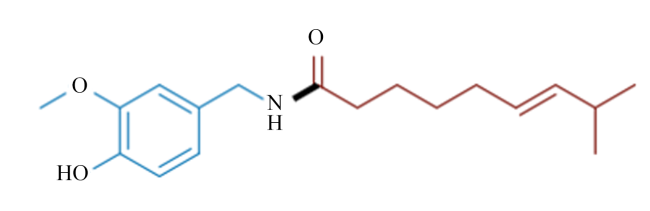
CAP的分子式为C18H27NO3(反式8-甲基-N-香草基-6-壬烯酰胺),化学结构见图1[13],其辣度主要由苯环决定,并经酰基链修饰,CAP被认为是辣椒的主要辛辣成分[14]。CAP主要存在于辣椒果实的“胎盘”和内膜中,其次是其他肉质部分,而种子本身不产生任何CAP,但在种子附着的内壁白髓中含有最高浓度的CAP[15]。辣椒中含有许多与CAP结构和生物学特性相似的化合物,均属于辣椒素类,其中CAP约占69%,其次是二氢辣椒素、去氢辣椒素、同二氢辣椒素和同辣椒素[4,16]。研究发现,大部分的CAP可以经过胃肠道迅速吸收,且大部分在胃中被吸收,只有小部分被肠道吸收,然后经门静脉进入肝脏,最后由肾脏排出[17]。大量的研究表明,CAP具有抗菌、抗炎、抗氧化等生物活性,并能促进小肠发育[18]
图1 辣椒素的化学结构

Fig.1 Chemical structure of capsaicin[13]

2 CAP对动物机体的调节作用机制

2.1 CAP对动物免疫系统的调节机制及抗炎作用

研究表明,CAP可能通过特定的方式在动物体内的免疫系统中发挥调节作用。Bertin等[19]通过诱导小鼠T细胞转移性结肠炎发现,CAP激活TRPV1往往会加重肠道炎症,而通过遗传手段敲除或药物抑制TRPV1则可缓解结肠炎。CAP通过激活TRPV1产生的促炎特性可能与肿瘤坏死因子-α(tumor necrosis factor-α,TNF-α)、干扰素-γ(interferon-γ,IFN-γ)、白细胞介素-2(interleukin-2,IL-2)、白细胞介素-4(interleukin-4,IL-4)、白细胞介素-10(interleukin-10,IL-10)和白细胞介素-17(interleukin-17,IL-17)等免疫因子的释放有关。Duo等[20]的研究表明,在炎症刺激后,TRPV1可促进树突状细胞的活化和细胞因子的产生,从而增强由树突状细胞介导的辅助性T细胞17(T helper cell 17,Th17)的分化。同时,Engel等[21]研究表明,CAP激活TRPV1后会诱导大量细胞外Ca2+进入细胞,从而刺激感觉神经元促进某些神经肽的释放,包括降钙素基因相关肽(calcitonin gene-related peptide,CGRP)和P物质(substance P,SP),这些神经肽对中枢神经系统有影响,能够调控免疫反应并参与免疫因子的分泌。Hoffmann等[22]在大鼠的结肠中注入CAP后发现,肠黏膜炎症细胞的数量明显增加,而使用CGRP和SP的拮抗剂能显著降低炎症细胞数量。这些结果表明,对CAP敏感的神经纤维可以调节结肠黏膜上皮细胞的生长以及炎症细胞向肠黏膜迁移,CAP在免疫系统中所发挥的这些调节作用是由TRPV1通过神经肽CGRP和SP介导的。
为了探究神经肽如何在动物体内对免疫系统调节,研究人员又进行一系列研究。Engel等[21]的研究发现,CGRP可刺激T细胞迁移,并促进Th17释放IFN-γ和IL-2,同时引起肥大细胞释放TNF-α。另外,SP又作为速激肽族的一种,其受体神经激肽-1(neurokinin-1,NK-1)在多种免疫细胞中的表达已经得到证实,包括树突状细胞、单核细胞、嗜酸性粒细胞、中性粒细胞、肥大细胞、自然杀伤细胞和T细胞。因此,SP可调节不同类型免疫细胞的功能[23]。另外有研究表明,SP可能导致促炎因子和趋化因子的释放,例如在结肠上皮细胞中分泌IL-8[24],并促进肥大细胞的迁移和活化[21]。而阻断SP的受体NK-1可以有效减轻T细胞转移性结肠炎的炎症[25]。Hong等[26]研究表明,CGRP和SP通过促进M2巨噬细胞和调节性T细胞的富集或维持屏障结构和调节免疫反应,缓解了经葡聚糖硫酸钠(dextran sulfate sodium,DSS)诱导的小鼠结肠炎。因此,在CAP调节动物机体的免疫系统过程中,CGRP和SP起着关键的作用。
对于CAP对免疫能力的调节在反刍动物上也进行了研究。Oh等[27-28]研究了CAP对经脂多糖(lipopolysaccharide,LPS)刺激后的奶牛免疫应答的影响,发现CAP的免疫调节作用包括抗炎和促炎作用,这种作用取决于试验动物的免疫应激状态,在LPS刺激的奶牛中,CAP可以降低促炎细胞因子的水平;而在未受LPS刺激的奶牛中,CAP可以增加T细胞和中性粒细胞等免疫细胞的数量,但降低炎症反应。此外,CAP的免疫调节作用可能与剂量有关。低剂量的CAP可以增加血液中CGRP的浓度,而高剂量的CAP则可能降低CGRP的浓度[29]。Su等[18]在犊牛所采食的牛奶中添加0.15或0.30 mL/(d·头)的水溶性CAP,结果显示,高剂量组血清免疫球蛋白A(immunoglobulin A,IgA)、免疫球蛋白G(immunoglobulin G,IgG)、免疫球蛋白M(immunoglobulin M,IgM)和IL-10水平显著提高,白细胞介素-1β(interleukin-1β,IL-1β)和白细胞介素-6(interleukin-6,IL-6)的水平有降低的趋势。An等[30]连续60 d在杂交母羊的饲粮中添加一种微胶囊(CAP含量为3.5%)50或80 mg/kg后发现,血清中IgM和IL-10的水平显著提高。这些结果说明CAP可以提高反刍动物的免疫能力,并且在一些特殊疾病中发挥着抗炎作用。

2.2 CAP对动物氧化应激的调节机制及抗氧化作用

研究表明,CAP在氧化应激和抗氧化作用方面有着不同的效果。低剂量的CAP具有一定的抗氧化作用,而高剂量的CAP则可能导致胃肠道氧化应激。Han等[31]给SD大鼠胃内注射CAP[60 mg/(kg·d)]2周后,其胃和空肠中谷胱甘肽过氧化物酶(glutathione peroxidase,GSH-Px)、谷胱甘肽还原酶(glutathione reductase,GR)和过氧化氢酶(catalase,CAT)的活性明显降低,同时谷胱甘肽(glutathione,GSH)的水平也显著下降。抗氧化酶活性的降低可能会增加活性氧(reactive oxygen species,ROS)的水平,而ROS是氧化应激的典型特征,其产生与依赖速激肽的受体NK-1有关,而SP恰好是速激肽的一种,CAP激活TRPV1后会诱导SP的释放,从而引起ROS的产生[32]。此外,Han等[31]还发现,给小鼠胃内注射CAP后,血红素加氧酶-1(heme oxygenase-1,HO-1)和NADPH奎宁氧化还原酶-1(NADPH quinine oxidoreductase-1,NQO-1)的转录水平降低,同时凋亡因子胱天蛋白酶-3(caspase-3,CASP-3)和胱天蛋白酶-9(caspase-9,CASP-9)被激活,这些酶都是调节细胞内的氧化还原平衡和抗氧化应激反应的关键酶,在动物体内发挥着重要的保护作用。这些结果表明,低剂量的CAP对动物具有一定的抗氧化作用,而剂量过高反而导致氧化应激。
除以上机制外,丙二醛(malondialdehyde,MDA)也是最常见的脂质过氧化指标之一。当体内发生应激时,会产生大量自由基,导致生物膜中的多不饱和脂肪酸发生过氧化反应,产生MDA[33]。Su等[18]的研究发现,在犊牛的饲粮中添加CAP后,血清中GSH-Px和SOD的活性会提高,而MDA的水平会降低,并且CAP的剂量越大,效果越明显。Cunha等[34]的研究表明,在哺乳绵羊的饲粮中添加0.5%的CAP可提高血清中SOD的活性,从而提高抗氧化能力。此外,Prasad等[35]研究发现,CAP能清除1,1-二苯基-2-三硝基苯肼(1,1-diphenyl-2-picrylhydrazyl radical,DPPH)自由基。还有一些研究发现,CAP可抑制人类红细胞膜的脂质过氧化和大鼠肝脏的过氧化[36-37],减少大鼠血清、肝脏、肺脏、肾脏和肌肉中的氧化应激标记物,如硫代巴比妥酸反应物质和MDA[38-39]。因此,CAP可能通过抑制自由基引起的氧化损伤和脂质过氧化等作用,增强机体的抗氧化能力。

2.3 CAP对动物机体疼痛的调节机制

CAP会引起动物内脏疼痛,但也具有缓解疼痛的作用。在动物机体疼痛的调节机制中,TRPV1起着关键作用,胃肠道中TRPV1的表达量增加会导致动物对疼痛的耐受性降低,并引发内脏超敏反应(visceral hypersensitivity,VHS)。Vecchi等[40]通过抑制TRPV1的磷酸化,发现经DSS诱导的结肠炎大鼠的VHS明显得到改善。此外,使用TRPV1拮抗剂或敲除TRPV1基因可显著降低DSS[41]或三硝基苯磺酸(trinitrobenzene sulfonic acid,TBS)诱导的结肠炎大鼠的VHS[42]。同时,CGRP和SP与结肠的疼痛密切相关。CGRP受体拮抗剂可降低不同肠道疼痛模型中的VHS,而SP则通过增加DSS诱导的结肠炎大鼠TRPV1的敏感性来引发VHS[8]。因此,CAP可能会引起内脏疼痛,但一般是基于动物本身的炎症。
CAP的止痛效果也与其受体TRPV1的激活以及各种神经肽有关。单次饲喂CAP会释放这些神经肽,从而加剧疼痛感;然而,多次饲喂CAP时其受体TRPV1就会脱敏,阻断疼痛刺激传导到脊髓,从而减轻疼痛感[43-45]。研究表明,如果TRPV1与CAP接触时间较长,其空间构象会发生改变并失活。这意味着即使CAP存在激活刺激,其受体也不会再做出反应[46-47]。因此,辣椒素及其受体TRPV1在动物疾病的不同阶段发挥着不同的作用。
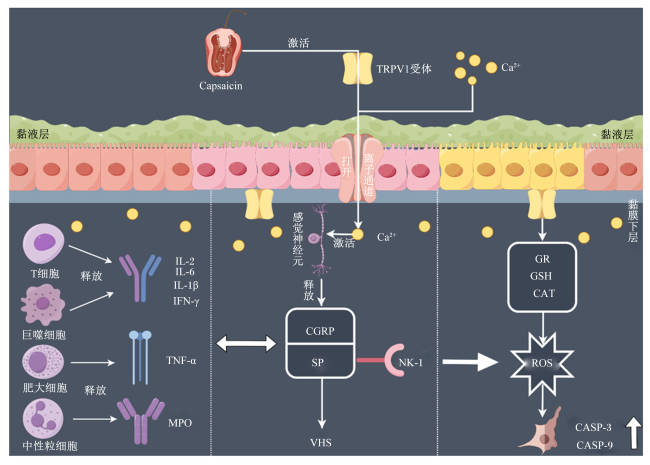
综上所述,饲喂或注射CAP可以激活TRPV1刺激神经肽对CGRP和SP的释放,从而调节动物胃肠道炎症引起的VHS和免疫反应,而且会对动物胃肠道的氧化应激和组织通透性产生影响。在反刍动物上的具体应用说明,CAP可以提高反刍动物的免疫和抗氧化能力。本文总结出了CAP对动物机体的多种调节机制,见图2
图2 辣椒素对动物机体的多种调节机制(由Figdraw绘制)

Capsaicin:辣椒素;TRPV1:瞬时受体电位香草酸亚型1 transient receptor potential vanilloid 1;CGRP:降钙素基因相关肽 calcitonin gene-related peptide;SP:P物质 substance P;VHS:内脏超敏反应 visceral hypersensitivity;NK-1:神经激肽-1 neurokinin-1;IL-2:白细胞介素-2 interleukin-2;IL-6:白细胞介素-6 interleukin-6;IL-1β:白细胞介素-1β interleukin-1β;IFN-γ:干扰素-γ interferon-γ;TNF-α:肿瘤坏死因子-α tumor necrosis factor-α;MPO:髓过氧化物酶 myeloperoxidase;GR:谷胱甘肽还原酶 glutathione reductase;GSH:谷胱甘肽 glutathione;CAT:过氧化氢酶 catalase;ROS:活性氧 reactive oxygen species;CASP-3:胱天蛋白酶-3 caspase-3;CASP-9:胱天蛋白酶-9 caspase-9。

Fig.2 Multiple regulatory mechanisms of capsaicin in animal organisms[16] (drawn by Figdraw)

3 CAP对反刍动物生产性能、瘤胃发酵及胃肠道菌群结构的影响

3.1 CAP对反刍动物生产性能及瘤胃发酵的影响

目前,在奶牛上针对CAP进行了大量的研究。Cardozo等[48]在奶牛饲粮中添加150 mg/(d·头)的CAP,21 d后发现奶牛的干物质采食量(dry matter intake,DMI)和产奶量增加,瘤胃pH和总挥发性脂肪酸(total volatile fatty acid,TVFA)的浓度无显著变化,但乙酸、支链脂肪酸和大分子含氮化合物的浓度下降,说明CAP促进了多肽的降解,增加了氨基酸,为脂肪酸的合成提供更多可直接利用的肽和氨基酸,并促进微生物蛋白合成和进入小肠。Oh等[49]在奶牛饲粮中添加100或200 mg/(d·头)的辣椒提取物(主要活性成分为CAP),结果发现辣椒提取物对奶牛的DMI无显著影响,但显著增加了产奶量,降低了瘤胃中氨态氮(ammoniacal nitrogen,NH3-N)浓度。Foskolos等[50]连续31 d在奶牛饲粮中添加500 mg/(d·头)的辣椒提取物后发现,与对照组相比,奶牛的DMI增加,对产奶量、瘤胃pH、TVFA浓度无显著影响,但NH3-N浓度有所下降,这与Cardozo等[48]所得结果相似。Vittorazzi等[51]在奶牛饲粮中添加750或1 500 mg/(d·头)含辣椒胶囊的饲料添加剂,结果表明奶牛的DMI和产奶量增加,对氮的利用率提高。Oh等[52]在奶牛饲粮添加250、500或1 000 mg/(d·头)的辣椒提取物,结果显示,试验组奶牛DMI、TVFA和NH3-N浓度无显著变化,但瘤胃pH有降低的趋势。Grigoletto等[53]在奶牛饲粮中添加1 500 mg/(d·头)含辣椒胶囊的饲料添加剂,3周时发现其对DMI和瘤胃发酵均无显著影响,但可使产奶量升高。
在肉牛、犊牛和绵羊等动物上针对CAP也进行了大量的研究。Giacomelli等[54]在荷斯坦公牛饲粮中分别添加200和400 mg/kg含辣椒胶囊的饲料添加剂90 d,发现在15~45 d时,荷斯坦公牛的平均日增重(average daily gain,ADG)和料重比(feed to gain ratio,F/G)增加,瘤胃中乙酸、丙酸和丁酸浓度升高,但对瘤胃pH无显著影响。Yi等[55]在安格斯阉牛饲粮中添加1 500 mg/(d·头)的含CAP的饲料添加剂,90 d后发现DMI和瘤胃pH与对照组相比无变化,但瘤胃中TVFA、NH3-N、异丁酸和异戊酸浓度降低。Westphalen等[56]在安格斯牛饲粮中添加15 mg/kg基于干物质含量的辣椒提取物,结果显示DMI无变化,但ADG和F/G升高,但该研究并没有检测瘤胃发酵参数。Fandiño等[57]在犊牛饲粮中添加500 mg/(d·头)的辣椒提取物,饲喂21 d后发现,与对照组相比,试验组犊牛的DMI显著增加,对于瘤胃pH和TVFA浓度无影响,但丁酸浓度升高,乙酸浓度下降。Su等[18]按照0.15或0.30 mL/(d·头)的添加量把1%水溶性CAP添加到犊牛的奶中,结果显示,CAP组的DMI和ADG显著增加,但对于瘤胃发酵参数无影响。刘宵静等[58]在杜泊羊饲粮中添加50、100或200 mg/kg的CAP(有效成分含量≥98%),结果显示,与对照组相比,绵羊的DMI和ADG升高,瘤胃TVFA浓度无显著变化,pH和乙酸浓度显著升高,丙酸浓度显著降低。高鑫等[59]在每吨育肥湖羊饲粮中加入150 g的CAP,45 d后发现,试验组的DMI和ADG显著升高,但F/G显著降低,瘤胃pH和TVFA浓度无显著变化,但丁酸浓度降低。
综上所述,大部分的试验结果表明,在反刍饲粮中添加CAP后,DMI、产奶量及ADG会升高,瘤胃pH无变化,瘤胃处于健康状态,且添加CAP后对瘤胃发酵具有一定的积极作用。虽然DMI增加可能与CAP的辛辣性引起的饲料适口性和饮水量的增加有关,但上述的大部分试验所采用的饲喂方式是对CAP进行微胶囊化或封装,对DMI的积极影响与适口性无关。微胶囊化可以进一步增强CAP的各种作用,保护CAP在储存、运输和加工过程中不被氧化,并提高其生物有效性,还能够对其控制进行靶向的释放和作用,并保护它们免受瘤胃改变。饲粮中添加CAP及其产品对反刍动物生产性能和瘤胃发酵的影响存在差异的原因可能是:1)CAP及其产品的添加量不同;2)所用动物品种、日龄及试验期长短不同;3)动物在试验期间所处于的状态不同。本文对饲粮中添加CAP对反刍动物生产性能和瘤胃发酵参数影响的相关研究结果进行了总结,见表1
表1 饲粮中添加CAP对反刍动物生产性能及瘤胃发酵参数的影响

Table 1 Effects of diets supplemented with capsaicin on performance and rumen fermentation parameters of ruminants

项目
Items
添加剂
Additive
添加剂量
Additive
quantity
饲喂期
Feeding
period/d
生产性能
Performance
瘤胃发酵参数
Rumen fermentation
parameters
参考文献
Reference
奶牛
Dairy cows
辣椒提取物
(含15%的CAP)
150 mg/(d·头) 21 DMI和产奶量↑ pH和TVFA浓度-,乙酸和
支链脂肪酸浓度↓
[48]
辣椒提取物(含15.5%的
辣椒精和0.93%的CAP)
100和200 mg/(d·头) 28 DMI-,产奶量↑ NH3-N浓度↓ [49]
辣椒提取物(含20%的
辣椒精和6%的CAP)
500 mg/(d·头) 31 DMI↑,产奶量- pH和TVFA浓度-,
NH3-N浓度↓
[50]
含辣椒胶囊的添加剂
(CAP含量为5 g/kg)
750和1 500 mg/(d·头) 63 DMI和产奶量↑ 氮的利用率↑ [51]
辣椒提取物(含20%的
辣椒精和1.2%的CAP)
250、500和
1 000 mg/(d·头)
25 DMI-,产奶量↑ pH↓,NH3-N和TVFA浓度- [52]
含辣椒胶囊的添加剂
(CAP含量为5 g/kg)
1 500 mg/(d·头) 21 DMI-,产奶量↑ 未检测 [53]
肉牛
Beef cattle
含辣椒胶囊的添加剂
(CAP含量为5 g/kg)
200和400 mg/(d·头) 90 DMI-,F/G和
ADG↑
pH-,乙酸、丙酸和丁酸浓度↑ [54]
含CAP的饲料添加剂
(CAP含量≥0.5%)
1 500 mg/(d·头) 90 DMI- pH-,TVFA、异丁酸、异戊酸和
NH3-N浓度-
[55]
辣椒提取物
(含1.1%的CAP)
15 mg/kg DM 100 DMI-,50 d时
ADG、F/G↑
未检测 [56]
犊牛
Calf
辣椒提取物
(含15%的CAP)
500 mg/(d·头) 24 DMI↑ pH和TVFA浓度-,乙酸浓度↓,
丁酸浓度↑
[57]
1%水溶性CAP
(1%)
0.15和0.30 mL/(d·头) 30 DMI、ADG↑,
F/G-
未检测 [18]
绵羊
Sheep
CAP
(含量≥98%)
50、100和200 mg/kg DM 45 DMI和ADG↑ TVFA浓度-,pH和乙酸浓度↑,
丙酸浓度↓
[58]
CAP
(有效成分含量为2%)
150 g/t 45 DMI和ADG↑,
F/G↓
pH和TVFA浓度-,丁酸浓度↑ [59]

CAP:辣椒素 capsaicin;DMI:干物质采食量 dry matter intake;F/G:料重比 feed to gain ratio;ADG:平均日增重 average daily gain;TVFA:总挥发性脂肪酸 total volatile fatty acid;NH3-N:氨态氮 ammoniacal nitrogen;“-”:无影响 no effect;“↑”:提高 increased;“↓”:降低 decreased。

3.2 CAP对反刍动物胃肠道菌群结构的影响

针对饲粮中添加CAP对反刍动物瘤胃和肠道菌群结构的影响也进行了研究,其中对肠道菌群变化的研究较少。An等[60]采集奶牛的瘤胃液,分别添加20和200 mg/L含量为10%的CAP进行体外培养,结果显示,低添加量组瘤胃液中纤维降解丁酸杆菌的数量显著升高。朱靖等[61]在奶牛饲粮中添加有效成分含量为2%的CAP微胶囊1 200 mg/(d·头),60 d时发现,在门水平上,试验组瘤胃液中厚壁菌门的相对丰度升高;在属水平上,瘤胃液中瘤胃球菌科UCG-014和瘤胃球菌科RC9肠道群的相对丰度升高,琥珀酸弧菌科UCG-001的相对丰度降低。Yi等[55]对肉牛瘤胃菌群的研究发现,在门水平上,试验组瘤胃液中拟杆菌门的相对丰度升高,Patescibacteria和厚壁菌门的相对丰度显著降低;在属水平上,试验组瘤胃液中瘤胃球菌科RC9肠道群和未明确F082科(Norank_f_F082)的相对丰度显著升高,NK4A214群和未分类梭菌纲(Unclassified_c_Clostridia)的相对丰度显著降低。高鑫等[59]对绵羊瘤胃菌群的研究显示,在门水平上,添加CAP组绵羊瘤胃液中拟杆菌门和螺旋菌门的相对丰度显著升高,变形菌门和蓝藻菌门的相对丰度显著降低;在属水平上,添加CAP组绵羊瘤胃液中瘤胃球菌科RC9肠道群、未明确F082科、普雷沃氏菌科UCG-001和琥珀酸菌属的相对丰度显著升高,琥珀酸弧菌科UCG-001、未明确月形单细胞菌科(Norank_f_Selenomonadaceae)的相对丰度显著降低。在对肠道菌群的研究中,Su等[18]发现,饲粮中添加CAP有增加犊牛肠道中柯林斯菌属相对丰度的趋势,且降低了棒状杆菌属、厄格特氏菌属、链球菌属、肠球菌属和巨球菌属以及肠杆菌科等有害菌的相对丰度。
瘤胃菌群结构的变化表明,饲粮中添加CAP加强了瘤胃液对非纤维性碳水化合物、蛋白质和纤维素的降解,产生了更多的挥发性脂肪酸供宿主吸收利用,提高了饲料利用率,同时降低了有害菌门,如变形菌门和蓝藻菌门的相对丰度,营造出更健康的瘤胃环境。犊牛肠道中柯林斯菌属的相对丰度增加有利于预防和缓解腹泻,而相对丰度降低的几种菌属与乳腺炎、腹泻、胃肠道疾病等相关,说明CAP具有减少有害菌,预防犊牛腹泻的作用。综上所述,饲粮中添加CAP后会通过改变瘤胃菌群结构影响瘤胃代谢物含量,进而改善瘤胃内环境,并对于反刍动物的健康产生积极影响。

4 小结

综上所述,CAP是一种自然界中广泛存在的活性物质,不仅为食品提供辣味,还在动物营养学领域展现出独特的价值。它通过激活特定的受体如TRPV1,在调节动物机体的免疫系统、氧化应激和疼痛等方面发挥着重要作用,同时还具有提高反刍动物的免疫和抗氧化能力,改善反刍动物的瘤胃发酵,调节肠道微生物多样性和抑制有害菌的作用。CAP的这些功能特性为可持续畜牧业提供了新思路,有助于减少抗生素使用,增强动物健康。据上述生产试验及专家推测,对添加量换算后得出CAP作为饲料添加剂在反刍动物上的推荐添加剂量为:奶牛100~150 mg/kg DM、肉牛75~125 mg/kg DM、羊50~100 mg/kg DM。然而,CAP的剂量和作用机制仍需要更精确的研究,以确保动物福利和生产效益的最大化。未来的研究应继续深入探讨CAP的作用机制,以及如何在动物饲粮中合理利用这一天然化合物。
[1]
SHANG Z H, GIBB M J, LEIBER F, et al. The sustainable development of grassland-livestock systems on the Tibetan plateau:problems,strategies and prospects[J]. The Rangeland Journal, 2014, 36(3):267-296.

[2]
WENK C. Herbs and botanicals as feed additives in monogastric animals[J]. Asian-Australasian Journal of Animal Sciences, 2003, 16(2):282-289.

[3]
LEE C, CHO I H, JEONG B C, et al. Strategies to minimize antibiotic resistance[J]. International Journal of Environmental Research and Public Health, 2013, 10(9):4274-4305.

[4]
REYES-ESCOGIDO M D L, GONZALEZ-MONDRAGON E G, VAZQUEZ-TZOMPANTZI E. Chemical and pharmacological aspects of capsaicin[J]. Molecules, 2011, 16(2):1253-1270.

[5]
MAKKAR H, FRANCIS G, BECKER K. Bioactivity of phytochemicals in some lesser-known plants and their effects and potential applications in livestock and aquaculture production systems[J]. Animal, 2007, 1(9):1371-1391.

DOI PMID

[6]
SZABADOS T, GÖMÖRI K, PÁLVÖLGYI L, et al. Capsaicin-sensitive sensory nerves and the TRPV1 ion channel in cardiac physiology and pathologies[J]. International Journal of Molecular Sciences, 2020, 21(12):4472.

[7]
WARD S M, BAYGUINOV J, WON K J, et al. Distribution of the vanilloid receptor (VR1) in the gastrointestinal tract[J]. Journal of Comparative Neurology, 2003, 465(1):121-135.

PMID

[8]
CHEN Y, MU J, ZHU M, et al. Transient receptor potential channels and inflammatory bowel disease[J]. Frontiers in Immunology, 2020, 11:180.

DOI PMID

[9]
KUMAR V, KUMAR V, MAHAJAN N, et al. Mucin secretory action of capsaicin prevents high fat diet-induced gut barrier dysfunction in C57BL/6 mice colon[J]. Biomedicine & Pharmacotherapy, 2022, 145:112452.

[10]
WANG F, XUE Y, FU L, et al. Extraction,purification,bioactivity and pharmacological effects of capsaicin:a review[J]. Critical Reviews in Food Science and Nutrition, 2022, 62(19):5322-5348.

[11]
ROSCA A E, IESANU M I, ZAHIU C D M, et al. Capsaicin and gut microbiota in health and disease[J]. Molecules, 2020, 25(23):5681.

[12]
THONGIN S, DEN-UDOM T, UPPAKARA K, et al. Beneficial effects of capsaicin and dihydrocapsaicin on endothelial inflammation,nitric oxide production and antioxidant activity[J]. Biomedicine & Pharmacotherapy, 2022, 154:113521.

[13]
CHEN L, GAO Z, ZHANG Y, et al. A green,facile,and practical preparation of capsaicin derivatives with thiourea structure[J]. Scientific Reports, 2024, 14(1):10576.

[14]
HERNANDEZ-PEREZ T, GOMEZ-GARCIA M, VALVERDE M E, et al. Capsicum annuum (hot pepper):an ancient Latin-American crop with outstanding bioactive compounds and nutraceutical potential.A review[J]. Comprehensive Reviews in Food Science and Food Safety, 2020, 19(6):2972-2993.

[15]
SRINIVASAN K. Biological activities of red pepper (Capsicum annuum) and its pungent principle capsaicin:a review[J]. Critical Reviews in Food Science and Nutrition, 2016, 56(9):1488-1500.

[16]
XIANG Q, GUO W, TANG X, et al. Capsaicin-the spicy ingredient of chili peppers: a review of the gastrointestinal effects and mechanisms[J]. Trends in Food Science & Technology, 2021, 116:755-765.

[17]
王欣, 石汉平. 辣椒素的摄取、代谢与生物学效应[J]. 肿瘤代谢与营养电子杂志, 2018, 5(4):419-423.

WANG X, SHI H P. Uptake,metabolism and biological effects of capsaicin[J]. Electronic Journal of Metabolism and Nutrition of Cancer, 2018, 5(4):419-423. (in Chinese)

[18]
SU M, SHE Y, DENG M, et al. The effect of capsaicin on growth performance,antioxidant capacity,immunity and gut micro-organisms of calves[J]. Animals, 2023, 13(14):2309.

[19]
BERTIN S, AOKI-NONAKA Y, DE JONG P R, et al. The ion channel TRPV1 regulates the activation and proinflammatory properties of CD4+ T cells[J]. Nature Immunology, 2014, 15(11):1055-1063.

[20]
DUO L, WU T, KE Z, et al. Gain of function of ion channel TRPV1 exacerbates experimental colitis by promoting dendritic cell activation[J]. Molecular Therapy-Nucleic Acids, 2020, 22:924-936.

DOI PMID

[21]
ENGEL M A, BECKER C, REEH P W, et al. Role of sensory neurons in colitis:increasing evidence for a neuroimmune link in the gut[J]. Inflammatory Bowel Diseases, 2011, 17(4):1030-1033.

[22]
HOFFMANN P, MAZURKIEWICZ J, HOLTMANN G, et al. Capsaicin-sensitive nerve fibres induce epithelial cell proliferation,inflammatory cell immigration and transforming growth factor-alpha expression in the rat colonic mucosa in vivo[J]. Scandinavian Journal of Gastroenterology, 2002, 37(4):414-422.

[23]
HERBERT M K, HOLZER P. Neurogenic inflammation. Ⅱ. Pathophysiology and clinical implications[J]. Anasthesiologie,Intensivmedizin,Notfallmedizin,Schmerztherapie:AINS, 2002, 37(7):386-394.

[24]
KOON H W, ZHAO D, ZHAN Y, et al. Substance P-stimulated interleukin-8 expression in human colonic epithelial cells involves protein kinase C delta activation[J]. Journal of Pharmacology and Experimental Therapeutics, 2005, 314(3):1393-1400.

[25]
GAD M, ELM PEDERSEN A, NY KRISTENSEN N, et al. Blockage of the neurokinin 1 receptor and capsaicin-induced ablation of the enteric afferent nerves protect SCID mice against T-cell-induced chronic colitis[J]. Inflammatory Bowel Diseases, 2009, 15(8):1174-1182.

DOI PMID

[26]
HONG H S, HWANG D Y, PARK J H, et al. Substance-P alleviates dextran sulfate sodium-induced intestinal damage by suppressing inflammation through enrichment of M2 macrophages and regulatory T cells[J]. Cytokine, 2017, 90:21-30.

DOI PMID

[27]
OH J, HARPER M, GIALLONGO F, et al. Effects of rumen-protected capsicum oleoresin on immune responses in dairy cows intravenously challenged with lipopolysaccharide[J]. Journal of Dairy Science, 2017, 100(3):1902-1913.

DOI PMID

[28]
OH J, HRISTOV A N, LEE C, et al. Immune and production responses of dairy cows to postruminal supplementation with phytonutrients[J]. Journal of Dairy Science, 2013, 96(12):7830-7843.

DOI PMID

[29]
DEMIRBILEK S, ERSOY M O, DEMIRBILEK S, et al. Small-dose capsaicin reduces systemic inflammatory responses in septic rats[J]. Anesthesia & Analgesia, 2004:1501-1507.

[30]
AN X, WANG Y, WANG R, et al. Effects of a blend of cinnamaldehyde,eugenol and capsicum oleoresin (CEC) on growth performance,nutrient digestibility,immune response and antioxidant status of growing ewes[J]. Livestock Science, 2020, 234:103982.

[31]
HAN J, ZHANG S, LIU X, et al. Fabrication of capsaicin emulsions:improving the stability of the system and relieving the irritation to the gastrointestinal tract of rats[J]. Journal of the Science of Food and Agriculture, 2020, 100(1):129-138.

[32]
POPESCU G D A, SCHEAU C, BADARAU I A, et al. The effects of capsaicin on gastrointestinal cancers[J]. Molecules, 2020, 26(1):94.

[33]
NIELSEN F, MIKKELSEN B B, NIELSEN J B, et al. Plasma malondialdehyde as biomarker for oxidative stress:reference interval and effects of life-style factors[J]. Clinical Chemistry, 1997, 43(7):1209-1214.

[34]
CUNHA M G, ALBA D F, LEAL K W, et al. Inclusion of pepper extract containing capsaicin in the diet of ewes in the mid-lactation period:effects on health,milk production,and quality[J]. Research,Society and Development, 2020, 9(11):e453530236.

[35]
PRASAD N S, RAGHAVENDRA R, LOKESH B R, et al. Spice phenolics inhibit human PMNL 5-lipoxygenase[J]. Prostaglandins,Leukotrienes and Essential Fatty Acids, 2004, 70(6):521-528.

[36]
PULLA REDDY A C, LOKESH B R. Studies on spice principles as antioxidants in the inhibition of lipid peroxidation of rat liver microsomes[J]. Molecular and Cellular Biochemistry, 1992, 111:117-124.

PMID

[37]
BHARATHI P S, SUNDARESH C S, LEELA S. Dietary components inhibit lipid peroxidation in erythrocyte membrane[J]. Nutrition Research, 1986, 6(10):1171-1178.

[38]
MANJUNATHA H, SRINIVASAN K. Protective effect of dietary curcumin and capsaicin on induced oxidation of low-density lipoprotein,iron-induced hepatotoxicity and carrageenan-induced inflammation in experimental rats[J]. The FEBS Journal, 2006, 273(19):4528-4537.

[39]
LEE C Y J, KIM M, YOON S W, et al. Short-term control of capsaicin on blood and oxidative stress of rats in vivo[J]. Phytotherapy Research, 2003, 17(5):454-458.

[40]
VECCHI B L, MARCUZZI A, TRICARICO P M, et al. Curcumin and inflammatory bowel disease:potential and limits of innovative treatments[J]. Molecules, 2014, 19(12):21127-21153.

[41]
LAPOINTE T K, BASSO L, IFTINCA M C, et al. TRPV1 sensitization mediates postinflammatory visceral pain following acute colitis[J]. American Journal of Physiology:Gastrointestinal and Liver Physiology, 2015, 309(2):G87-G99.

[42]
SALAMEH E, MELEINE M, GOURCEROL G, et al. Chronic colitis-induced visceral pain is associated with increased anxiety during quiescent phase[J]. American Journal of Physiology:Gastrointestinal and Liver Physiology, 2019, 316(6):G692-G700.

[43]
MORAN M M, SZALLASI A. Targeting nociceptive transient receptor potential channels to treat chronic pain:current state of the field[J]. British Journal of Pharmacology, 2018, 175(12):2185-2203.

[44]
HUANG S, SZALLASI A. Transient receptor potential (TRP) channels in drug discovery:old concepts & new thoughts[J]. Pharmaceuticals, 2017, 10(3):64.

[45]
KANEKO Y, SZALLASI A. Transient receptor potential (TRP) channels:a clinical perspective[J]. British Journal of Pharmacology, 2014, 171(10):2474-2507.

[46]
OLSZEWSKA J. Vanilloid receptors-comparison of structure and functions in mammals and invertebrates[J]. Kosmos, 2010, 59(1/2):133-139.

[47]
WINTER J, BEVAN S, CAMPBELL E A. Capsaicin and pain mechanisms.[J]. British Journal of Anaesthesia, 1995, 75(2):157-168.

PMID

[48]
CARDOZO P W, CALSAMIGLIA S, FERRET A, et al. Effects of alfalfa extract,anise,capsicum,and a mixture of cinnamaldehyde and eugenol on ruminal fermentation and protein degradation in beef heifers fed a high-concentrate diet[J]. Journal of Animal Science, 2006, 84(10):2801-2808.

[49]
OH J, HARPER M, LANG C H, et al. Effects of phytonutrients alone or in combination with monensin on productivity in lactating dairy cows[J]. Journal of Dairy Science, 2018, 101(8):7190-7198.

DOI PMID

[50]
FOSKOLOS A, FERRET A, SIURANA A, et al. Effects of capsicum and propyl-propane thiosulfonate on rumen fermentation,digestion,and milk production and composition in dairy cows[J]. Animals, 2020, 10(5):859.

[51]
VITTORAZZI P C, TAKIYA C S, NUNES A T, et al. Feeding encapsulated pepper to dairy cows during the hot season improves performance without affecting core and skin temperature[J]. Journal of Dairy Science, 2022, 105(12):9542-9551.

DOI PMID

[52]
OH J, GIALLONGO F, FREDERICK T, et al. Effects of dietary capsicum oleoresin on productivity and immune responses in lactating dairy cows[J]. Journal of Dairy Science, 2015, 98(9):6327-6339.

DOI PMID

[53]
GRIGOLETTO N T S, TAKIYA C S, BUGONI M, et al. Influence of encapsulated pepper on ruminal fermentation,nutrient digestibility,and performance in dairy cows[J]. Livestock Science, 2023, 267:105140.

[54]
GIACOMELLI C M, MARCHIORI M S, DO NASCIMENTO A L, et al. Encapsulated pepper blend in the diet of confined Holstein bullocks:effect on ruminal volatile fatty acid profiles,growth performance,and animal health[J]. Tropical Animal Health and Production, 2023, 55(2):114.

[55]
YI X, WU B, MA J, et al. Effects of dietary capsaicin and yucca schidigera extracts as feed additives on rumen fermentation and microflora of beef cattle fed with a moderate-energy diet[J]. Fermentation-Basel, 2023, 9(1):30.

[56]
WESTPHALEN M F, CARVALHO P H V, OH J, et al. Effects of feeding rumen-protected capsicum oleoresin on growth performance,health status,and total tract digestibility of growing beef cattle[J]. Animal Feed Science and Technology, 2021, 271:114778.

[57]
FANDIÑO I, CALSAMIGLIA S, FERRET A, et al. Anise and capsicum as alternatives to monensin to modify rumen fermentation in beef heifers fed a high concentrate diet[J]. Animal Feed Science and Technology, 2008, 145(1/2/3/4):409-417.

[58]
刘宵静, 王小建. 日粮添加不同水平辣椒碱对肉羊生长性能、瘤胃发酵及饲养经济效益的影响[J]. 中国饲料, 2023(24):34-37.

LIU X J, WANG X J. Effects of dietary supplementation of different levels of capsaicin on growth performance,rumen fermentation and feeding economy of meat goats[J]. China Feed, 2023(24):34-37. (in Chinese)

[59]
高鑫, 李秀芝, 晏琦, 等. 辣椒碱对育肥湖羊生长性能、瘤胃发酵指标、血清生化指标及瘤胃细菌区系的影响[J]. 动物营养学报, 2024, 36(6):3823-3832.

DOI

GAO X, LI X Z, YAN Q, et al. Effects of capsaicin on growth performance,rumen fermentation indices, serum biochemical indices and rumen bacterial flora of fattening Hu sheep[J]. Chinese Journal of Animal Nutrition, 2024, 36(6):3823-3832. (in Chinese)

DOI

[60]
AN Z, LUO G, ABDELRAHMAN M, et al. Effects of capsicum oleoresin supplementation on rumen fermentation and microbial abundance under different temperature and dietary conditions in vitro[J]. Frontiers in Microbiology, 2022, 13:1005818.

[61]
朱靖, 林红, 裴明财, 等. 辣椒碱对泌乳前期奶牛产奶性能、血清生化指标、瘤胃微生物及代谢组的影响[J]. 动物营养学报, 2021, 33(11):6290-6299.

DOI

ZHU J, LIN H, PEI M C, et al. Effects of capsaicin on milk production performance,serum biochemical indexes,rumen microorganisms and metabolome of pre-lactation dairy cows[J]. Chinese Journal of Animal Nutrition, 2021, 33(11):6290-6299. (in Chinese)

文章导航

/