综述

动物在热应激和冷应激条件下生理与代谢变化的比较分析

  • 赵进哲 ,
  • 姜治国 ,
  • 包卓旋 ,
  • 张红瑞 , *
展开
  • 宁夏大学动物科技学院,宁夏回族自治区反刍动物分子细胞育种重点实验室,银川 750021
* 张红瑞,讲师,硕士生导师,E-mail:

赵进哲(1999—),男,河南郑州人,硕士研究生,研究方向为动物营养与饲料科学。E-mail:

Copy editor: 田艳明

收稿日期: 2024-06-25

  网络出版日期: 2025-01-10

基金资助

民族学部区合建优势特色学科群高层次人才引进培养(030700002305)

Comparative Analysis of Physiological and Metabolic Changes in Animals under Heat and Cold Stress Conditions

  • ZHAO Jinzhe ,
  • JIANG Zhiguo ,
  • BAO Zhuoxuan ,
  • ZHANG Hongrui , *
Expand
  • Key Laboratory of Ruminant Molecular Cell Breeding in Ningxia, College of Animal Science and Technology, Ningxia University, Yinchuan 750021, China
* lecturer, E-mail:

Received date: 2024-06-25

  Online published: 2025-01-10

摘要

在动物的生命周期中,它们会遭受多种应激源,其中气候变化的影响尤为显著。这种变化可能导致动物处于热应激或冷应激状态,进而对其生产性能和生理代谢产生负面影响。热应激通常会引起机体皮质醇水平上升,抑制动物生长和发育,而冷应激则迫使动物分配更多能量来维持体温,影响其生长速度和产量。这2种应激状态均会降低动物的食欲,干扰消化吸收过程,削弱免疫功能,并导致血液代谢失衡。因此,深入理解动物在这些应激条件下的神经内分泌系统、生长、消化、免疫和代谢等方面的影响机制,对于把握其生理变化至关重要。本文旨在提供一个理论框架,帮助研究人员和养殖者更有效地防控这些应激条件的影响,并着重强调了温度控制和营养调控的重要性。

本文引用格式

赵进哲 , 姜治国 , 包卓旋 , 张红瑞 . 动物在热应激和冷应激条件下生理与代谢变化的比较分析[J]. 动物营养学报, 2025 , 37(1) : 169 -181 . DOI: 10.12418/CJAN2025.015

Abstract

During the life cycle of animals, they face a variety of stressors, with climate change having a particularly significant impact. Such changes could lead to animals being under heat or cold stress, thereby negatively affecting their performance and physiological parameters. Heat stress causes the body’s cortisol levels to rise, inhibiting development and growth, while cold stress forces animals to allocate more energy to maintain body temperature, thereby affecting their growth rate and yield. Both stress states reduce appetite, interfere with digestion and absorption processes, weaken immune function, and lead to imbalance in blood metabolism. Therefore, it is important to understand the mechanism of neuroendocrine system, growth, digestion, immunity and metabolism of animals under these stress conditions for comprehensively grasping their physiological changes. The aim of this paper is to provide a theoretical framework to help researchers and breeders more effectively prevent and control the effects of these stressful conditions, emphasizing the importance of temperature control and nutritional support.

在过去的几十年里,全球食品消费模式发生了显著的转变,从以谷物为主转向了更多地摄入动物蛋白质。这一转变不仅大幅增加了对畜牧业产量的需求,使其在农业总产量中占据近40%的比重,同时也带来了可持续发展的挑战[1]。其中,气候变化已经成为影响畜牧业可持续发展的主要因素之一。模拟预测显示,在不利的气候条件下,可能有多达8%的物种面临灭绝的风险[2-3]。气候因素如环境温度、相对湿度、太阳辐射以及风速等,都会显著影响动物饲粮和水的摄入[4],进而影响动物的营养摄入、健康状况和代谢情况。尽管家禽和家畜能够逐步适应温度的渐变,但快速的气候变化或持续的极端天气会显著降低其生产力,甚至威胁其生存[5]。多种气候压力源,如极端冷热、湿度变化、结冰和风暴等,会显著影响动物的内分泌系统,进而影响整体表现[6-7]。因此,深入探究热应激和冷应激对动物福利、生产性能和产品质量的影响显得至关重要。只有这样,我们才能制定出有效的策略缓解应激造成的损害,提高动物的福利,并实现畜牧业的可持续性。本文总结了热应激和冷应激对动物生理和代谢的影响,并进行了比较分析,旨在为理解和管理动物在不同温度条件下的生理和行为反应,以及采取相应的调节和保护措施提供参考。

1 动物冷热应激的概念及判定标准

1.1 动物热应激的概念及判断方法

当体温超过正常活动范围时,动物会经历热应激,因为总热负荷超过了散热能力[8]。极端环境条件会对动物生产产生负面影响。温度、相对湿度、通风和光照等因素与动物代谢过程的调节密切相关,影响个体适应环境的能力。温湿指数(temperature-humidity index,THI)是评估环境温度和相对湿度对动物热应激影响的重要指标[9]。根据NRC开发的公式计算THI,如下所示:THI=(1.8×T+32)-[(0.55-0.005 5×RH)×(1.8×T-26)][10]。式中:T为干球温度(℃);RH为相对湿度(%)。同时,使用风速计同时记录风速(m/s)。不同物种的热应激判定阈值有所不同,当THI<68时,奶牛处于无应激状态;当THI>67时,可分为轻度(THI为67~72)、中度(THI为72~80)和重度(THI>80)热应激3个等级[11]。而对于羊,无热应激状态THI<70,轻度热应激THI为70~75,中度热应激THI为75~85,重度热应激THI>85[12]
Gaughan等[13]提出的热负荷指数(heat load index,HLI)作为THI的一种改进标准,旨在更准确地评估热应激水平。HLI由2部分组成:HLIBG>25=8.62+(0.38×RH)+(1.55×BG)-(0.5×WS)+e(2.4-WS);HLIBG<25=10.66+(0.28×RH)+(1.3×BG)-WS。式中:BG为黑球温度(℃);RH为相对湿度(%);WS为风速(m/s)。HLI引入了黑球温度作为新的判断指标。黑球温度,又称实感温度,使用黑球温度计测量,代表物体在辐射热和对流热共同作用下的实际感知温度,通常比空气温度更高。与THI类似,HLI也制定了几个阈值,用于指导牛的热负荷管理。其中,HLI<70表示热中性,HLI为70.1~77.0表示温暖,HLI为77.1~86.0表示炎热,HLI为86.1~96.0表示非常炎热,而HLI>96则表示极端热负荷。不同于为所有动物设定统一阈值的THI模型,HLI模型的阈值会根据动物类型、健康状况、生产水平以及其他参数变化。
THI和HLI是评估热应激常用的指标,广泛应用于畜牧业中不同动物种类,但并非所有动物完全适用。不同种类的动物对热应激的敏感性和反应有差异,因此在具体应用时需要考虑不同动物的生理特点和环境要求。除了THI和HLI之外,还有其他几种评估热应激的方法:1)呼吸频率。在热应激条件下,呼吸频率通常会提高,以帮助机体散热,测定呼吸频率特别适用于牛、猪和鸡等养殖动物。2)体温。通过测量动物的直肠温度或皮肤温度了解体温情况,体温升高是热应激的重要信号。3)心率。心率在热应激条件下可能会提高,监测心率可以帮助判断动物的应激水平。4)行为监测。通过观察动物的行为变化,如食欲下降、饮水量增加和寻求阴凉处等[14],监测机体的应激状态。5)红外热成像。使用红外热成像仪可以非侵入性地监测动物皮肤温度和体表温度等表皮温度,帮助评估热应激程度[15]。6)血液指标。通过测定血液中的皮质醇和乳酸脱氢酶等生化指标,提供应激状态的参考[16]。7)生产性能。如奶牛的产奶量、鸡的产蛋率、猪的生长速度等,通常在热应激条件下会下降[17-18]。8)热舒适指数(thermal comfort index,TCI)。TCI综合考虑温度、相对湿度、风速和辐射等因素,用于评估环境对动物的热舒适程度[19-20]。综合使用这些方法,可以更准确地判断动物的热应激状态,并采取相应的防护措施。不过,每种方法都有其优势和局限,选择适当的评估方法需要根据具体的动物种类和生产环境来决定。

1.2 动物冷应激的概念及判断方法

低温作为一种常见的环境应激因素,会引发畜禽的病理生理应激反应,造成显著的经济损失[21]。在寒冷环境中,动物的能量需求增加,因为机体需要消耗更多能量以维持体温。因此,可能需要增加饲粮供给量或改变饲粮组成,以满足其增加的营养需求[22]。在寒冷条件下,动物的毛皮可能会变得更加浓密,这是一种适应寒冷的生理反应,但同时也会增加能量的消耗[23]
研究表明,当THI>38时,不存在冷应激反应;THI为25~38为轻度冷应激;THI为8~25为中度冷应激;THI为-12~8为严重冷应激;THI为-25~-12为极端冷应激[24]。冷应激还可以根据风寒温度(wind chill temperature,WCT)进行判定,WCT的计算公式为:WCT=13.12+0.621 5T-11.37V0.16+0.396 5T×V0.16。式中:T为环境温度(℃);V为风速(km/h)[25]。当WCT为-25~-10 ℃时,为轻度冷应激;当WCT为-45~-25 ℃时,为中度冷应激;当WCT为-59~-45 ℃时,为高度冷应激;当WCT低于-60 ℃时,为致命冷应激。而当风速≤1.34 m/s时,WCT与实际环境温度相等[26]
此外,冷应激指数也是专门用于评估动物在低温和高相对湿度环境中应激程度的指标,与THI类似,该指标综合考虑了空气温度、风速和相对湿度等因素,通过定量分析评估动物的冷应激状态[27]。皮肤温度测定是一种常用方法,通常直接测量动物皮肤表面温度[28]。在寒冷环境中,动物的皮肤温度可以直接反映其热量损失情况,从而评估其冷应激程度和适应能力。体温监测则是另一种常用的方法,通过测量动物体温变化来评估其在寒冷环境中的生理适应与应激反应[29]。动物体温的变化可以直接反映其对环境温度变化的生理调节能力。行为监测也是重要的评估手段之一,尤其是观察动物在低温环境下的行为变化,如寻找避风避寒措施、进食和饮水量的变化等,以评估其冷应激的适应水平[30]。另外,代谢指标,如血液中甲状腺素和皮质醇等激素水平,也是评估动物在冷应激条件下生理反应的重要指标,这些指标能够提供关于动物代谢和应激反应的重要信息[31]

2 冷热应激对动物生理反应的影响

2.1 热应激对动物生理反应的影响

2.1.1 呼吸频率

在温度突然升高的情况下,例如在热浪期间,为了帮助散热,动物的呼吸频率和出汗率会显著提高[32]。在热中性条件下,动物通过呼吸吸入氧气(O2)和排出二氧化碳(CO2),导致呼吸道水分的蒸发和散失,从而维持热平衡;由于导致水分的蒸发和散失,因此这一机制在预防热应激条件下体温过高方面尤为关键[33]。据报道,包括安格斯、内洛尔和萨希瓦尔在内的各品种牛在高热负荷下呼吸频率显著提高。Valente等[34]报道了热应激条件下安格斯牛的呼吸频率(104次/min,37.7 ℃)会显著提高。此外,在热应激条件下,猪的呼吸频率会随着环境温度的升高而提高。研究表明,当环境温度为19~24 ℃时,育肥猪的呼吸频率会提高[35]。由于猪无法通过汗腺大量出汗来散热,因此主要依赖呼吸散热,提高呼吸频率(即喘息)有助于通过蒸发散热降低体温,并且猪在急性热应激下比慢性热应激时更显著地减少了饲粮摄入(分别减少64%和36%)[36]。羊在慢性热应激下也会面临体温调节困难,长期高温环境可能导致持续的高体温和热应激反应;为了应对热应激,羊通常会增加饮水量,以帮助散热和维持体液平衡[37]。由此可知,无论品种如何,动物在暴露于不同环境温度期间都高度依赖呼吸速率来维持体温。

2.1.2 神经内分泌反应

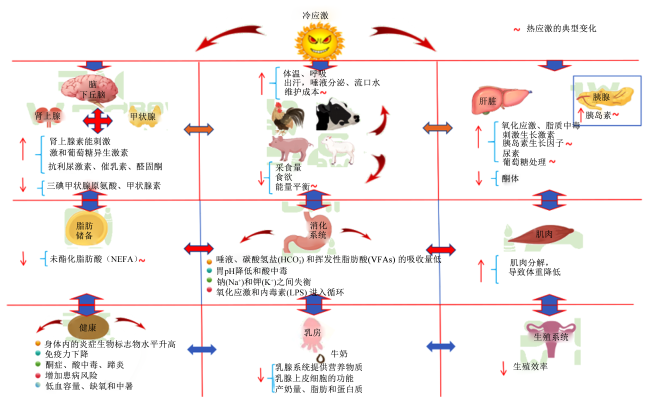
热应激会引发机体皮质醇水平的迅速升高,导致循环中的去甲肾上腺素和肾上腺素水平升高。这些内分泌变化会降低血浆中的甲状腺素(thyroxine,T4)和三碘甲腺原氨酸(triiodothyronine,T3)水平,从而降低基础代谢率以减少产热[38],但长期来看可能会抑制免疫系统。此外,低水平生长激素(growth hormone,GH)和高水平胰岛素样生长因子-2(insulin-like growth factor-2,IGF-2)显著影响热应激动物的摄食行为。在此过程中,肝脏GH受体的丰度下降,可能影响GH依赖的肝脏过程,如糖异生的调节[39]。在高产泌乳奶牛中,热应激条件下血清胰岛素样生长因子-1(insulin-like growth factor-1,IGF-1)水平显著升高,表明肝脏甘油三酯清除率提高[40]。然而,另一研究表明,热应激可降低奶牛肝脏IGF-1 mRNA的丰度,可能影响糖异生[41]。血浆T3和T4水平的下降作为即时适应性反应,与血浆GH减少一起协同作用以减少产热。在慢性热应激期间,由于出汗过多导致钾离子流失,使得醛固酮水平降低。在牛中,热暴露和脱水导致血浆抗利尿激素水平急剧升高,且与尿量显著减少有关[42]。据报道,催乳素作为一种稳态激素,可能有助于热应激的适应性代谢反应,其升高与满足热应激动物增加的水和电解质需求有关[43]。在急性热应激下,动物的血浆糖皮质激素水平会提高,这是通过激活下丘脑-垂体-肾上腺轴来实现的。与慢性热应激相比,急性热应激会引起更大的糖皮质激素水平升高[44]
图1总结了动物体内不同系统水平上发生的各种与热应激相关的生理和生化变化[45]
图1 动物体内不同系统水平上发生的各种与热应激相关的生理和生化变化

带有“~”指示的短语表示热应激动物的典型变化。

Fig.1 Various physiological and biochemical changes associated with heat stress occurring at different systemic levels in animals[45]

Phrases with an indication of “~” indicate typical changes in heat-stressed animals.

2.2 冷应激对动物生理反应的影响

在冷应激条件下,动物的体温调节机制是一个复杂且多层次的过程,涉及神经、内分泌和代谢系统的协调作用[46]。当面对寒冷环境时,动物首先通过行为调节,如寻找避风港、增加毛发竖立和颤抖等方式减少热量散失或增加产热[47]。然而,行为调节仅是动物适应寒冷环境的第一道防线,生理机制在此过程中亦发挥着至关重要的作用。研究表明,许多哺乳动物在低温环境中会显著提高基础代谢率,以增加体内热量的产生,当行为调节不足以维持体温时,动物将启动生理调节机制[48]。中枢神经系统在体温调节中起关键作用,神经内分泌调节因子通过促甲状腺激素释放激素(thyrotropin-releasing hormone,TRH)和生长抑素神经元的作用引发热遗传学反应[49]。特别值得注意的是,儿茶酚胺控制TRH的释放,而5-羟色胺主要作用于核周水平,这表明神经内分泌系统中存在复杂的调节网络[49]。此外,胰岛素和胰高血糖素等激素在能量代谢的调控中亦发挥重要作用,确保机体在冷应激条件下能量供应的稳定[50]。代谢调节是冷应激条件下维持体温的重要环节,动物通过增加基础代谢率和加强营养物质的氧化来生成更多的热量,提供了寒冷环境下身体适应的重要神经调节基础,确保体温的稳定性和生理功能的正常运行。图2总结了动物体内不同系统水平上发生的各种与冷应激相关的生理和生化变化。
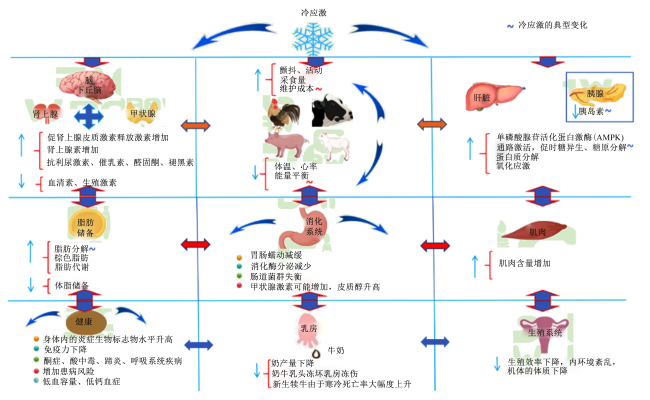
图2 动物体内不同系统水平上发生的各种与冷应激相关的生理和生化变化

带有“~”指示的短语表示冷应激动物的典型变化。

Fig.2 Various physiological and biochemical changes associated with cold stress occurring at different systemic levels in animals

Phrases with an indication of “~” indicate typical changes in cold-stressed animals.

3 冷热应激对动物代谢的影响

3.1 冷热应激对动物蛋白质代谢的影响

3.1.1 热应激对动物蛋白质代谢的影响

热应激可能导致动物体内蛋白质分解加速和合成减慢,从而影响其生长和发育[51]。在热应激条件下,动物的代谢率和热量需求显著增加,以应对高温环境下的体温调节需求。热应激诱导热休克蛋白(heat shock proteins,HSPs)的合成,特别是线粒体热休克蛋白70(heat shock protein 70,HSP70),在细胞保护中起着重要作用,HSP70的表达水平是预测热应激反应的重要指标[52]。研究表明,HSPs可以提高胰岛素敏感性,从而可能提升动物的生产力[53-54];这些蛋白质也可帮助细胞应对高温环境下的蛋白质变性和错误折叠,充当分子伴侣,帮助恢复和维护蛋白质的正常功能。在热应激条件下,动物的食欲和饲粮摄入量通常会下降,高温环境抑制了食欲中枢的活动,导致动物进食减少、饲粮摄入不足,这直接减少了动物体内可利用的营养物质,尤其是氨基酸和蛋白质,进一步限制了蛋白质的合成能力[55-56]。由于营养摄入不足,动物体内需要通过分解体内储存的蛋白质来补充能量,这进一步加速了蛋白质的分解过程。热应激的持续时间对动物在高温下的蛋白质代谢也有不同影响。短时间的热应激可增加蛋白质分解代谢,减少蛋白质合成和氮潴留[57],降低血浆中天冬氨酸(aspartic acid,Asp)、丝氨酸(serine,Ser)、酪氨酸(tyrosine,Tyr)和半胱氨酸(cysteine,Cys)的浓度[58]。然而,长期热应激可减少各种肌肉中的蛋白质合成、减少蛋白质分解,降低血浆氨基酸浓度,但升高Asp、谷氨酸(glutamic acid,Glu)和苯丙氨酸(phenylalanine,Phe)的浓度[59-60]。热应激也可导致氧化应激,增加细胞内活性氧(reactive oxygen species,ROS)含量,损伤蛋白质并激活蛋白质修复和降解途径,如自噬和蛋白酶体途径。此外,热应激激活多种细胞信号通路,包括丝裂原活化蛋白激酶(MAPK)途径和磷脂酰肌醇3-激酶(PI3K)/蛋白激酶B(Akt)途径,以调控蛋白质合成、分解和细胞应激反应[61]

3.1.2 冷应激对动物蛋白质代谢的影响

在冷应激条件下,动物体内应激激素(如肾上腺素和皮质醇)分泌增加,这些激素会刺激蛋白质分解代谢,以提供热量和能量,维持体温[62]。加速的蛋白质分解使得肌肉蛋白质被分解为氨基酸,为机体提供能量和维持基本的生理功能。尽管这一过程有助于短期生存,但从长期来看会导致肌肉消耗和体重下降。冷应激还会抑制蛋白质合成。研究表明,低温环境下GH和胰岛素样生长因子的水平下降,而这些激素对蛋白质合成起重要作用;随着这些激素水平的降低,动物体内蛋白质的合成速度减慢,影响肌肉和其他组织的修复与生长[63]。蛋白质代谢的变化还会导致氮代谢的改变。蛋白质分解产生的氨基酸在代谢过程中会转化为氨,随后转化为尿素并通过尿液排出[64]。在冷应激条件下,尿素的排出量增加,表明体内蛋白质分解增强,氮代谢加速[65]。肝脏是蛋白质代谢的重要器官,冷应激对肝脏功能有显著影响,可能导致肝脏负担增加,因为肝脏需要处理更多的氨基酸和代谢废物[66]。此外,肝脏还需要参与糖异生过程,从蛋白质分解产生的氨基酸中合成葡萄糖,以维持血糖水平,这进一步加重了肝脏的代谢负担。
总得来说,热应激诱导蛋白质的合成,保护细胞内的蛋白质;调节皮质醇、胰岛素和胰高血糖素的分泌,影响蛋白质代谢;引起氧化应激,触发蛋白质修复和降解途径;激活细胞信号通路,调节蛋白质合成和应激反应。冷热应激则通过不同的内分泌和细胞信号途径调节蛋白质代谢,以帮助动物适应环境变化。这些机制有助于维持能量平衡和细胞功能,但长期应激可能导致代谢失调和健康问题。
图3总结了环境冷应激和环境热应激对动物蛋白质代谢的影响机制。
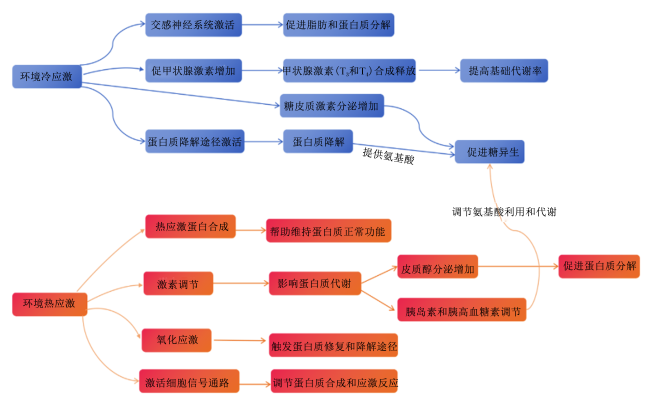
图3 环境冷应激与环境热应激对动物蛋白质代谢的影响机制

T3:三碘甲状腺原氨酸 triiodothyronine;T4:甲状腺素 tetraiodothyronine。图4同 the same as Fig.4

Fig.3 Influencing mechanism of environmental cold stress and environmental heat stress on protein metabolism in animals

3.2 冷热应激对动物脂肪代谢的影响

3.2.1 热应激对动物脂肪代谢的影响

热应激可能会影响动物的脂肪代谢,导致脂肪积累或消耗加速。多项研究表明,在热应激期间,啮齿动物[67]、猪[68]和奶牛[69]的非酯化脂肪酸基础水平通常会降低。这一现象通常与干物质摄入量的减少无关,而可能与激素变化相关。此外,动物还可能通过降低基础代谢率,从而减少脂肪的分解和利用。同时,氧化应激也在此过程中发挥作用,氧化应激会引起脂肪细胞损伤,使得血高血糖素分泌受到抑制,促使脂肪合成和储存增加,从而减少脂肪分解[70]。胰岛素分泌增加也会促进脂肪合成和储存。此时,HSPs表达也增多,有助于保护脂肪细胞,并结合交感神经系统抑制作用,减少去甲肾上腺素和肾上腺素分泌,共同减少脂肪分解。热应激还会下调某些解脂酶的活性,如在鸡[71]和猪[36]中所见。脂肪组织的钝化脂解活性似乎是一种限制热应激动物产热的适应形式。尽管在热应激下解脂酶的活性降低,但脂肪组织的脂蛋白脂肪酶活性却提高[72],这表明热应激动物的肠道和甘油三酯储存能力更强。不同动物对热应激的反应存在种属和个体差异。例如,一些耐热性较强的动物可能通过更有效的热调节机制来减轻热应激对脂肪代谢的影响,而耐热性较差的动物则更容易受到不利影响。这些差异需要通过具体研究来了解,以便为不同种类的动物制定针对性的管理和干预措施。热应激对动物行为的影响也不可忽视。在高温环境下,动物可能会表现出懒散、活动减少等行为,这些行为改变不仅直接影响能量消耗,还可能间接影响脂肪代谢[73]。热应激还可能导致动物出现异常行为,如过度舔舐或啃咬,这些行为可能进一步加重应激状态,影响整体代谢平衡。

3.2.2 冷应激对动物脂肪代谢的影响

在冷应激条件下,动物体内的应激激素(如肾上腺素和去甲肾上腺素)分泌增加,这些激素能够促进脂肪分解。脂肪组织中的甘油三酯被分解为甘油和脂肪酸,脂肪酸作为能量来源被氧化供能,以帮助动物抵抗寒冷。冷应激还会刺激棕色脂肪组织的活化。棕色脂肪组织内含有丰富的线粒体,通过非颤抖产热生成热量,从而可能导致脂肪重新分布和积累[74]。在低温环境下,棕色脂肪组织的产热作用增强,有助于动物维持体温。冷应激会提高脂肪酸的氧化速率[75]。在寒冷环境中,动物体需要通过氧化脂肪酸提供更多的能量,以维持体温和基本生理活动。这种增加的脂肪酸氧化不仅发生在肝脏,还包括骨骼肌和心肌等组织[46]。由于冷应激条件下脂肪分解和利用加快,动物体内的脂肪储存量会减少。这一过程在短期内有助于维持能量平衡和体温,但从长期来看可能导致体脂减少,影响动物的健康和生产性能[76]。冷应激还会影响脂质代谢相关酶的活性。例如,激素敏感性脂肪酶和脂肪酸合成酶的活性会发生变化;激素敏感性脂肪酶的活性增强,促进脂肪的分解,而脂肪酸合成酶的活性可能会降低,从而减少脂肪的合成,这些酶活性的变化共同调节脂肪的代谢过程[77]
综上所述,冷应激机制包括交感神经系统的激活,导致去甲肾上腺素和肾上腺素分泌增加,进而促进脂肪分解;甲状腺激素水平升高,会提高基础代谢率和脂肪分解速率;同时,棕色脂肪组织的活化会促进非颤抖性产热;皮质醇分泌增加,也有助于脂肪分解和糖异生。相反,热应激机制则表现为交感神经系统的抑制,导致脂肪分解减少;热应激还引起热应激蛋白的表达,保护脂肪细胞不受损伤;热应激导致胰岛素水平提高,促进脂肪的合成和储存;此外,氧化应激会导致脂肪细胞损伤,而皮质醇的增加可能引起脂肪重新分布和积累。冷热应激通过不同的内分泌和细胞信号途径调节脂肪代谢,以帮助动物适应环境变化。这些机制在维持能量平衡和体温调节中发挥关键作用。
图4总结了环境冷应激与环境热应激对动物脂肪代谢的影响机制。
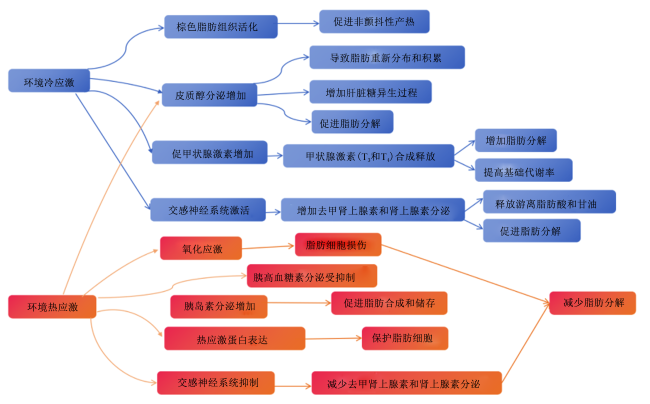
图4 环境冷应激与环境热应激对动物脂肪代谢的影响机制

Fig.4 Influencing mechanism of environmental cold stress and environmental heat stress on fat metabolism in animals

4 冷热应激对动物生理和代谢影响的比较

热应激和冷应激都对动物的生理和代谢产生显著影响,但它们的机制和结果有所不同。表1概括了这2种应激条件对动物生理和代谢影响的比较。由此可知,热应激与冷应激对动物生理和代谢的影响具有显著的对比特性。热应激主要表现为动物应激反应的加剧,心血管和呼吸系统的负担增加,代谢率上升导致能量消耗增加,以及免疫力下降引发疾病风险增加;冷应激则强调体温的保留和热量的生成,身体通过增加代谢作用和行为反应来应对寒冷,但也面临电解质失衡和免疫系统波动的风险。在畜牧管理中,必须谨慎应对不同季节的温度变化,以维护动物的健康和高效生产。建议在高温环境中提供充足的饮水和阴凉避暑设施,并在低温条件下确保适当的保暖措施和营养供给。这不仅有助于减少温度应激对动物生理和代谢的负面影响,还能提高畜牧业的整体效益。
表1 冷热应激对动物生理和代谢影响的比较

Table 1 Comparison of effects of heat and cold stress on animal physiology and metabolism

影响类别
Influence category
热应激
Heat stress
冷应激
Cold stress
体温调节
Thermoregulation
体温升高,可能引发热衰竭或中暑 体温降低,可能导致低体温症
心血管系统
Cardiovascular system
心率加快,血压升高,血液循环增加 心率减慢,血压升高,血液循环减慢
呼吸系统
Respiratory system
呼吸频率提高,可能引发呼吸困难 呼吸频率降低,可能导致呼吸暂停
代谢率
Metabolic rate
提高代谢率以散热,可能引发代谢失衡 提高代谢率以产热,能量消耗增加
内分泌系统
Endocrine system
皮质醇和肾上腺素水平升高,影响应激反应 甲状腺激素分泌增加,调高基础代谢率
电解质平衡
Electrolyte balance
出汗增加,导致电解质流失,可能引发脱水 尿量减少,保留热量,可能导致电解质失衡
免疫系统
Immune system
免疫功能可能下降,易感染疾病 免疫功能和抗寒能力可能提升或受损
行为反应
Behavior reaction
增加饮水,减少活动,寻找阴凉处 增加活动,寻找热源,减少暴露表面积
消化系统
Digestive system
食欲降低,消化功能减弱 食欲增加,消化功能增强以维持热量供给
皮肤反应
Skin reaction
血管扩张,出汗增加,皮肤红热 血管收缩,皮肤苍白或发绀,减少热量散失

5 小结

动物在应对冷应激与热应激时展现出复杂而精细的生理调节机制。面对冷应激,动物通过代谢调整、激素水平变化、免疫功能调节及血流分布等多方面机制适应低温环境,以维持体温稳定。然而,这种适应可能对动物健康及其产品产生不利影响。在高温高湿环境下的热应激中,动物则通过神经内分泌调节和免疫功能调整等方式进行适应,但同样可能影响其代谢、免疫功能及生长性能。综上所述,动物在应对环境挑战时展现出复杂的适应机制,但这些应激反应可能带来潜在的健康风险。
[1]
CAO Y H, LI D F. Impact of increased demand for animal protein products in Asian countries:implications on global food security[J]. Animal Frontiers, 2013, 3(3):48-55.

[2]
MCLAUGHLIN J F, HELLMANN J J, BOGGS C L, et al. Climate change hastens population extinctions[J]. Proceedings of the National Academy of Sciences of the United States of America, 2002, 99(9):6070-6074.

DOI PMID

[3]
POUNDS J A, BUSTAMANTE M R, COLOMA L A, et al. Widespread amphibian extinctions from epidemic disease driven by global warming[J]. Nature, 2006, 439(7073):161-167.

[4]
KOKNAROGLU H, HARRINGTON J A, MADER T L, et al. Determination of climatologically suitable places in Türkiye for feedlot cattle production using the comprehensive climate index model[J]. International Journal of Biometeorology, 2023, 67(11):1813-1824.

[5]
EMEDIEGWU L E, UBABUKOH C L. Re-examining the impact of annual weather fluctuations on global livestock production[J]. Ecological Economics, 2023,204:107662.

[6]
ANGRECKA S, HERBUT P. Conditions for cold stress development in dairy cattle kept in free stall barn during severe frosts[J]. Czech Journal of Animal Science, 2015, 60(2):81-87.

[7]
ZENG J, CAI J, WANG D M, et al. Heat stress affects dairy cow health status through blood oxygen availability[J]. Journal of Animal Science and Biotechnology, 2023, 14(1):112.

DOI PMID

[8]
MADER T L, GAUGHAN J B, JOHNSON L J, et al. Tympanic temperature in confined beef cattle exposed to excessive heat load[J]. International Journal of Biometeorology, 2010, 54(6):629-635.

DOI PMID

[9]
BERMAN A, HOROVITZ T, KAIM M, et al. A comparison of THI indices leads to a sensible heat-based heat stress index for shaded cattle that aligns temperature and humidity stress[J]. International Journal of Biometeorology, 2016, 60(10):1453-1462.

PMID

[10]
林勇, 代伟伟, 夏礼如, 等. 夏季不同环境控制方法对层叠式笼养肉鸭舍内环境的影响[J]. 中国家禽, 2024, 46(12):85-92.

LIN Y, DAI W W, XIA L R, et al. Effects of different environmental control methods in summer on indoor environment of cascading cage-rearing meat duck house[J]. China Poultry, 2024, 46(12):85-92. (in Chinese)

[11]
YAN G Q, LIU K X, HAO Z, et al. The effects of cow-related factors on rectal temperature,respiration rate,and temperature-humidity index thresholds for lactating cows exposed to heat stress[J]. Journal of Thermal Biology, 2021,100:103041.

[12]
HAMZAOUI S, SALAMA A A K, ALBANELL E, et al. Physiological responses and lactational performances of late-lactation dairy goats under heat stress conditions[J]. Journal of Dairy Science, 2013, 96(10):6355-6365.

DOI PMID

[13]
GAUGHAN J B, MADER T L, HOLT S M, et al. A new heat load index for feedlot cattle[J]. Journal of Animal Science, 2008, 86(1):226-234.

PMID

[14]
LI G, CHEN S Y, CHEN J, et al. Predicting rectal temperature and respiration rate responses in lactating dairy cows exposed to heat stress[J]. Journal of Dairy Science, 2020, 103(6):5466-5484.

DOI PMID

[15]
PENG D, CHEN S, LI G, et al. Infrared thermography measured body surface temperature and its relationship with rectal temperature in dairy cows under different temperature-humidity indexes[J]. International Journal of Biometeorology, 2019, 63(3):327-336.

DOI PMID

[16]
BLOND B, MAJKIĆ M, SPASOJEVIĆ J, et al. Influence of heat stress on body surface temperature and blood metabolic,endocrine,and inflammatory parameters and their correlation in cows[J]. Metabolites, 2024, 14(2):104.

[17]
MASHALY M M, HENDRICKS G L 3, KALAMA M A, et al. Effect of heat stress on production parameters and immune responses of commercial laying hens[J]. Poultry Science, 2004, 83(6):889-894.

PMID

[18]
XIONG Y, YI H, WU Q, et al. Effects of acute heat stress on intestinal microbiota in grow-finishing pigs,and associations with feed intake and serum profile[J]. Journal of Applied Microbiology, 2020, 128(3):840-852.

[19]
PAIM T D P, MARTINS R F S, CARDOSO C, et al. Thermal comfort index and infrared temperatures for lambs subjected to different environmental conditions[J]. Scientia Agricola, 2014, 71(5):356-361.

[20]
JI B Y, BANHAZI T, GHAHRAMANI A, et al. Modelling of heat stress in a robotic dairy farm.Part 1:thermal comfort indices as the indicators of production loss[J]. Biosystems Engineering, 2020,199:27-42.

[21]
WEI H D, ZHANG R X, SU Y Y, et al. Effects of acute cold stress after long-term cold stimulation on antioxidant status,heat shock proteins,inflammation and immune cytokines in broiler heart[J]. Frontiers in Physiology, 2018,9:1589.

[22]
DADO-SENN B, GINGERICH K N, HORVATH K C, et al. Early-life heat stress exposure impacts dairy calf feeding and thermoregulatory behavior[J]. JDS Communications, 2022, 3(1):38-43.

[23]
KRISHNAN G, SILPA M V, SEJIAN V. Environmental physiology and thermoregulation in farm animals[M]. Singapore: Springer Nature Singapore,2023:723-749.

[24]
张轶凤. 南方荷斯坦奶牛冷热应激评价指标及适宜环境温湿度研究[D]. 硕士学位论文. 武汉: 华中农业大学, 2019.

ZHANG Y F. Evaluation indexes of cold and heat stress and suitable environmental temperature and humidity for southern Holstein dairy cows[D]. Master’s Thesis. Wuhan: Huazhong Agricultural University, 2019. (in Chinese).

[25]
BORSHCH O O, BORSHCH O V, MASHKIN Y, et al. Behavior and energy losses of cows during the period of low temperatures[J]. Scientific Horizons, 2021, 24(5):46-53.

[26]
彭孝坤. 急性冷热应激对肉羊生理生化指标和HSP70家族基因表达的影响[D]. 硕士学位论文. 杨凌: 西北农林科技大学, 2019.

PENG X K. Effects of acute heat and cold stress on physiological and biochemical indices and HSP70 family gene expression in meat goats[D]. Master’s Thesis. Yangling: Northwest A&F University, 2019. (in Chinese).

[27]
UGURLU M, TEKE B, AKDAG F, et al. Effect of temperature-humidity index,cold stress index and dry period length on birth weight of Jersey calf[J]. Bulgarian Journal of Agricultural Science, 2014, 20(5):1227-1232.

[28]
INGRAM D L, LEGGE K F. The influence of deep body temperatures and skin temperatures on peripheral blood flow in the pig[J]. The Journal of Physiology, 1971, 215(3):693-707.

[29]
SCHOLANDER P F, HOCK R, WALTERS V, et al. Adaptation to cold in Arctic and tropical mammals and birds in relation to body temperature,insulation,and basal metabolic rate[J]. The Biological Bulletin, 1950, 99(2):259-271.,

[30]
KEARNEY M, SHINE R, PORTER W P. The potential for behavioral thermoregulation to buffer “cold-blooded” animals against climate warming[J]. Proceedings of the National Academy of Sciences of the United States of America, 2009, 106(10):3835-3840.

[31]
VERBEEK E, OLIVER M H, WAAS J R, et al. Reduced cortisol and metabolic responses of thin ewes to an acute cold challenge in mid-pregnancy:implications for animal physiology and welfare[J]. PLoS One, 2012, 7(5):e37315.

[32]
SILANIKOVE N. The physiological basis of adaptation in goats to harsh environments[J]. Small Ruminant Research, 2000, 35(3):181-193.

[33]
DA SILVA W E, LEITE J H G M, DE SOUSA J E R, et al. Daily rhythmicity of the thermoregulatory responses of locally adapted Brazilian sheep in a semiarid environment[J]. International Journal of Biometeorology, 2017, 61(7):1221-1231.

DOI PMID

[34]
VALENTE É E L, CHIZZOTTI M L, DE O C V R, et al. Intake, physiological parameters and behavior of Angus and Nellore bulls subjected to heat stress[J]. Semina:Ciências Agrárias, 2015,36 (Suppl.2):4565-4574.

[35]
SCRIBA M F, WECHSLER B. Behavioural and physiological indicators of heat stress in fattening pigs[J]. Agrarforschung Schweiz, 2021,12:181-188.

[36]
QU H, AJUWON K M. Adipose tissue-specific responses reveal an important role of lipogenesis during heat stress adaptation in pigs[J]. Journal of Animal Science, 2018, 96(3):975-989.

DOI PMID

[37]
AKINMOLADUN O F, FON F N, MPENDULO C T, et al. Performance, heat tolerance response,and blood metabolites of water-restricted Xhosa goats supplemented with vitamin C[J]. Translational Animal Science, 2020, 4(2):txaa044.

[38]
MOFFETT S X, GIANNOPOULOS P F, JAMES T D, et al. Effects of acute microinjections of thyroid hormone to the preoptic region of hypothyroid adult male rats on sleep,motor activity and body temperature[J]. Brain Research, 2013,1516:55-65.

[39]
LAKHANI P, KUMAR P, ALHUSSIEN M N, et al. Effect of betaine supplementation on growth performance,nutrient intake and expression of IGF-1 in Karan fries heifers during thermal stress[J]. Theriogenology, 2020,142:433-440.

[40]
QU M Z, WEI S J, CHEN Z Q, et al. Differences of hormones involved in adipose metabolism and lactation between high and low producing Holstein cows during heat stress[J]. Animal Nutrition, 2015, 1(4):339-343.

DOI PMID

[41]
RHOADS M L, KIM J W, COLLIER R J, et al. Effects of heat stress and nutrition on lactating Holstein cows:Ⅱ.Aspects of hepatic growth hormone responsiveness[J]. Journal of Dairy Science, 2010, 93(1):170-179.

[42]
EL-NOUTY F D, ELBANNA I M, DAVIS T P, et al. Aldosterone and ADH response to heat and dehydration in cattle[J]. Journal of Applied Physiology:Respiratory, Environmental and Exercise Physiology, 1980, 48(2):249-255.

[43]
COLLIER R J, BEEDE D K, THATCHER W W, et al. Influences of environment and its modification on dairy animal health and production[J]. Journal of Dairy Science, 1982, 65(11):2213-2227.

PMID

[44]
KADIM I T, MAHGOUB O, AL-KINDI A, et al. Effects of transportation at high ambient temperatures on physiological responses,carcass and meat quality characteristics of three breeds of Omani goats[J]. Meat Science, 2006, 73(4):626-634.

[45]
SAMMAD A, WANG Y J, UMER S, et al. Nutritional physiology and biochemistry of dairy cattle under the influence of heat stress:consequences and opportunities[J]. Animals, 2020, 10(5):793.

[46]
CAREY H V, ANDREWS M T, MARTIN S L. Mammalian hibernation:cellular and molecular responses to depressed metabolism and low temperature[J]. Physiological Reviews, 2003, 83(4):1153-1181.

[47]
HAMMEL H T, HARDY J D, FUSCO M M. Thermoregulatory responses to hypothalamic cooling in unanesthetized dogs[J]. The American Journal of Physiology, 1960,198:481-486.

[48]
DOS SANTOS M M, SOUZA-JUNIOR J B F, DANTAS M R T, et al. An updated review on cattle thermoregulation:physiological responses,biophysical mechanisms,and heat stress alleviation pathways[J]. Environmental Science and Pollution Research International, 2021, 28(24):30471-30485.

[49]
ZHANG Z, BOELEN A, KALSBEEK A, et al. TRH neurons and thyroid hormone coordinate the hypothalamic response to cold[J]. European Thyroid Journal, 2018, 7(6):279-288.

DOI PMID

[50]
WANG S Y, LI Q, PENG J H, et al. Effects of long-term cold stress on growth performance,behavior,physiological parameters,and energy metabolism in growing beef cattle[J]. Animals, 2023, 13(10):1619.

[51]
ARIYO O W, KWAKYE J, SOVI S, et al. Glucose supplementation improves performance and alters glucose transporters’ expression in pectoralis major of heat-stressed chickens[J]. Animals, 2023, 13(18):2911.

[52]
STAMPERNA K, GIANNOULIS T, DOVOLOU E, et al. Heat shock protein 70 improves in vitro embryo yield and quality from heat stressed bovine oocytes[J]. Animals, 2021, 11(6):1794.

[53]
MORERA P, BASIRICÒ L, HOSODA K, et al. Chronic heat stress up-regulates leptin and adiponectin secretion and expression and improves leptin,adiponectin and insulin sensitivity in mice[J]. Journal of Molecular Endocrinology, 2012, 48(2):129-138.

[54]
BEDFORD A, GONG J. Implications of butyrate and its derivatives for gut health and animal production[J]. Animal Nutrition, 2018, 4(2):151-159.

DOI PMID

[55]
HE X F, LU Z, MA B B, et al. Chronic heat stress alters hypothalamus integrity,the serum indexes and attenuates expressions of hypothalamic appetite genes in broilers[J]. Journal of Thermal Biology, 2019,81:110-117.

[56]
GREENLAND M S, WALDRON B L, ISOM S C, et al. Dry matter intake and feed efficiency of heifers from 4 dairy breed types grazing organic grass and grass-birdsfoot trefoil mixed pastures[J]. Journal of Dairy Science, 2023, 106(6):3918-3931.

DOI PMID

[57]
BOUSSAID-OM EZZINE S, EVERAERT N, MÉTAYER-COUSTARD S, et al. Effects of heat exposure on Akt/S6K1 signaling and expression of genes related to protein and energy metabolism in chicken (Gallus gallus) pectoralis major muscle[J]. Comparative Biochemistry and Physiology Part B:Biochemistry & Molecular Biology, 2010, 157(3):281-287.

[58]
LU Z, HE X F, MA B B, et al. Serum metabolomics study of nutrient metabolic variations in chronic heat-stressed broilers[J]. British Journal of Nutrition, 2018, 119(7):771-781.

[59]
MA B B, HE X F, LU Z, et al. Chronic heat stress affects muscle hypertrophy,muscle protein synthesis and uptake of amino acid in broilers via insulin like growth factor-mammalian target of rapamycin signal pathway[J]. Poultry Science, 2018, 97(12):4150-4158.

[60]
GONZALEZ E R, LEESON S. Physiological and metabolic responses of broilers to heat stress-implications for protein and amino acid nutrition[J]. World’s Poultry Science Journal, 2006, 62(2):282-295.

[61]
PENKE B, BOGÁR F, CRUL T, et al. Heat shock proteins and autophagy pathways in neuroprotection:from molecular bases to pharmacological interventions[J]. International Journal of Molecular Sciences, 2018, 19(1):325.

[62]
SANO H, NAKAMURA S, KOBAYASHI S, et al. Effect of cold exposure on profiles of metabolic and endocrine responses and on responses to feeding and arginine injection in sheep[J]. Journal of Animal Science, 1995, 73(7):2054-2062.

PMID

[63]
REINECKE M. Influences of the environment on the endocrine and paracrine fish growth hormone-insulin-like growth factor-Ⅰ system[J]. Journal of Fish Biology, 2010, 76(6):1233-1254.

[64]
POORTMANS J R. Principles of exercise biochemistry:protein metabolism[M]//HEBBELINCK M,SHEPHARD R J. and sport science. Basel: Karger Publishers, 2015.

[65]
YIN H M, ZHONG Y D, WANG H, et al. Short-term exposure to high relative humidity increases blood urea and influences colonic urea-nitrogen metabolism by altering the gut microbiota[J]. Journal of Advanced Research, 2022,35:153-168.

[66]
ŞAHIN E, GÜMŞÜLÜ S. Cold-stress-induced modulation of antioxidant defence:role of stressed conditions in tissue injury followed by protein oxidation and lipid peroxidation[J]. International Journal of Biometeorology, 2004, 48(4):165-171.

[67]
HAMANO Y. Alleviative effects of α-lipoic acid supplementation on acute heat stress-induced thermal panting and the level of plasma nonesterified fatty acids in hypothyroid broiler chickens[J]. British Poultry Science, 2012, 53(1):125-133.

DOI PMID

[68]
CUI Y J, WANG C, HAO Y, et al. Chronic heat stress induces acute phase responses and serum metabolome changes in finishing pigs[J]. Animals, 2019, 9(7):395.

[69]
ANTANAITIS R, DŽERMEIKAITĒ K, KRIŠTOLAI-TYTĒ J, et al. Impact of heat stress on the in-line registered milk fat-to-protein ratio and metabolic profile in dairy cows[J]. Agriculture, 2024, 14(2):203.

[70]
MALANDRINO M I, FUCHO R, WEBER M, et al. Enhanced fatty acid oxidation in adipocytes and macrophages reduces lipid-induced triglyceride accumulation and inflammation[J]. American Journal of Physiology Endocrinology and Metabolism, 2015, 308(9):E756-E769.

[71]
FLEES J, RAJAEI-SHARIFABADI H, GREENE E, et al. Effect of Morinda citrifolia (Noni)-enriched diet on hepatic heat shock protein and lipid metabolism-related genes in heat stressed broiler chickens[J]. Frontiers in Physiology, 2017,8:919.

[72]
DOROSTI F, DANESHYAR M, FARHOOMAND P, et al. The effect of mild and chronic heat stress on yield,carcass characteristics,blood parameters,meat quality and expression of fatty acid synthase and lipoprotein lipase genes in broilers[J]. Journal of Animal Science Research, 2024, 33(4):47-59.

[73]
OLSON B, MARKS D L, GROSSBERG A J. Diverging metabolic programmes and behaviours during states of starvation,protein malnutrition,and cachexia[J]. Journal of Cachexia,Sarcopenia and Muscle, 2020, 11(6):1429-1446.

[74]
WANG C X, XIA T T, DU Y, et al. Effects of ATF4 on PGC1α expression in brown adipose tissue and metabolic responses to cold stress[J]. Metabolism, 2013, 62(2):282-289.

[75]
BAL N C, SINGH S, REIS F C G, et al. Both brown adipose tissue and skeletal muscle thermogenesis processes are activated during mild to severe cold adaptation in mice[J]. Journal of Biological Chemistry, 2017, 292(40):16616-16625.

DOI PMID

[76]
MASORO E J. Effect of cold on metabolic use of lipids[J]. Physiological Reviews, 1966, 46(1):67-101.

PMID

[77]
CHU P, WANG T, SUN Y R, et al. Effect of cold stress on the MAPK pathway and lipidomics on muscle of Takifugu fasciatus[J]. Aquaculture, 2021,540:736691.

文章导航

/