综述

大豆皂苷对水产动物影响的研究进展

  • 陈威 ,
  • 曾海波 1, 2 ,
  • 张恒 3 ,
  • 阮国良 , 1, 3, *
展开
  • 1 长江大学动物科学技术学院,荆州 434025
  • 2 湘西自治州农业综合行政执法支队,吉首 416000
  • 3 湖北省水产产业技术研究院,荆州 434026
* 阮国良,教授,硕士生导师,E-mail:

陈 威(1998—),男,海南文昌人,硕士研究生,从事水产养殖生态学研究。E-mail:

Copy editor: 菅景颖

收稿日期: 2024-07-10

  网络出版日期: 2025-01-10

基金资助

湖北省乡村振兴科技示范(农业科技成果转化)项目(XCZX202400006)

Research Progress on Effects of Soybean Saponins on Aquatic Animals

  • CHEN Wei ,
  • ZENG Haibo 1, 2 ,
  • ZHANG Heng 3 ,
  • RUAN Guoliang , 1, 3, *
Expand
  • 1 College of Animal Science and Technology, Yangtze University, Jingzhou 434025, China
  • 2 Agricultural Comprehensive Administrative Law Enforcement Detachment of Xiangxi Autonomous Prefecture, Jishou 416000, China
  • 3 Hubei Fisheries Industrial Technology Research Institute, Jingzhou 434026, China
* professor, E-mail:

Received date: 2024-07-10

  Online published: 2025-01-10

摘要

大豆皂苷是一种由三萜皂苷元与糖类结合形成的化合物,在植物界中广泛存在并具有多种生物学功能,豆粕中所含0.5%左右的大豆皂苷被视为一种抗营养因子。低剂量的大豆皂苷会对水产动物产生积极影响,而高剂量的大豆皂苷则会产生抗营养等消极影响。本文综述了大豆皂苷的生物学功能以及不同剂量大豆皂苷对水产动物生长性能、抗氧化、免疫、炎症和肠道健康的影响及其相关潜在机制,以期为合理限定大豆皂苷在水产饲料中的使用量提供参考,从而避免过量的大豆皂苷对水产动物产生不利影响。

本文引用格式

陈威 , 曾海波 , 张恒 , 阮国良 . 大豆皂苷对水产动物影响的研究进展[J]. 动物营养学报, 2025 , 37(1) : 182 -193 . DOI: 10.12418/CJAN2025.016

Abstract

Soybean saponins (SAPs), a class of compound formed by the combination of triterpenoid saponin and sugar, widely exists in plant and has many biological functions. Low doses of SAPs have positive effects on aquatic animals, while high doses of SAPs can produce negative influences including anti-nutrition. In this paper, the biological functions of SAPs and its effects with different doses on the growth performance, antioxidation, immunity, inflammatory, and intestinal health of aquatic animals were reviewed. Additionally, the related potential mechanisms were discussed. This review can provide certain references for the reasonable use constrictions of SAPs in aquatic diets, so as to help to avoid the adverse effects of excessive SAPs on aquatic animals.

豆粕是大豆提取豆油过程中产生的副产品,因其蛋白质含量高、氨基酸组成均衡和营养元素全面而成为主要的植物蛋白质饲料原料之一[1],且因其来源广、价格低廉而成为鱼粉等稀缺饲料蛋白质源的常用替代原料[2]。但是,豆粕中含有不同类型的抗营养因子,会阻碍水产动物对营养物质的吸收,从而产生消极影响[3]。例如,豆粕中约含有0.5%的大豆皂苷[4],其作为醇溶性抗营养因子,是潜在的致病因素[5-6],并且大豆皂苷因其高热稳定性,不易通过常规技术去除,而乙醇抽提法作为有效去除大豆皂苷的方法其成本较高[7]。研究发现,低剂量的大豆皂苷会对水产动物的生理功能产生积极影响,而高剂量的大豆皂苷对水产动物产生消极影响[8]。目前,尚不清楚大豆皂苷对水产动物的使用剂量安全阈值和影响机制。为此,本文主要综述不同剂量的大豆皂苷对水产动物生长性能、抗氧化、免疫及肠道健康的影响及其潜在机制,旨在为今后大豆皂苷在水产养殖业中的深入研究和合理使用提供科学依据。

1 大豆皂苷的结构与生物学功能

1.1 结构

大豆皂苷又名大豆皂甙,因其水溶液呈泡沫状,像肥皂样而得名[9]。大豆皂苷是大豆中提取的一系列化合物,它们由三萜类结构的羟基与糖分子的环状半缩醛羟基通过脱水反应形成。大豆皂苷包含多种糖类成分,具体包括β-D-半乳糖、β-D-木糖、α-L-鼠李糖、α-L-阿拉伯糖以及β-D-葡萄糖醛酸[10]
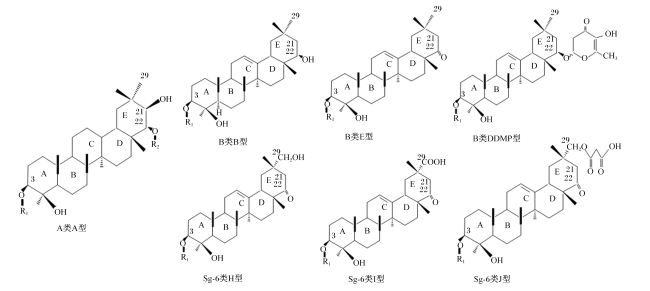
根据苷元结构的不同,大豆皂苷可划分为7种主要类型,分别为A型、B型、E型、DDMP型、H型、I型和J型。这些类型根据C-3、C-22和C-29位点上官能团的差异被归类为三大类:A类、B类和Sg-6类[11-12](图1)。A类大豆皂苷是以大豆皂醇A为母核结构,特征在于其C-3和C-22位点上连接有双糖链的糖苷;B类大豆皂苷则以大豆皂醇B为母核,其C-3位点上连接有单糖链的糖苷,而B类大豆皂苷可进一步细分为含羟基的B型、含羰基的E型,以及通过酰键与DDMP环相连的DDMP型;Sg-6类则特指C-22位点上具有羰基,且C-29位点上的甲基被不同官能团取代的H型、I型和J型大豆皂苷,这些官能团分别为羟甲基、甲酸和丙二酸[13]
图1 大豆皂苷的化学结构

Fig.1 Chemical structures of soybean saponins

1.2 生物学功能

大豆皂苷具有广泛的生物学功能:1)可降低血糖和胆固醇的水平[11];2)可抑制脂质过氧化物(lipid peroxide,LPO)的生成和促进LPO的分解,并且可以清除活性氧(reactive oxide species,ROS)自由基[11]和缓解过氧化氢(hydrogen peroxide,H2O2)导致的HepG2细胞的氧化应激[14];3)可提高免疫球蛋白的水平[15]以及自然杀伤性细胞和杀伤性细胞的活性[16],并且可以促进T淋巴细胞和白细胞介素(interleukin,IL)-2的分泌[17],从而发挥免疫促进的作用;4)抗肿瘤作用,可阻碍癌细胞的生长并促使其凋亡[18],这一作用主要是通过干预磷酸酶和张力蛋白同系物(phosphatase and tensin homolog,PTEN)/磷脂酰肌醇3-激酶(phosphatidylinositol 3-kinase,PI3K)/蛋白激酶B(protein kinase B,Akt)信号通路以及核因子-κB(nuclear factor-kappa B,NF-κB)信号传导系统实现的,进而激活含半胱氨酸的天冬氨酸蛋白水解酶(cysteinyl aspartate specific proteinase,Caspase)级联反应,从而触发肿瘤细胞的凋亡过程[11];5)抗炎作用。NF-κB是一种核转录因子,在细胞的炎症反应、免疫反应等过程中起到关键性作用[19]。大豆皂苷的抗炎作用一般与抑制NF-κB信号通路有关[20-22]。大豆皂苷可以通过抑制NF-κB信号通路抑制小鼠炎症因子的表达[23],其大体机制为:大豆皂苷可阻止脂多糖(lipopolysaccharide,LPS)与细胞上的Toll样受体4(Toll-like receptor 4,TLR4)结合,使NF-κB以非活化的形式存在于细胞质中,从而阻断NF-κB信号通路[23-24]。此外,大豆皂苷还可减轻炎症反应,这主要通过降低髓样分化因子88(myeloid differentiation factor 88,MyD88)蛋白的表达水平以及减少TLR4和MyD88在细胞膜脂筏区域的集中来实现,从而抑制炎症信号的传递[25]

2 大豆皂苷对水产动物的影响

目前的研究表明,不同剂量的大豆皂苷对水产动物的影响是不同的。高剂量的大豆皂苷不仅会抑制水产动物的生长发育,还会增加水产动物的肠道通透性,损伤肠道结构,不利于营养素的吸收与利用,从而影响其生长和健康;而在适宜剂量下大豆皂苷对水产动物生长性能、抗氧化、免疫和肠道健康等方面均具有促进作用。

2.1 生长性能

大豆皂苷具有增加细胞通透性的作用,因此有利于营养物质的吸收,而当大豆皂苷的剂量过高时,细胞通透性的过量增加会抑制糖类等活性营养物质的运输[26],从而影响机体的消化和吸收,导致水产动物的生长性能下降。本文对影响不同水产动物生长性能的大豆皂苷的适宜添加量[8,27-37]进行了总结,详见表1。从表1中可以看出,主要养殖鱼类饲料中大豆皂苷的适宜添加量为1~3 g/kg;饲料中大豆皂苷添加量较低时对鱼类的生长性能可产生积极作用,而其添加量过高则会导致生长性能下降。但是,有关大豆皂苷对甲壳类动物生长的影响则罕见报道,为维持克氏原螯虾(Procambarus clarkii)[29]和中华绒螯蟹(Eriocheir sinensis)[37]正常的生长性能,其饲料中大豆皂苷添加量应分别控制在5和1 g/kg以内。
表1 大豆皂苷对水产动物生长性能的影响

Table 1 Effects of soybean saponins on growth performance of aquatic animals

水产动物
Aquatic animals
添加量范围
Additive amount
range/(g/kg)
效应
Responses
适宜添加量
Appropriate additive
amount/(g/kg)
参考文献
References
异育银鲫
Carassius auratus
gibelio
0~7.2 1.6 g/kg时,特定生长率(SGR)最高;
0.8~1.6 g/kg时,饲料系数最低及
蛋白质效率较高
1.6 张伟[27]
草鱼
Ctenopharyngodon idella
0~6.0 2.4 g/kg时,SGR及饲料效率最高 2.4 陈智杰[28]
黄颡鱼
Pelteobagrus fulvidraco
0~40 0~2 g/kg时,增重率(WGR)及
SGR较高,饲料系数较低
<2 王岳松[29]
罗非鱼
Oreochromis niloticus
0~3.6 14 d:1.8、3.6 g/kg时,WGR及SGR显著
下降;28 d:1.8、3.6 g/kg时,WGR及
SGR显著上升
<1.8 张鑫等[30]
石斑鱼
Epinephelus fuscoguttatus
0~15 3 g/kg时,SGR与WGR最高,
饲料系数最低
3 Yin等[8]
牙鲆
Paralichthys olivaceus
0~6.4 0.8 g/kg时,平均终末体重及
饲料效率最高
0.8 Chen等[31]
大菱鲆
Scophthalmus maximus
0~5 0~2.5 g/kg时,WGR及
饲料效率较高
<2.5 Yun等[32]
0~15 0~2.5 g/kg时,SGR及饲料效率较高 Gu等[33]
大鳞大马哈鱼
Oncorhynchus tshawytscha
0~3 1.5 g/kg时,WGR及饲料效率最高 1.5 Bureau等[34]
大西洋鲑
Salmo salar
0~10 2 g/kg时,WGR最高 2 谷珉[35]
虹鳟
Oncorhynchus mykiss
0~3 1.5 g/kg时,WGR及饲料效率最高 1.5 Bureau等[34]
金头鲷
Sparus aurata
0~2 1 g/kg时,WGR、饲料效率及蛋白质效率最高 1 Couto等[36]
克氏原螯虾
Procambarus clarkii
0~40 0~5 g/kg时,SGR、WGR较高,饲料系数较低 <5 王岳松[29]
中华绒螯蟹
Eriocheir sinensis
0~10 0~1 g/kg时,SGR、WGR及蛋白质效率
较高,饲料系数较低
<1 张璐[37]
大豆皂苷对水产动物生长性能的影响还与养殖周期有关。饲喂含低剂量(0.8 g/kg)大豆皂苷饲料14 d后,牙鲆(Paralichthys olivaceus)的生长性能得到提高,而饲喂含高剂量(6.4 g/kg)大豆皂苷饲料则降低了牙鲆的生长性能[33],可能是因为大豆皂苷具有苦味[38];但在56 d后,所有皂苷组牙鲆的平均体重、摄食量和饲料效率均与对照组无显著差异。张鑫等[30]分别用添加1.8和3.6 g/kg大豆皂苷的饲料饲喂罗非鱼(Oreochromis niloticus),结果发现,饲喂14 d后罗非鱼的生长性能受到抑制,而在饲喂28 d后其生长性能与对照组无显著差异。陈度煌等[39]用添加15 g/kg大豆皂苷(纯度为40%)的饲料饲喂罗非鱼60 d后,其生长性能与对照组无显著差异。这说明养殖鱼类对饲料中的大豆皂苷存在不同程度的适应性和耐受性,但其机制还有待研究。
随着大豆皂苷添加量的增加,大西洋鲑(Salmo salar)后肠中亮氨酸氨基肽酶活性显著下降,从而使其对饲料中蛋白质的消化和吸收能力下降[35],而胰蛋白酶活性的显著上升可能是后肠的炎症所致[40-41];中华绒螯蟹在摄食添加有大豆皂苷(1~10 g/kg)的饲料时其肝胰腺中淀粉酶和纤维素酶活性与对照组相比无显著差异,而其类胰蛋白酶和脂肪酶活性显著下降[37];3 g/kg的大豆皂苷显著抑制了大菱鲆(Scophthalmus maximus)幼鱼胃中胃蛋白酶活性和肠道中淀粉酶活性,进而影响其对蛋白质的消化和吸收效率[42];随着大豆皂苷添加量(1~8 g/kg)的增加,牙鲆肝脏和肠道中胰蛋白酶活性显著下降[43]。然而,随着养殖周期的延长,这些消化酶活性可否恢复正常将有待验证。

2.2 抗氧化能力

丙二醛(malondialdehyde,MDA)作为一种生物标志物,能够直接反映出生物体内氧化损伤的水平。一系列抗氧化酶,包括超氧化物歧化酶(superoxide dismutase,SOD)、谷胱甘肽过氧化物酶(glutathione peroxidase,GPx)以及过氧化氢酶(catalase,CAT),在中和ROS自由基的过程中扮演着至关重要的角色,帮助维护机体的氧化平衡。
大豆皂苷可以抑制自由基的产生、降低体内过氧化物含量[44]和保护生物膜(如线粒体膜、红细胞膜)系统免受损伤[45-46]。一些研究表明,大豆皂苷对水产动物抗氧化能力的影响与其添加量紧密相关。例如,在0~40 g/kg的添加量范围内,添加量大于4 g/kg的大豆皂苷导致黄颡鱼(Pelteobagrus fulvidraco)氧化应激且血清谷丙转氨酶(glutine pyruvic transaminase,GPT)活性显著上升,而克氏原螯虾在大豆皂苷添加量大于5 g/kg时其肝胰腺中MDA含量和CAT活性分别显著下降和上升,在添加量大于10 g/kg时肝胰腺总抗氧化能力(total antioxidant capacity,T-AOC)显著下降[29];随着大豆皂苷添加量(0~10 g/kg)的增加,中华绒螯蟹肝胰腺和血清中SOD活性呈先升后降趋势,且分别在添加量为3和1 g/kg时活性最高[37]。在0~15 g/kg的添加量范围内,大菱鲆肠道中CAT和GPx活性随着大豆皂苷添加量的增加呈持续下降趋势[33];在0~7.2 g/kg的添加量范围内,异育银鲫(Carassius auratus gibelio)血清中总超氧化物歧化酶(total superoxide dismutase,T-SOD)活性各大豆皂苷组均低于对照组,但肝脏中T-SOD活性各大豆皂苷组与对照组差异不显著[27]。由此可见,低剂量的大豆皂苷可激发水产动物的抗氧化能力,而高剂量的大豆皂苷则会导致其抗氧化能力受损。

2.3 免疫及炎症反应

2.3.1 免疫反应

饲料中添加大豆皂苷对水产动物的免疫酶活性会产生一定影响。酸性磷酸酶(acid phosphatase,ACP)参与蛋白质胞饮和细胞内消化[47];碱性磷酸酶(alkaline phosphatase,AKP)是水产动物在应激、寄生虫感染和伤口愈合中具有保护作用的关键酶[48-49];补体系统被认为是抵抗微生物感染的防御系统,主要包括补体3(complement 3,C3)和补体4(complement 4,C4)[50];免疫球蛋白M(immunoglobulin M,IgM)是一种重要的免疫球蛋白,对外源性物质反应敏感,是鱼类体液适应性免疫反应的重要生物标志物[51]
水产动物的免疫可分为特异性免疫和非特异性免疫,但关于大豆皂苷对水产动物的特异性免疫影响的研究较少。AKP可激活单核巨噬细胞[52],NO可提高自然杀伤(natural killer,NK)细胞活性[53],PO在甲壳动物机体免疫功能中发挥重要作用[54]。随着大豆皂苷添加量(0~40 g/kg)的增加,黄颡鱼血清中AKP活性和一氧化氮(nitric oxide,NO)含量呈先升后降趋势,且分别在添加量为4和2 g/kg时有最高值;克氏原螯虾血清中AKP及酚氧化酶(phenol oxidase,PO)活性呈先升后降趋势,且分别在添加量为5和10 g/kg时有最高值[29]。此外,张璐[37]研究发现,在0~10 g/kg的添加量范围内,添加大豆皂苷使中华绒螯蟹肝胰腺中AKP活性下降、ACP活性上升,在添加量为1 g/kg时血清中AKP和ACP活性最高。以上结果表明,大豆皂苷仅在较低剂量时可刺激机体的免疫反应。作为一种重要的溶酶体酶,ACP在水产动物非特异性免疫中具有防御和胞内消化的双重作用[55]。研究显示,40 g/kg的大豆皂苷使黄颡鱼及克氏原螯虾血浆中的ACP活性显著上升[29];2 g/kg的大豆皂苷使黄鳝(Monopterus albus)血清中ACP活性上升,且IgM、C3和C4含量显著下降[56]。高剂量大豆皂苷导致的水产动物体内ACP活性上升可能是由机体肠道黏膜受损和炎症引起[7]

2.3.2 炎症反应

炎症现象通常是由一系列抗炎性细胞因子和促炎性细胞因子的平衡调节所控制的。在炎症状态下,这些免疫调节因子的基因表达水平往往会发生显著变化,从而反映出机体对损伤或感染的响应。抗炎性细胞因子包括转化生长因子-β(transforming growth factor-β,TGF-β)、IL-10等;促炎性细胞因子包括不同类型的IL(如IL-1β、IL-8、IL-12、IL-15、IL-16等)、γ-干扰素(interferon-γ,IFN-γ)和肿瘤坏死因子-α(tumor necrosis factor-α,TNF-α)。其中,TNF-α和IL-1β在肠道炎症的病理过程中发挥着重要作用,它们能够促使肠上皮细胞死亡,并影响紧密连接蛋白的结构和功能,最终引起肠道屏障功能的减弱[57-58]
炎症反应的发生和强度与大豆皂苷的添加量有关。例如,3 g/kg的大豆皂苷可刺激杂交石斑鱼(Epinephelus fuscogutatus ♀×Epinephelus polyphekadion♂)肠道产生TGF-β并且降低IL-1β的表达水平,而15 g/kg的大豆皂苷可使肠道中TGF-β的表达水平显著下降和促炎性细胞因子(IL-1βIL-8、IFN-γTNF-α)的表达水平显著上升[8],TGF-β表达水平的下降不利于维持肠道屏障稳态,升高了肠道发生炎症的风险[59];2~16 g/kg的大豆皂苷会诱发黄颡鱼肠炎现象,分别上调和下调了肠道中促炎性细胞因子(IL-1βIL-8、IL-15、TNF-α)和抗炎性细胞因子(TGF-βIL-10)的表达[29];2 g/kg的大豆皂苷显著上调了黄鳝肠道中促炎性细胞因子(IL-1βIL-12、IL-15、IL-8、IFN-γ)的表达,并且下调了抗炎性细胞因子(IL-10和TGF-β)的表达[56];2 g/kg以上的大豆皂苷促使大西洋鲑近端肠组织炎症反应逐步增强[5];1.8、3.6 g/kg大豆皂苷对罗非鱼肠道的炎症因子表达产生了影响,其中促炎性细胞因子(IL-8、IFN-γTNF-α)的表达水平得到了提高,抗炎性细胞因子(TGF-β)的表达水平则有所下降[30];24.6 g/kg的大豆皂苷显著上调了中华鳖(Pelodiscus sinensis)肠道中炎症反应的关键转录因子[信号转导与转录激活子1(signal transducer and activator of transcription 1,STAT1)、T-框蛋白21(T-box protein 21,Tbx21)、FOS]、趋化因子[C-C-基元配体3(C-C-motif ligand 3,CCL3]和促炎因子(TNF-αIL-8)的表达,表明大豆皂苷激活了活跃的炎症反应[60]。以上研究表明,随着大豆皂苷添加量的增加,鱼类必会发生炎症反应。

2.4 肠道健康

皂苷分子由于其两亲性特征,能够与肠道黏膜细胞的细胞膜紧密结合,这种作用可能导致细胞膜结构的改变,形成孔洞,增加细胞膜对物质的透过性,进而影响肠道黏膜的物质转运功能[61]。细胞膜通透性的过量增加可能导致肠道组织结构受损[62],本文归纳了影响不同水产动物肠道结构的大豆皂苷的适宜添加量[8,27,29,31,33-36,63-64],详见表2。从表2可以看出,饲料中添加1~3 g/kg的大豆皂苷一般不会对水产动物肠道黏膜组织的通透性产生负面影响,这与前面所述的影响水产动物生长性能的大豆皂苷适宜添加量是基本一致的。
表2 大豆皂苷对水产动物肠道结构的影响

Table 2 Effects of soybean saponins on intestinal structure of aquatic animals

水产动物
Aquatic animals
添加量范围
Additive amount
range/(g/kg)
效应
Responses
适宜添加量
Appropriate additive
amount/(g/kg)
参考文献
References
异育银鲫
Carassius auratus gibelio
0~7.2 1.6 g/kg时,黏膜褶皱最长,
固有层宽度最短
1.6 张伟[27]
黄颡鱼
Pelteobagrus fulvidraco
0~40 2 g/kg时,黏膜褶皱高度最高,
固有层宽度最短
<2 王岳松[29]
石斑鱼
Epinephelus fuscoguttatus
0~15 3 g/kg时,褶皱高度最高,
杯状细胞水平正常
3 Yin等[8]
牙鲆
Paralichthys olivaceus
0~6.4 0.8 g/kg时,肠道黏膜完整,杯状
细胞水平正常且大小均匀
0.8 Chen等[31]
大西洋鲑
Salmo salar
0~10 0~2 g/kg时,后肠黏膜皱襞高度较高,
固有层宽度较低
<2 谷珉[35]
0~2.6 1.7 g/kg时,肠道结构完整 Knudsen等[63]
虹鳟
Oncorhynchus mykiss
3.8 3.8 g/kg时,微绒毛发育不良
以及空泡大量积累
<1.5 Iwashita等[64]
0~3 1.5~3 g/kg时,肠细胞形状不规则,
顶端细胞质中空泡很大
Bureau等[34]
大菱鲆
Scophthalmus maximus
0~15 0~2.5 g/kg时,黏膜褶皱高度
较高,固有层宽度较低
<2.5 Gu等[33]
金头鲷
Sparus aurata
0~2 0~2 g/kg时,肠黏膜高度、固有层和黏膜
下层宽度无显著差异
2 Couto等[36]
克氏原螯虾
Procambarus clarkii
0~40 5~40 g/kg时,结缔组织和黏膜基层
血细胞浸润程度增加
<5 王岳松[29]
肠道通透性与肠道紧密连接相关蛋白[如封闭蛋白(claudin,CLDN)、密封蛋白(occludin,OCLN)、闭锁小带蛋白(zona occlude,ZO)]的表达密切相关[65]。研究发现,大豆皂苷可以改变水产动物肠道紧密连接相关蛋白(如CLDN-1、CLDN-2、CLDN-3、CLDN-4、CLDN-5、ZO-1、ZO-2、ZO-3等)的表达。例如,低剂量(3 g/kg)大豆皂苷使杂交石斑鱼肠道中CLDN-3、CLDN-15、ZO-1、ZO-2和ZO-3的表达量上升,而高剂量(15 g/kg)大豆皂苷则使上述蛋白的表达量显著下降,但在添加1.3 g/kg的丁酸钠(sodium butyrate,NaB)后,其肠道紧密连接结构得到显著改善[8];随着大豆皂苷添加量(0~40 g/kg)的升高,黄颡鱼肠道中ZO-1、CLDN-1、CLDN-2和CLDN-5的表达量持续下调,且在低剂量(2 g/kg)时表达量最高[29];2 g/kg的大豆皂苷显著降低了黄鳝肠道中CLDN-12、CLDN-15、ZO-1和ZO-2的表达量[56];10 g/kg的大豆皂苷显著降低大菱鲆肠道中CLDN-3、CLDN-4和ZO-1的表达量,但在添加15 g/kg的谷氨酰胺(glutamine,Gln)后,其CLDN-3、CLDN-4和ZO-1的表达量显著升高[66]。紧密连接相关蛋白之间的链式结构可以增强肠道健康[67],因而大豆皂苷添加量的增加会对鱼类肠道产生消极影响。然而,在大豆皂苷(1.8、3.6 g/kg)对罗非鱼肠道健康影响的研究中,肠道紧密连接相关蛋白的表达与其养殖周期有关,在14 d时大豆皂苷组肠道中ZO-1的表达量显著下降,OCLN和CLDN-4的表达量上升,但在28 d时上述3种蛋白的表达量与对照组无显著差异[30]。同时,炎症因子的产生也是肠道上皮紧密连接结构受损的原因之一[68],这在大豆皂苷引起石斑鱼[8]、黄颡鱼[29]和黄鳝[56]的炎症反应中得到映证。
大豆皂苷还能改变某些水通道蛋白(aquaporin,AQP)的表达量。例如,24.6 g/kg的大豆皂苷可使中华鳖肠道中AQP3和AQP6的表达量显著上升,但使AQP8的表达量显著下降[60],AQP可以控制水分子和其他物质在细胞中的进出,当机体免疫受损或发生炎症反应时其AQP表达可能会失调[69]。AQP3和AQP6的表达量上升表明细胞通透性增加,使得一些病毒或细菌趁机进入细胞内,导致肠道发生炎症反应,TNF-α表达量的显著上升也说明肠道产生了炎症反应,而AQP8表达量下降的原因可能是TNF-α介导转录后的反应机制[70]。此外,完整的肠黏膜屏障会阻止血浆二胺氧化酶(diamine oxidase,DAO)和D-乳酸浸润门静脉血液[71-72]。在大菱鲆的研究中,血浆中DAO活性和D-乳酸含量随着大豆皂苷添加量(0~15 g/kg)的增加而升高[33],这表明高剂量的大豆皂苷致使大菱鲆肠黏膜屏障受损。
研究发现,饲料中添加大豆皂苷会引起黄颡鱼肠道中梭杆菌门(Fusobacteria)相对丰度的降低与变形菌门(Proteobacteria)相对丰度的升高,且其变化幅度随着大豆皂苷添加量的增加而增加;高剂量的大豆皂苷导致黄颡鱼肠道中同属于变形菌门的代尔夫特菌属(Delftia)及苍白杆菌属(Ochrobactrum)的富集或相对丰度升高,同时可参与大豆皂苷水解的鞘脂单胞菌属(Sphingomonas)的相对丰度也升高[29]。变形菌门包含多种潜在致病菌,其相对丰度升高很可能导致肠道菌群失调并增加潜在疾病风险[73]。大豆皂苷使罗非鱼肠道中梭杆菌门和鞘脂单胞菌属的相对丰度上升,并且与饲料中大豆皂苷添加量呈现显著正相关性[30]。饲料中添加3 g/kg的大豆皂苷使大菱鲆幼鱼肠道中变形菌门和希瓦氏菌属(Shewanella)等优势菌群的相对丰度显著提高,且鞘脂单胞菌属、普氏菌属(Prevotella)、栖瘤胃普雷沃菌(P. ruminicola)等皂苷水解相关菌以及莫拉氏杆菌属(Moraxella)、发光杆菌属(Photobacterium)等潜在致病菌的相对丰度也显著提高[42]。以上研究结果表明,较高剂量的大豆皂苷可引起皂苷分解相关菌及条件致病菌的相对丰度上升。此外,大豆皂苷在特定结构的肠道菌群相互作用下可转化为更高生物利用度的大豆皂苷元[74-75]。大豆皂苷元在肠道菌群的作用下可转变为具有高抗氧化活性的雌马酚(equol,Eq)[76],而Eq能抑制肿瘤细胞的增殖[77]。因此,深入了解肠道菌群对于大豆皂苷的作用机制可为消减大豆皂苷对水产动物肠道健康消极影响提供新思路。
综合来看,大豆皂苷的添加可引起水产动物肠道结构和功能发生不同程度的变化,且高剂量的大豆皂苷明显不利于维持正常的肠道结构和肠道健康。

3 小结与展望

综上所述,大豆皂苷是一类抗营养因子,但其在低剂量下可对水产动物的生长性能、抗氧化、免疫和肠道健康等产生积极作用。饲料中大豆皂苷的安全阈值范围较窄,高剂量大豆皂苷对水产动物的负面影响主要是通过增强细胞通透性实现的。因此,合理限定饲料中大豆皂苷的含量对水产动物的生长和健康极其重要。豆粕作为一种重要的饲料原料,其大豆皂苷含量约为0.5%,大多水产动物(含鱼类和甲壳类)饲料中大豆皂苷合理的限量使用范围应为1~3 g/kg(表1表2)。然而,豆粕中还可能含有其他的抗营养因子,且目前的研究方法和结果还很有限,为提高豆粕类饲料原料在水产动物中的高效应用,今后需加强以下方面的研究工作:一是以上所推荐的大豆皂苷使用限量是一个较粗略的范围,在实际生产中需针对特定养殖对象加以进一步的研究;二是探索不同类型大豆皂苷对不同水产动物(尤其是甲壳类)免疫力、抗炎以及肠道菌群的作用机制;三是探寻可消减高添加量大豆皂苷所造成负面影响的添加物(如丁酸钠和谷氨酰胺)或寻找更有效降低植物性饲料原料中大豆皂苷含量的方法。
[1]
赵满琦, 陈星, 陈志敏, 等. 豆粕抗营养因子及酶解豆粕制备肽的研究进展[J]. 中国畜牧兽医, 2024, 51(5):1931-1938.

DOI

ZHAO M Q, CHEN X, CHEN Z M, et al. Research progress on anti nutritional factors of soybean meal and peptide preparation by enzymatic hydrolysis of soybean meal[J]. China Animal Husbandry & Veterinary Medicine, 2024, 51(5):1931-1938. (in Chinese)

[2]
彭凯, 罗锦伟, 黄文. 植物蛋白原料替代鱼粉在水产饲料中的研究进展[J]. 饲料研究, 2022, 45(15):136-140.

PENG K, LUO J W, HUANG W. Research progress of plant protein ingredients replacing fish meal in aquatic feed[J]. Feed Research, 2022, 45(15):136-140. (in Chinese)

[3]
ZHOU Z, RINGØ E, OLSEN R E, et al. Dietary effects of soybean products on gut microbiota and immunity of aquatic animals:a review[J]. Aquaculture Nutrition, 2018, 24(1):644-665.

[4]
阮洪生, 陈志宝, 朱丹, 等. 豆粕中大豆皂苷提取工艺的研究[J]. 粮食与食品工业, 2008, 15(3):15-17.

RUAN H S, CHEN Z B, ZHU D, et al. Investigation on extracting soybean saponin from soybean residue[J]. Cereal & Food Industry, 2008, 15(3):15-17. (in Chinese)

[5]
KROGDAHL Å, GAJARDO K, KORTNER T M, et al. Soya saponins induce enteritis in Atlantic salmon (Salmo salar L.)[J]. Journal of Agricultural and Food Chemistry, 2015, 63(15):3887-3902.

[6]
CHIKWATI E M, VENOLD F F, PENN M H, et al. Interaction of soyasaponins with plant ingredients in diets for Atlantic salmon,Salmo salar L.[J]. British Journal of Nutrition, 2012, 107(11):1570-1590.

[7]
王岳松, 李鸿, 矣林圆, 等. 大豆皂甙对杂交黄颡鱼生长、免疫及肠道健康的影响[J]. 水生生物学报, 2023, 47(9):1386-1395.

WANG Y S, LI H, YI LI Y, et al. Effects of soybean saponins on growth,immunity and intestinal health of hybrid yellow catfish[J]. Acta Hydrobiologica Sinica, 2023, 47(9):1386-1395. (in Chinese)

[8]
YIN B, LIU H, TAN B P, et al. The effects of sodium butyrate (NaB) combination with soy saponin dietary supplementation on the growth parameters,intestinal performance and immune-related genes expression of hybrid grouper (Epinephelus fuscoguttatus ♀×E.lanceolatus ♂)[J]. Fish & Shellfish Immunology, 2023,141:109033.

[9]
王春梅, 王光明. 大豆皂甙的性质及其开发应用[J]. 江西饲料, 2007(3):5-7.

WANG C M, WANG G M. The properties and development applications of soybean saponins[J]. Jiangxi Feed, 2007(3):5-7. (in Chinese)

[10]
孟新静, 杨旭, 孟德尚, 等. 大豆次生代谢产物结构、生物活性及其作用机制研究进展[J/OL]. 食品科学:1-21[2024-06-07]. http://kns.cnki.net/kcms/detail/11.2206.TS.20240529.1347.018.html.

MENG X J, YANG X, MENG D S, et al. Research progress on the structure,biological activity,and mechanism of action of secondary metabolites in soybeans[J/OL]. Food Science:1-21[2024-06-07]. http://kns.cnki.net/kcms/detail/11.2206.TS.20240529.1347.018.html. (in Chinese)

[11]
朱力杰, 潘月影, 李英燕, 等. 大豆皂苷结构及生理活性研究进展[J]. 食品科学技术学报, 2024, 42(1):69-82.

ZHU L J, PAN Y Y, LI Y Y, et al. Research progress on structure and physiological activity of soyasaponins[J]. Journal of Food Science and Technology, 2024, 42(1):69-82. (in Chinese)

[12]
KRISHNAMURTHY P, LEE J M, TSUKAMOTO C, et al. Evaluation of genetic structure of Korean wild soybean (Glycine soja) based on saponin allele polymorphism[J]. Genetic Resources and Crop Evolution, 2014,61:1121-1130.

[13]
薛鹏, 赵雷, 郑星, 等. 大豆皂苷化学结构及分析方法的研究进展[J]. 现代食品科技, 2018, 34(9):291-297.

XUE P, ZHAO L, ZHENG X, et al. Chemical structure and analysis methods of soybean saponins:a review[J]. Modern Food Science and Technology, 2018, 34(9):291-297. (in Chinese)

[14]
ZHU L, ZHANG M, LIU X, et al. Evaluation of in vitro antioxidant activities of soyasaponins from soy hypocotyls in human HepG2 cell line[J]. Chemical Papers, 2017,71:653-660.

[15]
SUN T, YAN X, GUO W, et al. Evaluation of cytotoxicity and immune modulatory activities of soyasaponin Ab: an in vitro and in vivo study[J]. Phytomedicine, 2014, 21(13):1759-1766.

[16]
张荣标, 林炳南, 陈铁晖. 大豆皂苷及乳酸菌对机体免疫功能影响的研究进展[J]. 海峡预防医学杂志, 2011, 17(4):19-21.

ZHANG R B, LIN B N, CHEN T H. Research progress on the effects of soy saponins and lactic acid bacteria on the immune function of the body[J]. Strait Journal of Preventive Medicine, 2011, 17(4):19-21. (in Chinese)

[17]
陈静, 王春艳, 赵刚, 等. 大豆皂甙抑瘤效应及对荷瘤鼠免疫功能的影响[J]. 预防医学文献信息, 1999(3):209-210.

CHEN J, WANG C Y, ZHAO G, et al. The tumor-inhibition effect of total soyasaponin and its influence on immune functions of mice with tumor[J]. Preventive Medicine Tribune, 1999(3):209-210. (in Chinese)

[18]
尹学哲, 李天, 许惠仙, 等. 单糖链和双糖链大豆皂甙对结肠癌细胞增殖和凋亡的影响[J]. 食品科技, 2010, 35(4):196-198,203.

YIN X Z, LI T, XU H X, et al. Effects of monosaccharide and disaccharide soy saponins on proliferation and apoptosis of colon cancer cells[J]. Food Science and Technology, 2010, 35(4):196-198,203. (in Chinese)

[19]
李世龙, 王贺, 曹英杰. NF-κB信号通路介导巨噬细胞参与心肌缺血再灌注损伤的研究进展[J]. 中国比较医学杂志, 2024, 34(4):139-146.

LI S L, WANG H, CAO Y J. Research progress on NF-κB signaling pathway mediated macrophage involvement in myocardial ischemia-reperfusion injury[J]. Chinese Journal of Comparative Medicine, 2024, 34(4):139-146. (in Chinese)

[20]
XIE Q, GU X, CHEN J, et al. Soyasaponins reduce inflammation and improve serum lipid profiles and glucose homeostasis in high fat diet-induced obese mice[J]. Molecular Nutrition & Food Research, 2018, 62(19):1800205.

[21]
GUANG C, CHEN J, SANG S, et al. Biological functionality of soyasaponins and soyasapogenols[J]. Journal of Agricultural and Food Chemistry, 2014, 62(33):8247-8255.

DOI PMID

[22]
古祥福. 大豆皂苷经调控脂筏介导的TLR4信号通路发挥抗炎活性的分子机制研究[D]. 博士学位论文. 广州: 南方医科大学, 2023.

GU X F. Investigation on the molecular mechanism that soyasaponins exert the anti-inflammatory activity byregulating the lipid raft-mediated Toll-like receptor (TLR) 4 signaling pathway[D]. Ph.D.Thesis. Guangzhou: Southern Medical University, 2023. (in Chinese)

[23]
LEE I A, PARK Y J, YEO H K, et al. Soyasaponin I attenuates TNBS-induced colitis in mice by inhibiting NF-κB pathway[J]. Journal of Agricultural and Food Chemistry, 2010, 58(20):10929-10934.

[24]
KANG J H, SUNG M K, KAWADA T, et al. Soybean saponins suppress the release of proinflammatory mediators by LPS-stimulated peritoneal macrophages[J]. Cancer Letters, 2005, 230(2):219-227.

[25]
CHEN J, ULLAH H, ZHENG Z, et al. Soyasaponins reduce inflammation by downregulating MyD88 expression and suppressing the recruitments of TLR4 and MyD88 into lipid rafts[J]. BMC Complementary Medicine and Therapies, 2020,20:1-16.

[26]
JOHNSON I T, GEE J M, PRICE K, et al. Influence of saponins on gut permeability and active nutrient transport in vitro[J]. The Journal of Nutrition, 1986, 116(11):2270-2277.

[27]
张伟. 大豆皂甙与大豆异黄酮对异育银鲫生长、生理及肠道健康的影响[D]. 硕士学位论文. 苏州: 苏州大学, 2011.

ZHANG W. Effects of soybean saponins and soybean isoflavones on growth,physiology and intestinal health of alogynogentic silver crucian carp (Carassius auratus gibelio♀×Cyprinus carpio ♂)[D]. Master’s Thesis. Master’s Thesis: Suzhou University, 2011. (in Chinese)

[28]
陈智杰. 大豆皂甙对生长后期草鱼生产性能和肌肉品质的影响及其机制[D]. 硕士学位论文. 成都: 四川农业大学, 2021.

CHEN Z J. Effects of soy saponins on growth performance,flesh quality andrelated mechanism in sub-adult grass carp (Ctenopharyngodon idella)[D]. Master’s Thesis. Chengdu: Sichuan Agricultural University, 2021. (in Chinese)

[29]
王岳松. 大豆皂甙对小龙虾和杂交黄颡鱼生长、免疫及肠道健康的影响[D]. 硕士学位论文. 武汉: 华中农业大学, 2023.

WANG Y S. Effects of soybean saponin on growth,immunity and intestinal health of crayfish (Procambarus clarkii) and hybrid yellow catfish (Pelteobagrus fulvidraco)[D]. Master’s Thesis. Wuhan: Huazhong Agricultural University, 2023. (in Chinese)

[30]
张鑫, 常恩慧, 付裕, 等. 大豆皂苷对吉富罗非鱼肠道菌群和肠道健康的影响[J]. 动物营养学报, 2022, 34(12):7993-8006.

DOI

ZHANG X, CHANG E H, FU Y, et al. Effects of soyasaponins on intestinal microflora and intestinal health of genetic improved farmed tilapia[J]. Chinese Journal of Animal Nutrition, 2022, 34(12):7993-8006. (in Chinese)

DOI

[31]
CHEN W, AI Q, MAI K, et al. Effects of dietary soybean saponins on feed intake,growth performance,digestibility and intestinal structure in juvenile Japanese flounder (Paralichthys olivaceus)[J]. Aquaculture, 2011, 318(1/2):95-100.

[32]
YUN B, AI Q, QIAN X, et al. Effects of soya saponins on feed intake,growth performance,and cholesterol metabolism in juvenile turbot (Scophthalmus maximus L.)[J]. Israeli Journal of Aquaculture-Bamidgeh, 2015,1082:8.

[33]
GU M, JIA Q, ZHANG Z, et al. Soya-saponins induce intestinal inflammation and barrier dysfunction in juvenile turbot (Scophthalmus maximus)[J]. Fish & Shellfish Immunology, 2018,77:264-272.

[34]
BUREAU D P, HARRIS A M, CHO C Y. The effects of purified alcohol extracts from soy products on feed intake and growth of chinook salmon (Oncorhynchus tshawytscha) and rainbow trout (Oncorhynchus mykiss)[J]. Aquaculture, 1998, 161(1/2/3/4):27-43.

[35]
谷珉. 影响海水鱼虾对植物蛋白利用的抗营养因子和蛋氨酸的研究[D]. 博士学位论文. 青岛: 中国海洋大学, 2014.

GU M. The research on the plant protein utilization bymarine fish and shrimp-antinutritional factors and methionine[D]. Ph.D.Thesis. Qingdao: Ocean University of China, 2014. (in Chinese)

[36]
COUTO A, KORTNER T M, PENN M, et al. Effects of dietary phytosterols and soy saponins on growth,feed utilization efficiency and intestinal integrity of gilthead sea bream (Sparus aurata) juveniles[J]. Aquaculture, 2014,432:295-303.

[37]
张璐. 饲料蛋白源及抗营养因子对中华绒螯蟹生理生化影响的初步研究[D]. 硕士学位论文. 上海: 华东师范大学, 2007.

ZHANG L. A preliminary study on the effects of dietary protein sources and anti-nutrient factors on physiology and biochemistry of chinese mitten crab (Eriocheir sinensis)[D]. Master’s Thesis. Shanghai: East China Normal University, 2007 (in Chinese)

[38]
PRICE K R, ROGER F G. Soyasaponin I,a compound possessing undesirable taste characteristics isolated from the dried pea (Pisum sativum L.)[J]. Journal of the Science of Food and Agriculture, 1984, 35(8):887-892.

[39]
陈度煌, 李学贵, 樊海平, 等. 不同蚕豆和大豆提取物对罗非鱼生长和肉质脆化的影响[J]. 福建农业学报, 2014, 29(1):12-16.

CHEN D H, LI X G, FAN H P, et al. Effects of different broad bean and soybean extracts on growth and crisping muscle quality of tilapia[J]. Fujian Journal of Agricultural Sciences, 2014, 29(1):12-16. (in Chinese)

[40]
BUSTOS D, NEGRI G, DE PAULA J A, et al. Colonic proteinases:increased activity in patients with ulcerative colitis[J]. Medicina Buenos Aires, 1998,58:262-264.

[41]
HAWKINS J V, EMMEL E L, FEUER J J, et al. Protease activity in a hapten-induced model of ulcerative colitis in rats[J]. Digestive Diseases and Sciences, 1997,42:1969-1980.

[42]
余桂娟, 杨沛, 戴济鸿, 等. 饲料中添加大豆皂甙对大菱鲆幼鱼生长和肠道健康的影响[J]. 水产学报, 2019, 43(4):1104-1115.

YU G J, YANG P, DAI J H, et al. Effects of dietary soyasaponins on the growth performance and intestinal health of juvenile turbot (Scophthalmus maximus)[J]. Journal of Fisheries of China, 2019, 43(4):1104-1115. (in Chinese)

[43]
米海峰. 不同蛋白源和大豆抗营养因子对牙鲆蛋白消化酶的活性与基因表达的影响[D]. 博士学位论文. 青岛: 中国海洋大学, 2009.

MI H F. Effects of different protein sources and antinutritional factorson gene expression and activity of protein-digestive-enzyme of Japanese flounde, Paralichthys olivaceus[D]. Ph.D.Thesis. Qingdao: Ocean University of China, 2009. (in Chinese)

[44]
叶保国, 闻春艳, 王薇, 等. 大豆皂甙对实验性糖尿病大鼠肾脏自由基防御机能的影响[J]. 中国实验诊断学, 2013, 17(3):440-442.

YE B G, WEN C Y, WANG W, et al. Effect of soyasaponins on free radical defense function in experimental diabetic rats kidney[J]. Chinese Journal of Laboratory Diagnosis, 2013, 17(3):440-442. (in Chinese)

[45]
孙权, 刘淑萍, 金爱花, 等. 大豆皂甙体外抗氧化活性研究[J]. 食品科技, 2010, 35(3):72-75.

SUN Q, LIU S P, JIN A H, et al. Effect on antioxidant activity of soybean saponins in vitro[J]. Food Science and Technology, 2010, 35(3):72-75. (in Chinese)

[46]
李天, 刘淑萍, 全吉淑. 大豆皂甙抗血浆脂质过氧化和红细胞保护作用的研究[J]. 大豆科学, 2009, 28(6):1067-1070.

LI T, LIU S P, QUAN J S. Anti-plasma lipid peroxidative and erythrocyte protective effects of soyasaponins[J]. Soybean Science, 2009, 28(6):1067-1070. (in Chinese)

[47]
NIGAM A K, KUMARI U, MITTAL S, et al. Comparative analysis of innate immune parameters of the skin mucous secretions from certain freshwater teleosts,inhabiting different ecological niches[J]. Fish Physiology and Biochemistry, 2012,38:1245-1256.

[48]
PALAKSHA K J, SHIN G W, KIM Y R, et al. Evaluation of non-specific immune components from the skin mucus of olive flounder (Paralichthys olivaceus)[J]. Fish & Shellfish Immunology, 2008, 24(4):479-488.

[49]
BATES J M, AKERLUND J, MITTGE E, et al. Intestinal alkaline phosphatase detoxifies lipopolysaccharide and prevents inflammation in zebrafish in response to the gut microbiota[J]. Cell Host & Microbe, 2007, 2(6):371-382.

[50]
XIN Y, HERTLE E, VAN DER KALLEN C J H, et al. Complement C3 and C4,but not their regulators or activated products,are associated with incident metabolic syndrome:the CODAM study[J]. Endocrine, 2018,62:617-627.

[51]
LIM S H, HO H T, KHADER S M S, et al. First report on the isolation of immunoglobulin M of guppy,Poecilia reticulata,for the production of polyclonal antibodies[J]. Aquaculture, 2009, 295(1-2):134-137.

[52]
田青, 杨振燕, 臧涛, 等. 乳酸菌对大口黑鲈生长、抗氧化能力和肠道健康的影响[J/OL]. 饲料工业:1-17[2024-05-09]. http://kns.cnki.net/kcms/detail/21.1169.S.20240506.1110.002.html

TIAN Q, YANG Z Y, ZANG T, et al. The effects of lactic acid bacteria on the growth,antioxidant capacity,and intestinal health of largemouth bass[J/OL]. Feed Industry:1-17[2024-05-09]. http://kns.cnki.net/kcms/detail/21.1169.S.20240506.1110.002.html (in Chinese)

[53]
杨光. 一氧化氮与炎症及免疫调节[J]. 国际免疫学杂志, 1995(6):303-307.

YANG G. Nitric oxide,inflammation,and immune regulation[J]. International Journal of Immunology, 1995(6):303-307. (in Chinese)

[54]
李贺水, 曾勇, 栾青. 注射白斑综合征病毒对克氏原螯虾酚氧化酶活力的影响[J]. 淡水渔业, 2017, 47(2):30-35.

LI H S, ZENG Y, LUAN Q. Phenoloxidase activity of Procambarus clarkii infected by white spot syndrome virus[J]. Freshwater Fisheries, 2017, 47(2):30-35. (in Chinese)

[55]
周进, 宋晓玲, 黄倢, 等. A3α肽聚糖对牙鲆不同组织中超氧化物歧化酶及磷酸酶活性的影响[J]. 中国水产科学, 2004(4):296-301.

ZHOU J, SONG X L, HUANG J, et al. Effect of A3α peptidoglycan (PG) on SOD,ACP,and AKP activities in different tissues of Japanese flounder Paralichthys olivaceus[J]. Journal of Fishery Sciences of China, 2004(4):296-301. (in Chinese)

[56]
HU Y, ZHANG J, XUE J, et al. Effects of dietary soy isoflavone and soy saponin on growth performance,intestinal structure,intestinal immunity and gut microbiota community on rice field eel (Monopterus albus)[J]. Aquaculture, 2021,537:736506.

[57]
SHEN S, ZHAO J, DAI Y, et al. Methamphetamine-induced alterations in intestinal mucosal barrier function occur via the microRNA-181c/TNF-α/tight junction axis[J]. Toxicology Letters, 2020,321:73-82.

[58]
KAMINSKY L W, AL-SADI R, MA T Y. IL-1β and the intestinal epithelial tight junction barrier[J]. Front Immunol, 2021,12:767456.

[59]
MARINCOLA SMITH P, CHOKSI Y A, MARKHAM N O, et al. Colon epithelial cell TGFβ signaling modulates the expression of tight junction proteins and barrier function in mice[J]. American Journal of Physiology:Gastrointestinal and Liver Physiology, 2021, 320(6):G936-G957.

[60]
WANG Y, JIA X, GUO Z, et al. Effect of dietary soybean saponin Bb on the growth performance,intestinal nutrient absorption,morphology,microbiota,and immune response in juvenile Chinese soft-shelled turtle (Pelodiscus sinensis)[J]. Frontiers in Immunology, 2022,13:1093567.

[61]
VINCKEN J P, HENG L, DE GROOT A, et al. Saponins,classification and occurrence in the plant kingdom[J]. Phytochemistry, 2007, 68(3):275-297.

[62]
BAUMGART D C, DIGNASS A U. Intestinal barrier function[J]. Current Opinion in Clinical Nutrition & Metabolic Care, 2002, 5(6):685-694.

[63]
KNUDSEN D, JUTFELT F, SUNDH H, et al. Dietary soya saponins increase gut permeability and play a key role in the onset of soyabean-induced enteritis in Atlantic salmon (Salmo salar L.)[J]. British Journal of Nutrition, 2008, 100(1):120-129

[64]
IWASHITA Y, SUZUKI N, MATSUNARI H, et al. Influence of soya saponin,soya lectin,and cholyltaurine supplemented to a casein-based semipurified diet on intestinal morphology and biliary bile status in fingerling rainbow trout Oncorhynchus mykiss[J]. Fisheries Science, 2009,75:1307-1315.

[65]
JUTFELT F. The intestinal epithelium of salmonids: transepithelial transport,barrier function and bacterial interactions[M]. Cambridge: Department of Zoology, 2006.

[66]
GU M, PAN S, LI Q, et al. Protective effects of glutamine against soy saponins-induced enteritis,tight junction disruption,oxidative damage and autophagy in the intestine of Scophthalmus maximus L[J]. Fish & Shellfish Immunology, 2021,114:49-57.

[67]
FINDLEY M K, KOVAL M. Regulation and roles for claudin-family tight junction proteins[J]. Iubmb Life, 2009, 61(4):431-437.

DOI PMID

[68]
RAO R. Oxidative stress-induced disruption of epithelial and endothelial tight junctions[J]. Frontiers in Bioscience, 2008,13:7210.

[69]
LV H, LI Y, XUE C, et al. Aquaporin: targets for dietary nutrients to regulate intestinal health[J]. Journal of Animal Physiology and Animal Nutrition, 2022, 106(1):167-180.

[70]
LEHMANN G L, CARRERAS F I, SORIA L R, et al. LPS induces the TNF-α-mediated downregulation of rat liver aquaporin-8:role in sepsis-associated cholestasis[J]. American Journal of Physiology:Gastrointestinal and Liver Physiology, 2008, 294(2):G567-G575.

[71]
KAMIYA S, NAGINO M, KANAZAWA H, et al. The value of bile replacement during external biliary drainage: an analysis of intestinal permeability,integrity,and microflora[J]. Annals of Surgery, 2004, 239(4):510-517.

[72]
LUK G D, BAYLESS T M, BAYLIN S B. Plasma postheparin diamine oxidase.Sensitive provocative test for quantitating length of acute intestinal mucosal injury in the rat[J]. The Journal of Clinical Investigation, 1983, 71(5):1308-1315.

[73]
SHIN N R, WHON T W, BAE J W. Proteobacteria:microbial signature of dysbiosis in gut microbiota[J]. Trends in biotechnology, 2015, 33(9):496-503.

[74]
吴雪娇, 赵力超, 方祥, 等. 大豆活性组分和肠道菌群相互作用研究进展[J]. 食品科学, 2021, 42(13):265-272.

WU X J, ZHAO L C, FANG X, et al. Progress in understanding the interaction between bioactive components of soybean and gut microbiota[J]. Food Science, 2021, 42(13):265-272. (in Chinese)

DOI

[75]
KAMO S, SUZUKI S, SATO T. Comparison of bioavailability (Ⅰ) between soyasaponins and soyasapogenols,and (Ⅱ) between group A and B soyasaponins[J]. Nutrition, 2014, 30(5):596-601.

[76]
CHEN L R, KO N Y, CHEN K H. Isoflavone supplements for menopausal women:a systematic review[J]. Nutrients, 2019, 11(11):2649.

[77]
袁少隆, 李蓉. 6,7,4'-三羟基异黄酮(T2)水溶性衍生物的合成及其对宫颈癌细胞抑制作用的研究[J]. 重庆医学, 2017, 46(1):33-35,39.

YUAN S L, LI R. Synthesize of water-solubility derivant of 6,7,4'-trihydroxyisoflavone (T2) and study of its inhibition effect on human breast cancer cell proliferation[J]. Chongqing Medicine, 2017, 46(1):33-35,39. (in Chinese)

文章导航

/