研究论文

酵母培养物对奶牛体外瘤胃甲烷排放、发酵参数及微生物区系的影响

  • 庄巧越 ,
  • 赵丽伟 ,
  • 雒诚龙 ,
  • 袁静 ,
  • 胡羽飏 ,
  • 王中汉 ,
  • 王倩倩 ,
  • 王蔚 , *
展开
  • 中国农业大学动物科学技术学院,畜禽营养与饲养全国重点实验室,北京 100193
*王 蔚,副教授,博士生导师,E-mail:

庄巧越(2000—),女,吉林白山人,硕士研究生,动物营养与饲料科学专业。E-mail:

Copy editor: 陈鑫

收稿日期: 2024-07-21

  网络出版日期: 2025-02-16

基金资助

国家重点研发计划(2022YFD1301001)

财政部和农业农村部-国家现代农业产业技术体系(CARS-36)

Effects of Yeast Culture on in Vitro Rumen Methane Emission, Fermentation Parameters and Microbiota of Dairy Cows

  • ZHUANG Qiaoyue ,
  • ZHAO Liwei ,
  • LUO Chenglong ,
  • YUAN Jing ,
  • HU Yuyang ,
  • WANG Zhonghan ,
  • WANG Qianqian ,
  • WANG Wei , *
Expand
  • State Key Laboratory of Animal Nutrition and Feeding, College of Animal Science and Technology, China Agricultural University, Beijing 100193, China
*associate professor, E-mail:

Received date: 2024-07-21

  Online published: 2025-02-16

摘要

本试验旨在探讨不同功能成分酵母培养物对奶牛体外瘤胃甲烷排放、发酵参数及微生物区系的影响。试验所用瘤胃液采集自3头泌乳中后期瘘管奶牛,选取3种酵母培养物——霉可吸(Myc)、奇力素(Act)和达农威XP(XP),共设置4个组(对照组、Myc组、Act组和XP组),每组6个重复,试验组在100 g对照组底物的基础上分别添加0.075 g酵母培养物。采用体外自动产气记录仪AGRS-Ⅲ系统发酵48 h并记录产气量,收集所产气体和发酵液,分别检测各组气体组分、发酵参数及微生物区系。结果表明:1)与对照组相比,Myc组总产气量显著降低(P<0.05),Act组瘤胃甲烷排放量显著下降(P<0.05)。2)与对照组相比,Act组氨态氮含量显著降低(P<0.05),Myc组和Act组瘤胃乙酸、异丁酸、丁酸、异戊酸、戊酸及总挥发性脂肪酸含量显著降低(P<0.05),XP组丁酸含量显著增加(P<0.05)。3)与对照组相比,XP组Chao1指数显著下降(P<0.05);在门水平上,各组前3位优势菌门均为拟杆菌门、厚壁菌门及变形菌门;与对照组相比,XP组厚壁菌门的相对丰度显著升高(P<0.05),变形菌门的相对丰度显著降低(P<0.05);在属水平上,Act组和XP组理研菌科RC9肠道群相对丰度与对照组相比显著降低(P<0.05),克里斯藤森菌科R-7群相对丰度显著升高(P<0.05);与对照组相比,Act组密螺旋体属2和纤维杆菌属相对丰度显著升高(P<0.05),XP组琥珀酸弧菌属相对丰度显著降低(P<0.05);与对照组相比,Myc组纤维杆菌属相对丰度显著升高(P<0.05)。综上所述,Myc降低了48 h产气量,可能对瘤胃发酵具有抑制作用,但对甲烷排放没有显著影响;XP可以促进丁酸的产生,改善瘤胃内环境,具有降低甲烷排放的趋势;Act具有甲烷抑制效果,可能通过调节瘤胃菌群丰度,进而改变瘤胃发酵方式,减少瘤胃内乙酸生成并改善瘤胃环境来提高对养分的吸收效率,进而抑制甲烷排放。

本文引用格式

庄巧越 , 赵丽伟 , 雒诚龙 , 袁静 , 胡羽飏 , 王中汉 , 王倩倩 , 王蔚 . 酵母培养物对奶牛体外瘤胃甲烷排放、发酵参数及微生物区系的影响[J]. 动物营养学报, 2025 , 37(2) : 1059 -1070 . DOI: 10.12418/CJAN2025.092

Abstract

The aim of this study was to investigate the effects of yeast cultures with different functional constituents on rumen methane emission, fermentation parameters and microbiota of dairy cows under in vitro condition. Three yeast culture were used in this study, mycosorb, actigen and XP for setting up four groups (control, Myc, Act and XP groups), with six replicates in each group, the test groups were supplemented with 0.075 g of yeast culture on the basis of 100 g of substrate of control group, respectively. The AGRS-Ⅲ system was used for monitoring the fermentation for 48 h. The amount of gas production and curve parameters were recorded, and the gas and fermentation fluid were collected to analyze the gas components microbiota and fermentation parameters and microbiota. Results showed as follows: 1) total gas production was significantly lower in the Myc group compared with the control group (P<0.05); rumen methane yield was significantly lower in the Act group compared with the control group (P<0.05). 2) Ammoniacal nitrogen content was significantly lower in the Act group compared with the control group (P<0.05); the addition of Myc and Act significantly decreased the contents of acetate, isobutyric, butyrate, isovalerate, valerate, and the total volatile fatty acids (P<0.05); XP significantly increased the content of butyrate compared with the control group (P<0.05). 3) Compared with the control group, the microbiota Chao1 index was significantly lower in the XP group (P<0.05). At the phylum level, the top three dominant phyla were Bacteroidota, Bacillota and Pseudomonadota; compared with the control group, XP significantly increased the relative abundance of the Bacillota (P<0.05) and decreased the relative abundance of the Pseudomonadota (P<0.05). At the genus level, compared with the control group, the relative abundance of the Rikenellaceae_RC9_gut_group was significantly decreased in the Act group and XP group (P<0.05), and the relative abundance of the Christensenellaceae_R-7_group was significantly increased (P<0.05); compared with the control group, the relative abundance of Treponema_ 2 and Fibrobacter increased significantly in the Act group (P<0.05), and the relative abundance of Succinivibrio was significantly lower in XP group (P<0.05); compared with the control group, the Myc group showed a significant increase in the relative abundance of Fibrobacter (P<0.05). In summary, Myc reduces gas production for 48 h, which may inhibit rumen fermentation, but has no significant effect on methane emissions. XP can promote the production of butyric acid, improve the rumen environment and has a tendency to reduce methane emissions. Act has methane inhibition effect, which may change rumen fermentation mode by regulating rumen bacteria abundance, reduce acetate production in rumen and improve rumen environment to improve nutrient absorption efficiency and inhibit methane emission.

全球约18%的人类活动造成的温室气体排放来自畜牧业生产,其中反刍动物的排放量占畜牧业总量的80%[1]。反刍动物排放的温室气体主要为甲烷。在100年范围内,甲烷全球升温潜能值是二氧化碳的28倍[2],是仅次于二氧化碳的第二大温室气体来源[3]。甲烷是奶牛瘤胃发酵碳水化合物的产物,是摄入能量以甲烷形式的损失。前人研究表明,奶牛排放甲烷损失的能量约占摄入能量的6%[4]。综上所述,减少畜牧业产生的甲烷——特别是减少反刍动物瘤胃发酵产生的甲烷是未来畜牧业提高生产效率、减少温室气体排放方面研究的重点关注方向之一。
目前生产实践中已有多种营养策略可在不同程度上减少奶牛瘤胃发酵产生的甲烷排放。例如,调整饲粮配方,通过降低粗饲料比例来改变瘤胃发酵模式,减少氢气生成,从而抑制产甲烷菌生成甲烷[5]。然而,奶牛生产实践中,精料饲喂过多会导致瘤胃酸中毒[6],使用难度大;甲烷抑制剂效果显著,但大部分为化学制剂,可能会对奶牛的生产性能造成不良影响,且需连续喂养成本过高无法全面实施[7];通过选育得到低排放的奶牛品种是一种长期有效的办法,但试验周期过长且费用高昂,目前仍处于研究阶段[8]。因此,如何在现有的营养策略中找到降低甲烷排放的适宜措施应是研究的重点。
酵母培养物作为瘤胃微生物群调节剂被广泛应用于反刍动物营养中。有研究表明,在奶牛饲粮中添加酵母培养物可以调控瘤胃pH,改善瘤胃环境,提高生产性能[9-10]。Chaucheyras等[11]的体外研究发现,一种酿酒酵母可以通过刺激产氢菌对氢气的利用竞争性抑制甲烷菌对氢的利用,从而降低甲烷排放。然而,目前在反刍动物营养上,对酵母类添加剂的关注点大多在其对生产性能的影响,而对其是否能调控甲烷排放的研究较少。霉可吸(mycosorb, Myc)是以吸附功能为主的酵母培养物,主要成分为从酵母细胞壁提取的经修饰的酯化葡甘露聚糖,这类酯化的多糖可吸附饲料中的黄曲霉毒素[12],改善奶牛机体免疫功能并提高产奶量[13]。还有部分酵母培养物的主要功能成分为从酿酒酵母细胞壁中提取的甘露寡糖,如酵母培养物奇力素(actigen, Act)。甘露寡糖可以提高反刍动物的采食量,提高饲料转化效率[14-15]。大量研究表明,甘露寡糖可以抑制如沙门氏菌、大肠杆菌等有害菌的繁殖,促进益生菌生长[16-18]。基于前人研究,推测上述2种酵母培养物可能通过促进有益菌的生成,改善瘤胃微生物环境,增加奶牛对养分的利用率来减少甲烷的生成。达农威XP(diamond V XP,XP)是由酿酒酵母发酵,将其及发酵产物干燥处理后的酵母培养物。有研究表明,饲粮中添加XP可以增加奶牛产奶量[19],提高干物质消化率、蛋白质消化率及瘤胃丙酸含量[20]。Zhu等[21]在奶牛饲粮中添加XP,也观察到了瘤胃液挥发性脂肪酸(VFA)含量的增加。由此推测XP可以通过促进养分吸收、调控瘤胃发酵模式,促进丙酸生成来减少瘤胃甲烷菌对氢气的利用,从而减少甲烷生成。
上述3种酵母培养物已被证实有益于奶牛生产并作为饲料添加剂在奶牛生产中广泛应用,但这3种酵母培养物对甲烷减排效果的研究较少,因此,本试验选择这3种酵母培养物,通过体外产气法研究其对奶牛体外甲烷排放及瘤胃发酵参数的影响,并利用高通量测序技术进一步探究各组瘤胃内微生物群落的差异,为大型牧场应用安全高效经济甲烷抑制剂提供理论依据。

1 材料与方法

1.1 试验设计

本试验共设计4组,对照组发酵底物参照NRC(2001)奶牛饲养标准配制,其组成及营养水平见表1。试验组在100 g对照组底物的基础上分别添加0.075 g Myc、Act或XP。
表1 发酵底物组成及营养水平(干物质基础)

Table 1 Composition and nutrient levels of the fermentation substrate (DM basis) %

项目Items 含量Content
原料Ingredients
苜蓿干草Alfalfa hay 7.89
苜蓿青贮Alfalfa silage 3.86
全株玉米青贮Whole corn silage 29.27
棉籽Cottonseed 1.97
压片玉米Flaked corn 16.95
玉米粉Maize meal 11.85
豆粕Soybean meal 15.45
大豆皮Soybean hull 3.16
玉米蛋白粉Corn gluten meal 2.98
糖蜜Molasses 1.65
脂肪粉Fat powder 1.52
碳酸氢钠NaHCO3 0.65
预混料Premix1) 2.80
合计Total 100.00
营养水平Nutrient levels2)
泌乳净能NEL/(MJ/kg) 7.57
粗蛋白质CP 17.81
中性洗涤纤维NDF 23.15
酸性洗涤纤维ADF 14.81
粗灰分Ash 7.92
钙Ca 0.85
磷P 0.38

1)每千克预混料含有 One kilogram of premix contained: VA 804 000 IU,VD3 188 800 IU,Cu 590 mg,Zn 1 730 mg,Mn 500 mg,Se 150 mg,Co 90 mg,烟酸 nicotinic acid 800 mg。

2)泌乳净能参照NRC(2001)计算,其他营养水平均为实测值。NEL was calculated according to NRC (2001), while the other nutrient levels were measured values.

1.2 试验材料

参与研究的奶牛按照中国农业大学实验动物福利与动物实验伦理检查委员会批准的方案进行管理和护理,本研究的批准方案编号为AW10804202-1-6。奶牛瘤胃液采集自北京金银岛牧场3头处于泌乳中后期、装有永久瘤胃瘘管的成年荷斯坦奶牛。试验当天于晨饲前采集奶牛的瘤胃液,经4层纱布过滤后置于39 ℃恒温水浴锅,不断搅拌并持续通入CO2备用。
酵母培养物从生产商处购入,Myc主要成分为从酵母细胞壁提取的经修饰的酯化葡甘露聚糖;Act主要成分为从酿酒酵母细胞外壁提取的甘露寡糖;XP是由酿酒酵母在特制的谷物培养基中进行发酵,将其及发酵产物经特殊干燥工艺处理而成的产品,有效成分为酵母分泌的多种代谢物。

1.3 试验方法

本试验采用体外自动产气记录仪AGRS-Ⅲ型微生物发酵产气系统[22],对发酵过程中累积产气量(GP)进行实时监测和记录。依据Menke等[23]提出的方法配制缓冲液,将采集过滤后的瘤胃液立即与人工唾液以1∶2比例混合,缓慢持续通入CO2气体30 min左右,调节混合液pH至6.8,置于39 ℃恒温水浴锅备用。
试验组在100 g对照组底物的基础上分别添加0.075 g的酵母培养物,称取0.5 g混匀后的试验组饲粮样品,同时称取0.5 g对照组底物,分别放于发酵瓶中。移取75 mL配制好的人工瘤胃液于发酵瓶,通入氮气气体8~10 s后,加上几丁质胶塞,上紧螺盖,将产气发酵瓶与产气系统对应的通道气路接口连接,记录气体的发酵瓶外接气体收集袋,均置于39 ℃恒温培养。
发酵48 h后关闭系统,依次取出发酵瓶测定发酵液pH,并将瓶中发酵物全部转入已烘干称重的尼龙袋(300目,9 cm ×14 cm)中过滤,尼龙袋用水反复清洗至澄清后放入烘箱中55 ℃烘干至恒重后在空气中回潮称重,用于干物质消失率(IVDMD)的计算,一部分滤液用于发酵液氨态氮及VFA含量的测定,另一部分滤液分装后置于液氮中用于高通量测序。

1.4 指标检测与方法

1.4.1 GP及产气动力学参数

GP由AGRS-Ⅲ系统记录,其余产气动力学参数计算公式如下:
GPt=A/[1+(C/t)B];
TRmaxS=C×(B-1)(1/B);
RmaxS=(B×TRmaxSB-1)/(CB+TRmaxSB);
TRmaxG=C×[(B-1)/(B-1)](1/B);
RmaxG=[A×CB×B×TRmaxG(-B-1)]/[1+CB×TRmaxG(-B)]2
式中:GPtt时间的GP (mL/g DM);A为发酵底物在该产气速率下的理论最大GP (mL/g DM);B为底物发酵产气过程中的曲线拐点参数;C为达到总GP 1/2所用时间 (h);t为体外培养时间 (h);TRmaxS为达到底物最大降解率所需的时间(h);RmaxS为底物的最大降解率(h-1);TRmaxG为达到最大产气速率所需的时间(h);RmaxG为最大产气速率(mL/h)。

1.4.2 常规养分及干物质消失率(IVDMD)

饲粮样品在烘箱55 ℃烘干48 h,取出后放置于室温下,回潮24 h得到风干样本。恒重后,使用粉碎机粉碎样品,过1 mm筛,保存待测。使用凯氏定氮法(GB/T 6432—2018)测定粗蛋白质含量,采用灼烧法(GB/T 6438—2007)测定粗灰分含量,采用Van Soest法[24]测定中性洗涤纤维及酸性洗涤纤维含量,采用高锰酸钾法(GB/T 6436—2018)及钒钼酸铵比色法(GB/T 6437—2018)分别测定钙、磷含量。IVDMD的测定方法参考张丽英[25]的《饲料分析及饲料质量检测技术(第4版)》,计算公式为:
IVDMD(%)=[(瘤胃培养前袋内样品重-瘤胃培养前袋内样品重)/瘤胃培养前袋内样品重]×100。

1.4.3 发酵产物与气体成分分析

用梅特勒FiveEasyPlus系列pH计测定发酵液pH。氨态氮含量根据苯酚-次氯酸钠比色法[26]使用酶标仪(ReadMax 1200,上海闪谱生物科技有限公司)进行测定,VFA含量参考Erwin等[27]提出的气相色谱分析法(TP-2060系统,北京北分天普仪器技术有限公司)测定。气体成分(氢气、氧气、甲烷和二氧化碳)采用气相色谱法(TP-2060系统,北京北分天普仪器技术有限公司)测定,测定条件为进样口温度120 ℃,检测器温度180 ℃,柱温80 ℃,柱流量1 mL/min。

1.5 瘤胃微生物区系的测定

1.5.1 DNA的提取与质控

使用OMEGA Soil DNA Kit(M5635-02)(Omega Bio-Tek,Norcross,美国)试剂盒提取核酸。对抽提完成的DNA,利用Nanodrop对DNA进行定量检测。PCR扩增选用细菌16S rRNA V3~V4区特异性引物338F(5'-barcode+ACTCCTACGGGAGGCAGCA-3')和806R(5'-GGACTACHVGGGTWTCTAAT-3')。利用Quant-iT PicoGreen dsDNA Assay Kit对PCR产物在Microplate reader(bioTek,FLx800)上进行定量,然后按照每个样品所需的数据量进行混样。利用Illumina公司的TruSeq Nano DNA LT Library Prep Kit进行建库。对合格的文库使用Illumina NovaSeq利用NovaSeq 6000 SP Reagent Kit(500 cycles)进行2×250 bp的双端测序。

1.5.2 测序序列的质控与分析

使用DADA2[28]插件对序列进行质控、过滤、去噪、拼接和嵌合体去除等处理。将处理后的序列按100%的序列相似度进行归并,生成特征性序列(ASVs)以及丰度数据。使用QIIME2 2019.4对微生物组生物学数据进行分析。

1.6 数据统计

试验所得数据用SAS 9.2统计软件的NLIN程序拟合得到产气动力学参数ABC、TRmaxG、RmaxG、TRmaxS和RmaxS。采用one-way ANOVA程序对数据进行单因素方差分析,方差相等数据利用Duncan氏多重比较检验法,方差不等数据使用Tambane’s T2法进行多重比较,非正态数据用Kruskal-Wallis检验进行比较。统计结果以P>0.05表示差异不显著;以P<0.05表示差异显著;当0.05≤P<0.10时,表示差异具有显著趋势。试验结果以平均值和标准误(SE)的形式表示。

2 结果

2.1 不同酵母培养物对奶牛体外瘤胃发酵48 h GP及甲烷排放量的影响

表2所示,对照组、Act组和XP组48 h GP显著高于Myc组(P<0.05),但3组间无显著差异(P>0.05)。Myc组和Act组TRmaxS和TRmaxG显著高于对照组(P<0.05),同时Myc组TRmaxS和TRmaxG显著高于Act组(P<0.05)。
表2 不同酵母培养物对奶牛体外瘤胃发酵产气量及动力学参数的影响

Table 2 Effects of different yeast cultures on in vitro rumen fermentation gas production and kinetic parameters of dairy cows

项目
Items
对照组
Control group
Myc组
Myc group
Act组
Act group
XP组
XP group
SE P
P-value
48 h累积产气量48 h Cumulative GP/(mL/g DM) 150.89a 128.51b 141.51a 150.75a 2.69 <0.01
A/(mL/g DM) 172.37ab 144.83b 162.53c 181.85a 3.61 <0.01
B 1.11bc 1.27a 1.18b 1.04c 0.02 <0.01
C/h 8.41 9.40 9.65 10.72 0.30 0.05
TRmaxS/h 1.16c 3.27a 2.27b 0.48c 0.27 <0.01
RmaxS/h-1 0.10a 0.08b 0.08b 0.09b 0.00 0.01
TRmaxG/h 0.60c 1.72a 1.18b 0.24c 0.14 <0.01
RmaxG/(mL/h) 15.78a 10.12b 11.92b 15.00a 0.59 <0.01

A:理论最大产气量theoretical maximum gas production;B:曲线拐点参数point of inflexion on curve parameter;C:产气量达到总产气量1/2时所用的时间the time at which half of total gas production is reached;TRmaxS:达到底物最大降解率所需的时间the time at which maximumrate of substrate digestion is reached;RmaxS:底物的最大降解率 maximum substrate digestion rate;TRmaxG:达到最大产气速率所需的时间the time at which maximumrate of substrate digestion is reached;RmaxG:为最大产气速率the maximum gas production rate。

同行数据肩标不同小写字母表示差异显著(P<0.05),相同或无字母表示差异不显著(P>0.05)。下表同。In the same row, values with different small letter superscripts mean significant difference (P<0.05), while with the same or no letter superscripts mean no significant difference (P>0.05). The same as below.

表3所示,与对照组相比,Act组发酵过程产生的氢气、甲烷排放量显著降低(P<0.05),而Myc组和XP组无显著差异(P>0.05);Act组二氧化碳排放量显著低于对照组和Myc组(P<0.05)。
表3 不同酵母培养物对奶牛体外瘤胃发酵气体成分的影响

Table 3 Effects of different yeast cultures on in vitro rumen fermentation gas component of dairy cows mmol/L

项目
Items
对照组
Control group
Myc组
Myc group
Act组
Act group
XP组
XP group
SE P
P-value
氢气H2 0.78a 0.66ab 0.34b 0.52ab 0.05 <0.01
氧气O2 0.42 0.47 0.52 0.48 0.02 0.59
甲烷CH4 24.97a 23.81ab 12.86b 20.52ab 1.22 0.01
二氧化碳CO2 73.21a 74.53a 62.69b 67.44ab 1.11 <0.01

2.2 不同酵母培养物对奶牛体外瘤胃发酵参数及IVDMD的影响

表4所示,与对照组相比,Myc组和XP组发酵液中氨态氮含量无显著差异(P>0.05),而Act组氨态氮含量显著降低(P<0.05);Myc组和Act组乙酸、异丁酸、丁酸、戊酸及总VFA含量显著低于对照组和XP组(P<0.05);Act组和XP组丙酸含量显著低于Myc组(P<0.05);从乙丙比来看,XP组最高,显著高于Myc组和Act组(P<0.05),但3组与对照组相比均无显著差异(P>0.05)。在IVDMD上,对照组与Myc组、Act组和XP组之间不存在显著差异(P>0.05)。
表4 不同酵母培养物对奶牛体外瘤胃发酵参数及IVDMD的影响

Table 4 Effects of different yeast cultures on in vitro rumen fermentation parameters and IVDMD of dairy cows

项目
Items
对照组
Control group
Myc组
Myc group
Act组
Act group
XP组
XP group
SE P
P-value
pH 6.39 6.39 6.35 6.37 0.11 0.21
氨态氮NH3-N/(mg/L) 223.60a 216.24a 153.70b 238.54a 0.65 <0.01
乙酸Acetate/(mmol/L) 47.57a 44.12b 43.52b 46.81a 0.46 <0.01
丙酸Propionate/(mmol/L) 28.23ab 28.93a 27.12b 27.15b 0.24 <0.01
异丁酸Isobutyrate/(mmol/L) 1.68a 1.19b 1.20b 1.77a 0.07 <0.01
丁酸Butyrate/(mmol/L) 16.69b 15.57c 14.93c 17.63a 0.25 <0.01
异戊酸Isovalerate/(mmol/L) 2.72a 1.96b 2.00b 2.94ab 0.11 <0.01
戊酸Valerate/(mmol/L) 3.04a 2.55b 2.51b 3.26a 0.08 <0.01
总挥发性脂肪酸Total VFA/(mmol/L) 99.87a 94.31b 91.26b 99.56a 0.91 <0.01
乙丙比A/P 1.69ab 1.53b 1.61b 1.73a 0.02 <0.01
干物质消失率IVDMD/% 76.52 77.94 75.93 75.27 0.01 0.72

2.3 不同酵母培养物对奶牛体外瘤胃微生物区系的影响

2.3.1 不同酵母培养物对瘤胃微生物Alpha多样性的影响

表5所示,4组的覆盖率均大于96%,结果可以反映瘤胃微生物群落真实情况。Act组和XP组的皮尔洛均匀度指数与对照组相比均显著升高(P<0.05);与对照组相比,XP组的Chao1指数及观测物种指数显著下降(P<0.05);与对照组相比,各组的Shannon指数、Simpson指数及系统发育多样性无显著差异(P>0.05),但XP组Shannon指数显著低于Myc组(P<0.05)。
表5 不同酵母培养物对奶牛体外瘤胃微生物alpha多样性指数的影响

Table 5 Effects of different yeast cultures on microbial alpha diversity indexes of rumen in vitro of dairy cows

项目
Items
对照组
Control group
Myc组
Myc group
Act组
Act group
XP组
XP group
SE P
P-value
Chao1指数Chao1 index 8 299.34a 8 367.86a 7 800.71ab 6 108.14b 222.35 <0.01
观测物种指数Observed_species index 6 453.27a 6 507.14a 6 171.77ab 5 057.60b 154.80 <0.01
Shannon指数Shannon index 10.25ab 10.29a 10.26ab 10.06b 0.03 0.04
Simpson指数Simpson index 0.99 0.99 0.99 0.99 0.00 0.16
覆盖率Goods_coverage 0.96b 0.96b 0.96ab 0.97a 0.00 <0.01
系统发育多样性PD 348.35 353.44 341.64 317.66 5.13 0.06
皮尔洛均匀度指数Pielou_e index 0.81b 0.82ab 0.82a 0.82a 0.00 <0.01

2.3.2 不同酵母培养物对瘤胃微生物Beta多样性的影响

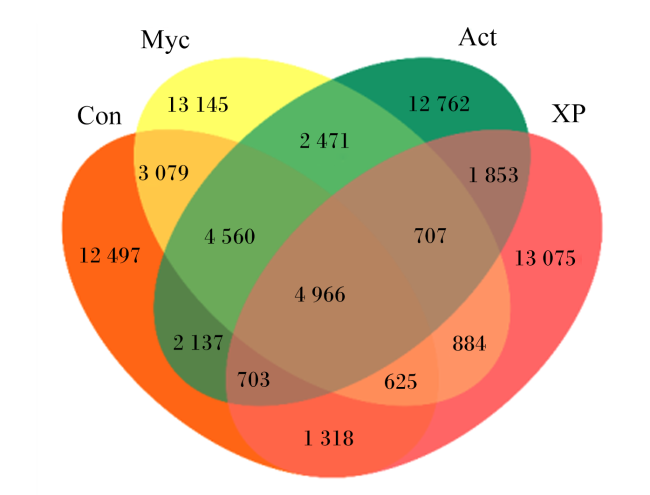
图1可知,对照组、Myc组、Act组和XP组总ASVs数目分别为29 885、30 437、30 159、24 131个,4组共有的ASVs数目为4 966个,分别占各组的16.62%、16.32%、16.47%、20.58%。
图1 瘤胃微生物ASVs数量Venn图

Con: 对照组 control group; Myc: Myc组 Myc group; Act: Act 组Act group; XP: XP 组XP group。

Fig.1 Venn diagram of number of ASVs of rumen microbes

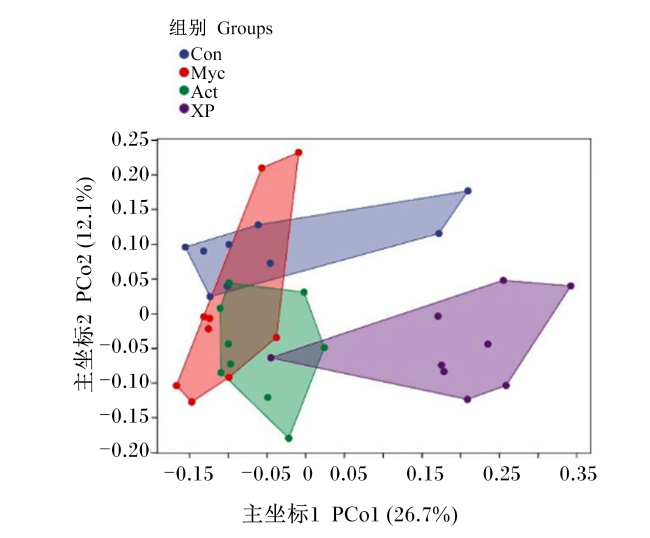
图2所示,主成分分析(PCoA)中主坐标1和主坐标2的贡献率分别为26.7%和12.1%,对照组与Myc组有部分交集,与Act组及XP组分离明显。由表6可知,PERMANOVA分析表明,对照组与Act组及XP组间样本分布差异显著(P<0.05)。
图2 瘤胃微生物PCoA

Fig.2 PCoA of rumen microbes

表6 瘤胃微生物PERMANOVA分析

Table 6 PERMANOVA analyse of rumen microbes

项目
Items
样本大小
Sample size/个
置换次数
Permutations/次
F
Pseudo-F-value
P
P-value
q
q-value
对照组和Myc组Control group vs. Myc group 18 999 3.922 0.086 0.096
对照组和Act组Control group vs. Ac group 18 999 1.493 0.001 0.002
对照组和XP组Control group vs. XP group 18 999 3.568 0.001 0.002

2.3.3 不同酵母培养物对瘤胃微生物群落组成的影响

表7所示,各组共有的优势菌门依次为拟杆菌门、厚壁菌门、变形菌门、螺旋体菌门、圣诞岛菌门及纤维杆菌门等。各组间拟杆菌门相对丰度无显著差别(P>0.05);与对照组相比,添加XP显著增加了厚壁菌门的相对丰度(P<0.05),显著降低了变形菌门的相对丰度(P<0.05);Act组螺旋体菌门相对丰度较对照组显著升高(P<0.05),其余2组较对照组无显著差异(P>0.05);与对照组相比,其余3组圣诞岛菌门的相对丰度均显著下降(P<0.05);对照组纤维杆菌门相对丰度显著低于Myc组和Act组(P<0.05);Act组与XP组支原体菌门相对丰度均显著高于对照组(P<0.05);XP组放线菌门的相对丰度最高,且显著高于对照组(P<0.05)。
表7 不同酵母培养物对奶牛瘤胃优势菌群门水平相对丰度的影响(前10位)

Table 7 Effects of different yeast cultures on relative abundance of dominant rumen bacteria at phylum level of dairy cows (top 10) %

项目
Items
对照组
Control group
Myc组
Myc group
Act组
Act group
XP组
XP group
SE P
P-value
拟杆菌门Bacteroidota 49.26 48.97 50.50 48.15 0.01 0.43
厚壁菌门Bacillota 33.30b 31.42b 31.35b 40.19a 0.01 <0.01
变形菌门Pseudomonadota 7.00a 7.43a 6.73a 4.26b 0.00 <0.01
螺旋体菌门Spirochaetota 3.35b 4.62ab 4.42a 3.05b 0.00 0.01
圣诞岛菌门Kiritimatiellota 3.97a 2.88b 1.96bc 1.20c 0.00 <0.01
纤维杆菌门Fibrobacterota 1.44b 2.85a 3.19a 1.17b 0.00 <0.01
支原体菌门Mycoplasmatota 0.45b 0.55ab 0.61a 0.67a 0.00 0.02
髌骨细菌门Patescibacteria 0.44 0.43 0.44 0.43 0.00 0.99
放线菌门Actinobacteriota 0.23b 0.28ab 0.28ab 0.37a 0.00 0.02
黏胶球形菌门Lentisphaerota 0.23 0.25 0.19 0.18 0.00 0.11
表8为各组瘤胃微生物属水平上相对丰度>1%的前10位优势菌属相对丰度,反映属水平下各组间瘤胃微生物群落分布。各组瘤胃微生物相对丰度占比最大的是普雷沃氏菌属1;与对照组相比,XP的添加显著降低了F082、琥珀酸弧菌属的相对丰度(P<0.05),显著增加了瘤胃球菌科NK4A214群的相对丰度(P<0.05);Act组和XP组理研菌科RC9肠道群及WCHB1-41相对丰度显著低于对照组(P<0.05),克里斯滕森菌科R-7群相对丰度显著高于对照组(P<0.05);Act组密螺旋体属2相对丰度显著高于对照组(P<0.05),其余3组相对丰度差异不显著(P>0.05);Myc组和Act组纤维杆菌属相对丰度较对照组和XP组显著升高(P<0.05)。
表8 不同酵母培养物对奶牛瘤胃优势菌群属水平相对丰度的影响(前10位)

Table 8 Effects of different yeast cultures on relative abundance of dominant rumen bacteria at genus level of dairy cows (top 10) %

项目
Items
对照组
Control group
Myc组
Myc group
Act组
Act group
XP组
XP group
SE P
P-value
普雷沃菌属1 Prevotella_1 26.01 27.31 29.18 25.42 0.01 0.14
F082 9.18a 8.96a 9.05a 7.67b 0.00 0.02
解琥珀酸菌属Succiniclasticum 8.88 8.04 7.49 7.06 0.00 0.07
理研菌科RC9肠道群
Rikenellaceae_RC9_gut_group
7.16a 6.51ab 5.7bc 5.57c 0.00 <0.01
密螺旋体属2 Treponema_2 3.10b 4.28ab 4.13a 2.89b 0.03 0.01
琥珀酸弧菌属Succinivibrio 3.59a 3.59a 3.78a 2.40b 0.00 <0.01
瘤胃球菌科NK4A214群
Ruminococcaceae_NK4A214_group
2.27b 1.87b 2.20b 3.72a 0.00 <0.01
克里斯滕森菌科R-7群
Christensenellaceae_R-7_group
1.98c 2.21bc 2.41b 3.11a 0.00 <0.01
WCHB1-41 3.97a 2.88ab 1.96bc 1.20c 0.00 <0.01
纤维杆菌属Fibrobacter 1.44b 2.85a 3.19a 1.17b 0.02 <0.01

3 讨论

3.1 不同酵母培养物对奶牛体外瘤胃发酵48 h GP及甲烷排放量的影响

瘤胃GP在一定程度上可反映奶牛瘤胃对摄入物质的发酵程度。本研究在体外试验条件下发现,与对照组相比,添加Act和XP对48 h GP无显著影响,添加主要功能成分为酯化葡甘露聚糖的Myc酵母培养物48 h GP显著下降,表明酯化葡甘露聚糖可能对微生物发酵产气过程具有抑制作用。
瘤胃产生甲烷最主要的途径为氢气还原二氧化碳途径[29],本试验中观察到Act组的二氧化碳排放量及氢气排放量与对照组相比显著下降。因此,推测瘤胃产甲烷菌可以利用的氢含量降低,进而导致甲烷排放量下降。张然等[30]对绵羊的体外研究中发现,随着甘露寡糖添加量的增加,甲烷排放量也随之降低。Zheng等[31]在绵羊的体外研究发现,添加甘露寡糖有降低每单位代谢体重甲烷排放量的趋势,本试验中Act组甲烷排放量与对照组相比显著下降,XP组有降低的趋势但差异不显著。综上表明,从酿酒酵母细胞壁中提取的甘露寡糖可以降低奶牛瘤胃甲烷的排放量,同时,酵母培养物XP可能具有降低甲烷排放的趋势。

3.2 不同酵母培养物对奶牛体外瘤胃发酵参数的影响

瘤胃pH是反映瘤胃内环境稳定性的一个重要指标,并且可以直接影响反刍动物的健康及微生物的生长和繁殖。本试验各组瘤胃液pH差异不显著,且均在6.30~6.40,属于正常范围[32],说明3种受试酵母培养物都可保证正常瘤胃内pH。瘤胃氨态氮是瘤胃代谢蛋白质生成的中间产物,其含量反映了瘤胃微生物对蛋白质利用及分解的速率。张然等[30]在绵羊饲粮中添加甘露寡糖,结果发现发酵液中总氮、氨态氮等含量均没有显著变化。本试验中,Act的添加显著降低了瘤胃内氨态氮含量,可能是添加Act促进了微生物对瘤胃氨态氮的利用[33],具体机制有待于进一步研究。
瘤胃VFA为反刍动物提供了约70%的能量,VFA含量高低不仅反映了瘤胃对养分消化吸收水平的强弱,也会对瘤胃微生物菌群结构产生影响。瘤胃微生物将饲粮中的纤维素等消化分解成VFA、二氧化碳和氢气,在此过程中氢气将二氧化碳还原生成甲烷,同时部分乙酸会被微生物分解为二氧化碳和氢气,继续生成甲烷[29]。此外,瘤胃内丙酮酸与H+竞争电子,抑制氢气的产生从而导致更少的甲烷生成和更多的丙酸生成[5]。因此,丙酸的生成增加和乙酸含量降低可能会导致更少的甲烷生成。相比于对照组,Act显著降低了瘤胃液中乙酸、丁酸、戊酸及总酸的含量。Miller-Webster等[20]的研究中观察到添加XP增加瘤胃丙酸盐的比例的同时,乙酸盐的比例也有所下降。本试验中,XP促进了丁酸产生,但乙酸和丙酸含量未观察到显著差异。总的来说,Act改变了瘤胃发酵模式,降低了乙酸含量,减少了可利用氢浓度进而抑制了甲烷生成。

3.3 不同酵母培养物对奶牛体外瘤胃微生物区系的影响

奶牛瘤胃对养分的消化效率和发酵模式由瘤胃微生物结构决定,瘤胃微生物的构成及活性很大程度上决定了宿主的生产效率及健康程度。本试验中,各组覆盖率均达到96%,结果可以反映瘤胃微生物的真实情况。各组Shannon指数及Simpson指数无显著差异,表明添加酵母培养物对奶牛瘤胃微生物多样性没有显著影响,与对照组相比未出现差异较大的优势菌。XP组的Chao1指数与对照组相比显著下降,表明添加XP降低了瘤胃微生物物种丰富度。
在门水平上,各组优势菌门均为拟杆菌门、厚壁菌门和变形菌门,与前人的研究结果[34]相似。拟杆菌门参与饲粮非纤维碳水化合物的降解产生乙酸、丙酸等VFA,但本试验中观察到,各组间拟杆菌门的相对丰度均无显著差异。Li等[35]对湘西肉牛的饲养试验中发现,拟杆菌门和纤维杆菌门在饲喂高纤维饲粮的牛瘤胃中显著富集,而变形菌门和螺旋体菌门在饲喂高淀粉的牛瘤胃中显著富集,说明螺旋体菌门是利用淀粉的优势菌门。高纤维饲粮往往会导致更多的乙酸生成,而高淀粉饲粮往往会导致瘤胃更多的丙酸产生,Act添加可以提高瘤胃中螺旋体菌门的相对丰度,推动奶牛瘤胃发酵模式向丙酸发酵型转变,降低乙酸的产生,进而减少甲烷生成。
在属水平上,各组优势菌属为普雷沃氏菌属1、F082、解琥珀酸菌属及理研菌科RC9肠道群。普雷沃氏菌属1在所有菌属中相对丰度最高,约占总微生物的25%,各组中普雷沃氏菌属1相对丰度差异不显著。与对照组相比,添加Act显著降低了理研菌科RC9肠道群及WCHB1-41的相对丰度。理研菌科RC9肠道群属于拟杆菌门,可消化可溶性糖和不溶性纤维素[36],生成乙酸等VFA。WCHB1-41属于圣诞岛菌门,有研究表明,圣诞岛菌门的Kiritimatiella glycovorans L21-Fru-ABT能将木糖发酵成乙醇和醋酸盐,但不能利用淀粉、蔗糖或果糖。同时,Act组密螺旋体属2的相对丰度显著高于对照组,该菌属为螺旋体菌门,在Li等[35]饲喂高淀粉饲粮的肉牛瘤胃中被显著富集。琥珀酸弧菌属是主要的琥珀酸产生菌,可以降解多糖,生成乙酸、琥珀酸和少量的甲酸。大部分丙酸经由琥珀酸途径合成[37],相较于对照组,XP组琥珀酸弧菌属相对丰度显著降低,可能解释本试验中观察到的XP组瘤胃丙酸含量的下降。克里斯滕森菌主要参与肠道菌群调节,与宿主免疫调节和体内健康稳态有关[38],在反刍动物上可以促进瘤胃发育,增加对养分的消化和吸收[39-40],与对照组相比,添加Act和XP增加了克里斯滕森菌科R-7群的相对丰度,促进了有益菌增殖。刘绘汇[41]在饲粮中添加甘露寡糖,发现湖羊结肠内产甲烷菌种的广古菌门和甲烷短杆菌属相对丰度显著降低,本试验中也观察到了添加主要功能成分为甘露寡糖的Act可以使甲烷排放量显著下降,表明甘露寡糖可能具有降低反刍动物甲烷排放的作用。综上所述,推测Act可以通过调节理研菌科RC9肠道群、WCHB1-41、密螺旋体属2、克里斯滕森菌科R-7群等不同菌群相对丰度来调控VFA的生成,通过降低乙酸产生提高丙酸含量,减少甲烷菌可利用氢来抑制甲烷产生。

4 结论

① Act可以显著降低体外瘤胃甲烷排放量,XP有降低甲烷排放趋势,而Myc对奶牛甲烷排放无显著影响。
② Act降低了瘤胃液乙酸等VFA及氨态氮的含量,同时增加了螺旋体菌门等促进丙酸生成菌群的相对丰度,降低了理研菌科RC9肠道群等促进乙酸产生的菌群的相对丰度。
③ Act可能通过调节瘤胃菌群丰度,推动瘤胃发酵模式向丙酸发酵模式的转变,促进对瘤胃内氮的利用,提高对养分的吸收效率,进而抑制甲烷排放。
[1]
OSOFSKY S A. Livestock’s long shadow:environmental issues and options:a workshop[M]. Washington,D.C.: FAO, 2007.

[2]
Intergovernmental Panel on Climate Change (IPCC). Anthropogenic and natural radiative forcing[M]// Intergovernmental Panel on Climate Change (IPCC).Climate Change 2013—The Physical Science Basis: Working Group I Contribution to the Fifth Assessment Report of the Intergovernmental Panel on Climate Change. Cambridge: Cambridge University Press, 2014:659-740.

[3]
SCHWIETZKE S, SHERWOOD O A, BRUHWILER L M P, et al. Upward revision of global fossil fuel methane emissions based on isotope database[J]. Nature, 2016, 538(7623):88-91.

[4]
JOHNSON K A, JOHNSON D E. Methane emissions from cattle[J]. Journal of Animal Science, 1995, 73(8):2483-2492.

DOI PMID

[5]
JANSSEN P H. Influence of hydrogen on rumen methane formation and fermentation balances through microbial growth kinetics and fermentation thermodynamics[J]. Animal Feed Science and Technology, 2010, 160(1/2):1-22.

[6]
AGUERRE M J, WATTIAUX M A, POWELL J M, et al. Effect of forage-to-concentrate ratio in dairy cow diets on emission of methane,carbon dioxide,and ammonia,lactation performance,and manure excretion[J]. Journal of Dairy Science, 2011, 94(6):3081-3093.

[7]
ARNDT C, HRISTOV A N, PRICE W J, et al. Full adoption of the most effective strategies to mitigate methane emissions by ruminants can help meet the 1.5 ℃ target by 2030 but not 2050[J]. Proceedings of the National Academy of Sciences of the United States of America, 2022, 119(20):e2111294119.

[8]
MANZANILLA-PECH C I V, L VENDAHL P, MANSAN GORDO D, et al. Breeding for reduced methane emission and feed-efficient Holstein cows:an international response[J]. Journal of Dairy Science, 2021, 104(8):8983-9001.

[9]
SCHINGOETHE D J, LINKE K N, KALSCHEUR K F, et al. Feed efficiency of mid-lactation dairy cows fed yeast culture during summer[J]. Journal of Dairy Science, 2004, 87(12):4178-4181.

PMID

[10]
CARPINELLI N A, HALFEN J, TREVISI E, et al. Effects of peripartal yeast culture supplementation on lactation performance,blood biomarkers,rumen fermentation,and rumen bacteria species in dairy cows[J]. Journal of Dairy Science, 2021, 104(10):10727-10743.

[11]
CHAUCHEYRAS F, FONTY G, BERTIN G, et al. In vitro H2 utilization by a ruminal acetogenic bacterium cultivated a lone or in association with an archaea methanogen is stimulated by a probiotic strain of Saccharomyces cerevisiae[J]. Applied and Environmental Microbiology, 1995, 61(9):3466-3467.

[12]
DIAZ D E, HAGLER W M,Jr, BLACKWELDER J T, et al. Aflatoxin binders Ⅱ:reduction of aflatoxin M1 in milk by sequestering agents of cows consuming aflatoxin in feed[J]. Mycopathologia, 2004, 157(2):233-241.

[13]
张克春, 徐国忠, 范占炼, 等. 霉可吸对奶牛产奶量、乳成分和体细胞数的影响[J]. 中国奶牛, 2010(5):15-16.

ZHANG K C, XU G Z, FAN Z L, et al. Effect of mycosorb on milk yield,milk composition and somatic cell count in dairy cows[J]. China Dairy Cattle, 2010(5):15-16. (in Chinese)

[14]
HEINRICHS A J, JONES C M, HEINRICHS B S. Effects of mannan oligosaccharide or antibiotics in neonatal diets on health and growth of dairy calves[J]. Journal of Dairy Science, 2003, 86(12):4064-4069.

PMID

[15]
GHOSH S, MEHLA R K. Influence of dietary supplementation of prebiotics (mannanoligosaccharide) on the performance of crossbred calves[J]. Tropical Animal Health and Production, 2012, 44(3):617-622.

DOI PMID

[16]
RAJANI J, DASTAR B, SAMADI F, et al. Effect of extracted galactoglucomannan oligosaccharides from pine wood (Pinus brutia) on Salmonella typhimurium colonisation,growth performance and intestinal morphology in broiler chicks[J]. British Poultry Science, 2016, 57(5):682-692.

[17]
金亚东, 张力莉, 陈绍淑, 等. 甘露寡糖添加方式对哺乳期犊牛生长性能、粪便菌群及血清免疫指标的影响[J]. 中国畜牧兽医, 2016, 43(11):2922-2930.

DOI

JIN Y D, ZHANG L L, CHEN S S, et al. Effect of different addition schemes of mannan oligosaccharide on growth performance,fecal microorganism and serum immune indexes of calves[J]. China Animal Husbandry & Veterinary Medicine, 2016, 43(11):2922-2930. (in Chinese)

[18]
张继忠. 甘露寡糖和复合酸化剂组合使用对八眉猪生长性能的影响[J]. 养猪, 2015(3):43-44.

ZHANG J Z. Effect of the combination of mannan-oligosaccharides and complex acidifiers on the growth performance of eight-browed pigs[J]. Swine Production, 2015(3):43-44. (in Chinese)

[19]
ZAWORSKI E M, SHRIVER-MUNSCH C M, FADDEN N A, et al. Effects of feeding various dosages of Saccharomyces cerevisiae fermentation product in transition dairy cows[J]. Journal of Dairy Science, 2014, 97(5):3081-3098.

[20]
MILLER-WEBSTER T, HOOVER W H, HOLT M, et al. Influence of yeast culture on ruminal microbial metabolism in continuous culture[J]. Journal of Dairy Science, 2002, 85(8):2009-2014.

[21]
ZHU W, WEI Z H, XU N N, et al. Effects of Saccharomyces cerevisiae fermentation products on performance and rumen fermentation and microbiota in dairy cows fed a diet containing low quality forage[J]. Journal of Animal Science and Biotechnology, 2017, 8:36.

[22]
沈英, 宋正河, 杨红建, 等. 基于虚拟仪器技术的饲料体外发酵产气自动记录系统的研制[J]. 农业工程学报, 2006(12):159-163.

SHEN Y, SONG Z H, YANG H J, et al. Research and development of automated gas recording system for in vitro fermentation based on virtual instrumentation[J]. Transactions of the Chinese Society of Agricultural Engineering, 2006(12):159-163. (in Chinese)

[23]
MENKE K H, STEINGASS H. Estimation of the energetic feed value obtained from chemical analysis and in vitro gas production using rumen fluid[J]. Animal Research & Development, 1988, 28:7-55.

[24]
VAN SOEST P J, ROBERTSON J B, LEWIS B A. Methods for dietary fiber,neutral detergent fiber,and nonstarch polysaccharides in relation to animal nutrition[J]. Journal of Dairy Science, 1991, 74(10):3583-3597.

[25]
张丽英. 饲料分析及饲料质量检测技术[M]. 3版. 北京: 中国农业大学出版社, 2007.

ZHANG L Y. Feed analysis and quality test technology[M]. 3rd ed. Beijing: China Agricultural University Press, 2003. (in Chinese)

[26]
HAO Y Y, HUANG S, LIU G K, et al. Effects of different parts on the chemical composition,silage fermentation profile,in vitro and in situ digestibility of paper mulberry[J]. Animals:an Open Access Journal from MDPI, 2021, 11(2):413.

[27]
ERWIN E S, MARCO G J, EMERY E M. Volatile fatty acid analyses of blood and rumen fluid by gas chromatography[J]. Journal of Dairy Science, 1961, 44(9):1768-1771.

[28]
BENJAMINI Y, HOCHBERG Y. Controlling the false discovery rate:a practical and powerful approach to multiple testing[J]. Journal of the Royal Statistical Society:Series B (Methodological), 1995, 57(1):289-300.

[29]
周怿, 刁其玉. 反刍动物瘤胃甲烷气体生成的调控[J]. 草食家畜, 2008(4):21-24.

ZHOU Y, DIAO Q Y. Manipulation for the methane production in rumen[J]. Grass-Feeding Livestock, 2008(4):21-24. (in Chinese)

[30]
张然, 郑琛, 韩海珠, 等. 应用Rusitec-S系统研究甘露寡糖对绵羊体外瘤胃发酵的影响[J]. 草业科学, 2018, 35(9):2262-2269.

ZHANG R, ZHENG C, HAN H Z, et al. Effect of mannan oligosaccharides on ruminal fermentation of sheep in an in vitro Rusitec-S system[J]. Pratacultural Science, 2018, 35(9):2262-2269. (in Chinese)

[31]
ZHENG C, MA J J, LIU T, et al. Effects of mannan oligosaccharides on gas emission,protein and energy utilization,and fasting metabolism in sheep[J]. Animals, 2019, 9(10):741.

[32]
杨梓曼, 尚相龙, 陈豪, 等. 热应激对肉牛血清生化指标、瘤胃发酵参数及微生物区系的影响[J]. 动物营养学报, 2022, 34(7):4487-4497.

DOI

YANG Z M, SHANG X L, CHEN H, et al. Effects of heat stress on serum biochemical indexes,rumen fermentation parameters and microflora of beef cattle[J]. Chinese Journal of Animal Nutrition, 2022, 34(7):4487-4497. (in Chinese)

[33]
戈婷婷. 不同组合的功能性寡糖对锦江黄牛瘤胃体外发酵的影响[D]. 硕士学位论文. 南昌: 江西农业大学, 2011.

GE T T. Effects of different functional oligosaccharides proportion on the rumen fermentation of Jinjiang cattle in vitro[D]. Master’s Thesis. Nanchang: Jiangxi Agricultural University, 2011. (in Chinese)

[34]
KIM M, MORRISON M, YU Z T. Status of the phylogenetic diversity census of ruminal microbiomes[J]. FEMS Microbiology Ecology, 2011, 76(1):49-63.

DOI PMID

[35]
LI Q S, WANG R, MA Z Y, et al. Dietary selection of metabolically distinct microorganisms drives hydrogen metabolism in ruminants[J]. The ISME Journal, 2022, 16(11):2535-2546.

[36]
ZHU Y X, WANG Z S, HU R, et al. Comparative study of the bacterial communities throughout the gastrointestinal tract in two beef cattle breeds[J]. Applied Microbiology and Biotechnology, 2021, 105(1):313-325.

DOI PMID

[37]
MITSUMORI M, SUN W B. Control of rumen microbial fermentation for mitigating methane emissions from the rumen[J]. Asian-Australasian Journal of Animal Sciences, 2008, 21(1):144-154.

[38]
WATERS J L, LEY R E. The human gut bacteria Christensenellaceae are widespread,heritable,and associated with health[J]. BMC Biology, 2019, 17(1):83.

[39]
HUANG C, GE F, YAO X X, et al. Microbiome and metabolomics reveal the effects of different feeding systems on the growth and ruminal development of yaks[J]. Frontiers in Microbiology, 2021, 12:682989.

[40]
COUCH C E, ARNOLD H K, CROWHURST R S, et al. Bighorn sheep gut microbiomes associate with genetic and spatial structure across a metapopulation[J]. Scientific Reports, 2020, 10(1):6582.

DOI PMID

[41]
刘绘汇. 饲粮中添加甘露寡糖对湖羊生长和屠宰性能、胃肠道组织形态及微生物区系的影响[D]. 硕士学位论文. 兰州: 甘肃农业大学, 2021.

LIU H H. Effects of adding mannan oligosaccharide on growth and slaughter performance,gastrointestinal histological morphology and microflora of Hu sheep[D]. Master’s Thesis. Lanzhou: Gansu Agricultural University, 2021. (in Chinese)

文章导航

/