综述

植物精油调控畜禽肠道免疫稳态的作用及其机制

  • 于文静 ,
  • 贾慧鑫 ,
  • 王凯 ,
  • 李艳玲 , *
展开
  • 北京农学院动物科学技术学院,北京 102206
*李艳玲,教授,硕士生导师,E-mail:

于文静(2000—),女,山东烟台人,硕士研究生,从事反刍动物营养研究。E-mail:

Copy editor: 武海龙

收稿日期: 2024-08-22

  网络出版日期: 2025-03-13

基金资助

北京市自然科学基金(6222006)

Effects and Mechanisms of Plant Essential Oils on Intestinal Immune Homeostasis in Livestock and Poultry

  • YU Wenjing ,
  • JIA Huixin ,
  • WANG Kai ,
  • LI Yanling , *
Expand
  • College of Animal Science and Technology, Beijing University of Agriculture, Beijing 102206, China
*professor, E-mail:

Received date: 2024-08-22

  Online published: 2025-03-13

摘要

肠道内免疫稳态对畜禽的健康生长起重要作用。植物精油作为潜在的抗生素替代品,在调节畜禽肠道免疫稳态上发挥着良好效果。它可以通过调节肠道菌群来改变肠上皮Toll样受体表达以及维持机体辅助性T细胞17/调节性T细胞免疫平衡,促进肠道健康;另外,植物精油还可以通过改变肠道微生物代谢物,如短链脂肪酸、胆汁酸、色氨酸衍生物等,进一步改善肠道免疫功能,提高畜禽健康水平,促进畜禽健康生长。本文综述了植物精油的抗菌活性及其通过调控肠道微生物及其代谢物从而改善畜禽肠道免疫稳态的作用及其潜在机制,为植物精油在畜禽生产上的应用提供理论基础。

本文引用格式

于文静 , 贾慧鑫 , 王凯 , 李艳玲 . 植物精油调控畜禽肠道免疫稳态的作用及其机制[J]. 动物营养学报, 2025 , 37(3) : 1448 -1457 . DOI: 10.12418/CJAN2025.124

Abstract

Intestinal immune homeostasis plays an important role in the healthy growth of livestock and poultry. As a potential antibiotic substitute, plant essential oils play a good role in regulating intestinal immunity of livestock and poultry. It can change the expression of Toll-like receptors in intestinal epithelium by regulating intestinal flora and maintain the balance of T helper cell 17/regulatory T cells immune balance to promote intestinal health. In addition, plant essential oils can also change intestinal microbial metabolites, such as short-chain fatty acids, bile acids and tryptophan derivatives, further improve intestinal immune function, improve the health level of livestock and poultry, and promote the healthy growth of livestock and poultry. In this paper, the antibacterial activity of plant essential oil and its potential mechanism to improve the intestinal immune function of livestock and poultry by regulating intestinal microorganisms and metabolites were reviewed, providing a theoretical basis for the application of plant essential oil in livestock and poultry production.

肠道作为机体最大的“免疫器官”,在维持畜禽机体健康过程中发挥着重要作用。其中,肠道微生物可影响肠道免疫稳态,对维持肠道健康意义重大。肠道微生物能调控机体免疫系统,如刺激免疫球蛋白的分泌以及CD4+ T细胞的成熟和分化,维持肠道健康[1]。另外,肠道微生物还可以产生多种代谢物,如短链脂肪酸(short chain fatty acids,SCFAs)、胆汁酸(bile acids,BAs)、色氨酸衍生物等,调节各种免疫反应和能量代谢。然而,肠道菌群及其代谢紊乱会影响畜禽肠道健康,甚至引起畜禽肠道疾病,极大地影响畜禽的生长发育,严重时可能会导致死亡。
植物精油(essential oil,EOs)是从植物的根、茎、叶、花、果实中提取的一种具有挥发性的芳香物质,可通过蒸汽蒸馏、挤压、冷浸或溶剂提取的方法进行提取,具有抗菌[2]、抗炎、抗氧化、免疫调节[3]等多种生物活性,被认为是抗生素的潜在替代物之一。近些年来,相关研究证明植物精油可调节肠道微生物及其代谢物,对肠道免疫功能具有积极的作用,可用于调控畜禽肠道菌群稳态,调节肠道免疫机能。本文着重阐述了植物精油通过调控畜禽肠道微生物及其代谢物影响肠道免疫稳态的作用及其机制,以期为应用植物精油在畜禽生产上维持肠道健康、预防肠道疾病提供理论基础。

1 植物精油的抗菌活性

植物精油发挥抑菌作用时,可对细菌造成一系列损伤,包括细胞膜损伤和内容物泄漏、氧化还原稳态破坏、DNA拓扑变化和RNA生物合成、呼吸代谢抑制等[4-6]。植物精油能诱导细菌形态发生改变,破坏细菌生物膜,增加生物膜通透性,并引起膜的膨胀和不稳定性[7-8],使细菌中各种细胞成分的释放显著增加。植物精油还能破坏细菌内的线粒体膜,受影响的线粒体会产生活性氧(reactive oxygen species,ROS),触发氧化反应,损害脂质、蛋白质和DNA,阻碍细菌的生长和发育。而机体内的线粒体为细胞生命活动提供基本能量,与呼吸代谢密切相关。植物精油也可以通过抑制细菌的呼吸代谢途径发挥抑菌作用[9]。此外,植物精油中的某些成分可以与细菌DNA嵌合,破坏细菌的DNA结构[4,10],导致细菌死亡。
机体肠道微生态主要由细菌构成,在正常情况下,肠道内细菌处于一个稳定的平衡状态,若这种状态失衡,如致病菌丰度增加,则会导致肠道微生物区系紊乱,进而引发肠道炎症。目前,通过体内和体外试验已证实植物精油对多种致病性微生物表现出显著的抗菌活性,可抑制大肠杆菌、沙门氏菌等肠道致病菌的生长。植物精油也作为抗菌剂被广泛应用于畜禽肠道微生物的调节。由此可见,植物精油可通过发挥其抗菌活性,有效调控肠道微生物区系。

2 植物精油对动物机体肠道微生物的调节作用

2.1 对畜禽肠道微生物区系的调节作用

肠道微生物参与多种生理活性过程,对肠道微生物区系的调控,有助于畜禽肠道健康发育。已有研究表明,大部分植物精油对有害菌的抑制作用远大于其对有益菌的抑制作用,如柠檬精油在抑制有害菌大肠杆菌生长的同时,对有益菌乳杆菌的抑制作用则微乎其微[11-12]。在仔猪上,植物精油能有效调节仔猪的肠道微生物群,如添加百里香酚、丁香酚和香芹酚等植物精油混合物可增加肠道中有益菌普拉梭菌属(Faecalibacterium)的丰度,使有害菌理研菌科RC9肠道群(Rikenellaceae_RC9_gut_group)的丰度降低[13]。饲粮中添加牛至精油可增加肉鸡肠道中厌氧细杆菌属(Anaerofilum)、Fournierella、梭杆菌属(Fusobacterium)和萨特氏菌属(Sutterella)的丰度[14]。Ge等[15]研究表明,含有香芹酚、肉桂醛和辣椒油的复合精油改善了番鸭盲肠微生物的多样性和组成,增加了SCFAs产生菌[罕见小球菌属(Subdoligranulum)和沙特尔沃思氏菌属(Shuttleworthia)]的丰度,降低了潜在肠道致病菌[另枝菌属(Alistipes)、艾森伯格氏菌属(Eisenbergiella)和欧陆森氏菌属(Olsenella)]的丰度。在反刍动物上,植物精油可改善机体肠道菌群结构,添加牛至精油能提高育肥公牛肠道中拟杆菌属(Bacteroides)、粪芽孢菌属(Coprobacillus)、毛螺菌科UCG_001(Lachnospiraceae_UCG_001)等的丰度,从而促进肠道内环境稳态,增强肠道屏障功能[16]

2.2 对畜禽肠道微生物代谢物的调节作用

植物精油还能通过调控肠道微生物组成,进一步调控肠道微生物代谢物的分泌。肠道菌群产生的活性代谢物能维持肠道内稳态,并进一步对宿主健康产生影响[17-18]。肠道菌群主要的代谢物包括SCFAs、BAs和氨基酸代谢产物,如吲哚衍生物等。此外,植物精油也能通过其他肠道微生物代谢物发挥免疫调控作用,但因其研究尚少,本文将重点以SCFAs、BAs以及色氨酸衍生物为主展开阐述。
SCFAs是由肠道细菌代谢产生的不可消化碳水化合物(non-digestible carbohydrates,NDC)的主要终产物[19]。Niu等[20]研究证明,饲粮中添加由肉桂醛、百里香酚、香兰素组成的精油提高了断奶仔猪粪便中丙酸(propionic acid)和异戊酸(isovaleric acid)的含量。饲粮中添加牛至精油可以显著增加蛋鸡盲肠中乙酸、丙酸、丁酸、戊酸的含量,改善肠道环境[21]。饲粮中添加罗勒、香菜和月桂等8种精油的复合精油可提高肉鸡肠道内异丁酸、2-甲基丁酸和3-甲基丁酸等SCFAs的含量[22]
BAs是胆汁的主要成分,由肝细胞中的胆固醇合成,储存在胆囊中,可释放到肠道中,由肠道微生物进一步代谢[23]。苍术挥发油能通过调节BAs的代谢,改变机体肠道内的BAs代谢谱[24]。含有肉桂醛和丁香酚等成分的植物精油能显著改变初级BAs生物合成和苯丙氨酸代谢等代谢途径,改变盲肠微生物区系中代谢物的产生[17]
氨基酸在改善宿主肠道微生物区系和代谢方面起着关键作用。肠道菌群可通过代谢蛋白质产生氨基酸,从而对畜禽肠道健康产生积极影响。色氨酸代谢有吲哚、血清素和犬尿氨酸(kynurenine,Kyn)3种代谢途径[25],在肠道中起着不可忽略的作用。研究表明,花椒精油能改变羔羊瘤胃中蛋白质的消化吸收,调控肠道微生物并进一步调节色氨酸代谢[26]。Ge等[27]的研究也证明,由香薰醇、肉桂醛和辣椒油树脂组成的植物精油能通过改善公鸭肠道菌群组成,进而干扰色氨酸代谢。

3 植物精油对畜禽肠道免疫稳态的调控及其作用机制

3.1 通过调节肠道微生物及其代谢物调控畜禽肠道免疫稳态

肠道免疫系统体现了肠道黏膜屏障、宿主免疫细胞和肠道微生物群之间的复杂相互作用[28]。植物精油可通过调控肠道微生物群维持机体肠道免疫稳态。已有研究表明,普雷沃氏菌可通过上皮细胞间接刺激白细胞介素-1(IL-1)、白细胞介素-6(IL-6)、白细胞介素-8(IL-8)、白细胞介素-23(IL-23)等细胞因子的产生,促进免疫应答[29]。添加肉桂精油能改善仔鸡盲肠微生物组成,提高仔鸡血清中免疫球蛋白M(IgM)的含量,提高仔鸡的免疫功能[30]。Li等[31]研究表明,饲粮中添加肉桂醛和百里香酚的复合精油可调节微生物多样性,降低仔猪腹泻发生率,增加血清白蛋白、免疫球蛋白A(IgA)和免疫球蛋白G(IgG)含量,改善断奶仔猪的免疫功能。此外,Su等[32]研究也表明,饲粮中添加含有百里香酚、香芹酚、肉桂醛的精油能显著提高肠道内免疫球蛋白如分泌型免疫球蛋白A(secretory immunoglobulin A,SIgA)、IgG含量,增强肉鸡肠道免疫力。饲粮中添加牛至精油可通过改变微生物组成,改善蛋鸡肠上皮屏障功能,调节黏膜免疫状态[33]
肠道微生物的代谢产物也是影响肠道免疫的关键因素。Jia等[34]研究发现,饲粮中添加牛至精油促进了瘤胃球菌、双歧杆菌和肠球菌的富集,这些菌的富集显著提高了代谢物吲哚-3-乙酸和吲哚乙醛的含量,增加绵羊血清中IgA和IgG含量的同时,降低白细胞介素-2(IL-2)和肿瘤坏死因子-β(tumor necrosis factor-β,TNF-β)的含量,改善了机体肠道炎症反应,增强肠屏障功能。Zhang等[26]研究表明,花椒精油能改变肠道菌群组成,增强羔羊体内脂质转运及其代谢相关功能,调控色氨酸衍生物犬尿氨酸的含量,进而促进T细胞亚群向调节性T细胞(regulatory T cells,Treg细胞)分化,从而增强羔羊免疫功能。以上研究表明,植物精油调节畜禽肠道免疫可能的作用一方面是通过改变肠道菌群丰度变化,另一方面是参与微生物相关代谢途径,来维持畜禽肠道稳态。

3.2 调控畜禽肠道免疫稳态的作用机制

3.2.1 通过肠道微生物调控畜禽肠道免疫稳态的作用机制

肠道免疫疾病的发生通常与畜禽肠道菌群的紊乱有关。肠道菌群的改变可进一步通过其本身或代谢物(SCFAs、BAs、氨基酸衍生物等)的变化而影响辅助性T细胞17(T helper cell 17,Th17细胞)/Treg细胞的分化以及Toll样受体(Toll-like receptor,TLRs)的识别,在调节肠道免疫中具有重要作用[35-36]
Th17/Treg细胞的分化与CD4+ T细胞直接相关。而CD4+ T细胞是调节免疫的关键靶点,肠道菌群通过调节CD4+ T细胞的成熟和分化维持肠道内稳态[37],在缓解炎症性肠病的发生中起着关键作用[38]。TLRs作为典型模式识别受体的成员,可以介导微生物分子的识别,促进免疫应答,肠道菌群的某些成分和表面蛋白可以通过激活TLRs来调节肠道屏障功能[39],激活免疫相关反应,缓解肠道炎症。
因此,本部分主要在Th17/Treg细胞平衡以及TLRs 2方面探讨植物精油通过调控肠道微生物发挥肠道免疫功能的作用机制。

3.2.1.1 Th17/Treg细胞平衡

机体炎症反应是一种防御危险刺激的机制,不受控制的炎症反应是一系列疾病的主要原因。机体肠道内的微生物群是一个相对复杂的群体,能调节局部和全身免疫功能,对于维持肠道正常健康的生理状态至关重要[39]
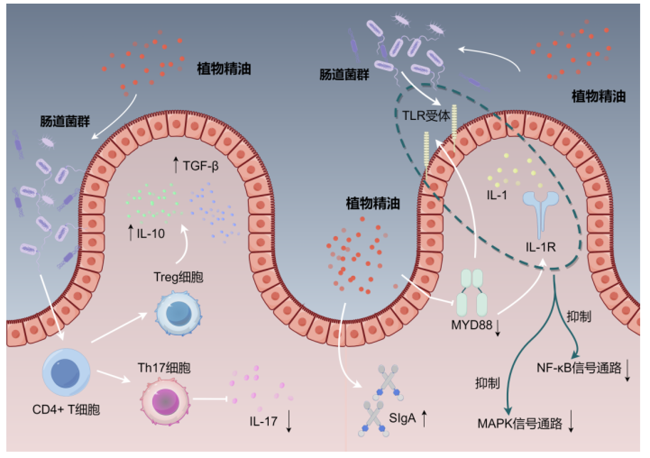
在体外,百里香酚能促进Naïve CD4+CD25-T细胞向CD4+CD25+Foxp3+Treg细胞分化,增加Treg细胞上叉头框P3(Forkhead box P3,Foxp3)基因的表达强度[40]。Th17/Treg细胞的分化来源于原始CD4+ T细胞,CD4+ T细胞在调节自身免疫性中发挥关键作用[41-42]。视黄酸受体相关孤儿受体γt(retinoic acid receptor-associated orphan receptor γt,RORγt)诱导Th17细胞的分化,Foxp3基因则是控制Treg细胞发育和功能的最主要转录因子。目前,对畜禽肠道免疫的研究中并没有直接表明植物精油对肠道内Th17/Treg细胞平衡的影响。Chen等[43]研究表明,白藜芦醇能增加仔猪盲肠中粪杆菌的丰度;而Zhou等[44]研究发现,粪杆菌能调节Th17/Treg细胞平衡来减轻结直肠癌。这证明植物精油除自身调控外还可通过调节肠道菌群影响Th17/Treg细胞的分化平衡。另外,除粪杆菌外,肠道内如幽门螺杆菌属一方面可以调节Toll样受体4(Toll-like receptor 4,TLR4)和Toll样受体5(Toll-like receptor 5,TLR5)的识别,另一方面还可通过诱导Treg细胞以及调节辅助性T细胞1(T helper cell 1,Th1细胞)和Th17细胞的应答来调控获得性免疫应答[45]。Zhong等[46]研究发现,百里香酚可促进原始CD4+CD25-T细胞向CD4+CD25+Foxp3+Treg细胞分化,降低RORγt/Foxp3的比值,调节免疫反应。综上所述,植物精油对肠道免疫的影响可通过调控肠道菌群,降低原始CD4+ T细胞向Th17细胞的分化,进一步减少促炎因子白细胞介素-17(IL-17)的分泌,同时促进原始CD4+ T细胞向Treg细胞分化,使Treg细胞分泌转化生长因子-β(transforming growth factor-β,TGF-β)和抗炎因子白细胞介素-10(IL-10),从而缓解肠道炎症,并重建肠道免疫平衡[18,42](图1)。
图1 植物精油通过肠道微生物调控肠道免疫稳态的作用机制(由Figdraw绘制)

TLRs:Toll样受体 Toll-like receptors;Th17细胞:辅助性T细胞17 T helper cell 17;Treg细胞:调节性T细胞T helper cell 17;IL-17:白细胞介素-17 interleukin-17;IL-10:白细胞介素-10 interleukin-10;TGF-β:转化生长因子-β transforming growth factor-β;SIgA:分泌型免疫球蛋白A secretory immunoglobulin A;MYD88:髓样分化因子88 myeloid differentiation factor 88;IL-1:白细胞介素-1 interleukin-1;IL-1R:白细胞介素-1受体 interleukin-1 receptor;NF-κB:核因子-κB nuclear factor-κB;MAPK:丝裂原活化蛋白激酶 mitogen-activated protein kinase。

Fig.1 Mechanism of plant essential oils regulating intestinal immune homeostasis through gut microbiome (drawn by Figdraw)

3.2.1.2 TLRs-髓样分化因子88(myeloid differentiation factor 88,MYD88)信号通路

TLRs是介导机体炎症反应的重要信号通路,肠道中某些细菌的分子结构鞭毛蛋白、肽聚糖等可通过与肠道表面的TLRs结合[47],激活免疫反应并诱导促炎细胞因子的释放,动物机体内TLR4信号表达的改变和异常的免疫反应能引发肠道炎症[48],并致使肠道菌群紊乱。
肠道菌群与相关TLRs作用有助于维持肠道免疫稳态,植物精油可通过调节肠道菌群组成进而调节TLRs表达。如大肠杆菌、沙门氏菌和志贺氏菌等外膜的脂多糖(lipopolysaccharide,LPS)能与肠道内TLR4结合引发肠道炎症反应。Feng等[33]研究发现,牛至油能下调蛋鸡回肠内TLR4和促炎细胞因子白细胞介素-1β(interleukin-1β,IL-1β)、肿瘤坏死因子-α(tumor necrosis factor-α,TNF-α)、干扰素-γ(interferon-γ,IFN-γ)mRNA的表达,这可能与植物精油的抑菌和对肠道微生物区系的调控作用有关。此外,饲粮中添加牛至油可提高雏鸡回肠SIgA和血浆中IgG的含量,降低MYD88 mRNA的表达[49]。其中,MYD88可介导多种TLRs的信号传递,通过蛋白-蛋白相互作用,将TLR家族与白细胞介素-1R相关激酶(IL-1R related kinases,IRAK)连接起来,进一步促进p65蛋白核易位,激活核因子-κB(nuclear factor-κB,NF-κB)和丝裂原活化蛋白激酶(mitogen-activated protein kinase,MAPK)信号通路[50],在固有免疫中发挥显著作用。Liao等[51]研究证明,从凤仙花中提取的植物精油也能降低TLR4的表达,并进一步抑制NF-κB信号通路的激活。这表明植物精油可能通过调节肠道菌群组成进而调节TLRs表达,并抑制其下游NF-κB炎症信号通路的激活,对肠道产生积极作用。且MYD88可介导TLRs受体相关炎症信号的传递,从而引发肠道炎症。由以上结果表明,植物精油潜在的作用机制是可通过抑制TLRs-MYD88-NF-κB/MAPK信号通路发挥免疫调节作用,保护肠道健康(图1)。

3.2.2 通过肠道微生物代谢物调控肠道免疫稳态的作用机制

植物精油调节畜禽肠道微生物区系的改变能进一步诱发微生物代谢物发生变化。这些代谢物能通过启动信号转导膜锚定受体,如G蛋白偶联受体(G protein-coupled receptor,GPR)和TLRs等来诱导细胞反应,从而影响宿主免疫成熟及稳态,参与促进肠道健康[39,52]

3.2.2.1 SCFAs途径

SCFAs能为微生物提供能量,加强肠上皮细胞(intestinal epithelial cells,IECs)的紧密连接,肠道菌群能促进碳水化合物发酵产生SCFAs[53]
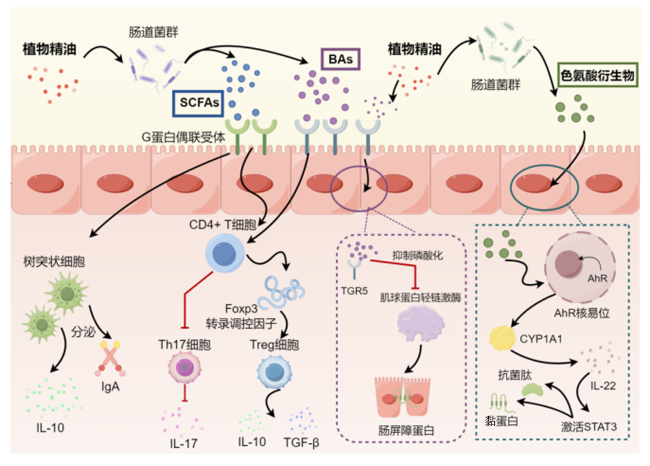
植物精油能介导肠道微生物调控畜禽机体内SCFAs的含量。产生的SCFAs通过多种机制调节Treg细胞赋予抗炎特性[18]。很多SCFAs的产生与局部或全身的炎症呈显著相关。研究表明,广藿香精油显著富集已知的SCFAs产生菌,如丁酸厌氧杆菌(Anaerostipes butyraticus)、溶纤维丁酸弧菌(Butytivibrio fibrisolvens)、空肠梭菌(Clostridium jejuense)和乳酸杆菌(Lactobacillus lactis)等,增加肠道内SCFAs的含量,且关键的SCFAs受体GPR41[也称游离脂肪酸受体3(free fatty acid receptor 3,FFAR3)]、GPR43[也称游离脂肪酸受体2(free fatty acid receptor 2,FFAR2)]和GPR109a[也称羟基羧酸受体2(hydroxycarboxylic acid receptor 2,HCA2)]的表达在肠上皮中也显著升高,它们的表达都与肠道稳态密切相关[54]。其中,GPR41和GPR43能感知SCFAs,对宿主肠道健康具有有益作用[55]。SCFAs激活的GPR43通过抑制组蛋白去乙酰化酶(histone deacetylase,HDAC)抑制Foxp3的组蛋白H3乙酰化,从而直接刺激Treg细胞增殖[18];此外,SCFAs也可通过树突状细胞促进肠道中IgAIL-10的表达,以及促进IECs中白细胞介素-18(IL-18)的产生来调节组织炎症和保护性免疫[56](图2)。由此可见,植物精油可通过SCFAs-GPR43通路发挥免疫调节作用。
图2 植物精油通过微生物代谢物调控肠道免疫稳态的作用机制(由Figdraw绘制)

SCFAs:短链脂肪酸 short chain fatty acids;BAs:胆汁酸 bile acids;IL-10:白细胞介素-10 interleukin-10;IgA:免疫球蛋白A immunoglobulin A;Th17细胞:辅助性T细胞17 T helper cell 17;Treg细胞:调节性T细胞T helper cell 17;IL-17:白细胞介素-17 interleukin-17;TGF-β:转化生长因子-β transforming growth factor β;AhR:芳香烃受体 aryl hydrocarbon receptor;CYP1A1:细胞色素P450 cytochrome P450;TGR5:跨膜G蛋白偶联受体5 transmembrane G protein- coupled receptor 5;IL-22:白细胞介素-22 interleukin-22;STAT3:信号转导与转录激活因子3 signal transducer and activator of transcription 3。

Fig.2 Mechanism of plant essential oils regulating intestinal immune homeostasis through microbial metabolites (drawn by Figdraw)

3.2.2.2 BAs途径

BAs可作为脂肪乳化剂调节糖、脂代谢和能量平衡[57],内源性BAs经肠道菌群代谢生成次生BAs,在调节肠道屏障和肠道免疫中起着至关重要的作用[39]。肠道内的BAs能与法尼醇受体(Farnesoid X receptor,FXR)、胆汁酸G蛋白偶联受体5(Takeda G protein-coupled receptor 5,TGR5)[也称G蛋白偶联胆汁酸受体1(G protein-coupled bile acid receptor 1,GPCBAR1)]等多种受体结合,发挥免疫作用[39,52]
植物精油调节初级BAs的含量,改变肠道菌群组成及其代谢物分泌[17]。微生物可以对BAs进行多样化的修饰,包括氧化、还原、脱水和异构化、酰胺化等[58],从而使其在T细胞分化和树突状信号传导中发挥作用,并与芳香烃受体(aryl hydrocarbon receptor,AhR)、TGR5相互作用,促进肠道干细胞增殖[59-60]。Cheng等[24]研究表明,苍术油可改善肠道菌群结构,增加胆酸和去氧胆酸的含量,调节BAs代谢途径,促进抗炎因子IL-2、白细胞介素-4(IL-4)的表达。此外,BAs能调节Th17/Treg细胞的分化,下调IL-17和TNF-α等促炎细胞因子含量,上调IL-10和TGF-β等抗炎细胞因子含量[61]
此外,除肠道菌群介导的次级BAs代谢的变化外,补充含有肉桂醛、丁香酚等成分的植物精油还能增加鸡盲肠内容物中鹅脱氧胆酸和血清中牛磺酸的含量[17]。鹅去氧胆酸是以胆固醇为原料合成的初级BAs,牛磺酸与鹅去氧胆酸结合后形成牛磺酸去氧胆酸。牛磺酸去氧胆酸是TGR5的激动剂,可通过激活TGR5发挥抗炎作用[62],激活的TGR5能进一步抑制肌球蛋白轻链激酶(MLCK)信号通路的激活,从而改善肠道上皮屏障损伤。牛磺酸去氧胆酸可通过TGR5-MLCK途径增强断奶仔猪肠道屏障功能,提高免疫力[63](图2)。

3.2.2.3 色氨酸衍生物途径

色氨酸在维持肠道免疫耐受和肠道微生物群之间的平衡中起着至关重要的作用,控制肠道微生物组成可以调节色氨酸和色氨酸衍生物的浓度。色氨酸代谢物可调节肠上皮屏障功能,参与肠道免疫稳态和多种免疫疾病[64]
有研究表明,植物精油通过调控肠道微生物维持稳态,通过干扰色氨酸分解代谢来调节肠道免疫,从而激活AhR,进一步促进细胞色素P450(cytochrome P450,CYP1A1)、白细胞介素-22(IL-22)和信号转导与转录激活因子3(signal transducer and activator of transcription 3,STAT3)等基因表达水平的升高,从而缓解肠道炎症,增强肠道屏障功能[27]。在微生物介导下,色氨酸代谢能产生吲哚类物质,可以激活AhR信号通路,驱动AhR易位进入细胞核,AhR的激活导致CYP1A1的表达上调,从而促进IL-22的产生,而IL-22能够持续激活STAT3,通过刺激抗菌肽和黏蛋白的产生,调节肠道免疫稳态[27,65](图2)。

4 小结与展望

肠道微生物与肠道健康息息相关,植物精油可通过发挥抗菌活性调控畜禽肠道微生物区系及其代谢产物,从而调控肠道免疫应答。将植物精油应用到畜禽生产上可有效增强畜禽肠道免疫力,提高肠道健康水平,降低因肠道疾病而诱发的畜禽高风险死亡率。但植物精油对肠道免疫的调控作用是非常复杂且多样的,未来应深入探明植物精油调节免疫的内在机制。此外,目前植物精油通过自身成分直接调控肠道免疫稳态的研究尚且不足,因植物精油独特的免疫调节活性,探索其在免疫机制中的多种作用靶点是非常有必要的,并能以此确保其在畜禽生产上的有效应用。
[1]
EKSTEDT N, JAMIOL-MILC D, PIECZYNSKA J, et al. Importance of gut microbiota in patients with inflammatory bowel disease[J]. Nutrients, 2024, 16(13):2092.

[2]
KHAN S, ABDO A A A, SHU Y, et al. The extraction and impact of essential oils on bioactive films and food preservation, with emphasis on antioxidant and antibacterial activities—a review[J]. Foods, 2023, 12(22):4169.

[3]
IMBABI T, HASSAN T M M, OSMAN A, et al. Impacts of thyme and/or garlic oils on growth,immunity,antioxidant and net farm income in Damascus goats[J]. Scientific Reports, 2024, 14(1):13173.

[4]
DAI J M, LI C Z, CUI H Y, et al. Unraveling the anti-bacterial mechanism of Litsea cubeba essential oil against E.coli O157:H7 and its application in vegetable juices[J]. International Journal of Food Microbiology, 2021, 338:108989.

[5]
SHI L, LIN W, CAI Y, et al. Oxidative stress-mediated repression of virulence gene transcription and biofilm formation as antibacterial action of Cinnamomum burmannii essential oil on Staphylococcus aureus[J]. International Journal of Molecular Sciences, 2024, 25(5):3078.

[6]
MANSURI A, LOKHANDE K, KORE S, et al. Antioxidant, anti-quorum sensing, biofilm inhibitory activities and chemical composition of patchouli essential oil:in vitro and in silico approach[J]. Journal of Biomolecular Structure & Dynamics, 2022, 40(1):154-165.

[7]
MUKARRAM M, CHOUDHARY S, KHAN M A, et al. Lemongrass essential oil components with antimicrobial and anticancer activities[J]. Antioxidants, 2021, 11(1):20.

[8]
LUCIARDI M C, BLÁZQUEZ M A, ALBERTO M R, et al. Lemon oils attenuate the pathogenicity of Pseudomonas aeruginosa by quorum sensing inhibition[J]. Molecules, 2021, 26(10):2863.

[9]
LI C Z, ZHANG C H, CHEN X C, et al. The interference mechanism of basil essential oil on the cell membrane barrier and respiratory metabolism of Listeria monocytogenes[J]. Frontiers in Microbiology, 2022, 13:855905.

[10]
HU W, LI C Z, DAI J M, et al. Antibacterial activity and mechanism of Litsea cubeba essential oil against methicillin-resistant Staphylococcus aureus (MRSA)[J]. Industrial Crops and Products, 2019, 130:34-41.

[11]
TANG W X, ZHANG Z, NIE D C, et al. Selective antibacterial activity of Citrus medica limonum essential oil against Escherichia coli K99 and Lactobacillus acidophilus and its antibacterial mechanism[J]. LWT, 2023, 186:115215.

[12]
AMBROSIO C M S, IKEDA N Y, MIANO A C, et al. Unraveling the selective antibacterial activity and chemical composition of citrus essential oils[J]. Scientific Reports, 2019, 9(1):17719.

DOI PMID

[13]
ZHENG X Y, WANG Y B, ZHOU X M, et al. Plant essential oils combined with organic acids restored lipopolysaccharide-induced leaky intestine via gut microbial modulation in weaned piglets[J]. Animal Nutrition, 2024, 18:419-432.

DOI PMID

[14]
GAO F, ZHANG L H, LI H, et al. Dietary oregano essential oil supplementation combined with cinnamaldehyde improves production performance and alters gut microbiota in late-phase laying hens[EB/OL].(2022-02-17) [2024-10-18]. https://www.researchsquare.com/article/rs-1342979/v1

[15]
GE C Y, LUO X Y, WU L C, et al. Plant essential oils improve growth performance by increasing antioxidative capacity, enhancing intestinal barrier function, and modulating gut microbiota in Muscovy ducks[J]. Poultry Science, 2023, 102(8):102813.

[16]
MA Y, SHI J P, JIA L, et al. Oregano essential oil modulates colonic homeostasis and intestinal barrier function in fattening bulls[J]. Frontiers in Microbiology, 2023, 14:1293160.

[17]
CHEN Y, WANG J, YU L F, et al. Microbiota and metabolome responses in the cecum and serum of broiler chickens fed with plant essential oils or virginiamycin[J]. Scientific Reports, 2020, 10(1):5382.

DOI PMID

[18]
ZHANG Y N, TU S Y, JI X W, et al. Dubosiella newyorkensis modulates immune tolerance in colitis via the L-lysine-activated AhR-IDO1-Kyn pathway[J]. Nature Communications, 2024, 15:1333.

[19]
SEBASTIÀ C, FOLCH J M, BALLESTER M, et al. Interrelation between gut microbiota,SCFA,and fatty acid composition in pigs[J]. mSystems, 2023, 9(1):e0104923.

[20]
NIU Y, CHEN Y N, LIU J S, et al. Effect of diets supplemented with coated plant essential oil on the growth performance,immunity, antioxidant activity, and fecal microbiota of weaned piglets[J]. Frontiers in Veterinary Science, 2024, 11:1346922.

[21]
张淑芳. 牛至精油和有机酸对广西三黄鸡生长性能、抗氧化能力和肠道微生物区系的影响[D].硕士学位论文. 南宁: 广西大学, 2023.

ZHANG S F. Effects of origano essential oil and organic acids on growth performance,antioxidant capacity and intestinal microflora of Guangxi Sanhuang chicken[D].Master’s Thesis. Nanning: Guangxi University, 2023. (in Chinese)

[22]
CHANG W Y, YU Y H. Effect of Bacillus species-fermented products and essential oils on growth performance,gut morphology,cecal short-chain fatty acid levels,and microbiota community in broilers[J]. Poultry Science, 2022, 101(8):101970.

[23]
YANG J F, PALMIOTTI A, KUIPERS F. Emerging roles of bile acids in control of intestinal functions[J]. Current Opinion in Clinical Nutrition and Metabolic Care, 2021, 24(2):127-133.

DOI PMID

[24]
CHENG H, ZHANG D D, WU J, et al. Atractylodes macrocephala Koidz. volatile oil relieves acute ulcerative colitis via regulating gut microbiota and gut microbiota metabolism[J]. Frontiers in Immunology, 2023, 14:1127785.

[25]
AGUS A, PLANCHAIS J, SOKOL H. Gut microbiota regulation of tryptophan metabolism in health and disease[J]. Cell Host & Microbe, 2018, 23(6):716-724.

[26]
ZHANG H L, LANG X, LI X, et al. Effect of Zanthoxylum bungeanum essential oil on rumen enzyme activity, microbiome, and metabolites in lambs[J]. PLoS One, 2022, 17(8):e0272310.

[27]
GE C Y, LUO X Y, LV Y J, et al. Essential oils ameliorate the intestinal damages induced by nonylphenol exposure by modulating tryptophan metabolism and activating aryl hydrocarbon receptor via gut microbiota regulation[J]. Chemosphere, 2024, 362:142571.

[28]
WANG Z W, XIE N, LIANG X R, et al. Gut mechanoimmunology:shaping immune response through physical cues[J]. Physics of Life Reviews, 2024, 50:13-26.

[29]
LARSEN J M. The immune response to Prevotella bacteria in chronic inflammatory disease[J]. Immunology, 2017, 151(4):363-374.

[30]
YANG Y F, ZHAO L L, SHAO Y X, et al. Effects of dietary graded levels of cinnamon essential oil and its combination with bamboo leaf flavonoid on immune function, antioxidative ability and intestinal microbiota of broilers[J]. Journal of Integrative Agriculture, 2019, 18(9):2123-2132.

[31]
LI Y Y, CAO H R, ZHANG S Y, et al. Effects of the supplementation of essential oil mixtures on growth performance,nutrient digestibility,immune status and microbial community in weaned piglets[J]. Animals, 2023, 13(23):3697.

[32]
SU G Q, WANG L, ZHOU X W, et al. Effects of essential oil on growth performance,digestibility,immunity,and intestinal health in broilers[J]. Poultry Science, 2021, 100(8):101242.

[33]
FENG J, LU M Y, WANG J, et al. Dietary oregano essential oil supplementation improves intestinal functions and alters gut microbiota in late-phase laying hens[J]. Journal of Animal Science and Biotechnology, 2021, 12(1):72.

DOI PMID

[34]
JIA L, WU J P, LEI Y, et al. Oregano essential oils mediated intestinal microbiota and metabolites and improved growth performance and intestinal barrier function in sheep[J]. Frontiers in Immunology, 2022, 13:908015.

[35]
MA Z Y, AKHTAR M, PAN H, et al. Fecal microbiota transplantation improves chicken growth performance by balancing jejunal Th17/Treg cells[J]. Microbiome, 2023, 11(1):137.

DOI PMID

[36]
TIAN Z Z, CHEN J M, LIN T B, et al. Dietary supplementation with lysozyme-cinnamaldehyde conjugates enhances feed conversion efficiency by improving intestinal health and modulating the gut microbiota in weaned piglets infected with enterotoxigenic Escherichia coli[J]. Animals, 2023, 13(22):3497.

[37]
LIAN F P, ZHANG F, ZHAO C M, et al. Gut microbiota regulation of T lymphocyte subsets during systemic lupus erythematosus[J]. BMC Immunology, 2024, 25(1):41.

[38]
JIA L, JIANG Y Y, WU L L, et al. Porphyromonas gingivalis aggravates colitis via a gut microbiota-linoleic acid metabolism-Th17/Treg cell balance axis[J]. Nature Communications, 2024, 15(1):1617.

[39]
HAO Z, DING X D, WANG J. Effects of gut bacteria and their metabolites on gut health of animals[J]. Advances in Applied Microbiology, 2024, 127:223-252.

DOI PMID

[40]
NAMDARI H, IZAD M, REZAEI F, et al. Thymol as a reciprocal regulator of T cell differentiation: promotion of regulatory T cells and suppression of Th1/Th17 cells[J]. International Immunopharmacology, 2019, 67:417-426.

DOI PMID

[41]
YANG W J, YU T M, LIU X, et al. Microbial metabolite butyrate modulates granzyme B in tolerogenic IL-10 producing Th1 cells to regulate intestinal inflammation[J]. Gut Microbes, 2024, 16(1):2363020.

[42]
ZHANG M M, DANG M, WU X, et al. Da-Jian-Zhong decoction alleviates diarrhea-predominant irritable bowel syndrome via modulation of gut microbiota and Th17/Treg balance[J]. Journal of Ethnopharmacology, 2024, 331:118275.

[43]
CHEN Y N, ZHANG H, CHEN Y P, et al. Resveratrol and its derivative pterostilbene ameliorate intestine injury in intrauterine growth-retarded weanling piglets by modulating redox status and gut microbiota[J]. Journal of Animal Science and Biotechnology, 2021, 12(1):70.

DOI PMID

[44]
ZHOU L X, ZHANG M M, WANG Y M, et al. Faecalibacterium prausnitzii produces butyrate to maintain Th17/Treg balance and to ameliorate colorectal colitis by inhibiting histone deacetylase 1[J]. Inflammatory Bowel Diseases, 2018, 24(9):1926-1940.

[45]
MARZHOSEYNI Z, MOUSAVI M J, GHOTLOO S. Helicobacter pylori antigens as immunomodulators of immune system[J]. Helicobacter, 2024, 29(1):e13058.

[46]
ZHONG L Y, LUO N, ZHONG X J, et al. The immunoregulatory effects of natural products on psoriasis via its action on Th17 cells versus regulatory T cells balance[J]. International Immunopharmacology, 2022, 110:109032.

[47]
ALLAIRE J M, CROWLEY S M, LAW H T, et al. The intestinal epithelium:central coordinator of mucosal immunity[J]. Trends in Immunology, 2018, 39(9):677-696.

[48]
LI J, ZHANG X, LUAN F, et al. Therapeutic potential of essential oils against ulcerative colitis:a review[J]. Journal of Inflammation Research, 2024, 17:3527-3549.

[49]
RUAN D, FAN Q L, FOUAD A M, et al. Effects of dietary oregano essential oil supplementation on growth performance,intestinal antioxidative capacity,immunity,and intestinal microbiota in yellow-feathered chickens[J]. Journal of Animal Science, 2021, 99(2):skab033.

[50]
SONG J L, LI Y Y, WU K, et al. MyD88 and its inhibitors in cancer:prospects and challenges[J]. Biomolecules, 2024, 14(5):562.

[51]
LIAO J M, XIE X Y, WANG W L, et al. Anti-inflammatory activity of essential oil from leaves of Blumea balsamifera (L.) DC through Inhibiting TLR4/NF-kB signaling pathways and NLRP3 inflammasome activation in LPS-induced RAW264.7 macrophage cells[J]. Journal of Essential Oil Bearing Plants, 2021, 24(2):160-176.

[52]
LAVELLE A, SOKOL H. Gut microbiota-derived metabolites as key actors in inflammatory bowel disease[J]. Nature Reviews:Gastroenterology & Hepatology, 2020, 17(4):223-237.

[53]
BAI G J, XIE Y Z, GAO X, et al. Selective impact of three homogenous polysaccharides with different structural characteristics from Grifola frondosa on human gut microbial composition and the structure-activity relationship[J]. International Journal of Biological Macromolecules, 2024, 269(Pt 2):132143.

[54]
LEONG W, HUANG G X, KHAN I, et al. Patchouli essential oil and its derived compounds revealed prebiotic-like effects in C57BL/6J mice[J]. Frontiers in Pharmacology, 2019, 10:1229.

DOI PMID

[55]
LEE D H, KIM M T, HAN J H. GPR41 and GPR43:from development to metabolic regulation[J]. Biomedicine & Pharmacotherapy, 2024, 175:116735.

[56]
HE Z Y, DONG H. The roles of short-chain fatty acids derived from colonic bacteria fermentation of non-digestible carbohydrates and exogenous forms in ameliorating intestinal mucosal immunity of young ruminants[J]. Frontiers in Immunology, 2023, 14:1291846.

[57]
高瑞玲, 李胜利, 金鹿, 等. 植物精油和胆盐复合制剂对山羊肠道屏障功能的影响[J]. 动物营养学报, 2023, 35(5):3174-3182.

DOI

GAO R L, LI S L, JIN L, et al. Effects of plant essential oil and bile salt compound preparation on intestinal barrier function of goats[J]. Chinese Journal of Animal Nutrition, 2023, 35(5):3174-3182. (in Chinese)

DOI

[58]
MOHANTY I, MANNOCHIO-RUSSO H, SCHWEER J V, et al. The underappreciated diversity of bile acid modifications[J]. Cell, 2024, 187(7):1801-1818.e20.

DOI PMID

[59]
RIMAL B, COLLINS S L, TANES C E, et al. Bile salt hydrolase catalyses formation of amine-conjugated bile acids[J]. Nature, 2024, 626(8000):859-863.

[60]
FU T, HUAN T, RAHMAN G, et al. Paired microbiome and metabolome analyses associate bile acid changes with colorectal cancer progression[J]. Cell Reports, 2023, 42(8):112997.

[61]
HANG S Y, PAIK D, YAO L N, et al. Bile acid metabolites control TH17 and Treg cell differentiation[J]. Nature, 2019, 576(7785):143-148.

[62]
WU X, LIU C H, CHEN L, et al. Protective effects of tauroursodeoxycholic acid on lipopolysaccharide-induced cognitive impairment and neurotoxicity in mice[J]. International Immunopharmacology, 2019, 72:166-175.

DOI PMID

[63]
SONG M, ZHANG F L, FU Y M, et al. Tauroursodeoxycholic acid (TUDCA) improves intestinal barrier function associated with TGR5-MLCK pathway and the alteration of serum metabolites and gut bacteria in weaned piglets[J]. Journal of Animal Science and Biotechnology, 2022, 13(1):73.

DOI PMID

[64]
GAO J, XU K, LIU H N, et al. Impact of the gut microbiota on intestinal immunity mediated by tryptophan metabolism[J]. Frontiers in Cellular and Infection Microbiology, 2018, 8:13.

DOI PMID

[65]
YANG W Q, REN D Y, SHAO H J, et al. Theabrownin from Fu brick tea improves ulcerative colitis by shaping the gut microbiota and modulating the tryptophan metabolism[J]. Journal of Agricultural and Food Chemistry, 2023, 71(6):2898-2913.

文章导航

/