综述

巨噬细胞极化机理及益生菌介导其极化改善肠道健康的研究进展

  • 梁坤 , 1, 2, 3 ,
  • 秦小霞 1, 2, 3 ,
  • 杨玲媛 , 1, 2, 3, * ,
  • 黄兴国 1, 2, 3
展开
  • 1 湖南农业大学动物科学技术学院,长沙 410128
  • 2 农业农村部畜禽资源(猪)评价利用重点实验室,长沙 410128
  • 3 岳麓山实验室,长沙 410128
*杨玲媛,副教授,硕士生导师,E-mail:

梁 坤(2000—),男,湖南娄底人,硕士研究生,从事单胃动物营养的研究。E-mail:

Copy editor: 陈鑫

收稿日期: 2024-08-26

  网络出版日期: 2025-03-13

基金资助

湖南省自然科学基金重点项目(2024JJ3020)

湖南省教育厅科学研究重点项目(24A0153)

Research Progress on Mechanism of Macrophage Polarization and Improvement of Intestinal Health Mediated by Probiotics through Macrophage Polarization

  • LIANG Kun , 1, 2, 3 ,
  • QIN Xiaoxia 1, 2, 3 ,
  • YANG Lingyuan , 1, 2, 3, * ,
  • HUANG Xingguo 1, 2, 3
Expand
  • 1 College of Animal Science and Technology, Hunan Agricultural University, Changsha 410128, China
  • 2 Key Laboratory of Livestock and Poultry Resources (Pig) Evaluation and Utilization, Ministry of Agriculture and Rural Affairs,Changsha 410128, China
  • 3 Yuelushan Laboratory, Changsha 410128, China
*associate professor, E-mail:

Received date: 2024-08-26

  Online published: 2025-03-13

摘要

益生菌作为优质的“替抗品”,在畜禽肠道健康中发挥着重要作用,提高了畜禽生产水平。作为一种先天免疫细胞,巨噬细胞在吞噬、炎症等反应中发挥着重要作用。不同的巨噬细胞表型具有不同的生物学功能,并受到不同因素和机制的调节。研究发现,益生菌能够介导巨噬细胞极化、保护肠道屏障、缓解肠道炎症、维持肠道内环境稳态。因此,本文就巨噬细胞极化机制和益生菌介导巨噬细胞极化改善宿主肠道健康展开论述,以期为未来益生菌调控畜禽肠道健康的研究提供参考。

本文引用格式

梁坤 , 秦小霞 , 杨玲媛 , 黄兴国 . 巨噬细胞极化机理及益生菌介导其极化改善肠道健康的研究进展[J]. 动物营养学报, 2025 , 37(3) : 1470 -1479 . DOI: 10.12418/CJAN2025.126

Abstract

Probiotics, serving as high-quality alternatives to antibiotics, play a crucial role in promoting intestinal health and enhancing production performance in livestock and poultry. Macrophages, as innate immune cells, are pivotal in phagocytosis, inflammation, and other immune responses. Distinct macrophage phenotypes exhibit various biological functions and are regulated by different factors and mechanisms. Studies have shown that probiotics can mediate macrophage polarization, protect intestinal barriers, alleviate intestinal inflammation, and maintain intestinal homeostasis. Therefore, this paper discusses the mechanisms of macrophage polarization and the improvement of host intestinal health through probiotic-mediated macrophage polarization, aiming to provide a reference for future research on the regulation of intestinal health in livestock and poultry using probiotics.

巨噬细胞来源于组织驻留巨噬细胞和单核细胞,在清除病原体和衰老细胞、调节炎症反应、诱导适应性免疫以及组织修复和重塑中发挥着关键作用[1-2]。巨噬细胞极化是指巨噬细胞在病原微生物、炎症反应、细胞因子或某些理化因素的刺激下被激活,并根据微环境的状态和变化分化成不同的表型[3]。原始的M0细胞根据对各种刺激的不同反应,分化为经典活化的M1巨噬细胞和交替活化的M2巨噬细胞[4]。M1型巨噬细胞作为杀死细胞内病原体的强效应细胞,具有促炎和抗肿瘤的作用,可能加剧炎症性肠病(inflammatory bowel disease,IBD)等炎性疾病的发生[5]。M2型巨噬细胞是促进伤口组织愈合的一种修复细胞[6],与抗炎和促肿瘤密切相关[7]。巨噬细胞具有极高的可塑性,可以根据微环境的变化而表现出不同的激活状态[3]
肠道作为机体抵御外界病菌入侵和应激损伤的重要防线,其受损会导致生产性能下降,造成严重的经济损失。益生菌被称为“对宿主健康有益的活的微生物”,常见的肠道益生菌包括乳酸杆菌、双歧杆菌、链球菌和部分大肠杆菌等,嗜黏蛋白阿克曼菌和拟杆菌等共生菌也具有成为新一代益生菌的潜力[8]。益生菌通过分解肠道中的膳食底物合成代谢物,如短链脂肪酸(short chain fatty acids,SCFAs)、胆汁酸(bile acids,BAs)等[9-10],同时自身也会衍生代谢物如胞外囊泡、细菌素等[11]。益生菌及代谢产物具有改善畜禽生长性能、提升肉品质、缓解仔猪腹泻、改善肠道炎症、促进肠道消化吸收等作用,已在实际生产中得到验证[12-17]。近年来的研究发现,益生菌及代谢物改善仔猪腹泻、加强肠道屏障功能、增强肠黏膜免疫能力是通过介导巨噬细胞极化实现的[18-21]。因此,关于益生菌介导巨噬细胞极化改善肠道健康对于未来畜禽生产效应具有重要意义。

1 巨噬细胞极化的表型

M0巨噬细胞由干扰素-γ(interferon-γ,IFN-γ)、肿瘤坏死因子-α(tumor necrosis factor-α,TNF-α)和细菌来源的脂多糖(lipopolysaccharide,LPS)诱导分化为M1巨噬细胞,同时过量表达CD86、CD80并诱导一氧化氮合酶(inducible nitric oxide synthase,iNOS)等表面蛋白标记物,释放炎性细胞因子[白细胞介素(interleukin,IL)-1β、TNF-α、IL-12等],从而导致炎症反应和组织损伤[22-24]。M2巨噬细胞受Th2细胞刺激,由IL-4和IL-13诱导[25],通过提高精氨酸酶-1(ARG-1)、甘露糖受体(MR)、CD163的表达,参与提升IL-10、转化生长因子-β(transforming growth factor-β,TGF-β)等抗炎因子水平,缓解炎症反应、蠕虫感染,促进伤口愈合、组织重塑,减缓肿瘤进展等反应[26-27]。巨噬细胞适应其表型以响应各种微环境信号,进而表现出不同的特征性标志物和功能[28]

2 巨噬细胞极化的机制

在巨噬细胞极化过程中,大量信号因子参与其中并能够直接或间接调控巨噬细胞极化,如信号转导子和转录激活子(signal transducers and activators of transcription,STATs)[29]、核因子-κB(nuclear factor-κB,NF-κB)[30]、激活蛋白-1(activator protein-1,AP-1)[29]、磷脂酰肌醇3-激酶/蛋白激酶B(phosphoinositide3-kinase/protein kinase B,PI3K/Akt)[31]、C-Jun N-末端激酶(c-Jun N-terminal kinase,JNK)[32]和过氧化物酶体增殖物激活受体(peroxisome proliferator-activated receptor,PPAR)[33]

2.1 Toll样受体(Toll-like receptor,TLR)-NF-κB信号通路

TLR是参与非特异性免疫的一类重要蛋白质分子,可以识别来源于微生物具有保守结构的分子,同时也是连接非特异性免疫和特异性免疫的桥梁。TLR4能被革兰氏阴性菌的LPS激活[34],LPS与TLR4结合,通过髓样分化主要反应88蛋白(myeloid differentiation primary response 88,MyD88)依赖性途径或干扰素调节因子3(interferon regulatory factor 3,IRF3)激活NF-κB,进而导致p65/p50异源二聚体的激活,使巨噬细胞向M1型极化[35]。例如,姜黄素通过BV2细胞中的TLR4-NF-κB通路促进M2极化来抑制LPS诱导的神经炎症[36]。TLR2驱动NF-κB的p65亚基激活,促进M1型极化[37]。此外,如果NF-κB以p50/p50形式活化时,IL-10可以通过诱导p50/p50同型二聚体,促进细胞肌腱膜纤维肉瘤癌基因同源蛋白(cellular musculoaponeurotic fibrosarcoma oncogene homolog,c-Maf)和STAT3的活化使M2极化[38-39]

2.2 Janus激酶(Janus kinase,JAK)-STAT信号通路

JAK-STAT途径主要介导细胞因子受体的信号传导[40]。IFN-γ与其受体结合并激活JAK1,从而诱导STAT1磷酸化,导致巨噬细胞极化为M1[41]。例如,小鼠骨桥蛋白通过激活非酒精性脂肪肝病中的JAK1-STAT1-高迁移率群盒蛋白1(high mobility group box 1,HMGB1)信号通路促进巨噬细胞M1极化。JAK-STAT6是IL-4抑制M1并诱导M2极化的重要途径[42-43]。脂肪源性干细胞分泌的外泌体通过JAK-STAT6途径促进肢体缺血的2型糖尿病小鼠体内巨噬细胞M2极化,从而促进血管生成[44]

2.3 TGF-β-Smads信号通路

TGF-β属于生长转化因子中的一类,其在免疫调节、组织再生中发挥重要作用。在介导巨噬细胞极化中TFG-β首先作用于Ⅱ型受体,然后与Ⅰ型受体结合形成受体复合物,导致Ⅰ型受体结构域磷酸化,通过激活其下游信号分子(Smad 2和Smad 3)调节相关基因的表达,从而介导巨噬细胞M2极化[45]。Duan等[46]研究发现,作为TGF-β家族成员中的生长和分化因子11(growth differentiation factor 11,GDF11)通过TGF-βR1-Smad2通路调控巨噬细胞极化,其能够改善胰腺炎,减少了M1巨噬细胞极化,促进M2巨噬细胞极化。

2.4 Notch信号通路

Notch信号通路是一种高度保守的通路,它调节细胞生命周期并参与许多病理过程。目前,已证实了Notch信号转导在炎症和感染过程中调节巨噬细胞的分化、活化和代谢[47]。Wu等[48]研究发现,复方槐汤能通过调节Notch信号传导,降低M1/M2的比值,改善结肠炎。M1巨噬细胞的Notch1受体表达显著增加,Notch1受体抑制将导致M1极化降低,M2极化增加[49]

2.5 PPAR-γ信号通路

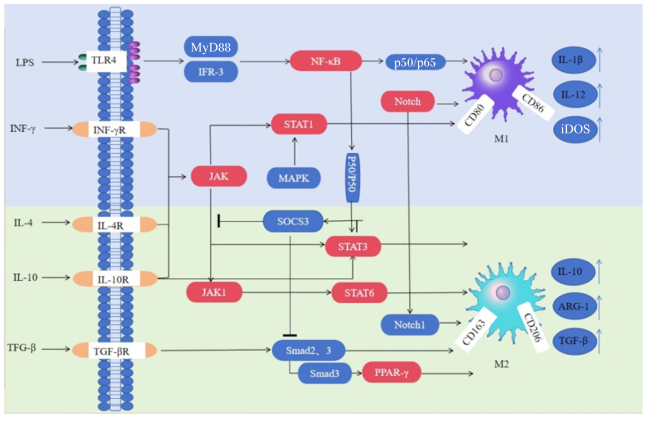
PPAR-γ是细胞分化的重要转录因子,对于炎症的调控发挥着重要的作用。Zhou等[50]研究发现,PPAR-γ通路能够调节IL-4诱导的巨噬细胞M2极化。Luo等[51]研究表明,PPAR-γ与NF-κB相互作用,调节M1/M2巨噬细胞的平衡。如图1所示,巨噬细胞极化主要通过各种受体和下游信号分子调控。
图1 巨噬细胞极化机制

LPS:脂多糖 lipopolysaccharide;INF-γ:干扰素-γ interferon-γ;IL-4:白细胞介素-4 interleukin-4;IL-10:白细胞介素-10 interleukin-10;TFG-β:转化生长因子-β transforming growth factor-β;TLR4:Toll样受体4 Toll-like receptor 4;INF-γR:干扰素-γ受体 interferon-γ receptor;IL-4R:白细胞介素-4受体 interleukin-4 receptor;IL-10R:白细胞介素-10受体 interleukin-4 receptor;IL-12:白细胞介素-12 interleukin-12;TGF-βR:转化生长因子-β受体 transforming growth factor-β receptor;MyD88:髓样分化主要反应88蛋白 myeloid differentiation primary response 88;IFR-3:干扰素调节因子-3 interferon regulatory factor-3;NF-κB:核因子-κB nuclear factor-κB;JAK:Janus激酶 Janus kinase;STAT:信号转导及转录激活因子 signal transducer and activator of transcription;PPAR-γ:氧化物酶体增殖物激活受体-γ peroxisome proliferator-activated receptor-γ;SOCS3: 细胞因子信号传导抑制因子 3 suppressor of cytokine signaling 3;ARG-1:精氨酸酶-1 arginase-1;iNOS:一氧化氮合酶 inducible nitric oxide synthase。

箭头:传递、激活;平箭头:抑制;上箭头:表达增加。Arrow: transmit, activate; flat arrow: inhibit; upward arrow: expression increase.

Fig.1 Macrophage polarization mechanisms[52]

3 益生菌及其代谢产物介导巨噬细胞极化改善肠道健康

3.1 益生菌介导巨噬细胞极化改善肠道炎症及屏障功能
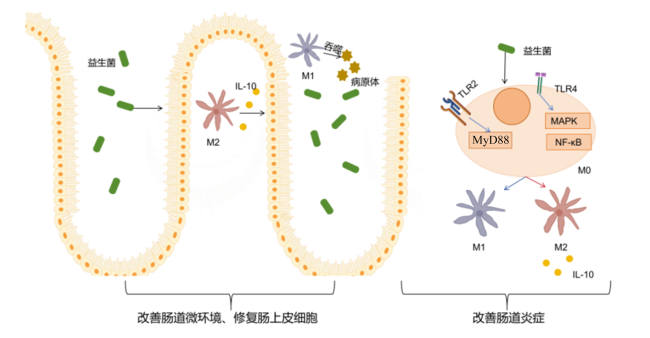
部分乳杆菌能够有效介导巨噬细胞改善肠道炎症。Jang等[53]研究发现,植物乳杆菌CLP-0611通过抑制TRL4连接的NF-κB和丝裂原活化蛋白激酶(mitogen-activated protein kinases,MAPK)信号通路,使M1向M2巨噬细胞极化,从而改善小鼠结肠炎。乳酸明串珠EJ-1和清酒乳杆菌S1也能介导M1向M2极化从而改善结肠炎[54-55]。Dias等[56]研究发现,罗伊氏乳杆菌应激蛋白(DaGroEL)通过抑制TRL4信号通路从而抑制巨噬细胞M1极化,促进M2极化,进而改善结肠炎。乳酸球菌也能介导巨噬细胞极化改善肠道炎症,研究发现,戊糖假单胞菌CECT8330和猫乳源乳酸片球菌YH-15通过抑制NF-κB信号通路,使巨噬细胞向M2极化,改善炎症[57-58]
益生菌也能够介导巨噬细胞极化改善肠道微生物内环境。洪宇轩[59]研究发现,解淀粉芽胞杆菌TL可促进结肠巨噬细胞向M1型极化,从而抑制病原菌的定植。研究发现,益生菌淀粉芽孢杆菌SC06(BaSC06)在体外试验中能将M1极化,从而增加对鼠伤寒沙门氏菌(Salmonella typhimurium,ST)的吞噬杀伤作用;而在小鼠体内试验中发现,BaSC06处理的动物移植粪便微生物群促进盲肠中M2巨噬细胞极化,并显著缓解ST引起的炎症[60]。Wu等[61]研究发现,约翰逊乳杆菌培养物的上清液缓解了结肠炎并重塑了肠道菌群。Hua等[57]研究发现,戊糖假单胞菌CECT8330能介导巨噬细胞从M1转向M2,并修复肠上皮细胞,恢复肠道菌群平衡,缓解炎症性肠病。如图2所示,益生菌中部分乳酸菌能通过激活抗炎信号通路及改善肠道内环境,从而激活巨噬细胞极化,改善宿主肠道微生物环境,缓解肠道炎症。
图2 益生菌介导巨噬细胞极化改善宿主肠道健康

M0:M0型巨噬细胞 M0 type macrophage;M1:M1型巨噬细胞 M1 type macrophage;M2:M2型巨噬细胞 M2 type macrophage;IL-10:白细胞介素-10 interleukin-10;TLR2:Toll样受体2 Toll-like receptor2;MyD88:髓样分化主要反应88蛋白 myeloid differentiation primary response 88;NF-κB:核因子-κB nuclear factor-κB。

黑箭头:介导,传递;蓝色箭头:抑制;红色箭头:促进。Black arrow: mediate and transmit; blue arrow: inhibit; red arrow: promote。

Fig.2 Probiotics-mediated macrophage polarization improves host gut health[53,56-60]

3.2 益生菌代谢产物介导巨噬细胞极化改善肠道健康

3.2.1 SCFAs

SCFAs是由1~6个碳原子组成,以直链和支链构象存在[62]。肠道菌群降解膳食纤维会产生大量的SCFA,如乙酸、丙酸和丁酸等,其在肠道免疫中具有重要作用[63-64]。在猪生产中,SCFAs能够改善仔猪肠道形态、增强肠道屏障功能和提高免疫力[65]。巨噬细胞对于肠道上皮细胞具有免疫调节及修复作用。巨噬细胞来源的WNT蛋白在损伤后促进局部组织的再生,而黏膜中M2巨噬细胞数量的增加会激活WNT信号通路,并以STAT6依赖性方式驱动慢性UC的肠道愈合[66-68]。研究发现,丁酸能够调节M2巨噬细胞显著增强黏蛋白2(mucin 2,MUC2)和杯状细胞标记基因的表达[69]。SCFAs也能够介导巨噬细胞极化,改善黏膜免疫能力。Wang等[70]发现,拟杆菌代谢产生的异戊酸通过哺乳动物雷帕霉素靶蛋白(mammalian target of rapamycin,mTOR)-PPAR-γ-STAT3信号通路促进M2巨噬细胞极化,产生IL-10、IL-4和TGF-β等细胞因子,改善肉鸡肠道黏膜免疫能力。Wu等[61]研究发现,约氏乳杆菌代谢的丙酸通过抑制MAPK信号通路,使巨噬细胞向M2极化,从而改善结肠炎,重塑肠道菌群。总之,益生菌代谢的SCFAs能够调控巨噬细胞极化从而改善肠道屏障、参与宿主免疫调控。在畜禽生产中充分利用SCFAs或产SCFAs益生菌能够有效促进肠道健康,但其具体机制需要进一步研究。

3.2.2 BAs

BAs是一种胆固醇代谢产物,在糖、脂代谢中发挥重要作用。肠道微生物能够将初级BAs分解,随后生物转化为次级BAs,如脱氧胆酸(deoxycholic acid,DCA)和石胆酸(lithochalic acid,LCA)[70-71]。近期研究发现,DCA和LCA对于巨噬细胞极化的调控有所不同,DCA通常能介导巨噬细胞M2极化改善结肠炎,LCA则会加重结肠炎[72-74]。益生菌代谢产生的次级BAs能够与细胞核中的法尼酯X受体(Farnesoid X receptor,FXR)或细胞膜上的胆汁酸G蛋白偶联受体5(Takeda G-protein-coupled receptor 5,TGR5)结合,调节黏膜免疫并减少炎症反应[75]。研究发现,FXR的激活促进M2巨噬细胞极化,能够有效缓解肠道炎症[76-77]。Pi等[78]研究发现,给仔猪口服益生菌代谢物BAs-熊去氧胆酸能显著改善仔猪结肠炎,这主要是由于熊去氧胆酸通过激活FXR从而减少炎症细胞因子的产生,同时抑制NF-κB在巨噬细胞中的激活,并介导M2巨噬细胞极化。Deng等[79]研究发现,嗜酸乳杆菌的代谢物熊去氧胆酸能够抑制M1巨噬细胞极化,降低促炎细胞因子的分泌水平。综上所述,益生菌代谢产生的次级BAs能通过其相应受体介导巨噬细胞极化,调控炎症通路,减少炎症因子的产生,从而改善肠道炎症。

3.2.3 细胞外囊泡(extracellular vesicles,EVs)
EVs是一种具有磷脂双层结构的纳米级膜囊泡,几乎所有细胞都有分泌。微生物来源EVs含有蛋白质、DNA、RNA、信号分子等,其在宿主健康中起着重要作用[80]。最近的研究表明,益生菌衍生的EVs可以调节巨噬细胞的免疫可塑性,从而有助于维持肠道稳态[20,81],乳酸杆菌、双歧杆菌等革兰氏阳性菌来源的EVs在免疫和肠道疾病中的作用已引起广泛关注。Fan等[20]研究发现,乳酸杆菌分泌的Evs激活了TLR2,促进M2巨噬细胞极化分泌IL-10,从而增强肠道屏障功能,改善了由脱氧雪腐镰刀菌醇(deoxynivalenol,DON)导致的肠道屏障破坏。Li等[18]研究表明,约氏乳酸杆菌和黏膜乳酸杆菌能通过抑制NF-κB通路,改善由LPS诱导的肠道炎症因子上调、紧密连接蛋白下降,其分泌的Evs能介导肠道巨噬细胞M2极化,改善肠道屏障功能。植物乳杆菌分泌的EVs也具有介导巨噬细胞极化改善肠道炎症的特性[82]。Tao等[19]利用宏基因组和粪便微生物移植(FMT)来探索肠道微生物与腹泻之间的因果关系,结果发现,约氏乳杆菌的EVs能够激活M2巨噬细胞,从而抑制肠上皮细胞中NOD样受体热蛋白结构域相关蛋白3(NOD-like receptor thermal protein domain associated protein 3,NLRP3)的激活,缓解仔猪腹泻。由此可见,益生菌自身代谢的EVs能够介导巨噬细胞极化改善肠道屏障,提高肠道免疫能力。但目前大多数研究EVs调节肠道屏障功能时,都是对其进行整体研究,而具体的成分和相关机制尚不清楚,未来需要进一步识别EVs成分,并明晰其机制。
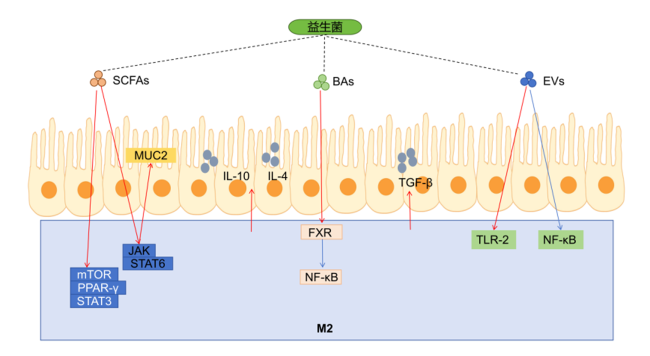
综上所述,益生菌各类代谢产物能够介导巨噬细胞极化改善宿主肠道免疫能力(图3)。益生菌各类代谢产物主要是通过调控各类炎症信号通路,释放抗炎因子,从而改善肠道健康,未来需要更深入研究其机制,并应用在实际生产中。
图3 益生菌代谢产物介导巨噬细胞极化改善宿主肠道健康

SCFAs:短链脂肪酸 short chain fatty acids;BAs:胆汁酸 bile acids;Evs:细胞外囊泡extracellular vesicles;mTOR:哺乳动物雷帕霉素靶蛋白 mammalian target of rapamycin;PPAR-γ:氧化物酶体增殖物激活受体-γ peroxisome proliferator-activated receptor-γ;STAT3:信号转导及转录激活因子3 signal transducer and activator of transcription 3;IL-4:白细胞介素-4 interleukin-4;IL-10:白细胞介素-10 interleukin-10;FXR:法尼酯X受体Farnesoid X receptor;NF-κB:核因子-κB nuclear factor-κB;TLR2:Toll样受体2 Toll-like receptor 2;TFG-β:转化生长因子-β transforming growth factor-β。

虚线:分泌;蓝色箭头:抑制;红色箭头:促进。Dashed line: secretion; blue arrow: inhibition; red arrow: promotion.

Fig.3 Probiotic metabolites mediate macrophage polarization to improve host gut health[18-21,61,78]

4 小 结

益生菌的免疫调控能力被逐渐挖掘,其介导巨噬细胞极化能够有效改善肠道炎症、修复肠道屏障、维持肠道内环境稳态。在未来,益生菌有望能够作为免疫调节微生物制剂在畜禽生产中推广,提高生产效益。但是,目前益生菌对于巨噬细胞调控的研究还主要集中在M2巨噬细胞。有研究发现,益生菌在物理条件下可能介导M1巨噬细胞极化发挥促炎作用。同时,巨噬细胞表型不仅受到益生菌及其代谢物的影响,还受到其他因素的组合影响。对于益生菌调控巨噬细胞极化的具体分子机制尚需进一步明晰。而且,作为畜禽生产的高效替抗品,益生菌介导巨噬细胞极化的研究主要集中在小鼠和细胞中,关于畜禽生产中应用的研究也比较少。未来需要持续深入研究关于益生菌及其代谢产物如何影响巨噬细胞表型和功能,进一步挖掘其调控机制,开发基于益生菌改善畜禽肠道健康的功能性产品,对于未来畜牧业可持续发展具有重要意义。
[1]
LAVIN Y, MORTHA A, RAHMAN A, et al. Regulation of macrophage development and function in peripheral tissues[J]. Nature Reviews:Immunology, 2015, 15(12):731-744.

[2]
PERDIGUERO E G, GEISSMANN F. The development and maintenance of resident macrophages[J]. Nature Immunology, 2016, 17(1):2-8.

DOI PMID

[3]
MURRAY P J. Macrophage polarization[J]. Annual Review of Physiology, 2017, 79:541-566.

DOI PMID

[4]
ATRI C, GUERFALI F Z, LAOUINI D. Role of human macrophage polarization in inflammation during infectious diseases[J]. International Journal of Molecular Sciences, 2018, 19(6):1801.

[5]
LISSNER D, SCHUMANN M, BATRA A, et al. Monocyte and M1 macrophage-induced barrier defect contributes to chronic intestinal inflammation in IBD[J]. Inflammatory Bowel Diseases, 2015, 21(6):1297-1305.

DOI PMID

[6]
LEY K. M1 means kill; M2 means heal[J]. Journal of Immunology, 2017, 199(7):2191-2193.

[7]
XIAO H, GUO Y, LI B, et al. M2-like tumor-associated macrophage-targeted codelivery of STAT6 inhibitor and IKKβ siRNA induces M2-to-M1 repolarization for cancer immunotherapy with low immune side effects[J]. ACS Central Science, 2020, 6(7):1208-1222.

DOI PMID

[8]
LIU Q, YU Z M, TIAN F W, et al. Surface components and metabolites of probiotics for regulation of intestinal epithelial barrier[J]. Microbial Cell Factories, 2020, 19(1):23.

DOI PMID

[9]
MICHAUDEL C, SOKOL H. The gut microbiota at the service of immunometabolism[J]. Cell Metabolism, 2020, 32(4):514-523.

[10]
SCHROEDER B O, BÄCKHED F. Signals from the gut microbiota to distant organs in physiology and disease[J]. Nature Medicine, 2016, 22(10):1079-1089.

DOI PMID

[11]
KUMAR M, NAGPAL R, VERMA V, et al. Probiotic metabolites as epigenetic targets in the prevention of colon cancer[J]. Nutrition Reviews, 2013, 71(1):23-34.

DOI PMID

[12]
GRELA E R, ŚWIATKIEWICZ M, FLOREK M, et al. Effect of inulin source and a probiotic supplement in pig diets on carcass traits, meat quality and fatty acid composition in finishing pigs[J]. Animals, 2021, 11(8):2438.

[13]
LIANG J, KOU S S, CHEN C, et al. Effects of Clostridium butyricum on growth performance, metabonomics and intestinal microbial differences of weaned piglets[J]. BMC Microbiology, 2021, 21(1):85.

[14]
LUISE D, BOSI P, RAFF L, et al. Bacillus spp. probiotic strains as a potential tool for limiting the use of antibiotics,and improving the growth and health of pigs and chickens[J]. Frontiers in Microbiology, 2022, 13:801827.

[15]
PUPA P, APIWATSIRI P, SIRICHOKCHATCHAWAN W, et al. Microencapsulated probiotic Lactiplantibacillus plantarum and/or Pediococcus acidilactici strains ameliorate diarrhoea in piglets challenged with enterotoxigenic Escherichia coli[J]. Scientific Reports, 2022, 12(1):7210.

[16]
SHEN J K, ZHANG J, ZHAO Y, et al. Tibetan pig-derived probiotic Lactobacillus amylovorus SLZX20-1 improved intestinal function via producing enzymes and regulating intestinal microflora[J]. Frontiers in Nutrition, 2022, 9:846991.

[17]
YIN H, WANG C B, SHUAI Y, et al. Pig-derived probiotic Bacillus tequilensis YB-2 alleviates intestinal inflammation and intestinal barrier damage in colitis mice by suppressing the TLR4/NF-κB signaling pathway[J]. Animals, 2024, 14(13):1989.

[18]
LI J J, FENG S F, WANG Z Y, et al. Limosilactobacillus mucosae-derived extracellular vesicles modulates macrophage phenotype and orchestrates gut homeostasis in a diarrheal piglet model[J]. NPJ Biofilms and Microbiomes, 2023, 9(1):33.

DOI PMID

[19]
TAO S Y, FAN J P, LI J J, et al. Extracellular vesicles derived from Lactobacillus johnsonii promote gut barrier homeostasis by enhancing M2 macrophage polarization[J/OL]. Journal of Advanced Research.(2024-03-18) [2024-09-18]. https://pubmed.ncbi.nlm.nih.gov/38508446/

[20]
FAN J P, ZHANG Y H, ZUO M Y, et al. Novel mechanism by which extracellular vesicles derived from Lactobacillus murinus alleviates deoxynivalenol-induced intestinal barrier disruption[J]. Environment International, 2024, 185:108525.

[21]
WANG X K, HU Y F, ZHU X Y, et al. Bacteroides-derived isovaleric acid enhances mucosal immunity by facilitating intestinal IgA response in broilers[J]. Journal of Animal Science and Biotechnology, 2023, 14(1):4.

DOI PMID

[22]
ARNOLD C E, GORDON P, BARKER R N, et al. The activation status of human macrophages presenting antigen determines the efficiency of Th17 responses[J]. Immunobiology, 2015, 220(1):10-19.

PMID

[23]
UTOMO L, BASTIAANSEN-JENNISKENS Y M, VERHAAR J A N, et al. Cartilage inflammation and degeneration is enhanced by pro-inflammatory (M1) macrophages in vitro, but not inhibited directly by anti-inflammatory (M2) macrophages[J]. Osteoarthritis and Cartilage, 2016, 24(12):2162-2170.

[24]
LEE H W, CHOI H J, HA S J, et al. Recruitment of monocytes/macrophages in different tumor microenvironments[J]. Biochimica et Biophysica Acta, 2013, 1835(2):170-179.

[25]
MOSSER D M, EDWARDS J P. Exploring the full spectrum of macrophage activation[J]. Nature Reviews:Immunology, 2008, 8(12):958-969.

[26]
VAN DYKEN S J, LOCKSLEY R M. Interleukin-4- and interleukin-13-mediated alternatively activated macrophages:roles in homeostasis and disease[J]. Annual Review of Immunology, 2013, 31:317-343.

[27]
WANG L X, ZHANG S X, WU H J, et al. M2b macrophage polarization and its roles in diseases[J]. Journal of Leukocyte Biology, 2019, 106(2):345-358.

DOI PMID

[28]
LENDECKEL U, VENZ S, WOLKE C. Macrophages:shapes and functions[J]. Chemtexts, 2022, 8(2):12.

[29]
LAWRENCE T, NATOLI G. Transcriptional regulation of macrophage polarization:enabling diversity with identity[J]. Nature Reviews:Immunology, 2011, 11(11):750-761.

[30]
LIU Y C, ZOU X B, CHAI Y F, et al. Macrophage polarization in inflammatory diseases[J]. International Journal of Biological Sciences, 2014, 10(5):520-529.

[31]
HYAM S R, LEE I A, GU W, et al. Arctigenin ameliorates inflammation in vitro and in vivo by inhibiting the PI3K/AKT pathway and polarizing M1 macrophages to M2-like macrophages[J]. European Journal of Pharmacology, 2013, 708(1/2/3):21-29.

[32]
MAO Y L, WANG B K, XU X, et al. Glycyrrhizic acid promotes M1 macrophage polarization in murine bone marrow-derived macrophages associated with the activation of JNK and NF-κB[J]. Mediators of Inflammation, 2015, 2015:372931.

[33]
GUHA RAY A, ODUM O P, WISEMAN D, et al. The diverse roles of macrophages in metabolic inflammation and its resolution[J]. Frontiers in Cell and Developmental Biology, 2023, 11:1147434.

[34]
CIESIELSKA A, MATYJEK M, KWIATKOWSKA K. TLR4 and CD14 trafficking and its influence on LPS-induced pro-inflammatory signaling[J]. Cellular and Molecular Life Sciences, 2021, 78(4):1233-1261.

DOI PMID

[35]
CHEN X X, TANG L, FU Y M, et al. Paralemmin-3 contributes to lipopolysaccharide-induced inflammatory response and is involved in lipopolysaccharide-Toll-like receptor-4 signaling in alveolar macrophages[J]. International Journal of Molecular Medicine, 2017, 40(6):1921-1931.

[36]
ZHANG J W, ZHENG Y L, LUO Y, et al. Curcumin inhibits LPS-induced neuroinflammation by promoting microglial M2 polarization via TREM2/ TLR4/ NF-κB pathways in BV2 cells[J]. Molecular Immunology, 2019, 116:29-37.

DOI PMID

[37]
FAN L N, XU C C, GE Q W, et al. A. muciniphila suppresses colorectal tumorigenesis by inducing TLR2/NLRP3-mediated M1-like TAMs[J]. Cancer Immunology Research, 2021, 9(10):1111-1124.

[38]
KAUR P, CHOUDHURY D. Insulin promotes wound healing by inactivating NFkβP50/P65 and activating protein and lipid biosynthesis and alternating pro/anti-inflammatory cytokines dynamics[J]. Biomolecular Concepts, 2019, 10(1):11-24.

DOI PMID

[39]
FANG J Q, OU Q, WU B H, et al. TcpC inhibits M1 but promotes M2 macrophage polarization via regulation of the MAPK/NF-κB and Akt/STAT6 pathways in urinary tract infection[J]. Cells, 2022, 11(17):2674.

[40]
XIN P, XU X Y, DENG C J, et al. The role of JAK/STAT signaling pathway and its inhibitors in diseases[J]. International Immunopharmacology, 2020, 80:106210.

[41]
IVASHKIV L B. IFNγ:signalling,epigenetics and roles in immunity,metabolism,disease and cancer immunotherapy[J]. Nature Reviews:Immunology, 2018, 18(9):545-558.

[42]
YAO G D, BAI Z J, NIU J G, et al. Astragalin attenuates depression-like behaviors and memory deficits and promotes M2 microglia polarization by regulating IL-4R/JAK1/STAT6 signaling pathway in a murine model of perimenopausal depression[J]. Psychopharmacology, 2022, 239(8):2421-2443.

DOI PMID

[43]
CHAO H, ZHENG L S, HSU P, et al. IL-13RA2 downregulation in fibroblasts promotes keloid fibrosis via JAK/STAT6 activation[J]. JCI Insight, 2023, 8(6):e157091.

[44]
WANG X K, CHEN S Y, LU R, et al. Adipose-derived stem cell-secreted exosomes enhance angiogenesis by promoting macrophage M2 polarization in type 2 diabetic mice with limb ischemia via the JAK/STAT6 pathway[J]. Heliyon, 2022, 8(11):e11495.

[45]
MORIKAWA M, DERYNCK R, MIYAZONO K. TGF-β and the TGF-β family:context-dependent roles in cell and tissue physiology[J]. Cold Spring Harbor Perspectives in Biology, 2016, 8(5):a021873.

[46]
DUAN F X, WANG X W, WANG H W, et al. GDF11 ameliorates severe acute pancreatitis through modulating macrophage M1 and M2 polarization by targeting the TGFβR1/SMAD-2 pathway[J]. International Immunopharmacology, 2022, 108:108777.

[47]
陈楚溪, 刘巧媛, 黄志杰, 等. Notch信号在炎症和感染过程中对巨噬细胞的调控作用研究进展[J]. 细胞与分子免疫学杂志, 2023, 39(5):468-473.

CHEN C X, LIU Q Y, HUANG Z J, et al. Notch signaling regulates macrophages during inflammation and infection:an update[J]. Chinese Journal of Cellular and Molecular Immunology, 2023, 39(5):468-473. (in Chinese)

[48]
WU H, CHEN Q Y, WANG W Z, et al. Compound sophorae decoction enhances intestinal barrier function of dextran sodium sulfate induced colitis via regulating notch signaling pathway in mice[J]. Biomedicine & Pharmacotherapy, 2021, 133:110937.

[49]
BAI J W, WEI M, LI J W, et al. Notch signaling pathway and endocrine resistance in breast cancer[J]. Frontiers in Pharmacology, 2020, 11:924.

[50]
ZHOU D D, JI L, CHEN Y G. TSPO modulates IL-4-Induced microglia/macrophage M2 polarization via PPAR-γ pathway[J]. Journal of Molecular Neuroscience, 2020, 70(4):542-549.

DOI PMID

[51]
LUO W J, XU Q Y, WANG Q, et al. Effect of modulation of PPAR-γ activity on Kupffer cells M1/M2 polarization in the development of non-alcoholic fatty liver disease[J]. Scientific Reports, 2017, 7:44612.

DOI PMID

[52]
WANG C, MA C, GONG L H, et al. Macrophage polarization and its role in liver disease[J]. Frontiers in Immunology, 2021, 12:803037.

[53]
JANG S E, HAN M J, KIM S Y, et al. Lactobacillus plantarum CLP-0611 ameliorates colitis in mice by polarizing M1 to M2-like macrophages[J]. International Immunopharmacology, 2014, 21(1):186-192.

[54]
JANG S E, MIN S W. Amelioration of colitis in mice by Leuconostoc lactis EJ-1 by M1 to M2 macrophage polarization[J]. Microbiology and Immunology, 2020, 64(2):133-142.

[55]
JANG S E, MIN S W. Lactobacillus sakei S1 improves colitis induced by 2,4,6-trinitrobenzene sulfonic acid by the inhibition of NF-κB signaling in mice[J]. Journal of Microbiology and Biotechnology, 2020, 30(1):71-78.

[56]
DIAS A M M, DOUHARD R, HERMETET F, et al. Lactobacillus stress protein GroEL prevents colonic inflammation[J]. Journal of Gastroenterology, 2021, 56(5):442-455.

[57]
HUA H Y, PAN C, CHEN X X, et al. Probiotic lactic acid bacteria alleviate pediatric IBD and remodel gut microbiota by modulating macrophage polarization and suppressing epithelial apoptosis[J]. Frontiers in Microbiology, 2023, 14:1168924.

[58]
刘仕伟, 李亚辉, 赵鹤一, 等. 猫乳源乳酸片球菌的分离及对巨噬细胞极化的影响[J]. 动物营养学报, 2024, 36(8):5422-5431.

DOI

LIU S W, LI Y H, ZHAO H Y, et al. Isolation of Pediococcus acidilactici from feline milk and its effects on polarization of macrophages[J]. Chinese Journal of Animal Nutrition, 2024, 36(8):5422-5431. (in Chinese)

[59]
洪宇轩. 解淀粉芽胞杆菌TL在诱导巨噬细胞极化和调节肠道菌群中的作用研究[D].硕士学位论文. 武汉: 华中农业大学, 2020.

HONG Y X. Investigating the role of Bacillus amyloliquefaciens TL in inducing macrophage polarization and regulating intestinal flora[D].Master’s Thesis. Wuhan: Huazhong Agricultural University, 2020. (in Chinese)

[60]
FU A K, MO Q F, WU Y P, et al. Protective effect of Bacillus amyloliquefaciens against Salmonella via polarizing macrophages to M1 phenotype directly and to M2 depended on microbiota[J]. Food & Function, 2019, 10(12):7653-7666.

[61]
WU Z, HE J, ZHANG Z, et al. Propionic acid driven by the Lactobacillus johnsonii culture supernatant alleviates colitis by inhibiting M1 macrophage polarization by modulating the MAPK pathway in mice[J]. Journal of Agricultural and Food Chemistry, 2023, 71(41):14951-14966.

[62]
RÍOS-COVIÁN D, RUAS-MADIEDO P, MARGOLLES A, et al. Intestinal short chain fatty acids and their link with diet and human health[J]. Frontiers in Microbiology, 2016, 7:185.

[63]
MARTIN-GALLAUSIAUX C, MARINELLI L, BLOTTIÈRE H M, et al. SCFA:mechanisms and functional importance in the gut[J]. Proceedings of the Nutrition Society, 2021, 80(1):37-49.

[64]
HAYS K E, PFAFFINGER J M, RYZNAR R. The interplay between gut microbiota, short-chain fatty acids, and implications for host health and disease[J]. Gut Microbes, 2024, 16(1):2393270.

[65]
WU J M, WANG J P, LIN Z S, et al. Clostridium butyricum alleviates weaned stress of piglets by improving intestinal immune function and gut microbiota[J]. Food Chemistry, 2023, 405(Pt B):135014.

[66]
SAHA S, ARANDA E, HAYAKAWA Y K, et al. Macrophage-derived extracellular vesicle-packaged WNTs rescue intestinal stem cells and enhance survival after radiation injury[J]. Nature Communications, 2016, 7:13096.

DOI PMID

[67]
COSÍN-ROGER J, ORTIZ-MASIÁ D, CALATAYUD S, et al. M2 macrophages activate WNT signaling pathway in epithelial cells: relevance in ulcerative colitis[J]. PLoS One, 2013, 8(10):e78128.

[68]
COSÍN-ROGER J, ORTIZ-MASIÁD, CALATAYUD S, et al. The activation of Wnt signaling by a STAT6-dependent macrophage phenotype promotes mucosal repair in murine IBD[J]. Mucosal Immunology, 2016, 9(4):986-998.

[69]
LIANG L P, LIU L, ZHOU W Y, et al. Gut microbiota-derived butyrate regulates gut mucus barrier repair by activating the macrophage/WNT/ERK signaling pathway[J]. Clinical Science, 2022, 136(4):291-307.

[70]
WAHLSTRÖM A, SAYIN S I, MARSCHALL H U, et al. Intestinal crosstalk between bile acids and microbiota and its impact on host metabolism[J]. Cell Metabolism, 2016, 24(1):41-50.

DOI PMID

[71]
RIDLON J M, HARRIS S C, BHOWMIK S, et al. Consequences of bile salt biotransformations by intestinal bacteria[J]. Gut Microbes, 2016, 7(1):22-39.

DOI PMID

[72]
HE S Y, LI J T, YAO Z R, et al. Insulin alleviates murine colitis through microbiome alterations and bile acid metabolism[J]. Journal of Translational Medicine, 2023, 21(1):498.

DOI PMID

[73]
WANG L Y, GONG Z Z, ZHANG X Y, et al. Gut microbial bile acid metabolite skews macrophage polarization and contributes to high-fat diet-induced colonic inflammation[J]. Gut Microbes, 2020, 12(1):1-20.

DOI PMID

[74]
LIU J T, WEI Y H, JIA W B, et al. Chenodeoxycholic acid suppresses AML progression through promoting lipid peroxidation via ROS/p38 MAPK/DGAT1 pathway and inhibiting M2 macrophage polarization[J]. Redox Biology, 2022, 56:102452.

[75]
RAMÍREZ-PÉREZ O, CRUZ-RAMÓN V, CHINCHILLA-LÓPEZ P, et al. The role of the gut microbiota in bile acid metabolism[J]. Annals of Hepatology, 2017, 16(Suppl.1):S21-S26.

[76]
FIORUCCI S, CARINO A, BALDONI M, et al. Bile acid signaling in inflammatory bowel diseases[J]. Digestive Diseases and Sciences, 2021, 66(3):674-693.

DOI PMID

[77]
JAROONWITCHAWAN T, ARIMOCHI H, SASAKI Y, et al. Stimulation of the Farnesoid X receptor promotes M2 macrophage polarization[J]. Frontiers in Immunology, 2023, 14:1065790.

[78]
PI Y, WU Y J, ZHANG X Y, et al. Gut microbiota-derived ursodeoxycholic acid alleviates low birth weight-induced colonic inflammation by enhancing M2 macrophage polarization[J]. Microbiome, 2023, 11(1):19.

DOI PMID

[79]
DENG S, PEI C Y, CAI K W, et al. Lactobacillus acidophilus and its metabolite ursodeoxycholic acid ameliorate ulcerative colitis by promoting Treg differentiation and inhibiting M1 macrophage polarization[J]. Frontiers in Microbiology, 2024, 15:1302998.

[80]
LIU Y, ALEXEEVA S, DEFOURNY K A, et al. Tiny but mighty:bacterial membrane vesicles in food biotechnological applications[J]. Current Opinion in Biotechnology, 2018, 49:179-184.

[81]
LI J J, FENG S K, PI Y, et al. Limosilactobacillus johnsoni and Limosilactobacillus mucosae and their extracellular vesicles alleviate gut inflammatory injury by mediating macrophage polarization in a lipopolysaccharide-challenged piglet model[J]. The Journal of Nutrition, 2023, 153(8):2497-2511.

[82]
CHEN Q, FANG Z Z, YANG Z, et al. Lactobacillus plantarum-derived extracellular vesicles modulate macrophage polarization and gut homeostasis for alleviating ulcerative colitis[J]. Journal of Agricultural and Food Chemistry, 2024, 72(26):14713-14726.

文章导航

/