研究论文

黄芪多糖粉对湖羊瘤胃体外发酵参数和微生物区系的影响

  • 冉航 , 1 ,
  • 朱声鑫 1 ,
  • 刘婷 1 ,
  • 徐建风 1 ,
  • 王静 1 ,
  • 安俪婧 2 ,
  • 潘发明 3 ,
  • 张蕙 4 ,
  • 王新基 5 ,
  • 徐国延 6 ,
  • 郑琛 , 1, *
展开
  • 1 甘肃农业大学动物科学技术学院,兰州 730070
  • 2 甘肃省合作市那吾镇畜牧兽医站,合作 747000
  • 3 甘肃省农业科学院畜草与绿色农业研究所,兰州 730070
  • 4 甘肃省卫生健康委员会,兰州 730000
  • 5 甘肃省民勤县畜牧兽医工作站,民勤 733399
  • 6 甘肃省民勤县农业农村局大滩镇畜牧兽医站,民勤 733399
*郑 琛,教授,博士生导师,E-mail:

冉 航(1999—),男,甘肃陇南人,硕士研究生,从事反刍动物营养研究。E-mail:

Copy editor: 田艳明

收稿日期: 2024-08-22

  网络出版日期: 2025-03-13

基金资助

国家自然科学基金(32160803)

甘肃农业大学学科团队项目(GAU-XKTD-2022-20)

Effects of Astragalus Polysaccharide Powder on Rumen Fermentation Parameters and Microflora of Hu Sheep in Vitro

  • RAN Hang , 1 ,
  • ZHU Shengxin 1 ,
  • LIU Ting 1 ,
  • XU Jianfeng 1 ,
  • WANG Jing 1 ,
  • AN Lijing 2 ,
  • PAN Faming 3 ,
  • ZHANG Hui 4 ,
  • WANG Xinji 5 ,
  • XU Guoyan 6 ,
  • ZHENG Chen , 1, *
Expand
  • 1 College of Animal Science and Technology, Gansu Agricultural University, Lanzhou 730070, China
  • 2 Animal Husbandry and Veterinary Station, Nawu Town, Hezuo City, Gansu Province, Hezuo 747000, China
  • 3 Institute of Animal & Pasture Science and Green Agriculture, Gansu Academy of Agricultural Science, Lanzhou 730070, China
  • 4 Gansu Provincial Health Commission, Lanzhou 730000, China
  • 5 Animal Husbandry and Veterinary Workstation of Minqin County, Gansu Province, Minqin 733399, China
  • 6 Animal Husbandry and Veterinary Workstation of Datan Town, Minqin County Agriculture and Rural Bureau, Gansu Province, Minqin 733399, China
*professor, E-mail:

Received date: 2024-08-22

  Online published: 2025-03-13

摘要

本试验旨在探究饲粮中添加不同比例黄芪多糖粉对湖羊瘤胃体外发酵参数和微生物区系的影响。选择4只健康且体重相近的4月龄湖羊作为瘤胃液供体动物。采用单因素试验设计,随机分为5个组,并分别在基础饲粮中添加0(对照)、1.0%、1.5%、2.0%和2.5%的黄芪多糖粉,每组设6个重复。体外发酵48 h,测定产气量及甲烷产量、发酵参数、营养物质降解率以及微生物区系,并采用多项组合效应指数(MFAEI)评价黄芪多糖粉对湖羊瘤胃体外发酵影响的组合效应。结果表明: 1)与对照组相比,1.5%黄芪多糖粉组发酵12 h时产气量显著提高(P<0.05),慢速产气部分和潜在产气量显著提高(P<0.05);1.5%和2.5%黄芪多糖粉组24 h时甲烷产量显著提高(P<0.05)。2)与对照组相比,1.5%黄芪多糖粉组发酵液氨态氮(NH3-N)含量显著降低(P<0.05),发酵液总挥发性脂肪酸(TVFA)含量和丙酸摩尔比例显著提高(P<0.05);同时,1.5%黄芪多糖粉组发酵液乙酸/丙酸值最低,显著低于其他4组(P<0.05)。3)1.5%黄芪多糖粉组体外发酵粗蛋白质降解率最高,达到51.73%,显著高于其他4组(P<0.05)。4)各黄芪多糖粉组MFAEI从高到低排序依次为1.5%黄芪多糖粉组>2.0%黄芪多糖粉>1.0%黄芪多糖粉组>2.5%黄芪多糖粉组。5)与对照组相比,1.5%黄芪多糖粉组瘤胃体外发酵微生物区系的Chao1指数、可观测操作分类单元(OTU)数、Shannon指数和Simpson指数均显著提高(P<0.05)。在门水平上,与对照组相比,1.5%组黄芪多糖粉组广古菌门(Euryarchaeota)、脱硫杆菌门(Desulfobacterota)和放线菌门(Actinobacteriota)相对丰度显著提高(P<0.05),螺旋体门(Spirochaetota)、变形菌门(Proteobacteria)和纤维杆菌门(Fibrobacterota)相对丰度显著降低(P<0.05)。在属水平上,与对照组相比,1.5%黄芪多糖粉组瘤胃球菌属(Ruminococcus)、甲烷短杆菌属(Methanobrevibacter)和脱硫弧菌属(Desulfovibrio)相对丰度显著提高(P<0.05),UCG-005和UCG-002相对丰度显著降低(P<0.05)。综上所述,饲粮中添加1.5%黄芪多糖粉可以提高湖羊瘤胃体外发酵产气量和甲烷产量,并提高粗蛋白质降解率、TVFA含量以及丙酸摩尔比例,降低NH3-N含量,改善瘤胃微生物区系结构。

本文引用格式

冉航 , 朱声鑫 , 刘婷 , 徐建风 , 王静 , 安俪婧 , 潘发明 , 张蕙 , 王新基 , 徐国延 , 郑琛 . 黄芪多糖粉对湖羊瘤胃体外发酵参数和微生物区系的影响[J]. 动物营养学报, 2025 , 37(3) : 1880 -1892 . DOI: 10.12418/CJAN2025.159

Abstract

This experiment was conducted to investigate the effects of different adding proportions of Astragalus polysaccharide powder on rumen fermentation parameters and microflora of Hu sheep in vitro. Four healthy 4-month-old Hu sheep with similar body weight were selected as rumen fluid donor animals. Using a single-factor experimental design, 5 groups were randomly divided with 6 replicates per group and supplemented with 0 (control), 1.0%, 1.5%, 2.0% and 2.5% Astragalus polysaccharide powder in the basal diet, respectively. After 48 h in vitro fermentation, the gas and methane production, fermentation parameters, nutrient degradation rates and microflora were measured, and the multiple-factor associative effects index (MFAEI) was used to evaluate the combined effects of Astragalus polysaccharide powder on rumen fermentation of Hu sheep in vitro. The results showed as follows: 1) compared with the control group, the gas production in 1.5% Astragalus polysaccharide powder group at 12 h was significantly increased (P<0.05), the slow gas production fraction and potential gas production were significantly increased (P<0.05); the methane production in 1.5% and 2.5% Astragalus polysaccharide powder groups at 24 h was significantly increased (P<0.05). 2) Compared with the control group, the ammonia nitrogen (NH3-N) content in fermentation broth in 1.5% Astragalus polysaccharide powder group was significantly decreased (P<0.05), the total volatile fatty acid (TVFA) content and molar ratio of propionate in fermentation broth were significantly increased (P<0.05); at the same time, the acetate to propionate ratio in fermentation broth in 1.5% Astragalus polysaccharide powder group was the lowest, which was significantly lower than that in the other 4 groups (P<0.05). 3) The crude protein degradation rate in 1.5% Astragalus polysaccharide powder group was the highest, reaching 51.73%, which was significantly higher than that in the other 4 groups (P<0.05). 4) The order of MFAEI of all Astragalus polysaccharide powder groups from high to low was 1.5% Astragalus polysaccharide powder group>2.0% Astragalus polysaccharide powder group>1.0% Astragalus polysaccharide powder group>2.5% Astragalus polysaccharide powder group. 5) Compared with the control group, Chao1 index, observed operational taxonomic unit (OTU) number, Shannon index and Simpson index of rumen fermentation microflora in 1.5% Astragalus polysaccharide powder group were significantly increased (P<0.05). At phylum level, compared with the control group, the relative abundances of Euryarchaeota, Desulfobacterota and Actinobacteriota in 1.5% Astragalus polysaccharide powder group were significantly increased (P<0.05), while the relative abundances of Spirochaetota, Proteobacteria and Fibrobacterota were significantly decreased (P<0.05). At genus level, compared with the control group, the relative abundances of Ruminococcus, Methanobrevibacter and Desulfovibrio in 1.5% Astragalus polysaccharide powder group were significantly increased (P<0.05), while the relative abundances of UCG-005 and UCG-002 were significantly decreased (P<0.05). In conclusion, dietary supplementation of 1.5% Astragalus polysaccharide powder can increase the gas and methane productions in rumen fermentation of Hu sheep in vitro, increase crude protein degradation rate, TVFA content and propionate molar ratio, decrease NH3-N content, and improve the rumen microflora structure.

近年来,随着中草药等绿色产业的迅速发展,采用中草药提取物作为饲料添加剂成为营养学研究的热点[1]。中草药提取物作为饲料添加剂不仅有营养和药用功能[2],同时中草药中的活性成分还能够调节动物的生理功能,增强免疫力,从而提高动物的生产性能,促进动物生长发育[3-4]。黄芪多糖作为中药黄芪中的主要活性成分,具有调节机体免疫功能、抗菌、抗病毒及抗炎等活性作用[5-6]
研究发现,黄芪多糖可以调节瘤胃内环境,改善羔羊的瘤胃微生物群落结构[7]。在体外条件下,添加1.0%黄芪多糖可提高瘤胃含氮物质的降解率,促进微生物蛋白的合成和利用[8]。提高黄芪植物提取物的剂量可线性提高瘤胃中总挥发性脂肪酸(total volatile fatty acid,TVFA)含量和丙酸盐的摩尔比例,对反刍动物的生产有积极作用[9]。桂文龙等[10]研究表明,湖羊饲粮中添加0.10%和0.20%黄芪多糖可以提高湖羊末重和平均日增重,显著降低料重比。陈华[11]也研究发现,分别饲喂在基础饲粮中添加0.1、0.2和0.4 g/kg黄芪多糖的饲粮,可显著改善羔羊生长性能,增强机体的抗氧化能力。Shao等[12]报道,饲粮中添加黄芪粉可改善羔羊瘤胃微生物群结构及其代谢产物,进而参与脂质代谢及免疫等途径的调控,提高羔羊能量吸收效率。Zhong等[13]研究表明,饲粮中添加1.5%黄芪多糖可提高羔羊干物质采食量。不过,黄芪多糖对湖羊瘤胃甲烷生成和微生物调控关系的应用研究较少。基于此,本试验通过在同一营养水平下,探究添加不同比例黄芪多糖粉对湖羊瘤胃体外发酵甲烷生成、营养物质降解率、瘤胃发酵参数以及微生物区系的影响,旨在为黄芪多糖的应用提供依据。

1 材料与方法

1.1 试验材料

本试验所用黄芪多糖粉为市售产品,其中黄芪多糖含量≥70%。

1.2 试验设计

选择4只健康、体重[(30.02±0.38) kg]相近的4月龄湖羊作为瘤胃液供体动物,试验方案和样本采集均经甘肃农业大学实验动物伦理委员会批准(批准编号:GAU-LC-2020-018)。参照我国《肉羊饲养标准》(NY/T 816—2021)配制试验羊全混合日粮,其组成及营养水平见表1。试验羊每天饲喂2次(07:00和18:00各1次),自由采食和饮水,定期对圈舍进行清洁和消毒。
表1 试验羊全混合日粮组成及营养水平(干物质基础)

Table 1 Composition and nutrient levels of total mixed ration for experimental sheep (DM basis) %

项目Items 含量Content
原料Ingredients
玉米秸秆Corn stalk 12.00
苜蓿Alfalfa 5.00
葵花皮Sunflower skin 5.00
大豆皮Soybean skin 8.00
玉米Corn 49.00
豆粕Soybean meal 12.80
芝麻粕Sesame meal 3.00
石粉Limestone 0.50
磷酸氢钙CaHPO4 1.00
糖蜜Molasses 2.00
食盐NaCl 0.70
预混料Premix1) 1.00
合计Total 100.00
营养水平Nutrient levels2)
消化能DE/(MJ/kg) 11.55
粗蛋白质CP 13.57
粗脂肪EE 2.03
中性洗涤纤维NDF 44.56
酸性洗涤纤维ADF 16.32
钙Ca 0.82
磷P 0.35

1)预混料为每千克饲粮提供 The premix provided the following per kg of the diet:VA 940 IU,VE 20 IU,S 200 mg,Fe 25 mg,Zn 40 mg,Cu 8 mg,I 0.3 mg,Mn 40 mg,Se 0.2 mg,Co 0.1 mg。

2)消化能为计算值[14],其他为实测值。DE was a calculated value[14], while the others were measured values.

采用单因素试验设计,随机分为5个组,并分别在基础饲粮中添加0(对照)、1.0%、1.5%、2.0%和2.5%的黄芪多糖粉,每组设6个重复。饲粮粉碎过40 mm筛后作为瘤胃体外发酵的底物,培养时间为48 h。

1.3 瘤胃体外发酵试验

清晨在供体羊晨饲前采集新鲜的瘤胃液,经4层纱布过滤后装入预热39 ℃的保温瓶中,并向其中通入二氧化碳(CO2)保持厌氧,然后立即盖紧带回实验室。人工瘤胃培养液的配制为10 mL瘤胃液加20 mL瘤胃缓冲液。在人工瘤胃培养液配制前,先配制人工瘤胃缓冲液并进行预热,预热温度为39 ℃,人工瘤胃缓冲液组成及比例参照Menke等[15]的方法制备。
将刚采集回的瘤胃液与配制好的人工瘤胃缓冲液按照体积比1∶2的比例依次加入培养瓶中充分混匀,整个过程持续向其中通入CO2保持厌氧,当混合液颜色变为无色透明时停止CO2的通入。试验时准确称取(0.200 0±0.001 0) g干物质基础的发酵底物,加入100 mL玻璃注射器(HFT000025,Häberle Maschinenfabrik,德国),将玻璃注射器放于39 ℃恒温干燥箱中进行预热,随后在玻璃注射器内加入约30 mL经过CO2饱和的人工瘤胃培养液,排出注射器中的气泡后密封,对初始刻度进行记录。参照Guo等[16]的方法使试验在厌氧且恒温(39 ℃)的培养箱摇床上进行48 h发酵培养。

1.4 样本采集及指标测定

1.4.1 饲粮营养成分测定

饲粮中干物质、粗蛋白质、粗脂肪、钙和磷含量参照AOAC(1995)[17]的方法进行测定,中性洗涤纤维和酸性洗涤纤维含量依照Van Soest等[18]的方法进行测定。

1.4.2 产气量及甲烷产量测定

分别在发酵的不同时间点(3、6、9、12、24、36和48 h)记录注射器活塞的刻度;同时,按照Mauricio等[19]的方法计算各个时间点产气量,计算公式如下:
GPt=100×(V1-V0)/W0
式中:GPtt时间点的累计产气量(mL/g);V1t时间点注射器活塞处的刻度(mL);V0为空白注射器活塞处的刻度(mL);W0为样品干物质重量(g)。
利用GraphPad Prism 6.1软件,参照Ahmed等[20]的产气拟合模型公式计算产气参数,计算公式如下:
GPt=a+b(1-e-ct)。
式中:GPtt时间点的累计产气量(mL);t为发酵开始后的某一时间点(h);a为快速产气部分(mL);b为慢速产气部分(mL);c为慢速产气部分的产气速率(%/h);a+b为潜在产气量(mL)。
每个时间点利用集气袋采集注射器内的气体样品,利用气相色谱仪(6890N,Agilent,美国)测定甲烷产量,分析测定参考张然等[21]的方法。计算公式如下:
甲烷产量=GPt×W
式中:GPtt时间点的累计产气量(mL/g);W为气体中甲烷百分比(%)。

1.4.3 发酵参数测定

发酵结束后,采用便携式pH计(PHSJ-3F,雷磁)测定体外发酵液pH,测定3次取其平均值;参照Broderick等[22],采用比色法测定发酵液中氨态氮(NH3-N)含量;采用气相色谱仪(6890N,Agilent,美国)测定发酵液中挥发性脂肪酸含量。

1.4.4 营养物质降解率测定

发酵结束后,收集玻璃注射器中的发酵残渣,用于营养物质降解率的测定。计算公式为:
某营养物质降解率(%)=100×(发酵前该营养物质含量-发酵后该营养物质含量)/发酵前该营养物质含量。

1.5 组合效应评价

参考杨梓曼等[23]的方法计算多项组合效应指数(multiple-factor associative effects index,MFAEI),MFAEI为各单项指标效应指数(single-factor associative effect index,SFAEI)之和。计算公式为:
S F A E I = m n ( A 2 - A 1 ) / n A 3
式中:m为各培养时间点;n为培养时间点的个数;A1为对照组各培养时间点各指标数值;A2为试验组各培养时间各指标数值;A3为每个时间点A2总和的平均值。

1.6 瘤胃微生物区系

发酵结束后,收集玻璃注射器中的培养液于5 mL冻存管中,共计5组,每组6个样本,带回实验室于-80 ℃冰箱保存。将体外培养物样本送至北京诺禾致源科技股份有限公司进行高通量测序。采用十二烷基硫酸钠(sodium dodecyl sulfate,SDS)法提取样本的基因组DNA,以稀释后的基因组DNA为模板,选择16S rRNA的V3~V4区作为测序区域。PCR扩增使用特定引物(带条形码)、Phusion® High-Fidelity PCR Master Mix与GC缓冲液(New England Biolabs)以及高效保真酶。采用QIIME 2计算α多样性,所有样本的扩增子文库均在Illumina MiSeq平台进行处理,相似度≥97%的序列被分配到相同的操作分类单元(operational taxonomic unit,OTU);在进行去引物、质控、去噪、拼接和去嵌合体后,对得到的有效数据进行物种注释以及丰度分析。

1.7 数据统计分析

试验数据采用Excel 2019进行初步整理,然后采用SPSS 23.0软件中的单因素方差分析(one-way ANOVA)程序进行分析,差异显著时,采用Tukey法进行多重比较。P<0.05表示差异显著。

2 结果与分析

2.1 黄芪多糖粉对湖羊瘤胃体外发酵产气量及甲烷产量的影响

表2可知,随着体外发酵时间的增加,各组湖羊瘤胃体外发酵产气量在3~9h快速增长,然后在12~48 h增速降缓。与对照组相比,1.5%黄芪多糖粉组发酵12 h时产气量显著提高(P<0.05);1.5%黄芪多糖粉组产气参数中慢速产气部分和潜在产气量显著提高(P<0.05),快速产气部分有降低趋势,但差异不显著(P>0.05)。由表3可知,与对照组相比,1.5%和2.5%黄芪多糖粉组24 h时甲烷产量显著提高(P<0.05)。
表2 黄芪多糖粉对湖羊瘤胃体外发酵产气量的影响

Table 2 Effects of Astragalus polysaccharide powder on gas production in rumen fermentation of Hu sheep in vitro

项目
Items
黄芪多糖粉添加比例
Astragalus polysaccharide powder adding proportions/%
均值
标准误
SEM
P
P-value
0(对照
Control)
1.0 1.5 2.0 2.5
产气量Gas production/(mL/g DM)
3 h 7.66 8.61 9.81 7.94 7.86 0.27 0.056
6 h 22.60 20.57 25.07 22.13 19.62 0.69 0.107
9 h 31.57 28.40 32.82 28.38 28.13 0.70 0.092
12 h 32.42b 33.93ab 36.42a 33.67b 31.47b 0.48 0.007
24 h 34.27 32.82 35.68 32.97 34.38 0.40 0.126
48 h 43.87 42.42 45.28 42.57 43.98 0.41 0.126
产气参数Gas production parameters
快速产气部分a/mL -32.44ab -29.70a -34.41b -30.81ab -28.13a 0.71 0.038
慢速产气部分b/mL 211.27b 203.83b 225.45a 205.42b 202.93b 2.39 0.007
慢速产气部分的产气速率c/(%/h) 0.067 0.065 0.069 0.066 0.061 0.00 0.051
潜在产气量a+b/mL 178.83b 174.14b 191.04a 174.61b 174.81b 1.83 0.007

同行数据肩标不同字母表示差异显著(P<0.05),相同字母或无字母表示差异不显著(P>0.05)。表3表5同。

In the same row, values with different letter superscripts mean significant difference (P<0.05), while with no letter or the same letter superscripts mean no significant difference (P>0.05). The same as Table 3 to Table 5.

表3 黄芪多糖粉对湖羊瘤胃体外发酵甲烷产量的影响

Table 3 Effects of Astragalus polysaccharide powder on methane production in rumen fermentation of Hu sheep in vitro mL/g

项目
Items
黄芪多糖粉添加比例
Astragalus polysaccharide powder adding proportions/%
均值
标准误
SEM
P
P-value
0(对照
Control)
1.0 1.5 2.0 2.5
3 h 2.23 2.94 2.75 2.84 2.52 0.10 0.197
6 h 5.54 6.16 5.88 6.47 5.54 0.14 0.168
9 h 7.33 7.23 6.94 7.59 7.83 0.13 0.245
12 h 11.51 11.80 10.53 12.12 11.99 0.24 0.213
24 h 12.36b 12.88b 14.17a 13.12b 13.33a 0.17 0.007
48 h 15.45 16.83 16.80 15.99 17.36 0.23 0.055

2.2 黄芪多糖粉对湖羊瘤胃体外发酵参数的影响

表4可知,体外发酵48 h后,与对照组相比,1.5%黄芪多糖粉组湖羊瘤胃体外发酵液NH3-N含量显著降低(P<0.05),发酵液TVFA含量和丙酸摩尔比例显著提高(P<0.05);同时,1.5%黄芪多糖粉组发酵液乙酸/丙酸值最低,显著低于其他4组(P<0.05)。
表4 黄芪多糖粉对湖羊瘤胃体外发酵参数的影响

Table 4 Effects of Astragalus polysaccharide powder on fermentation parameters in rumen of Hu sheep in vitro

项目
Items
黄芪多糖粉添加比例
Astragalus polysaccharide powder adding proportions/%
均值
标准误
SEM
P
P-value
0(对照
Control)
1.0 1.5 2.0 2.5
pH 6.07 6.07 6.05 6.12 6.11 0.01 0.103
氨态氮NH3-N/(mg/dL) 7.87a 7.76a 7.55b 7.78a 7.72ab 0.03 0.016
总挥发性脂肪酸TVFA/(mmol/L) 98.09b 103.05b 120.59a 104.15b 105.36b 2.24 0.011
各挥发性脂肪酸摩尔比例Molar ratio of each volatile fatty acid/%
乙酸Acetate 57.98 58.21 57.63 58.44 59.43 0.26 0.258
丙酸Propionate 24.27b 25.35b 27.38a 25.21b 24.85b 0.29 0.003
丁酸Butyrate 7.97 7.95 7.60 7.92 6.85 0.16 0.140
乙酸/丙酸Acetate/propionate 2.48a 2.23a 1.76b 2.25a 2.44a 0.07 0.009

2.3 黄芪多糖粉对湖羊瘤胃体外发酵营养物质降解率的影响

表5可知,1.5%黄芪多糖粉组湖羊瘤胃体外发酵粗蛋白质降解率最高,达到51.73%,显著高于其他4组(P<0.05)。各组间干物质、中性洗涤纤维和酸性洗涤纤维降解率均无显著差异(P>0.05)。
表5 黄芪多糖粉对湖羊瘤胃体外发酵营养物质降解率的影响

Table 5 Effects of Astragalus polysaccharide powder on nutrient degradation rates in rumen fermentation of Hu sheep in vitro %

项目
Items
黄芪多糖粉添加比例
Astragalus polysaccharide powder adding proportions/%
均值
标准误
SEM
P
P-value
0(对照
Control)
1.0 1.5 2.0 2.5
干物质DM 46.43 46.36 48.08 47.65 46.98 0.28 0.230
粗蛋白质CP 43.52b 44.54b 51.73a 44.41b 41.57b 1.16 0.029
中性洗涤纤维NDF 50.01 49.69 43.86 46.94 46.52 0.91 0.173
酸性洗涤纤维ADF 51.85 50.88 49.68 48.71 50.15 0.78 0.814

2.4 黄芪多糖粉对湖羊瘤胃体外发酵影响的组合效应评价

表6可知,黄芪多糖粉对湖羊瘤胃体外发酵影响的MFAEI从高到低排序依次为1.5%黄芪多糖粉组>2.0%黄芪多糖粉>1.0%黄芪多糖粉组>2.5%黄芪多糖粉组。由此可见,饲粮中黄芪多糖的适宜添加比例为1.5%。
表6 黄芪多糖粉对湖羊瘤胃体外发酵影响的组合效应评价

Table 6 Evaluation of combined effects of Astragalus polysaccharide powder on rumen fermentation of Hu sheep in vitro

项目
Items
黄芪多糖粉添加比例
Astragalus polysaccharide powder adding proportions/%
1.0 1.5 2.0 2.5
产气量Gas production -0.033 0.074 -0.028 -0.040
氨态氮NH3-N 0.000 0.030 0.027 0.012
pH 0.000 -0.003 0.008 0.007
总挥发性脂肪酸TVFA 0.047 0.212 0.057 0.068
粗蛋白质降解率CP degradation rate -0.001 0.035 0.026 0.012
干物质降解率DM degradation rate -0.010 0.091 -0.038 -0.130
中性洗涤纤维降解率NDF degradation rate -0.007 -0.130 -0.065 -0.074
酸性洗涤纤维降解率ADF degradation rate -0.019 -0.043 -0.062 -0.034
多项组合效应指数MFAEI 0.002 0.439 0.053 -0.072

2.5 黄芪多糖粉对湖羊瘤胃体外发酵微生物区系的影响

2.5.1 湖羊瘤胃体外发酵微生物区系OTU分析

本试验选取1.5%黄芪多糖粉组与对照组进行16S rRNA测序分析。如图1所示,基于97%的物种相似性,所有样本中共得到2 251个OTU,其中有1 074个OTU为2组共有,799个OTU为1.5%黄芪多糖粉组特有,378个OTU为对照组特有。
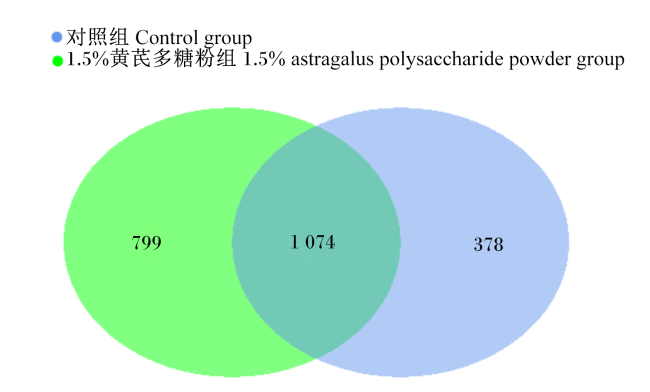
图1 湖羊瘤胃体外发酵微生物区系维恩图

Fig.1 Venn diagram of rumen fermentation microflora of Hu sheep in vitro

2.5.2 湖羊瘤胃体外发酵微生物区系α多样性分析

图2所示,与对照组相比,1.5%黄芪多糖粉组湖羊瘤胃体外发酵微生物区系的Chao1指数、可观测OTU数、Shannon指数和Simpson指数均显著提高(P<0.05),表明饲粮中添加1.5%黄芪多糖粉可以提高湖羊瘤胃体外发酵微生物区系丰富度和多样性。
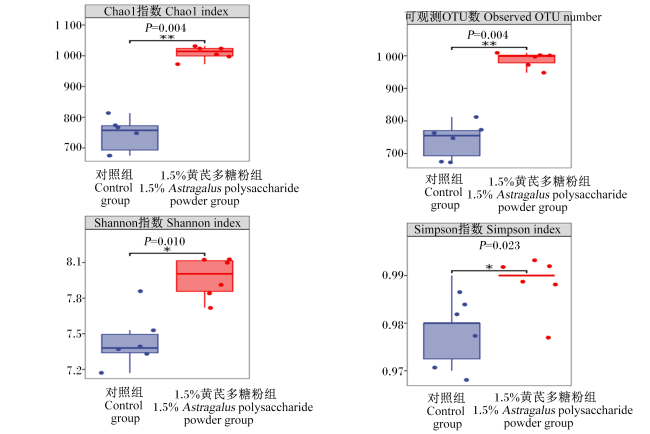
图2 湖羊瘤胃体外发酵微生物区系α多样性

*表示差异显著(P<0.05),**表示差异极显著P<0.05)。

Fig.2 Alpha diversity of rumen fermentation microflora of Hu sheep in vitro

* mean significant difference (P<0.05), ** mean extremely significant difference (P<0.05).

2.5.3 湖羊瘤胃体外发酵微生物区系主坐标分析(PCoA)

图3所示,在OTU水平上基于加权Unifrac距离的PCoA结果表明,主坐标1(PC1)和主坐标2(PC2)2个主坐标的贡献值分别为48.45%和33.43%。同时,对照组和1.5%黄芪多糖粉组湖羊瘤胃体外发酵微生物区系存在明显的区分,说明添加1.5%黄芪多糖对瘤胃菌群整体结构和多样性产生了明显的影响。
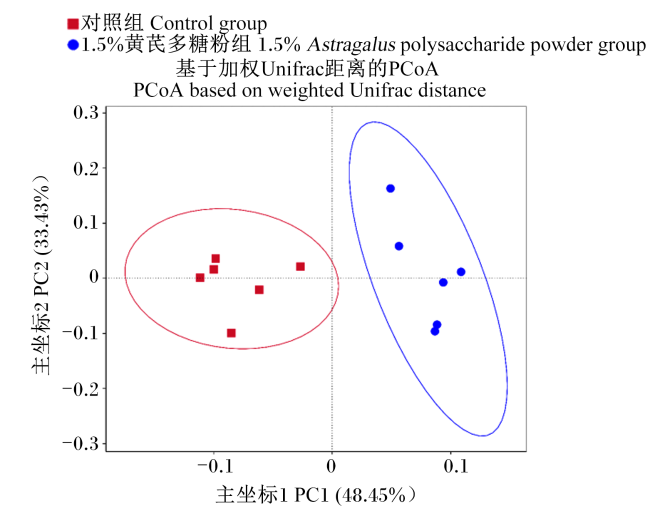
图3 湖羊瘤胃体外发酵微生物区系PCoA

Fig.3 PCoA of rumen fermentation microflora of Hu sheep in vitro

2.5.4 湖羊瘤胃体外发酵微生物区系组成分析

图4-A所示,在门水平上,湖羊瘤胃体外发酵微生物区系中拟杆菌门(Bacteroidota)、厚壁菌门(Firmicutes)和广古菌门(Euryarchaeota)是主要菌门,其相对丰度在对照组和1.5%黄芪多糖粉组所有菌群中所占比例达92%以上。与对照组相比,1.5%组黄芪多糖粉组广古菌门、脱硫杆菌门(Desulfobacterota)和放线菌门(Actinobacteriota)相对丰度显著提高(P<0.05),螺旋体门(Spirochaetota)、变形菌门(Proteobacteria)和纤维杆菌门(Fibrobacterota)相对丰度显著降低(P<0.05)。
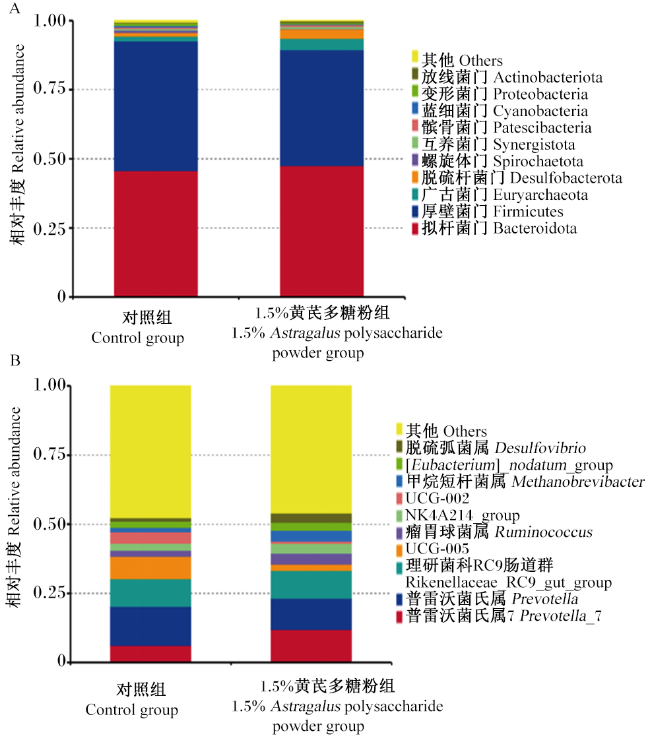
图4 湖羊瘤胃体外发酵微生物区系在门水平(A)和属水平(B)上的组成

Fig.4 Composition of rumen fermentation microflora at phylum (A) and genus (B) levels of Hu sheep in vitro

图4-B所示,在属水平上,湖羊瘤胃体外发酵微生物区系中普雷沃氏菌属(Prevotella)和理研菌科RC9肠道群(Rikenellaceae_RC9_gut_group)在2组中相对丰度均较高,为瘤胃菌群主要菌属;除此之外,对照组UCG-005相对丰度较高。与对照组相比,1.5%黄芪多糖粉组瘤胃球菌属(Ruminococcus)、甲烷短杆菌属(Methanobrevibacter)和脱硫弧菌属(Desulfovibrio)相对丰度显著提高(P<0.05),UCG-005和UCG-002相对丰度显著降低(P<0.05)。

2.5.5 湖羊瘤胃体外发酵微生物区系线性判别分析(LDA)效应大小(LEfSe)分析

图5所示,LEfSe分析结果表明(LDA得分>4),在湖羊瘤胃体外发酵微生物区系中,对照组有8个明显不同的优势微生物类群,主要是颤螺菌目(Oscillospirales)、颤螺菌科(Oscillospiraceae)、梭菌纲(Clostridia)、瘤胃菌属(UCG-005和UCG-002)以及Eubacterium_coprostanoligenes_group等;1.5%黄芪多糖粉组有12个明显不同的优势微生物类群,主要是甲烷短杆菌属、广古菌门、克里斯滕森菌科(Christensenellaceae)和克里斯滕森菌目(Christensenellales)等。
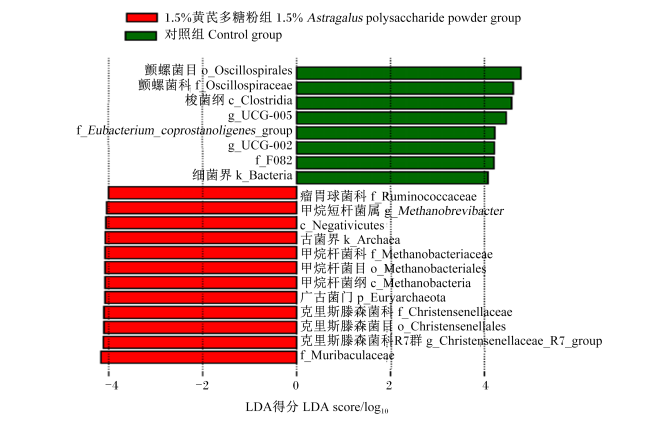
图5 湖羊瘤胃体外发酵微生物区系LEfSe分析

Fig.5 LEfSe analysis of rumen fermentation microflora of Hu sheep in vitro

3 讨论

3.1 黄芪多糖粉对湖羊瘤胃体外发酵产气量及甲烷产量的影响

在反刍动物瘤胃中,微生物通过降解饲粮中的碳水化合物产生气体,主要包括甲烷和CO2[24]。产气量是反映饲粮降解程度和微生物活性的关键指标[25-26],产气量的增加与发酵底物的降解速率和微生物的活性呈正相关[27]。饲粮的降解程度越高,表明瘤胃中微生物的活性就越高,产气量也越大。本试验中,发酵12 h时,1.5%黄芪多糖粉组产气量显著高于对照组,说明黄芪多糖粉在该添加比例下对瘤胃发酵的促进作用最强,这可能是因为黄芪多糖作为植物性多糖添加到饲料中,提高了发酵底物中的非结构性碳水化合物水平,这些碳水化合物在瘤胃中被微生物利用进行发酵产生大量气体,导致产气量增加。
本试验在湖羊瘤胃体外发酵中添加1.5%黄芪多糖粉后,甲烷短杆菌属相对丰度显著提高。黄芪多糖是一种可被微生物利用的多糖类物质,添加黄芪多糖可提供更多可发酵的碳源,并提供额外的营养和能量,从而促进微生物特别是产甲烷菌活性的提高,这些微生物利用黄芪多糖进行代谢,代谢产生更多的氢气(H2)和CO2,这些都是甲烷短杆菌属合成甲烷的前体物质[28]。有研究表明,植物性添加物可以通过调节瘤胃微生物群,利用饲粮与微生物的相互作用调节发酵动力学和甲烷生成[29]。甲烷短杆菌属的相对丰度与甲烷产量呈正相关。由此可见,黄芪多糖的添加提高了整个湖羊瘤胃体外发酵过程的效率,促进了微生物的代谢,特别是提高了产甲烷菌的活性,导致有机物被更充分地分解,增强了对营养物质的消化代谢,同时也提高了甲烷产量。

3.2 黄芪多糖粉对湖羊瘤胃体外发酵参数的影响

瘤胃发酵参数能够综合反映瘤胃内的发酵状况和环境变化。反刍动物维持正常瘤胃生理的pH范围为5.5~7.0[20]。本试验中,体外发酵液pH的在6.05~6.19,在正常范围内,这表明黄芪多糖的添加不会对瘤胃内环境稳态造成破坏,有利于微生物的生长和代谢。NH3-N含量是瘤胃内环境是否稳定的关键指标,适宜的NH3-N有利于瘤胃发酵,若NH3-N含量过高,瘤胃微生物从氮源中释放氨的速率超过微生物合成蛋白质的速率,就会增加瘤胃氮循环中氮的损失;而低含量的NH3-N则会限制纤维素分解菌分解纤维素的效率[30]。NH3-N是微生物蛋白合成的氮源,瘤胃内适宜NH3-N含量为6~30 mg/dL[31]。本试验中,各组NH3-N含量均处于适宜范围内,且1.5%黄芪多糖粉组NH3-N含量显著低于对照组,这说明添加一定比例的黄芪多糖可促进瘤胃微生物对氮的利用,对瘤胃发酵有促进作用。研究表明,饲粮中黄芪多糖添加量的提高相应地降低了绵羊瘤胃中NH3-N的含量,且蛋白质降解率随着黄芪多糖添加量的提高而提高[13]。这个结果也与本试验中1.5%黄芪多糖粉组粗蛋白质降解率显著高于对照组的结果一致。
瘤胃是反刍动物消化活动的主要场所,反刍动物瘤胃中的微生物发酵碳水化合物可产生挥发性脂肪酸[32],如乙酸、丙酸和丁酸(占据了TVFA的95%)。同时,挥发性脂肪酸为反刍动物提供了70%~80%的能量需求,是瘤胃微生物发酵过程的重要指标[33]。研究发现,提高黄芪植物提取物的添加比例可线性提高瘤胃中TVFA含量和丙酸的摩尔比例,但会降低乙酸的摩尔比例和乙酸/丙酸值[34]。在本试验中,饲粮中添加1.5%黄芪多糖粉显著提高了体外发酵液丙酸的摩尔比例。丙酸是反刍动物体内主要的糖异生物质,当丙酸比例较高时,可在一定程度上为反刍动物提供较高的有效能量[35]。由此说明,饲粮中添加一定比例的黄芪多糖可以改善动物的瘤胃发酵过程,使其向丙酸型发酵转变,从而提高能量的利用效率。

3.3 黄芪多糖粉对湖羊瘤胃体外发酵营养物质降解率的影响

营养物质降解率是一种衡量瘤胃内微生物对饲粮降解程度的指标,它反映了植物纤维等难以消化的食物在瘤胃中被分解的效率,同时饲粮的营养价值与其可被消化的营养物质含量成正相关[36]。黄芪多糖粉中氨基酸、维生素和微量元素等含量较高,都可能对动物的生长发育起到一定的促进作用[37]。冯会利等[38]研究表明,在断奶羔羊饲粮中添加0.2 g/kg的黄芪多糖可以提高断奶羔羊的生长性能,改善血液生化指标,并提高免疫力。Deng等[9]使用体外发酵法研究不同浓度的黄芪提取物对体外发酵营养物质降解率的影响发现,添加黄芪提取物显著提高了干物质降解率。还有研究表明,在体外条件下,黄芪多糖的添加对粗蛋白质降解率有显著提升作用,且随着添加量的增加呈现出一定的剂量效应[8]。本研究中,1.5%黄芪多糖粉组粗蛋白质降解率显著高于其他4组,可能是因为黄芪多糖可以促进瘤胃微生物的生长和活性,从而提高对饲粮的降解效率,加快微生物蛋白的合成[39]。黄芪中的多糖类生物活性成分是促进这种效应的关键因素,这些多糖类成分通过刺激微生物的代谢活动,促进微生物蛋白的合成,这进一步提高了饲粮的利用率和反刍动物的营养吸收能力,这种改善作用不仅有助于提高饲粮的转化效率,还可能对反刍动物的生长性能和健康状况产生积极影响。
此外,本试验采用MFAEI评价了黄芪多糖粉对湖羊瘤胃体外发酵影响的组合效应,结果表明,1.5%黄芪多糖粉组MFAEI最高,即饲粮中添加1.5%黄芪多糖对湖羊瘤胃体外发酵的效果较好。

3.4 黄芪多糖粉对湖羊瘤胃体外发酵微生物区系的影响

瘤胃内的微生物对反刍动物的消化和营养吸收起着至关重要的作用。这些微生物包括原虫、细菌和真菌,它们在瘤胃内形成了稳定的生态环境[40]。瘤胃微生物通过相互协同和制约作用,将饲粮中的纤维等难以消化的物质转化为反刍动物可以利用的营养物质,如挥发性脂肪酸和氨基酸等。微生物的种类和比例对于营养物质的利用效率具有重要影响[41]。在反刍动物瘤胃内,厚壁菌门和拟杆菌门是占主导地位的菌群,它们对瘤胃内的发酵过程至关重要,不仅能有效降解饲粮中的纤维素和蛋白质,还能促进挥发性脂肪酸(如乙酸、丙酸和丁酸)的生成,为反刍动物提供重要的能量来源[42]。本试验结果显示,湖羊瘤胃体外发酵微生物区系中的主要菌门为拟杆菌门、厚壁菌门和广古菌门,这三类菌群共同占据了瘤胃菌群总量的92%以上,这一结果与上述研究结果一致。饲粮营养成分对改善瘤胃微生物多样性和群落结构也有显著影响。王胜男等[43]研究表明,饲粮添加岩藻多糖后,羔羊瘤胃微生物多样性并没有发生明显的变化,这与本试验结果不同,这种差异可能是由于多糖的添加量和种类,以及试验羊的品种和年龄的不同而产生的。本试验中,饲粮中添加1.5%黄芪多糖粉提高了瘤胃球菌属相对丰度,同时降低了变形菌门和纤维杆菌门相对丰度。Shao等[12]研究表明,添加黄芪粉提高了瘤胃球菌属和普雷沃氏菌属相对丰度,瘤胃球菌属和普雷沃氏菌属在瘤胃微生物群落中发挥着不可或缺的作用,它们参与了纤维素、半纤维素和蛋白质的消化代谢过程,并与其他消化道细菌协同作用,促进营养物质的生物降解。普雷沃氏菌是瘤胃中最为丰富的蛋白质降解菌,主要负责蛋白质的分解、肽的吸收以及相关的发酵过程,对瘤胃的蛋白质代谢和营养供应起着关键作用;普雷沃氏菌属还具有发酵淀粉和蛋白质的能力,能够生成丙酸和琥珀酸,这些代谢产物不仅参与了瘤胃内的能量转换过程,还为宿主提供了重要的能量来源[44]。本试验中,在属水平上,湖羊瘤胃体外发酵微生物区系中普雷沃氏菌属为优势菌属,且1.5%组黄芪多糖粉组普雷沃氏菌属相对丰度较对照组有所提高,这说明黄芪多糖的添加有助于该菌属的生长,这也与本次试验中1.5%组黄芪多糖粉组粗蛋白质降解率显著高于对照组的结果相一致。

4 结论

在体外发酵条件下,饲粮中添加1.5%黄芪多糖粉可以提高湖羊瘤胃发酵产气量和甲烷产量,并提高粗蛋白质降解率、TVFA含量以及丙酸摩尔比例,降低NH3-N含量,改善瘤胃微生物区系结构。
[1]
YU Q P, FENG D Y, XIA M H, et al. Effects of a traditional Chinese medicine formula supplementation on growth performance,carcass characteristics,meat quality and fatty acid profiles of finishing pigs[J]. Livestock Science, 2017, 202:135-142.

[2]
HOSSD K, KURAMOTO K, ERUDEN B, et al. The effects of three herbs as feed supplements on blood metabolites,hormones,antioxidant activity,IgG concentration,and ruminal fermentation in Holstein steers[J]. Asian-Australasian Journal of Animal Sciences, 2005, 19(1):35-41.

[3]
DU Y, WAN H T, HUANG P, et al. A critical review of Astragalus polysaccharides:from therapeutic mechanisms to pharmaceutics[J]. Biomedicine & Pharmacotherapy, 2022, 147:112654.

[4]
SONG X Z, LUO J R, FU D B, et al. Traditional Chinese medicine prescriptions enhance growth performance of heat stressed beef cattle by relieving heat stress responses and increasing apparent nutrient digestibility[J]. Asian-Australasian Journal of Animal Sciences, 2014, 27(10):1513-1520.

DOI PMID

[5]
孙超, 原雪峰, 暴丽梅, 等. 中草药黄芪饲料添加剂在畜禽养殖业中的应用研究进展[J]. 饲料研究, 2022, 45(16):154-156.

SUN C, YUAN X F, BAO L M, et al. Research progress on application of Chinese herbal medicine Astragalus as feed additive in livestock and poultry breeding industry[J]. Feed Research, 2022, 45(16):154-156. (in Chinese)

[6]
LIU J S, LIU J, LIU L, et al. The gut microbiota alteration and the key bacteria in Astragalus polysaccharides (APS)-improved osteoporosis[J]. Food Research International, 2020, 138(Pt B):109811.

[7]
QIAO G H, ZHOU X H, LI Y, et al. Effect of several supplemental Chinese herbs additives on rumen fermentation,antioxidant function and nutrient digestibility in sheep[J]. Journal of Animal Physiology and Animal Nutrition, 2012, 96(5):930-938.

[8]
李翌, 聂春桃, 兰剑, 等. 日粮中添加黄芪多糖对锦江黄牛瘤胃体外发酵及养分降解率的影响[J]. 中国牛业科学, 2023, 49(2):46-49,53.

LI Y, NIE C T, LAN J, et al. Effects of dietary addition of Astragalus polysaccharide on in vitro fermentation and nutrient degradation rate of rumen of Jinjiang yellow cattle[J]. China Bovine Science, 2023, 49(2):46-49,53. (in Chinese)

[9]
DENG D, WANG J, REN L, et al. The effect of different doses of Astragalus root extract on in vitro rumen fermentation of steam-flaked maize grains used as an only substrate[J]. Journal of Animal and Feed Sciences, 2007,16 (Suppl.2):172-177.

[10]
桂文龙, 李巨银, 苏治国. 黄芪多糖对湖羊生长性能、血清生化指标及免疫功能的影响[J]. 饲料研究, 2023, 46(12):13-16.

GUI W L, LI J Y, SU Z G. Effect of Astragalus polysaccharide on growth performance,serum biochemistry indexes and immunity function of Hu sheep[J]. Feed Research, 2023, 46(12):13-16. (in Chinese)

[11]
陈华. 黄芪多糖对羔羊生长性能及抗氧化功能的影响[J]. 现代畜牧兽医, 2022(8):31-34.

CHEN H. Effect of Astragalus polysaccharides on growth performance and antioxidant function of lambs[J]. Modern Journal of Animal Husbandry and Veterinary Medicine, 2022(8):31-34. (in Chinese)

[12]
SHAO P Y, SHA Y Z, LIU X, et al. Supplementation with Astragalus root powder promotes rumen microbiota density and metabolome interactions in lambs[J]. Animals, 2024, 14(5):788.

[13]
ZHONG R Z, YU M, LIU H W, et al. Effects of dietary Astragalus polysaccharide and Astragalus membranaceus root supplementation on growth performance,rumen fermentation,immune responses,and antioxidant status of lambs[J]. Animal Feed Science and Technology, 2012, 174(1/2):60-67.

[14]
张宏福. 动物营养参数与饲养标准[M].2版. 北京: 中国农业出版社, 2010.

ZHANG H F. Nutrition parameters and feeding standard for animals[M].2nd ed. Beijing: China Agriculture Press, 2010. (in Chinese)

[15]
MENKE K H, RAAB L, SALEWSKI A, et al. The es-timation of the digestibility and metabolizable energy content of ruminant feeding stuffs from the gas pro-duction when they are incubated with rumen liquor in vitro[J]. The Journal of Agricultural Science, 1979, 93(1):217-222.

[16]
GUO Y, CHEN X, GONG P, et al. Advances in the in vitro digestion and fermentation of polysaccharides[J]. International Journal of Food Science & Technology, 2021, 56(10):4970-4982.

[17]
AOAC International. Official methods of analysis of AOAC international[M]. Virginia: AOAC International, 1995.

[18]
VAN SOEST P J, ROBERTSON J B, LEWIS B A. Methods for dietary fiber,neutral detergent fiber,and nonstarch polysaccharides in relation to animal nutrition[J]. Journal of Dairy Science, 1991, 74(10):3583-3597.

[19]
MAURICIO R M, MOULD F L, DHANOA M S, et al. A semi-automated in vitro gas production technique for ruminant feedstuff evaluation[J]. Animal Feed Science and Technology, 1999, 79(4):321-330.

[20]
AHMED E, FUKUMA N, HANADA M, et al. The Efficacy of plant-based bioactives supplementation to different proportion of concentrate diets on methane production and rumen fermentation characteristics in vitro[J]. Animals, 2021, 11(4):1029.

[21]
张然, 郑琛, 韩海珠, 等. 应用Rusitec-S系统研究甘露寡糖对绵羊体外瘤胃发酵的影响[J]. 草业科学, 2018, 35(9):2262-2269.

ZHANG R, ZHENG C, HAN H Z, et al. Effect of mannan oligosaccharides on ruminal fermentation of sheep in an in vitro Rusitec-S system[J]. Pratacultural Science, 2018, 35(9):2262-2269. (in Chinese)

[22]
BRODERICK G A, KANG J H. Automated simultaneous determination of ammonia and total amino acids in ruminal fluid and in vitro media[J]. Journal of Dairy Science, 1980, 63(1):64-75.

[23]
杨梓曼, 聂春桃, 尚相龙, 等. 日粮中添加广藿香油对肉牛瘤胃体外发酵特性的影响[J]. 饲料工业, 2022, 43(15):50-54.

YANG Z M, NIE C T, SHANG X L, et al. Effect of dietary supplementation of patchouli oil on rumen fermentation in beef cattle in vitro[J]. Feed Industry, 2022, 43(15):50-54. (in Chinese)

[24]
何洪浪, 马政发, 郭子義, 等. 体外产气法评价刺梨果渣对肉羊瘤胃体外发酵参数的影响[J]. 饲料工业, 2024, 45(7):68-73.

HE H L, MA Z F, GUO Z Y, et al. Effect of Rosa roxburghii Tratt. residue on in vitro rumen fermentation parameters of goats using gas production technology[J]. Feed Industry, 2024, 45(7):68-73. (in Chinese)

[25]
吴征敏, 彭苏, 王志敬, 等. 添加乳酸菌和纤维素酶对菠萝渣青贮发酵品质和体外发酵的评价[J]. 动物营养学报, 2022, 34(12):7981-7992.

DOI

WU Z M, PENG S, WANG Z J, et al. Evaluation of lactic acid bacteria and cellulase on silage fermentation quality and fermentation in vitro of pineapple residue[J]. Chinese Journal of Animal Nutrition, 2022, 34(12):7981-7992. (in Chinese)

[26]
LAN W, YANG C L. Ruminal methane production:associated microorganisms and the potential of applying hydrogen-utilizing bacteria for mitigation[J]. Science of the Total Environment, 2019, 654:1270-1283.

[27]
MAIA M R G, FONSECA A J M, OLIVEIRA H M, et al. The potential role of seaweeds in the natural manipulation of rumen fermentation and methane production[J]. Scientific Reports, 2016, 6:32321.

DOI PMID

[28]
SHUI P W, WEN J W, ZHI L T, et al. Effect of traditional Chinese medicine compounds on rumen fermentation,methanogenesis and microbial flora in vitro[J]. Animal Nutrition, 2019, 5(2):185-190.

[29]
HASSAN F U, ARSHAD M A, EBEID H M, et al. Phytogenic additives can modulate rumen microbiome to mediate fermentation kinetics and methanogenesis through exploiting diet-microbe interaction[J]. Frontiers in Veterinary Science, 2020, 7:575801.

[30]
CORREDDU F, NUDDA A, BATTACONE G, et al. Effects of grape seed supplementation,alone or associated with linseed,on ruminal metabolism in Sarda dairy sheep[J]. Animal Feed Science and Technology, 2015, 199:61-72.

[31]
YU J K, CAI L Y, ZHANG J C, et al. Effects of thymol supplementation on goat rumen fermentation and rumen microbiota in vitro[J]. Microorganisms, 2020, 8(8):1160.

[32]
CHENG Y N, TIAN S L, CHEN Y, et al. Structural characterization and in vitro fermentation properties of polysaccharides from Polygonatum cyrtonema[J]. International Journal of Biological Macromolecules, 2024,258, Part 1:128877.

[33]
WANAPAT M, KANG S, POLYORACH S. Development of feeding systems and strategies of supplementation to enhance rumen fermentation and ruminant production in the tropics[J]. Journal of Animal Science and Biotechnology, 2013, 4(1):32.

DOI PMID

[34]
CHE D S, ADAMS S, WEI C, et al. Effects of Astragalus membranaceus fiber on growth performance,nutrient digestibility,microbial composition,VFA production,gut pH,and immunity of weaned pigs[J]. MicrobiologyOpen, 2019, 8(5):e00712.

[35]
WANG J, ZHANG Z, LIU H, et al. Evaluation of gas production,fermentation parameters,and nutrient degradability in different proportions of sorghum straw and ammoniated wheat straw[J]. Fermentation, 2022, 8(8):415.

[36]
HERVÁS G, BOUSSALIA Y, LABBOUZ Y, et al. Insect oils and chitosan in sheep feeding:effects on in vitro ruminal biohydrogenation and fermentation[J]. Animal Feed Science and Technology, 2022, 285:115222.

[37]
CHEN G M, JIANG N, ZHENG J P, et al. Structural characterization and anti-inflammatory activity of polysaccharides from Astragalus membranaceus[J]. International Journal of Biological Macromolecules, 2023, 241:124386.

[38]
冯会利, 王海棚, 刘守铉, 等. 日粮中添加黄芪多糖对断奶羔羊生长性能、血液生化指标及免疫力的影响[J]. 饲料研究, 2021, 44(2):23-26.

FENG H L, WANG H P, LIU S X, et al. Effect of Astragalus polysaccharides in diets on growth performance,blood biochemical indexes and immunity of weaned lambs[J]. Feed Research, 2021, 44(2):23-26. (in Chinese)

[39]
LI Y, GUO S, ZHU Y, et al. Flowers of Astragalus membranaceus var. mongholicus as a novel high potential by-product:phytochemical characterization and antioxidant activity[J]. Molecules, 2019, 24(3):434.

[40]
MAO H L, ZHANG Y F, YUN Y, et al. Weaning age affects the development of the ruminal bacterial and archaeal community in Hu lambs during early life[J]. Frontiers in Microbiology, 2021, 12:636865.

[41]
MAHMOUDI-ABYANE M, ALIPOUR D, MOGHIMI H R. Effects of different sources of nitrogen on performance,relative population of rumen microorganisms,ruminal fermentation and blood parameters in male feedlotting lambs[J]. Animal, 2020, 14(7):1438-1446.

[42]
MAO H L, JI W W, YUN Y, et al. Influence of probiotic supplementation on the growth performance,plasma variables,and ruminal bacterial community of growth-retarded lamb[J]. Frontiers in Microbiology, 2023, 14:1216534.

[43]
王胜男, 杨伟光, 尹福泉. 岩藻多糖对断奶羔羊瘤胃微生物区系及代谢组学的影响[J]. 动物营养学报, 2023, 35(3):1827-1840.

DOI

WANG S N, YANG W G, YIN F Q. Effects of fucoidan on rumen microbiota and metabolomics of weaned lambs[J]. Chinese Journal of Animal Nutrition, 2023, 35(3):1827-1840. (in Chinese)

[44]
ABDALLAH A, ZHANG P, ABUBAKARI A H, et al. Reclamation of Astragalus by-product through dietary inclusion in ruminant diets:effects on growth performance,nutrient digestibility,rumen fermentation,blood biochemical parameters,and humoral immune response in sheep[J]. Evidence-Based Complementary and Alternative Medicine, 2019, 2019:8530961.

文章导航

/