研究论文

饲料中添加丁酸梭菌对珍珠龙胆石斑鱼生长性能以及肠道抗氧化能力、菌群及代谢的影响

  • 陈伟军 , 1, 2 ,
  • 陈铭钒 1, 2 ,
  • 李栋 1, 2 ,
  • 宋涛 1, 2 ,
  • 张海涛 3 ,
  • 叶继丹 , 1, 2, *
展开
  • 1 集美大学水产学院,厦门 361021
  • 2 厦门市饲料检测与安全评价重点实验室,厦门 361021
  • 3 恒兴智慧农业发展(广州)有限公司,广州 511453
* 叶继丹,研究员,博士生导师,E-mail:

陈伟军(1984—),男,广东汕尾人,博士研究生,研究方向为水产动物营养与饲料。E-mail:

Copy editor: 陈鑫

收稿日期: 2024-08-26

  网络出版日期: 2025-04-15

基金资助

国家自然科学基金(32072990)

国家自然科学基金(31772861)

Effects of Dietary Clostridium butyricum Addition on Growth Performance, Intestinal Antioxidant Capacity, Microbiota and Metabolism of Hybrid Grouper

  • CHEN Weijun , 1, 2 ,
  • CHEN Mingfan 1, 2 ,
  • LI Dong 1, 2 ,
  • SONG Tao 1, 2 ,
  • ZHANG Haitao 3 ,
  • YE Jidan , 1, 2, *
Expand
  • 1 Fisheries College, Jimei University, Xiamen 361021, China
  • 2 Xiamen Key Laboratory for Feed Quality Testing and Safety Evaluation, Xiamen 361021, China
  • 3 Evergreen Intelligent Agriculture (Guangzhou) Development Co., Ltd., Guangzhou 511453, China
* professor, E-mail:

Received date: 2024-08-26

  Online published: 2025-04-15

摘要

为了研究饲料中添加丁酸梭菌对珍珠龙胆石斑鱼生长性能和肠道健康的影响,将225尾健康珍珠龙胆石斑鱼[平均体重(24.89±0.02) g/尾]随机分成3组,分别饲喂基础饲料(CON组)、基础饲料中分别添加2种不同来源的丁酸梭菌菌株(CB1组、CB2组)的试验饲料,饲料中丁酸梭菌浓度均为107 CFU/g。每组3个重复,每个重复25尾鱼。试验期为56 d。结果表明: 与CON组相比,CB1、CB2组珍珠龙胆石斑鱼的生长性能没有显著改善(P>0.05),但显著提高了肠道谷胱甘肽过氧化物酶、超氧化物歧化酶活性和总短链脂肪酸含量(P<0.05)。与CON组相比,CB2组肠道黏膜褶皱高度和肌层厚度显著提高(P<0.05),且肠道丙二醛的含量显著降低(P<0.05);与CON组相比,CB2组的优势菌门由变形菌门变为厚壁菌门,且厚壁菌门和拟杆菌门的相对丰度有所提高,变形菌门和放线菌门的相对丰度有所下降;CB2组的主要优势菌属由假单胞菌属变成乳杆菌属,且乳杆菌属的相对丰度明显增加;CB2组与CON组进行肠道代谢组学比对分析,共筛选到184个差异代谢物,其中,数量最多的差异代谢物是脂类代谢物,在这些脂类代谢物中以表达上调的鞘脂和磷脂居多。通过KEGG富集分析,共富集到5条代谢通路:淀粉和蔗糖代谢、半乳糖代谢、ABC转运蛋白、不饱和脂肪酸的生物合成、亚油酸代谢。综上所述,丁酸梭菌改善了肠道菌群结构,促进糖、脂代谢和提高糖、脂利用率,并调节了肠道渗透压,从而提高了肠道抗氧化能力,进而维持了肠道健康。

本文引用格式

陈伟军 , 陈铭钒 , 李栋 , 宋涛 , 张海涛 , 叶继丹 . 饲料中添加丁酸梭菌对珍珠龙胆石斑鱼生长性能以及肠道抗氧化能力、菌群及代谢的影响[J]. 动物营养学报, 2025 , 37(4) : 2558 -2575 . DOI: 10.12418/CJAN2025.215

Abstract

To investigate the effects of adding Clostridium butyricum to the diet on the growth performance and intestinal health of hybrid grouper, 225 healthy juveniles [average body weight (24.89±0.02) g/fish] were randomly divided into 3 groups and fed a basal diet (CON group), and the experimental diets with two different sources of Clostridium butyricum strains (CB1 group and CB2 group) added to the basal diet, respectively. The concentration of Clostridium butyricum in the diet was 107 CFU/g for all groups. Each group had 3 replicates, with 25 fish in each replicate. The experimental period was 56 days. The results showed that compared with CON group, the growth performance of hybrid grouper in CB1 and CB2 groups was not significantly improved (P>0.05), but the gut glutathione peroxidase, superoxide dismutase activities and total short-chain fatty acid content were significantly increased (P<0.05). Compared with CON group, height of mucosal folds and muscle thickness in CB2 group were significantly increased (P<0.05), and intestinal malondialdehyde content was significantly decreased (P<0.05). Compared to CON group, the dominant phylum bacteria in the CB2 group shifted from Proteobacteria to Firmicutes, with an increase in the relative abundance of Firmicutes and Bacteroidetes, and decreased relative abundance of Proteobacteria and Actinobacteriota; the dominant genus bacteria in the CB2 group shifted from Pseudomonas to Lactobacillus, with an increase in the relative abundance of Lactobacillus. Metabolomics results showed that 184 differential metabolites were identified in the comparison of CON and CB2 groups. The most abundant differential metabolites were lipid metabolites, with the majority of up-regulated lipid metabolites being upregulated sphingolipids and phospholipids. The differential metabolites were enriched into five pathways, i.e. starch and sucrose metabolism, galactose metabolism, ABC transporters, biosynthesis of unsaturated fatty acids, and linoleic acid metabolism. The results indicate that Clostridium butyricum can improve the structure of intestinal microbiota, promote glucose and lipid metabolism and their utilization, and regulate intestinal osmotic pressure, thereby enhancing intestinal antioxidant capacity and maintaining the intestinal health of fish.

珍珠龙胆石斑鱼又称龙虎斑或珍珠斑,是用棕点石斑鱼(E. fuscoguttatus ♀)和鞍带石斑鱼(E. lanceolatus♂)进行杂交而培育出来的品种,具有抗病力强、生长速度快等优点,已成为我国重要的石斑鱼养殖品种[1-2]。根据《2024年中国渔业统计年鉴》统计,2023年我国石斑鱼年养殖量达到214 480 t[3],位居我国海水养殖鱼类产量前列,按塘头价计算养殖石斑鱼的产值超过百亿元,是继大黄鱼之后海水鱼养殖产值超百亿元的海水养殖鱼类。随着石斑鱼的规模化和集约化养殖的快速发展,石斑鱼的养殖健康问题日益突出,尤其是肠道细菌性疾病,如鱼肠道致病菌鳗弧菌(Vibrio anguillarum)、爱德华氏菌(Edwardsiella tarda)、嗜水气单胞菌(Aeromonas hydrophila)的危害巨大[4],面对病害频发问题,抗菌素仍是疾病防控的重要手段,然而抗菌素的过度使用不仅会加剧致病菌的抗药性问题,降低抗菌素药效,残留药物及其代谢产物还可能对环境和人体健康带来危害[5-6]。实施禁抗的前提是开发出高效替抗品,因此,大力开发和应用替抗品成为当前水产养殖最为紧迫的任务之一。
益生菌作为肠道功能性物质在防控鱼类疾病、促进鱼体健康方面有着巨大的应用前景。丁酸梭菌(Clostridium butyricum),又名酪酸菌,属梭菌属(Clostridium),专性厌氧的G+芽孢杆状菌,广泛分布于人和动物肠道、粪便和土壤中。由于该菌能产生内生芽孢,使得其具有较强的耐热、耐酸碱、耐胆酸盐等抗逆性,可在25~37 ℃、pH 5.2~9.0下生长良好[7]。丁酸梭菌在肠道内能分泌短链脂肪酸、B族维生素、消化酶等生物活性物质,起到良好的整肠作用[8],还可以黏附于肠道上皮细胞,竞争附着位点,促进乳酸菌、双歧杆菌等有益菌的增殖,抑制病原菌的生长,调节肠道微生物菌群平衡[9],从而抑制肠炎、修复肠上皮以及减少致病菌侵袭等积极作用[10]。正是由于上述诸多的优良特性,才使得丁酸梭菌成为极具潜力的饲用益生菌。
目前丁酸梭菌作为益生菌应用于养殖鱼类已有很多的研究报道,其中,以改善生长性能为目的报道较多,如饲料中添加丁酸梭菌均显著提高银鲳(Pampus argenteus)[11]、七彩神仙鱼(S. aequifasciata)[12]、尼罗罗非鱼(Oreochromis niloticus)[13]、奥利罗非鱼(O. niloticus×O.aureus)[14]的增重率和饲料利用率。鮸鱼(Miichthys miiuy)的增重率和饲料利用率随着丁酸梭菌在饲料中添加剂量的增加(103~109 CFU/g)而增加,并在109 CFU/g时达到峰值[15]。尽管2个试验中使用的剂量不同(4×105或1×108 CFU/g),但饲喂结果均表明饲料中添加丁酸梭菌能促进珍珠龙胆石斑鱼的生长速度和饲料利用率[8,16]。但丁酸梭菌在改善肠道健康方面的报道较少。最近的研究表明,饲料中添加丁酸梭菌明显增加奥利罗非鱼前肠绒毛高度并减少肠道大肠杆菌数量[14]。饲料中添加丁酸梭菌提高了大黄鱼(Larimichthys crocea)幼鱼肠绒毛高度、肠细胞高度和肌层厚度,并增加了闭锁小带蛋白-2(ZO-2)的表达量[17]。Meng等[18]的研究发现,饲料中添加1×10⁷ CFU/g丁酸梭菌提高了鲤鱼(Cyprinus carpio L.)肠道丁酸、丙酸的含量,改善肠道结构,同时抑制气单胞菌、弧菌和假单胞菌等致病菌的增殖。此外,丁酸梭菌对养殖鱼类的免疫促进和抗氧化能力的增强作用也做了一些研究[19-23]。综上所述,虽然已有应用该菌改善包括珍珠龙胆石斑鱼在内的养殖鱼类生长性能、机体抗氧化、免疫和肠道健康的相关报道,但丁酸梭菌在调节养殖鱼类肠道菌群、肠道代谢和免疫功能中的作用机制还不够充分。因此,本研究以珍珠龙胆石斑鱼为研究对象,运用微生物组学和代谢组学方法分析饲料中添加丁酸梭菌对珍珠龙胆石斑鱼肠道微生物菌群、肠道内容物代谢物丰度的影响,阐明丁酸梭菌在珍珠龙胆石斑鱼肠道代谢中的调控作用,为丁酸梭菌在石斑鱼配合饲料中的合理应用提供科学依据。

1 材料与方法

1.1 试验菌株

由于丁酸梭菌菌株来源不同,对鱼类生长性能和肠道健康的影响可能有所不同[23]。为了获得不同菌株的应用效果,本试验使用2种不同来源的丁酸梭菌菌株:HJCB998菌株(从健康陆生动物肠道分离筛选)和DBNDS3菌株(从健康鱼类肠道分离筛选)。菌株的产品形态为菌粉,前者菌粉中的活菌浓度为109 CFU/g,后者菌粉中活菌浓度为109 CFU/g。

1.2 试验饲料

饲料原料使用超细粉碎机(ZFJ-300,江苏省江阴市睿宗机械制造有限公司)粉碎处理后,过60目筛。将各种饲料原料按饲料配方进行混合,搅拌均匀,用双螺旋杆挤条机(F-76,广东华工光机电科技有限公司)和造粒机(GY-500,江苏省常州市倍成干燥设备工程有限公司)制成粒径为2.5和5.0 mm的颗粒料。湿颗粒料在55 ℃电热鼓风干燥箱(WGL-625B,天津市泰斯特仪器有限公司)中干燥24 h,使饲料水分含量降至10%以下,冷却后装袋并保存于-20 ℃冰箱中备用。基础饲料组成及营养水平见表1
表1 基础饲料组成及营养水平(风干基础)

Table 1 Composition and nutrient levels of the basal diet (air-dry basis) %

项目Items 含量Contents
原料Ingredients
鱼粉Fish meal 52.00
酪蛋白Casein 11.98
明胶Gelatin 3.00
玉米淀粉Corn starch 17.73
鱼油Fish oil 0.82
豆油Soy oil 3.50
大豆磷脂Soybean lecithin 2.00
磷酸二氢钙Ca(H2PO4)2 1.50
氯化胆碱Choline chloride 0.40
稳定型维生素C Stable vitamin C 0.02
维生素预混料Vitamin premix1) 0.40
矿物质预混料Mineral premix2) 0.50
微晶纤维素Microcrystalline cellulose 6.15
合计Total 100.00
营养水平Nutrient levels3)
干物质Dry matter 91.86
粗蛋白质Crude protein 49.90
粗脂肪Crude lipid 13.36
粗灰分Ash 11.63

1)维生素预混料为每千克饲料提供 Vitamin premix provided the following per kg of the diet:VA 10 mg,VD 10 mg,VE 100 mg,VK3 10 mg 10 mg,VB1 10 mg,VB2 20 mg,VB6 20 mg,VB12 0.05 mg,尼克酸 nicotinic acid 50 mg,泛酸钙 calcium pantothenate 100 mg,生物素 biotin 1 mg,肌醇 inositol 500 mg,叶酸 folic acid 4 mg。

2)矿物质预混料为每千克饲料提供 Mineral premix provided the following per kg of the diet:柠檬酸铁 ferric citrate 497 mg,CuSO4·5H2O 24 mg,ZnSO4·7H2O 176 mg, MnSO4·4H2O 122 mg,CoCl2·6H2O 0.18 mg, KIO3 0.51 mg,Na2SeO3 0.33 mg。

3)营养水平为实测值。Nutrient levels were measured values.

将2株丁酸梭菌菌粉分别加入适量的无菌生理盐水制成2个丁酸梭菌母液,然后分别用小型喷雾器均匀喷洒到基础饲料上,使饲料中活菌数均达到107 CFU/g,制备2个试验饲料。对照组的基础饲料仅喷洒生理盐水,试验饲料和基础饲料均在室温下阴干后,保存备用。

1.3 试验设计及饲养管理

试验设计和试验程序得到集美大学试验动物伦理委员的评估和支持,批准编号为集大综[2011]59号。珍珠龙胆石斑鱼幼鱼购自福建省漳州市某养殖场。养殖试验在漳州市诏安大北农海康养殖基地完成。试验开始前,将珍珠龙胆石斑鱼放入一个温控的循环水养殖系统中暂养,2周后,挑选大小基本一致的珍珠龙胆石斑鱼225尾[平均体重(24.89±0.02) g/尾],随机分配到9个蓝色养殖桶(500 L/桶),分成3个组,分别饲喂基础饲料(CON组)和2个试验饲料(CB1、CB2组),每组3个养殖桶,每桶放25尾鱼,进行为期56 d的饲养试验。
在饲养期间,每组每天早晚(06:00和17:00)各投喂同一种饲料(试验开始后投喂粒径为2.5 mm的颗粒料,在试验第20天时,开始投喂粒径为5.0 mm的颗粒至试验完成),每次投喂至表观饱食,喂食30 min后收集各养殖桶中残饵,烘干称重用于计算摄食量,并通过虹吸清理养殖桶中的粪便。每天用二级过滤的新鲜海水补足清污减少的水体1次至原来水桶水位。养殖系统的养殖水温保持在(28.0±0.5) ℃,溶解氧含量高于6 mg/L,氨氮含量低于0.2 mg/L。每天记录摄食量、死鱼数量和重量以及观察鱼体状况。

1.4 样品采集与制备

养殖试验结束后,称取每桶鱼的总重并记录鱼数。从每桶随机捞出10尾鱼,用丁香酚麻醉,随后逐个称重,测量体长并解剖,取出肝脏称重。每桶取1尾鱼的肠道组织(前肠、中肠、后肠)放在波恩氏液中固定,制作石蜡切片。每桶取5尾鱼的肠道内容物,合并放入冻存管中用液氮快速冷冻,然后在-80 ℃保存,用于测定短链脂肪酸含量。每桶另取4尾鱼的肠道,合并放入冻存管,在-80 ℃保存,用于生化指标测定。饲料常规营养成分参照AOAC(2016)[24]的标准方法进行干物质(AOAC,930.15)、粗蛋白质(AOAC,976.05)、粗脂肪(AOAC,920.39)、粗灰分(AOAC,942.05)含量的测定。

1.5 指标测定

1.5.1 生长性能计算

生长性能计算公式如下:
增重率(WGR,%)=100×(末体重-初体重)/初体重;
饲料效率(FE,%)=100×(末体重-初体重)/总摄食量;
日摄食率(DFR,%/d)=100×总摄食量/[养殖天数×(初体重+末体重)/2];
肝体比(HSI,%)=100×肝脏重/鱼重;
肥满度(CF,g/cm3)=100×鱼重/鱼体长3;
特定生长率(SGR,%/d)=100×(ln末体重-ln初体重)/养殖天数。
式中:重量单位为g;长度单位为cm;时间单位为d。

1.5.2 肠道抗氧化指标测定

用南京建成生物工程研究所生产的试剂盒测定肠道总抗氧化能力(T-AOC)、丙二醛(MDA)含量及谷胱甘肽过氧化物酶(GSH-Px)、过氧化氢酶(CAT)、超氧化物歧化酶(SOD)活性。

1.5.3 肠道短链脂肪酸含量测定

采用气-质联用仪(7890B/5977B,Agilent公司,美国)测定肠道内容物短链脂肪酸的含量(包括乙酸、丙酸、丁酸、异丁酸、戊酸、异戊酸和己酸)。将样品冰上解冻,取适量样品于2 mL离心管中。加入50 μL 20%的磷酸重悬,加入终浓度为500 μmol/L的4-甲基戊酸作为内标,振荡混匀2 min;14 000×g离心20 min,取上清加入进样瓶,进入GC-MS检测,进样量1 μL,分流比10∶1,分流进样。色谱条件:样品采用色谱柱[DB-FFAP毛细管柱(30 m × 250 μm × 0.25 μm),Agilent公司,美国]气相色谱系统进行分离。程序升温:初始温度90 ℃;以10 ℃/min升温至160 ℃;再以40 ℃/min升温至240 ℃并维持5 min。载气为氦气,载气流速1.0 mL/min。样本队列中每间隔一定数量的试验样本设置一个QC样本,用于检测和评价系统的稳定性及重复性。质谱条件:采用质谱仪(5977B MSD,Agilent公司,美国)进行质谱分析。条件如下:进样口温度250 ℃;离子源温度230 ℃;传输线温度250 ℃,四极杆温度150 ℃。电子轰击电离(EI)源,电子能量70 eV;采用SCAN/SIM模式检测待测物。

1.6 肠道组织切片制作

肠道组织切片采用苏木精-伊红(HE)染色法,用4%甲醛溶液24 h固定后,进行脱水包埋、石蜡切片脱蜡至水、苏木素染色、伊红染色后和脱水封片后,制作石蜡切片,使用正置显微镜(Leica DM-5500B,徕卡公司,德国)拍照并保存。

1.7 肠道菌群测定

委托北京奥维森基因科技有限公司对肠道样品进行肠道菌群进行测定,利用Illumina NextSeq 2000高通量测序平台,将CON组和CB2组肠道样品的微生物基因组DNA提取和PCR扩增后,进行16S rRNA测序,数据根据barcode序列进行标识和归类。使用Pear软件对测序数据进行过滤、拼接。拼接后使用Vsearch软件去除低质量和嵌合体序列,然后使用uparse算法对序列进行操作分类单元(OTU)聚类,序列相似性阈值为97%。然后将OTU使用BLAST算法与Silva数据库进行比对,得到每个OTU的物种分类信息。基于OTU及其丰度结果,使用QIIME软件计算α多样指数和β多样性距离矩阵,之后用R软件进行绘图,最后使用Phython软件进行线性判别分析效应值(LEfSe)分析,并使用PICRUSt2软件进行肠道菌群功能预测。

1.8 肠道代谢物测定

1.8.1 样品选择和代谢物提取

本试验选择超高效液相色谱-质谱联用技术(UHPLC-QE-MS)进行代谢组学分析。肠道样品从-80 ℃冰箱中取出并在4 ℃环境下缓慢解冻,吸取适量样本加入含内标预冷提取液(甲醇∶乙腈=1∶1),涡旋混匀30 s,冰水浴超声10 min,-40 ℃静置1 h,4 ℃下8 854.56×g离心15 min;取上层清液到进样瓶中,用于上机分析。另外,每个样本取10 μL混合作成1个QC样本。

1.8.2 色谱-质谱分析

色谱条件:样品使用Vanquish (Thermo Fisher Scientific)超高效液相色谱仪进行分离。Waters ACQUITY UPLC BEH Amide (2.1 mm × 50 mm, 1.7 μm)液相色谱柱,柱温50 ℃;流速300 μL/min。流动相组成A:水相(含25 mmol/L乙酸铵和25 mmol/L氨水),流动相组成B:乙腈。样品在整个过程中置于4 ℃自动进样器中,进样量2 μL。
质谱分析:从色谱柱流出的样本代谢分析物经高分辨率质谱Orbitrap Exploris 120进行正离子模式和负离子模式各采集1次。详细参数为鞘气流速50 Arb,辅助气流速15 Arb,毛细管温度320 ℃,喷雾电压(正离子模式3.8 kV,负离子模式-3.4 kV);质谱扫描质量范围70~1 200;MS1分辨率60 000,200 m/z;MS2分辨率15 000,200 m/z。

1.8.3 代谢物指纹图谱信息分析

UHPLC-QE-MS平台有正离子模式和负离子模式2种电离方式,在检测代谢组时将2种方式结合使用可以使结果覆盖率更高,检测效果也更好,本研究在数据分析过程中2种模式的数据合并分析。采用XCMS软件做代谢物的保留时间矫正、峰识别、峰提取等工作,并使用BiotreeDB (V3.0) 数据库进行代谢物注释。对XCMS提取得到的数据首先进行质量评价(只保留缺失值在实际样本中<50%的峰值),通过后再进行数据分析。数据分析内容包括对代谢组的定性定量结果进行主成分分析(PCA)和正交偏最小二乘法判别分析(OPLS-DA),筛选出差异代谢物[25],差异代谢物按P<0.05,变量投影重要性 (VIP)≥1的条件进行筛选。在OPLS-DA模型中,R2X、R2Y表示模型的解释率,而Q2则表示模型的预测率,数值越是接近于1,对样本的解释率和预测率越好[25]。然后对差异代谢物进行京都基因和基因组数据库(KEGG)通路注释和富集分析,找到所有差异代谢物参与的通路,最后对差异代谢物进行进一步的代谢通路分析。本试验还运用差异丰度得分方法分析某一途径中所有代谢物的平均、总体变化[26]

1.9 数据统计分析

使用SPSS 24.0软件进行单因素方差分析(one-way ANOVA),结果用平均值±标准误表示,若差异显著,则运用Duncan氏法进行多重比较,P<0.05表示显著差异。

2 结果

2.1 生长性能

表2所示,与CON组相比,试验组的WGR、SGR有所增加,但无显著差异(P>0.05);FE、FR、HSI、CF均不受饲料处理的显著影响(P>0.05)。
表2 丁酸梭菌对珍珠龙胆石斑鱼生长性能的影响

Table 2 Effects of Clostridium butyricum on growth performance of hybrid grouper

项目
Items
组别Groups
CON CB1 CB2
初体重IBW/(g/尾) 24.89±0.05 24.93±0.04 24.85±0.03
末体重FBW/(g/尾) 126.36±5.88 127.82±2.79 128.02±6.17
增重率WGR/% 407.67±22.65 412.79±10.5 415.19±25.53
特定生长率SGR/(%/d) 2.90±0.08 2.92±0.04 2.93±0.09
饲料效率FE/% 110.82±3.04 112.10±0.71 109.16±1.46
日摄食率DFR/(%/d) 2.15±0.08 2.13±0.01 2.18±0.01
肝体比HSI/% 2.39±0.19 2.65±0.19 2.44±0.30
肥满度CF/(g/cm3) 2.97±0.04 2.86±0.05 2.85±0.05

同行数据肩标无字母或相同字母表示差异不显著(P>0.05),不同小写字母表示差异显著(P<0.05)。下表同。

In the same row, values with no letter or the same letter superscripts mean no significant difference (P>0.05), while with different small letter superscripts mean significant difference (P<0.05). The same as below.

2.2 肠道生化指标

2.2.1 肠道抗氧化指标

表3所示,与CON组相比,试验组肠道GSH-Px和SOD活性均显著提高(P<0.05),T-AOC有上升趋势,但无显著差异(P>0.05);与CON组相比,CB2组肠道MDA含量显著降低(P<0.05);各组间肠道CAT活性无显著差异(P>0.05)。
表3 丁酸梭菌对珍珠龙胆石斑鱼肠道抗氧化指标的影响

Table 3 Effects of Clostridium butyricum on intestinal antioxidant indexes of hybrid grouper

项目
Items
组别Groups
CON CB1 CB2
总抗氧化能力
Total antioxidant capacity/(mmol/g prot)
1.18±0.27 1.73±0.27 1.89±0.14
谷胱甘肽过氧化物酶
Glutathione peroxidase/(U/mg prot)
502.29±24.34a 943.57±45.56b 851.37±23.90b
过氧化氢酶
Catalase/(U/mg prot)
21.83±0.08 20.53±0.67 19.66±0.32
超氧化物歧化酶
Superoxide dismutase/(U/mg prot)
26.60±0.49a 32.67±1.44b 32.69±1.76b
丙二醛
Malondialdehyde/(nmol/mg prot)
3.22±0.73b 3.93±0.01b 1.15±0.36a

2.2.2 肠道短链脂肪酸含量

表4所示,与CON组相比,CB1、CB2组肠道乙酸含量显著提高(P<0.05),丁酸、异丁酸和异戊酸含量也呈上升趋势,但无显著差异(P>0.05),总短链脂肪酸含量显著提高(P<0.05)。
表4 丁酸梭菌对珍珠龙胆石斑鱼肠道短链脂肪酸含量的影响

Table 4 Effects of Clostridium butyricum on intestinal SCFA contents of hybrid grouper μmol/g

项目
Items
组别Groups
CON CB1 CB2
乙酸Acetic acid 49.03±0.81a 59.82±2.89b 59.39±3.11b
丙酸Propionic acid 2.21±0.18 1.68±0.19 2.60±0.89
丁酸Butyric acid 0.62±0.02 0.70±0.05 0.72±0.001
异丁酸Isobutyric acid 0.61±0.02 0.70±0.05 0.81±0.16
戊酸Valeric acid 0.43±0.04 0.42±0.03 0.43±0.05
异戊酸Isovaleric acid 1.67±0.25 1.93±0.05 2.54±0.80
己酸Caproic acid 1.18±0.16 0.83±0.02 1.14±0.26
总短链脂肪酸Total SCFA 55.79±0.64a 65.88±2.99b 67.58±1.02b

2.3 肠道组织结构

表5所示,与CON组相比,CB2组中肠的肌层厚度(MT)和黏膜褶皱高度(HMF)显著增加(P<0.05);各组间的前、后肠形态指标无显著差异(P>0.05)。由图1可知,CB1和CB2组前、中肠道组织的黏膜褶皱发育良好。
表5 丁酸梭菌对珍珠龙胆石斑鱼肠道组织形态指标的影响

Table 5 Effects of Clostridium butyricum on intestinal morphology indexes of hybrid grouper

项目
Items
组别Groups
CON CB1 CB2
前肠
Proximal
intestine
肌层厚度Muscle thickness/μm 189.82±43.87 175.15±32.39 178.95±12.15
黏膜褶皱Number of fold mucosa/个 61.50±6.50 69.33±5.24 73.00±4.00
黏膜褶皱高度Height of mucosal folds/μm 459.73±36.73 447.43±14.36 521.06±7.69
中肠
Middle
intestine
肌层厚度Muscle thickness/μm 104.06±12.43a 105.92±3.46a 138.70±9.91b
黏膜褶皱Number of fold mucosa/个 33.50±0.50 36.50±0.50 35.42±1.46
黏膜褶皱高度Height of mucosal folds/μm 351.19±29.99a 391.89±14.32ab 444.23±12.15b
后肠
Distal
intestine
肌层厚度Muscle thickness/μm 224.40±94.44 187.28±36.39 214.97±40.56
黏膜褶皱Number of fold mucosa/个 51.50±6.50 51.67±6.49 52.00±6.00
黏膜褶皱高度Height of mucosal folds/μm 465.42±90.64 413.36±33.93 407.22±16.16
图1 丁酸梭菌对珍珠龙胆石斑鱼肠道组织形态的影响

PI:前肠 proximal intestine:MI:中肠middle intestine;DI:后肠 distal intestine;MT:肌层厚度 muscle thickness;LP:固有层 lamina propria;GC:杯状细胞 goblet cells。

A、B、C分别表示CON、CB1、CB2组;肌层厚度由黑色双向箭头表示;固有层由黑色单向箭头表示;杯状细胞由蓝色单向箭头表示。A, B, and C represent the CON, CB1, and CB2 groups, respectively. The black solid bidirectional arrows indicate the muscle thickness, the black solid unidirectional arrows indicate the lamina propria, and the blue solid unidirectional arrows indicate goblet cells.

Fig.1 Effects of Clostridium butyricum on intestinal morphology of hybrid grouper (100×)

2.4 肠道菌群变化

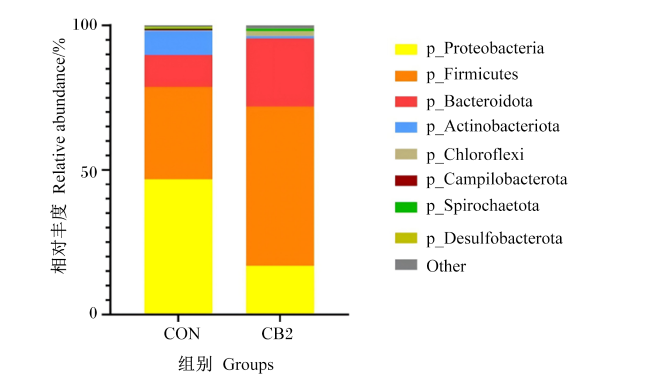
选择改善肠道健康效果更显著的CB2组与CON组分别进行16S rRNA测序。CON组与CB2组在门水平上肠道菌群组成如图2所示。在门水平上,珍珠龙胆石斑鱼肠道中的微生物主要菌群为变形菌门、厚壁菌门、拟杆菌门。与CON组相比,CB2组的厚壁菌门和拟杆菌门的相对丰度明显增加,而变形菌门和放线菌门的相对丰度明显减少,厚壁菌门成为了CB2组的优势菌。
图2 丁酸梭菌对珍珠龙胆石斑鱼肠道菌群在门水平上的相对丰度的影响

Proteobacteria:变形菌门;Firmicutes:厚壁菌门;Bacteroidota:拟杆菌门;Actinobacteriota:放线菌门;Chloroflexi:绿弯菌门;Campilobacterota:弯曲杆菌门;Spirochaetota:螺旋体门;Desulfobacterota:脱硫杆菌门;Other:其他。

Fig.2 Effects of Clostridium butyricum on relative abundance of gut microbiota at phylum level of hybrid grouper

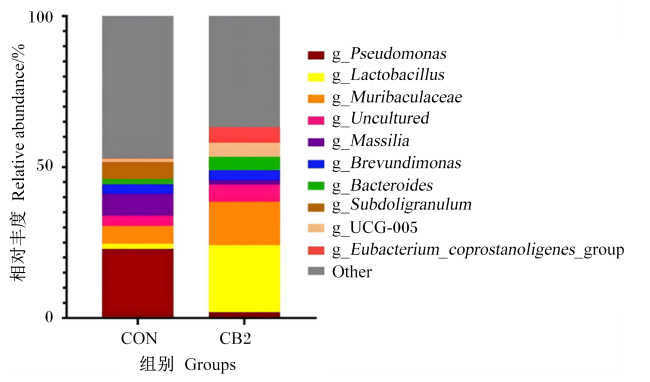
在属水平上,CON组与CB2组丰度排名前10肠道菌群如图3所示。与CON组相比,CB2组的乳杆菌属的相对丰度明显增加,Muribaculaceae、拟杆菌属、UCG-005、真杆菌属群的相对丰度也有所增加,假单胞菌属、马赛菌属和罕见小球菌属的相对丰度则有所减少。
图3 丁酸梭菌对珍珠龙胆石斑鱼肠道菌群在属水平上的相对丰度的影响(前10)

Pseudomonas:假单胞菌属;Lactobacillus:乳杆菌属;Massilia:马赛菌属;Brevundimonas:短波单胞菌属;Bacteroides:拟杆菌属;Subdoligranulum:罕见小球菌属;Eubacterium_coprostanoligenes_group:真杆菌属群;Other:其他。

Fig.3 Effects of Clostridium butyricum on relative abundance of gut microbiota at genus level of hybrid grouper (top 10)

2.5 代谢组学分析

2.5.1 PCA

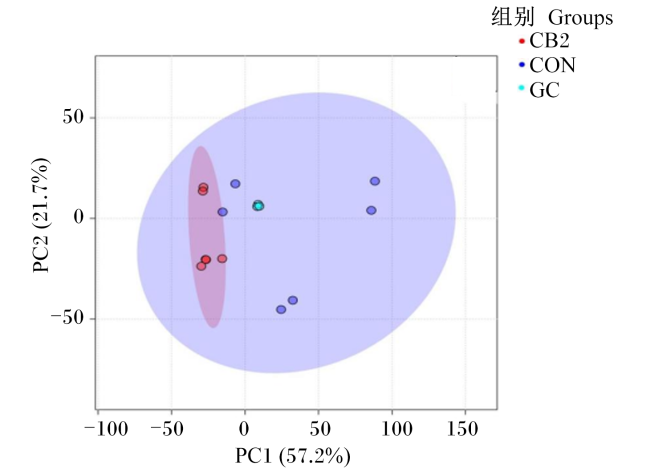
图4为肠道代谢产物的PCA图。QC样品紧密聚集,表明UHPLC-QE-MS运行状态良好,采集的数据可靠。CB2组与CON组比对,组内样品之间距离更近,代谢产物更相似。第1主成分(PC1)和第2主成分(PC2)共解释了样品之间78.9%的差异。这一结果表明,饲料中添加丁酸梭菌改变了肠道代谢产物组成。
图4 肠道代谢产物的PCA

PC1:第1主成分 principal component 1;PC2:第2主成分 principal component 2。

Fig.4 PCA of intestinal metabolites

2.5.2 OPLS-DA模型

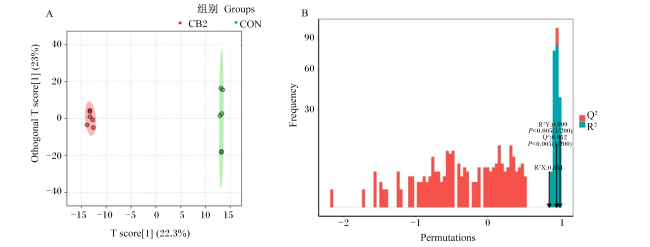
在PCA的基础上,再采用OPLS-DA法对数据进行分析,结果如图5-A所示。CB2组与CON组数据在横坐标轴上的距离较远,出现明显的分离,表明CB2组与CON组间代谢物成分存在明显差异(P<0.05)。由图5-B所示,通过验证,该OPLS-DA模型的解释率和预测率均在80%以上,说明CON组与CB2组区分明显。这表明饲料中添加丁酸梭菌明显改变了珍珠龙胆石斑鱼肠道代谢产物组成。
图5 肠道代谢产物的OPLS-DA

A: OPLS-DAL图 OPLS-DA diagram; B: OPLS-DA模型验证OPLS-DA model validation。

T score [1]:预测成分的得分值 T score for the first principal component;Orthogonal T score [1]:正交成分得分值 T score for the first orthogonal component;Permutation:置换;Frequency:频率。

Fig.5 OPLS-DA of intestinal metabolites

2.5.3 差异代谢物筛选

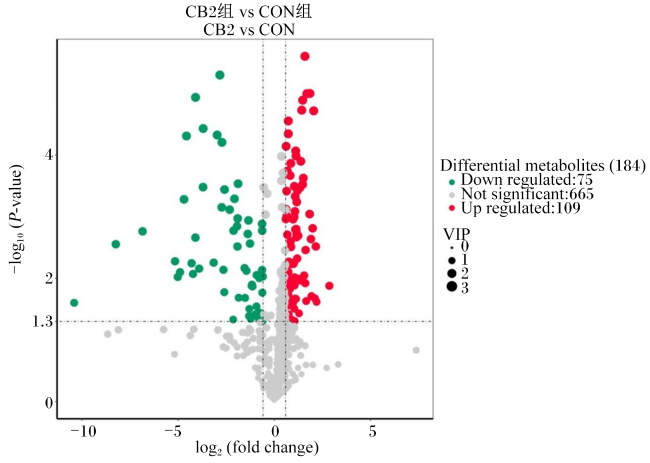
图6显示了CON组与CB2组比对后获得的差异代谢物分布情况。共筛选到184个差异代谢物,其中109个上调,75个下调,差异代谢物以脂类代谢物(56个)居多,且在上调的脂类代谢物中有7个为鞘脂,25个为磷脂。
图6 差异代谢物筛选火山图

Differential metabolites:差异代谢物;down regulated:下调;not significant:不显著;up regulated:上调;VIP:变量投影重要性 variable importance in projection;-log10 (P-value):-log10(P值);log2 (fold change):对数变化倍数 logarithm base 2 of fold change。

Fig.6 Volcano diagram for screening differential metabolites

2.5.4 KEGG代谢通路富集分析

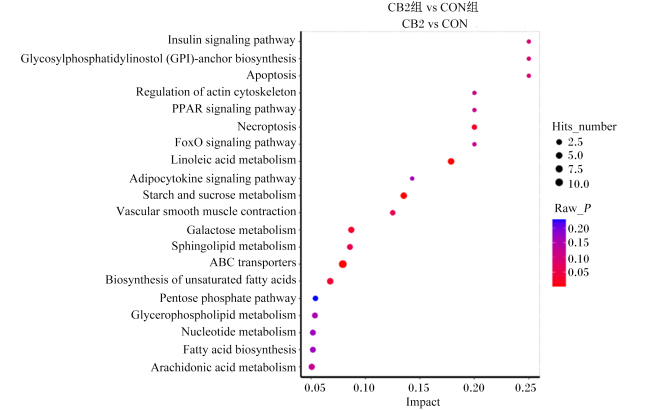
为了了解差异代谢物的代谢途径,对这些差异代谢物进行KEGG通路注释和富集分析,共富集到50条代谢通路。图7仅展示了影响值前20的代谢通路,其中,有5条代谢通路是差异代谢物富集明显的通路:ABC转运蛋白(ABC transporters)、亚油酸代谢(linoleic acid metabolism)、淀粉和蔗糖代谢(starch and sucrose metabolism)、半乳糖代谢(galactose metabolism)、不饱和脂肪酸的生物合成(biosynthesis of unsaturated fatty acids)。此外,花生四烯酸代谢(arachidonic acid metabolism)、鞘脂类代谢(sphingolipid metabolism)中也是差异代谢物富集较多的通路。这表明饲料中添加丁酸梭菌主要影响了肠道糖、脂代谢,对脂类代谢的影响尤为明显。
图7 肠道差异代谢物的KEGG代谢通路图(前20)

Hits_number:命中数 number of hits;Raw_P:未校正P值 unadjusted P-values;Impact:影响;Insulin signaling pathway:胰岛素信号通路;Glycosylphosphatidylinostol (GPI)-anchor biosynthesis:糖基磷脂酰肌醇(GPI)锚生物合成;Apoptosis:细胞凋亡;Regulation of actin cytoskeleton:肌动蛋白骨架的调控;PPAR signaling pathway:PPAR信号通路;Necroptosis:坏死性凋亡;FoxO signaling pathway:FoxO信号通路;Linoleic acid metabolism:亚油酸代谢;Adipocytokine signaling pathway:脂肪细胞因子信号通路;Starch and sucrose metabolism:淀粉和蔗糖代谢;Vascular smooth muscle contraction:血管平滑肌收缩;Galactose metabolism:半乳糖代谢;Sphingolipid metabolism:鞘脂类代谢;ABC transporters:ABC转运蛋白;Biosynthesis of unsaturated fatty acids:不饱和脂肪酸生物合成;Pentose phosphate pathway:磷酸戊糖途径;Glycerophospholipid metabolism:甘油磷脂代谢;Nucleotide metabolism:核苷酸代谢;Fatty acid biosynthesis:脂肪酸合成;Arachidonic acid metabolism:花生四烯酸代谢。

Fig.7 KEGG metabolic pathway diagram of intestinal differential metabolites (top 20)

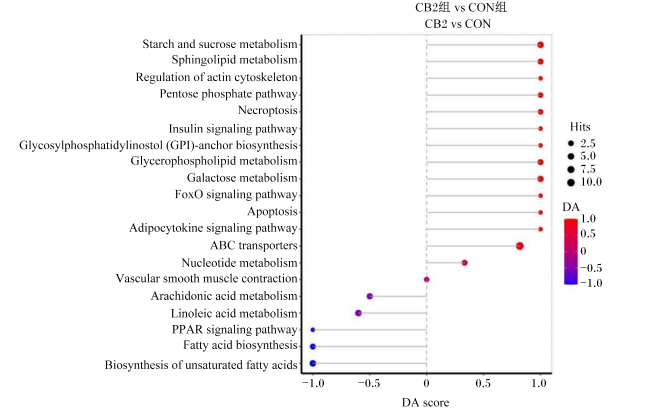
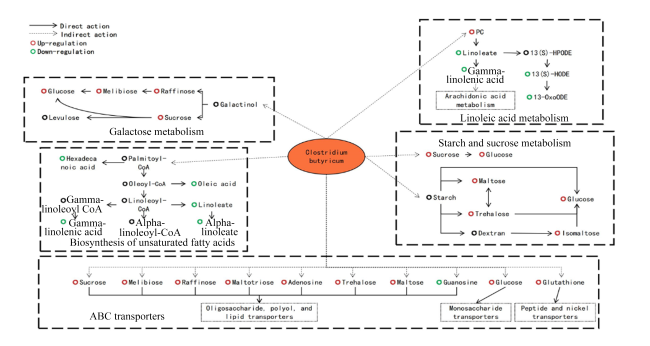
图8为影响值前20的差异丰度得分图,ABC转运蛋白、淀粉和蔗糖代谢、半乳糖代谢表现为上调,亚油酸代谢、不饱和脂肪酸生物合成表现为下调。将这些显著富集的代谢通路中的差异代谢物变化情况进行汇总,结果见表6。利用该表构建了丁酸梭菌参与肠道代谢的代谢物网络(图9)。此外,在富集的代谢通路中,鞘脂类代谢、甘油磷脂新陈代谢表现为上调,脂肪酸合成表现为下调。
图8 肠道差异代谢通路的差异丰度得分图(前20)

Hits:命中;DA:差异丰度 differential abundance;DA score:差异丰度得分 differential abundance score;Starch and sucrose metabolism:淀粉和蔗糖代谢;Sphingolipid metabolism:鞘脂类代谢;Regulation of actin cytoskeleton:肌动蛋白骨架的调控;Pentose phosphate pathway:磷酸戊糖途径;Necroptosis:坏死性凋亡;Insulin signaling pathway:胰岛素信号通路;Glycosylphosphatidylinostol (GPI)-anchor biosynthesis:糖基磷脂酰肌醇(GPI)锚生物合成;Glycerophospholipid metabolism:甘油磷脂代谢;Galactose metabolism:半乳糖代谢;FoxO signaling pathway:FoxO信号通路;Apoptosis:细胞凋亡;Adipocytokine signaling pathway:脂肪细胞因子信号通路;ABC transporters:ABC转运蛋白;Nucleotide metabolism:核苷酸代谢;Vascular smooth muscle contraction:血管平滑肌收缩;Arachidonic acid metabolism:花生四烯酸代谢;Linoleic acid metabolism:亚油酸代谢;PPAR signaling pathway:PPAR信号通路;Fatty acid biosynthesis:脂肪酸合成;Biosynthesis of unsaturated fatty acids:不饱和脂肪酸生物合成。

Fig.8 Differential abundance score diagram of intestinal differential metabolic pathways (top 20)

表6 显著富集通路中的差异代谢物的变化

Table 6 Changes in differential metabolites within significantly enriched pathways

项目
Items
对照组
CON group/
(mg/g)
CB2组
CB2 group/
(mg/g)
Log2 P
P-value
变量投影
重要性
VIP
变化趋势
Trends of
change
蜜二糖Melibiose 0.38±0.07 0.73±0.13 0.92 0.05 1.24 Up
棉子糖Raffinose 0.06±0.01 0.22±0.04 1.91 0.00 1.67 Up
麦芽三糖Maltotriose 0.05±0.01 0.18±0.03 1.84 0.00 1.76 Up
海藻糖Trehalose 0.53±0.010 1.47±0.14 1.47 0.00 1.83 Up
葡萄糖Glucose 7.18±0.65 13.11±1.38 0.87 0.00 1.65 Up
蔗糖Sucrose 0.53±0.10 1.47±0.14 1.47 0.00 1.83 Up
谷胱甘肽Glutathione 0.15±0.02 0.26±0.03 0.75 0.02 1.45 Up
腺苷Adenosine 19.31±1.62 32.46±5.27 0.75 0.04 1.27 Up
鸟嘌呤核苷Guanosine 4.97±0.82 2.26±0.38 -1.14 0.01 1.45 Down
异麦芽糖Isomaltose 0.38±0.01 0.73±0.13 0.92 0.17 1.24 Up
麦芽糖Maltose 0.53±0.10 1.47±0.14 1.47 0.00 1.83 Up
磷脂酰胆碱PC (44:11) 0.22±0.06 0.47±0.02 1.09 0.00 1.71 Up
γ-亚麻酸γ-linolenic acid 30.48±5.45 13.63±1.14 -1.16 0.01 1.46 Down
亚油酸酯Linoleate 1.71±0.40 0.69±0.04 -1.30 0.03 1.31 Down
油酸Oleic acid 20.38±4.81 7.11±0.54 -1.52 0.02 1.38 Down
十六烷酸Hexadecanoic acid 0.67±0.17 0.11±0.02 -2.64 0.01 1.54 Down
α-亚麻酸α-linolenic acid 30.48±5.45 13.63±1.14 -1.16 0.01 1.46 Down
13-酮-9z,11e-十八碳二烯酸
13-OxoODE
2.16±0.20 1.43±0.26 -0.60 0.05 1.21 Down
13(s)-羟基-9z,11e-十八碳二烯酸
13(S)-HODE
7.58±1.90 0.85±0.20 -3.15 0.01 1.57 Down

Log2为该物质在该组对比的相对丰度比值取log2;P-value为该物质在该组对比的t检验得到的P值;VIP为该物质在OPLS-DA模型中的VIP值;Up为CB2组含量上升;Down为CB2组含量下降。

Log2 is the relative abundance ratio of the substance in the comparison group, taken as log2; P-value is the P-value obtained from the t-test of the substance in the comparison group; VIP is the VIP value of the substance in the OPLS-DA model; Up indicates that the content of CB2 group increased; Down indicates that the content of CB2 group decreases.

图9 饲料中添加丁酸梭菌对珍珠龙胆石斑鱼肠道代谢影响的代谢物网络图

Clostridium btyricum:丁酸梭菌;Direct action:直接作用;Indirect action:间接作用;Up-regulation:上调;Down-regulation:下调;Glucose:葡萄糖;Melibiose:蜜二糖;Raffinose:棉子糖;Galactinol:肌醇半乳糖苷;Sucrose:蔗糖;Levulose:果糖;Galactose metabolism:半乳糖代谢;Hexadecanoic acid:十六烷酸;Palmitoyl-CoA:棕榈酰辅酶A palmitoyl CoA;Oleoyl-CoA:油酰辅酶A oleyl CoA;Oleic acid:油酸;Linoleoyl-CoA:亚油酰基辅酶A linoleyl-CoA;Linoleate:亚油酸脂;Alpha-linoleoyl-CoA:α-亚油酰基辅酶A;Alpha-linoleate:α-亚油酸脂;Gamma-linoleoyl-CoA:γ-亚油酰基辅酶A;Gamma-linolenic acid:γ-亚麻酸;Biosynthesis of unsaturated fatty acids:不饱和脂肪酸的生物合成;PC:磷脂酰胆碱 phosphatidylcholine;Arachidonic acid metabolism:花生四烯酸代谢;13(S)-HPODE:13(S)-羟基-9z,11e-二十碳四烯酸过氧化物 13(S) -hydroxy-9z, 11e-eicosatetraenoic acid peroxide;13(S)-HODE:13(s)-羟基-9z,11e-十八碳二烯酸 13(s) -hydroxy-9z, 11e-octadecadienoic acid;13-OxoODE:13-酮-9z,11e-十八碳二烯酸 13-keto-9z, 11e-octadecadienoic acid;Linoleic acid metabolism:亚油酸代谢;Starch and sucrose metabolism:淀粉和蔗糖代谢;Starch:淀粉;Maltose:麦芽糖;Trehalose:海藻糖;Dextran:葡聚糖;Isomaltose:异麦芽糖;Maltotriose:麦芽三糖;Adenosine:腺苷;Guanosine:鸟嘌呤核苷;Glutathione:谷胱甘肽;ABC transporters:ABC转运蛋白;Oligosaccharide:低聚糖;Polyol:多元醇;Lipid transporters:脂质转运蛋白;Monosaccharide transporters:单糖转运蛋白;Peptide and nickel transporters:肽和镍转运蛋白。

Fig.9 Metabolite network diagram of effects of dietary Clostridium butyricum on intestinal metabolism of hybrid grouper

3 讨论

3.1 生长性能

本研究发现,不同来源的2株丁酸梭菌菌株分别添加到饲料后对珍珠龙胆石斑鱼的生长性能没有产生明显的影响,该结果与以往在鲤鱼[19,27-28]、鮸鱼[22,29]、克氏原螯虾[30]、山羊[31]等的研究结果类似。与本试验结果不一致,一些研究表明,在低鱼粉饲料中添加丁酸梭菌可明显促进鱼类生长[10,14,32-35],其促生长机制可能是丁酸梭菌通过在肠道中分泌大量短链脂肪酸和消化酶等生物活性物质来改善肠道代谢功能,促进养分消化吸收[36-37]。值得一提的是,本试验配方中的蛋白质原料均为优质动物蛋白质原料,且饲料蛋白质、脂肪等营养水平均是按珍珠龙胆石斑鱼的营养需要设定的,这可能是添加丁酸梭菌没有明显促进石斑鱼生长的原因。类似的结果也在七彩神仙鱼[12]的试验中得到进一步的证实,这表明在用优质蛋白质源配制的饲料中添加丁酸梭菌难以充分发挥其生长促进作用。此外,丁酸梭菌的促生长作用还会受添加剂量的影响。随着丁酸梭菌的浓度(103~109 CFU/g)增加,鮸鱼的生长性能随之增加,并在浓度为109 CFU/g时获得最大生长性能[29]。Bi等[38]用不同浓度的丁酸梭菌(106~108 CFU/g)投喂大菱鲆,结果发现丁酸梭菌浓度为107 CFU/g时促生长作用最明显。虽然本试验没有设置饲料中不同丁酸梭菌浓度,但设置的107 CFU/g丁酸梭菌处于大多数试验推荐的浓度范围(106~108 CFU/g)。因此,在水产饲料中是否添加丁酸梭菌的一个重要考量依据就是水产饲料配方中蛋白质源是以植物蛋白质源为主还是以动物蛋白质源为主。

3.2 肠道抗氧化能力

抗氧化能力可以反映机体的健康状态,当机体应激或患病时,机体就会产生过量的自由基,进而对机体造成氧化损伤[39-40]。肠道作为连接机体内环境与外环境的媒介,它不断地遭受来自摄入的外源物质和内源物质代谢过程中产生的自由基的攻击,从而诱发肠道氧化损伤[41-42]。研究发现,丁酸梭菌有效提高鱼虾抗氧化酶的活性,促进鱼虾免疫应答反应[23,43-44]。本研究获得了相似的结果,饲料中添加丁酸梭菌显著提高珍珠龙胆石斑鱼肠道SOD、GSH-Px活性,降低MDA含量。丁酸梭菌的抗氧化作用与丁酸梭菌在肠道产生丁酸、丙酸等短链脂肪酸对肠道黏膜细胞的供能进而维持肠道稳态有关[45]。本研究中的肠道短链脂肪酸含量变化也得到验证。

3.3 肠道短链脂肪酸含量

短链脂肪酸是一种挥发性脂肪酸,主要有乙酸、丙酸、丁酸等。短链脂肪酸是肠道微生物的主要代谢产物之一[46],是肠上皮细胞的重要能源,在维持肠道黏膜屏障、肠上皮细胞通透性和应对炎症反应等方面均有积极作用[47]。丁酸梭菌的最大特点是能够在肠道大量分泌短链脂肪酸,尤其是丁酸,起到供能作用[48-49],丁酸可通过影响组蛋白脱乙酰基酶的活性来减轻肠炎[50-51]。饲料添加丁酸梭菌明显促进鮸鱼、鲤鱼肠道乙酸、丙酸、丁酸的生成[15,28],但没有提高肠道总短链脂肪酸的含量。本试验结果表明,饲料中添加丁酸梭菌虽没有明显提高珍珠龙胆石斑鱼肠道丙酸、丁酸、异丁酸、戊酸、异戊酸和己酸等单个短链脂肪酸的含量,却显著提高乙酸和总短链脂肪酸含量,这与Li[52]对黄颡鱼进行的类似试验结果一致。

3.4 肠道组织结构

鱼类肠道组织结构的完整性对于有效维持养分消化吸收至关重要。肠道的黏膜褶皱高度越高则表明肠道表面积越大,肠道吸收养分的能力越强[53],而肠道的肌层厚度反映肠道的蠕动能力,决定肠道食糜消化和排空速度[54]。短链脂肪酸可为肠上皮细胞提供能量,促进肠绒毛生长发育[55],减少肠道黏膜损伤和肠细胞凋亡[56]。本试验结果和以往的试验结果均表明,饲料中添加丁酸梭菌均具有良好改善鱼类肠道结构的作用[14,33,44]

3.5 肠道菌群

本研究结果表明,珍珠龙胆石斑鱼肠道优势菌群是变形菌门、厚壁菌门、拟杆菌门,与之前在石斑鱼上的报道结果[57]类似。但添加丁酸梭菌后,珍珠龙胆石斑鱼肠道优势菌群排序有所变化,厚壁菌门和拟杆菌门的相对丰度明显增加,变形菌门和放线菌门的相对丰度明显降低,类似的结果在斜带石斑鱼[58]、克氏原螯虾[30]上也观察到。厚壁菌门和拟杆菌门分泌短链脂肪酸较多[59-60],这在一定程度上解释了丁酸梭菌提高肠道短链脂肪酸含量的结果。变形菌门和放线菌门中的很多细菌被认为是潜在致病菌[61-62],如果肠道中变形菌门和放线菌门的相对丰度增加,意味着肠道菌群结构失衡,肠炎发生或病原体入侵的机会增加[62-63]。本研究中,丁酸梭菌降低了变形菌门和放线菌门的相对丰度,提示肠炎发生的机会减少,有益于肠道健康。
同样在属水平上,丁酸梭菌提高了乳杆菌属、瘤胃球菌属和拟杆菌属的相对丰度,降低了假单胞菌属的相对丰度,肠道主要优势菌由假单胞菌属变为乳杆菌属,排序发生明显变化。与本研究结果类似,饲料中添加丁酸梭菌增加了鲤鱼、克氏原螯虾肠道中乳杆菌属、毛螺菌属或瘤胃球菌属的相对丰度[28],减少了假单胞菌属的相对丰度[30]。假单胞菌属会诱发应激导致鱼类发病[64],是最常见的鱼类病原体之一。由此可见,丁酸梭菌能促进鱼类肠道有益菌的增殖,抑制致病菌的繁殖。

3.6 肠道差异代谢物

迄今,已有大量有关丁酸梭菌促进水产动物肠道健康的研究报道[23],然而,丁酸梭菌如何调节肠道代谢尚未完全阐明。本试验首先从代谢组学角度研究了丁酸梭菌在鱼类肠道代谢中的作用。本试验结果表明,CB2组与CON组比对,共发现了109个显著上调和75个显著下调的差异代谢物,差异代谢物中以脂类代谢物居多,这说明丁酸梭菌对肠道脂类代谢的影响很大。本试验研究还发现,上调的脂类差异代谢物中以鞘脂和磷脂居多。鞘脂是调节炎症和免疫的重要信号分子,并与炎症性肠病(inflammatory bowel disease, IBD)发病机制有关[65]。磷脂对肠道健康具有调节作用,特别是对肠道微生物组成和炎症的调节[66],肠道磷脂含量的减少可能反映了慢性炎症的存在和肠道屏障完整性受损[67-68]。这提示丁酸梭菌改善肠道代谢和肠道健康,可能也与丁酸梭菌提高了珍珠龙胆石斑鱼肠道抗氧化能力有关。
本试验中共富集到了5条代谢通路,其中3条代谢通路上调,分别为淀粉和蔗糖代谢通路、半乳糖代谢通路和ABC转运蛋白通路,2条代谢通路下调,分别为不饱和脂肪酸的生物合成通路和亚油酸代谢通路。下调的2条代谢通路关联到的差异代谢物除了磷脂酰胆碱上调外,其余的脂类代谢物均表现为下调。磷脂酰胆碱又被称为卵磷脂,是一种天然乳化剂,可以协助脂肪酸、胆固醇等亲脂性营养素的消化和吸收,磷脂酰胆碱还具有抗氧化作用,有助于维持肠道的健康[69]。本研究中丁酸梭菌使不饱和脂肪酸的生物合成通路和亚油酸代谢通路下调的原因可能与磷脂酰胆碱水平上升有关,脂肪酸相关代谢的下调与本研究珍珠龙胆石斑鱼血脂的降低的结果相一致。研究发现,饲料中添加丁酸梭菌会导致小鼠肠道菌群功能更多地转向碳水化合物代谢[70],这与本研究的结果相一致。本研究中丁酸梭菌促进了淀粉和蔗糖代谢、半乳糖代谢通路中的代谢物上调,进而提高了珍珠龙胆石斑鱼对糖类的代谢利用。此外,糖类可被丁酸梭菌、乳杆菌、瘤胃球菌等有益菌利用而产生短链脂肪酸[71-72],这也支持了本研究中丁酸梭菌上调珍珠龙胆石斑鱼肠道总短链脂肪酸含量的试验结果。ABC转运蛋白是膜转运的一部分,其主要功能涉及小分子的主动转运[73]。本研究中,丁酸梭菌通过上调糖类和谷胱甘肽刺激ABC转运蛋白的表达,从而调节肠道渗透压,这种机制可能在珍珠龙胆石斑鱼的渗透调节中起着重要的作用。综上所述,丁酸梭菌通过调节肠道糖、脂代谢,提高糖、脂利用率,进而为肠上皮的发育提供能量并调节肠道渗透压,维持肠道代谢稳态和肠道健康。

4 结论

在本试验条件下,2株丁酸梭菌菌株(HJCB998、DBNDS3)均不影响珍珠龙胆石斑鱼的生长性能,却显著提高了肠道抗氧化酶活性、总短链脂肪酸含量及肠道结构完整性。从肠道菌群和肠道代谢的角度,丁酸梭菌DBNDS3对珍珠龙胆石斑鱼肠道健康的调节作用更明显。将CON组和CB2组进行比对分析,丁酸梭菌促进了肠道有益菌的增殖而抑制了致病菌的繁殖。丁酸梭菌主要通过调节肠道糖、脂代谢,提高糖、脂利用率,为肠上皮发育提供能量并调节肠道渗透压,进而维持肠道微生物稳态和改善肠道健康。
[1]
ZHANG W, TAN B P, DENG J M, et al. Soybean protein concentrate causes enteritis in juvenile pearl gentian groupers (Epinephelus fuscoguttatus♀×Epinephelus lanceolatus ♂)[J]. Animal Nutrition, 2023,12:171-185.

[2]
HUANG W B, LI T, CAI W S, et al. Effects of α-lipoic acid supplementation on growth performance,liver histology,antioxidant and related genes expression of hybrid grouper (Epinephelus fuscoguttatus♀×E.lanceolatus♂)[J]. Antioxidants, 2024, 13(1):88.

[3]
农业农村部渔业渔政管理局, 全国水产技术推广总站,中国水产学会. 2024中国渔业统计年鉴[M]. 北京: 中国农业出版社,2024:22.

Fishery and Fishery Administration Bureau of the Ministry of Agriculture and Rural Affairs,National Aquaculture Technology Promotion Station, Chinese Fisheries Society. 2024 China fishery statistics yearbook[M]. Beijing: China Agriculture Press,2024:22. (in Chinese)

[4]
王大鹏, 曹占旺, 谢达祥, 等. 石斑鱼的研究进展[J]. 南方农业学报, 2012, 43(7):1058-1065.

WANG D P, CAO Z W, XIE D X, et al. Research progress in Epinephelus industry[J]. Journal of Southern Agriculture, 2012, 43(7):1058-1065. (in Chinese)

[5]
DONG J, ZHANG D F, LI J R, et al. Genistein inhibits the pathogenesis of Aeromonas hydrophila by disrupting quorum sensing mediated biofilm formation and aerolysin production[J]. Frontiers in Pharmacology, 2021,12:753581.

[6]
ZHOU L, LIAN K, WANG M, et al. The antimicrobial effect of a novel peptide LL-1 on Escherichia coli by increasing membrane permeability[J]. BMC Microbiology, 2022,22:220.

[7]
艾春香. 丁酸梭菌的研发及其在水产配合饲料中的应用[J]. 饲料工业, 2018, 39(24):1-7.

AI C X. Research & development of Clostridium butyricum and its application in aquatic formula feed[J]. Feed Industry, 2018, 39(24):1-7. (in Chinese)

[8]
何瑞鹏, 奉杰, 田相利, 等. 酪酸菌对珍珠龙胆石斑鱼生长、消化酶、血清抗氧化酶和溶菌酶活性的影响[J]. 中国海洋大学学报(自然科学版), 2017, 47(11):15-23.

HE R P, FENG J, TIAN X L, et al. Effects of dietary supplementation of Clostridium butyricum on the growth and activities of digestive and serum antioxidant enzymes and lysozyme of hybrid grouper (Epinephelus fuscoguttatus♀×E.lanceolatus♂)[J]. Periodical of Ocean University of China, 2017, 47(11):15-23. (in Chinese)

[9]
FOYSAL M J, NGUYEN T T T, CHAKLADER M R, et al. Marked variations in gut microbiota and some innate immune responses of fresh water crayfish,marron (Cherax cainii,Austin 2002) fed dietary supplementation of Clostridium butyricum[J]. PeerJ, 2019,7:e7553.

[10]
PAN L, LI W K, XIE R T, et al. Effects of Clostridium butyricum on growth performance,intestinal health,and disease resistance of hybrid grouper (Epinephelus fuscoguttatus♀×E.lanceolatus♂) fed with cottonseed protein concentrate (CPC) replacement of fishmeal[J]. Aquaculture Nutrition, 2023,2023:1184252.

[11]
GAO Q, XIAO C, MIN M, et al. Effects of probiotics dietary supplementation on growth performance, innate immunity and digestive enzymes of silver pomfret,Pampus argenteus[J]. Indian Journal of Animal Research, 2016, 50(6):936-941.

[12]
朱建国. 丁酸梭菌对七彩神仙鱼生长、营养利用和肠道健康的影响[D]. 硕士学位论文. 上海: 上海海洋大学, 2022.

ZHU J G. Effects of Clostridium butyricum on the growth,nutrition utilization and intestinal health of the Symphysodon haraldi[D]. Master’s Thesis. Shanghai: Shanghai Ocean University, 2022. (in Chinese)

[13]
LI H Q, ZHOU Y, LING H Y, et al. The effect of dietary supplementation with Clostridium butyricum on the growth performance,immunity,intestinal microbiota and disease resistance of tilapia (Oreochromis niloticus)[J]. PLoS One, 2019, 14(12):e0223428.

[14]
POOLSAWAT L, LI X Q, HE M, et al. Clostridium butyricum as probiotic for promoting growth performance,feed utilization,gut health and microbiota community of tilapia (Oreochromis niloticus×O.aureus)[J]. Aquaculture Nutrition, 2020, 26(3):657-670.

[15]
SONG Z F, WU T X, CAI L S, et al. Effects of dietary supplementation with Clostridium butyricum on the growth performance and humoral immune response in Miichthys miiuy[J]. Journal of Zhejiang University:Science B (Biomedicine & Biotechnology), 2006, 7(7):596-602.

[16]
黄灵. 饲料中添加益生菌对虎龙斑 (Epinephelus fuscoguttatus♀×Elancedatiis♂) 幼鱼生长、非特异性免疫和抗病力影响的研究[D]. 硕士学位论文. 广州: 广州大学, 2017.

HUANG L. The effects of dietary probiotics on growth,non-specific immunity and disease resistance of hybrid grouper (Epinephelus fuscoguttatus♀×Elancedatiis♂)[D]. Master’s Thesis. Guangzhou: Guangzhou University, 2017. (in Chinese)

[17]
YIN Z Y, LIU Q D, LIU Y T, et al. Early life intervention using probiotic Clostridium butyricum improves intestinal development,immune response,and gut microbiota in large yellow croaker (Larimichthys crocea) larvae[J]. Frontiers in Immunology, 2021,12:640767.

[18]
MENG X L, WU S K, HU W P, et al. Clostridium butyricum improves immune responses and remodels the intestinal microbiota of common carp (Cyprinus carpio L.)[J]. Aquaculture, 2021,530:735753.

[19]
SAKAI M, YOSHIDA T, ATSUTA S, et al. Enhancement of resistance to vibriosis in rainbow trout, Oncorhynchus mykiss (Walbaum),by oral administration of Clostridium butyricum bacterin[J]. Journal of Fish Diseases, 1995, 18(2):187-190.

[20]
PAN X, WU T, ZHANG L, et al. In vitro evaluation on adherence and antimicrobial properties of a candidate probiotic Clostridium butyricum CB2 for farmed fish[J]. Journal of Applied Microbiology, 2008, 105(5):1623-1629.

[21]
宋会仪. 丁酸梭菌发酵条件的优化及其对美国红鱼免疫指标的影响[D]. 硕士学位论文. 杭州: 浙江大学, 2007.

SONG H Y. Optimization of fermentation conditions for Clostridium butyricum and effects on immune parameters of red drum (Sciaenops ocellatus)[D]. Master’s Thesis. Hangzhou: Zhejiang University, 2007. (in Chinese)

[22]
PAN X, WU T, SONG Z, et al. Immune responses and enhanced disease resistance in Chinese drum,Miichthys miiuy (Basilewsky),after oral administration of live or dead cells of Clostridium butyrium CB2[J]. Journal of Fish Diseases, 2008, 31(9):679-686.

[23]
TRAN N T, LIANG H F, LI J K, et al. Health benefits of butyrate and its producing bacterium,Clostridium butyricum,on aquatic animals[J]. Fish and Shellfish Immunology Reports, 2023,4:100088.

[24]
AOAC. Official methods of analysis of the association of official analytical chemists[S]. 20th ed.Washington D.C.:Association of Official Analytical Chemists, 2016.

[25]
ZHANG W W, CUI Y F, ZHANG J Y. Multi metabolomics-based analysis of application of Astragalus membranaceus in the treatment of hyperuricemia[J]. Frontiers in Pharmacology, 2022,13:948939.

[26]
马立清, 张文羿, 孙天松. 嗜热链球菌S4发酵乳代谢组学的研究[J]. 食品与发酵工业, 2021, 47(19):71-78.

DOI

MA L Q, ZHANG W Y, SUN T S. Metabolomics analysis of fermented milk with Streptococcus thermophilus S4[J]. Food and Fermentation Industries, 2021, 47(19):71-78. (in Chinese)

[27]
DU Y, CHENG L, ZHAO J, et al. Effects of Clostridium butyricum and sodium butyrate on growth performance,immunity,and gut microbiota of mirror carp Cyprinus carpio fed with soybean meal based diet[J]. Aquaculture Reports, 2023,29:101501.

[28]
朱振祥. 丁酸梭菌对鲤生长、免疫及肠道微生态的影响[D]. 硕士学位论文. 新乡: 河南师范大学, 2019.

ZHU Z X. Effects of Clostridium butyricum on growth,immunity and intestinal microecology of common carp (Cyprinus carpio L.)[D]. Master’s Thesis. Xinxiang: Henan Normal University, 2019. (in Chinese)

[29]
宋增福, 吴天星. 丁酸梭菌C2菌株对鮸鱼肠道菌群影响的研究[J]. 水利渔业, 2007, 27(4):91-93.

SONG Z F, WU T X. Effects of Clostridium butyricum C2 on bacterial community in the intestine of Miichthys miiuy[J]. Reservoir Fisheries, 2007, 27(4):91-93. (in Chinese)

[30]
范晨薇. 丁酸梭菌对克氏原螯虾肠道健康的影响[D]. 硕士学位论文. 武汉: 华中农业大学, 2020.

FAN C W. Effects of Clostridium butyricum on intestinal health of Procambarus clarkii[D]. Master’s Thesis. Wuhan: Huazhong Agricultural University, 2020. (in Chinese)

[31]
ZHANG C R, YU Q Y, WANG J H, et al. Effects of dietary supplementation with Clostridium butyricum on growth performance,apparent digestibility,blood metabolites,ruminal fermentation and bacterial communities of fattening goats[J]. Frontiers in Nutrition, 2022,9:888191.

[32]
LI Y, WANG Y Q, LV J Y, et al. Effects of dietary supplementation with Clostridium butyricum on the amelioration of growth performance,rumen fermentation,and rumen microbiota of Holstein heifers[J]. Frontiers in Nutrition, 2021,8:763700.

[33]
李芳源. 低鱼粉饲料中添加丁酸梭菌对三倍体虹鳟生长、消化生理、肠道免疫和菌群的影响研究[D]. 硕士学位论文. 南京: 南京农业大学, 2021.

LI F Y. Effects of adding Clostridium Butyricum to low fish meal feed on the growth,digestive physiology,intestinal immunity and flora of triploid rainbow trout[D]. Master’s Thesis. Nanjing: Nanjing Agricultural University, 2021. (in Chinese)

[34]
矣林圆, 桂聪, 刘婧文, 等. 豆粕替代鱼粉添加丁酸梭菌对大口黑鲈生长性能、体组成和抗氧化能力的影响[J]. 华中农业大学学报, 2024, 43(1):176-184.

YI L Y, GUI C, LIU J W, et al. Effects of adding Clostridium butyricum to soybean meal replacing fish meal on growth performance,body composition and antioxidant capacity of largemouth bass (Micropterus salmoides)[J]. Journal of Huazhong Agricultural University, 2019, 43(1):176-184. (in Chinese)

[35]
吴杨, 黄倩倩, 虞为, 等. 饲料中添加丁酸梭菌对卵形鲳鲹幼鱼生长性能、血清生化指标及肠道菌群和短链脂肪酸含量的影响[J]. 动物营养学报, 2023, 35(9):5904-5918.

DOI

WU Y, HUANG Q Q, YU W, et al. Effects of dietary supplementation of Clostridium butyricum on growth performance,serum biochemical indexes and intestinal flora and short-chain fatty acid contents of juvenile Trachinotus ovatus[J]. Chinese Journal of Animal Nutrition, 2023, 35(9):5904-5918. (in Chinese)

[36]
夏琳. 丁酸梭菌的分离及其预发酵对产沼气的影响研究[D]. 硕士学位论文. 哈尔滨: 哈尔滨师范大学, 2014.

XIA L. Study on the separation of Clostridium butyricum and effects of per-fermentation on biogas[D]. Master’s Thesis.Harbin:Harbin Normal University, 2014. (in Chinese)

[37]
姜芳芳, 李圣杰, 丁轲, 等. 丁酸梭菌C.L24蛋白酶产酶条件的优化[J]. 家畜生态学报, 2016, 37(1):63-67.

JIANG F F, LI S J, DING K, et al. Optimization of proteinase producing conditions of a beneficial Clostridium butyricum[J]. Journal of Domestic Animal Ecology, 2016, 37(1):63-67. (in Chinese)

[38]
BI X J, LV C J, WANG M M, et al. Effects of dietary supplementation of Clostridium butyricum H129 on growth performance and intestinal health of turbot,Scophthalmus maximus[J]. Aquaculture Reports, 2023,30:101544.

[39]
LIU H D, XUE J G, MO H. Study on the mechanism of Shenjing Guben prescription regulating PI3K and NRF2 signaling pathway in the treatment of immune infertility[J]. Evidence-Based Complementary and Alternative Medicine : eCAM, 2022,2022:8754188.

[40]
YAO J, WANG L L, ZHANG W J, et al. Effects of Bacillus megaterium on growth performance,serum biochemical parameters,antioxidant capacity,and immune function in suckling calves[J]. Open Life Sciences, 2020, 15(1):1033-1041.

[41]
ZHANG M J, SUN W W, YANG J, et al. The effect of preventing oxidative stress and its mechanisms in the extract from Sonchus brachyotus DC.Based on the Nrf2-Keap1-ARE signaling pathway[J]. Antioxidants, 2023, 12(9):1677.

[42]
REIS B, RAMOS-PINTO L, CUNHA S A, et al. Chlorella vulgaris extracts as modulators of the health status and the inflammatory response of gilthead seabream juveniles (Sparus aurata)[J]. Marine Drugs, 2022, 20(7):407.

[43]
LI H D, TIAN X L, ZHAO K, et al. Effect of Clostridium butyricum in different forms on growth performance,disease resistance,expression of genes involved in immune responses and mTOR signaling pathway of Litopenaeus vannamai[J]. Fish & Shellfish Immunology, 2019,87:13-21.

[44]
李维康. 浓缩棉籽蛋白替代鱼粉饲料中添加丁酸梭菌对石斑鱼和凡纳滨对虾生长、免疫及肠道健康的影响[D]. 硕士学位论文. 湛江: 广东海洋大学, 2022.

LI W K. Effects of diets supplementation of Clostridium butyricum on growth,immunity and intestinal health in grouper (♀Epinephelus fuscoguttatus♀×E.lanceolatus♂) and Litopenaeus vannamei fed with cottonseed protein concentrate instead of fish meal[D]. Master’s Thesis. Zhanjiang: Guangdong Ocean University, 2022. (in Chinese)

[45]
梁静, 聂存喜, 张文举, 等. 丁酸梭菌的生物学功能及其在动物生产中的应用[J]. 动物营养学报, 2018, 30(5):1639-1646.

LIANG J, NIE C X, ZHANG W J, et al. Biological function of Clostridium butyricum and its application in animal production[J]. Chinese Journal of Animal Nutrition, 2018, 30(5):1639-1646. (in Chinese)

[46]
QIAN X H, HAI W X, CHEN S Y, et al. Multi-omics data reveals aberrant gut microbiota-host glycerophospholipid metabolism in association with neuroinflammation in APP/PS1 mice[J]. Gut Microbes, 2023, 15(2):2282790.

[47]
OBERMÜLLER B, SINGER G, KIENESBERGER B, et al. Probiotic OMNi-BiOTiC 10 AAD reduces cyclophosphamide-induced inflammation and adipose tissue wasting in mice[J]. Nutrients, 2023, 15(16):3655.

[48]
KHOGALI M K, WEN K, JAUREGUI D, et al. Probiotics-induced changes in intestinal structure and gut microbiota are associated with reduced rate of pimpled eggs in the late laying period of hens[J]. Journal of Poultry Science, 2022, 59(3):206-222.

DOI PMID

[49]
YU J, DONG B, ZHAO M M, et al. Dietary Clostridium butyricum and Bacillus subtilis promote goose growth by improving intestinal structure and function,antioxidative capacity and microbial composition[J]. Animals, 2021, 11(11):3174.

[50]
WANG R X, HENEN M A, LEE J S, et al. Microbiota-derived butyrate is an endogenous HIF prolyl hydroxylase inhibitor[J]. Gut Microbes, 2021, 13(1):1938380.

[51]
JOHNSO S D, OLWENYI O A, BHYRAVBHATLAH N, et al. Therapeutic implications of SARS-CoV-2 dysregulation of the gut-brain-lung axis[J]. World Journal of Gastroenterology, 2021, 27(29):4763-4783.

DOI PMID

[52]
LI P, HOU D, ZHAO H, et al. Dietary Clostridium butyricum improves growth performance and resistance to ammonia stress in yellow catfish (Pelteobagrus fulvidraco)[J]. Aquaculture Nutrition, 2022,2022:6965174.

[53]
LI H, LIU Y, WEI L, et al. Effects of feeding fermented Medicago sativa (plus soybean and DDGS) on growth performance,blood profiles,gut health, and carcass characteristics of Lande (meat) geese[J]. Frontiers in Physiology, 2022,13:902802.

[54]
JIAO F, ZHANG L, LIMBU S M, et al. A comparison of digestive strategies for fishes with different feeding habits:digestive enzyme activities,intestinal morphology,and gut microbiota[J]. Ecology and Evolution, 2023, 13(9):e10499.

[55]
DUAN Y F, ZHANG Y, DONG H B, et al. Effect of dietary Clostridium butyricum on growth,intestine health status and resistance to ammonia stress in pacific white shrimp Litopenaeus vannamei[J]. Fish & Shellfish Immunology, 2017,65:25-33.

[56]
DUAN Y F, ZHANG Y, DONG H B, et al. Effect of the dietary probiotic Clostridium butyricum on growth, intestine antioxidant capacity and resistance to high temperature stress in Kuruma shrimp Marsupenaeus japonicus[J]. Journal of Thermal Biology, 2017,66:93-100.

[57]
YE G L, DONG X H, YANG Q H, et al. Dietary replacement of fish meal with peanut meal in juvenile hybrid grouper (Epinephelus fuscoguttatus♀×Epinephelus lanceolatus♂):growth performance,immune response and intestinal microbiota[J]. Aquaculture Reports, 2020,17:100327.

[58]
LIU Z Y, YANG H L, HU L H, et al. Autochthonous probiotics alleviate the adverse effects of dietary histamine in juvenile grouper (Epinephelus coioides)[J]. Frontiers in Microbiology, 2021,12:792718.

[59]
LOUIS P, FLINT H J. Formation of propionate and butyrate by the human colonic microbiota[J]. Environmental Microbiology, 2017, 19(1):29-41.

DOI PMID

[60]
DEN BESTEN G, VAN EUNEN K, GROEN A K, et al. The role of short-chain fatty acids in the interplay between diet,gut microbiota,and host energy metabolism[J]. Journal of Lipid Research, 2013, 54(9):2325-2340.

[61]
QIAO Y B, HAN F L, PENG X H, et al. Dietary β-glucan alleviates antibiotic-associated side effects by increasing the levels of antioxidant enzyme activities and modifying intestinal microbiota in pacific white shrimp (Litopenaeus vannamei)[J]. Antioxidants, 2023, 13(1):52.

[62]
KARLSSON F H, USSERY D W, NIELSEN J, et al. A closer look at Bacteroides:phylogenetic relationship and genomic implications of a life in the human gut[J]. Microbial Ecology, 2011, 61(3):473-485.

[63]
LI H, LIU S Y, ZHANG K K, et al. Gut microbiome and plasma metabolome alterations in myopic mice[J]. Frontiers in Microbiology, 2023,14:1251243.

[64]
DUMAN M, MULET M, ALTUN S, et al. The diversity of Pseudomonas species isolated from fish farms in turkey[J]. Aquaculture, 2021,535:736369.

[65]
ZHANG X L, CHEN L, YANG J, et al. Vitamin D alleviates non-alcoholic fatty liver disease via restoring gut microbiota and metabolism[J]. Frontiers in Microbiology, 2023,14:1117644.

[66]
PAN J Y, CHEN M Q, LI N, et al. Bioactive functions of lipids in the milk fat globule membrane:a comprehensive review[J]. Foods, 2023, 12(20):3755.

[67]
WU X, LI P, WANG W H, et al. The underlying changes in serum metabolic profiles and efficacy prediction in patients with extensive ulcerative colitis undergoing fecal microbiota transplantation[J]. Nutrients, 2023, 15(15):3340.

[68]
LU K, KNUTSON C G, WISHNOK J S, et al. Serum metabolomics in a Helicobacter hepaticus mouse model of inflammatory bowel disease reveal important changes in the microbiome,serum peptides,and intermediary metabolism[J]. Journal of Proteome Research, 2012, 11(10):4916-4926.

[69]
LU L W, CHEN J H. Seaweeds as ingredients to lower glycemic potency of cereal foods synergistically-a perspective[J]. Foods, 2022, 11(5):714.

[70]
HAGIHARA M, YAMASHITA R, MATSUMOTO A, et al. The impact of probiotic Clostridium butyricum MIYAIRI 588 on murine gut metabolic alterations[J]. Journal of Infection and Chemotherapy, 2019, 25(8):571-577.

[71]
LI Y, ZHU M, LIU Y, et al. The oral microbiota and cardiometabolic health:a comprehensive review and emerging insights[J]. Frontiers in Immunology, 2022,13:1010368.

[72]
QU D, BO P P, LI Z M, et al. Effects of whole nutritional formula foods on nutritional improvement and intestinal flora in malnourished rats[J]. Food Science & Nutrition, 2024, 12(3):1724-1735.

[73]
YUN E J, LO U G, HSIEH J T. The evolving landscape of prostate cancer stem cell:therapeutic implications and future challenges[J]. Asian Journal of Urology, 2016, 3(4):203-210.

文章导航

/