研究论文

饲料磷脂含量对杂交鳢仔稚鱼生长、消化和抗氨氮胁迫能力的影响

  • 胡波 , 1, 2 ,
  • 郑雨顺 1, 2 ,
  • 李瑜琬 1 ,
  • 覃瑶 1, 2 ,
  • 熊攀 1 ,
  • 黄文 1 ,
  • 鲁慧杰 1 ,
  • 邹记兴 2 ,
  • 王国霞 , 1, *
展开
  • 1 广东省农业科学院动物科学研究所,农业农村部华南动物营养与饲料重点实验室,广东省畜禽育种与营养研究重点实验室,广州 510640
  • 2 华南农业大学海洋学院,广州 510642
* 王国霞,研究员,硕士生导师,E-mail:

胡 波(2000—),男,江西赣州人,硕士研究生,研究方向为水产动物营养与饲料。E-mail:

Copy editor: 菅景颖

收稿日期: 2024-08-22

  网络出版日期: 2025-04-15

基金资助

广东省现代农业产业技术体系创新团队建设项目(2023KJ115)

广东省农业科学院动物科学研究所2020横022

Effects of Dietary Phospholipid Content on Growth, Digestion and Resistance to Ammonia Nitrogen Stress of Hybrid Snakehead (Channa argus ♂×Channa maculate ♀) Larvae

  • HU Bo , 1, 2 ,
  • ZHENG Yushun 1, 2 ,
  • LI Yuwan 1 ,
  • QIN Yao 1, 2 ,
  • XIONG Pan 1 ,
  • HUANG Wen 1 ,
  • LU Huijie 1 ,
  • ZOU Jixing 2 ,
  • WANG Guoxia , 1, *
Expand
  • 1 Guangdong Key Laboratory of Animal Breeding and Nutrition, Key Laboratory of Animal Nutrition and Feed Science in South China, Ministry of Agriculture and Rural Affairs, Institute of Animal Science, Guangdong Academy of Agricultural Sciences, Guangzhou 510640, China
  • 2 College of Marine Sciences, South China Agricultural University, Guangzhou 510642, China
* professor, E-mail:

Received date: 2024-08-22

  Online published: 2025-04-15

摘要

为探究饲料磷脂含量对杂交鳢仔稚鱼生长、消化和抗氨氮胁迫能力的影响,本试验采用磷脂含量不同(分别为1.35%、4.30%、7.45%、9.96%和13.33%)而总氮、总脂水平相同的4种试验饲料对杂交鳢仔稚鱼[初始体重为(119.94±0.14) mg]进行为期4周的养殖试验。每个网箱投放60尾试验鱼,每5个网箱投喂同一种试验饲料。结果显示: 随着饲料磷脂含量的增加,杂交鳢仔稚鱼的特定生长率先增加后降低,在磷脂含量为9.96%时达到最高,且此时饲料系数最低,全鱼粗脂肪含量最高。杂交鳢仔稚鱼肠道绒毛高度和肌层厚度也在磷脂含量为9.96%时达到最高,显著高于磷脂含量为1.35%和4.30%时(P<0.05)。杂交鳢仔稚鱼的肝脏甘油三酯含量、谷草转氨酶和谷丙转氨酶活性均随饲料磷脂含量的增加先下降后上升,在磷脂含量为9.96%时达到最低;同时,在磷脂含量为9.96%时肝脏补体3含量最高,显著高于磷脂含量为1.35%时(P<0.05)。无论是氨氮胁迫前还是胁迫后,杂交鳢仔稚鱼肝脏中过氧化氢酶和总超氧化物歧化酶活性均在磷脂含量为9.96%时有最高值,显著高于磷脂含量为1.35%时(P<0.05)。氨氮胁迫后,杂交鳢仔稚鱼的存活率在磷脂含量为9.96%时最高,显著高于磷脂含量为1.35%、4.30%、7.45%和13.33%时(P<0.05)。综上所述,饲料中适宜含量的磷脂可促进杂交鳢仔稚鱼的生长性能,改善肠道健康、肝脏脂肪和蛋白质代谢,增加鱼体粗脂肪含量,提高其免疫与抗氧化能力,进而增强抗氨氮应激能力。本试验条件下,以特定生长率、饲料系数、全鱼粗脂肪含量、部分肝脏生化和抗氧化指标以及氨氮胁迫后存活率为评价指标,综合分析得出杂交鳢仔稚鱼饲料中适宜磷脂含量为9.46%~10.80%。

本文引用格式

胡波 , 郑雨顺 , 李瑜琬 , 覃瑶 , 熊攀 , 黄文 , 鲁慧杰 , 邹记兴 , 王国霞 . 饲料磷脂含量对杂交鳢仔稚鱼生长、消化和抗氨氮胁迫能力的影响[J]. 动物营养学报, 2025 , 37(4) : 2599 -2613 . DOI: 10.12418/CJAN2025.218

Abstract

In order to explore the effects of dietary phospholipid content on the growth, digestion and resistance to ammonia nitrogen stress of hybrid snakehead (Channa argus ♂×Channa maculate ♀) larvae, in this study, four experimental diets with different phospholipid contents (1.35%, 4.30%, 7.45%, 9.96% and 13.33%, respectively) and the same levels of total nitrogen and total lipid were used to culture larval hybrid snakehead [initial body weight (119.94±0.14) mg] for 4 weeks. Each cage was filled with 60 experimental fish, and each cage was fed with the same experimental diet. The results showed that with the increase of dietary phospholipid content, the specific growth rate of hybrid snakehead larvae increased first and then decreased, it reached the highest when the phospholipid content was 9.96%, and the feed conversion ratio was the lowest, and the ether extract content of whole fish was the highest. The intestinal villi height and muscular thickness were the highest at 9.96% phospholipid content, which were significantly higher than those at 1.35% and 4.30% phospholipid contents (P<0.05). The liver triglyceride content, glutamic-oxalacetic transaminase and glutamic-pyruvic transaminase activities of hybrid snakehead larvae decreased first and then increased with the increase of dietary phospholipid content, and reached the lowest at 9.96% phospholipid content; the content of complement 3 in liver was the highest when phospholipid content was 9.96%, which was significantly higher than that when phospholipid content was 1.35% (P<0.05). The activities of catalase and total superoxide dismutase in the liver of hybrid snakehead larvae were the highest when the phospholipid content was 9.96% both before and after ammonia nitrogen stress, which were significantly higher than those when phospholipid content was 1.35% (P<0.05). After ammonia nitrogen stress, the survival rate of hybrid snakehead larvae was the highest when the phospholipid content was 9.96%, which was significantly higher than that when the phospholipid contents were 1.35%, 4.30%, 7.45% and 13.33% (P<0.05). In summary, appropriate phospholipid content in the diet can promote the growth performance of hybrid snakehead larvae, improve the intestinal health, liver fat and protein metabolism, increase the ether extract content of whole fish, enhance the immunity and antioxidant capacity, and then improve the resistance to ammonia nitrogen stress. Under this experiment condition, the specific growth rate, feed conversion ratio, ether extract content of whole fish, some biochemical and antioxidant indicators of liver, and survival rate after ammonia nitrogen stress are used as evaluation indexes, the optimum dietary phospholipid content for hybrid snakehead larvae is 9.46% to 10.80%.

磷脂是一种含有磷酸的脂类,在生物体内大量存在,不仅是细胞膜的主要组成成分,还是第二信使的来源。适量的磷脂能通过调控脂质的转运、吸收和同化来缓解鱼类的脂肪沉积,调节鱼体内脂质的代谢,在促进鱼类的生长发育、免疫、抗氧化和肠道消化等方面起重要作用[1-4]。磷脂的有益作用已在多种鱼类身上中得到验证,在饲料中添加适量的磷脂能够显著提高草鱼(Ctenopharyngodon idellus)[5]、闪光鲟(Acipenser stellatus)[6]、斑点叉尾鮰(Ictalurus punctatus)[7]和大黄鱼(Larimichthys crocea)[4]的非特异性免疫能力;显著提高大黄鱼[8]和金头鲷(Sparus aurata)[9]的特定生长率和抗氧自由基能力;显著增强大口黑鲈(Micropterus salmoides)[10]的消化能力。仔稚鱼阶段鱼自身合成磷脂的能力不足,又处于快速发育阶段,因此相较于幼鱼和成鱼对外源性的磷脂补充更加依赖[11]
杂交鳢(Channa argus ♂×Channa maculate ♀)又称杂交生鱼,为凶猛肉食性鱼类。目前市场上的杂交鳢通常是指乌鳢(Channa maculate)和斑鳢(Channa argus)通过鱼类种间杂交得到的杂交品种。杂交鳢肉质鲜美、韧性高,且滋补保健价值突出,能生肌补血,是制作酸菜鱼的常用鱼之一,养殖产量年年递增,是我国非常有潜力的淡水鱼种。但杂交鳢存在标苗存活率低的问题,转食期间饵料营养不足或不够全面导致肠道健康或生长不均匀是导致存活率低的主要原因之一,开发全价均衡的饲料是一种解决途径,而关键营养素需求量确定是配制饲料的基础。目前,已有研究报道饲料中添加4.15%的磷脂能够显著提高杂交鳢幼鱼的生长性能和抗氧化能力,还能够减少杂交鳢幼鱼肝脏中的脂质沉积[12],但杂交鳢仔稚鱼的磷脂需求量还未见相关研究。因此,本试验以杂交鳢仔稚鱼为研究对象,考察磷脂对其生长性能、体成分、肝脏生化指标、免疫与抗氧化能力以及抗应激能力的影响,确定磷脂最适需要量,为仔稚鱼饲料配制提供营养参数和理论依据。

1 材料与方法

1.1 试验饲料

以鱼粉、南极磷虾粉和酶解鸡肉粉为蛋白质源,鱼油、豆油和大豆卵磷脂(丙酮不溶物含量>55%)为脂肪源,再添加维生素、矿物质等配制成5种等氮等能的试验饲料,大豆卵磷脂的添加量分别为0、3%、6%、9%和12%(5种试验饲料中磷脂含量实测值分别为1.35%、4.30%、7.45%、9.96%和13.33%),分别记为L1、L4、L7、L10和L13。试验饲粮组成及营养水平见表1。饲料原料通过粉碎机粉碎后过筛80目,按配方称量后混匀,维生素、矿物质等微量元素采用逐级扩大法混匀,然后加入豆油和大豆卵磷脂搅拌混匀,加水充分混匀后经摇摆机制粒机,55 ℃烘干后冷却至室温,随后直接分别过60、40和20目筛网,过筛后得到粒径分别为0.30~0.43 mm和0.43~0.85 mm的颗粒饲料,并装入密封袋中于-20 ℃冰箱保存备用。
表1 试验饲料组成及营养水平(风干基础)

Table 1 Composition and nutrient levels of experimental diets (air-dry basis) %

项目
Items
饲料Diets
L1 L4 L7 L10 L13
原料Ingredients
鱼粉Fish meal 60.00 60.00 60.00 60.00 60.00
南极磷虾粉Antarctic krill powder 5.00 5.00 5.00 5.00 5.00
酶解鸡肉粉Enzymolytic chicken powder 10.00 10.00 10.00 10.00 10.00
面粉Flour 4.75 4.75 4.75 4.75 4.75
三藻胶Trialgin 3.00 3.00 3.00 3.00 3.00
混合油(鱼油∶豆油=2∶1) Oil mixture (fish oil∶soybean oil=2∶1) 14.00 11.00 8.00 5.00 2.00
大豆卵磷脂Soy lecithin 3.00 6.00 9.00 12.00
磷酸二氢钙Ca(H2PO4)2 2.00 2.00 2.00 2.00 2.00
胆碱Choline 0.25 0.25 0.25 0.25 0.25
维生素C磷酸酯Vitamin C phosphate 0.30 0.30 0.30 0.30 0.30
维生素预混料Vitamin premix1) 0.20 0.20 0.20 0.20 0.20
矿物质预混料Mineral premix2) 0.50 0.50 0.50 0.50 0.50
合计Total 100.00 100.00 100.00 100.00 100.00
营养水平Nutrient levels3)
粗蛋白质Crude protein 50.85 50.46 50.81 50.55 50.52
粗脂肪Ether extract 17.49 17.72 17.87 18.12 18.27
水分Moisture 3.14 4.87 3.76 4.62 4.47
粗灰分Ash 13.12 13.06 12.63 12.76 12.73
磷脂Phospholipids 1.35 4.30 7.45 9.96 13.33

1)维生素预混料为每千克饲料提供 Vitamin premix provided the following per kg of diets:VA 8 000 IU,VB1 4 mg,VB2 3.6 mg,VB5 40 mg,VB6 4 mg,VB12 0.02 mg,VD3 3 000 IU,VE 20 IU,VK3 2 mg,生物素 biotin 0.15 mg,叶酸 folic acid 1.0 mg,D-泛酸 D-pantothenic acid 11 mg,烟酸 nicotinic acid 10 mg,抗氧化剂 antioxidant 100 mg。

2)矿物质预混料为每千克饲料提供 Mineral premix provided the following per kg of diets:Cu (as copper sulfate) 10 mg,Fe (as ferrous sulfate) 80 mg,Mn (as manganese sulfate) 80 mg,Zn (as zinc sulfate) 75 mg,I (as potassium iodide) 0.40 mg,Se (as sodium selenite) 0.30 mg。

3)营养水平均为实测值。Nutrient levels were all measured values.

1.2 饲养管理

养殖试验在广东省农业科学院动物科学研究所水产研究室的网箱(PVC塑料骨架,侧面40目尼龙网布,底部100目尼龙网布,0.5 m×0.3 m×0.5 m)养殖系统进行,网箱设在水泥池中,试验开始前在循环水系统先暂养试验鱼5 d,投喂商品暂养料,5 d暂养结束后,挑选1 500尾规格整齐、活力好的试验鱼[初始体质量(119.94±0.14) mg],随机均分到25个网箱之中,每个网箱60尾。每5个网箱作为1组,投喂一种试验饲料。采用表观饱食投喂法每天定时投食4次,分别为07:30、11:30、14:30和18:00,每日记录摄食量及和死亡数量,每日虹吸法吸出残饵,每2天排污1次,试验周期为28 d,养殖期间为自然光照,水温27.0~31.5 ℃、pH 7.4~7.8、溶氧浓度>5.5 mg/L、氨氮浓度<0.20 mg/L、亚硝酸盐浓度<0.04 mg/L。动物试验由广东省农业科学院动物科学研究所实验动物伦理委员会批准,批准号2023010。

1.3 样品采集

每个网箱取15尾鱼装入密封袋,于-80 ℃冰箱保存用于全鱼营养成分测定;每个网箱取16尾鱼,于冰上解剖,取全肠和肝脏,-80 ℃冰箱保存,用以检测消化酶活性和生化指标,这16尾鱼中有8尾鱼需测量体长,称量体重、内脏团重、肝脏重,用于计算形体指标;每个网箱再取2尾鱼分离肠道,置于4%甲醛溶液中固定,用于后期的切片制作。

1.4 指标测定

1.4.1 生长性能

养殖试验结束后,试验鱼禁食24 h,依次对各个网箱的鱼称总重,并统计存活数,用于计算生长性能。
增重率(weight gain rate,WGR,%)=100×(Wf-Wi)/Wi;
特定生长率(specific growth rate,SGR,%/d)=100×(lnWf-lnWi)/t;
饲料系数(feed conversion ratio,FCR)=F/(Wf-Wi);
脏体比(visero-somatic index,VSI,%)=100×Wv/W;
肥满度(condition factor,CF,g/cm3)=100×W/L3;
存活率(survival rate,SR,%)=100×Nf/Ni
式中:Wf代表终末体重(g);Wi代表初始体重(g);t代表试验天数(d);F代表总摄食饲料干重(g);Nf代表试验初始鱼尾数;Ni代表试验终末鱼尾数;Wv代表鱼体内脏质量(g);W代表鱼体体重(g);L代表鱼体体长(cm)。

1.4.2 全鱼和饲料常规营养成分及饲料磷脂含量测定

全鱼和饲料干物质含量通过测定水分含量后计算得出,水分含量采用直接干燥法(GB/T 6435—2014)测定;粗蛋白质含量采用半自动微量凯氏定氮法(GB/T 6432—2018)测定;粗脂肪含量采用索氏抽提法(GB/T 6433—2006)测定;粗灰分含量采用马弗炉灼烧法(GB/T 6438—2007)测定。测定饲料磷脂含量时,先用索氏提取法从饲料中提取脂肪,再通过钼蓝法(GB/T 5537—2008)测定磷脂含量[13]

1.4.3 肠道组织切片制作

取固定24 h后的杂交鳢仔稚鱼肠道,通过固定、包埋、染色等一系列步骤进行石蜡切片的制作,将制备完成的肠道组织切片放置在光学显微镜下观察,使用CaseViewer 2.0软件进行拍摄,挑选合格的切片,测量绒毛高度(villus height,VH)、绒毛宽度(villus width,VW)和肌层厚度(muscular thickness,MT)。

1.4.4 消化酶活性和生化指标测定

分别取适量-80 ℃保存的肝脏和肠道样品于离心管,加入生理盐水,研磨,离心,取上清液,采用南京建成生物工程研究所生产的试剂盒测定胰蛋白酶(trypsin,TRY)、脂肪酶(lipase,LPS)、淀粉酶(amylase,AMS)、碱性磷酸酶(alkaline phosphatase,AKP)、溶菌酶(lysozyme,LZM)、补体3(complement 3,C3)、补体4(complement 4,C4)、葡萄糖(glucose,GLU)、甘油三酯(triglyceride,TG)、总胆固醇(total cholesterol,TC)、谷丙转氨酶(glutamic-pyruvic transaminase,GPT)、谷草转氨酶(glutamic-oxaloacetic transaminase,GOT)、过氧化氢酶(catalase,CAT)、丙二醛(malondialdehyde,MDA)、总抗氧化能力(total antioxidant capacity,T-AOC)和总超氧化物歧化酶(total superoxide dismutase,T-SOD)的含量或活性,测定步骤和计算公式等参考试剂盒说明书。

1.5 氨氮胁迫试验

生长试验采样结束后,将试验鱼先按组混合再每组重新随机分为3个重复进行氨氮胁迫试验,根据各组剩余尾数,确定每个重复随机选取20尾鱼,试验前禁食12 h。在水中加入氯化铵(NH4Cl)固体,使总氨氮浓度达到预试验得出的半致死浓度232.1 mg/L,胁迫时间为24 h,胁迫期间不投饵,每6 h检测1次水体氨氮浓度,并作调整。试验期间,水温(30.00±2.00) ℃,pH 8.40~8.60,保持自然光照。胁迫试验结束后统计死亡率,且每个平行取6尾鱼解剖,取肝脏放入-80 ℃保存,用于抗氧化指标测定,测定方法同1.4.4。

1.6 数据统计分析

所有试验数据均表示为平均值±标准误(mean±SE)。采用SPSS 22.0软件进行单因素方差分析(one-way ANOVA)和Duncan氏法组间多重比较。先对数据进行方差齐性检验,若不满足方差齐性则采用Dunnett-T3检验法进行多重比较。P<0.05表示显著差异。

2 结果与分析

2.1 杂交鳢仔稚鱼的生长性能

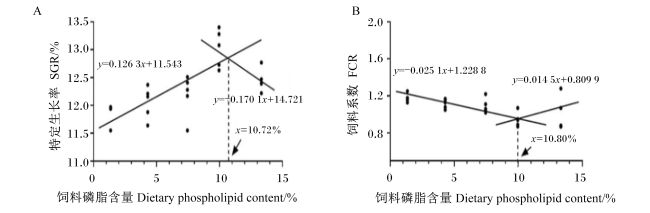
表2可知,随着饲料磷脂含量的增加,杂交鳢仔稚鱼的WGR和SGR均先上升后下降,在L10组达到最大值,L10组均显著高于L1、L4、L7和L13组(P<0.05);随着饲料磷脂含量的增加,杂交鳢仔稚鱼的FCR先下降后上升,在L10组达到最小值,显著低于L1、L4和L7组(P<0.05);杂交鳢仔稚鱼的VSI在L10组有最大值,显著大于L7和L13组(P<0.05);杂交鳢仔稚鱼的SR和CF各组之间无显著差异(P>0.05)。分别以SGR和FCR为评价指标,采用双折线模型得到杂交鳢仔稚鱼饲料的最适磷脂含量分别为10.72%(图1-A)和10.80%(图1-B)。
表2 杂交鳢仔稚鱼的生长性能

Table 2 Growth performance of hybrid snakehead (Channa argus ♂×Channa maculate ♀) larvae (n=5)

项目
Items
组别Groups
L1 L4 L7 L10 L13
增重率WGR/% 2 668.85±72.60a 2 818.53±101.25ab 2 949.67±131.15ab 3 745.19±153.98c 3 168.46±91.06b
特定生长率SGR/(%/d) 11.86±0.10a 12.04±0.13a 12.19±0.16ab 13.02±0.14c 12.45±0.09b
饲料系数FCR 1.18±0.03c 1.12±0.02bc 1.09±0.04bc 0.94±0.08a 0.99±0.03ab
存活率SR/% 87.50±0.83 87.33±2.50 87.67±4.20 78.00±3.39 83.33±7.67
肥满度CF/(g/cm3) 1.07±0.02 1.05±0.02 1.08±0.02 1.09±0.03 1.05±0.04
脏体比VSI/% 7.48±0.17bc 7.52±0.24bc 7.11±0.19ab 7.95±0.18c 6.79±0.15a

同行数据肩标无字母或相同字母表示差异不显著(P>0.05),不同小写字母表示差异显著(P<0.05)。下表同。

In the same row, values with no letter or the same letter superscripts mean no significant difference (P>0.05), while with different small letter superscripts mean significant difference (P<0.05). The same as below.

图1 饲料磷脂含量与杂交鳢仔稚鱼特定生长率和饲料系数的关系

Fig.l Relationship between dietary phospholipid content and SGR and FCR of hybrid snakehead (Channa argus ♂×Channa maculate ♀) larvae

2.2 杂交鳢仔稚鱼的体成分

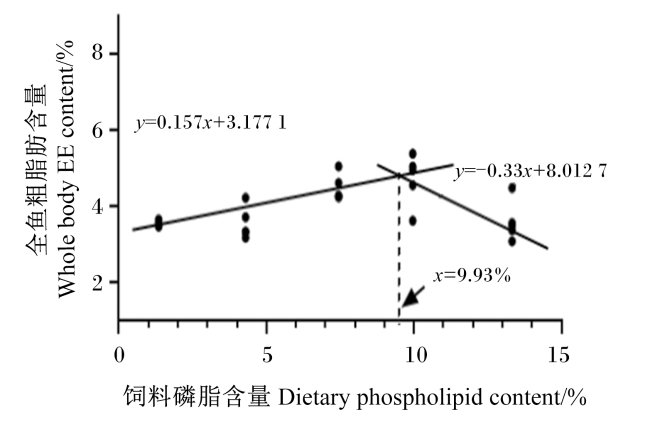
表3可知,杂交鳢仔稚鱼全鱼粗蛋白质和粗灰分含量各组之间并无显著差异(P>0.05);L10组杂交鳢仔稚鱼全鱼粗脂肪含量显著高于L1、L4和L13组(P<0.05);L10组杂交鳢仔稚鱼全鱼水分含量显著低于L1、L4、L7和L13组(P<0.05)。以全鱼粗脂肪含量为评价指标,采用双折线模型得到杂交鳢仔稚鱼饲料的最适磷脂含量为9.93%(图2)。
表3 杂交鳢仔稚鱼的体成分(湿物质基础)

Table 3 Body composition of hybrid snakehead (Channa argus ♂×Channa maculate ♀) larvae (wet matter basis, n=5) %

项目
Items
组别Groups
L1 L4 L7 L10 L13
粗蛋白质CP 13.76±0.17 14.08±0.13 13.72±0.22 14.22±0.13 13.99±0.13
粗脂肪EE 3.56±0.04a 3.57±0.19a 4.50±0.16ab 4.73±0.30b 3.61±0.24a
粗灰分Ash 3.44±0.09 3.48±0.07 3.43±0.08 3.51±0.07 3.43±0.07
水分Moisture 78.41±0.28b 78.11±0.08b 78.03±0.45b 76.70±0.50a 78.24±0.42b
图2 饲料磷脂含量与杂交鳢仔稚鱼全鱼粗脂肪含量的关系

Fig.2 Relationship between dietary phospholipid content and whole body EE content of hybrid snakehead (Channa argus ♂×Channa maculate ♀) larvae

2.3 杂交鳢仔稚鱼的肝脏生化指标

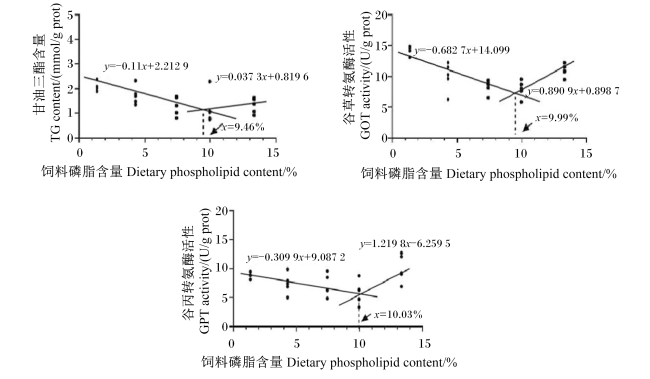
表4可知,随着饲料磷脂含量的增加,杂交鳢仔稚鱼肝脏中TG含量先下降后上升,并在L10组达到最小值,L10组显著低于L1和L4组(P<0.05);随着饲料磷脂含量的增加,肝脏中GOT活性先下降后上升,在L10组达到最小值,显著低于L1、L4和L13组(P<0.05);随着饲料磷脂含量的增加,肝脏中GPT活性先下降后上升,在L10组达到最小值,显著低于L1和L13组(P<0.05);杂交鳢仔稚鱼肝脏中TC和GLU含量各组之间并无显著差异(P>0.05)。以部分肝脏生化指标为评价指标,采用双折线模型得到杂交鳢仔稚鱼饲料的适宜磷脂含量为9.46%~10.03%(图3)。
表4 杂交鳢仔稚鱼的肝脏生化指标

Table 4 Liver biochemical indicators of hybrid snakehead (Channa argus ♂×Channa maculate ♀) larvae (n=5)

项目
Items
组别Groups
L1 L4 L7 L10 L13
甘油三酯TG/(mmol/g prot) 2.11±0.10b 1.73±0.17b 1.29±0.17a 1.19±0.28a 1.32±0.14a
总胆固醇TC/(mmol/g prot) 0.25±0.01 0.25±0.04 0.20±0.03 0.19±0.02 0.23±0.02
葡萄糖GLU/(mmol/g prot) 2.25±0.25 2.11±0.45 1.72±0.30 1.71±0.11 2.07±0.43
谷草转氨酶GOT/(U/g prot) 14.19±0.39d 9.98±1.03bc 8.37±0.50ab 7.97±0.62a 10.98±0.44c
谷丙转氨酶GPT/(U/g prot) 8.82±0.28bc 7.43±0.79abc 7.09±0.85ab 5.89±0.91a 10.00±1.06c
图3 饲料磷脂含量与杂交鳢仔稚鱼部分肝脏生化指标的关系

Fig.3 Relationship between dietary phospholipid content and part liver biochemical indices of hybrid snakehead (Channa argus ♂×Channa maculate ♀) larvae

2.4 杂交鳢仔稚鱼的消化酶活性

表5可知,L7和L13组杂交鳢仔稚鱼的肠道淀粉酶活性显著大于L1和L4组(P<0.05);肠道脂肪酶活性除L1组外,随着饲料磷脂含量的增加而上升,L10和L13组显著大于L4组(P<0.05);肝脏脂肪酶活性随着饲料磷脂含量的增加而上升,L13组显著大于L1和L4组(P<0.05);杂交鳢仔稚鱼的肠道胰蛋白酶以及肝脏淀粉酶和蛋白酶活性各组间并无显著差异(P>0.05)。
表5 杂交鳢仔稚鱼的消化酶活性

Table 5 Digestive enzyme activities of hybrid snakehead (Channa argus ♂×Channa maculate ♀) larvae (n=5) U/g prot

项目
Items
组别Groups
L1 L4 L7 L10 L13
肝脏Liver
淀粉酶AMS 2.18±0.06 1.86±0.17 1.71±0.10 1.78±0.25 2.19±0.29
脂肪酶LPS 2.51±0.25a 2.84±0.24ab 3.53±0.44abc 4.28±0.63bc 4.58±0.60c
胰蛋白酶TRY 2 328.76±676.88 1 647.12±438.40 1 803.83±503.58 1 444.57±270.03 2 671.25±759.03
肠道Intestine
淀粉酶AMS 1.59±0.20a 1.61±0.13a 2.44±0.38b 2.24±0.15ab 2.46±0.21b
脂肪酶LPS 4.71±0.18ab 3.37±0.43a 4.89±0.29abc 5.84±0.52bc 6.51±0.89c
胰蛋白酶TRY 2 027.42±761.41 1 281.44±372.61 1 725.46±473.37 1 910.41±489.21 2 359.78±673.16

2.5 杂交鳢仔稚鱼的肠道组织结构

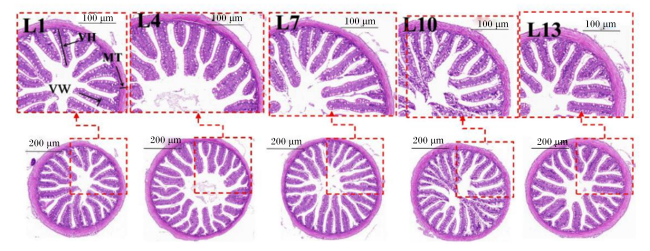
图4表6可知,各组杂交鳢仔稚鱼肠道的绒毛高度和肌层厚度随饲料磷脂含量的增加先增上升后下降,均在L10组达到最高值。其中,L10组绒毛高度显著大于L1、L4和L13组(P<0.05),肌层厚度显著大于L1和L4组(P<0.05)。
图4 杂交鳢仔稚鱼的肠道组织切片

VH:绒毛高度 villus height;MT:肌层厚度 muscular thickness;VW:绒毛宽度villus width。

Fig.4 Intestinal tissue slices of of hybrid snakehead (Channa argus ♂×Channa maculate ♀) larvae

表6 杂交鳢仔稚鱼的肠道组织结构

Table 6 Intestinal tissue structure of hybrid snakehead (Channa argus ♂×Channa maculate ♀) larvae (n=5) μm

项目
Items
组别Groups
L1 L4 L7 L10 L13
绒毛高度Villus height 226.42±8.34a 228.72±11.39a 263.93±20.09ab 307.29±22.36b 218.60±12.86a
肌层厚度
Muscular thickness
31.47±3.54a 33.63±1.35a 39.60±3.97ab 46.20±5.35b 42.56±2.34ab
绒毛宽度Villus width 70.76±2.27 67.00±2.80 65.56±1.65 65.01±3.54 59.54±5.73

2.6 杂交鳢仔稚鱼的肝脏非特异性免疫指标

表7可知,随着饲料磷脂含量的增加,杂交鳢仔稚鱼肝脏中C3含量先上升后下降,并在L10组达到最大值,显著大于L1组(P<0.05);杂交鳢仔稚鱼肝脏中C4除L10组外均显著大于L1组(P<0.05);杂交鳢仔稚鱼肝脏中LZM和AKP活性各组之间并无显著差异(P>0.05)。
表7 杂交鳢仔稚鱼的肝脏非特异性免疫指标

Table 7 Liver non-specific immune indicators of hybrid snakehead (Channa argus ♂×Channa maculate ♀) larvae (n=5)

项目
Items
组别Groups
L1 L4 L7 L10 L13
溶菌酶
LZM/(μg/mg prot)
222.79±62.96 145.08±27.49 186.13±58.42 179.72±72.30 382.80±110.93
补体3 C3/(μg/mg prot) 355.93±15.03a 389.07±19.42ab 419.47±26.99ab 461.83±42.94b 416.88±20.84ab
补体4 C4/(μg/mg prot) 113.95±3.73a 133.60±6.90b 130.82±4.06b 126.53±3.06ab 132.79±6.26b
碱性磷酸酶
AKP/(U/g prot)
0.79±0.21 0.73±0.13 0.81±0.21 0.58±0.07 0.75±0.19

2.7 杂交鳢仔稚鱼氨氮胁迫后的存活率及氨氮胁迫前后的肝脏抗氧化指标

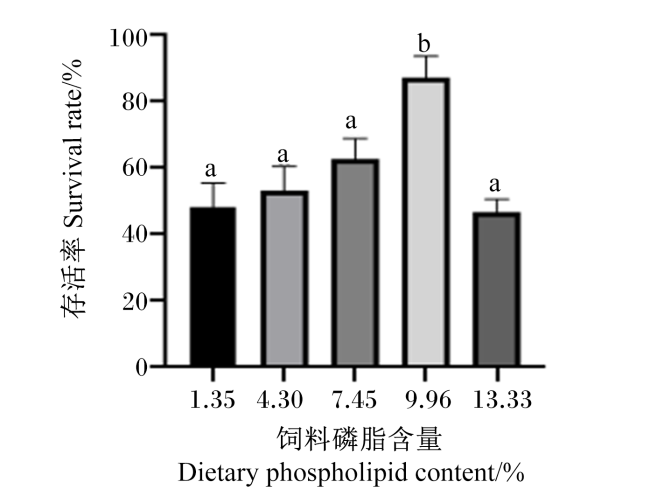
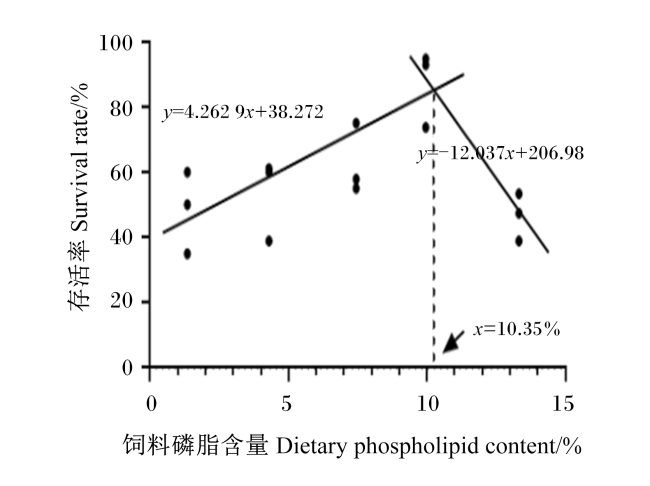
图5可知,24 h急性氨氮胁迫结束后,随着饲料磷脂含量的增加,杂交鳢仔稚鱼的存活率先上升后下降,L10组的存活率显著高于其他各组(P<0.05);以氨氮胁迫后的存活率为评价指标,采用双折线模型得到杂交鳢仔稚鱼的饲料最适磷脂含量为10.35%(图6)。
图5 杂交鳢仔稚鱼氨氮胁迫后的存活率

数据柱形标注不同小写字母表示差异显著(P<0.05)。

Fig.5 Survival rate of hybrid snakehead (Channa argus ♂×Channa maculate ♀) larvae after ammonia nitrogen stress (n=5)

Data columns with different lowercase letters indicated significant difference (P<0.05).

图6 饲料磷脂含量与杂交鳢仔稚鱼氨氮胁迫后的存活率的关系

Fig.6 Relationship between dietary phospholipid content and survival rate of hybrid snakehead (Channa argus ♂×Channa maculate ♀) larvae after ammonia nitrogen stress

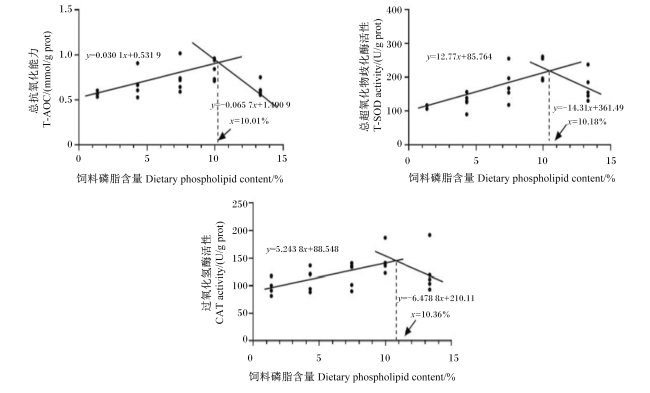
表8可知,氨氮胁迫前,随着饲料磷脂含量的增加,杂交鳢仔稚鱼肝脏中T-AOC先上升后下降,在L10组达到最大值,显著高于L1和L13组(P<0.05);随着饲料磷脂含量的增加,杂交鳢仔稚鱼肝脏中T-SOD活性先上升后下降,在L10组达到最大值,显著高于L1和L4组(P<0.05);L10组肝脏中CAT活性显著高于L1组(P<0.05)。氨氮胁迫后,杂交鳢仔稚鱼肝脏中T-SOD和CAT活性随饲料磷脂含量的增加均呈先上升后下降的变化趋势,在L10组达到最大值,且L10组的CAT活性活性显著高于L1、L4和L13组(P<0.05)。无论是氨氮胁迫前还是氨氮胁迫后,各组之间干重中MDA含量并无显著差异(P>0.05)。以部分肝脏抗氧化指标为评价指标,采用双折线模型得到杂交鳢仔稚鱼饲料的适宜磷脂含量为10.01%~10.36%(图7)。
表8 杂交鳢仔稚鱼氨氮胁迫前后的肝脏抗氧化指标

Table 8 Liver antioxidant indicators of hybrid snakehead (Channa argus ♂×Channa maculate ♀) larvae before and after ammonia nitrogen stress (n=5)

时间
Time
指标
Indicators
组别Groups
L1 L4 L7 L10 L13
应激前
Before stress
总抗氧化能力
T-AOC/(mmol/g prot)
0.56±0.01ab 0.68±0.06abc 0.74±0.07bc 0.84±0.05c 0.61±0.04ab
过氧化氢酶
CAT/(U/g prot)
97.51±7.77a 112.01±9.11ab 120.39±10.33ab 145.58±10.84b 123.75±17.57ab
总超氧化物歧化酶
T-SOD/(U/g prot)
114.14±2.59a 128.20±10.90ab 178.56±23.03bc 218.96±16.10c 170.74±19.01bc
丙二醛
MDA/(nmol/g prot)
3.28±0.64 3.27±0.53 3.86±0.73 3.47±1.18 3.20±0.49
应激后
After stress
过氧化氢酶
CAT/(U/g prot)
326.39±19.09a 364.98±18.09a 393.74±29.49ab 466.87±32.82b 345.14±26.92a
总超氧化物歧化酶
T-SOD/(U/g prot)
289.57±43.42 316.73±12.79 368.89±18.48 385.61±52.33 330.23±15.18
丙二醛
MDA/(nmol/g prot)
10.90±1.93 12.08±0.80 13.28±1.52 10.72±0.76 11.96±1.13
图7 饲料磷脂含量与杂交鳢仔稚鱼氨氮胁迫前部分肝脏抗氧化指标的关系

Fig.7 Relationship between dietary phospholipid content and part liver antioxidant indicators of hybrid snakehead (Channa argus ♂×Channa maculate ♀) larvae before ammonia nitrogen stress

3 讨论

3.1 饲料磷脂含量对杂交鳢仔稚鱼生长性能的影响

磷脂是鱼体内重要的营养物质,对鱼类的生长发育有重要作用。本试验结果显示,饲料中添加适量的磷脂能提高杂交鳢仔稚鱼的生长性能,与磷脂在虹鳟(Oncorhynchus mykiss)[14]、杂交石斑鱼(Epinephelus fuscoguttatus ♀×E. lanceolatus♂)[15]、大西洋鲑鱼(Salmo salar)[16]、团头鲂(Megalobrama amblycephala)[17]、杜氏鰤(Seriola dumerili)[18]和军曹鱼(Rachycentron canadum)[19]等水产动物中的应用结果一致。磷脂能够通过促进饲料脂质乳化和脂蛋白组装,增强肠道对中性脂质的吸收、运输,进而促进脂肪的吸收,为生长发育提供能量[17];此外,磷脂还可以直接或间接的用于细胞膜的生成,满足仔稚鱼生长的需要;同时,磷脂还有助于改善饲料的适口性,提高仔稚鱼的食欲,降低FCR。本试验以生长性能为评价指标,得到杂交鳢仔稚鱼对饲料磷脂的需要量为10.72%~10.80%,要高于梭鲈(Sander lucioperca)仔鱼(9.5%)[20]、金头鲷仔稚鱼(8%)[21]和杂交石斑鱼幼鱼(9.17%)[15],低于石鲷(Oplegnathus fasciatus)仔鱼(12.21%)[22]、鲈鱼(Lateolabrax japonicus)仔鱼(11.6%)[23]和黄姑鱼(Nibea albiflora)仔鱼(11.46%)[24]。其原因除了不同品种的鱼类对磷脂需要量的差异外,还可能是不同日龄的鱼对外源性磷脂的需要量不同,鱼卵孵化后,仔稚鱼生长阶段是鱼类生长最为迅速的时期,磷脂作为细胞膜的主要成分,各日龄段的鱼类幼体对磷脂的需要量波动也较大。

3.2 饲料磷脂含量对杂交鳢仔稚鱼体成分和肝脏生化指标的影响

全鱼营养成分是评价水产品质量和营养状况的重要指标,肝脏TG含量是监测肝脏健康的重要指标,其含量过高说明肝脏代谢功能不正常,会有患脂肪肝的风险。本试验结果显示,杂交鳢仔稚鱼全鱼粗脂肪含量随着饲料磷脂含量的增加先上升后下降;肝脏中TG含量则随着饲料磷脂含量的增加先下降后上升。由此可见,饲料中适宜含量的磷脂能够减少TG在肝脏中积累,促进肝脏中脂肪向组织中转运,改善肝脏的健康。这一结果与在大口黑鲈[10]、泥鳅(Misgurnus anguillicaudatus)[25]和条纹鲶鱼(Silurus asotus)[26]上所得结果相似。其原因可能是磷脂是组装脂蛋白的关键成分,TG在体内的运输都依赖于脂蛋白,适量的磷脂能够促进体内脂蛋白的组装,加快脂质从肠道和肝脏通过血液转运至体内的各个组织,提高组织中脂肪的积累[27-29]。同时,磷脂作为细胞膜的主要成分,结合本试验肠道组织切片的观察结果,发现适量的磷脂能够改善鱼的肠道健康,健康的肠道有益于对饲料中的脂质在小肠组织滞留和利用,加强脂质营养在体内的利用[23,30-31]。磷脂的添加促进了杂交鳢仔稚鱼体内脂质代谢为机体供能,提高了脂肪利用率,但本试验中全鱼粗蛋白质含量各组间无显著差异,并无明显的“蛋白质节约效应”。Zhao等[4]研究发现,鱼类在面临营养波动时,具有维持体内蛋白质恒定的能力。GOT和GPT是参与氨基酸合成代谢转氨反应的关键酶,其活性的大小反映了氨基酸合成代谢的效率[32]。在本试验中,肝脏GOT和GPT活性随着饲料磷脂含量的增加先下降后上升,这与张翩[33]以石鲷仔稚鱼为试验对象的研究结果类似。其可能原因是磷脂的添加促进了脂肪代谢供能,减少了蛋白质的分解供能,为维持体内的蛋白质恒定,转氨酶活性被抑制,降低了蛋白质的合成效率。

3.3 饲料磷脂含量对杂交鳢仔稚鱼肠道消化能力和健康的影响

消化酶活性是衡量消化能力的重要指标之一,决定了机体对营养物质的初步利用率,直接影响到生长发育。已有研究报道,在饲料中添加植物卵磷脂能够提高鱼类消化酶活性[4,8,20]。本试验中,杂交鳢仔稚鱼的肠道和肝脏脂肪酶活性均随着饲料磷脂含量的增加呈线性上升,这一结果与在大黄鱼[8]、鲤鱼(Cyprinus carpio)[34]上所得结果一致。有研究证明,乳糜微粒的不足会导致肠道上皮细胞和肝细胞内脂肪沉积过多,而脂质积累异常会抑制鱼的消化能力,对于消化器官未发育完全的仔稚鱼影响更为显著,而磷脂是乳糜微粒的主要成分之一,磷脂的补充有利于乳糜微粒的生成,加快脂质向组织的转运,能够正向促进胰腺和肝脏分泌脂肪酶[35-37]。L7、L10和L13组之间肠道淀粉酶活性无显著差异,但均显著大于L1和L4组,这一结果与在大黄鱼上所得结果[38]一致。肠道中淀粉酶升高的可能原因是,仔稚鱼还处于快速生长阶段,对能量需求较大,且肠道发育还不成熟,本研究中观察肠道组织切片发现适量的磷脂能够改善肠道健康,可能正向促进了肠道分泌淀粉酶。
肠道是鱼类吸收营养物质的主要器官,其绒毛高度和肌层厚度是发挥消化吸收功能的关键,肠道绒毛高度的增高能够增加小肠与营养物质的接触面积,增强小肠的营养吸收能力。肌层厚度决定了肠道的收缩蠕动能力,肌层增厚可提升消化效率。本试验中,杂交鳢仔稚鱼肠道绒毛高度和肌层厚度均随饲料磷脂含量的增加先上升后下降,说明适宜的磷脂含量有利于杂交鳢仔稚鱼的肠道发育,加强肠道的消化吸收功能,这与在黄颡鱼[31]、黄姑鱼[24]和大黄鱼[27]上所得结果一致。这一结果可能是通过增加肠道细胞的能量供应实现的,仔稚鱼肠道细胞快速增殖需要大量的能量供应[28],肠细胞的能量供应主要是通过脂肪酸β氧化过程实现,肉碱棕榈酰转移酶Ⅰ(carnitine palmitoyltransferase Ⅰ,CPTⅠ)是调节线粒体的脂肪酸β氧化过程的关键限速酶,其活性则受过氧化物酶体增殖物激活受体(peroxisomeproliferator-activated receptors,PPARs)的α亚型(PPARα)转录调控,磷脂的衍生产物能够作为配体激活PPARα,进而促进脂肪酸的β氧化,为肠细胞提供更多的能量[39-40]。且已有研究证明,肠上皮细胞的能量代谢不足会对肠道形态造成损伤,阻碍肠道发育[41]

3.4 饲料磷脂含量对杂交鳢仔稚鱼非特异性免疫、抗氧化和抗氨氮胁迫能力的影响

C3和C4是由肝脏合成的重要免疫分子,是鱼体非特异性免疫系统的重要组成部分,其含量在一定程度上反映了免疫系统的活性[42]。本结果显示,饲料中适宜的磷脂含量可以显著提高杂交鳢仔稚鱼肝脏中C3和C4含量,说明饲料中适量添加磷脂能够激活补体系统,有助于提高杂交鳢仔稚鱼的非特异性免疫反应,提高机体的抗病力,这与在闪光鲟[6]上所得的结果类似。
生物体在正常有氧代谢过程中会产生大量活性氧,过量的活性氧会攻击细胞和组织,导致机体氧化损伤[43]。超氧化物歧化酶(superoxide dismutase,SOD)和CAT是常见的抗氧化酶,机体内的线粒体通过有氧作用产生的活性氧,会被SOD捕获并将其转化为过氧化氢(hydrogen peroxide,H2O2),CAT则进一步将H2O2分解成无毒的水,保护细胞膜不受损伤[44]。T-AOC是各种抗氧化物质和抗氧化酶等构成的综合抗氧化水平。MDA是脂质过氧化反应的产物,过量的MDA会损害细胞结构和功能。磷脂能够提高鱼类的抗氧化能力已在多种鱼类上得到验证[15,45]。在实际生产中,残饵和粪便等有机物的分解产生的非离子氨(NH3)会对鱼类的生长发育造成不良影响[46-47]。本试验中,在氨氮胁迫前,杂交鳢仔稚鱼肝脏T-AOC、CAT和T-SOD活性的上升表明磷脂能够提高杂交鳢仔稚鱼抗氧化能力,增强对氧化应激的防御能力,在鲤鱼[34]和杂交石斑鱼[15]也有类似的结果。正常情况下,鱼体内的自由基含量是处于一个动态稳定的状态,但受到外界的刺激时,为抵抗外界环境的变化,鱼体内氧化速率加快会产生过氧化状态,且不同种类的鱼对外界污染物的抵抗力不同,面对水中氨氮浓度增加时,抗氧化酶活性的变化也有较大差异[48]。本试验中,在氨氮胁迫后,各组杂交鳢仔稚鱼肝脏中CAT、T-SOD活性和MDA含量均有提高,说明水环境中NH3含量的变化引起了鱼体内的活性氧含量增加,激活了机体的抗氧化防御体系,以及时清除过多的活性氧[49-50]。氨氮胁迫后杂交鳢仔稚鱼的存活率与肝脏中CAT和T-SOD活性的变化保持一致,均在L10组达到最高值,说明饲料中适量添加磷脂能够提高杂交鳢仔稚鱼对环境中NH3的抵抗力,减少氧化损伤。Kanazawa等[51]对真鲷(Pagrosomus major)的研究也发现大豆磷脂能够有效提高真鲷对外界压力(如水温和盐度变化及低溶解氧浓度)的耐受性。Trushenski等[52]使用海洋卵磷脂来替代部分鱼粉的研究也发现磷脂的添加能够增强军曹鱼在压力环境中的恢复能力。鱼组织细胞膜磷脂中含有丰富的花生四烯酸(arachidonic acid,ARA,C20∶4n-6),ARA是前列腺素的前体,当外界压力相关的触发因素诱导ARA释放,ARA则会转化为前列腺素,前列腺素能够调节皮质醇和皮质酮的释放,增强机体面对外界急性刺激的抗应激能力[53-54],这也许是适量磷脂能够提高氨氮环境中杂交鳢仔稚鱼存活率的原因之一。

4 结论

饲料中添加适量的磷脂能够提高杂交鳢仔稚鱼的生长性能,改善肠道健康,促进肝脏脂肪和蛋白质代谢,增加鱼体粗脂肪含量,提高免疫与抗氧化能力,增强抗氨氮应激能力。本试验条件下,综合考虑生长、全鱼粗脂肪含量、部分肝脏生化和抗氧化指标以及氨氮胁迫后存活率,杂交鳢仔稚鱼饲料中适宜的磷脂含量为9.46%~10.80%。
[1]
TURCHINI G M, FRANCIS D S, DU Z Y, et al. Chapter 5—the lipids[M]//HARDY R W,KAUSHIK S J.Fish nutrition. 4th ed. New York: Academic Press,2021:303-467.

[2]
MORAES G, DE ALMEIDA L C.Chapter 11—nutrition and functional aspects of digestion in fish[M]//BALDISSEROTTO B,URBINATI E C,CYRINO J E P.Biology and physiology of freshwater neotropical fish. New York: Academic Press,2020:251-271.

[3]
CHEN J, ZHUO M Q, JIANG J L, et al. Effects of dietary lipid levels on fiber quality,lipidomic profiles,antioxidant and inflammation responses in muscle of yellow catfish Pelteobagrus fulvidraco[J]. Aquaculture Reports, 2023,33:101855.

[4]
ZHAO J Z, AI Q H, MAI K S, et al. Effects of dietary phospholipids on survival,growth,digestive enzymes and stress resistance of large yellow croaker,Larmichthys crocea larvae[J]. Aquaculture, 2013,410/411:122-128.

[5]
FENG L, CHEN Y P, JIANG W D, et al. Modulation of immune response,physical barrier and related signaling factors in the gills of juvenile grass carp (Ctenopharyngodon idella) fed supplemented diet with phospholipids[J]. Fish & Shellfish Immunology, 2016,48:79-93.

[6]
JAFARI F, AGH N, NOORI F, et al. Effects of dietary soybean lecithin on growth performance,blood chemistry and immunity in juvenile stellate sturgeon (Acipenser stellatus)[J]. Fish & Shellfish Immunology, 2018,80:487-496.

[7]
SINK T D, LOCHMANN R T. The effects of soybean lecithin supplementation to a practical diet formulation on juvenile channel catfish,Ictalurus punctatus:growth,survival,hematology,innate immune activity,and lipid biochemistry[J]. Journal of the World Aquaculture Society, 2014, 45(2):163-172.

[8]
CAI Z N, FENG S H, XIANG X J, et al. Effects of dietary phospholipid on lipase activity,antioxidant capacity and lipid metabolism-related gene expression in large yellow croaker larvae (Larimichthys crocea)[J]. Comparative Biochemistry and Physiology-Part B:Biochemistry & Molecular Biology, 2016,201:46-52.

[9]
SALEH N E, WASSEF E A, KAMEL M A, et al. Beneficial effects of soybean lecithin and vitamin C combination in fingerlings gilthead seabream (Sparus aurata) diets on fish performance,oxidation status and genes expression responses[J]. Aquaculture, 2022,546:737345.

[10]
YANG W X, WU J J, SONG R, et al. Effects of dietary soybean lecithin on growth performances,body composition,serum biochemical parameters,digestive and metabolic abilities in largemouth bass Micropterus salmoides[J]. Aquaculture Reports, 2023,29:101528.

[11]
CAHU C L, GISBERT E, VILLENEUVE L A N, et al. Influence of dietary phospholipids on early ontogenesis of fish[J]. Aquaculture Research, 2009, 40(9):989-999.

[12]
LIN S M, LI F J, YUANGSOI B, et al. Effect of dietary phospholipid levels on growth,lipid metabolism,and antioxidative status of juvenile hybrid snakehead (Channa argus×Channa maculata)[J]. Fish Physiology and Biochemistry, 2018, 44(1):401-410.

[13]
李宝齐, 邓英杰, 索绪斌. 钼蓝法测定脂质体凝胶剂中磷脂的含量[J]. 中国药剂学杂志(网络版), 2005(5):305-309.

LI B Q, DENG Y J, SUO X B. Determinating contents of phospholipids in liposomal gel with molybdenum blue method[J]. Chinese Journal of Pharmaceutics (Online Edition), 2005(5):305-309. (in Chinese)

[14]
AZARM H M, KENARI A A, HEDAYATI M. Effect of dietary phospholipid sources and levels on growth performance,enzymes activity,cholecystokinin and lipoprotein fractions of rainbow trout (Oncorhynchus mykiss) fry[J]. Aquaculture Research, 2013, 44(4):634-644.

[15]
HUANG Y, XU J, SHENG Z, et al. Integrated response of growth performance,fatty acid composition,antioxidant responses and lipid metabolism to dietary phospholipids in hybrid grouper (Epinephelus fuscoguttatus ♀×E.lanceolatus ♂) larvae[J]. Aquaculture, 2021,541:736728.

[16]
TAYLOR J F, MARTINEZ-RUBIO L, DEL POZO J, et al. Influence of dietary phospholipid on early development and performance of Atlantic salmon (Salmo salar)[J]. Aquaculture, 2015,448:262-272.

[17]
LI Y, GAO J, HUANG S Q. Effects of different dietary phospholipid levels on growth performance,fatty acid composition,PPAR gene expressions and antioxidant responses of blunt snout bream Megalobrama amblycephala fingerlings[J]. Fish Physiology and Biochemistry, 2015, 41(2):423-436.

[18]
UYAN O, KOSHIO S, ISHIKAWA M, et al. The influence of dietary phospholipid level on the performances of juvenile amberjack,Seriola dumerili,fed non-fishmeal diets[J]. Aquaculture Nutrition, 2009, 15(5):550-557.

[19]
NIU J, LIU Y J, TIAN L X, et al. Effects of dietary phospholipid level in cobia (Rachycentron canadum) larvae:growth,survival,plasma lipids and enzymes of lipid metabolism[J]. Fish Physiology and Biochemistry, 2008, 34(1):9-17.

[20]
HAMZA N, MHETLI M, KHEMIS I B, et al. Effect of dietary phospholipid levels on performance,enzyme activities and fatty acid composition of pikeperch (Sander lucioperca) larvae[J]. Aquaculture, 2008, 275(1/2/3/4):274-282.

[21]
SALEH R, BETANCOR M B, ROO J, et al. Optimum soybean lecithin contents in microdiets for gilthead seabream (Sparus aurata) larvae[J]. Aquaculture Nutrition, 2013, 19(4):585-597.

[22]
TAN P, ZHANG P, ZHANG L, et al. Effects of soybean lecithin on growth performance,intestine morphology,and liver tissue metabolism in rock bream (Oplegnathus fasciatus) larvae[J]. Frontiers in Marine Science, 2022,9:942259.

[23]
CAHU C L, ZAMBONINO INFANTE J L, BARBOSA V. Effect of dietary phospholipid level and phospholipid:neutral lipid value on the development of sea bass (Dicentrarchus labrax) larvae fed a compound diet[J]. British Journal of Nutrition, 2003, 90(1):21-28.

PMID

[24]
TAN P, ZHU W L, ZHANG P, et al. Dietary soybean lecithin inclusion promotes growth,development,and intestinal morphology of yellow drum (Nibea albiflora) larvae[J]. Aquaculture, 2022,559:738446.

[25]
GAO J, KOSHIO S, WANG W M, et al. Effects of dietary phospholipid levels on growth performance,fatty acid composition and antioxidant responses of dojo loach Misgurnus anguillicaudatus larvae[J]. Aquaculture, 2014,426/427:304-309.

[26]
SIVARAMAKRISHNAN T, SAHU N P, JAIN K K, et al. Optimum dietary lipid requirement of Pangasianodon hypophthalmus juveniles in relation to growth,fatty acid profile,body indices and digestive enzyme activity[J]. Aquaculture International, 2017, 25(2):941-954.

[27]
FONTAGNÉ S, GEURDEN I, ESCAFFRE A M, et al. Histological changes induced by dietary phospholipids in intestine and liver of common carp (Cyprinus carpio L.) larvae[J]. Aquaculture, 1998, 161(1/4):213-223.

[28]
SHERIDAN M A. Lipid dynamics in fish:aspects of absorption,transportation,deposition and mobilization[J]. Comparative Biochemistry and Physiology B:Comparative Biochemistry, 1988, 90(4):679-690.

[29]
TESHIMA S I, KANAZAWA A, HORINOUCHI K, et al. Phospholipids of the rotifer,prawn,and larval fish[J]. Nippon Suisan Gakkaishi, 1987, 53(4):609-615.

[30]
ZAMBONINO INFANTE J L, CAHU C L. High dietary lipid levels enhance digestive tract maturation and improve Dicentrarchus labrax larval development[J]. The Journal of Nutrition, 1999, 129(6):1195-1200.

[31]
LU S F, ZHAO N, ZHAO A, et al. Effect of soybean phospholipid supplementation in formulated microdiets and live food on foregut and liver histological changes of Pelteobagrus fulvidraco larvae[J]. Aquaculture, 2008, 278(1/2/3/4):119-127.

[32]
BIBIANO MELO J F, LUNDSTEDT L M, METÓN I, et al. Effects of dietary levels of protein on nitrogenous metabolism of Rhamdia quelen (Teleostei:Pimelodidae)[J]. Comparative Biochemistry and Physiology-Part A:Molecular & Integrative Physiology, 2006, 145(2):181-187.

[33]
张翩. 大豆磷脂对条石鲷稚鱼存活、生长性能和肝脏代谢的影响[D]. 硕士学位论文. 舟山: 浙江海洋大学, 2023.

ZHANG P. Effects of soybean lecithin on survival rate,growthperformance,and liver tissue metabolism in rock bream (Oplegnathus fasciatus) larvae[D]. Master’s Thesis. Zhoushan: Zhejiang Ocean University, 2023. (in Chinese)

[34]
ADEL M, GHOLAGHAIE M, KHANJANY P, et al. Effect of dietary soybean lecithin on growth parameters,digestive enzyme activity,antioxidative status and mucosal immune responses of common carp (Cyprinus carpio)[J]. Aquaculture Nutrition, 2017,23:1145-1152.

[35]
DAPRÀ F, GEURDEN I, CORRAZE G, et al. Physiological and molecular responses to dietary phospholipids vary between fry and early juvenile stages of rainbow trout (Oncorhynchus mykiss)[J]. Aquaculture, 2011, 319(3/4):377-384.

[36]
LIU J L, CABALLERO M J, IZQUIERDO M A, et al. Necessity of dietary lecithin and eicosapentaenoic acid for growth,survival,stress resistance and lipoprotein formation in gilthead sea bream Sparus aurata[J]. Fisheries Science, 2002, 68(6):1165-1172.

[37]
SALHI M, HERNÁNDEZ-CRUZ C M, BESSONART M, et al. Effect of different dietary polar lipid levels and different n-3 HUFA content in polar lipids on gut and liver histological structure of gilthead seabream (Sparus aurata) larvae[J]. Aquaculture, 1999, 179(1/2/3/4):253-263.

[38]
MA H, CAHU C, ZAMBONINO J, et al. Activities of selected digestive enzymes during larval development of large yellow croaker (Pseudosciaena crocea)[J]. Aquaculture, 2005, 245(1/2/3/4):239-248.

[39]
VARGA T, CZIMMERER Z, NAGY L. PPARs are a unique set of fatty acid regulated transcription factors controlling both lipid metabolism and inflammation[J]. Biochimica et Biophysica Acta, 2011, 1812(8):1007-1022.

DOI PMID

[40]
MANDRUP S, LANE M D. Regulating adipogenesis[J]. Journal of Biological Chemistry, 1997, 272(9):5367-5370.

DOI PMID

[41]
NAZLI A, YANG P C, JURY J, et al. Epithelia under metabolic stress perceive commensal bacteria as a threat[J]. The American Journal of Pathology, 2004, 164(3):947-957.

[42]
LING M, MURALI M. Analysis of the complement system in the clinical immunology laboratory[J]. Clinics in Laboratory Medicine, 2019, 39(4):579-590.

DOI PMID

[43]
ALI S S, AHSAN H, ZIA M K, et al. Understanding oxidants and antioxidants:classical team with new players[J]. Journal of Food Biochemistry, 2020, 44(3):e13145.

[44]
SEIFRIED H E, ANDERSON D E, FISHER E I, et al. A review of the interaction among dietary antioxidants and reactive oxygen species[J]. The Journal of Nutritional Biochemistry, 2007, 18(9):567-579.

[45]
JENABI HAGHPARAST R, SARVI MOGHANLOU K, MOHSENI M, et al. Effect of dietary soybean lecithin on fish performance,hemato-immunological parameters,lipid biochemistry,antioxidant status,digestive enzymes activity and intestinal histomorphometry of pre-spawning Caspian brown trout (Salmo trutta caspius)[J]. Fish & Shellfish Immunology, 2019,91:50-57.

[46]
XU Z K, CAO J, QIN X M, et al. Toxic effects on bioaccumulation,hematological parameters,oxidative stress,immune responses and tissue structure in fish exposed to ammonia nitrogen:a review[J]. Animals, 2021, 11(11):3304.

[47]
RANDALL D J, TSUI T K N. Ammonia toxicity in fish[J]. Marine Pollution Bulletin, 2002, 45(1/12):17-23.

[48]
KIM J H, YU Y B, CHOI J H. Toxic effects on bioaccumulation,hematological parameters,oxidative stress,immune responses and neurotoxicity in fish exposed to microplastics:a review[J]. Journal of Hazardous Materials, 2021,413:125423.

[49]
刘亚娟, 胡静, 周胜杰, 等. 急性氨氮胁迫对尖吻鲈稚鱼消化酶及抗氧化酶活性的影响[J]. 南方农业学报, 2018, 49(10):2087-2095.

LIU Y J, HU J, ZHOU S J, et al. Effects of acute ammonia nitrogen stress on antioxidant enzymes activity and digestive enzymes activity in larval Lates calcarifer[J]. Journal of Southern Agriculture, 2018, 49(10):2087-2095. (in Chinese)

[50]
SUN H J, K, MINTER E J A, et al. Combined effects of ammonia and microcystin on survival,growth,antioxidant responses,and lipid peroxidation of bighead carp Hypophthalmythys nobilis larvae[J]. Journal of Hazardous Materials, 2012,221-222:213-219.

[51]
KANAZAWA A. Effects of docosahexaenoic acid and phospholipids on stress tolerance of fish[J]. Aquaculture, 1997, 155(1/4):129-134.

[52]
TRUSHENSKI J, SCHWARZ M, PESSOA W V N, et al. Amending reduced fish-meal feeds with marine lecithin,but not soy lecithin,improves the growth of juvenile cobia and may attenuate heightened responses to stress challenge[J]. Journal of Animal Physiology and Animal Nutrition, 2013, 97(1):170-180.

[53]
VAN ANHOLT R D, SPANINGS F A T, KOVEN W M, et al. Arachidonic acid reduces the stress response of gilthead seabream Sparus aurata L[J]. Journal of Experimental Biology, 2004, 207(Pt 19):3419-3430.

[54]
KOVEN W, BARR Y, LUTZKY S, et al. The effect of dietary arachidonic acid (20∶4n-6) on growth,survival and resistance to handling stress in gilthead seabream (Sparus aurata) larvae[J]. Aquaculture, 2001, 193(1/2):107-122.

文章导航

/