综述

饲粮纤维对犬、猫健康影响的研究进展

  • 沈鑫宇 , 1 ,
  • 余东游 1, 2 ,
  • 许佳 , 3, 4, *
展开
  • 1 浙江大学动物科学学院,杭州 310058
  • 2 浙江大学新昌联合创新中心(天姥实验室),绍兴 312500
  • 3 金华职业技术大学农学院,金华 321017
  • 4 海特宠食科技(杭州)有限公司,杭州 310057
* 许 佳,副教授,E-mail:

沈鑫宇(2001—),男,四川宜宾人,硕士研究生,从事动物营养研究。E-mail:

Copy editor: 武海龙

收稿日期: 2024-10-11

  网络出版日期: 2025-05-14

基金资助

新型生骨肉冻干的研究与开发(校合-2024-KYY-517102-0004)

Advances in Effects of Dietary Fiber on Dog and Cat Health

  • SHEN Xinyu , 1 ,
  • YU Dongyou 1, 2 ,
  • XU Jia , 3, 4, *
Expand
  • 1 College of Animal Sciences, Zhejiang University, Hangzhou 310058, China
  • 2 Xinchang Joint Innovation Center (Tianmu Laboratory), Zhejiang University, Shaoxing 312500, China
  • 3 College of Agriculture, Jinhua University of Vocational Technology, Jinhua 321017, China
  • 4 Haite Pet Food Science and Technology (Hangzhou) Co., Ltd., Hangzhou 310057, China
* associate professor, E-mail:

Received date: 2024-10-11

  Online published: 2025-05-14

摘要

饲粮纤维在犬、猫饲粮中具有重要作用。虽然纤维并非犬、猫的必需营养物质,但适量添加特定类型的纤维对机体健康具有明显益处。其中,可溶性纤维易于发酵,通过调节肠道菌群及其代谢产物,有助于维持肠道微生态平衡;而不可溶性纤维则通过增加粪便体积和加速肠道内容物的转运,有效支持正常的消化功能。此外,饲粮纤维在犬、猫体重控制、血糖和血脂代谢的调节以及增强胃肠道屏障功能方面同样表现出积极作用。根据生理状态和疾病类型,选择合适的纤维类型可用于老年犬、猫的健康管理,治疗和预防胃肠道疾病、肥胖症、糖尿病等代谢疾病,对慢性肾病等也起到缓解或改善作用。本文综述了饲粮纤维的定义、类型、来源及理化特性,探讨了不同纤维对犬、猫生理功能的影响和辅助疾病治疗中的应用潜力,旨在为未来犬、猫营养研究和饲粮设计提供参考。

本文引用格式

沈鑫宇 , 余东游 , 许佳 . 饲粮纤维对犬、猫健康影响的研究进展[J]. 动物营养学报, 2025 , 37(5) : 2858 -2874 . DOI: 10.12418/CJAN2025.239

Abstract

Dietary fiber plays a crucial role in the diets of dogs and cats. Although fiber is not an essential nutrient for dogs and cats, the appropriate addition of specific types of dietary fiber can provide significant health benefits. Soluble fiber, which is readily fermentable, aids in maintaining intestinal microbial balance by modulating gut microbiota and their metabolites. In contrast, insoluble fiber can effectively supporting normal digestive function by increasing fecal volume and accelerating intestinal contents transport. Furthermore, dietary fiber significantly contributes to weight management, regulation of blood glucose and lipid metabolism, and strengthening of the gastrointestinal barrier in dogs and cats. Based on physiological conditions and disease types, selecting the appropriate type of fiber can support health management in senior dogs and cats, aid in the treatment and prevention of gastrointestinal diseases, metabolic diseases such as obesity, diabetes and alleviate symptom or improve conditions of chronic kidney disease. This review outlines the definition, types, sources and physicochemical properties of dietary fiber, discusses its effects on physiological functions in dogs and cats, and explores its potential applications in disease treatment, aiming to provide insights for future research on pet nutrition and diet formulation.

饲粮纤维虽然不是必需营养物质,但在犬、猫饲粮中具有重要作用,适量添加特定类型的纤维对机体健康具有益处。目前有关饲粮纤维对犬、猫健康影响的报道较少,且大多仅针对饲粮纤维对犬、猫粪便形态和消化率的影响进行描述,在其分类、来源和应用方面暂未有综述进行详细叙述。因此,本文旨在综述饲粮纤维的类型、来源、生物学功能,并对不同纤维在犬、猫饲粮中的实际应用进行深入论述,让读者能对饲粮纤维对于犬、猫健康的意义有更全面深入的认识。

1 饲粮纤维的定义和类型

1.1 饲粮纤维的定义
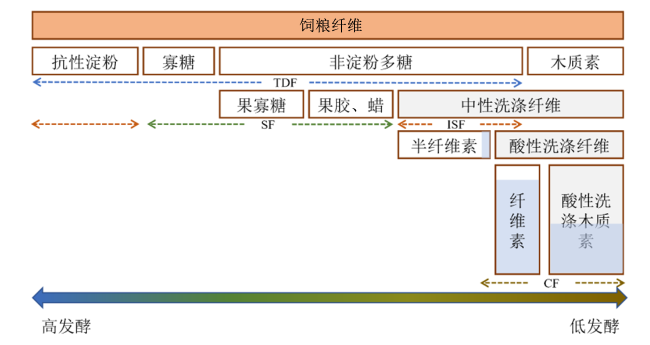
联合国粮食及农业组织将饲粮纤维定义为一种聚合度不低于3且不能被人体肠道消化及吸收的碳水化合物[1]。国际食品法典委员会则将饲粮纤维定义为富含10个或以上糖单位且不能被人小肠酶分解吸收的碳水化合物[2]。通常认为,饲粮纤维是一种不能被人和动物直接消化吸收的多糖类物质或不可消化的碳水化合物,如抗性淀粉、低聚糖、非淀粉多糖和木质素等(图1)[3]
图1 饲粮纤维组成示意图

TDF:总饲粮纤维 total dietary fiber;SF:可溶性纤维 soluble fiber;ISF:不可溶性纤维 insoluble fiber;CF:粗纤维 crude fiber。

蓝色部分代表粗纤维中含部分半纤维素、纤维素和酸性洗涤木质素。The blue part represents the presence of partial hemicellulose, cellulose and acid washed lignin in crude fiber.

Fig.1 Diagram of dietary fiber composition[4]

1.2 饲粮纤维的类型及理化特性

饲粮纤维的分类方法有很多种,常见饲粮纤维的理化特性见表1[3,5]。根据总饲粮纤维(total dietary fiber,TDF)在水中的溶解性,分为可溶性纤维(soluble fiber,SF)和不可溶性纤维(insoluble fiber,ISF),其中SF含有不同结构的活性物质,主要包括抗性低聚糖和由各种高分子质量多糖组成的黏性纤维[6]。果寡糖(fructooligosaccharide,FOS)和甘露寡糖(mannose-oligosaccharides,MOS)是研究最多的低聚糖[7]。在宠物食品中,常用的黏性纤维有果胶、瓜尔胶(guar gum,GG)和β-葡聚糖等,黏性纤维相对分子质量较大(一般聚合度大于10),表现出较高的持水性,且在溶液中仅需低浓度即可形成凝胶,使体系黏度明显增加[3]。果胶富含半乳糖醛酸,是优质的SF来源,其溶解度和黏性与甲酯化程度(degrees of methyl esterification,DE)相关。高DE果胶(DE>50%)易在酸性介质(pH<3.5)和高糖(>55%)条件下溶解,形成凝胶;低DE果胶(DE<50%)易在pH 2~6且二价金属离子存在下形成凝胶[8]。瓜尔胶是一种天然的半乳甘露聚糖,由一条含1,4-β-D-吡喃甘露糖基的线性链构成[9-10]。其链缠结特性增强了胶凝和增稠能力,即便低浓度下也能显著增加溶液黏度[11]。β-葡聚糖是由β-1,3-键和β-1,6-键连接的葡萄糖构成,链的弯曲结构允许水分进入,赋予其良好的溶解性[12]。果聚糖(如菊粉)也是重要的SF来源,由β-D-呋喃果糖基单元组成,聚合度在2~60[13]
表1 常见饲粮纤维的理化特性

Table 1 Physicochemical properties of common dietary fiber

纤维种类Fiber types 溶解性Solubility 黏性Viscosity 发酵性Fermentability
纤维素Cellulose 不可溶 无黏性
低聚半乳糖GOS
低聚甘露糖MOS
果寡糖FOS
低聚木糖XOS
果胶Pectin 中至高
β-葡聚糖β-glucan 中至高
半纤维素Hemicellulose 低至中 无黏性
木质素Lignin 不可溶 无黏性
阿拉伯木聚糖Arabinoxylan 低至中
粘液Mucilage 中至高
抗性淀粉-4 RS-4 低至高 低至中
抗性淀粉-3 RS-3 无至低
抗性淀粉-2 RS-2 无黏性
ISF是一类几乎不溶于水、不能在小肠中消化的非淀粉多糖,包括纤维素、部分半纤维素和木质素[14]。纤维素是β-1,4-键连接的D-葡萄糖单元的线性均聚物;半纤维素是由不同单糖构成的异质多聚体,包括五碳糖(木糖、阿拉伯糖)和六碳糖(半乳糖),骨架为β-1,4-键连接,分为可溶或不溶的半纤维素,其特性取决于它们的大小和结构(例如侧链取代和分子间交联)[15]。木质素是一种酚类聚合物,由3种单体(对香豆醇、针叶醇和芥子醇)的自由基诱导缩合形成[16]
饲粮纤维按照功能可分为不可发酵、慢速发酵、适度可发酵和可快速发酵纤维[17]。纤维发酵性主要受物理化学特性(例如溶解度和黏度)影响。比如果胶、菊粉等发酵性较好的饲粮纤维溶解性较好,而发酵性较差的纤维(纤维素、半纤维素)溶解性较差。大多数ISF因糖链间密集的氢键形成疏水结构,可以抵抗外源葡萄糖苷酶的水解,所以不易被肠道细菌发酵利用[18]。尽管溶解性和发酵性在纤维特性中存在一定关联,但两者并非完全一致。例如抗性淀粉(resistant starch,RS)有5种亚型,其中RS-2、RS-3和部分RS-4溶解度较低,但仍具有较好的发酵性[19-20]

2 常见的饲粮纤维来源

2.1 谷物

谷类如大米、小麦、大麦等由谷皮、胚乳、胚芽3个主要部分组成[21]。胚乳以淀粉和蛋白质为主,占干粒重的80%~85%,谷皮和胚芽则占干粒重量的12%~18%和2%~3%[22]。尽管谷物中淀粉含量较高(约80%),但其TDF含量仍普遍超过9%,其中燕麦的TDF含量甚至可达30%[23-25]。谷物纤维中,ISF占比均较多,如黑麦、小米和玉米的ISF含量,分别是其SF含量的3倍、6倍和25倍,这些ISF主要由谷皮中的纤维素和木质素构成[23-24,26]。而SF则主要存在于胚乳细胞壁中,如半纤维素[27-28]。谷物中的半纤维素以阿拉伯木聚糖为主,其中胚乳中的阿拉伯木聚糖主要为可溶性阿拉伯木聚糖,具有良好的发酵性和黏性;而细胞壁中的阿拉伯木聚糖则以ISF为主。相比小麦胚乳,黑麦的阿拉伯木聚糖含量和溶解度更高[29]。此外,β-葡聚糖是燕麦、大麦、黑麦和小麦中的主要SF,已被证明能在犬后肠促进发酵[30]。常见的大麦品种中含有68%的淀粉和5%的β-葡聚糖,某些品种(如Prowashonupana)β-葡聚糖含量可高达18%。
除了天然的谷物原料,经特定工艺处理的谷物加工产品也是优质的饲粮纤维来源。可溶性玉米纤维是通过部分水解玉米糖浆后分离富含低聚糖部分制得,其生产过程中增加的α-1,6糖苷键使其成为低消化碳水化合物[31]。啤酒渣(brewers' spent grain,BSG)是酿造过程中大麦的不溶性固体残渣,占酿造废料总量的85%[32]。由于酿造过程去除了大部分淀粉,BSG的纤维含量为40%~50%,其中20%~40%为半纤维素,主要为阿拉伯木聚糖[33-35],另外含16%~29%的纤维素和12%~28%的木质素[35-37]。米糠是碾米的副产品,由果皮、种皮、外胚乳、糊粉层和胚加工制成,其TDF含量可达30%,其中90%为ISF[38]

2.2 根茎瓜果类

根茎瓜果类的饲粮纤维主要来源于其表皮和籽,富含果胶。犬、猫饲粮中常用的SF主要包括是菊粉和甜菜粕。菊粉是从菊苣(Cichorium intybus)等蔬菜中提取的链状多糖,由D-果糖组成,通过β-糖苷键与末端的葡萄糖连接,聚合度为2~60。聚合度小于10的菊粉为抗性低聚糖,其他则属于黏性纤维[6,39]。甜菜粕是制糖的副产品,TDF含量高达74%,其中SF占比24%,主要为果胶[40]。甜菜粕和菊粉易被结肠微生物群发酵,产生短链脂肪酸(short chain fatty acids,SCFAs)[41-42]。橙纤维是提取柑橘汁的副产品,SF含量为20.0%~30.6%,可用作宠物食品的天然SF来源。除ISF和SF外,橙纤维等果蔬副产品还富含抗坏血酸、类黄酮和类胡萝卜素等天然抗氧化剂[43]

2.3 其他

除上述常见来源外,还有一些在犬、猫饲粮中验证有效的纤维来源。大豆壳是一种农业副产品,TDF含量为63%~81%,其中SF占比4%~12%[44]。同时大豆含有低聚糖,如棉子糖(0.3%~1.0%)、水苏糖(0.8%~4.0%)和毛蕊糖(0.1%~0.2%)等[45]。酿酒酵母是生产啤酒和玉米乙醇的副产物,含有残留的酵母细胞以其细胞壁成分,其中富含β-葡聚糖和低聚甘露糖[46-47]。洋车前子原产于地中海区域,其外壳富含SF。洋车前子壳具有很强的可溶性和黏性,其中最主要的成分是阿拉伯木聚糖,包括木糖、阿拉伯糖和半乳糖等[48-49]。近年来,芒草和亚麻籽等也具备作为犬、猫饲粮纤维来源的潜力[50-51]。宠物饲粮中常见纤维原料的纤维类型和发酵性见表2
表2 宠物饲粮中常见纤维原料的纤维类型和发酵性

Table 2 Fiber types and fermentability of common fiber raw materials in pet diet

原料
Ingredients
纤维类型占比Fiber types proportion/% 发酵性
Fermentability
参考文献
Reference
可溶性纤维SF 不可溶性纤维ISF
大麦Barley 3.32 15.33 ++ [52]
黑麦Rye 3.7 8.4 ++ [53]
小麦Wheat 2.3 6.8 ++ [53]
燕麦Oat 4.1~4.9 6.0~7.1 +++ [54]
大米Rice 0.88~1.44 2.18~3.82 ++ [55]
玉米Corn 0.5~2.5 3.1~6.1 ++ [56]
米糠Rice bran 1.5 22.5 + [38]
麦麸Wheat bran 1.5 35.0 + [57]
柑橘渣Citrus pomace 12.7 7.3 +++ [58]
甜菜粕Beet pulp 25.2 18.0 +++ [53]
苹果渣Apple pomace 11.1 59.8 ++ [59]
西瓜皮Watermelon rind 19.1 53.1 ++ [60]
芒果渣Mango pomace 15.7 21.2 ++ [61]
大豆壳Soybean husks 10.0 45.0 + [53]
洋车前子壳Psyllium husk 78.5 13.0 + [62]
芒草Miscanthus 6.9 78.6 + [63]
微晶纤维素Microcrystalline cellulose 2.3~3.5 92.0~97.0 - [64-67]

-:不可发酵 not fermentable;+:低发酵 low fermentable;++:适度可发酵 moderately fermentable;+++:可快速发酵 rapid fermentable。

3 饲粮纤维的生物学功能

3.1 影响消化率和排泄

不同纤维的类型对消化率产生不同的影响。饲粮纤维能使犬、猫代谢能(metabolizable energy,ME)和总能(gross energy,GE)降低,还可造成淀粉、脂肪、有机物(organic matter,OM)和干物质(dry matter,DM)的表观全肠消化率(apparent total tract digestibility,ATTD)下降[68-71]。但SF对OM和DM造成的影响较小[72-74]。SF能显著降低粗蛋白(crude protein,CP)消化率,但ISF对CP消化率的影响有限,可能是由于与高ISF水平的纤维源(如纤维素和芒草)相比,甜菜粕、柑橘渣等发酵性更好,在肠道内生成大量的微生物氮,从而导致CP消化率被低估[74-75]。此外,SCFAs可增加犬、猫的肠道蠕动,干扰营养物质的消化和吸收,造成能量损失[76]
高持水能力的饲粮纤维在肠道中吸水膨胀,显著增加结肠内容物体积,从而促进粪便排出。可发酵SF(如菊粉)可以使肠道微生物群数量增加,从而增加粪便排泄量;纤维发酵产生的氢气、甲烷和二氧化碳等气体被包裹在结肠内容物中,也是增加粪便体积的机制之一[77]。每种纤维来源都有不同的膨胀和发酵能力,例如麦麸水结合能力为每克纤维5~6 g水[78]。洋车前子壳的膨胀能力是麦麸的500倍,常见蔬果的膨胀能力仅为麦麸的3%~30%[79]

3.2 调节血糖、血脂代谢功能

饲粮纤维中部分寡糖和非淀粉多糖在小肠中具有一定的消化抵抗力,可通过阻碍消化酶对碳水化合物的水解,有效改善血糖控制,如可溶性玉米纤维[80]。研究表明,高黏度纤维(如洋车前子壳和瓜尔胶)能够通过延迟胃排空和减缓小肠对葡萄糖的吸收,更有效地控制动物血糖水平和平稳血糖波动[81-82]。此外,SCFAs作为微生物的发酵产物,可刺激黏膜L细胞分泌胰高血糖素样肽-1(glucagon-like peptide-1,GLP-1)。GLP-1与食欲下降有关,是一种半衰期较短的多肽,可刺激胰岛β细胞的生长,改善胰岛素的产生和敏感性,并减少胰高血糖素分泌[83]。SCFAs还充当信号分子,激活G蛋白偶联受体(G protein-coupled receptors,GPCR),特别是刷状边界膜上的短链脂肪酸受体GPCR43和GPCR41。它们刺激肠内分泌细胞释放GLP-1和具有类似功能的多肽[84-85]。在此情况下,营养物质的消化、葡萄糖的吸收和餐后血糖反应将被延缓。此外,一些纤维还具有“第二餐效应”,即在下一餐中可改变血糖反应[86]。此效应主要与纤维的可发酵性有关,而非黏度。研究表明,添加5%果胶和3%FOS的饲粮可通过增加犬的胰岛素分泌和胰岛素敏感性,有效降低“第二餐效应”[86]
猫的葡萄糖代谢能力较低,胰岛素分泌较少且迟缓,胃排空时间平均超过8 h,导致碳水化合物摄入后的血糖浓度更高且影响时间达8~15 h,而人类为2~3 h,犬为3~6 h[87-90]。与犬相比,猫小肠中钠依赖性葡萄糖转运蛋白表达更高,符合肉食性物种特征,可有效吸收低糖饮食中的葡萄糖,且猫肝脏的功能倾向于糖异生[91]。由于猫以上的代谢特征,饲粮纤维对猫的葡萄糖和胰岛素反应的影响较小,但仍存在改善猫的血糖调控的潜能。
饲粮纤维可在肠道中与胆汁酸/盐结合,吸附和螯合胆固醇,加速胆汁酸的排泄,并阻止其被肠肝循环重吸收,使甘油三酯和低密度脂蛋白水平降低。胆汁酸与纤维的结合或胆盐胶束被高黏性纤维形成的凝胶捕获是一种可能的机制,且与ISF相比,SF对胆汁酸的结合能力更强[92]。Pallotto等[93]通过非靶向代谢组学技术发现,在采食高纤维饲粮1周后,猫血清中3-磷酸甘油、磷酸甘油、肌醇和磷脂代谢的代谢物含量降低;长链脂肪酸和多不饱和脂肪酸含量在第8周、第12周和第16周低于第0周;原发性胆汁酸代谢的标志物(胆酸和牛磺胆酸盐)和继发性胆汁酸代谢的标志物(脱氧胆酸盐和熊去氧胆酸盐)含量也显著降低。

3.3 影响肠道微生态平衡

饲粮纤维通过其发酵特性及理化性质,影响犬、猫肠道菌群的组成及代谢功能[94]。研究表明,TDF含量的增加会使犬粪便中的厚壁菌门丰度增加,放线菌门丰度减少,而梭杆菌门丰度不受影响[95-96]。对猫的研究也显示,随着TDF含量的增加,双歧杆菌属(Bifidobacterium)和拟杆菌属(Bacteroidetes)丰度升高,而梭状芽孢杆菌属(Clostridium)丰度下降[74,97-98]。梭状芽孢杆菌属的许多菌与饲粮中的蛋白质含量相关,但也有报道与犬和猫的肠胃炎和腹泻相关,如产肠毒素的产气荚膜梭菌(Clostridium perfringens)和艰难梭菌(Clostridioides difficile);而拟杆菌属是常见的肠道有益菌属[99]。但当TDF含量过高时,犬粪便中拟杆菌门丰度显著降低,变形菌门丰度显著升高,且普拉梭菌属丰度显著降低;猫粪便中双歧杆菌属丰度显著降低。这表明适当的饲粮纤维对犬、猫肠道健康有益,但添加量过高也会对犬、猫肠道稳态带来一定的负面影响[74,95-96]
根据纤维的可溶性及发酵特性,其对菌群的调节作用存在明显差异。SF具有较高的发酵能力,可在犬、猫结肠中被厌氧菌降解,显著促进拟杆菌门(Bacteroidetes)和普雷沃氏菌属(Prevotella)的丰度增加[41]。这些菌群以复杂多糖为底物,产生丰富的SCFAs,如乙酸、丙酸和丁酸[42]。SCFAs可通过降低结肠pH,抑制潜在致病菌的生长,如某些梭菌(Clostridium spp.)[100]。丁酸是结肠上皮细胞的主要能量来源,有助于维持上皮完整性并减少炎症反应[101]。ISF发酵程度低,但对肠道机械环境的改善具有重要作用。这些纤维通过增加粪便体积和促进肠内容物转运时间的缩短,为瘤胃球菌属(Ruminococcus)等专门降解纤维的微生物提供了生存空间[102]。研究发现,在属水平上,饲粮ISF含量增加使普拉梭菌(Faecalibacterium prausnitzii)丰度显著上升[95-96]。ISF还可通过物理稀释作用,减少致病菌如大肠杆菌(Escherichia coli)在肠道中的定植几率[3]。它们的作用虽然不直接依赖于发酵,但能够间接通过维持肠道的正常功能,协助肠道菌群的平衡。
益生元类型的纤维,如菊粉和FOS,能够选择性促进益生菌(如乳杆菌属和双歧杆菌属)的增殖[103]。这些菌群的增强伴随着肠道pH的降低,有利于益生菌生长的同时抑制了致病菌如沙门氏菌(Salmonella spp.)的繁殖[104]。乳酸和醋酸等有机酸的产生,进一步巩固了微生态稳定性[42]。部分纤维具有混合特性,如既含可溶性部分又含不可溶性部分。这些纤维通过综合作用机制影响菌群。例如,甜菜浆和大豆纤维能够在改善粪便形态的同时提升益生菌丰度,并抑制某些潜在致病菌[41,105-106]

3.4 改善肠道功能

肠道黏膜屏障可防止病原体侵袭,维持肠道功能。饲粮纤维发酵的SCFAs为结肠细胞供能,可促进蠕动和减少炎症,保护屏障完整,从而预防癌症及其他胃肠疾病[107]。SCFAs可以和胃肠道上许多与炎症和癌症调节有关的受体结合。丙酸盐和丁酸盐都能抑制组蛋白去乙酰化酶(histone deacetylase,HDAC)的活性,从而改变基因表达,抑制胃肠道组织中的肿瘤形成和炎症发生[107]。丁酸和乙酸通过抑制HDAC诱导肠道细胞中的“生理性缺氧”、调节肠道巨噬细胞的功能和促进调节性T细胞的发育来促进屏障功能[101,108]。丁酸还可以调节肠紧密连接蛋白的表达,增强上皮细胞增殖,抑制细胞凋亡[109]。一项研究表明,饲粮中添加酶解海藻粉可显著降低幼猫血浆中肠道黏膜通透性相关代谢物的水平,提高肠道屏障功能,降低炎症水平[110]

4 饲粮纤维在犬、猫饲粮中的作用

4.1 改善粪便形态

SF和ISF都有助于改善粪便稠度和粪便重量[72-73]。具有高持水能力的黏性SF(例如洋车前子壳)在胃肠道中形成黏弹性物质,可软化粪便并增加粪便体积,从而促进排出。而不溶性、非黏性纤维(例如纤维素)则通过对肠黏膜的机械刺激改善粪便形态[73-74,111]。研究显示,SF的高发酵性和持水性使犬、猫的粪便评分增加(粪便越稀,评分越高),且粪便DM含量降低。在Marx等[73]的研究中,与含有10%甜菜粕的饲粮相比,含有10%玉米淀粉或6.5%纤维素的饲粮提升了犬粪便的DM含量,并获得了更低的粪便评分。Fritsch等[112]的研究也得到了类似的结果。Donadelli等[113]研究也发现,喂食芒草纤维饲粮比喂食甜菜粕饲粮的猫的粪便更硬,且粪便DM含量更高。

4.2 增加肠道有益菌及代谢产物

饲粮纤维对于犬、猫肠道健康至关重要,可作为益生元显著影响肠道菌群,增加有益菌丰度。犬、猫肠道微生物在属水平上的丰度差异较大[114]。但多项研究均表明,饲粮纤维可提高犬粪便中普雷沃氏菌属丰度[96,115]。例如,饲喂含50%黑麦(DM基础)的饲粮,犬粪便中普雷沃氏菌属相对丰度增加,并伴有儿茶杆菌属、拟杆菌属和巨单胞菌属丰度的减少,且乙酸在短链脂肪酸中的占比增加。饲粮补充大豆壳使总拟杆菌属、普雷沃氏菌属、乳杆菌属和粪杆菌属的占比升高,梭状芽胞杆菌簇Ⅺ的占比减少[105]。由于普雷沃氏菌属与葡萄糖代谢有关,且乙酸可以抑制人类的食欲,因此黑麦还可能具有抑制犬的新陈代谢和降低食欲等功能[116]
在猫的研究中,即使低浓度SF也可增加产SCFAs菌和双歧杆菌的丰度,从而改变肠道pH和粪便微生物群[117]。例如,添加0.04%或0.4%低聚木糖的饲粮可使柯林斯氏菌属(与抑制炎症、抑制细胞凋亡、抗氧化有关)的丰度增加(2.6%~4.4%),巨型球菌属的丰度降低(0.80%~0.82%)[118]。而在另一项研究中,喂食芒草纤维和芒草纤维加番茄粕饲粮的猫中观察到相似的巨型球菌属丰度[74]。饲粮纤维来源对肠道微生物和代谢物的调节作用见表3,但不同研究之间肠道微生物相对丰度的差异可能受到许多变量的影响,包括动物个体和方法的差异,DNA提取、用于测序的可变区域和引物、生物信息学程序和使用的参考数据库。此外,SF可显著影响犬、猫肠道菌群代谢物[119]。SF通过微生物群发酵产生SCFAs,可缓解由低回肠蛋白质消化率引起的微生物失衡、软便和腹泻等相关问题[106]。特定代谢物的产生取决于纤维的种类及其物化结构。阿拉伯木聚糖、β-葡聚糖、瓜尔胶和FOS等的发酵可迅速产生大量乙酸和丁酸。抗性淀粉发酵主要产生乙酸和丁酸。木葡聚糖和低聚半乳糖经过快速发酵可产生丁酸和丙酸。纤维素等低发酵纤维也可产生极少量的乙酸和丁酸[120-121]。但同时,SF也可通过肠道菌群对蛋白质的降解,显著增加肠道中腐败代谢物(氨、吲哚、胺)的含量,而ISF的添加能显著减少这些产物的含量[122-124]
表3 饲粮纤维来源对肠道微生物和代谢物的调节作用

Table 3 Regulatory effects of dietary fiber sources on intestinal microorganisms and metabolites

项目
Items
健康状况
Health status
纤维原料和占比
Fiber raw
materials and
proportion
试验时间
Experiment
time
微生物
Microorganisms
代谢物
metabolites
参考文献
Reference
犬Dogs 健康 甜菜粕,11% 21 d 拟杆菌属、粪杆菌属和艰难
梭菌属↑,拟普雷沃氏菌属↓
SCFAs↑ [125]
犬Dogs 健康 木质素,2.7% 24周 乳杆菌属和
双歧杆菌属↓
乙酸、丙酸、正丁酸、
SCFAs和L-乳酸↓
[126]
犬Dogs 健康 大豆壳,5.6% 7 d 乳杆菌属和
普拉梭菌属↑
SCFAs、乙酸、
丁酸和乳酸
[105]
犬Dogs 健康 苹果渣,9% 30 d 丹毒梭菌属、经黏液真杆
菌属和拟杆菌属↑
丁酸↑
丙酸↓
[127]
犬Dogs 肠炎 木质素、亚麻籽、
果胶,3.4%
35 d 经黏液真杆菌属、柯林斯菌属和
罗氏菌属↑,戴阿利斯特杆菌属、
消化链球菌属和邻单胞菌属↓
吲哚、吲哚-2-
酮、亚精胺、
腐胺和赖氨酸↓
[128]
犬Dogs 肠炎 山核桃壳、亚麻籽、
甜菜浆、柑橘渣、
蔓越莓、洋车前子壳
16周 梭杆菌属、经黏液真杆菌属、
螺杆菌属↑,假单胞菌属↓
色氨酸↑,支链脂肪酸、
异丁酸、2-甲基丁酸、
尸胺、腐胺和亚精胺↓
[112]
犬Dogs 肥胖 大麦,14%;酒糟,4%;
纤维素,2%;洋车前
子壳、低聚果糖,1%;
亚麻籽,0.5%
24周 变形菌门↑,双歧杆菌属、真杆
菌属和丹毒丝菌属↑,丹毒
梭菌属、乳杆菌属、巨单胞
菌属和链球菌属↓
戊酸↑,乙酸和
氨↓
[129]
猫Cats 健康 甜菜粕,11% 21 d α多样性↑,拟杆菌门和
变形菌门↑,普雷沃氏
菌属和琥珀酸弧菌属↑
SCFAs、乙酸和
丙酸↑
[74]
猫Cats 健康 菊粉,2% 21 d α多样性↑,双歧杆菌属、
大肠杆菌属和乳杆菌属↑
[98]
猫Cats 健康 酵母细胞壁,
92.4 mg/kg
27 d 拟杆菌属和
普雷沃氏菌属↑
丁酸↑ [117]
猫Cats 健康 低聚果糖,4% 30 d 双歧杆菌属↑,
大肠杆菌属↓
丁酸、异丁酸、
异戊酸和戊酸↑
[130]
猫Cats 健康 果胶,4% 30 d 荚膜梭菌属、大肠
杆菌属和乳杆菌属↑
丁酸、异戊酸、戊酸、
乙酸、丙酸和SCFAs↑
[130]
猫Cats 肥胖 酒糟、糙米、豌豆、
苜蓿、燕麦、亚麻籽、
甜菜浆
18周 放线菌门↑,双歧杆菌↑和
柯林氏菌属↑,普雷沃氏菌属、
乳杆菌属和丁酸球菌属↓
[131]

SCFAs:短链脂肪酸 short chain fatty acids;↑:升高 increased;↓:降低 decreased。

4.3 管理肥胖症和糖尿病

肥胖是宠物犬、猫的全球健康问题。2022年美国宠物肥胖调查显示,59%的犬和61%的猫被归类为超重或肥胖[132]。2013年的一项调查表明,北京市犬的超重和肥胖率达到44.4%[133]。饲粮纤维在犬、猫减肥饲粮中应用广泛(TDF含量>20%)[134-135]。其中不可溶、不可发酵的饲粮纤维起到的作用较大,占减肥饲粮TDF含量的90%以上。一项对61只犬的调查表明,与超重犬相比,偏瘦的犬摄入的粗纤维明显更多,这表明高纤维饮食与体况评分有关[136]。Flanagan等[137]从全球27个国家或地区中征集到926只超重犬(12~193月龄,体况评分8~9)。在饲喂3个月减肥食物后(CF含量16.5%或15.5%,纤维来源包含纤维素、甜菜粕、FOS、洋车前子壳、菊苣粕和谷物),97%的犬体重减轻,平均减重11.4%。该研究团队也征集到730只超重猫(12~200月龄,体况评分7~9),在饲喂3个月减肥食物后(CF含量23.6%,纤维来源包含纤维素、洋车前子壳、菊苣粕和谷物),97%的猫体重减轻,平均减重10.6%[138]。此外,含有12.8%甘蔗纤维的饲粮可使OM和DM的消化率显著降低,且效果优于添加15.5%甜菜粕的饲粮[64]
De Godoy等[139]的试验表明,即使在浓度低至5%时,可溶性玉米纤维与支链淀粉、山梨糖醇或果糖混合也可降低犬的血糖和胰岛素反应。Kaelle等[140]的研究表明,喂食高粱和鹰嘴豆饲粮(抗性淀粉含量更高)的犬,其血糖达到峰值的时间更长。猫的相关研究表明,添加甘蔗纤维饲粮可显著降低平均血糖浓度并改善血糖代谢水平[64]。近年来也有研究发现FOS和菊粉补充剂可通过增强丙酸的糖异生和抑制氨基酸分解代谢来调节猫血糖代谢[141]

4.4 维护老年犬、猫健康

饲粮纤维的使用应该考虑到宠物年龄带来的影响,并适当调整配方。近来研究发现食物的消化率与犬、猫年龄显著相关。例如添加甜菜粕会显著降低老年犬的CP和脂肪消化率[142]。相较于成年猫,老年猫在摄入高脂肪低纤维饲粮时,其CP、脂肪消化率下降至78%~79%,而成年猫分别为82.7%和85.1%。但在低脂肪中等纤维饲粮条件下,老年猫的DM和CP的消化率(76.5%和80.9%)显著优于成年猫(70.7%和75.8%)[143]。因此,在制定老年犬、猫营养配方时,应该结合身体情况(如是否肥胖)选择饲粮纤维类型。
此外,饲粮纤维的特殊结构中往往包含酚类和黄酮类物质,这些成分是果蔬渣中重要的生物活性物质[144]。一项针对36只老年犬的试验显示,饲喂含有柑橘、胡萝卜、菠菜和番茄成分的饲粮使犬的肠道有益菌的比例增加,巨单胞菌属、沙门氏菌属和消化链球菌属等的比例降低。同时,这些犬的循环吡咯啉和酚类尿毒症毒素水平较低,包括微生物脑毒素4-乙基苯硫酸盐、对称二甲基精氨酸(肾脏健康标志物)含量显著改善[145]

4.5 改善其他疾病

慢性肾病(chronic kidney disease,CKD)是犬、猫常见健康问题,其患病率约为1.2%,在大于9岁的老年猫中增至3.6%[146]。处方粮是患有CKD的犬、猫的护理方式之一。有证据表明,在饲粮中添加FOS、β-葡聚糖对患CKD 1期犬的血浆和粪便代谢物有积极影响,能够预防或延缓尿毒症发展,并提高生活质量和长期生存率[147]。Ephraim等[146]研究发现,在猫的饲粮中添加可发酵纤维和甜菜碱,可显著减少与CKD相关的几种酰基肉毒碱和支链脂肪酸,降低血浆中反式-4-羟脯氨酸和N-甲基脯氨酸含量,同时体重和瘦体重显著增加。相比苹果渣,可发酵程度更高的FOS能够更有效地降低血浆中酚类尿毒症毒素、谷胱甘肽代谢物和炎症鞘脂代谢物浓度[97,148]。因此,适当添加SF能够更有效地帮助管理CKD。这其中涉及的机制是“氮陷阱原理”[149]。肠道中的微生物可以利用这些纤维作为发酵的基质。在这个过程中,微生物会捕获和利用消化道中氨、尿素等氮类物质,将其转化为微生物蛋白质,而不是通过血液循环将这些氮类物质排出体外。
饲粮纤维在缓解犬、猫肠炎和腹泻方面也发挥重要作用。研究显示,相较于标准TDF的饲粮,喂食含有更多麦麸、玉米、大麦和豌豆纤维等成分的高TDF饲粮在短期内能显著改善犬的粪便评分[150]。一项针对46只患结肠炎幼犬的研究发现,含苹果渣、亚麻籽、蔓越莓、南瓜和菊粉的混合SF饲粮(CF含量4.3%,SF含量2.0%)可显著缓解幼犬临床症状,且粪便评分得到改善[151]。这些研究为使用纤维作为急性腹泻(尤其是结肠炎)的主要治疗方法提供了证据。也有研究支持在非炎症性和特发性慢性结肠炎中使用高纤维饮食来缓解症状[152-153]。据Rossi等[154]的研究,使用MOS、FOS和丝兰等纤维来源的饲粮(TDF含量21%)与益生菌(嗜酸乳杆菌、植物乳杆菌和副干酪乳杆菌等)联用,可在1周内缓解犬的结肠炎临床症状。同样,研究发现饲粮纤维可显著缓解猫的急性结肠炎。研究发现,相较于对照饲粮(CF含量1.1%,SF含量0.2%),饲喂纤维含量更高的测试饲粮(CF含量3.0%,SF含量1.6%)可有效缓解猫的腹泻症状[151]。对于猫的慢性腹泻,混合来源的SF饲粮(CF含量3.0%,SF含量1.6%)能改善粪便评分,降低软便频率[155]。还有研究表明,与传统饲粮纤维来源相比,使用苹果纤维等抗炎效果更佳、能产生抗氧化剂的纤维来源具有更好的结果[156]
鉴于猫消化道独特的生理结构与行为特性,其吞咽下的毛发易在胃内形成毛球[50,157]。毛球可能导致呕吐、厌食和腹痛,甚至导致肠梗阻[158]。ISF添加到猫粮中可刺激胃收缩,帮助毛球从粪便中排出[159]。一项研究显示,甘蔗纤维与酶联合添加到饲粮中可使毛球减少50%[160]。甜菜粕的摄入并没有减少短毛猫粪便中的毛球数量或大小[161]。也有研究使用洋车前子壳控制毛球呕吐,TDF含量为11%或15%时,长毛猫的粪便毛球排泄量显著增加,但对短毛猫无效[50]。这说明SF和ISF都可能对长毛猫毛球呕吐有改善效果,但ISF效果更好。早期研究表明,食用添加芒草的饲粮的猫,每克干粪便的毛发总重量和毛团更少[162]。但近期的研究并未观察到芒草对毛球的明显改善效果[113]。芒草对改善毛球呕吐的作用有待进一步验证。

5 小结与展望

饲粮纤维在犬、猫饲粮中占据重要地位,不同种类及来源的饲粮纤维对犬、猫健康的潜在影响可能呈现显著差异。其中发酵性较低的ISF常用于体重管理、减少毛球等,黏性较大的SF常用来控制血糖水平,低黏性高发酵的SF常用于辅助治疗CKD。混合类型的纤维则在治疗腹泻等方面起主要作用。另外,果蔬中的SF可通过降低与衰老、肾脏、大脑和肠道健康有关的有毒代谢物的水平来增强老年犬的健康。相较于犬类,饲粮纤维在猫血糖调控中所发挥的作用较为有限,其具体机制尚未阐明。同时,不同纤维类型对犬、猫肠道特定菌群的作用机制仍需进一步研究。综上所述,不同类型的饲粮纤维具有各自独特的生理功能,因此在将其应用于犬、猫饲粮中时,需结合实际需求进行科学配比。鉴于饲粮纤维对健康的益处存在相互关联性和个体特异性,未来应开展更多研究,为其在犬、猫饲粮中的合理应用提供更为坚实的科学依据。
[1]
FAO.Codex guidelines on nutrition labelling:CXG 5-1985[S]. Rome,Italy: FAO, 2023.

[2]
ZIELINSKI G, DEVRIES J W, CRAIG S A S, et al. Dietary fiber methods in codex alimentarius:current status and ongoing discussions[J]. Cereal Foods World, 2013, 58(3):148-152.

[3]
GILL S K, ROSSI M, BAJKA B, et al. Dietary fibre in gastrointestinal health and disease[J]. Nature Reviews.Gastroenterology & Hepatology, 2021, 18(2):101-116.

[4]
SERNA SALDÍVAR S O, AYALA SOTO F E. Chemical composition and biosynthesis of dietary fiber components[M]. Cham: Springer International Publishing,2020:15-43.

[5]
CHEN Y X, XIE Y N, AJUWON K M, et al.Xylo-oligosaccharides, preparation and application to human and animal health:a review[J]. Frontiers in Nutrition, 2021,8:731930.

[6]
GUAN Z W, YU E Z, FENG Q. Soluble dietary fiber,one of the most important nutrients for the gut microbiota[J]. Molecules (Basel,Switzerland), 2021, 26(22):6802.

[7]
SANDERS M E, MERENSTEIN D J, REID G, et al. Author correction:probiotics and prebiotics in intestinal health and disease:from biology to the clinic[J]. Nature Reviews:Gastroenterology & Hepatology, 2019, 16(10):642.

[8]
MOSLEMI M. Reviewing the recent advances in application of pectin for technical and health promotion purposes:from laboratory to market[J]. Carbohydrate Polymers, 2021,254:117324.

[9]
DESHMUKH R, HARWANSH R K, RAHMAN M A. Sodium alginate-guar gum and carbopol based methotrexate loaded mucoadhesive microparticles for colon delivery:an in vitro evaluation[J]. Brazilian Journal of Pharmaceutical Sciences, 2021,57:e19147.

[10]
MUKHERJEE B, KUMARI L E, EHSAN I, et al. Chapter 6-guar gum-based nanomaterials in drug delivery and biomedical applications[M]// BERAH, HASSAINC M, SAHAS. Biopolymer-based nanomaterials in drug delivery and biomedical applications. New York: Academic Press,2021:143-164.

[11]
CHOI I, GENDENSUREN B, LEE J, et al. Cyanoethyl-guar gum as an effective polymer binder for lithium titanate electrode of the lithium-ion battery[J]. Korean Journal of Chemical Engineering, 2023, 40(4):802-809.

[12]
NEWMAN C W, NEWMAN R K, FASTNAUGHT C E. Barley[M]// JOHNSONJ, WALLACET.Whole grains and their bioactives: composition and health. Hoboken,NJ:Wiley,2019:135-167.

[13]
EL-MAHIS A, BAKY M H, FARAG M A. How does rye compare to other cereals? A comprehensive review of its potential nutritional value and better opportunities for its processing as a food-based cereal[J]. Food Reviews International, 2023, 39(7):4288-4311.

[14]
STEPHEN A M, CHAMP M M J, CLORAN S J, et al. Dietary fibre in Europe:current state of knowledge on definitions,sources,recommendations,intakes and relationships to health[J]. Nutrition Research Reviews, 2017, 30(2):149-190.

[15]
SHARMA P, BHANDARI C, KUMAR S, et al. Chapter 11—dietary fibers:a way to a healthy microbiome[M]// HALBANA M, GRUMEZESCUA M. Diet,microbiome and health:a volume in handbook of food bioengineering. New York: Academic Press,2018:299-345.

[16]
TIAN M L, PAK S J, MA C, et al. Chemical features and biological functions of water-insoluble dietary fiber in plant-based foods[J]. Critical Reviews in Food Science and Nutrition, 2024, 64(4):928-942.

[17]
NRC. Nutrient requirements of dogs and cats[S]. Washington,D.C.: The National Academies Press, 2006.

[18]
MCRORIE J W J, MCKEOWN N M. Understanding the physics of functional fibers in the gastrointestinal tract:an evidence-based approach to resolving enduring misconceptions about insoluble and soluble fiber[J]. Journal of the Academy of Nutrition and Dietetics, 2017, 117(2):251-264.

[19]
DEMARTINO P, COCKBURN D W. Resistant starch:impact on the gut microbiome and health[J]. Current Opinion in Biotechnology, 2020,61:66-71.

[20]
MORENO A A, PARKER V J, WINSTON J A, et al. Dietary fiber aids in the management of canine and feline gastrointestinal disease[J]. Journal of the American Veterinary Medical Association, 2022, 260(Suppl.3):S33-S45.

[21]
LIU K, ROSENTRATER K A. Distillers grains:production, properties,and utilization[M]. New York: AOCS Publishing, 2011.

[22]
BROUNS F, HEMERY Y, PRICE R, et al. Wheat aleurone:separation,composition,health aspects,and potential food use[J]. Critical Reviews in Food Science and Nutrition, 2012, 52(6):553-568.

[23]
HANSEN H B, RASMUSSEN C V, BACH KNUDSEN K E, et al. Effects of genotype and harvest year on content and composition of dietary fibre in rye (Secale cereale L) grain[J]. Journal of the Science of Food and Agriculture, 2003, 83(1):76-85.

[24]
JAYAWARDANA S A S, SAMARASEKERA J K R R, HETTIARACHCHI G H C M, et al. Dietary fibers,starch fractions and nutritional composition of finger millet varieties cultivated in Sri Lanka[J]. Journal of Food Composition and Analysis, 2019,82:103249.

[25]
ŠTERNA V, ZUTE S, JANSONE I, et al. Chemical composition of covered and naked spring barley varieties and their potential for food production[J]. Polish Journal of Food and Nutrition Sciences, 2017, 67(2):151-158.

[26]
VITAGLIONE P, NAPOLITANO A, FOGLIANO V. Cereal dietary fibre:a natural functional ingredient to deliver phenolic compounds into the gut[J]. Trends in Food Science & Technology, 2008, 19(9):451-463.

[27]
BADER UL AIN H, SAEED F, KHAN M A, et al. Modification of barley dietary fiber through thermal treatments[J]. Food Science & Nutrition, 2019, 7(5):1816-1820.

[28]
NIRMALA P V P, JOYE I J. Dietary fibre from whole grains and their benefits on metabolic health[J]. Nutrients, 2020, 12(10):3045.

[29]
PIRO M C, MUYLLE H, HAESAERT G. Exploiting rye in wheat quality breeding:the case of arabinoxylan content[J]. Plants-Basel, 2023, 12(4):737.

[30]
MONTSERRAT-MALAGARRIGA M, CASTILLEJOS L, SALAS-MANI A, et al. The impact of fiber source on digestive function,fecal microbiota,and immune response in adult dogs[J]. Animals, 2024, 14(2):196.

[31]
PANDEY S, SHRESHTHA I, SACHAN S G. Pullulan:biosynthesis,production and applications[M]. Cham: Springer International Publishing, 2021:121-141.

[32]
ZEKO-PIVAČ A, TIŠMA M, ŽNIDARŠIČ-PLAZL P, et al. The potential of brewer's spent grain in the circular bioeconomy:state of the art and future perspectives[J]. Frontiers in Bioengineering and Biotechnology, 2022: 10:870744.

[33]
WATERS D M, JACOB F, TITZE J, et al. Fibre, protein and mineral fortification of wheat bread through milled and fermented brewer's spent grain enrichment[J]. European Food Research and Technology, 2012, 235(5):767-778.

[34]
LYNCH K M, STRAIN C R, JOHNSON C, et al. Extraction and characterisation of arabinoxylan from brewers spent grain and investigation of microbiome modulation potential[J]. European Journal of Nutrition, 2021, 60(8):4393-4411.

DOI PMID

[35]
ASSEFA Y, JABASINGH A. Lactic acid production from brewer's spent grain by Lactobacillus plantarum ATCC 8014[J]. Journal of Scientific & Industrial Research, 2020,79:610-613.

[36]
FERNANDES H, SALGADO J M, FERREIRA M, et al. Valorization of brewer's spent grain using biological treatments and its application in feeds for European seabass (Dicentrarchus labrax)[J]. Frontiers in Bioengineering and Biotechnology, 2022,10:732948.

[37]
XIROS C, TOPAKAS E, KATAPODIS P, et al. Hydrolysis and fermentation of brewer's spent grain by Neurospora crassa[J]. Bioresource Technology, 2008, 99(13):5427-5435.

[38]
CASAS G A, LÆRKE H N, BACH KNUDSEN K E, et al. Arabinoxylan is the main polysaccharide in fiber from rice coproducts, and increased concentration of fiber decreases in vitro digestibility of dry matter[J]. Animal Feed Science and Technology, 2019,247:255-261.

[39]
ASTÓ E, MÉNDEZ I, AUDIVERT S, et al. The efficacy of probiotics,prebiotic inulin-type fructans,and synbiotics in human ulcerative colitis:a systematic review and meta-analysis[J]. Nutrients, 2019, 11(2):293.

[40]
SIMI&#x00106; S, PETROVI&#x00106; J, RAKI&#x00106; D, et al. The influence of extruded sugar beet pulp on cookies'nutritional,physical and sensory characteristics[J]. Sustainability, 2021, 13(9):5317.

[41]
DONADELLI R A, ALDRICH C G. The effects on nutrient utilization and stool quality of beagle dogs fed diets with beet pulp,cellulose,and Miscanthus grass12[J]. Journal of Animal Science, 2019, 97(10):4134-4139.

[42]
EUGÊNIO D A, VOLPE L M, RIBEIRO P M, et al. Effect of orange fibre on nutrient digestibility and fermentation products in faeces of cats fed kibble diets[J]. Archives of Animal Nutrition, 2022, 76(1):61-73.

[43]
CZECH A, MALIK A, SOSNOWSKA B, et al. Bioactive substances,heavy metals,and antioxidant activity in whole fruit,peel,and pulp of citrus fruits[J]. International Journal of Food Science, 2021,2021:6662259.

[44]
AMARO BITTENCOURT G, et al. PORTO DE SOUZA VANDENBERGHE L,VALLADARES-DIESTRA K,Soybean hulls as carbohydrate feedstock for medium to high-value biomolecule production in biorefineries:a review[J]. Bioresource Technology, 2021,339:125594.

[45]
FAN P H, ZANG M T, XING J. Oligosaccharides composition in eight food legumes species as detected by high-resolution mass spectrometry[J]. Journal of the Science of Food and Agriculture, 2015, 95(11):2228-2236.

[46]
LIN C Y, ALEXANDER C, STEELMAN A J, et al. Effects of a Saccharomyces cerevisiae fermentation product on fecal characteristics,nutrient digestibility,fecal fermentative end-products,fecal microbial populations,immune function,and diet palatability in adult dogs1[J]. Journal of Animal Science, 2019, 97(4):1586-1599.

[47]
VAN DEN ABBEELE P, DUYSBURGH C, RAKEBRANDT M, et al. Dried yeast cell walls high in beta-glucan and mannan-oligosaccharides positively affect microbial composition and activity in the canine gastrointestinal tract in vitro[J]. Journal of Animal Science, 2020, 98(6):skaa173.

[48]
BELORIO M, GÓMEZ M. Psyllium:a useful functional ingredient in food systems[J]. Critical Reviews in Food Science and Nutrition, 2022, 62(2):527-538.

[49]
FISCHER M H, YU N X, GRAY G R, et al. The gel-forming polysaccharide of psyllium husk (Plantago ovata Forsk)[J]. Carbohydrate Research, 2004, 339(11):2009-2017.

[50]
WEBER M, SAMS L, FEUGIER A, et al. Influence of the dietary fibre levels on faecal hair excretion after 14 days in short and long-haired domestic cats[J]. Veterinary Medicine and Science, 2015, 1(1):30-37.

[51]
PANASEVICH M R, DARISTOTLE L, YAMKA R M, et al. Dietary ground flaxseed increases serum alpha-linolenic acid concentrations in adult cats[J]. Animals, 2022, 12(19):2543.

[52]
FANELLI N S, TORRES-MENDOZA L J, ABELILLA J J, et al. Chemical composition of barley and co-products from barley,corn,and wheat produced in south-east Asia or Australia[J]. Animal Bioscience, 2024, 37(1):105-115.

[53]
NRC. Nutrient requirements of swine[S]. 11th ed.Washington,D.C.: The National Academies Press, 2012.

[54]
MANTHEY F A, HARELAND G A, HUSEBY D J. Soluble and insoluble dietary fiber content and composition in oat[J]. Cereal Chemistry, 1999, 76(3):417-420.

[55]
WATTANAVANITCHAKORN S, WANSUKSRI R, CHAICHOOMPU E, et al. Dietary fibre impacts the texture of cooked whole grain rice[J]. Foods (Basel,Switzerland), 2023, 12(4):899.

[56]
PRASANTHI P S, NAVEENA N, VISHNUVARDHANA RAO M, et al. Compositional variability of nutrients and phytochemicals in corn after processing[J]. Journal of Food Science and Technology, 2017, 54(5):1080-1090.

DOI PMID

[57]
ESPOSITO F, ARLOTTI G, BONIFATI A M, et al. Antioxidant activity and dietary fibre in durum wheat bran by-products[J]. Food Research International, 2005, 38(10):1167-1173.

[58]
陈贵婷, 石凯欣, 张珮珮, 等. 不同品种柑橘皮渣膳食纤维构效关系比较[J]. 食品科学, 2023, 44(17):20-28.

CHEN G T, SHI K X, ZHANG P P, et al. Comparative study on the structure-activity relationship of dietary fiber from different varieties of citrus peel and pomace[J]. Food Science, 2023, 44(17):20-28.

DOI

[59]
CERDA-TAPIA A, PÉREZ-CHABELA M D L, PÉREZ-ÁLVAREZ J Á, et al. Valorization of pomace powder obtained from native Mexican apple (Malus domestica var. rayada):chemical,techno-functional and antioxidant properties[J]. Plant Foods for Human Nutrition (Dordrecht,Netherlands), 2015, 70(3):310-316.

[60]
NAKNAEN P, ITTHISOPONKUL T, SONDEE A, et al. Utilization of watermelon rind waste as a potential source of dietary fiber to improve health promoting properties and reduce glycemic index for cookie making[J]. Food Science and Biotechnology, 2016,25:415-424.

[61]
AMAYA-CRUZ D M, RODRÍGUEZ-GONZÁLEZ S, PÉREZ-RAMÍREZ I F, et al. Juice by-products as a source of dietary fibre and antioxidants and their effect on hepatic steatosis[J]. Journal of Functional Foods, 2015,17:93-102.

[62]
YU L L, PERRET J. Effects of xylanase treatments on gelling and water-uptaking properties of psyllium[J]. Journal of Agricultural and Food Chemistry, 2003, 51(2):492-495.

PMID

[63]
DONADEKKI R, ALDRICH G. Miscanthus grass as a nutritional fiber source for monogastric animals[M]// LQBAL M A. Grasses and grassland-new perspectives. Rijeka:IntechOpen,2021:99951.

[64]
FISCHER M M, KESSLER A M, DE SÁ L R, et al. Fiber fermentability effects on energy and macronutrient digestibility,fecal traits,postprandial metabolite responses,and colon histology of overweight cats[J]. Journal of Animal Science, 2012, 90(7):2233-2245.

[65]
ETALE A, ONYIANTA A J, TURNER S R, et al. Cellulose:a review of water interactions,applications in composites,and water treatment[J]. Chemical Reviews, 2023,123:2016-2048.

[66]
KERR K R, MORRIS C L, BURKE S L, et al. Influence of dietary fiber type and amount on energy and nutrient digestibility,fecal characteristics,and fecal fermentative end-product concentrations in captive exotic felids fed a raw beef-based diet[J]. Journal of Animal Science, 2013, 91(5):2199-2210.

[67]
SWANSON K S, GRIESHOP C M, CLAPPER G M, et al. Fruit and vegetable fiber fermentation by gut microflora from canines[J]. Journal of Animal Science, 2001, 79(4):919-926.

PMID

[68]
SALAS-MANI A, JEUSETTE I, CASTILLO I, et al. Fecal microbiota composition changes after a BW loss diet in beagle dogs[J]. Journal of Animal Science, 2018, 96(8):3102-3111.

[69]
ABD EL-WAHAB A, CHUPPAVA B, SIEBERT D C, et al. Digestibility of a lignocellulose supplemented diet and fecal quality in beagle dogs[J]. Animals, 2022, 12(15):1965.

[70]
DETWEILER K B, HE F, MANGIAN H F, et al. Extruded feline diets formulated with high inclusion of soybean hulls:effects on apparent total tract macronutrient digestibility,and fecal quality and metabolites[J]. Journal of Animal Science, 2019, 97(3):1042-1051.

[71]
EL-WAHAB A A, LINGENS J B, HANKEL J, et al. Effect of different fiber sources as additives to wet food for beagle dogs on diet acceptance,digestibility,and fecal quality[J]. Veterinary Sciences, 2023, 10(2):91.

[72]
VOLPE L M, PUTAROV T C, IKUMA C T, et al. Orange fibre effects on nutrient digestibility,fermentation products in faeces and digesta mean retention time in dogs[J]. Archives of Animal Nutrition, 2021, 75(3):222-236.

[73]
MARX F R, MACHADO G S, KESSLER A D M, et al. Dietary fibre type influences protein and fat digestibility in dogs[J]. Italian Journal of Animal Science, 2022, 21(1):1411-1418.

[74]
FINET S E, SOUTHEY B R, RODRIGUEZ-ZAS S L, et al. Miscanthus grass as a novel functional fiber source in extruded feline diets[J]. Frontiers in Veterinary Science, 2021,8:668288.

[75]
FINET S E, HE F, MANGIAN H, et al. 80 Effects of miscanthus fiber on nutrient digestibility and fecal metabolites of adult dogs[J]. Journal of Animal Science, 2020,98:58.

[76]
DE GODOY M R C. KERR K R, Jr FAHEY G C. Alternative dietary fiber sources in companion animal nutrition[J]. Nutrients, 2013, 5(8):3099-3117.

DOI PMID

[77]
DREHER M L. Fiber-rich dietary patterns and foods in laxation and constipation[M]. Cham: Springer International Publishing,2018:145-164.

[78]
JENKINS D J, KENDALL C W, VUKSAN V, et al. The effect of wheat bran particle size on laxation and colonic fermentation[J]. Journal of the American College of Nutrition, 1999, 18(4):339-345.

PMID

[79]
MONRO J A. Adequate intake values for dietary fibre based on faecal bulking indexes of 66 foods[J]. European Journal of Clinical Nutrition, 2004, 58(1):32-39.

PMID

[80]
RASTALL R A, DIEZ-MUNICIO M, FORSSTEN S D, et al. Structure and function of non-digestible carbohydrates in the gut microbiome[J]. Beneficial Microbes, 2022, 13(2):95-168.

DOI PMID

[81]
JENKINS D J, WOLEVER T M, LEEDS A R, et al. Dietary fibres,fibre analogues,and glucose tolerance:importance of viscosity[J]. British Medical Journal, 1978, 1(6124):1392-1394.

[82]
MALJAARS P W J, PETERS H P F, MELA D J, et al. Ileal brake:a sensible food target for appetite control.A review[J]. Physiology & Behavior, 2008, 95(3):271-281.

[83]
MCRORIE J W J. Evidence-based approach to fiber supplements and clinically meaningful health benefits,part 1:what to look for and how to recommend an effective fiber therapy[J]. Nutrition Today, 2015, 50(2):82-89.

[84]
ALEXANDER C, SWANSON K S, FAHEY G C, et al. Perspective:physiologic importance of short-chain fatty acids from nondigestible carbohydrate fermentation[J]. Advances in Nutrition (Bethesda,Md.), 2019, 10(4):576-589.

[85]
LEHMANN A, HORNBY P J. Intestinal SGLT1 in metabolic health and disease[J]. American Journal of Physiology:Gastrointestinal and Liver Physiology, 2016, 310(11):G887-G898.

[86]
DENG P, BELOSHAPKA A N, VESTER BOLER B M, et al. Dietary fibre fermentability but not viscosity elicited the ‘second-meal effect' in healthy adult dogs[J]. The British Journal of Nutrition, 2013, 110(5):960-968.

[87]
PETERSMANN A, MÜLLER-WIELAND D, MÜLLER U A, et al. Definition,classification and diagnosis of diabetes mellitus[J]. Experimental and Clinical Endocrinology & Diabetes, 2019, 127(Suppl.1):S1-S7.

[88]
ELLIOTT K F, RAND J S, FLEEMAN L M, et al. A diet lower in digestible carbohydrate results in lower postprandial glucose concentrations compared with a traditional canine diabetes diet and an adult maintenance diet in healthy dogs[J]. Research in Veterinary Science, 2012, 93(1):288-295.

DOI PMID

[89]
HEWSON-HUGHES A K, GILHAM M S, UPTON S, et al. Postprandial glucose and insulin profiles following a glucose-loaded meal in cats and dogs[J]. The British Journal of Nutrition,2011,106:S101-S104.

[90]
RUTHERFORD S, GASCHEN F, HUSNIK R, et al. Ultrasonographic evaluation of the effects of azithromycin on antral motility and gastric emptying in healthy cats[J]. Journal of Veterinary Internal Medicine, 2022, 36(2):508-514.

DOI PMID

[91]
BRIENS J M, SUBRAMANIAM M, KILGOUR A, et al. Glycemic,insulinemic and methylglyoxal postprandial responses to starches alone or in whole diets in dogs versus cats:relating the concept of glycemic index to metabolic responses and gene expression[J]. Comparative Biochemistry and Physiology:Part A, Molecular & Integrative Physiology, 2021,257:110973.

[92]
SINGH J, METRANI R, SHIVANAGOUDRA S R, et al. Review on bile acids:effects of the gut microbiome,interactions with dietary fiber,and alterations in the bioaccessibility of bioactive compounds[J]. Journal of Agricultural and Food Chemistry, 2019, 67(33):9124-9138.

[93]
PALLOTTO M R, OBA P M, DE GODOY M R C, et al. Effects of weight loss and moderate-protein,high-fiber diet consumption on the fasted serum metabolome of Cats[J]. Metabolites, 2021, 11(5):324.

[94]
PILLA R, SUCHODOLSKI J S. The gut microbiome of dogs and cats,and the influence of diet[J]. The Veterinary Clinics of North America:Small Animal Practice, 2021, 51(3):605-621.

[95]
EISENHAUER L, VAHJEN W, DADI T, et al. Effects of brewer's spent grain and carrot pomace on digestibility,fecal microbiota,and fecal and urinary metabolites in dogs fed low-or high-protein diets1[J]. Journal of Animal Science, 2019, 97(10):4124-4133.

[96]
LEE A H, LIN C Y, DO S, et al. Dietary supplementation with fiber,“biotics”,and spray-dried plasma affects apparent total tract macronutrient digestibility and the fecal characteristics,fecal microbiota,and immune function of adult dogs[J]. Journal of Animal Science, 2022, 100(3):skac048.

[97]
HALL J A, JEWELL D E, EPHRAIM E. Changes in the fecal metabolome are associated with feeding fiber not health status in cats with chronic kidney disease[J]. Metabolites, 2020, 10(7):281.

[98]
BUTOWSKI C F, THOMAS D G, YOUNG W, et al. Addition of plant dietary fibre to a raw red meat high protein,high fat diet,alters the faecal bacteriome and organic acid profiles of the domestic cat (Felis catus)[J]. PLoS One, 2019, 14(5):e0216072.

[99]
SILVA R O S, DORELLA F A, FIGUEIREDO H C P, et al. Clostridium perfringens and C.difficile in parvovirus-positive dogs[J]. Anaerobe, 2017,48:66-69.

[100]
MA J Y, PIAO X S, MAHFUZ S, et al. The interaction among gut microbes,the intestinal barrier and short chain fatty acids[J]. Animal Nutrition, 2022,9:159-174.

[101]
CHANG P V, HAO L M, OFFERMANNS S, et al. The microbial metabolite butyrate regulates intestinal macrophage function via histone deacetylase inhibition[J]. Proceedings of the National Academy of Sciences of the United States of America, 2014, 111(6):2247-2252.

DOI PMID

[102]
ZE X L, DUNCAN S H, LOUIS P, et al. Ruminococcus bromii is a keystone species for the degradation of resistant starch in the human colon[J]. The ISME Journal, 2012, 6(8):1535-1543.

[103]
GARCIA-MAZCORRO M J F, BARCENAS-WALLS J R, SUCHODOLSKI J S, et al. Molecular assessment of the fecal microbiota in healthy cats and dogs before and during supplementation with fructo-oligosaccharides (FOS) and inulin using high-throughput 454-pyrosequencing[J].PeerJ, 2017,5:e3184.

[104]
TSUGAWA H, KABE Y, KANAI A, et al. Short-chain fatty acids bind to apoptosis-associated speck-like protein to activate inflammasome complex to prevent Salmonella infection[J]. PLoS Biology, 2020, 18(9):e3000813.

[105]
MYINT H, IWAHASHI Y, KOIKE S, et al. Effect of soybean husk supplementation on the fecal fermentation metabolites and microbiota of dogs[J]. Animal Science Journal, 2017, 88(11):1730-1736.

DOI PMID

[106]
DETWEILER K B, HE F, MANGIAN H F, et al. Effects of high inclusion of soybean hulls on apparent total tract macronutrient digestibility,fecal quality,and fecal fermentative end-product concentrations in extruded diets of adult dogs[J]. Journal of Animal Science, 2019, 97(3):1027-1035.

[107]
ZHANG L S, DAVIES S S. Microbial metabolism of dietary components to bioactive metabolites:opportunities for new therapeutic interventions[J]. Genome Medicine, 2016, 8(1):46.

[108]
SMITH P M, HOWITT M R, PANIKOV N, et al. The microbial metabolites,short-chain fatty acids,regulate colonic Treg cell homeostasis[J]. Science (New York,N.Y.), 2013, 341(6145):569-573.

[109]
KINOSHITA M, SUZUKI Y, SAITO Y. Butyrate reduces colonic paracellular permeability by enhancing PPARγ activation[J]. Biochemical and Biophysical Research Communications, 2002, 293(2):827-831.

[110]
ZHANG M, MO R, LI M, et al. Comparison of the effects of Enzymolysis seaweed powder and Saccharomyces boulardii on intestinal health and microbiota composition in kittens[J]. Metabolites, 2023, 13(5):637.

[111]
KELLER E, LAXALDE J, TRANIER N, et al. Psyllium husk powder increases defecation frequency and faecal score,bulk and moisture in healthy cats[J]. Journal of Feline Medicine and Surgery, 2024, 26(4):1098612X241234151.

[112]
FRITSCH D A, JACKSON M I, WERNIMONT S M, et al. Adding a polyphenol-rich fiber bundle to food impacts the gastrointestinal microbiome and metabolome in dogs[J]. Frontiers in Veterinary Science, 2022,9:1039032.

[113]
DONADELLI R A, ALDRICH C G. The effects of diets varying in fibre sources on nutrient utilization,stool quality and hairball management in cats[J]. Journal of Animal Physiology and Animal Nutrition, 2020, 104(2):715-724.

[114]
HAND D, WALLIS C, COLYER A, et al. Pyrosequencing the canine faecal microbiota: breadth and depth of biodiversity[J]. PLoS One, 2013, 8(1):e53115.

[115]
TRAUGHBER Z T, HE F, HOKE J M, et al. Ancient grains as novel dietary carbohydrate sources in canine diets[J]. Journal of Animal Science, 2021, 99(6):skab080.

[116]
PALMQVIST H, RINGMARK S, HÖGLUND K, et al. Effects of rye inclusion in dog food on fecal microbiota and short-chain fatty acids[J]. BMC Veterinary Research, 2023, 19(1):70.

DOI PMID

[117]
GONZÁLEZ F, CARELLI A, KOMARCHEUSKI A, et al. Yeast cell wall compounds on the formation of fermentation products and fecal microbiota in cats:an in vivo and in vitro approach[J]. Animals, 2023, 13(4):637.

[118]
LYU Y, DEBEVERE S, BOURGEOIS H, et al. Dose-dependent effects of dietary xylooligosaccharides supplementation on microbiota,fermentation and metabolism in healthy adult cats[J]. Molecules (Basel,Switzerland), 2020, 25(21):5030.

[119]
HANG I, HEILMANN R M, GRÜTZNER N, et al. Impact of diets with a high content of greaves-meal protein or carbohydrates on faecal characteristics,volatile fatty acids and faecal calprotectin concentrations in healthy dogs[J]. BMC Veterinary Research, 2013,9:201.

[120]
ZHANG Y, DING Z, CHEN X Y, et al. Effects of oligosaccharide fermentation on canine gut microbiota and fermentation metabolites in an in vitro fecal fermentation model[J]. Fermentation, 2023, 9(8):722.

[121]
SOUZA C M M, BASTOS T S, KAELLE G C B, et al. Comparison of cassava fiber with conventional fiber sources on diet digestibility,fecal characteristics,intestinal fermentation products,and fecal microbiota of dogs[J]. Animal Feed Science and Technology, 2021,281:115092.

[122]
CUMMINGS J H, MACFARLANE G T. The control and consequences of bacterial fermentation in the human colon[J]. The Journal of Applied Bacteriology, 1991, 70(6):443-459.

[123]
COELHO L P, KULTIMA J R, COSTEA P I, et al. Similarity of the dog and human gut microbiomes in gene content and response to diet[J]. Microbiome, 2018,6:72.

[124]
JACKSON M, JEWELL D. Fiber type determines feline gut microbiome metabolism and bioactive lipid profiles in feces (P20-034-19)[J]. Current Developments in Nutrition,2019,3:nzz040.P20-034-19.

[125]
FINET S, HE F, CLARK L V, et al. Functional properties of miscanthus fiber and prebiotic blends in extruded canine diets[J]. Journal of Animal Science, 2022, 100(4):skac078.

[126]
KRÖGER S, VAHJEN W, ZENTEK J. Influence of lignocellulose and low or high levels of sugar beet pulp on nutrient digestibility and the fecal microbiota in dogs[J]. Journal of Animal Science, 2017, 95(4):1598-1605.

DOI PMID

[127]
DE BRITO C B M, MENEZES SOUZA C M, BASTOS T S, et al. Effect of dietary inclusion of dried apple pomace on faecal butyrate concentration and modulation of gut microbiota in dogs[J]. Archives of Animal Nutrition, 2021, 75(1):48-63.

DOI PMID

[128]
JACKSON M I, JEWELL D E. Balance of saccharolysis and proteolysis underpins improvements in stool quality induced by adding a fiber bundle containing bound polyphenols to either hydrolyzed meat or grain-rich foods[J]. Gut Microbes, 2019, 10(3):298-320.

DOI PMID

[129]
PHUNGVIWATNIKUL T, LEE A H, BELCHIK S E, et al. Weight loss and high-protein,high-fiber diet consumption impact blood metabolite profiles,body composition,voluntary physical activity,fecal microbiota,and fecal metabolites of adult dogs[J]. Journal of Animal Science, 2022, 100(2):skab379.

[130]
BARRY K A, WOJCICKI B J, MIDDELBOS I S, et al. Dietary cellulose,fructooligosaccharides,and pectin modify fecal protein catabolites and microbial populations in adult cats[J]. Journal of Animal Science, 2010, 88(9):2978-2987.

[131]
PALLOTTO M R, DE GODOY M R C, HOLSCHER H D, et al. Effects of weight loss with a moderate-protein,high-fiber diet on body composition,voluntary physical activity,and fecal microbiota of obese cats[J]. American Journal of Veterinary Research, 2018,79:181-190.

[132]
Australian Dog Lover. 2023 state of US pet obesity report[R]. Ocean Isle: The Association for Pet Obesity Prevention,2023:1-30.

[133]
MAO J F, XIA Z F, CHEN J N, et al. Prevalence and risk factors for canine obesity surveyed in veterinary practices in Beijing,China[J]. Preventive Veterinary Medicine, 2013, 112(3/4):438-442.

[134]
KIELER I N, SHAMZIR KAMAL S, VITGER A D, et al. Gut microbiota composition may relate to weight loss rate in obese pet dogs[J]. Veterinary Medicine and Science, 2017, 3(4):252-262.

DOI PMID

[135]
BERMUDEZ SANCHEZ S, PILLA R, SARAWICHITR B, et al. Fecal microbiota in client-owned obese dogs changes after weight loss with a high-fiber-high-protein diet[J]. PeerJ, 2020,8:e9706.

[136]
HEUBERGER R, WAKSHLAG J. The relationship of feeding patterns and obesity in dogs[J]. Journal of Animal Physiology and Animal Nutrition, 2011, 95(1):98-105.

DOI PMID

[137]
FLANAGAN J, BISSOT T, HOURS M A, et al. Success of a weight loss plan for overweight dogs:the results of an international weight loss study[J]. PLoS One, 2017, 12(9):e0184199.

[138]
FLANAGAN J, BISSOT T, HOURS M A, et al. An international multi-centre cohort study of weight loss in overweight cats:differences in outcome in different geographical locations[J]. PLoS One, 2018, 13(7):e0200414.

[139]
DE GODOY M R C, KNAPP B K, BAUER L L, et al. Blending of soluble corn fiber with pullulan,sorbitol,or fructose attenuates glycemic and insulinemic responses in the dog and affects hydrolytic digestion in vitro[J]. Journal of Animal Science, 2013, 91(8):3796-3806.

[140]
KAELLE G C B, BASTOS T S, DE SOUZA R B M D S, et al. Different starch sources result in distinct responses to diets digestibility,fecal microbiota and fermentative metabolites,and postprandial glycemic response in dogs[J]. Animal Feed Science and Technology, 2023,306:115822.

[141]
VERBRUGGHE A, HESTA M, GOMMEREN K, et al. Oligofructose and inulin modulate glucose and amino acid metabolism through propionate production in normal-weight and obese cats[J]. The British Journal of Nutrition, 2009, 102(5):694-702.

DOI PMID

[142]
MARIA A P J, AYANE L, PUTAROV T C, et al. The effect of age and carbohydrate and protein sources on digestibility,fecal microbiota,fermentation products,fecal IgA,and immunological blood parameters in dogs[J]. Journal of Animal Science, 2017, 95(6):2452-2466.

[143]
SCHAUF S, STOCKMAN J, HAYDOCK R, et al. Healthy ageing is associated with preserved or enhanced nutrient and mineral apparent digestibility in dogs and cats fed commercially relevant extruded diets[J]. Animals, 2021, 11(7):2127.

[144]
N&#xDA; ÑEZ-GÓMEZ V, JES&#xDA; S PERIAGO M, LUIS ORDÓÑEZ-DÍAZ J, et al. Dietary fibre fractions rich in (poly) phenols from orange by-products and their metabolisation by in vitro digestion and colonic fermentation[J]. Food Research International (Ottawa,Ont.), 2024,177:113718.

[145]
American Society for Nutrition. Experimental animal nutrition[J]. Current Developments in Nutrition, 2018, 2(11):nzy038.

[146]
EPHRAIM E, JEWELL D E. Betaine and soluble fiber improve body composition and plasma metabolites in cats with chronic kidney disease[J]. Frontiers in Bioscience (Elite Edition), 2023, 15(2):8.

DOI PMID

[147]
EPHRAIM E, JEWELL D E. Effect of added dietary betaine and soluble fiber on metabolites and fecal microbiome in dogs with early renal disease[J]. Metabolites, 2020, 10(9):370.

[148]
HALL J A, JACKSON M I, JEWELL D E, et al. Chronic kidney disease in cats alters response of the plasma metabolome and fecal microbiome to dietary fiber[J]. PLoS One, 2020, 15(7):e0235480.

[149]
XIA J, ZHANG Y, ZHANG S H, et al. Oat dietary fiber delays the progression of chronic kidney disease in mice by modulating the gut microbiota and reducing uremic toxin levels[J]. Journal of Agricultural and Food Chemistry, 2024, 72(24):13757-13768.

[150]
LAPPIN M R, ZUG A, HOVENGA C, et al. Efficacy of feeding a diet containing a high concentration of mixed fiber sources for management of acute large bowel diarrhea in dogs in shelters[J]. Journal of Veterinary Internal Medicine/American College of Veterinary Internal Medicine, 2022, 36(2):488-492.

[151]
ANON. Abstracts of the 19th AAVN clinical nutrition & research symposium[J]. Journal of animal physiology and animal nutrition, 2020, 104(1):400-408.

[152]
LEIB M S. Treatment of chronic idiopathic large-bowel diarrhea in dogs with a highly digestible diet and soluble fiber:a retrospective review of 37 cases[J]. Journal of Veterinary Internal Medicine/American College of Veterinary Internal Medicine, 2000, 14(1):27-32.

[153]
LECOINDRE P, GASCHEN F P. Chronic idiopathic large bowel diarrhea in the dog[J]. The Veterinary Clinics of North America.Small Animal Practice, 2011, 41(2):447-456.

[154]
ROSSI G, CERQUETELLA M, GAVAZZA A, et al. Rapid resolution of large bowel diarrhea after the administration of a combination of a high-fiber diet and a probiotic mixture in 30 dogs[J]. Veterinary Sciences, 2020, 7(1):21.

[155]
NZ F PM, RM Y. Novel food with mixed soluble fibre promotes improved stool scores in cats with chronic diarrhoea[J]. Journal of Animal Physiology and Animal Nutrition, 2020,8:110-119.

[156]
WERNIMONT S M, FRITSCH D A, SCHIEFELBEIN H M, et al. Food with specialized dietary fiber sources improves clinical outcomes in adult cats with constipation or diarrhea[J]. The FASEB Journal, 2020,34:1.

[157]
CANNON M. Hair balls in cats:a normal nuisance or a sign that something is wrong?[J]. Journal of Feline Medicine and Surgery, 2013, 15(1):21-29.

[158]
BARRS V R, BEATTY J A, TISDALL P L, et al. Intestinal obstruction by trichobezoars in five cats[J]. Journal of Feline Medicine and Surgery, 1999, 1(4):199-207.

DOI PMID

[159]
LOUREIRO B A, SEMBENELLI G, MARIA A P J, et al. Sugarcane fibre may prevents hairball formation in cats[J]. Journal of Nutritional Science, 2014,3:e20.

[160]
MILTENBURG T Z, PERALTA R M, OLIVEIRA C A L D, et al. Effects of combined use of keratinolytic enzymes and sugarcane fibre on the hairball excretion in cats[J]. Journal of Animal Physiology and Animal Nutrition, 2021,105 (Suppl.2):129-137.

[161]
LOUREIRO B A, MONTI M, PEDREIRA R S, et al. Beet pulp intake and hairball faecal excretion in mixed-breed shorthaired cats[J]. Journal of Animal Physiology and Animal Nutrition, 2017,101 (Suppl.1):31-36.

[162]
TOURNIER C D H, NGUYEN P, BIOURGE V. Dietary fiber stimulates fecal hair excretion in cats[J]. European Society of Veterinary and Comparative Nutrition GrugliascoItaly, 2005,11:23-26.

文章导航

/