研究论文

断奶仔猪对蛋白质源玉米干酒糟及其可溶物和豆粕利用的差异性比较研究

  • 梁坤 , 1 ,
  • 姚婷 2, 3 ,
  • 黄兴国 1 ,
  • 何流琴 4 ,
  • 宾石玉 5 ,
  • 李铁军 , 2, 3, * ,
  • 杨玲媛 , 1, *
展开
  • 1 湖南农业大学动物科学技术学院,长沙 410128
  • 2 中国科学院亚热带农业生态研究所,中国科学院亚热带农业生态过程重点实验室,长沙 410125
  • 3 中国科学院大学现代农业科学学院,北京 100049
  • 4 湖南师范大学生命科学学院,动物肠道功能调控湖南省重点实验室,长沙 410081
  • 5 广西师范大学生命科学学院,珍稀濒危动植物生态与环境保护教育部重点实验室,桂林 541006
* 李铁军,研究员,博士生导师,E-mail: ;
杨玲媛,副教授,硕士生导师,E-mail:

梁 坤(2000—),男,湖南娄底人,硕士研究生,研究方向为单胃动物营养。E-mail:

Copy editor: 田艳明

收稿日期: 2024-10-18

  网络出版日期: 2025-05-14

基金资助

广西重点研发计划(桂科AB22035039)

湖南省重点研发计划(2022NK2023)

国家重点研发计划(2024YFD1300403)

Comparative Study on Utilization Difference of Corn Distiller's Dried Grains with Solubles and Soybean Meal as Protein Sources in Weaned Piglets

  • LIANG Kun , 1 ,
  • YAO Ting 2, 3 ,
  • HUANG Xingguo 1 ,
  • HE Liuqin 4 ,
  • BIN Shiyu 5 ,
  • LI Tiejun , 2, 3, * ,
  • YANG Lingyuan , 1, *
Expand
  • 1 College of Animal Science and Technology, Hunan Agricultural University, Changsha 410128, China
  • 2 Chinese Academy of Sciences Key Laboratory of Agro-Ecological Processes in Subtropical Region, Institute of Subtropical Agriculture, Chinese Academy of Sciences, Changsha 410125, China
  • 3 College of Advanced Agricultural Sciences, University of Chinese Academy of Sciences, Beijing 100049, China
  • 4 Hunan Key Laboratory of Animal Intestinal Function Regulation, College of Life Sciences, Hunan Normal University, Changsha 410081, China
  • 5 Key Laboratory of Ecology of Rare and Endangered Species and Environmental Protection, Ministry of Education, College of Life Sciences, Guangxi Normal University, Guilin 541006, China
* LI Tiejun, professor, E-mail: ;
YANG Lingyuan, associate professor, E-mail:

Received date: 2024-10-18

  Online published: 2025-05-14

摘要

本试验旨在比较研究断奶仔猪对饲粮蛋白质源玉米干酒糟及其可溶物(DDGS)和豆粕利用的差异性。选取18头体重为(6.94±0.60) kg、健康的28日龄“杜×长×大”断奶仔猪,随机分为3组,每组6个重复,每个重复1头猪,单栏饲养。对照组(CON组)饲喂玉米+15%豆粕并补充10种必需氨基酸(EAA)(赖氨酸、蛋氨酸、苏氨酸、色氨酸、缬氨酸、异亮氨酸、亮氨酸、精氨酸、组氨酸、苯丙氨酸)饲粮,DDGS组饲喂玉米+15%DDGS并补充10种EAA饲粮,DDGS+NE组饲喂玉米+15%DDGS并补充10种EAA和7种非必需氨基酸(NEAA)(丙氨酸、天冬氨酸、谷氨酸、甘氨酸、脯氨酸、丝氨酸、酪氨酸)饲粮,且7种NEAA补充的依据参照CON组饲粮的NEAA含量。试验期28 d。结果表明:1)试验第15天和第29天,DDGS组断奶仔猪体重显著低于CON组和DDGS+NE组(P<0.05);试验各个阶段,DDGS组平均日增重(ADG)均显著低于CON组和DDGS+NE组(P<0.05),料重比(F/G)均显著高于CON组和DDGS+NE组(P<0.05)。2)试验各个阶段,与CON组相比,DDGS组和DDGS+NE组腹泻评分均显著降低(P<0.05)。3)与CON组相比,DDGS组和DDGS+NE组血清谷丙转氨酶(ALT)活性和高密度脂蛋白胆固醇(HDL-C)含量显著提高(P<0.05),血清尿素氮(UN)含量显著降低(P<0.05);DDGS组血清胆固醇(CHOL)含量显著提高(P<0.05)。4)与CON组相比,DDGS组粗蛋白质、精氨酸、组氨酸、天冬氨酸、谷氨酸、甘氨酸、脯氨酸、丝氨酸和酪氨酸表观消化率均显著降低(P<0.05),DDGS+NE组蛋氨酸、精氨酸、组氨酸、脯氨酸和丝氨酸表观消化率均显著降低(P<0.05),DDGS组和DDGS+NE组赖氨酸表观消化率显著提高(P<0.05)。与DDGS组相比,DDGS+NE组粗蛋白质、天冬氨酸、谷氨酸、甘氨酸、脯氨酸、丝氨酸和酪氨酸表观消化率显著提高(P<0.05)。5)DDGS+NE组回肠绒毛高度显著高于DDGS组(P<0.05)。6)与CON组相比,DDGS组回肠溶质载体家族15成员1(SLC15A1)、溶质载体家族7成员7(SLC7A7)和溶质载体家族6成员19(SLC6A19)mRNA相对表达量显著降低(P<0.05)。综上所述,与玉米-豆粕型基础饲粮相比,玉米DDGS作为单一蛋白质源并补充10种EAA,能够有效改善断奶仔猪腹泻,但对肝脏功能会有一定负面影响;在补充EAA的前提下,额外补充NEAA能够有效缓解玉米DDGS作为单一蛋白质源导致的断奶仔猪生长性能和养分表观消化率下降,并改善肠道形态以及氨基酸转运吸收能力。

本文引用格式

梁坤 , 姚婷 , 黄兴国 , 何流琴 , 宾石玉 , 李铁军 , 杨玲媛 . 断奶仔猪对蛋白质源玉米干酒糟及其可溶物和豆粕利用的差异性比较研究[J]. 动物营养学报, 2025 , 37(5) : 2973 -2987 . DOI: 10.12418/CJAN2025.248

Abstract

The purpose of this experiment was to compare and study the utilization difference of corn distiller's dried grains with solubles (DDGS) and soybean meal as dietary protein source in weaned piglets. A total of 18 healthy 28-day-old Duroc×Landrace×Yorkshire weaned piglets with body weight of (6.94±0.60) kg were randomly divided into 3 groups with 6 replicates per group and 1 pig per replicate, and each piglet was fed in a single pen. Piglets in the control group (CON group) were fed a diet containing corn+15% soybean meal supplemented with 10 essential amino acids (EAA) (lysine, methionine, threonine, tryptophan, valine, isoleucine, leucine, arginine, histidine and phenylalanine), those in DDGS group were fed a diet containing corn+15% DDGS supplemented with 10 EAA, those in DDGS+NE group were fed a diet containing corn+15% DDGS supplemented with 10 EAA and 7 non-essential amino acids (NEAA) (alanine, aspartic acid, glutamic acid, glycine, proline, serine and tyrosine), and the supplementation of 7 NEAA was based on the dietary NEAA contents in CON group. The experiment lasted for 28 days. The results showed as follows: 1) on days 15 and 29, the body weight of weaned piglets in DDGS group was significantly lower than that in CON group and DDGS+NE group (P<0.05); in all stages of the experiment, the average daily gain (ADG) in DDGS group was significantly lower than that in CON group and DDGS+NE group (P<0.05), and the ratio of feed to gain (F/G) was significantly higher than that in CON group and DDGS+NE group (P<0.05). 2) In each stage of the experiment, the diarrhea score in DDGS group and DDGS+NE group was significantly decreased compared with CON group (P<0.05). 3) Compared with CON group, the serum alanine aminotransferase (ALT) activity and high-density lipoprotein cholesterol (HDL-C) content in DDGS group and DDGS+NE group were significantly increased (P<0.05), and the serum urea nitrogen (UN) content was significantly decreased (P<0.05); the serum cholesterol (CHOL) content in DDGS group was significantly increased (P<0.05). 4) Compared with CON group, the apparent digestibilities of crude protein, arginine, histidine, aspartic acid, glutamic acid, glycine, proline, serine and tyrosine in DDGS group were significantly decreased (P<0.05), the apparent digestibilities of methionine, arginine, histidine, proline and serine in DDGS+NE group were significantly decreased (P<0.05), and the apparent digestibility of lysine in DDGS group and DDGS+NE group was significantly increased (P<0.05). Compared with DDGS group, the apparent digestibilities of crude protein, aspartic acid, glutamic acid, glycine, proline, serine and tyrosine in DDGS+NE group was significantly increased (P<0.05). 5) The villi height of ileum in DDGS+NE group was significantly higher than that in DDGS group (P<0.05). 6) Compared with CON group, the mRNA relative expression levels of solute carrier family 15 member 1 (SLC15A1), solute carrier family 7 member 7 (SLC7A7) and solute carrier family 6 member 19 (SLC6A19) in ileum in DDGS group were significantly decreased (P<0.05). In conclusion, compared with the corn-soybean meal type basal diet, the corn DDGS, as a single protein source supplemented with 10 EAA, can effectively relieve the diarrhea of weaned piglets, but has some negative effects on liver function; under the premise of supplementation of EAA, additional supplementation of NEAA can effectively alleviate the decline in growth performance and nutrient apparent digestibility of weaned piglets caused by corn DDGS as a single protein source, and improve the intestinal morphology and amino acid transport and absorption capacity.

近年来,饲料原料的需求大幅提高,占我国总粮食消费的1/2左右,其中豆粕作为我国生猪养殖体系中的第一蛋白质源,其80%都依赖于进口,是我国粮食安全主要风险之一[1]。豆粕减量替代作为我国国家战略,是畜牧业降本增效的主要路径[2]。非常规饲料资源因其来源丰富、价格低廉,其开发和利用可以有效地缓解我国“人畜争粮”的局面[3]。玉米干酒糟及其可溶物(distiller's dried grains with solubles,DDGS)营养物质丰富,其蛋白质含量是玉米的3倍,氨基酸含量为玉米的2.5~3.0倍[4]。研究发现,在饲粮中添加20%以内的玉米DDGS替代部分豆粕并额外补充特定必需氨基酸(essential amino acid,EAA)不影响猪的生长发育,并能达到降本增效的作用[5-6]
氨基酸平衡、净能体系平衡已成为了低蛋白质饲粮的核心[1,7-8]。当前,在断奶仔猪低蛋白质饲粮中额外补充晶体氨基酸主要集中在一种或几种EAA[9-10],在饲粮中额外补充全部EAA以及非必需氨基酸(non-essential amino acid,NEAA)的研究较少。本试验旨在研究以EAA平衡、净能体系下的能量平衡为基础,使用豆粕或玉米DDGS作为唯一蛋白质源,同时额外添加晶体NEAA,探究其对断奶仔猪生长性能、腹泻率、肠道形态及氨基酸消化吸收的影响,为玉米DDGS作为单一蛋白质源在畜禽生产中的应用提供科学依据。

1 材料与方法

1.1 试验设计和饲粮

选取18头体重为(6.94±0.60) kg、健康的28日龄“杜×长×大”断奶仔猪,随机分为3组,每组6个重复,每个重复1头猪,单栏饲养。参照NRC(2012)断奶仔猪营养需要标准,所有饲粮补充10种EAA(赖氨酸、蛋氨酸、苏氨酸、色氨酸、缬氨酸、异亮氨酸、亮氨酸、精氨酸、组氨酸、苯丙氨酸),即对照组(CON组)饲喂玉米+15%豆粕并补充10种EAA饲粮,DDGS组饲喂玉米+15%DDGS并补充10种EAA饲粮,DDGS+NE组饲喂玉米+15%DDGS并补充10种EAA和7种NEAA(丙氨酸、天冬氨酸、谷氨酸、甘氨酸、脯氨酸、丝氨酸、酪氨酸)饲粮,且7种NEAA补充的依据参照CON组饲粮的NEAA含量。各组饲粮组成及营养水平见表1,各组饲粮氨基酸含量见表2。试验饲粮氨基酸和净能水平参照NRC(2012)推荐的7~11 kg猪的标准回肠可消化氨基酸需要量和净能水平。试验期28 d,期间试验猪自由采食和饮水,观察仔猪健康状态,记录每天的采食量及腹泻情况。动物试验经中国科学院亚热带农业生态研究所动物伦理委员会批准(批准号:ISA-2024-0090)。
表1 饲粮组成及营养水平(风干基础)

Table 1 Composition and nutrient levels of diets (air-dry basis) %

项目
Items
组别Groups
CON DDGS DDGS+NE
原料Ingredients
玉米Corn 76.40 69.68 64.31
豆粕Soybean meal 15.00
玉米DDGS Corn DDGS1) 15.00 15.00
椰子油Coconut oil 0.91 3.10 4.40
稻米油Rice oil 0.91 3.10 4.40
磷酸氢钙CaHPO4 1.19 1.52 1.61
石粉Limestone 0.73 0.65 0.61
包被单宁酸Coated tannic acid 0.10 0.10 0.10
食盐NaCl 0.30 0.30 0.30
赖氨酸Lys 1.15 1.62 1.63
蛋氨酸Met 0.39 0.49 0.51
苏氨酸Thr 0.47 0.64 0.66
色氨酸Trp 0.11 0.19 0.19
缬氨酸Val 0.39 0.58 0.60
异亮氨酸Ile 0.26 0.48 0.50
亮氨酸Leu 0.27 0.51 0.57
精氨酸Arg 0.28 0.30
组氨酸His 0.16 0.27 0.28
苯丙氨酸Phe 0.26 0.49 0.51
丙氨酸Ala 0.16
天冬氨酸Asp 0.68
谷氨酸Glu 0.90
甘氨酸Gly 0.20
脯氨酸Pro 0.15
丝氨酸Ser 0.24
酪氨酸Tyr 0.19
预混料Premix2) 1.00 1.00 1.00
合计Total 100.00 100.00 100.00
营养水平Nutrient levels3)
净能NE/(MJ/kg) 10.24 10.24 10.24
干物质DM 94.56 94.49 94.15
粗蛋白质CP 18.46 14.09 15.80
粗脂肪EE 2.44 6.47 6.60
粗纤维CF 2.43 2.38 1.90
钙Ca 0.78 0.72 0.74
总磷TP 0.63 0.63 0.59
标准全肠道可消化磷STTD P 0.26 0.30 0.40
必需氨基酸EAA
赖氨酸Lys 1.53 1.53 1.53
蛋氨酸Met 0.87 0.87 0.87
苏氨酸Thr 0.95 0.95 0.95
色氨酸Trp 0.25 0.25 0.25
缬氨酸Val 1.00 1.00 1.00
异亮氨酸Ile 0.79 0.79 0.79
亮氨酸Leu 1.54 1.54 1.54
精氨酸Arg 0.68 0.68 0.68
组氨酸His 0.53 0.53 0.53
苯丙氨酸Phe 0.91 0.91 0.91
非必需氨酸NEAA
丙氨酸Ala 0.77 0.65 0.77
天冬氨酸Asp 1.22 0.69 1.22
谷氨酸Glu 2.41 1.61 2.41
甘氨酸Gly 0.54 0.37 0.54
脯氨酸Pro 0.92 0.81 0.92
丝氨酸Ser 0.64 0.42 0.64
酪氨酸Tyr 0.44 0.27 0.44

1)玉米DDGS营养水平实测值 Measured values of nutrition levels in corn DDGS:干物质 DM 93.20%,粗蛋白质 CP 27.70%,粗脂肪 EE 10.21%,赖氨酸 Lys 1.50%,蛋氨酸 Met 0.16%,苏氨酸 Thr 1.08%,色氨酸 Trp 0.86%。

2)预混料为每千克饲粮提供 The premix provided the following per kg of diets:VA 14 700 IU,VD3 4 200 IU,VE 31.5 IU,VK3 4.2 mg,VB1 4.2 mg,VB2 10.5 mg,VB6 6.3 mg,VB12 0.042 mg,烟酸 nicotinic acid 42 mg,D-泛酸钙 D-calcium pantothenate 21 mg,叶酸 folic acid 0.21 mg,生物素 biotin 0.168 mg,抗氧化剂 antioxidant 0.084 mg,Fe (as ferrous fumarate) 150 mg,Zn (as zinc lactate) 48.75 mg,Zn (as zinc sulfate) 48.75 mg,Cu (as copper citrate) 22.5 mg,Mn (as manganese sulfate) 26.25 mg,Mn (as manganese methionine) 26.25 mg,Se (as selenium yeast) 3 mg,Se (as sodium selenite) 3 mg,I (as calcium iodate) 1.5 mg,Co (as cobalt chloride) 0.375 mg。

3)干物质(GB/T 6435—2014)、粗蛋白质(GB/T 6432—2018)、粗脂肪(GB/T 6433—2006)、粗纤维(GB/T 6434—2022)、钙(GB/T 6436—2018)和总磷(GB/T 6437—2018)为实测值,其他为参照NRC(2012)的计算值。DM (GB/T 6435—2014), CP (GB/T 6432—2018), EE (GB/T 6433—2006), CF (GB/T 6434—2022), Ca (GB/T 6436—2018) and TP (GB/T 6437—2018) were measured values, while the others were calculated values referred to NRC (2012).

表2 饲粮氨基酸含量

Table 2 Amino acid contents in diets %

项目
Items
组别Groups
CON DDGS DDGS+NE
必需氨基酸EAA
赖氨酸Lys 1.26 1.73 1.72
蛋氨酸Met 0.32 0.30 0.22
苏氨酸Thr 1.11 1.10 0.98
缬氨酸Val 1.18 1.18 1.15
异亮氨酸Ile 1.00 0.91 0.91
亮氨酸Leu 1.82 1.78 1.78
精氨酸Arg 0.88 0.69 0.66
组氨酸His 0.58 0.57 0.58
苯丙氨酸Phe 1.13 1.06 1.05
非必需氨基酸NEAA
丙氨酸Ala 0.86 0.74 0.90
天冬氨酸Asp 1.52 0.65 1.41
谷氨酸Glu 2.72 1.65 2.67
甘氨酸Gly 0.67 0.38 0.61
丝氨酸Ser 0.75 0.45 0.70
脯氨酸Pro 1.03 0.84 1.00
酪氨酸Tyr 0.60 0.36 0.53

实测值 Measured values。

1.2 检测指标及方法

1.2.1 生长性能

试验期间,每天记录每头猪的饲粮投喂量和余料量,计算平均日采食量(ADFI);分别于试验第1、15和29天对试验猪进行空腹称重,计算平均日增重(ADG),并计算料重比(F/G)。计算公式如下:
$ \mathrm{ADG}= (试验末重 - 试验始重)/试验天数;\\ ADFI = [试验期内饲粮投喂量 - 试验期内余料量)/试验猪头数 ] /试验天数;\\ \mathrm{F} / \mathrm{G}=\mathrm{ADFI} / \mathrm{ADG}_{\circ} $

1.2.2 腹泻评分

试验期间,采用断奶仔猪评分标准记录仔猪的腹泻情况,0分表示粪便形状正常,未发生腹泻;1分表示粪便偏软,无固定形状,轻度腹泻;2分表示粪便稀软,中度腹泻;3分表示粪便呈水样,重度腹泻。腹泻评分计算公式如下:
$ \text { 腹泻评分=评分/(试验猪头数×试验天数)。 }$

1.2.3 器官指数

试验第29天,对仔猪进行屠宰后,立即剖开胸腔,取出心脏、肝脏、脾脏、肺脏和肾脏,并去除器官表面附着物后记录重量,计算器官指数。计算公式如下:
$ \text { 器官指数 }(\mathrm{g} / \mathrm{kg})=\text { 器官重量 }(\mathrm{g}) \text {/仔猪宰前活体重 }(\mathrm{kg}) \text { 。 }$

1.2.4 血清生化指标

试验第29天08:00,采集仔猪前腔静脉血至采血管,静置20 min后1 006.2×g离心10 min,分离出血清,置于-20 ℃冰箱保存。血清生化指标采用全自动生化分析仪(Cobas C311,Roche,瑞士)进行测定。

1.2.5 养分表观消化率

采用外源指示剂法进行养分表观消化率的测定。在饲粮中加入0.4%二氧化钛(TiO2),于试验第26~28天每天收集仔猪新鲜粪便样品,于-20 ℃冰箱密封保存。检测时,将采集的粪便样品取出解冻后混合均匀,并置于65 ℃烘箱烘至恒重,粉碎后过60目筛。饲粮和粪便样品中粗蛋白质(CP)含量采用全自动连续流动分析仪(AA3,SEAL,德国)测定,总能(GE)采用等温自动量热仪(5E-AC8018,长沙开元仪器有限公司)测定,氨基酸含量采用氨基酸分析仪(L8900,Hitachi,日本)测定,TiO2含量采用等离子体发射光谱仪(ICP-OES-5110,Agilent,美国)测定。养分表观消化率计算方法如下:
$ \text { 养分表观消化率 }(\%)=\left[1-\left(A_{1} / A_{2}\right) \times\left(F_{2} / F_{1}\right)\right] \times 100 \text { 。 }$
式中:A1为饲粮中TiO2含量(%);A2为粪便中TiO2含量(%);F1为饲粮中养分含量(%);F2为粪便中养分含量(%)。

1.2.6 回肠组织形态

试验第29天进行屠宰取样,分离回肠肠段,取大约4 cm肠段置于多聚甲醛固定液常温保存,用于后续苏木精-伊红(HE)染色,测量回肠绒毛高度和隐窝深度,并计算绒毛高度/隐窝深度值。

1.2.7 回肠氨基酸转运载体mRNA相对表达量

剪取1 cm左右回肠中部肠段,用锡纸包装后置于-80 ℃冰箱保存,用于后续氨基酸转运载体mRNA表达测定。剪取少量回肠组织样品转移到含有TRIzol(上海碧云天生物技术股份有限公司)的离心管提取总RNA,采用分光光度仪(NanoDrop 2000C,Thermo Fisher,美国)测定所提取RNA的浓度和稳定性;然后采用Evo M-MLV逆转录试剂盒(湖南艾科瑞生物工程有限公司)将RNA逆转录成cDNA。
在美国国家生物技术信息中心(NCBI)官网进行引物设计,引物由生工生物工程(上海)股份有限公司合成。采用SYBR Green Premix Pro Taq HS qPCR试剂盒(湖南艾科瑞生物工程有限公司)对反转录产物cDNA进行扩增。PCR具体过程为:95 ℃下预变性30 s,然后在95 ℃下变性5 s,并在60 ℃下退火30 s,最后进行延伸,共40个循环周期。采用参考基因的几何平均值标准化靶基因表达,并用2-ΔΔCt方法计算目的基因mRNA相对表达量。氨基酸转运载体基因引物序列见表3
表3 氨基酸转运载体基因引物序列

Table 3 Primer sequences of amino acid transporter genes

基因
Genes
正向引物
Forward primers (5'—3')
反向引物
Reverse primers (5'—3')
β-肌动蛋白β-actin CTACGCCAACACGGTGCTGTC CTCCTGCTTGCTGATCCACATCTG
溶质载体家族1成员1 SLC1A1 GGCCTGTTTCCAGCAGTACA GTCCCATTCGTCTCTGGCTC
溶质载体家族7成员9 SLC7A9 GCCTATCAAGGTGCCCATC AGCGGACGAACAGGAAGTAA
溶质载体家族15成员1 SLC15A1 TTCCTTCAGGCGCAAAAAGC CACATAGGTAAACGCGCTGC
溶质载体家族1成员5 SLC1A5 CAAGATTGTGGAGATGGAGGATGTG TGCGAGTGAAGAGGAAGTAGATGAG
溶质载体家族7成员7 SLC7A7 GGGCACCACCATTAAGAAGTCTG AGTCGGATGAAGGCAAGGAGTC
溶质载体家族6成员19 SLC6A19 GGACAGGTTCAACAGCGACATC CTGGATCACGAAGAAGAAGAGGAAG

1.3 数据处理与分析

采用Excel 2021对试验结果数据进行初步整理,然后采用SPSS 25.0软件的ANOVA程序进行单因素方差分析,并采用Duncan氏法进行多重比较,结果数据采用“平均值±标准误”形式表示,P<0.05表示差异显著。

2 结果

2.1 玉米DDGS和豆粕蛋白质源对断奶仔猪生长性能的影响

表4可知,试验第15天和第29天,与CON组相比,DDGS组断奶仔猪体重显著降低(P<0.05),DDGS+NE组体重无显著差异(P>0.05)。试验各个阶段,DDGS组ADG均显著低于CON组和DDGS+NE组(P<0.05),F/G均显著高于CON组和DDGS+NE组(P<0.05)。此外,试验第1~14天,DDGS+NE组ADFI显著高于CON组和DDGS组(P<0.05);试验第1~28天,DDGS+NE组ADFI显著高于DDGS组(P<0.05)。
表4 玉米DDGS和豆粕蛋白质源对断奶仔猪生长性能的影响

Table 4 Effects of corn DDGS and soybean meal protein sources on growth performance of weaned piglets

项目
Items
组别Groups P
P-value
CON DDGS DDGS+NE
体重BW/kg
第1天Day 1 6.92±0.21 6.69±0.17 6.75±0.18 0.688
第15天Day 15 10.17±0.46a 8.72±0.19b 10.17±0.15a 0.012
第29天Day 29 16.42±0.46a 11.69±0.75b 15.36±0.31a <0.001
第1~14天Days 1 to 14
平均日增重ADG/(g/d) 234.41±22.71a 107.38±20.41b 218.10±18.65a 0.001
平均日采食量ADFI/(g/d) 299.07±12.77b 287.24±20.86b 351.68±11.05a 0.002
料重比F/G 1.15±0.09c 2.24±0.08a 1.62±0.10b <0.001
第15~28天Days 15 to 28
平均日增重ADG/(g/d) 446.55±20.42a 227.74±38.57b 370.72±17.15a <0.001
平均日采食量ADFI/(g/d) 805.05±40.40 734.77±64.26 842.87±25.70 0.312
料重比F/G 1.77±0.11b 3.68±0.47a 2.39±0.14b 0.010
第1~28天Days 1 to 28
平均日增重ADG/(g/d) 340.48±13.62a 153.93±14.58b 299.71±15.13a <0.001
平均日采食量ADFI/(g/d) 552.06±23.61ab 511.00±35.90b 621.55±20.54a 0.037
料重比F/G 1.50±0.10c 3.16±0.26a 2.22±0.17b <0.001

同行数据肩标无字母或相同字母表示差异不显著(P>0.05),不同字母表示差异显著(P<0.05)。下表同。

In the same row, values with no letter or the same letter superscripts mean no significant difference (P>0.05), while with different letter superscripts mean significant difference (P<0.05). The same as below.

2.2 玉米DDGS和豆粕蛋白质源对断奶仔猪腹泻评分的影响

表5可知,与CON组相比,DDGS组和DDGS+NE组断奶仔猪在试验第1~14天、第15~28天和第1~28天腹泻评分均显著降低(P<0.05),且DDGS组与DDGS+NE组之间无显著差异(P>0.05)。
表5 玉米DDGS和豆粕蛋白质源对断奶仔猪腹泻评分的影响

Table 5 Effects of corn DDGS and soybean meal protein sources on diarrhea score of weaned piglets

项目
Items
组别Groups P
P-value
CON DDGS DDGS+NE
第1~14天Days 1 to 14 0.07±0.01a 0.03±0.01b 0.03±0.01b 0.031
第15~28天Days 15 to 28 0.02±0.01a 0.00±0.00b 0.00±0.00b 0.009
第1~28天Days 1 to 28 0.05±0.01a 0.02±0.01b 0.01±0.00b 0.010

2.3 玉米DDGS和豆粕蛋白质源对断奶仔猪器官指数的影响

表6可知,各组之间断奶仔猪心脏、肝脏、脾脏、肺脏和肾脏指数均无显著差异(P>0.05)。
表6 玉米DDGS和豆粕蛋白质源对断奶仔猪器官指数的影响

Table 6 Effects of corn DDGS and soybean meal protein sources on organ indices of weaned piglets g/kg

项目
Items
组别Groups P
P-value
CON DDGS DDGS+NE
心脏Heart 5.44±0.19 5.12±0.18 4.93±0.09 0.121
肝脏Liver 28.53±0.74 26.79±0.65 29.58±1.05 0.088
脾脏Spleen 1.76±0.09 1.85±0.08 1.64±0.09 0.254
肺脏Lung 10.31±0.47 11.60±0.24 10.65±0.27 0.067
肾脏Kidney 4.87±0.19 4.98±0.15 4.90±0.08 0.859

2.4 玉米DDGS和豆粕蛋白质源对断奶仔猪血清生化指标的影响

表7可知,DDGS+NE组断奶仔猪血清白蛋白(ALB)含量显著高于DDGS组(P<0.05),与CON组相比无显著差异(P>0.05)。与CON组相比,DDGS组和DDGS+NE组血清谷丙转氨酶(ALT)活性和高密度脂蛋白胆固醇(HDL-C)含量显著提高(P<0.05),血清尿素氮(UN)含量显著降低(P<0.05);DDGS组血清胆固醇(CHOL)含量显著提高(P<0.05)。各组间血清总蛋白(TP)、甘油三酯(TG)、葡萄糖(GLU)、低密度脂蛋白胆固醇(LDL-C)和氨(NH3)含量以及谷草转氨酶(AST)和碱性磷酸酶(ALP)活性均无显著差异(P>0.05)。
表7 玉米DDGS和豆粕蛋白质源对断奶仔猪血清生化指标的影响

Table 7 Effects of corn DDGS and soybean meal protein sources on serum biochemical indices of weaned piglets

项目
Items
组别Groups P
P-value
CON DDGS DDGS+NE
总蛋白TP/(g/L) 53.53±0.71 54.20±1.47 54.92±0.70 0.672
白蛋白ALB/(g/L) 29.25±0.71ab 27.84±0.35b 30.34±0.61a 0.043
谷丙转氨酶ALT/(U/L) 24.52±0.60b 48.90±6.46a 37.84±3.23a 0.002
谷草转氨酶AST/(U/L) 40.50±1.96 47.60±1.60 40.67±5.02 0.298
碱性磷酸酶ALP/(U/L) 319.14±37.74 310.00±21.80 300.17±22.22 0.902
尿素氮UN/(mmol/L) 1.23±0.29a 0.44±0.05b 0.44±0.02b 0.014
甘油三酯TG/(mmol/L) 0.40±0.05 0.50±0.03 0.56±0.06 0.069
葡萄糖GLU/(mmol/L) 6.98±0.27 6.34±0.20 7.12±0.12 0.066
胆固醇CHOL/(mmol/L) 2.17±0.09b 2.54±0.11a 2.36±0.06ab 0.038
低密度脂蛋白胆固醇LDL-C/(mmol/L) 1.11±0.08 1.19±0.05 1.26±0.08 0.391
高密度脂蛋白胆固醇HDL-C/(mmol/L) 0.97±0.05b 1.18±0.05a 1.16±0.02a 0.005
氨NH3/(mmol/L) 97.27±4.71 109.05±18.60 98.43±1.54 0.842

2.5 玉米DDGS和豆粕蛋白质源对断奶仔猪养分表观消化率的影响

表8可知,与CON组相比,DDGS组断奶仔猪CP、精氨酸、组氨酸、天冬氨酸、谷氨酸、甘氨酸、脯氨酸、丝氨酸和酪氨酸表观消化率均显著降低(P<0.05),DDGS+NE组蛋氨酸、精氨酸、组氨酸、脯氨酸和丝氨酸表观消化率均显著降低(P<0.05),DDGS组和DDGS+NE组赖氨酸表观消化率显著提高(P<0.05)。DDGS+NE组CP、天冬氨酸、谷氨酸、甘氨酸和酪氨酸表观消化率显著高于DDGS组(P<0.05),与CON组相比无显著差异(P>0.05);DDGS+NE组脯氨酸和丝氨酸表观消化率显著高于DDGS组(P<0.05);DDGS+NE组蛋氨酸表观消化率显著低于DDGS组(P<0.05)。各组间GE、苏氨酸、缬氨酸、异亮氨酸、亮氨酸、苯丙氨酸和丙氨酸表观消化率均无显著差异(P>0.05)。
表8 玉米DDGS和豆粕蛋白质源对断奶仔猪养分表观消化率的影响

Table 8 Effects of corn DDGS and soybean meal protein sources on nutrient apparent digestibility of weaned piglets %

项目
Items
组别Groups P
P-value
CON DDGS DDGS+NE
总能GE 81.35±0.90 78.70±0.98 80.32±1.07 0.189
粗蛋白质CP 74.52±0.93a 66.27±1.38b 70.68±1.51a 0.002
必需氨基酸EAA
赖氨酸Lys 80.23±1.15b 88.37±0.67a 87.69±0.87a <0.001
蛋氨酸Met 89.31±0.83a 89.53±1.07a 83.95±1.57b 0.008
苏氨酸Thr 82.68±0.69 83.47±0.86 79.98±1.22 0.052
缬氨酸Val 77.18±0.89 77.12±1.27 76.51±1.85 0.931
异亮氨酸Ile 79.64±0.86 79.54±1.12 79.53±1.45 0.997
亮氨酸Leu 80.04±0.65 77.95±1.25 76.50±1.69 0.174
精氨酸Arg 87.45±0.42a 83.12±1.06b 81.32±1.42b 0.002
组氨酸His 90.27±0.37a 88.03±0.67b 88.08±0.81b 0.034
苯丙氨酸Phe 81.40±0.69 81.11±1.22 81.28±1.16 0.979
非必需氨基酸NEAA
丙氨酸Ala 64.87±1.24 59.73±1.94 66.04±2.04 0.051
天冬氨酸Asp 74.79±1.05a 47.26±2.86b 72.41±2.13a <0.001
谷氨酸Glu 80.63±0.72a 65.90±1.94b 77.85±1.29a <0.001
甘氨酸Gly 65.41±1.38a 48.16±3.05b 67.29±1.97a <0.001
脯氨酸Pro 79.91±0.66a 71.97±1.31c 76.08±1.09b <0.001
丝氨酸Ser 79.35±1.06a 63.94±1.59c 72.83±1.85b <0.001
酪氨酸Tyr 76.83±1.06a 61.12±3.97b 73.01±1.61a 0.001

2.6 玉米DDGS和豆粕蛋白质源对断奶仔猪回肠组织形态的影响

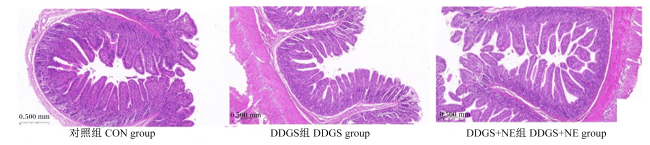
表9图1可知,DDGS+NE组断奶仔猪回肠绒毛高度显著高于DDGS组(P<0.05),与CON组相比无显著差异(P>0.05);各组间回肠隐窝深度和绒毛高度/隐窝深度值无显著差异(P>0.05)。
表9 玉米DDGS和豆粕蛋白质源对断奶仔猪回肠组织形态的影响

Table 9 Effects of corn DDGS and soybean meal protein sources on histological morphology of ileum of weaned piglets

项目
Items
组别Groups P
P-value
CON DDGS DDGS+NE
绒毛高度Villus height/μm 433.04±15.76ab 382.72±4.45b 488.07±40.18a 0.024
隐窝深度Crypt depth/μm 219.21±11.10 201.31±8.99 238.63±10.87 0.085
绒毛高度/隐窝深度Villus height/crypt depth 2.10±0.09 1.97±0.08 1.95±0.23 0.720
图1 断奶仔猪回肠组织形态HE染色切片

Fig.1 HE staining slices of histological morphology of ileum of weaned piglets (2×)

2.7 玉米DDGS和豆粕蛋白质源对断奶仔猪回肠氨基酸转运载体mRNA相对表达量的影响

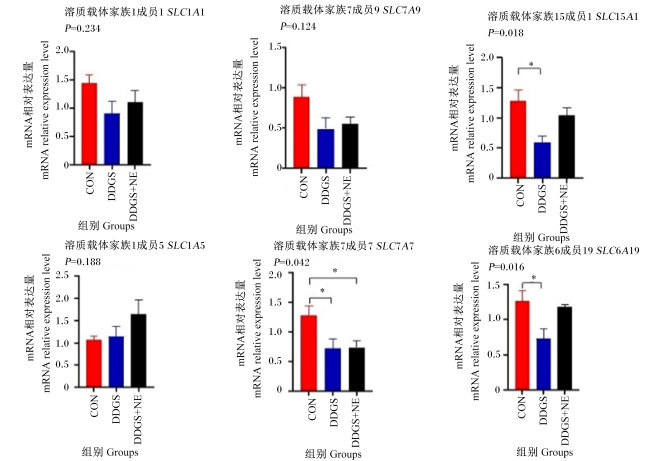
图2所示,与CON组相比,DDGS组断奶仔猪回肠溶质载体家族15成员1(SLC15A1)和溶质载体家族6成员19(SLC6A19)mRNA相对表达量显著降低(P<0.05);DDGS组和DDGS+NE组回肠溶质载体家族7成员7(SLC7A7)mRNA相对表达量显著降低(P<0.05)。各组间回肠溶质载体家族1成员1(SLC1A1)、溶质载体家族7成员9(SLC7A9)和溶质载体家族1成员5(SLC1A5)mRNA相对表达量均无显著差异(P>0.05)。
图2 玉米DDGS和豆粕蛋白质源对断奶仔猪回肠氨基酸转运载体mRNA相对表达量的影响

数据柱标注*表示差异显著(P<0.05)。Value columns with * mean significant difference (P<0.05).

Fig.2 Effects of corn DDGS and soybean meal protein sources on mRNA relative expression levels of amino acid transporters in ileum of weaned piglets

3 讨论

3.1 玉米DDGS和豆粕蛋白质源对断奶仔猪生长性能、腹泻评分和器官指数的影响

生长性能和腹泻率反映断奶仔猪的生长发育和健康状况。据报道,饲粮补充晶体氨基酸以及平衡回肠可消化氨基酸能维持饲喂低蛋白质饲粮猪的生长性能[11-12]。研究发现,当饲粮CP水平为13.52%时,额外补充支链氨基酸能够在一定程度上缓解仔猪生长性能的降低[13]。本研究中,当使用DDGS作为单一蛋白质源时,即使平衡EAA也会使断奶仔猪体重和ADG显著降低,F/G显著提高。结合前人研究结果,在仔猪保育前期,在平衡限制性氨基酸的基础上,猪饲粮中可添加15%的DDGS;而在保育后期,饲粮中最多可添加30% DDGS,此时不会影响其生长性能[14-15]。推测造成该结果的原因是当使用玉米DDGS等量替代豆粕作为单一蛋白质源时,饲粮氮元素含量过低,即使平衡EAA,也会导致猪生长性能下降[16]。研究表明,在低蛋白饲粮中额外补充NEAA可以改善断奶仔猪生长性能[17]。与前人研究相似,本试验使用玉米DDGS作为蛋白质源后进一步平衡NEAA可以改善断奶仔猪生长性能,其体重和ADG与CON组相比均无显著差异,表明进一步补充NEAA后可以缓解玉米DDGS蛋白质源导致生长性能降低的负面影响。当饲粮中总氮含量不足时,NEAA中的氨基酸能够有效维持仔猪生长[18]。本试验中,DDGS组和DDGS+NE组断奶仔猪腹泻评分显著低于CON组,表明玉米DDGS作为蛋白质源能够有效改善仔猪腹泻情况,这可能与玉米DDGS纤维含量较高,等量替代豆粕后饲粮氮含量下降,改善了仔猪腹泻。研究表明,饲粮中蛋白质水平降低会使肠道中的氨、胺和硫化氢线性降低,断奶仔猪的腹泻发生率显著降低[19]
器官指数能够反映断奶仔猪内脏器官的生长发育情况。Ajao等[20]在饲粮中使用玉米DDGS部分替代豆粕并额外补充甘氨酸和丝氨酸发现,在蛋白质水平不变的情况下,肉鸡器官指数会随着玉米DDGS替代量的增加而降低。本试验中,在补充EAA的前提下,使用玉米DDGS作为单一蛋白质源时,仔猪的内脏器官发育正常,说明玉米DDGS蛋白质源不会影响仔猪器官生长发育。

3.2 玉米DDGS和豆粕蛋白质源对断奶仔猪血清生化指标的影响

血清生化指标反映动物的健康状况和养分代谢情况[21]。血清TP含量能反映体内蛋白质的吸收和代谢情况,其含量越高表明机体蛋白质合成能力越强[22]。血清UN含量能够反映机体蛋白质代谢及需要量,当蛋白质代谢良好时,血清UN含量降低[23]。本试验中,与玉米DDGS作为单一蛋白质源相比,进一步补充NEAA能够显著提高断奶仔猪血清ALB含量,表明其能促进机体蛋白质的合成;同时,使用玉米DDGS作为单一蛋白质源能够显著降低血清UN含量,提高蛋白质代谢能力,推测是由于玉米DDGS等量替代豆粕后饲粮氮含量降低,低氮饲粮能够有效促进机体对于蛋白质的利用,从而降低血清UN含量[24-25]
血清ALT和AST常被作为肝脏损伤的标志物,其活性与肝脏损伤程度呈正相关[26]。鲁春灵等[27]研究显示,随着饲粮中玉米DDGS含量的增加,会使肉鸡血清ALT活性提高,表明玉米DDGS含量过高会对肝脏产生负面影响。王潇[28]研究发现,在育肥猪饲粮中添加15%玉米DDGS会显著提高血清ALT和AST活性。本试验所使用的玉米DDGS油脂含量高,容易发生油脂氧化现象。研究发现,饲料油脂氧化会对肝脏造成损伤[29]。与前人研究结果相似,本试验中使用DDGS作为单一蛋白质源也会显著提高仔猪血清ALT活性,推测是玉米DDGS中油脂发生了一定程度氧化,对肝脏代谢产生负面影响。
血清CHOL是反映体脂代谢的指标,和肝脏脂质代谢能力相关;HDL-C是将CHOL从外周组织运送至肝脏进行代谢,而LDL-C是将CHOL运送至肝脏外组织。研究发现,饲喂高蛋白质饲粮的猪脂肪沉积低于饲喂低蛋白质饲粮的猪[30-31]。研究发现,玉米DDGS显著提高猪血清CHOL含量[32-33]。与前人研究结果相似,本试验中,玉米DDGS作为单一蛋白质源会显著提高断奶仔猪血清CHOL和HDL-C含量,推测是由于玉米DDGS容易发生油脂氧化,从而显著提高机体CHOL含量[34]。本试验中使用的玉米DDGS添加量高,容易出现油脂氧化现象,结合上述血清ALT活性变化表明,玉米DDGS作为单一蛋白质源会对仔猪肝脏造成一定程度损伤。

3.3 玉米DDGS和豆粕蛋白质源对断奶仔猪养分表观消化率的影响

养分表观消化率反映动物对养分的吸收情况,一般来说,表观消化率和动物生长呈正相关。薛强等[35]研究发现,低蛋白质氨基酸平衡饲粮(13.2%CP和14.9%CP)CP表观消化率显著低于20.1%CP饲粮,但18.3%CP饲粮与20.1%CP饲粮间CP表观消化率无显著差异。Millet等[36]发现补充了晶体氨基酸的低蛋白质饲粮,能够使各组间的CP表观消化率无显著差异。与上述结果相似,本试验中使用玉米DDGS作为单一蛋白质源会显著降低断奶仔猪CP表观消化率,推测是由于饲粮中氮含量较低,使得CP消化率降低;而在其基础上额外补充NEAA能够抵消这一负面效果,提示在使用较低蛋白质含量的蛋白质源替代豆粕作为单一蛋白质源时,可以通过额外补充NEAA维持仔猪蛋白质消化。NEAA能够有效改善仔猪生理功能,以提高饲粮蛋白质的利用效率,并最大限度地减少体内含氮废物的排泄[37]
氨基酸全肠道消化率受饲粮组成的影响。Ajao等[38]研究发现,使用玉米DDGS部分替代豆粕的低蛋白质饲粮会显著提高赖氨酸表观消化率,显著降低天冬氨酸、谷氨酸和丝氨酸表观消化率。本试验中,DDGS组和DDGS+NE组赖氨酸表观消化率显著高于CON组,精氨酸和组氨酸表观消化率显著低于CON组,推测是玉米DDGS中赖氨酸含量较低,额外补充的晶体氨基酸相较于蛋白态氨基酸更容易利用,并且猪往往会优先利用限制性氨基酸[39]。同时,使用玉米DDGS作为单一蛋白质源会显著降低天冬氨酸、谷氨酸、甘氨酸、脯氨酸、丝氨酸和酪氨酸表观消化率,而在其基础上额外补充NEAA只有脯氨酸和丝氨酸表观消化率显著降低,表明在饲粮中使用玉米DDGS作为唯一蛋白质源时,额外补充NEAA会促进断奶仔猪对于NEAA的消化。

3.4 玉米DDGS和豆粕蛋白质源对断奶仔猪回肠组织形态的影响

肠道组织形态主要与小肠养分的消化吸收功能相关,肠绒毛越长、隐窝深度越浅表明小肠的吸收功能越好[40-41]。Peng等[41]研究发现,低蛋白质饲粮同时额外补充EAA能降低断奶仔猪十二指肠绒毛高度和隐窝深度。Chen等[15]在饲粮中添加30%玉米DDGS,并额外补充赖氨酸、蛋氨酸、苏氨酸和色氨酸,显著降低了仔猪肠绒毛高度和绒毛高度/隐窝深度值。Correia等[42]研究发现,相比于高蛋白质饲粮,低蛋白质饲粮+NEAA能够显著提高断奶仔猪十二指肠绒毛高度。本试验中,相较于玉米DDGS作为单一蛋白质源饲粮,在其基础上额外补充NEAA能够显著提高断奶仔猪回肠绒毛高度,表明使用玉米DDGS作为蛋白质源时,额外补充NEAA可以改善断奶仔猪肠道形态。

3.5 玉米DDGS和豆粕蛋白质源对断奶仔猪回肠氨基酸转运载体mRNA相对表达量的影响

肠道内氨基酸进入肠细胞主要依靠细胞膜上相应的氨基酸转运载体,其对蛋白质合成和生理功能维持有重要作用[43]SLC15A1为二肽和三肽的转运载体基因,SLC6A19和SLC1A5为中性氨基酸转运载体基因,SLC1A1为酸性氨基酸转运载体基因,SLC7A9和SLC7A7为碱性氨基酸转运载体基因[32]。Ajao等[38]研究发现,在低蛋白质氨基酸平衡饲粮中使用玉米DDGS部分替代豆粕对肉鸡空肠SLC15A1 mRNA相对表达量影响极小。与上述研究结果不同,本试验发现使用玉米DDGS作为单一蛋白质源会显著降低断奶仔猪回肠SLC15A1 mRNA相对表达量,而在其基础上额外添加NEAA则无显著变化,推测是NEAA的添加能够通过氨基酸转运载体相关信号通路[如哺乳动物雷帕霉素靶蛋白(mammalian target of rapamycin,mTOR)]促进氨基酸转运载体基因表达[37,42]。Li等[44]研究发现,低蛋白质饲粮会促进猪肠道SLC1A5 mRNA相对表达量的提高,而降低SLC7A7和SLC7A9 mRNA相对表达量。本试验中,玉米DDGS作为单一蛋白质源会显著降低断奶仔猪回肠SLC7A7和SLC6A19 mRNA相对表达量,在其基础上额外添加NEAA也会造成回肠SLC7A7 mRNA相对表达量显著降低。结合前人研究表明,在本试验条件下,玉米DDGS作为单一蛋白质源时,对于仔猪回肠氨基酸转运载体mRNA表达具有负面影响,在其基础上额外补充NEAA能够改善仔猪小肠对于小肽和中性氨基酸的转运。

4 结论

① 与玉米-豆粕型基础饲粮相比,玉米DDGS作为单一蛋白质源并补充10种EAA,能够有效改善断奶仔猪腹泻,但对肝脏功能会有一定负面影响。
② 当使用玉米DDGS作为断奶仔猪饲粮单一蛋白质源时,在补充EAA的前提下,额外补充NEAA能够有效缓解玉米DDGS作为单一蛋白质源导致的生长性能和养分表观消化率下降,改善肠道形态以及氨基酸转运吸收能力。
[1]
谯仕彦, 周俊言, 李晟铠, 等. 低蛋白质低豆粕多元化饲粮是养猪节粮增效的关键技术[J]. 动物营养学报, 2024, 36(6):3401-3412.

DOI

QIAO S Y, ZHOU J Y, LI S K, et al. Diversified diet with low protein and low soybean meal is a key technology for pigs industry to save feed and improve efficiency[J]. Chinese Journal of Animal Nutrition, 2024, 36(6):3401-3412. (in Chinese)

DOI

[2]
杨凤娟, 谯仕彦. T/CFIAS 8001—2022《生猪低蛋白低豆粕多元化日粮生产技术规范》团体标准解读[J]. 中国饲料, 2023(22):31-36.

YANG F J, QIAO S Y. Interpretation of the group standard of T/CFIAS 8001—2022 “Technical specifications for the production of diversified diets with low protein and low soybean meal for pigs”[J]. China Feed, 2023(22):31-36. (in Chinese)

[3]
尹杰, 刘红南, 李铁军, 等. 我国蛋白质饲料资源短缺现状与解决方案[J]. 中国科学院院刊, 2019, 34(1):89-93.

YIN J, LIU H N, LI T J, et al. Current situation and developmental suggestions on shortage of feeding protein resources in Chinese pig industry[J]. Bulletin of Chinese Academy of Sciences, 2019, 34(1):89-93. (in Chinese)

[4]
HAN J C, LIU K S. Changes in composition and amino acid profile during dry grind ethanol processing from corn and estimation of yeast contribution toward DDGS proteins[J]. Journal of Agricultural and Food Chemistry, 2010, 58(6):3430-3437.

DOI PMID

[5]
TOLOSA A F, TOKACH M D, GOODBAND R D, et al. Evaluation of increasing digestible threonine to lysine ratio in corn-soybean meal diets without and with distillers dried grains with solubles on growth performance of growing-finishing pigs[J]. Translational Animal Science, 2022, 6(2):txac058.

[6]
CLIZER D A, TOSTENSON B J, TAUER S K, et al. Impact of increasing standardized ileal digestible valine:lysine in diets containing 30% dried distiller grains with solubles on growing pig performance[J]. Journal of Animal Science, 2022, 100(9):skac228.

[7]
NOBLET J, LABUSSIÈRE E, RENAUDEAU D, et al. Energy and energy metabolism in swine[M]// CHIBA L L.Sustainable swine nutrition. 2nd ed.Hoboken: Wiley-Blackwell, 2022.

[8]
ZHOU J Y, WANG Y M, ZENG X Z, et al. Effect of antibiotic-free,low-protein diets with specific amino acid compositions on growth and intestinal flora in weaned pigs[J]. Food & Function, 2020, 11(1):493-507.

[9]
LIU S H, XIE J Y, FAN Z Y, et al. Effects of low protein diet with a balanced amino acid pattern on growth performance,meat quality and cecal microflora of finishing pigs[J]. Journal of the Science of Food and Agriculture, 2023, 103(2):957-967.

[10]
GOODARZI P, WILEMAN C M, HABIBI M, et al. Effect of isoleucine and added valine on performance,nutrients digestibility and gut microbiota composition of pigs fed with very low protein diets[J]. International Journal of Molecular Sciences, 2022, 23(23):14886.

[11]
HEO J M, KIM J C, HANSEN C F, et al. Feeding a diet with a decreased protein content reduces both nitrogen content in the gastrointestinal tract and post-weaning diarrhoea,but does not affect apparent nitrogen digestibility in weaner pigs challenged with an enterotoxigenic strain of Escherichia coli[J]. Animal Feed Science and Technology, 2010, 160(3/4):148-159.

[12]
WANG J, LIU S J, MA J Y, et al. Growth performance,serum parameters,inflammatory responses,intestinal morphology and microbiota of weaned piglets fed 18% crude protein diets with different ratios of standardized ileal digestible isoleucine to lysine[J]. Animal Nutrition, 2024,16:313-325.

[13]
SPRING S, PREMATHILAKE H, BRADWAY C, et al. Effect of very low-protein diets supplemented with branched-chain amino acids on energy balance,plasma metabolomics and fecal microbiome of pigs[J]. Scientific Reports, 2020, 10(1):15859.

[14]
TRAN H, MORENO R, HINKLE E E, et al. Effect of corn distillers dried grains with solubles on growth performance and health status indicators in weanling pigs[J]. Journal of Animal Science, 2012, 90(3):790-801.

DOI PMID

[15]
CHEN H Y, ZHANG S H, KIM S W. Effects of supplemental xylanase on health of the small intestine in nursery pigs fed diets with corn distillers' dried grains with solubles[J]. Journal of Animal Science, 2020, 98(6):skaa185.

[16]
ROCHA G C, DUARTE M E, KIM S W. Advances,implications,and limitations of low-crude-protein diets in pig production[J]. Animals, 2022, 12(24):3478.

[17]
MANSILLA W D, HTOO J K, DE LANGE C F M.Nitrogen from ammonia is as efficient as that from free amino acids or protein for improving growth performance of pigs fed diets deficient in nonessential amino acid nitrogen[J]. Journal of Animal Science, 2017, 95(7):3093-3102.

DOI PMID

[18]
NEMECHEK J E, GAINES A M, TOKACH M D, et al. Evaluation of standardized ileal digestible lysine requirement of nursery pigs from seven to fourteen kilograms[J]. Journal of Animal Science, 2012, 90(12):4380-4390.

DOI PMID

[19]
TANG Q S, LAN T Y, ZHOU C Y, et al. Nutrition strategies to control post-weaning diarrhea of piglets:from the perspective of feeds[J]. Animal Nutrition, 2024,17:297-311.

[20]
AJAO A M, WHITE D, KIM W K, et al. Partial replacement of soybean meal with canola meal or corn DDGS in low-protein diets supplemented with crystalline amino acids-effect on growth performance,whole-body composition,and litter characteristics[J]. Animals, 2022, 12(19):2662.

[21]
NICHOLSON J K, HOLMES E, KINROSS J M, et al. Metabolic phenotyping in clinical and surgical environments[J]. Nature, 2012, 491(7424):384-392.

[22]
田丽新, 崔玉铭, 史彬林, 等. 低蛋白日粮对肉仔鸡血液生化指标的影响[J]. 中国畜牧杂志, 2014, 50(5):56-59.

TIAN L X, CUI Y M, SHI B L, et al. Effects of low-protein diets on blood biochemical index in broilers[J]. Chinese Journal of Animal Science, 2014, 50(5):56-59. (in Chinese)

[23]
侯磊. 无抗饲粮蛋白质水平对仔猪生长、肠道健康和养分沉积的影响[D]. 博士学位论文. 哈尔滨: 东北农业大学, 2021.

HOU L. Effects of protein level on growth,intestinal health and nutrient deposition of piglets fed antibiotic-free diets[D]. Ph.D.Thesis. Harbin: Northeast Agricultural University, 2021. (in Chinese)

[24]
KIM H, SHIN H, KIM Y Y. Effects of different levels of dietary crude protein on growth performance,blood profiles,diarrhea incidence,nutrient digestibility,and odor emission in weaning pigs[J]. Animal Bioscience, 2023, 36(8):1228-1240.

[25]
DUARTE M E, PARNSEN W, ZHANG S H, et al. Low crude protein formulation with supplemental amino acids for its impacts on intestinal health and growth performance of growing-finishing pigs[J]. Journal of Animal Science and Biotechnology, 2024, 15(1):55.

DOI PMID

[26]
王鑫. 不同蛋白源和蛋白水平日粮对断奶仔猪生长性能、血液指标及肠道菌群的影响[D]. 硕士学位论文. 杨凌: 西北农林科技大学, 2023.

WANG X. Effects of different diets with protein sources or protein levels on growth performance,blood indexes and intestinal microflora of weaned piglets[D]. Master's Thesis. Yangling: Northwest A&F University2023. (in Chinese)

[27]
鲁春灵, 秦玉昌, 李俊, 等. 玉米干酒糟及其可溶物对颗粒饲料质量、肉鸡生长性能和血清生化指标的影响[J]. 动物营养学报, 2021, 33(11):6161-6172.

DOI

LU C L, QIN Y C, LI J, et al. Effects of corn distillers dried grains with solubles on pellet feed quality,growth performance and serum biochemical indices of broilers[J]. Chinese Journal of Animal Nutrition, 2021, 33(11):6161-6172. (in Chinese)

[28]
王潇. 玉米DDGS和复合酶SSF对生长育肥猪血液生化指标、机体抗氧化性及肠道健康的影响[D]. 硕士学位论文. 南京: 南京农业大学, 2009.

WANG X. Effects of DDGS and compound enzyme (SSF) on blood biochemical indexes,antioxidant capacity of the body and intestinal health of growing-finishing pigs[D]. Master's Thesis. Nanjing: Nanjing Agricultural University, 2009. (in Chinese)

[29]
VARADY J, GESSNER D K, MOST E, et al. Dietary moderately oxidized oil activates the Nrf2 signaling pathway in the liver of pigs[J]. Lipids in Health and Disease, 2012,11:31.

[30]
MORISE A, SÈVE B, MACÉ K, et al. Impact of intrauterine growth retardation and early protein intake on growth,adipose tissue,and the insulin-like growth factor system in piglets[J]. Pediatric Research, 2009, 65(1):45-50.

[31]
MORAZÁN H, ALVAREZ-RODRIGUEZ J, SERADJ A R, et al. Trade-offs among growth performance,nutrient digestion and carcass traits when feeding low protein and/or high neutral-detergent fiber diets to growing-finishing pigs[J]. Animal Feed Science and Technology, 2015,207:168-180.

[32]
ZENGIN M, SUR A, ĪLHAN Z, et al. Effects of fermented distillers grains with solubles,partially replaced with soybean meal,on performance,blood parameters,meat quality,intestinal flora,and immune response in broiler[J]. Research in Veterinary Science, 2022,150:58-64.

[33]
CORASSA A, STRAUB I W W, SBARDELLA M, et al. Brazilian corn ethanol coproducts for pigs:feeding value and blood parameters[J]. Animals, 2024, 14(14):2108.

[34]
LIU P, CHEN C, KERR B J, et al. Influence of thermally oxidized vegetable oils and animal fats on growth performance,liver gene expression,and liver and serum cholesterol and triglycerides in young pigs[J]. Journal of Animal Science, 2014, 92(7):2960-2970.

[35]
薛强, 张鹤亮, 李秀花, 等. 低粗蛋白质氨基酸平衡日粮对仔猪生长性能、血液指标、营养物质表观消化率和腹泻率的影响[J]. 中国畜牧兽医, 2019, 46(8):2307-2314.

DOI

XUE Q, ZHANG H L, LI X H, et al. Effects of low crude protein diet supplemented with amino acids on the growth performance,blood indexes,nutrient apparent digestibility and diarrhea rate of weaned piglets[J]. China Animal Husbandry & Veterinary Medicine, 2019, 46(8):2307-2314. (in Chinese)

[36]
MILLET S, ALUWÉ M, DE BOEVER J, et al. The effect of crude protein reduction on performance and nitrogen metabolism in piglets (four to nine weeks of age) fed two dietary lysine levels[J]. Journal of Animal Science, 2018, 96(9):3824-3836.

[37]
REZAEI R, WANG W W, WU Z L, et al. Biochemical and physiological bases for utilization of dietary amino acids by young pigs[J]. Journal of Animal Science and Biotechnology, 2013,4:7.

[38]
AJAO A M, OLUKOSI O A. Apparent ileal amino acid digestibility,gut morphometrics,and gene expression of peptide and amino acid transporters in broiler chickens fed low-crude-protein diets supplemented with crystalline amino acids with soybean meal,canola meal,or corn DDGS as protein feedstuffs[J]. Journal of the Science of Food and Agriculture, 2024, 104(7):4189-4200.

[39]
ZHANG S, MARINI J C, MAVANGIRA V, et al. Effects of improved amino acid balance diet on lysine mammary utilization,whole body protein turnover and muscle protein breakdown on lactating sows[J]. Journal of Animal Science and Biotechnology, 2024, 15(1):65.

[40]
韩昕儒, 王秀东, 王济民, 等. 新时期种植业保障我国食物安全战略研究[J]. 中国工程科学, 2024, 26(2):92-102.

DOI

HAN X R, WANG X D, WANG J M, et al. Strategy for ensuring China's food security through planting industry in the new era[J]. Strategic Study of CAE, 2024, 26(2):92-102. (in Chinese)

DOI

[41]
PENG X, HU L, LIU Y, et al. Effects of low-protein diets supplemented with indispensable amino acids on growth performance,intestinal morphology and immunological parameters in 13 to 35 kg pigs[J]. Animal, 2016, 10(11):1812-1820.

[42]
CORREIA A M, GENOVA J L, SARAIVA A, et al. Effects of crude protein and non-essential amino acids on growth performance,blood profile,and intestinal health of weaned piglets[J]. Frontiers in Veterinary Science, 2023,10:1243357.

[43]
WU G Y, WU Z L, DAI Z L, et al. Dietary requirements of “nutritionally non-essential amino acids” by animals and humans[J]. Amino Acids, 2013, 44(4):1107-1113.

[44]
LI Y Y, YIN J, HAN H, et al. Metabolic and proteomic responses to long-term protein restriction in a pig model[J]. Journal of Agricultural and Food Chemistry, 2018, 66(47):12571-12579.

DOI PMID

文章导航

/