研究论文

脆弱拟杆菌和维生素B6对强制换羽蛋鸡生产性能、蛋品质、免疫功能和肠道健康的影响

  • 张梦妍 ,
  • 罗志煊 ,
  • 朱意丹 ,
  • 曾庆朵 ,
  • 张豪 ,
  • 宫玉杰 ,
  • 康相涛 ,
  • 田亚东 ,
  • 蒋瑞瑞 , *
展开
  • 河南农业大学动物科技学院,农村农业部畜禽资源(家禽)评价利用重点实验室,郑州 450046
* 蒋瑞瑞,教授,硕士生导师,E-mail:

张梦妍(1998—),女,河南商丘人,硕士研究生,从事家禽生产与营养调控研究。E-mail:

Copy editor: 田艳明

收稿日期: 2024-09-14

  网络出版日期: 2025-05-14

基金资助

河南省重点研发与推广专项(科技攻关)(232102111042)

河南省重大科技专项(221100110200)

河南省科技攻关项目(242102110038)

Effects of Bacteroides fragilis and Vitamin B6 on Performance, Egg Quality, Immune Function and Intestinal Health of Laying Hens during Forced Molting

  • ZHANG Mengyan ,
  • LUO Zhixuan ,
  • ZHU Yidan ,
  • ZENG Qingduo ,
  • ZHANG Hao ,
  • GONG Yujie ,
  • KANG Xiangtao ,
  • TIAN Yadong ,
  • JIANG Ruirui , *
Expand
  • Key Lab of Livestock Resource (Poultry) Evaluation and Utilization of the Ministry of Agriculture and Rural Affairs, College of Animal Science and Technology, Henan Agricultural University, Zhengzhou 450046, China
* professor, E-mail:

Received date: 2024-09-14

  Online published: 2025-05-14

摘要

本试验旨在探究脆弱拟杆菌(B. fragilis)和维生素B6(VB6)对蛋鸡强制换羽过程中生产性能、蛋品质、免疫功能和肠道健康的影响。选取健康且体重接近的420日龄矮脚贵妃鸡288只,随机分为4组,每组9个重复,每个重复8只鸡。对照组(NC组)在禁食过程中灌服生理盐水,B. fragilis组在禁食过程中每只鸡每次灌服1×10⁹ CFU/mL B. fragilis,VB6组在禁食过程中每只鸡每次灌服0.5 mg VB6,B. fragilis+VB6组在禁食过程中每只鸡每次灌服1×10⁹ CFU/mL B. fragilis和0.5 mg VB6。各组灌服均为1日1次,每次1 mL。试验期45 d,试验过程中每隔3 d记录各组蛋鸡体重,并分别于禁食前1天(F0)、禁食第15天(F15)、恢复采食第5天(R5)和恢复采食第30天(R30)进行采样。结果表明:1)试验第45天即恢复采食第30天时,B. fragilis+VB6组蛋鸡体重恢复情况优于其他组,但各组之间各阶段无显著差异(P>0.05)。2)在恢复采食后期(恢复采食第27天~恢复采食第30天),B. fragilis+VB6组平均产蛋率高于其他组。3)恢复采食第30天,与NC组相比,B. fragilis组和B. fragilis+VB6组蛋黄颜色显著提高(P<0.05),VB6组蛋壳重显著提高(P<0.05)。4)与NC组相比,禁食第15天,B. fragilis+VB6组回肠绒毛高度显著提高(P<0.05)。5)与NC组相比,B. fragilis+VB6组肠道屏障相关基因咬合蛋白-1(occludin-1)和闭合蛋白-1(claudin-1)以及肠道增殖相关基因富含亮氨酸重复的G蛋白偶联受体5(Lgr5)和细胞周期蛋白依赖性激酶1(CDK1)mRNA相对表达量显著提高(P<0.05),肠道促炎相关基因肿瘤坏死因子-α(TNF-α)、白细胞介素-6(IL-6)和白细胞介素-18(IL-18)mRNA相对表达量显著降低(P<0.05)。6)与NC组相比,禁食第15天,B. fragilis+VB6组血清免疫球蛋白G(IgG)含量显著提高(P<0.05);恢复采食第5天,B. fragilis+VB6组血清免疫球蛋白A(IgA)、IgG和免疫球蛋白M(IgM)含量均显著提高(P<0.05);恢复采食第30天,B. fragilis+VB6组血清IgG含量显著提高(P<0.05)。综上所述,在蛋鸡强制换羽过程中,共同灌服B. fragilis和VB6能够提高其生产性能,改善肠道组织形态结构,提高肠道屏障及增殖相关基因表达,降低肠道炎症相关基因表达,增强机体免疫功能,从而维持肠道健康,其效果优于单独灌服B. fragilis或VB6

本文引用格式

张梦妍 , 罗志煊 , 朱意丹 , 曾庆朵 , 张豪 , 宫玉杰 , 康相涛 , 田亚东 , 蒋瑞瑞 . 脆弱拟杆菌和维生素B6对强制换羽蛋鸡生产性能、蛋品质、免疫功能和肠道健康的影响[J]. 动物营养学报, 2025 , 37(5) : 3027 -3043 . DOI: 10.12418/CJAN2025.252

Abstract

This study was conducted to investigate the effects of Bacteroides fragilis (B. fragilis) and vitamin B6 (VB6) on performance, egg quality, immune function and intestinal health of laying hens during forced molting. A total of 288 healthy 420-day-old bantam royal chickens with similar body weight were randomly divided into 4 groups with 9 replicates per group and 8 chickens per replicate. Control group (NC group) was given saline during fasting, B. fragilis group was given 1×10⁹ CFU/mL B. fragilis, VB6 group was given 0.5 mg VB6, and B. fragilis+VB6 group was given 1×10⁹ CFU/mL B. fragilis and 0.5 mg VB6 per chicken each time during fasting. Each group was given 1 mL once a day. The experiment lasted for 45 days. During the experiment, the body weight of laying hens in each group was recorded every 3 days, and samples were collected on day 1 before fasting (F0), day 15 of fasting (F15), day 5 of resumption of feeding (R5) and day 30 of resumption of feeding (R30), respectively. The results showed as follows: 1) the body weight recovery of laying hens in B. fragilis+VB6 group was better than that in the other groups on day 45, i.e. the day 30 of resumption of feeding, but there was no significant difference in each stage among all groups (P>0.05). 2) The average laying rate in B. fragilis+VB6 group was higher than that in the other groups in the late stage of resumption of feeding (days 27 to 30 of resumption of feeding). 3) On day 30 of resumption of feeding, compared with NC group, the yolk color in B. fragilis group and B. fragilis+VB6 group was significantly increased (P<0.05), and the eggshell weight in VB6 group was significantly increased (P<0.05). 4) Compared with NC group, the villus height of ileum in B. fragilis+VB6 group was significantly increased on day 15 of fasting (P<0.05). 5) Compared with NC group, the mRNA relative expression levels of occludin-1 and claudin-1 related to intestinal barrier as well as leucine-rich repeat-containing G-protein-coupled receptor 5 (Lgr5) and cyclin-dependent kinase 1 (CDK1) related to intestinal proliferation in B. fragilis+VB6 group were significantly increased (P<0.05), while the mRNA relative expression levels of tumor necrosis factor-α (TNF-α), interleukin-6 (IL-6) and interleukin-18 (IL-18) related to intestinal proinflammatory were significantly decreased (P<0.05). 6) Compared with NC group, the serum immunoglobulin G (IgG) content in B. fragilis+VB6 group was significantly increased on day 15 of fasting (P<0.05); the serum contents of immunoglobulin A (IgA), IgG and immunoglobulin M (IgM) in B. fragilis+VB6 group were significantly increased on day 5 of resumption of feeding (P<0.05); the serum IgG content in B. fragilis+VB6 group was significantly increased on day 30 of resumption of feeding (P<0.05). In conclusion, in the process of forced molting, co-administration of B. fragilis and VB6 can improve the performance of laying hens, improve the intestinal tissue morphology and structure, improve the expression of intestinal barrier and proliferation related genes, reduce the expression of intestinal inflammatory related genes, enhance the body immune function, and thus maintain intestinal health. The effect was better than B. fragilis or VB6 alone.

产蛋后期蛋鸡的机体消耗过大,蛋品质和产蛋率下降,蛋鸡开始休产换羽。因此,大多数的商品蛋鸡开始休产换羽后,其经济效益会显著下降,当其不足以给养殖场带来效益时,将被全部淘汰。近年来,随着饲料原料价格的不断上升[1],蛋鸡延养成为了一个主流趋势。强制换羽亦称诱导生理重塑,是指通过人为干预使蛋鸡机体发生特有的形态和机能的重塑,促使鸡群在同一时间段进行羽毛脱落和更换,从而更快进入下一个新的产蛋周期[2-3]。强制换羽能有效延长蛋鸡使用寿命,降低饲养成本,提高经济效益,满足市场要求[2]。有效实施蛋鸡强制换羽,是缓解人畜争食引发的粮食安全问题的重要举措。但在强制换羽过程中,会诱发产蛋鸡的免疫抑制,导致机体对肠炎沙门氏菌、大肠杆菌等致病菌的敏感性提高,肠道菌群紊乱等问题,而相应的肠道保健方案较少。
本团队前期研究发现,在强制换羽过程中,禁食期间机体会产生炎症,肠道结构遭到破坏,盲肠拟杆菌相对丰度和盲肠代谢物维生素B6(vitamin B6,VB6)含量均显著降低[4]。拟杆菌作为畜禽肠道的基石菌群,对维持肠道稳态至关重要。拟杆菌门常见的成员之一是脆弱拟杆菌(Bacteroides fragilis,B. fragilis),其是人类及动物肠道正常菌群的一部分。B. fragilis的非产肠毒素菌株被认为是有益细菌,是肠道菌群的重要组成部分,对维持肠道稳态具有重要作用[5-6],它具有强大的免疫调节益处和促进健康的作用。研究发现,B. fragilis在促进免疫系统成熟、抑制异常炎症以及改善肠道菌群结构方面发挥着重要作用[7]。用B. fragilis对小鼠进行定植可以通过刺激脾脏CD4 T细胞的成熟[8]和重新平衡Th1/Th2反应来纠正无菌小鼠的全身免疫缺陷。B. fragilis已被证明可以抑制肠道炎症和与肠炎相关的癌症[9-11];还可以通过肠-脑轴参与脑免疫的免疫调节[12],并调节其他区域的炎症[13]。Rhee等[14]研究发现,将B. fragilis注射到无菌处理后的家兔蚓突中,可增强肠道免疫活性,促进免疫系统发育。VB6是维持动物机体健康生长所必需的微量营养素,具有抗炎[15]、抗氧化[16]、神经调节和抗肿瘤等生理功能。5-磷酸吡哆醛(5-pyridoxal phosphate,PLP)是VB6的活性形式,作为辅助因子参与多种生理代谢反应,如氨基酸代谢与合成、碳水化合物代谢以及神经递质的合成[17],对宿主和肠道微生物群都是不可或缺的,在维持机体免疫稳态中亦发挥着重要作用。肠道中至少有100种细菌可以合成B族维生素,宏基因组分析发现大多数拟杆菌门、放线菌门和变形菌门具有至少1个合成VB6的相关基因,如B. fragilis、普雷沃氏菌、长双歧杆菌都可合成VB6[18]。也有研究证明,补充VB6可降低类风湿性关节炎患者的血清白细胞介素-6(IL-6)和肿瘤坏死因子-α(TNF-α)含量[19],VB6还可抑制患有结肠炎小鼠体内白细胞介素-1β(IL-1β)的产生[20]
本团队前期研究发现,在强制换羽过程中,蛋鸡盲肠内容物拟杆菌相对丰度和VB6含量显著降低[4]B. fragilis可促进肉仔鸡免疫器官发育,提高机体免疫力[21]。Chen等[22]研究发现,给予蛋鸡泄殖腔注射B. fragilis可调节泄殖腔微生物组成,影响免疫和炎症基因的表达及代谢相关途径。有研究发现,在脂多糖(LPS)诱导的小鼠肺炎模型中,VB6显著抑制了促炎因子IL-1βIL-6和TNF-α的基因表达水平,缓解了炎症损伤[23]。此外,B. fragilis可以合成VB6[18],但在有关B. fragilis和VB6的报道中,未发现B. fragilis与VB6联合应用的研究。因此,为研究B. fragilis与VB6联合应用是否对蛋鸡生理重塑起到更强的增效作用,本试验通过在蛋鸡强制换羽过程中灌服B. fragilis和VB6,评估B. fragilis和VB6对蛋鸡生产性能、蛋品质、免疫功能和肠道健康的影响,旨在为阐释强制换羽在蛋鸡肠道保健中的作用提供理论依据,并为蛋鸡延养、节本增效提供实践参考。

1 材料与方法

1.1 试验材料

本试验所用的B. fragilis菌种为B. fragilis ATCC25285,活菌数为1×10⁹ CFU/mL;VB6纯度为99%。

1.2 试验设计和饲养管理

试验动物由河南农业大学家禽种质资源场提供,所有试验均经河南农业大学机构动物护理和使用委员会批准(批准编号:11-0085)。试验选取健康且体重接近的420日龄矮脚贵妃鸡288只,随机分为4组,每组9个重复,每个重复8只鸡。对照组(NC组)在禁食过程中灌服生理盐水,B. fragilis组在禁食过程中每只鸡每次灌服1×10⁹ CFU/mL B. fragilis,VB6组在禁食过程中每只鸡每次灌服0.5 mg VB6,B. fragilis+VB6组在禁食过程中每只鸡每次灌服1×10⁹ CFU/mL B. fragilis和0.5 mg VB6。各组灌服均为每日1次,每次1 mL。试验期45 d。试验期间,除禁食期外,各组饲喂相同的基础饲粮,其组成及营养水平见表1。参照GB/T 6432—2018测定饲粮中粗蛋白质(CP)含量,参照GB/T 6436—2018测定饲粮中钙(Ca)含量;参考NY/T 33—2004计算饲粮代谢能(ME)以及赖氨酸(Lys)和蛋氨酸(Met)含量;参考NRC(1994)[24]计算饲粮中有效磷(AP)含量。
表1 基础饲粮组成及营养水平(风干基础)

Table 1 Composition and nutrient levels of the basal diet (air-dry basis) %

项目Items 含量Content
原料Ingredients
玉米Corn 62.50
豆粕Soybean meal 25.50
石粉Limestone 9.20
油粉Oil powder 0.80
预混料Premix1) 2.00
合计Total 100.00
营养水平Nutrient levels2)
代谢能ME/(MJ/kg) 11.20
粗蛋白质CP 15.80
钙Ca 3.78
有效磷AP 0.28
赖氨酸Lys 0.71
蛋氨酸Met 0.66

1)预混料为每千克饲粮提供 The premix provided the following per kg of the diet:VA 12 000 IU,VD3 3 000 IU,VE 30 IU,VK3 10 mg,VB1 12 mg,VB12 0.05 mg,生物素 biotin 16.4mg,烟酸 nicotinic acid 30 mg,泛酸 pantothenic acid 10 mg,叶酸 folic acid 1 mg,胆碱 choline 500 mg,Cu (as copper sulfate) 45 mg,Fe (as ferrous sulfate) 80 mg,Zn (as zinc sulfate) 85 mg,Mn (as manganese sulfate) 70 mg,I (as potassium iodide) 0.5 mg,Se (as sodium selenite) 0.5 mg。

2)粗蛋白质和钙为实测值,其余营养水平为计算值。CP and Ca were measured values, while the other nutrient levels were calculated values.

将被挑选的蛋鸡转移到试验鸡舍后先适应性饲养10 d,然后再开始强制换羽的程序,强制换羽实施程序见表2。强制换羽过程中共设置4个采样时间节点,分别为禁食前1天(F0)、禁食第15天(F15)、恢复采食第5天(R5)和恢复采食第30天(R30)。试验期间,鸡舍内采取人工光照,每日定时对鸡舍进行消毒并捡蛋。
表2 强制换羽实施程序

Table 2 Implementation procedures of forced molting

时期Periods 处理阶段Processingphase/d 饲喂Feeding 饮水Drinkingwater 光照Light 采样时间点Sampling timepoint
环境适应期Environmental adaptation period 10 120 g/d 自由饮水 16 h 禁食前1天(F0)
禁食诱导期Fasting induction period 3 停料 停水 8 h 禁食第15天(F15)
12 停料 自由饮水 8 h
恢复采食期Resumption of feeding period 2 30 g/d 自由饮水 8 h 恢复采食第5天(R5)
2 60 g/d 自由饮水 每天增加0.5 h,直至16 h
1 90 g/d 自由饮水
15 120 g/d 自由饮水
第2产蛋期The second laying period 10 120 g/d 自由饮水 16 h 恢复采食第30天(R30)

1.3 样品采集

在每个采样时间点,每个重复挑选1只接近平均体重的试验鸡,采用促凝管采集翅下静脉血液,1 265×g离心10 min后收集血清,液氮速冻后转移至-80 ℃保存,用于血清免疫指标的检测。试验鸡采血后进行屠宰,分别采集1 cm的空肠和回肠样品,用0.9%的生理盐水缓慢冲洗后,保存于盛放4%多聚甲醛的10 mL离心管中,用于后续切片制作;同时采集空肠和回肠组织样,盛放于1.5 mL的无菌无酶离心管中,液氮迅速冻存,最后放置在-80 ℃冰箱中保存,用于后续测量。

1.4 检测指标及方法

1.4.1 生产性能

试验期间,每天同一时间记录每组产蛋数并计算产蛋率,并以各阶段每天产蛋率的平均值作为此阶段的产蛋率。每隔3 d计算1次蛋鸡失重率,具体方法为:从每组每个重复中随机抽取1只蛋鸡并进行编号,从禁食前1天开始,每隔3 d,对编号鸡只进行称重并记录。失重率计算公式为:
$ \text { 失重率=(禁食前 } 1 \text { 天体重-每隔 } 3 \mathrm{~d} \text { 的体重)/禁食前 } 1 \text { 天体重。 }$

1.4.2 蛋品质

于恢复采食第30天,每组随机收集25枚蛋进行蛋品质的测定。采用多功能蛋品质分析仪(EMT-5200)测定蛋重、蛋形指数、蛋壳厚度、蛋壳强度、蛋壳重、蛋白高度和蛋黄颜色。

1.4.3 肠道组织形态结构

将采集的空肠和回肠样品固定24 h后,从固定液中取出肠段用石蜡进行包埋,制成切片,并使用苏木精-伊红(HE)进行染色,于光学显微镜下观察并拍照。利用Motic DSAssistant Lite软件测定各肠段绒毛高度和隐窝深度,并计算绒隐比(绒毛高度/隐窝深度)。测量方法参照Bikker等[25]

1.4.4 肠道相关基因表达

从NC组和B. fragilis+VB6组随机各取8个空肠和回肠样本,提取每个采样点的总RNA,以甘油醛-3-磷酸脱氢酶(GAPDH)为内参基因,利用Cham Q SYBR qPCR Master Mix(Q311-02)实时荧光定量PCR检测目标基因,并使用2-ΔΔCt法计算目标基因在肠段中的mRNA相对表达量。内参基因和目标基因的参考引物序列见表3
表3 实时荧光定量PCR引物序列

Table 3 Primer sequences for real-time fluorescent quantitative PCR

基因
Genes
登录号
Accession number
引物序列
Primer sequences (5'—3')
产物大小
Product size/bp
肿瘤坏死因子-α
TNF-α
NM_204267.2 F:GCCCAGTTCAGATGAGTTGCC
R:AAGAGGCCACCACACGACAG
169
白细胞介素-15
IL-15
NM_204571.2 F:CTCCATAGGTTTCCGAGGCTTGT
R:ATGTGTTTTCTGACTCTCCGGC
159
白细胞介素-6
IL-6
NM_204628.2 F:AAATGTCCAGCAGCCAGACT
R:CTTTCGGAGCGGCCTTCATA
130
白细胞介素-18
IL-18
XM_046932263.1 F:TGATGAGCTGGAATGCGATG
R:ACTGCCAGATTTCACCTCCTG
148
咬合蛋白-1
Occludin-1
XM_046904540.1 F:CCGTGGAGTCCAGTGATGAG
R:TCGAACTCCTGCTTGTAGCG
123
闭合蛋白-1
Claudin-1
NM_001013611.2 F:CACCCGTTAACACCAGATTTGA
R:AGGGGGCATTTTTGGGGTAG
100
富含亮氨酸重复的G蛋白偶联受体5
Lgr5
XM_046909876.1 F:ACGTCTTGCAGGAAATGGCT
R:TTGGCATCCAGGCGTAGAGA
159
细胞周期蛋白依赖性激酶1
CDK1
NM_205314.2 F:TAATAGATGACAAAGGGGT
R:GAGTGGAATACAGAGCAGA
130
甘油醛-3-磷酸脱氢酶
GAPDH
NM_205518 F:TGTTACCAACACCCACACCC
R:TCCTGAGTCAAGCGCCAAAA
110

1.4.5 血清免疫指标

从NC组和B. fragilis+VB6组随机各取8个血清样本,采用酶联免疫吸附测定(ELISA)试剂盒检测血清免疫球蛋白A(IgA)、免疫球蛋白M(IgM)和免疫球蛋白G(IgG)含量,试剂盒均购自南京建成生物工程研究所。

1.5 数据统计分析

试验数据采用Excel 2010进行初步整理,再利用SPSS 26.0软件进行统计分析,生产性能、蛋品质和肠道组织形态结构数据采用单因素方差分析(one-way ANOVA)和Duncan氏法多重比较,肠道相关基因表达以及血清免疫指标进行t检验分析;采用GraphPad Prism 8.0软件进行数据及图形处理。结果数据以“平均值±标准差”表示,P<0.05表示差异显著。

2 结果与分析

2.1 B. fragilis和VB6对强制换羽蛋鸡生产性能和蛋品质的影响

B. fragilis和VB6对强制换羽蛋鸡失重率的影响见表4。试验过程中每隔3 d记录各组蛋鸡体重,在第45天即恢复采食第30天时B. fragilis+VB6组蛋鸡体重恢复情况优于其他组,但各组之间各阶段无显著差异(P>0.05)。
表4 B. fragilis和VB6对强制换羽蛋鸡失重率的影响

Table 4 Effects of B. fragilis and VB6 on weight loss rate of laying hens during forced molting

时间
Time
组别Groups P
P-value
NC B. fragilis VB6 B. fragilis+VB6
第3天Day 3 0.12±0.04 0.15±0.02 0.11±0.03 0.14±0.06 0.237
第6天Day 6 0.16±0.05 0.18±0.02 0.16±0.03 0.19±0.05 0.585
第9天Day 9 0.21±0.06 0.21±0.02 0.20±0.03 0.22±0.05 0.771
第12天Day 12 0.24±0.06 0.24±0.02 0.24±0.02 0.26±0.04 0.913
第15天Day 15 0.27±0.07 0.28±0.02 0.28±0.03 0.28±0.04 0.947
第18天Day 18 0.27±0.06 0.24±0.01 0.30±0.04 0.29±0.05 0.209
第21天Day 21 0.24±0.05 0.22±0.04 0.26±0.05 0.24±0.04 0.487
第24天Day 24 0.21±0.05 0.18±0.02 0.23±0.06 0.19±0.04 0.338
第27天Day 27 0.14±0.04 0.12±0.03 0.15±0.04 0.13±0.04 0.442
第30天Day 30 0.11±0.03 0.10±0.04 0.13±0.04 0.13±0.05 0.663
第33天Day 33 0.10±0.02 0.08±0.05 0.13±0.06 0.10±0.05 0.495
第36天Day 36 0.07±0.01 0.06±0.05 0.10±0.09 0.07±0.06 0.819
第39天Day 39 0.07±0.03 0.05±0.06 0.09±0.10 0.03±0.07 0.488
第42天Day 42 0.07±0.04 0.03±0.06 0.08±0.10 0.01±0.06 0.309
第45天Day 45 0.03±0.03 0.02±0.07 0.09±0.07 0.00±0.06 0.127

同行数据肩标不同字母表示差异显著(P<0.05),相同字母或无字母表示差异不显著(P>0.05)。表5表6同。

In the same row, values with different letter superscripts mean significant difference (P<0.05), while with the same letter or no letter superscripts mean no significant difference (P>0.05). The same as Table 5 and Table 6.

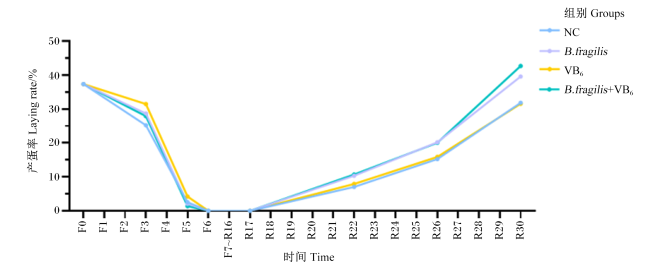
B. fragilis和VB6对强制换羽蛋鸡产蛋率的影响如图1所示。禁食第1天~禁食第3天(F1~F3),NC组、B. fragilis组、VB6组和B. fragilis+VB6组平均产蛋率分别下降到25.51%、28.70%、31.48%和27.89%;禁食第4天~禁食第5天(F4~F5),各组平均产蛋率分别下降到2.55%、2.09%、4.23%和1.41%;禁食第6天~恢复采食第17天(F6~R17),鸡群进入休产期。NC组、B. fragilis组、VB6组和B. fragilis+VB6组分别在恢复采食第20天(R20)、恢复采食第18天(R18)、恢复采食第21天(R21)和恢复采食第19天(R19)时开始重新产蛋,并且每组的产蛋率都逐渐升高。恢复采食第17天~恢复采食第22天(R17~R22),NC组、B. fragilis组、VB6组和B. fragilis+VB6组平均产蛋率分别为7.08%、10.37%、7.96%、和10.71%;恢复采食第23天~恢复采食第26天(R23~R26),各组平均产蛋率分别为15.27%、20.21%、15.91%和20.07%;恢复采食第27天~恢复采食第30天(R27~R30),各组平均产蛋率分别为31.83%、39.54%、31.17%和42.64%。
图1 B. fragilis和VB6对强制换羽蛋鸡产蛋率的影响

F表示禁食,其中F0表示禁食前1天;R表示恢复采食。

Fig.1 Effects of B. fragilis and VB6 on laying rate of laying hens during forced molting

F indicated fasting, where F0 indicated day 1 before fasting; R indicated resumption of feeding.

B. fragilis和VB6对强制换羽蛋鸡蛋品质的影响见表5。恢复采食第30天,与NC组相比,B. fragilis组和B. fragilis+VB6组蛋黄颜色显著提高(P<0.05),VB6组蛋壳重显著提高(P<0.05)。各组间蛋重、蛋形指数、蛋壳厚度、蛋壳强度和蛋白高度均无显著差异(P>0.05)。
表5 B. fragilis和VB6对强制换羽蛋鸡蛋品质的影响

Table 5 Effects of B. fragilis and VB6 on egg quality of laying hens during forced molting

项目
Items
组别Groups P
P-value
NC B. fragilis VB6 B. fragilis+VB6
蛋重Egg weight/g 51.54±5.11 50.51±3.86 51.80±5.08 50.58±5.25 0.094
蛋形指数Egg-shaped index 1.34±0.07 1.37±0.09 1.32±0.06 1.35±0.06 0.081
蛋壳厚度Eggshell thickness/mm 0.32±0.04 0.32±0.04 0.31±0.03 0.31±0.04 0.455
蛋壳强度Eggshell strength/N 35.42±8.16 36.26±8.81 40.63±7.70 35.78±7.56 0.090
蛋壳重Eggshell weight/g 6.82±0.83b 6.61±0.42b 7.45±0.90a 6.88±0.97b 0.004
蛋白高度Albumen height/mm 4.64±0.92 4.60±0.73 4.31±1.04 4.66±0.81 0.481
蛋黄颜色Yolk color 8.80±0.83b 9.31±0.55a 9.20±0.67ab 9.41±0.87a 0.014

2.2 B. fragilis和VB6对强制换羽蛋鸡肠道组织形态结构的影响

B. fragilis和VB6对强制换羽蛋鸡肠道组织形态结构的影响见表6。与NC组相比,禁食第15天,VB6组空肠隐窝深度显著提高(P<0.05);B. fragilis+VB6组回肠绒毛高度显著提高(P<0.05)。各组间肠道其他时间绒毛高度、隐窝深度和绒隐比均无显著差异(P>0.05)。
表6 B. fragilis和VB6对强制换羽蛋鸡肠道组织形态结构的影响

Table 6 Effects of B. fragilis and VB6 on intestinal tissue morphology and structure of laying hens during forced molting

项目
Items
组别Groups P
P-value
NC B. fragilis VB6 B. fragilis+VB6
空肠Jejunum
F0 绒毛高度Villus height/μm 850.59±335.70 850.59±335.70 850.59±335.70 850.59±335.70 1.000
隐窝深度Crypt depth/μm 173.96±45.77 173.96±45.77 173.96±45.77 173.96±45.77 1.000
绒隐比V/C 5.25±2.50 5.25±2.50 5.25±2.50 5.25±2.50 1.000
F15 绒毛高度Villus height/μm 415.76±131.98 549.87±225.53 415.73±133.14 507.23±104.84 0.275
隐窝深度Crypt depth/μm 187.27±35.07b 192.57±21.37ab 240.59±27.34a 203.14±48.49ab 0.039
绒隐比V/C 2.34±0.95 3.00±1.32 1.79±0.68 2.68±0.76 0.138
R5 绒毛高度Villus height/μm 860.25±193.67 871.36±276.89 716.73±174.09 814.07±223.83 0.498
隐窝深度Crypt depth/μm 156.96±51.15 159.75±55.42 137.16±43.29 174.42±42.57 0.528
绒隐比V/C 6.34±2.76 5.89±1.39 6.04±1.67 4.98±1.08 0.552
R30 绒毛高度Villus height/μm 987.10±226.78 1 036.96±269.72 1 256.65±226.04 1 110.66±478.49 0.369
隐窝深度Crypt depth/μm 179.62±96.46 159.06±30.34 176.75±41.72 165.26±60.52 0.901
绒隐比V /C 7.39±3.56 7.15±3.09 7.91±2.79 7.32±3.01 0.967
回肠Ileum
F0 绒毛高度Villus height/μm 969.77±138.01 969.77±138.01 969.77±138.01 969.77±138.01 1.000
隐窝深度Crypt depth/μm 143.01±49.57 143.01±49.57 143.01±49.57 143.01±49.57 1.000
绒隐比V/C 7.97±3.55 7.97±3.55 7.97±3.55 7.97±3.55 1.000
F15 绒毛高度Villus height/μm 376.98±96.10b 426.60±90.64ab 297.71±91.90b 519.55±144.16a 0.007
隐窝深度Crypt depth/μm 166.28±25.90 183.04±23.35 161.05±40.84 183.71±32.76 0.392
绒隐比V/C 2.23±0.85 2.43±0.45 2.23±1.16 2.75±1.23 0.694
R5 绒毛高度Villus height/μm 669.09±158.13 689.74±202.24 589.20±197.22 618.23±171.58 0.682
隐窝深度Crypt depth/μm 159.42±53.20 144.81±46.04 132.05±47.20 178.22±45.83 0.276
绒隐比V/C 5.09±2.61 5.05±0.95 4.73±1.18 3.88±1.71 0.483
R30 绒毛高度Villus height/μm 797.80±367.83 902.22±241.35 808.56±328.57 937.23±317.72 0.789
隐窝深度Crypt depth/μm 165.72±76.27 124.86±38.8 150.12±82.71 175.13±49.04 0.453
绒隐比V/C 5.65±2.27 8.13±3.01 6.31±2.56 5.63±1.60 0.168

F0表示禁食前1天,F15表示禁食第15天,R5表示恢复采食第5天,R30表示恢复采食第30天。表7同。

F0 indicated day 1 before fasting, F15 indicated day 15 of fasting, R5 indicated day 5 of resumption of feeding, and R30 indicated day 30 of resumption of feeding. The same as Table 7.

根据蛋鸡生产性能和肠道组织形态结构结果得出,同时灌服B. fragilis和VB6对蛋鸡强制换羽过程中的影响较大,因此选用NC组和B. fragilis+VB6组进行肠道相关基因表达和血清免疫指标的分析。

2.3 B. fragilis和VB6对强制换羽蛋鸡肠道相关基因表达的影响

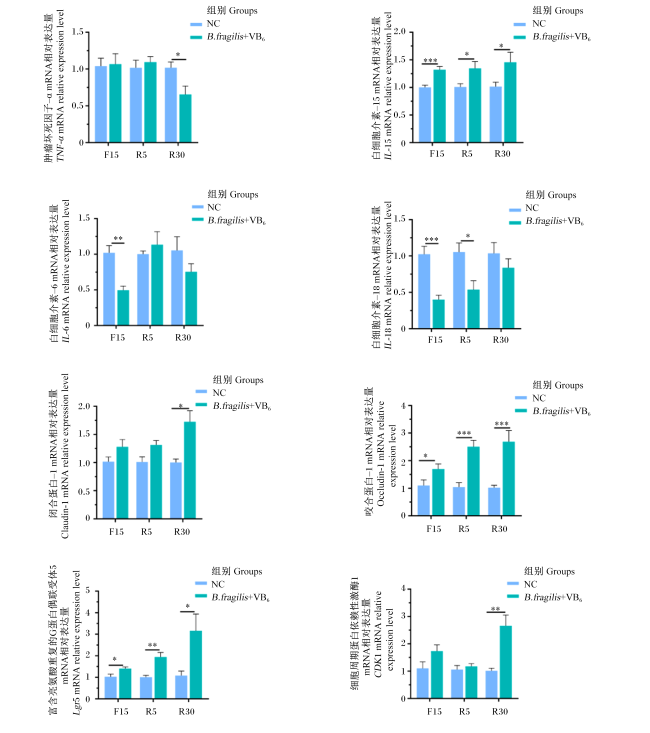
B. fragilis和VB6对强制换羽蛋鸡空肠相关基因表达的影响如图2所示。与NC组相比,禁食第15天,B. fragilis+VB6组蛋鸡空肠IL-6和白细胞介素-18(IL-18)mRNA相对表达量显著降低(P<0.05),空肠白细胞介素-15(IL-15)、咬合蛋白-1(occludin-1)和富含亮氨酸重复的G蛋白偶联受体5(Lgr5)mRNA相对表达量显著提高(P<0.05);恢复采食第5天,B. fragilis+VB6组空肠IL-15、occludin-1和Lgr5 mRNA相对表达量显著提高(P<0.05),空肠IL-18 mRNA相对表达量显著降低(P<0.05);恢复采食第30天,B. fragilis+VB6组空肠TNF-α mRNA相对表达量显著降低(P<0.05),空肠IL-15、闭合蛋白-1(claudin-1)、occludin-1、Lgr5和细胞周期蛋白依赖性激酶1(CDK1)mRNA相对表达量显著提高(P<0.05)。
图2 B. fragilis和VB6对强制换羽蛋鸡空肠相关基因表达的影响

F15表示禁食第15天,R5表示恢复采食第5天,R30表示恢复采食第30天。*表示P<0.05,**表示P<0.01,***表示P<0.001。图3同。

Fig.2 Effects of B. fragilis and VB6 on related gene expression in jejunum of laying hens during forced molting

F15 indicated day 15 of fasting, R5 indicated day 5 of resumption of feeding, and R30 indicated day 30 of resumption of feeding. * mean P<0.05, ** mean P<0.01, and *** mean P<0.001. The same as Fig.3.

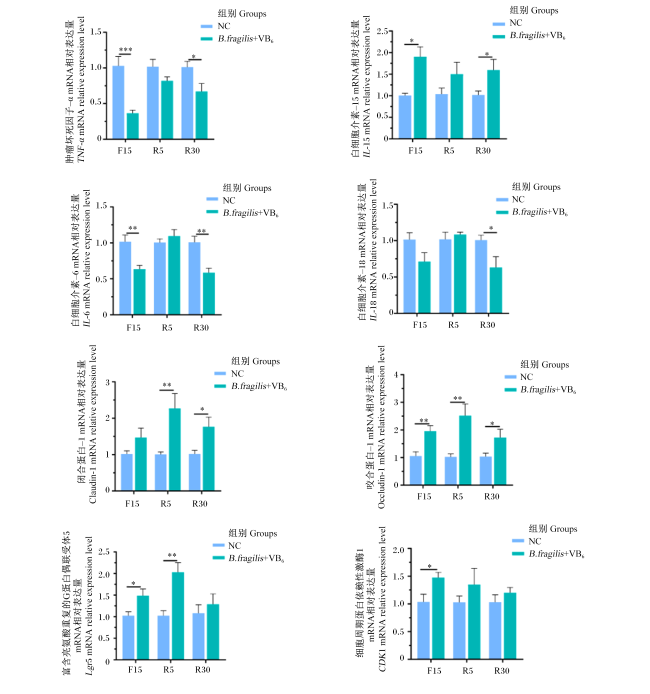
B. fragilis和VB6对强制换羽蛋鸡回肠相关基因表达的影响如图3所示。与NC组相比,禁食第15天,B. fragilis+VB6组蛋鸡回肠TNF-αIL-6 mRNA相对表达量显著降低(P<0.05),回肠IL-15、occludin-1、Lgr5和CDK1 mRNA相对表达量显著提高(P<0.05);恢复采食第5天,B. fragilis+VB6组回肠claudin-1、occludin-1和Lgr5 mRNA相对表达量显著提高(P<0.05);恢复采食第30天,B. fragilis+VB6组回肠TNF-αIL-6和IL-18 mRNA相对表达量显著降低(P<0.05),回肠IL-15、claudin-1和occludin-1 mRNA相对表达量显著提高(P<0.05)。
图3 B. fragilis和VB6对强制换羽蛋鸡回肠相关基因表达的影响

Fig.3 Effects of B. fragilis and VB6 on related gene expression in ileum of laying hens during forced molting

2.4 B. fragilis和VB6对强制换羽蛋鸡血清免疫指标的影响

B. fragilis和VB6对强制换羽蛋鸡血清免疫指标的影响见表7。与NC组相比,禁食第15天,B. fragilis+VB6组血清IgG含量显著提高(P<0.05);恢复采食第5天,B. fragilis+VB6组血清IgA、IgG和IgM含量均显著提高(P<0.05);恢复采食第30天,B. fragilis+VB6组血清IgG含量显著提高(P<0.05)。
表7 B. fragilis和VB6对强制换羽蛋鸡血清免疫指标的影响

Table 7 Effects of B. fragilis and VB6 on serum immune indices of laying hens during forced molting

项目
Items
免疫球蛋白A
IgA/(μg/mL)
免疫球蛋白G
IgG/(ng/mL)
免疫球蛋白M
IgM/(μg/mL)
F0 NC组NC group 9.29±2.99 98.88±2.60 6.18±0.23
B. fragilis+VB6B. fragilis+VB6 group 9.29±2.99 98.88±2.60 6.18±0.23
PP-value 1.000 1.000 1.000
F15 NC组NC group 9.06±0.24 84.83±2.26b 5.30±0.33
B. fragilis+VB6B. fragilis+VB6 group 8.83±0.14 88.94±2.69a 5.31±0.32
PP-value 0.111 0.007 0.947
R5 NC组NC group 9.61±0.27b 89.75±4.19b 5.34±0.26b
B. fragilis+VB6B. fragilis+VB6 group 10.11±0.24a 99.24±4.97a 6.00±0.22a
PP-value 0.015 0.001 <0.001
R30 NC组NC group 8.93±0.08 91.50±2.44b 5.31±0.28
B. fragilis+VB6B. fragilis+VB6 group 8.80±0.31 96.53±3.13a 5.34±0.22
PP-value 0.387 0.003 0.829

同列数据肩标不同字母表示差异显著(P<0.05)。

Values in the same column with different letter superscripts mean significant difference (P<0.05).

3 讨论

3.1 B. fragilis和VB6对强制换羽蛋鸡生产性能和蛋品质的影响

产蛋周期短、蛋品质差一直是产蛋后期蛋鸡面临的主要问题。强制换羽可以延长产蛋周期,提高生产性能,但传统的强制换羽方法会引起肠道菌群紊乱,引起潜在病原体的感染。研究发现,补充益生菌和维生素可促进肠道有益菌的生长,从而改善老龄蛋鸡的生产性能[25-26]B. fragilis和VB6进入蛋鸡肠道后,可以产生大量的活性物质,从而抑制病原菌的增殖,并促进有益菌的增殖。朱延旭等[21]研究表明,B. fragilis具有促进肉仔鸡免疫器官发育的作用,能够降低死淘率,提高肉仔鸡生长性能。魏芳等[27]研究发现,B. fragilis可以调节改善小鼠肠道菌群平衡,增加有益菌数量,提高免疫力,促进其生长发育。本研究发现,在恢复采食后期,B. fragilis+VB6组蛋鸡体重恢复情况优于其他组,表明共同灌服B. fragilis和VB6可能提高了蛋鸡对饲粮的消化利用率,从而使蛋鸡的体重恢复得以改善,这与上述研究结果基本一致。B. fragilis的代谢产物为维生素和多种活性物质,能够增强机体吸收营养物质的能力,从而间接提高产蛋率。本试验结果表明,共同灌服组在恢复采食后期产蛋率优于单独灌服组,B. fragilis+VB6组产蛋率明显提高,这表明共同灌服B. fragilis和VB6可能改善了蛋鸡肠道内环境,从而维持了肠道菌群稳定,使蛋鸡的生产性能得到改善。
蛋鸡的肠道健康决定了机体的健康状况和产蛋效率,肠道菌群的组成对蛋品质的调节具有一定的作用。在整个产蛋期,拟杆菌在肠道菌群中占有着重要的比例,在产蛋期对蛋黄颜色、蛋壳厚度等有重要的作用[28]。益生菌还可以改善蛋壳强度,提高蛋白高度,进而改善蛋品质[29-30]。蛋黄颜色和蛋黄比例是影响消费者对蛋品质判断的重要指标[31]。Andreatti等[32]研究表明,对蛋鸡实施强制换羽可以改善鸡蛋的蛋壳质量与内部品质。刘幸[33]研究指出,饥饿法诱导生理重塑显著提高鸡蛋的蛋黄颜色。本试验结果表明,B. fragilis+VB6组蛋黄颜色明显加深,这与上述研究结果一致。蛋壳是防止细菌侵入蛋内的第一道屏障,蛋壳质量的好坏间接影响着鸡蛋产品的安全性[34]。蛋壳厚度和蛋壳强度对于鸡蛋的包装运输、孵化和食用安全等有重要意义。VB6是生物体细胞中最核心的分子之一,是调节基本细胞代谢的各种生化反应的关键辅助因子,从而影响整个机体。VB6还是细胞代谢中非常重要的化合物,已被证明是细胞中140多种生化反应的辅助因子,不尽以辅酶因子的形式参与包括蛋白质、脂肪和碳水化合物在内的多种代谢过程,还与多种维生素和矿物元素代谢密切相关[17]。钙和磷的比例平衡对于蛋壳质量至关重要,而维生素D3对于钙的吸收和利用起关键作用,VB6通过影响氨基酸代谢,间接影响钙和磷的代谢,进而可能影响蛋壳质量[35]。Bilski等[36]研究发现,VB6可能在保护细胞免受氧化应激方面发挥关键作用,因为VB6的抗氧化活性甚至超过维生素C和维生素E,VB6可能通过其抗氧化功能保护细胞膜完整,减少氧化应激对蛋鸡生殖系统的损害,从而有助于维持蛋壳腺的健康和蛋壳的形成。本试验发现,在强制换羽过程中灌服VB6蛋品质得到一定的改善,具体机制有待进一步探究。以上结果表明,B. fragilis和VB6对蛋品质有一定的改善作用。

3.2 B. fragilis和VB6对强制换羽蛋鸡肠道组织形态结构的影响

小肠的主要功能是摄取、消化和吸收营养物质,以支持动物的生长和生理功能,同时保护宿主免受有害化合物的侵害。膳食营养素的消化和吸收主要发生在小肠中[37]。肠道组织形态结构是评价肠道健康的重要依据,绒毛高度、隐窝深度和绒隐比反映了机体对营养物质消化和吸收的效率,是衡量肠道功能的重要指标。绒毛缩短和隐窝加深可能导致营养吸收不良、胃肠道分泌增加和生产性能降低[38]。相反,绒毛高度提高与上皮细胞更新直接相关[39]。Yamauchi等[40]研究表明,禁食会导致蛋鸡十二指肠、空肠等绒毛高度降低,恢复采食后绒毛高度显著提高。Samli等[41]研究表明,饲粮添加益生菌屎肠球菌可提高回肠绒毛高度。王思梦等[42]研究表明,饲粮添加丁酸梭菌显著提高肉鸡十二指肠绒毛高度,并显著降低回肠隐窝深度。张煜坤[43]研究表明,给兔共同灌服B. fragilis和枯草芽孢杆菌提高了十二指肠和回肠绒毛高度,并降低了其隐窝深度;而单独灌服B. fragilis并没有显著提高十二指肠和回肠绒毛高度。本试验中,HE染色切片结果显示,禁食第15天,单独灌服B. fragilis没有提高蛋鸡肠道绒毛高度,共同灌服B. fragilis和VB6显著提高回肠绒毛高度,且单独灌服VB6显著提高空肠隐窝深度,说明单独灌服VB6阻碍了肠道对营养物质的消化吸收,共同灌服B. fragilis和VB6提高了蛋鸡对营养物质的消化吸收能力,这与上述研究结果一致。笔者推测B. fragilis和VB6可能存在加性效应,两者能够共同促进肠道细胞的增殖和修复,改善肠道结构,并有助于维持肠道形态,从而促进肠道发育和对营养物质的消化吸收。

3.3 B. fragilis和VB6对强制换羽蛋鸡肠道相关基因表达的影响

紧密连接是肠道重要的物理屏障,如claudin-1和occludin-1,它们是构成紧密连接的主要跨膜蛋白,在维持肠道屏障方面发挥重要作用[44-45]。TNF-α、IL-6、IL-18、IL-15都是与机体炎性相关的细胞因子,促炎细胞因子如IL-6、TNF-α和IL-18分泌增加,会直接破坏肠道的稳态[46]。IL-15作为一种重要的细胞因子,在自身免疫性疾病、炎症性疾病和肿瘤等疾病的发生发展中发挥着重要的作用[47]。有研究表明,IL-15是肠黏膜屏障的重要组成成分,并具有调节肠道稳态的功能[48]。Barker等[49]研究表明,肠上皮是动物机体更新代谢最快的组织,肠绒毛在几天之内就会完全脱落,而位于肠隐窝基底部的肠道干细胞是肠上皮更新代谢的发起者,Lgr5和CDK1都是跟细胞的增殖修复有关的基因,对维持肠道稳态功能具有重要作用。
健康的肠道形态对于维持肠道屏障和肠道通透性至关重要。肠道屏障是一种物理屏障,由肠上皮细胞及其紧密连接蛋白组成,可防止有害微生物和物质进入体内,同时促进营养物质的吸收[50-51]。当肠道形态受损时,上皮细胞受损或紧密连接弱化,肠道屏障功能可能会受到影响,导致肠道通透性增加,这被称为“肠漏”。徐家辉[52]研究表明,B. fragilis能够促进结肠炎小鼠结肠上皮细胞损伤的修复,在结肠炎小鼠中,B. fragilis能够促进结肠上皮细胞增殖并抑制上皮细胞凋亡。Zhang等[53]研究发现,B. fragilis处理可以通过调节肠道菌群来改善腹泻大鼠胃肠道症状,从而恢复上皮细胞组织和屏障功能。本研究结果发现,共同灌服B. fragilis和VB6可提高蛋鸡肠道Lgr5和CDK1 mRNA相对表达量,促进肠道上皮细胞的增殖与分化。TNF-α、IL-6和IL-18是促炎性细胞因子,可造成组织细胞的浸润和组织破坏,其表达失调可引起许多疾病。有研究表明,VB6具有抗炎特性,Zheng等[54]研究表明,饲粮中缺乏VB6会导致草鱼肠道TNF-αIL-6和IL-8 mRNA相对表达量的升高,可能会损害肠道免疫功能,而补充VB6会缓解这一现象。Zhang等[20]研究表明,VB6在体内抑制了IL-1β的产生,并保护小鼠免受脂多糖(LPS)诱导的内毒性休克。Shan等[23]研究表明,在LPS诱导的小鼠肺炎模型中,VB6显著抑制了促炎因子IL-1βIL-6和TNF-α的表达,缓解了炎症损伤。B. fragilis可以刺激肠道内的免疫细胞,如巨噬细胞、树突状细胞和T细胞等并产生抗炎因子,如白细胞介素-10(IL-10)和转化生长因子-β(TGF-β),同时抑制促炎因子,如TNF-α和白细胞介素-17(IL-17),这种免疫调节作用有助于恢复肠道免疫系统的平衡,减轻肠道炎症的进一步发展[55]。Shao等[11]研究发现,通过管饲法移植B. fragilis发现,B. fragilis能够有效维持小鼠体重,抑制肠道肿瘤生长,缓解肠道炎症和异型增生。本研究发现,共同灌服B. fragilis和VB6可降低蛋鸡肠道TNF-αIL-6和IL-18 mRNA相对表达量,提高IL-15 mRNA相对表达量,这表明在饮水中添加B. fragilis和VB6减缓了肠道炎症,保护了机体的健康,这与上述研究结果一致。雷棋怡等[56]研究表明,B. fragilis可提高硫酸葡聚糖钠(DSS)诱导的小鼠肠道屏障损伤模型的紧密连接蛋白闭合蛋白-2(claudin-2)和咬合蛋白(occludin)的表达,保护肠道屏障的完整性。魏芳等[27]研究表明,结肠炎小鼠补充B. fragilis可以提高肠道闭锁小带蛋白-1(ZO-1)的表达,增强肠黏膜屏障功能。本研究发现,共同灌服B. fragilis和VB6可提高蛋鸡肠道claudin-1和occludin-1 mRNA相对表达量,增强蛋鸡上皮细胞屏障的完整性,从而促进肠道对养分的吸收,这与上述研究结果一致。综上所述,B. fragilis和VB6共同维持了蛋鸡强制换羽过程中的肠道屏障功能,维护了肠道稳态,从而保护机体健康。

3.4 B. fragilis和VB6对强制换羽蛋鸡血清免疫指标的影响

B. fragilis作为肠道内定植的益生菌,具有提升动物免疫能力和维持健康的作用。血清免疫指标可以体现动物体免疫应答能力。VB6在先天性和适应性免疫系统方面发挥着重要和互补的作用,其缺乏会对免疫功能产生负面影响,并可能降低机体对感染的抵抗力[57]。VB6与免疫反应的调节有关,研究表明,缺乏VB6会损害免疫功能,并可能间接损害抗体产生[58]。Qian等[59]研究表明,缺乏VB6可延缓小鼠的生长,抑制淋巴细胞增殖,并干扰其分化。Bargiela等[60]研究表明,通过饮食缺乏VB6来限制PLP水平会导致小鼠T细胞反应受损,而补充VB6可有效增强细胞介导的免疫反应。靳昌旻等[61]研究表明,IgA、IgG和IgM含量可反映动物机体体液免疫的强弱。研究表明,IgM可以通过降低炎症患者的内毒素水平来维持人体肠道屏障的正常发育[62-63]。IgG是血清和细胞外组织液中含量最高的免疫球蛋白亚型,占总免疫球蛋白的70%~75%[64],可反映动物的全身免疫状态[65]。王新锴[66]研究发现,拟杆菌干预可以显著提高血清IgG和IgA含量,并有提高血清IgM含量的趋势。Yanagibashi等[67]研究发现,拟杆菌相较于传统益生菌,可以促进小鼠肠道中B细胞的分化,并显著增加IgA的分泌量,促进肠道内致病因子的清除。Nakajima等[68]研究发现,高纤维饲粮可以提高小鼠肠道拟杆菌的相对丰度,并且提高肠道固有层激活诱导胞啶脱氨酶(AID)表达水平和肠道IgA含量。Tan等[69]研究发现,B. fragilis可以产生一种重要的功能性物质,称为PSA,并已被鉴定为是一种免疫调节分子,在免疫系统成熟中发挥作用,可增强机体的免疫能力。本研究结果表明,B. fragilis+VB6组蛋鸡血清IgA、IgG和IgM含量显著提高,表明蛋鸡免疫功能得到提高,从而提高了机体对外界病原体的抵抗力。综上所述,B. fragilis和VB6可以增强蛋鸡强制换羽过程中的免疫功能。

4 结论

在蛋鸡强制换羽过程中,共同灌服B. fragilis和VB6能够提高其生产性能,改善肠道组织形态结构,提高肠道屏障及增殖相关基因表达,降低肠道炎症相关基因表达,增强机体免疫功能,从而维持肠道健康,其效果优于单独灌服B. fragilis或VB6
[1]
MAKKAR H P S. Review:feed demand landscape and implications of food-not feed strategy for food security and climate change[J]. Animal, 2018, 12(8):1744-1754.

[2]
BERRY W D. The physiology of induced molting[J]. Poultry Science, 2003, 82(6):971-980.

PMID

[3]
赵怀宝, 陈亮, 张宏福. 强制换羽在肉种鸡上的应用及营养调控策略[J]. 中国家禽, 2020, 42(9):1-11.

ZHAO H B, CHEN L, ZHANG H F. Application and nutritional control strategy on broiler breeder forced molting[J]. China Poultry, 2020, 42(9):1-11. (in Chinese)

[4]
ZHANG H, ZHANG Y H, GONG Y J, et al. Fasting-induced molting impacts the intestinal health by altering the gut microbiota[J]. Animals, 2024, 14(11):1640.

[5]
HSIAO E Y, MCBRIDE S W, HSIEN S, et al. Microbiota modulate behavioral and physiological abnormalities associated with neurodevelopmental disorders[J]. Cell, 2013, 155(7):1451-1463.

DOI PMID

[6]
WEXLER H M. Bacteroides:the good,the bad,and the nitty-gritty[J]. Clinical Microbiology Reviews, 2007, 20(4):593-621.

[7]
ROUND J L, LEE S M, LI J, et al. The Toll-like receptor 2 pathway establishes colonization by a commensal of the human microbiota[J]. Science, 2011, 332(6032):974-977.

DOI PMID

[8]
MAZMANIAN S K, ROUND J L, KASPER D L. A microbial symbiosis factor prevents intestinal inflammatory disease[J]. Nature, 2008, 453(7195):620-625.

[9]
LEE Y K, MEHRABIAN P, BOYAJIAN S, et al. The protective role of Bacteroides fragilis in a murine model of colitis-associated colorectal cancer[J]. mSphere, 2018, 3(6):e00587-18.

[10]
ZHENG L J, LUO M H, KUANG G B, et al. Capsular polysaccharide from Bacteroides fragilis protects against ulcerative colitis in an undegraded form[J]. Frontiers in Pharmacology, 2020,11:570476.

[11]
SHAO X Y, SUN S S, ZHOU Y Q, et al. Bacteroides fragilis restricts colitis-associated cancer via negative regulation of the NLRP3 axis[J]. Cancer Letters, 2021,523:170-181.

[12]
ERTURK-HASDEMIR D, OCHOA-REPÁRAZ J, KASPER D L, et al. Exploring the gut-brain axis for the control of CNS inflammatory demyelination:immunomodulation by Bacteroides fragilis' polysaccharide A[J]. Frontiers in Immunology, 2021,12:662807.

[13]
JOHNSON J L, JONES M B, COBB B A. Polysaccharide-experienced effector T cells induce IL-10 in FoxP3+ regulatory T cells to prevent pulmonary inflammation[J]. Glycobiology, 2018, 28(1):50-58.

[14]
RHEE K J, SETHUPATHI P, DRIKS A, et al. Role of commensal bacteria in development of gut-associated lymphoid tissues and preimmune antibody repertoire[J]. Journal of Immunology, 2004, 172(2):1118-1124.

[15]
MATXAIN J M, PADRO D, RISTILÄ M, et al. Evidence of high ·OH radical quenching efficiency by vitamin B6[J]. Journal of Physical Chemistry B, 2009, 113(29):9629-9632.

[16]
BIRD R P. The emerging role of vitamin B6 in inflammation and carcinogenesis[J]. Advances in Food and Nutrition Research, 2018,83:151-194.

[17]
MAGNÚSDÓTTIR S, RAVCHEEV D, DE CRÉCY-LAGARD V, et al. Systematic genome assessment of B-vitamin biosynthesis suggests co-operation among gut microbes[J]. Frontiers in Genetics, 2015,6:148.

[18]
银佳, 冯立科, 杨爱君, 等. 产B族维生素微生物研究进展[J]. 中国乳业, 2023(10):105-115.

YIN J, FENG L K, YANG A J, et al. Research progress of B vitamins-producing microorganisms[J]. China Dairy, 2023(10):105-115. (in Chinese)

[19]
RIMM E B. Folate and vitamin B6 from diet and supplements in relation to risk of coronary heart disease among women[J]. Bibliotheca Nutritio et Dieta, 2001(55):42-45.

[20]
ZHANG P P, TSUCHIYA K, KINOSHITA T, et al. Vitamin B6 prevents IL-1β protein production by inhibiting NLRP3 inflammasome activation[J]. Journal of Biological Chemistry, 2016, 291(47):24517-24527.

[21]
朱延旭, 尚尔彬, 王占红. BF-839脆弱拟杆菌对肉仔鸡生产性能的影响[J]. 现代畜牧兽医, 2012(3):40-42.

ZHU Y X, SHANG E B, WANG Z H. Effect of BF-839 on the performance of broiler chickens[J]. Modern Journal of Animal Husbandry and Veterinary Medicine, 2012(3):40-42. (in Chinese)

[22]
CHEN L, YANG M S, ZHU W, et al. Multi-omics analysis after vaginal administration of Bacteroides fragilis in chickens[J]. Frontiers in Microbiology, 2022,13:846011.

[23]
SHAN M R, ZHOU S N, FU C N, et al. Vitamin B6 inhibits macrophage activation to prevent lipopolysaccharide-induced acute pneumonia in mice[J]. Journal of Cellular and Molecular Medicine, 2020, 24(5):3139-3148.

[24]
NRC. Nutrient requirements of poultry[S]. 9th Rev. ed.Washington,D. C.:The National Academies Press,1994.

[25]
BIKKER P, DIRKZWAGER A, FLEDDERUS J, et al. The effect of dietary protein and fermentable carbohydrates levels on growth performance and intestinal characteristics in newly weaned piglets[J]. Journal of Animal Science, 2006, 84(12):3337-3345.

DOI PMID

[26]
WANG C Y, SHAN H H, CHEN H, et al. Probiotics and vitamins modulate the cecal microbiota of laying hens submitted to induced molting[J]. Frontiers in Microbiology, 2023,14:1180838.

[27]
魏芳, 范梦慧, 刘光臣, 等. 脆弱拟杆菌ATCC25285通过TGF-β/Smad3通路诱导Treg细胞分化缓解结肠炎[J]. 中国药科大学学报, 2023, 54(2):226-237.

WEI F, FAN M H, LIU G C, et al. Bacteroides fragilis ATCC25285 relieves colitis by inducing Treg cells differentiation via the TGF-β/Smad3 signaling pathway[J]. Journal of China Pharmaceutical University, 2023, 54(2):226-237. (in Chinese)

[28]
佟跃, 贾亚红, 李向梅, 等. 蛋鸡不同生理阶段肠道菌群动态变化的研究进展[J]. 北方牧业, 2023(9):12-13.

TONG Y, JIA Y H, LI X M, et al. Research progress on the dynamic changes of intestinal microbiota in different physiological stages of laying hens[J]. Northern Animal Husbandry, 2023(9):12-13. (in Chinese)

[29]
王媛媛, 闫俊书, 宦海琳, 等. 生物发酵饲料对蛋鸡生产性能、蛋品质及肠道微生物菌群的影响[J]. 饲料工业, 2024, 45(5):23-31.

WANG Y Y, YAN J S, HUAN H L, et al. Effects of biofermented feed on production performance,egg quality and intestinal microbiota of laying hens[J]. Feed Industry, 2024, 45(5):23-31. (in Chinese)

[30]
CARVALHO C L, ANDRETTA I, GALLI G M, et al. Dietary supplementation with β-mannanase and probiotics as a strategy to improve laying hen performance and egg quality[J]. Frontiers in Veterinary Science, 2023,10:1229485.

[31]
刘璐, 郑江霞, 徐桂云. 鸡蛋蛋黄比例研究综述[J]. 食品安全质量检测学报, 2014(8):2560-2567.

LIU L, ZHENG J X, XU G Y. Review of researches on yolk percentage in chicken egg[J]. Journal of Food Safety & Quality, 2014(8):2560-2567. (in Chinese)

[32]
ANDREATTI F R L, MILBRADT E L, OKAMOTO A S, et al. Salmonella enteritidis infection,corticosterone levels,performance and egg quality in laying hens submitted to different methods of molting[J]. Poultry Science, 2019, 98(10):4416-4425.

[33]
刘幸. 强制换羽期蛋鸡生产、生理代谢及肠道健康的变化规律研究[D]. 硕士学位论文. 西安: 西北农林科技大学, 2020.

LIU X. Study on changes of production,physiological metabolism and intestinal health of laying hen during molting[D]. Master's Thesis. Xi'an: Northwest A&F University, 2020. (in Chinese)

[34]
MABE I, RAPP C, BAIN M M, et al. Supplementation of a corn-soybean meal diet with manganese,copper,and zinc from organic or inorganic sources improves eggshell quality in aged laying hens[J]. Poultry Science, 2003, 82(12):1903-1913.

[35]
SINCLAIR-BLACK M, GARCIA R A, ELLESTAD L E. Physiological regulation of calcium and phosphorus utilization in laying hens[J]. Frontiers in Physiology, 2023,14:1112499.

[36]
BILSKI P, LI M Y, EHRENSHAFT M, et al. Vitamin B6 (pyridoxine) and its derivatives are efficient singlet oxygen quenchers and potential fungal antioxidants[J]. Photochemistry and Photobiology, 2000, 71(2):129-134.

[37]
KAWALILAK L T, ULMER FRANCO A M, FASENKO G M. Impaired intestinal villi growth in broiler chicks with unhealed navels[J]. Poulty Science, 2010, 89(1):82-87.

[38]
AWAD W A, GHAREEB K, ABDEL-RAHEEM S, et al. Effects of dietary inclusion of probiotic and synbiotic on growth performance,organ weights,and intestinal histomorphology of broiler chickens[J]. Poultry Science, 2009, 88(1):49-56.

[39]
FAN Y K, CROOM J, CHRISTENSEN V L, et al. Jejunal glucose uptake and oxygen consumption in turkey poults selected for rapid growth[J]. Poultry Science, 1997, 76(12):1738-1745.

PMID

[40]
YAMAUCHI K, KAMISOYAMA H, ISSHIKI Y. Effects of fasting and refeeding on structures of the intestinal villi and epithelial cells in white leghorn hens[J]. British Poultry Science, 1996, 37(5):909-921.

DOI PMID

[41]
SAMLI H E, SENKOYLU N, KOC F, et al. Effects of Enterococcus faecium and dried whey on broiler performance,gut histomorphology and intestinal microbiota[J]. Archives of Animal Nutrition, 2007, 61(1):42-49.

[42]
王思梦, 聂存喜, 姬琳堡, 等. 丁酸梭菌对爱拔益加肉鸡生长性能、肠道健康和抗氧化能力的影响[J]. 动物营养学报, 2024, 36(2):897-907.

DOI

WANG S M, NIE C X, JI L B, et al. Effects of Clostridium butyricum on growth performance,intestine health and antioxidant capacity of arbor acres broilers[J]. Chinese Journal of Animal Nutrition, 2024, 36(2):897-907. (in Chinese)

[43]
张煜坤. 脆弱拟杆菌与枯草芽孢杆菌对仔兔肠道微生物区系及免疫的影响[D]. 硕士学位论文. 西安: 西北农林科技大学, 2014.

ZAHNG Y K. Effects of Bacteroides fragilis and Bacillus subtilis on young rabbits' intestinal microfiora and immune.[D]. Master's Thesis. Xi'an: Northwest A&F University, 2014. (in Chinese)

[44]
GONG Y J, XIA W R, WEN X T, et al. Early inoculation with caecal fermentation broth alters small intestine morphology,gene expression of tight junction proteins in the ileum,and the caecal metabolomic profiling of broilers[J]. Journal of Animal Science and Technology, 2020,11:8.

[45]
ALI F, SAEED K, FATEMEH H. Nano-bio selenium synthesized by Bacillus subtilis modulates broiler performance,intestinal morphology and microbiota,and expression of tight junction's proteins[J]. Biological Trace Element Research, 2022, 200(4):1811-1825.

[46]
BUFORD T W. (Dis)trust your gut:the gut microbiome in age-related inflammation,health,and disease[J]. Microbiome, 2017, 5(1):80.

[47]
GUO Y, LUAN L M, PATIL N K, et al. Immunobiology of the IL-15/IL-15Rα complex as an antitumor and antiviral agent[J]. Cytokine & Growth Factor Reviews, 2017,38:10-21.

[48]
PAGLIARI D, CIANCI R, FROSALI S, et al. The role of IL-15 in gastrointestinal diseases:a bridge between innate and adaptive immune response[J]. Cytokine & Growth Factor Reviews, 2013, 24(5):455-466.

[49]
BARKER N, VAN ES J H, KUIPERS J, et al. Identification of stem cells in small intestine and colon by marker gene Lgr5[J]. Nature, 2007, 449(7165):1003-1007.

[50]
BAO J F, LU Y H, SHE Q Y, et al. MicroRNA-30 regulates left ventricular hypertrophy in chronic kidney disease[J]. JCI Insight, 2021, 6(10):138027.

[51]
YANG J P, LI Y N, WEN Z Q, et al. Oscillospira—a candidate for the next-generation probiotics[J]. Gut Microbes, 2021, 13(1):1987783.

[52]
徐家辉. 脆弱拟杆菌ZY-312治疗小鼠实验性结肠炎的机制探究[D]. 博士学位论文. 广州: 南方医科大学, 2019.

XU J H. Study on the mechanism of experimental colitis in mice treated with bacteroides fragilis ZY-312[D]. Ph.D. Thesis. Guangzhou: Southern Medical University, 2019. (in Chinese)

[53]
ZHANG W D, ZHU B, XU J H, et al. Bacteroides fragilis protects against antibiotic-associated diarrhea in rats by modulating intestinal defenses[J]. Frontiers in Immunology, 2018,9:1040.

[54]
ZHENG X, FENG L, JIANG W D, et al. Dietary pyridoxine deficiency reduced growth performance and impaired intestinal immune function associated with TOR and NF-κB signalling of young grass carp (Ctenopharyngodon idella)[J]. Fish & Shellfish Immunology, 2017,70:682-700.

[55]
舒宝莲, 桂若虎, 郑新平, 等. 柳氮磺胺吡啶联合脆弱拟杆菌治疗对溃疡性结肠炎小鼠脾脏中Treg比例的影响[J]. 北方药学, 2024, 21(3):5-8.

SHU B L, GUI R H, ZHENG X P, et al. The effect of sulfasalazine combined with Bacteroides fragilis treatment on the proportion of Treg in the spleen of mice with ulcerative colitis[J]. Journal of North Pharmacy, 2024, 21(3):5-8. (in Chinese)

[56]
雷棋怡, 徐杨, 李鹏飞. 脆弱拟杆菌六型分泌系统对肠道屏障的影响及机制[J]. 生物技术通报, 2024, 40(3):286-295.

DOI

LEI Q Y, XU Y, LI P F. Influence and mechanism of Bacteroides fragilis type Ⅵ secretory system on the intestinal barrier[J]. Biotechnology Bulletin, 2024, 40(3):286-295. (in Chinese)

[57]
CALDER P C, CARR A C, GOMBART A F, et al. Optimal nutritional status for a well-functioning immune system is an important factor to protect against viral infections[J]. Nutrients, 2020, 12(4):1181.

[58]
RALL L C, MEYDANI S N. Vitamin B6 and immune competence[J]. Nutrition Reviews, 1993, 51(8):217-225.

[59]
QIAN B J, SHEN S Q, ZHANG J H, et al. Effects of vitamin B6 deficiency on the composition and functional potential of T cell populations[J]. Journal of Immunology Research, 2017,2017:2197975.

[60]
BARGIELA D, CUNHA P P, VELIÇA P, et al. Vitamin B6 metabolism determines T cell anti-tumor responses[J]. Frontiers in Immunology, 2022,13:837669.

[61]
靳昌旻, 邵彩梅, 于滢, 等. 饲粮蛋白质水平和枯草芽孢杆菌制剂对大骨鸡种母鸡生产性能、蛋品质、养分表观代谢率及血清抗氧化和免疫指标的影响[J]. 中国饲料, 2024(17):75-82.

JIN C M, SHAO C M, YU Y, et al. Effects of dietary crude protein levels and Bacillus subtilis preparation on performance,egg quality,nutrient apparent metabolic rate,serum antioxidant and immune indices of Dagu breeding hens[J]. China Feed, 2024(17):75-82. (in Chinese)

[62]
AL-BAHRANI A Z, DARWISH A, HAMZA N, et al. Gut barrier dysfunction in critically ill surgical patients with abdominal compartment syndrome[J]. Pancreas, 2010, 39(7):1064-1069.

[63]
MAES M, SIRIVICHAYAKUL S, KANCHANATAWAN B, et al. Breakdown of the paracellular tight and adherens junctions in the gut and blood brain barrier and damage to the vascular barrier in patients with deficit schizophrenia[J]. Neurotoxicity Research, 2019, 36(2):306-322.

DOI PMID

[64]
VIDARSSON G, DEKKERS G, RISPENS T. IgG subclasses and allotypes:from structure to effector functions[J]. Frontiers in Immunology, 2014,5:520.

[65]
GUO Q, GOLDENBERG J Z, HUMPHREY C, et al. Probiotics for the prevention of pediatric antibiotic-associated diarrhea[J]. The Cochrane Database of Systematic Reviews, 2019, 4(4):CD004827.

[66]
王新锴. 拟杆菌及其代谢物对肉仔鸡肠道免疫调控及机制的研究[D]. 博士学位论文. 武汉: 华中农业大学, 2022.

WANG X K. Effects and mechanism of bacteroides and its metabolites on the intestinal immune performance of broilers[D]. Ph.D. Thesis. Wuhan: Huazhong Agricultural University, 2022. (in Chinese)

[67]
YANAGIBASHI T, HOSONO A, OYAMA A, et al. IgA production in the large intestine is modulated by a different mechanism than in the small intestine:Bacteroides acidifaciens promotes IgA production in the large intestine by inducing germinal center formation and increasing the number of IgA+ B cells[J]. Immunobiology, 2013, 218(4):645-651.

[68]
NAKAJIMA A, SASAKI T, ITOH K, et al. A soluble fiber diet increases Bacteroides fragilis group abundance and immunoglobulin a production in the gut[J]. Applied and Environmental Microbiology, 2020, 86(13):e00405-e00420.

[69]
TAN H Z, ZHAI Q X, CHEN W. Investigations of Bacteroides spp. towards next-generation probiotics[J]. Food Research International, 2019,116:637-644.

文章导航

/