研究论文

茶多糖对热应激西门塔尔肉牛瘤胃发酵参数、微生物区系和代谢物的影响

  • 李凡 , 1 ,
  • 徐俊 , 1, 2, * ,
  • 陈国良 3 ,
  • 费丹 2 ,
  • 广业兰 2 ,
  • 侯玉洁 4 ,
  • 谢敏 2 ,
  • 李文飞 5 ,
  • 王颖新 5
展开
  • 1 江西省农业科学院畜牧兽医研究所,江西省畜禽健康养殖重点实验室,南昌 330200
  • 2 江西省农业科学院农产品质量安全与标准研究所,南昌 330200
  • 3 江西省农业技术推广中心,南昌 330038
  • 4 南昌市农业科学院,南昌 330038
  • 5 高安市农业农村局,高安 330800
* 徐 俊,副研究员,E-mail:

李 凡(1995—),男,江西南昌人,助理研究员,博士,研究方向为肉牛营养与生理调控。E-mail:

Copy editor: 武海龙

收稿日期: 2024-09-26

  网络出版日期: 2025-05-14

基金资助

江西省农业科学院基础研究和人才培养专项(JXSNKYJCRC202209)

江西省重点研发项目(20201BBF61008)

江西省现代农业产业技术体系

Effects of Tea Polysaccharides on Rumen Fermentation Parameters, Microflora and Metabolites of Simmental Beef Cattle under Heat Stress

  • LI Fan , 1 ,
  • XU Jun , 1, 2, * ,
  • CHEN Guoliang 3 ,
  • FEI Dan 2 ,
  • GUANG Yelan 2 ,
  • HOU Yujie 4 ,
  • XIE Min 2 ,
  • LI Wenfei 5 ,
  • WANG Yingxin 5
Expand
  • 1 Jiangxi Key Laboratory of Healthy Livestock and Poultry Breeding, Jiangxi Academy of Agricultural Sciences, Institute of Animal Science and Veterinary Science, Nanchang 330200, China
  • 2 Jiangxi Academy of Agricultural Science, Institute of Agricultural Product Quality Safety and Standards, Nanchang 330200, China
  • 3 Jiangxi Agricultural Technology Extension Center, Nanchang 330038, China
  • 4 Nanchang Academy of Agricultural Sciences, Nanchang 330038, China
  • 5 Gaoan Agriculture and Rural Bureau, Gaoan 330800, China
* associate professor, E-mail:

Received date: 2024-09-26

  Online published: 2025-05-14

摘要

本试验旨在研究茶多糖对热应激西门塔尔肉牛瘤胃发酵参数、微生物区系和代谢物的影响。选取24头15月龄育肥期西门塔尔肉牛,随机分为4组,每组6个重复,每个重复1头牛,在夏季构建热应激模型。对照组(CON组)饲喂基础饲粮,试验组分别在基础饲粮中额外添加0.4%(T1组)、0.8%(T2组)和1.2%(T3组)的茶多糖(干物质基础)。预试期2周,正试期6周。结果表明:1)与CON组相比,T1组瘤胃pH和乙酸、丙酸含量显著提高(P<0.05),氨态氮含量显著降低(P<0.05);T2组瘤胃pH显著提高(P<0.05);T3组瘤胃pH显著提高(P<0.05),乙酸、丁酸和戊酸含量显著降低(P<0.05)。2)在门水平上,与CON组相比,T1组瘤胃中拟杆菌门相对丰度显著提高(P<0.05),厚壁菌门、放线菌门和浮霉菌门相对丰度显著降低(P<0.05)。在属水平上,与CON组相比,T1、T2和T3组瘤胃中瘤胃杆菌属相对丰度显著提高(P<0.05);T1组瘤胃中普雷沃氏菌属相对丰度显著提高(P<0.05),未命名的毛螺菌科和未命名的梭菌目相对丰度显著降低(P<0.05)。3)代谢组学结果显示,负离子模式下,与CON组相比,T1组瘤胃N-乙酰基-L-苯丙氨酸、苯乙醛、D(+)-苯乙酸、4-乙基苯酚、L-苯丙氨酸、2,3-二羟基苯甲酸、(±)9-六溴二苯醚、对苯二酚和L-肾上腺素含量均显著降低(P<0.05),T2组瘤胃溶血磷脂酰胆碱(18∶2)和对苯二酚含量显著降低(P<0.05)。正离子模式下,与CON组相比,T1组瘤胃油酸酰胺、十六碳酰胺、5,6-二甲基-4-氧代-4氢-吡喃-2-羧酸和C8 1-磷酸神经酰胺含量均显著降低(P<0.05),胸腺嘧啶和胸腺嘧啶核苷含量显著升高(P<0.05);T2组瘤胃5,6-二甲基-4-氧代-4氢-吡喃-2-羧酸、C8 1-磷酸神经酰胺和3-(2-羟乙基)吲哚含量显著降低(P<0.05),胸腺嘧啶和胸腺嘧啶核苷含量显著升高(P<0.05);T3组瘤胃油酸酰胺和C8 1-磷酸神经酰胺含量显著降低(P<0.05)。4)正、负离子模式下代谢物模块汇总和富集分析(MSEA)显著通路富集分析结果显示,茶多糖显著改变了瘤胃中酪氨酸代谢、硒代氨基酸代谢、嘧啶代谢、嘌呤代谢和咖啡因代谢等相关代谢通路(P<0.05)。综上所述,饲粮中添加茶多糖改善了西门塔尔肉牛在热应激胁迫下的瘤胃发酵参数和微生物区系,影响了瘤胃功能型代谢物组成和代谢通路。

本文引用格式

李凡 , 徐俊 , 陈国良 , 费丹 , 广业兰 , 侯玉洁 , 谢敏 , 李文飞 , 王颖新 . 茶多糖对热应激西门塔尔肉牛瘤胃发酵参数、微生物区系和代谢物的影响[J]. 动物营养学报, 2025 , 37(5) : 3099 -3114 . DOI: 10.12418/CJAN2025.257

Abstract

This experiment was carried out to investigate the effects of tea polysaccharides on rumen fermentation parameters, microflora and metabolites of Simmental beef cattle under heat stress. Twenty-four 15-month-old Simmental beef cattle during the fattening stage were randomly divided into 4 groups with 6 replicates per group and 1 cattle per replicate, and the heat stress model was established in summer. The control group (CON group) was fed a basal diet, and the experimental groups were fed the basal diet additional supplemented with 0.4% (T1 group), 0.8% (T2 group) and 1.2% (T3 group) tea polysaccharides (dry matter basis), respectively. The pre-experimental period lasted for 2 weeks, and the experimental period lasted for 6 weeks. The results showed as follows: 1) compared with the CON group, the rumen pH and acetic acid, propionic acid contents of T1 group were significantly increased (P<0.05), and the ammonia nitrogen content was significantly decreased (P<0.05); the rumen pH of T2 group was significantly increased (P<0.05); the rumen pH of T3 group was significantly increased (P<0.05), and the propionic acid, butyric acid and valeric acid contents were significantly decreased (P<0.05). 2) At the phylum level, compared with the CON group, the rumen Bacteroidetes relative abundance of T1 group was significantly increased (P<0.05), and the Firmicutes, Actinobacteria and Planctomycetes relative abundances were significantly decreased (P<0.05). At the genus level, compared with the CON group, the rumen Ruminobacter relative abundance of T1, T2 and T3 groups was significantly increased (P<0.05); the rumen Prevotella relative abundance of T1 group was significantly increased (P<0.05), and the Lachnospiraceae_noname and Clostridiales_noname relative abundances were significantly decreased (P<0.05). 3) Metabolomics results indicated that in the negative ion mode, compared with the CON group, the contents of N-acetyl-L-phenylalanine, phenylacetaldehyde, D(+)-phenyllactic acid, 4-ethylphenol, L-phenylalanine, 2,3-dihydroxybenzoic acid, (±)9-hexabromodiphenyl ether, hydroquinone and L-adrenaline in rumen of T1 group were significantly decreased (P<0.05), and the contents of lysophosphatidylcholine (18∶2) and hydroquinone in rumen of T2 group were significantly decreased (P<0.05). In the positive ion mode, compared with the CON group, the contents of oleamide, hexadecanamide, 5,6-dimethyl-4-oxo-4H-pyran-2-carboxylic acid and C8 1-phosphate ceramide in rumen of T1 group were significantly decreased (P<0.05), and the thymine and thymidine contents were significantly increased (P<0.05); the contents of 5,6-dimethyl-4-oxo-4H-pyran-2-carboxylic acid, C8 1-phosphate ceramide and 3-(2-hydroxyethyl) indole in rumen of T2 group were significantly decreased (P<0.05), and the thymine and thymidine contents were significantly increased (P<0.05); the contents of oleic amide and C8 1-phosphate ceramide in rumen of T3 group were significantly decreased (P<0.05). 4) The module summarization and enrichment analysis (MSEA) significant pathway enrichment analysis in the positive and negative ion mode revealed that the tea polysaccharides significantly altered the rumen related metabolic pathways such as tyrosine metabolism, selenoamino acid metabolism, pyrimidine metabolism, purine metabolism and caffeine metabolism et al (P<0.05). In conclusion, dietary tea polysaccharides can improve the rumen fermentation parameters and microflora of Simmental beef cattle under heat stress, and affect the composition of rumen functional metabolites and metabolic pathways.

热应激是指当外界环境温度超过了动物自身稳态调节能力,诱发机体产生的一系列非特异性应答反应[1]。瘤胃作为反刍动物最重要的消化器官之一,对保证反刍动物的生理健康和生长性能至关重要,同时,瘤胃中数量众多的微生物在维持反刍动物胃肠道正常代谢和营养吸收方面也发挥着重要的调控作用[2-3]。已有研究表明,热应激会严重影响肉牛瘤胃生理功能并破坏瘤胃菌群结构,导致肉牛免疫能力减弱、生长性能下降、肉品质降低[4-6]。因此,探究热应激对肉牛瘤胃功能及菌群结构的影响及其减缓措施对提高肉牛生产性能及改善健康具有十分重要的意义。
茶多糖是广泛存在于茶叶中具有天然生物活性的一种酸性糖蛋白,由多种单糖通过糖苷键相互连接并结合蛋白质和矿质元素组成[7-8]。目前,针对茶叶中茶多酚或儿茶素等相关活性成分的生物功能研究取得了重大进展,但茶多糖却很少受到关注。近年来,在小鼠、肉鸡和猪等动物试验中,茶多糖被发现在改善机体免疫功能、炎症反应和肠道健康等方面发挥了重要的生理作用。Zhang等[9]研究表明,口服茶多糖可改善炎症性肠病小鼠肠道菌群结构,抑制致病性幽门螺杆菌的丰度增加,提高有益菌如阿克曼菌和毛螺旋菌等的丰度。Zeng等[10]和Li等[11]研究也报道,茶多糖可通过增加拟杆菌、双歧杆菌、乳酸杆菌和阿克曼菌等有益菌的丰度,改善高脂饮食引起的小鼠肥胖和相关代谢紊乱。目前,在热应激条件下研究茶多糖对育肥期肉牛瘤胃健康和微生物多样性的相关研究还未见报道,尤其是茶多糖是否能缓解热应激引起的肉牛瘤胃损伤和肠道微生态紊乱,国内外至今尚未有报道。因此,本研究以夏季育肥期肉牛为研究对象,构建肉牛热应激模型,通过在饲粮中添加不同水平的茶多糖,探究茶多糖对热应激育肥期肉牛瘤胃发酵参数和微生物群落结构的影响,以期为开发茶多糖作为一种新型饲料添加剂并缓解肉牛热应激提供科学数据和理论依据。

1 材料与方法

1.1 试验设计

本试验中肉牛养殖符合实验动物伦理福利养殖规范,经江西省农业科学院实验动物使用和管理委员会批准(批准号:2024-JXAAS-XM-16)。试验动物由江西省高安市宜华畜牧业有限公司提供。茶多糖由湖南世纪华星生物工程有限公司提供,纯度为98%。
选取体况相近、饲养管理一致的15月龄育肥期西门塔尔肉牛24头,体重为(450±20) kg,随机分为4组,每组6个重复,每个重复1头牛,在夏季构建热应激模型。对照组(CON组)饲喂基础饲粮,试验组分别在基础饲粮中额外添加0.4%(T1组)、0.8%(T2组)和1.2%(T3组)的茶多糖(干物质基础)。试验期共8周,其中预试期2周,正试期6周。全混合日粮(TMR)饲喂,每天06:00和18:00各饲喂1次,自由采食和饮水。基础饲粮组成及营养水平见表1
表1 基础饲粮组成及营养水平(风干基础)

Table 1 Composition and nutrient levels of the basal diet (air-dry basis) %

原料Ingredients 含量Content 营养水平Nutrient levels2) 含量Content
花生秧Peanut vine 45.00 综合净能NEmf/(MJ/kg) 7.03
啤酒糟Brewer's grains 5.00 干物质DM 89.91
玉米Corn 29.00 粗蛋白质CP 12.45
豆粕Soybean meal 2.00 粗脂肪EE 1.52
棉籽粕Cottonseed meal 4.50 粗纤维CF 13.42
麦麸Wheat bran 11.00 粗灰分Ash 9.89
石粉Limestone 0.60 无氮浸出物NFE 52.63
碳酸氢钠NaHCO3 0.50 中性洗涤纤维NDF 34.14
磷酸氢钙CaHPO4 0.70 酸性洗涤纤维ADF 25.53
食盐NaCl 0.70 钙Ca 0.69
预混料Premix1) 1.00 磷P 0.30
合计Total 100.00

1)预混料为每千克饲粮提供 Premix provided the following per kg of the diet:VA 20 000 IU,VD3 30 000 IU,VE 1 500 IU,Cu 500 mg,Fe 100 mg,Mn 60 mg,Zn 60 mg,Se 50 mg,I 0.5 mg。

2)综合净能和无氮浸出物为计算值,其他为实测值。NEmf and NFE were calculated values, while the others were measured values.

1.2 饲粮营养成分测定

饲粮中干物质、粗蛋白质、粗脂肪、粗纤维、中性洗涤纤维、酸性洗涤纤维、粗灰分、钙和磷含量分别参照GB/T 6435—2014、GB/T 6432—2018、GB/T 6433—2006、GB/T 6434—2006、GB/T 20806—2022、NY/T 1459—2022、GB/T 6438—2007、GB/T 6436—2018和GB/T 6437—2018方法测定。无氮浸出物含量根据公式无氮浸出物(%)=100-(水分+粗蛋白质+粗脂肪+粗纤维+粗灰分)计算得出,综合净能根据《肉牛饲养标准》(NY/T 815—2004)计算得出。

1.3 温湿度指数(THI)测定

在试验牛舍的中间和两端距地面约1.5 m处悬挂温湿度表,正试期内,每天记录08:00、14:00和20:00的温度和相对湿度,计算牛舍THI,计算公式如下:
$ \mathrm{THI}=0.81 \times T+R H \times(T-14.40)+46.40 \text { 。 }$
式中:T为温度(℃);RH为相对湿度(%)。
THI阈值为74,THI≤74时,肉牛无热应激;75≤THI≤78时,肉牛处于轻度热应激;79≤THI≤83时,肉牛处于中度热应激;THI>83时,肉牛处于重度热应激[12]

1.4 样品采集和分析

1.4.1 样品的采集与制备

瘤胃液的采集和样品制备方法参照侯玉洁等[13]的步骤。在正试期第6周末晨饲前,通过口腔采集器采集瘤胃液样品100 mL,经过4层纱布过滤后立即测定瘤胃液pH;同时取过滤后的瘤胃液8 mL,加入2 mL新配制的25%偏磷酸,封盖、倒置摇匀,11 000×g离心20 min,上清液通过高效液相色谱法测定挥发性脂肪酸含量;另取2 mL滤液,加入0.5 mol/L盐酸(HCl)用于氨态氮(NH3-N)含量的测定。剩余样品用于微生物群落结构的测定,并于-80 ℃保存待用。

1.4.2 瘤胃液总菌DNA提取及宏基因组测序与分析

瘤胃内容物样本的基因组总DNA采用试剂盒(D3141,广州美基生物科技有限公司)提取。使用NanoDrop微量分光光度计(NanoDrop2000,美国赛默飞世尔科技公司)、琼脂糖凝胶电泳仪(DYY-6C,北京六一仪器厂)和凝胶成像系统(Tanon-2500,上海天能科技有限公司)检测总DNA的质量和浓度,最后使用无菌水将总DNA样本稀释为1 ng/μL。
使用NEBNext® ULtraTM DNA Library Prep Kit for Illumina®(NEB#E7370L,美国New England Biolabs公司)构建测序文库,并利用ABI StepOnePlus Real-Time PCR System(美国Life Technologie公司)进行文库定量,采用NovaSeq X Plus的PE150模式pooling上机测序。使用方差分析进行分组间的物种差异分析。使用使R语言Vegan包(版本2.5.3)进行组间α多样性差异分析,α多样性指数包括Chao1、Shannon、ACE和Simpson指数。使用R语言Vegan包(版本2.5.3)进行β多样性分析,绘制主成分分析(PCA)图表示组间的β多样性。宏基因组数据具体统计分析过程均在基迪奥云生物信息云平台(Omicsmart平台)上操作执行。

1.4.3 瘤胃液中pH及挥发性脂肪酸含量的检测

瘤胃液的pH采用S200-K型便携式pH测定仪检测;瘤胃液挥发性脂肪酸和NH3-N含量采用Trace1310气相色谱仪和全自动分光光度计检测。

1.4.4 瘤胃液代谢组学分析

样品前处理参照已有文献方法[14-15],取1 mL瘤胃液样本于冻干机中冻干,加入100 μL 的80%甲醇水溶液,涡旋振荡,冰浴5 min,15 000×g、4 ℃离心15 min。使用质谱级纯水将上清液中甲醇含量稀释至53%。最后以15 000×g、4 ℃离心15 min,收集上清液,作为样品进行色谱-质谱(LC-MS)分析。
采用Thermo Fisher的Q ExactiveTM HF-X质谱仪和Vanquish UHPLC超高效液相色谱仪(美国ThermoFisher公司)对瘤胃液进行检测。正离子模式下的流动相分别为0.1%的甲酸溶液和甲醇溶液,负离子模式下的流动相分别为5 mmol/L醋酸铵溶液和甲醇溶液。色谱柱:HypesilGoldcolumn(C18),柱温40 ℃,流速为0.2 mL/min。色谱梯度洗脱程序如表2所示。质谱仪质荷比范围为100~1 500 m/z。电喷雾离子化(ESI)源设置喷涂电压为3.2 kV,鞘气流量为40 arb,辅助气流量为10 arb,毛细管温度设置为320 ℃;极性选择正离子和负离子。MS/MS data-dependent模式进行二级扫描。将下机数据(raw)文件导入Compound Discover 3.1软件中进行数据处理,针对每个代谢产物进行初步筛选和峰对齐分析和数据库进行比对。代谢组后续数据分析操作均在基迪奥云生物信息云平台(Omicsmart平台)上操作执行,最终得到代谢组数据的鉴定和定量结果。通过统计分析与正交偏最小二乘法判别分析(orthogonal projection to latent structures-discriminant analysis,OPLS-DA)来判定组间差异代谢物,选取变量投影重要性值(variable importance in projection score,VIP)和t检验P值为分析计量值,VIP>1、P<0.05表明组间有显著差异的代谢物。
表2 色谱梯度洗脱程序

Table 2 Chromatographic gradient elution program %

时间
Time/min
流动相A
Mobile phase A
流动相B
Mobile phase B
0 98 2
1.5 98 2
12 0 100
14 0 100
14.1 98 2
17 98 2

1.5 数据统计与分析

试验数据采用Excel 2019进行初步汇总和整理,采用Prism Graphpad 9.0软件中的学生独立样本t检验(student's unpaired t test)方法进行组间差异统计分析。数据以平均值±标准误(SE)表示,P<0.05表示差异显著。

2 结果

2.1 西门塔尔肉牛养殖环境热应激强度

表3可知,试验开展期间,肉牛栏舍环境在早晨和晚上达到中度热应激条件,在中午达到重度热应激条件。
表3 牛舍THI

Table 3 THI of cattle shed

项目
Items
温度
Temperature/℃
相对湿度
Relative humidity/%
温湿度指数
THI
热应激强度
Heat stress intensity
早晨Morning (08:00) 32.11±0.82 58.11±1.74 82.70±1.13 中度
下午Afternoon (14:00) 34.08±1.43 53.71±0.88 84.58±1.92 重度
晚上Evening (20:00) 29.32±1.29 72.99±5.98 80.97±1.36 中度

2.2 茶多糖对热应激肉牛瘤胃发酵参数的影响

表4可知,与CON组相比,T1组瘤胃pH和乙酸、丙酸含量显著提高(P<0.05),NH3-N含量显著降低(P<0.05);T2组瘤胃pH显著提高(P<0.05);T3组瘤胃pH显著提高(P<0.05),乙酸、丁酸和戊酸含量显著降低(P<0.05)。
表4 茶多糖对热应激肉牛瘤胃发酵参数的影响

Table 4 Effects of tea polysaccharides on rumen fermentation parameters of beef cattle under heat stress

项目
Items
组别Groups
CON T1 T2 T3
pH 6.58±0.06b 6.78±0.01a 6.70±0.10a 6.69±0.08a
乙酸Acetic acid/(mmol/L) 65.88±1.17b 71.75±1.20a 59.21±4.03b 55.83±0.79c
丙酸Propionic acid/(mmol/L) 15.51±0.45b 19.45±1.03a 13.94±2.05b 14.54±0.66b
丁酸Butyric acid/(mmol/L) 9.53±0.72a 8.12±1.09ab 8.72±0.14a 6.19±0.71b
异丁酸Isobutyric acid/(mmol/L) 0.78±0.03 0.82±0.06 0.78±0.08 0.67±0.05
戊酸Valeric acid/(mmol/L) 1.07±0.03a 0.99±0.05a 0.97±0.06a 0.86±0.06b
异戊酸Isovaleric acid/(mmol/L) 0.83±0.03 0.76±0.03 0.83±0.07 0.82±0.15
乙酸/丙酸Acetic acid/propionic acid 4.31±0.16 3.66±0.43 4.37±0.43 3.85±0.15
氨态氮NH3-N/(mg/dL) 3.13±0.94a 0.67±0.17b 4.57±0.60a 3.58±1.86ab

同行数据肩标不同小写字母表示差异显著(P<0.05),相同或无字母表示差异不显著(P>0.05)。下表同。

In the same row, values with different small letter superscripts mean significant difference (P<0.05), while with the same or no letter superscripts mean no significant difference (P>0.05). The same as below.

2.3 茶多糖对热应激肉牛瘤胃菌群丰富度和多样性的影响

表5可知,各组之间瘤胃菌群Chao1指数、Shannon指数、Simpson指数和ACE指数均无显著差异(P>0.05)。
表5 瘤胃菌群α多样性指数

Table 5 Rumen flora α diversity indices

项目
Items
组别Groups
CON T1 T2 T3
Chao1指数Chao1 index 29 902.22±322.81 29 226.42±158.59 29 186.29±365.82 29 626.85±329.31
ACE指数ACE index 29 606.25±302.88 28 950.15±154.21 28 939.44±401.68 29 379.57±343.62
Shannon指数Shannon index 9.35±0.24 9.02±0.18 9.36±0.28 9.61±0.16
Simpson指数Simpson index 0.984±0.003 0.980±0.003 0.983±0.003 0.987±0.001
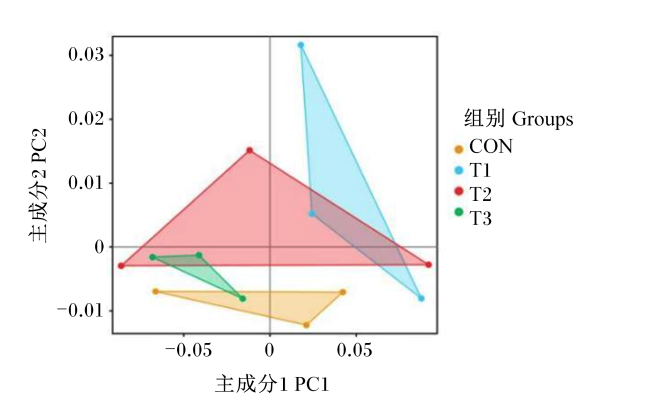
图1可知,各组之间瘤胃菌群区分明显。
图1 瘤胃菌群PCA图

Fig.1 PCA chart of rumen flora

2.4 茶多糖对热应激肉牛瘤胃微生物门、属水平相对丰度的影响

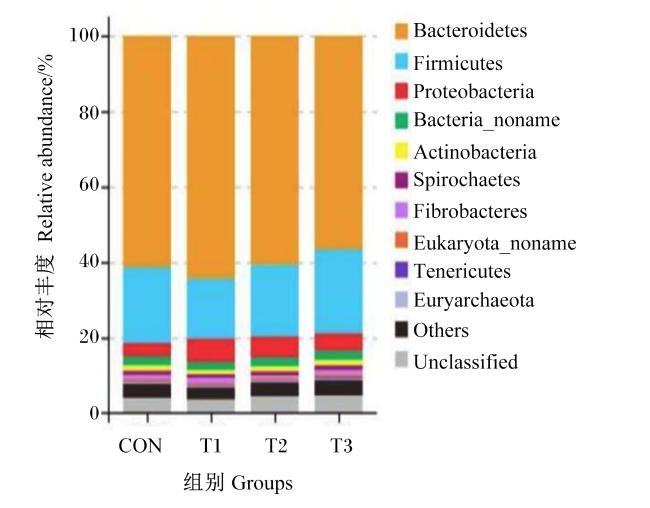
图2可知,肉牛瘤胃菌群中厚壁菌门和拟杆菌门为优势菌门,占总相对丰度的70%以上。
图2 瘤胃菌群门水平相对丰度

Bacteroidetes:拟杆菌门;Firmicutes:厚壁菌门;Proteobacteria:变形菌门;Bacteria_noname:未命名的细菌;Actinobacteria:放线菌门;Spirochaetes:螺旋体门;Fibrobacteres:纤维杆菌门;Eukaryota_noname:未命名的真核菌;Tenericutes:软壁菌门;Euryarchaeota:广古菌门;Others:其他;Unclassified:未分类。

Fig.2 Rumen flora relative abundances at phylum level

表6可知,与CON组相比,T1组瘤胃中拟杆菌门相对丰度显著提高(P<0.05),厚壁菌门、放线菌门和浮霉菌门相对丰度显著降低(P<0.05)。
表6 瘤胃菌群门水平相对丰度(前15)

Table 6 Rumen flora relative abundances at phylum level (top 15)

项目
Items
组别Groups
CON T1 T2 T3
拟杆菌门Bacteroidetes 61.30±2.73b 64.39±2.48a 60.69±4.72ab 56.63±1.80b
厚壁菌门Firmicutes 20.00±1.63a 15.89±0.39b 19.00±2.88ab 22.21±0.70a
变形菌门Proteobacteria 3.60±0.19 6.29±1.99 5.64±0.96 4.74±0.38
未命名的细菌Bacteria_noname 2.34±0.09 2.02±0.10 2.33±0.30 2.39±0.11
放线菌门Actinobacteria 1.42±0.06a 1.11±0.05b 1.33±0.24a 1.40±0.10a
螺旋体门Spirochaetes 1.14±0.31 0.91±0.16 1.13±0.36 1.20±0.21
纤维杆菌门Fibrobacteres 1.05±0.15 1.41±0.28 0.61±0.06 1.13±0.35
未命名的真核菌Eukaryota_noname 0.67±0.04 0.57±0.17 0.55±0.12 0.68±0.15
软壁菌门Tenericutes 0.29±0.03 0.32±0.03 0.29±0.07 0.50±0.15
广古菌门Euryarchaeota 0.31±0.03 0.27±0.02 0.30±0.04 0.38±0.06
疣微菌门Verrucomicrobia 0.32±0.03 0.24±0.02 0.32±0.06 0.31±0.06
黏胶球形菌门Lentisphaerae 0.31±0.05 0.21±0.02 0.31±0.07 0.30±0.08
子囊菌门Ascomycota 0.27±0.01 0.23±0.03 0.24±0.01 0.27±0.04
浮霉菌门Planctomycetes 0.24±0.01a 0.18±0.01b 0.25±0.04a 0.24±0.04a
黑水仙菌门Candidatus_Melainabacteria 0.12±0.04 0.22±0.09 0.21±0.05 0.32±0.16
表7可知,与CON组相比,T1、T2和T3组瘤胃中瘤胃杆菌属相对丰度显著提高(P<0.05);此外,T1组瘤胃中普雷沃氏菌属相对丰度显著提高(P<0.05),未命名的毛螺菌科和未命名的梭菌目相对丰度显著降低(P<0.05)。
表7 瘤胃菌群属水平相对丰度(前15)

Table 7 Rumen flora relative abundances at genus level (top 15)

项目
Items
组别Groups
CON T1 T2 T3
普雷沃氏菌属Prevotella 37.99±2.43b 46.67±0.98a 39.51±5.12ab 35.60±1.52b
拟杆菌属Bacteroides 4.40±0.21 3.96±0.07 3.90±0.08 4.22±0.12
丁酸弧菌属Butyrivibrio 2.95±0.53 2.13±0.21 2.47±0.51 3.03±0.34
未命名的细菌Bacteria_noname 2.33±0.09 2.01±0.10 2.32±0.30 2.37±0.11
未命名的普雷沃氏菌科
Prevotellaceae_noname
1.59±0.12 1.72±0.11 1.80±0.27 1.43±0.06
未命名的毛螺菌科
Lachnospiraceae_noname
1.58±0.02a 1.25±0.03b 1.74±0.23ab 1.83±0.10a
未命名的梭菌目
Clostridiales_noname
1.61±0.21a 1.17±0.17b 1.38±0.42ab 1.66±0.04a
未命名的拟杆菌目
Bacteroidales_noname
1.64±0.20 1.26±0.09 1.38±0.28 1.44±0.05
梭菌属Clostridium 1.25±0.14 1.17±0.20 1.20±0.10 1.48±0.18
瘤胃杆菌属Ruminobacter 0.38±0.08b 2.15±0.94a 1.35±0.35a 0.82±0.16a
纤维杆菌属Fibrobacter 1.04±0.15a 1.40±0.28a 0.60±0.06b 1.11±0.35a
另枝菌属Alistipes 1.07±0.15 0.81±0.07 0.94±0.21 0.97±0.04
瘤胃球菌属Ruminococcus 0.86±0.06ab 0.73±0.02b 1.01±0.28ab 1.17±0.15a
密螺旋体属Treponema 0.90±0.27 0.70±0.13 0.88±0.31 0.90±0.20
未命名的拟杆菌门Bacteroidetes_noname 0.71±0.05 0.72±0.05 0.90±0.12 0.89±0.10

2.5 瘤胃微生物功能预测

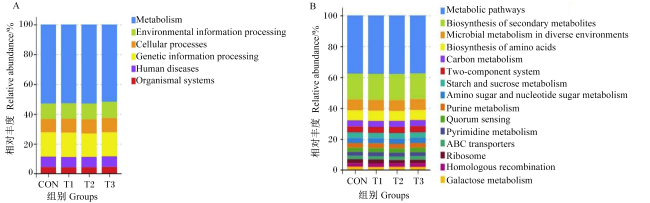
图3-A可知,瘤胃微生物功能基因进行分类主要为新陈代谢途径。由图3-B可知,瘤胃微生物功能基因相对丰度由高到低分别是代谢途径、次生代谢产物生物合成、不同环境下微生物代谢、氨基酸生物合成和碳素代谢等。
图3 瘤胃微生物功能分析图

Metabolism:新陈代谢;Environmental information processing:环境信息处理;Cellular processes:细胞进程;Genetic information processing:遗传信息处理;Human diseases:人类疾病;Organismal systems:有机系统。Metabolic pathways:代谢途径;Biosynthesis of secondary metabolites:次生代谢产物生物合成;Microbial metabolism in diverse environments:不同环境下微生物代谢;Biosynthesis of amino acids:氨基酸生物合成;Carbon metabolism:碳素代谢;Two-component system:双组分系统;Starch and sucrose metabolism:淀粉和蔗糖代谢;Amino sugar and nucleotide sugar metabolism:氨基糖和核苷酸糖代谢;Purine metabolism:嘌呤代谢;Quorum sensing:群感效应;Pyrimidine metabolism:嘧啶代谢;ABC transporters:ABC转运蛋白;Ribosome:核糖体;Homologous recombination:同源重组;Galactose metabolism:半乳糖代谢。

Fig.3 Functional analysis chart of rumen microbiota

2.6 茶多糖对热应激肉牛瘤胃代谢物的影响

表8可知,负离子模式下组间差异前10的代谢物中,与CON组相比,T1组瘤胃芳香族化合物如N-乙酰基-L-苯丙氨酸、苯乙醛、D(+)-苯乙酸、4-乙基苯酚、L-苯丙氨酸、2,3-二羟基苯甲酸、(±)9-六溴二苯醚和对苯二酚含量均显著降低(P<0.05),L-肾上腺素含量也显著降低(P<0.05);T2组瘤胃溶血磷脂酰胆碱(18∶2)和对苯二酚含量显著降低(P<0.05)。
表8 负离子模式下组间瘤胃差异代谢物对比分析(前10)

Table 8 Comparative analysis of rumen differential metabolites among groups in negative ion mode (top 10)

项目
Items
组别Groups
CON T1 T2 T3
N-乙酰基-L-苯丙氨酸N-acetyl-L-phenylalanine 1.00±0.36a 0.13±0.05b 0.66±0.32a 1.58±0.36a
苯乙醛Phenylacetaldehyde 1.00±0.15a 0.33±0.07b 0.73±0.26a 1.17±0.10a
D(+)-苯乙酸D(+)-phenyllactic acid 1.00±0.19a 0.29±0.07b 0.72±0.33a 1.02±0.05a
4-乙基苯酚4-ethylphenol 1.00±0.14a 0.32±0.12b 0.66±0.26a 1.06±0.05a
L-苯丙氨酸L-phenylalanine 1.00±0.38a 0.14±0.04b 0.63±0.28a 1.55±0.33a
2,3-二羟基苯甲酸2,3-dihydroxybenzoic acid 1.00±0.20a 0.20±0.06b 0.81±0.35a 0.96±0.37ab
溶血磷脂酰胆碱(18∶2)
Lysophosphatidylcholine (18∶2)
1.00±0.17a 0.48±0.12a 0.46±0.03b 1.52±0.60a
(±)9-六溴二苯醚(±)
9-hexabromodiphenyl ether
1.00±0.04c 0.68±0.05b 1.50±0.10a 1.29±0.15c
对苯二酚Hydroquinone 1.00±0.13a 0.20±0.08b 0.29±0.10b 0.83±0.38ab
L-肾上腺素L-adrenaline 1.00±0.33a 0.24±0.04b 0.66±0.25a 1.49±0.29a
表9可知,正离子模式下组间差异前10的代谢物中,与CON组相比,T1组瘤胃脂类代谢物如油酸酰胺、十六碳酰胺、5,6-二甲基-4-氧代-4氢-吡喃-2-羧酸和C8 1-磷酸神经酰胺含量均显著降低(P<0.05),核酸类代谢物如胸腺嘧啶和胸腺嘧啶核苷含量显著升高(P<0.05);T2组瘤胃5,6-二甲基-4-氧代-4氢-吡喃-2-羧酸、C8 1-磷酸神经酰胺和3-(2-羟乙基)吲哚含量显著降低(P<0.05),胸腺嘧啶和胸腺嘧啶核苷含量显著升高(P<0.05);T3组瘤胃油酸酰胺和C8 1-磷酸神经酰胺含量显著降低(P<0.05),吡哆醇含量显著升高(P<0.05)。
表9 正离子模式下组间瘤胃差异代谢物对比分析(前10)

Table 9 Comparative analysis of rumen differential metabolites among groups in positive ion mode (top 10)

项目
Items
组别Groups
CON T1 T2 T3
油酸酰胺Oleamide 1.00±0.03a 0.84±0.04b 1.04±0.03a 0.85±0.05b
十六碳酰胺Hexadecanamide 1.00±0.06a 0.80±0.03b 1.00±0.05a 0.88±0.10a
硬脂酰胺Stearamide 1.00±0.12ab 0.81±0.05b 1.16±0.10a 1.44±0.41a
胸腺嘧啶Thymine 1.00±0.03b 3.28±0.95a 3.11±0.08a 2.09±0.70ab
5,6-二甲基-4-氧代-4氢-吡喃-2-羧酸
5,6-dimethyl-4-oxo-4H-pyran-2-carboxylic acid
1.00±0.11a 0.51±0.13b 0.45±0.13b 0.69±0.32a
3-(2-羟乙基)吲哚3-(2-hydroxyethyl) indole 1.00±0.06a 0.92±0.16a 0.38±0.08b 0.63±0.22a
4-乙基苯甲醛4-ethylbenzaldehyde 1.00±0.11ab 1.17±0.04b 0.90±0.04a 1.03±0.17a
胸腺嘧啶核苷Thymidine 1.00±0.22b 3.90±1.07a 3.66±0.17a 2.04±0.59ab
C8 1-磷酸神经酰胺C8 1-phosphate ceramide 1.00±0.08a 0.42±0.12b 0.27±0.07b 0.44±0.05b
吡哆醇Pyridoxine 1.00±0.10b 1.05±0.08b 1.00±0.04b 1.43±0.12a

2.7 茶多糖对热应激肉牛瘤胃代谢通路的影响

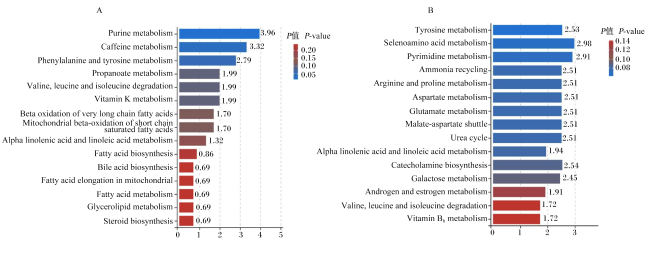
图4为正、负离子模式下代谢物模块汇总和富集分析(module summarization and enrichment analysis,MSEA)显著通路富集图。负离子模式下,由图4-A可知,嘌呤代谢和咖啡因代谢为代谢物富集有显著差异的代谢通路(P<0.05)。正离子模式下,由图4-B可知,酪氨酸代谢、硒代氨基酸代谢和嘧啶代谢为代谢物富集有显著差异的代谢通路(P<0.05)。
图4 正、负离子模式下代谢物MSEA显著通路富集图

A:负离子模式;B:正离子模式。横坐标是富集倍数,表示代谢通路中观测代谢数量/理论代谢物数量。不同颜色表示P值大小。A: negative ion mode; B: positive ion mode. The horizontal coordinate is the enrichment factor, representing the observed metabolic quantity/theoretical metabolite quantity in the metabolic pathway. Use different colors to represent the P-value size.

Purine metabolism:嘌呤代谢;Caffeine metabolism:咖啡因代谢;Phenylalanine and tyrosine metabolism:苯丙氨酸和酪氨酸代谢;Propanoate metabolism:丙酸代谢;Valine, leucine and isoleucine degradation:缬氨酸、亮氨酸和异亮氨酸降解;Vitamin K metabolism:维生素K代谢;Beta oxidation of very long chain fatty acids:超长链脂肪酸线粒体β氧化;Mitochondrial beta-oxidation of short chain saturated fatty acids:线粒体短链饱和脂肪酸β氧化;Alpha linolenic acid and linoleic acid metabolism:亚麻酸和亚油酸代谢;Fatty acid biosynthesis:脂肪酸生物合成;Bile acid biosynthesis:胆汁酸生物合成;Fatty acid elongation in mitochondrial:线粒体脂肪酸延伸;Fatty acid metabolism:脂肪酸代谢;Glycerolipid metabolism:甘油脂代谢;Steroid biosynthesis:类固醇生物合成;Tyrosine Metabolism:酪氨酸代谢;Selenoamino acid metabolism:硒代氨基酸代谢;Pyrimidine metabolism:嘧啶代谢;Ammonia recycling:氨循环代谢;Arginine and proline metabolism:精氨酸和脯氨酸代谢;Aspartate metabolism:天冬氨酸代谢;Glutamate metabolism:谷氨酸代谢;Malate-aspartate shuttle:苹果酸-天冬氨酸穿梭;Urea cycle:尿素循环;Catecholamine biosynthesis:儿茶酚胺生物合成;Galactose metabolism:半乳糖代谢;Androgen and estrogen metabolism:雄激素和雌激素代谢;Vitamin B6 metabolism:维生素B6代谢。

Fig.4 Significant pathway enrichment map of metabolite MSEA in positive and negative ion modes

2.8 瘤胃发酵参数与瘤胃菌群及瘤胃差异代谢物之间的相关性分析

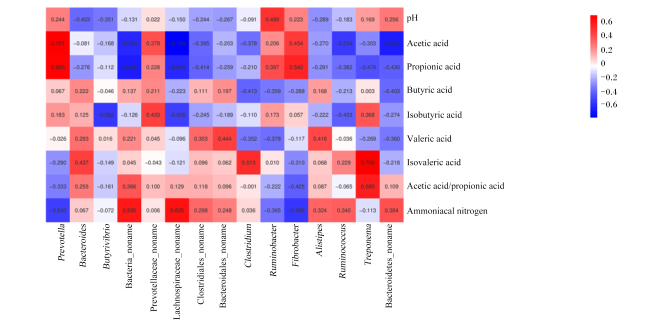
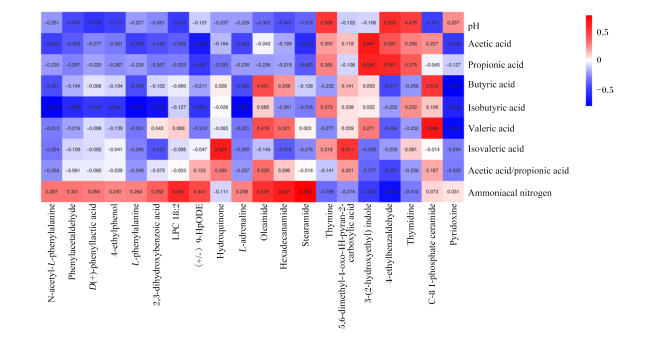
为了进一步探究茶多糖对瘤胃功能影响的潜在调控机制,将瘤胃发酵参数与瘤胃菌群属水平相对丰度和差异代谢物含量进行Person相关性分析,选取相关系数和t检验P值为分析计量值,以相关系数>0.4、P<0.05代表2组数据显著相关。
图5可知,瘤胃乙酸和丙酸含量与普雷沃氏菌属相对丰度呈显著正相关(P<0.05),与未命名的细菌和未命名的毛螺菌科相对丰度呈显著负相关(P<0.05)。瘤胃乙酸含量与未命名的拟杆菌门相对丰度呈显著负相关(P<0.05),乙酸/丙酸与密螺旋体属相对丰度呈显著正相关(P<0.05)。瘤胃NH3-N含量与普雷沃氏菌属相对丰度呈显著负相关(P<0.05),与未命名的细菌和未命名的毛螺菌科相对丰度呈显著正相关(P<0.05)。瘤胃异丁酸含量与丁酸弧菌属相对丰度呈显著负相关(P<0.05),与密螺旋体属相对丰度呈显著正相关(P<0.05)。
图5 瘤胃发酵参数与瘤胃菌群属水平相对丰度相关性分析

红色代表正相关,蓝色代表负相关,颜色深浅表示相关系数大小。图6同。Red represents the positive correlation, blue represents the negative correlation, the color depth indicates the size of the correlation coefficient. The same as Fig.6.

Prevotella:普雷沃氏菌属;Bacteroides:拟杆菌属;Butyrivibrio:丁酸弧菌属;Bacteria_noname:未命名的细菌;Prevotellaceae_noname:未命名的普雷沃氏菌科;Lachnospiraceae_noname:未命名的毛螺菌科;Clostridiales_noname:未命名的梭菌目;Bacteroidales_noname:未命名的拟杆菌目;Clostridium:梭菌属;Ruminobacter:瘤胃杆菌属;Fibrobacter:纤维杆菌属;Alistipes:另枝菌属;Ruminococcus:瘤胃球菌属;Treponema:密螺旋体属;Bacteroidetes_noname:未命名的拟杆菌门;Acetic acid:乙酸;Propionic acid:丙酸;Butyric acid:丁酸;Isobutyric acid:异丁酸;Valeric acid:戊酸;Isovaleric acid:异戊酸;Acetic acid/propionic acid:乙酸/丙酸;Ammoniacal nitrogen:氨态氮。

Fig.5 Correlation analysis between rumen fermentation parameters and rumen flora relative abundances at genus level

图6可知,瘤胃异丁酸含量与苯乙醛、N-乙酰基-L-苯丙氨酸、L-苯丙氨酸、L-肾上腺素和吡哆醇含量呈显著负相关(P<0.05),与对苯二酚含量呈显著正相关(P<0.05)。瘤胃乙酸和丙酸含量与(±)9-六溴二苯醚含量呈显著负相关(P<0.05),与3-(2-羟乙基)吲哚含量呈显著正相关(P<0.05)。瘤胃乙酸含量与硬脂酰胺含量呈显著负相关(P<0.05)。瘤胃NH3-N含量与十六碳酰胺和硬脂酰胺含量呈显著正相关(P<0.05),与4-乙基苯甲醛呈含量显著负相关(P<0.05)。瘤胃戊酸含量与C8 1-磷酸神经酰胺含量呈显著正相关(P<0.05),与吡哆醇含量呈显著负相关(P<0.05)。瘤胃丁酸含量与吡哆醇含量呈显著负相关(P<0.05)。
图6 瘤胃发酵参数与瘤胃差异代谢产物相关性分析

N-acetyl-L-phenylalanine:N-乙酰基-L-苯丙氨酸;Phenylacetaldehyde:苯乙醛;D(+)-phenyllactic acid:D(+)-苯乙酸;4-ethylphenol:4-乙基苯酚;L-phenylalanine:L-苯丙氨酸;2,3-dihydroxybenzoic acid:2,3-二羟基苯甲酸;LPC 18∶2:溶血磷脂酰胆碱(18∶2) lysophosphatidylcholine (18∶2);(+/-)9-HpODE:(±)9-六溴二苯醚 (±)9-hexabromodiphenyl ether;Hydroquinone:对苯二酚;L-adrenaline:L-肾上腺素;Oleamide:油酸酰胺;Hexadecanamide:十六碳酰胺;Stearamide:硬脂酰胺;Thymine:胸腺嘧啶;5,6-dimethyl-4-oxo-4H-pyran-2-carboxylic acid:5,6-二甲基-4-氧代-4氢-吡喃-2-羧酸;3-(2-hydroxyethyl) indole:3-(2-羟乙基)吲哚;4-ethylbenzaldehyde:4-乙基苯甲醛;Thymidine:胸腺嘧啶核苷;C-8 1-phosphate ceramide:C8 1-磷酸神经酰胺;Pyridoxine:吡哆醇;Acetic acid:乙酸;Propionic acid:丙酸;Butyric acid:丁酸;Isobutyric acid:异丁酸;Valeric acid:戊酸;Isovaleric acid:异戊酸;Acetic acid/propionic acid:乙酸/丙酸;Ammoniacal nitrogen:氨态氮。

Fig.6 Correlation analysis between rumen fermentation parameters and rumen differential metabolites

3 讨论

3.1 茶多糖对热应激肉牛瘤胃发酵参数的影响

瘤胃是牛消化系统中最重要器官之一,主要通过其拥有的数量众多且多样性的微生物对饲料中的纤维素和其他难以消化的物质进行发酵和分解。瘤胃微生物在发酵饲料过程中会产生以乙酸、丙酸和丁酸为主的挥发性脂肪酸和NH3-N供机体代谢和利用,并影响瘤胃内环境pH[16-17]。因此,瘤胃挥发性脂肪酸、NH3-N含量和pH可以综合评价瘤胃微生物区系和瘤胃代谢物的状况,是反映瘤胃发酵情况的重要指标。杨镇玮[18]研究表明,正常情况下西门塔尔肉牛瘤胃pH介于6.0~7.2。本试验中,各组肉牛瘤胃pH介于6.5~6.8,处于正常范围内,说明饲粮中添加茶多糖并未对瘤胃pH产生异常影响。热应激对肉牛瘤胃功能具有不利影响。杨梓曼等[19]研究表明,高温会导致肉牛瘤胃NH3-N含量显著升高,总挥发性脂肪酸含量显著降低。邹必成[20]研究也发现,热应激会显著降低肉牛瘤胃pH以及乙酸、丁酸和总挥发性脂肪酸含量。
江西地属亚热带气候地区,夏季持续的高温高湿气候极易引起肉牛的热应激反应,通过对栏舍温度和相对湿度进行检测,证实在本试验正式饲喂期间,牛栏舍整体THI维持在80以上,处于中高强度热应激环境。本研究中,饲粮中添加0.4%茶多糖显著增加了肉牛瘤胃挥发性脂肪酸乙酸和丙酸含量,显著降低了瘤胃NH3-N含量。与本研究类似,有报道发现,饲粮中添加黄芪多糖和枸杞多糖可以改善奶牛瘤胃发酵功能,显著增加奶牛瘤胃乙酸、丙酸、丁酸和NH3-N含量[21-22];也有报道表明,饲粮中添加生物活性多糖和低聚糖作为饲料添加剂,可以在瘤胃体外模拟发酵罐中调控瘤胃发酵进程,增加瘤胃罐中总挥发性脂肪酸含量和脂肪酸氧化[23]。因此,综合前人报道和本研究结果,在热应激胁迫情况下,饲粮中添加0.4%茶多糖可以提高瘤胃挥发性脂肪酸含量和降低NH3-N含量,改善反刍动物瘤胃发酵功能。

3.2 茶多糖对热应激肉牛瘤胃微生物区系的影响

瘤胃微生物对饲粮中营养物质消化、瘤胃发酵参数和反刍动物机体功能的维持有重要作用。有研究报道,饲粮中添加茶叶中的茶多酚或儿茶素等相关活性成分可以显著改善牛瘤胃菌群结构,维持瘤胃健康[24-25]。本研究采用宏基因组测序技术对茶多糖饲喂肉牛瘤胃微生物多样性和组成进行检测,结果表明,饲粮中添加茶多糖对瘤胃菌群α多样性指数均无显著影响,但各组间β多样性菌群PCA区分明显,表明茶多糖饲喂没有显著改变瘤胃菌群数量,但对瘤胃菌群多样性有明显影响。本研究发现,在门水平上,肉牛瘤胃中厚壁菌门和拟杆菌门占瘤胃微生物总相对丰度的70%以上,为肉牛瘤胃微生物中的优势菌门,与前人研究结果一致。Yu等[26]研究表明,在热应激条件下,伴随着环境温度的升高,肉牛胃肠道微生物中厚壁菌门与拟杆菌门的比例以及血清炎症因子肿瘤坏死因子-α(tumor necrosis factor-α,TNF-α)、白细胞介素-6(interleukin 6,IL-6)和白细胞介素-1β(interleukin-1β,IL-1β)的含量均显著增加,而在小鼠和人的一些机体疾病如酒精肝和脂肪肝模型下,厚壁菌门与拟杆菌门的比例也显著提高,这揭示着厚壁菌门与拟杆菌门的比值作为机体应激的一种潜在靶标[27-28]。而在本研究中,饲粮中添加0.4%茶多糖可以显著增加肉牛瘤胃中拟杆菌门相对丰度,显著降低厚壁菌门、放线菌门和浮霉菌门相对丰度,虽然对厚壁菌门与拟杆菌门的比例无显著影响,但有降低其比值的趋势,表明茶多糖具有改善热应激胁迫下瘤胃菌群结构的潜在作用。
已有研究报道,普雷沃氏菌属和瘤胃杆菌属在肉牛瘤胃发酵和代谢中具有重要的调控功能[29-30]。本研究在瘤胃菌群属水平上发现,普雷沃氏菌属和拟杆菌属为添加茶多糖后肉牛瘤胃菌群的主要优势菌群,且饲粮中添加0.4%茶多糖可以显著增加普雷沃氏菌属和瘤胃杆菌属相对丰度;饲粮中添加0.4%茶多糖还显著降低了瘤胃未命名的毛螺菌科和未命名的梭菌目相对丰度,这两种菌的相对丰度被报道在机体炎症模型下显著升高[31-32]。此外,瘤胃发酵参数与瘤胃菌群的相关性分析结果显示,瘤胃乙酸和丙酸含量与普雷沃氏菌相对丰度呈显著正相关,且与未命名的毛螺菌科相对丰度呈显著负相关。相反地,瘤胃NH3-N含量则与普雷沃氏菌相对丰度呈显著负相关,与未命名的毛螺菌科相对丰度呈显著正相关。这一相关性分析结果与已有研究结果[33-34]一致,同时也进一步证明,饲粮中添加0.4%茶多糖可能通过影响瘤胃中普雷沃氏菌和未命名的毛螺菌科的相对丰度,改善热应激胁迫下的机体应激反应和瘤胃功能。有意思的是,在饲粮中添加0.8%茶多糖的情况下,瘤胃菌群中普雷沃氏菌和未命名的毛螺菌科相对丰度的变化规律与添加0.4%茶多糖相反,这说明茶多糖对于热应激胁迫下瘤胃菌群结构的影响可能具有双面性,有待进一步细化探究。总体来说,综合前人报道和本研究结果,饲粮中添加适宜水平的茶多糖可以一定程度改善热应激肉牛瘤胃菌群紊乱。

3.3 茶多糖对热应激肉牛瘤胃代谢物的影响

在瘤胃微生物组成检测中发现,饲粮中添加茶多糖可以改善肉牛瘤胃肠道菌群结构。瘤胃代谢物与微生物种类及数量相关联,研究表明,外界刺激及饲料添加剂会通过改变瘤胃菌群多样性和相对丰度影响代谢物的种类和水平[35]。在本研究中,通过代谢组学分析了茶多糖对热应激肉牛瘤胃代谢物的影响,代谢物MSEA显著通路富集分析结果显示,在正离子模式下瘤胃代谢物显著富集于酪氨酸代谢、硒代氨基酸代谢和嘧啶代谢通路,负离子模式下瘤胃代谢物显著富集于嘌呤代谢和咖啡因代谢通路。氨基酸对动物的生长发育和代谢至关重要,是机体蛋白质和肽类合成的重要组成成分,还能够调节机体免疫功能和多种代谢途径。反刍动物的生存依赖于瘤胃微生物对饲料发酵产生的氨基酸,有研究报道,酪氨酸能促进肾上腺、脑垂体和甲状腺的生理功能的并刺激机体合成肾上腺素、去甲肾上腺素和生长激素等多种激素[36-37]。Imaz等[38]研究表明,瘤胃中酪氨酸含量与肉牛的生长性能呈正相关。在本研究中,饲粮中添加茶多糖影响了硒代氨基酸的代谢通路。硒是动物体内必需的微量元素,它在生物体内多以硒代氨基酸的形式参与机体内硒蛋白包括谷胱甘肽过氧化物酶、硫氧还蛋白还原酶和碘甲状腺原氨酸脱碘酶的生物合成[39-40]。有研究报道,硒在肉牛机体生长发育、肉产品品质、免疫应答和生殖等生理进程中发挥多种生物学功能[41-43]。嘧啶和嘌呤是牛瘤胃微生物氮转化和利用的重要来源,近年来,有关瘤胃核酸代谢对牛生长及健康的报道也越来越多,有研究发现,口服核苷酸可以显著提高犊牛的生长性能、抗氧化能力、肠绒毛高度和隐窝深度[44-46]。在荷斯坦奶牛上,饲喂含核苷酸的固体牛奶可以改善新生牛犊的采食、体增重及瘤胃发酵[47-48]。另外,在咖啡因代谢方面,Toledo等[49]研究发现,咖啡因在体外模拟发酵罐模型下也可以一定程度改善瘤胃发酵参数。通过代谢物富集通路分析,可以为进一步探究茶多糖对热应激肉牛瘤胃菌群和功能的具体调控机制提供研究思路。

4 结论

饲粮中添加茶多糖改善了西门塔尔肉牛在热应激胁迫下的瘤胃发酵参数和微生物区系,影响了瘤胃功能型代谢物组成和代谢通路。
[1]
国梦阳, 王纯洁, 敖日格乐, 等. 热应激对肉牛的影响及调控措施研究进展[J]. 饲料研究, 2023, 46(18):174-178.

GUO M Y, WANG C J, AO R G L, et al. Research progress on effect of heat stress on beef cattle and its nutritional regulation measures[J]. Feed Research, 2023, 46(18):174-178. (in Chinese)

[2]
罗生金, 李文, 潘伊微, 等. 肉牛瘤胃健康营养调控研究进展[J]. 饲料研究, 2023, 46(10):175-179.

LUO S J, LI W, PAN Y W, et al. Research progress on rumen nutrition regulation of beef cattle[J]. Feed Research, 2023, 46(10):175-179. (in Chinese)

[3]
李岩, 杨英魁, 柴沙驼, 等. 瘤胃液移植在反刍动物中的研究进展[J]. 动物营养学报, 2023, 35(4):2105-2110.

DOI

LI Y, YANG Y K, CHAI S T, et al. Research progress of rumen fluid transplantation in ruminants[J]. Chinese Journal of Animal Nutrition, 2023, 35(4):2105-2110. (in Chinese)

DOI

[4]
CORREIA SALES G F, CARVALHO B F, SCHWAN R F, et al. Heat stress influence the microbiota and organic acids concentration in beef cattle rumen[J]. Journal of Thermal Biology, 2021,97:102897.

[5]
LIU L, ZHANG W J, YU H J, et al. Improved antioxidant activity and rumen fermentation in beef cattle under heat stress by dietary supplementation with creatine pyruvate[J]. Animal Science Journal, 2020, 91(1):e13486.

[6]
THORNTON P, NELSON G, MAYBERRY D, et al. Impacts of heat stress on global cattle production during the 21st century:a modelling study[J]. The Lancet:Planetary Health, 2022, 6(3):e192-e201.

[7]
刘芷珊, 石玉涛, 肖锟月, 等. 茶多糖研究进展与展望[J]. 中国茶叶加工, 2023(4):66-74.

LIU Z S, SHI Y T, XIAO K Y, et al. Progress and prospects of research on tea polysaccharides[J]. China Tea Processing, 2023(4):66-74. (in Chinese)

[8]
邓董华, 王悦, 吴苗苗. 茶多糖的提取方法、生物学功能以及在畜禽生产中的应用[J]. 动物营养学报, 2023, 35(12):7605-7616.

DOI

DENG D H, WANG Y, WU M M. Extraction methods,biological function of tea polysaccharides and their application in livestock and poultry production[J]. Chinese Journal of Animal Nutrition, 2023, 35(12):7605-7616. (in Chinese)

[9]
ZHANG Y X, PAN Y N, LIN H Y, et al. Crude tieguanyin oolong tea polysaccharides regulate intestinal immune and gut microflora in dextran sulfate sodium-induced mice colitis[J]. Journal of the Science of Food and Agriculture, 2024, 104(5):3156-3166.

[10]
ZENG Z Q, XIE Z Y, CHEN G J, et al. Anti-inflammatory and gut microbiota modulatory effects of polysaccharides from Fuzhuan brick tea on colitis in mice induced by dextran sulfate sodium[J]. Food & Function, 2022, 13(2):649-663.

[11]
LI D L, CHENG Y K, ZENG X Q, et al. Polysaccharide from Ziyang selenium-enriched green tea prevents obesity and promotes adipose thermogenesis via modulating the gut microbiota[J]. Journal of Agricultural and Food Chemistry, 2023, 71(36):13363-13375.

[12]
HAHN G L. Dynamic responses of cattle to thermal heat loads[J]. Journal of Animal Science, 1999,77 Suppl 2:10-20.

[13]
侯玉洁, 徐俊, 郭小泽, 等. 不同牧草来源日粮对奶牛瘤胃发酵和微生物蛋白合成的影响[J]. 中国饲料, 2017(8):21-24.

HOU Y J, XU J, GUO X Z, et al. Effects of different forage sources on rumen fermentation characteristic and microbial protein synthesis[J]. China Feed, 2017(8):21-24. (in Chinese)

[14]
WANT J, O'MAILL E, SMITH A, et al. Solvent-dependent metabolite distribution,clustering,and protein extraction for serum profiling with mass spectrometry[J]. Analytical Chemistry, 2006, 78(3):743-752.

[15]
BARRI T, DRAGSTED L O. UPLC-ESI-QTOF/MS and multivariate data analysis for blood plasma and serum metabolomics:effect of experimental artefacts and anticoagulant[J]. Analytica Chimica Acta, 2013,768:118-128.

[16]
付瑶, 齐志国, 王俊, 等. 硒源对泌乳牛瘤胃发酵参数及微生物区系的影响[J]. 动物营养学报, 2023, 35(1):301-310.

DOI

FU Y, QI Z G, WANG J, et al. Effects of selenium sources on rumen fermentation parameters and microflora of dairy cows[J]. Chinese Journal of Animal Nutrition, 2023, 35(1):301-310. (in Chinese)

DOI

[17]
李岚捷, 成述儒, 刁其玉, 等. 不同NFC/NDF水平饲粮对犊牛瘤胃发酵参数和微生物区系多样性的影响[J]. 畜牧兽医学报, 2017, 48(12):2347-2357.

LI L J, CHENG S R, DIAO Q Y, et al. Effects of diets with different NFC/NDF levels on the rumen fermentation parameters and bacterial community in male calves[J]. Acta Veterinaria et Zootechnica Sinica, 2017, 48(12):2347-2357. (in Chinese)

DOI

[18]
杨镇玮. 发酵菠萝渣对育肥后期肉牛的饲喂效果研究[D]. 硕士学位论文. 广州: 华南农业大学, 2020.

YANG Z W. Study on the feeding effect of fermented pineapple residue on beef cattle in the late fattening period[D]. Master's Thesis. Guangzhou: South China Agricultural University, 2020. (in Chinese)

[19]
杨梓曼, 尚相龙, 陈豪, 等. 热应激对肉牛血清生化指标、瘤胃发酵参数及微生物区系的影响[J]. 动物营养学报, 2022, 34(7):4487-4497.

DOI

YANG Z M, SHANG X L, CHEN H, et al. Effects of heat stress on serum biochemical indexes,rumen fermentation parameters and microflora of beef cattle[J]. Chinese Journal of Animal Nutrition, 2022, 34(7):4487-4497. (in Chinese)

[20]
邹必成. 烟酸对热应激肉牛生产性能和瘤胃功能的影响及机理[D]. 硕士学位论文. 南昌: 江西农业大学, 2023.

ZOU B C. Effect and mechanism of niacin on the performance and rumen function of heat-stressed beef cattle[D]. Master's Thesis. Nanchang: Jiangxi Agricultural University, 2023. (in Chinese)

[21]
赵晏, 雷英鹏. 枸杞多糖对奶牛生产性能、瘤胃发酵参数、血清抗氧化及免疫能力的影响[J]. 中国饲料, 2024(10):43-46.

ZHAO Y, LEI Y P. Effects of Lycium barbarum polysaccharides on production performance,rumen fermentation parameters,antioxidant capacity,and immune capacity of dairy cows[J]. China Feed, 2024(10):43-46. (in Chinese)

[22]
徐丽云, 郑梦荷, 许子豪, 等. 黄芪多糖对泌乳初期奶牛血清生化指标、瘤胃发酵及表观消化率的影响[J]. 饲料工业, 2023, 44(1):80-86.

XU L Y, ZHENG M H, XU Z H, et al. Effects of Astragalus polysaccharide administration on serum biochemical indices,rumen fermentation and apparent digestibility of early lactating dairy cows[J]. Feed Industry, 2023, 44(1):80-86. (in Chinese)

[23]
LI Z J, BAI H X, ZHENG L X, et al. Bioactive polysaccharides and oligosaccharides as possible feed additives to manipulate rumen fermentation in Rusitec fermenters[J]. International Journal of Biological Macromolecules, 2018,109:1088-1094.

[24]
WEIN S, BEYER B, GOHLKE A, et al. Systemic absorption of catechins after intraruminal or intraduodenal application of a green tea extract in cows[J]. PLoS One, 2016, 11(7):e159428.

[25]
TENG Z W, LIU S, ZHANG L J, et al. Tea polyphenols inhibit methanogenesis and improve rumen epithelial transport in dairy cows[J]. Animals:an Open Access Journal from MDPI, 2024, 14(17):2569.

[26]
YU Z, CANTER J M, PAZ H A, et al. Heat stress-associated changes in the intestinal barrier,inflammatory signals,and microbiome communities in dairy calves[J]. Journal of Dairy Science, 2024, 107(2):1175-1196.

[27]
ARAGÓN-VELA J, SOLIS-URRA P, RUIZ-OJEDA F J, et al. Impact of exercise on gut microbiota in obesity[J]. Nutrients, 2021, 13(11):3999.

[28]
ZHANG X L, CHEN L, YANG J, et al. Vitamin D alleviates non-alcoholic fatty liver disease via restoring gut microbiota and metabolism[J]. Frontiers in Microbiology, 2023,14:1117644.

[29]
BETANCUR-MURILLO C L, AGUILAR-MARIN S B, JOVEL J. Prevotella:a key player in ruminal metabolism[J]. Microorganisms, 2022, 11(1):1.

[30]
ZEINELDIN M, BARAKAT R, ELOLIMY A, et al. Synergetic action between the rumen microbiota and bovine health[J]. Microbial Pathogenesis, 2018,124:106-115.

[31]
ALHOBAYB T, CIORBA M A. Clostridium difficile in inflammatory bowel disease[J]. Current Opinion in Gastroenterology, 2023, 39(4):257-262.

[32]
LIAN Y Z, CHANG C C, CHEN Y S, et al. Lycium barbarum polysaccharides and capsaicin modulate inflammatory cytokines and colonic microbiota in colitis rats induced by dextran sulfate sodium[J]. Journal of Clinical Biochemistry and Nutrition, 2022, 71(3):229-237.

[33]
陈银银. 不同NFC/NDF颗粒型TMR对奶公牛生长性能和瘤胃微生物区系及其代谢物的影响[D]. 博士学位论文. 扬州: 扬州大学, 2022.

CHEN Y Y. Effects of different NFC/NDF pelleted total mixed ration on growth performance, rumen microbiota and its metabolites of Hostein growing cattle[D]. Ph.D.Thesis. Yangzhou: Yangzhou University, 2022. (in Chinese)

[34]
WU Q, CHEN H, ZHANG F, et al. Cysteamine supplementation in vitro remarkably promoted rumen fermentation efficiency towards propionate production via Prevotella enrichment and enhancing antioxidant capacity[J]. Antioxidants, 2022,11:2233.

[35]
庞凯悦. 日粮精粗比对牦牛瘤胃发酵、瘤胃菌群结构及代谢物的影响[D]. 博士学位论文. 西宁: 青海大学, 2023.

PANG K Y. Effects of different NFC/NDF pelleted total mixed ration on growth performance,rumen microbiota and its metabolites of Holstein growing cattle[D]. Ph.D.Thesis. Xining: Qinghai University, 2023. (in Chinese)

[36]
LIEBERMAN H R, GEORGELIS J H, MAHER T J, et al. Tyrosine prevents effects of hyperthermia on behavior and increases norepinephrine[J]. Physiology & Behavior, 2005, 84(1):33-38.

[37]
HASE A, JUNG S E, AAN HET ROT M. Behavioral and cognitive effects of tyrosine intake in healthy human adults[J]. Pharmacology, Biochemistry, and Behavior, 2015,133:1-6.

[38]
IMAZ J A, GARCÍA S, GONZÁLEZ L A. The metabolomics profile of growth rate in grazing beef cattle[J]. Scientific Reports, 2022, 12(1):2554.

DOI PMID

[39]
RAYMAN M P. The importance of selenium to human health[J]. The Lancet, 2000, 356(9225):233-241.

[40]
LABUNSKYY V M, HATFIELD D L, GLADYSHEV V N. Selenoproteins:molecular pathways and physiological roles[J]. Physiological Reviews, 2014, 94(3):739-777.

[41]
MEHDI Y, DUFRASNE I. Selenium in cattle:a review[J]. Molecules, 2016, 21(4):545.

[42]
魏慧娟. 日粮添加有机硒对肉牛生长性能、牛肉品质及肌肉硒富集规律的影响[D]. 硕士学位论文. 杨凌: 西北农林科技大学, 2022.

WEI H J. Effects of dietary organic selenium supplementation on growth performance,beef quality and selenium accumulation in muscle of beef cattle[D]. Master's Thesis. Yangling: Northwest A and F University, 2022. (in Chinese)

[43]
牛志斌. 日粮添加不同水平酵母硒对肉牛营养物质消化率的影响[J]. 养殖技术顾问, 2012(3):247.

NIU Z B. Effects of dietary supplementation with different levels of selenium yeast on nutrient digestibility of beef cattle[J]. Modern Animal Husbandry Science & Technology, 2012(3):247. (in Chinese)

[44]
STENTOFT C, RØJEN B A, JENSEN S K, et al. Absorption and intermediary metabolism of purines and pyrimidines in lactating dairy cows[J]. The British Journal of Nutrition, 2015, 113(4):560-573.

DOI PMID

[45]
WANG B, SUN Z Q, TU Y, et al. Untargeted metabolomic investigate milk and ruminal fluid of Holstein cows supplemented with Perilla frutescens leaf[J]. Food Research International (Ottawa, Ont.), 2021,140:110017.

[46]
DINARDO F R, MAGGIOLINO A, MARTINELLO T, et al. Oral administration of nucleotides in calves:effects on oxidative status,immune response,and intestinal mucosa development[J]. Journal of Dairy Science, 2022, 105(5):4393-4409.

[47]
ABBASLOU Y, MAHJOUBI E, AHMADI F, et al. Short communication:performance of Holstein calves fed high-solid milk with or without nucleotide[J]. Journal of Dairy Science, 2020, 103(12):11490-11495.

[48]
ABBASLOU Y, ZAHMATKESH D, MAHJOUBI E, et al. Nucleotide supplementation to whole milk has beneficial effects on post-weaning Holstein calf performance[J]. Animals:an Open Access Journal From MDPI, 2021, 11(1):218.

[49]
TOLEDO M, HUSSEIN S M, PENA M, et al. Effects of caffeine doses on rumen fermentation profile and nutrient digestibility using a lactating cow diet under continuous cultures conditions[J]. Ruminants, 2024, 4(3):406-417.

文章导航

/