研究论文

饲料苏氨酸水平对生长中期松浦镜鲤生长性能、肌肉品质及抗氧化能力的影响

  • 张家邦 , 1, 2 ,
  • 范泽 1, 3, * ,
  • 李晨辉 1, 3 ,
  • 吴迪 1 ,
  • 李晋南 1 ,
  • 姜永杰 4, 5 ,
  • 王连生 , 1, **
展开
  • 1 中国水产科学研究院黑龙江水产研究所,黑龙江省水生动物病害与免疫重点实验室,哈尔滨 150070
  • 2 大连海洋大学食品科学与工程学院,大连 116023
  • 3 农业农村部渔业环境及水产品质量检验测试中心,哈尔滨 150070
  • 4 农业农村部华南水产与畜禽饲料重点实验室,湛江 524000
  • 5 广东省恒兴水产养殖重点实验室,湛江 524000
** 王连生,研究员,硕士生导师,E-mail:

* 同等贡献作者

张家邦(1998—),男,浙江台州人,硕士研究生,食品加工与安全专业。E-mail:

Copy editor: 菅景颖

收稿日期: 2024-10-24

  网络出版日期: 2025-05-14

基金资助

黑龙江省重点研发计划(2024ZX10B06)

黑龙江省自然科学基金项目(LH-2023C056)

中国水产科学研究院中央级公益性科研院所基本科研业务费专项资金资助(2023TD60)

财政部和农业农村部国家现代农业产业技术体系资助

Effects of Dietary Threonine Level on Growth Performance, Muscle Quality and Antioxidant Capacity of Songpu Mirror Carp in Mid-Growth Stage

  • ZHANG Jiabang , 1, 2 ,
  • FAN Ze 1, 3, * ,
  • LI Chenhui 1, 3 ,
  • WU Di 1 ,
  • LI Jinnan 1 ,
  • JIANG Yongjie 4, 5 ,
  • WANG Liansheng , 1, **
Expand
  • 1 Key Laboratory of Aquatic Animal Diseases and Immune Technology of Heilongjiang Province, Heilongjiang River Fisheries Research Institute, Chinese Academy of Fishery Sciences, Harbin 150070, China
  • 2 School of Fisheries and Life Science, Dalian Ocean University, Dalian 116023, China
  • 3 Inspection and Testing Center for Fishery Environment and Aquatic Products, Ministry of Agriculture and Rural Affairs, Harbin 150070, China
  • 4 Key Laboratory of Aquatic, Livestock and Poultry Feed Science and Technology in South China, Ministry of Agriculture and Rural Affairs, Zhanjiang 524000, China
  • 5 Guangdong Provincial Key Laboratory of Evergreen Aquaculture, Zhanjiang 524000, China
** professor, E-mail:

* Contributed equally

Received date: 2024-10-24

  Online published: 2025-05-14

摘要

本试验旨在探究饲料苏氨酸水平对生长中期松浦镜鲤生长性能、肌肉品质及抗氧化能力的影响,确定生长中期松浦镜鲤对饲料中苏氨酸的需求量。选取540尾健康、初始体重为(300.57±12.82) g的松浦镜鲤,随机分为6组,每组3个重复,每个重复30尾鱼。各组试验鱼分别饲喂苏氨酸水平为0.67%、1.02%、1.37%、1.72%、2.07%及2.42%的等氮(粗蛋白质含量为28.11%)半精制饲料。试验期56 d。结果表明:1)1.72%组松浦镜鲤的增重率、特定生长率显著高于0.67%、1.02%及2.42%组(P<0.05),蛋白质效率显著高于除2.07%组外的其余4组(P<0.05),摄食率显著高于0.67%组(P<0.05),饲料系数显著低于0.67%、1.02%及2.42%组(P<0.05)。2)1.72%组松浦镜鲤肌肉粗蛋白质含量显著高于0.67%、1.02%及2.42%组(P<0.05),粗灰分含量显著高于除1.37%组外的其余4组(P<0.05);1.72%组松浦镜鲤肌肉硬度及胶黏性显著高于0.67%、1.02%及1.37%组(P<0.05),弹性显著高于0.67%和1.02%组(P<0.05),咀嚼性显著高于除2.07%组外的其余4组(P<0.05);1.72%组松浦镜鲤肌肉离心失水率显著低于0.67%组(P<0.05),蒸煮损失显著低于0.67%和1.02%组(P<0.05);1.72%组松浦镜鲤肌纤维直径显著低于0.67%和2.42%组(P<0.05),肌纤维密度显著高于其余5组(P<0.05);1.72%组松浦镜鲤肌肉亮度(L*)值显著低于0.67%、1.02%和1.37%组(P<0.05),黄度(b*)值显著低于0.67%和1.02%组(P<0.05),红度(a*)值显著高于0.67%组(P<0.05)。3)1.72%组松浦镜鲤肌肉超氧化物歧化酶(SOD)活性显著高于0.67%组(P<0.05),过氧化物酶(POD)活性显著高于0.67%和1.02%组(P<0.05),过氧化氢酶(CAT)活性显著高于其余5组(P<0.05),还原型谷胱甘肽(GSH)含量显著高于0.67%、1.02%和1.37%组(P<0.05),总抗氧化能力(T-AOC)显著高于0.67%、2.07%和2.42%组(P<0.05);松浦镜鲤肌肉丙二醛(MDA)含量以1.72%组最低,但与其余5组无显著差异(P>0.05)。4)1.72%组松浦镜鲤肌肉雷帕霉素靶蛋白(TOR)、蛋白激酶B(AKT)和叉头框蛋白O1(FOXO1)的mRNA相对表达量显著高于0.67%、1.02%和2.42%组(P<0.05),4E结合蛋白1(4EBP1)的mRNA相对表达量显著高于除2.07%外的其余4组(P<0.05),核糖体蛋白S6激酶1(S6K1)的mRNA相对表达量显著高于其余5组(P<0.05)。综上所述,在本试验条件下,饲料苏氨酸水平为1.72%时不仅可以增强生长中期松浦镜鲤肌肉的抗氧化能力,改善肌肉质构特性,还可以通过提高蛋白质合成能力,提高其生长性能及饲料利用率;分别以增重率、特定生长率、饲料系数、肌肉硬度及肌肉SOD活性为评价指标进行回归分析,得到生长中期松浦镜鲤对苏氨酸需求量分别为饲料干物质的1.639%、1.641%、1.631%、1.876%及1.806%。

本文引用格式

张家邦 , 范泽 , 李晨辉 , 吴迪 , 李晋南 , 姜永杰 , 王连生 . 饲料苏氨酸水平对生长中期松浦镜鲤生长性能、肌肉品质及抗氧化能力的影响[J]. 动物营养学报, 2025 , 37(5) : 3244 -3257 . DOI: 10.12418/CJAN2025.268

Abstract

This experiment was conducted to investigate the effects of dietary threonine level on the growth performance, muscle quality and antioxidant capacity of Songpu mirror carp in mid-growth stage, and to determine the dietary threonine requirement of Songpu mirror carp in mid-growth period. A total of 540 healthy Songpu mirror carp with an initial body weight of (300.57±12.82) g were randomly divided into 6 groups, with 3 replicates per group and 30 fish per replicate. The fish in 6 groups were fed iso-nitrogenous (crude protein content: 28.11%) semi-purified diets with threonine levels of 0.67%, 1.02%, 1.37%, 1.72%, 2.07% and 2.42%, respectively. The experimental period lasted for 56 days. The results were as follows: 1) the weight gain rate and specific growth rate of Songpu mirror carp in the 1.72% group were significantly higher than those in the 0.67%, 1.02% and 2.42% groups (P<0.05), the protein efficiency was significantly higher than that in the other four groups except the 2.07% group (P<0.05), the feeding rate was significantly higher than that in the 0.67% group (P<0.05), the feed conversion rate was significantly lower than that in the 0.67%, 1.02% and 2.42% groups (P<0.05). 2) The crude protein content in the muscle of Songpu mirror carp in the 1.72% group was significantly higher than that in the 0.67%, 1.02% and 2.42% groups (P<0.05), and the ash content was significantly higher than that in the other four groups except the 1.37% group (P<0.05); the muscle hardness and adhesiveness of Songpu mirror carp in the 1.72% group were significantly higher than those in the 0.67%, 1.02% and 1.37% groups (P<0.05), the elasticity was significantly higher than that in the 0.67% and 1.02% groups (P<0.05), and the masticity was significantly higher than that in the other four groups except the 2.07% group (P<0.05); the centrifugal water loss rate of Songpu mirror carp in the 1.72% group was significantly lower than that in the 0.67% group (P<0.05), and the cooking loss was significantly lower than that in the 0.67% and 1.02% groups (P<0.05); the muscle fiber diameter of Songpu mirror carp in the 1.72% group was significantly lower than that in the 0.67% and 2.42% groups (P<0.05), and the muscle fiber density was significantly higher than that in the other five groups (P<0.05); the muscle lightness (L*) value of Songpu mirror carp in the 1.72% group was significantly lower than that in the 0.67%, 1.02% and 1.37% groups (P<0.05), the yellowness (b*) value was significantly lower than that in the 0.67% and 1.02% groups (P<0.05), and the redness (a*) value was significantly higher than that in the 0.67% group (P<0.05). 3) The superoxide dismutase (SOD) activity in the muscle of Songpu mirror carp in the 1.72% group was significantly higher than that in the 0.67% group (P<0.05), the peroxidase (POD) activity was significantly higher than that in the 0.67% and 1.02% groups (P<0.05), the catalase (CAT) activity was significantly higher than that in the other five groups (P<0.05), the glutathione (GSH) content was significantly higher than that in the 0.67%, 1.02% and 1.37% groups (P<0.05), and the total antioxidant capacity (T-AOC) was significantly higher than that in the 0.67%, 2.07% and 2.42% groups (P<0.05); in addition, the malondialdehyde (MDA) content reached the lowest value in the 1.72% group, but there was no significant difference compared with the other five groups (P>0.05). 4) The mRNA relative expression levels of target protein of rapamycin (TOR), protein kinase B (AKT) and Forkhead box protein O1 (FOXO1) in muscle of Songpu mirror carp in the 1.72% group were significantly higher than those in the 0.67%, 1.02% and 2.42% groups (P<0.05), the mRNA relative expression level of 4E-binding protein 1 (4EBP1) was significantly higher than that in the other four groups except the 2.07% group (P<0.05), and the mRNA relative expression level of ribosomal S6 kinase 1 (S6K1) was significantly higher than that in the other five groups (P<0.05). In conclusion, under the conditions of this experiment, diet with 1.72% threonine can not only enhance the antioxidant capacity and improve the muscle texture characteristics, but also improve the growth performance and feed utilization rate by increasing the protein synthesis ability of Songpu mirror carp in mid-growth stage. Through regression analysis with weight gain rate, specific growth rate, feed conversion ratio, muscle hardness and SOD activity as evaluation indexes, the dietary threonine requirements of Songpu mirror carp in mid-growth stage are 1.639%, 1.641%, 1.631%, 1.876% and 1.806% of the dry matter of the diet, respectively.

苏氨酸是水生动物生长过程中的必需氨基酸。在以豆粕、菜籽粕、玉米等植物为主要蛋白质源的水产动物饲料中,苏氨酸含量通常较低,这会使水生动物体内氨基酸失衡,无法高效利用饲料中的蛋白质,影响机体生长与代谢[1]。作为水生动物的限制性氨基酸,即使其他氨基酸充足,苏氨酸的缺乏仍会对水生动物的生长性能产生影响[2]。研究发现,在大盖巨脂鲤(Colossoma macropomum)[3]、南亚野鲮(Labeo rohita)[4]和草鱼(Ctenopharyngodon idellus)[5]中,苏氨酸缺乏会显著降低其生长性能、存活率和免疫力。目前,水产养殖领域针对苏氨酸在水产动物消化吸收、抗氧化、免疫等方面影响的研究较多[6-7],但其对肌肉品质方面影响的研究少有报道。
肉质是一个多元概念,其不仅与肌肉的理化性质有关,在更大程度上还取决于肌肉的纤维状态及特性[8]。肌肉特性又与饲料营养物质密切相关,如脂肪、蛋白质、氨基酸的种类及其来源等,均会对其产生影响[9-10]。在草鱼饲料中添加适量苏氨酸,能改变其肌肉氨基酸和脂肪酸组成[10]。在21日龄肉鸡饲粮中添加0.68%的苏氨酸能优化其生长性能、肌肉肌酸含量及降低肌肉氧化速度[11]。此外,肌纤维特性和肌肉质构也是肉质的重要参数,它们不仅直接影响水产品的口感,更是其经济价值的重要体现。在草鱼饲料中添加适量苏氨酸,能显著增强其胶原蛋白合成能力,提高肌肉硬度[12]。随着我国整体消费水平的提升,人们对水产品的品质要求越来越高,水产品的品质直接影响着我国水产养殖市场的发展前景。
近年来,松浦镜鲤(Songpu mirror carp)因其生长性能优越,且具有较常规鲤鱼品种更高的成活率、更强的适应性和抗病力等多种优良经济价值,而得到了广泛推广[13]。研究显示,在建鲤(Cyprinus carpio var. Jian)饲料中添加适量苏氨酸,能显著增强肠道功能及蛋白质合成速率[14]。还有研究表明,在饲料中添加适量苏氨酸,能改善建鲤肌纤维特性和品质[15]。目前,相关研究多集中于苏氨酸对水生动物肌肉成分组成和变化的影响,对肉质结构特性方面的研究较少,且研究对象主要集中于幼鱼阶段,对生长中期鱼类的研究较少。因此,本研究以生长中期松浦镜鲤为试验对象,探究饲料苏氨酸水平对其生长性能、肌肉品质和抗氧化能力的影响,旨在为生产实践中提升松浦镜鲤肌肉品质提供理论依据和数据基础。

1 材料与方法

1.1 伦理声明

本研究中所有动物试验程序均按照中国科学院黑龙江水产研究所实验动物护理和使用指南进行,动物试验经中国科学院黑龙江水产研究所实验动物福利与伦理委员会审查批准(审批编号:2021-0725-001)。

1.2 试验饲料

以鱼粉、豆粕及玉米蛋白粉为主要蛋白质源,玉米淀粉和次粉为碳水化合物源,豆油为脂肪源,配制L-苏氨酸添加量分别为0、0.35%、0.70%、1.05%、1.40%和1.75%的6种等氮(粗蛋白质含量为28.11%)半精制试验饲料,饲料中对应的苏氨酸水平实测值分别为0.67%、1.02%、1.37%、1.72%、2.07%及2.42%(干物质基础)。试验饲料组成及营养水平见表1。饲料中所用L-丙氨酸、L-苏氨酸为晶体氨基酸(纯度为99%),购自河南万邦生物技术有限公司,各饲料原料按照配比混合后用制粒机制成条状饲料,60 ℃烘4 h后常温风干,制成粒径为3 mm的小颗粒饲料后装袋,于-20 ℃冰箱中保存备用。
表1 试验饲料组成及营养水平(干物质基础)

Table 1 Composition and nutrient levels of experimental diets (DM basis) %

项目
Items
饲料苏氨酸水平Dietary Thr levels/%
0.67 1.02 1.37 1.72 2.07 2.42
原料Ingredients
鱼粉Fish meal 4.00 4.00 4.00 4.00 4.00 4.00
玉米淀粉Corn starch 20.00 20.00 20.00 20.00 20.00 20.00
豆粕Soybean meal 4.00 4.00 4.00 4.00 4.00 4.00
玉米蛋白粉Corn gluten meal 21.00 21.00 21.00 21.00 21.00 21.00
次粉Wheat middling 18.00 18.00 18.00 18.00 18.00 18.00
豆油Soybean oil 4.00 4.00 4.00 4.00 4.00 4.00
微晶纤维素Microcrystalline cellulose 15.65 15.65 15.65 15.65 15.65 15.65
氯化胆碱Choline chloride 0.50 0.50 0.50 0.50 0.50 0.50
磷酸二氢钙Ca(H2PO4)2 3.00 3.00 3.00 3.00 3.00 3.00
维生素预混料Vitamin premix1) 0.30 0.30 0.30 0.30 0.30 0.30
矿物质预混料Mineral premix2) 0.20 0.20 0.20 0.20 0.20 0.20
氨基酸混合物Amino acid mixture3) 7.60 7.60 7.60 7.60 7.60 7.60
L-丙氨酸L-Ala 1.75 1.40 1.05 0.70 0.35
L-苏氨酸L-Thr 0.35 0.70 1.05 1.40 1.75
合计Total 100.00 100.00 100.00 100.00 100.00 100.00
营养水平Nutrient levels4)
粗蛋白质CP 28.08 28.15 28.11 28.21 28.18 28.20
粗脂肪EE 5.58 5.60 5.59 5.62 5.64 5.64
粗灰分Ash 5.58 5.55 5.64 5.61 5.60 5.58

1)维生素预混料为每千克饲料提供The vitamin premix provided the following per kg of diets:VA 8 000 IU,VC 500 mg,VD3 3 000 IU,VE 60 mg,VK3 5 mg,VB2 30 mg,VB6 15 mg,VB12 0.5 mg,烟酸 nicotinic acid 175 mg,D-生物素 D-biotin 2.5 mg,肌醇 inositol 1 000 mg,叶酸 folic acid 5 mg,泛酸 pantothenic acid 50 mg。

4)营养水平为实测值。Nutrient levels were measured values.

2)矿物质预混料为每千克饲料提供The mineral premix provided the following per kg of diets:Zn 25 mg,Cu 3 mg,Fe 25 mg,Mn 15 mg,I 0.6 mg,Co 0.1 mg,Se 0.4 mg。

3)氨基酸混合物为每千克饲料提供 The amino acid mixture provided the following per kg of diets:蛋氨酸 Met 2.6 g,赖氨酸 Lys 19.3 g,精氨酸 Arg 9.0 g,组氨酸 His 6.4 g,异亮氨酸 Ile 0.9 g,苯丙氨酸 Phe 11.4 g,缬氨酸 Val 3.3 g,甘氨酸 Gly 3.1 g,天冬氨酸 Asp 15.9 g,胱氨酸 Cys 2.1 g,酪氨酸 Tyr 2.0 g。

因本试验设定的饲料粗蛋白质含量为28%,所以以粗蛋白质含量为28%的松浦镜鲤肌肉氨基酸组成模型设计饲料氨基酸组成,未满足的通过氨基酸混合物进行补充,超出部分视为各组间统一干扰因素。基础饲料与松浦镜鲤肌肉氨基酸组成对比见表2
表2 基础饲料与松浦镜鲤肌肉氨基酸组成对比(干物质基础)

Table 2 Comparison of amino acid composition of basal diet and muscle of Songpu mirror carp (DM basis) %

项目
Items
基础饲料
Basal diet
肌肉
Muscle
蛋氨酸Met 0.78 0.78
赖氨酸Lys 2.49 2.49
精氨酸Arg 1.67 1.67
组氨酸His 1.05 1.05
异亮氨酸Ile 0.78 0.87
亮氨酸Leu 2.47 1.22
苯丙氨酸Phe 2.25 2.25
苏氨酸Thr 0.67 2.29
缬氨酸Val 1.24 1.24
丙氨酸Ala 3.42 1.54
谷氨酸Glu 4.40 3.58
甘氨酸Gly 1.15 1.15
天冬氨酸Asp 2.83 2.83
丝氨酸Ser 1.01 0.98
胱氨酸Cys 0.38 0.38
酪氨酸Tyr 0.96 0.96
脯氨酸Pro 0.92 0.84

表中数据均为实测值。基础饲料是指未额外添加苏氨酸的试验饲料,肌肉是指粗蛋白质含量为28%的松浦镜鲤肌肉。

The data in the table were all measured values. The basal diet refered to the experimental diet without additional threonine, and the muscle refered to the muscle of Songpu mirror carp with a crude protein content of 28%.

1.3 试验鱼及饲养管理

挑选540尾体格健壮、规格一致、初始体重为(300.57±12.82) g的松浦镜鲤,随机分为6组,每组3个重复,每个重复30尾鱼。禁食24 h后,养殖于18个池塘沉性网箱(规格为1.0 m×2.0 m×2.0 m)中,分别对6组试验鱼投喂不同试验饲料,试验期56 d。采用固定日投喂率(日投喂率为鱼体重的4%)的方法进行投喂,每天投喂时间为08:00、13:00和17:30。每2周对各网箱鱼称重,并据此调整投喂量。

1.4 样品采集

饲喂试验结束后,禁食24 h,以网箱为单位称重,并计数活鱼尾数。每个网箱随机选取3尾鱼,记录体长并称重,用30 mg/L的MS-222麻醉后,取侧线上方背部肌肉,用于肌肉营养成分、品质参数等指标测定。

1.5 指标测定

1.5.1 饲料、肌肉营养成分含量

饲料和肌肉粗蛋白质含量采用杜马斯燃烧法(GB/T 24318—2009)测定,粗脂肪含量采用索氏抽提法(GB/T 6433—2006)测定,粗灰分含量采用灼烧法(GB/T 6438—2007)测定;肌肉水分含量采用直接干燥法(GB/T 6435—2014)测定。饲料和肌肉氨基酸含量采用全自动氨基酸分析仪(日立L-8900)测定,称量干燥后的饲料60~70 mg(精确至0.1 mg)于50 mL安瓿瓶中,加入10 mL 6 mol/L盐酸水解24 h,超净水定容至150 mL,旋转蒸发瓶蒸发至干。用0.02 mol/L的盐酸洗涤蒸发瓶,洗液转至10 mL容量瓶中,定容。充分混匀后吸取水解液及混合氨基酸标准液3 mL过滤至进样瓶中,经过全自动氨基酸分析仪检测各氨基酸含量。

1.5.2 生长性能指标

$增重率(WGR,%) =100 (末均重—初均重)/初均重;蛋白质效率(PER,%) =100 \times (末均重初均重)/(摄入饲料干重×饲料粗蛋白质含量);特定生长率( \mathrm{SGR}, \% / \mathrm{d}) ~=100 \times(\ln 末均重 -\ln 初均重 ) / 试验天数;饲料系数(FCR)=摄入饲料干重/(末均重-初均重);摄食率 (\mathrm{FR}, \% / \mathrm{d})=100 \times 摄入饲料干重/[试验天数 \times (末均重 + 初均重) / 2 ]。$

1.5.3 肌肉品质

取背部肌肉样品,使用质构检测分析仪(Food Technology Corporation TPA,美国)进行质构参数的检测,具体参数设置见说明书。
离心失水率:取0.5 g左右新鲜背部肌肉样品称重(m1)后放入离心管中,4 ℃下444×g的离心力离心30 min,吸干水分后称重(m2),计算离心失水率。
$\text { 离心失水率 }(\%)=100 \times\left(m_{1}-m_{2}\right) / m_{1} 。$
蒸煮损失:取0.5 g左右新鲜背部肌肉样品称重(m3)后放入离心管中,75 ℃水浴10 min,吸干水分后称重(m4),计算蒸煮损失。
$\text { 蒸煮损失 }(\%)=100 \times\left(m_{3}-m_{4}\right) / m_{3} \text { 。 }$
pH:取0.5 g背部肌肉,加入10 mL蒸馏水研磨匀浆,4 ℃下2 247.75×g的离心力离心10 min,取上清液测定pH。
色泽:采用测色色差仪(GEB-104 Pantone Color-Cue,美国)测定背部肌肉亮度(L*)、红度(a*)和黄度(b*)值,具体操作见说明书。

1.5.4 肌纤维特性

取背部同一位置1 cm3肉样进行石蜡切片及苏木精-伊红(HE)染色,使用Eclipse Ci-L显微镜测量肌纤维直径、肌纤维总面积及肌纤维总数,并计算肌纤维密度。

1.5.5 肌肉抗氧化指标

用冰生理盐水漂洗肌肉,除去血液,擦干水分,加入肌肉块质量9倍的0.9%生理盐水进行匀浆,4 ℃下以2 247.75×g的离心力离心15 min,取上清液于-20 ℃冰箱中保存备用。肌肉超氧化物歧化酶(SOD)活性采用上海酶联生物科技有限公司生产的试剂盒测定。肌肉过氧化氢酶(CAT,A007-1-1)、过氧化物酶(POD,A084-1-1)活性与还原型谷胱甘肽(GSH,A006-2-1)、丙二醛(MDA,A003-1)含量及总抗氧化能力(T-AOC,A015-2-1)均采用南京建成生物工程研究所生产的试剂盒检测。

1.5.6 肌肉中蛋白质合成相关基因的相对表达量

利用Trizol法提取肌肉总RNA,参照TaKaRa PrimeScriptTM RT reagent Kit with gDNA Eraser (Perfect Real Time)(Code No.:RR047A)说明书,将总RNA反转录为cDNA。实时荧光定量PCR采用SYBR Green染色法,按照SYBR® Premix Ex TaqTM (Tli RNaseH Plus)(Code No.:RR420A)试剂盒说明书,在Applied Biosystems 7500 Real Time PCR System下进行。PCR所用引物序列见表3,由生工生物工程(上海)有限股份公司合成。以β-肌动蛋白(β-actin)为内参基因,采用2-ΔΔCt方法[9]计算目的基因mRNA相对表达量。
表3 引物序列

Table 3 Primer sequences

基因Genes 引物序列Primer sequences (5'—3')
雷帕霉素靶蛋白TOR F:CCACAACGCAGCCAACAA;R:GCCACAGAATAGCAACCCT
蛋白激酶B AKT F:GGTGTGTTCAAGTTCACCGTCT;R:TCCTCACCCAGCTCTCCA
核糖体蛋白S6激酶1 S6K1 F:GCCAATCTCAGCGTTCTCAAC;R:CTGCCTAACATCATCCTCCTT
4E结合蛋白1 4EBP1 F:GCTACCTCACGACTATTGC3;R:TTCTTGCTTGTCACTCCTG
叉头框蛋白O1 FOXO1 F:CCAAGAG CAGAGGACGAG;R:CATCAATAAAGGGCGAGA
β-肌动蛋白β-actin F:GGCAGGTCATCACCATCGG;R:TTGGCATACAGGTCTTTACGG

1.6 数据统计分析

试验数据采用SPSS 22.0统计软件进行单因素方差分析(one-way ANOVA),对差异显著的指标采用Duncan氏法进行组间多重比较检验,P<0.05表示差异显著,结果数据以“平均值±标准差”的形式表示。使用GraphPad Prism 9.0软件绘制柱状图。

2 结果

2.1 饲料苏氨酸水平对松浦镜鲤生长性能的影响

表4可知,随着饲料苏氨酸水平的上升,松浦镜鲤的增重率、特定生长率、蛋白质效率及摄食率均呈现先上升后下降的变化趋势,且均在1.72%组达到最高值,其中1.72%组增重率及特定生长率显著高于0.67%、1.02%及2.42%组(P<0.05),蛋白质效率显著高于除2.07%组外的其余4组(P<0.05),摄食率显著高于0.67%组(P<0.05)。随着饲料苏氨酸水平的上升,饲料系数则呈现先下降后上升的变化趋势,在1.72%组达到最低值,显著低于0.67%、1.02%及2.42%组(P<0.05)。
表4 饲料苏氨酸水平对松浦镜鲤生长性能的影响

Table 4 Effects of dietary Thr level on growth performance of Songpu mirror carp

组别
Groups
初始体重
IBW/g
终末体重
FBW/g
增重率
WGR/%
特定生长率
SGR/(%/d)
饲料系数
FCR
蛋白质效率
PER/%
摄食率
FR/(%/d)
0.67% 285.33±17.14 487.33±21.35c 70.90±2.79c 0.95±0.03d 2.37±0.09a 1.41±0.06d 8.56±0.51b
1.02% 311.33±17.92 563.83±26.30b 81.19±3.60bc 1.06±0.04bc 2.07±0.09b 1.61±0.07bc 9.34±0.54a
1.37% 299.34±5.03 564.09±15.12b 88.43±2.04ab 1.13±0.02ab 2.04±0.14bc 1.64±0.11b 8.91±0.25ab
1.72% 310.89±7.70 607.36±21.12a 95.35±3.43a 1.19±0.03a 1.86±0.73c 1.80±0.07a 9.36±0.09a
2.07% 301.22±5.13 567.07±8.67b 88.26±0.69ab 1.13±0.01ab 1.95±0.07bc 1.71±0.06ab 9.26±0.23ab
2.42% 304.22±25.02 535.84±21.36b 76.58±8.18c 1.01±0.09cd 2.26±0.14a 1.48±0.10cd 9.33±0.40a

同列数据肩标不同字母表示差异显著(P<0.05)。下表同。

In the same column, values with different letter superscripts mean significant difference (P<0.05). The same as below.

2.2 饲料苏氨酸水平对松浦镜鲤肌肉营养成分的影响

表5可知,松浦境鲤肌肉中水分、粗蛋白质和粗灰分含量随饲料苏氨酸水平的上升均呈现先升高后降低的变化趋势,水分含量在1.37%组达到最高值,粗蛋白质含量在1.72%组达到最高值且显著高于除1.37%和2.07%组外的其余各组(P<0.05),粗灰分含量在1.72%组达到最高值且显著高于除1.37%组外的其余各组(P<0.05);粗脂肪含量最低值出现在1.72%组,但各组间没有显著差异(P>0.05)。
表5 饲料苏氨酸水平对松浦镜鲤肌肉营养成分的影响

Table 5 Effects of dietary Thr level on muscle nutrient composition of Songpu mirror carp %

组别Groups 水分Moisture 粗蛋白质CP 粗脂肪EE 粗灰分Ash
0.67% 79.08±0.28 12.49±1.43b 4.94±0.26 1.33±0.07b
1.02% 79.12±0.27 13.34±0.94b 4.59±0.69 1.46±0.12b
1.37% 79.64±0.10 13.99±0.05ab 4.78±0.14 1.76±0.17a
1.72% 79.05±0.16 14.91±0.58a 3.63±1.47 1.82±0.20a
2.07% 79.01±0.13 13.49±0.79ab 4.08±0.70 1.33±0.08b
2.42% 78.88±0.33 12.75±0.29b 3.89±0.38 1.12±0.05b

2.3 饲料苏氨酸水平对松浦镜鲤肌肉质构参数的影响

表6可知,随着饲料苏氨酸水平的上升,松浦镜鲤的肌肉硬度、胶黏性、弹性、咀嚼性及剪切力均呈现先上升后下降的变化趋势,均在1.72%组达到最高值,其中硬度及胶黏性显著高于0.67%、1.02%及1.37%组(P<0.05),弹性显著高于0.67%和1.02%组(P<0.05),咀嚼性显著高于除2.07%组外的其余4组(P<0.05)。各组间肌肉内聚性和剪切力无显著差异(P>0.05)。
表6 饲料苏氨酸水平对松浦镜鲤肌肉质构参数的影响

Table 6 Effects of dietary Thr level on muscle texture parameters of Songpu mirror carp

组别
Groups
硬度
Hardness/N
内聚性
Cohesion
胶黏性
Adhesiveness/N
弹性
Elasticity/mm
咀嚼性
Masticity/J
剪切力
Shear force/N
0.67% 5.85±1.02c 0.47±0.01 275.99±53.48c 0.76±0.10c 208.23±33.79d 20.97±7.42
1.02% 7.51±0.65bc 0.46±0.04 343.90±46.47bc 0.80±0.05bc 277.80±38.21cd 25.36±7.10
1.37% 7.53±1.08bc 0.47±0.03 351.32±51.71bc 0.87±0.05ab 302.37±35.02c 23.35±6.22
1.72% 9.58±1.55a 0.49±0.02 464.73±81.23a 0.90±0.01a 416.62±72.16a 28.33±7.75
2.07% 9.17±1.67ab 0.49±0.01 446.72±86.62a 0.89±0.02a 397.56±68.54ab 27.28±12.26
2.42% 8.09±1.99ab 0.49±0.02 392.16±98.30ab 0.85±0.11ab 332.68±85.07bc 25.35±8.49

2.4 饲料苏氨酸水平对松浦镜鲤肌肉离心失水率、蒸煮损失及pH的影响

表7可知,随着饲料苏氨酸水平的上升,松浦镜鲤肌肉离心失水率及蒸煮损失均呈现先下降后上升的变化趋势,均在1.72%组有最低值,其中离心失水率显著低于0.67%组(P<0.05),蒸煮损失显著低于0.67%和1.02%组(P<0.05)。0.67%组肌肉pH显著低于除2.07%组外的其余4组(P<0.05)。
表7 饲料苏氨酸水平对松浦镜鲤肌肉离心失水率、蒸煮损失及pH的影响

Table 7 Effects of dietary Thr level on muscle centrifugal water loss rate, cooking loss and pH of Songpu mirror carp

组别
Groups
离心失水率
Centrifugal water loss rate/%
蒸煮损失
Cooking loss/%
pH
0.67% 9.14±1.52a 15.27±2.17a 6.78±0.05c
1.02% 7.94±1.15ab 14.55±1.78a 6.86±0.04ab
1.37% 7.86±2.34ab 12.22±1.79b 6.93±0.07a
1.72% 5.48±1.30b 10.83±0.94b 6.89±0.04ab
2.07% 6.38±1.17b 11.93±1.21b 6.84±0.07bc
2.42% 7.74±1.09ab 12.08±1.78b 6.89±0.04ab

2.5 饲料苏氨酸水平对松浦镜鲤肌纤维特性的影响

表8可知,随着饲料苏氨酸水平的上升,松浦镜鲤的肌纤维直径呈现先下降后上升的变化趋势,最低值出现在1.72%组,显著低于0.67%和2.42%组(P<0.05);肌纤维密度则随着饲料苏氨酸水平的上升呈现先上升后下降的变化趋势,在1.72%组达到最高值,显著高于其余5组(P<0.05)。
表8 饲料苏氨酸水平对松浦镜鲤肌纤维特性的影响

Table 8 Effects of dietary Thr level on muscle fiber characteristics of Songpu mirror carp

组别
Groups
肌纤维直径
Muscle fiber diameter/μm
肌纤维密度
Muscle fiber density/(根/mm2)
0.67% 78.20±7.97a 275.76±70.96c
1.02% 67.25±4.37b 327.95±53.57bc
1.37% 63.11±6.10b 348.68±58.07b
1.72% 60.59±4.52b 464.00±41.46a
2.07% 67.52±6.62b 370.57±31.90b
2.42% 80.35±9.02a 275.51±50.61c

2.6 饲料苏氨酸水平对松浦镜鲤肌肉色泽的影响

表9可知,随着饲料苏氨酸水平的上升,松浦镜鲤的肌肉L*和b*值呈现先下降后上升的变化趋势,并在1.72%组达到最低值,L*值显著低于0.67%、1.02%和1.37%组(P<0.05),b*值显著低于0.67%和1.02%组(P<0.05);肌肉a*值则随着饲料苏氨酸水平的上升呈现先上升后下降的变化趋势,在1.72%组达到最高值,显著高于0.67%组(P<0.05)。
表9 饲料苏氨酸水平对松浦镜鲤肌肉色泽的影响

Table 9 Effects of dietary Thr level on muscle color of Songpu mirror carp

组别Groups 亮度L* 红度a* 黄度b*
0.67% 31.40±0.39a 10.41±1.89b 8.03±0.81a
1.02% 31.77±1.60a 12.39±2.02ab 7.14±0.93a
1.37% 31.56±1.65a 12.02±2.17ab 6.72±1.69ab
1.72% 30.00±1.10b 12.99±0.90a 5.27±1.92b
2.07% 31.06±1.18ab 10.71±1.25ab 6.52±1.08ab
2.42% 30.02±0.72b 11.14±2.75ab 6.72±0.06ab

2.7 饲料苏氨酸水平对松浦镜鲤肌肉抗氧化指标的影响

表10可知,随着饲料苏氨酸水平的上升,松浦镜鲤肌肉SOD、POD和CAT活性,GSH含量及T-AOC呈现先上升后下降的变化趋势,均在1.72%组达到最高值,其中SOD活性显著高于0.67%组(P<0.05),POD活性显著高于0.67%和1.02%组(P<0.05),CAT活性显著高于其余5组(P<0.05),GSH含量显著高于0.67%、1.02%和1.37%组(P<0.05),T-AOC显著高于0.67%、2.07%和2.42%组(P<0.05);肌肉中MDA含量随着饲料苏氨酸水平的上升呈现先下降后上升的变化趋势,在1.72%组出现最低值,但各组间无显著差异(P>0.05)。
表10 饲料苏氨酸水平对松浦镜鲤肌肉抗氧化指标的影响

Table 10 Effects of dietary Thr level on muscle antioxidant indices of Songpu mirror carp

组别
Groups
超氧化物歧化酶
SOD/
(U/mg prot)
过氧化物酶
POD/
(U/mg prot)
过氧化氢酶
CAT/
(U/mg prot)
还原型谷胱甘肽
GSH/
(μmol/g prot)
总抗氧化能力
T-AOC/
(mmol/g prot)
丙二醛
MDA/
(nmol/mg prot)
0.67% 6.41±0.35b 170.79±70.32c 8.96±2.33b 28.15±5.45c 1.16±0.02b 3.62±0.90
1.02% 6.60±0.81ab 271.30±45.49bc 12.38±1.64b 37.76±11.96bc 1.23±0.03ab 2.69±1.23
1.37% 6.72±0.10ab 360.04±110.32ab 14.02±3.57b 44.09±9.95bc 1.27±0.06ab 3.25±0.49
1.72% 7.13±0.24a 467.42±38.87a 28.22±10.62a 65.94±20.08a 1.32±0.02a 2.55±0.51
2.07% 6.84±0.50ab 399.06±74.99ab 12.37±4.52b 57.21±6.44ab 1.18±0.14b 2.61±0.19
2.42% 6.75±0.56ab 340.11±49.93ab 11.21±1.08b 56.62±4.72ab 1.20±0.01b 2.94±0.49

2.8 饲料苏氨酸水平对松浦镜鲤肌肉中蛋白质合成相关基因表达的影响

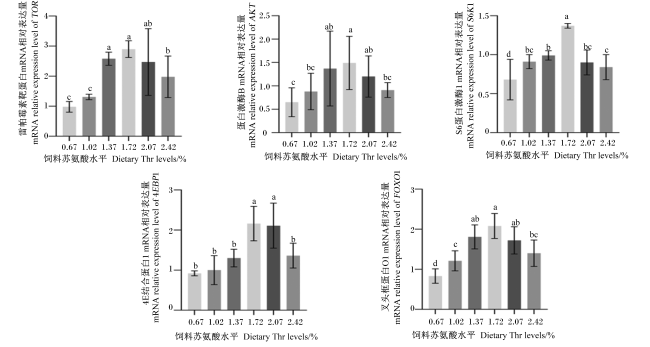
图1可知,随着饲料苏氨酸水平的上升,松浦镜鲤肌肉中雷帕霉素靶蛋白(TOR)、蛋白激酶B(AKT)、核糖体蛋白S6激酶1(S6K1)、4E结合蛋白1(4EBP1)及叉头框蛋白O1(FOXO1)的mRNA相对表达量均在1.72%组达到最高值,其中TORAKTFOXO1的mRNA相对表达量显著高于0.67%、1.02%和2.42%组(P<0.05),4EBP1的mRNA相对表达量显著高于除2.07%组外的其余4组(P<0.05),S6K1的mRNA相对表达量显著高于其余5组(P<0.05)。
图1 饲料苏氨酸水平对松浦镜鲤肌肉中蛋白质合成相关基因表达的影响

数据柱形标注不同字母表示差异显著(P<0.05)。

Fig.1 Effects of dietary Thr level on expression of genes related to protein synthesis in muscle of Songpu mirror carp

Data columns with different letters mean significant difference (P<0.05).

2.9 生长中期松浦镜鲤对苏氨酸的需求量

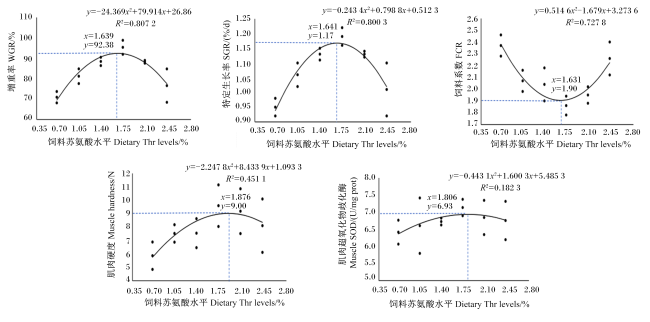
对饲料苏氨酸水平与松浦镜鲤增重率、特定生长率、饲料系数、肌肉硬度及肌肉SOD活性进行二次回归分析(图2),建立回归方程。
图2 饲料苏氨酸水平与松浦镜鲤增重率、特定生长率、饲料系数、肌肉硬度及肌肉超氧化物歧化酶活性的关系

Fig.2 Relationships between dietary Thr level and WGR, SGR, FCR, muscle hardness, muscle SOD activity of Songpu mirror carp

饲料苏氨酸水平(x)与增重率(y)的二次回归方程为y=-24.369x2+79.914x+26.86(R2=0.807 2)。通过回归方程得出,饲料苏氨酸水平为1.639%时,增重率最高,为92.38%。
饲料苏氨酸水平(x)与特定生长率(y)的二次回归方程为y=-0.243 4x2+0.798 8x+0.512 3(R2=0.800 3)。通过回归方程得出,饲料苏氨酸水平为1.641%时,特定生长率最高,为1.17%/d;
饲料苏氨酸水平(x)与饲料系数(y)的二次回归方程为y= 0.514 6x2-1.679x+3.273 6(R2=0.727 8)。通过回归方程得出,饲料苏氨酸水平为1.631%时,饲料系数最低,为1.90。
饲料苏氨酸水平(x)与肌肉硬度(y)的二次回归方程为y=-2.247 8x2+8.433 9x+1.093 3(R2=0.451 1)。通过回归方程得出,饲料苏氨酸水平为1.876%时,肌肉硬度最高,为9.00 N。
饲料苏氨酸水平(x)与肌肉SOD活性(y)的二次回归方程为y=-0.443 1x2+1.600 3x+5.485 3(R2=0.182 3)。通过回归方程得出,饲料苏氨酸水平为1.806%时,肌肉SOD活性最高,为6.93 U/mg prot。

3 讨论

3.1 饲料苏氨酸水平对松浦镜鲤生长性能的影响

本研究结果显示,饲料苏氨酸水平能显著影响松浦镜鲤的增重率、特定生长率及蛋白质效率,在饲料苏氨酸水平达1.72%时,松浦镜鲤的生长性能最佳,这与在罗非鱼(Tilapia mossambica)[16-17]上所得的研究结果相似;同时,饲料苏氨酸水平也显著影响饲料系数,随苏氨酸水平的升高呈先升后降的趋势,在1.72%组出现最低值,该结果在团头鲂(Megalobrama amblycephala)[18]、大口黑鲈(Micropterus salmoides)[19]的研究中也有发现。本研究中,过量苏氨酸(2.07%、2.42%)使松浦镜鲤蛋白质合成能力下降,推测其生长性能降低可能与之相关。过量苏氨酸在肝脏中被分解代谢,产生大量氨氮废物,排泄的能量消耗可能导致蛋白质合成所需能量不足[20];也可能是由于过量苏氨酸造成饲料适口性下降,降低了摄食率[21]。从氨基酸利用角度看,过量苏氨酸破坏了鱼体氨基酸平衡,诱导其他氨基酸氧化,而非沉积用于蛋白质合成,影响鱼类吸收和利用其他氨基酸的能力,从而降低其生长性能[22]。然而,研究显示,在鲶鱼(Silurus asotus)[23]、杂交条纹鲈(Morone chrysops ♀×M. saxatilis♂)[24]等肉食性鱼种上,饲料中过量苏氨酸对其生长性能无显著影响。上述结果说明饲料中过量苏氨酸对鱼类生长性能的影响存在种间差异,推测造成这种差异的原因在于,肉食性鱼种与杂食性鱼种在结构、摄食、代谢等方面存在不同,受自身机体特性影响,其消化吸收能力不会因过量苏氨酸而显著降低。

3.2 饲料苏氨酸水平对松浦镜鲤肌肉品质的影响

肌肉的营养成分、硬度、弹性、咀嚼性、剪切力、失水率及肌纤维密度和直径是反映肌肉品质的重要指标。本研究表明,当饲料苏氨酸水平为1.72%时,松浦镜鲤肌肉粗蛋白质、粗灰分含量与肌纤维密度达最高值,粗脂肪含量与肌纤维直径最低,表明在此水平下,鱼体的蛋白质合成能力与肌纤维生长能力最强,生长速度最快[25]。这也与本试验中松浦镜鲤肌肉中TORAKTS6K1、4EBP1及FOXO1等蛋白质合成相关基因的mRNA相对表达量在此水平下达到最高相对应。肌纤维直径和密度决定肌肉多孔比例,与肌肉质构参数特性密切关联,纤维密度越高、直径越小,肌肉的咀嚼性和剪切力越高,硬度越强[26]。本试验对松浦镜鲤肌肉离心失水率和蒸煮损失的测定结果显示,1.72%组肌肉的离心失水率和蒸煮损失最低。有研究指出,饲料中添加苏氨酸能显著提高草鱼的蛋白质效率和沉积率,且在添加水平为1.62%时达最高值[27]。肌肉中大部分水分与蛋白质结合形成水合离子[22],增强了肌肉的锁水能力。在本研究中,1.72%组的离心失水率最低而肌纤维密度显著高于其他组,说明肌肉的锁水力可能与蛋白质结构和密度密切相关。此外,色泽也是影响肌肉品质的重要因素,a*、b*和L*是反映肌肉色泽状态的主要指标[28]。L*值越高表示肉色越白,b*值与肌肉硫化肌红蛋白的产生有关,二者均与肉质呈负相关[29]。a*值主要受肌红蛋白含量的影响,反映肉的鲜红程度[30]。本研究中,1.72%组的a*值最高,b*和L*值最低,表明该苏氨酸水平下松浦镜鲤肌肉色泽最佳。综上所述,饲料中适宜水平的苏氨酸可改善松浦镜鲤肌肉品质,提高蛋白质转化和沉积效率,增强肌肉锁水能力。

3.3 饲料苏氨酸水平对松浦镜鲤肌肉抗氧化能力的影响

鱼类肌肉中富含不饱和脂肪酸,易发生氧化作用,引发脂质过氧化[31],而过氧化生成的MDA会进一步加速脂肪酸的氧化反应。此外,鱼体的自由基也可直接作用于蛋白质,影响蛋白质合成[32],导致鱼体肌肉品质下降。鱼类主要依靠体内的非酶抗氧化物与抗氧化酶来清除自由基[33]。其中,SOD可以催化自由基歧化为过氧化氢,过氧化氢由GSH予以去除,而CAT是抵御自由基及其潜在毒性的重要手段[17,34]。本研究中,随着饲料苏氨酸水平的升高,肌肉中MDA含量呈先下降后上升的趋势,在饲料苏氨酸水平为1.72%时肌肉MDA含量最低。在草鱼的研究中也有类似发现,在饲料中添加适量苏氨酸显著降低了草鱼血清、肝脏、肌肉中的MDA含量,随着添加量的不断提升,肌肉中MAD含量呈先下降后上升的趋势,当添加量为1.09%和1.31%时肌肉MDA含量有最低值[35]。这表明苏氨酸可通过抑制肌肉脂质过氧化来保护机体,适量的苏氨酸有助于减轻松浦镜鲤肌肉氧化损伤。在虹鳟(Oncorhynchus mykiss)的研究中发现,饲料中添加适量苏氨酸能显著升高血清中SOD、CAT的活性,且随着添加量提高,上升趋势减缓[36]。本研究中,1.72%组的肌肉抗氧化酶活性和GSH含量均高于其他各组。这说明饲料中适宜水平的苏氨酸能提高生长中期松浦镜鲤体内抗氧化酶活性以及GSH含量,从而增强其消除自由基的能力,减少肌肉氧化损伤程度以维持良好的肌肉品质。

3.4 松浦镜鲤饲料中苏氨酸的适宜水平

本研究以增重率、特定生长率、饲料系数为指标时,得出松浦镜鲤饲料中苏氨酸适宜水平为1.631%~1.641%;以肌肉硬度及SOD活性为指标时,得出松浦镜鲤饲料中苏氨酸适宜水平为1.806%~1.876%。鱼类生长通过蛋白质沉积来实现,肌肉硬度与肌纤维密度呈正相关[37]。但有研究指出,在鱼类生长过程中,肌肉沉积速率与肌纤维密度增长率呈负相关,二者可能无法同时达到最优[38]。此外,当饲料苏氨酸水平为1.806%时,松浦镜鲤肌肉SOD活性最高,表明松浦镜鲤肌肉达到最佳品质时所需苏氨酸量要高于生长性能达最佳时所需苏氨酸量[39]。本研究基于生长指标与基于肌肉品质指标所得出的饲料苏氨酸适宜水平存在差异,后续研究可根据不同目的,选择适宜的饲料苏氨酸水平。

4 结论

① 在本试验条件下,饲料苏氨酸水平为1.72%时不仅可以增强生长中期松浦镜鲤的抗氧化能力,改善肌肉质构特性,还可以通过提高蛋白质合成能力提高其生长性能及饲料利用率。
② 以增重率、特定生长率、饲料系数、肌肉硬度及肌肉SOD活性为评价指标,生长中期松浦镜鲤对苏氨酸需求量分别为饲料干物质的1.639%、1.641%、1.631%、1.876%及1.806%。
[1]
范泽, 张植元, 李正伟, 等. 水产动物苏氨酸营养免疫研究进展[J]. 中国饲料, 2022(21):102-108.

FAN Z, ZHANG Z Y, LI Z W, et al. The research progress of threonine nutrition immunity in aquatic animals[J]. China Feed, 2022(21):102-108. (in Chinese)

[2]
SHARF Y, KHAN M A. Dietary threonine requirement of fingerling Channa punctatus (Bloch) based on growth,feed conversion,protein retention efficiency,hematological parameters,and biochemical composition[J]. Aquaculture, 2022,560:738504.

[3]
MARCHÃO R S, RIBEIRO F B, BOMFIM M A D, et al. Digestible threonine requirement in tambaqui (Colossoma macropomum) diets:growth, body deposition,haematology and metabolic variables[J]. Aquaculture Research, 2022, 53(16):5697-5709.

[4]
MAHADEV J S, MURTHY S H, SINGH S R. Supplementation of dietary L-threonine in rohu (Labeo rohita):effects of stocking density on nutritional physiology,immune response,antioxidant system and disease resistance against Aeromonas hydrophila[J]. Aquaculture Research, 2022, 53(11):4155-4167.

[5]
DONG Y W, FENG L, JIANG W D, et al. Dietary threonine deficiency depressed the disease resistance,immune and physical barriers in the gills of juvenile grass carp (Ctenopharyngodon idella) under infection of Flavobacterium columnare[J]. Fish&Shellfish Immunology, 2018,72:161-173.

[6]
DONG Y W, JIANG W D, WU P, et al. Nutritional digestion and absorption, metabolism fates alteration was associated with intestinal function improvement by dietary threonine in juvenile grass carp (Ctenopharyngodon idella)[J]. Aquaculture, 2022,555:738194.

[7]
徐尚潇. 日粮中苏氨酸水平对杂交江鲿生长性能、消化吸收和肠道屏障功能的影响[D]. 硕士学位论文. 雅安: 四川农业大学,2018:62-70.

XU S X. Effect of graded levels of dietary threonine on the growth performance,digestive and absorptive capacity,and intestinal barrier function of Jiang catfish[D]. Master's Thesis. Ya'an: Sichuan Agricultural University,2018:62-70. (in Chinese)

[8]
陈严轩, 王国霞, 刘燕, 等. 氧化鱼油和姜黄素对黄颡鱼生长性能、血清和肝脏指标、体色及肌肉质构特性的影响[J]. 动物营养学报, 2024, 36(7):4610-4622.

DOI

CHEN Y X, WANG G X, LIU Y, et al. Effects of oxidized fish oil and curcumin on growth performance,serum and liver indexes,body colour and muscle texture characteristics of Pelteobagrus fulvidraco[J]. Chinese Journal of Animal Nutrition, 2024, 36(7):4610-4622. (in Chinese)

[9]
范泽, 李晨辉, 吴迪, 等. 两种新型植物蛋白替代豆粕在大规格鲤饲料中的应用效果研究[J]. 水产学杂志, 2023, 36(4):20-28,37.

FAN Z, LI C H, WU D, et al. Application effect of two new plant protein substitutes for soybean meal in large-size common carp feed[J]. Chinese Journal of Fisheries, 2023, 36(4):20-28,37. (in Chinese)

[10]
FAN Z, LI C H, WU D, et al. Evaluation of four novel protein sources as alternatives to soybean meal for two specifications of cage-farmed grass carp (Ctenopharyngodon idellus) feeds:effect on growth performance,flesh quality,and expressions of muscle-related genes[J]. Frontiers in Marine Science, 2022,9:935651.

[11]
OSPINA R I, MURAKAMI A, POZZA P, et al. Dietary glycine+serine and threonine effects on performance,creatine muscle content and meat lipid oxidation of broiler chickens from 21 to 42 days of age[J]. Journal of Animal Science, 2018, 96(S3):313.

[12]
WEN M L, WU P, JIANG W D, et al. Dietary threonine improves muscle nutritional value and muscle hardness associated with collagen synthesis in grass carp (Ctenopharyngodon idella)[J]. Food Chemistry, 2023,422:136223.

[13]
石连玉, 李池陶, 葛彦龙, 等. 黑龙江水产研究所鲤育种概要[J]. 水产学杂志, 2016, 29(3):1-8.

SHI L Y, LI C T, GE Y L, et al. A review:common carp breeding in Heilongjiang fisheries research institute[J]. Chinese Journal of Fisheries, 2016, 29(3):1-8. (in Chinese)

[14]
FENG L, PENG Y, WU P, et al. Threonine affects intestinal function,protein synthesis and gene expression of TOR in Jian carp (Cyprinus carpio var. Jian)[J]. PLoS One, 2013, 8(7):e69974.

[15]
白稚子, 刘明宇, 李树红, 等. 饲料中苏氨酸含量对建鲤肉质及组织蛋白酶B、L的影响[J]. 食品与发酵工业, 2019, 45(22):90-96.

DOI

BAI Z Z, LIU M Y, LI S H, et al. Effect of dietary threonine supplement on the fillet quality and cathepsin B/L level of Jian carp (Cyprlnus carpio var Jian)[J]. Food and Fermentation Industries, 2019, 45(22):90-96. (in Chinese)

[16]
YUE Y, ZOU Z, ZHU J, et al. Dietary threonine requirement of juvenile Nile tilapia,Oreochromis niloticus[J]. Aquaculture International, 2014, 22(4):1457-1467.

[17]
周兴华, 向枭, 罗莉, 等. 吉富罗非鱼对饲料中苏氨酸的需要量[J]. 淡水渔业, 2014, 44(4):83-89.

ZHOU X H, XIANG X, LUO L, et al. Dietary threonine requirement of GIFT Oreochromis niloticus[J]. Freshwater Fisheries, 2014, 44(4):83-89. (in Chinese)

[18]
HABTE-TSION H M, LIU B, REN M C, et al. Dietary threonine requirement of juvenile blunt snout bream (Megalobrama amblycephala)[J]. Aquaculture, 2015,437:304-311.

[19]
RAHMAN M M, LI X Q, SHARIFUZZAMAN S M, et al. Dietary threonine requirement of juvenile largemouth bass,Micropterus salmoides[J]. Aquaculture, 2021,543:736884.

[20]
FARHAT. KHAN A M.growth feed conversion and body composition of fingerling stinging catfish Heteropneustes fossilis (Bloch) fed varying levels of dietary L-threonine[J]. Aquaculture Research, 2017, 48(5):2355-2368.

[21]
PIANESSO D, RADÜNZ NETO J, DA SILVA L P, et al. Determination of tryptophan requirements for juvenile silver catfish (Rhamdia quelen) and its effects on growth performance,plasma and hepatic metabolites and digestive enzymes activity[J]. Animal Feed Science and Technology, 2015,210:172-183.

[22]
何志刚, 艾庆辉, 麦康森, 等. 鲈幼鱼对饲料中苏氨酸的需要量[J]. 水产学报, 2012, 36(1):124-131.

HE Z G, AI Q H, MAI K S, et al. Dietary threonine requirement of juvenile Japanese seabass (Lateolabrax japonicus)[J]. Journal of Fisheries of China, 2012, 36(1):124-131. (in Chinese)

[23]
DANIEL F P, DIRLEISE P, EDUARDO B K, et al. L-threonine requirement of silver catfish (Rhamdia quelen):growth performance,body composition,plasma and liver metabolites[J]. Journal of Applied Animal Research, 2023, 51(1):358-365.

[24]
KEEMBIYEHETTY C N, GATLIN III D M. Dietary threonine requirement of juvenile hybrid striped bass (Morone chrysops ♀×M. saxatilis♂)[J]. Aquaculture Nutrition, 1997, 3(4):217-221.

[25]
ROWLERSON A, VEGGETTI A. Cellular mechanisms of post-embryonic muscle growth in aquaculture species[J]. Fish Physiology, 2001,18:103-140.

[26]
PERIAGO M J, AYALA M D, LÓPEZ-ALBORS O, et al. Muscle cellularity and flesh quality of wild and farmed sea bass,Dicentrarchus labrax L[J]. Aquaculture, 2005, 249(1/2/3/4):175-188.

[27]
陈拥军, 邹滔, 林仕梅, 等. 草鱼体组成的数学描述[J]. 水产学报, 2016, 40(4):566-576.

CHEN Y J, ZOU T, LIN S M, et al. Quantitative description of body composition in grass carp (Ctenopharyngodon idella)[J]. Journal of Fisheries of China, 2016, 40(4):566-576. (in Chinese)

[28]
付亮亮, 郭雪峰, 何永涛. 分光光度法与肉眼评分法评定猪肉肉色的研究[J]. 当代畜牧, 2006(6):45-46.

FU L L, GUO X F, HE Y T. Study on the evaluation of pork color by spectrophotometry and naked eye scoring method[J]. Contemporary Animal Husbandry, 2006(6):45-46. (in Chinese)

[29]
郑明德, 刘喜魁, 冯敏, 等. 溧阳鸡肌肉和鸡蛋品质的检测与分析评价[J]. 畜牧与兽医, 2022, 54(8):20-26.

ZHENG M D, LIU X K, FENG M, et al. Detection and evaluation of muscle and egg quality of Liyang chicken[J]. Animal Husbandry&Veterinary Medicine, 2022, 54(8):20-26. (in Chinese)

[30]
张莘. 小型优质肉鸭和樱桃谷鸭屠宰性能与肉品质的比较研究[D]. 硕士学位论文. 扬州: 扬州大学, 2020.

ZHANG S. Comparative study on slaughtering performance and meat quality of small high quality meat ducks and cherry valley ducks[D]. Master's Thesis. Yangzhou: Yangzhou University, 2020. (in Chinese)

[31]
DE LIMA V R, MORFIM M P, TEIXEIRA A, et al. Relationship between the action of reactive oxygen and nitrogen species on bilayer membranes and antioxidants[J]. Chemistry and Physics of Lipids, 2004, 132(2):197-208.

PMID

[32]
KOHEN R, NYSKA A. Oxidation of biological systems:oxidative stress phenomena,antioxidants,redox reactions, and methods for their quantification[J]. Toxicologic Pathology, 2002, 30(6):620-650.

[33]
ZHOU Q C, WANG Y L, WANG H L, et al. Dietary threonine requirements of juvenile pacific white shrimp,Litopenaeus vannamei[J]. Aquaculture, 2013,392-395:142-147.

[34]
HABTE-TSION H M, REN M, LIU B, et al. Threonine modulates immune response,antioxidant status and gene expressions of antioxidant enzymes and antioxidant-immune-cytokine-related signaling molecules in juvenile blunt snout bream (Megalobrama amblycephala)[J]. Fish and Shellfish Immunology, 2016,51:189-199.

[35]
洪杨. 苏氨酸对生长后期草鱼消化吸收功能和抗氧化能力影响的研究[D]. 硕士学位论文. 雅安: 四川农业大学,2012:48-75.

HONG Y. Studies on effects of dietary threonine on digestive ability and antioxidative ability of sub-adult grass carp (Ctenopharyngodon idella)[D]. Master's Thesis. Ya'an: Sichuan Agricultural University,2012:48-75. (in Chinese)

[36]
王亚玲, 王常安, 刘红柏, 等. 低鱼粉饲料中添加苏氨酸对三倍体虹鳟抗氧化能力、消化生理及肠道炎症因子基因表达的影响[J]. 水生生物学报, 2022, 46(4):478-487.

WANG Y L, WANG C A, LIU H B, et al. Dietary threonine in low fish meal diet on antioxidant capacity,digestive physiology and intestinal inflammatory factor gene expression of triploid Oncorhynchus mykiss[J]. Acta Hydrobiologica Sinica, 2022, 46(4):478-487. (in Chinese)

[37]
RODRIGUES B R, HASSEMER Z M, MELO A W I, et al. Valine in diets for juvenile Nile tilapia (Oreochromis niloticus):growth performance,chemical composition,blood parameters and skeletal muscle development[J]. Spanish Journal of Agricultural Research, 2019, 17(2):e0602.

[38]
MINGCHUN R, MING S, HUALIANG L, et al. Role of dietary isoleucine supplementation in facilitating growth performance and muscle growth in juvenile largemouth bass (Micropterus salmoides)[J]. Aquaculture Reports, 2023,33:101783.

[39]
LIANG X Y, WANG Q, WANG H Y, et al. Grass carp superoxide dismutases exert antioxidant function and inhibit autophagy to promote grass carp reovirus (GCRV) replication[J]. International Journal of Biological Macromolecules, 2024, 256(Part 2):128454.

文章导航

/