研究论文

低蛋白质高脂饲料中添加胆汁酸对丝尾鳠生长、抗氧化能力及脂代谢的影响

  • 龙文豪 , 1 ,
  • 胡毅 1 ,
  • 杨程皓 1 ,
  • 蔡炜佳 1 ,
  • 张姚铮泰 1 ,
  • 李新平 2 ,
  • 李东放 3 ,
  • 马艳娜 3 ,
  • 戴济鸿 , 1, *
展开
  • 1 湖南农业大学水产学院,长沙 410128
  • 2 西双版纳土著鱼类研究繁育中心,西双版纳 666109
  • 3 云南循环农业产业研究院,普洱 665000
* 戴济鸿,讲师,硕士生导师,E-mail:

龙文豪(2001—),男,湖南衡阳人,硕士研究生,研究方向为水产动物营养与饲料。E-mail:

Copy editor: 菅景颖

收稿日期: 2024-10-31

  网络出版日期: 2025-05-14

基金资助

云南省重大科技专项-云南名优土著鱼类设施化养殖利用关键技术创新项目(202202AE090033)

Effects of Bile Acids Added to Low-Protein and High-Fat Diets on Growth, Antioxidant Capacity and Lipid Metabolism of Hemibagrus wyckioides

  • LONG Wenhao , 1 ,
  • HU Yi 1 ,
  • YANG Chenghao 1 ,
  • CAI Weijia 1 ,
  • ZHANG Yaozhengtai 1 ,
  • LI Xinping 2 ,
  • LI Dongfang 3 ,
  • MA Yanna 3 ,
  • DAI Jihong , 1, *
Expand
  • 1 College of Aquatic Sciences, Hunan Agricultural University, Changsha 410128, China
  • 2 Xishuangbanna Indigenous Fish Research and Breeding Center, Xishuangbanna 666109, China
  • 3 Institute of Yunnan Circular Agricultural Industry, Puer 665000, China
* lecturer, E-mail:

Received date: 2024-10-31

  Online published: 2025-05-14

摘要

本试验旨在探讨低蛋白质高脂饲料中添加胆汁酸对丝尾鳠生长、抗氧化能力及脂代谢的影响。选取初始体质量为(40.06±0.05) g的丝尾鳠270尾,随机分为3组,每组3个网箱,每个网箱30尾。3组试验鱼对应饲喂3种试验饲料,即常规基础饲料(含42%蛋白质和10%脂肪,CON组)、低蛋白质高脂饲料(含37%蛋白质和14%脂肪,HF组)、添加胆汁酸的低蛋白质高脂饲料(含37%蛋白质和14%脂肪并添加500 mg/kg胆汁酸,HFB组),养殖试验持续8周。结果显示:1)与CON组相比,HF组的增重率、成活率、特定生长率显著降低(P<0.05),饲料系数显著升高(P<0.05)。与HF组相比,HFB组的增重率、特定生长率显著提高(P<0.05),饲料系数显著降低(P<0.05)。HFB组的各生长性能指标与CON组均无显著差异(P>0.05)。2)与CON组相比,HF组的全鱼粗蛋白质含量显著降低(P<0.05),全鱼和肝脏粗脂肪含量显著升高(P<0.05),肝脏中脂滴数量增多。与HF组相比,HFB组全鱼粗蛋白质含量显著升高(P<0.05),全鱼和肝脏粗脂肪含量显著降低(P<0.05),肝脏中脂滴数量减少。3)与CON组相比,HF组血清甘油三酯含量以及谷草转氨酶、谷丙转氨酶活性显著升高(P<0.05),高密度脂蛋白胆固醇含量显著降低(P<0.05)。与HF组相比,HFB组血清甘油三酯含量以及谷草转氨酶、谷丙转氨酶活性显著降低(P<0.05),高密度脂蛋白胆固醇含量显著增加(P<0.05)。HFB组血清谷草转氨酶、谷丙转氨酶活性与CON组无显著差异(P>0.05)。4)与CON组相比,HF组肝脏总抗氧化能力、谷胱甘肽含量和抗氧化酶(过氧化氢酶和超氧化物歧化酶)活性均显著降低(P<0.05),丙二醛含量显著升高(P<0.05)。与HF组相比,HFB组肝脏总抗氧化能力、谷胱甘肽含量显著升高(P<0.05),丙二醛含量显著降低(P<0.05),且其肝脏总抗氧化能力、谷胱甘肽含量与CON组无显著差异(P>0.05)。5)与HF组相比,HFB组肝脏中脂肪分解相关基因[脂肪甘油三酯脂肪酶(ATGL)、肉碱棕榈酰转移酶-1(CPT-1)、激素敏感脂肪酶(HSL)]的表达显著上调(P<0.05),且脂肪合成相关基因[脂肪酸合成酶(FAS)、过氧化物酶体增殖物激活受体γ(PPARγ)]的表达显著下调(P<0.05)。综上所述,低蛋白质高脂饲料中添加胆汁酸可有效缓解高脂诱导的丝尾鳠抗氧化能力降低和脂肪代谢紊乱,具体表现为提高脂肪分解相关基因、降低脂肪合成相关基因的表达、降低血清甘油三酯含量、减少肝脏中脂滴数量以及提高肝脏抗氧化酶活性,最终改善丝尾鳠的饲料效率和生长性能。

本文引用格式

龙文豪 , 胡毅 , 杨程皓 , 蔡炜佳 , 张姚铮泰 , 李新平 , 李东放 , 马艳娜 , 戴济鸿 . 低蛋白质高脂饲料中添加胆汁酸对丝尾鳠生长、抗氧化能力及脂代谢的影响[J]. 动物营养学报, 2025 , 37(5) : 3258 -3270 . DOI: 10.12418/CJAN2025.269

Abstract

This experiment was conducted to investigate the effects of adding bile acids to low-protein and high-fat diets on the growth, antioxidant capacity and lipid metabolism of Hemibagrus wyckioides. A total of 270 Hemibagrus wyckioides with initial body mass of (40.06±0.05) g were randomly divided into 3 groups of 3 nets with 30 fish each. Three experimental feeds were designed and fed the fish in the 3 groups, they were conventional basal diet group (contained 42% protein and 10% fat, CON group), low-protein and high-fat diet (contained 37% protein and 14% fat, HF group), and low-protein and high-fat with bile acid diet (contained 37% protein and 14% fat, and 500 mg/kg bile acid was added in the diet, HFB group). The aquaculture experiment lasted for 8 weeks. The results showed as follows: 1) the weight gain rate (WGR), survival rate (SR) and specific growth rate (SGR) were significantly decreased and the feed conversion rate (FCR) was significantly increased in the HF group compared with the CON group (P<0.05). Compared with the HF group, the HFB group showed significantly higher WGR, SGR and significantly lower FCR (P<0.05), but there were no significant differences in growth performance indicators between the HFB group and CON group (P>0.05). 2) Compared with the CON group, the HF group showed significantly lower whole body crude protein content (P<0.05), significantly higher whole body crude lipid content and liver crude lipid content (P<0.05), and an increased number of liver lipid droplets. Compared with the HF group, the HFB group had significantly higher crude protein content (P<0.05), significantly lower whole body crude lipid content and liver crude lipid content (P<0.05), and fewer hepatic lipid droplets. 3) Serum triglyceride content as well as aspartate aminotransferase and alanine aminotransferase activities were significantly increased and high-density lipoprotein cholesterol content was significantly decreased in the HF group compared with the CON group (P<0.05). The triglyceride content as well as aspartate aminotransferase and alanine aminotransferase activities were significantly decreased and high-density lipoprotein cholesterol content was significantly increased in the HFB group compared with the HF group (P<0.05). There were no significant differences in the serum aspartate aminotransferase and alanine aminotransferase activities between the HFB group and the CON group (P>0.05). 4) Liver total antioxidant capacity, glutathione content, and antioxidant enzyme (catalase and superoxide dismutase) activities were significantly decreased and malondialdehyde content was significantly increased in the HF group compared with the CON group (P<0.05). Compared with the HF group, the liver total antioxidant capacity and glutathione content was improved and the malondialdehyde content was significantly decreased in the HFB group (P<0.05). There were no significant differences in the liver total antioxidant capacity and glutathione content between the HFB group and the CON group (P>0.05). 5) Compared with the HF group, the expression of lipolysis-related [adipose triacylglyceride lipase (ATGL), carnitine palmitoyl transferase-1 (CPT-1) and hormone sensitive lipase (HSL)] were significantly up-regulated and the expression of liposynthesis-related genes [fatty acid synthetase (FAS) and peroxisome proliferator activated receptor γ (PPARγ)] were significantly down-regulated in the HFB group (P<0.05). In conclusion, adding bile acid to the low-protein and high-fat diet can effectively alleviate the high fat-induced reduction of antioxidant capacity and lipid metabolism disorders of Hemibagrus wyckioides, which can be manifested as increasing the expression of lipolysis-related genes, decreasing the expression of liposynthesis-related genes, lowering the content of serum triglyceride, reducing the number of hepatic lipid droplets, and increasing the activities of liver antioxidant enzymes, which ultimately improves the feed efficiency and growth performance of Hemibagrus wyckioides.

蛋白质是鱼类有机体结构和功能必不可少的营养物质,鱼粉和豆粕是水产饲料中广泛应用的蛋白质原料[1]。然而,我国对优质的蛋白质资源一直有很大的进口依赖,随着国际贸易形势和气候变化的影响,蛋白质原料价格也在不断上涨,严重制约着饲料生产成本和养殖效益[2]。降低饲料蛋白质水平可有效减少养殖业粮食消耗量,缓解供应压力,同时有助于减少氮排放,减轻水环境污染压力[3]。脂肪也是一种重要的营养物质,可以为鱼类提供脂肪酸、胆固醇和磷脂,与蛋白质相比,脂肪的成本更低、能量效率更高,且容易被鱼类代谢[4]。近年来,高脂饲料被广泛应用于水产养殖中,以最大限度地提高“蛋白质节约效应”[5]。适当提高饲料脂肪水平,能够显著提高一些鱼类的生长性能,如杂交蛇头鱼(Channa maculata ♀×Channa argus♂)[6]、大黄鱼(Larimichthys crocea)[7]。但当饲料中脂肪水平过高时容易造成脂质过度蓄积和脂质代谢紊乱,从而引起肝脏受损等问题[8]。因此,通过饲料添加剂来提高脂肪的利用效率并减少或消除高脂带来的不良影响至关重要。
胆汁酸是胆固醇代谢的主要终产物,是胆汁的重要组成成分,对促进动物肠道中胆固醇、脂质和脂溶性维生素的吸收有重要的生理作用[9]。胆汁酸可以作为乳化剂乳化脂肪,再聚合成乳糜微粒,增大其与酶的接触面积,从而促进脂肪的消化;同时,胆汁酸作为信号分子通过与类法尼醇X受体(FXR)结合,发挥代谢调控作用,参与脂质稳态调节途径[10]。目前,用胆汁酸来缓解高脂饲料的不良影响的研究已有很多。在黄颡鱼(Pelteobagrus fulvidraco)[11]、大口黑鲈(Micropterus salmoides)[12]、大黄鱼[13]上的研究表明,高脂饲料中添加胆汁酸可以改善脂质的消化吸收、抗氧化能力和肝肠健康,从而减轻高脂饲料诱导的鱼体生长迟缓、脂质积累等不良影响。此外,Bhusare等[14]研究表明,在低蛋白质高脂饲料中添加胆汁酸能提高尼罗罗非鱼(Oreochromis niloticus)的抗氧化能力和脂质代谢,提高生长性能和营养利用率。Peng等[15]的研究显示,在低蛋白质高脂饲料中添加胆汁酸可增强草鱼(Ctenopharyngodon idella)的生长性能,缓解脂肪肝和肠炎症状。总体而言,胆汁酸应用于水产养殖中,能促进脂肪乳化和吸收,提高饲料利用率,改善肝脏健康,调节脂质稳态,缓解氧化应激。因此,对于低蛋白质高脂饲料可能引起脂肪沉积、氧化应激等问题,使用胆汁酸是一种很好的策略。
丝尾鳠(Hemibagrus wyckioides)隶属于鲇形目鲿科鳠属,地方名长胡子鱼,为云南省境内澜沧江下游的主要经济鱼类之一[16],其营养丰富、口味鲜美,是一种具有良好养殖前景的名优品种。本课题组前期研究表明,丝尾鳠生长性能最高时的饲料蛋白质水平达到了42%,高脂条件下虽出现了脂质沉积并影响肝脏健康的现象,但未影响生长性能[17]。因此,本试验以丝尾鳠为试验对像,通过设计低蛋白质高脂饲料,同时使用胆汁酸,以期进一步降低饲料中蛋白质原料的使用,增加脂肪的利用效率,并改善丝尾鳠的脂质代谢,为丝尾鳠饲料配方的优化和健康养殖提供理论基础。

1 材料与方法

1.1 伦理声明

本试验获得了湖南农业大学生物医学研究伦理委员会批准,试验参与人员严格遵守道德伦理规范,并按照湖南农业大学生物医学研究伦理委员会制定的规章制度执行,批准号为:湖南农业大学伦审科第(119)号。

1.2 试验设计

挑选规整健康、初始体质量为(40.06±0.05) g的丝尾鳠270尾,随机分为3组,每组3个网箱,每个网箱(1.5 m×1.5 m×2.0 m)投放30尾。根据丝尾鳠的营养需求,以鱼粉、豆粕、菜籽粕为主要蛋白质源,以鱼油和豆油为主要脂肪源,以小麦粉为糖源,共配制3种试验饲料,分别为常规基础饲料(含42%蛋白质和10%脂肪,CON组)、低蛋白质高脂饲料(含37%蛋白质和14%脂肪,HF组)、添加胆汁酸的低蛋白质高脂饲料(含37%蛋白质和14%脂肪并添加500 mg/kg胆汁酸,HFB组),制成硬颗粒饲料。试验饲料组成及营养水平见表1
表1 试验饲料组成及营养水平(干物质基础)

Table 1 Composition and nutrition levels of experimental diets (DM basis) %

项目
Items
组别Groups
CON HF HFB
原料Ingredients
鱼粉Fish meal 30.00 25.00 25.00
豆粕Soybean meal 15.00 12.50 12.50
菜籽粕Rapeseed meal 15.00 12.50 12.50
啤酒酵母Brewer's yeast 4.00 4.00 4.00
小麦粉Wheat flour 18.50 18.50 18.50
米糠Rice bran 10.00 10.00 10.00
麦麸Wheat bran 0.26 6.16 6.11
鱼油Fish oil 1.70 1.70
豆油Soybean oil 4.40 6.80 6.80
胆汁酸Bile acids 0.05
磷酸二氢钙Ca(H2PO4)2 1.50 1.50 1.50
氯化胆碱Choline chloride 0.30 0.30 0.30
防霉剂Mould inhibitor 0.03 0.03 0.03
抗氧化剂Antioxidant 0.01 0.01 0.01
预混料Premix1) 1.00 1.00 1.00
合计Total 100.00 100.00 100.00
营养水平Nutrient levels2)
粗蛋白质Crude protein 41.67 36.94 36.97
粗脂肪Crude lipid 9.98 13.97 14.04
粗灰分Ash 9.39 9.22 9.22

1)预混料为每千克饲料提供The premix provided the following per kg of diets:KCl 200 mg,KI (1%) 60 mg,CoCl2·6H2O (1%) 50 mg,CuSO4·5H2O 30 mg,FeSO4·H2O 400 mg,ZnSO4·H2O 400 mg,MnSO4·H2O 150 mg,Na2SeO3·5H2O (1%) 65 mg,MgSO4·H2O 2 000 mg,沸石粉 zeolite power 3 645.85 mg,VB1 12 mg,核黄素 riboflavin 12 mg,VB6 8 mg,VB12 0.05 mg,VK3 8 mg,肌醇 inositol 100 mg,泛酸 pantothenic acid 40 mg,烟酸 niacin acid 50 mg,叶酸 folic acid 5 mg,生物素 biotin 0.8 mg,VA 25 mg,VD 35 mg,VE 50 mg,VC 100 mg,乙氧基喹啉 ethoxyquin 150 mg,面粉 wheat flour 2 403.3 mg。

2)营养水平为测定值。Nutrient levels were measured values.

1.3 饲养管理

饲养试验在云南省西双版纳土著鱼类研究繁育中心进行,日投喂2次(07:30、17:30),按体重的2%~4%进行投喂,定期调整投喂量,整个养殖试验持续8周。试验期间,水体温度为(26.40±3.60) ℃,溶氧浓度高于5.00 mg/L,氨氮浓度低于0.50 mg/L。

1.4 样本采集

养殖试验结束后,禁食24 h,测量并记录每个网箱丝尾鳠的重量和数目。每个网箱随机取5尾丝尾鳠,用2 mL无菌注射器于尾柄部抽血,血样于4 ℃冰箱静置分层后,再以860×g的离心力离心10 min,取上清液储存于-80 ℃冰箱中备用。每个网箱随机取4尾丝尾鳠,测量并记录其体重、体长,随后迅速解剖,测量肝脏、内脏团、腹腔脂肪重量并记录;切取肝脏组织,一部分置于4%甲醛溶液中固定,以备制作切片,一部分放入1.5 mL EP管中,储存于-80 ℃冰箱中备用。每个网箱随机取3尾丝尾鳠,储存于-20 ℃冰箱中,用于测定体成分。

1.5 指标测定

1.5.1 生长性能

生长性能相关指标计算方法如下:
$存活率 (\mathrm{SR}, \%)=100 \times 终末尾数/初始尾数;增重率(WGR,%)= 100 \times 条均重( g )一初均重( g ) ] 初均重( g );饲料系数 (\mathrm{FCR})= 饲料摄取量 (\mathrm{g}) /[ 末总重 (\mathrm{g})- 初总重 (\mathrm{g})] ;特定生长率( \mathrm{SGR}, \% / \mathrm{d} ) =100 \times[\ln 末均重( g ) -\ln 初均重( g ) ] /养殖天数;肝体比(HSI,%)=100×肝脏重(g)/体重(g);脏体比(VSI,%) =100 \times 内脏团重(g)/体重(g);肥满度 \left(\mathrm{CF}, \mathrm{g} / \mathrm{cm}^{3}\right)=100 \times 体重 (\mathrm{g}) /体长 (\mathrm{cm})^{3} ;腹脂率(AFP, \% ) =100 \times 腹脂重( g )/体重( g )。$

1.5.2 营养成分含量

采用105 ℃恒温干燥法(GB/T 5009.3—2003)去除饲料、鱼体及肝脏中水分后制备成绝干样品。分别使用550 ℃马弗炉灼烧法(GB/T 5009.4—2003)、凯氏定氮法(GB/T 5009.5—2003)与索氏抽提法(GB/T 5009.6—2003)测定绝干样品中粗灰分(饲料、全鱼)、粗蛋白质(饲料、全鱼)和粗脂肪含量(饲料、全鱼和肝脏)。

1.5.3 血清生化指标

血清中总胆固醇(TC)、甘油三酯(TG)、低密度脂蛋白胆固醇(LDL-C)、高密度脂蛋白胆固醇(HDL-C)含量以及谷草转氨酶(AST)、谷丙转氨酶(ALT)活性均采用试剂盒测定,试剂盒均购自南京建成生物工程研究所。

1.5.4 肝脏组织结构

取出固定好的肝脏样品,微流水冲洗,经过脱水、包埋后,使用RM-2235型切片机(Leica,Germany)制作厚度为5 μm的切片,先用油红O染液浸染10 min,蒸馏水清洗,然后用60%异丙醇洗去多余染液,蒸馏水清洗,再用Mary氏苏木素复染3~8 min,蒸馏水清洗,甘油明胶封片。使用光学显微镜(EX2000,重庆中显光电仪器有限公司)镜检,完成图像分析。

1.5.5 肝脏抗氧化指标

肝脏样品解冻后匀浆,1 160×g离心10 min,取上清液,采用试剂盒测定丙二醛(MDA)、谷胱甘肽(GSH)含量,总抗氧化能力(T-AOC)以及过氧化氢酶(CAT)、超氧化物歧化酶(SOD)活性,试剂盒均购自南京建成生物工程研究所。

1.5.6 肝脏脂代谢相关基因表达

采用总RNA提取试剂盒提取丝尾鳠肝脏总RNA。采用核酸定量仪对提取的总RNA样本进行测定,确定260与280 nm处吸光度值的比值介于1.8~2.1。使用Hifairs Ⅲ 1st Strand cDNA synthesis Kit (gDNA digester plus)反转录试剂盒(翌圣生物科技股份有限公司)将RNA反转录为cDNA。通过在NCBI中获取已公布的丝尾鳠基因组序列信息,选用β-肌动蛋白(β-actin)作为内参基因,目的基因为脂肪酸合成酶(FAS)、乙酰辅酶A羧化酶(ACC)、过氧化物酶体增殖物激活受体γ(PPARγ)、肉碱棕榈酰转移酶-1(CPT-1)、脂肪甘油三酯脂肪酶(ATGL)、激素敏感脂肪酶(HSL)。利用Primer 5.0软件设计引物,引物由武汉生工生物工程技术服务有限公司合成,引物序列见表2。使用Celemetor实时荧光定量PCR分析系统(翌圣生物科技股份有限公司)进行实时荧光定量PCR。反应程序包括:预变性(95 ℃,5 min);扩增(95 ℃,10 s;60 ℃,30 s;40个循环);终止反应。目的基因相对表达量采用2-ΔΔCt方法计算。
表2 引物序列

Table 2 Primer sequences

基因名称
Gene names
上游引序列
Forward primer sequences (5'—3')
下游引物序列
Reverse primer sequences (5'—3')
脂肪酸合成酶
FAS
CTCACTCAACTTCCGAGACATCA AGGTAGGAGACCCATAACACGAC
乙酰辅酶A羧化酶
ACC
GCAGGACGACCCAATCAGA CCATAAACGAGCCACAGTCAA
过氧化物酶体增殖物激活受体γ
PPARγ
TCAATGCCTCGTCCACTTCC GACCTCTGACCTCTGTGACTTG
肉碱棕榈酰转移酶-1
CPT-1
CCAGACGCCTTCATCCAGATT CGGTCATAGCCATTCGGTACA
脂肪甘油三酯脂肪酶
ATGL
GCACATCTACGGAGCCTCTG AACCGCTTCCTTGCTTCCTT
激素敏感脂肪酶
HSL
TGGTTCTGTCCTGCGTTCTG CCGTGTTCGTTGTTGTTGAGTA
β-肌动蛋白
β-actin
CGTGACCGCCAATTCCGATG CACCACAAGCCAGACGACCT

1.6 数据处理与统计分析

试验数据采用SPSS 26.0软件进行分析。将符合方差齐质性的数据进行单因素方差分析(one-way ANOVA),当差异显著(P<0.05)时,采用Duncan氏进行事后多重比较,结果用平均值±标准误(mean±SE)表示。

2 结果

2.1 胆汁酸对丝尾鳠生长性能的影响

表3可知,各组间的肥满度、肝体比、脏体比、腹脂率均无显著差异(P>0.05)。与CON组相比,HF组的末均重、增重率、存活率、特定生长率均显著降低(P<0.05),饲料系数显著升高(P<0.05)。与HF组相比,HFB组的末均重、增重率、特定生长率均显著升高(P<0.05),饲料系数显著降低(P<0.05),且HFB组与CON组上述指标均无显著差异(P>0.05)。
表3 胆汁酸对丝尾鳠生长性能的影响

Table 3 Effects of bile acid on growth performance of Hemibagrus wyckioides

项目
Items
组别Groups
CON HF HFB
初均重IBW/(g/尾) 39.99±0.06 40.14±0.15 40.03±0.10
末均重FBW/(g/尾) 100.36±3.33b 75.71±1.72a 96.34±2.05b
增重率WGR/% 150.99±8.73b 88.63±4.86a 140.63±4.86b
存活率SR/% 96.67±0.00b 88.89±2.22a 93.33±1.93ab
饲料系数FCR 1.47±0.08a 2.49±0.13b 1.57±0.05a
特定生长率SGR/(%/d) 1.64±0.06b 1.13±0.05a 1.57±0.03b
肥满度CF/(g/m3) 1.34±0.03 1.33±0.01 1.40±0.03
肝体比HSI/% 1.76±0.08 2.03±0.07 1.84±0.12
脏体比VSI/% 13.20±0.50 14.72±0.50 14.98±0.65
腹脂率AFP/% 2.29±0.13 2.57±0.15 2.34±0.16

同行数据肩标不同字母代表差异显著(P<0.05)。下表同。

Values in the same row with different letter superscripts indicate significant difference (P<0.05). The same as below.

2.2 胆汁酸对丝尾鳠体成分和肝脏粗脂肪含量的影响

表4可知,与CON组相比,HF组的全鱼粗蛋白质含量显著降低(P<0.05),全鱼和肝脏粗脂肪含量显著升高(P<0.05)。与HF组相比,HFB组全鱼粗蛋白质含量显著升高(P<0.05),全鱼和肝脏粗脂肪含量显著降低(P<0.05)。HFB组全鱼粗蛋白质含量显著低于CON组(P<0.05),全鱼和肝脏粗脂肪含量显著高于CON组(P<0.05)。各组全鱼粗灰分含量无显著差异(P>0.05)。
表4 胆汁酸对丝尾鳠体成分以及肝脏粗脂肪含量的影响(干物质基础)

Table 4 Effects of bile acids on body composition and live crude lipid content of Hemibagrus wyckioides (DM basis) %

项目
Items
组别Groups
CON HF HFB
全鱼Whole body
粗蛋白质Crude protein 57.59±0.18c 50.15±0.07a 54.41±0.14b
粗脂肪Crude lipid 26.22±0.30a 30.23±0.11c 27.82±0.44b
粗灰分Ash 12.52±0.18 12.54±0.12 12.49±0.06
肝脏Liver
粗脂肪Crude lipid 8.47±0.37a 12.60±0.25c 10.92±0.46b

2.3 胆汁酸对丝尾鳠血清生化指标的影响

表5可知,各组间血清TC、LDL-C含量无显著差异(P>0.05)。与CON组相比,HF组血清TG含量以及AST、ALT活性显著升高(P<0.05),HDL-C含量显著降低(P<0.05)。与HF组相比,HFB组血清TG含量以及AST、ALT活性显著降低(P<0.05),HDL-C含量显著增加(P<0.05)。HFB组血清TG和HDL-C含量显著高于CON组(P<0.05),而AST、ALT活性与CON组无显著差异(P>0.05)。
表5 胆汁酸对丝尾鳠血清生化指标的影响

Table 5 Effects of bile acid on serum biochemical indicators of Hemibagrus wyckioides

项目
Items
组别Groups
CON HF HFB
甘油三酯TG/(mmol/L) 2.31±0.11a 6.12±0.57c 4.19±0.44b
总胆固醇TC/(mmol/L) 3.45±0.21 3.33±0.10 3.58±0.08
高密度脂蛋白胆固醇HDL-C/(mmol/L) 0.69±0.01b 0.46±0.02a 0.81±0.03c
低密度脂蛋白胆固醇LDL-C/(mmol/L) 0.85±0.04 0.84±0.02 0.81±0.03
谷草转氨酶AST/(U/L) 30.64±2.19a 53.90±0.93b 28.74±2.85a
谷丙转氨酶ALT/(U/L) 3.94±0.28a 7.39±0.28b 4.71±0.22a

2.4 胆汁酸对丝尾鳠肝脏组织结构的影响

丝尾鳠肝脏组织油红O染色切片见图1。与CON组相比,HF组的肝脏脂滴数量增多。与HF组相比,HFB组的肝脏脂滴数量减少。
图1 丝尾鳠肝脏组织油红O染色切片

CON:CON组;HF:HF组;HFB:HFB组。下图同。Ld表示脂滴,图示红色区域;N表示细胞核,图示蓝色小点。

Fig.1 Oil red O staining sections of liver tissues of Hemibagrus wyckioides (400×)

CON: CON group; HF: HF group; HFB: HFB group. The same as below. Ld mean lipid droplet, red area in the figure; N mean nucleus, blue dots in the figure.

2.5 胆汁酸对丝尾鳠肝脏抗氧化指标的影响

表6可知,与CON组相比,HF组肝脏GSH含量、T-AOC及CAT、SOD活性均显著降低(P<0.05),MDA含量显著升高(P<0.05)。与HF组相比,HFB组肝脏GSH含量、T-AOC显著升高(P<0.05),MDA含量显著降低(P<0.05),CAT、SOD活性有所升高但差异未达显著水平(P>0.05)。HFB组肝脏CAT、SOD活性显著低于CON组(P<0.05),MDA含量显著高于CON组(P<0.05),而GSH含量、T-AOC与CON组无显著差异(P>0.05)。
表6 胆汁酸对丝尾鳠肝脏抗氧化指标的影响

Table 6 Effects of bile acid on liver antioxidant indicators of Hemibagrus wyckioides

项目
Items
组别Groups
CON HF HFB
谷胱甘肽GSH/(μmol/g prot) 43.66±1.73b 35.72±1.54a 42.39±0.84b
总抗氧化能力T-AOC/(mmol/g prot) 0.49±0.01b 0.40±0.01a 0.47±0.01b
过氧化氢酶CAT/(U/mg prot) 3.85±0.03b 3.42±0.04a 3.52±0.03a
超氧化物歧化酶SOD/(U/mg prot) 17.80±0.45b 15.42±0.24a 16.59±0.30a
丙二醛MDA/(nmol/mg prot) 0.79±0.02a 1.73±0.01c 1.19±0.01b

2.6 胆汁酸对丝尾鳠肝脏脂代谢相关基因表达的影响

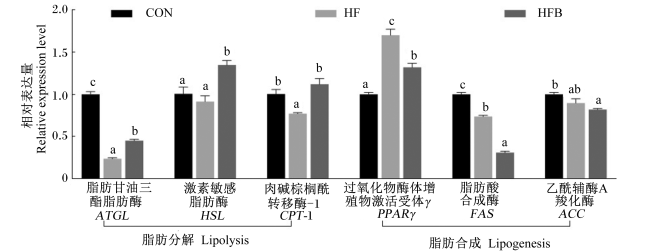
图2可知,与CON组相比,HF组肝脏中PPARγ的相对表达量显著上调(P<0.05),ATGLFASCPT-1的相对表达量显著下调(P<0.05)。与HF组相比,HFB组肝脏中ATGLHSLCPT-1的相对表达量显著上调(P<0.05),PPARγFAS的相对表达量显著下调(P<0.05)。相较于CON组,HFB组肝脏中ATGLFASACC的相对表达显著下调(P<0.05),HSLPPARγ的相对表达量显著上调(P<0.05)。
图2 胆汁酸对丝尾鳠肝脏脂代谢相关基因表达的影响

同一指标数据柱标注不同字母代表差异显著(P<0.05)。

Fig.2 Effects of bile acid on expression of liver lipid metabolism related genes of Hemibagrus wyckioides

Data columns of the same indicator with different letters indicate significant difference (P<0.05).

3 讨论

3.1 胆汁酸对丝尾鳠生长性能和体成分的影响

脂质是水生动物饲料中的重要成分,它为水生动物提供生长所需的能量和必需脂肪酸。本研究发现,与CON组相比,投喂低蛋白质高脂饲料的丝尾鳠的增重率、特定生长率显著降低,饲料系数显著增高,这与投喂低蛋白质高脂饲料的鲤鱼(Cyprinus carpio)[18]、尼罗罗非鱼[14]的研究结果一致,表明低蛋白质高脂饲料对丝尾鳠的生长有显著的负面影响。这可能是由于饲料蛋白质的减少,使得用于组织蛋白质合成的氨基酸不足[19],此外,高脂提供的能量可能超过生长需求,导致新陈代谢不平衡,减少了对其他营养物质的利用[12]。但在低蛋白质高脂饲料中添加0.05%的胆汁酸后,丝尾鳠的增重率、特定生长率得到显著改善,饲料系数降低,并达到与CON组接近的水平。同样,Bhusare等[14]的研究显示,在低蛋白质高脂饲料中添加0.05%的胆汁酸能显著提高尼罗罗非鱼的增重率和特定生长率,降低饲料系数。相似的是,在高脂饲料中添加0.05%的胆汁酸后显著提高了黄鳝(Monopterus albus)的增重率和特定生长率[20];补充胆汁酸能显著改善高脂饲料引起的黄颡鱼[11]和大口黑鲈[21]的增重率降低。本研究中,与低蛋白质高脂饲料相比,胆汁酸的添加显著降低了丝尾鳠全鱼粗脂肪含量,并提高了全鱼粗蛋白质含量。有研究发现,高脂饲料提高了大口黑鲈[12]和草鱼[22]体内粗脂肪的含量,同时降低了粗蛋白质的含量,但补充适量胆汁酸后,这2种鱼的粗脂肪含量显著降低,粗蛋白质含量显著增加,这与本研究的结果一致。上述结果表明,饲料中的胆汁酸可能通过对脂肪的乳化作用,从而获得更好的脂质消化和代谢利用以供应能量,这反过来又可以保留蛋白质,从而增加合成组织蛋白质的氨基酸可用性,进而提高鱼类的生长性能[15]

3.2 胆汁酸对丝尾鳠血清生化指标的影响

本研究中,低蛋白质高脂饲料增加了丝尾鳠血清TG含量,补充胆汁酸后,TG含量显著降低。胆汁酸可降低血清中TG的含量在鲤鱼[23]、虎河豚(Takifugu rubripes)[24]上也有报道。肝脏是TG代谢的场所,血清TG含量增加可能导致肝脏脂肪含量升高[17]。本研究中,低蛋白质高脂饲料组中丝尾鳠肝脏粗脂肪含量最高,肝脏切片油O红染色结果也显著该组丝尾鳠肝脏中脂滴数量最多,补充胆汁酸后这些情况得到改善,与血清TG含量的结果一致,说明胆汁酸对丝尾鳠的脂肪代谢有一定的促进作用。HDL-C能够反映肝外组织中的胆固醇被运输到肝脏进行代谢转化的效率[25]。据报道,投喂低蛋白质高脂饲料的尼罗罗非鱼的血清HDL-C含量显著降低,然而,补充0.05%胆汁酸使其含量显著增加[14],本研究得到的结果与此相一致。同样,在饲料中补充胆汁酸后,在黑鲷(Acanthopagrus schlegelii)[26]和杂交石斑鱼(Epinephelus fuscoguttatus ♀×E. lanceolatus )[27]中发现血清HDL-C含量升高。这可能是由于胆汁酸作为信号分子通过法尼醇X受体(FXR)信号通路调节HDL-C含量升高。在小鼠上的试验发现,FXR能诱导肝脏高密度脂蛋白摄取转运体清道夫受体-B1(SR-B1)的表达,促进对高密度脂蛋白的摄取[28]。肝脏脂肪沉积可能导致肝脏功能受损,而AST、ALT是肝细胞内2种重要的转氨酶[29]。当肝细胞受到损伤或者其细胞膜的通透性增加时,血液中这2种转氨酶的活性会显著上升,可用于反映肝脏受损状况[30]。本研究中,低蛋白质高脂饲料使丝尾鳠血清AST、ALT活性均显著升高,而添加胆汁酸使这2种转氨酶的活性均显著降低,与在大菱鲆(Scophthalmus maximus)[31]上所得结果一致。同样,在条纹鲶鱼(Pangasianodon hypophthalmus)[32]和欧洲鳗鲡(Anguilla anguilla)[33]上的研究显示,投喂含胆汁酸的饲料,其血浆中AST、ALT的活性显著降低。上述结果表明胆汁酸对肝脏损伤有缓解作用。有研究表明,高脂饲料会导致脂质过度沉积,脂质过氧化,从而引起氧化应激,诱导肝脏损伤[13]。由此推测,胆汁酸缓解肝脏损伤可能与抗氧化有关。

3.3 胆汁酸对丝尾鳠肝脏抗氧化指标的影响

抗氧化能力是评估鱼类健康和氧化应激状况的重要指标。通常,氧化应激是由于生物体中氧自由基的生成和清除之间不能达到平衡而发生的,氧自由基的积累可导致脂质过氧化,损伤细胞膜[34]。脂质过氧化和细胞损伤的程度能够通过MDA含量来反映[35]。T-AOC是评估体内所有抗氧化物(包括酶和非酶)抗氧化能力的关键标志物[36]。本研究中,低蛋白质高脂饲料显著提高了丝尾鳠肝脏MDA含量,降低了GSH含量、T-AOC以及SOD、CAT活性,而添加胆汁酸可以改善这种情况。上述结果表明,低蛋白质高脂饲料对丝尾鳠的抗氧化系统造成了损害,而胆汁酸减轻了这种损害。在尼罗罗非鱼上的研究发现,肝脏MDA含量随着饲料脂肪水平的增加和饲料蛋白质水平的降低而显著增加,补充胆汁酸可显著降低肝脏MDA含量[14],与本研究结果一致。同样,Su等[37]研究发现,饲料中补充胆汁酸可显著提高南美白对虾(Litopenaeus vannamei)肝胰腺GSH含量、T-AOC和SOD活性。胆汁酸发挥抗氧化能力可能是因为:一方面,低蛋白质高脂饲料导致脂肪蓄积,引起肝脏氧化应激损伤,而胆汁酸通过促进脂肪代谢,缓解了脂肪蓄积,从而减少肝脏氧化应激损伤,这与前面的血清生化指标结果相对应;另一方面,在对胆汁酸抗氧化作用分子机制的探究中发现,胆汁酸在黄鳝和鲍鱼(Haliotis discus hannai)的抗氧化基因水平上正调控了核因子E2相关因子2(Nrf2)-Kelch样环氧氯丙胺相关蛋白1(Keap1)通路[20,38],因此胆汁酸的抗氧化作用可能依赖于通过调节Nrf2-Keap1通路促进MDA清除和抗氧化反应的增强。

3.4 胆汁酸对丝尾鳠肝脏脂代谢相关基因表达的影响

在鱼类脂肪合成过程中,PPARγ促进脂肪组织积累,是脂肪产生的关键调节因子[39]。ACC和FAS是参与脂肪酸合成的关键酶,ACC催化乙酰辅酶A羧化为丙二酰辅酶A,FAS将丙二酰辅酶A转化为棕榈酸,棕榈酸最终酯化为TG[40]。据报道,高脂饲料显著上调了鲤鱼肝脏中PPARγ的相对表达量,而添加胆汁酸使其相对表达量显著下调[35],本研究中也有同样的结果。本研究结果显示,低蛋白质高脂饲料使丝尾鳠肝脏中PPARγ的相对表达量显著上调,而添加胆汁酸后肝脏中PPARγFAS的相对表达量显著下调。在大口黑鲈中也发现,高脂饲料中添加胆汁酸显著下调了肝脏中FAS的相对表达量[21]。ATGL和HSL是鱼类脂肪分解中必不可少的酶,而脂肪酸分解代谢是通过肉碱棕榈酰转移酶(CPT)将长链脂肪酸转运到线粒体区室进行β氧化发生的[41]。本研究中,与低蛋白质高脂饲料相比,胆汁酸的添加显著上调了丝尾鳠肝脏中ATGLCPT-1、HSL的相对表达量。在其他鱼类上也有相似的结果,如胆汁酸增强了鲍鱼肝胰腺中CPT-1、HSLATGL的表达[42];胆汁酸可以上调高脂饲料喂养的大黄鱼肝脏中CPT-1的表达[13];饲料中胆汁酸对草鱼肝脏中ATGLHSL的表达有积极影响[21]。研究发现,胆汁酸作为FXR的天然配体,可以激活FXR的表达,而FXR可诱导靶基因小异源二聚体伴侣(SHP)表达的上调,后者可抑制胆固醇调节元件结合蛋白-1(SREBP-1)的表达,而SREBP-1可调控参与脂肪合成基因如ACCFAS的表达,从而减少肝脏中的脂质合成[43]。此外,FXR还可以直接诱导过氧化物酶体增殖物激活受体α(PPARα)表达的上调,从而导致其下游基因CPT-1的高表达,并促进脂肪酸的β氧化以减少脂质沉积[44]。上述结果表明,胆汁酸可能通过下调脂肪合成相关基因的表达和上调脂肪分解相关基因的表达来减少肝脏中的脂肪沉积,这也与前面体成分、血清生化指标和肝脏油红O染色切片的结果相对应。

4 结论

综上所述,低蛋白质高脂饲料中添加胆汁酸可有效缓解高脂诱导的丝尾鳠抗氧化能力降低和脂肪代谢紊乱,具体表现为提高脂肪分解相关基因、降低脂肪合成相关基因的表达,降低血清TG含量,减少肝脏脂滴数量以及提高肝脏抗氧化酶活性,最终改善丝尾鳠的饲料效率和生长性能。
[1]
翟钰姗, 姜晓娜, 瞿飞虎, 等. 饲料中蛋白质对鱼类的影响及其研究进展[J]. 河北渔业, 2023(9):40-46.

ZHAI Y S, JIANG X N, QU F H, et al. The effect of protein in feed on fish and its research progress[J]. Hebei Fisheries, 2023(9):40-46. (in Chinese)

[2]
刘国庆, 谭青松, 解绶启. 新型蛋白源在水产饲料中的应用研究进展[J]. 饲料工业, 2022, 43(12):10-20.

LIU G Q, TAN Q S, XIE S Q. Research progress on the use of unconventional protein sources in aquatic feeds[J]. Feed Industry, 2022, 43(12):10-20. (in Chinese)

[3]
WANG J T, HAN T, LI X Y, et al. Effects of dietary protein and lipid levels with different protein-to-energy ratios on growth performance,feed utilization and body composition of juvenile red-spotted grouper,Epinephelus akaara[J]. Aquaculture Nutrition, 2017, 23(5):994-1002.

[4]
TANG T, HU Y, PENG M, et al. Effects of high-fat diet on growth performance,lipid accumulation and lipid metabolism-related microRNA/gene expression in the liver of grass carp (Ctenopharyngodon idella)[J]. Comparative Biochemistry and Physiology B:Biochemistry and Molecular Biology, 2019,234:34-40.

[5]
FRANCIS D S, TURCHINI G M. Retro-engineering the protein sparing effect to preserve n-3 LC-PUFA from catabolism and optimise fish oil utilisation:a preliminary case study on juvenile Atlantic salmon[J]. Aquaculture, 2017,468:184-192.

[6]
ZHANG Y F, SUN Z Z, WANG A L, et al. Effects of dietary protein and lipid levels on growth,body and plasma biochemical composition and selective gene expression in liver of hybrid snakehead (Channa maculata ♀×Channa Argus ♂)fingerlings[J]. Aquaculture, 2017,468:1-9.

[7]
CHEN Z M, YU A L, WANG L, et al. Reassessment of dietary protein and lipid requirements for large yellow croaker,Larimichthys crocea,reared in net pens[J]. Journal of the World Aquaculture Society, 2023, 54(5):1179-1195.

[8]
NAIEL M A E, NEGM S S, GHAZANFAR S, et al. The risk assessment of high-fat diet in farmed fish and its mitigation approaches:a review[J]. Journal of Animal Physiology and Animal Nutrition, 2023, 107(3):948-969.

[9]
孔祎頔, 李民, 王桂芹. 胆汁酸的生理功能及其对水产动物的影响研究进展[J]. 中国畜牧杂志, 2020, 56(9):10-15.

KONG Y D, LI M, WANG G Q. Physiological function of bile acid and its effect on aquatic animals[J]. Chinese Journal of Animal Science, 2020, 56(9):10-15. (in Chinese)

[10]
陈玉艳, 李静, 刘鸿鹤, 等. 胆汁酸在畜禽及水产养殖中的应用[J]. 中国饲料, 2024(13):15-21.

CHEN Y Y, LI J, LIU H H, et al. Application of bile acids in livestock and aquaculture[J]. China Feed, 2024(13):15-21. (in Chinese)

[11]
ZHENG H, XU Y C, ZHAO T, et al. Dietary chenodeoxycholic acid attenuates high-fat diet-induced growth retardation,lipid accumulation and bile acid metabolism disorder in the liver of yellow catfish Pelteobagrus fulvidraco[J]. British Journal of Nutrition, 2024, 131(6):921-934.

[12]
YIN P, XIE S W, ZHUANG Z X, et al. Dietary supplementation of bile acid attenuate adverse effects of high-fat diet on growth performance,antioxidant ability,lipid accumulation and intestinal health in juvenile largemouth bass (Micropterus salmoides)[J]. Aquaculture, 2021,531:735864.

[13]
DING T, XU N, LIU Y T, et al. Effect of dietary bile acid (BA) on the growth performance,body composition,antioxidant responses and expression of lipid metabolism-related genes of juvenile large yellow croaker (Larimichthys crocea) fed high-lipid diets[J]. Aquaculture, 2020,518:734768.

[14]
BHUSARE S, SARDAR P, SAHU N P, et al. Bile acid improves growth,lipid utilization and antioxidative status of genetically improved farmed tilapia (Oreochromis niloticus) fed with varying protein-lipid diets reared in inland saline water[J]. Animal Feed Science and Technology, 2023,303:115677.

[15]
PENG X R, FENG L, JIANG W D, et al. Supplementation exogenous bile acid improved growth and intestinal immune function associated with NF-κB and TOR signalling pathways in on-growing grass carp (Ctenopharyngodon idella):enhancement the effect of protein-sparing by dietary lipid[J]. Fish & Shellfish Immunology, 2019,92:552-569.

[16]
张正兴, 张正雄, 薛晨江, 等. 丝尾鳠生物学特性及人工养殖技术[J]. 现代农业科技, 2014(21):274-276.

ZHANG Z X, ZHANG Z X, XUE C J, et al. Biological characteristics and artificial breeding technology of Mystus wyckioides Chaux et Fang[J]. Modern Agricultural Science and Technology, 2014(21):274-276. (in Chinese)

[17]
张姚铮泰, 谢凯, 石勇, 等. 饲料蛋白质和脂肪水平对丝尾鳠幼鱼生长、血清生化指标及肝脏抗氧化能力的影响[J]. 水生生物学报, 2024, 48(6):968-978.

ZHANG Y Z T, XIE K, SHI Y, et al. Dietary protein and lipid level on growth,serum biochemi-cal index and liver antioxidant capacity of juvenile Asian red-tailed catfish (Hemibagrus wyckioides)[J]. Acta Hydrobiologica Sinica, 2024, 48(6):968-978. (in Chinese)

[18]
LUO W, CHEN P Y, ZHANG X Y, et al. Effect of adding L-carnitine to high-fat/low-protein diets of common carp (Cyprinus carpio) and the mechanism of regulation of fat and protein metabolism[J]. Aquaculture Nutrition, 2022,2022:3768368.

[19]
MA B H, WANG L G, LOU B, et al. Dietary protein and lipid levels affect the growth performance,intestinal digestive enzyme activities and related genes expression of juvenile small yellow croaker (Larimichthys polyactis)[J]. Aquaculture Reports, 2020,17:100403.

[20]
LEI W, LI J M, FANG P, et al. Effects of dietary bile acids on growth performance,lipid deposition,and intestinal health of rice field eel (Monopterus albus) fed with high-lipid diets[J]. Aquaculture Nutrition, 2023,2023:3321734.

[21]
杨影, 廖晨蕾, 王力, 等. 高脂日粮添加胆汁酸对大口黑鲈生长性能、脂代谢和胆汁酸代谢的调节作用[J]. 中国水产科学, 2023, 30(7):863-877.

YANG Y, LIAO C L, WANG L, et al. Effects of dietary bile acid on growth performance,bile acid metabolism and lipid metabolism in largemouth bass (Micropterus salmoides) fed high-fat diets[J]. Journal of Fishery Sciences of China, 2023, 30(7):863-877. (in Chinese)

[22]
ZHOU J S, CHEN H J, JI H, et al. Effect of dietary bile acids on growth,body composition,lipid metabolism and microbiota in grass carp (Ctenopharyngodon idella)[J]. Aquaculture Nutrition, 2018, 24(2):802-813.

[23]
YANG L P, LIU M Y, ZHAO M J, et al. Dietary bile acid supplementation could regulate the glucose, lipid metabolism,and microbiota of common carp (Cyprinus carpio L.) fed with a high-lipid diet[J]. Aquaculture Nutrition, 2023,2023:9953927.

[24]
LIAO Z B, SUN B, ZHANG Q G, et al. Dietary bile acids regulate the hepatic lipid homeostasis in tiger puffer fed normal or high-lipid diets[J]. Aquaculture, 2020,519:734935.

[25]
蔺玉珍, 王伟伟. 胆汁酸对青鱼生长性能、抗氧化、非特异性免疫及脂质代谢的影响[J]. 饲料研究, 2023, 46(19):47-51.

LIN Y Z, WANG W W. Effect of bile acids on growth performance,antioxidation,non-specific immunity and lipid metabolism of black carp[J]. Feed Research, 2023, 46(19):47-51. (in Chinese)

[26]
JIN M, PAN T T, CHENG X, et al. Effects of supplemental dietary L-carnitine and bile acids on growth performance,antioxidant and immune ability,histopathological changes and inflammatory response in juvenile black seabream (Acanthopagrus schlegelii) fed high-fat diet[J]. Aquaculture, 2019,504:199-209.

[27]
XU J, LI X Y, YAO X Z, et al. Protective effects of bile acids against hepatic lipid accumulation in hybrid grouper fed a high-lipid diet[J]. Frontiers in Nutrition, 2022,9:813249.

[28]
LAMBERT G, AMAR M J A, GUO G, et al. The farnesoid X-receptor is an essential regulator of cholesterol homeostasis[J]. Journal of Biological Chemistry, 2003, 278(4):2563-2570.

DOI PMID

[29]
王绍, 胡毅, 陈开健, 等. 氨基酸微量元素螯合物对草鱼生长及血清生化指标、脂质代谢和抗氧化能力的影响[J]. 动物营养学报, 2023, 35(12):7942-7952.

DOI

WANG S, HU Y, CHEN K J, et al. Effects of amino acid chelate trace element on growth performance,serum biochemical indexes,lipid metabolism and antioxidant capacity of grass carp[J]. Chinese Journal of Animal Nutrition, 2023, 35(12):7942-7952. (in Chinese)

DOI

[30]
汤哲, 林东晓, 蔡明浪, 等. 低鱼粉高脂饲料添加大豆卵磷脂对黄鳝生长、血清生化指标及肠道菌群的影响[J]. 水生生物学报, 2024, 48(3):361-371.

TANG Z, LIN D X, CAI M L, et al. Low-fishmeal and high-fat diet supplement with soybean lecithin on growth,serum biochemical indexes and intestinal flora of rice field eel (Monopterus albus)[J]. Acta Hydrobiologica Sinica, 2024, 48(3):361-371. (in Chinese)

[31]
孙建珍, 王际英, 马晶晶, 等. 不同脂肪水平下添加胆汁酸对大菱鲆(Scophthalmus maximus)幼鱼生长、体组成和脂肪代谢的影响[J]. 海洋与湖沼, 2014, 45(3):617-625.

SUN J Z, WANG J Y, MA J J, et al. Effects of dietary bile acids on growth, body composition and lipid metabolism of juvenile turbot (Scophthalmus maximus) at different lipid levels[J]. Oceanologia et Limnologia Sinica, 2014, 45(3):617-625. (in Chinese)

[32]
ADAM A H, VERDEGEM M, SOLIMAN A A, et al. Effect of dietary bile acids:growth performance,immune response,genes expression of fatty acid metabolism,intestinal,and liver morphology of striped catfish (Pangasianodon hypophthalmus)[J]. Aquaculture Reports, 2023,29:101510.

[33]
ZHAI S W, ZHAO P Y, HUANG L X. Dietary bile acids supplementation improves the growth performance with regulation of serum biochemical parameters and intestinal microbiota of growth retarded European eels (Anguilla anguilla) cultured in cement tanks[J]. Israeli Journal of Aquaculture-Bamidgeh, 2020,72:1217104.

[34]
TORUN A N, KULAKSIZOGLU S, KULAKSIZOGLU M, et al. Serum total antioxidant status and lipid peroxidation marker malondialdehyde levels in overt and subclinical hypothyroidism[J]. Clinical Endocrinology, 2009, 70(3):469-474.

DOI PMID

[35]
ZHAO Y, WANG C, LI Y L, et al. Effects of bile acids supplementation in feed on digestive capacity,antioxidant capacity,lipid metabolism,and intestinal microorganisms in Yellow River carp (Cyprinus carpio)[J]. Aquaculture Reports, 2024,36:102096.

[36]
ZHAO W, YAO R, WEI H L, et al. Astaxanthin,bile acid and chlorogenic acid attenuated the negative effects of high-fat diet on the growth,lipid deposition,and liver health of Oncorhynchus mykiss[J]. Aquaculture, 2023,567:739255.

[37]
SU C, LI J B, LU Y S, et al. Interactive effects of dietary cholesterol and bile acids on the growth,lipid metabolism,immune response and intestinal microbiota of Litopenaeus vannamei:sparing effect of bile acids on cholesterol in shrimp diets[J]. Aquaculture, 2022,547:737412.

[38]
CHEN P, WU Z H, CUI Z Y, et al. Effects of dietary bile acids levels on growth performance,anti-oxidative capacity,immunity and intestinal microbiota of abalone Haliotis discus hannai[J]. Fish & Shellfish Immunology, 2023,142:109114.

[39]
谢帝芝, 宋尚书, 陈芳, 等. PPARγ调控鱼类脂质代谢作用机制的研究进展[J]. 水生生物学报, 2024, 48(3):524-536.

XIE D Z, SONG S S, CHEN F, et al. Research progress in the mechanism of PPARγ regulating lipid metabolism of fish[J]. Acta Hydrobiologica Sinica, 2024, 48(3):524-536. (in Chinese)

[40]
WU X, HUANG T H. Recent development in acetyl-CoA carboxylase inhibitors and their potential as novel drugs[J]. Future Medicinal Chemistry, 2020, 12(6):533-561.

DOI PMID

[41]
LIU L, LONG X W, DENG D, et al. Molecular characterization and tissue distribution of carnitine palmitoyltransferases in Chinese mitten crab Eriocheir sinensis and the effect of dietary fish oil replacement on their expression in the hepatopancreas[J]. PLoS One, 2018, 13(8):e0201324.

[42]
CHEN P, HUANG D, LI X X, et al. Interaction between dietary lipid and bile acids on the growth performance and lipid metabolism in abalone Haliotis discus hannai Ino[J]. Aquaculture Reports, 2023,30:101560.

[43]
WATANABE M, HOUTEN S M, WANG L, et al. Bile acids lower triglyceride levels via a pathway involving FXR,SHP,and SREBP-1c[J]. The Journal of Clinical Investigation, 2004, 113(10):1408-1418.

[44]
KUMARI A, PAL PATHAK D, ASTHANA S. Bile acids mediated potential functional interaction between FXR and FATP5 in the regulation of lipid metabolism[J]. International Journal of Biological Sciences, 2020, 16(13):2308-2322.

DOI PMID

文章导航

/