研究论文

低蛋白质饲粮中添加精氨酸对肉兔免疫性能、抗氧化能力和肠道健康的影响

  • 任启峰 , 1, 2 ,
  • 王利华 2 ,
  • 杨丽萍 1 ,
  • 张云海 1, 2 ,
  • 周贝贝 1 ,
  • 孙海涛 1 ,
  • 刘晓静 1 ,
  • 刘公言 , 1, * ,
  • 高淑霞 , 1, *
展开
  • 1 山东省农业科学院畜牧兽医研究所,农业农村部畜禽生物组学重点实验室,济南 250100
  • 2 青岛农业大学,动物科技学院,青岛 266109
* 刘公言,副研究员,E-mail: ;
高淑霞,研究员,E-mail:

任启峰(1999—),男,山东济南人,硕士研究生,动物营养与饲料科学专业。E-mail:

Copy editor: 菅景颖

收稿日期: 2024-10-17

  网络出版日期: 2025-05-14

基金资助

山东省重点研发计划(乡村振兴科技创新提振行动计划)

山东省重点研发计划(2023TZXD044)

山东现代农业特种经济动物产业体系(SDAIT-21)

山东省自然科学基金项目(ZR2023QC017)

国家兔产业技术体系济南综合试验站(CARS-43-G-7)

Effects of Low Protein Diet Supplemented with Arginine on Immune Performance, Antioxidant Capacity and Intestinal Health of Meat Rabbits

  • REN Qifeng , 1, 2 ,
  • WANG Lihua 2 ,
  • YANG Liping 1 ,
  • ZHANG Yunhai 1, 2 ,
  • ZHOU Beibei 1 ,
  • SUN Haitao 1 ,
  • LIU Xiaojing 1 ,
  • LIU Gongyan , 1, * ,
  • GAO Shuxia , 1, *
Expand
  • 1 Key Laboratory of Livestock and Poultry Multiomics of Ministry of Agriculture and Rural Affairs, Institute of Animal Science and Veterinary Medicine, Shandong Academy of Agricultural Sciences, Ji'nan 250100, China
  • 2 College of Animal Science and Technology, Qingdao Agricultural University, Qingdao 266109, China
* LIU Gongyan, associate professor, E-mail: ;
GAO Shuxia, professor, E-mail:

Received date: 2024-10-17

  Online published: 2025-05-14

摘要

本试验旨在研究低蛋白质饲粮中添加精氨酸对肉兔免疫性能、抗氧化能力和肠道健康的影响。选用35日龄体重相近的伊拉肉兔400只,随机分成5组,每组8个重复,每个重复10只(公母各占1/2)。Ⅰ组饲喂基础饲粮(粗蛋白质含量为17.5%),Ⅱ组饲喂低蛋白质饲粮(粗蛋白质含量为15.5%),Ⅲ、Ⅳ、Ⅴ组饲喂在低蛋白质饲粮基础上分别添加0.2%、0.4%、0.6%精氨酸的饲粮,持续饲喂35 d。结果显示:与Ⅰ组相比,Ⅱ组的血清免疫球蛋白A(IgA)、免疫球蛋白G(IgG)、免疫球蛋白M(IgM)含量均无显著变化(P>0.05);与Ⅱ组相比,Ⅲ、Ⅳ组血清IgG含量显著提高(P<0.05),Ⅳ组血清IgM含量显著提高(P<0.05)。与Ⅰ组相比,Ⅱ组血清一氧化氮(NO)含量及血清和空肠诱导型一氧化氮合酶(iNOS)活性均显著降低(P<0.05);与Ⅱ组相比,Ⅲ、Ⅳ组血清NO含量及血清、空肠iNOS活性均显著升高(P<0.05)。与Ⅰ组相比,Ⅳ组回肠黏膜白细胞介素-1β(IL-1β)含量显著降低(P<0.05),γ-干扰素(IFN-γ)和白细胞介素-10(IL-10)含量显著升高(P<0.05);与Ⅱ组相比,Ⅲ、Ⅳ、Ⅴ组回肠黏膜IL-10、IFN-γ含量显著升高(P<0.05),Ⅲ、Ⅳ组回肠黏膜分泌型免疫球蛋白A(sIgA)含量显著上升(P<0.05)。与Ⅱ组相比,Ⅲ、Ⅳ组空肠总抗氧化能力(T-AOC)及谷胱甘肽过氧化物酶(GSH-Px)、超氧化物歧化酶(SOD)活性均显著升高(P<0.05);与Ⅰ组相比,Ⅲ、Ⅳ组空肠T-AOC显著升高(P<0.05),Ⅳ组空肠SOD活性显著升高(P<0.05)。与Ⅰ组相比,Ⅱ组盲肠微生物各α多样性指数均无显著差异(P>0.05),Ⅲ、Ⅳ组Chao1指数显著升高(P<0.05)。与Ⅱ组相比,Ⅲ、Ⅳ、Ⅴ组盲肠微生物Observed_ASVs、Chao1、Shannon指数显著升高(P<0.05)。Ⅴ组盲肠微生物中变形菌门的相对丰度显著低于Ⅱ、Ⅲ组(P<0.05)。由此可见,低蛋白质饲粮中添加精氨酸能够提高肉兔血清免疫能力,改善盲肠微生物区系,提升肠道免疫性能和抗氧化能力,有益于维持肠道健康,且精氨酸的最适添加水平为0.4%。

本文引用格式

任启峰 , 王利华 , 杨丽萍 , 张云海 , 周贝贝 , 孙海涛 , 刘晓静 , 刘公言 , 高淑霞 . 低蛋白质饲粮中添加精氨酸对肉兔免疫性能、抗氧化能力和肠道健康的影响[J]. 动物营养学报, 2025 , 37(5) : 3330 -3341 . DOI: 10.12418/CJAN2025.274

Abstract

The aim of this experiment was to study the effects of adding arginine to the low-protein diet on immune performance, antioxidant capacity and intestinal health of meat rabbits. A total of 400 Ira meat rabbits aged 35 days with similar body weight were randomly divided into 5 groups with 8 replicates per group, and each replicate contained 10 rabbits (half male and half female). Group Ⅰ was fed a basal diet (crude protein content: 17.5%), group Ⅱ was fed a low-protein diet (crude protein content: 15.5%), while groups Ⅲ, Ⅳ and Ⅴ were fed the low-protein diet supplemented with 0.2%, 0.4%, and 0.6% arginine, respectively. The feeding trial lasted for 35 days. The results showed that compared with group Ⅰ, serum immunoglobulin A (IgA), immunoglobulin G (IgG) and immunoglobulin M (IgM) contents in group Ⅱ had no significant changes (P>0.05). However, compared with group Ⅱ, serum IgG content in groups Ⅲ and Ⅳ was significantly increased (P<0.05), and serum IgM content in group Ⅳ was significantly increased (P<0.05). Serum nitric oxide (NO) content, serum and jejunal inducible nitric oxide synthase (iNOS) activity were significantly lower in group Ⅱ than those in group Ⅰ (P<0.05), and those in group Ⅱ were significantly higher than those in groups Ⅲ and Ⅳ (P<0.05). Compared with group Ⅰ, ileal mucosal interleukin-1β (IL-1β) content in group Ⅳ was significantly decreased (P<0.05), while γ-interferon (IFN-γ) and interleukin-10 (IL-10) contents were significantly increased (P<0.05); compared with group Ⅱ, ileal mucosal IL-10 and IFN-γ contents in groups Ⅲ, Ⅳ and Ⅴ were significantly increased (P<0.05), and ileal mucosal secretory immunoglobulin A (sIgA) content in groups Ⅲ and Ⅳ were also significantly increased (P<0.05). Compared with group Ⅱ, the total antioxidant capacity (T-AOC), as well as glutathione peroxidase (GSH-Px) and superoxide dismutase (SOD) activities in the jejunum of groups Ⅲ and Ⅳ were significantly increased (P<0.05); compared with group Ⅰ, the T-AOC in the jejunum of groups Ⅲ and Ⅳ was significantly increased (P<0.05), and the SOD activity in the jejunum of group Ⅳ was significantly increased (P<0.05). Compared with group Ⅰ, there were no significant differences in the α diversity indices of cecum microbiota in group Ⅱ (P>0.05), while the Chao1 index in groups Ⅲ and Ⅳ was significantly increased (P<0.05). Compared with group Ⅱ, the Observed_ASVs, Chao1 and Shannon indices of cecum microbiota in groups Ⅲ, Ⅳ and Ⅴ were significantly increased (P<0.05). The relative abundance of Proteobacteria in the cecum microbiota of groups Ⅴ was significantly lower than that in groups Ⅱ and Ⅲ (P<0.05). In conclusion, adding arginine to the low-protein diet can improve the serum immunity and cecum microflora, enhance the intestinal immune performance and antioxidant capacity, which is beneficial to maintain the intestinal health of meat rabbits. The optimal supplemental level of arginine is 0.4%.

随着畜禽产业规模化发展,对各种饲料原料的需求持续增长,尤其对蛋白质资源的需求在日益增加。目前,我国口粮供应尚能得到保障,但饲料粮的供应存在问题[1]。豆粕作为畜牧业最主要的蛋白源饲料,有着很大的饲料缺口,2022年我国玉米和大豆进口总量分别为2 062万和9 108万t,其中约有80%的进口粮食用于养殖业饲料加工[2]。因此,做好豆粕的减量替代工作,解决豆粕进口“卡脖子”的潜在问题,守住畜禽的“口粮”,促进养殖业和饲料工业的协同发展,才能保障畜牧业有序生产和畜产品有序供应,更好地稳定畜禽产业链[3]。近年来,我国大力推广低蛋白质饲粮技术,以减少饲粮中玉米及豆粕的用量。低蛋白质饲粮是指将饲粮蛋白质水平降低2~4个百分点。研究表明,低蛋白质饲粮可以减轻肉鸡胃肠道负担,降低发病率,节约饲料成本[4]。邱凯等[5]研究表明,将饲粮蛋白质水平由21%调至19%后,不会对肉鸡的免疫性能造成影响。夏伟光等[6]研究表明,饲喂低蛋白质饲粮不影响90~150日龄清远麻鸡的免疫机能。
在实际生产中,由于营养方式的转变且消化功能发育不够成熟,对外界环境不适应,肉兔在断奶初期极易发生腹泻类疾病,从而对其肠道营养吸收产生影响,甚至造成大规模的死亡[7]。精氨酸是一种条件型必需氨基酸,一般能由动物机体合成,但在应激状态或者机体尚为年幼状态情况下是一种条件型必需氨基酸,精氨酸参与幼畜肠道蛋白质的合成,可以调控肠道健康,增强肠道的免疫力、抗氧化能力[8]。Wenkai等[9]研究表明,饲粮中添加精氨酸可以改变小鼠的肠道微菌群,促进肠道先天免疫的激活。同时,精氨酸作为免疫调节介质调节机体免疫功能,还可刺激不同免疫球蛋白和免疫细胞因子的产生。田一航等[10]研究表明,补充1.0%精氨酸可改善低出生重哺乳仔猪肝脏抗氧化功能。
本课题组在前期研究发现,低蛋白质饲粮中添加精氨酸能够显著提高肉兔的末重、平均日增重、半净膛率和全净膛率[11]。在此基础上,本试验进一步研究低蛋白质饲粮中添加不同水平精氨酸对肉兔免疫性能、抗氧化能力和肠道健康的影响,以探究低蛋白质饲粮中添加精氨酸提高肉兔生产性能的机理,为低蛋白质饲粮及精氨酸在肉兔生产上的应用提供理论参考。

1 材料与方法

1.1 伦理声明

动物试验由青岛农业大学动物科技学院实验动物管理及伦理委员会审批批准,动物试验伦理批准编号为DKY20230415。

1.2 试验动物及试验设计

试验选用35日龄体重相近的伊拉肉兔400只,随机分成5组,每组8个重复,每个重复10只(公母各占1/2)。Ⅰ组(对照组)饲喂粗蛋白质含量为17.5%的基础饲粮;Ⅱ组饲喂粗蛋白质含量为15.5%的低蛋白质饲粮;Ⅲ、Ⅳ、Ⅴ组饲喂在低蛋白质饲粮基础上分别添加0.2%、0.4%、0.6%精氨酸(饲料级L-精氨酸,有效含量为99%)的饲粮。饲喂期为35 d。参照《肉兔营养需要量》(NY/T 4049—2021)配制饲粮,各组饲粮组成及营养水平见表1
表1 饲粮组成及营养水平(风干基础)

Table 1 Composition and nutrient levels of basal diets (air-dry basis) %

项目
Items
组别Groups
原料Ingredients
玉米Corn 5.00 5.00 5.00 5.00 5.00
豆粕Soybean meal 10.70 3.50 3.50 3.50 3.50
小麦麸Wheat bran 8.00 12.70 12.50 12.30 12.10
大豆油Soybean oil 0.80 0.80 0.80 0.80 0.80
大麦皮Barley hulls 12.00 12.00 12.00 12.00 12.00
次粉Wheat middlings 8.00 8.00 8.00 8.00 8.00
稻壳粉Rice hull powder 5.00 5.00 5.00 5.00 5.00
白杆粉White stalk powder 10.00 10.00 10.00 10.00 10.00
花生壳Peanut shell 6.00 8.50 8.50 8.50 8.50
碱草粉Alkali grass powder 10.00 10.00 10.00 10.00 10.00
进口黑啤酒糟Imported black beer lees 9.50 9.50 9.50 9.50 9.50
胚芽粕Germ meal 10.00 10.00 10.00 10.00 10.00
精氨酸Arginine 0.20 0.40 0.60
预混料Premix1) 5.00 5.00 5.00 5.00 5.00
合计Total 100.00 100.00 100.00 100.00 100.00
营养水平Nutrient levels2)
消化能Digestible energy/(MJ/kg) 10.56 10.22 10.20 10.18 10.16
粗蛋白质Crude protein 17.45 15.51 15.48 15.46 15.48
粗脂肪Ether extract 2.74 2.84 2.83 2.82 2.78
粗纤维Crude fiber 16.26 17.49 17.44 17.41 17.37
中性洗涤纤维Neutral detergent fiber 34.04 36.36 36.31 36.23 36.14
酸性洗涤纤维Acid detergent fiber 20.37 21.48 21.46 21.41 21.38
酸性洗涤木质素Acid detergent lignin 6.23 6.62 6.59 6.57 6.46
钙Calcium 1.19 1.10 1.13 1.18 1.16
磷Phosphorus 0.57 0.58 0.57 0.58 0.57
赖氨酸Lysine 1.05 0.88 0.87 0.88 0.87
蛋氨酸+胱氨酸Methionine+cystine 0.64 0.58 0.58 0.57 0.57
精氨酸Arginine 0.76 0.53 0.73 0.93 1.13

1)预混料为每千克饲粮提供 Premix provided the following per kg of diets:VA 10 000 IU, VD3 2 000 IU,VE 50 mg,VK3 2.5 mg,硫胺素 thiamine 5 mg,核黄素 riboflavin 10 mg,烟酸 nicotinic acid 20 mg,泛酸 pantothenic acid 50 mg,叶酸 folic acid 2.5 mg,VB12 1 mg,氯化胆碱 choline chloride 400 mg,Fe 100 mg,Zn 50 mg,Cu 40 mg,Mn 30 mg,I 0.5 mg,Se 0.05 mg,CaHPO4 15 g,NaCl 5 g,赖氨酸 Lys 1.5 g,蛋氨酸 Met 1.5 g,其余为杂粕载体补足the rest was supplemented by carrier miscellaneous meal。

2)消化能为计算值,参照《肉兔营养需要量》(NY/T 4049—2021)计算,其余均为实测值。Digestible energy was a calculated value, which according to the Nutritional Requirement of Meat Rabbits (NY/T 4049—2021), while the others were measured values.

1.3 饲养管理

试验兔采用上、下双层笼养,试验期间每天饲喂2次,自由采食和饮水。所有试验兔断奶前均完成常规免疫接种,试验期间定期进行兔舍消毒。

1.4 样品采集

饲养试验结束后,每组选8只试验兔(来自不同重复,公、母各4只)进行心脏采血,将采集的血液置于10 mL离心管内,1 581×g离心力下离心10 min,分离血清,置于-20 ℃保存,用于血清免疫指标检测。采血后的试验兔屠宰,取空肠、回肠肠段置于-80 ℃保存备用,采集盲肠内容物于液氮中保存。

1.5 测定指标及方法

1.5.1 饲粮营养成分

饲粮粗蛋白质(CP)、粗脂肪(EE)、粗灰分(Ash)、粗纤维(CF)、中性洗涤纤维(NDF)、酸性洗涤纤维(ADF)、钙(Ca)、磷(P)、酸性洗涤木质素(ADL)含量分别参照GB/T 6432—2018、GB/T 6433—2006、GB/T 6438—2007、GB/T 6434—2022、GB/T 20806—2006、NY/T 1459—2022、GB/T 6436—2018、GB/T 6437—2018、GB/T 20805—2006测定。采用茚三酮比色法[12]测定饲粮中氨基酸含量。

1.5.2 血清免疫球蛋白含量

使用上海酶联生物科技有限公司生产的酶联免疫吸附测定(ELISA)试剂盒测定血清免疫球蛋白A(IgA)、免疫球蛋白G(IgG)、免疫球蛋白M(IgM)含量。

1.5.3 血清一氧化氮(NO)及血清和空肠诱导型一氧化氮合酶(iNOS)活性

血清NO含量使用上海酶联生物科技有限公司生产的生化试剂盒测定。取空肠中段,制成1∶9的组织匀浆,使用上海酶联生物科技有限公司生产的ELISA试剂盒测定空肠和血清中iNOS活性。

1.5.4 回肠黏膜免疫因子含量

刮取0.2 g回肠黏膜,溶于1.8 mL生理盐水,使用匀浆器于冰上充分研磨。将匀浆液于5 000×g离心5~10 min,取上清液进行各指标检测。使用上海酶联生物科技有限公司生产的ELISA试剂盒测定回肠黏膜白细胞介素-1β(IL-1β)、白细胞介素-2(IL-2)、白细胞介素-6(IL-6)、白细胞介素-10(IL-10)、分泌型免疫球蛋白A(sIgA)、γ-干扰素(IFN-γ)含量。

1.5.5 空肠抗氧化指标

取空肠中段,按照质量体积比1∶9(g∶mL)加入生理盐水制成组织匀浆液,使用南京建成生物工程研究所的试剂盒测定谷胱甘肽过氧化物酶(GSH-Px,比色法)与超氧化物歧化酶(SOD,羟胺法)活性、总抗氧化能力(T-AOC,比色法)、丙二醛(MDA,硫代巴比妥酸法)含量。

1.5.6 盲肠微生物区系

取盲肠内容物,干冰邮寄送至北京诺和致源科技股份有限公司,提取DNA后进行PCR扩增,对得到的PCR产物进行纯化、回收,构建文库。文库构建好后,基于Illumina NovaSeq测序平台对文库进行双末端测序。

1.6 数据处理

采用Excel 2021对数据进行初步处理。采用SPSS 24.0软件中的ANOVA程序对数据进行单因素方差分析,并采用Duncan氏法比较组间差异。P<0.05表示差异显著。结果以平均值±标准误表示。

2 结果与分析

2.1 低蛋白质饲粮中添加精氨酸对肉兔血清免疫球蛋白含量的影响

表2可知,低蛋白质饲粮中添加不同水平的精氨酸对肉兔血清IgA含量无显著影响(P>0.05);与Ⅰ组相比,Ⅱ组的血清IgG、IgM含量均无显著变化(P>0.05);与Ⅱ组相比,Ⅲ和Ⅳ组血清IgG含量显著提高(P<0.05),并与Ⅰ组无显著差异(P>0.05);此外,Ⅳ组血清IgM含量显著高于Ⅰ、Ⅱ和Ⅴ组(P<0.05)。
表2 低蛋白质饲粮中添加精氨酸对肉兔血清免疫球蛋白含量的影响

Table 2 Effects of low protein diet supplemented with arginine on serum immunoglobulin contents of meat rabbits g/L

项目
Items
组别Groups P
P-value
免疫球蛋白A IgA 62.51±2.52 61.38±5.14 62.26±3.46 64.62±3.50 55.59±2.13 0.460
免疫球蛋白G IgG 65.74±7.01ab 61.50±5.25b 70.45±9.30a 71.55±3.44a 60.37±8.28b 0.031
免疫球蛋白M IgM 14.94±3.91b 14.63±3.42b 19.04±4.87ab 24.13±5.66a 17.41±7.12b 0.025

2.2 低蛋白饲粮中添加精氨酸对肉兔血清NO含量及血清和空肠iNOS活性的影响

表3可知,与Ⅰ组相比,Ⅱ组血清NO含量及血清、空肠iNOS活性均显著降低(P<0.05);与Ⅱ组相比,Ⅲ、Ⅳ组血清NO含量及血清、空肠iNOS活性均显著升高(P<0.05);与Ⅰ组相比,Ⅲ、Ⅳ、Ⅴ组血清NO含量及血清、空肠iNOS活性均无显著变化(P>0.05)。
表3 低蛋白质饲粮中添加精氨酸对肉兔血清NO含量及血清和空肠iNOS活性的影响

Table 3 Effects of low protein diet supplemented with arginine on serum NO content and serum and jejunal iNOS activity of meat rabbits

项目
Items
组别Groups P
P-value
血清一氧化氮
Serum NO/(μmol/L)
69.08±4.58ab 54.33±3.92c 71.83±3.96ab 78.22±6.07a 62.25±4.57bc 0.012
血清诱导型一氧化氮合酶
Serum iNOS/(pg/mL)
408.67±3.83ab 358.33±18.37c 409.95±17.75ab 443.01±13.11a 369.81±9.70bc 0.001
空肠诱导型一氧化氮合酶
Jejunal iNOS/(pg/g)
22.07±0.39ab 20.32±0.47c 22.01±0.48ab 22.80±0.68a 20.66±0.67bc 0.016

2.3 低蛋白质饲粮中添加精氨酸对肉兔回肠黏膜免疫因子含量的影响

表4可知,Ⅱ组回肠黏膜IL-10、sIgA含量显著低于Ⅰ组(P<0.05);与Ⅰ组相比,Ⅳ组回肠黏膜IL-1β含量显著降低(P<0.05),IFN-γ、IL-10含量显著升高(P<0.05);与Ⅱ组相比,Ⅲ、Ⅳ、Ⅴ组回肠黏膜IL-10、IFN-γ含量显著升高(P<0.05),Ⅲ、Ⅳ组回肠黏膜sIgA含量显著升高(P<0.05)。
表4 低蛋白质饲粮中添加精氨酸对肉兔回肠黏膜免疫因子含量的影响

Table 4 Effects of low protein diet supplemented with arginine on ileal mucosal immune factor contents of meat rabbits

项目
Items
组别Groups P
P-value
白细胞介素-2 IL-2/(pg/g) 17.55±0.87 16.75±0.99 16.14±0.68 17.24±0.73 19.87±1.20 0.067
白细胞介素-10 IL-10/(pg/g) 6.06±0.21c 5.30±0.17d 6.44±0.22bc 6.97±0.30ab 7.42±0.25a <0.001
白细胞介素-6 IL-6/(pg/g) 9.95±0.69 8.77±0.31 9.94±0.54 8.38±0.33 9.43±0.67 0.164
γ-干扰素IFN-γ/(pg/g) 71.45±3.57bc 68.87±3.77c 77.48±1.83ab 81.48±2.65a 79.00±2.20ab 0.021
分泌型免疫球蛋白A
sIgA/(μg/g)
2.27±0.09a 1.94±0.13b 2.54±0.06a 2.31±0.12a 2.24±0.09ab 0.005
白细胞介素-1β
IL-1β/(pg/g)
4.99±0.16a 4.58±0.12ab 4.90±0.17a 4.37±0.11b 4.28±0.13b 0.003

2.4 低蛋白质饲粮中添加精氨酸对肉兔空肠抗氧化指标的影响

表5可知,低蛋白质饲粮中添加精氨酸对肉兔空肠T-AOC及SOD、GSH-Px活性有显著影响(P<0.05);与Ⅰ组相比,饲喂低蛋白质饲粮的Ⅱ组肉兔空肠T-AOC及SOD、GSH-Px活性和MDA含量没有产生显著变化(P>0.05);与Ⅱ组相比,Ⅲ、Ⅳ组空肠T-AOC及GSH-Px、SOD活性均显著升高(P<0.05);与Ⅰ组相比,Ⅲ、Ⅳ组空肠T-AOC显著升高(P<0.05),Ⅳ组空肠SOD活性显著升高(P<0.05)。
表5 低蛋白质饲粮中添加精氨酸对肉兔空肠抗氧化指标的影响

Table 5 Effects of low protein diet supplemented with arginine on jejunal antioxidant indexes of meat rabbits

项目
Items
组别Groups P
P-value
总抗氧化能力
T-AOC/(U/mg prot)
2.00±0.09c 2.01±0.11c 2.36±0.06ab 2.45±0.11a 2.09±0.13bc 0.011
超氧化物歧化酶
SOD/(U/mg prot)
60.88±4.60bc 49.98±5.78c 73.60±6.18ab 77.81±2.05a 61.12±4.84bc 0.003
丙二醛
MDA/(nmol/mg prot)
0.57±0.04 0.47±0.07 0.48±0.10 0.56±0.10 0.60±0.09 0.766
谷胱甘肽过氧化物酶
GSH-Px/(U/mg prot)
23.56±0.60ab 20.89±1.27b 24.98±0.94a 26.5±1.43a 23.55±1.28ab 0.024

2.5 低蛋白质饲粮中添加精氨酸对肉兔盲肠微生物区系的影响

2.5.1 韦恩图
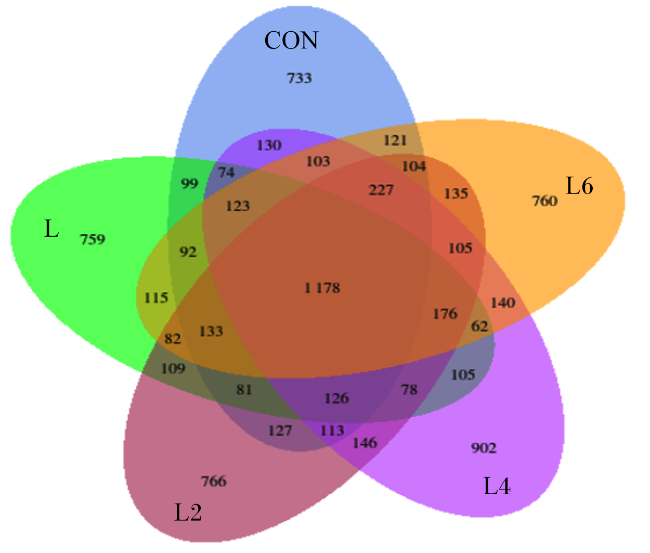
扩增子序列变异(ASVs)韦恩图(图1)可以显示各组肉兔之间盲肠微生物物种差异情况,Ⅰ组特有ASVs有733个,Ⅱ组特有ASVs有759个,Ⅲ组特有ASVs有766个,Ⅳ组特有ASVs有902个,Ⅴ组特有ASVs有760个。
图1 ASVs分布韦恩图

CON、L、L2、L4、L6分别代表Ⅰ、Ⅱ、Ⅲ、Ⅳ、Ⅴ组。

Fig.1 Venn diagram of ASVs distribution

CONTER, L, L2, L4 and L6 represented groups Ⅰ, Ⅱ, Ⅲ, Ⅳ and Ⅴ, respectively.

2.5.2 α多样性

表6可知,与Ⅰ组相比,Ⅱ组各α多样性指数均无显著差异(P>0.05),Ⅲ、Ⅳ组Chao1指数显著升高(P<0.05)。与Ⅱ组相比,Ⅲ、Ⅳ、Ⅴ组Observed_ASVs指数显著升高(P<0.05),Ⅲ、Ⅳ组Chao1、Shannon指数显著升高(P<0.05)。
表6 低蛋白质饲粮中添加精氨酸对肉兔盲肠微生物α多样性的影响

Table 6 Effects of low protein diet supplemented with arginine on microbial alpha diversity in cecum of meat rabbits

项目
Items
组别Groups P
P-value
Observed_ASVs指数
Observed_ASVs index
908.43±75.22ab 789.43±51.41b 956.57±38.6a 1 018.43±25.82a 943.86±32.93a 0.009
Chao1指数Chao1 index 806.15±81.44b 795.55±51.09b 993.11±45.42a 1 030.14±27.14a 932.43±34.5ab 0.030
Pielou_e指数Pielou_e index 0.78±0.01 0.74±0.03 0.78±0.02 0.80±0.02 0.78±0.01 0.300
Shannon指数Shannon index 7.63±0.19ab 7.20±0.26b 7.96±0.25a 8.15±0.17a 7.77±0.12ab 0.029
Simpson指数Simpson index 0.98±0.00 0.97±0.01 0.97±0.01 0.98±0.00 0.98±0.00 0.377

2.5.3 菌群组成

2.5.3.1 门水平

表7可知,低蛋白质饲粮中添加精氨酸对肉兔盲肠微生物中变形菌门(Proteobacteria)的相对丰度有显著影响(P<0.05),具体表现为Ⅴ组显著低于Ⅱ、Ⅲ组(P<0.05)。
表7 低蛋白质饲粮中添加精氨酸对肉兔盲肠微生物门水平相对丰度的影响(前10位)

Table 7 Effects of low protein diet supplemented with arginine on relative abundances of cecal microbes at phylum level of meat rabbits (top 10) %

项目
Items
组别Groups P
P-value
厚壁菌门Firmicutes 45.38±1.67 43.00±5.14 49.79±3.70 53.10±4.27 46.75±2.33 0.344
拟杆菌门Bacteroidota 45.15±2.15 44.27±2.70 41.36±4.29 36.62±4.06 43.55±2.71 0.382
螺旋体门Spirochaetota 0.11±0.06 4.56±4.26 0.39±0.19 0.18±0.13 0.18±0.09 0.403
疣微菌门Verrucomicrobiota 3.90±1.18 3.50±1.00 2.62±0.71 4.58±1.37 4.09±1.04 0.763
广古菌门Euryarchaeota 0.42±0.27 0.25±0.09 0.23±0.08 0.23±0.10 1.15±0.98 0.572
蓝细菌门Cyanobacteria 0.86±0.45 0.17±0.05 0.39±0.09 1.04±0.65 0.50±0.18 0.453
脱硫杆菌门Desulfobacterota 0.77±0.14 0.54±0.15 1.55±0.31 1.52±0.36 1.44±0.49 0.089
变形菌门Proteobacteria 1.90±0.27ab 2.31±0.40a 2.34±0.37a 1.48±0.27ab 1.15±0.07b 0.031
髌骨细菌门Patescibacteria 0.49±0.11 0.63±0.12 0.49±0.21 0.38±0.06 0.23±0.10 0.280
放线菌门Actinobacteriota 0.47±0.09 0.46±0.18 0.29±0.06 0.27±0.04 0.23±0.04 0.304

2.5.3.2 属水平

表8可知,低蛋白质饲粮中添加精氨酸对肉兔盲肠微生物属水平的相对丰度没有显著影响(P>0.05)。
表8 低蛋白质饲粮中添加精氨酸对肉兔盲肠微生物属水平相对丰度的影响(前20位)

Table 8 Effects of low protein diet supplemented with arginine on relative abundances of cecal microbes at genus level of meat rabbits (top 20) %

项目
Items
组别Groups P
P-value
理研菌科RC9肠道群
Rikenellaceae_RC9_gut_group
1.01±1.01 1.44±1.08 3.63±3.63 0.23±0.21 0.18±0.18 0.636
Sphaerochaeta 0.11±0.06 4.55±4.26 0.39±0.19 0.18±0.13 0.18±0.09 0.403
克曼菌属Akkermansia 3.90±1.18 3.50±1.00 2.62±0.71 4.58±1.37 4.09±1.04 0.763
Unidentified_Muribaculaceae 0.02±0.01 0.42±0.27 0.04±0.02 0.08±0.06 1.18±1.18 0.513
dgA-11肠道群dgA-11_gut_group 0.68±0.36 1.33±0.68 0.40±0.19 2.62±1.17 2.39±1.04 0.193
拟杆菌属Bacteroides 2.55±0.70 2.81±1.14 1.19±0.44 2.66±0.93 1.54±0.47 0.489
真杆菌属siraeum
[Eubacterium]_siraeum_group
2.30±0.29 3.12±0.75 2.72±0.33 3.03±0.58 2.42±0.38 0.720
NK4A214群NK4A214_group 2.14±0.44 2.28±0.45 2.83±0.58 2.56±0.41 2.65±0.70 0.886
甲烷球形菌属Methanosphaera 0.11±0.04 0.16±0.06 0.05±0.02 0.07±0.03 0.87±0.81 0.469
另枝菌属Alistipes 2.52±0.96 2.42±0.70 2.24±0.42 3.09±0.89 2.91±0.68 0.924
V9D2013群V9D2013_group 2.02±0.67 1.91±0.58 1.63±0.34 1.90±0.65 1.15±0.33 0.787
瘤胃球菌属Ruminococcus 3.30±0.37 2.53±0.58 2.34±0.36 2.44±0.45 2.49±0.51 0.598
理研菌属Rikenella 0.03±0.02 0.03±0.01 0.73±0.64 0.47±0.41 0.07±0.04 0.490
肠球菌属Enterococcus 0.00±0.00 0.00±0.00 0.02±0.02 0.02±0.02 0.65±0.65 0.434
考拉杆菌属Phascolarctobacterium 0.52±0.24 0.74±0.68 0.85±0.36 1.78±0.50 0.93±0.29 0.336
克里斯滕森菌科R-7群
Christensenellaceae_R-7_group
1.15±0.16 1.50±0.28 1.17±0.17 1.15±0.26 1.28±0.15 0.734
UCG-005 0.71±0.26 0.69±0.18 0.84±0.24 0.93±0.19 0.91±0.27 0.917
Intestinimonas 0.42±0.18 0.57±0.27 0.36±0.14 0.43±0.27 0.30±0.06 0.902
马赛菌属Mailhella 0.22±0.08 0.00±0.00 0.19±0.17 0.66±0.27 0.65±0.31 0.099
脱硫杆菌属Desulfovibrio 0.41±0.10 0.33±0.13 1.02±0.19 0.72±0.18 0.64±0.25 0.074

3 讨论

3.1 低蛋白质饲粮中添加精氨酸对肉兔血清免疫球蛋白含量的影响

血清免疫球蛋白在机体免疫系统中发挥着重要作用,也是用来衡量机体免疫能力的重要指标。本研究发现,给肉兔饲喂低蛋白质饲粮对血清IgA、IgG、IgM含量没有显著影响,这与张磊正等[13]的研究结果基本一致。本试验研究表明,低蛋白质饲粮中添加0.4%的精氨酸能显著提高肉兔血清中IgG、IgM含量。有研究证实,在饲粮中添加精氨酸可显著提高肉鸡血清中IgG、IgM含量[14],与本试验研究结果基本一致。

3.2 低蛋白质饲粮中添加精氨酸对肉兔血清NO含量及血清和空肠iNOS活性的影响

NO是体内多种组织及细胞产生的多功能生物信号传导分子,可以调节血管张力、舒张血管平滑肌[15],能通过调节肠道的血流量和分泌功能促进肠道的生长发育。NO能通过iNOS以精氨酸作为唯一底物合成,NOS分为神经型(nNOS)、诱导型(iNOS)和内皮型(eNOS),其中iNOS是影响NO的主要影响因素之一[16]。本研究发现,低蛋白质饲粮中添加精氨酸能够提高肉兔血清中NO含量,提高血清和空肠中iNOS活性。这可能是由于精氨酸的添加导致iNOS的活性增加,从而提高血清中NO的含量。这在张林林[16]的研究中得到证实,其研究发现在饲粮中添加精氨酸可以提高獭兔血清和空肠中NO含量和iNOS活性。周锡红等[17]研究发现,饲粮中添加精氨酸会调高仔猪血浆中NO的含量。孙悦等[18]研究发现,饲粮中添加不同水平精氨酸显著提高了临武鸭血清中NO含量,但是随着精氨酸添加量的升高,血清NO含量呈现降低的趋势,说明过高水平的精氨酸会对机体iNOS和NO的合成产生抑制。本试验结果与上述研究结果基本一致。

3.3 低蛋白质饲粮中添加精氨酸对肉兔回肠黏膜免疫因子含量的影响

精氨酸在体内的代谢途径有2条,一是在精氨酸酶的催化下分解为鸟氨酸和尿素,鸟氨酸进一步转化为脯氨酸、谷氨酰胺、腐胺;二是在一氧化氮合酶作用下分解为瓜氨酸和NO[19]。在动物细胞中,精氨酸主要通过以上代谢途径调节NK细胞、T细胞,增强巨噬细胞活性,刺激淋巴细胞以及免疫球蛋白和免疫细胞因子的产生,从而调节机体的免疫能力[20]。张林林[17]研究证明,饲粮中添加精氨酸能够提高仔幼兔空肠中IFN-γ、IL-10含量。彭众[21]研究发现,哺乳期补饲精氨酸可以显著提高21日龄断奶仔猪回肠黏膜sIgA含量。陈西风等[22]研究表明,在饲粮中添加不同水平的精氨酸均能够显著提升肉鸡血清中IFN-γ含量。以上结果说明,饲粮中添加精氨酸能够有效降低动物机体促炎因子的含量,提高抗炎因子的含量,对机体的免疫能力有提升作用,本试验结果与此基本一致。

3.4 低蛋白质饲粮中添加精氨酸对肉兔空肠抗氧化指标的影响

精氨酸可以通过提高血浆或组织细胞中SOD、GSH-Px等抗氧化酶的活性等方式来增强畜禽的抗氧化能力[23]。吴俊光等[24]的研究表明,饲料中添加精氨酸能够显著提高杂交鲟幼鱼前肠、中肠、后肠中SOD、GSH-Px活性。陈莹等[25]研究发现,饲粮中添加1.02%精氨酸可以显著五龙鹅空肠中GSH-Px活性。范秋丽等[26]研究发现,在饲粮中添加精氨酸后,清远麻鸡血浆T-SOD、GSH-Px活性和T-AOC以及空肠黏膜T-SOD活性和血浆MDA含量随饲粮精氨酸水平的升高而呈先升高后降低的变化趋势。SOD和GSH-Px是动物机体抗氧化防御体系中的重要抗氧化酶,SOD通过催化超氧阴离子自由基(O2-·)发生歧化反应来清除机体内的活性氧(ROS);GSH-Px通过催化过氧化物反应来减少羟基自由基的生成[27]。本试验结果表明,低蛋白质饲粮中添加精氨酸能显著提高肉兔空肠中T-SOD、GSH-Px的活性和T-AOC,与以上研究结果基本一致。这可能与精氨酸的添加能够调节机体NO含量和促进谷氨酸的合成有关,而谷氨酸含量提高会提高GSH-Px合成的效率,清除氧自由基,提高抗氧化酶活性[28]

3.5 低蛋白质饲粮中添加精氨酸对肉兔盲肠微生物区系的影响

肉兔由野兔进化而来,是单胃草食动物且盲肠发达,盲肠内含有大量的内源微生物,盲肠内微生物在增加营养成分的消化利用方面发挥重要作用,能够维持肠道健康,促进肠道消化吸收[29]。本研究表明,饲喂低蛋白质饲粮不会对肉兔盲肠微生物α多样性产生显著影响,这与赵伟玉[30]的研究结果基本一致。本研究中,在低蛋白质饲粮中添加精氨酸能够显著增加盲肠微生物的ASVs数目以及Chao1和Shannon指数,这与前人研究结果[31]相同。此外,本研究还发现,肉兔盲肠中相对丰度较高的3个菌门是厚壁菌门(Firmicutes)、拟杆菌门(Bacteroidetes)和变形菌门。变形菌门以革兰氏阴性细菌居多,包括大肠杆菌和多种病原菌[32]。本研究中,在低蛋白质饲粮中添加精氨酸能够显著降低变形菌门的相对丰度,说明精氨酸能一定程度上维护肠道健康。研究表明,厚壁菌门和拟杆菌门占在哺乳动物肠道微生物群中检测到的16 S rRNA序列的>98%,厚壁菌门和拟杆菌门能够帮助宿主从其他难消化的碳水化合物来源中获得能量,以及促进木质素等难消化物质的降解[33]。因此,厚壁菌门和拟杆菌门相对丰度的稳定对于肠道健康有着重要作用。本试验中,低蛋白质饲粮中添加精氨酸在属水平上对肉兔盲肠微生物组成没有显著影响。

4 结论

低蛋白质饲粮中添加精氨酸能够提高肉兔机体血清免疫球蛋白含量,改善肠道免疫性能和抗氧化能力,改善盲肠微生物区系,有益于维持肠道健康。综合本试验结果,低蛋白质饲粮中精氨酸的最适添加水平为0.4%。
[1]
宋小燕, 杨朝武, 余春林, 等. 畜禽豆粕减量替代技术研究进展[J]. 黑龙江畜牧兽医, 2024(17):13-17.

SONG X Y, YANG C W, YU C L, et al. Research progress on soybean meal reduction and replacement technology for livestock and poultry[J]. Heilongjiang Animal Science and Veterinary Medicine, 2024(17):13-17. (in Chinese)

[2]
吴秋杰, 刘佳, 陈华云, 等. 玉米豆粕减量替代营养调控在养猪上的研究进展[J]. 中国猪业, 2024, 19(4):12-18.

WU Q J, LIU J, CHEN H Y, et al. Research progress on reducing and replacing nutritional regulation with corn and soybean meal in pigs feed[J]. China Swine Industry, 2024, 19(4):12-18. (in Chinese)

[3]
郑爱荣, 牛岩, 张晓霞, 等. 豆粕减量替代的意义、研究进展与对策建议[J]. 饲料工业, 2023, 44(14):93-98.

ZHENG A R, NIU Y, ZHANG X X, et al. Significance,research progress and countermeasure on reduction and substitution of soybean meal[J]. Feed Industry, 2023, 44(14):93-98. (in Chinese)

[4]
戚继存, 王铁军, 邓靖宇, 等. 低蛋白日粮饲养肉鸡推广与应用技术[J]. 北方牧业, 2024(6):15.

QI J C, WANG T J, DENG J Y, et al. Promotion and application technology of broiler raised on low protein diets[J]. Northern Pastoralism, 2024(6):15. (in Chinese)

[5]
邱凯, 张广民, 郑爱娟, 等. 低蛋白日粮添加新型毕赤酵母蛋白酶对肉鸡生长性能、胴体性状、机体免疫和氨基酸表观回肠消化率的影响[J]. 中国饲料, 2023(22):171-177.

QIU K, ZHANG G M, ZHENG A J, et al. Effects of the addition of novel Pichia pastoris protease to low-protein diets on growth performance,carcass traits,immunity and apparent ileal digestibility of amino acids in broilers[J]. China Feed, 2023(22):171-177. (in Chinese)

[6]
夏伟光, 何国戈, 郑经成, 等. 低蛋白氨基酸平衡饲粮对清远麻鸡生长性能、屠宰性能、肉品质及血液指标的影响[J]. 中国畜牧杂志, 2022, 58(6):179-183.

XIA W G, HE G G, ZHENG J C, et al. Effects of low protein amino acid balanced diet on growth performance,carcass traits,meat quality and blood indices of Qingyuan broilers[J]. Chinese Journal of Animal Science, 2022, 58(6):179-183. (in Chinese)

[7]
韩祥林, 林钟鸣. 幼兔腹泻类疾病的原因分析与防治[J]. 中国养兔杂志, 2024(1):39-40.

HAN X L, LIN Z M. Analysis of the causes and prevention of diarrhea-like diseases in young rabbits[J]. Chinese Journal of Rabbit Farming, 2024(1):39-40. (in Chinese)

[8]
张硕, 窦秀静. 精氨酸的营养生理功能及其对动物免疫调节作用的分析[J]. 中国动物保健, 2021, 23(8):96-97.

ZHANG S, DOU X J. Analysis of the nutritional and physiological functions of arginine and its role in immunomodulation in animals[J]. China Animal Health, 2021, 23(8):96-97. (in Chinese)

[9]
WENKAI P, SHUAI C, JIE Y, et al. Dietary arginine supplementation of mice alters the microbial population and activates intestinal innate immunity[J]. The Journal of Nutrition, 2014, 144(6):988-995.

[10]
田一航, 宋毅, 陈代文, 等. 低出生重对仔猪肝脏抗氧化功能的影响及精氨酸的营养效应[J]. 四川农业大学学报, 2019, 37(3):383-389.

TIAN Y H, SONG Y, CHEN D W, et al. Effects of low birth weight on the antioxidant function in liver of piglets and the nutritional regulation of L-arginine[J]. Journal of Sichuan Agricultural University, 2019, 37(3):383-389. (in Chinese)

[11]
任启峰, 高淑霞, 杨丽萍, 等. 低蛋白质饲粮中添加精氨酸对肉兔生长性能,养分表观消化率,屠宰性能,血清生化指标及肉品质的影响[J]. 动物营养学报, 2024, 36(12):7956-7966.

DOI

REN Q F, GAO S X, YANG L P, et al. Effects of low protein diet supplemented with arginine on growth performance,nutrient apparent digestibility,slaughter performance,serum biochemical indices and meat quality of meat rabbits[J]. Chinese Journal of Animal Nutrition, 2024, 36(12):7956-7966. (in Chinese)

[12]
丁永霞. 茚三酮显色分光光度法测定食品中α-氨基酸含量的方法探讨[J]. 食品工程, 2017(1):55-57.

DING Y X. Determination of alpha amino acid in food by ninhydrin color spectrophotometry[J]. Food Engineering, 2017(1):55-57. (in Chinese)

[13]
张磊正, 龚建刚, 荆佳林, 等. 低蛋白饲粮添加酶菌肽复合制剂对肉鸡养分表观利用率、免疫功能及肠道健康的影响[J]. 中国家禽, 2022, 44(12):72-79.

ZHANG L Z, GONG J G, JING J L, et al. Effects of low protein diet supplemented with enzyme,probiotics and antimicrobial peptides compound additive on nutrient availability,immune function and intestinal health of broilers[J]. China Poultry, 2022, 44(12):72-79. (in Chinese)

[14]
PEREZ-CARBAJAL C, CALDWELL D, FARNELL M, et al. Immune response of broiler chickens fed different levels of arginine and vitamin E to a coccidiosis vaccine and Eimeria challenge[J]. Poultry Science, 2010, 89(9):1870-1877.

[15]
JOBGEN W S, FRIED S K, FU W J, et al. Regulatory role for the arginine-nitric oxide pathway in metabolism of energy substrates[J]. The Journal of Nutritional Biochemistry, 2006, 17(9):571-588.

[16]
张林林. 精氨酸或NCG对獭母兔繁殖性能和对仔幼兔生长、抗氧化应激及免疫的影响及其机制[D]. 硕士学位论文. 南京: 南京农业大学, 2017.

ZHANG L L. Mechanism and effect of arginine or NCG on doe reproductive performance and growth performance,ability of antioxidant and anti-stress and immunity in young rabbit[D]. Master's Thesis. Nanjing: Nanjing Agricultural University, 2017. (in Chinese)

[17]
周锡红, 吴信, 唐香山, 等. 不同水平精氨酸生素对断奶仔猪生长性能和血液指标的影响[J]. 农业现代化研究, 2010, 31(2):237-240.

ZHOU X H, WU X, TANG X S, et al. Effects of different dietary arginine activator additive on growth performance and plasma biochemical parameters in early-weaned piglets[J]. Research of Agricultural Modernization, 2010, 31(2):237-240. (in Chinese)

[18]
孙悦, 戴求仲, 蒋桂韬, 等. 饲粮精氨酸水平对8-35日龄临武鸭生长性能及血清生化、抗氧化和免疫指标的影响[J]. 动物营养学报, 2022, 34(9):5767-5776.

DOI

SUN Y, DAI Q Z, JIANG G T, et al. Effects of dietary arginine level on growth performance,serum biochemical,antioxidant and immune indexes of Linwu ducks during 8 to 35 days of age[J]. Chinese Journal of Animal Nutrition, 2022, 34(9):5767-5776. (in Chinese)

DOI

[19]
王莹, 姜廷波, 孙泽威. L-精氨酸代谢产物对动物营养调控的研究进展[J]. 中国畜牧杂志, 2017, 53(3):13-17.

WANG Y, JIANG Y B, SUN Z W. Advance in animal nutritional regulation of L-arginine metabolites[J]. Chinese Journal of Animal Science, 2017, 53(3):13-17. (in Chinese)

[20]
张益凡, 徐颖, 胡良宇, 等. 动物机体精氨酸和赖氨酸功能互作效应与机制的研究进展[J]. 中国畜牧杂志, 2022, 58(6):105-110,116.

ZHANG Y F, XU Y, HU L Y, et al. Research progress on the interaction effect and mechanism of arginine and lysine in animal body[J]. Chinese Journal of Animal Science, 2022, 58(6):105-110,116. (in Chinese)

[21]
彭众. 早期断奶对树突状细胞介导的仔猪肠道黏膜免疫功能的影响及精氨酸对其的调节作用[D]. 硕士学位论文. 扬州: 扬州大学, 2019.

PENG Z. Effect of early weaning on dendritic cell-mediated intestinal mucosal immune function in piglets and its modulation by arginine[D]. Master's Thesis. Yangzhou: Yangzhou University, 2019. (in Chinese)

[22]
陈西风, 刘维平. 饲粮中补充不同水平精氨酸对肉鸡生长性能及免疫的影响[J]. 中国饲料, 2019(21):51-53.

CHEN X F, LIU W P. Effects of dietary arginine supplementation on growth performance and immune status of broiler chickens[J]. China Feed, 2019(21):51-53. (in Chinese)

[23]
徐明明, 刘耀文, 曲湘勇. 精氨酸的生理功能及其在肉鸡生产中的应用[J]. 广东饲料, 2017, 26(3):29-32.

XU M M, LIU Y W, QU X Y. Physiological functions of arginine and its application in broiler production[J]. Guangdong Feed, 2017, 26(3):29-32. (in Chinese)

[24]
吴俊光, 王连生, 王常安, 等. 饲料中精氨酸水平对杂交鲟幼鱼抗氧化能力及血清生化指标的影响[J]. 大连海洋大学学报, 2016, 31(3):272-279.

WU J G, WANG L S, WANG C A, et al. Effects of dietary arginine levels on antioxidative state and serum biochemical indices in juvenile hybrid sturgeon[J]. Journal of Dalian Fisheries University, 2016, 31(3):272-279. (in Chinese)

[25]
陈莹, 张贝贝, 王宝维, 等. 精氨酸对产蛋期五龙鹅肝脏生化、抗氧化和肠道抗氧化、免疫指标的影响[J]. 饲料研究, 2023, 46(20):30-34.

CHEN Y, ZHANG B B, WANG B W, et al. Effect of arginine on liver biochemistry,antioxidant and intestinal antioxidant and immune indexes of Wulong geese during laying period[J]. Feed Research, 2023, 46(20):30-34. (in Chinese)

[26]
范秋丽, 叶金玲, 林楚晓, 等. 饲粮精氨酸水平对91-120日龄清远麻鸡生长性能、抗氧化能力、免疫功能和肉品质的影响[J]. 动物营养学报, 2021, 33(7):3821-3832.

DOI

FAN Q L, YE J L, LIN C X, et al. Effects of dietary arginine level on growth performance,antioxidant capacity,immune function and meat quality of Qingyuan partridge chickens during 91 to 120 days of age[J]. Chinese Journal of Animal Nutrition, 2021, 33(7):3821-3832. (in Chinese)

[27]
俞清霞. 低蛋白饲粮添加精氨酸对断乳仔猪生长性能、血液抗氧化和免疫指标的影响[J]. 福建畜牧兽医, 2024, 46(5):13-17.

YU Q X. Effects of low-protein diet supplemented with arginine on the growth performance,blood antioxidant and immune indicators of weaned piglets[J]. Journal of Animal Husbandry and Veterinary Medicine Fujian, 2024, 46(5):13-17. (in Chinese)

[28]
梁明才, 杨林. 精氨酸抗氧化作用机制[J]. 生物信息学, 2020, 18(4):201-205.

LIANG M C, YANG L. Antioxidant mechanism of arginine[J]. China Journal of Bioinformatics, 2020, 18(4):201-205. (in Chinese)

[29]
徐建, 季荣梅, 张莉蕊, 等. 饲粮不同比例番茄秸秆替代花生秧对肉兔生长性能、营养物质表观消化率和盲肠微生物结构的影响[J]. 动物营养学报, 2024, 36(6):3920-3930.

DOI

XU J, JI R M, ZHANG L R, et al. Effects of different ratios of tomato straw substituted for peanut straw in diets on growth performance,apparent digestibility of nutrients and cecal microbial structure of meet rabbits[J]. Chinese Journal of Animal Nutrition, 2024, 36(6):3920-3930. (in Chinese)

[30]
赵伟玉. 饲粮粗蛋白质和赖氨酸水平对北京油鸡生长性能、肉品质和肠道微生物区系的影响[D]. 硕士学位论文. 泰安: 山东农业大学, 2023.

ZHAO W Y. Effects of dietary crude protein and lysine levels on growth performance,meat quality and gut microbiota of Beijing you chicken[D]. Master's Thesis. Tai'an: Shandong Agricultural University, 2023. (in Chinese)

[31]
戴东. 胚蛋给养L-精氨酸对蛋雏鸡早期肠道发育与微生物区系的作用[D]. 硕士学位论文. 北京: 中国农业科学院, 2020.

DAI D. Effects of in ovo feeding of L-arginine on the early intestinal development and microflora of pullets[D]. Master's Thesis. Beijing: Chinese Academy of Agricultural Sciences, 2020. (in Chinese)

[32]
吕景智. 精氨酸和菊粉对肉兔肠道形态、盲肠菌群结构和生产性能的影响[D]. 博士学位论文. 重庆: 西南大学, 2017.

LYU J Z. Effect of arginine and inulin on intestinal morphology,caecal microflora and growth performance of meat rabbits[D]. Ph.D.Thesis. Chongqing: Southwest University, 2017. (in Chinese)

[33]
THOMAS F, HEHEMANN J H, REBUFFET E, et al. Environmental and gut Bacteroidetes:the food connection[J]. Frontiers in Microbiology, 2011,2:93.

文章导航

/