研究论文

饲粮中添加灭活植物乳杆菌对断奶仔猪生长性能和肠道健康的影响

  • 武祎凡 , 1 ,
  • 徐有晗 1 ,
  • 康露渊 1 ,
  • 武玉珺 1 ,
  • 刘晶晶 2 ,
  • 邹有为 1 ,
  • 刘筱怡 1 ,
  • 臧建军 1, 3 ,
  • 何春兰 2 ,
  • 杨俊岚 2 ,
  • 李雪平 2 ,
  • 赵金标 1, 3 ,
  • 韩丹丹 1, 3 ,
  • 王军军 , 1, 3, *
展开
  • 1 中国农业大学动物科学技术学院,畜禽营养与饲养全国重点实验室,北京 100193
  • 2 江西好实沃生物技术有限公司,宜春 336000
  • 3 中国农业大学教授工作站,宜春 336000
*王军军,教授,博士生导师,E-mail:

武祎凡(1998—),男,新疆阿克苏人,硕士研究生,动物营养与饲料科学专业。E-mail:

Copy editor: 武海龙

收稿日期: 2024-10-24

  网络出版日期: 2025-06-12

基金资助

国家自然科学基金项目(32125036)

国家自然科学基金项目(32330100)

国家自然科学基金项目(32172750)

国家自然科学基金项目(32302765)

北京市自然科学基金项目(6232024)

国家重点研发计划项目(2022YFA1304201)

国家现代农业产业技术体系建设专项(CARS-35)

中国农业大学教授工作站(20230610)

饲料资源开发与高效利用学科创新引智基地(111创新引智基地)(B16044)

中国农业大学人才发展培育计划资助(1041-00109011)

Effects of Dietary Inactivated Lactobacillus plantarum on Growth Performance and Intestinal Health of Weaned Piglets

  • WU Yifan , 1 ,
  • XU Youhan 1 ,
  • KANG Luyuan 1 ,
  • WU Yujun 1 ,
  • LIU Jingjing 2 ,
  • ZOU Youwei 1 ,
  • LIU Xiaoyi 1 ,
  • ZANG Jianjun 1, 3 ,
  • HE Chunlan 2 ,
  • YANG Junlan 2 ,
  • LI Xueping 2 ,
  • ZHAO Jinbiao 1, 3 ,
  • HAN Dandan 1, 3 ,
  • WANG Junjun , 1, 3, *
Expand
  • 1 State Key Laboratory of Animal Nutrition and Feeding, College of Animal Science and Technology, China Agricultural University, Beijing 100193, China
  • 2 Jiangxi Heswof Biotechnology Co., Ltd., Yichun 336000, China
  • 3 The Professor Workstation of China Agricultural University, Yichun 336000, China
* professor, E-mail:

Received date: 2024-10-24

  Online published: 2025-06-12

摘要

本试验旨在研究饲粮中添加灭活植物乳杆菌(L. plantarum)对断奶仔猪生长性能和肠道健康的影响。选取28日龄初始体重为7.71 kg的健康“杜×长×大”断奶仔猪192头,随机分为4组,每组6个重复,每个重复8头猪。对照组(CON组)饲喂基础饲粮,试验组分别饲喂添加800 g/t Z100[灭活L. plantarum及其代谢产物乳酸、短链脂肪酸(SCFA)和细菌素,Z100组]、Z518(灭活L. plantarum及其代谢产物乳酸、SCFA、细菌素、枯草芽孢杆菌、丁酸梭菌和葡萄糖氧化酶,Z518组)的试验饲粮,阳性对照组(PC组)饲喂添加800 g/t抗菌肽和精油的试验饲粮。试验期42 d。结果表明:1)与CON组相比,Z100组和Z518组的42 d的体重显著增加(P<0.05),22~42 d和1~42 d的平均日增重(ADG)显著增加(P<0.05),22~42 d和1~42 d的料重比(F/G)显著降低(P<0.05),1~21 d和1~42 d的腹泻率显著降低(P<0.05)。2)与CON组相比,Z518组的血清葡萄糖(GLU)含量显著提高(P<0.05),Z100组的血清免疫球蛋白A(IgA)、免疫球蛋白M(IgM)和免疫球蛋白G(IgG)含量显著提高(P<0.05)。3)与CON组相比,Z100组和Z518组的空肠绒毛高度(VH)和绒毛高度与隐窝深度(V/C)均显著提高(P<0.05)。4)与CON组相比,Z100组的空肠闭锁小带蛋白-1(ZO-1)的mRNA相对表达量增加(P<0.05);Z518组的回肠黏蛋白-1(Mucin-1)的mRNA相对表达量增加(P<0.05),Z100组和Z518组的回肠黏蛋白-2(Mucin-2)的mRNA相对表达量增加(P<0.05)。5)与CON组相比,Z100组和Z518组的空肠肿瘤坏死因子-α(TNF-α)和白细胞介素-6(IL-6)的mRNA相对表达量水平显著降低(P<0.05),Z100组的回肠TNF-α的mRNA相对表达量显著降低(P<0.05)。6)与CON组相比,Z100组的结肠丁酸弧菌属(Butyrivibrio)和毛螺菌科NK4B4群(Lachnospiraceae_NK4B4_group)相对丰度提高,Z518组的结肠单球菌(Monoglobus)和丁酸菌科(Butyricicoccaceae)相对丰度提高。由此可见,饲粮中添加Z100和Z518能够改善断奶仔猪空肠黏膜的形态和结构,增强肠道屏障功能,提高机体抗炎能力,调节结肠微生物组成,从而改善断奶仔猪的生长性能,减轻断奶应激。

本文引用格式

武祎凡 , 徐有晗 , 康露渊 , 武玉珺 , 刘晶晶 , 邹有为 , 刘筱怡 , 臧建军 , 何春兰 , 杨俊岚 , 李雪平 , 赵金标 , 韩丹丹 , 王军军 . 饲粮中添加灭活植物乳杆菌对断奶仔猪生长性能和肠道健康的影响[J]. 动物营养学报, 2025 , 37(6) : 3618 -3632 . DOI: 10.12418/CJAN2025.298

Abstract

This study aimed to investigate the effects of dietary inactivated Lactobacillus plantarum (L. plantarum) on growth performance and intestinal health of weaned piglets. One hundred and ninety two 28-day-old healthy “Duroc×Landrace×Large White” weaned piglets with initial body weight of 7.71 kg were randomly divided into 4 groups with 6 replicates per group and 8 pigs per replicate. The control group (CON) was fed a basal diet, the experimental group was fed basal diets supplemented with 800 g/t Z100 [inactivated L. plantarum and its metabolites lactic acid, short chain fatty acids (SCFA) and bacteriocins, Z100 group] and Z518 (inactivated L. plantarum and its metabolites lactic acid, SCFA, bacteriocins, Bacillus subtilis, Clostridium butyricum and glucose oxidase, Z518 group), the positive control group (PC group) was fed the basal diet supplemented with 800 g/t antimicrobial peptides and essential oils. The experimental period was 42 days. The results showed as follows: 1) compared with the CON group, the body weight on 42 days of Z100 group and Z518 group was significantly increased (P<0.05), the average daily weight gain (ADG) during 22 to 42 days and 1 to 42 days was significantly increased (P<0.05), the feed to gain ratio (F/G) during 22 to 42 days and 1 to 42 days was significantly decreased (P<0.05), and the diarrhea rate during 1 to 21 days and 1 to 42 days was significantly decreased (P<0.05). 2) Compared with the CON group, the serum glucose (GLU) content of Z518 group was significantly increased (P<0.05), and the contents of immunoglobulin A (IgA), immunoglobulin M (IgM) and immunoglobulin G (IgG) in serum of Z100 group were significantly increased (P<0.05). 3) Compared with the CON group, the villus height (VH) and villus height/crypt depth (V/C) in jejunum of Z100 group and Z518 group were significantly increased (P<0.05). 4) Compared with the CON group, the mRNA relative expression level of zonula occluden-1 (ZO-1) in jejunum of Z100 group was significantly increased (P<0.05); the mRNA relative expression level of mucin-1 (Mucin-1) in ileum of Z158 group was significantly increased (P<0.05), and the mRNA relative expression level of mucin-2 (Mucin-2) in ileum of Z100 group and Z518 group was significantly increased (P<0.05). 5) Compared with the CON group, the mRNA relative expression levels of tumor necrosis factor-α (TNF-α) and interleukin-6 (IL-6) in jejunum of Z100 group and Z518 group were significantly decreased (P<0.05), and the mRNA relative expression level of TNF-α in ileum of Z100 group was significantly decreased (P<0.05). 6) Compared with the CON group, the relative abundances of Butyricivibrio and Lachnospiraceae_NK4B4_group in colon of Z100 group were increased, and the relative abundances of Monococcus and Butyriciaceae in colon of Z518 group were increased. In conclusion, dietary Z100 and Z518 can improve the jejunal mucosa morphology and structure of weaned piglets, enhance the intestinal barrier function, improve the body anti-inflammatory ability, and regulate the colonic microbial composition, which improve the growth performance of weaned piglets, alleviate the weaning stress.

集约化养猪生产广泛采用早期断奶方式以加快周转,这种方式在提高母猪繁殖效率和产房利用率方面也具有优势[1-3]。然而,早期断奶导致仔猪消化系统发育不完善、肠道菌群不稳定,加上饲料配方、饲养环境等因素的变化,容易导致仔猪食欲下降、消化不良、腹泻甚至死亡[4]。在传统的饲养环节,抗生素常作为维持仔猪正常生长发育或治疗肠道感染的重要手段,但因其细菌耐药性、环境污染、危害人体健康等问题,2020年起我国已禁止在畜禽饲料中添加抗生素[5-7]。因此,开发益生菌、益生元及后生元等抗生素替代物已成为饲料添加剂行业的发展趋势[6,8]
仔猪断奶后肠道菌群发生变化,肠道菌群紊乱是仔猪早期腹泻的主要原因之一[9]。研究发现,断奶应激引起的腹泻会减少仔猪肠道中有益菌如乳杆菌属(Lactobacillus)、布劳特氏菌属(Blautia)、罗氏菌属(Roseburia)和普雷沃氏菌属(Prevotella)的相对丰度,且会增加梭菌属(Clostridium)、大肠杆菌(Escherichia coli)、弯曲杆菌属(Campylobacter)和脱硫弧菌属(Desulfovibrio)等病原菌的相对丰度[10]。致病菌侵入肠道,破坏原有的微生态系统,引起微生物生态失调[11],而肠道菌群的稳态可以有效平衡宿主的健康和疾病状态[12]。因此,使用益生菌和益生元可以有效缓解微生物生态失调的风险。研究表明,益生菌及其代谢产物可以改善肠道环境,竞争性地抑制肠道病原菌对肠道的黏附,并有助于体内有益菌的生长[13]。同时,益生菌能够保护肠道屏障功能的完整性,从而调节机体的免疫功能,抑制肠道炎症反应,促进营养物质的吸收和利用,改善宿主肠道内环境的微生态平衡[14]。在仔猪断奶早期使用益生菌或益生元还可以使微生物早期定植,改善肠道微生物的组成并促进免疫成熟[15]
植物乳杆菌(Lactobacillus plantarum,L. plantarum)是一种不产生孢子的革兰氏阳性细菌[16],被认为是一种益生菌,其发酵产生的乳酸、短链脂肪酸(SCFA)、细菌素和其他生物活性物质具有益生作用,对某些致病性的革兰氏阴性和革兰氏阳性细菌具有抑菌作用[17]。近年来,随着人们对L. plantarum的了解不断加深,它在调节机体免疫力、促进生长性能和减轻细胞氧化损伤方面的生物学功能被逐渐发现[18-21]。饲粮中添加L. plantarum可改善断奶仔猪生长性能和肠道健康,有效缓解腹泻[21]。在水生动物饲料中添加L. plantarum具有相似的作用效果[18,22-24]。饲粮中添加1.25×10⁹ CFU/kg的L. plantarum可以增加断奶仔猪肠道微生物群落的多样性,减轻回肠的炎症[25]。此外,饲粮中添加L. plantarum能够提高畜产品的质量[19]。然而,L. plantarum活菌在动物胃肠道的低pH环境中稳定性较差,饲料生产过程中的高温造粒可能会降低其活性,使其在实际生产应用中存在困难[26-27]L. plantarum活菌的这些缺点,导致需要探索使用灭活L. plantarum。灭活L. plantarum暴露出更多的肽聚糖,具有更强的黏附力和竞争性排斥力,其代谢产物也包含乳酸、SCFA、细菌素等,可有效抑制或杀死肠道中的病原菌[28-29]。相关研究表明,热灭活L. plantarum L-137可促进干扰素(IFN)的产生,增强宿主对小鼠甲型流感病毒感染的防御能力[30]。灭活L. plantarum在增强肠黏膜屏障和调节肠道菌群方面起着至关重要的作用,在动物生产中具有广阔的应用前景[31]。然而,很少有试验探究灭活L. plantarum是否能使断奶仔猪获得更好的生长性能和肠道健康。基于灭活L. plantarum的优势,本试验旨在探究饲粮中添加灭活L. plantarum对断奶仔猪生长性能、腹泻情况、肠道屏障功能和微生物组成的影响,为基于微生物代谢产物的新型添加剂开发与应用提供新思路。

1 材料与方法

1.1 试验材料

本研究使用Z100和Z518这2种灭活L. plantarum及其代谢产物的益生菌添加剂,均由江西某生物技术有限公司自主研发并提供。Z100的主要成分包括灭活L. plantarum(灭活菌数≥1.0×10¹⁰ CFU/g)及其代谢产物乳酸、SCFA和细菌素。Z518的主要成分包括灭活L. plantarum(灭活菌数≥6.5×10⁹ CFU/g)及其代谢产物乳酸、SCFA和细菌素,还包括抑菌型枯草芽孢杆菌(Bacillus subtilis,B. subtilis,有效菌数≥1.0×10⁹ CFU/g)、丁酸梭菌(Clostridium butyricum,C. butyricum,有效菌数≥3.0×10⁸ CFU/g)和葡萄糖氧化酶(1 000 U/g)。

1.2 试验设计和饲养管理

动物试验方案已获得中国农业大学动物护理和使用委员会的批准(许可编号:AW41803202-1-1)。
试验选取28日龄初始体重为7.71 kg的健康“杜×长×大”断奶仔猪192头,随机分为4组,每组6个重复,每个重复8头猪,公母各占1/2。对照组(CON组)饲喂基础饲粮,Z100组在基础饲粮中添加800 g/t的Z100,Z518组在基础饲粮中添加800 g/t的Z518,阳性对照组(PC组)在基础饲粮中添加800 g/t的抗菌肽(500 g/t)和精油(300 g/t)。试验期42 d,分为前期(1~21 d)和后期(22~42 d)2个阶段。基础饲粮组成及营养水平见表1,符合NRC(2012)中断奶仔猪的营养标准。试验期内仔猪自由采食和饮水,严格遵守猪场饲养管理制度,按照猪场的常规程序对仔猪进行消毒、免疫和驱虫。
表1 基础饲粮组成及营养水平(饲喂基础)

Table 1 Composition and nutrient levels of basal diets (as-fed basis) %

项目
Items
含量Content
1~21 d 22~42 d
原料Ingredients
玉米Corn 62.35 65.10
豆粕Soybean meal 9.74 16.10
去皮豆粕Shelled soybean meal 5.20 3.10
鱼粉Fish meal 5.00 3.00
膨化大豆Extruded soybean 8.00 6.00
乳清粉Whey powder 5.40 1.80
豆油Soybean oil 1.00 1.20
磷酸氢钙CaHPO4 0.80 1.10
石粉Limestone 0.70 0.70
氯化钠NaCl 0.20 0.20
L-赖氨酸盐酸盐L-lysine-HCl 0.61 0.64
DL-蛋氨酸DL-methionine 0.10 0.12
L-苏氨酸L-threonine 0.20 0.23
L-色氨酸L-tryptophan 0.04 0.05
预混料Premix1) 0.50 0.50
氧化锌ZnO 0.16 0.16
合计Total 100.00 100.00
营养水平Nutrient levels2)
消化能DE/(MJ/kg) 14.65 14.65
粗蛋白质Crude protein 18.87 18.94
钙Calcium 0.78 0.75
磷Phosphorus 0.64 0.64

1)预混料为每千克饲粮提供 The premix provided the following per kg of diets:VA 12 000 IU,VD3 2 500 IU,VE 30 IU,VK3 3 mg,VB1 2.5 mg,VB2 4.0 mg,VB6 3.0 mg,VB12 12 μg,烟酸 niacin acid 40 mg,硫胺素 thiamine 3 mg,核黄素 riboflavin 6 mg,泛酸 pantothenic acid 5 mg,叶酸 folic acid 0.7 mg,生物素 biotin 50 μg,Fe 90.0 mg,Cu 25 mg,Zn 75 mg,Mn 40 mg,I 0.35 mg,Se 0.3 mg。
2)消化能为计算值,其余为实测值。DE was a calculated value, while the others were measured values.

1.3 样品采集

在试验第42天,每重复(栏)随机选择1头仔猪进行屠宰和取样。采集前腔静脉的血液,将血样在4 ℃下以1 000×g离心15 min以获得血清,然后在-20 ℃保存。屠宰后采集空肠、回肠组织及结肠食糜样品,在液氮中快速冷冻后在-80 ℃保存。收集空肠组织固定在4%多聚甲醛中待进行形态学分析。

1.4 指标测定

1.4.1 饲粮营养成分

饲粮粗蛋白质(CP)含量参考GB/T 6432—2018测定,钙含量参考GB/T 6436—2018测定,磷含量参考GB/T 6437—2018测定。总能(GE)参考ISO 9831:1998测定,并根据总能和采食量计算消化能(DE),计算公式如下:

消化能(MJ/kg)=(摄入总能-粪便总能)/采食量。

1.4.2 生长性能和腹泻率

在试验第21天和第42天,分别称量仔猪体重和每个重复余料重量,并计算仔猪在1~21 d和22~42 d的体重、平均日增重(ADG)、平均日采食量(ADFI)和料重比(F/G)。采用视觉评估法观察仔猪腹泻情况,每天07:30—21:30连续观测仔猪排粪情况(粪便颜色、形状、排粪次数),对每猪每次排出的粪便进行记载和感观评分,统计腹泻个体数并计算腹泻率。腹泻评分标准:条形或粒形粪便(0分);软粪、成形(1分);稠状、成形、粪水无分离现象(2分);液状、不成形、粪水有分离现象(3分)。将得分为2分和3分者定为腹泻。腹泻率计算公式如下:

腹泻率(%)=[(仔猪腹泻头数总和/仔猪头数)×试验天数]×100。

1.4.3 血清生化和免疫指标

血清生化指标包括总蛋白(TP)、白蛋白(ALB)、球蛋白(GLB)、葡萄糖(GLU)和尿素氮(UU)含量,均采用全自动生化分析仪(LABOSPECT 7600P,日本)进行测定;血清免疫指标包括免疫球蛋白A(IgA)、免疫球蛋白G(IgG)、免疫球蛋白M(IgM)、白细胞介素-1β(IL-1β)、白细胞介素-2(IL-2)、白细胞介素-10(IL-10)和肿瘤坏死因子-α(TNF-α)含量,均采用猪酶联免疫吸附试验(ELISA)试剂盒(武汉伊莱瑞特生物科技有限公司)进行测定。

1.4.4 空肠形态

取出4%多聚甲醛固定的空肠样品,经脱水、透明、包埋、冷却凝固和修正后制成包埋蜡块,再依次经过切片、漂浮和烤片制成切片,进行苏木精-伊红(HE)染色后,用显微镜观察和测定绒毛高度(VH)和隐窝深度(CD),计算绒毛高度/隐窝深度(V/C)。

1.4.5 总RNA的提取和实时荧光定量PCR(RT-qPCR)

采用Trizol法(北京艾德莱生物科技有限公司)提取肠道组织总RNA。使用NanoDrop ND-1000UV分光光度计(NanoDrop Technologies公司,美国)测定260和280 nm波长处总RNA的浓度和纯度,使用TSINGKE TSK322S SynScriptTM Ⅲ cDNA Synthesis Mix将1 μg总RNA逆转录成cDNA。使用2×TSINGKE® Master qPCR混合物(SYBR Green I)[宝生物工程(大连)有限公司]在Light Cycler System(Roche公司,美国)上进行RT-qPCR测定。数据按照2-ΔΔCt方法计算目的基因的mRNA相对表达量,β-肌动蛋白(β-actin)作为参考基因。RT-qPCR的引物由擎科生物技术有限公司合成,引物序列见表2
表2 引物序列

Table 2 Primer sequences

基因Genes 引物序列Primer sequences (5'—3')
闭合蛋白
Occludin
F:CAGGTGCACCCTCCAGATTG
R:ATGTCGTTGCTGGGTGCATA
封闭蛋白-2
Claudin-2
F:GGATCCTGCGGGACTTCTAC
R:TGGAGCGATTTCCTTGCAGT
闭锁小带蛋白-1
ZO-1
F:GCTGCGCGGACTTTTGT
R:CATTGCTGTGTTCTTGGCGG
黏蛋白-1
Mucin-1
F:ACACCCATGGGCGCTATGT
R:GCCTGCAGAAACCTGCTCAT
黏蛋白-2
Mucin-2
F:CAACGGCCTCTCCTTCTCTGT
R:GCCACACTGGCCCTTTGT
肿瘤坏死因子-α
TNF-α
F:GCCCTTCCACCAACGTTTTC
R:CAAGGGCTCTTGATGGCAGA
白细胞介素-6
IL-6
F:ACAAAGCCACCACCCCTAAC
R:CGTGGACGGCATCAATCTCA
干扰素-γ
IFN-γ
F:AGGGCAGAAGTCATGAGAGT
R:AGGAAGAATGGGCTTGTTAGTCT
β-肌动蛋白
β-actin
F:TGGAACGGTGAAGGTGACAG
R:CTTTTGGGAAGGCAGGGACT

1.4.6 微生物16S rRNA测序

使用QIAamp R Fast DNA Stool Mini Kit(Qiagen公司,德国)提取结肠食糜的总基因组DNA。使用通用引物338F(5'-ACTCCTACGGGAGGCAGCAG-3')和806R(5'-GGACTACHVGGGT-WTCTAAT-3')扩增16S rRNA基因的V3~V4区。使用2%琼脂糖凝胶电泳检测扩增产物,使用AxyPrep DNA凝胶提取试剂盒(Axygen Bio公司,美国)纯化,并通过Qubit 2.0荧光计(Thermo Fisher Scientific公司,美国)定量。将纯化的PCR产物合并为等摩尔量,并在Illumina HiSeq 2500平台上测序,产生300 bp的配对末端读数。基于Illumina HiSeq高通量测序平台对16S rRNA基因V3~V4区进行PCR扩增、文库构建和测序,获得了具有代表性的扩增序列变异(ASVs)序列,其中扩增引物为338F和806R。相关分析过程在美吉生物云平台上进行。

1.5 数据统计分析

试验数据经过Excel 2019处理后,采用SPSS 26.0统计软件进行单因素方差分析(one-way ANOVA),并用Duncan氏法进行多重比较。使用GraphPad Prism 9.4软件进行图片制作。P<0.05表示差异显著。

2 结果

2.1 饲粮中添加灭活L. plantarum对断奶仔猪生长性能和腹泻率的影响

表3所示,与CON组相比,Z100组和Z518组的42 d的体重显著增加(P<0.05),Z100组和Z518组的22~42 d和1~42 d的ADG显著增加(P<0.05),Z100组、Z518组和PC组的22~42 d和1~42 d的F/G显著降低(P<0.05)。此外,与CON组相比,Z100组、Z518组和PC组的1~21 d的腹泻率显著降低(P<0.05),Z518组的22~42 d的腹泻率显著降低(P<0.05),Z100组、Z518组和PC组的1~42 d的腹泻率显著降低(P<0.05);且Z518组的1~42 d的腹泻率显著低于PC组(P<0.05)。
表3 饲粮中添加灭活L. plantarum对断奶仔猪生长性能和腹泻率的影响

Table 3 Effects of dietary inactivated L. plantarum on growth performance and diarrhea rate of weaned piglets

项目
Items
时间
Time/d
组别Groups 均值标准误
SEM
P
P-value
CON Z100 Z518 PC
体重
BW/kg
1 7.71 7.71 7.72 7.70 0.771 0.785
21 14.72 14.99 14.88 14.51 0.973 0.312
42 23.58b 25.45a 25.34a 24.43ab 1.209 0.012
平均日采食量
ADFI/g
1~21 481 472 472 463 19.2 0.723
22~42 880 888 873 884 34.3 0.918
1~42 667 666 659 660 22.8 0.911
平均日增重
ADG/g
1~21 292 303 298 284 14.1 0.324
22~42 422b 498a 498a 473a 24.2 0.026
1~42 353b 394a 392a 372ab 13.9 0.012
料重比
F/G
1~21 1.66 1.56 1.60 1.64 0.091 0.670
22~42 2.09a 1.79b 1.76b 1.88b 0.102 0.023
1~42 1.89a 1.69b 1.69b 1.78b 0.051 0.001
腹泻率
Diarrhea rate/%
1~21 5.16a 1.59b 1.59b 1.69b 0.697 <0.001
22~42 4.06a 2.63ab 1.21b 3.40a 0.718 0.001
1~42 4.64a 2.08bc 1.41c 2.50b 0.509 <0.001

同行数据肩标不同小写字母表示差异显著(P<0.05),相同或无字母表示差异不显著(P>0.05)。下表同。

In the same row, values with different small letter superscripts mean significant difference (P<0.05), while with the same or no letter superscripts mean no significant difference (P>0.05). The same as below.

2.2 饲粮中添加灭活L. plantarum对断奶仔猪血清生化和免疫指标的影响

表4所示,与CON组相比,Z518组和PC组的血清GLU含量显著提高(P<0.05),Z100组和PC组的血清IgA、IgM和IgG含量显著提高(P<0.05)。各组之间断奶仔猪血清TP、ALB、GLB、UN、TNF-α、IL-1β、IL-2、IL-6和IL-10含量没有显著差异(P>0.05)。
表4 饲粮中添加灭活L. plantarum对断奶仔猪血清生化和免疫指标的影响

Table 4 Effects of dietary inactivated L. plantarum on serum biochemical and immune indices of weaned piglets

项目
Items
组别Groups 均值标准误
SEM
P
P-value
CON Z100 Z518 PC
总蛋白TP/(g/L) 54.60 52.00 49.60 51.80 2.363 0.242
白蛋白ALB/(g/L) 35.82 32.40 32.18 32.33 1.771 0.150
球蛋白GLB/(g/L) 18.73 19.62 17.40 19.48 1.887 0.635
尿素氮UN/(g/L) 3.18 3.73 3.06 3.29 0.471 0.521
葡萄糖GLU/(g/L) 2.89c 3.46bc 4.53ab 4.88a 0.631 0.017
免疫球蛋白A IgA/(g/L) 1.05b 1.24a 1.15ab 1.27a 0.699 0.024
免疫球蛋白M IgM/(g/L) 0.76b 0.88a 0.85ab 0.89a 0.464 0.045
免疫球蛋白G IgG/(g/L) 5.73b 6.76a 6.29ab 6.90a 0.362 0.016
肿瘤坏死因子-α TNF-α/(pg/mL) 173.09 144.33 144.31 162.29 5.901 0.089
白细胞介素-1β IL-1β/(pg/mL) 29.71 24.96 26.29 27.36 0.968 0.380
白细胞介素-2 IL-2/(pg/mL) 33.62 31.86 30.57 29.12 0.822 0.266
白细胞介素-6 IL-6/(pg/mL) 73.01 65.51 57.22 62.72 2.531 0.167
白细胞介素-10 IL-10/(pg/mL) 14.52 18.14 16.54 17.53 0.546 0.086

2.3 饲粮中添加灭活L. plantarum对断奶仔猪空肠形态的影响

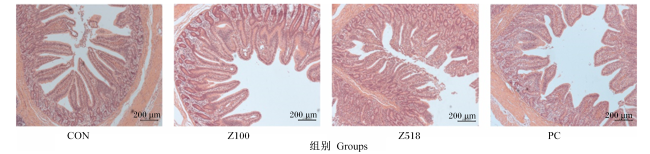
图1所示,CON组的断奶仔猪空肠绒毛结构完整,排列相对松散;Z100组和Z518组的断奶仔猪空肠绒毛结构完整,排列整齐,无明显组织学损伤;PC组和CON组的断奶仔猪空肠绒毛结构无明显差异。
图1 饲粮中添加灭活L. plantarum对断奶仔猪空肠绒毛形态结构的影响

Fig.1 Effects of dietary inactivated L. plantarum on jejunum villi morphological structure of weaned piglets

表5所示,与CON组相比,Z100组和Z518组的空肠VH和V/C均显著提高(P<0.05);且Z100组和Z518组的空肠VH显著高于与PC组(P<0.05)。各组之间空肠CD没有显著差异(P>0.05)。
表5 饲粮中添加灭活植物乳杆菌对断奶仔猪空肠形态的影响

Table 5 Effects of dietary inactivated L. plantarum on jejunum morphology of weaned piglets

项目
Items
组别Groups 均值标准误
SEM
P
P-value
CON Z100 Z518 PC
绒毛高度Villus height/μm 406.07d 429.12b 439.54a 409.54c 1.307 <0.001
隐窝深度Crypt depth/μm 170.29 165.05 164.25 166.65 16.898 0.823
绒毛高度/隐窝深度V/C 2.93b 3.99a 3.98a 3.23ab 0.474 0.037

2.4 饲粮中添加灭活L. plantarum对断奶仔猪肠道紧密连接蛋白和黏蛋白基因表达的影响
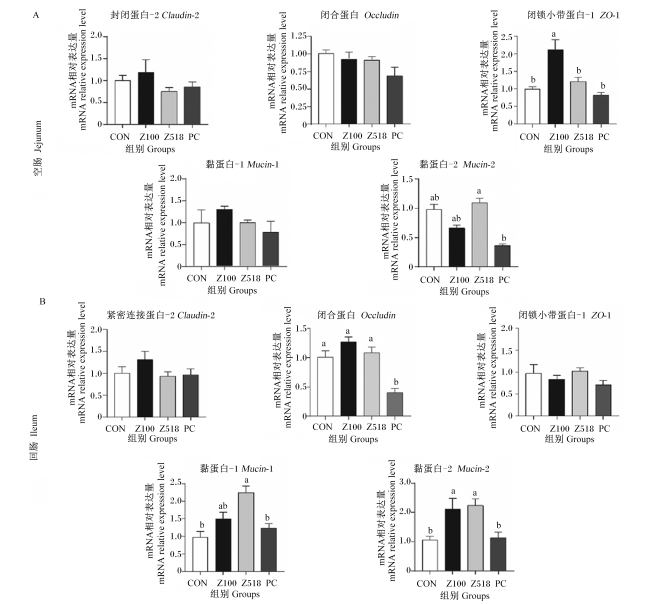
图2所示,与CON组和PC组相比,Z100组的空肠闭锁小带蛋白-1(ZO-1)的mRNA相对表达量增加(P<0.05);且Z518组的空肠黏蛋白-2(Mucin-2)的mRNA相对表达量显著高于PC组(P<0.05)。各组之间空肠封闭蛋白-2(Claudin-2)、闭合蛋白(Occludin)和黏蛋白-1(Mucin-1)的mRNA相对表达量没有显著差异(P>0.05)。
图2 饲粮中灭活L. plantarum对断奶仔猪肠道紧密连接蛋白和黏蛋白基因表达的影响

数据柱标相同小写字母表示差异不显著(P>0.05),不同小写字母表示差异显著(P<0.05)。下图同。

Fig.2 Effects of dietary inactivated L. plantarum on gene expression of tight junction proteins and mucins in intestine of weaned piglets

Value columns with the same small letter mean no significant difference (P>0.05), while with different small letters mean significant difference (P<0.05). The same as below.

与CON组相比,Z518组的回肠Mucin-1的mRNA相对表达量增加(P<0.05),Z100组和Z518组的回肠Mucin-2的mRNA相对表达量增加(P<0.05);且Z100组的回肠Mucin-1的mRNA相对表达量显著高于PC组(P<0.05),Z100组和Z518组的回肠OccludinMucin-2的mRNA相对表达量显著高于PC组(P<0.05)。各组之间回肠Claudin-2和ZO-1的mRNA相对表达量没有显著差异(P>0.05)。

2.5 饲粮中添加灭活L. plantarum对断奶仔猪肠道免疫细胞因子表达的影响
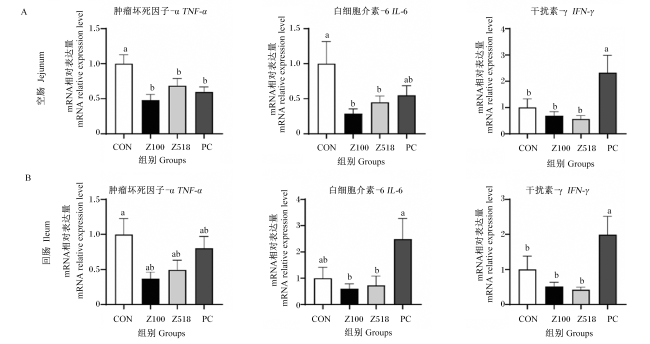
图3所示,与CON组相比,Z518组和Z100组的空肠TNF-α和白细胞介素-6(IL-6)的mRNA相对表达量水平显著降低(P<0.05),空肠干扰素-γ(IFN-γ)的mRNA相对表达量没有显著差异(P>0.05)。与PC组相比,Z518组和Z100组的空肠IFN-γ的mRNA相对表达量显著降低(P<0.05),空肠TNF-αIL-6的mRNA相对表达量没有显著差异(P>0.05)。
图3 饲粮中添加灭活L. plantarum对断奶仔猪肠道免疫细胞因子表达的影响

Fig.3 Effects of dietary inactivated L. plantarum on gene expression of immune cytokines in intestine of weaned piglets

与CON组相比,Z100组的回肠TNF-α的mRNA相对表达量显著降低(P<0.05),Z518组和Z100组的回肠IL-6和IFN-γ的mRNA相对表达量没有显著差异(P>0.05)。与PC组相比,Z518组和Z100组的回肠IL-6和IFN-γ的mRNA相对表达量显著降低(P<0.05),回肠TNF-α的mRNA相对表达量没有显著差异(P>0.05)。

2.6 饲粮中添加灭活L. plantarum对断奶仔猪肠道菌群组成的影响
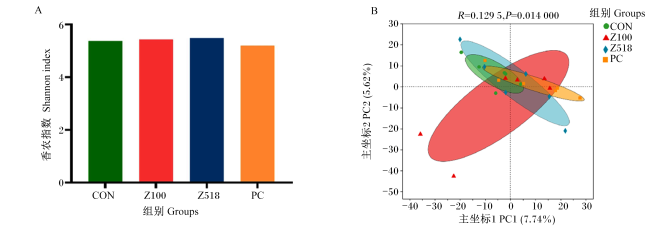
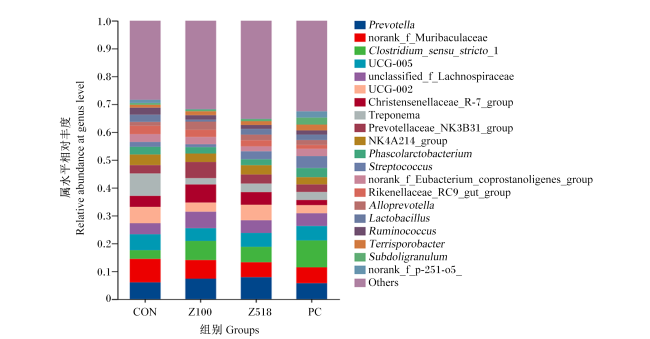
图4所示,各组之间结肠微生物香农指数没有显著差异(P>0.05);基于物种上主坐标分析(PCoA)表明,饲粮中添加Z100能够改变结肠微生物组成,与CON组差异显著(P<0.05)。如图5所示,各组之间结肠优势均属为普雷沃氏菌属(Prevotella)、未分类的拟杆菌门(norank_f_Muribaculaceae)和狭义梭状芽孢杆菌属1(Clostridium_sensu_stricto_1)。
图4 饲粮中添加灭活L. plantarum对断奶仔猪肠道微生物多样性的影响

A:Alpha多样性指数;B:基于加权Bray-Curtis距离的微生物主坐标分析。

Fig.4 Effects of inactivated L. plantarum on intestinal microbiota diversity of weaned piglets

A:Alpha diversity index;B:PCoA of the microbiome based on weighted Bray-Curtis distance.

图5 饲粮中添加灭活L. plantarum对断奶仔猪肠道微生物组成的影响

Prevotella:普雷沃氏菌属;norank_f_Muribaculaceae:未分类的拟杆菌门;Clostridium_sensu_stricto_1:狭义梭状芽孢杆菌属1;unclassified_f_Lachnospiraceae:未分类的毛螺菌科;Christensenellaceae_R-7_group:克里斯滕氏菌科R-7群;Treponema:螺旋体属;Prevotellaceae_NK3B31_group:普雷沃氏菌科NK3B31群;NK4A214_group:NK4A214群;Phascolarctobacterium:袋鼠肠杆菌属;Streptococcus:链球菌属;norank_f_Eubacterium_coprostanoligenes_group:未分类的拟杆菌群;Rikenellaceae_RC9_gut_group:理研菌科RC9肠道群;Alloprevotella:变普雷沃氏菌属;Lactobacillus:乳杆菌属;Ruminococcus:瘤胃球菌属;Terrisporobacter:土壤孢杆菌属;Subdoligranulum:罕见小球菌属;Others:其他。

Fig.5 Effects of dietary inactivated L. plantarum on intestinal microbiota composition of weaned piglets

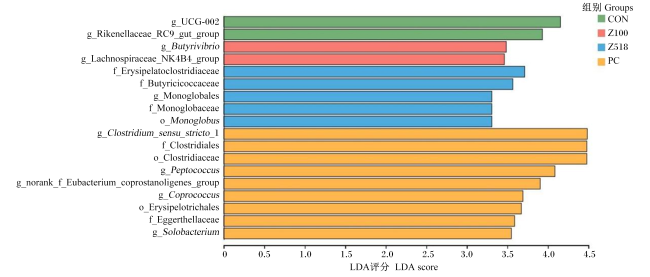
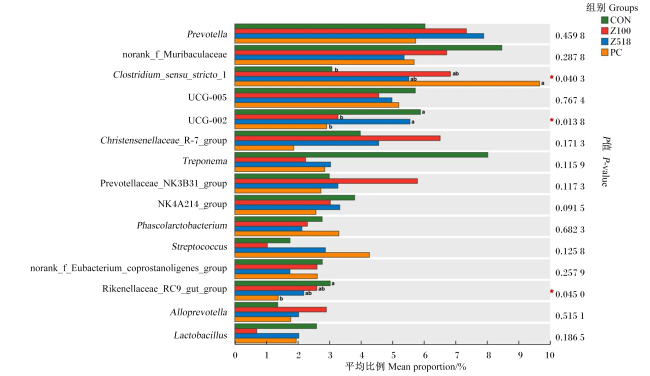
图6所示,多级物种线性判别分析效应大小分析(LEfSe)进一步表明,与CON组和PC组相比,Z100组的结肠丁酸弧菌属(Butyrivibrio)和毛螺菌科NK4B4群(Lachnospiraceae_NK4B4_group)相对丰度提高,Z518组的结肠单球菌(Monoglobus)和丁酸菌科(Butyricicoccaceae)相对丰度提高。如图7所示,属水平上,Kruskal-Wallis秩和检验的多重比较结果显示,各组之间Clostridium_sensu_stricto_1、UCG-002和理研菌科RC9肠道群(Rikenellaceae_RC9_gut_group)存在显著差异(P<0.05)。与CON组相比,Z100组的结肠UCG-002相对丰度显著降低了(P<0.05)。Z518组的结肠UCG-002相对丰度显著高于PC组(P<0.05)。
图6 断奶仔猪肠道微生物组成LEfSe多级物种差异判别分析

Rikenellaceae_RC9_gut_group:理研菌科RC9肠道群;Butyrivibrio:丁酸弧菌属; Lachnospiraceae_NK4B4_group:毛螺菌科NK4B4群;Erysipelatoclostridiaceae:丹毒杆菌科;Butyricicoccaceae:丁酸球菌科;Monoglobales:单球菌目;Monoglobaceae:单球菌科;Monoglobus:单球菌属;Clostridium_sensu_stricto_1:狭义梭状芽孢杆菌属1;Clostridiales:梭菌目;Clostridiaceae:梭菌科;Peptococcus:消化球菌属;norank_f_Eubacterium_coprostanoligenes_group:未分类的拟杆菌群;Coprococcus:粪球菌属;Erysipelotrichales:丹毒丝菌目;Eggerthellaceae:爱格氏菌科;Solobacterium:莫雷梭菌属。

Fig.6 Discriminant analysis of multi-level species differences of LEfSe on intestinal microbiota composition of weaned piglets

图7 断奶仔猪肠道微生物组成Kruskal-Wallis秩和检验的多重比较分析

Prevotella:普雷沃氏菌属;norank_f_Muribaculaceae:未分类的拟杆菌门;Clostridium_sensu_stricto_1:狭义梭状芽孢杆菌属1;Christensenellaceae_R-7_group:克里斯滕氏菌科R-7群;Treponema:螺旋体属;Prevotellaceae_NK3B31_group:普雷沃氏菌科NK3B31群;NK4A214_group:NK4A214群;Phascolarctobacterium:袋鼠肠杆菌属;Streptococcus:链球菌属;norank_f_Eubacterium_coprostanoligenes_group:未分类的拟杆菌群;Rikenellaceae_RC9_gut_group:理研菌科RC9肠道群;Alloprevotella:变普雷沃氏菌属;Lactobacillus:乳杆菌属。

Fig.7 Multiple comparisons analysis of Kruskal-Wallis rank sum test on intestinal microbiota composition of weaned piglets

3 讨论

随着饲料生产中禁止使用抗生素政策的实施,益生菌作为抗生素替代品的研究逐渐增加[32-33]。本研究评估了灭活L. plantarum及其代谢产物(Z100和Z518)对断奶仔猪生长性能、肠道屏障功能和微生物组成的影响。其中,主要成分乳酸和SCFA为不仅为肠道有益菌增殖创造了酸性环境,Z518包含的葡萄糖氧化酶、B. subtilisC. butyricum在催化、代谢反应过程中,也可为肠道细胞发育提供营养条件,起到抗菌、调节肠道菌群、促进仔猪生长的作用[29]。本研究表明,在饲粮中添加800 g/t Z100和Z518有效改善了断奶仔猪的肠道屏障和抗炎能力,改善了断奶仔猪肠道微生物组成,达到了提高断奶仔猪生长性能的目的。
生长性能是综合评价仔猪生长和健康状况的关键指标。本研究中,与CON组相比,在饲粮中添加800 g/t Z100或Z518对断奶仔猪在1~42 d和22~42 d的生长性能有更好的促进作用。本研究中,与CON组相比,Z518组和Z100组的42 d的体重显著增加,这与灭活L. plantarum及其代谢产物改善仔猪的肠黏膜屏障功能、免疫功能和肠道微生物群结构密切相关。断奶仔猪会受到环境和饮食的变化,导致肠道功能发育迟缓,进而导致仔猪腹泻甚至死亡,这是养殖生产中常见的问题。饲粮中添加Z100和Z518缓解了断奶仔猪的腹泻发病率,表明断奶仔猪的肠道功能得到改善。大量研究表明,抗菌肽具有的靶向清除病原菌的作用,且精油在调控肠道微生态方面效果显著[34-35]。本研究中,PC组断奶仔猪在1~21 d的腹泻率显著降低,这可能是由于抗菌肽在仔猪断奶初期起到抵抗外界病原菌侵入的作用;而Z518组断奶仔猪在整个生长阶段的腹泻率均显著降低,且效果优于PC组。这可能是因为Z518组中含有抑菌型B. subtilisC. butyricum,这2种益生菌能够广谱抑制致病性大肠杆菌、产气荚膜梭菌等致病菌,进而缓解断奶仔猪腹泻[36-37]。此外,灭活L. plantarum和抑菌型B. subtilisC. butyricum及其他代谢产物具有协同作用,可调节肠道微生态,营造利于乳酸菌等肠道有益菌长期定植的生长环境,共同抵御断奶仔猪肠道遭受病原菌的侵袭。研究表明,饲料中添加400 g/t热灭活L. plantarum可以提高黑鲷的生长性能和饲料转化率[22]。此外,饲粮中添加L. plantarum提高了肉鸡的生长性能,显示出替代抗生素生长促进剂(AGP)的效果[38]。本试验结果与这些研究一致,表明在饲粮中添加灭活L. plantarum可以提高动物的生长性能。这可能是由于灭活L. plantarum可促进有益微生物的定植,改善肠道环境,从而促进肠道对各种营养物质的消化和吸收,提高动物的生长性能。在本研究中,与CON组相比,Z518组的血清GLU含量显著提高,而Z100组血清GLU含量没有显著差异。这是因为Z518组中添加了葡萄糖氧化酶,可能转化为葡萄糖酸,以发挥其生物活性。研究表明,在生长猪饲粮中添加葡萄糖氧化酶以剂量依赖的方式提高营养物质表观消化率和血清抗氧化酶活性,从而提高猪的生长性能[39];此外,饲粮中添加葡萄糖氧化酶可提高血清抗氧化酶活性,减轻断奶应激,改善断奶仔猪的生长性能[40]。综上所述,饲粮中添加Z100和Z518对改善断奶仔猪的营养代谢和生长性能具有积极作用。
早期断奶会导致仔猪肠道组织学发生变化[41]。肠上皮绒毛是肠道的重要结构之一,它增加了消化物与肠壁的接触,促进食物消化和营养吸收。此外,肠道绒毛的定期摆动有助于病原菌的移位或分离。同时,肠道结构的完整性也是断奶仔猪吸收营养、发挥屏障和抗氧化功能的先决条件。在本研究中,与CON组相比,饲粮中添加Z100和Z518均可显著提高断奶仔猪空肠VH和V/C,这可能是由于其增强了断奶仔猪小肠上皮细胞对饲粮中营养物质的吸收能力。与本研究类似,在哺乳仔猪饲粮中添加L. plantarum 299v改善了空肠和回肠V/C[42]。然而,有研究发现饲粮中补充热灭活L. plantarum L-137对哺乳仔猪和断奶仔猪的VH、CD、V/C和绒毛面积没有显著影响[43]。Z100和Z518是由SCFA、细菌素以及其他益生菌组成的微生态制剂,可有效调节仔猪肠道微生态,进而促进肠上皮细胞发育,改善仔猪肠道绒毛结构。
肠道不仅是消化吸收的场所,也是抵御外来病原体入侵的重要屏障,紧密连接蛋白和黏蛋白是肠道屏障的重要指标[44]。Occludin是最早发现的紧密连接蛋白之一,能够通过自身磷酸化影响肠道通透性,Claudin-2有助于形成水通道以调节肠道通透性[45],ZO-1与紧密连接的稳定性密切相关[46-48]。在本研究中,饲粮中添加Z100和Z518提高了仔猪空肠和回肠黏膜中紧密连接蛋白(OccludinZO-1)的mRNA相对表达量,这表明肠上皮细胞具有更好的物理屏障。其他研究也表现出类似的效果,饲粮中添加L. plantarum 299v可提高哺乳仔猪空肠中Occludin和回肠中ZO-1的mRNA相对表达量[42]。小鼠口服L. plantarum FLPL05可促进肠上皮细胞中ZO-1和Occludin的表达,并减少肠上皮细胞的凋亡[49]
断奶会导致免疫功能障碍,促炎细胞因子过度分泌,引发肠道炎症,阻碍断奶仔猪的生长[50]。有研究表明,益生菌能够通过增强免疫反应、降低机体促炎反应发挥积极作用[51-52]。Shin等[24]转录组分析显示,仔猪补充L. plantarum JDFM LP11会下调免疫基因,表明炎症状态减弱。本研究中,饲粮中添加Z100和Z518降低了空肠和回肠黏膜中炎性细胞因子(IL-6、TNF-αIFN-γ)的mRNA相对表达,表明仔猪具有更好的抗炎能力。此外,免疫球蛋白也是免疫系统的重要组成部分。本研究中,饲粮中添加Z100和Z518增加了血清免疫球蛋白(IgA、IgG和IgM)含量,表明它们在调节体液免疫方面具有潜在的益处[53]。此外,Z100和Z518更倾向于通过降低血清促炎细胞因子含量并增加抗炎细胞因子含量的作用机制发挥作用。这些结果证明Z100和Z518在改善断奶仔猪的抗炎功能、调节机体免疫力方面具有潜在益生作用。
近年来,研究表明肠道微生物组成与宿主健康密切相关[54-56]。有研究表明,乳杆菌的给药会改变肠道微生物的结构,影响肠道黏膜免疫和宿主代谢[25,57]。口服L. plantarum 299v能够改变了哺乳仔猪的结肠微生物组成,厚壁菌门(Firmicutes)、放线菌门(Actinobacteri)和Lactobacillus的相对丰度显著增加[42]。本研究中,Z100组增加的Butyrivibrio和Z518组增加的Butylicicoeae都是丁酸产生菌,在抑制致病菌增殖方面发挥作用。丁酸盐能够促进黏蛋白合成和分泌,加强肠上皮连接,预防炎症,抵抗肠道应激[58-59]。有研究表明,Z518所含的L. plantarumC. butyricum可能通过菌体表面的黏附因子在肠黏膜表面形成生物屏障,阻碍致病菌的黏附[28]。另外,Lachnospiraceae_NK4B4_group和Monoglobus已被证明具有将肠道低聚糖、膳食纤维和其他碳水化合物降解为SCFA的能力[60-61]。笔者认为,Z518和Z100对肠道微生物的这些作用提高了营养消化和吸收水平,促进了肠道上皮细胞屏障结构和功能的发展,从而缓解了断奶应激,提高了仔猪的生长性能。

4 结论

饲粮中添加灭活L. plantarum有利于提高断奶仔猪机体抗炎能力,调节肠道微生物组成和屏障功能,有助于降低断奶仔猪的腹泻率,提高其生长性能。

感谢农业农村部饲料工业中心丰宁动物试验基地提供饲养场地的支持和帮助。

[1]
WU Y, ZHAO J F, XU C C, et al. Progress towards pig nutrition in the last 27 years[J]. Journal of the Science of Food and Agriculture, 2020, 100(14):5102-5110.

DOI PMID

[2]
BARBA-VIDAL E, MARTÍN-ORÚE SM, CASTILLEJOS L. Review:are we using probiotics correctly in post-weaning piglets?[J]. Animal, 2018, 12(12):2489-2498.

[3]
UPADHAYA S D, KIM I H. The impact of weaning stress on gut health and the mechanistic aspects of several feed additives contributing to improved gut health function in weanling piglets-a review[J]. Animals, 2021, 11(8):2418.

[4]
YIN J, REN W, LIU G, et al. Birth oxidative stress and the development of an antioxidant system in newborn piglets[J]. Free Radical Research, 2013, 47(12):1027-1035.

DOI PMID

[5]
KAPI A. The evolving threat of antimicrobial resistance:options for action[J]. Indian Journal of Medical Research, 2014, 139(1):182-183.

[6]
ZHANG S, WU X, HAN D, et al. Pork production systems in China:a review of their development,challenges and prospects in green production[J]. Frontiers of Agricultural Science and Engineering, 2021, 8(1):15-24.

[7]
FU Y L, CHEN Y Q, LIU D J, et al. Abundance of tigecycline resistance genes and association with antibiotic residues in Chinese livestock farms[J]. Journal of Hazardous Materials, 2021,409:124921.

[8]
SURESH G, DAS R K, KAUR BRAR S, et al. Alternatives to antibiotics in poultry feed: molecular perspectives[J]. Critical Reviews in Microbiology, 2018, 44(3):318-335.

DOI PMID

[9]
MENG Q W, LUO Z, CAO C Y, et al. Weaning alters intestinal gene expression involved in nutrient metabolism by shaping gut microbiota in pigs[J]. Frontiers in Microbiology, 2020,11:694.

[10]
LUO Y H, REN W, SMIDT H, et al. Dynamic distribution of gut microbiota in pigs at different growth stages:composition and contribution[J]. Microbiology Spectrum, 2022, 10(3):e0068821.

[11]
BALASINGHAM K, VALLI C, RADHAKRISHNAN L, et al. Probiotic characterization of lactic acid bacteria isolated from swine intestine[J]. Veterinary World, 2017, 10(7):825-829.

DOI PMID

[12]
FRANK D N, ZHU W, SARTOR R B, et al. Investigating the biological and clinical significance of human dysbioses[J]. Trends in Microbiology, 2011, 19(9):427-434.

DOI PMID

[13]
LIAO S F, NYACHOTI M. Using probiotics to improve swine gut health and nutrient utilization[J]. Animal Nutrition, 2017, 3(4):331-343.

DOI PMID

[14]
SU W F, GONG T, JIANG Z P, et al. The role of probiotics in alleviating postweaning diarrhea in piglets from the perspective of intestinal barriers[J]. Frontiers in Cellular and Infection Microbiology, 2022,12:883107.

[15]
GUEVARRA R B, LEE J H, LEE S H, et al. Piglet gut microbial shifts early in life:causes and effects[J]. Journal of Animal Science and Biotechnology, 2019, 10(1):1.

[16]
DE VRIES M C, VAUGHAN E E, KLEEREBEZEM M, et al. Lactobacillus plantarum-survival,functional and potential probiotic properties in the human intestinal tract[J]. International Dairy Journal, 2006, 16(9):1018-1028.

[17]
SEDDIK H A, BENDALI F R A, GANCEL F, et al. Lactobacillus plantarum and its probiotic and food potentialities[J]. Probiotics and Antimicrobial Proteins, 2017, 9(2):111-122.

[18]
SAGADA G, WANG L, XU B Y, et al. Synergistic effect of dietary inactivated Lactobacillus plantarum and berberine supplementation on growth performance,antioxidant capacity,and immune function of juvenile Black Sea bream (Acanthopagrus schlegelii)[J]. Aquaculture Nutrition, 2022, 2022(1):3053724.

[19]
SUO C, YIN Y S, WANG X N, et al. Effects of Lactobacillus plantarum ZJ316 on pig growth and pork quality[J]. BMC Veterinary Research, 2012,8:89.

[20]
WANG J, ZHANG W, WANG S X, et al. Lactobacillus plantarum exhibits antioxidant and cytoprotective activities in porcine intestinal epithelial cells exposed to hydrogen peroxide[J]. Oxidative Medicine and Cellular Longevity, 2021,2021:8936907.

[21]
DELL’ANNO M, CALLEGARI M L, REGGI S, et al. Lactobacillus plantarum and Lactobacillus reuteri as functional feed additives to prevent diarrhoea in weaned piglets[J]. Animals, 2021, 11(6):1766.

[22]
VAN NGUYEN N, ONODA S, VAN KHANH T, et al. Evaluation of dietary heat-killed Lactobacillus plantarum strain L-137 supplementation on growth performance,immunity and stress resistance of Nile tilapia (Oreochromis niloticus)[J]. Aquaculture, 2019,498:371-379.

[23]
HAN B, LONG W Q, HE J Y, et al. Effects of dietary Bacillus licheniformis on growth performance,immunological parameters,intestinal morphology and resistance of juvenile Nile tilapia (Oreochromis niloticus) to challenge infections[J]. Fish & Shellfish Immunology, 2015, 46(2):225-231.

[24]
SHIN D, CHANG S Y, BOGERE P, et al. Beneficial roles of probiotics on the modulation of gut microbiota and immune response in pigs[J]. PLoS One, 2019, 14(8):e0220843.

[25]
SHEHATA A A, YALÇIN S, LATORRE J D, et al. Probiotics,prebiotics,and phytogenic substances for optimizing gut health in poultry[J]. Microorganisms, 2022, 10(2):395.

[26]
MARKOWIAK P, ŚLIŻEWSKA K. The role of probiotics,prebiotics and synbiotics in animal nutrition[J]. Gut Pathogens, 2018, 10(1):21.

[27]
PARK S A, LEE G H, HOANG T H, et al. Heat-inactivated Lactobacillus plantarum nF1 promotes intestinal health in loperamide-induced constipation rats[J]. PLoS One, 2021, 16(4):e0250354.

[28]
KUCZKOWSKA K, COPLAND A, ØVERLAND L, et al. Inactivated Lactobacillus plantarum carrying a surface-displayed Ag85B-ESAT-6 fusion antigen as a booster vaccine against Mycobacterium tuberculosis infection[J]. Frontiers in Immunology, 2019,10:1588.

[29]
ARIMORI Y, NAKAMURA R, HIROSE Y, et al. Daily intake of heat-killed Lactobacillus plantarum L-137 enhances type Ⅰ interferon production in healthy humans and pigs[J]. Immunopharmacology and Immunotoxicology, 2012, 34(6):937-943.

[30]
LAITILA A, ALAKOMI H L, RAASKA L, et al. Antifungal activities of two Lactobacillus plantarum strains against fusarium moulds in vitro and in malting of barley[J]. Journal of Applied Microbiology, 2002, 93(4):566-576.

[31]
YAQOOB M U, WANG G, WANG M Q. An updated review on probiotics as an alternative of antibiotics in poultry-a review[J]. Animal Bioscience, 2022, 35(8):1109-1120.

[32]
XUAN Z N, KIM J D, HEO K N, et al. Study on the development of a probiotics complex for weaned pigs[J]. Asian-Australasian Journal of Animal Sciences, 2001, 14(10):1425-1428.

[33]
LI H H, LI Y P, ZHU Q, et al. Dietary supplementation with Clostridium butyricum helps to improve the intestinal barrier function of weaned piglets challenged with enterotoxigenic Escherichia coli K88[J]. Journal of Applied Microbiology, 2018, 125(4):964-975.

DOI PMID

[34]
DU Y P, XU Z C, YU G L, et al. A newly isolated Bacillus subtilis strain named WS-1 inhibited diarrhea and death caused by pathogenic Escherichia coli in newborn piglets[J]. Frontiers in Microbiology, 2019,10:1248.

[35]
CHANG H M, LOH T C, FOO H L, et al. Lactiplantibacillus plantarum postbiotics:alternative of antibiotic growth promoter to ameliorate gut health in broiler chickens[J]. Frontiers in Veterinary Science, 2022,9:883324.

[36]
DE X D, HOQUE M R, LIU Y J, et al. Dietary glucose oxidase supplementation improves growth performance,apparent nutrient digestibility,and serum antioxidant enzyme parameters in growing pigs[J]. Italian Journal of Animal Science, 2021, 20(1):1568-1574.

[37]
DANG D X, LIU Y J, CHEN N B, et al. Dietary supplementation of Aspergillus niger-expressed glucose oxidase ameliorates weaning stress and improves growth performance in weaning pigs[J]. Journal of Animal Physiology and Animal Nutrition, 2022, 106(2):258-265.

[38]
GONZÁLEZ-MARISCAL L, TAPIA R, CHAMORRO D. Crosstalk of tight junction components with signaling pathways[J]. Biochimica et Biophysica Acta, 2008, 1778(3):729-756.

[39]
WANG Q, SUN Q, QI R L, et al. Effects of Lactobacillus plantarum on the intestinal morphology,intestinal barrier function and microbiota composition of suckling piglets[J]. Journal of Animal Physiology and Animal Nutrition, 2019, 103(6):1908-1918.

[40]
TARTRAKOON W, CHAROENSOOK R, INCHAROEN T, et al. Effects of heat-killed Lactobacillus plantarum L-137 supplementation on growth performance,blood profiles, intestinal morphology,and immune gene expression in pigs[J]. Veterinary Sciences, 2023, 10(2):87.

[41]
DÖRFEL M J, HUBER O. Modulation of tight junction structure and function by kinases and phosphatases targeting occludin[J]. Journal of Biomedicine and Biotechnology, 2012,2012:807356.

[42]
VENUGOPAL S, ANWER S, SZÁSZI K. Claudin-2:roles beyond permeability functions[J]. International Journal of Molecular Sciences, 2019, 20(22):5655.

[43]
SUZUKI T. Regulation of intestinal epithelial permeability by tight junctions[J]. Cellular and Molecular Life Sciences:CMLS, 2013, 70(4):631-659.

[44]
YAMAMOTO T, HARADA N, KANO K, et al. The Ras target AF-6 interacts with ZO-1 and serves as a peripheral component of tight junctions in epithelial cells[J]. Journal of Cell Biology, 1997, 139(3):785-795.

DOI PMID

[45]
ZHADANOV A B, PROVANCE D W J, SPEER C A, et al. Absence of the tight junctional protein AF-6 disrupts epithelial cell-cell junctions and cell polarity during mouse development[J]. Current Biology, 1999, 9(16):880-888.

DOI PMID

[46]
YU X M, WEI M, YANG D, et al. Lactiplantibacillus plantarum strain FLPL05 promotes longevity in mice by improving intestinal barrier[J]. Probiotics and Antimicrobial Proteins, 2023, 15(5):1193-1205.

[47]
MCCRACKEN B A, SPURLOCK M E, ROOS M A, et al. Weaning anorexia may contribute to local inflammation in the piglet small intestine[J]. The Journal of Nutrition, 1999, 129(3):613-619.

[48]
AYYANNA R, ANKAIAH D, ARUL V. Anti-inflammatory and antioxidant properties of probiotic bacterium Lactobacillus mucosae AN1 and Lactobacillus fermentum SNR1 in Wistar albino rats[J]. Frontiers in Microbiology, 2018,9:3063.

[49]
PICKARD J M, ZENG M Y, CARUSO R, et al. Gut microbiota:role in pathogen colonization,immune responses,and inflammatory disease[J]. Immunological Reviews, 2017, 279(1):70-89.

[50]
SCHROEDER H W J, CAVACINI L. Structure and function of immunoglobulins[J]. The Journal of Allergy and Clinical Immunology, 2010, 125(2Suppl 2):S41-S52.

[51]
MICHAUDEL C, SOKOL H. The gut microbiota at the service of immunometabolism[J]. Cell Metabolism, 2020, 32(4):514-523.

DOI PMID

[52]
MARCHESI J R, ADAMS D H, FAVA F, et al. The gut microbiota and host health:a new clinical frontier[J]. Gut, 2016, 65(2):330-339.

[53]
FAN Y, PEDERSEN O. Gut microbiota in human metabolic health and disease[J]. Nature Reviews:Microbiology, 2021, 19(1):55-71.

[54]
VALERIANO V D V, BALOLONG M P, KANG D K. Probiotic roles of Lactobacillus sp.in swine:insights from gut microbiota[J]. Journal of Applied Microbiology, 2017, 122(3):554-567.

[55]
TILG H, ADOLPH T E, GERNER R R, et al. The intestinal microbiota in colorectal cancer[J]. Cancer Cell, 2018, 33(6):954-964.

DOI PMID

[56]
GENTILE C L, WEIR T L. The gut microbiota at the intersection of diet and human health[J]. Science, 2018,362:776-780.

[57]
ZHANG X S, YU D, WU D, et al. Tissue-resident Lachnospiraceae family bacteria protect against colorectal carcinogenesis by promoting tumor immune surveillance[J]. Cell Host & Microbe, 2023, 31(3):418-432.e8.

[58]
KIM C C, LUNKEN G R, KELLY W J, et al. Genomic insights from Monoglobus pectinilyticus:a pectin-degrading specialist bacterium in the human colon[J]. The ISME Journal, 2019, 13(6):1437-1456.

[59]
HOU Y Q, TAN T Y, GUO Z, et al. Gram-selective antibacterial peptide hydrogels[J]. Biomaterials Science, 2022, 10(14):3831-3844.

DOI PMID

[60]
CREMONESI P, BISCARINI F, CASTIGLIONI B, et al. Gut microbiome modifications over time when removing in-feed antibiotics from the prophylaxis of post-weaning diarrhea in piglets[J]. PLoS One, 2022, 17(3):e0262199.

文章导航

/