研究论文

饲料中添加茶多酚对凡纳滨对虾生长、非特异性免疫及亚硝酸盐耐受性的影响

  • 杨嘉惠 , 1 ,
  • 曹爱巧 2 ,
  • 胡祥娜 2 ,
  • 陈希平 1 ,
  • 张佳程 1 ,
  • 邓红进 1 ,
  • 谭北平 1 ,
  • 张玲 , 2, * ,
  • 迟淑艳 , 1, *
展开
  • 1 广东海洋大学水产动物营养与饲料实验室,湛江 524088
  • 2 深圳市农产品质量安全检验检测中心,深圳 518055
*张玲,正高级工程师,E-mail: ;
迟淑艳,教授,博士生导师,E-mail:

杨嘉惠(1999—),女,四川眉山人,硕士研究生,研究方向为水产动物营养与饲料。E-mail:

Copy editor: 田艳明

收稿日期: 2024-11-11

  网络出版日期: 2025-06-12

基金资助

国家重点研发计划(2023YFD2402000)

通过饲料营养途径提升养殖水产品品质关键技术研究[国农科普(新)2021087]

Effects of Dietary Tea Polyphenols on Growth, Non-Specific Immunity and Resistance to Nitrite Stress of Litopenaeus vannamei

  • YANG Jiahui , 1 ,
  • CAO Aiqiao 2 ,
  • HU Xiangna 2 ,
  • CHEN Xiping 1 ,
  • ZHANG Jiacheng 1 ,
  • DENG Hongjin 1 ,
  • TAN Beiping 1 ,
  • ZHANG Ling , 2, * ,
  • CHI Shuyan , 1, *
Expand
  • 1 Laboratory of Aquatic Nutrition and Feed, Guangdong Ocean University, Zhanjiang 524088, China
  • 2 Shenzhen Center of Agricultural Products Quality & Safety Inspection and Research, Shenzhen 518055, China
* ZHANG Ling, professorate senior engineer, E-mail: ;
CHI Shuyan, professor, E-mail:

Received date: 2024-11-11

  Online published: 2025-06-12

摘要

本试验旨在探究饲料中添加茶多酚(TP)对凡纳滨对虾生长、非特异性免疫及亚硝酸盐耐受性的影响。选择840尾平均体重为(0.25±0.00) g的健康凡纳滨对虾幼虾,随机分为7组,每组3个重复,每个重复40尾虾。对照组(TP0组)饲喂基础饲料,试验组分别饲喂在基础饲粮的基础上添加100(TP100组)、300(TP300组)、500(TP500组)、700(TP700组)、1 500(TP1500组)和3 000 mg/kg(TP3000组)TP的饲料。试验期56 d。结果表明:1)饲料中添加TP对凡纳滨对虾终末体重、增重率、特定生长率、成活率和饲料系数均无显著影响(P>0.05)。与TP0组相比,TP500组、TP700组和TP1500组肝体比显著提高(P<0.05),TP500组肥满度显著提高(P<0.05)。2)各组间凡纳滨对虾全虾水分、粗灰分和粗蛋白质含量均无显著差异(P>0.05)。与TP0组相比,TP500组、TP700组、TP1500组和TP3000组全虾粗脂肪含量显著降低(P<0.05)。3)与TP0组相比,TP300组凡纳滨对虾肝胰腺甘油三酯含量、TP700组肝胰腺总胆固醇含量以及TP500组肝胰腺低密度脂蛋白胆固醇含量显著降低(P<0.05),TP700组肝胰腺酸性磷酸酶活性显著提高(P<0.05)。4)与TP0组相比,油红O染色结果显示,TP500组凡纳滨对虾肝胰腺脂滴密度显著降低(P<0.05);Masson染色结果显示,试验组肝胰腺阳性面积均显著降低(P<0.05)。5)与TP0组相比,各试验组凡纳滨对虾肝胰腺热休克蛋白70(HSP70)相对表达量均显著提高(P<0.05),TP700组肝胰腺缺氧诱导因子-1α(HIF-1α)相对表达量显著降低(P<0.05),TP500组和TP700组肝胰腺酚氧化酶(PO)相对表达量均显著提高(P<0.05),TP700组肝胰腺免疫缺陷蛋白(IMD)、对虾抗菌肽(Pen)、甲壳素(crustin)、抗脂多糖因子(ALF)和溶菌酶(LZM)相对表达量显著提高(P<0.05)。6)亚硝酸盐胁迫后,与TP0组相比,TP700组凡纳滨对虾肝胰腺B细胞淋巴瘤-2(Bcl-2)相对表达量显著提高(P<0.05),肝胰腺P53、半胱天冬蛋白酶-3(Caspase-3)、半胱天冬蛋白酶-8(Caspase-8)和B细胞淋巴瘤-2相关X蛋白(Bax)相对表达量显著降低(P<0.05)。综上所述,饲料中添加500~700 mg/kg TP能够改善凡纳滨对虾肝胰腺脂质沉积,提高其非特异性免疫能力,并增强其对亚硝酸盐的耐受性。

本文引用格式

杨嘉惠 , 曹爱巧 , 胡祥娜 , 陈希平 , 张佳程 , 邓红进 , 谭北平 , 张玲 , 迟淑艳 . 饲料中添加茶多酚对凡纳滨对虾生长、非特异性免疫及亚硝酸盐耐受性的影响[J]. 动物营养学报, 2025 , 37(6) : 3979 -3993 . DOI: 10.12418/CJAN2025.326

Abstract

This experiment was conducted to explore the effects of dietary tea polyphenols (TP) on growth, non-specific immunity and resistance to nitrite stress of Litopenaeus vannamei. A total of 840 healthy juvenile Litopenaeus vannamei with an average body weight of (0.25±0.00) g were selected and randomly divided into 7 groups with 3 replicates in each group and 40 shrimp in each replicate. The control group (TP0 group) was fed a basal diet, while the experimental groups were fed the basal diet supplemented with 100 (TP100 group), 300 (TP300 group), 500 (TP500 group), 700 (TP700 group), 1 500 (TP1500 group) and 3 000 mg/kg (TP3000 group) TP, respectively. The experiment lasted for 56 days. The results showed as follows: 1) dietary TP had no significant effects on the final body weight, weight gain rate, specific growth rate, survival rate and feed coefficient of Litopenaeus vannamei (P>0.05). Compared with TP0 group, the hepatosomatic index in TP500 group, TP700 group and TP1500 group was significantly increased (P<0.05), and the condition factor in TP500 group was significantly increased (P<0.05). 2) There were no significant differences in the contents of moisture, crude ash and crude protein in whole body of Litopenaeus vannamei among groups (P>0.05). Compared with TP0 group, the crude lipid content in whole body in TP500 group, TP700 group, TP1500 group and TP3000 group was significantly decreased (P<0.05). 3) Compared with TP0 group, the triglyceride content in hepatopancreas of Litopenaeus vannamei in TP300 group, the total cholesterol content in hepatopancreas in TP700 group, and the low-density lipoprotein cholesterol content in hepatopancreas in TP500 group were significantly decreased (P<0.05), and the acid phosphatase activity in hepatopancreas in TP700 group was significantly increased (P<0.05). 4) Compared with TP0 group, the oil red O staining results showed that the lipid droplet density in hepatopancreas of Litopenaeus vannamei in TP500 group was significantly decreased (P<0.05); the Masson staining results showed that the positive areas in hepatopancreas in the experimental groups were significantly decreased (P<0.05). 5) Compared with TP0 group, the heat shock protein 70 (HSP70) relative expression level in hepatopancreas of Litopenaeus vannamei in each experimental group was significantly increased (P<0.05), the hypoxia-inducible factor-1α (HIF-1α) relative expression level in hepatopancreas in TP700 group was significantly decreased (P<0.05), the phenol oxidase (PO) relative expression level in hepatopancreas in both TP500 group and TP700 group was significantly increased (P<0.05), and the relative expression levels of immune deficiency protein (IMD), penaeidin (Pen), crustin, anti-lipopolysaccharide factor (ALF) and lysozyme (LZM) in hepatopancreas in TP700 group were significantly increased (P<0.05). 6) After nitrite stress, compared with TP0 group, the B-cell lymphoma-2 (Bcl-2) relative expression level in hepatopancreas of Litopenaeus vannamei in TP700 group was significantly increased (P<0.05), while the relative expression levels of P53, cysteinyl aspartate specific proteinase-3 (Caspase-3), cysteinyl aspartate specific proteinase-8 (Caspase-8) and B-cell lymphoma-2-associated X protein (Bax) in hepatopancreas were significantly decreased (P<0.05). In conclusion, dietary 500 to 700 mg/kg TP can improve the lipid deposition in hepatopancreas of Litopenaeus vannamei, increase its non-specific immunity, and enhance its resistance to nitrite stress.

凡纳滨对虾(Litopenaeus vannamei)又称南美白对虾或白对虾,是全球最重要的经济养殖虾类之一,其最适生存盐度为22.93‰[1]。尽管该虾具有广盐性(盐度0.5‰~50‰),可以通过一系列的渗透压调节机制适应外界盐度的变化[2],但是需要关注的是,低盐度的养殖环境,会影响对虾生长性能、免疫能力、对病原体的抵抗力以及应激耐受性[3-4],加剧对虾疾病的易感性,制约凡纳滨对虾在低盐度区域的养殖产量。
水产养殖系统中的亚硝酸盐由机体代谢氨排出生成并积累,会显著影响甲壳类动物的多种生理功能,包括蜕皮、氧化应激及细胞凋亡[5-6]。亚硝酸盐会导致过量的活性氧(ROS)生成和DNA损伤,并减少斑节对虾(Penaeus monodon)的总血细胞数量[7],上调了内质网(ER)应激标志基因葡萄糖调节蛋白78(GRP78)和促凋亡基因B细胞淋巴瘤-2相关X蛋白(Bax)的表达,促进草鱼(Ctenopharyngodon idella)细胞凋亡[8]。对于凡纳滨对虾而言,亚硝酸盐暴露则会导致对虾肝胰腺细胞萎缩、裂解及空泡化,并上调半胱天冬蛋白酶(Caspase)-3和P53的表达,诱导细胞凋亡[9]
研究报道,矿物质[10]、维生素[11]、菊粉[12]和β-葡聚糖[13]已在改善对虾在低盐度条件下的生长性能、脂质代谢、免疫能力和抗氧化能力方面得到应用。茶多酚(tea polyphenols,TP)是茶叶中多酚物质的总称,主要包含表没食子儿茶素没食子酸酯(EGCG)、表儿茶素(EC)、表没食子儿茶素(EGC)和表儿茶素没食子酸酯(ECG)等物质[14],具有促进生长、改善免疫系统、降脂以及抗氧化等多重生物学活性[15]。研究表明,饲料中添加TP可以改善草鱼幼鱼和尼罗罗非鱼(Oreochromis niloticus)的生长、脂质沉积及非特异性免疫功能[16-17],提高虹鳟鱼(Oncorhynchus mykiss)的抗氧化能力和免疫力[18],保护凡纳滨对虾免受黄曲霉毒素B1诱导的肌肉损伤[19],增强团头鲂(Megalobrama amblycephala)的亚硝酸盐耐受性[20]。基于此,本试验旨在探讨饲料中添加TP对凡纳滨对虾生长、非特异性免疫及抗亚硝酸盐胁迫的效能,为TP在对虾养殖中的应用提供参考。

1 材料与方法

1.1 试验材料

本试验所用TP为市售产品,其中没食子酸含量≥3 mg/g。凡纳滨对虾幼虾在室外水泥池(6.00 m×4.00 m×0.75 m)中暂养30 d,禁食24 h使用。

1.2 试验设计及饲料

本试验经广东海洋大学动物护理与使用委员会批准,批准编号为GDOU-IACUC-2022-A1457。选择840尾健康凡纳滨对虾幼虾[平均体重(0.25±0.00) g],随机分为7组,每组3个重复,每个重复40尾虾[养殖于同一个玻璃纤维桶(0.5 m3)中]。对照组(TP0组)饲喂基础饲料,试验组分别饲喂在基础饲粮的基础上添加100(TP100组)、300(TP300组)、500(TP500组)、700(TP700组)、1 500(TP1500组)和3 000 mg/kg(TP3000组)TP的饲料。试验期56 d。
各组饲料等氮等脂,饲料原料经粉碎后过80目筛,按照饲料配方称取原料,逐级混匀,采用双螺杆挤出机(F-75,华南理工大学)制成粒径分别为1.0和1.5 mm的颗粒饲料,自然风干,分装密封后置于-20 ℃冰箱保存备用。基础饲料组成及营养水平见表1
表1 基础饲料组成及营养水平(风干基础)

Table 1 Composition and nutrient levels of the basal diet (air-dry basis) %

项目Items 含量Content
原料Ingredients
红鱼粉Brown fish meal 18.00
虾粉Shrimp meal 3.00
浓缩棉籽蛋白
Concentrated cottonseed protein
14.00
豆粕Soybean meal 12.00
花生麸Peanut bran 8.00
玉米蛋白粉Corn gluten meal 6.00
啤酒酵母Brewer’s yeast 3.00
面粉Wheat flour 25.00
鱼油Fish oil 2.00
鱿鱼膏Squid paste 3.00
大豆卵磷脂Soybean lecithin 1.50
预混料Premix1) 1.50
其他Others2) 3.00
合计Total 100.00
营养水平Nutrient levels3)
水分Moisture 9.85
粗蛋白质Crude protein 42.52
粗脂肪Crude lipid 8.45
粗灰分Crude ash 7.89

1)每千克预混料含有 Each kilogram of the premix contained:盐酸硫胺素 thiamine hydrochloride 2.00 g,核黄素 riboflavin 12.00 g,盐酸吡哆醇 pyridoxine hydrochloride 4.00 g,DL-泛酸钙 DL-calcium pantothenate 20.00 g,烟酸 nicotinic acid 20.00 g,生物素 biotin 0.20 g,叶酸 folic acid 0.72 g,VB12 8.00 mg,肌醇 inositol 20.00 g,VA 400 000 IU,VD3 3 200 IU,VE 8 000 IU,VK3 8.00 g,氯化钴 cobalt chloride 0.07 g,五水硫酸铜 copper sulfate pentahydrate 2.50 g,七水硫酸亚铁 ferrous sulfate hemihydrate 49.00 g,一水硫酸锰 manganese sulfate monohydrate 6.50 g,碘化钾 potassium iodide 0.67 g,亚硒酸钠 sodium selenite 0.10 g,一水硫酸锌 zinc sulfate monohydrate 86.60 g,硫酸镁 magnesium sulfate 173.20 g。
2)其他包括 Others contained:磷酸二氢钙 calcium dihydrogen phosphate 1.50%,氯化胆碱 choline chloride 0.40%,蛋氨酸 methionine 0.30%,赖氨酸 lysine 0.20%,胆固醇 cholesterol 0.20%,维生素C vitamin C 0.05%,乙氧基喹啉 ethoxyquin 0.05%,微晶纤维素 microcrystalline cellulose 0.30%。
3)营养水平为实测值。Nutrient levels were measured values.

1.3 饲养管理

养殖试验在通威股份特种水产研究所试验基地室内静水养殖系统中进行,试验期间,每天饱食投喂饲料4次(07:00、11:00、17:00和21:00各1次);初始投喂量为对虾体重的6%~10%,并根据摄食情况和天气情况及时调整投喂量达到饱食,每次投喂后40 min用虹吸管清除桶底部的残饵。饲养期间,每天换水量近50%,养殖水体溶解氧含量≥6.5 mg/L,水温为(28±1) ℃,氨氮含量≤0.03 mg/L,盐度为0.68‰。

1.4 样品采集

养殖试验结束后,禁食24 h,对每个重复中的对虾称重并计数,采集样本。每个重复随机取3尾对虾称重并测量体长,分离肝胰腺称重,用于形体指标的分析。每个重复随机选取3尾对虾保存于-20 ℃,用于常规营养成分的分析。每个重复随机取4尾对虾的肝胰腺,液氮速冻后,保存于-80 ℃,用于酶活性检测;另取4尾对虾肝胰腺,立即放入RNA later中,4 ℃静置24 h,保存于-80 ℃,用于PCR分析。

1.5 亚硝酸盐胁迫试验

养殖试验结束后,每个重复选取10尾对虾进行亚硝酸盐胁迫试验。加入亚硝酸钠(NaNO2)调整水体亚硝酸盐浓度为5 mg/L[21-22],应激胁迫72 h,每个重复取4尾对虾的肝胰腺,立即放入RNA later中,4 ℃静置24 h后,保存于-80 ℃,用于PCR分析。

1.6 测定指标及方法

1.6.1 全虾及饲料常规营养成分含量测定

采用105 ℃烘干恒重法(GB/T 6435—2014)测定水分含量,采用杜马斯燃烧法(GB/T 24318—2009)测定粗蛋白质含量,采用索氏抽提法(GB/T 6433—2006)测定粗脂肪含量,采用马弗炉550 ℃灼烧恒重法(GB/T 6438—2007)测定粗灰分含量。

1.6.2 生长性能

生长性能相关计算公式如下:

增重率(weight gain rate,WGR,%)=100×(终末体重-初始体重)/初始体重;

特定生长率(specific growth rate,SGR,%/d)=100×(ln终末体重-ln初始体重)/饲喂天数;

成活率(survival rate,SR,%)=100×终末尾数/初始尾数;

饲料系数(feed coefficient,FCR)=饲料摄入量/(终末体重-初始体重);

肥满度(condition factor,CF,g/cm3)=100×体重/体长3;

肝体比(hepatosomatic index,HSI,%)=100×肝胰腺重量/体重。

1.6.3 肝胰腺组织匀浆样品制备及生化指标测定

取新鲜完整肝胰腺,称取适量样本,加入9倍体积生理盐水,冰浴条件下机械匀浆(IKA® T25 digital ULTRA-TURRAX®分散机,德国),4 ℃下607×g离心10 min,取上清液备测。采用试剂盒(南京建成生物工程研究所)测定肝胰腺中甘油三脂(TG,A110-1-1)、总胆固醇(TC,A111-1-1)、高密度脂蛋白胆固醇(HDL-C,A112-1-1)和低密脂蛋白胆固醇(LDL-C,A113-1-1)含量以及酸性磷酸酶(ACP,A060-2-2)和碱性磷酸酶(AKP,A059-2-2)活性。

1.6.4 肝胰腺组织学样品制备及分析

每个重复随机取4尾对虾,剥取完整的肝胰腺,保存于4%多聚甲醛配制的固定液中,4 ℃保存,分别用于Masson染色和油红O染色(武汉塞维尔生物科技有限公司)。使用光学显微镜(Nikon ECLIPSE Ni-E,日本)观察染色切片,采集图像(NIS Elements version 4.60,日本),计算和分析组织切片(Image-Pro Plus 6.0,美国)。

1.6.5 肝胰腺RNA提取及实时荧光定量PCR分析

采用TransZol Up Plus RNA试剂盒(北京全式金生物技术有限公司)提取肝胰腺的总RNA,然后采用Evo M-MLV反转录预混型试剂盒(湖南艾克瑞生物工程有限公司)合成cDNA,并采用SYBR® Green Premix Pro Taq HS qPCR Ⅱ Kit(湖南艾克瑞生物技术有限公司),在实时荧光定量PCR仪(Light Cycler 480Ⅱ,Roche Diagnostics,瑞士)上进行PCR分析。其中,10 μL反应体系包含1 μL cDNA模板、正向和反向引物各0.5 μL、5 μL 2×SYBR® Green Premix Pro Taq HS qPCR Ⅱ Kit以及3 μL RNase-free Water。反应条件为:95 ℃ 300 s,95 ℃ 5 s,60 ℃ 30 s,40个扩增循环。以延伸因子-1α(EF-1α)作为内参基因,根据2-△△Ct方法计算目的基因的相对表达量[23]。引物序列见表2
表2 引物序列

Table 2 Primer sequences

基因
Genes
引物序列
Primer sequences (5'—3')
GenBank登录号
GenBank accession number
延伸因子-1α EF-1α F:ACCAGGGACAGCCTCAGTAAG
R:GTATTGGAACAGTGCCCGTG
XM_027373349.1
酚氧化酶PO F:CCCTCAAAGTGCGGACAGT
R:TATCCCAAAGCAGCCACCC
XM_027381413.1
热休克蛋白70 HSP70 F:AGGAGACCGCTGAGGCTTAC
R:AGCACATTCAGACCCGAGAT
XM_027369405.1
缺氧诱导因子-1α HIF-1α F:CCTTGAAATGGGACCTGGAT
R:GAATCTTCGCCTCATCGTAAT
XM_027351333.1
P53 F:TGGCTGACTCTACTCTGGCACAT
R:GCAACATTTGGGCAGAGGTA
XM_027365891.1
半胱天冬蛋白酶-1 Caspase-1 F:CTTCATCCAGGCTTGTAGGG
R:GCTGGTATGTTCGTCCTCCTG
XM_027375909.1
半胱天冬蛋白酶-3 Caspase-3 F:ACCAAGGCATCCCTGTCA
R:GGGTTTATTCTGAAGTTGTGGG
XM_027378310.1
半胱天冬蛋白酶-8 Caspase-8 F:CGGCGACCAGATGGAGAA
R:ACACCGTGCCCGAGGATT
XM_027383230.1
B细胞淋巴瘤-2相关X蛋白Bax F:GGTGGAATCACAAGAGAGCGA
R:TGTTCTCCACGGTGTCTCAC
Yin等[24]
B细胞淋巴瘤-2 Bcl-2 F:CCTTGCTTGACACAGTCGGA
R:CAGACAAGGTCGTGAGGTGG
Yin等[24]
免疫缺陷蛋白IMD F:TGGGTCCGTGTCCAGTGAT
R:GCCAATGTGAACCGCAGAG
XM_027365702.1
Toll蛋白Toll F:AGTGGTGATGCTGGGAAGTCT
R:CCTACAGCAGAATGCCGTGA
XM_027374413.1
Relish F:CCCACTACATTCTGCCCTTGAC
R:GGCTGGCAAGTCGTTCTCG
XM_027357251.1
对虾抗菌肽Pen F:ACCACCCTTCGTGAGACCTTT
R:TGACAGCAACGCCCTAACC
XM_027360479.1
甲壳素Crustin F:GTGTTGGTGGTGGTTTCCC
R:AGTCGCTTGTGCCAGTTCC
XM_027352254.1
抗脂多糖因子ALF F:CGCAGTCCCTATTTGAAGAAGTT
R:TGTGGTCGCTTCCTCTTCC
XM_027383848.1
溶菌酶LZM F:GTGATGGTTCGCAGTGTTTGT
R:GTGCCTCTTATGTGGTGTAATCGT
XM_027381276.1

1.7 数据统计分析

试验数据采用SPSS 26.0软件进行单因素方差分析(one-way ANOVA),并采用Tukey’s检验进行多重比较,结果采用“平均值±标准误”形式表示,P<0.05表示差异显著;采用GraphPad Prism 8.0.2软件绘制图形。

2 结果

2.1 TP对凡纳滨对虾生长性能的影响

表3可知,饲料中添加TP对凡纳滨对虾终末体重、增重率、特定生长率、成活率和饲料系数均无显著影响(P>0.05)。TP500组、TP700组和TP1500组肝体比较TP0组和TP3000组分别提高9.07%、10.62%、10.62%和9.56%、11.11%、11.11%(P<0.05),TP500组肥满度较TP0组提高14.29%(P<0.05)。
表3 TP对凡纳滨对虾生长性能的影响

Table 3 Effects of TP on growth performance of Litopenaeus vannamei

组别
Groups
初始体重
IBW/g
终末体重
FBW/g
增重率
WGR/%
特定
生长率
SGR/(%/d)
成活率
SR/%
饲料系数
FCR
肝体比
HSI/%
肥满度
CF/
(g/cm3)
TP0 0.25±0.00 8.72±0.07 3 422.06±28.84 6.36±0.02 87.50±2.50 0.99±0.01 4.52±0.02b 0.98±0.02b
TP100 0.25±0.00 8.58±0.29 3 359.28±115.53 6.33±0.06 97.50±2.50 1.05±0.03 4.83±0.06ab 1.08±0.01ab
TP300 0.25±0.00 8.29±0.14 3 240.84±57.19 6.26±0.03 92.50±2.50 1.04±0.03 4.73±0.08ab 1.09±0.02ab
TP500 0.25±0.00 8.20±0.39 3 207.65±161.05 6.25±0.09 93.33±3.63 1.05±0.08 4.93±0.10a 1.12±0.03a
TP700 0.25±0.00 8.89±0.37 3 480.75±149.10 6.38±0.07 87.50±2.50 1.02±0.01 5.00±0.08a 1.09±0.04ab
TP1500 0.25±0.00 8.49±0.07 3 328.16±27.22 6.31±0.02 89.17±5.46 1.01±0.01 5.00±0.11a 1.06±0.02ab
TP3000 0.25±0.00 8.61±0.07 3 372.22±30.57 6.33±0.01 96.67±1.67 0.97±0.01 4.50±0.10b 1.04±0.01ab

同行数据肩标无字母或相同字母表示差异不显著(P>0.05),不同字母表示差异显著(P<0.05)。下表同。

In the same row, values with no letter or the same letter superscripts mean no significant difference (P>0.05), while with different letter superscripts mean significant difference (P<0.05). The same as below.

2.2 TP对凡纳滨对虾全虾体成分的影响

表4可知,各组间凡纳滨对虾全虾水分、粗灰分和粗蛋白质含量均无显著差异(P>0.05)。TP500组、TP700组、TP1500组和TP3000组全虾粗脂肪含量较TP0组和TP300组分别降低14.78%、18.11%、14.59%、16.11%和12.87%、16.28%、12.67%、14.23%(P<0.05)。
表4 TP对凡纳滨对虾全虾体成分的影响

Table 4 Effects of TP on whole body composition of Litopenaeus vannamei

组别
Groups
水分
Moisture/% FM
粗蛋白质
Crude protein/% DM
粗灰分
Crude ash/% DM
粗脂肪
Crude lipid/% DM
TP0 75.09±0.23 72.84±0.40 11.42±0.16 10.49±0.12a
TP100 74.94±0.49 72.98±0.09 10.82±0.24 9.79±0.04ab
TP300 74.07±0.21 73.20±0.22 10.74±0.02 10.26±0.25a
TP500 75.12±0.36 73.36±0.22 11.48±0.06 8.94±0.11bc
TP700 74.43±0.16 72.85±0.17 11.45±0.18 8.59±0.23c
TP1500 75.27±0.18 72.21±0.66 11.49±0.69 8.96±0.36bc
TP3000 75.49±0.75 73.08±0.87 10.43±0.56 8.80±0.21bc

FM:鲜物质 fresh matter;DM:干物质 dry matter。

2.3 TP对凡纳滨对虾肝胰腺生化指标的影响

表5可知,TP300组凡纳滨对虾肝胰腺TG含量较TP0组、TP700组和TP1500组分别降低38.19%、39.66%和36.54%(P<0.05);TP700组和TP3000组肝胰腺TC含量较TP0组分别降低35.26%和37.28%(P<0.05);TP3000组肝胰腺HDL-C含量较TP0组和TP300组分别提高56.50%和86.17%(P<0.05);TP500组和TP1500组肝胰腺LDL-C含量较TP0组分别降低23.40%和32.32%(P<0.05)。
表5 TP对凡纳滨对虾肝胰腺生化指标的影响

Table 5 Effects of TP on biochemical indices in hepatopancreas of Litopenaeus vannamei

组别
Groups
甘油三酯
TG/(μmol/g)
总胆固醇
TC/(μmol/g)
高密度脂蛋白胆固醇
HDL-C/(μmol/mg prot)
低密度脂蛋白胆固醇
LDL-C/(μmol/mg prot)
TP0 36.55±0.40a 3.46±0.28a 49.70±2.63b 115.75±6.40a
TP100 27.03±1.33ab 2.54±0.29ab 56.12±2.55ab 100.99±1.58ab
TP300 22.59±1.78b 2.39±0.10ab 41.78±1.61b 101.66±6.21ab
TP500 32.87±3.26ab 2.57±0.07ab 53.57±8.81ab 88.67±2.33bc
TP700 37.44±2.13a 2.24±0.12b 59.03±7.81ab 104.07±1.37ab
TP1500 35.60±2.70a 2.80±0.29ab 55.68±3.28ab 78.34±3.57c
TP3000 27.03±2.62ab 2.17±0.47b 77.78±2.62a 102.52±3.57ab

2.4 TP对凡纳滨对虾肝胰腺组织形态的影响

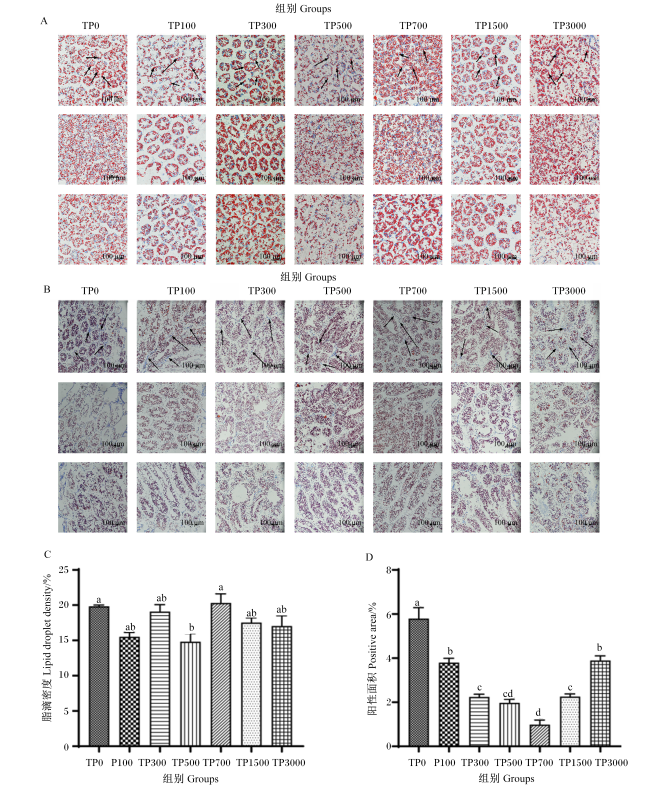
图1-A所示,凡纳滨对虾肝胰腺经油红O染色后,TP0组肝胰腺中包含有密集的脂滴,且脂滴直径较大;如图1-C所示,TP500组肝胰腺脂滴密度较TP0组和TP700组分别降低25.36%和27.12%(P<0.05)。
图1 凡纳滨对虾肝胰腺油红O和Masson染色

数据柱标注不同字母表示差异显著(P<0.05)。下图同。

A:油红O染色,黑色箭头所示为脂滴;B:Masson染色,黑色箭头所示为胶原纤维;C:油红O染色脂滴密度;D:Masson染色蓝色染色面积。

Fig.1 Stained hepatopancreas by oil red O and Masson of Litopenaeus vannamei

Value columns with different letters mean significant difference (P<0.05). The same as below.

A: oil red O staining, and black arrows indicated lipid droplets; B: Masson staining, and black arrows indicated collagen fibers; C: density of oil red O-stained lipid droplets; D: Masson stain blue staining area.

图1-B所示,Masson染色结果显示,TP0组凡纳滨对虾肝胰腺组织细胞外基质沉积(呈蓝色区域的相对面积)增加,细胞排列疏松;且随着饲料中TP添加水平的提高,肝胰腺组织蓝色区域的相对面积有所减少,其中TP100组、TP300组、TP500组、TP700组、TP1500组和TP3000组蓝染的阳性面积较TP0组分别降低34.43%、61.31%、65.92%、82.96%、61.08%和32.76%(P<0.05)(图1-D)。

2.5 TP对凡纳滨对虾肝胰腺ACP和AKP活性的影响

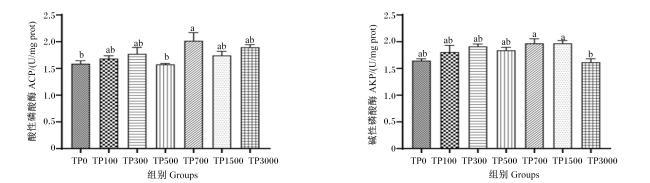
图2所示,TP700组凡纳滨对虾肝胰腺ACP活性较TP0组和TP500组分别提高27.04%和28.12%(P<0.05);TP700组和TP1500组肝胰腺AKP活性较TP3000组分别提高21.86%和21.86%(P<0.05)。
图2 TP对凡纳滨对虾肝胰腺ACP和AKP活性的影响

Fig.2 Effects of TP on ACP and AKP activities in hepatopancreas of Litopenaeus vannamei

2.6 TP对凡纳滨对虾肝胰腺非特异性免疫相关基因表达的影响

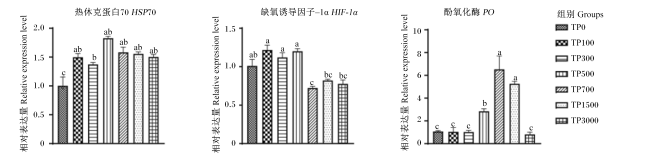
图3所示,各试验组凡纳滨对虾肝胰腺热休克蛋白70(HSP70)相对表达量显著高于TP0组(P<0.05),其中TP500组最高;TP700组肝胰腺缺氧诱导因子-1α(HIF-1α)相对表达量显著低于TP0组、TP100组、TP300组和TP500组(P<0.05),与其余各组差异不显著(P>0.05);TP500组、TP700组和TP1500组肝胰腺酚氧化酶(PO)相对表达量均显著高于其余各组(P<0.05),且TP700组和TP1500组显著高于TP500组(P<0.05)。
图3 TP对凡纳滨对虾肝胰腺HSP70、HIF-1αPO相对表达量的影响

Fig.3 Effects of TP on relative expression levels of HSP70, HIF-1α and PO in hepatopancreas of Litopenaeus vannamei

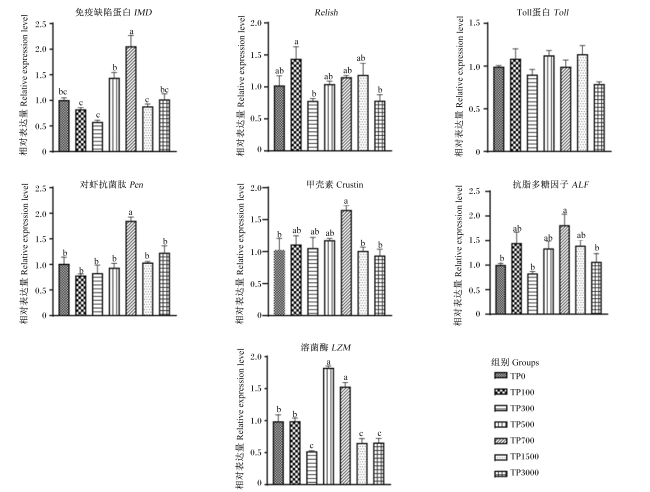
图4所示,TP700组凡纳滨对虾肝胰腺免疫缺陷蛋白(IMD)相对表达量显著高于其余各组(P<0.05);TP500组肝胰腺IMD相对表达量显著高于TP100组、TP300组和TP1500组(P<0.05),与TP0组和TP3000组相比无显著差异(P>0.05)。各试验组肝胰腺Relish和Toll蛋白(Toll)相对表达量与TP0组相比均无显著差异(P>0.05),但TP100组、TP500组、TP700组和TP1500组肝胰腺RelishToll相对表达量均有所提高。TP700组肝胰腺对虾抗菌肽(Pen)相对表达量显著高于其余各组(P<0.05)。TP700组肝胰腺甲壳素(crustin)相对表达量显著高于TP0组、TP1500组和TP3000组(P<0.05),与其余各组相比无显著差异(P>0.05)。TP700组肝胰腺抗脂多糖因子(ALF)相对表达量显著高于TP0组、TP300组和TP3000组(P<0.05),与其余各组相比无显著差异(P>0.05)。TP0组和TP100组肝胰腺溶菌酶(LZM)相对表达量显著低于TP500组和TP700组(P<0.05),且显著高于TP300组、TP1500组和TP3000组(P<0.05)。
图4 TP对凡纳滨对虾肝胰腺免疫相关基因相对表达量的影响

Fig.4 Effects of TP on relative expression levels of immune related genes in hepatopancreas of Litopenaeus vannamei

2.7 TP对亚硝酸盐胁迫凡纳滨对虾肝胰腺细胞凋亡相关基因表达的影响

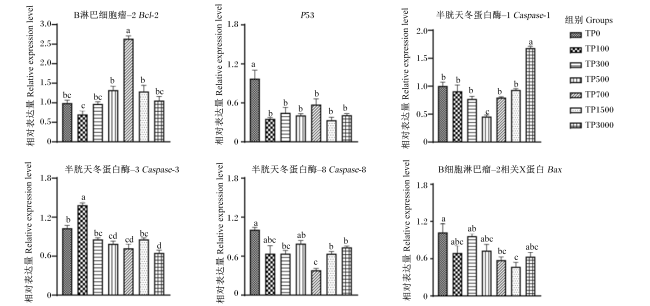
图5所示,亚硝酸盐胁迫后,TP0组凡纳滨对虾肝胰腺B细胞淋巴瘤-2(Bcl-2)相对表达量与除TP700组以外的其他各组均无显著差异(P>0.05),且TP700组显著高于其余各组(P<0.05)。各试验组肝胰腺P53相对表达量均显著低于T0组(P<0.05)。TP500组肝胰腺Caspase-1相对表达量显著低于其余各组(P<0.05)。TP500组和TP700组肝胰腺Caspase-3相对表达量显著低于TP0组和TP100组(P<0.05),与其余各组相比均无显著差异(P>0.05)。与TP0组相比,各试验组肝胰腺Caspase-8和Bax相对表达量有所降低,其中TP700组肝胰腺Caspase-8相对表达量显著低于TP0组、TP500组、TP1500组和TP3000组(P<0.05),TP700组和TP1500组肝胰腺Bax相对表达量显著低于TP0组(P<0.05)。
图5 TP对亚硝酸盐胁迫凡纳滨对虾肝胰腺细胞凋亡相关基因表达的影响

Fig.5 Effects of TP on expression of apoptosis-related genes in hepatopancreas of Litopenaeus vannamei under nitrite stress

3 讨论

3.1 饲料中添加TP对凡纳滨对虾生长性能和脂质沉积的影响

研究表明,饲料中添加适宜水平TP有助于提高珍珠龙胆石斑鱼(Epinephelus fuscoguttatus♀×Epinephelus lanceolatu♂)[25]、草鱼[26]、青鱼(Mylopharyngodon piceus)[16]和尼罗罗非鱼[17]生长性能。但在奥尼罗非鱼(Oreochromis niloticus×Oreochromis aureus)饲料中添加0.01%~0.08%TP对其生长性能无显著影响,且添加0.04%~0.08% TP有降低生长性能的趋势[27]。尽管本试验饲料中添加TP对凡纳滨对虾生长性能无显著影响,但是TP700组增重率和特定生长率较TP0组有所提高,而超过该组TP添加水平后,增重率有降低趋势,这提示高添加水平的TP对凡纳滨对虾生长可能具有抑制作用。
研究表明,TP中的生物活性成分通过调节TG、TC和LDL-C,具有促进脂质分解,减少肝脏脂质沉积的作用[28]。LDL-C和HDL-C是胆固醇中的主要脂蛋白,LDL-C将胆固醇从肝脏输送至全身,而HDL-C则将胆固醇从组织转运回肝脏,促进机体新陈代谢[29-30]。本试验结果表明,饲料中添加较低水平的TP降低了凡纳滨对虾肝胰腺中TG、TC和LDL-C含量,改善了凡纳滨对虾肝胰腺的脂质沉积。此外,TP500组全虾粗脂肪含量和肝胰腺脂滴密度较对照组显著降低,这进一步说明饲料中添加TP能够改善凡纳滨对虾脂肪沉积,提高脂质利用率。研究表明,高脂饲料中添加TP(0.02%~0.08%)显著降低了珍珠龙胆石斑鱼肝脏脂质沉积,而高水平TP(0.16%)组脂滴面积有所增加[25],这意味着TP对水产动物的脂质调节具有剂量依赖性。不过,本试验中,与对照组相比,尽管TP500组脂质代谢的调控效果较好,但随着TP添加水平的进一步提高(TP1500组和TP3000组),脂滴减少的趋势不再显著,说明较低水平TP对脂质的调控作用优于高水平。
研究发现,尼罗罗非鱼高脂饲料中添加TP后,其肝体比随肝脏脂质沉积的减少而降低[17]。草鱼饲料中添加TP后,其肝体比有所提高,并上调了肝脏中肝糖原合成酶(gys)的表达,诱导鱼肝脏中糖原的合成,从而降低血糖含量[31]。本试验中,虽然饲料中添加TP降低了凡纳滨对虾肝胰腺的脂质沉积,但是TP500组、TP700组和TP1500组肝体比与对照组相比显著提高,这可能与TP促进糖原沉积有关。研究表明,TP通过调控单磷酸腺苷活化蛋白激酶(AMPK)通路改善糖和脂代谢,一方面,降低磷酸烯醇丙酮酸羧激酶(PEPCK)和葡萄糖-6-磷酸酶(G-6-Pase)活性,提高糖原合成酶活性,改善糖代谢;另一方面,通过激活AMPK通路,降低乙酰辅酶A羧化酶(ACC)、脂肪酸合成酶(FAS)和3-羟基-3-甲基戊二酸单酰辅酶A还原酶(HMGCR)等脂质合成酶活性,以减少脂质合成[32]

3.2 饲料中添加TP对凡纳滨对虾肝胰腺非特异性免疫功能的影响

肝胰腺作为凡纳滨对虾营养物质储存的重要器官,在免疫功能和解毒方面也起着关键作用[33]。TP可以通过调节肝脏的氧化应激提高水生动物的抗病能力[34]。机体自由基的增加或抗氧化能力的减弱不仅会导致氧化系统的失衡,引发氧化损伤,还可能导致器质性损伤,影响器官功能[35]。为应对氧化应激,机体需要消耗大量ATP,并加速氧气消耗以维持能量代谢。这种情况下,肝胰腺的氧气含量下降,进而引发HIF-1α的上调[36]。HIF-1α被认为是应对缺氧环境的“主调节器”,能够感知生物体氧含量变化,调节基因表达以适应缺氧,在肝胰腺消除缺氧引起的有害物质方面发挥重要作用[37-38]。TP中的羟基氢与自由基反应,能够缓解机体的氧化应激[25]。本试验中,与对照组相比,TP700组凡纳滨对虾肝胰腺HIF-1α相对表达量显著降低,表明TP能够有效降低凡纳滨对虾的氧化损伤。纤维化是氧化损伤的典型表现之一[39],Masson染色进一步证实,饲料中添加TP显著降低了凡纳滨对虾肝胰腺纤维化程度,表明饲料中添加适宜水平的TP能够增强凡纳滨对虾的抗应激能力,减少肝胰腺纤维化损伤。同时,热休克蛋白家族在水生动物应对低氧、低温、重金属及盐度胁迫时发挥重要作用[40],其中HSP70能通过增强内源性过氧化物酶的活性,催化ROS的转化,帮助机体减轻应激反应[41]。本试验中,试验组凡纳滨对虾肝胰腺HSP70相对表达量均显著高于对照组,这进一步说明TP通过提高HSP70的表达增强凡纳滨对虾的抗应激能力,有效减少氧化损伤。
此外,TP可以通过提高水产动物的免疫性能来提高水产动物的抗病能力[42]。饲料中添加TP能够显著提高珍珠龙胆石斑鱼肝脏ACP和AKP活性,从而增强机体免疫能力[28]。AKP能够通过改变病原体表面特征来增强病原体的检测和吞噬作用,而ACP作为溶菌酶的标志性酶之一,能够分解病原体[43]。在低盐度环境中,对虾需要消耗更多的ATP来调节渗透压,而ATP合成所需的无机磷酸可由AKP和ACP通过水解磷酸酯类物质产生[44]。本试验结果显示,试验组凡纳滨对虾肝胰腺AKP活性较对照组有所提升,TP700组肝胰腺ACP活性较对照组显著提高,表明TP增强了凡纳滨对虾的非特异性免疫能力。
研究表明,TP可以通过抑制病原体生长提高水产动物的抗病能力[34]。当病原体感染宿主时,IMD受体能够识别病原体相关分子,并通过一系列复杂的级联反应激活细胞核转录因子-κB(NF-κB);Relish是NF-κB通路中的关键转录因子,也是IMD信号通路的重要组成部分[45]。本试验中,TP能够在一定程度上促进凡纳滨对虾肝胰腺Relish的表达,同时TP700组肝胰腺IMD相对表达量较对照组显著提高,表明TP激活了IMD通路。IMD通路能够介导甲壳类动物中抗菌肽(AMP)的产生,这些AMP是重要的体液免疫效应物[46]。对虾中已知的3类主要AMP——Pen、ALF和crustin,能够有效控制和杀死病原体,并参与调节其他免疫反应[47]。本试验中,TP700组凡纳滨对虾肝胰腺PenALFcrustin相对表达量较对照组显著提高,表明TP能够增强凡纳滨对虾的抗病能力。除此之外,研究表明,LZM能够通过作用于细菌细胞壁中的肽聚糖层,裂解入侵生物体的细胞壁[48]。PO在一定程度上反映了机体的免疫防御状态,能够杀死病原体,并在对虾的免疫中发挥重要作用[49-50]。本试验结果表明,TP500组和TP700组凡纳滨对虾肝胰腺LZMPO相对表达量较对照组显著提高,进一步表明TP能够提高凡纳滨对虾的非特异性免疫能力。
研究表明,青鱼饲料中添加0.05%TP显著升高血清谷丙转氨酶和谷草转氨酶活性,表明高水平TP中的鞍质类、单宁类等物质会导致机体产生一定的应激反应[16]。本试验中,饲料中添加TP提高了凡纳滨对虾的非特异性免疫功能,但是TP1500组和TP3000组Masson染色肝胰腺纤维化程度上升,表明TP的过量添加可能造成对凡纳滨对虾的外源性刺激,导致机体的过度免疫。免疫反应与动物的能量状态密切相关,对虾需要消耗能量用于调节非特异性免疫系统,过度免疫导致能量消耗增加,造成机体用于生长的能量减少[51-54],这可能是添加高水平TP导致凡纳滨对虾生长性能降低的原因。

3.3 饲料中添加TP对凡纳滨对虾亚硝酸盐耐受性的影响

研究表明,饲料中添加TP可以减少肝脏细胞凋亡[55]。饲料中添加TP可以降低草鱼和鲤鱼(Cyprinus carpio)体内Bax的表达,同时提高Bcl-2的表达[56-57]。高脂饲料中添加TP可以显著降低尼罗罗非鱼体内Caspase-3的表达[17]。饲料中添加槲皮素显著下调了对虾肝胰腺Caspase-3、P53和Bax的表达,并上调了肝胰腺Bcl-2的表达[58]。亚硝酸盐胁迫会促使对虾体内ROS水平上升,从而引发氧化应激反应,过多的ROS会激活对虾细胞内的细胞凋亡通路[6]。ROS增加导致线粒体膜电位下降,细胞色素C等凋亡相关因子从线粒体释放,随后激活Caspase家族,尤其是Caspase-3,Caspase的级联反应进一步驱动了细胞凋亡过程[59]。此外,氧化应激还通过激活P53通路以及Bax/Bcl-2蛋白表达水平的失衡来增强凋亡信号,进一步加剧细胞凋亡[60]。本试验中,饲料中添加TP能够下调凡纳滨对虾肝胰腺Caspase-3相对表达量,表明TP通过抑制Caspase-3活化,减少细胞凋亡的发生。P53作为Bax的上游调节因子,受氧化应激的调控,能够直接激活Bax的转录,从而诱导细胞凋亡[61]BaxBcl-2的比值是衡量细胞凋亡的重要指标,该比值会影响细胞对CD95/Fas介导的凋亡反应的敏感性[60-62]。本试验中,TP700组凡纳滨对虾肝胰腺Bax/Bcl-2值下降,这可能是由于Bcl-2相对表达量提高抑制了Bax的表达;同时,P53相对表达量的降低也进一步降低了Bax的相对表达量,从而减少由亚硝酸盐胁迫引起的细胞凋亡,进而保护凡纳滨对虾的肝胰腺健康。

4 结论

饲料中添加适宜水平(500~700 mg/kg)TP可以有效改善凡纳滨对虾肝胰腺脂质沉积,同时增强其非特异性免疫能力,改善肝胰腺氧化损伤,缓解因亚硝酸盐诱导的细胞凋亡。
[1]
YAO X Z, LIN Y Y, SHI M L, et al. Effect of Schizochytrium limacinum supplementation to a low fish-meal diet on growth performance,lipid metabolism,apoptosis,autophagy and intestinal histology of Litopenaeus vannamei[J]. Frontiers in Marine Science, 2022,9:1090235.

[2]
JIANG D, LAWRENCE A L, NEILL W H, et al. Effects of temperature and salinity on nitrogenous excretion by Litopenaeus vannamei juveniles[J]. Journal of Experimental Marine Biology and Ecology, 2000, 253(2):193-209.

[3]
GAO W H, TIAN L, HUANG T H, et al. Effect of salinity on the growth performance,osmolarity and metabolism-related gene expression in white shrimp Litopenaeus vannamei[J]. Aquaculture Reports, 2016,4:125-129.

[4]
TOMASSO J R. Environmental nitrite and aquaculture:a perspective[J]. Aquaculture International, 2012, 20(6):1107-1116.

[5]
ROMANO N, ZENG C S. Toxic effects of ammonia,nitrite,and nitrate to decapod crustaceans:a review on factors influencing their toxicity,physiological consequences,and coping mechanisms[J]. Reviews in Fisheries Science, 2013, 21(1):1-21.

[6]
CHENG C H, SU Y L, MA H L, et al. Effect of nitrite exposure on oxidative stress,DNA damage and apoptosis in mud crab (Scylla paramamosain)[J]. Chemosphere, 2020,239:124668.

[7]
XIAN J A, WANG A L, HAO X M, et al. In vitro toxicity of nitrite on haemocytes of the tiger shrimp,Penaeus monodon,using flow cytometric analysis[J]. Comparative Biochemistry and Physiology Part C:Toxicology & Pharmacology, 2012, 156(2):75-79.

[8]
XIE L X, CHEN S Q, YAO C R, et al. Nitrite induces endoplasmic reticulum stress and associates apoptosis of liver cells in grass carp (Ctenopharyngodon idella)[J]. Aquaculture, 2019,507:275-281.

[9]
YANG S P, LUO J L, HUANG Y X, et al. Effect of sub-lethal ammonia and nitrite stress on autophagy and apoptosis in hepatopancreas of Pacific whiteleg shrimp Litopenaeus vannamei[J]. Fish & Shellfish Immunology, 2022,130:72-78.

[10]
HUANG F, WANG L, ZHANG C X, et al. Replacement of fishmeal with soybean meal and mineral supplements in diets of Litopenaeus vannamei reared in low-salinity water[J]. Aquaculture, 2017,473:172-180.

[11]
ZHU G D, LU K L, LAI Y T, et al. Effects of dietary 25-hydroxyvitamin D3 on growth,calcium-phosphorus metabolism,lipid metabolism and immunity of Litopenaeus vannamei at low salinity[J]. Aquaculture Reports, 2024,35:101965.

[12]
ZHOU L, LI H F, QIN J G, et al. Dietary prebiotic inulin benefits on growth performance,antioxidant capacity,immune response and intestinal microbiota in Pacific white shrimp (Litopenaeus vannamei) at low salinity[J]. Aquaculture, 2020,518:734847.

[13]
LI H F, XU C, ZHOU L, et al. Beneficial effects of dietary β-glucan on growth and health status of Pacific white shrimp Litopenaeus vannamei at low salinity[J]. Fish & Shellfish Immunology, 2019,91:315-324.

[14]
ZHU Y F, WANG J P, DING X M, et al. Effect of different tea polyphenol products on egg production performance,egg quality and antioxidative status of laying hens[J]. Animal Feed Science and Technology, 2020,267:114544.

[15]
余江勤, 赵振新. 茶多酚的理化特性及在水产养殖中的应用研究[J]. 安徽农业科学, 2023, 51(19):5-11.

YU J Q, ZHAO Z X. Study on the physicochemical properties and application of tea polyphenols in aquaculture[J]. Journal of Anhui Agricultural Sciences, 2023, 51(19):5-11.(in Chinese)

[16]
ZHONG L, HU Y J, HU Y, et al. Effects of dietary tea polyphenols on growth,immunity and lipid metabolism of juvenile black carp Mylopharyngodon piceus[J]. Aquaculture Research, 2020, 51(2):569-576.

[17]
QIAN Y C, WANG X, REN J, et al. Different effects of two dietary levels of tea polyphenols on the lipid deposition,immunity and antioxidant capacity of juvenile GIFT tilapia (Oreochromis niloticus) fed a high-fat diet[J]. Aquaculture, 2021,542:736896.

[18]
NOOTASH S, SHEIKHZADEH N, BARADARAN B, et al. Green tea (Camellia sinensis) administration induces expression of immune relevant genes and biochemical parameters in rainbow trout (Oncorhynchus mykiss)[J]. Fish & Shellfish Immunology, 2013, 35(6):1916-1923.

[19]
HUANG Z R, SUN L J, WANG Y L, et al. Protective mechanism of tea polyphenols against muscle quality deterioration of shrimp (Penaeus vannamei) induced by aflatoxin B1[J].Aquaculture, 2021,532:736093.

[20]
LONG M, LIN W, HOU J, et al. Dietary supplementation with selenium yeast and tea polyphenols improve growth performance and nitrite tolerance of Wuchang bream (Megalobrama amblycephala)[J]. Fish & Shellfish Immunology, 2017,68:74-83.

[21]
DUAN Y F, ZHANG J S, WANG Y, et al. Nitrite stress disrupts the structural integrity and induces oxidative stress response in the intestines of Pacific white shrimp Litopenaeus vannamei[J]. Journal of Experimental Zoology Part A:Ecological and Integrative Physiology, 2018, 329(1):43-50.

[22]
DUAN Y F, LIU Q S, WANG Y, et al. Impairment of the intestine barrier function in Litopenaeus vannamei exposed to ammonia and nitrite stress[J]. Fish & Shellfish Immunology, 2018,78:279-288.

[23]
LIVAK K J, SCHMITTGEN T D. Analysis of relative gene expression data using real-time quantitative PCR and the 2-ΔΔCT method[J]. Methods, 2001, 25(4):402-408.

[24]
YIN X L, ZHUANG X Q, LUO W T, et al. Andrographolide promote the growth and immunity of Litopenaeus vannamei,and protects shrimps against Vibrio alginolyticus by regulating inflammation and apoptosis via a ROS-JNK dependent pathway[J]. Frontiers in Immunology, 2022,13:990297.

[25]
PAN S M, YAN X B, LI T, et al. Tea polyphenols improve lipid metabolism in hybrid grouper (♀Epinephelus fuscoguttatus×♂E.lanceolatus) fed high-lipid diets[J]. Aquaculture Reports, 2022,25:101217.

[26]
RIZWAN M, YANG Y, WAN X, et al. A transcriptome analysis focusing on growth performance and lipid metabolism-related genes of grass carp (Ctenopharyngodon idella) fed with tea polyphenols basal diets[J]. Aquaculture Research, 2021, 52(10):5044-5055.

[27]
梁高杨. 氧化油脂对斑点叉尾鮰、罗非鱼生长、抗氧化和肠道健康的影响及茶多酚的干预作用[D]. 硕士学位论文. 上海: 上海海洋大学, 2018.

LIANG G Y. Effect of dietary oxidized oil on growth,antioxidation and intestinal health of channel catfish (Ictalurus punctatus) and tilapia (Oreochromis niloticus) and the intervention of tea polyphenol on oxidized oil[D]. Master’s Thesis. Shanghai: Shanghai Ocean University, 2018.(in Chinese)

[28]
PAN S M, YAN X B, LI T, et al. Impacts of tea polyphenols on growth,antioxidant capacity and immunity in juvenile hybrid grouper (Epinephelus fuscoguttatus♀×E. lanceolatus♂) fed high-lipid diets[J]. Fish & Shellfish Immunology, 2022,128:348-359.

[29]
TULENKO T N, SUMNER A E. The physiology of lipoproteins[J]. Journal of Nuclear Cardiology, 2002, 9(6):638-649.

DOI PMID

[30]
RADER D J, KHETARPAL S A. Lipoprotein physiology[M]//GARG A.Dyslipidemias:pathophysiology,evaluation and management.Totow:Humana Press, 2015:1-12.

[31]
YUAN X C, CHEN F, YUE D D, et al. Tea polyphenols act as a natural antihyperglycemic feed additive candidate in grass carp (Ctenopharyngodon idella)[J]. Aquaculture Nutrition, 2021, 27(6):2712-2725.

[32]
YANG C S, ZHANG J S, ZHANG L, et al. Mechanisms of body weight reduction and metabolic syndrome alleviation by tea[J]. Molecular Nutrition & Food Research, 2016, 60(1):160-174.

[33]
CHAURASIA M K, NIZAM F, RAVICHANDRAN G, et al. Molecular importance of prawn large heat shock proteins 60,70 and 90[J]. Fish & Shellfish Immunology, 2016,48:228-238.

[34]
岳浩, 李晓东, 郎宇曦. 多酚类化合物在水产饲料中的应用研究进展[J]. 饲料工业, 2024, 45(14):70-77.

YUE H, LI X D, LANG Y X. Research progress on the application of polyphenolic compounds in aquafeeds[J]. Feed Industry, 2024, 45(14):70-77.(in Chinese)

[35]
KRISHNAN K, PRABHUDAS S K, JAYARAMAN K, et al. Transcriptomic variations associated with salinity stress in Penaeus indicus[J]. Molecular Biology Reports, 2023, 50(11):9295-9306.

[36]
陈建东, 张玲, 程涛, 等. 谷胱甘肽酵母水解物对干露胁迫下凡纳滨对虾肝胰腺糖代谢相关基因的影响[J]. 广东海洋大学学报, 2024, 44(1):153-160.

CHEN J D, ZHANG L, CHENG T, et al. Effects of glutathione yeast hydrolysate on genes related to hepatopancreas glucose metabolism of Litopenaeus vannamei under air exposure[J]. Journal of Guangdong Ocean University, 2024, 44(1):153-160.(in Chinese)

[37]
JUNPRUNG W, SUPUNGUL P, TASSANAKAJON A. HSP70 and HSP90 are involved in shrimp Penaeus vannamei tolerance to AHPND-causing strain of Vibrio parahaemolyticus after non-lethal heat shock[J]. Fish & Shellfish Immunology, 2017,60:237-246.

[38]
IMTIYAZ H Z, SIMON M C. Hypoxia-inducible factors as essential regulators of inflammation[J]. Current Topics in Microbiology and Immunology, 2010,345:105-120.

[39]
XIONG A J, LIU Y. Targeting hypoxia inducible factors-1α as a novel therapy in fibrosis[J]. Frontiers in Pharmacology, 2017,8:326.

[40]
BECKMANN R P, MIZZEN L E, WELCH W J. Interaction of Hsp 70 with newly synthesized proteins:implications for protein folding and assembly[J]. Science, 1990, 248(4957):850-854.

[41]
DUAN Y F, ZHANG Y, DONG H B, et al. Effect of dietary Clostridium butyricum on growth, intestine health status and resistance to ammonia stress in Pacific white shrimp Litopenaeus vannamei[J]. Fish & Shellfish Immunology, 2017,65:25-33.

[42]
刘振兴, 柯浩, 郝乐, 等. 茶多酚对罗非鱼生长性能、抗氧化功能和非特异免疫指标的影响[J]. 广东农业科学, 2012(23):113-115.

LIU Z X, KE H, HAO L, et al. Effects of tea polyphenols on growth performance,antioxidant effect and non-specific immune indices of Oreochromis niloticus[J]. Guangdong Agricultural Sciences, 2012(23):113-115.(in Chinese)

[43]
LIU Z Q, YU P, CAI M Q, et al. Effects of microplastics on the innate immunity and intestinal microflora of juvenile Eriocheir sinensis[J]. Science of the Total Environment, 2019,685:836-846.

[44]
李娜, 赵玉超, 王仁杰, 等. 高盐胁迫对凡纳滨对虾消化及免疫相关酶活力的影响[J]. 生态学报, 2018, 38(4):1411-1417.

LI N, ZHAO Y C, WANG R J, et al. Effects of high salinity on digestive and immunity-related enzymes in Litopenaeus vannamei[J]. Acta Ecologica Sinica, 2018, 38(4):1411-1417.(in Chinese)

[45]
HOFFMANN J A, REICHHART J M. Drosophila innate immunity:an evolutionary perspective[J]. Nature Immunology, 2002, 3(2):121-126.

[46]
DE GREGORIO E, SPELLMAN P T, TZOU P, et al. The Toll and Imd pathways are the major regulators of the immune response in Drosophila[J]. The EMBO Journal, 2002, 21(11):2568-2579.

[47]
TASSANAKAJON A, AMPARYUP P, SOMBOONWIWAT K, et al. Cationic antimicrobial peptides in penaeid shrimp[J]. Marine Biotechnology, 2011, 13(4):639-657.

DOI PMID

[48]
ELLIS R P, PARRY H, SPICER J I, et al. Immunological function in marine invertebrates:responses to environmental perturbation[J]. Fish & Shellfish Immunology, 2011, 30(6):1209-1222.

[49]
CERENIUS L, JIRAVANICHPAISAL P, LIU H P, et al. Crustacean immunity[J]. Advances in Experimental Medicine and Biology, 2010,708:239-259.

[50]
RATCLIFFE N A, ROWLEY A F, FITZGERALD S W, et al. Invertebrate immunity:basic concepts and recent advances[J]. International Review of Cytology, 1985,97:183-350.

[51]
KORFEL C A, CHAMBERLAIN J D, GIFFORD M E. A test of energetic trade-offs between growth and immune function in watersnakes[J]. Oecologia, 2015, 179(2):343-351.

DOI PMID

[52]
KIM J H, MACQUEEN D J, WINTON J R, et al. Effect of growth rate on transcriptomic responses to immune stimulation in wild-type,domesticated,and GH-transgenic coho salmon[J]. BMC Genomics, 2019, 20(1):1024.

[53]
LEE S, LEE Y M, KIM K H, et al. Effects of food availability on growth performance and immune-related gene expression of juvenile olive flounder (Paralichthys olivaceus)[J]. Fish & Shellfish Immunology, 2018,80:348-356.

[54]
LIN Y C, CHEN J C, LI C C, et al. Modulation of the innate immune system in white shrimp Litopenaeus vannamei following long-term low salinity exposure[J]. Fish & Shellfish Immunology, 2012, 33(2):324-331.

[55]
CHEN Y K, CHEUNG C, REUHL K R, et al. Effects of green tea polyphenol(-)-epigallocatechin-3-gallate on newly developed high-fat/western-style diet-induced obesity and metabolic syndrome in mice[J].Journal of Agricultural and Food Chemistry, 2011, 59(21):11862-11871.

[56]
MA Y B, ZHOU X Q, JIANG W D, et al. Tea polyphenols protect against Flavobacterium columnare-induced gill injury via suppression of oxidative stress,inflammation,and apoptosis in grass carp[J]. International Journal of Biological Macromolecules, 2024,254:127050.

[57]
XU R, HAN F X, WANG H R, et al. Tea polyphenols alleviate TBBPA-induced inflammation,ferroptosis and apoptosis via TLR4/NF-κB pathway in carp gills[J]. Fish & Shellfish Immunology, 2024,146:109382.

[58]
YANG X Y, WANG B J, JIANG K Y, et al. The combined analysis of transcriptomics and metabolomics reveals the mechanisms by which dietary quercetin regulates growth and immunity in Penaeus vannamei[J]. Fish & Shellfish Immunology, 2024,149:109579.

[59]
PORTT L, NORMAN G, CLAPP C, et al. Anti-apoptosis and cell survival:a review[J]. Biochimica et Biophysica Acta:Molecular Cell Research, 2011, 1813(1):238-259.

[60]
OLTVAI Z N, MILLIMAN C L, KORSMEYER S J. Bcl-2 heterodimerizes in vivo with a conserved homolog,Bax,that accelerates programmed cell death[J]. Cell, 1993, 74(4):609-619.

[61]
MITUPATUM T, AREE K, KITTISENACHAI S, et al. mRNA expression of Bax,Bcl-2,p53,cathepsin B,Caspase-3 and Caspase-9 in the HepG2 cell line following induction by a novel monoclonal Ab Hep88 mAb:cross-talk for paraptosis and apoptosis[J]. Asian Pacific Journal of Cancer Prevention, 2016, 17(2):703-712.

[62]
RAISOVA M, HOSSINI A M, EBERLE J, et al. The Bax/Bcl-2 ratio determines the susceptibility of human melanoma cells to CD95/Fas-mediated apoptosis[J]. Journal of Investigative Dermatology, 2001, 117(2):333-340.

DOI PMID

文章导航

/