综述

杜仲叶的生物学功能及其在动物生产中的应用

  • 靳可 , 1, 2 ,
  • 吕璧光 2 ,
  • 林谦 2 ,
  • 谢红兵 , 1, *
展开
  • 1 河南科技学院动物科技学院,新乡 453000
  • 2 中国农业科学院麻类研究所,长沙 410205
* 谢红兵,副教授,研究生导师,E-mail:

靳 可(1997—),男,河南新乡人,硕士研究生,从事动物营养研究。E-mail:

Copy editor: 田艳明

收稿日期: 2024-12-19

  网络出版日期: 2025-07-12

基金资助

河南省科技攻关项目(232102111039)

湖南省“三尖创新人才”(2022RC1160)

Biological Functions of Eucommia ulmoides Oliv. Leaves and Their Application in Animal Production

  • JIN Ke , 1, 2 ,
  • LYU Biguang 2 ,
  • LIN Qian 2 ,
  • XIE Hongbing , 1, *
Expand
  • 1 School of Animal Science and Technology, Henan University of Science and Technology, Xinxiang 453000, China
  • 2 Institute of Bast Fiber Crops, Chinese Academy of Agricultural Science, Changsha 410205, China
* associate professor, E-mail:

Received date: 2024-12-19

  Online published: 2025-07-12

摘要

杜仲是一种可以广泛种植的药用植物,其叶含有丰富的生物活性成分,包括苯丙素类、黄酮类、环烯醚萜类和木脂素类等。大量研究证实,杜仲叶的相关产物,如杜仲叶提取物、杜仲叶粉以及杜仲叶发酵物,在畜禽生产中发挥着促进生长、提高免疫力和抗氧化能力以及改善畜禽产品品质等作用。本文系统综述了杜仲叶活性成分的作用机制及其在动物生产中的应用效果,以期为杜仲叶在实际生产中的推广应用提供参考。

本文引用格式

靳可 , 吕璧光 , 林谦 , 谢红兵 . 杜仲叶的生物学功能及其在动物生产中的应用[J]. 动物营养学报, 2025 , 37(7) : 4274 -4285 . DOI: 10.12418/CJAN2025.350

Abstract

Eucommia ulmoides Oliv. is a widely cultivated medicinal plant. Its leaves are rich in bioactive components, including phenylpropanoids, flavonoids, cycloeneether terpenoids and lignans, etc. A large number of studies have confirmed that the related products of Eucommia ulmoides Oliv. leaves, such as extracts, powder and fermented products, play a role in promoting growth, enhancing immunity and antioxidant capacity, and improving the quality of livestock and poultry products in animal production. This article systematically reviews the mechanism of the active components in Eucommia ulmoides Oliv. leaves and their application effects in animal production, with the aim of providing a reference for the promotion and application of Eucommia ulmoides Oliv. leaves in actual production.

杜仲(Eucommia ulmoides Oliv.)隶属于杜仲科、杜仲属,其因具有出色的抗旱和耐寒能力[1-2],在我国山西、内蒙、新疆、甘肃、浙江、河南、湖北、四川、贵州和云南等地均有种植。现代药理学研究揭示了杜仲中含有多种活性成分,包括苯丙素类、黄酮类、环烯醚萜类和木脂素类等,并因此具有抗炎、抗氧化及调节脂质代谢等多种生理功能[3]。杜仲作为一种中药,用于治疗高血压、类风湿性关节炎、腰痛、坐骨痛、膝酸痛、肾虚痛、骨弱、骨折以及关节疾病等[4-5]。在传统上,杜仲主要以皮作为药材,然而随着研究的深入,研究人员发现虽然杜仲的叶和皮中的化学成分有细微差异,但总体功能上却十分相似[6]。此外,杜仲叶因其每年都可以循环采收,配合近年来杜仲规模化种植体系的有序推进[7],这大幅提升了杜仲叶的资源利用价值。目前,杜仲叶提取物已广泛作为饲料添加剂使用,杜仲叶粉及发酵产物的效果也在多项试验中得到验证,杜仲叶的开发和利用对提升动物健康水平、提高养殖经济效益和促进畜牧业健康发展具有重要的现实意义。

1 杜仲叶的饲用价值及活性成分

1.1 杜仲叶的饲用价值

杜仲叶不仅应用于医药领域,而且因其含有丰富的营养物质,也常应用在动物饲料领域。经测定,不同品种的杜仲叶粗蛋白质含量为11.50%~18.60%,粗脂肪含量为5.23%~6.70%,粗纤维含量为6.87%~16.97%[8-9],其中蛋白质中氨基酸种类齐全[10],属于优质的植物性蛋白质饲料。杜仲叶纤维中不溶性膳食纤维占比较高[8],通过酶法从脱脂米糠中提取的不溶性膳食纤维可以抑制炎症反应、缓解氧化应激以及调节肠道微生物群落结构[11]。杜仲叶的脂肪中不饱和脂肪酸比例高,其中α-亚麻酸(α-linolenic acid,ALA)含量丰富,而ALA是人和动物的必需脂肪酸,在维持健康方面扮演着关键角色,特别是在调节血脂方面具有重要作用[8]。此外,杜仲叶中还含有钙、磷等对动物机体有益的矿物元素。综合来看,在动物饲粮中适量添加杜仲叶相关产品,可提供营养物质和活性成分,从而改善动物肠道健康,促进生长发育,提高生产性能。

1.2 杜仲叶的活性成分

杜仲叶富含多种生物活性成分,它们各自具备不同的生物学功能,对维护机体健康有着重要作用。在杜仲的各个部位中,杜仲叶的黄酮类化合物含量最为丰富。研究发现,杜仲叶中含有槲皮素、紫云英苷、异槲皮苷、芦丁以及山奈酚等黄酮类化合物[12],这些成分具有降血糖、治疗脂质代谢紊乱以及清除自由基等功能[6,13-14]。杜仲叶含有环烯醚萜类化合物[3],环烯醚萜能有效清除自由基和消炎[15],环烯醚萜中含有的京尼平苷还能增强抗氧化应激能力[16]。杜仲叶中发挥作用的苯丙素类化合物主要是绿原酸,绿原酸不仅有提高抗氧化能力和抗炎等功能,还有抑制多种病原菌繁殖的作用[17-18]。值得注意的是,杜仲中主要含有木脂素的部位有皮和枝,除此之外,叶子部位也有多种木脂素类化合物[6],木脂素主要发挥了抗氧化和神经保护等作用[19]。综上所述,杜仲叶中的多种生物活性成分在抗氧化、抗炎、调节代谢、保护肠道健康及预防疾病等方面均有效果,对维护动物机体健康具有极大的潜力和应用前景。

2 杜仲叶的生物学功能

2.1 抗氧化功能

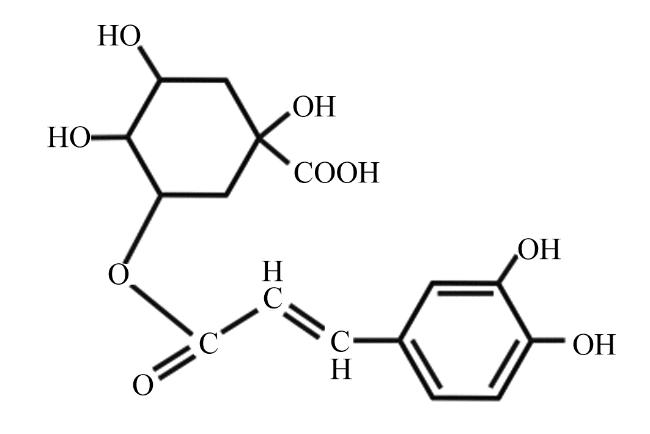
氧化应激是动物体内产生的自由基引起的,对脂质、蛋白质和DNA造成损害,破坏细胞功能,进而促使致疾病发生[20]。谷胱甘肽过氧化物酶(GSH-Px)、超氧化物歧化酶(SOD)和过氧化氢酶(CAT)是动物机体内主要的抗氧化酶,在清除自由基和阻止自由基产生中发挥重要作用[21]。在杜仲叶丰富的活性成分中,绿原酸和黄酮类化合物是2种具有显著抗氧化活性的化合物,能够有效发挥抗氧化功能。杜仲叶中绿原酸含量丰富,在多种植物绿原酸检测试验中发现,杜仲叶绿原酸提取物含量分别比平卧菊三七和金银花提高7.0%和2.8%[22]。如图1所示,杜仲叶中的绿原酸之所以有抗氧化作用,取决于它特殊的分子结构。绿原酸含有5个活性羟基和1个羧基[23],酚羟基结构易与自由基发生反应,可形成具有抗氧化作用的氢自由基,从而保护组织免受氧化作用[24]。此外,绿原酸通过调节核因子E2相关因子2(Nrf2,一种调控抗氧化反应的关键转录因子)通路,促进抗氧化蛋白血红素加氧酶-1(HO-1)、NAD(P)H醌氧化还原酶1(NQO-1)和GSH-Px1的蛋白表达[25]
图1 绿原酸分子结构

Fig.1 Molecular structure of chlorogenic acid[23]

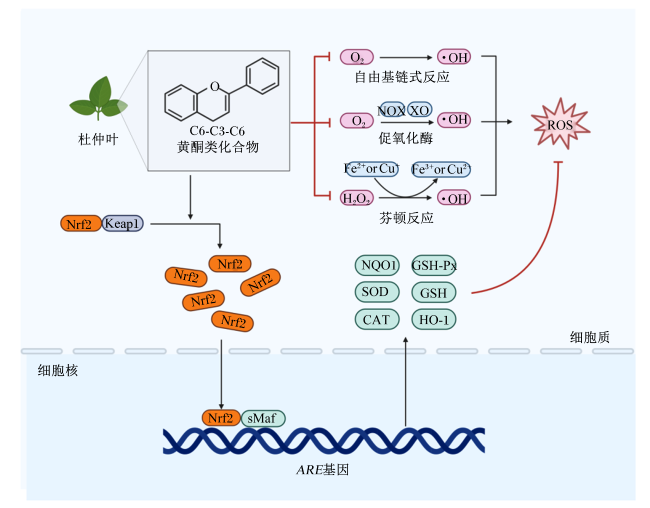
黄酮是一种常见的化合物,抗氧化能力较强。一般推测,杜仲叶中黄酮的抗氧化机制可能与以下4方面有关:第1,黄酮类化合物可以直接清除自由基;第2,黄酮可以抑制参与产生自由基酶的活性,如黄酮类化合物可以提高机体抑制黄嘌呤氧化酶的能力;第3,很多过渡金属离子有游离未配对电子,这会加速自由基的形成,黄酮类化合物具有络合金属离子的能力;第4,黄酮类化合物可以促进抗氧化物质的生成[26-28]。Wu等[29]报道,从杜仲叶中提取的总类黄酮可以通过调节SOD和CAT等抗氧化酶活性,降低丙二醛(MDA)含量,从而改善大鼠体内由四氯化碳(CCl4)诱导的肝脏和肾脏损伤。有研究指出,杜仲类黄酮化合物调节了Nrf2和Kelch样ECH相关蛋白1(Keap1,一种通过结合降解Nrf2来维持细胞氧化还原稳态的蛋白)蛋白表达,并增强了下游的HO-1和NQO-1等抗氧化基因表达,保护仔猪免受呕吐毒素(DON)引起的肠道氧化应激,从而维护其肠道健康[30]。Xiao等[31]在试验中进一步证实,杜仲类黄酮化合物不仅降低了仔猪小肠黏膜中氧化型谷胱甘肽(GSSG)含量以及GSSG/GSH值,还提高了Nrf2、Keap1、HO-1、NQO-1、谷氨酸-半胱氨酸连接酶催化亚基(GCLC)mRNA的表达;由此判断,黄酮类化合物促进抗氧化物质产生是通过Nrf2/Keap1通路来调节下游抗氧化酶活性,以此来增强抗氧化能力,从而改善仔猪肠道由敌草快诱导的氧化应激。在正常情况下,Nrf2通过与附着在肌动蛋白细胞骨架上的Keap1结合,锚定在细胞质中,维持细胞保护酶和抗氧化剂的基本表达水平,使细胞处于稳定状态;当自由基产生增加时,Keap1被转化为Keap1巯基或Nrf2被蛋白激酶磷酸化,从Keap1中释放并易位到细胞核中,激活下游抗氧化相关基因的表达[32-33]。杜仲叶黄酮类化合物抗氧化机制如图2所示。
图2 杜仲叶黄酮类化合物抗氧化机制

O2:氧分子 oxygen molecule;·OH:羟基自由基 hydroxyl radical;NOX:氮氧化物 nitrogen oxides;XO:黄嘌呤氧化酶 xanthine oxidase;Fe2+:正二价铁离子 ferrous ion;Fe3+:正三价铁离子 ferric ion;Cu+:亚铜离子 cuprous ion;Cu2+:铜离子copper ion;H2O2:过氧化氢 hydrogen peroxide;ROS:活性氧 reactive oxygen species;Nrf2:核因子E2相关因子2 nuclear factor E2 related factor 2;Keap1:Kelch样ECH相关蛋白1 Kelch-like ECH-associated protein 1;NQO1:NAD(P)H醌氧化还原酶1 NAD (P)H quinone oxidoreductase 1;GSH-Px:谷胱甘肽过氧化物酶 glutathione peroxidase;SOD:超氧化物歧化酶 superoxide dismutase;GSH:谷胱甘肽 glutathione;CAT:过氧化氢酶 catalase;HO-1:血红素加氧酶-1 heme oxygenase-1;sMaf:小Maf转录因子 small Maf transcription factor;ARE:抗氧化反应元件 antioxidant response element。

Fig.2 Antioxidant mechanism of flavonoid compounds in Eucommia ulmoides Oliv. leaves

杜仲叶中含有的其他活性成分也具有抗氧化功能,其中环烯醚萜类提取物对脂多糖(LPS)诱导的RAW264.7细胞中一氧化氮的产生具有抑制作用[34],推测可能是通过Nrf2和炎症因子核因子-κB(NF-κB,调控炎症反应和免疫应答的核心转录因子)途径减少活性氧(ROS)的产生。Han等[19]研究发现,杜仲叶中分离的木脂素通过调节磷脂酰肌醇3-激酶(PI3K,介导细胞存活与代谢调节的关键信号转导酶)/蛋白激酶B(AKT,介导细胞存活与代谢调控的丝氨酸、苏氨酸激酶)/糖原合成酶激酶-3β(GSK-3β,通过磷酸化作用参与炎症与凋亡调控的丝氨酸/苏氨酸蛋白激酶)/Nrf2信号通路,提高HO-1、NQO-1和CAT的蛋白表达,增强SOD和GPH-Px活性。综上所述,杜仲叶的抗氧化作用主要是通过其丰富的生物活性成分来实现的。

2.2 抗炎功能

炎症反应是一种保守的防御机制。然而,过度的炎症是慢性病理的一个标志。对于动物来说,不易觉察的炎症是一个危险信号,因此,维持炎症的稳态对其来说至关重要。NF-κB信号通路参与多种促炎因子表达,如肿瘤坏死因子-α(TNF-α)、白细胞介素-1β(IL-1β)和白细胞介素-6(IL-6)等,这些细胞因子的协同过表达构成了慢性炎症的基础,进而引起炎症疾病[35]。Wang等[36]研究发现,在LPS诱导的结直肠腺癌细胞(Caco-2细胞)/人单核细胞白血病(THP1)共培养物体系中,通过体外模拟消化和发酵模型评估,杜仲叶能够限制肠道IL-6、IL-1β和TNF-α促炎细胞因子生成。同样,Huang等[37]研究发现,从杜仲叶中提取的珊瑚木苷可以通过降低TNF-α和IL-6产生以及一氧化氮合酶(iNOS)活性,减轻LPS诱导的人肝癌细胞(HepG2细胞)的炎症。在LPS诱导的肠细胞损伤模型试验中发现,LPS通过Toll样受体4(TLR4,通过识别病原体相关分子激活炎症反应的关键跨膜受体)与PI3K相互作用诱导炎症,致使核因子-κB抑制蛋白-α(IκB-α)的磷酸化和降解,解除其对NF-κB的抑制作用,促使促炎因子的产生;而杜仲叶黄酮类化合物可以有效抑制IκB-α的降解和磷酸化,通过激活PI3K/AKT通路将NF-κB保留到细胞质中,并调节细胞增殖和凋亡以及线粒体功能来逆转炎症过程[38],这表明杜仲叶黄酮类化合物在抗炎治疗中具有潜在价值。小胶质细胞是脑组织中的巨噬细胞,在维持组织稳态和清除吞噬病原体方面发挥重要作用。但是,小胶质细胞过度激活,会导致强烈的炎症反应和促炎介质的产生[39]。Han等[40]报道,杜仲叶中有13种具有抗神经炎的化合物,与对照组相比,均对LPS处理的小鼠小胶质细胞(BV-2细胞)中促炎因子TNF-αIL-1βIL-6的表达有显著的抑制作用;其中,杜仲叶含有的乌烷型C29三萜类化合物还能够降低TLR4和分化簇14(CD14,一种参与先天免疫应答的关键模式识别受体)mRNA表达水平。由此推测,杜仲叶中的抗炎化合物是通过抑制CD14/TLR4信号通路,从而限制下游的NF-κB和丝裂原活化蛋白激酶(MAPK,调控细胞增殖分化炎症反应的关键信号转导系统)信号通路的激活。总得来说,杜仲叶的抗炎作用是通过多种活性成分和多途径来实现的,且主要是通过调控TLR4、NF-κB、MAPK等信号通路以及调节多种炎症因子表达来减轻机体的炎症反应。

2.3 调节糖和脂代谢功能

在动物机体中,氧自由基能够通过生物膜中不饱和脂肪酸的过氧化损伤细胞,引起脂质过氧化反应,脂质和蛋白质氧化是肉质变坏的主要威胁。脂质和蛋白质氧化会导致肉的保质期变短,对肉的颜色、风味以及营养价值产生影响[41-42]。核受体是脂肪组织和肝脏中的主要代谢调节因子,过氧化物酶体增殖物激活受体γ(PPARγ)是核受体的配体激活转录因子,参与调节细胞分化和脂质代谢[43]。Gong等[44]研究发现,在网络药理学分析中,杜仲叶含有的黄芪素与PPARγ结合能高,说明药物分子与靶点的相互作用强度较高;细胞试验也验证了这点,杜仲叶提取物可以激活细胞自噬,促进PPARγ表达,从而发挥降脂作用。Wang等[45]研究表明,含有杜仲树皮/叶提取物的小鼠粪菌悬液,可显著改善高脂饲粮诱导的脂质代谢紊乱和血糖升高,显著降低丹毒杆菌科和瘤胃球菌科相对丰度,促进短链脂肪酸的产生,从而激活G蛋白偶联受体43(GPR43)基因在结肠和附睾脂肪组织中的表达;此外,该粪菌悬液还可显著激活结肠组织中禁食诱导脂肪因子(Fiaf)基因的表达,抑制肝脏组织中脂蛋白脂肪酶的分泌,从而抑制甘油三酯(TG)的合成。Zhang等[46]研究发现,杜仲叶提取物通过抑制脂质合成基因固醇调节元件结合蛋白-1c(SREBP-1c)、PPARγ和乙酰辅酶A羧化酶1(ACC1)表达以及降低肝脏TG含量,改善斑点鲶鱼肠道屏障功能、抗氧化能力和生理结构。糖基化终产物不仅是蛋白质或脂质非酶糖基化反应的终产物,而且是血管功能障碍发展的产物[47]。研究发现,杜仲叶黄酮类化合物能显著降低高血脂大鼠血清总胆固醇(TC)、TG及低密度脂蛋白胆固醇(LDL-C)含量,显著提高血清高密度脂蛋白胆固醇(HDL-C)和载脂蛋白A(ApoA)含量,这个过程可能是杜仲叶黄酮类化合物通过激活细胞外信号调节激酶信号通路后上调低密度脂蛋白受体的表达,以此促进脂质代谢[48]。Peng等[13]研究发现,杜仲叶总黄酮提取物饲喂具有多囊卵巢综合征的小鼠,可以通过调节卵巢PI3K/AKT信号通路相关蛋白,如葡萄糖转运蛋白4(GLUT4)、胰岛素受体底物-1(IRS-1)和下丘脑-垂体-卵巢轴上亲吻素1(Kiss1)、雄激素受体(AR)的表达,调节糖和脂代谢紊乱并改善性激素分泌。综上所述,杜仲叶不仅可以通过相关信号通路来促进脂质代谢和降低血脂水平,还能改善肠道屏障功能和调节糖和脂代谢紊乱,这些作用共同有助于维护肉品质量、延长保质期,同时对改善动物机体健康具有重要意义。

2.4 免疫调节和抑菌功能

免疫是动物体内的一种生理功能,不仅能够识别和排除外来的如细菌、病毒等病原体,并且可以清除体内的异常细胞。淋巴细胞增殖是免疫功能的直接指标,众所周知,T淋巴细胞和B淋巴细胞在调节免疫应答中都起着至关重要的作用[49]。邱果等[50]研究表示,与环磷酰胺(CTX)造模的小鼠相比,饲喂1 000 mg/kg杜仲叶醇提物可以增强小鼠巨噬细胞的吞噬能力,提高小鼠血清溶血素含量。徐贤柱等[51]研究发现,饲喂200 mg/kg杜仲叶多糖可以显著提高小鼠脾脏指数和血清免疫球蛋白G(IgG)含量。此外,有试验证明,杜仲叶多糖还可升高CTX造模小鼠的巨噬细胞吞噬能力以及血清溶血素含量[52];其提高免疫力的机理可能是刺激了脾脏,使其对免疫应答的能力加强,刺激T细胞等分泌更多的免疫因子以达到提高免疫力的效果[53]。研究表明,杜仲叶桃叶珊瑚苷和绿原酸对金黄色葡萄球菌和大肠杆菌都有较强的抑菌作用,绿原酸还对对沙门氏菌有明显的抑制作用[22,54]。同样发挥抑菌效果的还有黄酮类化合物中的槲皮素,Wang等[55]研究发现,与对照组相比,饲喂200 mg/kg槲皮素的肉鸡盲肠中鼠伤寒沙门氏菌、金黄色葡萄球菌和大肠杆菌数量分别下降了6.60%、7.88%和10.39%。杜仲叶含有的槲皮素的抑菌机制可能有以下3个方面:首先,槲皮素具有破坏细菌细胞膜完整性的能力,从而抑制细菌生长;其次,槲皮素可以抑制细菌细胞中核酸的合成;最后,槲皮素的另一种抗菌机制是防止各种细菌种类形成生物膜[56]。由此可知,杜仲叶对多种病原菌有抑制效果,是一种具有潜力的天然抗菌资源。综上所述,杜仲叶及其提取物在增强动物免疫功能和抑制病原体方面具有显著效果,这些发现表明杜仲叶提取物在抑菌、疾病预防和动物健康方面具有潜在的应用价值。

3 杜仲叶在动物生产中的应用

3.1 杜仲叶提取物在动物生产中的应用

杜仲叶含有丰富的活性成分,因此常被用于制备提取物,作为功能性饲料添加剂在畜禽生产中应用。杜仲叶提取物的常用提取方法主要包括水提取和醇提取[57]。在动物生产中,杜仲叶提取物能直接或间接发挥提高生长性能、增强抗氧化能力、调节免疫和血脂等作用。其中,在家禽生产中,杜仲叶提取物在300~1 000 mg/kg剂量范围可显著提升日增重和抗氧化能力,且在调节蛋鸡血脂方面作用尤为突出[58-61]。在猪生产中,5 000 mg/kg杜仲叶提取物在不同生长阶段产生了差异化的效果,在断奶仔猪中可以增强肠道屏障相关基因表达,优化菌群结构,减少腹泻,降低料重比[62];而在育肥猪生产中,不仅可以降低料重比,还能改善肉品质[63]。此外,杜仲叶提取物在其他动物(如湖州公羊[64]、斑点鲶鱼[46])上也能在改善抗氧化功能,降低料重比,提升肉品质方面有所作用。杜仲叶提取物在动物生产中的应用效果见表1
表1 杜仲叶提取物在动物生产中的应用效果

Table 1 Application effects of Eucommia ulmoides Oliv. leaf extracts in animal production

试验动物
Experimental
animals
适宜添加量
Appropriate
addition amount/
(mg/kg)
饲喂时长
Feeding
period
应用效果
Application effects
参考文献
References
黄羽肉鸡
Yellow-feathered broilers
300 51 d 提高采食量和日增重,增强抗氧化能力 [58]
白羽肉鸡(热应激条件下)
White-feathered broilers
(under heat stress)
1 000 21 d 提高日增重和抗氧化相关基因表达 [59]
海兰褐蛋鸡
Hy-Line brown laying hens
500 11周 提高血浆免疫球蛋白和干扰素-γ含量,
调节血脂,提高产蛋率
[60]
海兰褐蛋鸡
Hy-Line brown laying hens
1 000 9周 提高产蛋率和肠道关键菌群丰度,增强
肠道屏障功能,改善肠道形态结构
[61]
断奶仔猪
Weaned piglet
5 000 30 d 提高日增重,降低料重比和腹泻率,改善肠道
形态结构,提高肠道挥发性脂肪酸含量,
提高紧密连接蛋白表达,调节肠道菌群
[62]
育肥猪
Finishing pigs
5 000 60 d 降低料重比,调节肌纤维组成,
改善肉品质
[63]
湖州断奶公羊
Huzhou weaned male sheep
1 000 59 d 提高抗氧化功能 [64]
斑点鲶鱼
Channel catfish
2 000 4周 改善抗氧化功能,提高肠道紧密连接
蛋白表达,降低脂肪生成相关基因表达
[46]

3.2 杜仲叶粉及发酵物在动物生产中的应用

杜仲叶粉制作工艺相对简单且可以保留杜仲叶大部分活性成分,因此,在动物生产中,它的使用相对便利且经济效益更为显著。Feng等[65]在蛋鸭饲粮中添加1%、2%和3%杜仲叶粉发现,蛋鸭血浆总蛋白、球蛋白和HDL-C含量呈线性升高,血浆LDL-C含量呈线性降低。杜仲叶粉在蛋鸡生产实践中也表现出了显著的效果。周莹等[66]研究发现,与对照组相比,饲粮中添加1.0%和1.5%杜仲叶粉使得平均产蛋率提高了5.06%和6.58%,蛋黄胆固醇含量下降了35.40%和33.63%。董一凡[67]研究表明,饲喂杜仲叶粉后显著提高了大午金凤蛋鸡的蛋品质和抗氧化能力,极显著提高了血清IgG和免疫球蛋白M(IgM)含量,一定程度提高了小肠隐窝深度,推测影响机理是杜仲叶粉通过影响肠道形态、屏障功能、微生物群落和血清代谢物分布来有效改善产蛋性能和蛋品质。石海仁等[68]选择体重与形态相近的“长白×大白”猪60头,在基础饲粮中添加4%杜仲叶粉,饲喂102 d,发现可显著降低育肥猪腹泻率,提高生长性能及肝脏抗氧化能力,并且改善其胴体性状和肉品质。Teng等[69]在荷斯坦奶牛上的试验发现,饲粮中添加3%杜仲叶粉可以有效降低抗炎因子含量,提高CD4/CD8值,从而提高乳品质。在草鱼饲粮中添加4 g/kg杜仲叶粉可显著提高肌肉中胶原合成相关基因如Ⅰ型胶原α1链蛋白编码基因(COL1A1)、赖氨酰氧化酶(LOX)表达水平,降低基质金属蛋白酶-2(MMP-2)、基质金属蛋白酶-9(MMP-9)表达水平,从而提高草鱼生长性能和抗氧化能力,改善肉质[70]。由此可见,杜仲叶粉效果不同于特定某一提取物集中和突出表现,但是其作为添加剂在改善肉蛋品质、增强抗氧化能力及维持动物机体健康中发挥了积极作用。
发酵中草药作为饲料添加剂可以改善饲粮的适口性,并且通过改善肠道微生物群落、提高营养物质消化率等途径改善动物生长性能[71]。曹银娣等[72]研究发现,饲喂42 d银杏-杜仲叶发酵物的爱拔益加(AA)肉鸡,其肝脏总超氧化物歧化酶活性和总抗氧化能力(T-AOC)显著升高,而血清和肝脏MDA含量以及肌肉剪切力和滴水损失显著降低,肉品质有所改善。李凤龙等[73]研究证明,在蛋鸡饲粮中添加发酵杜仲叶粉能够显著降低血清TC、TG和LDL-C含量,提高血清HDL-C含量,提高蛋鸡生产性能和蛋品质。在生长育肥猪饲粮中长期添加0.3%发酵杜仲叶粉,可以提高屠宰率,降低料重比,并降低肌肉饱和脂肪酸含量,改善肉的品质和风味[74]
杜仲叶经过发酵后其粗蛋白质和粗脂肪含量均呈现不同程度的提高[75],因此,已有研究尝试将其应用从饲料添加剂扩展至饲料原料领域。杨改青等[76]报道,饲粮添加10%杜仲叶饲喂绵羊可以提高采食量和日增重,降低料重比。梅德洪[75]研究发现,饲喂10%发酵杜仲叶显著提高肉牛总增重和抗氧化能力,显著提高血清总蛋白含量,显著降低血清尿素氮、TC、TG和MDA含量,并显著提高背最长肌中蛋白质含量。彭密军等[77]报道,在断奶仔猪饲粮中添加6%发酵杜仲叶进行饲喂,其血清MDA含量与对照组相比显著降低,血清T-AOC和GSH-Px活性显著提高。从杜仲叶发酵物多项研究发现,发酵杜仲叶作为饲料添加剂在动物生产中显示出多方面的积极效果,它不仅能够改善饲粮的适口性和提高动物的生长性能,还能够通过调节肠道微生物群落和提高营养物质消化率来促进机体健康。这些研究成果表明,发酵杜仲叶作为一种天然、有效的饲料添加剂和饲料原料,对提高动物抗氧化能力和肉品质具有重要的应用价值。
综上所述,杜仲叶粉及其发酵物在动物生产中表现出改善生产性能的作用,其表现为通过多项功能调节如血脂代谢、抗氧化、免疫及肠道功能,改善动物生产性能和产品(肉、蛋、奶)品质;同时,杜仲叶发酵可以进一步突破原料局限性,通过发酵工艺提升其营养物质含量,进而替代部分原料,从而降低饲料成本。

4 小结与展望

杜仲叶及其相关产物在动物生产中具有提高抗氧化能力、抗炎、调节免疫以及降低血脂等多种生物学功能,这些功能主要源于其较高的营养价值和丰富的生物活性成分,如绿原酸、黄酮类化合物等。此外,杜仲抗逆性强的生物学特性使其易于规模化种植,这为杜仲叶在动物生产中的应用提供了保障,既能确保原料供应稳定,又能降低应用成本。尽管如此,杜仲叶在动物生产中的应用仍有一些需要解决的问题。首先,不同地区及品种导致杜仲叶在活性成分存在差异,进而影响动物生产的应用效果,因此需要更统一的规范;其次,杜仲叶一些潜在的功能和作用机制尚未清晰,尤其是如何通过调节动物体内的信号通路来发挥生物学效应;此外,当前研究对杜仲叶长期添加可能引起的代谢负担等安全性问题缺乏验证,需要进行深入探究;并且,现有研究多针对活性成分功能,未来若要进一步开发杜仲叶粉及叶、粉发酵物,需要对动物适口性进行探索,这将有助于更全面地理解杜仲叶的作用机制。
总得来说,杜仲叶及其相关产物在动物生产中具有巨大的应用潜力和实用价值,未来的研究可关注杜仲叶活性成分的高效提取技术和应用方法,以及深入理解其在动物体内的具体作用机制,这些研究将有助于推动杜仲叶在畜牧业可持续发展中的广泛应用。
[1]
CHEN J J, HUANG Y H, LI J Y, et al. Overexpression of the Eucommia ulmoides aquaporin,EuPIP1;1,promotes leaf growth,flowering and bolting,and stress tolerance in Arabidopsis[J]. International Journal of Molecular Sciences, 2022, 23(19):11794.

[2]
WUYUN T N, WANG L, LIU H M, et al. The hardy rubber tree genome provides insights into the evolution of polyisoprene biosynthesis[J]. Molecular Plant, 2018, 11(3):429-442.

[3]
ZHU M Q, SUN R C. Eucommia ulmoides Oliver:a potential feedstock for bioactive products[J]. Journal of Agricultural and Food Chemistry, 2018, 66(22):5433-5438.

[4]
WANG C Y, TANG L, HE J W, et al. Ethnobotany,phytochemistry and pharmacological properties of Eucommia ulmoides:a review[J]. The American Journal of Chinese Medicine, 2019, 47(2):259-300.

[5]
HUANG L C, LYU Q, ZHENG W Y, et al. Traditional application and modern pharmacological research of Eucommia ulmoides Oliv.[J]. Chinese Medicine, 2021, 16(1):73.

[6]
盛益华, 王洪, 李思迪, 等. 基于HPLC-Q-TOF-MS鉴定杜仲不同部位中化学成分及其降血糖活性研究[J]. 中草药, 2023, 54(19):6228-6240.

SHENG Y H, WANG H, LI S D, et al. Identification of chemical components in different parts of Eucommia ulmoides by HPLC-Q-TOF-MS and investigation of its hypoglycemic activities[J]. Chinese Traditional and Herbal Drugs, 2023, 54(19):6228-6240. (in Chinese)

[7]
李耿, 李振坤, 李慧, 等. 我国杜仲中药产业发展战略研究[J]. 中国现代中药, 2021, 23(4):567-586.

LI G, LI Z K, LI H, et al. Study on development strategy of Eucommia ulmoides Chinese medicine industry[J]. Modern Chinese Medicine, 2021, 23(4):567-586. (in Chinese)

[8]
王翔, 胡凤杨, 杨秋玲, 等. 杜仲叶的营养评价及体外抗氧化活性分析[J]. 食品工业科技, 2019, 40(21):290-299.

WANG X, HU F Y, YANG Q L, et al. Nutritional evaluation and antioxidant activity analysis in vitro of Eucommia ulmoides leaves[J]. Science and Technology of Food Industry, 2019, 40(21):290-299. (in Chinese)

[9]
钱佳璇. 杜仲叶粉发酵饲料添加剂工艺优化及其应用[D].硕士学位论文. 贵阳: 贵州大学, 2024.

QIAN J X. Optimization of fermentation feed additive process for Eucommia leaf powder and its application[D].Master’s Thesis. Guiyang: Guizhou University, 2024. (in Chinese)

[10]
王琦. 杜仲良种叶片营养组分及其内生真菌多样性的研究[D].硕士学位论文. 长沙: 中南林业科技大学, 2023.

WANG Q. Study on the nutrient components and diversity of endophytic fungi in leaves of Eucommia ulmoides improved varieties[D].Master’s Thesis. Changsha: Central South University of Forestry and Technology, 2023. (in Chinese)

[11]
LIU Q, ZHAO J Y, LIU S S, et al. Positive intervention of insoluble dietary fiber from defatted rice bran on hyperlipidemia in high fat diet fed rats[J]. Journal of Food Science, 2021, 86(9):3964-3974.

DOI PMID

[12]
刘聪, 郭非非, 肖军平, 等. 杜仲不同部位化学成分及药理作用研究进展[J]. 中国中药杂志, 2020, 45(3):497-512.

LIU C C, GUO F F, XIAO J P, et al. Research advances in chemical constituents and pharmacological activities of different parts of Eucommia ulmoides[J]. China Journal of Chinese Materia Medica, 2020, 45(3):497-512.

[13]
PENG M F, TIAN S, SONG Y G, et al. Effects of total flavonoids from Eucommia ulmoides Oliv. leaves on polycystic ovary syndrome with insulin resistance model rats induced by letrozole combined with a high-fat diet[J]. Journal of Ethnopharmacology, 2021, 273:113947.

[14]
XU Z S, TANG M T, LI Y, et al. Antioxidant properties of Du-zhong (Eucommia ulmoides Oliv.) extracts and their effects on color stability and lipid oxidation of raw pork patties[J]. Journal of Agricultural and Food Chemistry, 2010, 58(12):7289-7296.

[15]
WANG H, ZHOU X M, WU L Y, et al. Aucubin alleviates oxidative stress and inflammation via Nrf2-mediated signaling activity in experimental traumatic brain injury[J]. Journal of Neuroinflammation, 2020, 17(1):188.

DOI PMID

[16]
LI J X, GE H J, XU Y, et al. Geniposide alleviates oxidative damage in hepatocytes through regulating miR-27b-3p/Nrf2 axis[J]. Journal of Agricultural and Food Chemistry, 2022, 70(37):11544-11553.

DOI PMID

[17]
TANG C, GAO J, LI S, et al. Chlorogenic acid improves SPS-induced PTSD-like behaviors in rats by regulating the crosstalk between Nrf2 and NF-κB signaling pathway[J]. Free Radical Biology and Medicine, 2025, 231:136-152.

[18]
CHEN K, PENG C T, CHI F, et al. Antibacterial and antibiofilm activities of chlorogenic acid against Yersinia enterocolitica[J]. Frontiers in Microbiology, 2022, 13:885092.

[19]
HAN R, YU Y, ZHAO K H, et al. Lignans from Eucommia ulmoides Oliver leaves exhibit neuroprotective effects via activation of the PI3K/Akt/GSK-3β/Nrf2 signaling pathways in H2O2-treated PC-12 cells[J]. Phytomedicine, 2022, 101:154124.

[20]
CHANDIMALI N S, BAK S G, PARK E H, et al. Free radicals and their impact on health and antioxidant defenses:a review[J]. Cell Death Discovery, 2025, 11(1):19.

[21]
IGHODARO O M, AKINLOYE O A. First line defence antioxidants-superoxide dismutase (SOD),catalase (CAT) and glutathione peroxidase (GPX):their fundamental role in the entire antioxidant defence grid[J]. Alexandria Journal of Medicine, 2018, 54(4):287-293.

[22]
胡居吾, 韩晓丹, 付建平, 等. 三种绿原酸提取物的抑菌和抗氧化效果比较[J]. 天然产物研究与开发, 2017, 29(11):1928-1933.

HU J W, HAN X D, FU J P, et al. Antimicrobial and antioxidant effects of 3 chlorogenic acid extracts[J]. Natural Product Research and Development, 2017, 29(11):1928-1933. (in Chinese)

DOI

[23]
HUANG J H, XIE M X, HE L, et al. Chlorogenic acid:a review on its mechanisms of anti-inflammation,disease treatment,and related delivery systems[J]. Frontiers in Pharmacology, 2023, 14:1218015.

[24]
MIAO M S, XIANG L L. Pharmacological action and potential targets of chlorogenic acid[J]. Advances in Pharmacology, 2020, 87:71-88.

[25]
WANG D, HOU J X, WAN J D, et al. Dietary chlorogenic acid ameliorates oxidative stress and improves endothelial function in diabetic mice via Nrf2 activation[J]. Journal of International Medical Research, 2021, 49(1):300060520985363.

[26]
SHEN N, WANG T F, GAN Q, et al. Plant flavonoids:classification,distribution,biosynthesis,and antioxidant activity[J]. Food Chemistry, 2022, 383:132531.

[27]
鄂晓迪, 赵晓南, 赵金标, 等. 黄酮类化合物调控Keap1-Nrf2/ARE信号通路的抗氧化机制及其在畜禽生产中应用的研究进展[J]. 中国畜牧兽医, 2024, 51(7):2880-2889.

DOI

E X D, ZHAO X N, ZHAO J B, et al. Research progress on antioxidant mechanism of flavonoids regulating the Keap1-Nrf2/ARE signaling pathway and its application in livestock and poultry[J]. China Animal Husbandry & Veterinary Medicine, 2024, 51(7):2880-2889. (in Chinese)

[28]
GULCIN Ī, ALWASEL S H. Metal ions,metal chelators and metal chelating assay as antioxidant method[J]. Processes, 2022, 10(1):132.

[29]
WU M F, ZHUANG Q L, LIN J K, et al. Enrichment of the flavonoid fraction from Eucommia ulmoides leaves by a liquid antisolvent precipitation method and evaluation of antioxidant activities in vitro and in vivo[J]. RSC Advances, 2023, 13(25):17406-17419.

[30]
LI R, TAN B, JIANG Q, et al. Eucommia ulmoides flavonoids alleviate intestinal oxidative stress damage in weaned piglets by regulating the Nrf2/Keap1 signaling pathway[J]. Ecotoxicology and Environmental Safety, 2024, 288:117373.

[31]
XIAO D F, YUAN D X, TAN B H, et al. The role of Nrf2 signaling pathway in Eucommia ulmoides flavones regulating oxidative stress in the intestine of piglets[J]. Oxidative Medicine and Cellular Longevity, 2019, 2019:9719618.

[32]
KASPAR J W, NITURE S K, JAISWAL A K. Nrf2:INrf2 (Keap1) signaling in oxidative stress[J]. Free Radical Biology & Medicine, 2009, 47(9):1304-1309.

[33]
HUANG T T, CHE Q J, CHEN X L, et al. Apple polyphenols improve intestinal antioxidant capacity and barrier function by activating the Nrf2/Keap1 signaling pathway in a pig model[J]. Journal of Agricultural and Food Chemistry, 2022, 70(24):7576-7585.

DOI PMID

[34]
LV Z Y, REN X M, HAN Z Z, et al. Two new iridoids and one new flavonoid glucoside from the tender leaves of Eucommia ulmoides and their anti-inflammatory activity[J]. Phytochemistry Letters, 2023, 57:96-100.

[35]
GUO Q, JIN Y Z, CHEN X Y, et al. NF-κB in biology and targeted therapy:new insights and translational implications[J]. Signal Transduction and Targeted Therapy, 2024, 9(1):53.

[36]
WANG X S, LIU W, ZHANG C, et al. Effects of Eucommia ulmoides Oliver leaves on gut microbiota and intestinal function during in vitro simulated digestion and fermentation[J]. Journal of Functional Foods, 2023, 109:105819.

[37]
HUANG H, CHANG Y H, XU J, et al. Aucubin as a natural potential anti-acute hepatitis candidate:inhibitory potency and hepatoprotective mechanism[J]. Phytomedicine, 2022, 102:154170.

[38]
HUSSAIN T, YUAN D X, TAN B, et al. Eucommia ulmoides flavones (EUF) abrogated enterocyte damage induced by LPS involved in NF-κB signaling pathway[J]. Toxicology in Vitro, 2020, 62:104674.

[39]
COHEN J, MATHEW A, DOURVETAKIS K D, et al. Recent research trends in neuroinflammatory and neurodegenerative disorders[J]. Cells, 2024, 13(6):511.

[40]
HAN R, YUAN T, YANG Z, et al. Ulmoidol,an unusual nortriterpenoid from Eucommia ulmoides Oliv. leaves prevents neuroinflammation by targeting the PU.1 transcriptional signaling pathway[J]. Bioorganic Chemistry, 2021, 116:105345.

[41]
MORITA M, NAITO Y, YOSHIKAWA T, et al. Plasma lipid oxidation induced by peroxynitrite,hypochlorite,lipoxygenase and peroxyl radicals and its inhibition by antioxidants as assessed by diphenyl-1-pyrenylphosphine[J]. Redox Biology, 2016, 8:127-135.

[42]
BAO Y L, ERTBJERG P, ESTÉVEZ M, et al. Freezing of meat and aquatic food:underlying mechanisms and implications on protein oxidation[J]. Comprehensive Reviews in Food Science and Food Safety, 2021, 20(6):5548-5569.

[43]
TARDELLI M, CLAUDEL T, BRUSCHI F V, et al. Nuclear receptor regulation of aquaglyceroporins in metabolic organs[J]. International Journal of Molecular Sciences, 2018, 19(6):1777.

[44]
GONG M, SU C F, FAN M Z, et al. Mechanism by which Eucommia ulmoides leaves regulate nonalcoholic fatty liver disease based on system pharmacology[J]. Journal of Ethnopharmacology, 2022, 282:114603.

[45]
WANG Z N, SUN Y, HAN Y W, et al. Eucommia bark/leaf extract improves HFD-induced lipid metabolism disorders via targeting gut microbiota to activate the Fiaf-LPL gut-liver axis and SCFAs-GPR43 gut-fat axis[J]. Phytomedicine, 2023, 110:154652.

[46]
ZHANG F L, HAO Q, ZHANG Q S, et al. Influences of dietary Eucommia ulmoides leaf extract on the hepatic lipid metabolism,inflammation response,intestinal antioxidant capacity,intestinal microbiota,and disease resistance of the channel catfish (Ictalurus punctatus)[J]. Fish & Shellfish Immunology, 2022, 123:75-84.

[47]
SCHMIDT A M, YAN S D, WAUTIER J L, et al. Activation of receptor for advanced glycation end products:a mechanism for chronic vascular dysfunction in diabetic vasculopathy and atherosclerosis[J]. Circulation Research, 1999, 84(5):489-497.

[48]
雷燕妮, 张小斌. 杜仲叶总黄酮降血脂作用研究[J]. 西北大学学报(自然科学版), 2015, 45(5):777-780,786.

LEI Y N, ZHANG X B. The total flavonoids from Eucommia ulmoides leaves on lowering blood lipid[J]. Journal of Northwest University (Natural Science Edition), 2015, 45(5):777-780,786. (in Chinese)

[49]
DONG C. Cytokine regulation and function in T cells[J]. Annual Review of Immunology, 2021, 39:51-76.

DOI PMID

[50]
邱果, 包旭, 李颖, 等. 杜仲叶醇提取物对小鼠免疫功能的影响[J]. 中药药理与临床, 2008, 24(4):41-43.

QIU G, BAO X, LI Y, et al. Effect of Eucommia leaf alcohol extract on the immune function of mice[J]. Pharmacology and Clinics of Chinese Materia Medica, 2008, 24(4):41-43. (in Chinese)

[51]
徐贤柱, 饶华, 蔡险峰, 等. 杜仲叶多糖提取及对小鼠免疫功能影响研究[J]. 时珍国医国药, 2013, 24(3):541-542.

XU X Z, RAO H, CAI X F, et al. Eucommia leaf polysaccharide extraction and its effect on the immune function of mice[J]. Lishizhen Medicine and Materia Medica Research, 2013, 24(3):541-542. (in Chinese)

[52]
叶颖霞, 林岚, 赵菊香, 等. 杜仲叶多糖对免疫抑制小鼠免疫功能的影响[J]. 中药材, 2015, 38(7):1496-1498.

YE Y X, LIN L, ZHAO J X, et al. The effect of Eucommia leaf polysaccharide on the immune function of immunosuppressed mice[J]. Journal of Chinese Medicinal Materials, 2015, 38(7):1496-1498. (in Chinese)

[53]
FENG H B, YANG J, ZHI H, et al. Eucommia ulmoides leaf polysaccharide in conjugation with ovalbumin act as delivery system can improve immune response[J]. Pharmaceutics, 2021, 13(9):1384.

[54]
郑杰, 刘端, 赵肃清, 等. 杜仲叶桃叶珊瑚苷的酶法提取及其抑菌活性[J]. 中药材, 2012, 35(2):304-306.

ZHENG J, LIU D, ZHAO S Q, et al. Enzymatic extraction and antibacterial activity of aucubin from Eucommia ulmoides leaves[J]. Journal of Chinese Medicinal Materials, 2012, 35(2):304-306. (in Chinese)

[55]
WANG S G, YAO J Y, ZHOU B, et al. Bacteriostatic effect of quercetin as an antibiotic alternative in vivo and its antibacterial mechanism in vitro[J]. Journal of Food Protection, 2018, 81(1):68-78.

[56]
NGUYEN T L A, BHATTACHARYA D. Antimicrobial activity of quercetin:an approach to its mechanistic principle[J]. Molecules, 2022, 27(8):2494.

[57]
邓云云, 张俊娥. 杜仲叶活性成分提取方法对其抗氧化性和降血糖能力的影响[J]. 分子植物育种, 2018, 16(19):6504-6508.

DENG Y Y, ZHANG J E. Effect of the extraction method of active components in Eucommia ulmoides leaves on its antioxidant activity and hypoglycemic ability[J]. Molecular Plant Breeding, 2018, 16(19):6504-6508. (in Chinese)

[58]
丁浩轩, 黄林, 章亦武, 等. 杜仲提取物对黄羽肉鸡抗氧化及免疫功能的影响[J]. 中国畜牧杂志, 2020, 56(9):187-191.

DING H X, HUANG L, ZHANG Y W, et al. Effects of Eucommia ulmoides extract on antioxidant and immune function of yellow feather broilers[J]. Chinese Journal of Animal Science, 2020, 56(9):187-191. (in Chinese)

[59]
ZHAO J S, DENG W, LIU H W. Effects of chlorogenic acid-enriched extract from Eucommia ulmoides leaf on performance,meat quality,oxidative stability,and fatty acid profile of meat in heat-stressed broilers[J]. Poultry Science, 2019, 98(7):3040-3049.

[60]
PENG M J, HUANG T, YANG Q L, et al. Dietary supplementation Eucommia ulmoides extract at high content served as a feed additive in the hens industry[J]. Poultry Science, 2022, 101(3):101650.

[61]
LIANG X X, FU Y W, NIU K M, et al. Dietary Eucommia ulmoides leaf extract improves laying performance by altering serum metabolic profiles and gut bacteria in aged laying hens[J]. Animal Nutrition, 2023, 15:307-319.

[62]
DING H X, CAO A Z, LI H Y, et al. Effects of Eucommia ulmoides leaf extracts on growth performance,antioxidant capacity and intestinal function in weaned piglets[J]. Journal of Animal Physiology and Animal Nutrition, 2020, 104(4):1169-1177.

[63]
ZHOU Y, RUAN Z, LI X L, et al. Eucommia ulmoides Oliver leaf polyphenol supplementation improves meat quality and regulates myofiber type in finishing pigs[J]. Journal of Animal Science, 2016, 94(Suppl.3):164-168.

[64]
LIU H W, LI K, ZHAO J S, et al. Effects of polyphenolic extract from Eucommia ulmoides Oliver leaf on growth performance,digestibility,rumen fermentation and antioxidant status of fattening lambs[J]. Animal Science Journal, 2018, 89(6):888-894.

[65]
FENG Y L, DAI G T, HAN X, et al. Feeding laying ducks Eucommia ulmoides Oliv. leaves increases the n-3 fatty acids content and decreases the n-6:n-3 PUFA ratio in egg yolk without affecting laying performance or egg quality[J]. Foods, 2023, 12(2):287.

[66]
周莹, 王琳燚, 付趁, 等. 杜仲叶粉对产蛋后期蛋鸡生产性能、蛋品质、血清生化指标及蛋黄胆固醇的影响[J]. 饲料研究, 2023, 46(11):47-50.

ZHOU Y, WANG L Y, FU C, et al. Effect of Eucommia ulmoides Oliv leaves powder on production performance,egg quality,serum biochemical indexes and yolk cholesterol of laying hens in late laying period[J]. Feed Research, 2023, 46(11):47-50. (in Chinese)

[67]
董一凡. 金仲粉对大午金凤蛋鸡产蛋性能及生理生化指标影响的研究[D].硕士学位论文. 泰安: 山东农业大学, 2024.

DONG Y F. Effect of Jin Zhong powder on laying performance and physiological and biochemical indexes of Da Wu Jinfeng hens[D].Master’s Thesis. Tai’an: Shandong Agricultural University, 2024. (in Chinese)

[68]
石海仁, 滚双宝, 张生伟, 等. 杜仲叶对育肥猪生长性能、胴体性状、抗氧化能力及肠道菌群的影响[J]. 动物营养学报, 2018, 30(1):350-359.

SHI H R, GUN S B, ZHANG S W, et al. Effects of Eucommia ulmoides leaves on growth performance,carcass characters,antioxidant capacity and intestinal microbial flora of finishing pigs[J]. Chinese Journal of Animal Nutrition, 2018, 30(1):350-359. (in Chinese)

[69]
TENG Z W, WANG L F, DU H Y, et al. Metabolomic and lipidomic approaches to evaluate the effects of Eucommia ulmoides leaves on milk quality and biochemical properties[J]. Frontiers in Veterinary Science, 2021, 8:644967.

[70]
YANG H, XU Z, LI X Q, et al. Influences of dietary Eucommia ulmoides extract on growth, flesh quality,antioxidant capacity and collagen-related genes expression in grass carp (Ctenopharyngodon idellus)[J]. Animal Feed Science and Technology, 2021, 277:114965.

[71]
CHEN G, LI Z, LIU S L, et al. Fermented Chinese herbal medicine promoted growth performance,intestinal health,and regulated bacterial microbiota of weaned piglets[J]. Animals, 2023, 13(3):476.

[72]
曹银娣, 张旭晖, 孙智远, 等. 银杏-杜仲叶复合发酵物对肉鸡抗氧化能力和胸肌肉品质的影响[J]. 动物营养学报, 2021, 33(3):1386-1395.

DOI

CAO Y D, ZHANG X H, SUN Z Y, et al. Effects of fermented ginkgo biloba-Eucommia ulmoides leaves on antioxidant capacity and breast meat quality of broilers[J]. Chinese Journal of Animal Nutrition, 2021, 33(3):1386-1395. (in Chinese)

[73]
李凤龙, 任爱军, 蔡国鹤, 等. 发酵杜仲叶粉对蛋鸡生产性能、鸡蛋胆固醇和脂质代谢的影响[J]. 西北农业学报, 2016, 25(8):1137-1143.

LI F L, REN A J, CAI G H, et al. Effects of fermented-Eucommia-ulmoides leaves on performance,egg quality,and lipid metabolism of layers[J]. Acta Agriculturae Boreali-Occidentalis Sinica, 2016, 25(8):1137-1143. (in Chinese)

[74]
段明房, 胡红伟, 闫凌鹏, 等. 发酵杜仲叶粉对生长育肥猪生长性能和肉品质的影响[J]. 中国饲料, 2018(5):66-70.

DUAN M F, HU H W, YAN L P, et al. The effects of fermented Eucommia ulmoides leaves on growth performance and meat quality of growing-finishing pigs[J]. China Feed, 2018(5):66-70. (in Chinese)

[75]
梅德洪. 杜仲叶发酵饲料工艺优化及其对肉牛生产性能的影响[D].硕士学位论文. 贵阳: 贵州大学, 2021.

MEI D H. Optimization of Eucommia leaf fermentation feed processing and its impact on meat cattle production performance[D].Master’s Thesis. Guiyang: Guizhou University, 2021. (in Chinese)

[76]
杨改青, 王林枫, 廉红霞, 等. 杜仲叶对绵羊营养物质消化利用、生长性能及屠宰性能的影响[J]. 动物营养学报, 2017, 29(4):1383-1391.

YANG G Q, WANG L F, LIAN H X, et al. Effects of Eucommia ulmoides leaves on nutrient digestion and utilization,growth performance and slaughtering performance of sheep[J]. Chinese Journal of Animal Nutrition, 2017, 29(4):1383-1391. (in Chinese)

[77]
彭密军, 张命龙, 王志宏, 等. 饲粮中添加杜仲叶对断奶仔猪生长性能、抗氧化力和免疫功能的影响[J]. 天然产物研究与开发, 2019, 31(4):675-681.

PENG M J, ZHANG M L, WANG Z H, et al. Effects of dietary addition of Eucommia leaves for antibiotic on growth performance,blood biochemical parameters and immune organs of weaning piglets[J]. Natural Product Research and Development, 2019, 31(4):675-681. (in Chinese)

文章导航

/