研究论文

壳寡糖对热应激肉鸡生长性能及肠道消化吸收功能的影响

  • 张迦 ,
  • 王浩轩 ,
  • 高金稔 ,
  • 齐志豪 ,
  • 兰瑞霞 , *
展开
  • 广东海洋大学滨海农业学院,湛江 524088
* 兰瑞霞,讲师,硕士生导师,E-mail:

张 迦(1998—),女,内蒙古赤峰人,硕士研究生,从事肉鸡营养与肠道健康的研究。E-mail:

Copy editor: 陈 鑫

收稿日期: 2024-12-30

  网络出版日期: 2025-07-12

基金资助

广东海洋大学科研启动项目(R18005)

Effects of Chitosan Oligosaccharides on Growth Performance and Intestinal Digestion and Absorption Function of Broilers under Heat Stress

  • ZHANG Jia ,
  • WANG Haoxuan ,
  • GAO Jinren ,
  • QI Zhihao ,
  • LAN Ruixia , *
Expand
  • College of Coastal Agriculture Sciences, Guangdong Ocean University, Zhanjiang 524088, China
* lecturer, E-mail:

Received date: 2024-12-30

  Online published: 2025-07-12

摘要

本试验旨在研究壳寡糖(COS)对热应激肉鸡生长性能及肠道消化吸收功能的影响。选取144只雄性28日龄爱拔益加肉鸡,随机分为3组,分别为对照组(CON组)、热应激组(HS组)和热应激COS添加组(HSC200组),每组6个重复,每个重复8只鸡。CON组肉鸡饲喂基础饲粮,鸡舍温度为(24±1) ℃,HS组肉鸡饲喂基础饲粮,HSC200组肉鸡在基础饲粮中添加200 mg/kg COS,HS组和HSC200组肉鸡鸡舍温在08:00—18:00为(34±1) ℃,其余时间为(24±1) ℃,相对湿度均为65%~75%。试验期14 d。结果表明:1)与CON相比,HS组平均日增重(ADG)显著降低(P<0.05),料重比(F/G)显著上升(P<0.05)。相较于HS组,HSC200组F/G显著降低(P<0.05)。2)与CON组相比,HS组十二指肠与回肠绒毛高度(VH)显著降低(P<0.05),十二指肠与空肠隐窝深度(CD)显著增加(P<0.05),十二指肠、空肠绒毛高度:隐窝深度(VH:CD)亦显著降低(P<0.05)。相较于HS组,HSC200组十二指肠与空肠CD显著降低(P<0.05),十二指肠VH及其VH:CD均显著提高(P<0.05)。3)与CON组相比,HS组十二指肠脂肪酶(Lip)、空肠胰蛋白酶(Try)及Lip活性显著降低(P<0.05)。相较于HS组,HSC200组空肠Try、Lip活性显著增加(P<0.05)。4)与CON组相比,HS组十二指肠钠/葡萄糖共转运蛋白1(SGLT1)、转运小肽转运蛋白1(PepT1)和兴奋性氨基酸转运蛋白3(EAAT3),空肠葡萄糖转运蛋白1(GLUT1)及回肠EAAT3 mRNA的相对表达量显著降低(P<0.05)。相较于HS组,HSC200组空肠GLUT1 mRNA的相对表达量显著增加(P<0.05)。5)与CON组相比,HS组十二指肠谷胱甘肽过氧化物酶(GSH-Px)和空肠过氧化氢酶(CAT)、GSH-Px及回肠CAT的活性显著降低(P<0.05),空肠和回肠丙二醛(MDA)含量显著增加(P<0.05)。相较于HS组,HSC200组十二指肠、回肠CAT和GSH-Px及空肠GSH-Px的活性显著提高(P<0.05),十二指肠、回肠和空肠MDA含量显著降低(P<0.05)。综上所述,热应激降低肉鸡生长性能和肠道消化吸收功能,COS通过修复小肠形态结构,提高消化酶活性、营养转运载体蛋白相关基因mRNA的表达和增强肠道抗氧化能力,最终改善了热应激肉鸡的消化吸收功能和生长性能。

本文引用格式

张迦 , 王浩轩 , 高金稔 , 齐志豪 , 兰瑞霞 . 壳寡糖对热应激肉鸡生长性能及肠道消化吸收功能的影响[J]. 动物营养学报, 2025 , 37(7) : 4408 -4421 . DOI: 10.12418/CJAN2025.361

Abstract

The present study aimed to investigate the impact of chitosan oligosaccharides (COS) on the growth performance, intestinal digestion and absorption function of broilers under heat stress. A total of 144 male Arbor Acres broilers at 28 days of age were used for this 14-d experiment. Broilers were randomly allocated to three groups: namely the control group (CON group), the heat stress group (HS group), and the heat stress COS supplementation group (HSC200 group), each comprising six replicates of eight broilers. The broilers in CON group were fed a basal diet and raised under (24±1) ℃, those in the HS group were fed the basal diet and raised under heat stress condition (34±1) ℃ from 08:00 to 18:00 and (24±1) ℃ for the rest time, the those in HSC200 group were fed the basal diet with 200 mg/kg COS and raised under heat stress condition. The relative humidity was all 65% to 75%. The results showed as follows: 1) compared with the CON group, the HS group exhibited lower average daily gain (ADG), while higher feed-to-gain ratio (F/G) (P<0.05). Compared with the HS group, the HSC200 group exhibited lower F/G (P<0.05). 2) Compared with the CON group, the villus height (VH) of the duodenum and ileum in the HS group was significantly decreased (P<0.05), the crypt depth (CD) of the duodenum and jejunum was significantly increased (P<0.05), and the VH:CD in the duodenum and jejunum was also significantly decreased (P<0.05). Compared with the HS group, the HSC200 group exhibited lower CD in the duodenum and jejunum (P<0.05), while higher VH and VH:CD in the duodenum (P<0.05). 3) Compared with the CON group, the HS group exhibited lower activities of duodenal lipase (Lip), jejunal trypsin (Try) and Lip (P<0.05). Compared with the HS group, the HSC200 group exhibited higher activities of jejunal Try and Lip (P<0.05). 4) Compared with the CON group, the HS group exhibited lower the mRNA relative expression levels of duodenal sodium/glucose cotransporter 1 (SGLT1), peptide transporter 1 (PepT1), excitatory amino acid transporter 3 (EAAT3), jejunal glucose transporter 1 (GLUT1), and ileal EAAT3 (P<0.05). Compared with the HS group, the HSC200 group exhibited a higher the mRNA relative expression level of jejunal GLUT1 (P<0.05). 5) Compared with the CON group, the HS group exhibited lower activities of duodenal glutathione peroxidase (GSH-Px), jejunal catalase (CAT) and GSH-Px, as well as ileal CAT (P<0.05). while higher malondialdehyde (MDA) content in the jejunum and ileum (P<0.05). Compared with the HS group, the HSC200 group exhibited higher activities of duodenal and ileal CAT and GSH-Px, jejunal GSH-Px (P<0.05), while lower MDA content in the duodenum, jejunum and ileum (P<0.05). In conclusion, heat stress decreases the growth performance and intestinal digestion and absorption function of broilers. COS improve the digestion and absorption function and growth performance of broilers under heat stress by repairing the morphology of the small intestine, increasing the activity of digestive enzymes, increasing the mRNA expression of nutrient transporter proteins and enhancing the antioxidant capacity of the intestine.

热应激是指恒温动物机体对高温高湿环境所产生的非特异性应答[1-2]。随着全球变暖和快速生长肉鸡品种的选育,现代肉鸡对高温环境更敏感,更易发生热应激[3-4]。热应激导致肉鸡生产性能下降、内分泌紊乱、免疫抑制及肠道功能损伤等,是现代肉鸡养殖面临的一大挑战[5-7]。肠道作为肉鸡营养物质消化吸收主要场所,不仅吸收营养物质用于各项生命活动,同时还为肉鸡提供屏障保护功能,因此对维持机体健康尤为重要[8-9]。然而,在肉鸡集约化养殖过程中,热应激破坏肠道形态结构,降低肠道消化酶活性,导致肠道消化吸收营养物质能力和屏障功能下降[2,10]。近年来,采用营养、遗传改良和饲养管理等方式来缓解肉鸡热应激成为研究热点,其中,通过营养调控改善热应激肉鸡的肠道健康,进而改善生长性能备受关注[11-12]。壳寡糖(chitosan oligosaccharides,COS)是目前已知的唯一碱性氨基寡糖,具有多种生物学特性,例如改善肠道形态、提高抗氧化酶活性、调节肠道菌群等功能[13-16],其中,COS在缓解应激、改善生产性能和肠道健康等方面发挥着重要作用[13,17-18]。Lan等[13]研究发现,COS提高1~14日龄白羽肉鸡绒毛高度(VH),降低隐窝深度(CD)和绒毛高度:隐窝深度(VH:CD),提高空肠脂肪酶(Lip)的活性,上调十二指肠葡萄糖转运蛋白1(GLUT1)、钠/葡萄糖共转运蛋白1(SGLT1)和转运小肽转运蛋白1(PepT1)mRNA的表达,这表明COS能够通过改善白羽肉鸡肠道形态结构、提高消化酶的活性和营养物质转运相关基因的表达提高肠道消化吸收能力。此外,Chang等[19]研究发现,COS提高热应激芦花鸡胸肌肉品质,且肉品质的提高与COS增强胸肌活性氧(ROS)清除能力,进而提高过氧化氢酶(CAT)活性和谷胱甘肽过氧化物酶1(GPX1)的表达相关。基于此,本研究旨在研究COS对热应激肉鸡生长性能和肠道消化吸收的影响,探究COS是否通过改善肠道形态、提高消化酶活性、营养转运载体蛋白相关基因mRNA的表达及抗氧化能力,进而改善生长性能,为COS在热应激肉鸡生产上的应用提供理论依据。

1 材料与方法

1.1 试验材料

COS纯度为93.6%,平均分子质量为1 768 u,脱乙酰度达到90.0%,分子质量≤2 000 u,聚合度介于2~20。

1.2 试验设计

肉鸡的使用和试验方案经广东海洋大学滨海农业学院动物福利委员会批准(SYXK-2018-0147)。
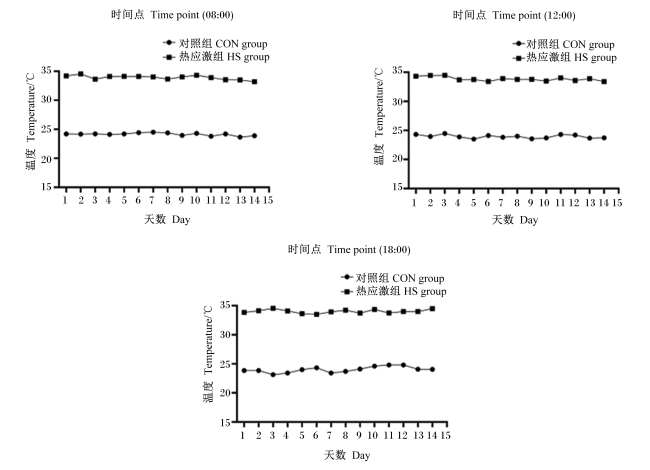
试验在广东海洋大学滨海农业学院动物科学系家禽试验基地进行。将144只雄性28日龄爱拔益加肉鸡随机分为3组,分别为对照组(CON组)、热应激组(HS组)和热应激COS添加组(HSC200组),每组6个重复,每个重复8只鸡,各组平均体重分别为(1.52±0.01) kg、(1.53±0.01) kg、和(1.52±0.01) kg,差异不显著(P>0.05)。CON组肉鸡鸡舍温度为(24±1) ℃,热应激肉鸡鸡舍温度在08:00—18:00为(34±1) ℃,其余时间为(24±1) ℃,相对湿度均为65%~75%。CON组和HS组肉鸡饲喂基础饲粮,HSC200组肉鸡在基础饲粮中添加200 mg/kg COS,COS的添加剂量依据前期试验结果,试验期14 d。整个饲养周期采用加热器、空调和加湿器调控温湿度,每日08:00、12:00和18:00记录鸡舍温湿度,见图1
图1 试验期间的环境温度

Fig.1 Ambient temperature during experimental period

1.3 试验饲粮

基础饲粮配制参考《鸡饲养标准》(NY/T 33—2004),其组成及营养水平表1。饲粮的代谢能和氨基酸含量根据《中国饲料成分及营养价值表(2020年第31版)》相关数据进行计算。饲粮中粗蛋白质、总磷和钙含量分别参照GB/T 6432—2018)、GB/T 6437—2018和GB/T 6436—2018中方法测定。
表1 基础饲粮组成及营养水平(风干基础)

Table 1 Composition and nutrient levels of the basal diet (air-dry basis)%

项目 Items 含量 Content
原料 Ingredients
玉米 Corn 55.00
小麦麸 Wheat bran 2.00
豆粕 Soybean meal 34.82
植物油 Vegetable oil 5.00
石粉 Limestone 0.50
食盐 NaCl 0.30
磷酸氢钙 CaHPO4 1.60
氯化胆碱 Choline chloride 0.10
L-赖氨酸 L-Lys 0.10
DL-蛋氨酸 DL-Met 0.18
维生素预混料 Vitamin premix1) 0.20
矿物质预混料 Mineral premix2) 0.20
合计 Total 100.00
营养水平 Nutrient levels2)
代谢能 ME/(MJ/kg) 12.82
粗蛋白质 CP 19.92
总磷 TP 0.44
钙 Ca 0.93
赖氨酸 Lys 0.45
蛋氨酸 Met 1.30

1)维生素预混料为每千克饲粮提供 Vitamin premix provided the following per kg of the diet:VA 9 000 IU,VD3 3 240 IU,VE 6 IU,VK3 0.75 mg,VB1 1.5 mg,VB2 4.5 mg,VB6 1.5 mg,VB12 10 mg,生物素 biotin 0.2 mg,烟酰胺 nicotinamide 10.5 mg,叶酸 folic acid 0.45 mg,泛酸 pantothenic acid 9 mg。
2)矿物质预混料为每千克饲粮提供 Mineral premix provided the following per kg of the diet:Cu (as copper sulfate) 5 to 10 mg,Fe (as ferrous sulfate) 45 to 120 mg,Mn (as manganese sulfate) 45 to 85 mg,Zn (as zinc sulfate) 50 to 80 mg,Se (as sodium selenite) 0.2 mg,I (as potassium iodide) 0.15 mg。
3)粗蛋白质、总磷和钙含量为实测值,其余为计算值。CP, TP and Ca were measured values, while the others were calculated values.

1.4 样品采集

在试验结束当天,宰前禁食8 h,自由饮水,每个重复随机选取2只体重接近该组平均体重的鸡,单独称重后,进行屠宰取样。一只试验鸡屠宰后,分离十二指肠、空肠和回肠,称重后测量各肠段长度,用于计算各肠段的相对重量和相对长度;另一只试验鸡屠宰后,分离十二指肠、空肠和回肠后,取各肠段中段2 cm左右固定于4%多聚甲醛,用于肠道形态分析,之后将各肠段纵向剖开,取食糜1 g左右于无酶管中,液氮速冻后,-80 ℃保存备用,用于消化酶活性的测定;最后用灭菌的载玻片分别刮取各肠段肠黏膜2份1 g左右于无酶管中,液氮速冻后,-80 ℃保存备用,分别用于抗氧化酶活性的测定和营养物质转运载体相关基因mRNA的表达分析。

1.5 测定指标与方法

1.5.1 生长性能

以重复为单位,于试验第1和14天对肉鸡进行空腹称重,每周记录采食量。计算试验期内平均日采食量(ADFI)、平均日增重(ADG)和料重比(F/G)。

1.5.2 小肠相对重量和长度

小肠(十二指肠、空肠和回肠)相对重量和相对长度,计算公式如下:
小肠相对重量(g/kg)=小肠重量(g)/体重(kg);
小肠相对长度(cm/kg)=小肠长度(cm)/体重(kg)。

1.5.3 肠道形态检测

肠道形态的检测参照之前的方法[20]。简述如下:把在4%多聚甲醛固定好的十二指肠、空肠和回肠样本依次经过乙醇梯度脱水处理,随后使用二甲苯进行透明化,透明化后的组织样本石蜡包埋,并切成薄片,切片后,进行脱蜡和水化处理,完成水化处理的切片再经乙醇梯度脱水,随后进行苏木精-伊红(HE)染色,最后封片。显微镜下观察并拍照,选择10根完整绒毛的视野,使用图像软件CapStudio采集图像,测量VH、CD,并计算VH:CD。

1.5.4 肠道食糜消化酶活性测定

采用试剂盒检测小肠食糜胰蛋白酶(Try)、Lip和α-淀粉酶(α-Amy)活性,试剂盒购买于南京建成生物工程研究所;蛋白浓度采用BCA法测定,试剂盒(T9300A)购买于宝日医生物技术(北京)有限公司,操作方法按试剂盒说明书进行。

1.5.5 肠道黏膜营养物质转运载体相关基因mRNA相对表达量测定

按试剂盒说明书提取组织样品总RNA,将总RNA反转录为cDNA,参照之前的方法进行实时荧光定量PCR[20],检测小肠GLUT1、SGLT1、PepT1及兴奋性氨基酸转运蛋白3(EAAT3)的mRNA相对表达量。引物序列见表2。采用2-ΔΔCt法计算目的基因mRNA相对表达量,内参基因为β-肌动蛋白(β-actin)。
表2 引物序列

Table 2 Primer sequence

基因
Genes
引物序列
Primer sequence (3'—5')
登录号
Accession No.
β-肌动蛋白
β-actin
F:ATCCGGACCCTCCATTGTC
R:AGCCATGCCAATCTCGTCTT
NM_205518.1
葡萄糖转运蛋白1
GLUT1
F:GAGAGCGGCAGCAAGATGACAG
R:CAGCCAGGTGTGGTTGTAGAAGTC
NM_205209.2
钠/葡萄糖共转运蛋白1
SGLT1
F:GATGTGCGGATACCTGAAGC
R:AGGGATGCCAACATGACTGA
XM_046928028.1
转运小肽转运蛋白1
PepT1
F:GCATTGTTTCTAGCTTGCGGT
R:TCCTCCTGAGAACGGACTGT
XM_040701727.2
兴奋性氨基酸转运蛋白3
EAAT3
F:ACCCTTTTGCCTTGGAAACT
R:TTGAGATGTTTGCGTGAAG
XM_046936555.1

1.5.6 肠道抗氧化能力

采用试剂盒检测小肠黏膜CAT、总超氧化物歧化酶(T-SOD)、谷胱甘肽过氧化物酶(GSH-Px)活性及丙二醛(MDA)含量,试剂盒购买于南京建成生物工程研究所:蛋白浓度采用BCA法测定,试剂盒(T9300A)购买于宝日医生物技术(北京)有限公司,操作方法按试剂盒说明书进行。

1.6 数据统计分析

使用SAS 9.4软件对数据进行单因素方差分析,采用多重范围检验进行多重比较,结果以平均值±标准误表示,P<0.05表示差异显著。

2 结果

2.1 COS对热应激肉鸡生长性能的影响

表3可知,与CON组相比,HS组ADG显著降低(P<0.05),F/G显著增加(P<0.05)。与HS组相比,HSC200组F/G显著降低(P<0.05)。
表3 COS对热应激肉鸡生长性能的影响

Table 3 Effects of COS on growth performance of heat-stressed broilers

项目
Items
对照组
CON group
热应激组
HS group
热应激COS添加组
HSC200 group
P
P-value
平均日增重 ADG/g 80.70±1.53a 65.29±4.25b 70.16±1.29b 0.022
平均日采食量 ADFI/g 137.76±2.48 147.78±6.85 139.98±5.94 0.625
料重比 F/G 1.71±0.04c 2.29±0.11a 2.01±0.09b 0.001

同行数据不同字母表示差异显著(P<0.05)。下表同。

In the same row, values with different letter superscripts indicate significant difference (P<0.05). The same as below.

2.2 COS对热应激肉鸡小肠相对重量和相对长度的影响

表4可知,与CON组相比,HS对肉鸡小肠相对长度和相对重量均无显著影响(P>0.05),与HS组相比,COS对肉鸡小肠相对长度和相对重量也无显著影响(P>0.05)。
表4 COS对热应激肉鸡小肠相对长度和相对重量的影响

Table 4 Effects of COS on relative length and relative weight in small intestine of heat-stressed broilers

项目
Items
对照组
CON group
热应激组
HS group
热应激COS添加组
HSC200 group
P
P-value
小肠相对长度 Relative length of small intestine/(cm/kg)
十二指肠 Duodenum 14.38±0.87 12.55±0.44 13.56±0.81 0.317
空肠 Jejunum 34.38±1.58 34.57±1.22 37.23±0.94 0.407
回肠 Ileum 32.71±1.31 30.88±2.33 35.29±1.10 0.224
小肠相对重量 Relative weight of small intestine/(g/kg)
十二指肠 Duodenum 5.85±0.23 5.45±0.39 5.93±0.28 0.643
空肠 Jejunum 12.17±0.77 11.51±0.58 12.45±0.65 0.776
回肠 Ileum 10.27±0.77 9.07±0.61 9.71±0.70 0.541

2.3 COS对热应激肉鸡小肠形态的影响

图2表5可知,与CON组相比,HS组十二指肠和回肠VH显著降低(P<0.05),十二指肠和空肠CD显著提高(P<0.05),十二指肠、空肠VH:CD显著降低(P<0.05)。与HS组相比,HSC200组十二指肠VH和VH:CD显著提高(P<0.05),十二指肠、空肠CD显著降低(P<0.05)。
图2 热应激肉鸡小肠形态

Fig.2 Small intestine morphology of heat-stressed broilers

表5 COS对热应激肉鸡小肠形态的影响

Table 5 Effects of COS on small intestine morphology of heat-stressed broilers

项目
Items
对照组
CON group
热应激组
HS group
热应激COS添加组
HSC200 group
P
P-value
十二指肠 Duodenum
绒毛高度 VH/μm 760.50±19.10a 519.50±4.30c 628.00±12.59b <0.001
隐窝深度 CD/μm 116.67±1.17c 132.00±0.93a 123.50±1.02b <0.001
绒毛高度:隐窝深度VH:CD 6.54±0.21a 3.94±0.04c 5.09±0.09b <0.001
空肠 Jejunum
绒毛高度 VH/μm 658.33±53.66 554.17±31.22 616.50±25.03 0.193
隐窝深度 CD/μm 100.50±3.31c 133.33±0.67a 119.17±3.13b <0.001
绒毛高度:隐窝深度VH:CD 6.60±0.59a 4.16±0.24b 5.18±0.17b 0.002
回肠 Ileum
绒毛高度 VH/μm 597.83±16.15a 446.50±46.19b 530.67±18.41ab 0.010
隐窝深度 CD/μm 102.33±8.01 130.17±17.08 100.00±6.87 0.132
绒毛高度:隐窝深度VH:CD 5.60±0.40 3.92±0.92 5.33±0.23 0.070

2.4 COS对热应激肉鸡小肠消化酶活性的影响

表6可知,与CON组相比,HS组十二指肠Lip和空肠Try、Lip活性显著降低(P<0.05)。与HS组相比,HSC200组空肠Try、Lip活性显著增加(P<0.05)。
表6 COS对热应激肉鸡小肠消化酶活性的影响

Table 6 Effects of COS on digestive enzyme activity in small intestine of heat-stressed broilersU/mg prot

项目
Items
对照组
CON group
热应激组
HS group
热应激COS添加组
HSC200 group
P
P-value
十二指肠 Duodenum
胰蛋白酶 Try 2 623.81±402.80 1 996.69±259.09 2 330.24±404.03 0.488
脂肪酶 Lip 19.19±1.74a 10.38±0.39b 12.17±0.58b <0.001
α-淀粉酶 α-Amy 0.78±0.15 0.28±0.13 0.37±0.14 0.057
空肠 Jejunum
胰蛋白酶 Try 3 323.79±236.32a 2 602.15±402.92b 3 847.77±194.17a 0.028
脂肪酶 Lip 26.24±0.70a 13.93±1.47b 20.43±3.33a 0.004
α-淀粉酶 α-Amy 0.14±0.02 0.13±0.03 0.15±0.01 0.906
回肠 Ileum
胰蛋白酶 Try 2 842.11±295.36 2 038.53±172.02 2 836.88±260.67 0.058
脂肪酶 Lip 17.33±1.76 14.56±2.22 16.98±2.76 0.658
α-淀粉酶 α-Amy 0.09±0.01 0.07±0.12 0.08±0.03 0.881

2.5 COS对热应激肉鸡小肠营养转运载体相关基因mRNA表达的影响

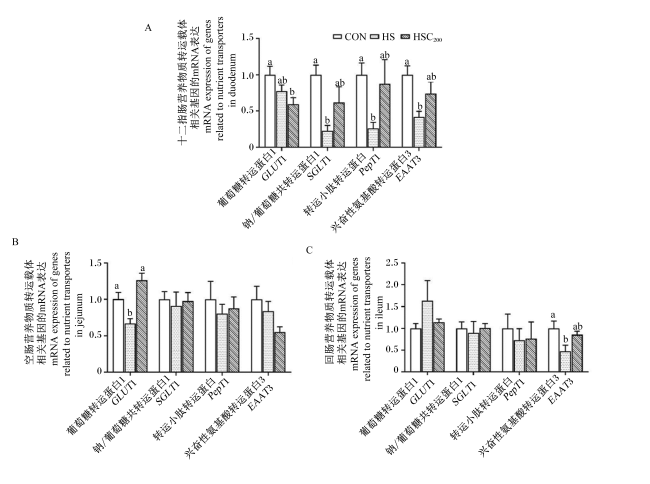
图3可知,与CON组相比,HS组十二指肠SGLT1、PepT1和EAAT3和空肠GLUT1及回肠EAAT3 mRNA相对表达量显著降低(P<0.05)。与HS组相比,HSC200组空肠GLUT1 mRNA相对表达量显著增加(P<0.05)。
图3 COS对热应激肉鸡小肠营养转运载体相关基因mRNA表达的影响

CON:对照组;HS:热应激组;HSC200:热应激COS添加组。同指标柱形标注不同字母表示差异显著(P<0.05)。

Fig.3 Effects of COS on mRNA expression of nutrient transporters related-genes in small intestine of heat-stressed broilers

CON: control group; HS: heat stress group; HSC200: heat stress with 200 mg/kg COS group. In the same item, value columns with different letters mean significant difference (P<0.05).

2.6 COS对热应激肉鸡小肠抗氧化指标的影响

表7可知,与CON组相比,HS组十二指肠GSH-Px的活性和空肠CAT、GSH-Px的活性及回肠CAT的活性显著降低(P<0.05),空肠和回肠MDA含量显著增加(P<0.05)。与HS组相比,HSC200组十二指肠和回肠CAT和GSH-Px的活性及空肠GSH-Px的活性显著提高(P<0.05),十二指肠、回肠和空肠MDA含量显著降低(P<0.05)。
表7 COS对热应激肉鸡小肠抗氧化指标的影响

Table 7 Effects of COS on antioxidant indexes in small intestine of heat-stressed broilers

项目
Items
对照组
CON group
热应激组
HS group
热应激COS添加组
HSC200 group
P
P-value
十二指肠 Duodenum
过氧化氢酶 CAT/(U/mg prot) 0.47±0.06ab 0.27±0.07b 0.55±0.08a 0.045
谷胱甘肽过氧化物酶 GSH-Px/(U/mg prot) 1.84±0.49a 0.64±0.04b 1.86±0.34a 0.039
总超氧化物歧化酶 T-SOD/(U/mg prot) 67.54±10.03 62.56±6.01 63.34±5.62 0.880
丙二醛 MDA/(nmol/g prot) 92.33±9.50ab 192.89±64.26a 35.90±4.72b 0.030
空肠 Jejunum
过氧化氢酶 CAT/(U/mg prot) 1.30±0.23a 0.62±0.13b 0.91±0.15ab 0.044
谷胱甘肽过氧化物酶 GSH-Px/(U/mg prot) 2.92±0.34b 1.18±0.43c 4.32±0.53a 0.001
总超氧化物歧化酶 T-SOD/(U/mg prot) 40.52±5.03 34.09±3.58 34.67±5.41 0.581
丙二醛 MDA/(nmol/g prot) 80.48±6.56b 137.02±7.22a 82.47±12.59b 0.001
回肠 Ileum
过氧化氢酶 CAT/(U/mg prot) 2.77±0.48a 0.54±0.20c 1.58±0.16b 0.001
谷胱甘肽过氧化物酶 GSH-Px/(U/mg prot) 4.65±0.52ab 3.69±0.37b 5.56±0.39a 0.026
总超氧化物歧化酶 T-SOD/(U/mg prot) 66.62±10.21 53.93±4.14 46.69±2.43 0.125
丙二醛 MDA/(nmol/g prot) 96.62±17.53b 160.69±2.97a 51.20±4.29c <0.001

3 讨论

3.1 COS对热应激肉鸡生长性能的影响

肉鸡热应激是指肉鸡持续暴露在高温环境下,机体对热暴露所做出的防御反应[21]。在全球变暖的大环境下,肉鸡生产面临着热应激的严峻挑战,大量研究报道了热应激对肉鸡的负面影响,包括体温升高、代谢紊乱、免疫抑制等,最终导致肉鸡生长性能下降[3,22-23]。而生长性能是决定肉鸡高效生产的关键,因此如何有效降低热应激对肉鸡生长性能的危害成为肉鸡生产的关键问题。Hu等[22]研究发现,热应激提高61~74日龄雪山鸡F/G。Fang等[23]研究发现,热应激降低50~106日龄文昌鸡ADG和ADFI。本试验结果与已报道的研究结果一致,与CON组相比,热应激显著降低肉鸡ADG,提高F/G,ADFI在数值上有所降低,但差异不显著。这提示热应激对肉鸡ADG的影响多于ADFI,最终导致肉鸡ADG下降,F/G升高[21]。COS作为一种功能性寡糖,具有缓解应激的作用[24-25]。Lan等[26]研究发现,饲粮中添加200 mg/kg COS可提高57~77日龄热应激黄羽肉鸡ADG和ADFI。杨明顺等[27]研究发现,饲粮中添加250 mg/kg COS可提高56~84日龄热应激黄羽肉鸡ADFI。本试验结果显示,与HS组相比,COS降低肉鸡F/G,表明COS能缓解热应激导致的生长性能下降。COS提高热应激肉鸡的生长性能可能与其改善肉鸡肠道健康发育有关。Li等[28]研究发现,30 mg/kg COS提高1~21日龄白羽肉鸡肠道形态和屏障通透性,进而降低肉鸡F/G。Lan等[13]研究发现,饲粮中添加400 mg/kg COS提高1~14日龄白羽肉鸡消化酶活性,进而提高肉鸡ADG和ADFI。Fathi等[24]研究发现,饲粮中添加300 mg/kg COS提高14~42日龄肉鸡肠道抗氧化能力,进而提高ADFI,降低F/G。以上结果表明,热应激降低肉鸡生长性能,COS可能通过改善肉鸡肠道的消化与吸收、增强肠道抗氧化能力等途径缓解热应激对肉鸡生长性能的负面效应。

3.2 COS对热应激肉鸡小肠相对重量和相对长度的影响

小肠相对重量和相对长度是衡量肠道生长发育的重要指标,热应激降低肉鸡小肠相对重量、缩短相对长度,扰乱小肠营养物质消化和吸收能力,从而影响着肉鸡的生长性能[29]。Sohail等[30]研究发现,34~37 ℃热应激降低22~42日龄肉鸡小肠相对重量。Peng等[31]研究发现,32~34 ℃热应激降低22~42日龄肉鸡小肠相对重量和相对长度。但关于热应激对肉鸡肠道发育的研究结果并不完全一致,Hashemitabar等[2]报道,热应激对21和42日龄肉鸡的小肠重量及21和32日龄肉鸡的小肠长度无显著影响,但显著降低32日龄肉鸡的小肠重量和42日龄肉鸡的小肠长度。Marchini等[32]研究发现,热应激对1、7、14、21和28日龄肉鸡肠道(小肠+直肠)长度无显著影响,但显著降低42日龄肉鸡肠道长度。本试验结果表明,与CON组相比,热应激在数值上降低了十二指肠和回肠的相对长度,及十二指肠、空肠和回肠的相对重量。本研究结果与之前的报道结果有差异,推测可能与肠道发育的阶段性相关,因为1~7日龄是肉鸡肠道发育的主要阶段[33]。COS具有促进肠道发育的作用[30,34]。Lan等[18]研究发现,200 mg/kg COS提高35~49日龄热应激黄羽肉鸡十二指肠、空肠和回肠的相对长度。本试验结果显示,与HS组相比,COS在数值上提高十二指肠、空肠和回肠的相对长度和相对重量。目前关于COS对热应激肉鸡小肠发育的作用机制还不明确,有待进一步研究。

3.3 COS对热应激肉鸡肠道形态的影响

小肠是营养物质消化吸收的主要场所,营养物质的消化吸收能力取决于肠道形态的完整性,VH和CD是代表肠道形态完整的重要指标[35-36]。热应激引起肠道缺血,导致肠上皮细胞损伤和脱落,黏膜层绒毛发生断裂,主要表现为VH变短和CD提高,VH:CD降低,最终影响肉鸡肠道形态,降低肠道对营养物质的吸收能力[2]。Oretomiloye等[37]研究发现,热应激降低1~28日龄罗斯208肉鸡十二指肠和回肠VH、VH:CD。Wu等[38]研究发现,热应激降低21~42日龄白羽肉鸡空肠和回肠VH,提高回肠CD。本试验结果与已报道的研究结果一致,与CON组相比,热应激降低肉鸡十二指肠和回肠VH,十二指肠、空肠和回肠VH:CD,提高十二指肠和空肠CD。COS能够修复热应激引发的肠道损伤[34]。Li等[28]研究发现,30 mg/kg COS提高1~15日龄热应激肉鸡十二指肠VH,十二指肠、空肠VH:CD,降低空肠CD。Lan等[18]研究发现,200 mg/kg COS降低35~49日龄热应激黄羽肉鸡空肠和回肠VH。本试验结果显示,COS提高十二指肠VH和VH:CD,降低十二指肠和空肠CD。以上结果表明,热应激损伤肉鸡肠道形态结构,而COS能够修复热应激引发的肠道损伤,进而增强肠道的消化吸收功能。

3.4 COS对热应激肉鸡肠道消化酶活性的影响

肠道消化酶活性与肠道形态相关[39-40]。消化酶在动物的消化过程中发挥着重要作用,主要包括Try、Lip和α-Amy等[39]。Try能够催化水解碱性氨基酸的肽键,将蛋白质分解成氨基酸[41]。Lip能够将甘油三酯水解成甘油和游离脂肪酸[42]。α-Amy是水解淀粉的酶,水解淀粉葡萄糖单元之间的糖苷键[43]。热应激降低肉鸡肠道消化酶的活性,进而影响肉鸡对营养物质的消化吸收[28]。Al-Zghoul等[44]研究发现,热应激降低28~35日龄肉鸡空肠Try和Lip活性。Madkour等[45]研究发现,热应激降低1~35日龄肉鸡空肠Try和α-Amy活性。本研究的发现与先前文献中的报道结果相似,与CON组相比,热应激降低肉鸡十二指肠Lip、α-Amy活性,空肠Try、Lip活性和回肠Try活性。当前,有关COS对肉鸡肠道消化酶活性影响的报道较少。Lan等[13]研究发现,饲粮中添加400 mg/kg COS增加1~14日龄白羽肉鸡空肠Lip和回肠α-Amy活性。Su等[46]研究发现,饲料中添加COS增加虎龙斑肠道的Try和Lip活性。Zhang等[47]研究发现,饲粮中饲料COS增加泥鳅肠道的Try、Lip和α-Amy活性。本试验结果显示,与HS组相比,COS提高空肠Lip和回肠Try活性。以上结果表明,热应激降低肠道消化酶活性,而COS可能通过促进肉鸡肠道Try、Lip和α-Amy等消化酶活性的分泌,进而提高肉鸡肠道消化吸收能力。

3.5 COS对热应激肉鸡肠道营养转运载体蛋白相关基因mRNA的表达的影响

为了进一步明确COS对热应激肉鸡小肠消化吸收能力的影响,本试验检测了COS对热应激肉鸡肠道营养转运载体蛋白相关基因mRNA的表达。肠上皮细胞营养转运载体蛋白中,GLUT1、SGLT1及PepT1和EAAT3的作用十分关键[48-49]。GLUTs和SGLTs家族位于肠黏膜的顶端侧,主要负责碳水化合物的吸收,GLUT1摄取基础水平的葡萄糖,而SGLT1对钠依赖性葡萄糖协同转运蛋白具有高亲和力[48]。PepT1主要分布在小肠上皮细胞刷状边界膜,负责二肽和三肽的转运[50-51]。EAAT3是一种上皮型高亲和力阴离子兴奋性氨基酸转运蛋白,负责阴离子氨基酸的转运[51]。热应激降低肉鸡肠道营养转运载体蛋白GLUT1、SGLT1和PepT1等基因mRNA相对表达量[48]。Abdelli等[52]研究发现,热应激降低肉鸡空肠GLUT2和EAAT3 mRNA相对表达量。Habashy等[48]研究发现,热应激降低肉鸡回肠GLUT1和PepT1 mRNA相对表达量。本研究的结果与先前文献中的报道结果相似,与CON组相比,热应激降低肉鸡十二指肠SGLT1、PepT1和EAAT3,空肠GLUT1和回肠EAAT3 mRNA相对表达量。目前,关于COS对肉鸡肠道上皮细胞中营养转运载体蛋白相关基因表达的影响,研究报道较少。方婷婷[53]研究发现,妊娠母猪饲粮中添加COS提高IUGR仔猪对应胎盘GLUT1、GLUT3 mRNA相对表达量。Lan等[13]研究发现,饲粮中添加400 mg/kg COS增加1~14日龄白羽肉鸡十二指肠、空肠及回肠中SGLT1和PepT1 mRNA相对表达量。本研究结果显示,与HS组相比,COS提高十二指肠SGLT1、PepT1和EAAT3,空肠GLUT1及回肠EAAT3 mRNA相对表达量。以上结果表明,热应激降低肉鸡肠道上皮细胞营养转运载体蛋白的表达,而COS有效上调大部分营养转运载体蛋白mRNA相对表达量,进而促进肉鸡肠道营养物质的吸收效率。值得注意的是,在本研究中,与CON组相比,HSC200组十二指肠GLUT1 mRNA相对表达量显著降低,但与HS组差异不显著。在回肠中,与CON组相比,HS组GLUT1 mRNA相对表达量显著降低,与HS组相比,HSC200GLUT1 mRNA相对表达量显著提高,但与CON组差异不显著。在空肠中,CON组、HS组和HSC200GLUT1 mRNA相对表达量无显著差异。这些结果表明,GLUT1 mRNA的表达具有不同肠段区域的特定效应。先前的研究结果同样也表明,COS提高1~14日龄肉鸡十二指肠GLUT1 mRNA相对表达量,但降低空肠和回肠GLUT1 mRNA相对表达量[13]。此外,十二指肠、空肠和回肠长度不一,营养物质在各肠段停留时间不同,是否也是影响COS发挥相关生物学功能及影响GLUT1 mRNA相对表达量的因素?相关研究工作还需进一步进行,本研究尚不能解释COS调节小肠营养转运蛋白表达水平的作用机制,应进一步设计相关试验以探究其机制。

3.6 COS对热应激肉鸡肠道抗氧化指标的影响

氧化应激是诱导肠道屏障功能障碍的重要因素[54-55]。热应激通过诱导ROS的过量产生来损害肠道功能,GSH-Px、SOD和CAT等抗氧化酶的活性及脂质过氧化产物MDA的含量直观反映了肉鸡机体ROS的产生情况[56]。Wang等[56]研究发现,热应激降低21~42日龄肉鸡空肠SOD和GSH-Px活性以及Nrf2相关因子mRNA水平,增加MDA含量。Jiang等[57]研究发现,热应激降低1~21日龄儋州鸡空肠总抗氧化能力和CAT活性,增加MDA含量。本研究的结果与先前文献中的报道结果相似,与CON组相比,热应激降低肉鸡十二指肠GSH-Px,空肠CAT和GSH-Px以及回肠CAT活性,增加空肠和回肠MDA含量。COS具有抗氧化作用[58-59]。Lan等[59]研究发现,饲粮中添加600 mg/kg COS提高热应激1~14日龄白羽肉鸡肝脏SOD、GSH-Px活性,降低MDA含量。Lan等[60]研究发现,饲粮中添加200 mg/kg COS提高35日龄黄羽肉鸡运输应激胸肌CAT、SOD活性,降低MDA含量。本试验结果显示,与HS组相比,COS提高热应激肉鸡十二指肠和回肠CAT、GSH-Px及空肠GSH-Px活性,降低十二指肠、回肠和空肠MDA含量。以上结果表明,热应激降低肉鸡肠道多种抗氧化酶活性,COS在一定程度上改善了热应激肉鸡肠道氧化应激状态。

4 结论

热应激降低肉鸡生长性能和肠道消化吸收功能,COS通过修复小肠形态结构,提高消化酶活性、营养转运载体蛋白相关基因mRNA表达和增强肠道抗氧化能力,从而改善热应激肉鸡的消化吸收功能和生长性能。
[1]
TANG L P, LIU Y L, ZHANG J X, et al. Heat stress in broilers of liver injury effects of heat stress on oxidative stress and autophagy in liver of broilers[J]. Poultry Science, 2022, 101(10):102085.

[2]
HASHEMITABAR S H, HOSSEINIAN S A. The comparative effects of probiotics on growth, antioxidant indices and intestinal histomorphology of broilers under heat stress condition[J]. Scientific Reports, 2024, 14(1):23471.

DOI PMID

[3]
APALOWO O O, EKUNSEITAN D A, FASINA Y O. Impact of heat stress on broiler chicken production[J]. Poultry, 2024, 3(2):107-128.

[4]
MADKOUR M, ALAQALY A M, SOLIMAN S S, et al. Growth performance, blood biochemistry, and mRNA expression of hepatic heat shock proteins of heat-stressed broilers in response to rosemary and oregano extracts[J]. Journal of Thermal Biology, 2024, 119:103791.

[5]
SAYED Y, HASSAN M, SALEM H M, et al. Prophylactic influences of prebiotics on gut microbiome and immune response of heat-stressed broiler chickens[J]. Scientific Reports, 2023, 13(1):13991.

DOI PMID

[6]
KIKUSATO M, NAMAI F, YAMADA K. Effect of feeding sugarcane bagasse-extracted polyphenolic mixture on the growth performance, meat quality, and oxidative and inflammatory status of chronic heat-stressed broiler chickens[J]. Animals, 2024, 14(23):3443.

[7]
MAZLAN N A F, MISWAN N A, AHMAD S, et al. Black soldier fly(Hermetia illucens)larvae meal for heat-stressed broiler chicken:its effects on gut health,stress biomarkers,and growth performance[J]. Italian Journal of Animal Science, 2024, 23(1):1391-1402.

[8]
WANG M, YANG C, WANG Q Y, et al. The growth performance, intestinal digestive and absorptive capabilities in piglets with different lengths of small intestines[J]. Animals, 2020, 14(6):1196-1203.

[9]
WU Q J, JIAO C, LIU Z H, et al. Effect of glutamine on the growth performance, digestive enzyme activity, absorption function, and mRNA expression of intestinal transporters in heat-stressed chickens[J]. Research in Veterinary Science, 2021, 134:51-57.

DOI PMID

[10]
SONG Z H, CHENG K, ZHENG X C, et al. Effects of dietary supplementation with enzymatically treated Artemisia annua on growth performance, intestinal morphology, digestive enzyme activities, immunity, and antioxidant capacity of heat-stressed broilers[J]. Poultry Science, 2018, 97(2):430-437.

DOI PMID

[11]
KIM D Y, KIM J H, CHOI W J, et al. Comparative effects of dietary functional nutrients on growth performance, meat quality, immune responses, and stress biomarkers in broiler chickens raised under heat stress conditions[J]. Animal Bioscience, 2021, 34(11):1839-1848.

[12]
SILVA T G L, JUNIOR N R, CAMPOS F P, et al. Effects of feeding diets with zinc-L-selenomethionine on growth performance of broilers subjected to cyclic heat stress[J]. Tropical Animal Health and Production, 2023, 55(6):384.

DOI PMID

[13]
LAN R X, WU F, WANG Y C, et al. Chitosan oligosaccharide improves intestinal function by promoting intestinal development, alleviating intestinal inflammatory response, and enhancing antioxidant capacity in broilers aged d 1 to 14[J]. Poultry Science, 2024, 103(2):103381.

[14]
CHANG Q Q, LU Y Q, LAN R X. Chitosan oligosaccharide as an effective feed additive to maintain growth performance, meat quality, muscle glycolytic metabolism, and oxidative status in yellow-feather broilers under heat stress[J]. Poultry Science, 2020, 99(10):4824-4831.

DOI PMID

[15]
魏琳琳, 兰瑞霞, 王语晨, 等. 壳寡糖对肉鸡生长性能、屠宰性能、胸肌肉品质及氧化稳定性的影响[J]. 中国畜牧杂志, 2024, 60(1):307-313.

WEI L L, LAN R X, WANG Y C, et al. The effect of shell oligosaccharides on the growth performance, slaughter performance, breast muscle quality, and oxidative stability of broiler chickens[J]. Chinese Journal of Animal Science, 2024, 60(1):307-313. (in Chinese)

[16]
WANG L, ZHANG C, FAN S H, et al. Chitosan oligosaccharide improves intestinal homeostasis to achieve the protection for the epithelial barrier of female Drosophila melanogaster via regulating intestinal microflora[J]. Microbiology Spectrum, 2024, 12(4):e0363923.

[17]
LI Q Y, SHI W R, HUANG Y L. Comparison of the protective effects of chitosan oligosaccharides and chitin oligosaccharide on apoptosis, inflammation and oxidative stress[J]. Experimental and Therapeutic Medicine, 2024, 28(2):310.

DOI PMID

[18]
LAN R X, LI Y X, CHANG Q Q, et al. Dietary chitosan oligosaccharides alleviate heat stress-induced intestinal oxidative stress and inflammatory response in yellow-feather broilers[J]. Poultry Science, 2020, 99(12):6745-6752.

DOI PMID

[19]
CHANG Q Q, CAI H A, WEI L L, et al. Chitosan oligosaccharides alleviate acute heat stress-induced oxidative damage by activating ERK1/2-mediated HO-1 and GSH-Px gene expression in breast muscle of broilers[J]. Poultry Science, 2022, 101(1):101515.

[20]
LAN R, LI S, CHANG Q, et al. Sodium butyrate enhances growth performance and intestinal development in broilers[J]. Czech Journal of Animal Science, 2020, 65(1):1-12.

[21]
KPOMASSE C C, OKE O E, HOUNDONOUGBO F M, et al. Broiler production challenges in the tropics: a review[J]. Veterinary Medicine and Science, 2021, 7(3):831-842.

DOI PMID

[22]
HU P, LI K Q, PENG X X, et al. Zinc intake ameliorates intestinal morphology and oxidative stress of broiler chickens under heat stress[J]. Frontiers in Immunology, 2023, 14:1308907.

[23]
FANG X, NONG K Y, QIN X Y, et al. Effect of purple sweet potato-derived anthocyanins on heat stress response in Wenchang chickens and preliminary mechanism study[J]. Poultry Science, 2023, 102(9):102861.

[24]
FATHI M, SAEIDIAN S, BAGHAEIFAR Z, et al. Chitosan oligosaccharides in the diet of broiler chickens under cold stress had anti-oxidant and anti-inflammatory effects and improved hematological and biochemical indices, cardiac index, and growth performance[J]. Livestock Science, 2023, 276:105338.

[25]
GARCÍA-GARCÍA A L, MATOS A R, FEIJÃO E, et al. The use of chitosan oligosaccharide to improve artemisinin yield in well-watered and drought-stressed plants[J]. Frontiers in Plant Science, 2023, 14:1200898.

[26]
LAN R, WEI L, CHANG Q, et al. Effects of dietary chitosan oligosaccharides on oxidative stress and inflammation response in liver and spleen of yellow-feather broilers exposed to high ambient temperature[J]. Italian Journal of Animal Science, 2020, 19(1):1508-1517.

[27]
杨明顺, 陈静文, 王润莲, 等. 海洋活性物质壳寡糖对持续高温环境下肉鸡生长、体脂沉积及胴体性能的影响[J]. 广东饲料, 2021, 30(3):20-23.

YANG M S, CHEN J W, WANG R L, et al. The effects of marine active substance chitosan oligosaccharides on the growth, body fat deposition, and carcass performance of broilers in a continuously high-temperature environment.[J]. Guangdong Feed, 2021, 30(3):20-23. (in Chinese)

[28]
LI J, CHENG Y F, CHEN Y P, et al. Dietary chitooligosaccharide inclusion as an alternative to antibiotics improves intestinal morphology, barrier function, antioxidant capacity, and immunity of broilers at early age[J]. Animals, 2019, 9(8):493.

[29]
NAZEM M N, SAJJADIAN S M, KHEIRANDISH R, et al. Histomorphometric analysis of the small intestine of broiler chick embryos injected in ovo with methionine[J]. Animal Production Science, 2019, 59(1):133.

[30]
SOHAIL M U, IJAZ A, YOUNUS M, et al. Effect of supplementation of mannan oligosaccharide and probiotic on growth performance, relative weights of viscera, and population of selected intestinal bacteria in cyclic heat-stressed broilers[J]. Journal of Applied Poultry Research, 2013, 22(3):485-491.

[31]
PENG X Y, XING T, LI J L, et al. Guanidinoacetic acid supplementation improves intestinal morphology, mucosal barrier function of broilers subjected to chronic heat stress[J]. Journal of Animal Science, 2023, 101:skac355.

[32]
MARCHINI C F P, SILVA P L, NASCIMENTO M R B M, et al. Body weight,intestinal morphometry and cell proliferation of broiler chickens submitted to cyclic heat stress[J]. International Journal of Poultry Science, 2011, 10(6):455-460.

[33]
IJI P A, SAKI A, TIVEY D R. Body and intestinal growth of broiler chicks on a commercial starter diet.2.Development and characteristics of intestinal enzymes[J]. British Poultry Science, 2001, 42(4):514-522.

[34]
GU Y F, CHEN Y P, JIN R, et al. Dietary chitooligosaccharide supplementation alleviates intestinal barrier damage, and oxidative and immunological stress in lipopolysaccharide-challenged laying hens[J]. Poultry Science, 2022, 101(4):101701.

[35]
ZHENG X T, XIE Y K, CHEN Z W, et al. Effects of glycine supplementation in drinking water on the growth performance, intestinal development, and genes expression in the jejunum of chicks[J]. Animals, 2023, 13(19):3109.

[36]
PELICANO E, SOUZA P, SOUZA H, et al. Intestinal mucosa development in broiler chickens fed natural growth promoters[J]. Revista Brasileira de Ciência Avícola, 2005, 7(4):221-229.

[37]
ORETOMILOYE F, ADEWOLE D. Exploring the modulatory effects of brown seaweed meal and extracts on intestinal microbiota and morphology of broiler chickens challenged with heat stress[J]. Poultry Science, 2024, 103(4):103562.

[38]
WU Q J, LIU N, WU X H, et al. Glutamine alleviates heat stress-induced impairment of intestinal morphology, intestinal inflammatory response, and barrier integrity in broilers[J]. Poultry Science, 2018, 97(8):2675-2683.

DOI PMID

[39]
SHI Z F, WANG T W, KANG J J, et al. Effects of weaning modes on the intestinal pH, activity of digestive enzymes, and intestinal morphology of piglets[J]. Animals, 2022, 12(17):2200.

[40]
GOPALRAAJ J, VELAYUDHANNAIR K, AROCKIASAMY J P, et al. The effect of dietary supplementation of proteases on growth, digestive enzymes, oxidative stress, and intestinal morphology in fishes—a review[J]. Aquaculture International, 2024, 32(1):745-765.

[41]
RAWLINGS N D, BARRETT A J. Evolutionary families of peptidases[J]. Biochemical Journal, 1993, 290(Pt 1):205-218.

[42]
HOUDE A, KADEMI A, LEBLANC D. Lipases and their industrial applications: an overview[J]. Applied Biochemistry and Biotechnology, 2004, 118(1/2/3):155-170.

[43]
SØGAARD M, ABE J I, MARTIN-EAUCLAIRE M F, et al. α-amylases: structure and function[J]. Carbohydrate Polymers, 1993, 21(2/3):137-146.

[44]
AL-ZGHOUL M B, ALLIFTAWI A R S, SALEH K M M, et al. Expression of digestive enzyme and intestinal transporter genes during chronic heat stress in the thermally manipulated broiler chicken[J]. Poultry Science, 2019, 98(9):4113-4122.

[45]
MADKOUR M, ABOELENIN M M, HABASHY W S, et al. Effects of oregano and/or rosemary extracts on growth performance,digestive enzyme activities,cecal bacteria,tight junction proteins,and antioxidants-related genes in heat-stressed broiler chickens[J]. Poultry Science, 2024, 103(9):103996.

[46]
SU P, HAN Y, JIANG C, et al. Effects of chitosan-oligosaccharides on growth performance,digestive enzyme and intestinal bacterial flora of tiger puffer(Takifugu rubripes Temminck et Schlegel,1850)[J]. Journal of Applied Ichthyology, 2017, 33(3):458-467.

[47]
ZHANG B Z. Dietary chitosan oligosaccharides modulate the growth, intestine digestive enzymes, body composition and nonspecific immunity of loach Paramisgurnus dabryanus[J]. Fish & Shellfish Immunology, 2019, 88:359-363.

[48]
HABASHY W S, MILFORT M C, FULLER A L, et al. Effect of heat stress on protein utilization and nutrient transporters in meat-type chickens[J]. International Journal of Biometeorology, 2017, 61(12):2111-2118.

DOI PMID

[49]
CRIADO-MESAS L, ABDELLI N, NOCE A, et al. Transversal gene expression panel to evaluate intestinal health in broiler chickens in different challenging conditions[J]. Scientific Reports, 2021, 11(1):6315.

[50]
WANG C Y, LIU S, XIE X N, et al. Regulation profile of the intestinal peptide transporter 1 (PepT1)[J]. Drug Design,Development and Therapy, 2017, 11:3511-3517.

[51]
LING Y J, GAO C Q, GUANG L X, et al. EAAT3 promotes amino acid transport and proliferation of porcine intestinal epithelial cells[J]. Oncotarget, 2016, 7(25):38681-38692.

[52]
ABDELLI N, RAMSER A, GREENE E S, et al. Effects of cyclic chronic heat stress on the expression of nutrient transporters in the jejunum of modern broilers and their ancestor wild jungle fowl[J]. Frontiers in Physiology, 2021, 12:733134.

[53]
方婷婷. 壳寡糖对IUGR仔猪肠道内质网应激的缓解效应及其机制研究[D].博士学位论文. 雅安: 四川农业大学, 2022.

FANG T T. Study on the relief effect of shell oligosaccharides on endoplasmic reticulum stress in IUGR piglets and its mechanism[D]. Ph.D.Thesis. Ya’an: Sichuan Agricultural University, 2022. (in Chinese)

[54]
WEN Z Y, LIU W H, LI X, et al. A protective role of the NRF2-Keap1 pathway in maintaining intestinal barrier function[J]. Oxidative Medicine and Cellular Longevity, 2019, 2019:1759149.

[55]
SONG Z H, CHENG K, ZHANG L L, et al. Dietary supplementation of enzymatically treated Artemisia annua could alleviate the intestinal inflammatory response in heat-stressed broilers[J]. Journal of Thermal Biology, 2017, 69:184-190.

[56]
WANG C, ZHAO F, LI Z, et al. Effects of resveratrol on growth performance, intestinal development, and antioxidant status of broilers under heat stress[J]. Animals, 2021, 11(5):1427.

[57]
JIANG H R, SHI L G, DENG T J, et al. Effects of cardamonin on the growth performance, intestinal barrier function and intestinal microbiota of Danzhou chickens under heat stress[J]. Poultry Science, 2024, 103(12):104362.

[58]
MEI Q X, HU J H, HUANG Z H, et al. Pretreatment with chitosan oligosaccharides attenuate experimental severe acute pancreatitis via inhibiting oxidative stress and modulating intestinal homeostasis[J]. Acta Pharmacologica Sinica, 2021, 42(6):942-953.

[59]
LAN R X, LUO H W, WU F, et al. Chitosan oligosaccharides alleviate heat-stress-induced lipid metabolism disorders by suppressing the oxidative stress and inflammatory response in the liver of broilers[J]. Antioxidants, 2023, 12(8):1497.

[60]
LAN R, CHANG Q, LU Y. Effects of chitosan oligosaccharides on meat quality,muscle energy metabolism and anti-oxidant status in broilers that have experienced transport stress[J]. Animal Production Science, 2021, 61(15):1625-1632.

文章导航

/