研究论文

补饲矿物质舔砖对藏羊生长性能、屠宰性能、瘤胃发酵参数与微生物区系以及血清指标的影响

  • 武高杰 , 1 ,
  • 赵建 1, 2, * ,
  • 赵鑫盛 1 ,
  • 王雷 3 ,
  • 拜彬强 1 ,
  • 杨英魁 1 ,
  • 王作江 4 ,
  • 杜雪燕 3 ,
  • 高健 2 ,
  • 鲍宇红 5 ,
  • 成艳芬 2 ,
  • 郝力壮 , 1, **
展开
  • 1 青海大学,青海省高原放牧家畜动物营养与饲料科学重点实验室,西宁 810016
  • 2 南京农业大学动物消化道营养国际联合研究中心,南京 210095
  • 3 青海省饲草料技术推广站,西宁 810000
  • 4 青海柴达木农垦莫河骆驼场有限公司,乌兰县科技特派员001号工作站,海西洲 817101
  • 5 西藏自治区农牧科学院草业科学研究所,拉萨 850000
** 郝力壮,研究员,博士生导师,E-mail:

* 同等贡献作者

武高杰(2000—),男,河南洛阳人,硕士研究生,研究方向为动物营养与饲料科学。E-mail:

Copy editor: 菅景颖

收稿日期: 2024-11-07

  网络出版日期: 2025-07-12

基金资助

国家重点研发子课题(2022YFD1302103)

国家重点研发子课题(2022YFD1602311)

青海省高原放牧家畜动物营养与饲料科学重点实验室(评估奖励项目:2024-1-8)

青海省科技特派员专项(2024-NK-P57)

青海省重点研发与转化计划项目(2021-NK-126)

Effects of Supplementary Feeding Mineral Licking Brick on Growth Performance, Slaughter Performance, Rumen Fermentation Parameters and Microbial Community, and Serum Indexes of Tibetan Sheep

  • WU Gaojie , 1 ,
  • ZHAO Jian 1, 2 ,
  • ZHAO Xinsheng 1 ,
  • WANG Lei 3 ,
  • BAI Binqiang 1 ,
  • YANG Yingkui 1 ,
  • WANG Zuojiang 4 ,
  • DU Xueyan 3 ,
  • GAO Jian 2 ,
  • BAO Yuhong 5 ,
  • CHENG Yanfen 2 ,
  • HAO Lizhuang , 1, **
Expand
  • 1 Qinghai Plateau Grazing Livestock Key Laboratory of Animal Nutrition and Feed Science, Qinghai University, Xi’ning 810016, China
  • 2 International Joint Research Center of Animal Digestive Tract Nutrition, Nanjing Agricultural University, Nanjing 210095, China
  • 3 Forage Grass Technology Promotion Station of Qinghai Province, Xi’ning 810000, China
  • 4 Wulan County Science and Technology Commissioner No.001 Workstation, Qinghai Qaidam Nongken Mohe Camel Farm Co., Ltd., Haixizhou 817101, China
  • 5 Institute of Pratacultural Science, Tibet Academy of Agricultural and Animal Husbandry Sciences, Lhasa 850000, China
** professor, E-mail:

* Contributed equally

Received date: 2024-11-07

  Online published: 2025-07-12

摘要

本试验对藏羊补饲矿物质舔砖,通过对生长性能、屠宰性能、器官指数、瘤胃发酵参数与微生物区系、血清指标等进行综合分析,阐明补饲矿物质舔砖对藏羊机体产生的影响。选取体重[(28.29±2.42) kg]相近的5月龄藏羊12只,随机分为对照组(CON组)和矿物质舔砖组(LB组),每组6只。CON组仅饲喂基础饲粮,LB组在饲喂基础饲粮的基础上补饲矿物质舔砖[含有硫酸盐来源的铁(Fe)、锰(Mn)、铜(Cu)和锌(Zn)以及亚硒酸盐来源的硒(Se)]。试验期65 d,其中预试期15 d,正试期50 d。结果显示:1)LB组藏羊平均日增重(ADG)显著高于CON组(P<0.05),料重比(F/G)显著低于CON组(P<0.05)。2)LB组瘤胃液挥发性脂肪中丙酸比例显著高于CON组(P<0.05),戊酸比例和乙丙比显著低于CON组(P<0.05)。3)LB组与CON组的瘤胃微生物组成在门和属水平上存在差异。与CON组相比,LB组拟杆菌门(Bacteroidota)的相对丰度升高,厚壁菌门(Firmicutes)的相对丰度降低。LB组有3种显著富集的标志物种——拟杆菌门(Bacteroidota)、拟杆菌目(Bacteroidales)和拟杆菌纲(Bacteroidia)。4)LB组藏羊血清中总胆固醇(TC)、尿素氮(UN)含量显著高于CON组(P<0.05),同时血清中超氧化物歧化酶(SOD)活性也显著高于CON组(P<0.05)。5)LB组藏羊血清中钙(Ca)、磷(P)、Fe、Zn、Mn和Se的含量均显著高于CON组(P<0.05)。6)LB组藏羊的胴体重显著高于CON组(P<0.05),GR值显著低于LB组(P<0.05);CON组与LB组藏羊的各器官指数均无显著差异(P>0.05)。综上所述,补饲矿物质舔砖可以通过影响瘤胃发酵和血清指标有效改善藏羊的生长性能和矿物质营养状况,对于促进藏羊健康养殖具有重要意义。

本文引用格式

武高杰 , 赵建 , 赵鑫盛 , 王雷 , 拜彬强 , 杨英魁 , 王作江 , 杜雪燕 , 高健 , 鲍宇红 , 成艳芬 , 郝力壮 . 补饲矿物质舔砖对藏羊生长性能、屠宰性能、瘤胃发酵参数与微生物区系以及血清指标的影响[J]. 动物营养学报, 2025 , 37(7) : 4713 -4727 . DOI: 10.12418/CJAN2025.385

Abstract

In order to elucidate the effects of supplementary feeding mineral lick brick on the body of Tibetan sheep, this study comprehensively analyzed the growth performance, slaughter performance, organ indexes, rumen fermentation parameters and microbial community, and serum indexes of Tibetan sheep after supplementary feeding mineral lick brick. Twelve 5-month-old Tibetan sheep with similar body weight [(28.29±2.42) kg] were randomly divided into a control group (CON group) and a mineral lick brick group (LB group), with 6 animals in each group. Sheep in the CON group were fed a basal diet, and those in the LB group were fed with mineral lick bricks on top of the basal diet. The mineral licking brick contained iron (Fe), manganese (Mn), copper (Cu) and zinc (Zn) from sulfate sources and selenium (Se) from selenite source. The experiment lasted for 65 days, with a pre-feeding period of 15 days and a formal period of 50 days. The results showed that: 1) the average daily gain of the LB group was significantly higher than that of the CON group (P<0.05), but the feed/gain ratio was significantly lower than that of the CON group (P<0.05). 2) The proportion of propionic acid in volatile fatty acids in rumen fluid of the LB group was significantly higher than that of the CON group (P<0.05), but the proportions of of pentanoic acid and acetic acid/pentanoic acid ratio was significantly lower than that of the CON group (P<0.05). 3) There were differences in rumen microbiota at phylum and genus levels between the LB groupand CON group. The relative abundance of Bacteroidota of the LB group was higher than that of the CON group, while the relative abundance of Firmicutes was lower than that of the CON group. There are three significantly enriched marker species in LB group: Bacteroidota, Bacteroidale and Bacteroidia. 4) The contents of total cholesterol (TC) and urea nitrogen (UN) in serum of the LB group were significantly higher than those of the CON group (P<0.05), at the same time, the activity of superoxide dismutase (SOD) in serum was significantly higher than that of CON group (P<0.05). The contents of calcium (Ca), phosphorus (P), Fe, Zn, Mn and Se in serum of the LB group were significantly higher than those of the CON group (P<0.05). 6) The carcass weight of the LB group was significantly higher than that of the CON group (P<0.05), while the GR value was significantly lower than that of the CON group (P<0.05). No significant differences were found in the organ indexes between the CON group and LB group (P>0.05). In summary, supplementary feeding mineral licking brick can effectively improve the growth performance and mineral nutrition status of Tibetan sheep by affecting rumen fermentation and serum indexes, which is of great significance for promoting the healthy breeding of Tibetan sheep.

藏羊(Tibetan sheep)是青藏高原上众多放牧畜禽之一,以毛皮和肉而闻名,主要以荒山草坡地放牧为主。藏羊能够适应高原的恶劣环境,包括低氧、严寒、高紫外线辐射和有限的草料资源。由于受到传统养殖观念影响,对藏羊补饲矿物质的情况较少,在该养殖方式下矿物质长期补充不均衡,容易造成藏羊的微量元素的缺乏,且这种矿物质供应不足的现象在反刍动物中是普遍存在的[1]。给反刍动物补饲矿物质舔砖是一种补充微量元素的有效途径,可弥补天然牧草的营养缺失,预防由营养不足引发的各种健康问题,同时矿物质舔砖的制作工艺简单、生产成本低、便于储存和运输,且有着低耗、高效且简便易行的优点[2]
铁(Fe)、锰(Mn)、锌(Zn)、铜(Cu)和硒(Se)是动物体内重要的微量元素,它们在多个生物过程中起着关键作用。这些微量元素尽管占生物体总质量的比例微小,但它们在调节生物体的健康状态、促进生长、泌乳以及繁殖等关键生命活动中扮演着重要的角色,参与了包括氧气的运输、激素的生物合成、酶的催化活性、维生素的体内合成、胶原蛋白的形成、组织的构建以及化学能量的产生等在内的多个生化和生理过程[3]。Fe是血红蛋白的重要组成成分,负责运输氧气[4];Mn参与骨骼发育和其他多种生理功能[5];Zn对维持生命过程至关重要,如碳水化合物和蛋白质代谢[6];Cu在细胞呼吸和色素沉着等反应中发挥重要作用[7];Se的缺乏会导致健康问题,而适量补充则有助于提高动物的消化和免疫能力[8]。Fe、Mn、Zn、Cu和Se这5种微量元素,既是维持反刍动物生理机能的核心微量元素[9],亦是牧场环境下最易出现区域性缺乏的营养组分[10]。有研究表明,补饲矿物质舔砖能够提高羊的生长性能、屠宰性能、抗氧化能力和免疫性能[11]
目前,补饲矿物质舔砖给藏羊血清生化指标以及瘤胃微生物区系带来的变化,以及这些变化如何影响藏羊的生长和健康状况仍不清楚。为了阐明这些问题,本试验对藏羊补饲矿物质舔砖,对藏羊的生长性能、瘤胃发酵参数与微生物区系、屠宰性能和器官指数以及血清指标进行综合分析,以期阐明补饲矿物质舔砖对藏羊机体产生的影响,为矿物质舔砖在藏羊养殖中的推广应用提供理论依据。

1 材料与方法

1.1 试验时间与地点

本试验在青海省海西蒙古族藏族自治州乌兰县茶卡镇青海柴达木农垦莫河骆驼场有限公司进行,试验时间为2023年2月15日至2023年4月21日。所有动物试验均遵循《青海省实验动物护理与使用指南》(青海省农牧厅,2002年),并已获得青海大学科学与兽医学院动物使用委员会的批准(批准号:QHU20210920)。

1.2 试验设计

采用单因素试验设计,选取12只5月龄左右健康的藏羊,体重(28.29±2.42) kg,随机分为对照组(CON组)和矿物质舔砖组(LB组),每组6只。CON组仅饲喂基础饲粮,LB组在饲喂基础饲粮的基础上补饲矿物质舔砖,矿物质舔砖中含有硫酸盐来源的Fe、Mn、Cu和Zn以及亚硒酸盐来源的Se,Fe、Mn、Zn、Cu和Se含量分别为1 800、1 240、3 300、252和5 mg/kg。基础饲粮参照《肉羊营养需要量》(NY/T 816—2021)配制,其组成及营养水平见表1。饲养试验期共65 d,其中预试期15 d,正试期50 d。所有试验羊在同一圈舍单栏饲养,每天饲喂2次(08:00和18:00),保证其自由采食与饮水,圈舍定期打扫卫生,保持圈舍通风。
表1 基础饲粮组成及营养水平(干物质基础)

Table 1 Composition and nutrient levels of the basal diet (DM basis)%

项目 Items 含量 Content
原料 Ingredients
青稞酒糟 Highland barley lees 40.00
玉米秸秆 Corn straw 15.00
马铃薯渣 Potato pulp 10.00
玉米 Corn 15.00
米糠 Rice bran 5.00
玉米胚芽粕 Corn germ meal 7.00
沙棘籽粕 Seabuckthorn seed meal 3.00
玉米浆 Corn steep liquor 2.00
石粉 Limestone 0.50
碳酸氢钠 NaHCO3 0.60
尿素 Urea 0.20
食盐 NaCl 0.20
预混料 Premix1) 1.50
合计 Total 100.00
营养水平 Nutrient levels2)
代谢能 ME/(MJ/kg) 9.67
粗蛋白质 CP 15.45
粗脂肪 EE 2.69
中性洗涤纤维 NDF 29.71
酸性洗涤纤维 ADF 16.06
钙 Ca 0.89
磷 P 0.45
粗灰分 Ash 8.31
铁 Fe/(mg/kg) 155.00
锌 Zn/(mg/kg) 26.80
铜 Cu/(mg/kg) 13.20
锰 Mn/(mg/kg) 14.60
硒 Se/(mg/kg) 0.021

1)每千克预混料中含有 Contained the following per kilogram of premix:VA 100 000 IU,VD 330 000 IU,VE 300 IU。
2)代谢能依据中国饲料数据库(http://www.chinafeeddata.org.cn)中每个原料的数据计算得出,其他指标为实测值。ME was calculated using the data for each ingredient obtained from the China Feed Database (http://www.chinafeeddata.org.cn), while other indexes were measured values.

1.3 样品采集

正试期开始第1天采集饲粮样品,此后每10 d采集1次,采集的饲粮样品置于65 ℃烘箱中干燥12 h,室温冷却直至恒重后,将其混合粉碎放置于密封袋中待测。正试期第50天,对各组试验羊进行瘤胃液和血液采集。将采集的瘤胃液样本放入冻存管后进行标号并密封,于-80 ℃冰箱保存待测;每只羊颈静脉采血10 mL,室温静置凝固后,4 ℃、1 095×g离心10 min,收集血清于离心管中,于-80 ℃冷冻保存待测。

1.4 指标测定及方法

1.4.1 营养成分

饲粮中干物质(DM)、粗蛋白质(CP)、粗脂肪(EE)、粗灰分(Ash)、中性洗涤纤维(NDF)和酸性洗涤纤维(ADF)含量分别参照GB/T 6435—2014、GB/T 6432—2018、GB/T 6433—2006、GB/T 6438—2007、GB/T 20806—2006和NY/T 1459—2007进行测定;钙(Ca)、Fe、Mn、Zn、Cu含量参照GB/T 13885—2017进行测定,磷(P)含量参照GB/T 6437—2018进行测定,Se含量参照叶云锋等[12]的方法进行测定。

1.4.2 生长性能

所有试验羊于正式期第1天空腹测定初始体重(IBW),并于正试期结束后测定终末体重(FBW),计算每头羊的平均日增重(ADG);在正试期内,晨饲前记录给料量,次日清晨采食前称量剩料量,计算平均日采食量(ADFI)和料重比(F/G)。正试期第1天称矿物质舔砖重量,第50天再次称矿物质舔砖重量,计算试验每头羊每日矿物质舔砖舔食量。
ADG(kg/d)=(FBW-IBW)/50;
F/G=ADFI/ADG。

1.4.3 屠宰性能和器官指数

正试期第50天,从CON组、LB组中各选择3只羊(禁食24 h、禁水3 h)进行屠宰。参照Suzuki等[13]方法测定宰前活重、胴体重、眼肌面积、GR值和背膘厚度,计算屠宰率。试验羊屠宰后,分离心脏、肝脏、脾脏、肺脏、肾脏,计算各器官重占宰前活重的比例(器官指数)。
眼肌面积(cm2)=眼肌高度×眼肌宽度×0.7;
屠宰率(%)=(胴体重/宰前活重)×100。

1.4.4 瘤胃发酵参数

瘤胃液氨态氮(NH3-N)含量参照冯宗慈等[14]的比色法进行测定;微生物蛋白(MCP)含量采用考马斯亮蓝法[15],使用Spectra Max i3型多功能酶标仪(Molecular Devices,美国)进行测定;挥发性脂肪酸(VFAs)含量参照Jin等[16]描述的方法,采用GC-2014C气相色谱仪(岛津,日本)进行测定。

1.4.5 瘤胃微生物区系

采用TIANamp粪便DNA试剂盒(DP328,天根生化科技有限公司)提取瘤胃液中总微生物DNA。用NanoDrop 2000c紫外分光光度计(赛默飞,美国)检测DNA的质量和浓度。使用引物515F(5'-GTGCCAGCMGCCGCGTAA-3')和806R(5'-GGACTACHVGGTWTCTAAT-3')扩增细菌16S rRNA基因V4区[17]。PCR扩增产物用Agcourt AMPure XP微珠纯化,检查文库质量,使用Illumina HiSeq 2500平台(因美纳,美国)测序。微生物DNA 16S rRNA测序在华大基因(深圳)进行。用Silva/v138.1_16s数据库对分类单元(OTUs)物种进行聚类。使用微科盟生科云平台(https://www.bioincloud.tech/)的工具,对数据进行Alpha多样性分析、Beta多样性分析和物种丰度分析。

1.4.6 血清生化指标和抗氧化指标

血清生化指标由合肥金域医学检验实验室有限公司进行测定,测定的指标包括葡萄糖(GLU)、总蛋白(TP)、白蛋白(ALB)、球蛋白(GLO)、甘油三酯(TG)、总胆固醇(TC)、尿素氮(UN)含量与碱性磷酸酶(ALP)、谷丙转氨酶(ALT)、谷草转氨酶(AST)活性,并计算ALB/GLO的比值,即白球比(A/G)。测定的血清抗氧化指标包括总抗氧化能力(T-AOC)、超氧化物歧化酶(SOD)活性以及丙二醛(MDA)含量,均所采用南京建成生物工程研究所生产的试剂盒(货号分别为A015-2-1、A001-1-2和A003-1-2)测定。

1.4.7 血清矿物质含量

室温解冻血清样品后,准确移取血清样品500 μL于消解管中,加入混酸3.00 mL(硝酸:高氯酸=5:1,体积比),盖上瓶塞,插入DigiBlock-ST36型石墨电热板(北京莱伯泰科仪器股份有限公司),静置2 h冷消解,10 min升至100 ℃,保持30 min,10 min升至130 ℃,保持90 min,10 min升至150 ℃,保持60 min。消解结束后,消化液呈澄清透明,剩至约1 mL,取下冷却。用少量超纯水洗涤消解管内壁和塞子,重复3~4次,定容至刻度10 mL,同时做空白试样。使用TAS-990型火焰原子吸收仪(北京普析通用仪器有限责任公司)测定血清中Fe、Zn和Ca含量。参照GB 5009.268—2016,经TOPEX型微波消解仪(上海屹尧仪器科技发展有限公司)进行前处理后,使用Agilent 7900型电感耦合等离子体质谱仪(安捷伦科技有限公司)测定血清中Mn、Cu和Se含量。

1.5 数据统计与分析

试验数据通过Excel 2021整理后,采用SPSS 26.0软件进行独立样本t检验,P<0.05表示差异显著,P>0.05表示差异不显著,结果以平均值和均值标准误(SEM)表示。

2 结果与分析

2.1 补饲矿物质舔砖对藏羊生长性能的影响

表2可知,LB组的IBW、FBW和ADFI与CON组相比均无显著差异(P>0.05);LB组的ADG显著高于CON组(P<0.05),提高了53.8%;同时,LB组的F/G显著低于CON组(P<0.05)。
表2 补饲矿物质舔砖对藏羊生长性能的影响

Table 2 Effects of supplementary feeding mineral lick brick on growth performance of Tibetan sheep

项目
Items
组别 Groups 均值标准误
SEM
P
P-value
CON LB
初始体重 IBW/kg 28.75 27.72 0.595 0.412
终末体重 FBW/kg 35.18 37.53 1.231 0.364
平均日增重 ADG/(kg/d) 0.13b 0.20a 0.017 0.042
平均日采食量 ADFI/(kg/d) 0.99 1.05 0.025 0.697
料重比 F/G 8.06a 5.57b 0.612 0.035
舔砖舔食量 Lick brick intake/(g/d) 6.04

同行数据肩标无字母表示差异不显著(P>0.05),不同小写字母表示差异显著(P<0.05)。下表同。

In the same row, values with no letter superscript mean no significant difference (P>0.05), while with different small letter superscripts mean significant difference (P<0.05). The same as below.

2.2 补饲矿物质舔砖对藏羊屠宰性能和器官指数的影响

表3可知,LB组藏羊的胴体重显著高于CON组(P<0.05),但CON组藏羊的GR值显著高于LB组(P<0.05);2组藏羊的宰前活重、屠宰率、背膘厚、眼肌面积和器官指数均无显著差异(P>0.05)。
表3 补饲矿物质舔砖对藏羊屠宰性能和器官指数的影响

Table 3 Effects of supplementary feeding mineral licking brick on slaughter performance and organ indexes of Tibetan sheep

项目
Items
组别 Groups 均值标准误
SEM
P
P-value
CON LB
宰前活重 Pre-slaughter live weight/kg 36.40 38.93 0.942 0.207
胴体重 Carcass weight/kg 17.00b 18.90a 0.500 0.032
屠宰率 Dressing percentage/% 46.74 48.56 0.507 0.053
背膘厚 Backfat thickness/mm 9.90 7.75 0.794 0.202
GR值 GR value/mm 12.06a 9.81b 0.591 0.031
眼肌面积 Eye muscle area/cm2 15.33 19.13 1.301 0.159

心脏Heart
重量 Weight/kg 0.275 0.318 0.015 2 0.175
指数 Index/% 0.754 0.820 0.033 8 0.392

肝脏Liver
重量 Weight/kg 0.568 0.643 0.034 8 0.335
指数 Index/% 1.553 1.652 0.061 4 0.487

脾脏Spleen
重量 Weight/kg 0.085 0.097 0.005 9 0.387
指数 Index/% 0.234 0.249 0.015 8 0.681

肺脏Lung
重量 Weight/kg 0.375 0.337 0.018 1 0.343
指数 Index/% 1.032 0.863 0.051 4 0.096

肾脏Kidney
重量 Weight/kg 0.100 0.098 0.003 9 0.859
指数 Index/% 0.274 0.253 0.008 7 0.270

2.3 补饲矿物质舔砖对藏羊瘤胃发酵参数的影响

表4可知,LB组瘤胃液挥发性脂肪酸中丙酸比例显著高于CON组(P<0.05),提高了25.4%,戊酸比例和乙丙比显著低于CON组(P<0.05);补饲矿物质舔砖对藏羊瘤胃液pH和NH3-N、乳酸、总挥发性脂肪酸含量以及乙酸、丁酸、异丁酸、异戊酸比例均无显著影响(P>0.05)。
表4 补饲矿物质舔砖对藏羊瘤胃发酵参数的影响

Table 4 Effects of supplementary feeding mineral licking brick on rumen fermentation parameters of Tibetan sheep%

项目
Items
组别 Groups 均值标准误
SEM
P
P-value
CON LB
pH 6.90 7.02 0.047 0.219
氨态氮 NH3-N/(mg/dL) 11.42 12.87 0.522 0.219
微生物蛋白 MCP/(mg/dL) 60.44 64.18 3.105 0.573
乳酸 Lactic acid/(mmol/L) 0.98 1.15 0.166 0.627
乙酸 Acetic acid/% 69.83 68.17 0.582 0.163
丙酸 Propionic acid/% 14.63b 18.34a 0.608 0.001
丁酸 Butyric acid/% 10.18 8.66 0.510 0.145
异丁酸 Isobutyric acid/% 1.84 1.82 0.069 0.880
戊酸 Valeric acid/% 1.48a 1.04b 0.093 0.010
异戊酸 Isovaleric acid/% 2.04 1.96 0.088 0.659
乙丙比 A/P 4.78a 3.73b 0.172 0.001
总挥发性脂肪酸 TVFAs/(mmol/L) 63.42 67.43 2.927 0.520

2.4 补饲矿物质舔砖对藏羊瘤胃微生物区系的影响

2.4.1 Venn图

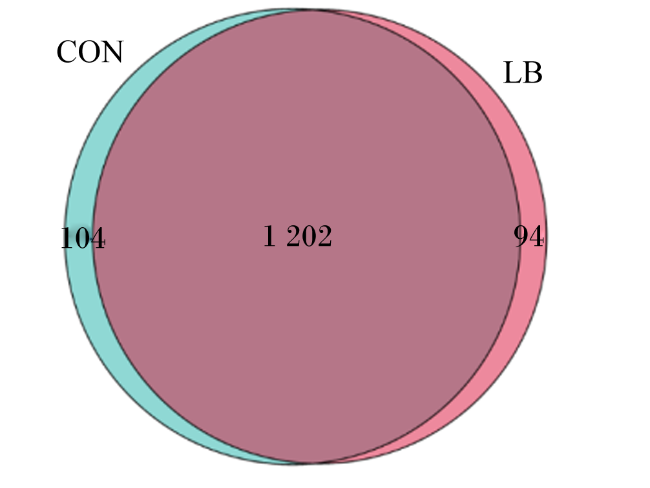
图1可知,CON组共包含1 306个OTUs,LB组共包括1 296个OTUs。2个组共有的OTUs有1 202个,CON组独有104个OTUs,LB组独有94个OTUs。
图1 Venn图

CON:CON组 CON group;LB:LB组 LB group。下图同 the same as below。

Fig.1 Venn diagram

2.4.2 Alpha多样性分析

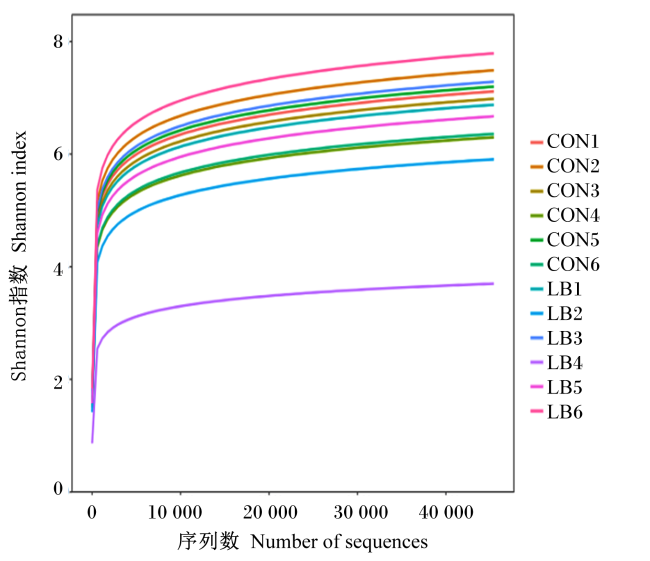
表5可知,LB组和CON组的物种丰富度指数(Chao1指数、Observed_OTUs指数)、谱系多样性指数(PD指数)、物种多样性指数(Shannon指数)和细菌菌群丰度指数(Simpson指数)均无显著差异(P>0.05),说明补饲矿物质舔砖对藏羊瘤胃菌群组成和丰富度无显著影响。由图2可知,曲线逐渐趋于平缓,说明样本量已足够覆盖主要菌群,再增加测序数据量不会显著影响物种多样性。
表5 Alpha多样性指数

Table 5 Alpha diversity indexes

项目
Items
组别 Groups 均值标准误
SEM
P
P-value
CON LB
Chao1指数 Chao1 index 965.06 953.41 24.324 0.824
PD指数 PD index 58.52 56.81 1.408 0.570
Observed_OTUs 指数 Observed_OTUs index 831.50 800.33 27.682 0.598
Shannon指数 Shannon index 6.52 6.01 0.291 0.411
Simpson指数 Simpson index 0.97 0.91 0.022 0.248
图2 稀释曲线

Fig.2 Dilution curve

2.4.3 Beta多样性分析

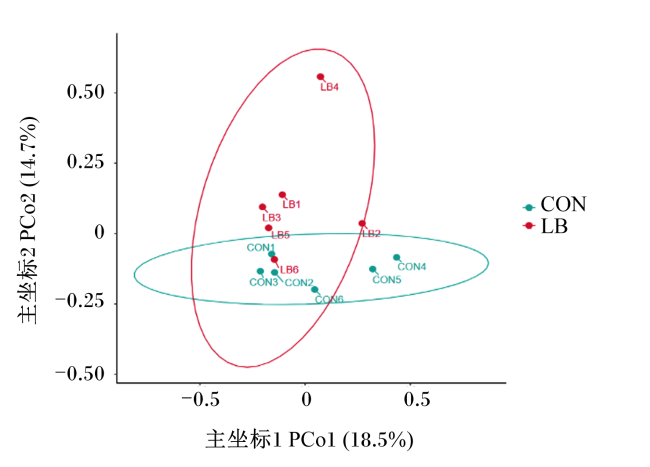
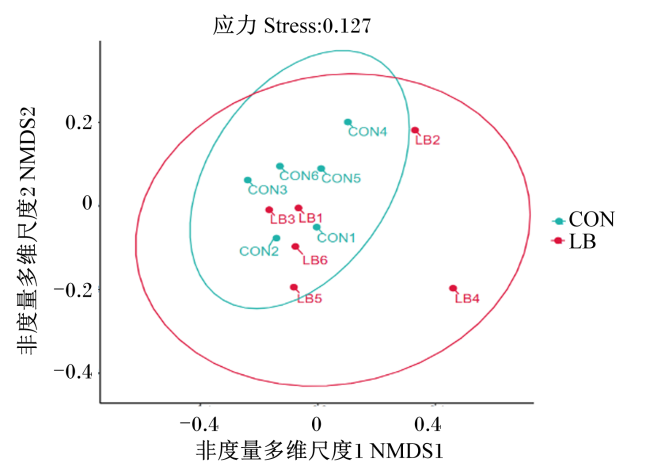
图3可知,2个区域没有明显重叠,说明LB组和CON组的样本在物种组成上存在差异;由图4可知,LB组的样本集中在图的左侧,而CON组的样本集中在图的右侧,同样说明LB组和CON组的样本在物种组成上存在差异。因此,LB组的样本与CON组的样本在物种组成上存在明显差异,且LB组样本间的差异也比CON组样本间的差异更大。
图3 基于样本间Beta多样性指数的PCoA散点图

Fig.3 PCoA scatter plot based on Beta diversity index between samples

图4 基于样本间Beta多样指数的NMDS散点图

Fig.4 NMDS scatter plot based on Beta diversity index between samples

2.4.4 补饲矿物质舔砖对藏羊瘤胃微生物门水平和属水平组成的影响

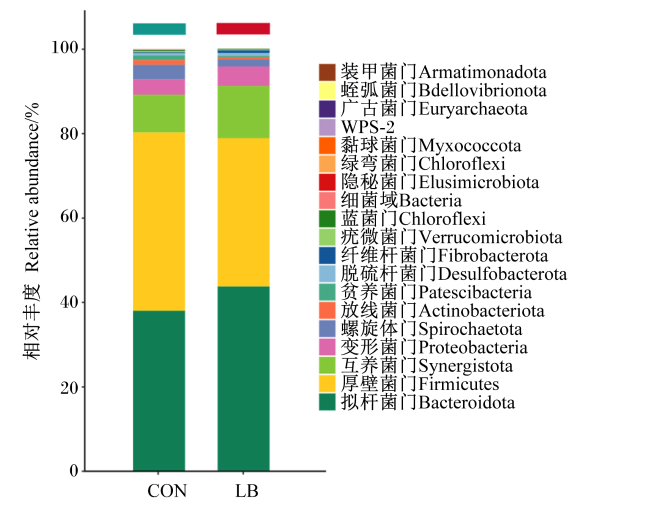
图5所知,2组瘤胃微生物在门水平上的优势菌门主要有拟杆菌门(Bacteroidota)、厚壁菌门(Firmicutes)、协同菌门(Synergistota)、变形菌门(Proteobacteria)、螺旋体门(Spirochaetota),其中优势菌门Bacteroidota的相对丰度在CON组和LB组中分别为38.0%和43.6%,Firmicutes的相对丰度在CON组和LB组中分别为42.2%和35.2%,Synergistota的相对丰度在CON组和LB组中分别为9.0%和12.4%,Proteobacteria的相对丰度在CON组和LB组中分别为3.6%和4.6%,Spirochaetota的相对丰度在CON组和LB组中分别为3.4%和1.7%。
图5 瘤胃微生物门水平相对丰度图

Fig.5 Relative abundance plots of rumen microbes at phylum level

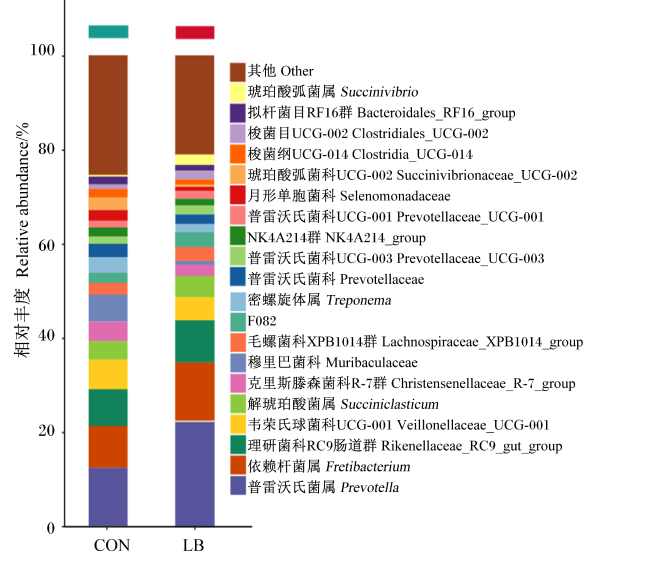
图6可知,2组瘤胃微生物在属水平上的优势菌属主要有普雷沃氏菌属(Prevotella)、依赖杆菌属(Fretibacterium)、理研菌科RC9肠道组(Rikenellaceae_RC9_gut_group)、韦荣氏球菌科UCG-001(Veillonellaceae_UCG-001)、解琥珀酸菌属(Succiniclasticum);其中优势菌属Prevotella的相对丰度在CON组和LB组中分别为12.3%和22.4%,Fretibacterium的相对丰度在CON组和LB组中分别为8.9%和12.4%,Rikenellaceae_RC9_gut_group的相对丰度在CON组和LB组中分别为7.8%和8.9%,Veillonellaceae_UCG-001的相对丰度在CON组和LB组中分别为6.3%和5.0%,Succiniclasticum的相对丰度在CON组和LB组中分别为3.9%和4.5%。
图6 瘤胃细菌属水平相对丰度图

Fig.6 Relative abundances plot of rumen microbes at genus level

2.4.5 LEfSe分析

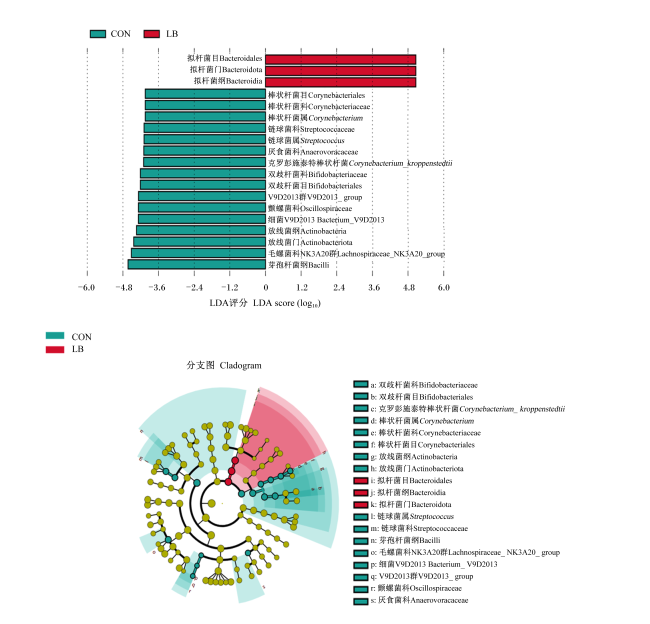
通过LEfSe分析组间菌群差异,可以找出各组间特异的主要菌群。如图7所示,CON组有11种显著富集的标志物种,包括棒状杆菌目(Corynebacteriales)、棒状杆菌科(Corynebacteriaceae)、棒状杆菌属(Corynebacterium)、链球菌科(Streptococcaceae)、链球菌属(Streptococcus)等;LB组有3种显著富集的标志物种,包括拟杆菌门(Bacteroidota)、拟杆菌目(Bacteroidales)和拟杆菌纲(Bacteroidia)。
图7 各组物种LDA值分布柱状图(A)和物种分类学分支图(B)

Fig.7 Histogram of LDA value distribution (A) and taxonomic branch diagram (B) of species in each group

2.5 补饲矿物质舔砖对藏羊血清指标的影响

表6可知,LB组藏羊血清中TC和UN的含量较CON组显著提高(P<0.05),但2组间血清中GLU、TP、ALB、GLO、TG含量和A/G以及ALP、ALT、AST活性均无显著差异(P>0.05);LB组血清中SOD活性也显著高于CON组(P<0.05),但2组间血清中MDA含量和T-AOC均无显著差异(P>0.05)。
表6 补饲矿物质舔砖对藏羊血清生化指标和抗氧化指标的影响

Table 6 Effects of supplementary feeding mineral licking brick on serum biochemical indexes and antioxidant indexes of Tibetan sheep

项目
Items
组别 Groups 均值标准误
SEM
P
P-value
CON LB
葡萄糖 GLU/(mmol/L) 3.69 3.83 0.073 0.335
总蛋白TP/(g/L) 47.50 51.00 0.945 0.060
白蛋白 ALB/(g/L) 22.58 23.70 0.343 0.104
球蛋白 GLO/(g/L) 24.92 27.30 0.917 0.209
白球比 A/G 0.93 0.87 0.037 0.475
甘油三酯 TG/(mmol/L) 0.42 0.47 0.039 0.505
总胆固醇 TC/(mmol/L) 1.46b 1.85a 0.087 0.015
碱性磷酸酶 ALP/(U/L) 416.88 479.21 23.199 0.192
谷丙转氨酶 ALT/(U/L) 7.81 7.40 0.352 0.591
尿素氮 UN/(mmol/L) 5.20b 6.28a 0.259 0.030
谷草转氨酶 AST/(U/L) 103.53 109.14 2.898 0.358
总抗氧化能力 T-AOC/(mmol/mL) 0.75 0.89 0.039 0.075
超氧化物歧化酶 SOD/(U/mL) 83.89b 151.49a 11.479 0.001
丙二醛 MDA/(nmol/mL) 5.26 3.65 0.424 0.052
表7可知,LB组血清中Ca、P、Fe、Zn、Mn和Se含量均显著高于CON组(P<0.05);2组间血清中Cu和Co含量无显著差异(P>0.05)。
表7 补饲矿物质舔砖对藏羊血清矿物质含量的影响

Table 7 Effects of supplementary feeding mineral licking brick on serum mineral contents of Tibetan sheepmg/L

项目
Items
组别 Groups 均值标准误
SEM
P
P-value
CON LB
钙 Ca 109.82b 129.97a 4.505 0.016
磷 P 112.04b 128.41a 3.433 0.008
铜 Cu 0.73 0.86 0.037 0.080
铁 Fe 10.57b 17.04a 1.367 0.009
锌 Zn 1.49b 1.80a 0.054 0.001
锰 Mn 0.12b 0.15a 0.006 0.030
硒 Se 0.09b 0.12a 0.005 0.001
钴 Co 0.02 0.03 0.002 0.374

3 讨论

3.1 补饲矿物质舔砖对藏羊生长性能和屠宰性能的影响

当藏羊处在同等饲养水平、生长阶段、生长环境和管理条件下,生长性能一般不会产生显著差异。微量元素作为动物机体多种酶的重要组成成分,在维持机体健康的同时促进机体对营养物质的吸收、利用和代谢[5-6,18-19]。Lu等[20]研究发现,在牦牛饲粮中补充微量元素能够提升牦牛的生长性能。研究表明,补饲矿物质舔砖能够提升哺乳期母羊[21]和高山细毛羊[22]的ADG。在本研究中,LB组的藏羊的ADG显著高于CON组,F/G显著低于CON组,与前人研究结果一致。综上所述,在同等饲养条件且饲喂相同饲粮的基础上补饲矿物质舔砖能够提高藏羊的生长性能。
屠宰性能与养殖效益密切相关,它反映了家畜肌肉组织中营养物质的沉积情况,其中胴体重、背膘厚、屠宰率及眼肌面积是衡量家畜产肉能力的重要指标[23-24]。动物的内脏器官重量与指数在一定程度上也可以反映动物的机体发育和机能状况[25]。经过50 d的饲养试验,与CON组相比,LB组藏羊的胴体重显著升高,屠宰率、眼肌面积和器官指数无显著差异。多项研究结果表明,矿物质舔砖可提高肉羊的胴体重、屠宰率和眼肌面积[11,26]。这与本研究结果不同,胴体重的升高表明复合矿物质可以促进藏羊的能量代谢,提高能量利用率,从而提高胴体重,屠宰率和眼肌面积差异不显著可能是因为在前人研究中肉羊饲喂模式均为自由放牧,导致矿物质摄入不均衡,动物机体处于矿物质过度缺乏状态,而在本试验中,CON组藏羊的矿物质可能并无过度缺乏的现象,因此补饲矿物质舔砖后屠宰率和眼肌面积没有出现显著提升。补饲矿物质舔砖对藏羊器官指数影响的相关报道较少。有文献报道,器官指数可能与饲粮精粗比和饲粮能量、蛋白质的消化利用有关[27-28]。因此,补饲矿物质舔砖对藏羊器官指数的影响可能与能量的代谢利用有关,但影响的机制需进一步研究。综上所述,当动物机体处于矿物质缺乏或不平衡状态时,补饲矿物质舔砖在一定程度上能够提升动物的屠宰性能。

3.2 补饲矿物质舔砖对藏羊瘤胃发酵参数的影响

瘤胃发酵过程中产生的挥发性脂肪酸的含量被认为是瘤胃发酵的重要指标,挥发性脂肪酸主要通过反刍动物瘤胃上皮吸收,这在反刍动物的免疫和生长中都起着重要的作用[29-30]。Wang等[31]研究发现,在奶牛饲粮中添加酵母硒能够使瘤胃液中丙酸比例上升,同时降低乙丙比。还有一些研究发现,给牦牛补饲Cu、Mn和碘(I)能够提升瘤胃液中戊酸比例[20]。在本试验中,与CON组相比,LB组藏羊瘤胃液中丙酸比例显著增高,但戊酸比例和A/P均显著降低。这是由于本试验对Zn和Se进行了补充,改善了瘤胃菌群结构,使拟杆菌门的相对丰度升高,促进了瘤胃发酵,从而极大提高了瘤胃液挥发性脂肪酸中丙酸比例[32-33];同时,丙酸又是反刍动物体内糖异生的重要前提物质,因此血液中GLU含量上升,进而提高能量的利用[34],致使胴体重也显著提高。
NH3-N的产生是由于瘤胃微生物对蛋白质和非蛋白氮降解,同时NH3-N还作为氮源合成MCP[35-36]。Se是影响瘤胃MCP含量的一个重要原因。青藏高原的传统放牧藏羊在饲喂酵母硒补充剂后,提高了饲粮蛋白质和非蛋白氮转化为MCP的效率[37]。在本试验中,LB组藏羊瘤胃液中NH3-N和MCP的含量虽在统计学上与CON组无显著差异,但均有上升趋势。郑永杰等[38]的研究发现,补饲微量元素能够提升肉羊瘤胃液中MCP含量,这与本试验结果不同,可能是由于以下因素的互相影响:1)补饲Zn和Se改善了瘤胃菌群结构,促进了MCP的合成[39-40];2)对照组藏羊机体内的矿物质并未严重缺乏,因此2个组瘤胃液中MCP的含量无显著差异。由此推测,补饲矿物质舔砖可能通过影响瘤胃菌群结构来影响MCP的合成,从而影响藏羊的生长性能。

3.3 补饲矿物质舔砖对藏羊瘤胃微生物区系的影响

消化道的微生物多样性与动物健康、生产性能和机体代谢能力密切相关[30]。在本试验中,与CON组相比,LB组的瘤胃微生物Alpha多样性指数无显著差异,说明补饲矿物质舔砖并不会对藏羊瘤胃微生物多样性产生不利影响。主坐标分析(PCoA)和非度量多维尺度(NMDS)分析结果显示,门水平上2组间在物种组成上存在差异,与CON组相比,LB组的Bacteroidota的相对丰度由38.0%提升到43.6%,而Firmicutes的相对丰度由42.2%降低到35.2%。前人研究表明,无论饲粮如何变化,瘤胃中的微生物都以Bacteroidota和Firmicutes为主[41]。其中,Bacteroidota有助于瘤胃中丙酸的合成以及蛋白质和碳水化合物的降解[42-43],而Firmicutes在能量利用中发挥重要作用[44-45]。Bacteroidota相对丰度的增加可能是由于补饲矿物质舔砖对Firmicutes的生长产生不利影响,但对Bacteroidota生长具有促进作用,从而导致瘤胃内丙酸比例的增加,进而提高饲料利用率,最后造成胴体重的提高,这与前面的研究结果相符合。
在属水平上,LB组瘤胃微生物中Prevotella的相对丰度高于CON组,而克里斯滕森氏菌科R-7群(Christensenellaceae_R-7_group)的相对丰度低于CON组。研究表明,Prevotella属于Bacteroidota,在瘤胃中发挥着降解蛋白质和碳水化合物的作用[46];而Christensenellaceae_R-7_group在瘤胃中则可能发挥着降解半纤维素和纤维素的作用[47]。有研究结果发现,在饲粮中补充Se能够提升瘤胃微生物中Prevotella的相对丰度[48]。Cui等[37]在藏羊饲粮中添加酵母硒后发现,随着饲粮中酵母硒添加量的增加,Christensenellaceae_R-7_group的相对丰度呈先减少后增加的趋势。这与本试验研究结果一致,印证了Prevotella相对丰度的升高可能与Se的补充有关,同时Christensenellaceae_R-7_group相对丰度的降低可能是因为Se的补充量不足导致。因此,门和属水平上微生物相对丰度的变化表明,补饲矿物质舔砖促进了藏羊瘤胃对饲粮蛋白质和其他有机物的降解,但可能对瘤胃的能量利用造成一些影响。

3.4 补饲矿物质舔砖对藏羊血清指标的影响

血清生化指标与动物的生产性能和脂质代谢密切相关[49-50],而微量元素在动物的生长与生产、代谢和免疫方面发挥着重要作用[51]。血清生化分析中使用TC和TG含量作为脂质代谢参数[49]。钟奇祺等[52]研究表明,给育肥牛补饲纳米氧化锌可以提高血清中TC含量。Lu等[20]对牦牛补饲Cu、Mn和I后发现,牦牛血清中TC和TG含量随微量元素添加量的增加呈先升高后降低的趋势。在本试验中,LB组藏羊血清中TC含量显著高于CON组,TG含量2组间无显著差异,与前人研究结果一致。还有研究表明,瘤胃内的挥发性脂肪酸可以间接影响TG和TC的合成[53-54]
血清TP、ALB、GLO、UN含量和A/G可以反映动物体的消化代谢和氮利用情况。其中,血清UN含量是反映动物体氨吸收和尿素生产排泄的指标,与机体内蛋白质和氨基酸的代谢和瘤胃内微生物群落息息相关[55-56]。本试验中,2组藏羊血清中TP、ALB、GLO含量和A/G均无显著差异,但LB组血清中UN含量显著高于CON组。Wang等[46]研究发现,Prevotella在瘤胃中发挥着降解蛋白质的作用。本试验中,补饲矿物质舔砖使藏羊血清中UN含量升高可能是由于Prevotella相对丰度升高促进了蛋白质降解导致的。
血清抗氧化指标是反映机体健康状况和生长状态的重要指标之一。SOD是关键抗氧化酶,通过催化消除超氧阴离子自由基( O 2 -·),保护细胞免受其伤害[57]。脂质过氧化能够产生多种醛类物质,其中MDA最具有代表性,MDA含量的升高表示抗氧化防御机制不足以应对氧化应激,因而机体的氧化应激和细胞损伤都会增加[58]。在本试验中,LB组藏羊血清中SOD活性显著高于CON组,MDA含量有低于CON组的趋势。Wang等[57]研究显示,给青藏高原藏羊补饲矿物质舔砖提高了血清中SOD活性,同时降低了MDA含量。郭天龙等[12]对蒙古羊补饲矿物质舔砖的研究发现,补饲矿物质舔砖能够提高血清SOD活性,同时降低MDA含量。上述研究结果均与本试验结果一致,产生这种结果可能是由于矿物质舔砖含有Cu、Mn和Zn,而Cu、Mn和Zn又是SOD的结构和功能成分,因此提供了SOD的合成量,使SOD活性增高,从而降低了动物体内氧自由基的含量,进而导致MAD含量的降低[59-61]
测定血清矿物质含量是评估动物矿物质营养状况和利用率的常用办法[62-63]。绵羊血清Cu和Zn含量的正常值分别不能低于为0.5和0.8 mg/L,血清Mn和Se含量的正常值分别为0.18~0.25 mg/L和0.08~0.50 mg/L[64]。在本试验中,LB组藏羊血清中Cu含量与CON组相比虽差异不显著,但有增高的趋势,而Zn、Mn和Se含量则显著提高。Zhou等[65]研究发现,在绵羊饲粮中添加微量矿物质提高了绵羊血清中Mn、Zn和Se的含量,但Cu的含量没有提升。Wang等[66]的研究结果表明,饲粮中添加酵母硒能够提高藏羊体内Se的保留率。上述结果与本试验结果一致,在本试验中,2组藏羊血清中Cu、Zn和Se含量均不低于正常值,但Mn含量低于正常值,说明该区域藏羊存在Mn缺乏的问题,通过补饲矿物质舔砖提高了藏羊血清中Mn含量,缓解了藏羊Mn缺乏的情况。因此,补饲矿物质舔砖能够缓解藏羊机体内的矿物质短缺,维持机体健康,并通过影响对瘤胃微生物区系,进而影响脂质、蛋白质和氨基酸的代谢,提高饲料利用效率和胴体重,同时提高藏羊机体的抗氧化能力。

4 结论

补饲矿物质舔砖能改善藏羊的瘤胃发酵参数和血清指标,提高增重和饲料转化效率,改善瘤胃菌群结构,并提升屠宰性能。因此,补饲矿物质舔砖可以有效改善藏羊的营养状况和生长性能,对于促进藏羊健康养殖具有重要意义。
[1]
HUMANN-ZIEHANK E, GANTER M, HENNIG-PAUKA I, et al. Trace mineral status and liver and blood parameters in sheep without mineral supply compared to local roe deer (Capreolus capreolus) populations[J]. Small Ruminant Research, 2008, 75(2/3):185-191.

[2]
ZHAO X S, DEGEN A, HAO L Z, et al. Ruminant lick blocks,particularly in China:a review[J]. Sustainability, 2022, 14(13):7620.

[3]
PRASHANTH L, KATTAPAGARI K K, CHITTURI R T, et al. A review on role of essential trace elements in health and disease[J]. Journal of Dr.NTR University of Health Sciences, 2015, 4(2):75-85.

[4]
BYRNE L, MURPHY R A. Relative bioavailability of trace minerals in production animal nutrition:a review[J]. Animals, 2022, 12(15):1981.

[5]
GERSHWIN M E, BEACH R S, HURLEY L S. Nutrition and immunity[M]. [S.l.]: Academic Press, 2012.

[6]
GONDAl A H, ZAFAR A, ZAINAB D, et al. A detailed review study of zinc involvement in animal,plant and human nutrition[J]. Indian Journal of Pure & Applied Biosciences, 2021, 9(2):262-271.

[7]
GAETKE L M, CHOW C K. Copper toxicity,oxidative stress,and antioxidant nutrients[J]. Toxicology, 2003, 189(1/2):147-163.

[8]
李万栋, 李光梅, 景建武, 等. 牦牛微量元素营养研究进展[J]. 黑龙江畜牧兽医, 2022(12):30-34.

LI W D, LI G M, JING J W, et al. Research progress of trace element nutrition in yaks[J]. Heilongjiang Animal Science and Veterinary Medicine, 2022(12):30-34. (in Chinese)

[9]
MCDOWELL L R. Minerals in animal and human nutrition[M]. 2nd ed. New York: Elsevier, 2003:110-210.

[10]
SUTTLE N F. Mineral nutrition of livestock[M]. 5th ed. Wallingford: CABI, 2022:265-440.

[11]
郭天龙, 智宇, 李康, 等. 矿物质舔砖对蒙古羊免疫、抗氧化指标及生长性能的影响[J]. 饲料工业, 2023, 44(7):73-78.

GUO T L, ZHI Y, LI K, et al. Effects of mineral lick block on immunity,antioxidant and performance of Mongolian sheep[J]. Feed Industry, 2023, 44(7):73-78. (in Chinese)

[12]
叶云锋, 谢梅冬, 农英相, 等. 氢化物发生-原子吸收光谱法快速测定预混合饲料中的硒[J]. 广西畜牧兽医, 2004, 20(1):15-16.

YE Y F, XIE M D, NONG Y X, et al. Rapid determination of selenium in premix feed by hydride generation-atomic absorption spectrometry[J]. Guangxi Journal of Animal Husbandry & Veterinary Medicine, 2004, 20(1):15-16. (in Chinese)

[13]
SUZUKI K, KADOWAKI H, SHIBATA T, et al. Selection for daily gain,loin-eye area,backfat thickness and intramuscular fat based on desired gains over seven generations of Duroc pigs[J]. Livestock Production Science, 2005, 97(2/3):193-202.

[14]
冯宗慈, 高民. 通过比色测定瘤胃液氨氮含量方法的改进[J]. 畜牧与饲料科学, 2010, 31(6/7):37.

FENG Z C, GAO M. Improvement of colorimetric method for determination of ammonia nitrogen in rumen fluid[J]. Animal Husbandry and Feed Science, 2010, 31(6/7):37. (in Chinese)

[15]
SEDMAK J J, GROSSBERG S E. A rapid,sensitive,and versatile assay for protein using Coomassie brilliant blue G250[J]. Analytical Biochemistry, 1977, 79(1/2):544-552.

[16]
JIN W, LI Y, CHENG Y F, et al. The bacterial and archaeal community structures and methanogenic potential of the cecal microbiota of goats fed with hay and high-grain diets[J]. Antonie van Leeuwenhoek, 2018, 111(11):2037-2049.

[17]
CAPORASO J G, LAUBER C L, WALTERS W A, et al. Global patterns of 16S rRNA diversity at a depth of millions of sequences per sample[J]. Proceedings of the National Academy of Sciences of the United States of America, 2011, 108(Suppl.1):4516-4522.

[18]
MUSTAFA S K, ALSHARIF M A. Copper (Cu) an essential redox-active transition metal in living system-a review article[J]. American Journal of Analytical Chemistry, 2018, 9(1):15-26.

[19]
LI L P, QU L, LI T. Supplemental dietary selenohomolanthionine affects growth and rumen bacterial population of Shaanbei white cashmere wether goats[J]. Frontiers in Microbiology, 2022, 13:942848.

[20]
LU H Z, WU W B, ZHAO X S, et al. Effects of diets containing different levels of copper,manganese,and iodine on rumen fermentation,blood parameters,and growth performance of yaks[J]. Animals, 2023, 13(16):2651.

[21]
李昕, 全晓毅, 常明华, 等. 妊娠后期和哺乳期母羊补饲营养盐砖的试验研究[J]. 中国畜牧兽医文摘, 2013(11):167-167,164.

LI X, QUAN X Y, CHANG M H, et al. Experimental study on supplementation of nutrient bricks for ewes during late pregnancy and lactation[J]. Chinese Abstracts of Animal Husbandry and Veterinary Medicine, 2013(11):167-167,164. (in Chinese)

[22]
张昌吉, 张利平. 补饲舔砖对甘肃高山细毛羊生产性能的影响[J]. 草业科学, 2015, 32(9):1496-1499.

ZHANG C J, ZHANG L P. Influence of brick supplementation on Gansu alpine Merino production performance[J]. Pratacultural Science, 2015, 32(9):1496-1499. (in Chinese)

[23]
周力, 李雪清, 李鹏翔, 等. 不同青贮饲料对欧拉型藏羊生长性能、屠宰性能和经济效益的影响[J]. 饲料研究, 2020, 43(10):5-8.

ZHOU L, LI X Q, LI P X, et al. Effect of different silage on growth performance,slaughter performance and economic benefit of Oula Tibetan sheep[J]. Feed Research, 2020, 43(10):5-8. (in Chinese)

[24]
HAN L, YU Y, FU R, et al. Impact of various ration energy levels on the slaughtering performance, carcass characteristics, and meat qualities of Honghe yellow cattle[J]. Foods, 2024, 13(9):1316.

[25]
王钊, 刘静, 于昊, 等. 日粮添加蚕豆皮对湖羊生长性能、屠宰性能、器官发育和肉品质的影响[J]. 草业学报, 2023, 32(10):162-172

DOI

WANG Z, LIU J, YU H, et al. Effects of dietary broad bean skin on growth rate,slaughter performance,organ development and meat quality of Hu sheep[J]. Acta Prataculturae Sinica, 2023, 32(10):162-172. (in Chinese)

[26]
李生莲, 戴源森, 保善科, 等. 复合微量元素对藏羊生长性能、屠宰性能和肉品质的影响[J]. 黑龙江畜牧兽医, 2016(10):91-93.

LI S L, DAI Y S, BAO S K, et al. Effects of compound trace elements on growth performance,slaughter performance and meat quality of Tibetan sheep[J]. Heilongjiang Animal Science and Veterinary Medicine, 2016(10):91-93. (in Chinese)

[27]
CHEN G J, SONG S D, WANG B X, et al. Effects of forage:concentrate ratio on growth performance,ruminal fermentation and blood metabolites in housing-feeding yaks[J]. Asian-Australasian Journal of Animal Sciences. 2015, 28(12):1736-1741.

[28]
WEBSTER A J F. Energy costs of digestion and metabolism in the gut[M]//RUCKEBUSCH Y,THIVEND D.Digestive physiology and metabolism in ruminants. Dordrecht: Springer, 1980:469-484.

[29]
CONE J W, BECKER P M. Fermentation kinetics and production of volatile fatty acids and microbial protein by starchy feedstuffs[J]. Animal Feed Science and Technology, 2012, 172(1/2):34-41.

[30]
FAN Q S, WANAPAT M, YAN T H, et al. Altitude influences microbial diversity and herbage fermentation in the rumen of yaks[J]. BMC Microbiology, 2020, 20(1):370.

DOI PMID

[31]
WANG C, LIU Q, YANG W Z, et al. Effects of selenium yeast on rumen fermentation,lactation performance and feed digestibilities in lactating dairy cows[J]. Livestock Science, 2009, 126(1/2/3):239-244.

[32]
HENDAWY A O, SUGIMURA S, SATO K, et al. Effects of selenium supplementation on rumen microbiota,rumen fermentation,and apparent nutrient digestibility of ruminant animals:a review[J]. Fermentation, 2022, 8(1):4.

[33]
BONHOMME A, DURAND M, DUMAY C, et al. in vitro study of the influence of zinc on rumen microbial populations[J]. Annales de Biologie Animale,Biochimie,Biophysique (France), 1979, 19(3):937-942.

[34]
FAN Q, CUI X, WANG Z, et al. Rumen microbiota of Tibetan sheep (Ovis aries) adaptation to extremely cold season on the Qinghai-Tibetan plateau[J]. Frontiers in Veterinary Science, 2021, 8:673822.

[35]
ZHOU J W, WANG W J, JING X P, et al. Effect of dietary energy on digestibilities,rumen fermentation,urinary purine derivatives and serum metabolites in Tibetan and small-tailed Han sheep[J]. Journal of Animal Physiology and Animal Nutrition, 2019, 103(4):977-987.

[36]
REYNOLDS C K, KRISTENSEN N B. Nitrogen recycling through the gut and the nitrogen economy of ruminants:an asynchronous symbiosis1[J]. Journal of Animal Science, 2008, 86(Suppl.14):E293-E305.

[37]
CUI X X, WANG Z F, TAN Y H, et al. Selenium yeast dietary supplement affects rumen bacterial population dynamics and fermentation parameters of Tibetan sheep (Ovis aries) in alpine meadow[J]. Frontiers in Microbiology, 2021, 12:663945.

[38]
郑永杰, 陆唯, 魏启恒, 等. 有机微量元素减量替代无机微量元素对肉羊生长性能、营养物质表观消化率、抗氧化功能和瘤胃发酵的影响[J]. 动物营养学报, 2024, 36(10):6578-6587.

DOI

ZHENG Y J, LU W, WEI Q H, et al. Effects of replacing inorganic trace elements with reduced amount of organic trace elements on growth performance,nutrient apparent digestibility,antioxidant function and rumen fermentation of meat sheep[J]. Chinese Journal of Animal Nutrition, 2024, 36(10):6578-6587. (in Chinese)

[39]
HOU P X, LI B, WANG Y, et al. The effect of dietary supplementation with zinc amino acids on immunity,antioxidant capacity,and gut microbiota composition in calves[J]. Animals, 2023, 13(9):1570.

[40]
PALANGI V, LACKNER M. Management of enteric methane emissions in ruminants using feed additives:a review[J]. Animals, 2022, 12(24):3452.

[41]
JAMI E, MIZRAHI I. Composition and similarity of bovine rumen microbiota across individual animals[J]. PLoS One, 2012, 7(3):e33306.

[42]
LUO D, GAO Y F, LU Y Y, et al. Niacin alters the ruminal microbial composition of cattle under high-concentrate condition[J]. Animal Nutrition, 2017, 3(2):180-185.

DOI PMID

[43]
MACFARLANE S, MACFARLANE G T. Regulation of short-chain fatty acid production[J]. Proceedings of the Nutrition Society, 2003, 62(1):67-72.

DOI PMID

[44]
WU G D, CHEN J, HOFFMANN C, et al. Linking long-term dietary patterns with gut microbial enterotypes[J]. Science, 2011, 334(6052):105-108.

DOI PMID

[45]
CHEN Y B, LAN D L, TANG C, et al. Effect of DNA extraction methods on the apparent structure of yak rumen microbial communities as revealed by 16S rDNA sequencing[J]. Polish Journal of Microbiology, 2015, 64(1):29-36.

[46]
WANG M Y, WU L F, GUO Y Q, et al. Effects of fermented herbal tea residue on meat quality,rumen fermentation parameters and microbes of black goats[J]. AMB Express, 2023, 13(1):106.

[47]
DAI X, TIAN Y, LI J T, et al. Metatranscriptomic analyses of plant cell wall polysaccharide degradation by microorganisms in the cow rumen[J]. Applied and Environmental Microbiology, 2015, 81(4):1375-1386.

PMID

[48]
MENG L B, JIN X W, SONG W X, et al. Dietary selenium levels affect mineral absorbability,rumen fermentation,microbial composition and metabolites of the grazing sheep[J]. Animal Feed Science and Technology, 2024, 308:115877.

[49]
LIANG C, QIAO L Y, HAN Y L, et al. Regulatory roles of SREBF1 and SREBF2 in lipid metabolism and deposition in two Chinese representative fat-tailed sheep breeds[J]. Animals, 2020, 10(8):1317.

[50]
GROSSKOPF R K, GROSSKOPF H M, BOITO J P, et al. Natural or replacer sources of milk in lambs during feeding adaptation:influences on performance,metabolism of protein and lipid and oxidative/antioxidant status[J]. Journal of Animal Physiology and Animal Nutrition, 2017, 101(2):243-250.

[51]
ANDRIEU S. Is there a role for organic trace element supplements in transition cow health?[J]. Veterinary Journal, 2008, 176(1):77-83.

[52]
钟奇祺, 黎力之, 幸清凤, 等. 纳米氧化锌对育肥牛生产性能、血清指标和背最长肌肌内脂肪沉积相关基因表达的影响[J]. 动物营养学报, 2022, 34(2):1067-1075.

DOI

ZHONG Q Q, LI L Z, XING Q F, et al. Effects of nano-zinc oxide on performance,serum indexes and expression of intramuscular fat deposition related genes in longissimus dorsi muscle of fattening cattle[J]. Chinese Journal of Animal Nutrition, 2022, 34(2):1067-1075. (in Chinese)

[53]
MAO S Y, HUO W J, ZHU W Y. Microbiome-metabolome analysis reveals unhealthy alterations in the composition and metabolism of ruminal microbiota with increasing dietary grain in a goat model[J]. Environmental Microbiology, 2016, 18(2):525-541.

[54]
MONTIEL R S, ACOSTA I T, DELGADO E V, et al. Inulin as a growth promoter in diets for rabbits[J]. Revista Brasileira de Zootecnia, 2013, 42(12):885-891.

[55]
TAN Z, MURPHY M R. Ammonia production,ammonia absorption,and urea recycling in ruminants.A review[J]. Journal of Animal and Feed Sciences, 2004, 13(3):389-404.

[56]
HUNTINGTON G, ARCHIBEQUE S. Practical aspects of urea and ammonia metabolism in ruminants[J]. Proceedings of the American Society of Animal Science, 1999, 77:1-11.

[57]
WANG H, LIU Z Q, HUANG M Z, et al. Effects of long-term mineral block supplementation on antioxidants,immunity,and health of Tibetan sheep[J]. Biological Trace Element Research, 2016, 172(2):326-335.

[58]
GREWAL A, AHUJA C S, SINGHA S P S, et al. Status of lipid peroxidation,some antioxidant enzymes and erythrocytic fragility of crossbred cattle naturally infected with Theileria annulata[J]. Veterinary Research Communications, 2005, 29(5):387-394.

[59]
PALOMARES R A. Trace minerals supplementation with great impact on beef cattle immunity and health[J]. Animals, 2022, 12(20):2839.

[60]
CHEN X L, ZENG Z Y, HUANG Z Q, et al. Effects of dietary resveratrol supplementation on immunity,antioxidative capacity and intestinal barrier function in weaning piglets[J]. Animal Biotechnology, 2021, 32(2):240-245.

[61]
GREŠÁKOVÁ L, TOKARČÍKOVÁ K, ČOBANOVÁ K. Bioavailability of dietary zinc sources and their effect on mineral and antioxidant status in lambs[J]. Agriculture, 2021, 11(11):1093.

[62]
HERDT T H, HOFF B. The use of blood analysis to evaluate trace mineral status in ruminant livestock[J]. Veterinary Clinics of North America:Food Animal Practice, 2011, 27(2):255-283.

[63]
BURROW K, YOUNG W, MCCONNELL M, et al. The effect of sheep and cow milk supplementation of a low calcium diet on the distribution of macro and trace minerals in the organs of weanling rats[J]. Nutrients, 2020, 12(3):594.

[64]
GUL M Z, AHMAD F, KONDAPI A K, et al. Antioxidant and antiproliferative activities of Abrus precatorius leaf extracts—an in vitro study[J]. BMC Complementary and Alternative Medicine, 2013, 13:53.

[65]
ZHOU J, REN Y F, WEN X, et al. Comparison of coated and uncoated trace elements on growth performance,apparent digestibility,intestinal development and microbial diversity in growing sheep[J]. Frontiers in Microbiology, 2022, 13:1080182.

[66]
WANG Z F, TAN Y H, CUI X X, et al. Effect of different levels of selenium yeast on the antioxidant status,nutrient digestibility,selenium balances and nitrogen metabolism of Tibetan sheep in the Qinghai-Tibetan Plateau[J]. Small Ruminant Research, 2019, 180:63-69.

文章导航

/