研究论文

维生素E对德州驴生长性能、抗氧化能力和皮用性能的影响

  • 李朋帅 , 1 ,
  • 马烁宁 2 ,
  • 郑云朵 1 ,
  • 冯玉龙 3 ,
  • 曲洪磊 1, 3 ,
  • 董博颖 3 ,
  • 黄世猛 1 ,
  • 赵丽红 1 ,
  • 马秋刚 , 1, *
展开
  • 1 中国农业大学动物科学技术学院,畜禽营养与饲养全国重点实验室,北京 100193
  • 2 山东农业大学动物科技学院,泰安 271018
  • 3 东阿阿胶股份有限公司,国家胶类中药工程技术研究中心,聊城 252000
*马秋刚,教授,博士生导师,E-mail:

李朋帅(2001—),男,河北邯郸人,硕士研究生,动物营养与饲料科学专业。E-mail:

Copy editor: 菅景颖

收稿日期: 2024-12-08

  网络出版日期: 2025-08-14

基金资助

特产动物高效养殖共性关键技术集成示范(2023YFD1302000)

河北省现代农业产业技术体系驴马鹿高效养殖与综合利用岗位(HBCT2024280203)

提升驴皮产量的营养调控关键技术开发(DEEJ-PT-20181029007)

Effects of Vitamin E on Growth Performance, Antioxidant Capacity and Skin Performance of Dezhou Donkeys

  • LI Pengshuai , 1 ,
  • MA Shuoning 2 ,
  • ZHENG Yunduo 1 ,
  • FENG Yulong 3 ,
  • QU Honglei 1, 3 ,
  • DONG Boying 3 ,
  • HUANG Shimeng 1 ,
  • ZHAO Lihong 1 ,
  • MA Qiugang , 1, *
Expand
  • 1 State Key Laboratory of Animal Nutrition and Feeding, College of Animal Science and Technology, China Agricultural University, Beijing 100193, China
  • 2 College of Animal Science and Technology, Shandong Agricultural University, Tai’an 271018, China
  • 3 National Engineering Research Center for Gelatin-Based Traditional Chinese Medicine, Dong-E-E-Jiao Co., Ltd., Liaocheng 252000, China
*professor, E-mail:

Received date: 2024-12-08

  Online published: 2025-08-14

摘要

本试验旨在研究维生素E(VE)对德州驴生长性能、抗氧化能力和皮用性能的影响。选取10月龄德州驴21头,随机分为3组,每组7个重复,每个重复1头。3组德州驴分别饲喂添加60(对照)、200和400 mg/kg VE的精补料,所喂粗饲料均为豆秸。预试期7 d,正试期135 d。结果显示:1)与对照组相比,添加200或400 mg/kg VE对德州驴的生长性能、胴体重、屠宰率、鲜皮率均无显著影响(P>0.05),添加400 mg/kg VE有显著提升鲜皮重的趋势(P=0.076)。2)与对照组相比,添加200或400 mg/kg VE均显著提高了德州驴血清中谷胱甘肽过氧化物酶、超氧化物歧化酶活性和总抗氧化能力(P<0.05),显著降低了血清中丙二醛含量(P<0.05)。3)与对照组相比,添加400 mg/kg VE显著提高了德州驴终末背部皮肤厚度(P<0.05),添加200或400 mg/kg VE显著提高了德州驴背部皮肤真皮层厚、羟脯氨酸含量和胶原蛋白占比(P<0.05),且添加400 mg/kg VE时羟脯氨酸含量显著高于添加200 mg/kg VE时(P<0.05)。4)与对照组相比,添加200和400 mg/kg VE组使背部皮肤中细胞外基质组织、胶原纤维组织、胶原蛋白生物合成、皮肤发育信号通路显著富集。由此可见,在精补料中添加200或400 mg/kg VE均能改善德州驴的抗氧化能力,有利于德州驴皮肤中细胞外基质的沉积(尤其是胶原蛋白),增加真皮层厚度,进而增加产皮量,但以添加量为400 mg/kg时效果较优。

本文引用格式

李朋帅 , 马烁宁 , 郑云朵 , 冯玉龙 , 曲洪磊 , 董博颖 , 黄世猛 , 赵丽红 , 马秋刚 . 维生素E对德州驴生长性能、抗氧化能力和皮用性能的影响[J]. 动物营养学报, 2025 , 37(8) : 5382 -5394 . DOI: 10.12418/CJAN2025.437

Abstract

The objective of this experiment was to study the effects of vitamin E (VE) on growth performance, antioxidant capacity and skin performance of Dezhou donkeys. Twenty-one 10-month-old Dezhou donkeys were randomly divided into 3 groups, with 7 replicates in each group and 1 donkey in each replicate. The 3 groups of Dezhou donkeys were fed a concentrate supplement with 60 (control), 200 and 400 mg/kg VE, roughage was soybean straw. The pre-trial period lasted for 7 days, and the formal trial period lasted for 135 days. The results showed as follows: 1) compared with the control group, the addition of 200 and 400 mg/kg VE had no significant effects on growth performance, dressed weight, dressed percentage and fresh skin rate of Dezhou donkeys (P>0.05), and addition of 400 mg/kg VE tended to enhance fresh skin weight significantly (P=0.076). 2) Compared with the control group, the addition of 200 and 400 mg/kg VE significantly increased glutathione peroxidase and superoxide dismutase activities and total antioxidant capacity in serum (P<0.05), and significantly reduced malondialdehyde content in serum of Dezhou donkeys (P<0.05). 3) Compared with the control group, the addition of 400 mg/kg VE significantly increased back skin thickness, and the addition of 200 and 400 mg/kg VE significantly increased back dermal skin thickness, hydroxyproline content, and collagen percentage in back skin of Dezhou donkeys (P<0.05), while the hydroxyproline content in the addition of 400 mg/kg VE group was significantly higher than that in the addition of 200 mg/kg VE group (P<0.05). 4)Compared with the control group, the addition of 200 and 400 mg/kg VE significantly enriched the signal pathways of extracellular matrix organization, collagen fibril organization, collagen biosynthetic process, and skin development in the back skin. It is concluded that the addition of 200 and 400 mg/kg VE to the concentrate supplement can improve the antioxidant capacity, promote the deposition of extracellular matrix in the skin (especially collagen), and increase the thickness of the dermis skin, thus increasing the skin production of Dezhou donkeys, however, the effect is better with the addition of 400 mg/kg.

近年来,驴产业已逐渐崛起成为我国新兴的特色畜牧产业,其产品因高营养价值和独特的药理特性而闻名,诸如阿胶、驴肉和驴奶等[1]。阿胶作为一种传统的名贵中药,是由驴皮作为核心原材料煎煮浓缩而成,具有滋阴补血、润肺燥、抗衰老和抑肿瘤的功效,其中胶原蛋白被认为是主要活性成分[2-3]。由于我国驴数量急剧下降,驴皮资源长期以来供不应求[4],利用营养调控手段提高驴皮产量和质量成为研究的热点。
维生素E(VE)对于维系动物机体内蛋白质、核酸的正常代谢起着至关重要的作用,是动物生长发育过程中的不可或缺的一类脂溶性维生素[5]。作为机体内天然的抗氧化剂,VE能够在中和活性氧(ROS)在内的多种自由基时提供1个氢原子,从而提高机体抗氧化能力[6]。诸多研究表明,在饲粮中分别添加VE能够增强肉鸡[7]、育肥猪[8]、肉兔[9]和羔羊[10]的抗氧化能力,改善肉品质。此外,VE在胶原蛋白合成中也同样发挥重要作用。在饲粮中分别添加VE能显著提高海参体壁[11]、大黄鱼[12]肌肉中羟脯氨酸含量,促进胶原蛋白沉积。胶原蛋白在成纤维细胞合成,由甘氨酸(Gly)-X-Y的重复序列组成,而羟脯氨酸是其特有的氨基酸,通常位于胶原螺旋区Y的位置[13-14]。Atila等[15]和Hobson[16]研究均发现,负载高浓度VE的敷料能够通过促进皮肤成纤维细胞合成胶原蛋白加快皮肤伤口愈合。同样,Archile-Contreras等[17]研究发现,在牛肌肉成纤维细胞中加入VE,能够加快胶原蛋白的周转代谢,从而增加胶原蛋白含量。
德州驴是我国五大优良驴品种之一,其体型方正美观、结构匀称、遗传稳定,具有生长快、耐粗饲、产皮量高等优点[18]。已有研究显示,在饲粮中添加维生素(VC)、锌和Gly均能够促进德州驴皮胶原蛋白沉积、增加皮肤厚度[19-20]。然而,VE对德州驴皮肤厚度、胶原蛋白含量的影响及其潜在机制未见报道。因此,本研究选择德州驴为试验对象,旨在探究不同添加水平的VE对德州驴生长性能、抗氧化能力、皮肤厚度、胶原蛋白沉积及皮肤转录组学的影响,为VE在德州驴养殖中的应用提供参考依据。

1 材料与方法

1.1 伦理声明

本试验按照中国科学技术部(北京)的实验动物指导原则进行,并经中国农业大学动物福利与动物实验伦理委员会批准(批准号:AW52114202-1-01)。

1.2 试验设计

本试验采用单因素试验设计,选取10月龄德州公驴21头,根据皮肤厚度、体重相近的原则分为3组,按照VE添加量的低、中、高分别命名为LVE、MVE、HVE组,每组7个重复,每个重复1头。由于VE是一种必需维生素,其缺乏可引发机体代谢异常,因此本研究将驴实际养殖中的VE添加量60 mg/kg设定为最低添加量。LVE、MVE、HVE组精补料中分别添加60(作为对照组)、200和400 mg/kg VE(产品中有效VE含量为50%)。预试期7 d,正试期135 d。精补料组成及营养水平见表1
表1 精补料组成及营养水平(风干基础)

Table 1 Composition and nutrient levels of concentrate supplement (air-dry basis) %

项目Items 含量Content
原料Ingredients
次粉Wheat middling 40.00
玉米Corn 15.00
豆粕Soybean meal 16.59
小麦麸Wheat bran 17.19
石粉Limestone 3.98
磷酸氢钙CaHPO4 1.80
食盐NaCl 0.44
氯化胆碱Choline chloride 0.10
L-赖氨酸盐酸盐L-Lys·HCl 0.20
预混料Premix1) 4.70
合计Total 100.00
营养水平Nutrient levels2)
干物质DM 88.22
消化能DE/(MJ/kg) 11.76
粗灰分Ash 12.36
粗蛋白质CP 17.46
钙Ca 0.84
总磷TP 0.77
有效磷AP 0.46
粗脂肪EE 2.18
粗纤维CF 2.94
赖氨酸Lys 0.99

1)预混料为每千克精补料提供The premix provided the following per kg of concentrate supplement:VA 12 000 IU,VD3 1 500 IU,VK3 3 mg,VB1 2 mg,VB2 4 mg,VB6 4 mg,VB12 0.01 mg,泛酸 pantothenic acid 20 mg,烟酸 nicotinic acid 30 mg,叶酸 folacin 1.7 mg,生物素 biotin 0.3 mg,Fe (as FeSO4) 150 mg,Cu (as CuSO4) 40 mg,Mn (as MnO) 100 mg,Se (as Na2SeO3) 0.4 mg,I (as KI) 0.6 mg,Zn (as ZnSO4) 200 mg。
2)消化能、有效磷和赖氨酸为计算值,其余为实测值。DE, AP and Lys were calculated values, while the others were measured values.

1.3 饲养管理

试验圈舍为双坡式半封闭类型的单列设计,采用单栏饲养。所有试验驴均健康且发育良好,采用每天饲喂2次精补料(08:00、14:00)和3次粗饲料(06:00、12:00、18:00)的养殖模式。精补料为颗粒状,每天按试验驴体重的1.5%定量饲喂,粗饲料为豆秸(风干基础下的营养成分含量实测值:干物质93.03%、粗蛋白质6.70%、粗灰分5.89%、粗纤维47.36%、中性洗涤纤维66.52%、酸性洗涤纤维54.42%、钙1.22%、总磷0.21%),自由采食,自由饮水。试验地点在山东省东阿县国家黑毛驴繁育中心,试验驴按场区规定接种疫苗。

1.4 样品采集

在正试期第135天,对所有试验驴进行颈静脉采血,收集于离心管中,2 150×g离心15 min,取上清存放于-80 ℃冰箱中。随后,每组选择5头试验驴进行屠宰,用直径为5 mm的圆孔取皮器在背部取皮,皮肤样品一部分置于4%多聚甲醛中固定,另一部分放入冻存管中置于-80 ℃冰箱。

1.5 指标检测

1.5.1 营养成分测定

精补料和粗饲料的干物质含量参照GB/T 6435—2014测定,粗灰分含量参照GB/T 6438—2007测定,粗蛋白质含量参照GB/T 6432—2018测定,钙含量参照GB/T 6436—2018测定,总磷含量参照GB/T 6437—2018测定,粗纤维含量参照GB/T 6436—2022测定,中性洗涤纤维含量参照GB/T 20806—2022测定,酸性洗涤纤维含量参照NY/T 1459—2022测定,粗脂肪含量参照GB/T 6433—2006测定,消化能、有效磷和赖氨酸含量参考本课题组前期建立的驴饲料原料营养价值数据库进行计算。

1.5.2 生长性能和屠宰性能测定

试验开始前称重作为初始体重(IBW),试验期统计粗料采食量和精补料采食量,试验结束后称重作为终末体重(FBW),计算精补料平均日采食量(ADFI)、粗饲料ADFI、平均日增重(ADG)和料重比(F/G)[F/G=(精补料ADFI+粗饲料ADFI)/ADG]。试验结束后,每组选取5头驴进行屠宰,测定胴体重(DW)、鲜皮重(FSW),计算屠宰率(DP)(DP=100×DW/FBW)、鲜皮率(FSR)(FSR=100×FSW/FBW)。

1.5.3 皮肤厚度和胶原蛋白占比测定

参照王敏等[21]的方法,用0~25 mm螺旋测微仪测量驴背部和颈部皮肤厚度,具体操作方法是在驴背部同侧倒数第4根肋骨处、颈部同侧中心处剃毛,然后用电子螺旋测微计测定皮褶厚度,由于螺旋测微仪测量的是皮褶厚度,因此测量数据除以2即为最终值。为保证测量准确性,在每头驴背部和颈部测量3次取平均值,且测量人员为同一人。在试验开始前测量初始背皮厚度(IBST)、初始颈皮厚度(INST),试验结束时测量终末背皮厚度(FBST)、终末颈皮厚度(FNST)。
将4%多聚甲醛中固定的驴背部皮肤制成切片,对切片进行苏木精-伊红(HE)染色和天狼猩红(SR)染色,由武汉塞维尔生物科技有限公司制作。使用CaseViewer软件对驴皮HE染色的真皮层厚度进行测量。在SR染色下,胶原纤维呈红色或鲜红色,其他呈黄色。使用Aipathwell®软件,根据色度、饱和度、亮度对红色或鲜红色自动进行阳性判断,对SR染色的真皮层中胶原蛋白占比(胶原蛋白占比=胶原蛋白阳性面积/组织面积)进行分析。

1.5.4 背部皮肤中羟脯氨酸含量测定

使用碱水解法对背部皮肤中的羟脯氨酸含量进行检测,所用试剂盒购自南京建成生物工程研究所,按照说明书进行操作。

1.5.5 血清抗氧化指标测定

用酶联免疫吸附检测法测定血清中谷胱甘肽过氧化物酶(GSH-Px)、超氧化物歧化酶(SOD)、过氧化氢酶(CAT)活性及丙二醛(MDA)含量和总抗氧化能力(T-AOC),上述测定指标所用试剂盒均购自南京建成生物工程研究所,按照说明书进行操作。

1.5.6 背部皮肤转录组学分析

首先用液氮研磨法将驴皮组织进行研磨,再使用Trlzol(R401,南京诺唯赞生物科技股份有限公司)试剂提取驴皮总RNA,最后使用反转录试剂盒(Q712,南京诺唯赞生物科技股份有限公司)进行cDNA合成,均按照说明书进行操作。转录组测序由百迈客生物科技有限公司(中国青岛)进行。首先,使用Fastq对原始数据进行质控,剔除包含接头、ploy-N和低质量的序列以确保获得高质量的有效数据(clean data);然后,使用HISAT2(2.0.4版)将获得的有效数据与参考基因组进行比对;之后,采用R语言包DESeq2_edge(1.30.1版)进行差异表达基因分析,筛选差异表达基因(DEGs)时使用差异倍数(FC)≥2且P<0.05作为筛选标准;最后,使用clusterProfiler(4.4.4版)进行GO富集分析。

1.6 数据统计分析

使用SPSS 19.0软件对试验数据进行单因素方差分析(one-way ANOVA),并采用Duncan氏法进行组间多重比较检验,结果以平均值±标准误表示。以P<0.05为差异显著,0.05≤P<0.10为差异有显著趋势,P>0.05为差异不显著。

2 结果

2.1 VE对德州驴生长性能的影响

表2可知,各组的IBW、FBW、ADG、粗饲料ADFI、精补料ADFI和F/G均无显著差异(P>0.05)
表2 VE对德州驴生长性能的影响

Table 2 Effects of VE on growth performance of Dezhou donkeys

项目
Items
组别Groups P
P-value
LVE MVE HVE
初始体重IBW/kg 159.14±3.60 159.07±3.52 159.36±3.85 0.998
终末体重FBW/kg 212.64±4.74 212.57±3.48 211.26±3.41 0.963
平均日增重ADG/g 396.30±19.41 396.30±8.40 384.66±10.86 0.789
粗饲料平均日采食量ADFI of roughage forage/kg 1.96±0.18 1.88±0.31 1.85±0.04 0.815
精补料平均日采食量ADFI of concentrate supplement/kg 2.60±0.00 2.60±0.00 2.60±0.00
料重比F/G 11.67±0.70 11.32±0.35 11.63±0.34 0.861

同行数据肩标无字母或相同字母表示差异不显著(P>0.05),不同小写字母表示差异显著(P<0.05)。下表同。

In the same row, values with no letter or the same letter superscripts mean no significant difference (P>0.05), while with different small letter superscripts mean significant difference (P<0.05). The same as below.

2.2 VE对德州驴屠宰性能的影响

表3可知,各组的DW、DP和FSR均无显著差异(P>0.05);与LVE组相比,HVE组FSW有显著提高的趋势(P=0.076)。
表3 VE对德州驴屠宰性能的影响

Table 3 Effects of VE on slaughter performance of Dezhou donkeys

项目
Items
组别Groups P
P-value
LVE MVE HVE
胴体重DW/kg 109.84±2.40 113.16±0.86 111.06±2.50 0.533
屠宰率DP/% 52.51±0.54 53.44±0.68 51.71±1.65 0.538
鲜皮重FSW/kg 17.47±0.29 18.40±0.31 18.60±0.40 0.076
鲜皮率FSR/% 8.37±0.22 8.69±0.22 8.66±0.23 0.554

2.3 VE对德州驴皮用性能的影响

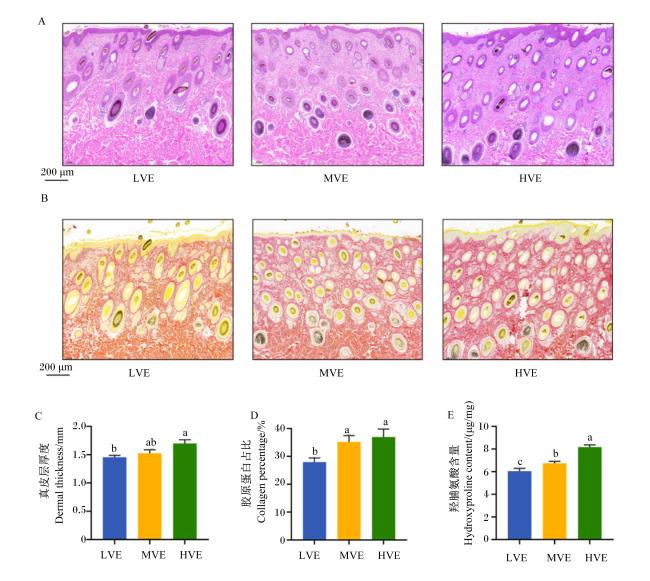
表4可知,各组的IBST和IBNT均无显著差异(P>0.05);与LVE组相比,HVE组的FBST显著提高(P<0.05);MVE和HVE组的FBST和FNST无显著差异(P>0.05)。由图1-A图1-C可知,HVE组的真皮层厚度与LVE组相比显著提高(P<0.05),与MVE组相比无显著差异(P>0.05);由图1-B图1-D图1-E可知,与LVE组相比,MVE和HVE组的胶原蛋白占比、羟脯氨酸含量显著提高(P<0.05),且HVE组的羟脯氨酸含量显著高于MVE组(P<0.05)。
表4 VE对德州驴皮肤厚度的影响

Table 4 Effects of VE on skin thickness of Dezhou donkeys mm

项目
Items
组别Groups P
P-value
LVE MVE HVE
初始背部皮肤厚度IBST 4.84±0.19 4.88±0.29 4.84±0.17 0.990
终末背部皮肤厚度FBST 6.55±0.13b 6.87±0.10ab 7.11±0.17a 0.028
初始颈部皮肤厚度INST 3.20±0.10 3.20±0.09 3.20±0.19 0.999
终末颈部皮肤厚度FNST 4.11±0.11 4.58±0.23 4.61±0.13 0.081
图1 VE对德州驴背部皮肤真皮层厚度、胶原蛋白占比及羟脯氨酸含量的影响

LVE:LVE组;MVE:MVE组;HVE:HVE组。下图同。数据柱形标注不同小写字母表示差异显著(P<0.05)。

Fig.1 Effects of VE on dermal thickness, collagen percentage and hydroxyproline content of back skin of Dezhou donkeys

LVE: LVE group; MVE: MVE group; HVE: HVE group. The same as below. Value columns with different small letters mean significant difference (P<0.05).

2.4 VE对德州驴血清抗氧化指标的影响

表5可知,与LVE组相比,MVE和HVE组的血清MDA含量显著降低(P<0.05),T-AOC与GSH-Px、SOD活性显著升高(P<0.05),CAT活性有显著升高的趋势(P=0.059)。
表5 VE对德州驴血清抗氧化指标的影响

Table 5 Effects of VE on serum antioxidant indexes of Dezhou donkeys

项目
Items
组别Groups P
P-value
LVE MVE HVE
总抗氧化能力T-AOC/(mmol/L) 0.22±0.02b 0.29±0.01a 0.29±0.01a 0.002
丙二醛MDA/(nmol/mL) 3.65±0.12b 2.98±0.10a 2.70±0.11a 0.001
谷胱甘肽过氧化物酶GSH-Px/(U/mL) 169.97±4.43b 191.08±7.45a 190.24±4.76a 0.028
过氧化氢酶CAT/(U/mL) 2.51±0.17 3.52±0.32 3.58±0.45 0.059
超氧化物歧化酶SOD/(U/mL) 130.48±1.65b 141.72±2.34a 141.51±1.91a 0.001

2.5 德州驴背部皮肤的转录组学分析结果

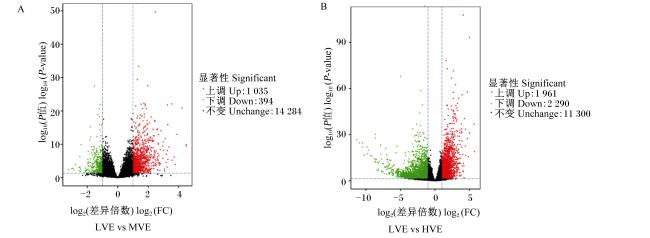
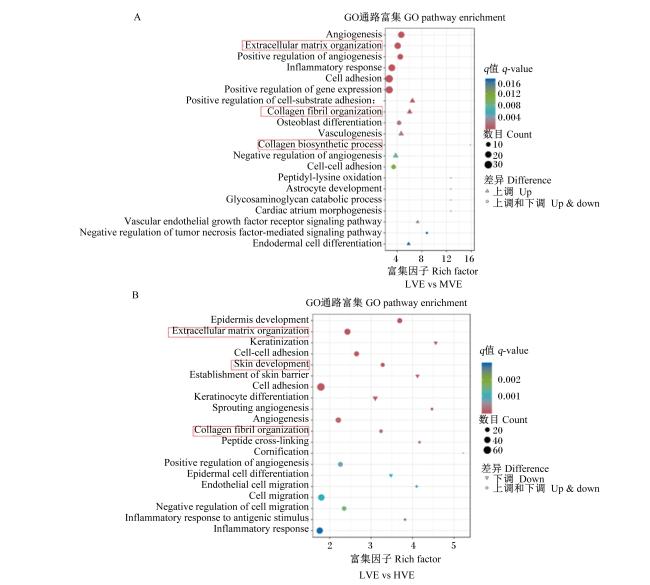
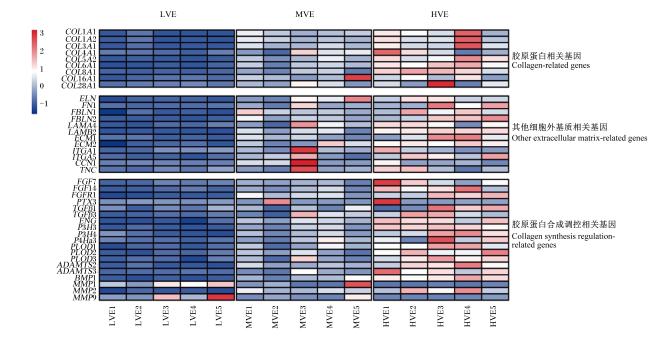
对德州驴背部皮肤进行转录组学分析,结果显示,LVE与MVE组间有1 429个DEGs,其中1 035个上调DEGs,394个下调DEGs(图2-A);LVE与HVE组间4 251个DEGs,其中1 961个上调DEGs,2 290个下调DEGs(图2-B)。GO富集分析结果(图3-A图3-B)显示,与LVE组相比,MVE和HVE组显著富集的与胶原蛋白和细胞外基质相关的信号通路为细胞外基质组织(extracellular matrix organization)、胶原纤维组织(collagen fibril organization)、胶原蛋白生物合成(collagen biosynthetic process)、皮肤发育(skin development)。图4为这4条显著富集信号通路中的差异表达基因聚类热图,与LVE组相比,MVE和HVE组的胶原蛋白相关基因Ⅰ型胶原蛋白α1链(COL1A1)、Ⅰ型胶原蛋白α2链(COL1A2)和Ⅲ型胶原蛋白α1链(COL3A1)等的表达显著上调;其他细胞外基质相关基因弹性蛋白(ELN)、纤连蛋白1(FN1)、层粘连蛋白α4亚基(LAMA4)和整合素(ITGA)等的表达显著上调;胶原蛋白合成调控相关基因成纤维细胞生长因子(FGF)、转化生长因子β(TGFβ)、脯氨酸3-羟化酶3(P3H3)、脯氨酸3-羟化酶4(P3H4)、赖氨酸羟化酶(PLOD)、去整合素金属蛋白酶(ADAMTS)、骨形态发生蛋白1(BMP1)、基质金属蛋白酶2(MMP2)、基质金属蛋白酶28(MMP28)等的表达显著上调,基质金属蛋白酶1(MMP1)、基质金属蛋白酶9(MMP9)的表达显著下调。
图2 VE对德州驴背部皮肤中差异表达基因数量的影响(火山图)

Fig.2 Effects of VE on number of DEGs in back skin of Dezhou donkeys (volcano plot)

图3 VE对德州驴背部皮肤中信号通路的影响(GO富集气泡图)

Angiogenesis:血管再生;Extracellular matrix organization:细胞外基质组织;Positive regulation of angiogenesis:血管再生的正向调节;Inflammatory response:炎症反应;Cell adhesion:细胞黏附;Positive regulation of gene expression:基因表达的正调控;Positive regulation of cell-substrate adhesion:细胞与基质黏附的正向调节;Collagen fibril organization:胶原纤维组织;Osteoblast differentiation:成骨细胞分化;Vasculogenesis:血管生成;Collagen biosynthetic process:胶原蛋白生物合成过程;Negative regulation of angiogenesis:对血管再生的负向调节;Cell-cell adhesion:细胞-细胞黏附;Peptidyl-lysine oxidation:肽基赖氨酸氧化;Astrocyte development:星形胶质细胞的发展;Glycosaminoglycan catabolic process:糖胺聚糖分解代谢过程;Cardiac atrium morphogenesis:心房形态发生;Vascular endothelial growth factor receptor signaling pathway:血管内皮生长因子受体信号通路;Negative regulation of tumor necrosis factor-mediated signaling pathway:负向调节肿瘤坏死因子介导的信号通路;Endodermal cell differentiation:内皮细胞分化;Epidermis development:表皮发育;Keratinization:角质形成;Skin development:皮肤发育;Establishment of skin barrier:建立皮肤屏障;Keratinocyte differentiation:角质细胞分化;Sprouting angiogenesis:发芽血管再成;Peptide cross-linking:肽交联;Cornification:角质化;Endothelial cell migration:内皮细胞迁移;Cell migration:细胞迁移;Negative regulation of cell migration:细胞迁移的负调控;Inflammatory response to antigenic stimulus:对抗原刺激的炎症反应。

Fig.3 Effects of VE on signaling pathways in back skin of Dezhou donkeys (GO enrichment bubble chart)

图4 差异表达基因聚类分析

COL1A1:Ⅰ型胶原蛋白α1链 collagen type Ⅰ alpha 1 chain;COL1A2:Ⅰ型胶原蛋白α2链 collagen type Ⅰ alpha 2 chain;COL3A1:Ⅲ型胶原蛋白α1链 collagen type Ⅲ alpha 1 chain;COL4A1:Ⅳ型胶原蛋白α1链 collagen type Ⅳ alpha 1 chain;COL5A2:Ⅴ型胶原蛋白α2链 collagen type Ⅴ alpha 2 chain;COL6A1:Ⅵ型胶原蛋白α1链 collagen type Ⅵ alpha 1 chain;COL8A1:Ⅷ型胶原蛋白α1链 collagen type Ⅷ alpha 1 chain;COL16A1:ⅩⅥ型胶原蛋白α1链 collagen type ⅩⅥ alpha 1 chain;COL28A1:ⅩⅩⅧ型胶原蛋白α1链 collagen type ⅩⅩⅧ alpha 1 chain;ELN:弹性蛋白 elastin;FN1:纤连蛋白1 fibronectin 1;FBLN1:纤维蛋白1 fibulin 1;FBLN2:纤维蛋白2 fibulin 2;LAMA4:层粘连蛋白α4亚基 laminin subunit alpha 4;LAMB2:层粘连蛋白β2亚基 laminin subunit beta 2;ECM1:细胞外基质蛋白1 extracellular matrix protein 1;ECM2:细胞外基质蛋白2 extracellular matrix protein 2;ITGA1:整合素α1亚基 integrin subunit alpha 1;ITGA5:整合素α5亚基 integrin subunit alpha 5;CCN1:细胞通讯网络因子 cellular communication network factor 1;TNC:肌腱蛋白C tenascin C;FGF7:成纤维细胞生长因子7 fibroblast growth factor 7;FGF14:成纤维细胞生长因子14 fibroblast growth factor 14;FGFR1:成纤维细胞生长因子受体1 fibroblast growth factor receptor 1;PTX3:五聚蛋白3 pentraxin 3;TGFβ1:转化生长因子β1 transforming growth factor beta 1;TGFβ3:转化生长因子β3 transforming growth factor beta 3;ENG:内皮糖蛋白 endoglin;P3H3:脯氨酰3-羟化酶3 prolyl 3-hydroxylase 3;P3H4:脯氨酰3-羟化酶4 prolyl 3-hydroxylase 4;P4Ha3:脯氨酰4-羟化酶α3 prolyl 4-hydroxylase alpha 3;PLOD1:赖氨酸羟化酶1 procollagen-lysine, 2-oxoglutarate 5-dioxygenase 1;PLOD2:赖氨酸羟化酶2 procollagen-lysine 2-oxoglutarate, 5-dioxygenase 2;PLOD3:赖氨酸羟化酶3 procollagen-lysine, 2-oxoglutarate 5-dioxygenase 3;ADAMTS2:去整合素金属蛋白酶2 ADAM with thrombospondin 2;ADAMTS3:去整合素金属蛋白酶3 ADAM with thrombospondin 3;BMP1:骨形态发生蛋白1 bone morphogenetic protein 1;MMP1:基质金属蛋白酶1 matrix metallopeptidase 1;MMP2:基质金属蛋白酶2 matrix metallopeptidase 2;MMP9:基质金属蛋白酶9 matrix metallopeptidase 9。

Fig.4 Cluster analysis of DEGs

3 讨论

3.1 VE对德州驴生长性能和屠宰性能的影响

在肉驴的养殖过程中,生长性能、产肉量和产皮量是最为重要的经济特征。目前,有关VE的研究主要聚焦在改善热应激和肉品质方面,而关于VE是否能够提高动物的生长性能和屠宰性能仍存在争议。研究表明,在肉牛饲粮中添加1 600 IU/kg VE[22]、在贵州黑山羊饲粮中添加250 mg/(d·只)VE[23]能够显著提高生长性能。但在肉兔上的研究显示,在饲粮中添加150[24]或375 mg/kg VE[25]与添加60 mg/kg VE(NRC推荐标准)相比肉兔的生长性能无显著差异,这与本试验结果基本一致。本研究结果表明,与添加60 mg/kg VE相比,添加200和400 mg/kg VE对德州驴的生长性能、胴体重和屠宰率均无显著影响,这说明60 mg/kg VE能够基本满足德州驴的生长需要。

3.2 VE对德州驴皮用性能的影响

近年来,在疫情的冲击下,人们越来越注重健康养生,更加重视到驴皮的营养和药用价值[4]。因此,以驴皮作为主要原材料的阿胶市场需求量大,驴皮的经济价值不断升高。胶原蛋白是真皮层的主要成分,皮肤厚度的增加与胶原蛋白的沉积有关[26-27]。羟脯氨酸是胶原蛋白的特有氨基酸,可用来指示胶原蛋白含量[13]。有研究表明,喂食海参不同浓度的VE能够增加其体壁的Ⅰ、Ⅲ型胶原蛋白占比和羟脯氨酸含量,使其胶原纤维排列更加致密[11]。同样,Huang等[28]报道,在杂交石斑鱼饲粮中添加110 mg/kg VE能够增强肌肉中羟脯氨酸的合成,从而促进其生长。在本研究中,在德州驴精补料中添加200、400 mg/kg VE能够显著增加其背部皮肤中羟脯氨酸含量和胶原蛋白占比,其中以添加400 mg/kg VE的效果最佳。
驴的皮肤厚度会因年龄、季节、性别和部位而存在较大差异。Wang等[29]和张强等[30]分别通过微创游标卡尺法和HE切片法测量了驴不同部位的皮肤厚度,结果均表明背部皮肤最厚且与其他各部位皮肤厚度的相关性最高。因此,本试验以德州驴的背部皮肤为重点进行研究,结果表明,添加400 mg/kg VE能够显著增加德州驴背部皮肤厚度、真皮层厚度,且鲜皮重有显著增加的趋势,主要机制可能还是归结于高剂量VE能够促进机体胶原蛋白沉积。因此,对于皮用性能而言,添加60 mg/kg VE并不能满足德州驴的产皮需求。

3.3 VE对德州驴抗氧化能力的影响

VE是一类脂溶性维生素,根据分子结构可将其分为生育酚和生育三烯酚两大类,每类又可分为α、β、γ、δ 4种异构体,其中α-生育酚是VE在动物机体发挥作用的主要活性形式[6,31]。VE对动物机体抗氧化能力的改善作用已达成共识,其机理为α-生育酚的酚羟基能够在中和ROS在内的多种自由基时提供1个氢原子,从而被氧化为生育酚,氧化后的α-生育酚可被VC还原再生,或进一步氧化为醌[32-34]。已有研究表明,在饲粮中添加适量VE能够显著提高育肥猪[35]、奶牛[36]、肉鸡[37]及母兔[38]的抗氧化酶的活性,降低脂质过氧化产物MDA的含量。在热应激条件下,饲粮中添加100~200 mg/kg VE能够显著改善蛋鸡[39]、蛋种鸭[40]的抗氧化能力。本研究结果与前人的研究结果基本一致,在精补料中添加200、400 mg/kg的VE能够显著提高德州驴的抗氧化能力。

3.4 基于转录组学分析VE对德州驴背部皮肤中信号通路和基因表达的影响

在哺乳动物皮肤中,细胞外基质主要是由真皮成纤维细胞(dFB)合成并分泌到细胞外的蛋白质和蛋白多糖形成的复杂动态网络结构,包括胶原蛋白、弹性蛋白、层粘连蛋白、迁连蛋白等[41]。细胞外基质在维持真皮弹性、皮肤凝聚和皮肤发育方面发挥重要作用,随着动物皮肤的生长和发育,其降解减少而合成增加,主要表现为真皮层厚度和皮肤弹性增加[42]。作为细胞外基质动态网络的主要成分,胶原蛋白家族在dFB的内质网合成,其含量相当于皮肤干重的70%~80%[43-44]。目前,在哺乳动物体内已发现28种类型胶原蛋白,其中Ⅰ、Ⅲ和Ⅴ型胶原蛋白分别约占皮肤总胶原蛋白的80%、15%和5%[43-44]。Wang等[29]对德州驴皮肤厚度存在显著差异的2个组进行了转录组学分析,GO富集分析结果显示:细胞外基质信号通路显著富集,并确定了MMP28为反映德州驴皮肤厚度变化的候选基因。Zou等[45]用单细胞转录组图谱表征了成华猪不同部位皮肤组织的细胞类型,结果显示:COL1A1、肌腱蛋白(TNN)、抑制素β亚基(INHBA)是促进猪皮肤细胞外基质积累的候选基因,其中INHBA基因编码转化生长因子蛋白质超家族的成员。FGF是一大类分泌因子,能够通过FGF受体发挥作用。研究表明,TGFβ能够与FGF发挥协同作用,包括促进成纤维细胞生长、皮肤发育、细胞外基质沉积及伤口愈合等[46]。本研究中的GO富集分析结果显示,精补料中添加200或400 mg/kg VE能够显著富集细胞外基质组织、胶原纤维组织、胶原蛋白生物合成、皮肤发育等信号通路,显著上调COL1A1、COL1A2、COL3A1、COL5A2、ELNFN1、LAMA2、FGF7、FGF14、TGFβ1、TGFβ3、MMP28等基因的表达,这说明在饲粮中添加适量VE能够促进德州驴皮肤中细胞外基质(尤其是胶原蛋白)沉积,从而增加真皮层厚度。
胶原蛋白是由3条α链螺旋交联形成,每条α链都是以Gly为骨架后衔接2个除Gly以外其他氨基酸(Gly-X-Y)的重复序列组装而成,其中在X或Y位置上的脯氨酸(Pro)和赖氨酸(Lys)需要在脯氨酸3-羟化酶(P3H3、P3H4)、PLOD的作用下进行羟基化修饰形成前胶原蛋白[14,47]。随后,前胶原蛋白被分泌出细胞外,在前胶原N端蛋白酶(ADAMTS2、3、14)和前胶原C端蛋白酶(BMP-1)的作用下切除N端和C端前肽,以保证胶原分子自发的组装并形成成熟的胶原纤维[48]。此外,基质金属蛋白酶家族(MMPs)对于胶原蛋白的降解发挥重要作用,有研究报道,由MMPs介导的胶原蛋白周转代谢有利于胶原纤维最终沉积[49]。本研究结果显示,精补料中添加200或400 mg/kg VE能够显著上调P3H3、P3H4、PLODADAMTSBMP-1、MMP2等基因的表达,显著下调MMP1、MMP9的表达,这说明VE在德州驴皮胶原蛋白的合成和组装过程中发挥重要作用,这为VE在驴皮质量和产量提升中的应用提供了参考依据。

4 结论

精补料中添加200或400 mg/kg VE对德州驴的生长性能无显著影响,但均能改善德州驴的抗氧化能力,并通过富集细胞外基质组织、胶原纤维组织、胶原蛋白生物合成、皮肤发育等信号通路,促进皮肤中胶原蛋白沉积,从而提高德州驴的皮用性能。综合分析各项指标,推荐德州驴精补料中VE添加量为400 mg/kg。
[1]
曹馨元, 鹿傲飞, 王春洪, 等. 2022年我国驴产业发展现状、问题及对策[J]. 中国畜牧杂志, 2023, 59(9):357-361.

CAO X Y, LU A F, WANG C H, et al. Status quo, problems and countermeasures for the development of China’s donkey industry in 2022[J]. Chinese Journal of Animal Science, 2023, 59(9):357-361. (in Chinese)

[2]
WU H Z, REN C Y, YANG F, et al. Extraction and identification of collagen-derived peptides with hematopoietic activity from Colla Corii Asini[J]. Journal of Ethnopharmacology, 2016,182:129-136.

[3]
YUE Q X, ZHANG W, LIN S M, et al. Ejiao ameliorates lipopolysaccharide-induced pulmonary inflammation via inhibition of NFκB regulating NLRP3 inflammasome and mitochondrial ROS[J]. Biomedicine & Pharmacotherapy, 2022,152:113275.

[4]
鲁帆, 王玉斌, 刘强德, 等. 2023年我国驴业发展状况、现实掣肘与应对之策[J]. 中国畜牧杂志, 2024, 60(12):396-399.

LU F, WANG Y B, LIU Q D, et al. China’s donkey industry in 2023,the state of development,the reality of the constraints and the response to the policy[J]. Chinese Journal of Animal Science, 2024, 60(12):396-399. (in Chinese)

[5]
魏雅婷, 徐泽君, 陈虹宇, 等. 外源维生素E和硒调控动物精液品质的研究进展[J]. 畜牧兽医学报, 2024, 55(4):1389-1400.

DOI

WEI Y T, XU Z J, CHEN H Y, et al. Research progress of exogenous vitamin E and selenium regulating semen quality in animals[J]. Acta Veterinaria et Zootechnica Sinica, 2024, 55(4):1389-1400. (in Chinese)

DOI

[6]
何晨鹏, 申文璨, 刘寰宇, 等. 维生素E抗氧化作用及其在动物生产上的应用研究进展[J]. 饲料工业, 2024, 45(7):11-14.

HE C P, SHEN W C, LIU H Y, et al. Progress in the study of antioxidant effects of vitamin E and its application in animal production[J]. Feed Industry, 2024, 45(7):11-14. (in Chinese)

[7]
WANG M, HE Z Z, XIONG Z L, et al. Effects of dietary supplementation of grape seed extract in comparison with excessive level of vitamin E on growth performance and antioxidant function of broilers[J]. Animal Biotechnology, 2024, 35(1):2331640.

[8]
ZHU C, YANG J S, NIE X Y, et al. Influences of dietary vitamin E,selenium-enriched yeast,and soy isoflavone supplementation on growth performance,antioxidant capacity,carcass traits,meat quality and gut microbiota in finishing pigs[J]. Antioxidants, 2022, 11(8):1510.

[9]
刘公言, 白莉雅, 孙海涛, 等. 饲粮中添加维生素E和酵母硒对肉兔生长性能、屠宰性能、肌肉品质和抗氧化性能的影响[J]. 动物营养学报, 2022, 34(3):1864-1874.

DOI

LIU G Y, BAI L Y, SUN H T, et al. Effects of dietary vitamin E and yeast selenium on growth performance,slaughter performance,muscle quality and antioxidant capacity of meat rabbits[J]. Chinese Journal of Animal Nutrition, 2022, 34(3):1864-1874. (in Chinese)

[10]
BALDI G, CHAUHAN S S, LINDEN N, et al. Comparison of a grain-based diet supplemented with synthetic vitamin E versus a lucerne (alfalfa) hay-based diet fed to lambs in terms of carcass traits,muscle vitamin E,fatty acid content,lipid oxidation,and retail colour of meat[J]. Meat Science, 2019,148:105-112.

[11]
WANG Z T, XU R J, YANG H B, et al. Vitamin E regulates the collagen contents in the body wall of sea cucumber (Apostichopus japonicus) via its antioxidant effects and the TGF-β/smads pathway[J].Antioxidants, 2024, 13(7):847.

[12]
ZHANG Z Y, YUAN J, TIAN S J, et al. Effects of dietary vitamin E supplementation on growth, feed utilization and flesh quality of large yellow croaker Larimichthys crocea fed with different levels of dietary yellow mealworm Tenebrio molitor meal[J]. Aquaculture, 2022,551:737954.

[13]
ISLAMI V, BITTNER P, FIALA T, et al. Self-sorting collagen heterotrimers[J]. Journal of the American Chemical Society, 2024, 146(3):1789-1793.

DOI PMID

[14]
GOLDBERGA I, LI R, DUER M J. Collagen structure-function relationships from solid-state NMR spectroscopy[J]. Accounts of Chemical Research, 2018, 51(7):1621-1629.

DOI PMID

[15]
ATILA D, KARATAŞ A, KESKIN D, et al. Pullulan hydrogel-immobilized bacterial cellulose membranes with dual-release of vitamin C and E for wound dressing applications[J]. International Journal of Biological Macromolecules, 2022,218:760-774.

[16]
HOBSON R. Vitamin E and wound healing:an evidence-based review[J]. International Wound Journal, 2016, 13(3):331-335.

[17]
ARCHILE-CONTRERAS A C, CHA M C, MANDELL I B, et al. Vitamins E and C may increase collagen turnover by intramuscular fibroblasts.Potential for improved meat quality[J]. Journal of Agricultural and Food Chemistry, 2011, 59(2):608-614.

[18]
高燕, 朱新文, 刘萌萌, 等. 德州驴的保护与开发利用[J]. 畜牧兽医杂志, 2023, 42(6):115-117.

GAO Y, ZHU X W, LIU M M, et al. The protection, development and utilization of Dezhou donkey[J]. Journal of Animal Science and Veterinary Medicine, 2023, 42(6):115-117. (in Chinese)

[19]
张梦杰. 不同锌水平和来源对德州驴生长性能、肠道健康和胶原蛋白沉积的影响[D]. 硕士毕业论文. 北京: 中国农业大学, 2022.

ZHANG M J. Effects of different zinc levels and sources on growth performance,gut healthy and collagen deposition in Dezhou donkeys[D]. Master’s Thesis. Beijing: China Agricultural University, 2022. (in Chinese)

[20]
符天泽. 甘氨酸、 脯氨酸和维生素C对德州驴生长性能、肠道健康及胶原蛋白沉积的影响[D]. 硕士毕业论文. 北京: 中国农业大学, 2022.

FU T Z.Effects of the glycine, proline,and vitamin C supplementation on growth performance,gut health and collagen deposition of Dezhou donkey[D]. Master’s Thesis. Beijing: China Agricultural University, 2022. (in Chinese)

[21]
王敏, 张新浩, 杨莉, 等. 德州驴皮肤厚度测定方法的研究[J]. 黑龙江畜牧兽医, 2018(13):98-101.

WANG M, ZHANG X H, YANG L, et al. A study on the method of determining the skin thickness of the Dezhou donkey[J]. Heilongjiang Animal Science and Veterinary Medicine, 2018(13):98-101. (in Chinese)

[22]
孙柳亚. 日粮中添加维生素E对肉牛生长性能、肌肉品质以及经济效益的影响[J]. 中国饲料, 2024(20):67-70.

SUN L Y. Effects of dietary vitamin E supplementation on growth performance,muscle quality and economic efficiency of beef cattle[J]. China Feed, 2024(20):67-70. (in Chinese)

[23]
杨洋, 王清峰, 袁超, 等. 饲粮中添加不同水平维生素E对贵州黑山羊生长性能、免疫指标以及肉品质的影响[J]. 饲料工业, 2024, 45(11):48-54.

YANG Y, WANG Q F, YUAN C, et al. Effects of different dietary levels of vitamin E on growth performance,immune indexes and meat quality of Guizhou black goats[J]. Feed Industry, 2024, 45(11):48-54. (in Chinese)

[24]
ORIANI G, CORINO C, PASTORELLI G, et al. Oxidative status of plasma and muscle in rabbits supplemented with dietary vitamin E[J]. The Journal of Nutritional Biochemistry, 2001, 12(3):138-143.

[25]
EIBEN C, VÉGI B, VIRÁG G, et al. Effect of level and source of vitamin E addition of a diet enriched with sunflower and linseed oils on growth and slaughter traits of rabbits[J]. Livestock Science, 2011, 139(3):196-205.

[26]
RODNAN G P, LIPINSKI E, LUKSICK J. Skin thickness and collagen content in progressive systemic sclerosis and localized scleroderma[J]. Arthritis and Rheumatism, 1979, 22(2):130-140.

DOI PMID

[27]
邹琴. 成华猪独特皮厚性状形成的分子调控机制研究[D]. 博士毕业论文. 雅安: 四川农业大学, 2023.

ZOU Q. Study on the molecular regulatory mechanisms underlying the unique skin thickness trait in Chenghua pigs[D]. Ph.D.Thesis. Ya’an: Sichuan Agricultural University, 2023. (in Chinese)

[28]
HUANG W B, YAN X B, LIU H, et al. Effects of vitamin E supplementation of a high-lipid diet on the growth and biochemical parameters of hybrid groupers (♀ Epinephelus fuscoguttatus× ♂ E.lanceolatus)[J]. Frontiers in Marine Science, 2022, 9:924018.

[29]
WANG M, LI H J, ZHANG X H, et al. An analysis of skin thickness in the Dezhou donkey population and identification of candidate genes by RNA-seq[J]. Animal Genetics, 2022, 53(3):368-379.

[30]
张强, 王艳萍, 苗凯, 等. 新疆驴不同部位皮肤组织学结构的研究[J]. 家畜生态学报, 2020, 41(11):62-65.

ZHANG Q, WANG Y P, MIAO K, et al. Study on the histological structure of skin in different parts of Xinjiang donkey[J]. Acta Ecologae Animalis Domastici, 2020, 41(11):62-65. (in Chinese)

[31]
TIAN H, LI Y F, JIAO G L, et al. Unveiling the antioxidant superiority of α-tocopherol:implications for vitamin E nomenclature and classification[J]. Free Radical Biology & Medicine, 2024,216:46-49.

[32]
SAITO Y. Lipid peroxidation products as a mediator of toxicity and adaptive response—the regulatory role of selenoprotein and vitamin E[J]. Archives of Biochemistry and Biophysics, 2021,703:108840.

[33]
EGGERSDORFER M, SCHMIDT K, PÉTER S, et al. Vitamin E:not only a single stereoisomer[J]. Free Radical Biology & Medicine, 2024,215:106-111.

[34]
GHANI S M A, GOON J A, AZMAN N H E N, et al. Comparing the effects of vitamin E tocotrienol-rich fraction supplementation and α-tocopherol supplementation on gene expression in healthy older adults[J]. Clinics, 2019,74:e688.

[35]
WANG D, JANG Y D, KELLEY M, et al. Effects of multiple vitamin E levels and two fat sources in diets for swine fed to heavy slaughter weight of 150 kg:Ⅱ.Tissue fatty acid profile,vitamin E concentrations,immune capacity,and antioxidant capacity of plasma and tissue[J]. Translational Animal Science, 2023, 7(1):txad086.

[36]
XIAO J X, KHAN M Z, MA Y L, et al. The antioxidant properties of selenium and vitamin E;their role in periparturient dairy cattle health regulation[J]. Antioxidants, 2021, 10(10):1555.

[37]
PEČJAK M, LESKOVEC J, LEVART A, et al. Effects of dietary vitamin E,vitamin C,selenium and their combination on carcass characteristics,oxidative stability and breast meat quality of broiler chickens exposed to cyclic heat stress[J]. Animals, 2022, 12(14):1789.

[38]
SALEM A A, TAHA D A, NASR A A, et al. Effect of vitamin E,D-limonene,and their combination on nulliparous rabbit reproductive performance[J]. Animal Reproduction Science, 2023,259:107378.

[39]
AMEVOR F K, CUI Z F, NING Z F, et al. Synergistic effects of quercetin and vitamin E on egg production,egg quality,and immunity in aging breeder hens[J]. Poultry Science, 2021, 100(12):101481.

[40]
王爽, 黄路生, 张亚男, 等. 饲粮维生素E添加水平对蛋种鸭产蛋性能、蛋品质及抗氧化性能的影响[J]. 动物营养学报, 2022, 34(9):5777-5784.

DOI

WANG S, HUANG L S, ZHANG Y N, et al. Effects of dietary vitamin E supplemental level on laying performance,egg quality and antioxidant performance of breeding laying ducks[J]. Chinese Journal of Animal Nutrition, 2022, 34(9):5777-5784. (in Chinese)

[41]
THEOCHARIS A D, SKANDALIS S S, GIALELI C, et al. Extracellular matrix structure[J]. Advanced Drug Delivery Reviews, 2016,97:4-27.

[42]
于皓玥, 章婧, 蔄茂强, 等. 真皮衰老与成纤维细胞老化关系的研究进展[J]. 皮肤科学通报, 2023, 40(5):559-563,578.

YU H Y, ZHANG J, MAN M Q, et al. The interaction of dermal aging,fibroblast senescence and chronic inflammaging[J]. Dermatology Bulletin, 2023, 40(5):559-563,578. (in Chinese)

[43]
HAYDONT V, BERNARD B A, FORTUNEL N O. Age-related evolutions of the dermis:clinical signs,fibroblast and extracellular matrix dynamics[J]. Mechanisms of Ageing and Development, 2019,177:150-156.

[44]
HUANG J W, HENG S J, ZHANG W L, et al. Dermal extracellular matrix molecules in skin development,homeostasis,wound regeneration and diseases[J]. Seminars in Cell & Developmental Biology, 2022,128:137-144.

[45]
ZOU Q, YUAN R, ZHANG Y, et al. A single-cell transcriptome Atlas of pig skin characterizes anatomical positional heterogeneity[J]. eLife, 2023,12:e86504.

[46]
LI X X, XIE R F, LUO Y L, et al. Cooperation of TGF-β and FGF signalling pathways in skin development[J]. Cell Proliferation, 2023, 56(11):e13489.

[47]
SALO A M, MYLLYHARJU J. Prolyl and lysyl hydroxylases in collagen synthesis[J]. Experimental Dermatology, 2021, 30(1):38-49.

[48]
CANTY-LAIRD E G, LU Y H, KADLER K E. Stepwise proteolytic activation of type Ⅰ procollagen to collagen within the secretory pathway of tendon fibroblasts in situ[J]. The Biochemical Journal, 2012, 441(2):707-717.

[49]
BIAN Y Q, XIANG Z, WANG Y F, et al. Immunomodulatory roles of metalloproteinases in rheumatoid arthritis[J]. Frontiers in Pharmacology, 2023,14:1285455.

文章导航

/