研究论文

丁酸梭菌或中草药制剂对牛蛙蝌蚪和幼蛙肝脏抗氧化能力、免疫功能及肠道菌群的影响

  • 王志龙 , 1 ,
  • 谢骏 1 ,
  • 王广军 1 ,
  • 李志斐 1 ,
  • 张凯 1 ,
  • 贺中华 2 ,
  • 田晶晶 1 ,
  • 谢文平 1 ,
  • 李红燕 1 ,
  • 夏耘 , 1, * ,
  • 龚望宝 , 1, *
展开
  • 1 中国水产科学研究院珠江水产研究所,农业农村部热带亚热带水产资源利用与养殖重点实验室,广州 510380
  • 2 广州市联鲲生物科技有限公司,广州 511483
*夏 耘,助理研究员,硕士生导师,E-mail: ;
龚望宝,研究员,硕士生导师,E-mail:

王志龙(1999—),男,河南滑县人,硕士研究生,从事水产动物营养研究。E-mail:

Copy editor: 菅景颖

收稿日期: 2024-11-04

  网络出版日期: 2025-08-14

基金资助

国家重点研发计划(2023YFD2400504)

中央公益性科研院所基本科研业务费专项资金(2023TD62)

Effects of Clostridium butyricum or Chinese Herbal Preparation on Hepatic Antioxidant Capacity, Immune Function and Gut Microbiota of Bullfrog Tadpoles and Froglets

  • WANG Zhilong , 1 ,
  • XIE Jun 1 ,
  • WANG Guangjun 1 ,
  • LI Zhifei 1 ,
  • ZHANG Kai 1 ,
  • HE Zhonghua 2 ,
  • TIAN Jingjing 1 ,
  • XIE Wenping 1 ,
  • LI Hongyan 1 ,
  • XIA Yun , 1, * ,
  • GONG Wangbao , 1, *
Expand
  • 1 Key Laboratory of Tropical & Subtropical Fishery Resource Application & Cultivation, Ministry of Agriculture and Rural Affairs, Pearl River Fisheries Research Institute, Chinese Academy of Fishery Science, Guangzhou 510380, China
  • 2 Guangzhou Nutriera Biotechnology Co., Ltd., Guangzhou 511483, China
*XIA Yun, assistant professor, E-mail: ;
GONG Wangbao, professor, E-mail:

Received date: 2024-11-04

  Online published: 2025-08-14

摘要

本研究旨在评估饲料中补充丁酸梭菌或中草药制剂对牛蛙(Aquarana catesbeiana)蝌蚪和幼蛙肝脏抗氧化能力、免疫功能及肠道菌群的影响。对照组采用基础饲料,试验组在基础饲料中添加5×10⁹ CFU/kg丁酸梭菌或5 g/kg中草药制剂,分别在蝌蚪和幼蛙阶段投喂30 d。蝌蚪阶段,每组设3个重复池,每池100只蝌蚪;幼蛙阶段,每组设3个重复池,每池30只幼蛙。结果显示:与对照组相比,饲料中补充丁酸梭菌或中草药制剂显著提高了牛蛙蝌蚪和幼蛙的增重率(P<0.05)。在蝌蚪阶段,与对照组相比,饲料中补充丁酸梭菌显著提高了肝脏总抗氧化能力(T-AOC)及酸性磷酸酶(ACP)、碱性磷酸酶(AKP)、溶菌酶(LZM)活性(P<0.05);饲料中补充中草药制剂显著提高了肝脏中T-AOC和免疫球蛋白M(IgM)含量(P<0.05)。在幼蛙阶段,与对照组相比,饲料中补充丁酸梭菌显著提高了肝脏中T-AOC、还原性谷胱甘肽(GSH)和IgM含量、ACP和LZM活性(P<0.05);饲料中补充中草药制剂显著提高了肝脏中T-AOC、过氧化氢酶(CAT)和LZM活性、IgM含量(P<0.05)。与对照组相比,饲料中补充丁酸梭菌显著提高了蝌蚪肝脏中肿瘤坏死因子-α(TNF-α)、转化生长因子-β(TGF-β)和白细胞介素-10(IL-10)的mRNA相对表达量(P<0.05)。与对照组相比,饲料中补充丁酸梭菌显著提高了幼蛙肝脏中TNF-αIL-10的mRNA相对表达量(P<0.05),饲料中补充中草药制剂显著提高了幼蛙肝脏中TNF-αTGF-βIL-10的mRNA相对表达量(P<0.05)。肠道菌群分析表明,丁酸梭菌或中草药制剂可正向调节肠道菌群结构,增加厚壁菌门的相对丰度,降低拟杆菌门的相对丰度。综上所述,饲料中添加5×109 CFU/kg丁酸梭菌或5 g/kg中草药制剂能够提高牛蛙蝌蚪和幼蛙肝脏抗氧化能力和免疫功能,优化肠道菌群结构,从而增强抗病力,降低疾病发生风险。

本文引用格式

王志龙 , 谢骏 , 王广军 , 李志斐 , 张凯 , 贺中华 , 田晶晶 , 谢文平 , 李红燕 , 夏耘 , 龚望宝 . 丁酸梭菌或中草药制剂对牛蛙蝌蚪和幼蛙肝脏抗氧化能力、免疫功能及肠道菌群的影响[J]. 动物营养学报, 2025 , 37(8) : 5395 -5409 . DOI: 10.12418/CJAN2025.438

Abstract

This study aimed to evaluate the effects of dietary supplementation with Clostridium butyricum or Chinese herbal preparation on the hepatic antioxidant capacity, immune function and gut microbiota of bullfrog (Aquarana catesbeiana) tadpoles and froglets. The control group was fed a basal diet, while the experimental groups were supplemented with 5×10⁹ CFU/kg of Clostridium butyricum or 5 g/kg of Chinese herbal preparation in the basal diet, respectively. The feeding trial lasted for 30 days during both the tadpole and froglet stages. During the tadpole stage, each group was replicated in three tanks, with 100 tadpoles per tank. During the froglet stage, each group was replicated in three tanks, with 30 froglets per tank. The results showed that compared with the control group, dietary supplementation with Clostridium butyricum or Chinese herbal preparation significantly increased the weight gain rate of both tadpoles and froglets (P<0.05). During the tadpole stage, compared with the control group, dietary supplementation with Clostridium butyricum significantly enhanced the total antioxidant capacity (T-AOC) in the liver, as well as the activities of acid phosphatase (ACP), alkaline phosphatase (AKP), and lysozyme (LZM) (P<0.05); dietary supplementation with Chinese herbal preparation significantly increased the T-AOC and immunoglobulin M (IgM) content in the liver (P<0.05). During the froglet stage, compared with the control group, dietary supplementation with Clostridium butyricum significantly increased the T-AOC, reduced glutathione (GSH) and IgM contents in the liver, as well as the activities of ACP and LZM (P<0.05); dietary supplementation with Chinese herbal preparation significantly enhanced the T-AOC, catalase (CAT) and LZM activities, as well as the IgM content in the liver (P<0.05). Compared with the control group, dietary supplementation with Clostridium butyricum significantly increased the mRNA relative expression levels of tumor necrosis factor-α (TNF-α), transforming growth factor-β (TGF-β), and interleukin-10 (IL-10) in the liver of tadpoles (P<0.05). Compared with the control group, dietary supplementation with Clostridium butyricum significantly increased the mRNA relative expression levels of TNF-α and IL-10 in the liver of froglets (P<0.05), while dietary supplementation with Chinese herbal preparation significantly increased the mRNA relative expression levels of TNF-α, TGF-β and IL-10 in the liver of froglets (P<0.05). Gut microbiota analysis indicated that Clostridium butyricum or Chinese herbal preparation could positively modulate the gut microbiota structure by increasing the relative abundance of Firmicutes and decreasing the relative abundance of Bacteroidetes. In conclusion, dietary supplementation with 5×10⁹ CFU/kg of Clostridium butyricum or 5 g/kg of Chinese herbal preparation can enhance the hepatic antioxidant capacity and immune function of tadpoles and froglets, optimize the gut microbiota structure, thereby improving disease resistance and reducing the risk of disease occurrence.

牛蛙(Aquarana catesbeiana)作为一种大型食用蛙,因其肉质细嫩、营养丰富、生长迅速以及强大的环境适应能力而广受关注[1]。近年来,牛蛙在中国南方地区的养殖呈现出快速发展的态势,目前已成为水产养殖领域中一种具有特色的新兴养殖对象。根据现有数据,牛蛙养殖活动中的养殖密度通常达到40~45 kg/ m 2 [2]。在2021年,牛蛙的年产量已达到60万t[3]。然而,随着水产养殖规模的不断扩大以及养殖密度的持续提高,疾病的发生频率显著增加,这对牛蛙养殖业构成了严重的威胁,不仅导致了重大的经济损失,还限制了产业的健康可持续发展[4]。为了预防和治疗各类疾病,抗生素在牛蛙养殖中被长期且广泛地使用,甚至出现了滥用的情况,进而导致了养殖牛蛙产生耐药性、肠道微生物群落失衡以及免疫力下降等问题[5-6]。因此,水产养殖行业迫切需要探索新的绿色替代方案,以降低对抗生素的依赖程度。益生菌和中草药的应用被视为一种潜在的可持续解决方案,在全球水产养殖业中正逐渐获得广泛认可[7-8]
多项研究发现,肠道菌群失调通过增加病原体数量及其代谢物来改变肠道通透性,从而改变机体健康和免疫状态[9]。此外,调整肠道菌群的组成可用作疾病治疗的策略[10]。肠道微生物的稳态被视为水产动物健康的关键指标之一,而益生菌的辅助应用是维持这种平衡的有效策略之一[11]。通过膳食补充益生菌可以促进肠道菌群的平衡,能够抑制病原体在胃肠道中的定植,并改善肠上皮的完整性,从而间接提高机体的免疫能力[12],进而提高鱼类的生长性能和存活率。在水产养殖领域,益生菌主要分为宿主源益生菌和外源益生菌。研究表明,宿主源益生菌在调控肠道微生物稳态、促进生长以及增强免疫功能方面相较于外源益生菌具有显著优势[11],但宿主源益生菌的分离及产业化过程较为复杂,因此,商业化的外源益生菌在水产养殖中得到了广泛的应用。丁酸梭菌(Clostridium butyricum)是一种专性厌氧菌,具有修复肠道损伤、增强肠道消化和吸收能力以及调节免疫反应的功能,主要用于治疗因肠道菌群失调所引发的肠道炎症[13]。对大口黑鲈(Micropterus salmoides)的研究发现,丁酸梭菌能够显著增强机体的消化与抗氧化能力、提高免疫酶活性,并能够改善肠道组织结构以及微生物群组成[13]。中草药具有杀菌、消毒及调节免疫反应等多重功效[14],并且由于其资源丰富、成本较低,已被广泛用于水产养殖领域。在普通饲料中补充中草药已被证明能够促进肠道微生物群平衡,直接促进宿主对食物的消化,抑制胃肠道内病原体的侵入与定植,增强肠上皮的完整性,并改善鱼类的生长及免疫状态[15]。在对欧洲鲈鱼(Dicentrarchus labrax)的研究中发现,在饲料中补充草本种子粉能够增强机体免疫能力,改善肠道形态,调节脂质代谢以及肠道菌群结构[16]
尽管近年来对益生菌和中草药在水产养殖中的益处已进行了广泛的研究[12-13,15-16],然而,商用益生菌和中草药制剂作为牛蛙膳食补充剂的潜力尚未得到充分的探讨。本研究选用商用丁酸梭菌和中草药制剂来配制饲料,并分别在牛蛙蝌蚪和幼蛙阶段进行为期30 d的投喂试验,旨在评估这些添加剂对牛蛙抗氧化能力、免疫功能和肠道菌群结构的影响,为丁酸梭菌和中草药制剂在牛蛙养殖中的应用提供参考。

1 材料与方法

1.1 伦理声明

本研究严格遵循珠江水产研究所实验动物使用指南,并获得珠江水产研究所实验伦理委员会(CAFS)的正式批准(伦理受理号为LAEC-PRFRI-2023-04-03)。

1.2 饲料制备

试验所用基础饲料(粉状)以豆粕和鱼粉为主要蛋白质源,豆油为主要脂肪源,具体组成及营养水平见表1。试验所用丁酸梭菌为商用丁酸梭菌液态制剂,其菌落数实测值为5×10⁸ CFU/mL,按照制造商的说明,在基础饲料中的添加量为10 mL/kg,即基础饲料中丁酸梭菌添加量为5×109 CFU/kg。试验所用中草药制剂为商用水产用中草药粉剂,是将甘草、柴胡、栀子、茵陈、茯苓和白芍粉碎后过80目筛,随后按6∶4∶2∶2∶1∶1的比例混合而成,其营养成分及有效活性成分含量见表2,按照制造商的说明,在基础饲料中的添加量为5 g/kg。在配制饲料时,按照设计的添加量将CB或CL加入水中与原料混合,利用挤出机加工成1.5 mm的颗粒饲料,随后在烘箱中55 ℃干燥6 h,最后将制备完成的3种试验饲料储存于-20 ℃备用。
表1 基础饲料组成及营养水平(风干基础)

Table 1 Composition and nutrient levels of the basal diet (air-dry basis) %

项目Items 含量Content
原料Ingredients
鱼粉Fish meal 30.00
豆粕Soybean meal 40.00
面粉Flour 24.50
豆油Soybean oil 1.45
预混料Premix1) 2.00
磷酸二氢钙Ca(H2PO4)2 1.50
抗氧化剂Antioxidant 0.02
防霉剂Mould inhibitor 0.03
氯化胆碱Choline chloride 0.50
合计Total 100.00
营养水平Nutrient levels2)
粗蛋白质CP 41.00
粗脂肪EE 7.00
粗纤维CF 3.00
粗灰分Ash 10.00
钙Ca 3.12
总磷TP 1.52

1)预混料组成及各成分含量参照徐文杰等[17]的报道。The composition and each component content of premix referred to the report by Xu et al[17].
2)营养水平为实测值。Nutrient levels were measured values.

表2 中草药添加剂营养成分及有效活性成分含量(风干基础)

Table 2 Contents of nutritional components and effective active components of Chinese herbal medicine additive (air-dry basis) %

项目Items 含量Content
营养成分Nutritional components
粗蛋白质CP 9.72
粗脂肪EE 7.85
粗纤维CF 25.36
粗灰分Ash 4.88
钙Ca 0.96
总磷TP 0.20
有效活性成分Effective active components
水提粗提物Water crude extract 22.72
总黄酮Total flavones 5.27
总多糖Total polysaccharides 12.56

营养成分和有效活性成分均为实测值。

Nutritional components and effective active components were all measured values.

1.3 试验设计与养殖管理

养殖试验在中国水产科学研究院珠江水产研究所的养殖基地进行。
蝌蚪养殖试验:20日龄牛蛙蝌蚪来自广州的一个牛蛙养殖场。所有蝌蚪喂食基础饲料(对照饲料)3 d以适应环境。随后,将900只初始体重为0.5 g左右的蝌蚪(Gosner 26期)随机分为3组,分别投喂对照饲料、添加丁酸梭菌饲料和添加中草药制剂饲料,每组设置3个平行养殖池(1.0 m×0.8 m×0.6 m),每池放养100只。
幼蛙养殖试验:蝌蚪养殖试验结束后,继续向各组投喂对应饲料,直至完全变态为四脚幼蛙。各组随机挑选90只初始体重为(1.5±0.2) g的幼蛙,继续向各组投喂对应饲料,每组3个平行养殖池,每池随机放养30只。每天2次(08:30和16:30)投喂,持续30 d。
投喂基础饲料、添加丁酸梭菌饲料和添加中草药制剂饲料的3组在蝌蚪养殖试验中分别命名为T0、TCB、TCL组,在幼蛙养殖试验分别命名为F0、FCB和FCL组。
试验期间,养殖池水位为0.2 m,溶氧浓度(4.0±0.5) mg/L,氨氮浓度<0.05 mg/L,水温在(28.0±1.0) ℃,pH为7.3±0.3。每天2次(08:30和16:30)投喂,持续30 d。每天定量投喂,投喂量为体重的3%~4%,每隔1周根据个体质量适当调整投喂量。

1.4 样品采集

养殖试验结束后停食24 h,捞出所有蝌蚪(Gosner 32~36期)或幼蛙,统计每个养殖池存活数量,沥干体表水分后再称重。每个养殖池随机取5只个体,在无氯冰上进行休克安乐,解剖后取出完整肠道和肝脏,使用生理盐水冲洗。然后收集肝脏组织和后肠内容物,放入液氮中冷冻后保存在-80 ℃以下,以便进行下一步分析。

1.5 测定指标与方法

1.5.1 营养成分和有效活性成分检测

试验所用的中草药制剂和基础饲料中粗蛋白质(CP)、粗脂肪(EE)、粗纤维(CF)、粗灰分(Ash)、钙(Ca)和总磷(TP)含量分别参考GB/T 6432—2018、GB/T 6433—2006、GB/T 6434—2022、GB/T 6438—2007、GB/T 6436—2018和GB/T 6437—2018进行测定。中草药添加剂中水提粗提物含量参考张清泰等[18]的方法测定,总多糖含量采用苯酚-硫酸比色法[19]测定,总黄酮含量参照GB/T 20574—2006采用分光光度法测定。

1.5.2 生长性能

牛蛙蝌蚪和幼蛙的增重率、存活率、饲料系数和摄食率参考向述辉等[20]报道的方法计算。

1.5.3 肝脏抗氧化和免疫指标

在4 ℃下用9倍肝脏组织样品重量的预冷生理盐水匀浆肝脏样品,然后在4 ℃下以1 160×g离心10 min,得到上清液,收集上清液以测定肝脏抗氧化和免疫指标。总抗氧化能力(T-AOC)(货号:A015-2-1)、超氧化物歧化酶(SOD)(货号:A001-3-2)、还原型谷胱甘肽(GSH)(货号:A006-2-1)、酸性磷酸酶(ACP)(货号:A060-2-1)和碱性磷酸酶(AKP)(货号:A059-2-2)的测定采用南京建成生物工程研究所生产的试剂盒;过氧化氢酶(CAT)(货号:MM-35705O)、丙二醛(MDA)(货号:MM-1664O)、溶菌酶(LZM)(货号:MM-925409O)和免疫球蛋白M(IgM)(货号:MM-33677O)的测定使用江苏酶免实业有限公司生产的酶联免疫吸附测定(ELISA)试剂盒;BCA蛋白浓度测定试剂盒(货号:A045-4-2)购自南京建成生物工程研究所。

1.5.4 肝脏免疫相关基因mRNA相对表达量

使用Trizol法提取肝脏组织总RNA,并通过琼脂糖凝胶电泳检测其纯度和完整性,再在分光光度计下测定RNA浓度,然后进行反转录以合成cDNA。实时荧光定量PCR(qRT-PCR)在Light Cycler 96-Time PCR系统(Roche,瑞士)中进行。20 μL反应系统的设置和qRT-PCR循环程序设置参照Du等[21]的报道。本研究使用的引物的有效性通过已公布的技术方法[22]进行评估,引物序列见表3。采用β-肌动蛋白(β-actin)为内参基因,根据Pfaffl[23]的数学模型计算目的基因的mRNA相对表达量。
表3 本试验所用到的引物序列

Table 3 Primer sequences used in this experiment

基因Genes 引物序列Primer sequence (5'—3') 登录号Accession number
β-肌动蛋白β-actin F:AAGCTCAAAGCAAGAGGGGT
R:GTTCCTCTGGGGCAACTCTC
XM_040357114.1
核因子-κB NF-κB F:GACCCCTCCATACCACAAGC
R:GACATCTCCGCCACGTTTTC
XM_040329919.1
肿瘤坏死因子-α TNF-α F:TCATGCTTCCACTGGCTCAG
R:ATGTGGAAGTGGAGCAGAGC
XM_040323112.1
转化生长因子-β TGF-β F:GCAGGTGGGTTCAGCCTATT
R CTCCTGTCATGGAAACCGCT
BT081838.1
干扰素调节因子-3 IRF-3 F:CAGGACCATTACTGCGTGTG
R:CATCGGTGCTATCCCAAGGA
XM_040327506.1
白细胞介素-1β IL-1β F:GTTGCTTTCCCTGGCTGGTA
R:TGCATGGGTTGGTTCTGAGG
XM_040345988.1
白细胞介素-8 IL-8 F: GCTTCTTGGGTAGAGCGCAT
R:TGTTCCTGAGAGGGTAGGGA
XM_040335899.1
白细胞介素-10 IL-10 F:AAAAGCAAGGCCATCAAGCAG
R:AGATGTCAAATTCTCCAACGGC
XM_040339663.1

1.5.5 肠道菌群结构

将采集到的肠道内容物样品送至上海美吉生物医药科技有限公司进行微生物组学分析。提取肠道内容物DNA并对16S rRNA基因V3~V4区进行PCR扩增,引物序列及PCR扩增条件参考Xia等[24]的报道。将纯化的扩增产物进行等量混合,连接测序接头,构建测序文库,使用Illumina MiSeq PE300平台上机测序。对获得的原始测序序列进行质控、拼接、过滤、双端拼接,进而产生优化序列(Tags);而后划分操作分类单元(OTU)并基于OTU的序列组成进行物种分类学分析。

1.6 统计分析

试验数据用平均值±标准差(mean±SD)表示,使用SPSS 22.0统计软件进行单因素方差分析(one-way ANOVA),并通过Duncan氏多重比较检验组间差异,P<0.05为差异显著。肠道菌群基于OTU和分类学结果,在美吉生物云平台(https://cloud.majorbio.com)上利用R语言(version 3.3.1)软件进行Alpha多样性分析、菌群组成分析、基于Bray-Curtis距离的主坐标分析(PCoA)和非度量多维尺度(NMDS)分析、线性判别分析效应大小(LEfSe)和PICRUSt 2功能预测分析。

2 结果与分析

2.1 生长性能

表4可知,在蝌蚪阶段,TCB和TCL组的增重率与T0组相比显著升高(P<0.05),而存活率、饲料系数和摄食率在T0、TCB和TCL组之间无显著差异(P>0.05)。由表5可知,在幼蛙阶段,F0、FCB和FCL组的存活率均为100%;FCB和FCL组的增重率显著高于F0组(P<0.05);饲料系数和摄食率在F0、FCB和FCL组之间差异不显著(P>0.05)。
表4 饲料中添加丁酸梭菌或中草药制剂对蝌蚪生长性能的影响

Table 4 Effects of dietary addition of Clostridium butyricum or Chinese herbal preparation on growth performance of tadpoles (n=5)

项目
Items
组别Groups P
P-value
T0 TCB TCL
增重率WGR/% 749.00±26.55a 904.67±65.41b 891.33±67.91b <0.001
摄食率FR/(%/d) 6.42±0.26 6.67±0.60 6.64±0.37 0.582
饲料系数FCR 1.22±0.05 1.17±0.11 1.22±0.17 1.000
存活率SR/% 91.59±1.34 91.02±1.36 90.81±1.63 0.653

同行数据肩标相同或无字母表示差异不显著(P>0.05),不同字母表示差异显著(P<0.05)。下表同。

In the same row, values with the same or no letter superscripts mean no significant difference (P>0.05), while with different letter superscripts mean significant difference (P<0.05). The same as below.

表5 饲料中添加丁酸梭菌或中草药制剂对幼蛙生长性能的影响

Table 5 Effects of dietary addition of Clostridium butyricum or Chinese herbal preparation on growth performance of froglets (n=5)

项目
Items
组别Groups P
P-value
F0 FCB FCL
增重率WGR/% 780.44±19.19a 878.89±44.47b 864.33±49.69b <0.001
摄食率FR/(%/d) 6.10±0.15 6.27±0.36 6.21±0.44 0.681
饲料系数FCR 1.15±0.09 1.09±0.11 1.13±0.09 0.974
存活率SR/% 100 100 100

2.2 肝脏抗氧化和免疫指标

表6可知,在蝌蚪阶段,与T0组相比,TCB组肝脏中T-AOC、MDA含量及ACP、AKP、LZM水平显著上调(P<0.05);TCL组肝脏中T-AOC、MDA和IgM含量显著上调(P<0.05),而CAT水平显著下调(P<0.05)。由表7可知,在幼蛙阶段, 与F0组相比,FCB组肝脏中T-AOC、GSH和IgM含量、ACP和LZM水平显著上调(P<0.05),CAT水平显著下调(P<0.05);FCL组肝脏中T-AOC、CAT和LZM水平和IgM含量显著上调(P<0.05)。
表6 饲料中添加丁酸梭菌或中草药制剂对蝌蚪肝脏抗氧化和免疫指标的影响

Table 6 Effects of dietary addition of Clostridium butyricum or Chinese herbal preparation on liver antioxidant and immune indexes of tadpoles (n=5)

项目
Items
组别Groups P
P-value
T0 TCB TCL
碱性磷酸AKP/(U/g prot) 28.26±4.43a 91.95±10.14b 37.16±5.53a <0.001
酸性磷酸酶ACP/(U/g prot) 22.43±3.37a 78.76±10.91b 21.29±2.44a <0.001
还原型谷胱甘肽GSH/(μmol/g prot) 2.09±0.09 3.24±0.14 2.54±0.45 0.058
超氧化物歧化酶SOD/(U/g prot) 24.62±2.01 22.45±1.30 22.78±1.37 0.628
总抗氧化能力T-AOC/(mmol/g prot) 0.68±0.03a 2.97±0.27b 2.18±0.46b 0.020
过氧化氢酶CAT/(μg/g prot) 475.96±23.78b 540.70±47.21b 422.63±19.96a 0.005
丙二醛MDA/(μmol/g prot) 4.51±0.79a 8.22±1.31b 9.30±1.33b <0.001
溶菌酶LZM/(ng/g prot) 161.38±16.46a 247.19±22.68b 175.79±26.36a <0.001
免疫球蛋白M IgM/(μg/g prot) 29.48±2.00a 34.06±3.45a 44.48±5.20b <0.001
表7 饲料中添加丁酸梭菌或中草药制剂对幼蛙肝脏抗氧化和免疫指标的影响

Table 7 Effects of dietary addition of Clostridium butyricum or Chinese herbal preparation on liver antioxidant and immune indexes of froglets (n=5)

项目
Items
组别Groups P
P-value
F0 FCB FCL
碱性磷酸AKP/(U/g prot) 10.34±0.89 23.89±8.39 15.17±2.51 0.162
酸性磷酸酶ACP/(U/g prot) 12.03±1.41a 22.04±1.66b 7.42±2.11a <0.001
还原型谷胱甘肽GSH/(μmol/g prot) 4.66±0.49a 8.42±0.63b 5.34±0.65a 0.005
超氧化物歧化酶SOD/(U/g prot) 17.61±0.71ab 19.66±1.74b 13.89±0.84a 0.014
总抗氧化能力T-AOC/(mmol/g prot) 1.07±0.05a 1.48±0.12b 1.54±0.16b 0.049
过氧化氢酶CAT/(μg/g prot) 432.45±36.59b 331.92±23.56a 353.66±31.25a <0.001
丙二醛MDA/(μmol/g prot) 9.11±2.64 12.50±4.28 8.37±2.56 0.159
溶菌酶LZM/(ng/g prot) 104.02±11.76a 140.24±11.95b 202.53±23.99c <0.001
免疫球蛋白M IgM/(μg/g prot) 29.23±5.55a 47.07±6.16b 44.39±8.04b <0.001

2.3 肝脏免疫相关基因mRNA相对表达量

表8可知,在蝌蚪阶段,与T0组相比,TCB和TCL组核因子-κB(NF-κB)、肿瘤坏死因子-α(TNF-α)、转化生长因子-β(TGF-β)、干扰素调节因子-3(IRF-3)、白细胞介素-1β(IL-1β)、白细胞介素-8(IL-8)、白细胞介素-10(IL-10)的mRNA相对表达量与T0相比均上调,其中TCL组TNF-αTGF-βIL-10的mRNA相对表达量与T0组的差异达到显著水平(P<0.05)。由表9可知,在幼蛙阶段,FCB和FCL组NF-κBTNF-αTGF-βIRF-3、IL-1βIL-8、IL-10的mRNA相对表达量与F0组相比均上调,其中FCB组TNF-αIL-10的mRNA相对表达量相比F0组显著上调(P<0.05),FCL组的TNF-αTGF-βIL-10的mRNA相对表达量相比F0组显著上调(P<0.05)。
表8 饲料中添加丁酸梭菌或中草药制剂对蝌蚪肝脏免疫相关基因mRNA相对表达量的影响

Table 8 Effects of dietary addition of Clostridium butyricum or Chinese herbal preparation on relative expression levels of liver immune-related genes in liver of tadpoles (n=5)

项目
Items
组别Groups P
P-value
T0 TCB TCL
核因子-κB NF-κB 0.95±0.12 1.17±0.17 1.73±0.49 0.223
肿瘤坏死因子-α TNF-α 0.84±0.17a 1.31±0.14ab 1.44±0.28b 0.042
白细胞介素-1β IL-1β 0.95±0.14 1.07±0.06 1.05±0.18 0.791
白细胞介素-8 IL-8 1.13±0.17 1.19±0.14 1.22±0.21 0.954
转化生长因子-β TGF-β 0.76±0.04a 1.11±0.14ab 1.49±0.19b 0.019
白细胞介素-10 IL-10 0.77±0.06a 1.24±0.12ab 1.60±0.25b 0.026
干扰素调节因子-3 IRF-3 1.12±0.24 1.25±0.37 1.12±0.22 0.936
表9 饲料中添加丁酸梭菌或中草药制剂对幼蛙肝脏免疫相关基因mRNA相对表达量的影响

Table 9 Effects of dietary addition of Clostridium butyricum or Chinese herbal preparation on relative expression levels of immune-related genes in liver of froglets (n=5)

项目
Items
组别Groups P
P-value
F0 FCB FCL
核因子-κB NF-κB 0.92±0.22 1.02±0.08 1.38±0.38 0.385
肿瘤坏死因子-α TNF-α 0.71±0.10a 1.33±0.11b 1.57±0.22b 0.014
白细胞介素-1β IL-1β 1.00±0.06 1.20±0.11 1.25±0.18 0.397
白细胞介素-8 IL-8 0.97±0.19 1.34±0.32 1.40±0.26 0.500
转化生长因子-β TGF-β 0.87±0.10a 1.29±0.29a 2.97±0.53b 0.004
白细胞介素-10 IL-10 0.81±0.21a 1.25±0.20b 1.66±0.42b 0.019
干扰素调节因子-3 IRF-3 1.11±0.21 1.35±0.32 1.35±0.42 0.858

2.4 肠道菌群结构

2.4.1 OTU分布

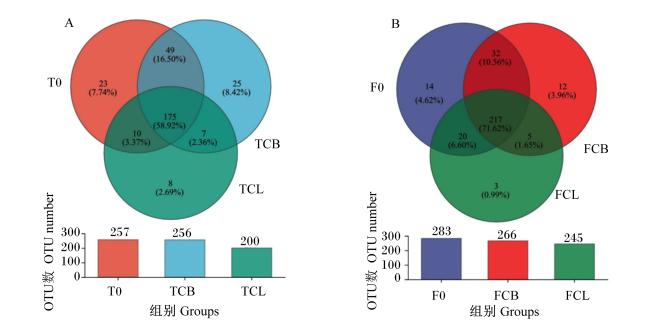
在经过质量控制和嵌合体去除后,从21个样品共获得优化序列1 253 814个,经降噪和数据扁平化后基于97%的序列一致性聚类为383个OTU。由牛蛙肠道菌群Venn图可知,蝌蚪样本组间共有OTU数为175个,T0、TCB和TCL组分别存在23、25和8个特有OTU(图1-A);幼蛙样本组间共有OTU数为217个,F0、FCB和FCL组分别存在14、12和3个特有OTU(图1-B)。
图1 饲料中添加丁酸梭菌或中草药制剂对蝌蚪和幼蛙肠道菌群OTU组成的影响

A:蝌蚪肠道菌群Venn图;B:幼蛙肠道菌群Venn图。

Fig.1 Effects of dietary addition of Clostridium butyricum or Chinese herbal preparation on OTU composition of gut microbiota of tadpoles and froglets

A: Venn diagram of tadpole gut microbiota; B: Venn diagram of froglet gut microbiota.

2.4.2 Alpha多样性和Beta多样性分析

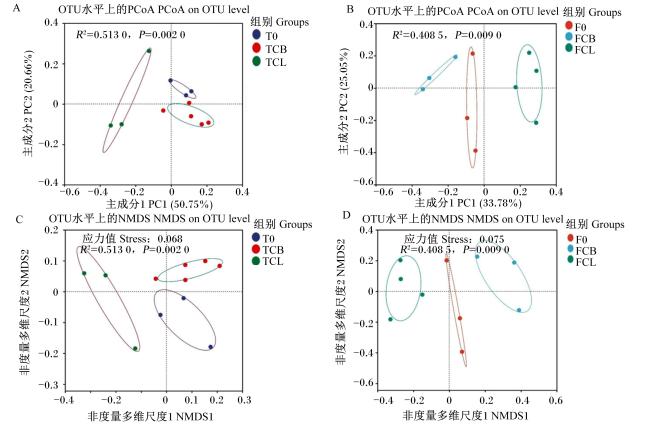
饲料中添加丁酸梭菌或中草药制剂对蝌蚪和幼蛙肠道菌群Alpha多样性的影响分别见表10表11。所有样本的Goods_coverage指数都不低于99.0%,表明测序深度已经基本覆盖到大多数微生物物种。无论是蝌蚪阶段还是幼蛙阶段,肠道菌群的Shannon、Simpson、Ace和Chao1指数在各组间均无显著差异(P>0.05)。基于Bray-Curtis距离的PCoA和NMDS分析显示(图2-A图2-B图2-C图2-D),蝌蚪阶段的T0、TCB和TCL组之间,幼蛙阶段的F0、FCB和FCL组之间,肠道菌群组成存在显著差异(P<0.05)。在NMDS分析中,蝌蚪和幼蛙样本的应力值(stress)分别为0.068和0.075,这显示该数据具有高度代表性。
表10 OTU水平上蝌蚪肠道菌群Alpha多样性比较分析

Table 10 Comparative analysis of Alpha diversity of tadpole gut microbiota at OTU level (n=5)

项目
Items
组别Groups P
P-value
T0 TCB TCL
Shannon指数Shannon index 2.17±0.44 1.78±0.37 1.13±0.78 0.299
Simpson指数Simpson index 0.26±0.06 0.34±0.06 0.63±0.30 0.213
Ace指数Ace index 168.90±68.20 177.40±52.11 161.20±3.45 0.905
Chao1指数Chao1 index 171.50±75.13 178.10±52.37 166.30±19.21 0.840
Goods_coverage指数Goods_coverage index/% 99.94±0.03 99.93±0.02 99.92±0.02 0.686
表11 OTU水平上幼蛙肠道菌群Alpha多样性比较分析

Table 11 Comparative analysis of Alpha diversity of froglet gut microbiota at OTU level (n=5)

项目
Items
组别Groups P
P-value
F0 FCB FCL
Shannon指数Shannon index 3.46±0.33 3.22±0.37 2.89±0.26 0.125
Simpson指数Simpson index 0.07±0.03 0.08±0.03 0.14±0.05 0.097
Ace指数Ace index 222.50±33.08 208.10±30.64 214.30±19.79 0.815
Chao1指数Chao1 index 230.90±31.81 208.20±28.83 216.10±16.62 0.636
Goods_coverage指数Goods_coverage index/% 99.94±0.01 99.94±0.01 99.93±0.02 0.517
图2 饲料中添加丁酸梭菌或中草药制剂对蝌蚪和幼蛙肠道菌群Beta多样性的影响

A:蝌蚪肠道菌群PCoA图;B:幼蛙肠道菌群PCoA图;C:蝌蚪肠道菌群NMDS图;D:幼蛙肠道菌群NMDS图。

Fig.2 Effects of dietary addition of Clostridium butyricum or Chinese herbal preparation on Beta diversity of gut microbiota of tadpoles and froglets

A: PCoA plot of tadpole gut microbiota; B: PCoA plot of froglet gut microbiota; C: NMDS plot of tadpole gut microbiota; D: NMDS plot of froglet gut microbiota.

2.4.3 肠道菌群组成和功能

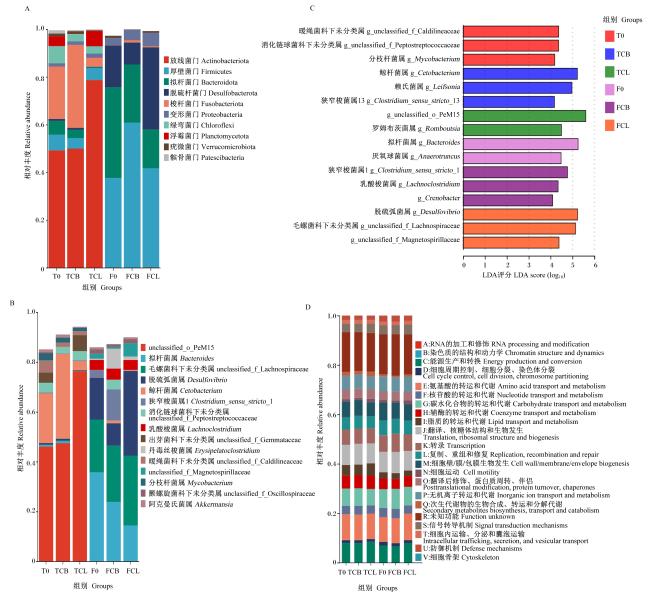
门水平上,牛蛙蝌蚪肠道菌群中的主要菌门包括放线菌门和梭杆菌门,而幼蛙肠道菌群中的主要菌门包括厚壁菌门、拟杆菌门和脱硫杆菌门(图3-A)。与T0组相比,TCB组中梭杆菌门的相对丰度明显升高(34.78% vs 21.99%),而TCL组中放线菌门和梭杆菌门相对丰度分别明显升高和降低(放线菌门:78.68% vs 49.24%;梭杆菌门:3.75% vs 21.99%)。与F0组相比,FCB组中厚壁菌门的相对丰度明显升高(60.89% vs 37.54%),脱硫杆菌门的相对丰度明显降低(9.21% vs 17.66%),而FCL组中脱硫杆菌门的相对丰度明显升高(34.48% vs 17.66%)。
图3 饲料中添加丁酸梭菌或中草药制剂对蝌蚪和幼蛙肠道菌群组成和功能的影响

A:相对丰度排名前10的菌门;B:相对丰度排名前15名肠道菌属;C:LEfSe分析;D:PICRUSt 2功能预测。

Fig.3 Effects of dietary addition of Clostridium butyricum or Chinese herbal preparation on composition and function of gut microbiota of tadpoles and froglets

A: the top 10 bacterial phyla in terms of relative abundance; B: the top 15 bacterial genera in terms of relative abundance; C: LEfSe analysis; D: PICRUSt 2 functional prediction.

牛蛙蝌蚪肠道菌群中的主要菌属包括unclassified_o_PeM15和鲸杆菌属,而幼蛙肠道菌群中的主要菌属为拟杆菌属、毛螺菌科下未分类属、脱硫弧菌属和狭窄梭菌属1(图3-B)。与T0组相比,TCB(33.98% vs 19.97%)和TCL组(3.61% vs 19.97%)中鲸杆菌属相对丰度分别明显升高和降低。与F0组相比,FCB组的狭窄梭菌属1的相对丰度明显提高(12.52% vs 2.87%),而拟杆菌属和脱硫弧菌属的相对丰度明显降低(拟杆菌属:23.80% vs 35.69%;脱硫弧菌属:9.01% vs 16.89%);FCL组拟杆菌属和脱硫弧菌属的相对丰度分别明显降低和提升(拟杆菌属:14.46% vs 35.69%;脱硫弧菌属:33.91% vs 16.89%)。
使用LEfSe方法在属水平上识别组间显著差异的类群[线性判别分析(LDA)评分>4.0且P<0.05](图3-C),结果显示:TCB组中鲸杆菌属显著富集(P<0.05),TCL组中unclassified_o_PeM15和罗姆布茨菌属显著富集(P<0.05);FCB组中狭窄梭菌属1显著富集(P<0.05);FCL组中脱硫弧菌属的显著富集(P<0.05)。
基于高通量测序结果和COG数据库对牛蛙肠道菌群功能进行PICRUSt 2预测分析,结果显示,牛蛙蝌蚪和幼蛙肠道菌群的功能主要包括氨基酸转运和代谢、翻译、核糖体结构和生物发生、碳水化合物转运和代谢及能量生产和转换(图3-D)。

3 讨论

3.1 饲料中添加丁酸梭菌或中草药制剂对牛蛙蝌蚪和幼蛙生长性能的影响

本试验结果表明,在饲料中添加丁酸梭菌能显著提升牛蛙蝌蚪及幼蛙的增重率。中草药富含的营养成分及生物活性物质,能加速机体代谢与蛋白质合成,进而增强生长性能。此前关于牛蛙的研究[25]已证实这一点。尽管丁酸梭菌作为饲料添加剂已被证实能显著提高机体生长性能和饲料利用率[26],在水产养殖中,其应用主要集中在鱼类和虾类,而针对蛙类养殖的研究尚属空白。本研究发现,饲料中添加丁酸梭菌也能显著提高牛蛙蝌蚪和幼蛙的增重率。综上所述,饲料中添加丁酸梭菌或中草药制剂对牛蛙蝌蚪和幼蛙的生长具有显著的促进作用。

3.2 饲料中添加丁酸梭菌或中草药制剂对牛蛙蝌蚪和幼蛙肝脏抗氧化指标的影响

抗氧化剂和氧化自由基之间存在微妙的平衡,任何对这种平衡的破坏都会对整体健康产生显著影响[13]。过量的活性氧(ROS)是氧化应激的产物,可导致细胞和组织的损伤[27],而抗氧化酶可以抵御这些过量ROS[28]。T-AOC是各种抗氧化酶和抗氧化物质构成的总体抗氧化水平,这些抗氧化酶和抗氧化物质可以有效保护细胞和生物体免受ROS诱导的氧化损伤[29]。SOD和CAT等抗氧化酶通过将氧化自由基转化为水和分子氧,共同构成抗氧化反应的第1道防线[15]。MDA是细胞内多不饱和脂肪酸过氧化的最终产物之一,通常被认为是氧化应激的生物标志物,可间接反映细胞受氧化损伤的程度[30]。研究表明,在大口黑鲈饲料中添加丁酸梭菌[13]或在牛蛙饲料中添加复方中草药[25]可以增强其抗氧化能力,并显著降低机体MDA含量[13]。本研究发现,丁酸梭菌或中草药制剂对牛蛙蝌蚪和幼蛙肝脏中SOD活性的影响不显著,但显著提高蝌蚪和幼蛙肝脏中T-AOC,且使GSH含量明显提升,表明机体抗氧化能力得到改善。此外,丁酸梭菌或中草药制剂显著提高牛蛙蝌蚪肝脏中MDA含量,而对幼蛙肝脏中MDA含量的影响不显著,说明丁酸梭菌或中草药制剂对幼蛙的氧化损伤相比蝌蚪要小,这可能是由于长期投喂所致的适应性。

3.3 饲料中添加丁酸梭菌或中草药制剂对牛蛙蝌蚪和幼蛙肝脏免疫相关指标的影响

ACP、AKP和LZM等免疫酶的活性可反映机体的免疫能力[31]。ACP和AKP属于能够水解有机磷酸酯的磷酸酶[31],而LZM是一种杀菌碱性酶,能有效杀灭革兰氏阳性菌[13]。此外,LZM和IgM可以消除细菌和其他入侵病原体并激活补体系统[32]。研究表明,饲料中添加中草药显著提高了牛蛙血清中ACP和AKP活性[25];类似的,饲料中添加丁酸梭菌使黄颡鱼(Pelteobagrus fulvidraco)血清中AKP、LZM活性和IgM含量显著升高[26]。本研究发现,丁酸梭菌可显著提升牛蛙蝌蚪和幼蛙肝脏中ACP和AKP活性,而中草药制剂对ACP和AKP活性的改善作用不显著;此外,丁酸梭菌或中草药制剂均显著提高牛蛙蝌蚪和幼蛙肝脏中LZM活性和IgM含量。这些结果表明,丁酸梭菌或中草药制剂可以提高牛蛙的免疫酶活性,从而更有效地保护牛蛙免受广泛存在的病原体的侵袭。
有研究指出,提升抗炎细胞因子基因的表达是饲料添加剂预防鱼类疾病并改善免疫反应的重要调控途径[33]。NF-κB信号通路被认为在促炎细胞因子基因的表达中发挥重要作用,NF-κB作为免疫系统中重要的协调因子,可以诱导促炎细胞因子的表达[11]。本研究发现,丁酸梭菌或中草药制剂上调了蝌蚪和幼蛙肝脏中NF-κB基因的表达,表明两者可能通过NF-κB信号通路调控牛蛙的免疫能力。TNF-α、IL-1β和IL-8是重要的促炎细胞因子,其表达的上调通常被认为机体发生了炎症反应[34];而IL-10和TGF-β是抗炎细胞因子,可以抑制IL-1β和TNF-α等促炎因子的过度释放,在调节免疫稳态中发挥重要作用[35]。本研究中,丁酸梭菌或中草药制剂上调了牛蛙蝌蚪和幼蛙肝脏中TNF-αTGF-βIL-10的表达,说明饲料中添加丁酸梭菌或中草药制剂诱发了机体的炎症反应,并相应增加了抗炎细胞因子的分泌,以维持免疫稳态。有文献报道,适宜水平的丁酸梭菌可显著上调中国花鲈(Lateolabrax maculatus)肠道TNF-αIL-8的表达[36],类似的,植物成分添加剂也可通过促进炎症基因的表达调控免疫反应,如姜黄素可上调TNF-α在鲤鱼(Cyprinus carpio)肠道中的表达[37]。IRF-3具有抗病毒和免疫调节的生物学功能,在识别病毒后,可以通过调控干扰素的表达增强机体的抗病毒能力[38]。研究显示,草本提取物可以显著提高大口黑鲈肝脏中IRF-3基因表达水平[39];在芽孢杆菌调节红杂交罗非鱼免疫反应的研究中也发现其肝脏中IRF-3基因表达水平显著提高[40]。本研究中,丁酸梭菌或中草药制剂上调了牛蛙蝌蚪和幼蛙肝脏中IRF-3的表达,说明这些饲料添加剂在一定程度上能够增强机体的抗病毒能力。

3.4 饲料中添加丁酸梭菌或中草药制剂对牛蛙蝌蚪和幼蛙肠道菌群结构的影响

维持肠道微生物群的动态平衡对水生动物的营养代谢、消化和吸收以及抵御应激源的免疫能力至关重要[41]。本研究中,饲料添加丁酸梭菌或中草药制剂显著影响了牛蛙的肠道菌群结构,增加了某些有益菌群的丰度,同时未影响微生物多样性。此前的研究指出,草药提取物[27]或益生菌[13]可以调节鱼类的肠道微生物群。放线菌门在代谢过程中会产生免疫抑制剂等生物活性物质,在抵抗致病菌和维持肠道稳态方面发挥重要作用[42]。厚壁菌门与拟杆菌门的比值被视为肠道炎症的标志,其比值增加通常预示炎症水平的升高[43]。本研究发现,丁酸梭菌或中草药制剂可提高幼蛙肠道中厚壁菌门与拟杆菌门的比值,这一结果与幼蛙肝脏中TNF-α的mRNA相对表达量显著上调的结果相一致。
据报道,在鱼类肠道中检测到的梭杆菌门微生物,其构成几乎完全由鲸杆菌属所占据,该菌属的发酵产物可以有效改善鱼类肠道和肝脏健康[44]。投喂丁酸梭菌后,牛蛙蝌蚪肠道菌群中鲸杆菌属的相对丰度明显增加。拟杆菌属相对丰度的升高可以引起小鼠肠道炎症、胃肠道功能紊乱[45]。本研究中,丁酸梭菌或中草药制剂降低了幼蛙肠道菌群中拟杆菌属的相对丰度,表明其对拟杆菌属有抑制作用,进而降低肠道炎症发生的风险。丁酸梭菌所隶属的狭窄梭菌属1是鱼类肠道的常见菌属,能够分解纤维素、单糖和木聚糖等糖类,为宿主提供营养[46]。投喂含丁酸梭菌饲料后,未在蝌蚪肠道内观察到狭窄梭菌属1,推测丁酸梭菌尚未在蝌蚪肠道内定植或占比极低。给大口黑鲈投喂丁酸梭菌未使肠道中狭窄梭菌属1成为优势菌属[13],这与本研究结果类似。有研究认为,丁酸梭菌即使未在动物肠道内定植,仍能发挥益生作用。例如,Duan等[47]推测丁酸梭菌可能不会在对虾肠道内定植,只在肠道组织中发挥有益作用。投喂含丁酸梭菌饲料后,幼蛙肠道菌群中狭窄梭菌属1的相对丰度提升,表明该菌属在幼蛙肠道中定植并发挥益生作用。此外,有研究发现,脱硫弧菌属的代谢产物是慢性肠道疾病的潜在致病因素,能够促进IL-6和TNF-α的分泌,诱发炎症反应[48]。本试验中,丁酸梭菌使幼蛙肠道菌群中脱硫弧菌属的相对丰度明显降低,表明丁酸梭菌对该菌属的增殖具有有效的抑制作用,从而减少肠道炎症发生的风险。

4 结论

综上所述,在牛蛙饲料中添加5×10⁹ CFU/kg丁酸梭菌或5 g/kg中草药制剂能有效改善牛蛙蝌蚪和幼蛙的生长性能,同时有效改善机体免疫力和抗氧化能力,并对肠道菌群结构及稳态平衡具有正向调控作用。
[1]
HUO X C, WANG P X, ZHAO F X, et al. Revitalizing pond culture system:harnessing the power of composite nanopeptide CI20,1,3-1, 6-β-glucan,and anthocyanidin biotherapy as an antibiotic substitute for efficient management of bacterial diseases in bullfrogs[J]. Aquaculture, 2024,581:740394.

[2]
SUN J Y, LI H, LIN H, et al. Identification and characterization of Streptococcus iniae from farmed American bullfrogs (Aquarana catesbeiana)[J]. Aquaculture Reports, 2024,35:101980.

[3]
陈秋羽, 郑晓婷, 仲劲松, 等. 牛蛙胚胎发育的形态特征观察[J]. 南方水产科学, 2023, 19(6):158-165.

CHEN Q Y, ZHENG X T, ZHONG J S, et al. Morphological characterization of embryonic development in Rana catesbeiana[J]. South China Fisheries Science, 2023, 19(6):158-165. (in Chinese)

[4]
BAI Y H, LU L Q, TAO J J, et al. Immune response mechanisms underlying bacterial infection in Aquarana catesbeiana erythrocytes[J]. Aquaculture, 2024,584:740565.

[5]
LARSSON D G J, FLACH C F. Antibiotic resistance in the environment[J]. Nature Reviews Microbiology, 2022, 20(5):257-269.

[6]
XU R, LI L A, ZHENG J H, et al. Combined toxic effects of nanoplastics and norfloxacin on mussel:leveraging biochemical parameters and gut microbiota[J]. Science of the Total Environment, 2023,880:163304.

[7]
XIA R, LI S H, YANG H W, et al. Effects of dietary bacterial culture of fengycin-producing Bacillus subtilis on growth performance,intestinal and hepatopancreas health,intestinal microbiota and disease resistance of common carp (Cyprinus carpio)[J]. Aquaculture, 2024,585:740725.

[8]
SHI X H, JIA Y Y, ZHANG Z F, et al. The effects of Chinese herbal feed additives on physiological health and detoxification ability in the red claw crayfish,Cherax quadricarinatus,and evaluation of their safety[J]. Aquaculture, 2023,569:739394.

[9]
YAN M Y, MAN S L, SUN B Y, et al. Gut liver brain axis in diseases: the implications for therapeutic interventions[J]. Signal Transduction and Targeted Therapy, 2023, 8(1):443.

DOI PMID

[10]
BUI T P N, DE VOS W M. Next-generation therapeutic bacteria for treatment of obesity,diabetes,and other endocrine diseases[J]. Best Practice & Research. Clinical Endocrinology & Metabolism, 2021, 35(3):101504.

[11]
ZHANG Y P, LIANG X F, HE S, et al. Dietary supplementation of exogenous probiotics affects growth performance and gut health by regulating gut microbiota in Chinese perch (Siniperca chuatsi)[J]. Aquaculture, 2022,547:737405.

[12]
HU R G, YANG B T, ZHENG Z Y, et al. Improvement of non-specific immunity,intestinal health and microbiota of crucian carp (Carassius auratus) juvenile with dietary supplementation of Bacillus coagulans BC1[J].Aquaculture, 2024,580,Part 2:740327.

[13]
CHEN X Y, LI P J, HOU D Q, et al. Probiotic breakthrough:Clostridium butyricum improved the intestinal SCFAs content,digestive enzymes and antioxidant activities,gut morphology and microbiota composition of largemouth bass[J]. Aquaculture Reports, 2024,36:102090.

[14]
HUANG Z F, LU J, YE Y L, et al. Effects of dietary Chinese herbal medicines mixture on growth performance,digestive enzyme activity and serum biochemical parameters of European eel,Anguilla anguilla[J]. Aquaculture Reports, 2020,18:100510.

[15]
FENG H W, ZHAO S, MA X M, et al. Dietary supplementation with emodin affects growth and gut health by modulating the gut microbiota of common carp (Cyprinus carpio)[J]. Aquaculture Reports, 2024,35:101962.

[16]
ASHRY A M, HABIBA M M, ABDEL-WARITH A W A, et al. Dietary effect of powdered herbal seeds on zootechnical performance,hemato-biochemical indices,immunological status,and intestinal microbiota of European sea bass (Dicentrarchus labrax)[J]. Aquaculture Reports, 2024,36:102074.

[17]
徐文杰, 朱波, 蔡明浪, 等. 低鱼粉饲料中添加酶解鱼小肽对牛蛙蝌蚪生长、变态、肝脏代谢及抗氧化能力的影响[J]. 动物营养学报, 2024, 36(1):478-89.

DOI

XU W J, ZHU B, CAI M L, et al. Effects of dietary enzymatic fish peptides on growth,metamorphosis,liver metabolism and antioxidant capacity of bullfrog tadpoles (Lithobates catesbeiana) fed low fish meal diets[J]. Chinese Journal of Animal Nutrition, 2024, 36(1):478-89. (in Chinese)

[18]
张清泰, 邓圣庭, 方成堃, 等. 复方中草药对母猪繁殖性能、免疫和抗氧化功能及其仔猪生长性能的影响[J]. 动物营养学报, 2024, 36(3):1578-1587.

DOI

ZHANG Q T, DENG S T, FANG C K, et al. Effects of compound Chinese herbs on reproductive performance,immune and antioxidant functions of sows and growth performance of their piglets[J]. Chinese Journal of Animal Nutrition, 2024, 36(3):1578-1587. (in Chinese)

[19]
MASUKO T, MINAMI A, IWASAKI N, et al. Carbohydrate analysis by a phenol-sulfuric acid method in microplate format[J]. Analytical Biochemistry, 2005, 339(1):69-72.

DOI PMID

[20]
向述辉, 朱波, 蔡明浪, 等. 发酵饲料对牛蛙生长性能、肌肉营养成分及肠道菌群的影响[J]. 动物营养学报, 2024, 36(10):6643-6655.

DOI

XIANG S H, ZHU B, CAI M L, et al. Effects of fermented diet on growth performance,muscle nutritional composition and intestinal flora of bullfrogs[J]. Chinese Journal of Animal Nutrition, 2024, 36(10):6643-6655. (in Chinese)

[21]
DU Y H, WANG G J, YU E M, et al. Dietary deoxycholic acid decreases fat accumulation by activating liver farnesoid X receptor in grass crap (Ctenopharyngodon idella)[J]. Aquaculture, 2024,578:740123.

[22]
HUYBEN D, VIDAKOVIC A, SUNDH H, et al. Haematological and intestinal health parameters of rainbow trout are influenced by dietary live yeast and increased water temperature[J]. Fish & Shellfish Immunology, 2019,89:525-536.

[23]
PFAFFL M W. A new mathematical model for relative quantification in real-time RT-PCR[J]. Nucleic Acids Research, 2001, 29(9):e45.

DOI PMID

[24]
XIA Y, LIU Y R, ZHANG K, et al. Microorganism-mediated denitrogenation of aquaculture systems provoked by poly-β-hydroxybutyrate (PHB)[J]. NPJ Clean Water, 2024, 7(1):43.

[25]
杨旭红, 黄凯, 黄明磊, 等. 饲料中添加复方中草药对美国牛蛙生长性能、血清生化指标和肠道组织形态的影响[J]. 饲料工业, 2023, 44(22):104-112.

YANG X H, HUANG K, HUANG M L, et al. Effects of compound Chinese herbal medicine in feed on growth performance,serum biochemistry and intestinal histomorphology in Lithobates catesbeiana[J]. Feed Industry, 2023, 44(22):104-112. (in Chinese)

[26]
王海瑞, 莫文艳, 赵红霞, 等. 饲料添加丁酸梭菌对黄颡鱼生长性能及血清生化指标、免疫功能和抗氧化能力的影响[J]. 动物营养学报, 2022, 34(8):5295-5303.

DOI

WANG H R, MO W Y, ZHAO H X, et al. Effects of adding Clostridium butyricum in diets on growth performance,serum biochemical indices,immune function and antioxidant ability of yellow catfish (Pelteobagrus fulvidraco)[J]. Chinese Journal of Animal Nutrition, 2022, 34(8):5295-5303. (in Chinese)

[27]
ZHU C B, SHEN Y T, REN C H, et al. A novel formula of herbal extracts regulates growth performance,antioxidant capacity,intestinal microbiota and resistance against Aeromonas veronii in largemouth bass (Micropterus salmoides)[J]. Aquaculture, 2024,583:740614.

[28]
CAI B N, WAN P, CHEN H, et al. Purification and identification of novel myeloperoxidase inhibitory antioxidant peptides from tuna (Thunnas albacares) protein hydrolysates[J]. Molecules, 2022, 27(9):2681.

[29]
GUPTA S, FINELLI R, AGARWAL A, et al. Total antioxidant capacity—relevance,methods and clinical implications[J]. Andrologia, 2021, 53(2):e13624.

[30]
JIE Y K, CHENG C H, WANG L C, et al. Hypoxia-induced oxidative stress and transcriptome changes in the mud crab (Scylla paramamosain)[J]. Comparative Biochemistry and Physiology:Toxicology & Pharmacology, 2021,245:109039.

[31]
LI H D, TIAN X L, DONG S L. Growth performance,non-specific immunity,intestinal histology and disease resistance of Litopenaeus vannamei fed on a diet supplemented with live cells of Clostridium butyricum[J]. Aquaculture, 2019,498:470-481.

[32]
DENG H C, YUE H M, RUAN R, et al. Dietary epigallocatechin-3-gallate (EGCG) improves nonspecific immune response of Chinese rice field eel (Monopterus albus)[J]. Aquaculture Nutrition, 2023,2023:6512136.

[33]
DAI Q Q, ZHOU X Q, JIANG W D, et al. Application of enzymatically treated Artemisia annua L. on adult grass carp (Ctenopharyngodon idella):improved growth performance,intestinal antioxidant capacity and apical junctional complex[J]. Aquaculture, 2023,575:739612.

[34]
JI M M, WANG B B, XIE J, et al. Effects of low protein feed on hepato-intestinal health and muscle quality of grass carp (Ctenopharyngodon idellus)[J]. Comparative Biochemistry and Physiology Part B:Biochemistry and Molecular Biology, 2024,273:110989.

[35]
LIU S L, WANG J, FENG Y Y, et al. Effects of compound antimicrobial peptides on the growth performance,antioxidant and immune responses and disease resistance of grass carp (Ctenopharyngodon idellus)[J]. Fish & Shellfish Immunology, 2020, 107(Pt A):163-170.

[36]
KONG L M, MA J R, ZHOU S S, et al. Effects of dietary Clostridium butyricum on the growth performance,digestion,and intestinal health of spotted sea bass (Lateolabrax maculatus)[J]. Frontiers in Immunology, 2023,14:1181471.

[37]
GIRI S S, SUKUMARAN V, PARK S C. Effects of bioactive substance from turmeric on growth,skin mucosal immunity and antioxidant factors in common carp,Cyprinus carpio[J]. Fish & Shellfish Immunology, 2019,92:612-620.

[38]
JOO M S, CHOI K M, KANG G, et al. Molecular characteristics, expression analysis and antiviral activity against RSIV of Red Sea bream IRF3 and IRF7[J]. Aquaculture Reports, 2022,27:101415.

[39]
HU Y, ZHOU Y, SHAN L P, et al. Combination therapy with Polygala tenuifolia Willd and Phellodendron chinense Schneid extracts provides effective protection against micropterus salmoides rhabdovirus in largemouth bass[J]. Aquaculture, 2024,579:740246.

[40]
WAIYAMITRA P, ZORAL M A, SAENGTIENCHAI A, et al. Probiotics modulate tilapia resistance and immune response against tilapia lake virus infection[J]. Pathogens, 2020, 9(11):919.

[41]
CAO S L, GUO J J, ZHAO W P, et al. Impacts of oral Vibrio mimicus double-targeted DNA vaccine on the gut microbiota in grass carps (Ctenopharyngodon idella) and correlations with intestinal mucosa innate immunity[J]. Aquaculture, 2021,533:736201.

[42]
ZHOU S S, BHUKYA H, MALET N, et al. Molecular basis for control of antibiotic production by a bacterial hormone[J]. Nature, 2021, 590(7846):463-467.

[43]
TURNBAUGH P J, LEY R E, MAHOWALD M A, et al. An obesity-associated gut microbiome with increased capacity for energy harvest[J]. Nature, 2006, 444(7122):1027-1031.

[44]
QI X Z, ZHANG Y, ZHANG Y L, et al. Vitamin B12 produced by Cetobacterium somerae improves host resistance against pathogen infection through strengthening the interactions within gut microbiota[J]. Microbiome, 2023, 11(1):135.

[45]
MA L, ZHAO X, LIU T, et al. Xuanfei baidu decoction attenuates intestinal disorders by modulating NF-κB pathway,regulating T cell immunity and improving intestinal flora[J]. Phytomedicine, 2022,101:154100.

[46]
NELSON W C, STEGEN J C. The reduced genomes of Parcubacteria (OD1) contain signatures of a symbiotic lifestyle[J]. Frontiers in Microbiology, 2015,6:713.

[47]
DUAN Y F, WANG Y, DONG H B, et al. Changes in the intestine microbial,digestive,and immune-related genes of Litopenaeus vannamei in response to dietary probiotic Clostridium butyricum supplementation[J]. Frontiers in Microbiology, 2018,9:2191.

[48]
ZHANG-SUN W, AUGUSTO L A, ZHAO L P, et al. Desulfovibrio desulfuricans isolates from the gut of a single individual:structural and biological lipid A characterization[J]. FEBS Letters, 2015, 589(1):165-171.

文章导航

/