研究论文

布拉迪酵母和植物多酚对母猪繁殖性能、抗氧化能力、免疫功能和粪便菌群的影响

  • 李凯利 , 1 ,
  • 周颖洁 1, * ,
  • 尚超越 1 ,
  • 郎育杰 1 ,
  • 陈晓晨 1 ,
  • 高磊 1 ,
  • 曾祥芳 2 ,
  • 俞海峰 3 ,
  • 刘凤菊 4 ,
  • 秦鹏 5 ,
  • 褚瑰燕 , 1, ** ,
  • 蔡传江 , 1, **
展开
  • 1 西北农林科技大学动物科技学院,杨凌 712100
  • 2 中国农业大学动物科学技术学院,北京 100193
  • 3 陕西石羊农业科技股份有限公司,西安 710021
  • 4 北京和联四海生物科技有限公司,北京 100102
  • 5 凯恩格生物科技(宜昌)有限公司,宜昌 443002
** 褚瑰燕,副教授,博士生导师,E-mail: ;
蔡传江,副教授,博士生导师,E-mail:

*同等贡献作者

李凯利(2000—),女,河北邢台人,硕士研究生,从事动物营养与饲料科学研究。E-mail:

Office editor: 田艳明

收稿日期: 2025-01-24

  网络出版日期: 2025-09-12

基金资助

国家重点研发计划(2022YFD13003)

Effects of Saccharomyces cerevisiae boulardii and Plant Polyphenols on Reproductive Performance, Antioxidant Capacity, Immune Function and Fecal Microbiota of Sows

  • LI Kaili , 1 ,
  • ZHOU Yingjie 1 ,
  • SHANG Chaoyue 1 ,
  • LANG Yujie 1 ,
  • CHEN Xiaochen 1 ,
  • GAO Lei 1 ,
  • ZENG Xiangfang 2 ,
  • YU Haifeng 3 ,
  • LIU Fengju 4 ,
  • QIN Peng 5 ,
  • CHU Guiyan , 1, ** ,
  • CAI Chuanjiang , 1, **
Expand
  • 1 College of Animal Science and Technology, Northwest A&F University, Yangling 712100, China
  • 2 College of Animal Science and Technology, China Agriculture University, Beijing 100193, China
  • 3 Shaanxi Shiyang Agriculture Technology Co., Ltd., Xi’an 710021, China
  • 4 Beijing Hi-Link International Biotechnology Co., Ltd., Beijing 100102, China
  • 5 Key Ingredients Biotechnology (Yichang) Co., Ltd., Yichang 443002, China
** CHU Guiyan, associate professor, E-mail: ;
CAI Chuanjiang, associate professor, E-mail:

*Contributed equally

Received date: 2025-01-24

  Online published: 2025-09-12

摘要

本试验旨在研究饲粮添加布拉迪酵母和植物多酚对母猪繁殖性能、抗氧化能力、免疫功能和粪便菌群的影响。采用2×2因子试验设计,选取112头二元(大白×长白)经产母猪,按照胎次(2~4胎)和体重[(245±10) kg]一致原则随机分为4组,每组28个重复,每个重复1头猪。对照组(CON组)饲喂基础饲粮,试验组在饲喂基础饲粮的基础上分别添加0.1 g/kg布拉迪酵母(SY组)、0.2 g/kg植物多酚(PPs组)和0.1 g/kg布拉迪酵母+0.2 g/kg植物多酚(SY+PPs组)。试验期从母猪妊娠第1天开始至仔猪断奶结束。结果表明:1)饲粮添加布拉迪酵母和植物多酚对母猪产仔性能和哺乳仔猪生长性能无显著影响(P>0.05)。2)与CON组相比,饲粮添加布拉迪酵母显著提高母猪泌乳期第1~7天平均日采食量(ADFI)(P<0.05),布拉迪酵母与植物多酚对第1~7天ADFI有显著互作效应(P<0.05)。3)与CON组相比,饲粮添加植物多酚显著提高母猪初乳免疫球蛋白G和免疫球蛋白M含量(P<0.05)。4)与CON组相比,饲粮添加布拉迪酵母显著降低母猪分娩当天和泌乳第21天血浆丙二醛(MDA)含量(P<0.05),显著提高分娩当天血浆总抗氧化能力(T-AOC)和泌乳第21天血浆谷胱甘肽过氧化物酶(GSH-Px)活性(P<0.05);饲粮添加植物多酚显著提高分娩当天血浆超氧化物歧化酶(SOD)活性以及泌乳第21天血浆T-AOC和GSH-Px活性(P<0.05),显著降低分娩当天血浆MDA含量(P<0.05);布拉迪酵母与植物多酚对分娩当天血浆MDA含量、T-AOC和SOD活性以及泌乳第21天血浆GSH-Px活性有显著互作效应(P<0.05)。5)与CON组相比,饲粮添加布拉迪酵母显著降低母猪分娩当天血浆白细胞介素-8(IL-8)和肿瘤坏死因子-α(TNF-α)含量(P<0.05);饲粮添加植物多酚显著降低血浆白细胞介素-1β(IL-1β)和IL-8含量(P<0.05);布拉迪酵母与植物多酚对血浆IL-1β和TNF-α含量有显著互作效应(P<0.05)。6)与CON组相比,饲粮添加布拉迪酵母显著提高母猪分娩当天粪便乙酸和总短链脂肪酸含量(P<0.05);饲粮添加植物多酚显著提高粪便乙酸、丙酸和总短链脂肪酸含量(P<0.05)。7)PPs组和SY+PPs组粪便菌群Ace、Chao和Sobs指数与SY组相比显著提高(P<0.05),有高于CON组的趋势(P>0.05)。线性判别分析效应大小(LEfSe)分析结果表明,PPs组显著富集了毛螺菌科NK4A136群和副拟杆菌属,SY+PPs著富集了乳杆菌属和普雷沃氏菌科UCG-001。综上所述,饲粮添加布拉迪酵母和植物多酚对母猪繁殖性能无显著影响,但可以增强机体抗氧化能力和免疫功能,同时改善粪便菌群结构,促进有益菌富集,提高粪便短链脂肪酸含量。

本文引用格式

李凯利 , 周颖洁 , 尚超越 , 郎育杰 , 陈晓晨 , 高磊 , 曾祥芳 , 俞海峰 , 刘凤菊 , 秦鹏 , 褚瑰燕 , 蔡传江 . 布拉迪酵母和植物多酚对母猪繁殖性能、抗氧化能力、免疫功能和粪便菌群的影响[J]. 动物营养学报, 2025 , 37(9) : 5824 -5837 . DOI: 10.12418/CJAN2025.474

Abstract

This experiment was conducted to investigate the effects of dietary Saccharomyces cerevisiae boulardii and plant polyphenols on reproductive performance, antioxidant capacity, immune function and fecal microbiota of sows. Using a 2×2 factor experimental design, 112 binary (Large White×Landrace) multiparous sows were selected and randomly divided into 4 groups according to the principle of consistent parity (2 to 4 parities) and body weight [(245±10) kg], with 28 replicates in each group and 1 sow in each replicate. Sows in the control group (CON group) were fed a basal diet, while those in the experimental groups were fed the basal diets supplemented with 0.1 g/kg Saccharomyces cerevisiae boulardii (SY group), 0.2 g/kg plant polyphenols (PPs group), and 0.1 g/kg Saccharomyces cerevisiae boulardii+0.2 g/kg plant polyphenols (SY+PPs group), respectively. The experiment started from the first day of gestation of sows and ended when the piglets were weaned. The results showed as follows: 1) dietary Saccharomyces cerevisiae boulardii and plant polyphenols had no significant effects on litter performance of sows and growth performance of suckling piglets (P>0.05). 2) Compared with CON group, dietary Saccharomyces cerevisiae boulardii significantly increased the average daily feed intake (ADFI) of sows from days 1 to 7 of lactation (P<0.05), and Saccharomyces cerevisiae boulardii and plant polyphenols had a significant interaction effect on ADFI from days 1 to 7 of lactation (P<0.05). 3) Compared with CON group, dietary plant polyphenols significantly increased the contents of immunoglobulin G and immunoglobulin M in colostrum of sows (P<0.05). 4) Compared with CON group, dietary Saccharomyces cerevisiae boulardii significantly reduced the plasma malondialdehyde (MDA) content on day of delivery and day 21 of lactation of sows (P<0.05), and significantly increased the plasma total antioxidant capacity (T-AOC) on day of delivery and the plasma glutathione peroxidase (GSH-Px) activity on day 21 of lactation (P<0.05). Dietary plant polyphenols significantly increased the plasma superoxide dismutase (SOD) activity on day of delivery, as well as the plasma T-AOC and GSH-Px activity on day 21 of lactation (P<0.05), and significantly reduced the plasma MDA content on day of delivery (P<0.05). Saccharomyces cerevisiae boulardii and plant polyphenols had significant interaction effects on plasma MDA content, T-AOC and SOD activity on day of delivery, and plasma GSH-Px activity on day 21 of lactation (P<0.05). 5) Compared with CON group, dietary Saccharomyces cerevisiae boulardii significantly reduced the contents of plasma interleukin-8 (IL-8) and tumor necrosis factor-α (TNF-α) of sows on day of delivery (P<0.05). Dietary plant polyphenols significantly reduced the contents of plasma interleukin-1β (IL-1β) and IL-8 (P<0.05). Saccharomyces cerevisiae boulardii and plant polyphenols had significant interaction effects on the contents of plasma IL-1β and TNF-α (P<0.05). 6) Compared with CON group, dietary Saccharomyces cerevisiae boulardii significantly increased the contents of acetic acid and total short-chain fatty acids in feces of sows on day of delivery (P<0.05); dietary plant polyphenols significantly increased the contents of acetic acid, propionic acid and total short-chain fatty acids in feces (P<0.05). 7) The Ace, Chao and Sobs indices of fecal microbiota in PPs group and SY+PPs group were significantly higher than those in SY group (P<0.05), and there was a tendency to be higher than those in CON group (P>0.05). The results of the linear discriminant analysis effect size (LEfSe) analysis showed that Lachnospiraceae_NK4A136_group and Parabacteroides were significantly enriched in PPs group, and Lactobacillus and Prevotellaceae_UCG-001 were significantly enriched in SY+PPs group. In conclusion, dietary Saccharomyces cerevisiae boulardii and plant polyphenols has no significant effects on reproductive performance of sows, but it can enhance the antioxidant capacity and immune function, improve the structure of fecal microbiota, promote the enrichment of beneficial bacteria, and increase the contents of short-chain fatty acids in feces.

母猪的生产效率和健康状况直接关乎养猪场的经济效益[1]。现代大型母猪繁育场采用限位栏饲养模式,研究表明,与空怀母猪相比,妊娠母猪肠道结构极易发生变化,便秘发生率更易变高[2-3];肠道屏障功能也随之发生改变,肠道内毒素倒流,机体炎症频发,从而导致机体氧化应激[4]。氧化应激会损害细胞内环境,导致机体代谢紊乱,使得母猪不仅容易出现高烧不退、食欲低迷等情况,还可能引起黄体退化,增加母猪流产风险[5]。改善妊娠和泌乳母猪肠道屏障功能对于降低活性氧(ROS)产生,同时降低妊娠后期母猪流产率和产后炎症发生率具有重要意义[6]。伴随着近些年来禁抗政策的提出,科学、绿色改善母猪肠道健康状态和提高母猪免疫功能变得日趋重要。
益生菌可以有效调节母猪肠道菌群,维护肠道健康,缓解母猪便秘情况[7]。布拉迪酵母(Saccharomyces cerevisiae boulardii)作为酵母中的活性酵母,在改善母猪肠道健康状态方面具有很大的应用潜力。研究表明,饲粮添加活酵母可以显著改善母猪肠道菌群,提高有益菌数量[8]。天然植物多酚是有效的益生菌生长调节剂,可能与布拉迪酵母发挥协同作用[9]。此外,天然植物多酚具有比维生素更高的抗氧化能力[10],其可能通过抗炎和抗氧化作用支持母猪肠道健康[11]。研究发现,饲粮添加植物多酚可以提高母猪体内谷胱甘肽过氧化物酶(GSH-Px)活性和总抗氧化能力(T-AOC),同时降低丙二醛(MDA)含量,可以更好地缓解母猪机体的氧化应激[12]。布拉迪酵母也可能通过肠道菌群间接增强机体抗氧化能力。目前,布拉迪酵母和植物多酚的联合使用研究较少且效果尚不明确。本研究假设饲粮添加布拉迪酵母以及植物多酚可以通过调节肠道微生物群落和血浆代谢物来改善妊娠晚期和泌乳期母猪的氧化应激状态,提高母猪的使用效率。因此,本研究旨在探究饲粮单独和联合添加布拉迪酵母和植物多酚对母猪繁殖性能、抗氧化能力、免疫功能和粪便菌群的影响,为布拉迪酵母和植物多酚在妊娠母猪生产上的应用提供参考。

1 材料与方法

1.1 试验材料

布拉迪酵母和植物多酚均为市购产品,其中布拉迪酵母菌株编号为CNCM I-1079,活菌数为1×10¹⁰ CFU/g;植物多酚主要成分为儿茶素、白藜芦醇和槲皮素等天然多酚类植物提取物。

1.2 试验设计和饲养管理

本试验涉及的动物管理和样品采集流程按照西北农林科技大学实验动物管理及伦理审查执行委员会制定的《动物福利和伦理规则》进行,并已获得批准(批准编号:No.NWAFU-202304134)。
采用2×2因子试验设计,选取112头二元(大白×长白)经产母猪,按照母猪生产胎次(2~4胎)和体重[(245±10) kg]一致原则随机分为4组,每组28个重复,每个重复1头猪。对照组(CON组)饲喂基础饲粮,试验组在饲喂基础饲粮的基础上分别添加0.1 g/kg布拉迪酵母(SY组)、0.2 g/kg植物多酚(PPs组)和0.1 g/kg布拉迪酵母+0.2 g/kg植物多酚(SY+PPs组)。试验期从母猪妊娠第1天开始至仔猪断奶结束。母猪妊娠期和泌乳期基础饲粮参照NRC(2012)配制,其组成及营养水平见表1
表1 基础饲粮组成及营养水平(风干基础)

Table 1 Composition and nutrient levels of basal diets (air-dry basis) %

项目Items 妊娠期Gestation period 泌乳期Lactation period
原料Ingredients
玉米Corn 39.20 42.00
面粉Wheat flour 15.00 15.00
麦麸Wheat bran 20.00 10.00
大豆皮Soybean hulls 12.50 6.50
豆粕Soybean meal 8.00 13.00
大豆油Soybean oil 0.90 1.90
缓释甲酸Slow-release formic acid 0.40 0.40
膨化大豆Extruded soybean 5.00
赖氨酸盐酸盐Lysine hydrochloride (98%) 0.20
鱼粉Fish meal (68% CP) 2.00
预混料Premix1) 4.00 4.00
合计Total 100.00 100.00
营养水平Nutrient levels2)
净能NE/(MJ/kg) 10.56 11.19
粗蛋白质CP 13.31 15.16
粗脂肪EE 4.00 3.42
粗灰分Ash 6.00 5.95
钙Ca 0.78 0.80
总磷TP 0.66 0.66

1)预混料为每千克饲粮提供 The premix provided the following per kg of diets:VA 9 000 IU,VD3 1 650 IU,VE 60 IU,VK3 3 mg,VB1 2.88 mg,VB2 8.1 mg,VB6 4.71 mg,VB12 0.024 mg,烟酰胺 nicotinamide 26.7 mg,D-泛酸 D-pantothenic acid 20.4 mg,叶酸 folic acid 5.34 mg,D-生物素 D-biotin 0.3 mg,Fe 0.63 g,Cu 0.02 g,Zn 0.11 g,Mn 0.09 g,I 0.33 mg,Se 0.25 mg,Ca 8.52 g,P 3.19 g。

2)净能为计算值,其余为实测值。NE was a calculated value, while the others were measured values.

本试验在甘肃省陇南市徽县某试验基地进行。试验母猪于妊娠第1天至妊娠第110天在妊娠舍内饲养,每日饲喂2次,饲喂量为2 kg/d;妊娠第111天,母猪转移至产房(泌乳舍)待产。分娩后,试验母猪每日饲喂4次,初始饲喂量为2 kg/d,之后每天饲喂量增加0.5 kg,直至达到最大采食量后自由采食。妊娠期和泌乳期母猪均位于限位栏饲养且自由饮水。妊娠舍温度保持在19~22 ℃,产房(泌乳舍)温度保持在23~25 ℃,试验期间保持舍内通风和干燥,消毒和防疫严格按照猪场管理制度进行,母猪分娩及断奶均按照猪场正常生产流程进行。
仔猪实行组内调栏,调栏标准为:1)保证仔猪吃过初乳;2)寄养时间不超过36 h;3)调强留弱;4)健康栏舍之间调栏,病猪不调栏;5)仔猪寄养数量尽量与奶母猪有效乳头数相同,调整后窝带仔数11~13头。

1.3 样品采集

1.3.1 血浆样品

母猪分娩当天和泌乳第21天清晨饲前,按照胎次相近、体况相似和健康状态良好等原则,每个组随机挑选8头母猪,于耳缘静脉采血5 mL于一次性肝素钠采血管中,静置2 h,1 000×g离心15 min收集血浆,并放置-20 ℃保存待测。

1.3.2 粪便样品

母猪分娩当天,按照胎次相近、体况相似和健康状态良好等原则,每个组随机挑选8头母猪,采用直肠刺激法采集粪便样品,并将粪便样品放置于液氮中快速冷冻,再集中转移至-80 ℃保存待测。

1.3.3 母猪乳样品

母猪分娩当天,按照胎次相近、体况相似和健康状态良好等原则,每个组随机挑选8头母猪,于前、中、后乳头区均匀采集初乳各15 mL,并加入溴硝丙二醇(防止变质),分别放置于0~4 ℃和-20 ℃保存待测。

1.4 检测指标和测定方法

1.4.1 饲粮营养物质含量

饲粮中粗蛋白质、粗脂肪、粗灰分、钙和总磷含量分别参考GB/T 6432—2018、GB/T 6433—2006、GB/T 6438—2007、GB/T 6436—2018和GB/T 6437—2018的方法进行测定;饲粮净能水平依据《中国饲料成分及营养价值表(2020年第31版)》计算得出。

1.4.2 母猪繁殖性能和泌乳期采食量

繁殖性能:母猪分娩后,以重复为单位统计总产仔数、产活仔数、产健仔数(健仔数评价标准:初生体重≥0.8 kg,活力好、健康、无遗传缺陷的仔猪数)和产死胎数,并计算死胎率和仔猪初生个体重;同时记录仔猪初生窝重、窝断奶仔猪数和断奶窝重,并根据初生窝重和断奶窝重计算窝增重、哺乳仔猪平均日增重、断奶存活率和断奶个体重。相关计算公式如下:
死胎率(%)=100×产死胎数/总产仔数;
断奶存活率(%)=100×断奶仔猪数/产活仔数。
泌乳期采食量:母猪在泌乳期自由采食,每天18:00统计料槽剩料量,并根据每日母猪的放料次数,计算母猪平均日采食量(ADFI)。计算公式如下:
ADFI=(总放料量-料槽剩料量)/哺乳天数。

1.4.3 初乳免疫球蛋白含量

初乳免疫球蛋白G(IgG)、免疫球蛋白A(IgA)和免疫球蛋白M(IgM)含量采用酶联免疫吸附试验(ELISA)试剂盒进行测定,操作完全按照说明书要求进行,试剂盒购于北京科霖生物科技有限公司。

1.4.4 血浆抗氧化指标和炎性细胞因子含量

血浆超氧化物歧化酶(SOD)和GSH-Px活性、T-AOC以及MDA、白细胞介素-1β(IL-1β)、白细胞介素-8(IL-8)和肿瘤坏死因子-α(TNF-α)含量均采用ELISA试剂盒,按照说明书的方法进行测定,试剂盒购于上海恒远生物科技有限公司。

1.4.5 粪便短链脂肪酸含量

粪便短链脂肪酸含量采用气相色谱-质谱(GC-MS)法测定。取0.1 g左右样品于5 mL离心管中,加入2 mL水匀质,4 ℃、6 660×g离心10 min,固液分离取上清液;加200 μL偏磷酸(25%)于上清液中,混匀,5 ℃静置3~4 h,4 ℃、12 138×g离心15 min,提取上清液,加200 μL巴豆酸与上清液中静置0.5~1.0 h,过滤并转移至气相瓶中,进行GC-MS分析。

1.4.6 粪便菌群

采用Omega Soil DNA提取试剂盒提取粪便样品DNA,进行PCR扩增,并送至上海美吉生物医药科技有限公司进行16S rRNA基因测序,测序流程包括DNA质检、Illumina文库建构和Illumina测序。通过对所得原始测序序列进行质控、过滤和双端拼接获得优化数据,使用序列降噪方法处理优化数据,获得扩增子序列变异(amplicon sequence variant,ASV)代表序列和丰度信息。利用美吉生物云平台进行菌群的多样性分析、组成分析和物种差异分析。

1.5 数据统计和分析

采用Excel 2016对试验数据进行初步整理,以布拉迪酵母和植物多酚作为主效应,采用SAS 9.4软件主效应加互作效应模型进行双因素方差分析(two-way ANOVA);粪便菌群α多样性指数采用单因素方差分析(one-way ANOVA)和Duncan氏法多重比较。试验结果数据以平均值(mean)和均值标准误(SEM)表示,P<0.05表示差异显著,0.05≤P<0.10为差异有显著趋势。

2 结果与分析

2.1 饲粮添加布拉迪酵母和植物多酚对母猪繁殖性能的影响

表2可知,与CON组相比,饲粮添加布拉迪酵母和植物多酚对母猪总产仔数、产活仔数、产健仔数、产死胎数、死胎率、初生窝重和初生个体重均无显著影响(P>0.05)。由表3可知,与CON组相比,饲粮添加布拉迪酵母和植物多酚对哺乳仔猪生长性能指标均无显著影响(P>0.05)。
表2 饲粮添加布拉迪酵母和植物多酚对母猪产仔性能的影响

Table 2 Effects of dietary Saccharomyces cerevisiae boulardii and plant polyphenols on litter performance of sows (n=28)

项目
Items
组别Groups 均值
标准误
SEM
PP-value
CON SY PPs SY+PPs P1 P2 P3
总产仔数Total born piglets/头 14.19 14.21 12.90 13.48 0.662 0.581 0.423 0.747
产活仔数Live born piglets/头 12.75 12.84 11.95 12.26 0.508 0.694 0.177 0.831
产健仔数Healthy born piglets/头 12.00 12.11 11.65 11.89 0.465 0.712 0.544 0.886
产死胎数Stillborn piglets/头 1.12 0.89 0.70 0.85 0.237 0.881 0.334 0.431
死胎率Stillbirth rate/% 8.00 6.00 5.00 6.00 0.004 0.342 0.343 0.232
初生窝重Litter weight at birth/kg 17.14 17.78 17.03 17.03 1.095 0.774 0.694 0.774
初生个体重Individual birth weight/kg 1.32 1.38 1.43 1.40 0.034 0.544 0.332 0.723

P1布拉迪酵母效应P值,P2表示植物多酚效应P值,P3表示布拉迪酵母与植物多酚互作效应P值。表3表8同。

P1 represented P-value of effect of Saccharomyces cerevisiae boulardii, P2 represented P-value of effect of plant polyphenols, and P3 represented P-value of interaction effect between Saccharomyces cerevisiae boulardii and plant polyphenols. The same as Table 3 to Table 8.

表3 饲粮添加布拉迪酵母和植物多酚对哺乳仔猪生长性能的影响

Table 3 Effects of dietary Saccharomyces cerevisiae boulardii and plant polyphenols on growth performance of suckling piglets (n=12)

项目
Items
组别Groups 均值
标准误
SEM
PP-value
CON SY PPs SY+PPs P1 P2 P3
窝断奶仔猪数Litter weaned piglets/头 11.08 10.83 10.50 11.00 0.398 0.755 0.603 0.351
断奶存活率Weaning survival rate/% 89.00 85.00 83.00 89.00 0.033 0.327 0.952 0.332
断奶窝重Weight of weaning litter/kg 70.68 67.88 62.43 69.51 3.920 0.588 0.404 0.214
窝增重Litter weight gain/kg 52.01 50.10 45.41 52.49 3.787 0.498 0.581 0.242
断奶个体重
Individual weigh of weaning/kg
6.37 6.28 5.98 6.32 1.342 0.179 0.583 0.231
哺乳仔猪平均日增重
ADG of suckling piglets/(kg/d)
0.22 0.22 0.20 0.23 0.013 0.493 0.923 0.141

2.2 饲粮添加布拉迪酵母和植物多酚对母猪泌乳期采食量的影响

表4可知,与CON组相比,饲粮添加布拉迪酵母显著提高母猪泌乳期第1~7天ADFI(P<0.05),有提高第15~21天ADFI的趋势(P=0.079);布拉迪酵母与植物多酚对第1~7天ADFI有显著互作效应(P<0.05)。此外,与CON组相比,SY组、PPs组、SY+PPs组母猪泌乳期第1~7天ADFI分别提高了8.67%、3.51%和15.46%。
表4 饲粮添加布拉迪酵母和植物多酚对母猪泌乳期采食量的影响

Table 4 Effects of dietary Saccharomyces cerevisiae boulardii and plant polyphenols on feed intake of sows during lactation (n=28) kg/d

项目
Items
组别Groups 均值
标准误
SEM
PP-value
CON SY PPs SY+PPs P1 P2 P3
平均日采食量ADFI
第1~7天Days 1 to 7 4.27 4.64 4.42 4.93 0.137 0.034 0.578 0.021
第8~14天Days 8 to 14 5.96 5.88 5.68 5.77 0.579 0.639 0.377 0.899
第15~21天Days 15 to 21 6.35 6.65 6.07 6.44 0.979 0.079 0.923 0.532
第1~21天Days 1 to 21 5.62 5.72 5.50 5.82 0.765 0.324 0.333 0.132

2.3 饲粮添加布拉迪酵母和植物多酚对母猪初乳免疫球蛋白含量的影响

表5可知,与CON组相比,饲粮添加植物多酚显著提高母猪初乳IgG和IgM含量(P<0.05)。与CON组相比,PPs组初乳IgG、IgA和IgM含量分别提高了14.70%、6.40%和9.02%,SY+PPs组初乳IgG、IgA和IgM含量分别提高了13.40%、1.72%和7.92%。
表5 饲粮添加布拉迪酵母和植物多酚对母猪初乳免疫球蛋白含量的影响

Table 5 Effects of dietary Saccharomyces cerevisiae boulardii and plant polyphenols on immunoglobulin contents in colostrum of sows (n=8) g/L

项目
Items
组别Groups 均值
标准误
SEM
PP-value
CON SY PPs SY+PPs P1 P2 P3
免疫球蛋白G IgG 29.93 31.04 34.33 33.94 1.198 0.767 0.007 0.537
免疫球蛋白A IgA 4.06 4.03 4.32 4.13 0.136 0.437 0.208 0.539
免疫球蛋白M IgM 5.43 5.54 5.92 5.86 0.179 0.908 0.036 0.652

2.4 饲粮添加布拉迪酵母和植物多酚对母猪血浆抗氧化指标的影响

表6可知,与CON组相比,饲粮添加布拉迪酵母显著降低母猪分娩当天血浆SOD活性和血浆MDA含量以及泌乳第21天血浆MDA含量(P<0.05),显著提高分娩当天血浆T-AOC和泌乳第21天血浆GSH-Px活性(P<0.05);饲粮添加植物多酚显著提高分娩当天血浆SOD活性以及泌乳第21天血浆T-AOC和GSH-Px活性(P<0.05),显著降低分娩当天血浆MDA含量(P<0.05);布拉迪酵母与植物多酚对分娩当天血浆MDA含量、T-AOC和SOD活性以及泌乳第21天血浆GSH-Px活性有显著互作效应(P<0.05)。
表6 饲粮添加布拉迪酵母和植物多酚对母猪血浆抗氧化指标的影响

Table 6 Effects of dietary Saccharomyces cerevisiae boulardii and plant polyphenols on plasma antioxidant indices of sows (n=8)

项目
Items
组别Groups 均值
标准误
SEM
PP-value
CON SY PPs SY+PPs P1 P2 P3
分娩当天Day of delivery
丙二醛MDA/(nmol/mL) 8.21 7.21 7.10 7.38 0.173 0.048 0.014 0.002
总抗氧化能力T-AOC/(U/mL) 2.04 2.34 1.94 2.47 0.048 <0.001 0.857 0.042
超氧化物歧化酶SOD/(U/mL) 1 194.94 931.05 1 390.89 1 249.62 33.067 <0.001 <0.001 <0.001
泌乳第21天Day 21 of lactation
丙二醛MDA/(nmol/mL) 9.61 8.35 9.66 8.70 0.171 <0.001 0.272 0.402
总抗氧化能力T-AOC/(U/mL) 2.06 2.07 2.28 2.48 0.089 0.243 0.003 0.348
谷胱甘肽过氧化物酶
GSH-Px/(U/mL)
162.59 190.35 206.75 207.64 3.651 <0.001 <0.001 0.002

2.5 饲粮添加布拉迪酵母和植物多酚对母猪血浆炎性细胞因子含量的影响

表7可知,与CON组相比,饲粮添加布拉迪酵母显著降低母猪分娩当天血浆IL-8和TNF-α含量(P<0.05),有降低血浆IL-1β含量的趋势(P=0.095);饲粮添加植物多酚显著降低血浆IL-1β和IL-8含量(P<0.05),显著提高血浆TNF-α含量(P<0.05);布拉迪酵母与植物多酚对血浆IL-1β和TNF-α含量有显著互作效应(P<0.05)。
表7 饲粮添加布拉迪酵母和植物多酚对母猪血浆炎性细胞因子含量的影响

Table 7 Effects of dietary Saccharomyces cerevisiae boulardii and plant polyphenols on plasma inflammatory cytokine contents of sows (n=8)

项目
Items
组别Groups 均值
标准误
SEM
PP-value
CON SY PPs SY+PPs P1 P2 P3
分娩当天Day of delivery
白细胞介素-1β IL-1β/(ng/L) 52.17 43.19 39.13 43.25 1.387 0.095 <0.001 <0.001
白细胞介素-8 IL-8/(ng/L) 612.91 557.93 515.24 465.74 13.727 0.001 <0.001 0.844
肿瘤坏死因子-α TNF-α/(pg/mL) 513.94 376.79 565.50 501.08 12.120 <0.001 <0.001 0.007

2.6 饲粮添加布拉迪酵母和植物多酚对母猪粪便短链脂肪酸含量的影响

表8可知,与CON组相比,饲粮添加布拉迪酵母显著提高母猪分娩当天粪便乙酸和总短链脂肪酸含量(P<0.05);饲粮添加植物多酚显著提高粪便乙酸、丙酸和总短链脂肪酸含量(P<0.05);布拉迪酵母与植物多酚对粪便异丁酸含量存在显著互作效应趋势(P=0.077)。
表8 饲粮添加布拉迪酵母和植物多酚对母猪粪便短链脂肪酸含量的影响

Table 8 Effects of dietary Saccharomyces cerevisiae boulardii and plant polyphenols on short-chain fatty acid contents in feces of sows (n=8) μmoL/L

项目
Items
组别Groups 均值
标准误
SEM
PP-value
CON SY PPs SY+PPs P1 P2 P3
乙酸Acetic acid 21.59 27.46 26.37 45.46 4.899 0.018 0.030 0.191
丙酸Propionic acid 4.20 5.72 7.97 9.57 1.651 0.355 0.030 0.979
异丁酸Isobutyric acid 1.54 1.07 1.27 1.79 0.270 0.937 0.417 0.077
丁酸Butyric acid 2.45 3.65 3.38 5.08 0.866 0.107 0.187 0.780
异戊酸Isovaleric acid 1.13 1.26 1.29 2.01 0.270 0.135 0.108 0.291
戊酸Valeric acid 0.93 1.13 1.24 1.51 0.198 0.338 0.175 0.891
总短链脂肪酸Total SCFAs 24.58 40.74 40.77 61.29 8.662 0.046 0.045 0.804

2.7 饲粮添加布拉迪酵母和植物多酚对母猪粪便菌群的影响

2.7.1 饲粮添加布拉迪酵母和植物多酚对母猪粪便菌群多样性的影响
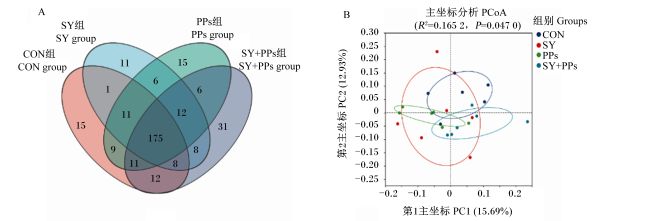
图1-A所示,CON组、SY组、PPs组和SY+PPs组分娩当天母猪粪便菌群分别独有15、11、15和31个ASV,4组共有175个ASV;如图1-B所示,主坐标分析(PCoA)结果表明,各组粪便菌群明显分离,具有显著差异(P<0.05)。由表9可知,PPs组和SY+PPs组粪便菌群Ace、Chao和Sobs指数与SY组相比显著提高(P<0.05),有高于CON组的趋势(P>0.05)。
图1 饲粮添加布拉迪酵母和植物多酚对母猪粪便菌群多样性的影响

Fig.1 Effects of dietary Saccharomyces cerevisiae boulardii and plant polyphenols on microbiota diversity in feces of sows (n=6)

A:韦恩图 Venn diagram;B:PCoA图 PCoA diagram。

表9 饲粮添加布拉迪酵母和植物多酚对母猪粪便菌群α多样性的影响

Table 9 Effects of dietary Saccharomyces cerevisiae boulardii and plant polyphenols on diversity of microbiota in feces of sows (n=6)

项目
Items
组别Groups 均值标准误
SEM
P
P-value
CON SY PPs SY+PPs
Ace指数Ace index 145.12ab 141.36b 156.75a 156.83a 6.106 0.037
Chao指数Chao index 144.33ab 140.94b 155.99a 156.21a 6.043 0.037
Sobs指数Sobs index 144.00ab 139.67b 155.33a 155.83a 5.941 0.028
Shannon指数Shannon index 2.89 2.97 3.15 3.15 0.228 0.574
Simpson指数Simpson index 0.12 0.12 0.09 0.11 0.030 0.797

同行数据肩标无字母或相同字母表示差异不显著(P>0.05),不同字母表示差异显著(P<0.05)。

In the same row, values with no letter or the same letter superscripts mean no significant difference (P>0.05), while with different letter superscripts mean significant difference (P<0.05).

2.7.2 饲粮添加布拉迪酵母和植物多酚对母猪粪便菌群组成的影响

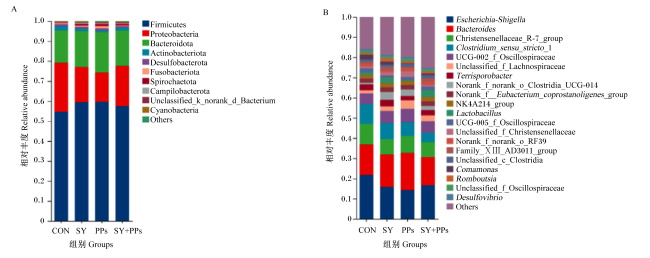
图2-A所示,母猪分娩当天粪便菌群在门水平上的优势菌门为厚壁菌门(Firmicutes)、变形菌门(Proteobacteria)、拟杆菌门(Bacteroidota)和放线菌门(Actinobacteriota);如图2-B所示,在属水平上的优势菌属为埃希氏-志贺氏菌属(Escherichia-Shigella)、拟杆菌属(Bacteroides)和克里斯滕森氏菌科R-7群(Christensenellaceae_R-7_group)等。
图2 饲粮添加布拉迪酵母和植物多酚对母猪粪便菌群在门水平(A)和属水平(B)上组成的影响

Firmicutes:厚壁菌门;Proteobacteria:变形菌门;Bacteroidota:拟杆菌门;Actinobacteriota:放线菌门;Desulfobacterota:脱硫杆菌门;Fusobacteriota:梭杆菌门;Spirochaetota:螺旋体门;Campilobacterota:弯曲杆菌门;Unclassified_k_norank_d_Bacterium:未分类细菌;Cyanobacteria:蓝藻菌门;Others:其他;Escherichia-Shigella:埃希氏-志贺氏菌属;Bacteroides:拟杆菌属;Christensenellaceae_R-7_group:克里斯滕森氏菌科R-7群;Clostridium_sensu_stricto_1:狭义梭菌属1;UCG-002_f_Oscillospiraceae:颤螺菌科UCG-002;Unclassified_f_Lachnospiraceae:未分类毛螺菌科;Terrisporobacter:土孢杆菌属;Norank_f_norank_o_Clostridia_UCG-014:未定级梭菌纲UCG-014;Norank_f_Eubacterium_coprostanoligenes_group:未定级产粪甾醇真细菌群;NK4A214_group:NK4A214群;Lactobacillus:乳杆菌属;UCG-005_f_Oscillospiraceae:颤螺菌科UCG-005;Unclassified_f_Christensenellaceae:未分类克里斯滕森氏菌科;Norank_f_norank_o_RF39:未定级RF39;Unclassified_c_Clostridia:未定级梭菌纲;Comamonas:丛毛单胞菌属;Romboutsia:罗姆布茨菌属;Unclassified_f_Oscillospiraceae:未分类颤螺菌科;Desulfovibrio:脱硫弧菌属。

Fig.2 Effects of dietary Saccharomyces cerevisiae boulardii and plant polyphenols on microbiota composition in feces of sows at phylum (A) and genus (B) levels (n=6)

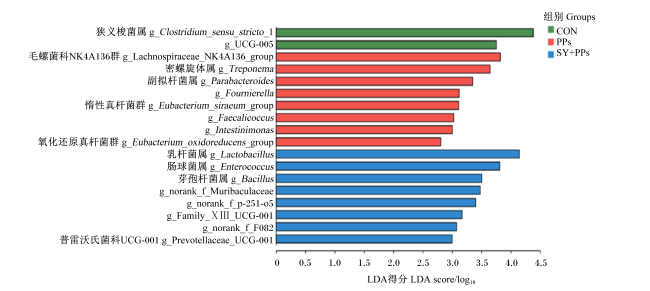
对母猪分娩当天粪便菌群进行线性判别分析(LDA)效应大小(LEfSe)分析,结果如图3所示,PPs组显著富集了毛螺菌科NK4A136群(Lachnospiraceae_NK4A136_group)、密螺旋体属(Treponema)、副拟杆菌属(Parabacteroides)、Fournierella和惰性真杆菌群(Eubacterium_siraeum_group)等;SY+PPs组显著富集了乳杆菌属(Lactobacillus)、肠球菌属(Enterococcus)和普雷沃氏菌科UCG-001(Prevotellaceae_UCG-001)等。
图3 LEfSe分析母猪粪便菌群在属水平上显著富集的微生物

Fig.3 Microorganisms significantly enriched in microbiota in feces of sows at genus level analyzed by LEfSe (n=6)

3 讨论

3.1 饲粮添加布拉迪酵母和植物多酚对母猪泌乳期采食量的影响

当前,二元母猪正面临着“带仔难”的问题,母猪泌乳期的采食量一定程度上决定了母猪的带仔能力[13];分娩应激(疼痛和情绪波动)会抑制母猪的食欲,导致采食量显著下降。快速恢复采食量是缓解分娩应激、维持母猪能量平衡以及支持泌乳的关键。
若泌乳期采食量下降,会导致母猪身体储备过分调动,泌乳失重升高,母猪的使用年限下降[14]。Sun等[15]研究发现,从妊娠后期到断奶,对96头母猪饲喂布拉迪酵母,可缩短分娩时间,减轻母猪的氧化应激损伤,提高采食量,并减少泌乳期的背膘损失。龙广[8]研究指出,饲粮添加布拉迪酵母极显著提高母猪泌乳期ADFI,并提高后代仔猪平均断奶重。本试验中,饲粮添加布拉迪酵母显著提高母猪泌乳期第1~7天ADFI,且布拉迪酵母与植物多酚对第1~7天ADFI有显著互作效应,SY+PPs组ADFI较CON组提高了15.46%,这与Sun等[15]和龙广[8]的结果一致,表明布拉迪酵母可以提高母猪采食量。布拉迪酵母可能通过改善肠道健康,减少分娩应激对消化功能的影响,并在联合添加植物多酚后更大程度地缓解了母猪的氧化损伤和炎症反应,提高了母猪围产期的采食量,从而更好地为提高母猪带仔能力做准备。

3.2 饲粮添加布拉迪酵母和植物多酚对母猪抗氧化能力的影响

抗氧化物酶活性可以反映机体代谢状态,自由基过度积累会导致机体发生氧化应激,并干扰细胞正常功能[16]。T-AOC是机体抗氧化物质和抗氧化酶抗氧化能力的总和,是评价抗氧化能力的综合指标;SOD和GSH-Px是生物体系中抗氧化酶系的重要组成部分,可以阻止ROS的产生[17-18];MDA是机体超氧自由基与膜脂质发生过氧化反应的产物,是机体氧化损伤的重要标志物,其含量越高,表明机体所受到的氧化应激反应越严重[19]。Meng等[20]研究表明,饲粮添加300 mg/d白藜芦醇显著降低母猪初乳MDA含量,提高初乳SOD活性。Fan等[21]研究发现,从配种到妊娠第40天,饲粮添加200 mg/kg儿茶素显著提高母猪分娩当天血浆SOD活性,显著降低血浆MDA含量。本试验结果与之一致,饲粮单独或联合添加布拉迪酵母和植物多酚可以不同程度地提高母猪分娩和断奶血浆SOD和GSH-Px活性以及T-AOC,并降低分娩血浆MDA含量,这可能与多酚独特的芳环结构有关,该结构含有多个羟基氢,是完美的氢原子和电子供体,可以中和自由基和活性氧,从而使其具有超强的抗氧化能力[12]

3.3 饲粮添加布拉迪酵母和植物多酚对母猪免疫功能的影响

母猪初乳中的蛋白质含量很大程度上决定了初生仔猪的生长潜力[22]。初乳中的营养物质是仔猪摄取能量、构建免疫屏障以及组建肠道菌群的重要来源[23]。Zhao等[24]研究发现,母猪饲粮添加白藜芦醇显著提高了初乳IgA、IgG和IgM含量,并提高了仔猪体重;Hong等[25]研究表明,母猪饲粮添加白藜芦醇通过提高母体初乳免疫球蛋白含量提高了哺乳仔猪肠道分泌型免疫球蛋白A(sIgA)含量;龙广[8]研究表明,饲粮添加布拉迪酵母可以提高仔猪的断奶重。本试验中,饲粮添加植物多酚显著提高了母猪初乳IgG和IgM含量,且联合添加布拉迪酵母和植物多酚不同程度上提高了初乳IgA、IgG和IgM含量,这与上述研究结果一致;不过,本试验中仔猪的断奶窝重未出现显著差异,这可能与添加剂的使用剂量、种类、植物多酚和布拉迪酵母的来源和提取工艺的不同以及试验条件等因素有关。
布拉迪酵母和植物多酚均具有免疫调节的特性[26-27]。IL-1β、IL-8和TNF-α是3种重要的促炎细胞因子,在调节细胞介导的免疫反应中发挥着重要作用[28-29],促炎因子含量过高,会损害肠道屏障功能。植物多酚可以抑制炎症因子的产生并提高免疫球蛋白含量以增强肠道免疫功能。植物多酚可分为黄酮类化合物和非黄酮类化合物。黄酮类化合物以槲皮素为例,不仅可以通过调节辅助性T细胞来抑制过敏性炎症反应,还可以抑制脂多糖诱导的巨噬细胞中TNF-α的产生;非黄酮类化合物以白藜芦醇为代表,通过激活沉默信息调节因子(Sirt)信号通路抑制炎症因子的产生[30],Hu等[31]研究表明,饲粮添加200 mg/kg白藜芦醇可以显著降低母猪血浆IL-1β和IL-6含量。与之一致的是,本研究结果发现,饲粮联合添加布拉迪酵母和植物多酚降低了母猪分娩当天血浆IL-1β和TNF-α含量,且SY+PPs组血浆IL-8含量比CON组降低了24.01%。由此可见,饲粮添加布拉迪酵母和植物多酚可能是通过降低母猪血浆促炎细胞因子含量和提高血浆免疫球蛋白含量,从而提高母猪机体免疫功能。

3.4 饲粮添加布拉迪酵母和植物多酚对母猪粪便短链脂肪酸含量的影响

短链脂肪酸是肠道微生物进行厌氧发酵的主要代谢产物,具有提供能量、维持肠道pH平衡以及抑制有害微生物生长等功能[24,27]。除此之外,短链脂肪酸还具有免疫调节的特性,有助于减轻机体炎症反应[26]。Hu等[32]研究表明,对葡聚糖硫酸钠(DSS)诱导的结肠炎小鼠进行饲喂酵母治疗后,其后肠道短链脂肪酸含量显著升高,组织损伤显著缓解。Wu等[33]研究发现,口服表没食子儿茶素-3-没食子酸酯可以显著提高结肠炎小鼠结肠中短链脂肪酸含量,减轻结肠炎症。与以上研究结果一致,本研究中,饲粮添加布拉迪酵母和植物多酚不同程度上提高了母猪粪便短链脂肪酸含量,结合初乳中免疫球蛋白含量提高的结果,表明布拉迪酵母和植物多酚可能通过提高肠道短链脂肪酸含量来调节机体免疫球蛋白含量,进而提高机体免疫功能。
此外,短链脂肪酸还是肠道菌群发挥广泛调控作用的重要物质基础,其中乙酸是主要调节脂质和碳水化合物代谢,丙酸具有抗菌和抗炎特性[34]。本研究中,试验组母猪粪便短链脂肪酸含量呈现不同程度的提高,这可能与肠道中有益菌毛螺菌科NK4A136群的富集有关。此外,本试验还发现,与CON组相比,SY+PPs组血浆IL-8和TNF-α含量明显降低,可能是该组肠道中较高含量的乙酸和丙酸通过介导G蛋白偶联受体途径抑制炎性细胞因子的分泌,从而调节肠道免疫。研究表明,丁酸可以通过降低肠道pH抑制有害菌增殖,增强肠道屏障功能,从而提高机体免疫能力,减少氧化应激和炎症反应[34]。本试验中,与CON组相比,SY+PPs组粪便丁酸含量提高了107.35%,表明联合添加布拉迪酵母和植物多酚可以通过调节粪便中乙酸、丙酸和丁酸等短链脂肪酸含量,来调节机体免疫功能。

3.5 饲粮添加布拉迪酵母和植物多酚对母猪粪便菌群的影响

肠道菌群是维持母猪肠道健康的“卫士”,具有免疫调节和抵抗病原体的作用[35],与宿主健康紧密相关[36],同时也是机体吸收营养物质的重要参与者[37]。研究表明,布拉迪酵母和植物多酚均能对肠道菌群产生积极影响[38-39]。α多样性指标是衡量群落内物种数量及丰富度的指标。Yu等[40]研究表明,白藜芦醇显著提高了结肠炎小鼠肠道菌群的Chao和Shannon指数,本研究结果与之一致,PPs组和SY+PPs组母猪粪便菌群Ace、Chao和Sobs指数与SY组相比显著提高,有高于CON组的趋势。
毛螺菌科NK4A136群主要产丁酸盐,与母猪肠道屏障功能有关[41]。He等[42]通过探究便秘型自闭症障碍儿童与正常发育儿童肠道菌群结构发现,正常组儿童粪便显著富集毛螺菌科NK4A136群。副拟杆菌属主要参与机体碳水化合物代谢和短链脂肪酸的合成,是炎症性肠病的重要标记物,是维持肠道稳态的一种有益菌[43]。Fu等[44]研究发现,副拟杆菌属可以通过产生乙酸、丙酸和丁酸等短链脂肪酸促进宿主机体健康。本试验中,PPs组母猪粪便显著富集了毛螺菌科NK4A136群和副拟杆菌属,故推测植物多酚可以通过增强肠道屏障功能,提高短链脂肪酸含量,从而维持肠道健康。这可能是由于植物多酚可通过提供底物或抗氧化功能支持有益菌的生长,并抑制有害菌的繁殖。
乳杆菌属是一种被广泛应用于各个领域的有益菌属。O’Callaghan等[45]研究发现,肠道中的乳杆菌属可以消化和代谢蛋白质和碳水化合物,分解代谢胆汁盐,增强机体先天性和获得性免疫力,抑制促炎介质产生,并对一系列病原体具有抗菌活性。Yu等[46]研究表明,普雷沃氏菌科UCG-001与TNF-α、干扰素-γ(IFN-γ)、C-X-C趋化因子受体4(CXCR4)表达呈正相关;Li等[47]研究发现,普雷沃氏菌科UCG-001相对丰度与IgA、IgG、IgM、白细胞介素-4(IL-4)、TNF-α和短链脂肪酸含量呈正相关,这表明肠道微生物和宿主免疫系统之间存在潜在的相互作用。本研究中,SY+PPs组母猪粪便显著富集了乳杆菌属和普雷沃氏菌科UCG-001等,结合初乳免疫球蛋白和血浆炎性细胞因子含量的结果,推测布拉迪酵母和植物多酚可能通过调节肠道菌群组成和代谢,降低炎症反应,提高肠道免疫功能。

4 结论

饲粮添加布拉迪酵母和植物多酚对母猪繁殖性能无显著影响,但可以增强机体抗氧化能力和免疫功能,同时改善粪便菌群结构,促进有益菌富集,提高粪便短链脂肪酸含量。
[1]
ROYALL R Q, COBLE K F, STEPHENS K R, et al. Effect of lactation feeder design on sow and litter performance,feeder cleaning criteria,and economic return[J]. Translational Animal Science, 2024,8:txae146.

[2]
ZHANG L, WANG L K, DAI Y M, et al. Effect of sow intestinal flora on the formation of endometritis[J]. Frontiers in Veterinary Science, 2021,8:663956.

[3]
LU D D, PI Y, YE H, et al. Consumption of dietary fiber with different physicochemical properties during late pregnancy alters the gut microbiota and relieves constipation in sow model[J]. Nutrients, 2022, 14(12):2511.

[4]
YANG X Z, HU R Z, SHI M K, et al. Placental malfunction,fetal survival and development caused by sow metabolic disorder:the impact of maternal oxidative stress[J]. Antioxidants, 2023, 12(2):360.

[5]
MAES D, PELTONIEMI O, MALIK M. Abortion and fetal death in sows[J]. Reproduction in Domestic Animals, 2023, 58(S2):125-136.

[6]
CHEN Z, YANG H, FU H, et al. Gut bacterial species in late trimester of pregnant sows influence the occurrence of stillborn piglet through pro-inflammation response[J]. Frontiers in immunology, 2023,13:1101130.

[7]
MA T, HUANG W Q, LI Y L, et al. Probiotics alleviate constipation and inflammation in late gestating and lactating sows[J]. NPJ Biofilms and Microbiomes, 2023, 9(1):70.

DOI PMID

[8]
龙广. 妊娠和泌乳饲粮中添加布拉迪酵母对母猪及仔猪性能的影响[D]. 硕士学位论文. 武汉: 华中农业大学, 2015.

LONG G. Effect of supplementation of diets with Saccharomyces boulardiduring pregnancy and lactation on sow and piglet performance[D]. Master’s Thesis. Wuhan: Huazhong Agricultural University, 2015. (in Chinese)

[9]
MILUTINOVIĆ M, DIMITRIJEVIĆ-BRANKOVIĆ S, RAJILIĆ-STOJANOVIĆ M. Plant extracts rich in polyphenols as potent modulators in the growth of probiotic and pathogenic intestinal microorganisms[J]. Frontiers in Nutrition, 2021,8:688843.

[10]
PITINO R, DE MARCHI M, MANUELIAN C L, et al. Plant feed additives as natural alternatives to the use of synthetic antioxidant vitamins on yield,quality, and oxidative status of poultry products:a review of the literature of the last 20 years[J]. Antioxidants, 2021, 10(5):757.

[11]
MESSAOUDENE M, PIDGEON R, RICHARD C, et al. A natural polyphenol exerts antitumor activity and circumvents anti-PD-1 resistance through effects on the gut microbiota[J]. Cancer Discovery, 2022, 12(4):1070-1087.

DOI PMID

[12]
CHEN J, HUANG Z Y, CAO X H, et al. Plant-derived polyphenols in sow nutrition:an update[J]. Animal Nutrition, 2022,12:96-107.

[13]
RODRÍGUEZ M, DÍAZ-AMOR G, MORALES J, et al. Feed intake patterns of modern genetics lactating sows:characterization and effect of the reproductive parameters[J]. Porcine Health Management, 2023, 9(1):6.

[14]
HAWE S J, SCOLLAN N, GORDON A, et al. Impact of sow lactation feed intake on the growth and suckling behavior of low and average birthweight pigs to 10 weeks of age[J]. Translational Animal Science, 2020, 4(2):txaa057.

[15]
SUN H Q, DE LAGUNA F B, WANG S, et al. Effect of Saccharomyces cerevisiae boulardii on sows’farrowing duration and reproductive performance,and weanling piglets’ performance and IgG concentration[J]. Journal of Animal Science and Technology, 2022, 64(1):10-22.

[16]
SIES H. Oxidative stress:a concept in redox biology and medicine[J]. Redox Biology, 2015,4:180-183.

[17]
SAMARGHANDIAN S, AZIMI-NEZHAD M, FARKHONDEH T, et al. Anti-oxidative effects of curcumin on immobilization-induced oxidative stress in rat brain,liver and kidney[J]. Biomedicine & Pharmacotherapy, 2017,87:223-229.

[18]
JUNIPER D T, KLIEM K E, LEE A, et al. The effect of stocking rate and supplementary selenium on the fatty acid composition and subsequent peroxidisability of poultry muscle tissues[J]. Animal, 2022, 16(3):100459.

[19]
ZHU L H, ZHAO K L, CHEN X L, et al. Impact of weaning and an antioxidant blend on intestinal barrier function and antioxidant status in pigs[J]. Journal of Animal Science, 2012, 90(8):2581-2589.

DOI PMID

[20]
MENG Q W, TAO G, LI G Q, et al. Dietary resveratrol improves antioxidant status of sows and piglets and regulates antioxidant gene expression in placenta by Keap1-Nrf2 pathway and SIRT1[J]. Journal of Animal Science and Biotechnology, 2018,9:34.

[21]
FAN Z Y, XIAO Y, CHEN Y H, et al. Effects of catechins on litter size,reproductive performance and antioxidative status in gestating sows[J]. Animal Nutrition, 2015, 1(4):271-275.

[22]
SANGILD P T, VONDEROHE C, MELENDEZ HEBIB V, et al. Potential benefits of bovine colostrum in pediatric nutrition and health[J]. Nutrients, 2021, 13(8):2551.

[23]
DECLERCK I, SARRAZIN S, DEWULF J, et al. Sow and piglet factors determining variation of colostrum intake between and within litters[J]. Animal, 2017, 11(8):1336-1343.

DOI PMID

[24]
ZHAO Y, HUANG Y J, GAO K G, et al. Maternal resveratrol regulates the growth performance,antioxidant capacity,and intestinal health of suckling piglets through intestinal microorganisms at high summer temperatures[J]. Frontiers in Nutrition, 2022,9:971496.

[25]
HONG C M, HUANG Y J, YANG G, et al. Maternal resveratrol improves the intestinal health and weight gain of suckling piglets during high summer temperatures:the involvement of exosome-derived microRNAs and immunoglobin in colostrum[J]. Animal Nutrition, 2024,17:36-48.

[26]
SHEN N, WANG T F, GAN Q, et al. Plant flavonoids:classification,distribution,biosynthesis,and antioxidant activity[J]. Food Chemistry, 2022,383:132531.

[27]
ASHRAF R, SHAH N P. Immune system stimulation by probiotic microorganisms[J]. Critical Reviews in Food Science and Nutrition, 2014, 54(7):938-956.

DOI PMID

[28]
HAN Y, ZHANG Y Y, PAN Y Q, et al. IL-1β-associated NNT acetylation orchestrates iron-sulfur cluster maintenance and cancer immunotherapy resistance[J]. Molecular Cell, 2023, 83(11):1887-1902,e8.

[29]
BERKE K, SUN P, ONG E, et al. VaximmutorDB:a web-based vaccine immune factor database and its application for understanding vaccine-induced immune mechanisms[J]. Frontiers in Immunology, 2021,12:639491.

[30]
SAQIB U, KELLEY T T, PANGULURI S K, et al. Polypharmacology or promiscuity?Structural interactions of resveratrol with its bandwagon of targets[J]. Frontiers in Pharmacology, 2018,9:1201.

[31]
HU R Z, TAN J J, LI Z F, et al. Effect of dietary resveratrol on placental function and reproductive performance of late pregnancy sows[J]. Frontiers in Nutrition, 2022,9:1001031.

[32]
HU Q J, YU L L, ZHAI Q X, et al. Anti-inflammatory,barrier maintenance,and gut microbiome modulation effects of Saccharomyces cerevisiae QHNLD8L1 on DSS-induced ulcerative colitis in mice[J]. International Journal of Molecular Sciences, 2023, 24(7):6721.

[33]
WU Z H, HUANG S M, LI T T, et al. Gut microbiota from green tea polyphenol-dosed mice improves intestinal epithelial homeostasis and ameliorates experimental colitis[J]. Microbiome, 2021, 9(1):184.

DOI PMID

[34]
DALILE B, VAN OUDENHOVE L, VERVLIET B, et al. The role of short-chain fatty acids in microbiota-gut-brain communication[J]. Nature Reviews Gastroenterology & Hepatology, 2019, 16(8):461-478.

[35]
JANDHYALA S M, TALUKDAR R, SUBRAMANYAM C, et al. Role of the normal gut microbiota[J]. World Journal of Gastroenterology, 2015, 21(29):8787-8803.

DOI PMID

[36]
HE J, XIE H M, CHEN D W, et al. Synergetic responses of intestinal microbiota and epithelium to dietary inulin supplementation in pigs[J]. European Journal of Nutrition, 2021, 60(2):715-727.

[37]
DE VOS W M, TILG H, VAN HUL M, et al. Gut microbiome and health: mechanistic insights[J]. Gut, 2022, 71(5):1020-1032.

DOI PMID

[38]
WAN M L Y, CO V A, EL-NEZAMI H. Dietary polyphenol impact on gut health and microbiota[J]. Critical Reviews in Food Science and Nutrition, 2021, 61(4):690-711.

[39]
BUSTOS FERNÁNDEZ L M, MAN F, LASA J S. Impact of Saccharomyces boulardii CNCM I-745 on bacterial overgrowth and composition of intestinal microbiota in diarrhea-predominant irritable bowel syndrome patients:results of a randomized pilot study[J]. Digestive Diseases, 2023, 41(5):798-809.

[40]
YU B, WANG Y, TAN Z K, et al. Resveratrol ameliorates DSS-induced ulcerative colitis by acting on mouse gut microbiota[J]. Inflammopharmacology, 2024, 32(3):2023-2033.

DOI PMID

[41]
MA L Y, NI Y H, WANG Z, et al. Spermidine improves gut barrier integrity and gut microbiota function in diet-induced obese mice[J]. Gut Microbes, 2020, 12(1):1-19.

[42]
HE J A, GONG X H, HU B, et al. Altered gut microbiota and short-chain fatty acids in Chinese children with constipated autism spectrum disorder[J]. Scientific Reports, 2023, 13(1):19103.

[43]
CUI Y L, ZHANG L S, WANG X, et al. Roles of intestinal Parabacteroides in human health and diseases[J]. FEMS Microbiology Letters, 2022, 369(1):fnac072.

[44]
FU X D, LIU Z M, ZHU C L, et al. Nondigestible carbohydrates,butyrate,and butyrate-producing bacteria[J]. Critical Reviews in Food Science and Nutrition, 2019, 59(Suppl.1):S130-S152.

[45]
O’CALLAGHAN J, O’TOOLE P W. Lactobacillus:host-microbe relationships.current topics microbiology and immunology[J]. Current Topics in Microbiology and Immunology, 2013,358:119-154.

[46]
YU H, LI X X, HAN X, et al. Fecal microbiota transplantation inhibits colorectal cancer progression:reversing intestinal microbial dysbiosis to enhance anti-cancer immune responses[J]. Frontiers in Microbiology, 2023,14:1126808.

[47]
LI W, LIU Y C, ZHENG X M, et al. Rewiring tryptophan metabolism via programmable probiotic integrated by dual-layered microcapsule protects against inflammatory bowel disease in mice[J]. ACS Nano, 2024, 18(52):35443-35464.

文章导航

/