研究论文

纳米硒对陕北白绒山羊生长性能、血清指标、瘤胃发酵参数和菌群结构的影响

  • 苏红萍 , 1 ,
  • 沈娜 1 ,
  • 丁常根 1 ,
  • 王涛 1 ,
  • 麻文静 1 ,
  • 刘燕泽 1 ,
  • 刘健鹏 2 ,
  • 李陇平 , 1, 3, * ,
  • 冯平 , 1, *
展开
  • 1 榆林学院现代农学院,榆林 719000
  • 2 榆林市农产品质量安全中心,榆林 719000
  • 3 榆林学院陕西省陕北绒山羊工程技术研究中心,榆林 719000
* 李陇平,副教授,硕士生导师,E-mail: ;
冯 平,教授,硕士生导师,E-mail:

苏红萍(2000—),女,山东淄博人,硕士研究生,研究方向为动物营养与饲料科学。E-mail:

Office editor: 靳爽

收稿日期: 2025-03-12

  网络出版日期: 2025-09-12

基金资助

榆林市科技局产学研项目(2023-CXY-174)

榆林市科技局产学研项目(2023-CXY-163)

榆林市产学研科技项目(CXY-2021-87)

陕西省科技厅一般项目-农业领域(S2023-YF-YBNY-0080)

Effects of Selenium Nanoparticles on Growth Performance, Serum Indexes, Rumen Fermentation Parameters and Microflora Structure of Shaanbei White Cashmere Goats

  • SU Hongping , 1 ,
  • SHEN Na 1 ,
  • DING Changgen 1 ,
  • WANG Tao 1 ,
  • MA Wenjing 1 ,
  • LIU Yanze 1 ,
  • LIU Jianpeng 2 ,
  • LI Longping , 1, 3, * ,
  • FENG Ping , 1, *
Expand
  • 1 College of Advanced Agricultural Sciences, Yulin University, Yulin 719000, China
  • 2 Yulin Agricultural Products Quality and Safety Center, Yulin 719000, China
  • 3 Shaanxi Province Engineering & Technology Research Center of Cashmere Goat, Yulin University, Yulin 719000, China
* LI Longping, associate professor, E-mail: ;
FENG Ping, professor, E-mail:

Received date: 2025-03-12

  Online published: 2025-09-12

摘要

本试验旨在探究纳米硒(SeNPs)对陕北白绒山羊生长性能、血清指标、瘤胃发酵参数和菌群结构的影响。采用单因素随机分组设计,选取56只体重[(22.0±1.5) kg]相近的5月龄陕北白绒山羊公羔,随机分为4组,每组14只。4组试验羊分别饲喂在基础饲粮中添加0、0.09、0.18和0.27 mg/kg SeNPs(以硒计)的饲粮,饲粮实际硒含量分别为0.074(Ⅰ组)、0.164(Ⅱ组)、0.254(Ⅲ组)和0.344 mg/kg(Ⅳ组),开展为期75 d的饲养试验,其中预试期15 d,正试期60 d。结果表明:1)与Ⅰ组相比,Ⅲ组平均日增重(ADG)显著提高(P<0.05),Ⅱ组、Ⅲ组和Ⅳ组平均日采食量(ADFI)显著提高(P<0.05)。Ⅲ组料重比(F/G)显著低于其他3组(P<0.05)。2)与Ⅰ组相比,Ⅲ组和Ⅳ组血清葡萄糖(GLU)含量极显著提高(P<0.01),血清尿素氮(UN)含量极显著降低(P<0.01);Ⅱ组、Ⅲ组和Ⅳ组血清超氧化物歧化酶(SOD)活性极显著提高(P<0.01),血清谷胱甘肽过氧化物酶(GSH-Px)和过氧化氢酶(CAT)活性显著提高(P<0.05);Ⅲ组血清丙二醛(MDA)含量显著降低(P<0.05)。3)与Ⅰ组相比,Ⅲ组瘤胃液氨态氮(NH3-N)和微生物蛋白(MCP)浓度显著提高(P<0.05)。Ⅲ组瘤胃液乙酸、丙酸、丁酸和总挥发性脂肪酸浓度为4组中最高,其中,瘤胃液乙酸和总挥发性脂肪酸浓度显著高于Ⅰ组和Ⅳ组(P<0.05),丙酸浓度显著高于Ⅳ组(P<0.05),丁酸浓度显著高于其他3组(P<0.05)。4)与Ⅰ组相比,Ⅲ组瘤胃微生物Chao1指数显著提高(P<0.05)。在门水平上,Ⅳ组瘤胃拟杆菌门(Bacteroidota)的相对丰度显著低于其他3组(P<0.05),厚壁菌门(Firmicutes)的相对丰度显著高于Ⅱ组(P<0.05);在属水平上,Ⅲ组瘤胃普雷沃氏菌属(Prevotella)的相对丰度极显著高于Ⅰ组和Ⅳ组(P<0.01),Ⅱ组和Ⅳ组瘤胃奎因氏菌属(Quinella)的相对丰度极显著低于Ⅰ组(P<0.01)。综上可知,饲粮中添加适量SeNPs可提高陕北白绒山羊的ADG和ADFI,降低F/G,改善血清生化指标及抗氧化能力,同时还能调节瘤胃菌群结构,促进瘤胃发酵。综合来看,以SeNPs作为硒源的最适硒添加量为0.18 mg/kg。

本文引用格式

苏红萍 , 沈娜 , 丁常根 , 王涛 , 麻文静 , 刘燕泽 , 刘健鹏 , 李陇平 , 冯平 . 纳米硒对陕北白绒山羊生长性能、血清指标、瘤胃发酵参数和菌群结构的影响[J]. 动物营养学报, 2025 , 37(9) : 6072 -6083 . DOI: 10.12418/CJAN2025.494

Abstract

This experiment was conducted to investigate the effects of selenium nanoparticles (SeNPs) on growth performance, serum indexes, rumen fermentation parameters and microflora structure of Shaanbei white cashmere goats. A single-factor randomized grouping design was adopted, and fifty-six 5-month-old Shaanbei white cashmere male lambs with similar body weight [(22.0±1.5) kg] were selected and randomly divided into 4 groups with 14 lambs in each group. Lambs in the 4 groups were fed diets supplemented with 0, 0.09, 0.18 and 0.27 mg/kg SeNPs (calculated as selenium) in the basal diet, and the actual selenium contents in the diets were 0.074 (group Ⅰ), 0.164 (group Ⅱ), 0.254 (group Ⅲ) and 0.344 mg/kg (group Ⅳ), respectively. The feeding experiment lasted for 75 days, with a 15-day pre-test period and a 60-day formal test period. The results showed as follows: 1) compared with group Ⅰ, the average daily gain (ADG) in group Ⅲ was significantly increased (P<0.05), and the average daily feed intake (ADFI) in groups Ⅱ, Ⅲ and Ⅳ was significantly increased (P<0.05). The feed-to-gain ratio (F/G) in group Ⅲ was significantly lower than that in the other 3 groups (P<0.05). 2) Compared with group Ⅰ, the serum glucose (GLU) content in groups Ⅲ and Ⅳ was extremely significantly increased (P<0.01), and the serum urea nitrogen (UN) content was extremely significantly decreased (P<0.01); the serum superoxide dismutase (SOD) activity in groups Ⅱ, Ⅲ and Ⅳ was extremely significantly increased (P<0.01), and the serum glutathione peroxidase (GSH-Px) and catalase (CAT) activities were significantly increased (P<0.05); the serum malondialdehyde (MDA) content in group Ⅲ was significantly decreased (P<0.05). 3) Compared with group Ⅰ, the concentrations of ammonia nitrogen (NH3-N) and microbial protein (MCP) in rumen fluid in group Ⅲ were significantly increased (P<0.05). The concentrations of acetic acid, propionic acid, butyric acid and total volatile fatty acids in rumen fluid in group Ⅲ were the highest among the 4 groups. Among them, the concentrations of acetic acid and total volatile fatty acids in rumen fluid in group Ⅲ were significantly higher than those in groups Ⅰ and Ⅳ (P<0.05), the propionic acid concentration was significantly higher than that in group Ⅳ (P<0.05), and the butyric acid concentration was significantly higher than that in the other 3 groups (P<0.05). 4) Compared with group Ⅰ, the rumen microbial Chao1 index in group Ⅲ was significantly increased (P<0.05). At the phylum level, the relative abundance of Bacteroidota in rumen in group Ⅳ was significantly lower than that in the other 3 groups (P<0.05), and the relative abundance of Firmicutes was significantly higher than that in group Ⅱ (P<0.05); at the genus level, the relative abundance of Prevotella in rumen in group Ⅲ was extremely significantly higher than that in groups Ⅰ and Ⅳ (P<0.01), and the relative abundance of Quinella in rumen in groups Ⅱ and Ⅳ was extremely significantly lower than that in group Ⅰ (P<0.01). In conclusion, dietary supplementation with appropriate amount of SeNPs can increase the ADG and ADFI, decrease the F/G, and improve the serum biochemical indexes and antioxidant capacity of Shaanbei white cashmere goats; it can also regulate rumen microflora structure and promote rumen fermentation. Based on comprehensive analysis, the optimal selenium supplementation level using SeNPs as the selenium source is 0.18 mg/kg.

硒(Se)作为人类和动物所必需的微量元素,对维持机体健康及微生态平衡具有重要作用。19世纪早期,瑞典化学家Berzelius在硫酸厂铅室底部的红色废泥中发现了硒,起初它被认为是一种天然有害物质[1];1957年,德国科学家Schwarz和Foltz发现硒可预防小鼠肝脏病变[2];1973年,世界卫生组织宣布硒是人类及动植物不可或缺的微量元素。此后,硒的重要性得到全球认可,越来越多的科学家证实其在抗氧化、抗肿瘤、甲状腺激素代谢、蛋白质折叠及免疫力提升等方面发挥关键作用。纳米硒(selenium nanoparticles,SeNPs)作为一种新型硒添加剂,是目前发现的毒性最低且生物利用率最高的硒添加剂[3]。研究表明,SeNPs能够提高畜禽的抗氧化能力与免疫力,改善生长性能,提升饲料转化率并优化肉品质[4-6]。因此,本试验旨在探究SeNPs对陕北白绒山羊生长性能、血清指标、瘤胃发酵参数和菌群结构的影响,以期为SeNPs在陕北白绒山羊生产实践中的应用提供理论依据。

1 材料与方法

1.1 试验材料

SeNPs购自山西某肥业有限公司,粒径≤40 nm,其中硒含量为45 mg/kg。

1.2 试验设计与饲养管理

本试验于2023年10—12月在陕西省榆林市瑞兴农牧科技有限公司开展,所有动物试验程序均得到榆林学院实验动物福利与伦理委员会的批准,批准编号:No.YLU2023023。
采用单因素随机分组设计,选取56只体重[(22.0±1.5) kg]相近的5月龄陕北白绒山羊公羔,随机分为4组,每组14只羊,按组混群饲养。4组试验羊分别饲喂在基础饲粮中添加0、0.09、0.18和0.27 mg/kg SeNPs(以硒计)的饲粮,饲粮实际硒含量分别为0.074(Ⅰ组)、0.164(Ⅱ组)、0.254(Ⅲ组)和0.344 mg/kg(Ⅳ组),开展为期75 d的饲养试验,其中预试期15 d,正试期60 d。基础饲粮参照《肉羊营养需要量》(NY/T 816—2021)[7]并结合生产实际进行配制,加工成颗粒料形式,其组成及营养水平见表1。试验羊舍选择在向阳、干燥、通风的地方。试验期间,羊只自由采食和饮水,按照正常免疫程序进行免疫接种。
表1 基础饲粮组成及营养水平(风干基础)

Table 1 Composition and nutrient levels of the basal diet (air-dry basis) %

项目Items 含量Content
原料Ingredients
玉米秸秆Corn straw 5.00
花生秧Peanut vines 25.00
玉米Corn 43.50
红枣Jujube 10.00
麸皮Wheat bran 2.50
豆粕Soybean meal 9.80
小苏打NaHCO3 1.20
预混料Premix1) 3.00
合计Total 100.00
营养水平Nutrient levels2)
代谢能ME/(MJ/kg) 10.21
粗蛋白质CP 12.45
粗脂肪EE 1.80
粗灰分Ash 8.02
中性洗涤纤维NDF 31.29
酸性洗涤纤维ADF 22.30
钙Ca 1.14
总磷TP 0.15
硒Se/(mg/kg) 0.074

1)预混料为每千克饲粮提供 The premix provided the following per kg of the diet:VA 40 000 IU,VD3 20 000 IU,VE 250 IU,Cu 200 mg,Fe 600 mg,Mn 400 mg,Zn 800 mg,Ca 2 400 mg,P 300 mg。

2)代谢能为根据《肉羊营养需要量》(NY/T 816—2021)[7]所得计算值,其余为实测值。ME was a calculated value according to Nutrient Requirements of Meat-Type Sheep and Goat (NY/T 816—2021)[7], while the others were measured values.

1.3 样品采集与指标测定

1.3.1 饲粮营养物质含量

饲粮中粗灰分(Ash)、粗蛋白质(CP)、粗脂肪(EE)、中性洗涤纤维(NDF)、酸性洗涤纤维(ADF)、钙(Ca)、总磷(TP)和硒的含量分别参照GB/T 6438—2007、GB/T 6432—2018、GB/T 6433—2006、GB/T 20806—2022、NY/T 1459—2007、GB/T 6436—2018、GB/T 6437—2018和GB/T 13883—2023的方法进行测定。

1.3.2 生长性能

在正试期第1天和第60天,对所有试验羊进行空腹称重,记为初始体重(IBW)和终末体重(FBW),每天记录各组的投料量和剩料量,并计算平均日增重(ADG)、平均日采食量(ADFI)和料重比(F/G),计算公式如下:
ADFI=(每组总投料量-每组总剩料量)/(试验天数×每组试验羊只数);
ADG=(FBW-IBW)/试验天数;
F/G=ADFI/ADG。

1.3.3 血清生化及抗氧化指标

在正试期第60天晨饲前,使用10 mL一次性真空采血器对所有试验羊进行颈静脉采血,以1 370×g的离心力离心15 min后,将血清转移至2 mL离心管中,置于-20 ℃保存待测。
血清总蛋白(TP)、球蛋白(GLB)、白蛋白(ALB)、葡萄糖(GLU)、尿素氮(UN)、甘油三酯(TG)、肌酐(CRE)含量及谷草转氨酶(AST)、谷丙转氨酶(ALT)活性采用全自动血液生化仪(PE-6800,深圳市普康电子有限公司)进行测定。
血清超氧化物歧化酶(SOD)、过氧化氢酶(CAT)、谷胱甘肽过氧化物酶(GSH-Px)活性及丙二醛(MDA)含量、总抗氧化能力(T-AOC)采用上海酶联生物科技有限公司生产的试剂盒进行测定。

1.3.4 瘤胃发酵参数

饲养试验结束后,从每组中随机选取3只羊进行屠宰并采集瘤胃液。采集的瘤胃液经4层无菌纱布过滤后,转移至标记好的50 mL无菌管中,立即使用Staidson(SG2)手持式pH计(METTLER TOLEDO,瑞士)测定其pH,随后置于-80 ℃冰箱中保存待测。
瘤胃液氨态氮(NH3-N)浓度采用苯酚-次氯酸钠比色法,使用722型分光光度计(上海美谱达仪器有限公司)测定;挥发性脂肪酸(VFA)浓度由北京奥维森基因科技有限公司参照Erwin等[8]的气相色谱法,采用TP-2070型气相色谱仪(北京北分天普仪器技术有限公司)测定;微生物蛋白(MCP)浓度使用南京建成生物工程研究所生产的试剂盒(货号:A045-2-2)测定。

1.3.5 瘤胃菌群结构

屠宰后,取试验羊瘤胃内容物放入2 mL冻存管中,并立即置于液氮中速冻保存,随后运回实验室并存放于-80 ℃冰箱中。采用二代高通量测序技术测定瘤胃微生物区系,相关16S rDNA基因的高通量测序分析工作委托北京奥维森基因科技有限公司完成。具体流程为:以瘤胃微生物的总DNA为模板,使用通用引物338F(5'-ACTCCTACGGGAGGCAGCAG-3')和806R(5'-GGACTACHVGGGTWTCTAAT-3')对细菌16S rDNA基因的V3~V4区域进行扩增;扩增完成后,利用Illumina NovaSeq 6000测序平台进行微生物多样性检测,分析微生物群落在门和属水平上的组成及相对丰度。

1.4 数据统计分析

试验数据经Excel 2010初步整理后,采用SPSS 27.0软件进行单因素方差分析(one-way ANOVA),并采用Duncan氏法进行多重比较。试验结果数据以“平均值±标准误”的形式表示,P<0.05表示差异显著,P<0.01表示差异极显著。

2 结果与分析

2.1 SeNPs对陕北白绒山羊生长性能的影响

表2可知,4组间试验羊的IBW和FBW均无显著差异(P>0.05)。与Ⅰ组相比,Ⅲ组的ADG显著提高(P<0.05);Ⅱ组、Ⅲ组和Ⅳ组的ADFI显著提高(P<0.05)。Ⅲ组的F/G显著低于其他3组(P<0.05)。
表2 SeNPs对陕北白绒山羊生长性能的影响

Table 2 Effects of SeNPs on growth performance of Shaanbei white cashmere goats

项目
Items
组别Groups P
P-value
初始体重IBW/kg 21.63±0.32 22.26±0.34 22.32±0.33 21.97±0.28 0.127
终末体重FBW/kg 28.55±0.62 29.35±0.84 30.73±0.60 29.32±0.64 0.296
平均日增重ADG/(g/d) 118.49±4.96b 127.72±8.77ab 140.60±4.62a 120.79±4.98ab 0.022
平均日采食量ADFI/(g/d) 822.12±16.79b 929.45±15.14a 896.86±17.84a 930.17±17.16a 0.020
料重比F/G 6.93±0.13a 7.25±0.11a 6.43±0.23b 7.46±0.26a 0.032

同行数据肩标无字母或相同小写字母表示差异不显著(P>0.05),不同小写字母表示差异显著(P<0.05),不同大写字母表示差异极显著(P<0.01)。下表同。

In the same row, values with no letter or the same small letter superscripts mean no significant difference (P>0.05), while with different small letter superscripts mean significant difference (P<0.05), and with different capital letter superscripts mean extremely significant difference (P<0.01). The same as below.

2.2 SeNPs对陕北白绒山羊血清生化和抗氧化指标的影响

表3可知,Ⅰ组和Ⅲ组血清GLB含量极显著高于Ⅳ组(P<0.01);Ⅲ组血清TP含量显著高于Ⅳ组(P<0.05);Ⅲ组和Ⅳ组血清GLU含量极显著高于Ⅰ组(P<0.01),血清UN含量极显著低于Ⅰ组(P<0.01)。与Ⅰ组相比,Ⅱ组、Ⅲ组和Ⅳ组血清SOD活性极显著提高(P<0.01),血清GSH-Px、CAT活性显著提高(P<0.05);Ⅲ组血清MDA含量显著降低(P<0.05)。
表3 SeNPs对陕北白绒山羊血清生化和抗氧化指标的影响

Table 3 Effects of SeNPs on serum biochemical and antioxidant indexes of Shaanbei white cashmere goats

项目
Items
组别Groups P
P-value
血清生化指标Serum biochemical indexes
白蛋白ALB/(g/L) 32.13±2.01 31.57±1.69 31.93±1.66 31.80±2.33 0.965
球蛋白GLB/(g/L) 39.47±4.65Aa 39.10±6.53ABab 40.13±2.15Aa 33.33±1.63Bb <0.001
总蛋白TP/(g/L) 71.60±6.41ab 70.67±6.51ab 72.20±1.09a 65.13±3.81b 0.019
葡萄糖GLU/(mmol/L) 3.99±0.31Bb 4.85±0.17ABab 6.82±3.54Aa 6.63±2.05Aa 0.001
肌酐CRE/(μmol/L) 47.33±14.49 57.67±3.72 57.00±10.32 54.33±2.25 0.251
尿素氮UN/(mmol/L) 5.46±0.41Aa 4.90±1.60ABab 4.36±0.64Cc 4.58±0.36Bb 0.007
甘油三酯TG/(mmol/L) 0.60±0.10 0.63±0.42 0.70±0.21 0.73±0.21 0.515
谷丙转氨酶ALT/(U/L) 20.67±4.29 19.33±2.14 18.50±2.67 19.27±3.49 0.176
谷草转氨酶AST/(U/L) 74.00±9.19 76.67±4.89 74.50±0.84 72.00±1.79 0.069
血清抗氧化指标Serum antioxidant indexes
总抗氧化能力
T-AOC/(μmol/mL)
1.00±0.41 1.02±0.70 1.05±0.20 1.06±0.46 0.118
超氧化物歧化酶
SOD/(U/mL)
81.05±11.46Cc 108.64±24.38Bb 140.63±27.41Aa 125.38±27.53ABab <0.001
谷胱甘肽过氧化物酶
GSH-Px/(U/mL)
119.30±18.99b 131.11±11.12a 139.25±26.33a 131.19±22.45a 0.033
过氧化氢酶CAT/(U/mL) 117.96±14.41b 123.73±19.77a 130.87±30.66a 133.24±30.31a 0.012
丙二醛MDA/(nmol/mL) 5.32±0.67a 4.64±1.31a 4.36±1.20b 4.63±1.12a 0.044

2.3 SeNPs对陕北白绒山羊瘤胃发酵参数的影响

表4可知,4组间试验羊的瘤胃液pH无显著差异(P>0.05)。与Ⅰ组相比,Ⅲ组和Ⅳ组瘤胃液NH3-N浓度显著提高(P<0.05);Ⅱ组和Ⅲ组瘤胃液MCP浓度显著提高(P<0.05)。Ⅲ组瘤胃液乙酸、丙酸、丁酸和总挥发性脂肪酸浓度为4组中最高,其中,瘤胃液乙酸和总挥发性脂肪酸浓度显著高于Ⅰ组和Ⅳ组(P<0.05),丙酸浓度显著高于Ⅳ组(P<0.05),丁酸浓度显著高于其他3组(P<0.05)。Ⅳ组瘤胃液乙酸/丙酸极显著高于其他3组(P<0.01)。
表4 SeNPs对陕北白绒山羊瘤胃发酵参数的影响

Table 4 Effects of SeNPs on rumen fermentation parameters of Shaanbei white cashmere goats

项目
Items
组别Groups P
P-value
pH 7.23±0.02 6.90±0.15 7.09±0.25 7.12±0.05 0.132
氨态氮NH3-N/(mg/dL) 11.45±0.61c 12.55±0.39bc 14.33±0.21a 14.08±0.63ab 0.011
微生物蛋白MCP/(g/L) 1.52±0.14b 2.59±0.06a 2.76±0.62a 2.23±0.44ab 0.018
乙酸Acetic acid/(mmol/L) 43.86±5.49b 49.73±6.07ab 67.67±6.39a 45.64±3.30b 0.019
丙酸Propionic acid/(mmol/L) 21.65±2.04ab 27.98±3.28ab 28.98±1.10a 19.84±1.08b 0.018
乙酸/丙酸
Acetic acid/propionic acid
1.96±0.04Bb 1.82±0.04Bb 1.83±0.01Bb 2.31±0.11Aa <0.001
丁酸Butyric acid/(mmol/L) 12.87±1.82b 12.70±1.12b 17.25±0.95a 13.55±0.83b 0.041
异丁酸Isobutyric acid/(mmol/L) 0.88±0.11 0.80±0.74 1.00±0.13 0.89±0.59 0.593
戊酸Valeric acid/(mmol/L) 0.65±0.06 0.74±0.05 0.98±0.17 0.60±0.05 0.088
异戊酸Isovaleric acid/(mmol/L) 1.10±0.02 0.89±0.16 1.20±0.33 0.75±0.17 0.498
总挥发性脂肪酸
TVFA/(mmol/L)
81.01±8.46b 92.84±9.71ab 117.08±4.14a 81.27±4.37b 0.027

2.4 SeNPs对陕北白绒山羊瘤胃菌群结构的影响

2.4.1 Venn图分析
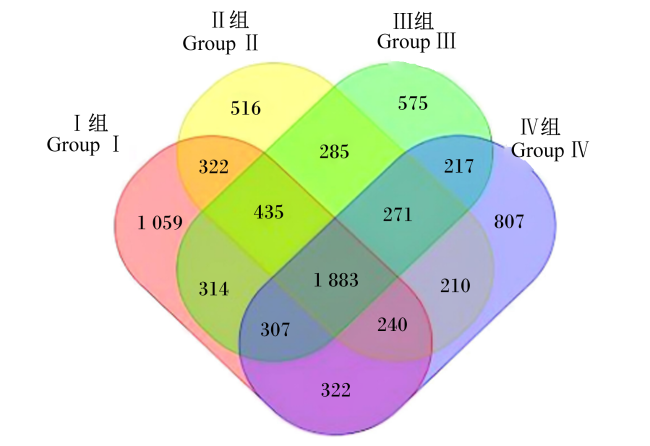
图1可知,4组试验羊瘤胃液中共检测到7 763个操作分类单元(OTU),4组共有的OTU为1 883个,占总数的24.26%。Ⅰ组特有1 059个OTU,Ⅱ组特有516个OTU,Ⅲ组特有575个OTU,Ⅳ组特有807个OTU,分别占总数的13.64%、6.65%、7.40%和10.39%,表明饲粮中添加SeNPs影响了试验羊的瘤胃菌群结构。
图1 Venn图

Fig.1 Venn diagram

2.4.2 稀释曲线

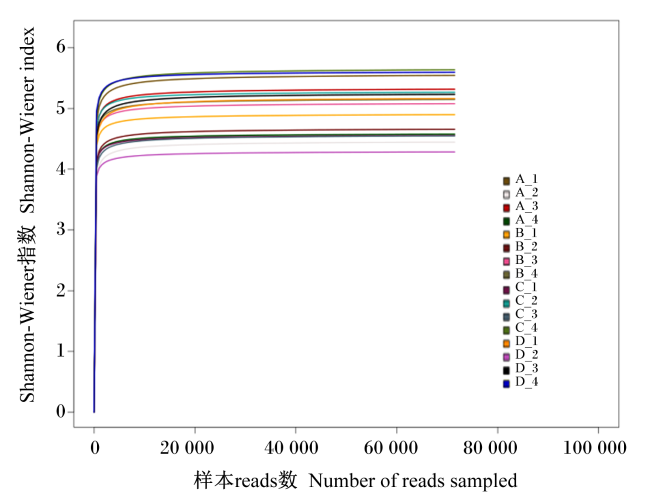
图2可知,基于Shannon-Wiener指数的稀释曲线斜率逐渐减小并趋于平缓。这表明样品的测序数据量已足够充分,测序深度基本覆盖所有菌群,说明本研究的测序结果能够有效表征瘤胃液样品中的细菌组成,可用于后续分析。
图2 稀释曲线

A_1、A_2、A_3、A_4代表Ⅰ组的4个样本;B_1、B_2、B_3、B_4代表Ⅱ组的4个样本;C_1、C_2、C_3、C_4代表Ⅲ组的4个样本;D_1、D_2、D_3、D_4代表Ⅳ组的4个样本。

Fig.2 Dilution curve

A_1, A_2, A_3 and A_4 represented 4 samples from group Ⅰ; B_1, B_2, B_3 and B_4 represented 4 samples from group Ⅱ; C_1, C_2, C_3 and C_4 represented 4 samples from group Ⅲ; and D_1, D_2, D_3 and D_4 represented 4 samples from group Ⅳ.

2.4.3 α多样性分析

表5可知,各组的覆盖率均在98%以上,表明各组样品的测序量与测序深度合理,能够反映瘤胃菌群的组成。与Ⅰ组相比,Ⅲ组瘤胃微生物Chao1指数显著提高(P<0.05)。4组间瘤胃微生物Simpson和Shannon指数均无显著差异(P>0.05)。
表5 SeNPs对陕北白绒山羊瘤胃菌群α多样性的影响

Table 5 Effects of SeNPs on α diversity of rumen microflora of Shaanbei white cashmere goats

项目
Items
组别Groups P
P-value
Chao1指数Chao1 index 2 033.80±368.92b 2 039.95±344.40b 2 143.43±446.06a 2 125.23±511.86a 0.037
Shannon指数Shannon index 6.76±0.20 6.73±0.15 6.80±0.08 6.90±0.11 0.275
Simpson指数Simpson index 0.96±0.02 0.97±0.08 0.97±0.02 0.97±0.01 0.658
覆盖度Coverage 0.98±0.02 0.98±0.01 0.98±0.02 0.98±0.02 0.707

2.4.4 β多样性分析

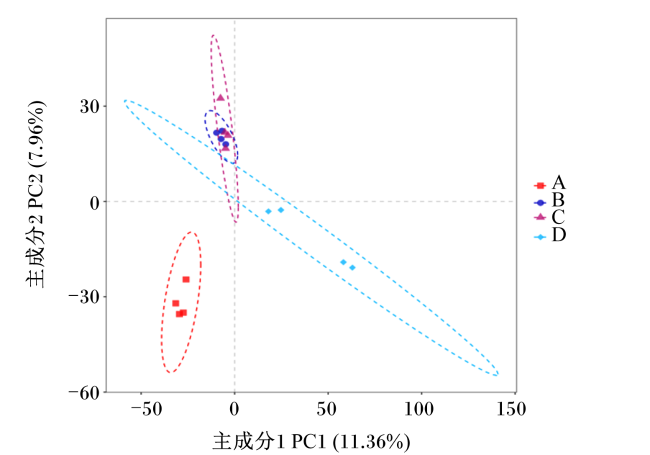
图3可知,Ⅱ组与Ⅲ组样本点聚集距离较近,说明饲粮中添加0.09和0.18 mg/kg SeNPs时瘤胃菌群的构成差异较小;而Ⅰ组样本点与其他3组的距离相对分散,说明饲粮中添加SeNPs会对瘤胃菌群结构产生影响。
图3 主成分分析

Fig.3 Principal component analysis

A、B、C、D分别表示Ⅰ组、Ⅱ组、Ⅲ组、Ⅳ组。A, B, C and D represented group Ⅰ, group Ⅱ, group Ⅲ and group Ⅳ, respectively.

2.4.5 菌群组成分析

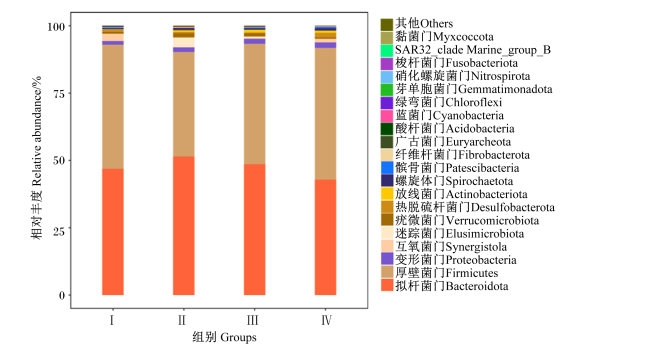
图4可知,4组瘤胃菌群中拟杆菌门(Bacteroidota)和厚壁菌门(Firmicutes)为优势菌门,这2类菌门相对丰度的平均值分别为47.53%和4.58%;次级优势菌门主要包括变形菌门(Proteobacteria)、互氧菌门(Synergistota)和迷踪菌门(Elusimicrobiota),其相对丰度的平均值分别为1.74%、1.11%和1.05%;其余菌门的相对丰度均小于1.00%。
图4 陕北白绒山羊瘤胃菌群门水平相对丰度的柱形图

Fig.4 Histogram of relative abundance of rumen microflora at phylum level of Shaanbei white cashmere goats

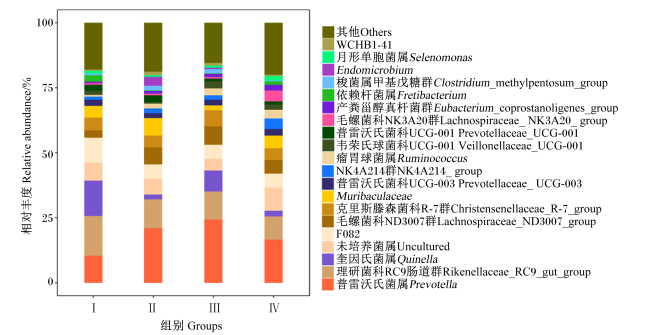
图5可知,在属水平上,本研究中相对丰度大于1.00%的菌属共有18类,主要有普雷沃氏菌属(Prevotella)、理研菌科RC9肠道群(Rikenellaceae_RC9_gut_group)、奎因氏菌属(Quinella)、未培养菌属(Uncultured)、F082、毛螺菌科ND3007群(Lachnospiraceae_ND3007_group)、克里斯滕森菌科R-7群(Christensenellaceae_R-7_group)、Muribaculaceae、普雷沃氏菌科UCG-003(Prevotellaceae_UCG-003)、NK4A214群(NK4A214_group)、瘤胃球菌属(Ruminococcus)、韦荣氏球菌科UCG-001(Veillonellaceae_UCG-001)、普雷沃氏菌科UCG-001(Prevotellaceae_UCG-001)、毛螺菌科NK3A20群(Lachnospiraceae_NK3A20_group)、产粪甾醇真杆菌群(Eubacterium_coprostanoligenes_group)、依赖杆菌属(Fretibacterium)、梭菌属甲基戊糖群(Clostridium_methylpentosum_group)、Endomicrobium,相对丰度平均值分别为18.12%、11.45%、6.55%、6.55%、6.48%、5.34%、5.12%、4.72%、2.29%、2.26%、2.20%、1.68%、1.63%、1.47%、1.27%、1.11%、1.07%、1.01%。
图5 陕北白绒山羊瘤胃菌群属水平相对丰度的柱形图

Fig.5 Histogram of relative abundance of rumen microflora at genus level of Shaanbei white cashmere goats

2.4.6 物种差异分析

表6可知,在门水平上,Ⅳ组瘤胃拟杆菌门的相对丰度显著低于其他3组(P<0.05),厚壁菌门的相对丰度显著高于Ⅱ组(P<0.05);在属水平上,Ⅲ组瘤胃普雷沃氏菌属的相对丰度极显著高于Ⅰ组和Ⅳ组(P<0.01),理研菌科RC9肠道群的相对丰度随着SeNPs添加量增加呈现降低趋势,Ⅱ组和Ⅳ组瘤胃奎因氏菌属的相对丰度极显著低于Ⅰ组(P<0.01)。
表6 相对丰度差异显著的瘤胃细菌

Table 6 Rumen bacteria with significant differences in relative abundance %

项目
Items
组别Groups P
P-value
门水平Phylum level
拟杆菌门Bacteroidota 47.03±15.59ab 57.47±6.74a 48.67±2.06ab 42.93±15.03c 0.043
厚壁菌门Firmicutes 45.99±14.18ab 38.86±9.18b 44.61±2.35ab 48.86±11.59a 0.012
属水平Genus level
普雷沃氏菌属Prevotella 10.55±4.85Cc 20.95±9.23ABab 24.34±11.84Aa 16.66±9.76BCbc <0.001
理研菌科RC9肠道群
Rikenellaceae_RC9_gut_group
15.10±12.27a 11.06±2.66ab 10.74±4.95ab 8.92±3.69b 0.046
奎因氏菌属Quinella 13.78±3.00Aa 2.01±0.41Bb 8.20±1.70ABab 2.22±0.54Bb <0.001
未培养菌属Uncultured 6.82±5.39ab 6.02±3.44b 4.44±2.32b 8.92±1.68a 0.022

3 讨论

3.1 SeNPs对陕北白绒山羊生长性能的影响

生长性能既可以反映山羊的身体健康状况,也与羊场的经济效益密切相关。研究表明,在饲粮中添加SeNPs可以显著提高畜禽的ADG[9]。Debata等[10]研究发现,饲粮中添加0.15和0.30 mg/kg SeNPs可显著提高肉鸡的ADG和饲料转化率。本研究结果表明,饲粮中添加0.18 mg/kg SeNPs可显著提高试验羊ADFI和ADG,同时显著降低F/G,改善了陕北白绒山羊的生长性能。这可能是由于SeNPs提高了碘甲腺原氨酸脱碘酶的活性,从而促进甲状腺分泌甲状腺素(T3)和三碘甲腺原氨酸(T4)。T3可以调节动物体的新陈代谢速度和能量平衡,适量的T3能够促进蛋白质合成、脂肪代谢以及糖的降解,从而对动物的生长发育起到促进作用[11]。Lin等[12]研究发现,饲料中添加0.74 mg/kg亚硒酸钠可以提高浅色黄姑鱼(Nibea coibor)的ADG,而当硒添加量超过1.11 mg/kg时,浅色黄姑鱼的ADG则呈现下降趋势。在本研究中,当饲粮中添加0.27 mg/kg SeNPs时,陕北白绒山羊的ADFI显著提高,但ADG却未出现显著变化。推测其原因,可能是饲粮中过量添加硒会导致机体代谢速度过快,即便采食量有所增加,体重增长速度仍不会提高。

3.2 SeNPs对陕北白绒山羊血清生化和抗氧化指标的影响

血清中TP、GLB和UN含量能够有效反映机体对蛋白质的吸收程度及营养代谢水平[13]。本研究结果表明,饲粮中添加0.18 mg/kg SeNPs可使陕北白绒山羊血清TP和GLB含量提高,血清UN含量极显著降低,说明添加0.18 mg/kg SeNPs能促进陕北白绒山羊对蛋白质的消化吸收及营养代谢。GLU是机体重要的能源物质,可直接反映机体的能量状态。康永刚等[14]研究发现,饲粮中添加0.3 mg/kg蛋氨酸硒能显著提高徐淮山羊血清GLU含量,改善血液健康状况。本研究中,饲粮中添加0.18 mg/kg SeNPs可以极显著提高陕北白绒山羊血清GLU含量,说明适量的SeNPs有助于促进机体对碳水化合物的消化与利用。
机体氧化系统与抗氧化系统的相互作用维持着自由基代谢的稳定平衡,从而保证机体的正常生长与免疫功能[15]。硒可通过提高机体抗氧化酶活性、降低脂质过氧化产生代谢产物(MDA)等方式,增强肠道抗氧化能力,减轻肠道氧化应激造成的损伤[16]。Chaosap等[17]研究发现,饲粮中添加L-硒代蛋氨酸可提高肉鸡血清GSH-Px活性。Shi等[18]研究发现,与亚硒酸钠和酵母硒相比,饲粮中添加0.3 mg/kg SeNPs时山羊血清抗氧化酶活性最高,能更有效增强机体抗氧化能力。本研究结果表明,饲粮中添加0.18 mg/kg SeNPs可以极显著提高陕北白绒山羊血清SOD活性,显著提高血清GSH-Px和CAT活性,同时显著降低血清MDA含量;而与添加0.18 mg/kg SeNPs相比,饲粮中添加0.27 mg/kg SeNPs时血清SOD和CSH-Px活性降低,MDA含量显著提高,分析其原因,可能是过量的SeNPs取代了抗氧化酶活性中心的其他金属离子,改变了酶的正常结构,导致其无法发挥有效的催化作用。

3.3 SeNPs对陕北白绒山羊瘤胃发酵参数的影响

瘤胃内环境稳态是维持瘤胃消化和吸收营养物质的前提。瘤胃液NH3-N浓度可反映瘤胃内蛋白质、非蛋白氮的降解情况及微生物对氮的利用与合成状态,其主要与饲粮蛋白质降解率和微生物利用率相关[19]。研究发现,瘤胃液NH3-N的适宜浓度为6.3~27.5 mg/dL,这一浓度范围有助于瘤胃微生物的生长和繁殖[20]。本研究中,4组陕北白绒山羊瘤胃液NH3-N浓度均处于11~15 mg/dL的正常区间,且饲粮中添加0.18 mg/kg SeNPs时瘤胃液NH3-N浓度显著提高,这表明该添加量能促进瘤胃内NH3-N的生成,这与张忠等[21]的研究结果相似。瘤胃中MCP的合成与瘤胃能量摄入相关,MCP可加速瘤胃中碳水化合物向能量的转化。本研究结果表明,饲粮中添加0.09和0.18 mg/kg SeNPs可显著提高陕北白绒山羊瘤胃液MCP浓度,促进MCP的合成。瘤胃中的VFA是厌氧菌通过发酵作用产生的短链脂肪酸,可抑制有害菌生长,改善肠道健康[22]。本研究结果表明,饲粮中添加0.18 mg/kg SeNPs能显著提高陕北白绒山羊瘤胃液乙酸、丁酸及总挥发性脂肪酸浓度,这与Bin等[23]在山羊饲粮中添加0.3 mg/kg酵母硒后,瘤胃液中总挥发性脂肪酸浓度显著提高的结果相符。与添加0.18 mg/kg SeNPs相比,饲粮中添加0.27 mg/kg SeNPs时瘤胃液乙酸浓度显著降低,可能是由于过量SeNPs抑制了甲烷的生成,导致瘤胃液中氢积累,进而使乙酸比例下降[24]

3.4 SeNPs对陕北白绒山羊瘤胃菌群结构的影响

α多样性用于概括单个样品的微生物多样性特征,涵盖物种的丰富度和分布均匀度。其中,覆盖率常用于表征各样本文库的覆盖程度,Chao1指数与物种丰富度有关,Shannon和Simpson指数则用于衡量瘤胃微生物的相对丰度[25]。本研究结果表明,4组瘤胃微生物覆盖率均在98%以上,说明各组样品的测序量和测序深度合理,能够精准反映瘤胃菌群的组成结构。Ⅲ组瘤胃微生物Chao1指数显著高于Ⅰ组,表明饲粮中添加0.18 mg/kg SeNPs可以提高瘤胃微生物的丰富度。β多样性主要用于分析样本间微生物群落的差异[26]。本研究中,饲粮中未添加SeNPs组(Ⅰ组)与添加SeNPs组(Ⅱ组、Ⅲ组、Ⅳ组)的样本点是分散的,这说明饲粮中添加SeNPs会影响陕北白绒山羊的瘤胃菌群结构。
拟杆菌门和厚壁菌门是反刍动物瘤胃内的优势菌门[27-28]。本研究中,陕北白绒山羊瘤胃微生物的优势菌门主要是拟杆菌门和厚壁菌门。拟杆菌门主要负责分解饲粮中的蛋白质和多种碳水化合物[29],厚壁菌门主要负责纤维降解[30]。本研究中,当饲粮中添加0.09 mg/kg SeNPs时,瘤胃拟杆菌门的相对丰度达到最高,但随着SeNPs添加量的增加,当达到0.27 mg/kg时,拟杆菌门的相对丰度较未添加SeNPs时显著降低,而厚壁菌门的相对丰度则随SeNPs添加量的增加而提高。这说明添加中等水平的SeNPs可能更适合拟杆菌门的生存,而高水平的SeNPs可能更适合厚壁菌门的生存,这与Cui等[31]的研究结果一致。普雷沃氏菌是一种淀粉降解菌,可帮助瘤胃降解碳水化合物,促进营养成分的吸收[32]。有研究表明,普雷沃氏菌相对丰度的增加,有利于饲粮中碳水化合物的降解以及丙酸和丁酸的生成[33]。本研究结果表明,饲粮中添加0.18 mg/kg SeNPs可极显著提高瘤胃普雷沃氏菌属的相对丰度,说明适量SeNPs可以提高瘤胃对碳水化合物的分解,促进能量合成。理研菌科RC9肠道群隶属于拟杆菌门,与乙酸、丙酸共同发挥脂肪调节剂的作用[34]。本研究中,当饲粮中添加0.27 mg/kg SeNPs时,陕北白绒山羊的ADG没有显著变化,瘤胃液乙酸/丙酸极显著提高,理研菌科RC9肠道群的相对丰度显著下降,由此可见,饲粮中添加0.27 mg/kg SeNPs可能影响了脂肪的分解过程,进而对瘤胃发酵产生不利影响。奎因氏菌属与乳酸发酵有关[35]。Li等[36]研究发现,饲粮中添加硒代高羊毛氨酸硒可增加瘤胃奎因氏菌属的相对丰度,提高陕北白绒山羊碳水化合物的分解效率。本研究中,饲粮中添加0.09和0.27 mg/kg SeNPs时瘤胃奎因氏菌属的相对丰度显著降低,说明这些添加水平影响了瘤胃对饲粮的乳酸发酵,降低了陕北白绒山羊碳水化合物的分解效率。

4 结论

在本试验条件下,饲粮中添加适量SeNPs可提高陕北白绒山羊ADG和ADFI,降低F/G,改善血清生化指标及抗氧化能力,同时还能调节瘤胃菌群结构,促进瘤胃发酵。综合来看,以SeNPs作为硒源的最适硒添加量为0.18 mg/kg。
[1]
RAYMAN M P. Food-chain selenium and human health:emphasis on intake[J]. British Journal of Nutrition, 2008, 100(2):254-268.

[2]
SCHWARZ K, FOLTZ C M. Selenium as an integral part of factor 3 against dietary necrotic liver degeneration[J]. Journal of the American Chemical Society, 1957, 79(12):3292-3293.

[3]
BIEÑ D, MICHALCZUK M, SZKOPEK D, et al. Changes in lipids metabolism indices as a result of different form of selenium supplementation in chickens[J]. Scientific Reports, 2022, 12(1):13817.

DOI PMID

[4]
NABI F, ARAIN A M, HASSAN F, et al. Nutraceutical role of selenium nanoparticles in poultry nutrition:a review[J]. World’s Poultry Science Journal, 2020, 76(3):459-471.

[5]
ABD EL-HACK M E, ASHOUR E A, BASET S A, et al. Effect of dietary supplementation of organic selenium nanoparticles on growth performance and carcass traits of broiler chickens[J]. Biological Trace Element Research, 2024, 202(8):3760-3766.

[6]
QIAO L, DOU X, SONG X F, et al. Replacing dietary sodium selenite with biogenic selenium nanoparticles improves the growth performance and gut health of early-weaned piglets[J]. Animal Nutrition, 2023,15:99-113.

[7]
中华人民共和国农业农村部. 肉羊营养需要量:NY/T 816—2021[S]. 北京: 中国农业出版社, 2021.

Ministry of Agriculture of the People’s Republic of China. Nutrient requirements of meat-type sheep and goat:NY/T 816—2021[S]. Beijing: China Agricultural Press, 2021. (in Chinese).

[8]
ERWIN E S, MARCO G J, EMERY E M. Volatile fatty acid analyses of blood and rumen fluid by gas chromatography[J]. Journal of Dairy Science, 1961, 44(9):1768-1771.

[9]
李丽伟, 马梦梦, 刘会超, 等. 不同硒源对肉鸡生长性能、组织硒含量、肠道抗氧化及菌群结构的影响[J]. 中国畜牧杂志, 2024, 60(2):282-292.

LI L W, MA M M, LIU H C, et al. The effects of different selenium sources on the growth performance,tissue selenium content,intestinal antioxidant capacity, and microbial community structure of broilers[J]. Chinese Journal of Animal Science, 2024, 60(2):282-292. (in Chinese)

[10]
DEBATA N R, SETHY K, SWAIN R K, et al. Supplementation of nano-selenium (SeNPs) improved growth,immunity,antioxidant enzyme activity,and selenium retention in broiler chicken during summer season[J]. Tropical Animal Health and Production, 2023, 55(4):260.

[11]
ARNAUT P R, DA SILVA VIANA G, DA FONSECA L, et al. Selenium source and level on performance,selenium retention and biochemical responses of young broiler chicks[J]. BMC Veterinary Research, 2021, 17(1):151.

[12]
LIN F, ZHANG H R, YU J, et al. Effects of dietary selenium on growth performance,antioxidative status and tissue selenium deposition of juvenile Chus croaker (Nibea coibor)[J]. Aquaculture, 2021,536:736439.

[13]
柏建明. 日粮添加不同水平酵母硒对肉羊生长性能、肉品质及血液生化指标的影响[J]. 中国饲料, 2021(17):75-79.

BAI J M. Effects of dietary supplementation of selenium yeast on growth performance,meat quality and blood biochemical indexes of mutton sheep[J]. China Feed, 2021(17):75-79. (in Chinese)

[14]
康永刚, 廖云琼, 朱广琴, 等. 蛋氨酸硒对徐淮山羊生长性能、营养物质表观消化率及血液生化指标的影响[J]. 中国饲料, 2022, 1(5):66-71.

KANG Y G, LIAO Y Q, ZHU G Q, et al. Effects of methionine-selenium on growth performance,nutrient apparent digestibility and blood biochemical indexes of Xuhuai goats[J]. China Feed, 2022, 1(5):66-71. (in Chinese)

[15]
崔锦, 杨倩茹, 朱宽佑, 等. 丁酸梭菌对断奶仔猪生长性能、血清免疫功能、抗氧化能力和肠道形态的影响[J]. 饲料研究, 2023, 46(2):40-45.

CUI J, YANG Q R, ZHU K Y, et al. Effect of Clostridium butyricum on growth performance,serum immune function,antioxidant capacity and intestinal morphology of weaned piglets[J]. Feed Research, 2023, 46(2):40-45. (in Chinese)

[16]
SHEN X Y, HUO B, GAN S Q. Effects of nano-selenium on antioxidant capacity in se-deprived Tibetan gazelle (Procapra picticaudata) in the Qinghai-Tibet Plateau[J]. Biological Trace Element Research, 2021, 199(3):981-988.

[17]
CHAOSAP C, SIVAPIRUNTHEP P, TAKEUNGWONGTRAKUL S, et al. Effects of Zn-L-selenomethionine on carcass composition,meat characteristics,fatty acid composition,glutathione peroxidase activity,and ribonucleotide content in broiler chickens[J]. Food Science of Animal Resources, 2020, 40(3):338-349.

[18]
SHI L G, XUN W J, YUE W B, et al. Effect of sodium selenite,Se-yeast and nano-elemental selenium on growth performance,Se concentration and antioxidant status in growing male goats[J]. Small Ruminant Research, 2010, 96(1):49-52.

[19]
BENCHAAR C, ROMERO-PÉREZ G A, CHOUINARD P Y, et al. Supplementation of increasing amounts of linseed oil to dairy cows fed total mixed rations:effects on digestion,ruminal fermentation characteristics,protozoal populations,and milk fatty acid composition[J]. Journal of Dairy Science, 2012, 95(8):4578-4590.

[20]
武霞霞. 硒源及硒水平对奶牛体外瘤胃发酵及营养物质降解的影响[D]. 硕士学位论文. 呼和浩特: 内蒙古农业大学, 2012.

WU X X. Effect of sources and levels of selenium on in vitro ruminal fermentation and nutrient degradation of dairy cows[D]. Master’s Thesis. Hohhot: Inner Mongolia Agricultural University, 2012. (in Chinese)

[21]
张忠, 时俊峰, 祝艳华, 等. 酵母硒联合枯草芽孢杆菌对肉羊生长性能、瘤胃发酵及屠宰性能的影响[J]. 中国饲料, 2024(10):23-26.

ZHANG Z, SHI J F, ZHU Y H, et al. Effects of yeast selenium combined with Bacillus subtilis on growth performance,rumen fermentation,and slaughter performance of meat sheep[J]. China Feed, 2024(10):23-26. (in Chinese)

[22]
STORM A C, KRISTENSEN N B, HANIGAN M D. A model of ruminal volatile fatty acid absorption kinetics and rumen epithelial blood flow in lactating Holstein cows[J]. Journal of Dairy Science, 2012, 95(6):2919-2934.

DOI PMID

[23]
BIN SHAHID A, MALHI M, SOOMRO S A, et al. Influence of dietary selenium yeast supplementation on fermentation pattern,papillae morphology and antioxidant status in rumen of goat[J]. Pakistan Journal of Zoology, 2020, 52(2):565-571.

[24]
MELGAR A, HARPER M T, OH J, et al. Effects of 3-nitrooxypropanol on rumen fermentation,lactational performance,and resumption of ovarian cyclicity in dairy cows[J]. Journal of Dairy Science, 2020, 103(1):410-432.

[25]
CHAO A. Nonparametric estimation of the number of classes in a populationl[J]. Scandinavian Journal of Statistics, 1984, 11(4):265-270.

[26]
LOZUPONE C, LLADSER M E, KNIGHTS D, et al. UniFrac:an effective distance metric for microbial community comparison[J]. The ISME Journal, 2011, 5(2):169-172.

[27]
崔双. 放牧条件下补充有机硒对绵羊胃肠道微生物区系和免疫功能的影响[D]. 硕士学位论文. 呼和浩特: 内蒙古师范大学, 2023.

CUI S. Effect of organic selenium supplementation on gastrointestinal microflora and immune function of sheep under grazing conditions[D]. Master’s Thesis. Hohhot: Inner Mongolia Normal University, 2023. (in Chinese)

[28]
ZHANG Y K, ZHANG X X, LI F D, et al. Characterization of the rumen microbiota and its relationship with residual feed intake in sheep[J]. Animal, 2021, 15(3):100161.

[29]
HENDERSON G, COX F, GANESH S, et al. Rumen microbial community composition varies with diet and host,but a core microbiome is found across a wide geographical range[J]. Scientific Reports, 2015, 5(1):14567.

[30]
SÖLLINGER A, TVEIT A T, POULSEN M, et al. Holistic assessment of rumen microbiome dynamics through quantitative metatranscriptomics reveals multifunctional redundancy during key steps of anaerobic feed degradation[J]. mSystems, 2018, 3(4):e00038-18.

[31]
CUI X X, WANG Z F, TAN Y H, et al. Selenium yeast dietary supplement affects rumen bacterial population dynamics and fermentation parameters of Tibetan sheep (Ovis aries) in alpine meadow[J]. Frontiers in Microbiology, 2021,12:663945.

[32]
张洁, 张力莉, 徐晓锋. 反刍动物瘤胃内普雷沃氏菌的研究进展[J]. 中国饲料, 2020(7):17-21.

ZHANG J, ZHANG L L, XU X F. Research progress of Prevotella in the rumen of ruminants[J]. China Feed, 2020(7):17-21. (in Chinese)

[33]
HUDMAN J F, GLENN A R. Selenite uptake and incorporation by Selenomonas ruminantium[J]. Archives of Microbiology, 1984, 140(2/3):252-256.

[34]
TAVELLA T, RAMPELLI S, GUIDARELLI G, et al. Elevated gut microbiome abundance of Christensenellaceae,Porphyromonadaceae and Rikenellaceae is associated with reduced visceral adipose tissue and healthier metabolic profile in Italian elderly[J]. Gut Microbes, 2021, 13(1):1880221.

[35]
KUMAR S, ALTERMANN E, LEAHY S C, et al. Genomic insights into the physiology of Quinella,an iconic uncultured rumen bacterium[J]. Nature Communications, 2022, 13(1):6240.

[36]
LI L P, QU L, LI T. Supplemental dietary selenohomolanthionine affects growth and rumen bacterial population of Shaanbei white cashmere wether goats[J]. Frontiers in Microbiology, 2022,13:942848.

文章导航

/