研究论文

桉枝生物炭对大口黑鲈生长性能、抗氧化能力及养殖水质的影响

  • 袁海宏 , 1, 2 ,
  • 胡俊茹 1, * ,
  • 韦木莲 3 ,
  • 李金鸿 1, 2 ,
  • 曾志华 3 ,
  • 黄文 1 ,
  • 赵红霞 1 ,
  • 曹俊明 1, 2 ,
  • 李翔 , 4, ** ,
  • 陈冰 , 1, **
展开
  • 1 广东省农业科学院动物科学研究所,广东省农业科学院水产研究中心,农业农村部华南动物营养与饲料重点实验室,广东省畜禽育种与营养研究重点实验室,广州 510640
  • 2 广东海洋大学水产学院,湛江 524088
  • 3 佛山市农业科学研究所,佛山 528000
  • 4 广东省农业科学院农业资源与环境研究所,广州 510640
** 李 翔,副研究员,硕士生导师,E-mail: ;
陈 冰,副研究员,硕士生导师,E-mail:

*同等贡献作者

袁海宏(1999—),女,江苏南通人,硕士研究生,从事水产动物营养与饲料研究。E-mail:

Office editor: 菅景颖

收稿日期: 2025-01-23

  网络出版日期: 2025-09-12

基金资助

2022年高水平广东省农业科技示范市建设资金市院合作项目(2220060000054)

Effects of Eucalyptus Branch Biochar on Growth Performance, Antioxidant Capacity and Aquatic Water Quality of Largemouth Bass

  • YUAN Haihong , 1, 2 ,
  • HU Junru 1 ,
  • WEI Mulian 3 ,
  • LI Jinhong 1, 2 ,
  • ZENG Zhihua 3 ,
  • HUANG Wen 1 ,
  • ZHAO Hongxia 1 ,
  • CAO Junming 1, 2 ,
  • LI Xiang , 4, ** ,
  • CHEN Bing , 1, **
Expand
  • 1 Guangdong Key Laboratory of Animal Breeding and Nutrition, Key Laboratory of Animal Nutrition and Feed Science in South China, Ministry of Agriculture and Rural Affairs, Fisheries Research Center of Guangdong Academy of Agricultural Sciences, Institute of Animal Science, Guangdong Academy of Agricultural Sciences, Guangzhou 510640, China
  • 2 College of Fisheries, Guangdong Ocean University, Zhanjiang 524088, China
  • 3 Foshan Academy of Agricultural Sciences, Foshan 528000, China
  • 4 Institute of Agricultural Resources and Environment, Guangdong Academy of Agricultural Sciences, Guangzhou 510640, China
** LI Xiang, associate professor, E-mail: ;
CHEN Bing, associate professor, E-mail:

*Contributed equally

Received date: 2025-01-23

  Online published: 2025-09-12

摘要

本试验旨在研究饲料中添加桉枝生物炭对大口黑鲈(Micropterus salmoides)生长性能、抗氧化能力及养殖水质的影响。在基础饲料中分别添加0、2.5、5.0、10.0和20.0 g/kg的桉枝生物炭,制作5种等氮等脂试验饲料,分别记为C0、C2.5、C5、C10、C20组。选取初始体重为(13.34±0.02) g的大口黑鲈600尾,随机分成5组,对应饲喂5种试验饲料,每组4个重复,每个重复30尾鱼,开展为期56 d的养殖试验。结果显示:1)各桉枝生物炭添加组(C2.5、C5、C10、C20组)的终末均重和特定生长率均显著高于对照组(C0组)(P<0.05),以C2.5组最高。C2.5组的增重率显著高于其他组(P<0.05),其饲料系数显著低于其他组(P<0.05)。大口黑鲈成活率、肥满度、脏体比、肝体比和肠体比各组间无显著差异(P>0.05)。2)与C0组相比,C10组血清中总抗氧化能力(T-AOC)显著提高(P<0.05);C2.5和C5组血清中过氧化氢酶(CAT)活性显著提高(P<0.05);C10和C20组血清中丙二醛(MDA)含量显著降低(P<0.05)。C2.5、C10和C20组肝脏中CAT活性较C0组显著升高(P<0.05);各桉枝生物炭添加组肝脏中MDA的含量均较C0组显著降低(P<0.05)。与C0组相比,各桉枝生物炭添加组肠道中T-AOC显著升高(P<0.05),同时MDA含量显著降低(P<0.05)。3)随着养殖时间的延长,各组养殖水体中总磷、总氮、氨氮和亚硝酸盐氮含量呈逐渐上升趋势,其中C5组总磷含量和C2.5组总氮含量较其他组上升速度缓慢。在第35~56天,各桉枝生物炭添加组养殖水体中总磷含量均较C0组显著降低(P<0.05)。在第42~56天,与C0组相比,各桉枝生物炭添加组养殖水体中总氮含量均显著降低(P<0.05)。在第14~56天,与C0组相比,各桉枝生物炭添加组养殖水体中亚硝酸盐氮含量显著低于C0组(P<0.05)。综上可知,本试验条件下,饲料中添加2.5~5.0 g/kg桉枝生物炭可提高大口黑鲈的生长性能,增强抗氧化能力,并通过降低养殖水体中总磷、总氮和亚硝酸盐氮含量改善养殖水质。

本文引用格式

袁海宏 , 胡俊茹 , 韦木莲 , 李金鸿 , 曾志华 , 黄文 , 赵红霞 , 曹俊明 , 李翔 , 陈冰 . 桉枝生物炭对大口黑鲈生长性能、抗氧化能力及养殖水质的影响[J]. 动物营养学报, 2025 , 37(9) : 6163 -6175 . DOI: 10.12418/CJAN2025.501

Abstract

This experiment aimed to investigate the effects of diets supplemented with eucalyptus branch biochar on growth performance, antioxidant capacity and aquatic water quality of largemouth bass (Micropterus salmoides). Five isonitrogenous and isolipidic experimental diets were formulated by adding 0, 2.5, 5.0, 10.0 and 20.0 g/kg of eucalyptus branch biochar to the basal diet, designated as groups C0, C2.5, C5, C10 and C20, respectively. Six hundred largemouth bass with an initial body weight of (13.34±0.02) g were randomly allocated into five groups (4 replicates per group with 30 fish per replicate) and fed the corresponding experimental diets for a 56-day feeding trial. The results showed as follows: 1) the final average body weight and specific growth rate of largemouth bass in the eucalyptus branch biochar addition groups (groups C2.5, C5, C10 and C20) were significantly higher than those in the control group (group C0) (P<0.05), with the highest in the C2.5 group. The weight gain rate of largemouth bass in the C2.5 group was significantly higher than that in other groups (P<0.05), and its feed conversion ratio (FCR) was significantly lower than that in other groups (P<0.05). There were no significant differences in survival rate, condition factor, viscera somatic index, hepatosomatic index and intestine somatic index of largemouth bass among all groups (P>0.05). 2) Compared with the C0 group, the serum total antioxidant capacity (T-AOC) of largemouth bass in the group C10 was significantly increased (P<0.05); the activity of serum catalase (CAT) in the groups C2.5 and C5 was significantly increased (P<0.05); the contents of serum malondialdehyde (MDA) in the groups C10 and C20 was significantly decreased (P<0.05). The activity of liver CAT in the groups C2.5, C10 and C20 was significantly higher than that in the group C0 (P<0.05); the content of liver MDA in the eucalyptus branch biochar addition groups was significantly lower than that in the C0 group (P<0.05). Compared with the group C0, the T-AOC in the intestine in the eucalyptus branch biochar addition groups was significantly increased (P<0.05), and the content of MDA was significantly decreased (P<0.05). 3) With the extension of the culture time, the contents of total phosphorus (TP), total nitrogen (TN), ammonia nitrogen (NH3-N) and nitrite nitrogen ($\mathrm{NO}_{2}^{-}$-N) in the aquatic water of each group showed a gradual upward trend. Among them, the increasing rates of TP content in group C5 and TN content in group C2.5 were slower than those in other groups. From the 35th to the 56th day, the aquatic water TP content in the eucalyptus branch biochar addition groups was significantly lower than that in the group C0 (P<0.05). From the 42nd to the 56th day, the aquatic water TN content in the eucalyptus biochar addition groups was significantly lower than that in the group C0 (P<0.05). From the 14th to the 56th day, the aquatic water $\mathrm{NO}_{2}^{-}$-N content in the eucalyptus branch biochar addition groups was significantly lower than that in the group C0 (P<0.05). In summary, under the conditions of this experiment, the addition of 2.5 to 5.0 g/kg eucalyptus branch biochar in the diet can improve the growth performance and enhance the antioxidant capacity of largemouth bass, and improve the aquatic water quality by reducing.the contents of TP, TN and $\mathrm{NO}_{2}^{-}$-N in the aquatic water.

生物炭(biochar)是由生物质在缺氧条件下热解产生的炭材料,具有高孔隙率和表面积[1-2]。生物炭的特殊孔隙结构具有去除有毒物质的高吸附能力,能有效维持机体及环境的稳定[3-5]。相较于稻壳炭和竹炭等常见生物质来源的生物炭,桉枝生物炭因其原料特性而呈现出独特的优势。桉树作为我国广泛种植的速生树种,其废弃产物——桉树枝的来源广泛且成本较低[6-7]。桉枝生物炭因原料纤维致密、木质素含量高的特性,经慢速热裂解后可能具有更发达的孔隙结构,且pH、灰分含量、阳离子交换量和有效磷含量通常较高[8-10]。有研究表明,桉枝生物炭在土壤改良、水质净化和动物养殖等方面均具有潜在的应用价值。例如,在土壤改良方面,桉枝生物炭可以提高土壤肥力,改善土壤结构[11];在水质净化方面,它可以吸附水中的重金属和有机污染物。利用酸化水洗等改性方法可以去除生物炭表面的无机物并形成更多的官能团,进一步增加生物炭的孔隙,提高其表面积和孔隙率[12-15]。已有研究表明,在鱼[16]、鸡[17]、猪[18]和羊[19]等动物饲粮中添加适量生物炭对养殖动物的生长、健康和养殖环境能产生积极影响。
大口黑鲈(Micropterus salmoides)是我国一种重要的经济鱼类,因肉质鲜美、生长速度快等优点而备受青睐[20]。近年来,大口黑鲈养殖业蓬勃发展,但同时也面临着诸多挑战。由于养殖密度高、投喂量大,水体中易积累大量有机废物,造成水质恶化,影响鱼类生长和健康[21]。养殖环境恶化和免疫力低下,导致鱼类病害发生率不断上升,造成经济损失。目前,关于生物炭在水产动物养殖中的应用研究已有报道,研究发现,饲料中添加0.5%竹炭可提高牙鲆(Paralichthys olivaceus)幼鱼的生长性能[22];饲料中添加4%的竹炭能改善鲤鱼(Cyprinus carpio L.)的健康状况和肠道功能[23]。此外,生物炭在改善养殖水质方面也有积极作用[22,24-26]。目前有关桉枝生物炭作为饲料添加剂在水产动物养殖中的应用研究尚未见报道。因此,本试验通过在饲料中添加不同水平的桉枝生物炭,研究其对大口黑鲈生长性能、抗氧化能力及养殖水质的影响,为桉枝生物炭在大口黑鲈养殖中的应用提供理论依据。

1 材料与方法

1.1 桉枝生物炭制备

试验所用桉枝生物炭由广东省农业科学院农业资源与环境研究所提供。将桉树枝去叶,清洗并烘干后,每段截取成10 cm的均一长度,室温储存备用。将上述制备的桉树枝在马弗炉中热解炭化(热解温度500 ℃,升温速率10 ℃/min,热解时间2 h),冷却至室温,粉碎后过60目筛,密封备用。为增加桉枝生物炭表面积及吸附功效,参考张丰等[27]报道的酸化水洗的方法对桉枝生物炭进行改性处理:将桉枝生物炭用0.5%盐酸酸化72 h,清水洗涤至中性,60 ℃烘干备用。桉枝生物炭的理化特性见表1
表1 桉枝生物炭的理化特性

Table 1 Physical and chemical properties of eucalyptus branch biochar

项目
Items
数值
Numerical value
pH 7.87
水分Moisture/% 5.82
粗灰分Ash/% 13.28
总有机碳Total organic carbon/% 40.33
总氮Total nitrogen/% 0.845
总磷Total phosphorus/% 0.413
总钾Total potassium/(g/kg) 27.31
铜Cu/(g/kg) 0.108
锰Mn/(g/kg) 0.135
铅Pb/(mg/kg) 6.09
铁Fe/(g/kg) 5.62
比表面积Specific surface area/(m2/g) 25.78

1.2 试验饲料

以鱼粉、豆粕和大豆浓缩蛋白作为主要蛋白质源,α-淀粉作为主要糖源,鱼油、豆油及大豆卵磷脂作为主要脂肪源,设计基础饲料配方。在基础饲料配方基础上,分别以0(对照)、2.5、5.0、10.0和20.0 g/kg桉枝生物炭替代等量微晶纤维素,配制成5种等氮等脂试验饲料,分别记为C0、C2.5、C5、C10和C20。试验饲料组成及营养水平见表2。饲料原料经粉碎过60目筛,按照表2配方比例逐级混合,并加入30%的水搅拌均匀,使用T-52双螺杆挤压膨化机(广东华强膨化机械厂)进行膨化处理,制成粒径为3.0 mm的膨化颗粒(切刀转速20~30 r/min、膨化温度110~120 ℃)。膨化后,进行喷油处理,将鱼油、豆油、磷脂油混合均匀后喷洒在膨化颗粒上,然后55 ℃烘6 h,冷却至室温后用封口袋封装,-20 ℃保存。
表2 试验饲料组成及营养水平(风干基础)

Table 2 Composition and nutrient levels of experimental diets (air-dry basis) %

项目
Items
组别Groups
C0 G2.5 C5 C10 C20
原料Ingredients
鱼粉Fish meal 45.00 45.00 45.00 45.00 45.00
豆粕Soybean meal 16.00 16.00 16.00 16.00 16.00
大豆浓缩蛋白Soybean protein concentrate 16.60 16.60 16.60 16.60 16.60
α-淀粉α-starch 8.50 8.50 8.50 8.50 8.50
鱼油Fish oil 2.00 2.00 2.00 2.00 2.00
豆油Soybean oil 3.50 3.50 3.50 3.50 3.50
大豆卵磷脂Soybean lecithin 1.00 1.00 1.00 1.00 1.00
维生素C磷酸酯Vitamin C phosphate ester 0.30 0.30 0.30 0.30 0.30
维生素预混料Vitamin premix1) 0.10 0.10 0.10 0.10 0.10
矿物质预混料Mineral premix2) 0.50 0.50 0.50 0.50 0.50
磷酸二氢钙Ca(H2PO4)2 1.50 1.50 1.50 1.50 1.50
氯化胆碱Choline chloride 0.50 0.50 0.50 0.50 0.50
甜菜碱Betaine 0.50 0.50 0.50 0.50 0.50
微晶纤维素Microcrystalline cellulose 4.00 3.75 3.50 3.00 2.00
桉枝生物炭Eucalyptus branch biochar 0.25 0.50 1.00 2.00
合计Total 100.00 100.00 100.00 100.00 100.00
营养水平Nutrient levels3)
粗蛋白质Crude protein 47.27 49.51 49.13 47.98 48.43
粗脂肪Crude lipid 7.66 7.91 7.89 8.28 8.77
水分Moisture 8.34 6.37 6.27 6.25 7.50
粗灰分Ash 11.08 11.34 11.14 11.40 11.65

1)每千克维生素预混料含有 One kilogram of vitamin premix contained the following:VA 3 000 000 IU,VD3 1 200 000 IU,VE 15 g,VK3 10 g,VB1 10 g,VB2 15 g,VB6 15 g,VB12 60 mg,烟酸 nicotinic acid 40 g,肌醇 inositol 70 g,D-泛酸钙 D-calcium pantothenate 40 g,叶酸 folic acid 1.8 g,D-生物素 D-biotin 100 mg。

2)每千克矿物质预混料含有 One kilogram of mineral premix contained the following:FeSO4·H2O 6 g,Met-Cu 1.5 g,ZnSO4·H2O 15 g,MnSO4·H2O 2 g,MgSO4·H2O 28 g,Met-Co 0.1 g,Na2SeO3 0.04 g,Ca(IO3)2 0.5 g。

3)营养水平为实测值。Nutrient levels were measured values.

1.3 试验设计与饲养管理

动物试验已通过广东省农业科学院动物科学研究所实验动物伦理委员会的伦理审查(批准编号2024014)。试验鱼为大口黑鲈,购自广东何氏水产有限公司。试验鱼在露天水泥池暂养7 d,每天投喂基础饲料2次(09:00和17:00)以适应环境。选取初始体重为(13.34±0.02) g的大口黑鲈600尾,随机分为5组,对应投喂5种试验饲料,每组4个重复,每个重复30尾鱼。养殖试验在广东省农业科学院动物科学研究所水产室的室内独立循环养殖系统进行,养殖周期为56 d。每组使用1套独立的循环系统,包括4个试验养殖缸和1个过滤缸,每个缸的水体独立循环。试验缸体积为200 L,直径80 cm,高70 cm,实际水体容积150 L,进水速率为1.5 L/min。试验期间每天饱食投喂试验饲料2次(09:00和17:00),根据大口黑鲈的摄食情况及时调整投喂量,并记录摄食量和死亡情况;采用自然光照,微量排污,定期测定水质,水体溶氧浓度>7 mg/L,水温为25~32 ℃。

1.4 样品采集

在试验第1、7、14、21、28、35、42、49和56天,采集每缸中心水面下方30 cm处的水样500 mL,于24 h内检测水质指标。
养殖结束后,禁食24 h后进行采样。记录每缸鱼的数量和总重,用于生长性能相关指标的计算。每缸随机选取6尾鱼,测体长、体重、肠重、内脏重、肝脏重等,计算生长及形体相关指标;每缸随机取3尾鱼,分离出肝脏和肠道,用于抗氧化指标的测定;每缸随机取15尾鱼,尾静脉取血,静置后1 610 ×g离心10 min,取上清液,用于抗氧化指标的测定。

1.5 指标测定

1.5.1 生长性能和形体指标

生长性能、形体指标的计算公式如下:
存活率(SR,%)=100×终末尾数/初始尾数;
增重率(WGR,%)=100×(终末体重-初始体重)/初始体重;
特定生长率(SGR,%/d)=100×(ln终末体重-ln初始体重)/饲养天数;
摄食量(FI,g/尾)=投饲总量/[(初始尾数+终末尾数)/2];
饲料系数(FCR)=投饲总量/(终末体重-初始体重);
肥满度(CF,g/cm3)=100×体重/体长3;
脏体比(VSI,%)=100×内脏重/体重;
肝体比(HSI,%)=100×肝脏重/体重;
肠体比(ISI,%)=100×肠重/体重。

1.5.2 饲料常规营养成分

饲料常规营养成分的测定方法如下:水分含量采用105 ℃烘干至恒重的方法(GB/T 6435—2014)测定;粗蛋白质含量利用半自动凯氏定氮仪采用凯氏定氮法(GB/T 6432—2018)测定;粗脂肪含量采用乙醚抽提法(GB/T 6433—2006)测定;粗灰分含量采用550 ℃灼烧至恒重的方法(GB/T 6433—2006)测定。

1.5.3 血清、肝脏及肠道抗氧化指标

血清样品解冻后直接进行检测。组织(肝脏和肠道)样品按重量∶生理盐水体积=1∶9的比例加入生理盐水,将组织样品在冰水浴条件下充分破碎,4 ℃下624×g离心10 min,取上清液进行抗氧化指标的检测。超氧化物歧化酶(SOD)与过氧化氢酶(CAT)活性、总抗氧化能力(T-AOC)及丙二醛(MDA)含量均使用南京建成生物工程研究所生产的试剂盒测定,具体步骤参考试剂盒说明书。

1.5.4 水质指标

养殖水体中总磷含量采用钼酸铵分光光度法(HJ 845-2017)测定;总氮含量采用碱性过硫酸钾消解紫外可见分光光度法(HJ 636-2012)测定;氨氮含量采用纳氏试剂分光光度法(HJ 535-2009)测定,超过方法量程时,对水样进行2~3倍的稀释后再检测;亚硝酸盐氮含量采用盐酸萘乙二胺分光光度法(HJ 501-2009)测定,超过方法量程时,对水样进行适当稀释后再检测;pH使用水质智能监控设备测控主机(广州市通盾电子科技有限公司)测定。

1.6 数据统计与分析

试验结果采用SPSS 22.0软件对所测数据进行单因素方差分析(one-way ANOVA)和Duncan氏法多重比较,确定试验数据组间差异的显著性,P<0.05表示差异显著,结果以平均值±标准误(mean±SE)的形式表示。使用GraphPad Prism 9.05软件绘制图片。

2 结果与分析

2.1 桉枝生物炭对大口黑鲈生长性能及形体指标的影响

表3所示,各桉枝生物炭添加组(C2.5、C5、C10和C20组)的终末均重和特定生长率均显著高于C0组(P<0.05),其中以C2.5组最高,并显著高于其他桉枝生物炭添加组(P<0.05);C2.5组的增重率显著高于其他组(P<0.05),其饲料系数显著低于其他组(P<0.05);与C0组相比,C2.5和C5组的摄食量显著降低(P<0.05);存活率、肥满度、脏体比、肝体比和肠体比各组间无显著差异(P>0.05)。
表3 桉枝生物炭对大口黑鲈生长性能及形体指标的影响

Table 3 Effects of eucalyptus branch biochar on growth performance and body indices of Micropterus salmoides

项目
Items
组别Groups
C0 C2.5 C5 C10 C20
初始均重IBW/g 13.35±0.01 13.33±0.01 13.34±0.01 13.36±0.03 13.33±0.02
终末均重FBW/g 73.25±1.16c 80.74±2.51a 76.30±2.20b 78.17±1.99b 75.76±1.85b
增重率WGR/% 448.80±9.17b 505.82±18.45a 471.90±16.79b 485.39±16.11b 468.33±13.54b
特定生长率SGR/(%/d) 3.04±0.03c 3.22±0.05a 3.11±0.05b 3.16±0.05b 3.10±0.04b
摄食量FI/(g/尾) 58.21±0.28ab 54.43±0.35cd 53.78±1.42d 56.35±0.73bc 59.43±0.59a
饲料系数FCR 0.79±0.01a 0.67±0.01c 0.72±0.03b 0.71±0.02b 0.80±0.01a
存活率SR/% 100.00±0.00 100.00±0.00 98.89±1.92 100.00±0.00 98.89±1.92
肥满度CF/(g/cm3) 2.11±0.09 2.22±0.05 2.21±0.24 2.12±0.07 2.26±0.15
脏体比VSI/% 6.26±0.21 6.21±0.35 6.16±0.24 6.13±0.17 6.01±0.19
肝体比HSI/% 1.44±0.11 1.29±0.26 1.46±0.29 1.44±0.18 1.27±0.08
肠体比ISI/% 0.60±0.03 0.59±0.04 0.58±0.03 0.57±0.03 0.57±0.02

同行数据肩标不同字母表示差异显著(P<0.05)。下表同。

Different letters on the shoulder of peer data indicated a significant difference (P<0.05). The same as below.

2.2 桉枝生物炭对大口黑鲈抗氧化能力的影响

2.2.1 桉枝生物炭对大口黑鲈血清抗氧化指标的影响

表4可知,各桉枝生物炭添加组血清中T-AOC、CAT活性均高于C0组,其中C10组T-AOC最高,显著高于其他组(P<0.05);C2.5和C5组血清中CAT活性显著高于其他组(P<0.05);C2.5、C5和C10组血清中SOD活性均高于C0组,但差异不显著(P>0.05);血清中MDA含量随着生物炭添加量的升高呈下降趋势,其中C10和C20组较C0和C2.5组显著降低(P<0.05)。
表4 桉枝生物炭水平对大口黑鲈血清抗氧化指标的影响

Table 4 Effects of eucalyptus branch biochar on serum antioxidant indices of Micropterus salmoides

项目
Items
组别Groups
C0 C2.5 C5 C10 C20
总抗氧化能力T-AOC/(U/mL) 2.84±1.79b 2.96±0.69b 3.34±1.99b 5.02±1.58a 3.80±1.74b
过氧化氢酶CAT/(U/mL) 5.09±1.42c 7.17±1.55a 7.86±1.21a 5.94±0.97b 5.29±0.31b
超氧化物歧化酶SOD/(U/mL) 12.04±0.62ab 13.83±0.33a 13.59±0.59a 12.55±0.36ab 11.35±0.94b
丙二醛MDA/(nmol/mL) 48.62±4.55a 43.95±5.63a 40.00±4.05ab 35.35±1.75b 36.91±7.57b

2.2.2 桉枝生物炭对大口黑鲈肝脏抗氧化指标的影响

表5可知,与C0组相比,C2.5、C10和C20组肝脏中CAT活性显著升高(P<0.05);各桉枝生物炭添加组肝脏中MDA含量均较C0组显著降低(P<0.05),各桉枝生物炭添加组间无显著差异(P>0.05);肝脏中T-AOC、SOD活性各组间差异不显著(P>0.05)。
表5 桉枝生物炭对大口黑鲈肝脏抗氧化指标的影响

Table 5 Effects of eucalyptus branch biochar on liver antioxidant indices of Micropterus salmoides

项目
Items
组别Groups
C0 C2.5 C5 C10 C20
总抗氧化能力
T-AOC/(U/mg prot)
2.03±0.54 1.89±0.20 1.93±0.20 2.22±0.74 1.95±0.40
过氧化氢酶
CAT/(U/mg prot)
12.41±1.87c 14.97±3.32b 12.95±1.26c 21.55±5.52a 17.11±4.09b
超氧化物歧化酶
SOD/(U/mg prot)
935.47±141.17 1 016.58±92.61 987.20±229.65 1 102.08±158.26 1 217.15±168.26
丙二醛
MDA/(nmol/mg prot)
6.82±0.45a 4.09±0.38b 4.97±0.68b 4.66±0.32b 4.94±0.65b

2.2.3 桉枝生物炭对大口黑鲈肠道抗氧化指标的影响

表6可知,与C0组相比,各桉枝生物炭添加组肠道中T-AOC显著升高(P<0.05),MDA含量显著降低(P<0.05);肠道中CAT和SOD活性各组间无显著差异(P>0.05)。
表6 桉枝生物炭水平对大口黑鲈肠道抗氧化指标的影响

Table 6 Effects of eucalyptus branch biochar on intestinal antioxidant indices of Micropterus salmoides

项目
Items
组别Groups
C0 C2.5 C5 C10 C20
总抗氧化能力
T-AOC/(U/mg prot)
1.03±0.42b 2.10±0.77a 1.80±0.35a 2.25±0.36a 1.56±0.19a
过氧化氢酶
CAT/(U/mg prot)
2.11±0.79 1.89±0.12 2.08±0.62 1.63±0.12 1.61±0.08
超氧化物歧化酶
SOD/(U/mg prot)
244.74±37.87 262.68±68.68 347.98±32.26 275.06±40.63 321.74±44.06
丙二醛
MDA/(nmol/mg prot)
28.19±7.50a 18.26±4.65b 12.77±3.45b 15.59±3.96b 13.28±2.67b

2.3 桉枝生物炭对大口黑鲈养殖水质的影响

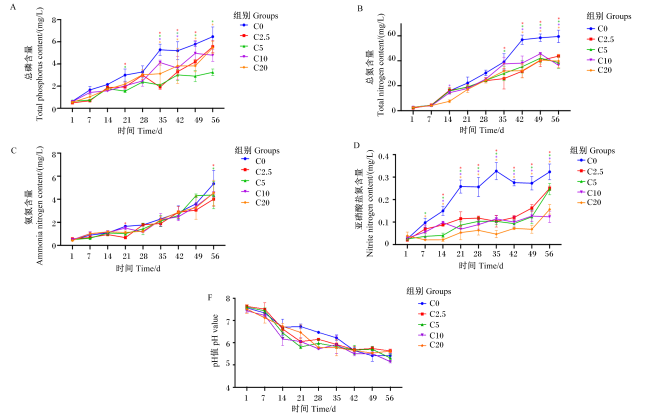
大口黑鲈养殖水体指标的动态变化如图1所示。
图1 水质指标动态变化图

A:养殖水体总磷含量的变化;B:养殖水体总氮含量的变化;C:养殖水体氨氮含量的变化;D:养殖水体亚硝酸盐氮含量的变化;F:养殖水体pH的变化。桉枝生物炭添加组(C2.5、C5、C10、C20组)数据点标注*表示与对照组(C0组)差异显著(P<0.05)。

Fig.1 Dynamic change charts of water quality indicators

A: change in total phosphorus content of aquatic water; B: change in total nitrogen content of aquatic water; C: change in ammonia nitrogen content of aquatic water; D: change in nitrite nitrogen content of aquatic water; F: change in pH of aquatic water. Data points of eucalyptus branch biochar addition groups (groups C2.5, C5, C10 and C20 ) marked with * indicated significant difference compared with the control group (group C0) (P<0.05).

图1-A图1-B可知,各组养殖水体中总磷、总氮含量随养殖时间的延长呈逐渐上升趋势。与C0组相比,各桉枝生物炭添加组第35~56天总磷、第42~56天总氮含量均显著降低(P<0.05),其中C5组总磷含量和C2.5组总氮含量较其他组上升速度缓慢,一直处在低位值,说明桉枝生物炭在一定程度上降低了养殖水体中总磷、总氮的积累。
图1-C可知,养殖水体中氨氮含量随养殖时间的延长呈逐渐上升趋势。第21天之前,各组间氨氮含量无显著差异(P>0.05);第21天时,C2.5组氨氮含量显著低于C0组(P<0.05);第56天时,C2.5和C5组氨氮含量显著低于C0组(P<0.05)。
图1-D可知,养殖水体中亚硝酸盐氮含量随养殖时间的延长呈逐渐上升趋势,但各桉枝生物炭添加组上升速度缓慢。第7天时,C5和C20组亚硝酸盐氮含量显著低于C0组(P<0.05);第14天后,与C0组相比,各桉枝生物炭添加组亚硝酸盐氮含量显著降低(P<0.05)。
图1-F可知,养殖水体的pH随养殖时间的延长呈逐渐下降趋势,但整个试验期内各组间无显著差异(P>0.05)。

3 讨论

3.1 桉枝生物炭对大口黑鲈生长性能及形体指标的影响

在本试验条件下,饲料中添加适量的桉枝生物炭能够提高大口黑鲈的增重率、特定生长率和终末均重,并显著降低大口黑鲈的饲料系数和摄食量,其中添加2.5和5 g/kg桉枝生物炭组大口黑鲈增重率、特定生长率较高,饲料系数较低,生长性能较好。这表明,适量添加桉枝生物炭能够有效促进大口黑鲈的生长。以往研究中,饲料中添加0.2%家禽粪便生物炭可使印地安鲤鱼(Catla catla)增重率提高118%[28];饲料中添加0.5%或1%生物炭饲料能够显著增加罗非鱼的末均重[29];饲料中添加0.5%竹炭可显著提高牙鲆(Paralichthys olivaceus)的增重率、特定生长率、饲料效率和蛋白质效率[22]。本课题组前期研究发现,饲料中添加1%的桑枝生物炭能够提高大口黑鲈的终末体重、增重率和特定生长率[16],这与本试验所得结果一致。适量添加生物炭和炭类物质能够提高鱼类对饲料的消化吸收效率。有研究表明,生物炭中的微孔结构可以吸附一些饲料中的有机物质,提高养分利用效率,促进肠道蠕动,使它们更容易被动物吸收,从而促进生长和发育[30]。超大的比表面积也有助于促进肠道微生物丰度增加,从而提高饲料的摄入量和利用效率[31-32]。Thaib等[30]研究发现,在尼罗罗非鱼(Oreochromis niloticus)饲料中添加3%鱼骨生物炭,可使肠道绒毛长度增加71.11 μm,生物炭的特殊孔隙结构可刺激肠道绒毛发育,使肠道的消化能力和吸收效率提高,进一步加速消化吸收过程,最终促进机体生长发育。生物炭具有选择性吸附细菌的能力,它更倾向于吸附革兰氏阴性菌(可能与细菌的细胞壁结构等有关)[33],也更倾向于吸附病原菌而非天然肠道菌群(可能与生物炭特定孔径等有关)[34]。生物炭的吸附特性使其可能成为益生菌载体,可以将乳杆菌等益生菌精准输送到肠道,从而发挥促进有益菌群生长和抑制病原菌的作用,这种组合效应有助于积极影响肠道微环境,并抑制病原菌的生长[35-36]。另外,有研究发现,生物炭可以减轻抗营养因子的影响,生物炭灰浸泡处理降低了草料中单宁的含量,并显著提高山羊对粗蛋白质和中性洗涤纤维的消化率[37]

3.2 桉枝生物炭对大口黑鲈抗氧化能力的影响

T-AOC是反映机体整体抗氧化能力的关键指标[38]。CAT和SOD是2种重要的抗氧化酶,在机体抗氧化防御系统中发挥着至关重要的作用。CAT能够有效清除体内过量的过氧化氢和其他有害的活性氧物质,保护机体免受氧化损伤[39];而SOD则能催化超氧化物自由基分解,减少细胞受到氧化应激,保护细胞免受氧化损伤[40]。本试验中,C10组大口黑鲈血清中T-AOC较C0组显著提高,肝脏中T-AOC各组间无显著差异,但各桉枝生物炭添加组大口黑鲈肠道中T-AOC均较C0组显著提高;相较C0组,C2.5和C5组大口黑鲈血清中CAT活性显著提高,C10和C20组肝脏中CAT活性显著提高,各组肠道中SOD和CAT活性无显著变化。根据上述结果推测,桉枝生物炭可能对大口黑鲈的抗氧化能力有积极的影响,但不同组织的响应存在差异。Ye等[41]研究发现,给小鼠灌胃1.0 g/kg竹笋生物炭,持续42 d后,肾脏中CAT活性显著升高;Elnaggar等[42]研究发现,在肉鸡饲粮中添加1%~6%的生物炭,可提高血液中T-AOC和SOD活性,这与本研究结果一致。MDA是氧化应激的标志物,其含量通常与氧化损伤程度相关[43]。本试验中,与C0组对比,各桉枝生物炭添加组肝脏和肠道中MDA含量均显著降低。Abdel-Tawwab等[44]研究发现,在重金属暴露环境下,饲喂含木炭饲料的尼罗罗非鱼(Oreochromis niloticus L.)体内MDA含量显著降低,生物炭能够有效缓解重金属引起的氧化损伤。在高硒饲料中添加1~4 g/kg竹质生物炭的研究中也发现,生物炭能够缓解高硒对团头鲂(Megalobrama amblycephala)幼鱼的氧化应激[45],表明生物炭能缓解重金属污染和高硒环境对鱼类的氧化应激。这与本研究结果一致,适量的桉枝生物炭可以降低大口黑鲈体内的氧化应激。这可能是生物炭通过吸附环境有害物质或是改善饲料质量,降低养殖动物的氧化应激,从而提高机体的抗氧化能力[46-48]。此外,养殖水体中氨氮含量等水质因素也可能对抗氧化指标产生影响,这有待进一步研究。

3.3 桉枝生物炭对大口黑鲈养殖水质的影响

养殖水体中总磷、总氮、氨氮和亚硝酸盐氮含量是衡量养殖水质环境的重要指标。集约化养殖过程中,水体总磷含量过高会导致水体富营养化,引发藻类过度繁殖,引发水华和造成水体缺氧[49-50];残饵、粪便以及有机废物经分解会产生大量的氨氮,水体氨氮含量过高影响鱼类摄食,会导致鱼类鳃、肝脏、肾脏等器官的损伤;氨氮在分解转化为亚硝酸盐的过程中会产生酸性物质,导致养殖水体pH下降,从而对鱼类的生长环境造成严重威胁,氨氮和亚硝酸盐氮是对鱼类具有直接毒性的物质[51-55]。生物炭对污染物的吸附能力主要取决于其比表面积、官能团和吸附特性[56],无论是直接投放到养殖池塘中,还是作为滤池的过滤材料,或是用于生物絮团系统,都展现出对水质改善的积极作用[26,57-59]。生物炭因独特的微孔结构而具有强大的吸附能力,可富集水中微生物,吸附水中游离氮,加快亚硝酸盐氮的分解[60]。本试验中,桉枝生物炭对养殖水体中亚硝酸盐氮含量的降低作用出现在7 d后,对总氮含量的降低作用主要在35 d后,而氨氮含量在第56天时的C5组出现显著降低。这可能是有机氮化合物(如蛋白质、氨基酸、尿素)在微生物(如细菌、真菌)的作用下不断分解为氨氮,再被硝化细菌氧化为亚硝酸盐氮,而试验中水体总氮和氨氮含量的降低需要较长时间,可能是因为生物炭对其影响是间接的,需要通过水体中的生物转化,以及硝化、反硝化、氨化等,需要较长时间才能完成[61]。生物炭可通过富集池塘中的磷酸盐从而固定磷[24]。生物炭对磷的吸附以非均匀表面的化学吸附为主,主要通过离子交换、络合反应等进行吸附沉降[62-63]。本试验中,各桉枝生物炭添加组养殖水体中总磷含量降低主要出现在35 d后,可能是桉生物炭吸附磷离子使其随粪便逐渐沉降在养殖缸底部,减少在水体漂浮。有研究表明,添加竹制生物炭的饲料可显著降低条纹鲶鱼(Pangasius hypophthalmus)养殖水体中氨氮含量,添加2%时效果最佳,此时水体氨氮含量最低[64]。在红罗非鱼养殖中,随着饲料中木炭添加水平的增加,水体中氨氮含量逐渐降低,添加4%的木炭可使红罗非鱼养殖水体中氨氮含量降至最低[65]。这与本试验结果较为一致,饲料中添加桉枝生物炭养殖大口黑鲈可以有效减少养殖水体中的环境污染。在本研究中,养殖水体的pH呈下降趋势,主要受养殖生物的代谢活动(呼吸作用等)和有机物(饲料、排泄物等)的分解影响,但各组之间无显著差异,这表明在本试验条件下,桉枝生物炭对养殖水体pH的影响不明显。

4 结论

本试验条件下,饲料中添加2.5~5.0 g/kg桉枝生物炭可提高大口黑鲈的生长性能,增强抗氧化能力,并可降低养殖水体中总磷、总氮和亚硝酸盐氮含量,改善养殖水质。
[1]
ZHANG A L, LI X, XING J, et al. Adsorption of potentially toxic elements in water by modified biochar:a review[J]. Journal of Environmental Chemical Engineering, 2020, 8(4):104196.

[2]
赵群英, 田敏, 李杨, 等. 改性生物炭去除水体中N、P营养物的研究[J]. 西安工业大学学报, 2022, 42(4):387-392.

ZHAO Q Y, TIAN M, LI Y, et al. Removal of N, P nutrientsfrom water by modified biochar[J]. Journal of Xi’an Technological University, 2022, 42(4):387-392. (in Chinese)

[3]
SHI J S, CUI H M, XU J G, et al. Design and fabrication of hierarchically porous carbon frameworks with Fe2O3 cubes as hard template for CO2 adsorption[J]. Chemical Engineering Journal, 2020,389:124459.

[4]
WANG Y Y, ZHENG K X, JIAO Z Q, et al. Simultaneous removal of Cu2+,Cd2+ and Pb2+ by modified wheat straw biochar from aqueous solution:preparation,characterization and adsorption mechanism[J]. Toxics, 2022, 10(6):316.

[5]
QU J H, WANG Y X, TIAN X, et al. KOH-activated porous biochar with high specific surface area for adsorptive removal of chromium (Ⅵ) and naphthalene from water:affecting factors,mechanisms and reusability exploration[J]. Journal of Hazardous Materials, 2021,401:123292.

[6]
ZHANG C C, XIAO X M, ZHAO L C, et al. Mapping eucalyptus plantation in Guangxi,China by using knowledge-based algorithms and PALSAR-2,Sentinel-2,and Landsat images in 2020[J]. International Journal of Applied Earth Observation and Geoinformation, 2023,120:103348.

[7]
HUANG L J, LI H Y, LUO Y S, et al. Exogenous silicon alleviates aluminum stress in Eucalyptus species by enhancing the antioxidant capacity and improving plant growth and tolerance quality[J]. BMC Plant Biology, 2024, 24(1):997.

[8]
张伟明. 生物炭的理化性质及其在作物生产上的应用[D]. 博士学位论文. 沈阳: 沈阳农业大学, 2012.

ZHANG W M. Physical and chemical properties of biochar and its application in crop production[D]. Ph.D.Thesis. Shenyang: Shenyang Agricultural University, 2012. (in Chinese)

[9]
廖芬. 不同生物质来源生物炭品质差异及对甘蔗氮素利用效应[D]. 博士学位论文. 南宁: 广西大学, 2018.

LIAO F. Ouality analysis of biochar derived from different sources biomass and the effect on sugarcane nitrogen utilization[D]. Ph.D.Thesis. Nanning: Guangxi University, 2018. (in Chinese)

[10]
TIAN S Q, JIANG S S, XU Y Y, et al. New insight into enhanced permanganate oxidation by lignocellulose-derived biochar:the overlooked role of persistent free radicals[J]. Water Research, 2025,274:123069.

[11]
段春燕, 沈育伊, 徐广平, 等. 桉树枝条生物炭输入对桂北桉树人工林酸化土壤的作用效果[J]. 环境科学, 2020, 41(9):4234-4245.

DUAN C Y, SHEN Y Y, XU G P, et al. Effects of eucalyptus branches biochar application on soil physicochemical properties of acidified soil in a eucalyptus plantation in northern Guangxi[J]. Environmental Science, 2020, 41(9):4234-4245. (in Chinese)

[12]
ZENG H T, ZENG H H, ZHANG H, et al. Efficient adsorption of Cr(Ⅵ) from aqueous environments by phosphoric acid activated eucalyptus biochar[J]. Journal of Cleaner Production, 2021,286:124964.

[13]
SHAFIQ M, ALAZBA A A, AMIN M T. Kinetic and isotherm studies of Ni2+ and Pb2+ adsorption from synthetic wastewater using Eucalyptus camdulensis-derived biochar[J]. Sustainability, 2021, 13(7):3785.

[14]
WU Y M, LI C, WANG Z M, et al. Enhanced adsorption of aqueous Pb(Ⅱ) by acidic group-modified biochar derived from peanut shells[J]. Water, 2024, 16(13):1871.

[15]
BOAKYE P, TRAN H N, LEE D S, et al. Effect of water washing pretreatment on property and adsorption capacity of macroalgae-derived biochar[J]. Journal of Environmental Management, 2019,233:165-174.

[16]
李金鸿, 李翔, 陈冰, 等. 饲料中添加桑枝生物炭对大口黑鲈生长性能及抗氧化指标的影响[J]. 淡水渔业, 2024, 54(6):71-78.

LI J H, LI X, CHEN B, et al. Effects of adding mulberry branch biochar to feed on growth performance and antioxidant indicators of Micropterus salmoides[J]. Freshwater Fisheries, 2024, 54(6):71-78. (in Chinese)

[17]
AMPRAKO L, ALHASSAN M, BUERKERTA, et al. Influence of dietary wood charcoal on growth performance,nutrient efficiency and excreta quality of male broiler chickens[J]. International Journal of Livestock Production, 2018, 9(10):286-292.

[18]
KIM K S, KIM Y H, PARK J C, et al. Effect of organic medicinal charcoal supplementation in finishing pig diets[J]. Korean Journal of Agricultural Science, 2017, 44(1):50-59.

[19]
MCAVOY D J, BURRITT B, VILLALBA J J. Use of biochar by sheep:impacts on diet selection,digestibility,and performance[J]. Journal of Animal Science, 2020, 98(12):skaa380.

[20]
国家特色淡水鱼产业技术体系. 中国淡水鲈产业发展报告[J]. 中国水产, 2021(3):40-48.

National Characteristic Freshwater Fish Industry Technology System. Report on the development of China’s freshwater perch industry[J]. China Fisheries, 2021(3):40-48. (in Chinese)

[21]
毕威, 赵孟杰, 曹嘉博, 等. 我国大口黑鲈养殖优势、存在问题及发展措施[J]. 科学养鱼, 2022(3):1-2.

BI W, ZHAO M J, CAO J B, et al. The advantages, existing problems,and development measures of largemouth bass aquaculture in China[J]. Scientific Fish Farming, 2022(3):1-2. (in Chinese)

[22]
THU M, KOSHIO S, ISHIKAWA M, et al. Effects of supplementation of dietary bamboo charcoal on growth performance and body composition of juvenile Japanese flounder,Paralichthys olivaceus[J]. Journal of the World Aquaculture Society, 2010,41:255-262.

[23]
MABE L T, SU S Y, TANG D, et al. The effect of dietary bamboo charcoal supplementation on growth and serum biochemical parameters of juvenile common carp (Cyprinus carpio L.)[J]. Aquaculture Research, 2018, 49(3):1142-1152.

[24]
MOPOUNG S, UDEYE V, VIRUHPINTU S, et al. Water treatment for fish aquaculture system by biochar-supplemented planting panel system[J]. The Scientific World Journal, 2020,2020:7901362.

[25]
SU M H, AZWAR E, YANG Y F, et al. Simultaneous removal of toxic ammonia and lettuce cultivation in aquaponic system using microwave pyrolysis biochar[J]. Journal of Hazardous Materials, 2020,396:122610.

[26]
ABAKARI G, LUO G Z, MENG H Y, et al. The use of biochar in the production of tilapia (Oreochromis niloticus) in a biofloc technology system-BFT[J]. Aquacultural Engineering, 2020,91:102123.

[27]
张丰, 刘畅, 王喆, 等. 不同吸附特性的稻草生物炭对稻田氨挥发和水稻产量的影响[J]. 农业工程学报, 2021, 37(9):100-109.

ZHANG F, LIU C, WANG Z, et al. Effects of rice straw biochar with different adsorption characteristics on ammonia volatilization from paddy field and rice yield[J]. Transactions of the Chinese Society of Agricultural Engineering, 2021, 37(9):100-109. (in Chinese)

[28]
KHALID M A, HUSSAIN S M, MAHBOOB S, et al. Biochar as a feed supplement for nutrient digestibility and growth performance of Catla catla fingerlings[J]. Saudi Journal of Biological Sciences, 2022, 29(12):103453.

[29]
NAJMUDEEN T M, FEBNA M A A, ROJITH G, et al. Characterisation of biochar from water hyacinth Eichhornia crassipes and the effects of biochar on the growth of fish and paddy in integrated culture systems[J]. Journal of Coastal Research, 2019, 86(S1):225-234.

[30]
THAIB A, HANDAYANI L, HANUM A, et al. Evaluating the addition of starry triggerfish (Abalistes stellaris) bone charcoal as a feed supplement to the growth performance and intestinal villi length of Nile tilapia (Oreochromis niloticus)[J]. Depik, 2021, 10(2):194-200.

[31]
LAN T T, PRESTON T R, LENG R A. Feeding biochar or charcoal increased the growth rate of striped catfish (Pangasius hypophthalmus) and improved water quality[J]. Livestock Research for Rural Development, 2016, 28(5):84.

[32]
THU M, KOSHIO S, ISHIKAWA M, et al. Effects of dietary bamboo charcoal on growth parameters,apparent digestibility and ammonia nitrogen excretion of tiger puffer fish,Takifugu rubripes[J]. Aquaculture Science, 2009, 57(1):53-60.

[33]
WATARAI S,TANA. Eliminating the carriage of Salmonella enterica serovar Enteritidis in domestic fowls by feeding activated charcoal from bark containing wood vinegar liquid (Nekka-Rich)[J]. Poultry Science, 2005, 84(4):515-521.

[34]
WILLSON N L, VAN T T H, BHATTARAI S P, et al. Feed supplementation with biochar may reduce poultry pathogens,including Campylobacter hepaticus,the causative agent of spotty liver disease[J]. PLoS One, 2019, 14(4):e0214471.

[35]
NAKA K, WATARAI S,Tana, et al. Adsorption effect of activated charcoal on enterohemorrhagic Escherichia coli[J]. Journal of Veterinary Medical Science, 2001, 63(3):281-285.

[36]
CHU G M, KIM J H, KIM H Y, et al. Effects of bamboo charcoal on the growth performance,blood characteristics and noxious gas emission in fattening pigs[J]. Journal of Applied Animal Research, 2013, 41(1):48-55.

[37]
BEN SALEM H, ABIDI S, MAKKAR H P S, et al. Wood ash treatment,a cost-effective way to deactivate tannins in Acacia cyanophylla Lindl. foliage and to improve digestion by Barbarine sheep[J]. Animal Feed Science and Technology, 2005, 122(1/2):93-108.

[38]
ZHAO P, LIU X, JIANG W D, et al. The multiple biotoxicity integrated study in grass carp (Ctenopharyngodon idella) caused by ochratoxin a:oxidative damage,apoptosis and immunosuppression[J]. Journal of Hazardous Materials, 2022,436:129268.

[39]
RAGHUVARAN N, SARDAR P, SAHU N P, et al. Effect of L-carnitine supplemented diets with varying protein and lipid levels on growth,body composition,antioxidant status and physio-metabolic changes of white shrimp,Penaeus vannamei juveniles reared in inland saline water[J]. Animal Feed Science and Technology, 2023,296:115548.

[40]
辛向荣, 贺琴, 游金明, 等. 丙氨酰-谷氨酰胺预处理对氧化应激猪小肠上皮细胞活力和自噬的影响[J]. 中国畜牧杂志, 2018, 54(8):91-95.

XIN X R, HE Q, YOU J M, et al. Effects of pre-adding alanyl-glutamine dipeptide on porcine intestinal epithelial cells viability and autophagy under oxidative stress[J]. Chinese Journal of Animal Science, 2018, 54(8):91-95. (in Chinese)

[41]
YE M G, DAI G H, SHEN B, et al. Effects of the bamboo shoot biochar on indexes of serum,antioxidant indexes of kidney and gut microbiota in db/db diabetic mice[J]. Research Square, 2022(2022-10-11)[2025-01-01].https://europepmc.org/article/PPR/PPR557388.

[42]
ELNAGGAR A, ELGHALID O, ELSAYED A, et al. Effect of graded levels of biochar supplementation as a growth promoter on productive and physiological performance of broiler chicks[J]. Egyptian Poultry Science Journal, 2022, 42(3):243-263.

[43]
周东来, 刘凡, 汪福保, 等. 桑叶提取物对鳜鱼生长性能、血清免疫指标、抗氧化能力及肝脏和肠道健康的影响[J]. 动物营养学报, 2023, 35(2):1147-1159.

ZHOU D L, LIU F, WANG F B, et al. Effects of mulberry leaf extract on growth performance,serum immune indices,antioxidant ability and liver and intestinal health of Siniperca chuatsi[J]. Chinese Journal of Animal Nutrition, 2023, 35(2):1147-1159. (in Chinese)

[44]
ABDEL-TAWWAB M, EL-SAYED G O, SHADY S H. Effect of dietary active charcoal supplementation on growth performance,biochemical and antioxidant responses,and resistance of Nile tilapia,Oreochromis niloticus (L.) to environmental heavy metals exposure[J]. Aquaculture, 2017,479:17-24.

[45]
郝婧媛. 饲料中添加硒对团头鲂幼鱼生长、糖脂代谢和抗氧化应激的影响及竹炭的缓解作用[D]. 硕士学位论文. 南京: 南京农业大学, 2020.

HAO J Y.Effects of dietary selenium on growth,glycolipid metabolism and antioxidant capacity and the relaxation effects on excess selenium of bamboo charcoal in blunt snout bream, Megalobrama amblycephala[D]. Master’s Thesis. Nanjing: Nanjing Agricultural University, 2020. (in Chinese)

[46]
TURK SEKULIĆ M, PAP S, STOJANOVIĆ Z, et al. Efficient removal of priority, hazardous priority and emerging pollutants with Prunus armeniaca functionalized biochar from aqueous wastes:experimental optimization and modeling[J]. Science of the Total Environment, 2018,613/614:736-750.

[47]
BHATTI S A, KHAN M Z, HASSAN Z U, et al. Comparative efficacy of Bentonite clay,activated charcoal and Trichosporon mycotoxinivorans in regulating the feed-to-tissue transfer of mycotoxins[J]. Journal of the Science of Food and Agriculture, 2018, 98(3):884-890.

[48]
GOPINATH A, DIVYAPRIYA G, SRIVASTAVA V, et al. Conversion of sewage sludge into biochar:a potential resource in water and wastewater treatment[J]. Environmental Research, 2021,194:110656.

[49]
SINGH M, PANDEY J. Alkaline phosphatase as a bio-indicator of phosphorus-eutrophy in freshwater ecosystems:a review[J]. International Journal of Sediment Research, 2023, 38(3):349-360.

[50]
CHO K, UENO M, LIANG Y, et al. Generation of reactive oxygen species (ROS) by harmful algal bloom (HAB)-forming phytoplankton and their potential impact on surrounding living organisms[J]. Antioxidants, 2022, 11(2):206.

[51]
刘丽平, 李赟, 潘鲁青, 等. 海水小球藻-芽孢杆菌复合体系去除海水养殖中氮磷污染的研究[J]. 中国海洋大学学报(自然科学版), 2022, 52(11):43-55.

LIU L P, LI Y, PAN L Q, et al. Studies on removal of nitrogen and phosphorus pollution by chlorella sp.-Bacillus sp.consortium in mariculture[J]. Periodical of Ocean University of China (Natural Science Edition), 2022, 52(11):43-55. (in Chinese)

[52]
VILLA-VILLASEÑOR I M, YÁÑEZ-RIVERA B, RUEDA-JASSO R A, et al. Differential sensitivity of offspring from four species of goodeine freshwater fish to acute exposure to nitrates[J]. Frontiers in Ecology and Evolution, 2022,10:1014814.

[53]
KIM J H, KANG Y J, KIM K I, et al. Toxic effects of nitrogenous compounds (ammonia,nitrite,and nitrate) on acute toxicity and antioxidant responses of juvenile olive flounder,Paralichthys olivaceus[J]. Environmental Toxicology and Pharmacology, 2019,67:73-78.

[54]
ZHANG W X, XIA S L, ZHU J, et al. Growth performance,physiological response and histology changes of juvenile blunt snout bream,Megalobrama amblycephala exposed to chronic ammonia[J]. Aquaculture, 2019,506:424-436.

[55]
MONDAL N, GHOSH A. Effects of nitrogen-based fertilizers on fish health:evaluation of stress factors and immune response[J]. Discovery, 2023, 59(333):e109d1353.

[56]
ZHOU L G, WANG X D, ZHANG X M, et al. Spatiotemporal variations in nitrogen and phosphorus in a large man-made lake and their relationships with human activities[J]. Water, 2020, 12(4):1106.

[57]
李书奇. 改性硬质生物炭复合材料的制备及其对水体氮磷的吸附作用[D]. 硕士学位论文. 石家庄: 河北师范大学, 2020.

LI S Q. Preparation of modified rigid biochar composite materials and their adsorption of nitrogen and phosphorus in water[D]. Master’s Thesis. Shijiazhuang: Hebei Normal University, 2020. (in Chinese)

[58]
丁露. 秸秆基生物炭对农村河道底泥修复的生态效应及动态研究[D]. 硕士学位论文. 南京: 东南大学, 2021.

DING L. Ecological benefit and dynamic study of straw-based biochar for river sediment remediation in rural areas[D]. Master’s Thesis. Nanjing: Southeast University, 2021. (in Chinese)

[59]
江昊飞, 李慷, 石文智, 等. 常用渔药及水体pH对生物质炭填料系统硝化作用和微生物群落结构的影响[J]. 水产学报, 2022, 46(9):1656-1668.

JIANG H F, LI K, SHI W Z, et al. Effects of common fishery drugs and water pH on nitrification performance and microbial community structure of biochar filler system[J]. Journal of Fisheries of China, 2022, 46(9):1656-1668. (in Chinese)

[60]
MUKHERJEE S, SARKAR B, ARALAPPANAVAR V K, et al. Biochar-microorganism interactions for organic pollutant remediation:challenges and perspectives[J]. Environmental Pollution, 2022,308:119609.

[61]
PAINTER H A. Microbial transformations of inorganic nitrogent[C]// Proceedings of the conference on nitrogen as a water pollutan.[S.l.]:Elsevier,2013:3-29.

[62]
连神海, 张树楠, 刘锋, 等. 不同生物炭对磷的吸附特征及其影响因素[J]. 环境科学, 2022, 43(7):3692-3698.

LIAN S H, ZHANG S N, LIU F, et al. Phosphorus adsorption characteristics of different biochar types and its influencing factors[J]. Environmental Science, 2022, 43(7):3692-3698. (in Chinese)

[63]
王淼, 李忠徽, 衣萌萌, 等. 零换水条件下3种异养硝化细菌对底部充氧池塘水质和尼罗罗非鱼生长、抗氧化能力的影响[J]. 水产学报, 2020, 44(7):1147-1155.

WANG M, LI Z H, YI M M, et al. Effect of three heterophic nitrifying bacteria on water quality of Nile tilapia pond with bottom aeration,and growth and antioxidative abilities of fish under zero water exchange[J]. Journal of Fisheries of China, 2020, 44(7):1147-1155. (in Chinese)

[64]
QUAIYUM M A, JAHAN R, JAHAN N, et al. Effects of bamboo charcoal added feed on reduction of ammonia and growth of Pangasius hypophthalmus[J]. Journal of Aquaculture Research & Development, 2014, 5(6):1000269.

[65]
MICHAEL F R, SALEH N E, SHALABY S M, et al. Effect of different dietary levels of commercial wood charcoal on growth,body composition and environmental loading of red tilapia hybrid[J]. Aquaculture Nutrition, 2017, 23(1):210-216.

文章导航

/