研究论文

蛋壳粉与石粉在蛋鸡体内、外溶解特点的对比研究

  • 袁文 , 1, 2 ,
  • 付宇 2 ,
  • 王晶 2 ,
  • 侯斐 3 ,
  • 侯建库 3 ,
  • 陈辉 , 1, *
展开
  • 1 河北农业大学动物科技学院,保定 071001
  • 2 中国农业科学院饲料研究所,农业农村部动物产品质量安全饲料源性因子风险评估实验室,农业农村部饲料生物技术重点实验室,北京 100081
  • 3 顺平县农业农村局,保定 071001
*陈 辉,教授,博士生导师,E-mail:

袁 文(2001—),女,河北衡水人,硕士研究生,研究方向为动物营养与饲料。E-mail:

Office editor: 菅景颖

收稿日期: 2025-03-04

  网络出版日期: 2025-10-15

基金资助

国家蛋鸡产业技术体系(CARS-40)

中国农业科学院农业科技创新工程(ASTIP)

中国博士后科学基金第76批面上资助(2024M763615)

河北省现代农业产业技术体系建设专项资金(HBCT2024260201)

A Comparative Study on Dissolution Characteristics of Eggshell Powder and Limestone in Vivo and in Vitro in Laying Hens

  • YUAN Wen , 1, 2 ,
  • FU Yu 2 ,
  • WANG Jing 2 ,
  • HOU Fei 3 ,
  • HOU Jianku 3 ,
  • CHEN Hui , 1, *
Expand
  • 1 College of Animal Science and Technology, Hebei Agricultural University, Baoding 071001, China
  • 2 Key Laboratory of Feed Biotechnology of the Ministry of Agriculture & Rural Affairs, Laboratory of Quality & Safety Risk Assessment for Animal Products on Feed-Origin Risk Factor of the Ministry of Agriculture & Rural Affairs, Institute of Feed Research, Chinese Academy of Agricultural Science, Beijing 100081, China
  • 3 Shunping County Agriculture and Rural Affairs Bureau, Baoding 071001, China
*professor, E-mail:

Received date: 2025-03-04

  Online published: 2025-10-15

摘要

本试验旨在对比蛋壳粉和不同粒径石粉在蛋鸡体内和体外的溶解特点,以期为蛋壳粉替代石粉在蛋鸡上应用提供参考。体外溶解试验:将2 g粗石粉(粒径2.00~4.00 mm)、细石粉(粒径0~2.00 mm)、混合石粉(粗、细石粉1∶1混合)或蛋壳粉(粒径0~2.00 mm)分别与200 mL 0.2 mol/L盐酸溶液混合,并于反应5、10、20、30、60、120 min后称量未溶解蛋壳或石粉的重量,计算体外溶解速率。体内溶解试验:选取32只35周龄产蛋时间相近的京红1号蛋鸡,随机分为4组(每组8个重复,每个重复1只),分别仅以粗石粉、细石粉、混合石粉和蛋壳粉作为饲粮钙源。预试期7 d,试验期3 d。试验期末收集饲粮、排泄物、食糜、血液和消化液检测钙含量。结果表明:1)蛋壳粉的体外溶解速率在短时内(5和10 min时)与混合石粉相似(P>0.05),显著低于细石粉且显著高于粗石粉(P<0.05),在30、60、120 min时显著低于所有石粉(P<0.05)。2)蛋壳粉组与所有石粉组蛋鸡的生产性能指标均差异不显著(P>0.05)。3)蛋壳粉组钙摄入量显著低于所有石粉组(P<0.05);以钙摄入量作为协变量进行协方差分析后发现,蛋壳粉组和所有石粉组对蛋鸡钙排出量和钙溶解百分比无显著影响(P>0.05),蛋壳粉组肠内钙量与细石粉组相似,但显著低于混合石粉组和粗石粉组(P<0.05)。4)蛋壳粉组与所有石粉组嗉囊、胃、十二指肠和空肠消化液中钙含量无显著差异(P>0.05),但蛋壳粉组回肠消化液中钙含量显著低于混合石粉组(P<0.05)。5)蛋壳粉组产蛋后0 h血清钙含量显著低于所有石粉组(P<0.05),产蛋后7和17 h血清钙含量各组间无显著差异(P>0.05)。由此可见,蛋壳粉与混合石粉体外溶解速率相似,与细石粉体内溶解特点相似,具有替代蛋鸡饲粮中细石粉的潜力,但可能因适口性较差导致钙的摄入量显著减少。

本文引用格式

袁文 , 付宇 , 王晶 , 侯斐 , 侯建库 , 陈辉 . 蛋壳粉与石粉在蛋鸡体内、外溶解特点的对比研究[J]. 动物营养学报, 2025 , 37(10) : 6720 -6728 . DOI: 10.12418/CJAN2025.547

Abstract

This study aimed to compare the in vivo and in vitro dissolution characteristics of eggshell powder and limestone with different particle sizes in laying hens, to provide a reference for the application of eggshell powder as a substitute for limestone in layer hen production. In vitro dissolution test: 2 g of coarse limestone (particle size: 2.00 to 4.00 mm), fine limestone (particle size: 0 to 2.00 mm), mixed limestone (1∶1 mixture of coarse and fine limestone), or eggshell powder (particle size: 0 to 2.00 mm) were mixed with 200 mL of 0.2 mol/L hydrochloric acid solution. The undissolved amount of eggshell or limestone powder was measured at 5, 10, 20, 30, 60, and 120 minutes after the reaction, and the in vitro dissolution rate was calculated. In vivo dissolution test: thirty-two 35-week-old Jinghong No.1 laying hens with similar egg laying cycle were randomly divided into 4 groups (8 replicates per group, and 1 hen per replicate). Each group was fed with a calcium source of either coarse limestone, fine limestone, mixed limestone, or eggshell powder. The pre-experiment period lasted for 7 days, and the experimental period lasted for 3 days. At the end of the experiment, diet, feces, digesta, blood and digestive fluid were collected to measure calcium content. The results showed as follows: 1) the in vitro dissolution rate of eggshell powder was similar to that of mixed limestone at starting time (5 and 10 min, P>0.05), and it was significantly lower than fine limestone (P<0.05), but significantly higher than coarse limestone (P<0.05). At 30, 60, and 120 min, the in vitro dissolution rate of eggshell powder was significantly less than that of coarse limestone, fine limestone, mixed limestone (P<0.05). 2) No significant differences were observed in production performance indexes between the eggshell powder group and any of the limestone groups (P>0.05). 3) The calcium intake of laying hens in the eggshell powder group was significantly lower than that in all limestone groups (P<0.05). After conducting a covariance analysis using calcium intake as a covariate, it was found that no significant effects were found on calcium output and calcium dissolved percentage between the eggshell powder group and limestone groups (P>0.05). The enteral calcium of the eggshell powder group was similar to that of the fine limestone group, but it was significantly lower than that of the mixed and coarse limestone groups (P<0.05). 4) No significant differences in calcium content were found in the crop, stomach, duodenal and jejunal digestive fluids between the eggshell powder group and limestone groups (P>0.05). However, the calcium content in the ileal digestive fluid of the eggshell powder group was significantly lower than that of the mixed limestone group (P<0.05). 5) The serum calcium content at 0 h post-oviposition in the eggshell powder group was significantly lower than that in all limestone groups (P<0.05). No significant differences in blood calcium concentrations were observed at 7 and 17 h post-oviposition (P>0.05). It can be concluded that the in vitro dissolution rate of eggshell powder is similar to that of mixed limestone, and in vivo dissolution characteristics is comparable to that of fine limestone. Therefore, eggshell powder has the potential to replace fine limestone in the diet of laying hens, while its lower palatability may lead to a significant reduction in calcium intake.

据联合国粮食及农业组织统计,2023年中国鸡蛋产量达3 064.17万t,占全球总产量的34%,预计每年约有337万t蛋壳被丢弃。未经任何处理的蛋壳填埋会释放出氨气和硫化氢等具有刺激性的气体,吸引啮齿动物和昆虫,给环境治理带来挑战[1]。蛋壳含有94%的碳酸钙、4%的有机物、1%的磷酸钙和磷酸镁,以及1%的碳酸镁,其中丰富的碳酸钙是其再利用的焦点[2]。在蛋鸡养殖中,常以石粉作为钙补充剂。与石粉相比,蛋壳粉不仅钙含量相当,且磷含量更高,同时富含多种微量矿物元素,如锌、铁、铜等[3],以及有助于蛋壳形成的基质蛋白和多糖[4]。因此,蛋壳粉有可能成为替代石粉的新型钙源。Lee等[5]研究发现,使用蛋壳粉完全替代混合石粉可为73周龄老龄蛋鸡提供足够的钙,且对其生产性能、蛋品质和骨矿化无不良影响。Gongruttananun[6]的研究也表明,采用蛋壳粉50%或100%替代细石粉对25周龄蛋鸡的生产性能、血浆钙含量、骨骼矿化和性腺特征均无显著影响。此外,Islam等[7]发现,使用蛋壳粉完全替代混合石粉会提高蛋鸡的采食量,且当蛋壳粉在饲粮中添加量为8%时可显著提高产蛋量。但Lichovnikova[8]却表示蛋壳粉100%替代粗石粉会降低56周龄蛋鸡的蛋壳重、蛋壳比例和蛋壳厚度。Tunç等[9]也发现蛋壳粉50%或100%替代粗石粉均会降低44周龄蛋鸡胫骨中钙含量。以往研究中蛋壳粉替代石粉对蛋鸡生产性能和蛋品质的影响不一,可能与其所替代的石粉粒径大小不一致有关,了解蛋壳粉在蛋鸡体内、外的溶解特点及其生物利用率有助于科学指导蛋壳粉在蛋鸡生产中的使用。因此,本研究通过对比蛋壳粉和石粉在蛋鸡体内、外的溶解特点,旨在为蛋壳粉在蛋鸡生产中的利用提供科学依据。

1 材料与方法

1.1 试验材料

本试验中,粗、细石粉仅为粒径大小不一样,通过4 mm孔径筛并保留在2 mm孔径筛上的石粉被认为是粗石粉,通过2 mm孔径筛的石粉被认为是细石粉。蛋壳粉是蛋壳经清洗、烘干、粉碎后通过2 mm孔径筛获得。参照AOAC(2005)[10]的方法测定石粉和蛋壳粉中钙、磷含量。本试验使用的石粉和蛋壳粉的粒径大小及钙、磷含量如表1所示。
表1 石粉和蛋壳粉的粒径大小及钙、磷含量

Table 1 Particle size and calcium, phosphorus contents of limestone and eggshell powder

项目
Items
粗石粉
Coarse limestone
细石粉
Fine limestone
蛋壳粉
Eggshell powder
粒径Particle size/mm 2.00~4.00 0~2.00 0~2.00
钙含量Calcium content/(mg/g) 417.70 417.70 406.82
磷含量Phosphorus content/(mg/g) 0.02 0.02 1.06

1.2 体外溶解速率的比较

体外溶解试验参考Zhang等[11]改进的失重法,将2 g粗石粉、细石粉、混合石粉(粗、细石粉1∶1混合)或蛋壳粉分别加入200 mL 0.2 mol/L盐酸溶液中,42 ℃水浴加热,使用滤纸(滤纸重记为m1)分别在5、10、20、30、60、120 min后过滤未溶解的蛋壳粉或石粉,将滤纸及纸上滤渣放入75 ℃烘箱内烘干并称重,记为m2,计算溶解蛋壳粉或石粉质量[m=2-(m2-m1)]以表征其体外溶解速率。

1.3 体内溶解特点的比较

动物试验经中国农业科学院饲料研究所动物伦理委员会批准(IFR-CAAS-20240719)。选用32只35周龄产蛋周期和产蛋时间都相近的健康京红1号产蛋鸡,随机分为4组,分别仅以粗石粉、细石粉、混合石粉(粗、细石粉1∶1混合)和蛋壳粉作为饲粮唯一钙源,每组8只鸡,单笼单养。预试期7 d,正试期3 d。参照《京红1号蛋鸡饲养管理手册》和NY/T 33—2004配制基础玉米-豆粕型饲粮,饲粮的粗蛋白质含量根据GB/T 6432—2018采用凯氏定氮法进行测定,钙含量根据GB/T 6436—2018采用乙二胺四乙酸(EDTA)络合滴定法进行测定,总磷含量根据GB/T 6437—2018采用分光光度法进行测定,代谢能、有效磷和氨基酸含量参考《中国饲料成分及营养价值表(2023年第34版)》计算得出。各组所喂饲粮除钙源不同,其他饲料原料均相同,试验饲粮组成及营养水平见表2
表2 试验饲粮组成及营养水平(饲喂基础)

Table 2 Composition and nutrient levels of experimental diets (as-fed basis) %

项目
Items
石粉组
Limestone
groups4)
蛋壳粉组
Eggshell
powder
group
原料Ingredients
玉米Corn 62.00 62.00
豆粕Soybean meal 24.20 24.20
豆油Soybean oil 1.50 1.50
麦麸Wheat bran 1.93 1.69
石粉Limestone 8.86
蛋壳粉Eggshell power 9.10
磷酸氢钙CaHPO4 0.60 0.60
氯化钠NaCl 0.15 0.15
硫酸钠Na2SO4 0.23 0.23
蛋氨酸Met 0.17 0.17
氯化胆碱
Choline chloride (50%)
0.12 0.12
植酸酶Phytase 0.02 0.02
维生素预混料Vitamin premix1) 0.02 0.02
矿物质预混料Mineral premix2) 0.20 0.20
合计Total 100.00 100.00
营养水平Nutrient levels3)
代谢能ME/(MJ/kg) 11.39 11.35
粗蛋白质CP 16.56 16.57
钙Ca 3.88 3.88
总磷TP 0.45 0.50
有效磷AP 0.32 0.32
色氨酸Trp 0.18 0.18
赖氨酸Lys 0.80 0.80
蛋氨酸Met 0.38 0.38
蛋氨酸+半胱氨酸Met+Cys 0.65 0.65
苏氨酸Thr 0.61 0.61

1)维生素预混料为每千克饲粮提供 Vitamin premix provided the following per kg of diets:VA 8 000 IU,VD3 2 500 IU,VK3 2.65 mg,VB1 2.0 mg,VB2 6.0 mg,VB12 0.025 mg,VB6 3.0 mg,VE 50 mg,泛酸 pantothenic acid 12 mg,烟酸 niacin 50 mg,生物素 biotin 0.032 5 mg,叶酸 folic acid 1.25 mg。2)矿物质预混料为每千克饲粮提供 Mineral premix provided the following per kg of diets;Cu 8 mg,Zn 7 mg,Fe 80 mg,Mn 100 mg,Se 0.15 mg,I 10.35 mg。3)粗蛋白质、钙和总磷含量为实测值,其余为计算值。CP, Ca and TP were measured values, while the others were calculated values.4)石粉组包括粗石粉组、细石粉组和混合石粉组。Limestone groups included coarse limestone group, fine limestone group and mixed limestone group.

动物饲养试验在中国农业科学院南口中试基地开展。养殖环境为独立试验单间,配有3层蛋鸡饲养笼架,全封闭舍,自动采光和通风系统,光照时间16 h/d,光照强度20 lx,相对湿度50%~90%;饲粮为干粉料,每天布料2次,乳头式饮水器,自由采食,自由饮水;专人管理,每天捡蛋2次,每日观察蛋鸡健康状态。

1.4 检测指标与方法

1.4.1 生产性能

正试期内,每日记录产蛋数和鸡蛋重量,试验结束时统计饲粮消耗量,计算整个试验期的产蛋率、平均日采食量、平均蛋重和料蛋比等指标。

1.4.2 血清钙含量

试验期间严格记录蛋鸡产蛋时间。试验结束后,选取全部试验蛋鸡,于产蛋后0、7、17 h经翅静脉采集5 mL血液于非抗凝管中,静置2 h后,在1 509.3×g离心力下离心10 min,收集血清于-20 ℃保存待用。检测前将血清样本室温下解冻,使用钙检测试剂盒(C004-1-1,南京建成生物工程研究所)测定血清钙含量。

1.4.3 钙溶解特点

正试期前断食24 h后饲喂试验饲粮,采用全收粪法每日以笼为单位收集蛋鸡排泄物,储存在-20 ℃下,并将整个试验期收集的排泄物混合成1个样品,烘干、称重、粉碎后过60目筛,取0.50 g样品于锥形瓶中,加入15 mL混酸(浓硝酸∶高氯酸=5∶1),220 ℃电沙浴锅消煮3 h,加入超纯水定容至100 mL,过膜(0.22 μm)后使用电感耦合等离子体发射光谱仪(7700,Agilent Technologies Inc,美国)测定钙含量。试验结束后,用二氧化碳窒息法对鸡实施安乐死,收集各消化道内消化液,使用钙检测试剂盒(C004-1-1,南京建成生物工程研究所)检测消化液中钙含量,随后收集全肠段食糜,烘干后称重。试验结束后回收剩余试验饲粮,称重,同时参考排泄物钙含量检测方法分析全肠段食糜和剩余饲粮中的钙含量。根据下述公式计算蛋鸡钙摄入量、钙排出量、全肠段食糜总钙量和钙溶解百分比。

钙摄入量=饲粮钙含量×摄入饲粮重-剩余饲粮钙含量×剩余饲粮重;

钙排出量=排泄物中钙含量×排泄物重;

肠内钙量=全肠段食糜钙含量×食糜重;

钙溶解百分比=[(钙摄入量-钙排出量->肠内钙量)/钙摄入量]×100[12]

1.5 数据统计分析

所有数据均采用SPSS 26.0进行分析,首先检验数据正态性和方差齐性。对体外溶解速率、生产性能和钙摄入量数据进行单因素方差分析(one-way ANOVA),并在方差分析显著时采用Duncan氏法进行组间多重比较检验;其他指标(钙排出量、肠内钙量、钙溶解百分比、消化液钙含量和血清钙含量)均以钙摄入量为协变量进行协方差分析。结果表示为平均值±标准误,P<0.05表示差异显著。

2 结果与分析

2.1 蛋壳粉与石粉体外溶解速率的差异

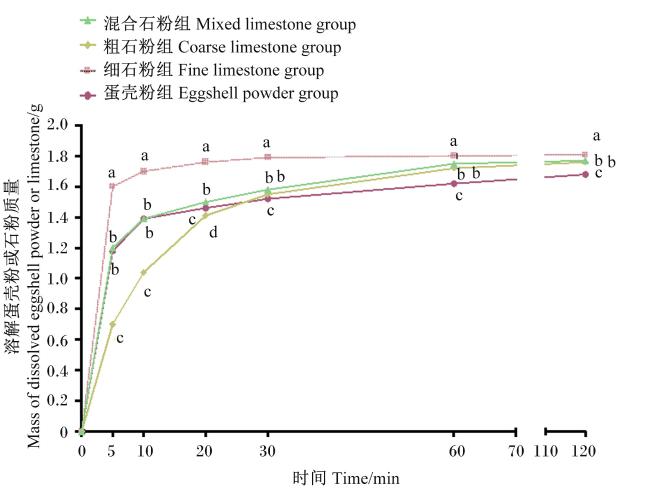
图1可知,在5和10 min时,蛋壳粉组体外溶解速率与混合石粉组差异不显著(P>0.05),二者显著低于细石粉组(P<0.05),且显著高于粗石粉组(P<0.05);在20 min时,蛋壳粉组显著低于混合石粉组和细石粉组(P<0.05),显著高于粗石粉组(P<0.05);在30、60、120 min时,蛋壳粉组显著低于所有石粉组(P<0.05)。
图1 蛋壳粉与石粉在蛋鸡体外溶解速率的差异

同一时间点,数据点标注不同字母表示差异显著(P<0.05),相同字母表示差异不显著(P>0.05)。

Fig.1 Difference in dissolution rate of eggshell powder and limestone in laying hens in vitro (n=5)

At the same time point, data points marked with different letters mean significant difference (P<0.05), while the same letters mean no significant difference (P>0.05).

2.2 蛋壳粉与石粉对蛋鸡生产性能的影响

表3可知,蛋壳粉组与所有石粉组蛋鸡的生产性能指标均无显著差异(P>0.05)。
表3 蛋壳粉与石粉对蛋鸡生产性能的影响

Table 3 Effects of eggshell powder and limestone on performance of laying hens

项目
Items
混合石粉组
Mixed limestone
group
粗石粉组
Coarse limestone
group
细石粉组
Fine limestone
group
蛋壳粉组
Eggshell powder
group
P
P-value
产蛋率Laying rate/% 100.00±0.00 100.00±0.00 100.00±0.00 95.83±0.04 0.397
平均蛋重Average egg weight/g 56.10±1.60 55.82±1.12 55.19±1.31 56.83±0.67 0.818
平均日采食量ADFI/(g/d) 107.06±3.18 103.27±4.44 107.79±2.47 102.78±3.12 0.643
料蛋比F/E 1.91±0.04 1.86±0.11 1.96±0.05 1.80±0.05 0.459
蛋壳重Eggshell weight/g 5.66±0.16 5.49±0.08 5.30±0.12 5.35±0.16 0.240
蛋壳比例Eggshell ratio/% 10.09±0.14 9.86±0.12 9.60±0.15 9.42±0.27 0.064

2.3 蛋壳粉与石粉对蛋鸡钙溶解百分比的影响

表4可知,蛋壳粉组的钙摄入量显著低于细石粉组(P<0.05),且这2组均显著低于混合石粉组和粗石粉组(P<0.05)。蛋壳粉组肠内钙量与细石粉组差异不显著(P>0.05),但这2组均显著低于混合石粉组和粗石粉组(P<0.05)。蛋壳粉组与所有石粉组粪钙排出量和钙溶解百分比差异不显著(P>0.05)。
表4 蛋壳粉与石粉对蛋鸡钙溶解百分比的影响

Table 4 Effects of eggshell powder and limestone on calcium dissolved percentage of laying hens

项目
Items
混合石粉组
Mixed limestone
group
粗石粉组
Coarse limestone
group
细石粉组
Fine limestone
group
蛋壳粉组
Eggshell powder
group
P
P-value
钙摄入量Calcium intake/g 13.77±0.06a 13.95±0.15a 13.26±0.15b 12.60±0.12c <0.001
粪排出量Calcium output/g 4.86±0.40 5.70±0.58 5.00±0.48 4.71±0.36 0.475
肠内钙量Enteral calcium/g 0.40±0.05a 0.55±0.06a 0.19±0.04b 0.12±0.06b <0.001
钙溶解百分比
Calcium dissolved percentage/%
63.62±3.91 56.03±4.19 59.50±3.23 61.19±3.78 0.466

同行数据肩标不同小写字母表示差异显著(P<0.05),无字母或相同字母表示差异不显著(P>0.05)。下表同。

In the same row, values with different small letter superscripts mean significant difference (P<0.05), while with no letter or the same letter superscripts mean no significant difference (P>0.05). The same as below.

2.4 蛋壳粉与石粉对蛋鸡肠消化液钙含量的影响

表5可知,蛋壳粉组与所有石粉组嗉囊、胃、十二指肠和空肠消化液中钙含量均差异不显著(P>0.05)。蛋壳粉组回肠消化液中钙含量显著低于混合石粉组和细石粉组(P<0.05),粗石粉组也显著低于细石粉组(P<0.05)。
表5 蛋壳粉与石粉对蛋鸡肠消化液钙含量的影响

Table 5 Effects of eggshell powder and limestone on digestive fluid calcium content of laying hens mmol/L

项目
Items
混合石粉组
Mixed limestone
group
粗石粉组
Coarse limestone
group
细石粉组
Fine limestone
group
蛋壳粉
Eggshell powder
group
P
P-value
嗉囊Craw 6.29±0.82 6.38±1.19 6.91±0.66 5.47±1.35 0.537
胃Stomach 4.43±0.57 4.07±0.50 3.47±0.49 3.16±0.41 0.318
十二指肠Duodenum 3.70±0.21 3.73±0.28 4.31±0.26 4.42±0.36 0.228
空肠Jejunum 12.53±1.32 13.16±1.42 11.71±1.05 13.47±1.79 0.674
回肠Ileum 11.00±1.40ab 8.07±1.42bc 12.66±1.16a 6.85±1.66c 0.004

2.5 蛋壳粉与石粉对蛋鸡血清钙含量的影响

表6可知,蛋壳粉组与所有石粉组蛋鸡产蛋后7和17 h血清钙含量差异不显著(P>0.05),但产蛋后0 h蛋壳粉组血清钙含量显著低于所有石粉组(P<0.05),粗石粉组显著低于混合石粉组(P<0.05)。
表6 蛋壳粉与石粉对蛋鸡血清钙含量的影响

Table 6 Effects of eggshell powder and limestone on serum calcium content of laying hens mmol/L

项目
Items
混合石粉组
Mixed limestone
group
粗石粉组
Coarse limestone
group
细石粉组
Fine limestone
group
蛋壳粉组
Eggshell powder
group
P
P-value
产蛋后0 h 0 h post-oviposition 2.17±0.03a 2.04±0.05b 2.14±0.05ab 1.89±0.05c <0.001
产蛋后7 h 7 h post-oviposition 3.12±0.15 3.32±0.13 3.11±0.12 3.10±0.18 0.621
产蛋后17 h 17 h post-oviposition 2.47±0.10 2.44±0.12 2.16±0.10 2.18±0.13 0.163

3 讨论

3.1 体外溶解速率的差异

钙的生物利用率与钙源体外溶解速率和蛋鸡体内溶解速率之间存在高度相关性[11]。为了多角度评估钙源在蛋鸡消化道中的可用性,常通过体外溶解试验辅助了解其在体内释放钙离子的能力。本研究参考Kim等[13]的方法探究了蛋壳粉和不同粒径石粉体外溶解速率的差异,结果表明,不同粒径石粉的体外溶解速率不同,细石粉的溶解速率要明显快于粗石粉,而混合石粉介于两者之间。Hervo等[14]比较了粒径≥0.402 mm的粗石粉和粒径在0~0.075 mm的细石粉的体外溶解速率,同样发现细石粉体外溶解速率大于粗石粉。由此可见,石粉粒径与体外溶解速率可能存在负相关。其原因可能是粗石粉粒径较大,与盐酸的相对接触面积小,从而导致其体外溶解速率低。在本试验中,蛋壳粉粒径与细石粉相近,但其体外溶解速率低于细石粉。这可能是由于蛋壳粉含有不溶于酸的蛋壳基质蛋白和多糖[15],从而减缓了其在酸溶液中的溶解和释放。上述结果表明,在无酶酸溶液中,石粉的溶解速率与其粒径大小有关,而在同等粒径下,蛋壳粉会延缓自身的溶解。总体来说,蛋壳粉的体外溶解速率与混合石粉相似。

3.2 蛋鸡生产性能的差异

钙源的选择对蛋鸡的生产性能和蛋品质具有重要影响。在本试验中,蛋壳粉与石粉对蛋鸡产蛋率、平均蛋重、平均日采食量和料蛋比的影响无显著差异,与Muir等[16]和Lee等[5]的研究结果基本相似。但韩占兵等[17]研究表明,饲粮中使用2%的蛋壳粉等量替代基础饲粮中的混合石粉会显著提高25周龄土鸡5号蛋鸡的产蛋率,降低料蛋比。Sk r ˇivan等[18]也表示石粉粒径会影响蛋鸡的生产性能,与饲喂细石粉(0~0.5 mm)相比,饲喂粗石粉(0.8~2 mm)会显著提高24~36周龄和56~68周龄伊莎褐蛋鸡的蛋重,并降低料蛋比,与本试验结果不一致。这可能是因为本试验周期短,蛋壳粉和不同粒径石粉短期内对蛋鸡生产性能没有产生影响。本试验中蛋壳粉组平均日采食量、蛋壳重和蛋壳比例在数值上略低于石粉组,但料蛋比在数值上最优。此研究以探究蛋壳粉和不同粒径石粉在蛋鸡体内、外溶解特点为主,试验鸡数有限,不利于生产性能的评估。未来有必要开展较大规模和较长周期的试验,进一步探讨蛋壳粉部分替代石粉对蛋鸡生产性能、蛋壳品质和骨骼质量的影响。

3.3 蛋鸡钙溶解百分比的差异

肠道食糜中的钙含量直接反映了钙源在蛋鸡肠道内的通过率。本试验中的试验鸡可自由采食,在该情况下发现蛋壳粉组与石粉组蛋鸡的平均日采食量无显著差异,但蛋壳粉组剩余饲粮中钙更多,使得蛋壳粉组蛋鸡的钙摄入量显著低于所有石粉组,推测这可能与蛋壳粉的适口性较差有关。本研究还发现,细石粉组蛋鸡的肠内钙量低于粗石粉组,与Anwar等[19]的研究相一致,这可能是由于细石粉颗粒较小,在肠道内溶解迅速、停留时间短,与体外溶解速率相似。与体外溶解速率不一致的是,蛋壳粉组与细石粉组的肠内钙含量相当。这可能是因为消化酶可以分解蛋壳中的基质蛋白和多糖,解除其对蛋壳溶解速率的限制。因此,蛋壳粉会降低蛋鸡的钙摄入量,但其与细石粉在蛋鸡肠内的通过率相似。
钙溶解百分比反映了蛋鸡对饲粮中钙的可用性。本试验中,蛋壳粉组与粗石粉组和细石粉组相比,钙摄入量少,钙排出量和肠内钙量均低,但钙溶解百分比绝对值高于粗石粉组和细石粉组。Hervo等[20]报道,饲粮钙水平为3.5%时,饲喂细石粉与混合石粉(粗石粉∶细石粉=3∶1)对蛋鸡钙的表观回肠消化率无显著差异。Kim等[13]也表示,在饲粮钙水平一致时,石粉粒径并不会影响钙的表观回肠消化率。Manangi等[21]发现,饲喂2种不同粒径(0.185和3.490 mm)的石粉对肉鸡的钙排出量没有显著影响。本研究结果与这些研究结果相一致,这些研究结果指出,无论是钙来源(蛋壳粉或石粉)还是粒径都对蛋鸡钙排出量和钙溶解百分比无显著影响。

3.4 蛋鸡消化液钙含量的差异

肠道作为蛋鸡体内钙吸收的主要场所,其吸收效率直接影响钙的生物学利用率。各肠段pH环境及消化酶组成的差异性[22],导致蛋鸡对不同粒径钙源的溶解特性及消化吸收效率不同。林君[23]提出空肠是钙吸收的主要部位,这与其较高的跨膜电位差密切相关,该生理特征有利于促进钙离子的主动转运过程。Denbow等[22]也指出,不同肠段内的消化酶种类和激素含量不同,使钙在空肠部大量溶解和吸收,尤其是空肠上半段。这可能解释了本研究中不同消化道消化液中钙含量存在差别,且空肠消化液中钙含量最高的结果。Kismiati等[24]研究发现,使用蛋壳粉替代适量的石粉可以增加蛋鸡消化液中钙含量和钙的生物利用率,但当使用蛋壳粉完全替代石粉时会不利于钙的吸收。本试验发现,以蛋壳粉或石粉作为唯一钙源对蛋鸡嗉囊、胃、十二指肠和空肠消化液中钙含量无显著影响,然而,蛋壳粉组回肠消化液中钙含量却低于细石粉组。回肠具有与空肠相似的pH,且食糜的停留时间也相似[22]。但回肠对碳水化合物主动转运的亲和力更高[25],且回肠中氨基酸的米氏常数(Km)也更低[22],表明该肠段对蛋壳基质蛋白和多糖消化后的释放氨基酸和糖具有更好的吸收效果,这可能会促进蛋壳在回肠部的整体吸收,使得回肠消化液中钙含量显著降低。本试验中蛋壳粉组与石粉组相比空肠消化液中钙含量绝对值最高,且回肠消化液中钙含量低,这提示蛋壳粉可能对蛋壳品质或骨骼质量有利。

3.5 蛋鸡血清钙含量的差异

钙在肠道吸收后,经由血液运抵子宫部以支持蛋壳的形成。本研究检测了蛋壳形成的几个关键时间点(产蛋后0 h:无蛋壳形成;产蛋后7 h:蛋壳形成初期;产蛋后17 h:蛋壳快速沉积期[26])的血清钙含量,以期评估其对蛋壳形成的可能影响。本研究发现,蛋壳粉组与所有石粉组产蛋后7和17 h时血清钙含量差异不显著,提示蛋壳粉的使用可能对蛋鸡蛋壳形成期间钙的可利用性影响较小。Park等[27]和Saki等[28]研究证明,钙源和粒径对蛋鸡血清钙含量没有显著影响。Gongruttananun[6]也报道,与全部使用细石粉相比,使用50%或100%蛋壳粉(0~5.00 mm)替代细石粉对蛋鸡血清钙含量无显著影响。蛋鸡在产蛋后0 h主要负责骨钙的恢复,与混合石粉相比,蛋壳粉的使用降低了产蛋后0 h的血清钙含量,这可能会导致骨钙水平降低。黄璇等[29]也指出混合石粉可显著提高笼养蛋鸭血清钙含量。
综上所述,蛋壳粉可能具有替代蛋鸡饲粮中细石粉的潜力。然而,需要注意的是,蛋壳粉的适口性较差,且可能对骨钙的沉积产生不利影响。未来,如何优化蛋壳粉的加工工艺以改善其适口性,并进一步研究其对蛋鸡骨骼健康的影响,值得深入探讨。此外,探索蛋壳粉与其他钙源的合理搭配使用,以实现蛋鸡饲粮中钙源的高效利用,也是未来研究的重要方向。

4 结论

蛋壳粉与混合石粉的体外溶解速率相似;在蛋鸡体内,蛋壳粉与细石粉的溶解特点更为接近,这表明蛋壳粉可能具有替代蛋鸡饲粮中细石粉的潜力。
[1]
OWUAMANAM S, CREE D. Progress of bio-calcium carbonate waste eggshell and seashell fillers in polymer composites:a review[J]. Journal of Composites Science, 2020, 4(2):70.

[2]
ATHANASIADOU D, JIANG W G, GOLDBAUM D, et al.Nanostructure,osteopontin,and mechanical properties of calcitic avian eggshell[J]. Science Advances, 2018, 4(3):eaar3219.

[3]
SCHAAFSMA A, PAKAN I, HOFSTEDE G J, et al. Mineral,amino acid,and hormonal composition of chicken eggshell powder and the evaluation of its use in human nutrition[J]. Poultry Science, 2000, 79(12):1833-1838.

[4]
WAHEED M, YOUSAF M, SHEHZAD A, et al. Channelling eggshell waste to valuable and utilizable products:a comprehensive review[J]. Trends in Food Science & Technology, 2020,106:78-90.

[5]
LEE W D, KOTHARI D, NIU K M, et al. Superiority of coarse eggshell as a calcium source over limestone,cockle shell,oyster shell,and fine eggshell in old laying hens[J]. Scientific Reports, 2021, 11(1):13225.

[6]
GONGRUTTANANUN N. Effects of eggshell calcium on productive performance,plasma calcium,bone mineralization,and gonadal characteristics in laying hens[J]. Poultry Science, 2011, 90(2):524-529.

[7]
ISLAM M A, NISHIBORI M. Use of extruded eggshell as a calcium source substituting limestone or oyster shell in the diet of laying hens[J]. Veterinary Medicine and Science, 2021, 7(5):1948-1958.

DOI PMID

[8]
LICHOVNIKOVA M. The effect of dietary calcium source,concentration and particle size on calcium retention,eggshell quality and overall calcium requirement in laying hens[J]. British Poultry Science, 2007, 48(1):71-75.

[9]
TUNÇ A E, CUFADAR Y. Effect of calcium sources and particle size on performance and eggshell quality in laying hens[J]. Turkish Journal of Agriculture-Food Science and Technology, 2014, 3(4):205-209.

[10]
AOAC. Official methods of analysis of AOAC International[S].18th ed. Washington: Association of Officiating Analytical Chemists, 2005.

[11]
ZHANG B F, COON C N. Improved in vitro methods for determining limestone and oyster shell solubility[J]. Journal of Applied Poultry Research, 1997, 6(1):94-99.

[12]
RAO K S, ROLAND D A Sr. Influence of dietary calcium level and particle size of calcium source on in vivo calcium solubilization by commercial Leghorns[J]. Poultry Science, 1989, 68(11):1499-1505.

[13]
KIM S W, LI W, ANGEL R, et al. Effects of limestone particle size and dietary Ca concentration on apparent P and Ca digestibility in the presence or absence of phytase[J]. Poultry Science, 2018, 97(12):4306-4314.

DOI PMID

[14]
HERVO F, NARCY A, NYS Y, et al. Effect of limestone particle size on performance,eggshell quality,bone strength, and in vitro/in vivo solubility in laying hens:a Meta-analysis approach[J]. Poultry Science, 2022, 101(4):101686.

[15]
GAUTRON J, STAPANE L, LE ROY N, et al. Avian eggshell biomineralization:an update on its structure,mineralogy and protein tool kit[J]. BMC Molecular and Cell Biology, 2021, 22(1):11.

[16]
MUIR F V, HARRIS P C, GERRY R W. The comparative value of five calcium sources for laying Hens[J]. Poultry Science, 1976, 55(3):1046-1051.

[17]
韩占兵, 王俊奎, 杨朋坤, 等. 蛋壳粉部分替代石粉对蛋鸡生产性能和蛋品质的影响[J]. 现代牧业, 2020, 4(3):14-16,33.

HAN Z B, WANG J K, YANG P K, et al. Effects of partial substitution of limestone meal with eggshell meal on performance and egg quality of laying hens[J]. Modern Animal Husbandry, 2020, 4(3):14-16,33. (in Chinese)

[18]
SKŘIVAN M, MAROUNEK M, BUBANCOVÁ I, et al. Influence of limestone particle size on performance and egg quality in laying hens aged 24-36 weeks and 56-68 weeks[J]. Animal Feed Science and Technology, 2010, 158(1/2):110-114.

[19]
ANWAR M N, RAVINDRAN V, MOREL P C H, et al. Effect of calcium source and particle size on the true ileal digestibility and total tract retention of calcium in broiler chickens[J]. Animal Feed Science and Technology, 2017,224:39-45.

[20]
HERVO F, LÉTOURNEAU-MONTMINY M P, MÊME N, et al. Effect of phytase and limestone particle size on mineral digestibility,performance,eggshell quality, and bone mineralization in laying hens[J]. Poultry Science, 2023, 102(5):102613.

[21]
MANANGI M K, MAHARJAN P, COON C N. Calcium particle size effects on plasma,excreta,and urinary Ca and P changes in broiler breeder hens[J]. Poultry Science, 2018, 97(8):2798-2806.

[22]
DENBOW D M. Gastrointestinal anatomy and physiology[M]// SCANESC G. Sturkie’savian physiology. New York: Academic Press, 2015:337-366.

[23]
林君. 饲粮维生素D3和钙对仔鹅生长性能、钙吸收和骨骼钙沉积的影响[D].硕士学位论文. 扬州: 扬州大学, 2023.

LIN J. Effects of dietary vitamin D3 and calcium on growth performance,calcium absorption,and bone calcium deposition for goslings[D].Master’s Thesis. Yangzhou: Yangzhou University, 2023. (in Chinese)

[24]
KISMIATI S, YUWANTA T, ZUPRIZAL, et al. Calcium deposition in egg due to substitution of limestone by eggshell flour in feed of laying hens[J]. Journal of the Indonesian Tropical Animal Agriculture, 2018, 43(3):257-264.

[25]
LEVIN R J, MITCHELL M A, BARBER D C. Comparison of jejunal and ileal absorptive functions for glucose and valine in vivo—a technique for estimating real Km and Jmax in the domestic fowl[J]. Comparative Biochemistry and Physiology-Part A:Physiology, 1983, 74(4):961-966.

[26]
齐广海, 王晶. 鸡蛋蛋壳生物矿化和力学特性调控的研究进展[J]. 动物营养学报, 2023, 35(1):1-12.

DOI

QI G H, WANG J. Advances in eggshell biomineralization and mechanical property regulation of eggs[J]. Chinese Journal of Animal Nutrition, 2023, 35(1):1-12. (in Chinese)

DOI

[27]
PARK J H, JEONG J S, LEE S I, et al. Influence of dietary particle size and sources of calcium and vitamin D3 on production performance,egg quality and blood calcium concentration of ISA brown laying hens[J]. Animal Nutrition and Feed Technology, 2017, 17(1):1-12.

[28]
SAKI A, RAHMANI A, YOUSEFI A. Calcium particle size and feeding time influence egg shell quality in laying hens[J]. Animal Sciences, 2019,41:e42926.

[29]
黄璇, 李闯, 张旭, 等. 饲粮中颗粒与粉状石粉比例对笼养蛋鸭产蛋性能、蛋品质、血清生化指标及胫骨指标的影响[J]. 动物营养学报, 2019, 31(11):5040-5046.

HUANG X, LI C, ZHANG X, et al. Effects of dietary particulate to ground limestone ratio on laying performance,egg quality,serum biochemical indices and tibia indices of cage-rearing laying ducks[J]. Chinese Journal of Animal Nutrition, 2019, 31(11):5040-5046. (in Chinese)

文章导航

/