研究论文

饲粮添加裂殖壶菌对体外瘤胃发酵特性及脂肪酸组成的影响

  • 滕佳美 , 1, 2 ,
  • 马露 2 ,
  • 卜登攀 , 1, 2, *
展开
  • 1 黑龙江八一农垦大学动物科技学院,大庆 163319
  • 2 中国农业科学院北京畜牧兽医研究所,畜禽营养与饲养全国重点实验室,北京 100193
* 卜登攀,研究员,博士生导师,E-mail:

滕佳美(2000—),女,吉林梨树人,硕士研究生,动物营养与饲料科学专业。E-mail:

Office editor: 靳 爽

收稿日期: 2025-03-27

  网络出版日期: 2025-10-15

基金资助

中国农业科学院科技创新工程(CAAS-ZDRW202303)

中国农业科学院科技创新工程(ASTIP-IAS-17)

畜禽营养与饲养全国实验室自主课题(2004DA125184G2404)

Effects of Diet Supplemented with Schizochytrium sp. on Rumen Fermentation Characteristics and Fatty Acid Composition in Vitro

  • TENG Jiamei , 1, 2 ,
  • MA Lu 2 ,
  • BU Dengpan , 1, 2, *
Expand
  • 1 College of Animal Science and Veterinary Medicine, Heilongjiang Bayi Agricultural University, Daqing 163319, China
  • 2 State Key Laboratory of Animal Nutrition and Feeding, Institute of Animal Science, Chinese Academy of Agricultural Sciences, Beijing 100193, China
* professor, E-mail:

Received date: 2025-03-27

  Online published: 2025-10-15

摘要

本试验旨在探究饲粮中添加不同水平裂殖壶菌对奶牛体外瘤胃发酵特性及脂肪酸组成的影响。试验利用双外流连续培养瘤胃模拟系统,采用4×4拉丁方试验设计,设置4个组,各组分别在全混合日粮(TMR)中添加0(对照)、2.2、3.7、5.2 g/kg DM的裂殖壶菌。试验共4期,每期10 d,其中第1~7天为适应期,第8~10天为采样期。测定发酵0、2、4、6、8、10、12 h的瘤胃发酵参数、脂肪酸组成及24 h累计产气量、二氧化碳(CO2)产量、甲烷(CH4)产量和干物质降解率(DMD)。结果表明:1)与对照组相比,5.2 g/kg DM裂殖壶菌组发酵液中氨态氮(NH3-N)含量显著降低(P<0.05),2.2和5.2 g/kg DM裂殖壶菌组发酵液中异戊酸含量显著升高(P<0.05);各组间发酵液pH、MCP、乙酸、丙酸、丁酸、戊酸、异丁酸、总挥发性脂肪酸含量及乙丙比均无显著差异(P>0.05)。2)各组间DMD、24 h累计产气量、CO2产量和CH4产量均无显著差异(P>0.05)。3)随着裂殖壶菌添加水平的增加,发酵液中C22∶6(DHA)含量呈显著线性和二次曲线变化(P<0.05),各裂殖壶菌添加组C22∶6含量较对照组显著升高(P<0.05)。与对照组相比,3.7 g/kg DM裂殖壶菌组发酵液中C20∶4、t9-C18∶1、c11,c14,c17-C20∶3和C16∶1含量显著升高(P<0.05),C18∶0和c9,c12-C18∶2含量显著降低(P<0.05);5.2 g/kg DM裂殖壶菌组发酵液中C13∶0、C22∶2、C22∶0、C20∶4、c11,c14,c17-C20∶3及多不饱和脂肪酸含量显著升高(P<0.05)。综上所述,在本试验条件下,裂殖壶菌能够改变体外瘤胃发酵脂肪酸组成,使得脂肪酸氢化中间产物增加,DHA及多不饱和脂肪酸含量升高;同时,其对瘤胃发酵无不利影响,未改变发酵模式。综合来看,裂殖壶菌最佳添加水平为3.7 g/kg DM。

本文引用格式

滕佳美 , 马露 , 卜登攀 . 饲粮添加裂殖壶菌对体外瘤胃发酵特性及脂肪酸组成的影响[J]. 动物营养学报, 2025 , 37(10) : 7133 -7142 . DOI: 10.12418/CJAN2025.581

Abstract

This experiment aimed to investigate the effects of diet supplemented with different levels of Schizochytrium sp. on rumen fermentation characteristics and fatty acid composition in vitro of dairy cows. A 4×4 Latin square design was adopted with a dual-flow continuous culture rumen simulation system. Four groups were set up, with Schizochytrium sp. added to the total mixed ration (TMR) at levels of 0 (control), 2.2, 3.7 and 5.2 g/kg DM, respectively. The experiment consisted of 4 periods, each lasting 10 days, with days 1 to 7 as the adaptation period and days 8 to 10 as the sampling period. Rumen fermentation parameters and fatty acid composition were determined at 0, 2, 4, 6, 8, 10 and 12 h of fermentation, while cumulative gas production, carbon dioxide (CO2) and methane (CH4) production, and dry matter degradability (DMD) were measured at 24 h of fermentation. The results showed as follows: 1) compared with the control group, the content of ammonia nitrogen (NH3-N) in fermentation broth in the 5.2 g/kg DM Schizochytrium sp. group was significantly decreased (P<0.05), while the content of isovaleric acid in the 2.2 and 5.2 g/kg DM Schizochytrium sp. groups was significantly increased (P<0.05). There were no significant differences in fermentation broth pH, the contents of microbial crude protein (MCP), acetic acid, propionic acid, butyric acid, valeric acid, isobutyric acid and total volatile fatty acid, or the acetic acid/propionic acid ratio among all groups (P>0.05). 2) There were no significant differences in DMD, 24 h cumulative gas production, CO2 or CH4 productions among all groups (P>0.05). 3) With the increase of supplemental levels of Schizochytrium sp., the content of C22∶6 in fermentation broth showed significant linear and quadratic changes (P<0.05), and the C22∶6 (DHA) content in all Schizochytrium sp.-supplemented groups was significantly higher than that in the control group (P<0.05). Compared with the control group, the contents of C20∶4, t9-C18∶1, c11,c14,c17-C20∶3 and C16∶1 in fermentation broth in the 3.7 g/kg DM Schizochytrium sp. group were significantly increased (P<0.05), the contents of C18∶0 and c9,c12-C18∶2 were significantly decreased (P<0.05); the contents of C13∶0, C22∶2, C22∶0, C20∶4, c11,c14,c17-C20∶3 and polyunsaturated fatty acids in fermentation broth in the 5.2 g/kg DM Schizochytrium sp. group were significantly increased (P<0.05). In conclusion, under the conditions of this experiment, Schizochytrium sp. can alter the fatty acid composition of in vitro rumen fermentation, increasing the intermediate products of rumen fatty acid hydrogenation, and elevating the contents of DHA and polyunsaturated fatty acids in fermentation broth. Meanwhile, it has no adverse effects on rumen fermentation and does not change the fermentation pattern. Overall, the optimal supplementation level of Schizochytrium sp. is 3.7 g/kg DM.

多不饱和脂肪酸在人类膳食中的重要性日益受到重视。饲粮中添加多不饱和脂肪酸可以通过畜禽机体的吸收利用转化到畜产品中[1]。裂殖壶菌(Schizochytrium sp.)是一种广泛分布于海洋的原生生物,其脂肪含量可达50%左右,而C22∶6(DHA)的含量可达总脂肪酸含量的50%以上[2]。DHA在动物机体中发挥着重要作用,具有抗癌、抗肿瘤、抗炎以及改善脑细胞和视力发育等生物活性[3]。由于裂殖壶菌的油脂和DHA含量较高,其已被用于调节乳制品以及肉的脂肪酸组成[4]。Sinedino等[5]研究表明,在泌乳奶牛饲粮中添加富含DHA的菌粉改变了乳中的脂肪酸组成,提高了奶牛的繁殖能力。Mavrommatis等[6]研究表明,在山羊饲粮中添加裂殖壶菌,不仅提高了山羊奶中ω-3多不饱和脂肪酸的含量,还能减轻动物机体的氧化应激。目前,裂殖壶菌对奶牛乳脂肪酸成分的影响已被证实,但关于其对奶牛瘤胃脂肪酸组成影响的研究较少。因此,本试验采用双外流连续培养瘤胃模拟系统评价添加不同水平裂殖壶菌对奶牛体外瘤胃发酵特性及脂肪酸组成的影响,以期为裂殖壶菌在奶牛养殖中的应用提供理论依据。

1 材料与方法

1.1 试验材料

试验所用裂殖壶菌由中国农业科学院北京畜牧兽医研究所反刍动物营养创新团队提供,其脂肪含量为55.37%,DHA含量为33.73%。体外发酵底物为全混合日粮(TMR),风干后过2 mm筛备用。TMR组成及营养水平见表1
表1 TMR组成及营养水平(风干基础)

Table 1 Composition and nutrient levels of the TMR (air-dry basis) %

项目Items 含量Content
原料Ingredients
玉米青贮Corn silage 18.37
苜蓿干草Alfalfa hay 5.83
燕麦干草Oat hay 5.00
蒸汽压片玉米Steam flaked corn 15.00
玉米粉Corn meal 16.67
全棉籽Whole cottonseed 1.25
甜菜粕Sugar beet pulp 5.83
豆粕Soybean meal 12.08
过瘤胃豆粕
Rumen-protected soybean meal
2.50
膨化大豆粉Expanded soybean meal 5.00
双低菜籽粕Double low rapeseed meal 8.21
预混料Premix1) 2.38
脂肪粉Fat powder 1.25
小苏打NaHCO3 0.63
合计Total 100.00
营养水平Nutrient levels2)
泌乳净能NEL/(MJ/kg) 7.14
粗蛋白质CP 17.18
中性洗涤纤维NDF 26.06
酸性洗涤纤维ADF 16.50
粗脂肪EE 3.67
钙Ca 0.71
磷P 0.42

1)每千克预混料含 One kilogram of the premix contained the following:VA 200 000 IU,VD 75 000 IU,VE 200 IU,Co 10.2 mg,Cu 541 mg,I 22.24 mg,Mn 1 560 mg,Zn 2 625 mg,Se 19.66 mg。2)泌乳净能为计算值,由NASEM Dairy 8软件计算得到,其他为测定值。NEL was a calculated value, which was calculated by NASEM Dairy 8 software, while the others were measured values.

1.2 供体动物管理与发酵前准备

1.2.1 供体动物管理

本试验经中国农业科学院北京畜牧兽医研究所动物实验福利伦理委员会批准(批准编号:IAS2024-59)。在中国农业科学院北京畜牧兽医研究所昌平动物试验基地选取3头健康、体况相近、装有永久性瘤胃瘘管的荷斯坦奶牛,作为体外发酵试验瘤胃液的供体牛。每日07:00和19:00各饲喂1次,自由饮水。
每期试验第1天晨饲前1 h采集瘤胃液,混匀后装入保温瓶迅速带回实验室,在39 ℃水浴环境中用4层纱布过滤,整个过程持续向其中通入二氧化碳(CO2)。

1.2.2 双外流连续培养瘤胃模拟系统前期准备

双外流连续培养瘤胃模拟系统所用缓冲溶液参照Mcdougall[7]的方法配制:将9.8 g NaHCO3、0.57 g KCl、9.3 g Na2HPO4·12H2O、0.47 g NaCl和0.12 g MgSO4·7H2O溶解于1 000 mL蒸馏水中,充分溶解后加入0.04 g CaCl2。加入CaCl2后产生白色沉淀,此时溶液pH为7.5~8.0,随后迅速通入CO2至溶液澄清,此时pH降至7.0,密封保存备用。
双外流连续培养瘤胃模拟系统参数设置如下:缓冲液蠕动泵流速为0.78 mL/min,搅拌电机频率为8.2 Hz(转速约15 r/min),发酵液溢流出筛网孔径为1.2 mm。每个发酵罐初始加入500 mL缓冲液和500 mL过滤后瘤胃液,总工作体积为1 000 mL。

1.3 试验设计与样品采集

本试验采用4×4拉丁方试验设计,设置4个组,各组分别在TMR中添加0(对照)、2.2、3.7、5.2 g/kg DM的裂殖壶菌,以试验周期为行,发酵罐为列,将4组按照拉丁方矩阵随机分配,确保每组在每行和每列中仅出现1次。试验共4期,每期10 d,其中第1~7天为适应期,第8~10天为采样期。
试验期间每日投料量为40 g(干物质基础),于每日09:00和21:00分2次等量投料至双外流连续培养瘤胃模拟系统中。在采样期,每日于09:00投料前(0 h)及投料后2、4、6、8、10、12 h,分别从各发酵罐采样口采集发酵液30 mL,用于测定pH及氨态氮(NH3-N)、微生物蛋白(MCP)、挥发性脂肪酸(VFA)、脂肪酸含量;采集24 h溢流液用于测定干物质降解率(DMD);记录24 h累计产气量,同时采集气体样品用于测定气体成分。

1.4 指标测定

1.4.1 饲粮营养水平的测定

粗蛋白质含量参考GB/T 6432—2018测定,中性洗涤纤维含量参考GB/T 20806—2022测定,酸性洗涤纤维含量参考NY/T 1459—2022测定,钙含量参考GB/T 13885—2017测定,磷含量参考GB/T 6437—2018测定,粗脂肪含量参考GB/T 6433—2006测定。

1.4.2 瘤胃发酵参数的测定

采样后,立即测定发酵液pH;溢流液经尼龙袋过滤后,残渣于65 ℃烘48 h,测定DMD;采用靛酚比色法测定发酵液中NH3-N含量;采用考马斯亮蓝法,使用多功能酶标仪(Tecan Infinite 200Pro,Tecan公司,瑞士)测定发酵液中MCP含量;使用气相色谱仪(6890N,安捷伦公司,美国)测定发酵液中乙酸、丙酸、丁酸、异丁酸、戊酸和异戊酸含量。

1.4.3 脂肪酸含量的测定

使用气相色谱仪(6890N,安捷伦公司,美国)测定发酵液中脂肪酸含量,仪器测定的条件与程序参考Zhan等[8]

1.4.4 气体成分的测定

采用自动进样方式,使用气相色谱仪(7890A,安捷伦公司,美国)检测样品气体中CO2和甲烷(CH4)的积分面积,根据中国计量科学研究院提供的CO2和CH4标准气体的浓度和响应面积,计算样品中CO2和CH4的浓度,并据此计算产气量。样品中CH4经Porapak Q填充柱分离后使用氢火焰离子化检测器(FID)检测,样品中CO2经Porapak Q填充柱分离并经镍转化炉还原后使用FID检测,镍转化炉、FID及微池电子捕获检测器(μECD)运行温度分别为375、200和330 ℃,炉温为55 ℃。

1.5 数据统计分析

所有数据均使用R语言4.3.1中lme包的线性混合模型进行分析,模型以试验处理为固定效应,发酵周期和发酵罐为随机效应。结果用平均值和均值标准误(SEM)表示,以P<0.05为差异显著。

2 结果

2.1 不同添加水平裂殖壶菌对体外瘤胃发酵参数的影响

表2可知,与对照组相比,5.2 g/kg DM裂殖壶菌组发酵液中NH3-N含量显著降低(P<0.05),2.2和3.7 g/kg DM裂殖壶菌组发酵液中NH3-N含量无显著变化(P>0.05),2.2和5.2 g/kg DM裂殖壶菌组发酵液中异戊酸含量显著升高(P<0.05),3.7 g/kg DM裂殖壶菌组发酵液中异戊酸含量无显著变化(P>0.05)。各组间发酵液pH、MCP、乙酸、丙酸、丁酸、戊酸、异丁酸、总挥发性脂肪酸含量及乙丙比均无显著差异(P>0.05)。
表2 不同添加水平裂殖壶菌对体外瘤胃发酵参数的影响

Table 2 Effects of different supplemental levels of Schizochytrium sp. on rumen fermentation parameters in vitro

项目
Items
裂殖壶菌添加水平
Supplemental levels of Schizochytrium
sp./(g/kg DM)
SEM PP-value
处理
Treatment
线性
Linear
二次
Quadratic
时间
Time
处理×时间
Treatment×
time
0(对照
Control)
2.2 3.7 5.2
pH 6.10 6.12 6.14 6.13 0.043 0.540 0.572 0.683 <0.001 1.000
微生物蛋白
MCP/(g/L)
0.49 0.53 0.51 0.52 0.041 0.272 0.341 0.460 <0.001 0.804
氨态氮
NH3-N/(mg/dL)
13.62b 13.17ab 13.30ab 12.51a 0.650 0.034 0.963 0.778 <0.001 0.991
乙酸
Acetate/(mmol/L)
74.12 73.22 72.61 74.05 2.871 0.253 0.202 0.207 <0.001 0.952
丙酸
Propionate/(mmol/L)
17.86 17.94 18.15 17.70 1.612 0.682 0.421 0.410 <0.001 0.990
异丁酸
Isobutyric/(mmol/L)
0.91 0.89 0.91 0.90 0.110 0.783 0.727 0.653 0.032 0.810
丁酸
Butyrate/(mmol/L)
11.66 12.56 12.06 12.41 0.864 0.089 0.191 0.290 0.044 1.000
异戊酸
Isovalerate/(mmol/L)
3.51a 3.81b 3.50a 3.83b 0.942 0.022 0.884 0.915 0.011 0.392
戊酸
Valerate/(mmol/L)
1.74 1.73 1.70 1.73 0.021 0.571 0.420 0.476 <0.001 0.735
乙丙比A/P 4.22 4.16 4.13 4.23 0.279 0.470 0.112 0.110 0.493 0.990
总挥发性脂肪酸
TVFA/(mmol/L)
109.76 110.10 108.86 110.64 6.156 0.403 0.607 0.574 <0.001 0.891

同行数据肩标不同小写字母表示差异显著(P<0.05),相同小写字母或无字母表示差异不显著(P>0.05)。下表同。

In the same row, values with different small letter superscripts mean significant difference(P<0.05), while with the same small letter or no letter superscripts mean no significant difference(P>0.05). The same as below.

2.2 不同添加水平裂殖壶菌对体外瘤胃发酵DMD及产气量的影响

表3可知,不同添加水平裂殖壶菌对体外瘤胃发酵DMD、24 h累计产气量、CO2产量和CH4产量均无显著影响(P>0.05)。
表3 不同添加水平裂殖壶菌对体外瘤胃发酵DMD及产气量的影响

Table 3 Effects of different supplemental levels of Schizochytrium sp. on rumen fermentation DMD and gas production in vitro

项目
Items
裂殖壶菌添加水平
Supplemental levels of Schizochytrium
sp./(g/kg DM)
SEM PP-value
处理
Treatment
线性
Linear
二次
Quadratic
0(对照
Control)
2.2 3.7 5.2
干物质降解率DMD/% 85.00 85.42 85.19 85.20 0.742 0.952 0.621 0.643
24 h累计产气量
24 h cumulative gas production/mL
8 747.71 8 806.08 9 010.29 8 705.42 128.271 0.316 0.150 0.151
二氧化碳产量
CO2 production/mL
3 351.98 3 422.59 3 383.00 3 298.42 75.879 0.663 0.342 0.284
甲烷产量CH4 production/mL 687.12 692.16 689.18 670.33 12.340 0.563 0.410 0.309

2.3 不同添加水平裂殖壶菌对体外瘤胃发酵脂肪酸组成的影响

表4可知,随着裂殖壶菌添加水平的增加,发酵液中C14∶0、c9,c12-C18∶2、c9,c12,c15-C18∶3、C20∶5和DHA含量呈显著二次曲线变化(P<0.05),C14∶0、C16∶0、c9,c12-C18∶2、c9,c12,c15-C18∶3、c11,c14,c17-C20∶3、C20∶5、DHA和饱和脂肪酸含量呈显著线性变化(P<0.05)。2.2、3.7和5.2 g/kg DM裂殖壶菌组发酵液中DHA含量显著高于对照组(P<0.05),3.7和5.2 g/kg DM裂殖壶菌组之间无显著差异(P>0.05)。与对照组相比,3.7 g/kg DM裂殖壶菌组发酵液中C20∶4、t9-C18∶1、c11,c14,c17-C20∶3和C16∶1含量显著升高(P<0.05),C18∶0和c9,c12-C18∶2含量显著降低(P<0.05);5.2 g/kg DM裂殖壶菌组发酵液中C13∶0、C22∶2、C22∶0、C20∶4、c11,c14,c17-C20∶3及多不饱和脂肪酸含量显著升高(P<0.05)。
表4 不同添加水平裂殖壶菌对体外瘤胃发酵脂肪酸组成的影响

Table 4 Effects of different supplemental levels of Schizochytrium sp. on rumen fermentation fatty acid compositation in vitro μg/mL

项目
Items
裂殖壶菌添加水平
Supplemental levels of Schizochytrium
sp./(g/kg DM)
SEM PP-value
处理
Treatment
线性
Linear
二次
Quadratic
时间
Time
处理×时间
Treatment×
time
0(对照
Control)
2.2 3.7 5.2
C4∶0 0.22 0.30 0.25 0.24 0.025 0.198 0.100 0.101 0.107 0.157
C6∶0 1.52 1.55 1.49 1.48 0.083 0.938 0.855 0.800 <0.001 0.770
C8∶0 1.82 1.76 1.74 1.77 0.137 0.976 0.736 0.770 <0.001 0.949
C10∶0 1.26 1.27 1.30 1.27 0.034 0.802 0.481 0.518 0.004 0.930
C11∶0 0.63 0.63 0.63 0.63 0.006 0.889 0.971 0.967 0.706 0.830
C12∶0 1.52a 1.64b 1.60ab 1.63b 0.034 0.022 0.078 0.156 0.089 0.259
C13∶0 0.49a 0.51a 0.51ab 0.54b 0.013 <0.001 0.609 0.749 0.099 0.948
C14∶0 6.91 6.42 6.31 6.90 0.876 0.091 0.019 0.018 <0.001 0.903
C14∶1 6.95ab 7.11ab 6.53a 7.51b 0.342 0.020 0.140 0.093 0.003 0.294
C15∶0 4.13ab 4.09ab 4.04a 4.42b 0.135 0.046 0.115 0.060 <0.001 0.404
C15∶1 0.26 0.26 0.27 0.26 0.002 0.156 0.053 0.060 0.036 0.304
C16∶0 175.00 165.00 164.00 169.00 4.750 0.184 0.040 0.057 0.209 0.413
C16∶1 0.58a 0.61a 0.71b 0.67ab 0.024 0.002 0.169 0.339 <0.001 0.004
C17∶0 2.01 1.93 1.92 1.96 0.063 0.411 0.142 0.173 0.024 0.090
C17∶1 0.12 0.11 0.12 0.11 0.005 0.347 0.686 0.570 0.906 0.937
C18∶0 254.00b 245.00ab 235.00a 245.00ab 10.303 0.031 0.082 0.122 0.002 0.197
t9-C18∶1 11.60a 11.91ab 13.73b 12.43ab 0.665 0.016 0.069 0.124 0.004 0.541
t11-C18∶1 19.70 20.80 20.30 20.50 4.990 0.778 0.557 0.616 0.072 0.255
c9-C18∶1 25.40 23.90 24.00 24.50 0.793 0.372 0.119 0.150 0.074 0.166
t9,t12-C18∶2 0.04 0.05 0.04 0.03 0.008 0.735 0.345 0.302 0.032 0.797
c9,c12-C18∶2 15.81b 14.02ab 13.50a 14.91ab 1.500 0.046 0.025 0.035 <0.001 0.499
c6,c9,c12-C18∶3 3.05 3.16 2.96 3.03 0.238 0.153 0.871 0.766 0.005 0.018
c9,c12,c15-C18∶3 1.60 1.53 1.44 1.60 0.052 0.088 0.038 0.041 0.001 0.115
C20∶1 1.03 1.13 1.06 1.01 0.085 0.600 0.393 0.347 <0.001 0.891
C21∶0 1.92 1.91 1.92 1.89 0.051 0.956 0.824 0.778 <0.001 0.323
C20∶2 0.50 0.53 0.53 0.50 0.031 0.625 0.275 0.260 <0.001 0.766
c8,c11,c14-C20∶3 0.03 0.04 0.04 0.04 0.003 0.753 0.742 0.792 0.257 0.254
C22∶0 1.53a 1.66ab 1.66ab 1.78b 0.071 0.009 0.480 0.887 0.639 0.193
c11,c14,c17-C20∶3 0.27a 0.33b 0.36b 0.41c 0.012 <0.001 0.028 0.465 0.010 0.931
C22∶2 0.14a 0.16ab 0.21ab 0.22b 0.021 0.024 0.296 0.592 0.375 0.237
C20∶4 0.62a 0.67ab 0.73b 0.85c 0.061 <0.001 0.990 0.178 0.087 0.032
C23∶0 0.30 0.30 0.27 0.30 0.015 0.253 0.393 0.408 0.005 0.282
C22∶1 0.41 0.40 0.41 0.41 0.019 0.986 0.796 0.763 0.412 0.387
C20∶5 0.11 0.08 0.09 0.11 0.009 0.091 0.026 0.021 0.087 0.457
C24∶0 1.44 1.48 1.37 1.44 0.052 0.302 0.591 0.656 0.003 0.243
C24∶1 0.40 0.36 0.37 0.41 0.025 0.470 0.157 0.137 0.038 0.395
C22∶6(DHA) 0.72a 2.25b 2.88c 3.30c 0.176 <0.001 <0.001 <0.001 0.145 0.815
t10,c12-C18∶2 1.48 1.64 1.47 1.63 0.191 0.062 0.853 0.995 0.078 0.686
t9,c11-C18∶2 6.93ab 7.83b 7.23ab 6.63a 0.932 0.043 0.082 0.061 <0.001 0.937
饱和脂肪酸SFA 455.28 435.21 423.72 440.98 39.201 0.126 0.045 0.068 0.006 0.238
不饱和脂肪酸UFA 97.69 98.91 98.86 101.08 11.096 0.714 0.971 0.834 0.005 0.013
单不饱和脂肪酸
MUFA
78.00 76.09 76.04 76.08 10.094 0.943 0.703 0.756 0.007 0.055
多不饱和脂肪酸
PUFA
22.87a 22.83ab 22.84ab 25.00b 2.110 0.049 0.306 0.177 <0.001 0.078

饱和脂肪酸=C4∶0~C24∶0之和,不饱和脂肪酸=C14∶1~C22∶6之和,单不饱和脂肪酸=C14∶1~C20∶1之和,多不饱和脂肪酸=c9,c12-C18∶2~C22∶6之和。

SFA=sum of C4∶0 to C24∶0, UFA=sum of C14∶1 to C22∶6, MUFA=sum of C14∶1 to C20∶1, and PUFA=sum of c9,c12-C18∶2 to C22∶6.

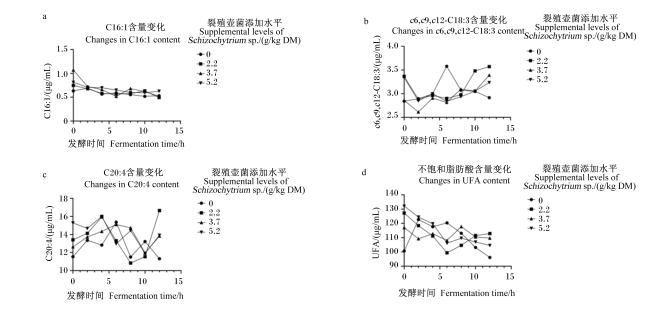
裂殖壶菌添加水平和发酵时间对发酵液中C16∶1、c6,c9,c12-C18∶3、C20∶4和不饱和脂肪酸含量存在显著交互作用(P<0.05)。由图1-a可知,在发酵6~8 h时,3.7 g/kg DM裂殖壶菌组发酵液中C16∶1含量呈上升趋势,而其他3组均呈下降趋势。由图1-b可知,在发酵4~6 h时,对照组发酵液中c6,c9,c12-C18∶3含量呈上升趋势,而各裂殖壶菌添加组均呈下降趋势。由图1-c可知,在发酵10~12 h时,对照组发酵液中C20∶4含量呈下降趋势,而各裂殖壶菌添加组均呈上升趋势。由图1-d可知,在发酵6 h时,对照组发酵液中不饱和脂肪酸含量为4组中最高,而随着发酵时间的延长,在发酵12 h时,各裂殖壶菌添加组发酵液中不饱和脂肪酸含量均高于对照组。
图1 发酵液中脂肪酸含量随发酵时间的变化

Fig.1 Changes in fatty acid contents in fermentation liquid over fermentation time

3 讨论

3.1 不同添加水平裂殖壶菌对体外瘤胃发酵参数的影响

瘤胃内环境的稳定是瘤胃微生物存活的基础,而pH是反映瘤胃发酵稳态的基本指标,研究认为,瘤胃液pH在6.0~6.3之间最适合瘤微生物的正常活动[9]。本研究中,各组间发酵液pH无显著差异,在6.10~6.14之间,属于正常瘤胃发酵的pH区间。瘤胃液中的NH3-N含量是反映瘤胃氨代谢的重要指标,也是瘤胃微生物合成MCP的前体物质[10]。本研究中,5.2 g/kg DM裂殖壶菌组发酵液中NH3-N含量较对照组显著降低;各裂殖壶菌添加组发酵液中MCP含量均高于对照组,但差异不显著。这可能是由于本研究所使用的发酵底物精粗比约为70∶30,属于高精料饲粮。已有研究表明,在适宜的精粗比条件下,随着饲粮精料水平的提高,瘤胃MCP含量会随之增加;但当精料水平过高时,虽然可以提供足够的能量,但会影响瘤胃微生物区系,降低纤维降解菌的丰度,从而影响MCP的合成[11]。Del valle等[12]在奶牛的饲粮中添加脂肪酸,结果表明添加脂肪酸组瘤胃液中NH3-N含量较对照组降低;Pi等[13]的研究也表明,在奶牛饲粮中添加4%的亚麻籽油会使瘤胃液中NH3-N含量下降,这与本研究结果一致。VFA由瘤胃微生物发酵饲粮中的碳水化合物转化而成,可以维持瘤胃健康并为反刍动物提供能量。Toral等[14]在奶牛饲粮中添加2.2% DM的鱼油,结果显示,瘤胃中乙酸含量降低而丙酸含量显著升高,导致乙丙比明显降低;刘亮等[15]利用双外流连续瘤胃模拟系统,在饲粮中添加0.65% C22∶5(EPA)/DHA,也观察到了类似结果。然而,Marques等[16]在奶牛饲粮中添加不同水平的富DHA微藻(0.350~1.049 g/kg DM DHA),发现此添加水平对瘤胃内的丙酸和丁酸含量没有显著影响,这与本研究的结果一致。本研究中,各组间发酵液中乙酸、丙酸、丁酸以及总挥发性脂肪酸含量并没有显著差异。这可能是由于本研究中裂殖壶菌添加水平较低,没有对瘤胃微生物群落产生实质性影响,因此未改变瘤胃的发酵模式,对VFA含量的影响也不显著。综上可知,本研究中裂殖壶菌的添加水平对瘤胃发酵无负面影响,且不会改变瘤胃发酵模式。

3.2 不同添加水平裂殖壶菌对体外瘤胃发酵DMD及产气的影响

添加油脂物质对DMD的影响在不同研究中存在差异。此前研究证实,在反刍动物饲粮中添加脂肪会导致DMD降低,尤其是对纤维降解率的抑制作用更为显著[17-18],这与油脂对瘤胃纤维分解菌及微生物群落的影响有关[19]。不过,Vargas等[20]利用双外流连续瘤胃模拟系统,在反刍动物饲粮中添加20 g/kg DM葵花籽油和10 g/kg DM藻油(含1.99 g/kg DM DHA),发现该油脂添加水平下,瘤胃纤维降解相关菌群未发生显著变化,DMD也无显著变化,这与本研究结果一致。本研究中,添加2.2~5.2 g/kg DM裂殖壶菌(含0.75~1.75 g/kg DM DHA)对DMD没有显著影响,表明该添加水平不会对瘤胃的饲粮消化能力产生负面影响。瘤胃是一个复杂的微生态系统,在瘤胃发酵过程中,瘤胃微生物会利用饲粮中的碳水化合物产生CH4和CO2。CH4的生成会造成饲粮能量浪费,导致饲粮的利用率降低,并且CH4和CO2也是大气中主要的温室气体,会对自然环境产生负面影响[21]。张然等[22]研究发现,反刍动物饲粮中添加不同水平牛至油时,高添加水平组可显著降低体外瘤胃发酵产气量及CH4产量,而低添加水平组则无显著变化。张雨等[23]的研究也发现,反刍动物饲粮中椰子油添加水平达7%以上时,体外瘤胃发酵产气量显著降低。本研究中,添加裂殖壶菌对体外瘤胃发酵24 h累计产气量及CH4产量、CO2产量没有显著影响,可能是由于本研究中的裂殖壶菌添加水平未改变瘤胃发酵模式,因此对24 h累计产气量及CO2产量无显著作用;同时,该添加水平可能对瘤胃氢化的抑制作用有限,因此不足以与产甲烷菌竞争氢气以有效抑制CH4的生成,故对CH4产量也无显著影响。

3.3 不同添加水平裂殖壶菌对体外瘤胃发酵脂肪酸组成的影响

脂质在瘤胃中可被微生物水解为游离脂肪酸,其中不饱和脂肪酸会进一步在微生物作用下发生生物氢化。C18∶0等饱和脂肪酸是其他多不饱和脂肪酸生物氢化形成的主要终产物,在多不饱和脂肪酸氢化的过程中也会造成t11-C18∶1和t9-C18∶1等中间产物的积累,t11-C18∶1和t9-C18∶1是共轭亚油酸(CLA)的前体化合物,与增强免疫功能相关[24]。饲粮中添加一定水平的多不饱和脂肪酸会改变微生物对不饱和脂肪酸氢化的途径,导致氢化率下降。多项研究已证实,饲粮中添加多不饱和脂肪酸会导致瘤胃脂肪酸中C18∶0含量下降[25-27]。本研究结果表明,与对照组相比,3.71 g/kg DM裂殖壶菌组发酵液中C18∶0含量显著降低,这与前人的研究结果一致,且3.71 g/kg DM裂殖壶菌组发酵液中t9-C18∶1含量显著升高;各组间发酵液中t11-C18∶1含量虽然没有显著差异,但各裂殖壶菌添加组t11-C18∶1含量较对照组均有所提高。此外,2.2和3.7 g/kg DM裂殖壶菌组发酵液中t9,c11-C18∶2含量高于对照组,这可能是由于裂殖壶菌的添加导致瘤胃中多不饱和脂肪酸氢化不完全,使中间产物积累所致。
本研究结果表明,各裂殖壶菌添加组发酵液中C22∶2和C22∶0含量均高于对照组,且5.2 g/kg DM裂殖壶菌组的含量最高,可能是由于DHA被瘤胃微生物氢化后生成的终产物和中间产物增加导致,说明当裂殖壶菌添加水平达到5.2 g/kg DM时,瘤胃氢化生成的终产物和中间产物更多,即DHA在瘤胃中的氢化率更高。已有研究表明,绵羊瘤胃体外发酵6 h后,DHA的氢化过程与C18∶0的氢化过程类似,碳链保留了C22∶0的结构,并且C22∶0含量显著增加[28]。尽管奶牛瘤胃中C22∶0可通过C18∶0延长碳链合成,但受到瘤胃微生物和相关酶的限制,合成效率很低,本研究结果也证明了这一点:与对照组相比,5.2 g/kg DM裂殖壶菌组发酵液中C18∶0含量无显著变化,而C22∶0含量显著升高,这说明C22∶0主要通过不饱和脂肪酸氢化生成,而非C18∶0的碳链延长。本研究中,裂殖壶菌的添加使发酵液中DHA含量显著增加,并且呈显著二次曲线变化,当添加量为5.2 g/kg DM时,DHA含量最高,但3.7和5.2 g/kg DM裂殖壶菌组之间无显著差异。这可能是由于随着裂殖壶菌添加水平的增加,DHA氢化率也随之升高,导致在更高添加水平下DHA含量不再持续提升,这与5.2 g/kg DM裂殖壶菌组发酵液中氢化终产物和中间产物C22∶2和C22∶0含量最高的结果一致。因此,本研究中裂殖壶菌添加水平为3.7 g/kg DM时对瘤胃脂肪酸组成的改善效果最好。

4 结论

在本试验条件下,裂殖壶菌能够改变体外瘤胃发酵脂肪酸组成,使得瘤胃脂肪酸氢化中间产物增加,发酵液中DHA含量升高;同时,其对瘤胃发酵无不利影响,未改变发酵模式。综合来看,裂殖壶菌最佳添加水平为3.7 g/kg DM。
[1]
蒋彩云, 时学锋, 陈若晨, 等. ω-3多不饱和脂肪酸强化鸡蛋的研究进展[J]. 中国家禽, 2023, 45(9):82-89.

JIANG C Y, SHI X F, CHEN R C, et al. Research advances on ω-3 polyunsaturated fatty acids enriched eggs[J]. China Poultry, 2023, 45(9):82-89. (in Chinese)

[2]
宫嘉泰, 胡睿智, 杨茜梓, 等. 裂殖壶藻的生理功能及其在畜牧生产中的应用[J]. 动物营养学报, 2022, 34(3):1476-1485.

DOI

GONG J T, HU R Z, YANG Q Z, et al. Biological function and application of Schizochytrium in livestock production[J]. Chinese Journal of Animal Nutrition, 2022, 34(3):1476-1485. (in Chinese)

[3]
LAURITZEN L, BRAMBILLA P, MAZZOCCHI A, et al. DHA effects in brain development and function[J]. Nutrients, 2016, 8(1):6.

[4]
VALENÇA R D L, SILVA SOBRINHO A G D, BORGHI T H, et al. Performance,carcass traits,physicochemical properties and fatty acids composition of lamb’s meat fed diets with marine microalgae meal (Schizochytrium sp.)[J]. Livestock Science, 2021,243:104387.

[5]
SINEDINO L D P, HONDA P M, SOUZA L R L, et al. Effects of supplementation with docosahexaenoic acid on reproduction of dairy cows[J]. Reproduction, 2017, 153(5):707-723.

[6]
MAVROMMATIS A, CHRONOPOULOU E G, SOTIRAKOGLOU K, et al. The impact of the dietary supplementation level with Schizochytrium sp. on the oxidative capacity of both goats’ organism and milk[J]. Livestock Science, 2018,218:37-43.

[7]
MCDOUGALL E I. The composition and output of sheep’s saliva[J]. The Biochemical Journal, 1948, 43(1):99-109.

[8]
ZHAN T F, GUO X, MA L, et al. Biotin and leucine alone or in combination promoted the synthesis of odd-and branched-chain fatty acids in the rumen in vitro[J]. Agriculture, 2023, 13(1):145.

[9]
王庆丽, 田兰英, 赵仁义, 等. 影响奶牛瘤胃pH值的因素[J]. 河南畜牧兽医(综合版), 2008, 29(10):36-37.

WANG Q L, TIAN L Y, ZHAO R Y, et al. Factors affecting rumen pH in dairy cows[J]. Henan Journal of Animal Husbandry and Veterinary Medicine(Comprehensive Edition), 2008, 29(10):36-37. (in Chinese)

[10]
PILGRIM A F, WELLER R A, GRAY F V, et al. Synthesis of microbial protein from ammonia in the sheep’s rumen and the proportion of dietary nitrogen converted into microbial nitrogen[J]. British Journal of Nutrition, 1970, 24(2):589-598.

[11]
ZHOU X Q, ZHANG Y D, ZHAO M, et al. Effect of dietary energy source and level on nutrient digestibility,rumen microbial protein synthesis,and milk performance in lactating dairy cows[J]. Journal of Dairy Science, 2015, 98(10):7209-7217.

[12]
DEL VALLE T A, ZILIO E M C, GHIZZI L G, et al. Effect of calcium salts of fatty acids and level of rumen degradable protein on nitrogen metabolism and performance of dairy cows fed corn silage-based diets[J]. Livestock Science, 2021,254:104770.

[13]
PI Y, MA L, PIERCE K M, et al. Rubber seed oil and flaxseed oil supplementation alter digestion,ruminal fermentation and rumen fatty acid profile of dairy cows[J]. Animal, 2019, 13(12):2811-2820.

[14]
TORAL P G, BERNARD L, BELENGUER A, et al. Comparison of ruminal lipid metabolism in dairy cows and goats fed diets supplemented with starch,plant oil,or fish oil[J]. Journal of Dairy Science, 2016, 99(1):301-316.

[15]
刘亮, 王加启, 卜登攀, 等. EPA/DHA对体外发酵及瘤胃液脂肪酸组成的影响[J]. 中国畜牧兽医, 2008, 35(7):5-10.

LIU L, WANG J Q, BU D P, et al. Effects of dietary EPA/DHA supplementation on fermentation and fatty acid profiles in rumen fluid from artificial rumen[J]. China Animal Husbandry & Veterinary Medicine, 2008, 35(7):5-10. (in Chinese)

[16]
MARQUES J A, DEL VALLE T A, GHIZZI L G, et al. Increasing dietary levels of docosahexaenoic acid-rich microalgae:ruminal fermentation,animal performance,and milk fatty acid profile of mid-lactating dairy cows[J]. Journal of Dairy Science, 2019, 102(6):5054-5065.

[17]
BEAUCHEMIN K A, MCGINN S M, BENCHAAR C, et al. Crushed sunflower,flax,or canola seeds in lactating dairy cow diets:effects on methane production,rumen fermentation,and milk production[J]. Journal of Dairy Science, 2009, 92(5):2118-2127.

[18]
金恩望, 王加启, 卜登攀, 等. 利用体外产气法研究植物精油对瘤胃体外发酵和甲烷生成的影响[J]. 中国农业大学学报, 2013(3):120-127.

JIN E W, WANG J Q, BU D P, et al. Effects of essential oil on rumen fermentation and methanogenesis in vitro gas production[J]. Journal of China Agricultural University, 2013(3):120-127. (in Chinese)

[19]
PALMQUIST D L, JENKINS T C. Fat in lactation rations:review[J]. Journal of Dairy Science, 1980, 63(1):1-14.

[20]
VARGAS J E, ANDRÉS S, SNELLING T J, et al. Effect of sunflower and marine oils on ruminal microbiota,in vitro fermentation and digesta fatty acid profile[J]. Frontiers in Microbiology, 2017,8:1124.

[21]
JOHNSON K A, JOHNSON D E. Methane emissions from cattle[J]. Journal of Animal Science, 1995, 73(8):2483-2492.

DOI PMID

[22]
张然, 郑琛, 闫晓刚, 等. 体外产气法研究牛至油对绵羊瘤胃发酵特性和甲烷产量的影响[J]. 动物营养学报, 2018, 30(8):3168-3175.

ZHANG R, ZHENG C, YAN X G, et al. Effects of oregano oil on ruminal fermentation characteristics and methane production of sheep by gas production technique in vitro[J]. Chinese Journal of Animal Nutrition, 2018, 30(8):3168-3175. (in Chinese)

[23]
张雨, 施力光, 荀文娟, 等. 体外产气法研究椰子油对瘤胃发酵、菌群数量及酶活性的影响[J]. 中国畜牧杂志, 2019, 55(5):66-71.

ZHANG Y, SHI L G, XUN W J, et al. Effects of coconut oil supplementation on rumen fermentation,bacteria abundance and enzyme activity in vitro[J]. Chinese Journal of Animal Science, 2019, 55(5):66-71. (in Chinese)

[24]
KOBA K, YANAGITA T. Health benefits of conjugated linoleic acid (CLA)[J]. Obesity Research & Clinical Practice, 2014, 8(6):e525-e532.

[25]
KAIRENIUS P, LESKINEN H, TOIVONEN V, et al. Effect of dietary fish oil supplements alone or in combination with sunflower and linseed oil on ruminal lipid metabolism and bacterial populations in lactating cows[J]. Journal of Dairy Science, 2018, 101(4):3021-3035.

DOI PMID

[26]
DING S, MEALE S J, ALAZZEH A Y, et al. Effect of Propionibacterium freudenreichii in diets containing rapeseed or flaxseed oil on in vitro ruminal fermentation,methane production and fatty acid biohydrogenation[J]. Animal Production Science, 2017, 57(10):2051-2059.

[27]
SAY M, BÜYÜKKILIÇ BEYZI S. Increasing levels of microalga supplementation in diet on in vitro ruminal biohydrogenation and fermentation[J]. Animal Production Science, 2022, 62(18):1757-1765.

[28]
ALDAI N, DELMONTE P, ALVES S P, et al. Evidence for the initial steps of DHA biohydrogenation by mixed ruminal microorganisms from sheep involves formation of conjugated fatty acids[J]. Journal of Agricultural and Food Chemistry, 2018, 66(4):842-855.

DOI PMID

文章导航

/