研究论文

妊娠母猪和哺乳母猪粪便中细菌和真菌群落结构的多样性及互作关系分析

  • 叶振峰 , 1 ,
  • 娄浙赟 1 ,
  • 徐绅烜 1 ,
  • 金永辉 1 ,
  • 卢韬 1 ,
  • 王珊珊 1 ,
  • 孔令航 2 ,
  • 肖英平 2 ,
  • 温洋 , 2, *
展开
  • 1 宁海县动物卫生监督所, 宁波 315600
  • 2 浙江省农业科学院农产品质量安全与营养研究所, 农产品质量安全全国重点实验室, 杭州 310021
*温 洋,助理研究员,E-mail:

叶振峰(1979—),男,浙江宁海人,兽医师,学士,研究方向为动物营养与风险防控。E-mail:

收稿日期: 2025-08-14

  网络出版日期: 2026-03-16

基金资助

农产品质量安全全国重点实验室开放课题(10417000025CE0615G)

Analysis of Structural Diversity and Interaction Relationships of Fecal Bacterial and Fungal Communities of Pregnant Sows and Lactating Sows

  • YE Zhenfeng , 1 ,
  • LOU Zheyun 1 ,
  • XU Shenxuan 1 ,
  • JIN Yonghui 1 ,
  • LU Tao 1 ,
  • WANG Shanshan 1 ,
  • KONG Linghang 2 ,
  • XIAO Yingping 2 ,
  • WEN Yang , 2, *
Expand
  • 1 Ninghai Animal Health Supervision Institute, Ningbo 315600, China
  • 2 State Key Laboratory of Agricultural Product Quality and Safety, Institute of Agro-Product Safety and Nutrition, Zhejiang Academy of Agricultural Sciences, Hangzhou 310021, China
*assistant professor, E-mail:

Received date: 2025-08-14

  Online published: 2026-03-16

摘要

本试验旨在探究妊娠母猪和哺乳母猪粪便中细菌和真菌群落结构的多样性及互作关系。选用18头“长大”母猪,分别收集妊娠期和哺乳期的新鲜粪便样品,采用宏基因组测序技术分析粪便中细菌和真菌群落变化,并分析其互作关系。结果表明:1)α多样性分析发现,哺乳母猪粪便中细菌和真菌的Richness、Simpson和Pielou指数均显著高于妊娠母猪(P<0.05);β多样性分析发现,哺乳母猪和妊娠母猪的粪便中细菌和真菌群落分布存在显著差异(P<0.05)。2)在门水平上,与妊娠母猪相比,哺乳母猪粪便中拟杆菌门(Bacteroidota)、壶菌门(Chytridiomycota)的相对丰度升高,而螺旋体门(Spirochaetota)、担子菌门(Basidiomycota)的相对丰度降低。在属水平上,与妊娠母猪相比,哺乳母猪粪便中普雷沃氏菌属(Prevotella)、Faecousia、球孢霉属(Globomyces)和新美鞭菌属(Neocallimastix)的相对丰度升高,而密螺旋体属(Treponema)、梭菌属(Clostridium)、埃希氏菌属(Escherichia)、乳杆菌属(Lactobacillus)、毛霉菌属(Mucor)、硬皮地星属(Astraeus)的相对丰度降低。3)通过线性判别分析效应大小分析(LEFSe)鉴定出妊娠母猪和哺乳母猪粪便中9个显著差异细菌和21个显著差异真菌。其中,妊娠母猪粪便中大肠杆菌(Escherichia coli)、嗜淀粉乳杆菌(Lactobacillus amylovorus)、歧根毛霉(Mucor ambiguus)、烟曲霉(Aspergillus fumigatus)等的相对丰度显著高于哺乳母猪(P<0.05),而加州新美鞭菌(Neocallimastix californiae)、乙二醇土孢菌(Terrisporobacter glycolicus)等的相对丰度显著低于哺乳母猪(P<0.05)。4)相关性网络分析表明,妊娠母猪粪便中细菌与真菌间的互作连接度更高,互作关系更复杂,核心菌Lactobacillus amylovorus与多个真菌节点存在显著或极显著相关(P<0.05或P<0.01)。哺乳母猪粪便中互作网络相对简单,Lactobacillus amylovorus的互作对象减少。综上所述,妊娠母猪和哺乳母猪粪便中细菌和真菌结构呈现出显著差异并存在可能的互作关联,为探索母猪关键生理阶段的肠道微生态适应机制提供了新思路。

本文引用格式

叶振峰 , 娄浙赟 , 徐绅烜 , 金永辉 , 卢韬 , 王珊珊 , 孔令航 , 肖英平 , 温洋 . 妊娠母猪和哺乳母猪粪便中细菌和真菌群落结构的多样性及互作关系分析[J]. 动物营养学报, 2026 , 38(3) : 1767 -1777 . DOI: 10.12418/CJAN2026.143

Abstract

This study aimed to analysis of structural diversity and interaction relationships of fecal bacterial and fungal communities of pregnant sows and lactating sows. Eighteen Large Yorkshire sows were selected, and the fresh fecal samples were collected during pregnancy and lactation periods, respectively. The metagenomic sequencing technology was used to analyze the changes of bacterial and fungal communities in feces, and analysis their interaction relationships. The results showed as follows: 1) the α diversity analysis revealed that the Richness, Simpson and Pielou indexes of bacteria and fungi in feces of lactating sows were significantly higher than those of pregnant sows (P<0.05); the β diversity analysis revealed that there was significant difference in distribution of fecal bacterial and fungal communities between pregnant sows and lactating sows (P<0.05). 2) At the phylum level, compared with pregnant sows, the relative abundances of Bacteroidota and Chytridiomycota in feces of lactating sows were increased, while the relative abundances of Spirochaetota and Basidiomycota were y decreased. At the genus level, compared with pregnant sows, the relative abundances of Prevotella, Faecousia, Globomyces and Neocallimastix in feces of lactating sows were increased, while the relative abundances of Treponema, Clostridium, Escherichia, Lactobacillus, Mucor and Astraeus were decreased. 3) The linear discriminant analysis effect size (LEfSe) analysis identified 9 significantly different bacteria and 21 significantly different and fungi in feces of pregnant and lactating sows. Among them, the relative abundances of Escherichia coli, Lactobacillus amylovorus, Mucor ambiguus and Aspergillus fumigatus et al in feces of pregnant sows were significantly higher than those of lactating sows (P<0.05), while the relative abundances of Neocallimastix californiae and Terrisporobacter glycolicus et al were significantly lower than those of lactating sows (P<0.05). 4) The correlation network analysis revealed that the interaction connectivity between bacteria and fungi of pregnant sows was higher, with more complex interaction relationships, and the core bacterium, Lactobacillus amylovorus, had significant interaction with multiple fungal nodes (P<0.05 or P<0.01). The interaction network of lactating sows was relatively simpler, with a reduction in the interaction partners of Lactobacillus amylovorus. In summary, the fecal bacterial and fungal structures of pregnant sows and lactating sows exhibit significant differences and potential interaction associations, providing new insights into exploring the adaptation mechanisms of gut microbiota during key physiological stages of sows.

肠道微生物组成与饮食、环境和宿主遗传密切相关[1],在能量代谢、细胞增殖、组织发育等各种生理过程中发挥重要作用[2-3]。在养殖生产中,妊娠和哺乳是母猪的关键生理阶段,涉及到复杂的代谢变化,其肠道菌群结构不仅直接影响自身营养代谢,还通过母乳间接转移给后代,进而影响后代肠道健康[4-6]
在肠道微生物群落中,细菌和真菌是影响宿主健康的关键组分,并且在不同肠道消化物中的群落组成也存在差异[5]。对于猪而言,厚壁菌门(Firmicutes)和拟杆菌门(Bacteroidota)是其肠道内相对丰度最高的细菌菌门[7]。研究表明,妊娠期母猪回肠中Firmicutes的相对丰度呈下降趋势,而Firmicutes与Bacteroidota的比率升高可能更有助于母猪从食物中获取能量,促进机体脂肪储备[8-9]。同时,妊娠过程中母猪空肠中梭菌属(Clostridium)的相对丰度逐渐增加,这可能与其增强宿主抵抗病原体感染和维护肠道屏障的功能有关[8-9]。此外,哺乳期母猪肠道内瘤胃球菌科的相对丰度较高,该菌科成员具有强大的纤维素和木质素降解能力,有助于母猪更好地利用纤维物质[10]
在真菌方面,子囊菌门(Ascomycota)和担子菌门(Basidiomycota)是猪肠道内相对丰度最高的真菌菌门[11]。研究发现,部分肠道真菌与短链脂肪酸(short chain fatty acid,SCFA)的产生及膳食碳水化合物的代谢过程相关,可能通过促进肠道细胞分化成熟、维持肠道微环境稳态等方式发挥作用[12]。例如,酿酒酵母可分泌大量氨基酸调节机体代谢过程,并能够促进肠道中植物乳杆菌和乳酸乳球菌的定植与增长,进而产生更多供酿酒酵母利用的乳糖[13]。此外,念珠菌属被报道有助于促进Clostridium的定植[14],而肠杆菌科细菌则可能通过调节酵母菌相对丰度影响真菌群落[15]。总而言之,真菌作为肠道微生物的重要组成部分,在宿主正常妊娠期间具有改善免疫调节能力、促进肠道组织形成发育及维持肠道健康等作用。然而,目前关于母猪肠道真菌和细菌的互作机制鲜有报道。在母猪繁殖周期内,肠道细菌和真菌的互作直接影响宿主生理表型及后代健康。因此,本研究以“长大”杂交妊娠母猪和哺乳母猪为研究对象,旨在利用宏基因组测序技术,探究宿主肠道细菌和真菌群落组成结构、丰富度及多样性特征,并重点分析两者间的互作关系,为深入理解母猪繁殖周期肠道细菌和真菌的互作研究提供理论基础。

1 材料与方法

1.1 试验设计与样品采集

本研究的动物试验程序和动物保护方案由浙江省农业科学院实验动物福利伦理委员会审查批准(批准编号:ZAAS-2017-009)。
选择浙江省一典型规模化猪场的18头健康“长×大”母猪(体重为160~180 kg,胎次2胎),试验母猪在分娩前7 d转入分娩舍。母猪产仔性能如下:总产仔数(13.10±0.53)个,产活仔数(12.74±0.62)个,健仔数(11.25±0.45)个,弱仔数(1.00±0.22)个,死胎数(1.00±0.22)个,平均个体重(1.47±0.12) kg,初产窝重(17.63±0.36) kg。本研究分别统计了妊娠90 d母猪及产子后哺乳14 d母猪的平均日采食量(2.54和6.76 kg/d),并收集了相应阶段的新鲜粪便样品,将收集的样品装入无菌密封袋后置于液氮中速冻,运至实验室于-80 ℃冰箱保存,用于后续宏基因组测序。
在整个试验期间,所有试验猪自由饮水和采食,试验饲粮参照NRC(2012)猪营养需要标准配制,其组成及营养水平见表1
表1 试验饲粮组成及营养水平(饲喂基础)

Table 1 Composition and nutrient levels of experimental diets (as-fed basis)

项目
Items
妊娠期
Gestation
period
哺乳期
Lactation
period
原料 Ingredients
玉米 Corn 63.16 58.81
豆粕 Soybean meal 16.72 26.50
小麦麸 Wheat bran 14.35 8.61
豆油 Soybean oil 2.50 2.50
磷酸氢钙 CaHPO4 0.81 1.45
石粉 Limestone 1.17 1.05
食盐 NaCl 0.50 0.50
赖氨酸盐酸盐 Lys·HCl 0.23 0.08
L-苏氨酸 L-Thr 0.05
L-色氨酸 L-Trp 0.01
预混料 Premix1) 0.50 0.50
合计 Total 100.00 100.00
营养水平 Nutrient levels2)
消化能 DE/(MJ/kg) 13.68 13.94
干物质 DM 88.73 88.04
粗蛋白质 CP 15.12 18.11
粗纤维 CF 3.48 3.13
中性洗涤纤维 NDF 12.99 11.55
酸性洗涤纤维 ADF 5.03 4.78
钙 Ca 0.68 0.80
总磷 TP 0.58 0.68
有效磷 AP 0.29 0.34

1)预混料为每千克饲粮提供 The premix provided the following per kg of diets:VA 12 000 IU,VE 24 IU,VK3 2.0 mg,硫胺素 thiamine 2.0 mg,核黄素 riboflavin 6.0 mg,吡哆醇 pyridoxine 4.0 mg,VB12 24 μg,烟酸 niacin 30 mg,泛酸 pantothenic acid 20 mg,叶酸 folic acid 3.6 mg,生物素 biotin 0.4 mg,氯化胆碱 choline chloride 0.4 mg,Fe 96 mg,Cu 8.0 mg,Zn 120 mg,Mn 40 mg,I 0.56 mg,Se 0.4 mg。

2)干物质、粗蛋白质、粗纤维、钙和总磷为实测值,其他营养水平为计算值。DM, CP, CF, Ca and TP were measured values, while the other nutrient levels were calculated values.

1.2 指标测定

1.2.1 饲粮营养成分

干物质含量参照GB/T 6435—2014中方法测定,粗蛋白质含量参照GB/T 6432—2018中方法测定,粗纤维含量参照GB/T 6434—2022中方法测定,钙和总磷含量分别参照GB/T 6436—2018和GB/T 6437—2018中方法测定。其他营养水平参考NRC(2012)计算所得。

1.2.2 粪便总DNA提取和宏基因组测序

利用粪便DNA试剂盒(E.Z.N.A.® Stool DNA Kit,Omega Bio-Tek公司,美国)提取母猪粪便总DNA,使用分光光度计(Nanodrop 1000,Thermo Fisher Scientific公司,美国)和生物分析仪(2100 Bioanalyzer,Agilent公司,美国)分别进行DNA浓度测定和质量控制。将提取的总DNA进行建库和宏基因组高通量测序。采用超声破碎仪(S220 Focused-Ultrasonicator,Covaris公司,美国)对DNA进行剪切,使用约450 bp的片段构建测序文库,所有样本基于Illumina HiSeq X平台进行双端150 bp(PE150)测序。原始读数通过Trimmomatic软件进行质量过滤,去除接头污染和低质量序列,得到的valid reads用于进一步分析。
使用MEGAHIT软件从valid reads中生成每个样本的contigs,使用Prodigal软件(v2.6.3)预测组装contigs的开放阅读框(ORFs),通过CD-HIT软件对所有样本中的ORFs进行聚类,生成独特的基因集。选取每个聚类簇中最长的基因序列作为该基因集的代表序列。使用Salmon软件获得每个基因的读数数量,统计对应样本中的基因丰度。通过Kraken数据库确定每个样本的分类学信息,使用Bracken计算物种在各样本中的丰度。使用R软件(v4.3.1)进行α多样性和β多样性分析,通过线性判别分析效应大小(linear discriminant analysis effect size,LEfSe)分析细菌和真菌之间菌群结构的差异,取线性判别分析(linear discriminant analysis,LDA)值>3.5,基于Spearman相关系数对细菌和真菌进行相关性分析,|r|>0.6、P<0.05则表明细菌和真菌之间具有显著相关关系,利用Gephi软件(v0.9.2)绘制网络图。

1.3 数据处理与统计分析

采用SPSS 25.0软件对数据进行统计分析,运用独立样本t检验比较2组之间的微生物菌群差异,P<0.05为差异显著,结果以平均值和均值标准误表示。

2 结果与分析

2.1 宏基因组测序结果

36份粪便样本下机后共得到5 862 293 546个序列,平均每个样本162 841 487条序列。经过质控后,共得到5 226 093 826条高质量序列,平均每个样本145 169 273条序列。所有样本的Q20值均在96%以上,Q30值均在92%以上,表明碱基识别正确率较高。各样本的GC值在44%左右,表明宏基因组测序过程的序列偏向性影响较小,具有更高的覆盖度,能够代表粪便样本的菌群结构,可用于进一步分析。

2.2 妊娠母猪和哺乳母猪粪便中细菌和真菌群落的α多样性分析

表2可见,在细菌群落中,哺乳母猪的Richness、Simpson和Pielou指数均显著高于妊娠母猪(P<0.05);在真菌群落中,哺乳母猪的Richness、Simpson和Pielou指数同样显著高于妊娠母猪(P<0.05)。由此可见,哺乳母猪粪便微生物群落的多样性高于妊娠母猪。
表2 妊娠母猪和哺乳母猪粪便中细菌和真菌群落的α多样性指数 Table 2 α diversity indexes of fecal bacteria and fungi communities of pregnant sows and lactating sows
项目
Items
妊娠母猪
Pregnant sows
哺乳母猪
Lactating sows
SEM P
P-value
细菌 Bacteria
Richness指数 Richness index 9 022.389b 9 581.444a 209.372 <0.001
Simpson指数 Simpson index 0.977b 0.982a 0.002 <0.001
Pielou指数 Pielou index 0.566b 0.587a 0.006 <0.001
真菌 Fungi
Richness指数 Richness index 163.333b 343.000a 28.662 <0.001
Simpson指数 Simpson index 0.886b 0.947a 0.012 <0.001
Pielou指数 Pielou index 0.580b 0.694a 0.020 <0.001

同行数据肩标不同小写字母表示差异显著(P<0.05)。

In the same row, values with different small letter superscripts mean significant difference (P<0.05).

2.3 妊娠母猪和哺乳母猪粪便中细菌和真菌群落的β多样性分析

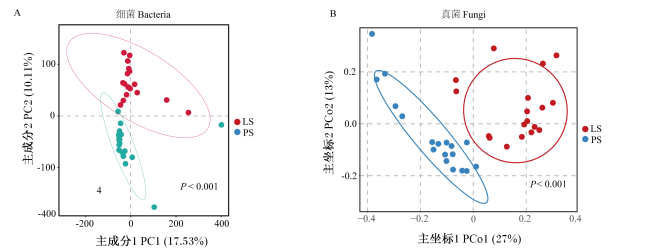
通过主成分分析(PCA)和主坐标分析(PCoA),对哺乳母猪和妊娠母猪的粪便微生物群落结构进行可视化分析,由图1可见,哺乳母猪和妊娠母猪的粪便中细菌和真菌群落分布存在显著差异(P<0.05)。
图1 妊娠母猪和哺乳母猪粪便细菌的主成分分析和真菌群落的主坐标分析

PS:妊娠母猪;LS:哺乳母猪;下图同。

Fig.1 PCA of fecal bacteria and and PCoA of fungi community of pregnant sows and lactating sows

PS: pregnant sows; LS: lactating sows. The same as below.

2.4 妊娠母猪和哺乳母猪粪便中细菌和真菌群落的物种组成

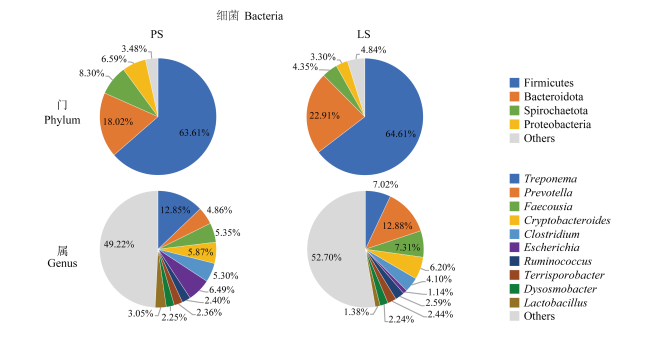
图2可见,细菌界中,在门水平上,Firmicutes、Bacteroidota、螺旋体门(Spirochaetota)、变形菌门(Proteobacteria)是妊娠母猪和哺乳母猪粪便中的优势细菌门,总体相对丰度占整个细菌群落的95%以上。其中,哺乳母猪粪便中Bacteroidota的相对丰度高于妊娠母猪,而Spirochaetota的相对丰度显著低于妊娠母猪。
图2 妊娠母猪和哺乳母猪在门和属水平上的细菌群落结构

Firmicutes:厚壁菌门;Bacteroidota:拟杆菌门;Spirochaetota:螺旋体门;Proteobacteria:变形菌门;Treponema:密螺旋体属;Prevotella:普雷沃氏菌属;Clostridium:梭菌属;Escherichia:埃希氏菌属;Ruminococcus:瘤胃球菌属;Terrisporobacter:土孢杆菌属;Dysosmobacter:难嗅杆菌属;Lactobacillus:乳杆菌属;Others:其他。

Fig.2 Bacteria community structure of pregnant sows and lactating sows at phylum and genus levels

在属水平上,密螺旋体属(Treponema)、普雷沃氏菌属(Prevotella)、FaecousiaCryptobacteroidesClostridium是妊娠母猪和哺乳母猪粪便中的优势细菌属。其中,哺乳母猪粪便中PrevotellaFaecousia的相对丰度高于妊娠母猪,而TreponemaClostridium、埃希氏菌属(Escherichia)、乳杆菌属(Lactobacillus)的相对丰度低于妊娠母猪。
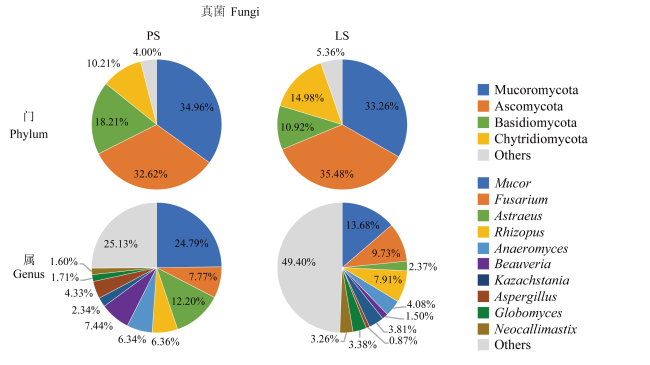
图3可见,真菌界中,在门水平上,毛霉门(Mucoromycota)、Ascomycota、Basidiomycota、壶菌门(Chytridiomycota)是妊娠母猪和哺乳母猪的优势真菌门,总体相对丰度占整个真菌群落的94%以上。其中,哺乳母猪粪便中Basidiomycota的相对丰度低于妊娠母猪,而Chytridiomycota的相对丰度高于妊娠母猪。
图3 妊娠母猪和哺乳母猪在门和属水平上的真菌群落结构

Mucoromycota:毛霉门;Ascomycota:子囊菌门;Basidiomycota:担子菌门;Chytridiomycota:壶菌门;Mucor:毛霉菌属;Fusarium:镰刀菌属;Astraeus:硬皮地星属;Rhizopus:根霉菌属;Anaeromyces:厌氧霉属;Beauveria:白僵菌属;Kazachstania:哈萨克斯坦酵母属;Aspergillus:曲霉菌属;Globomyces:球孢霉属;Neocallimastix:新美鞭菌属;Others:其他。

Fig.3 Fungi community structure of pregnant sows and lactating sows at phylum and genus levels

在属水平上,毛霉菌属(Mucor)、镰刀菌属(Fusarium)、硬皮地星属(Astraeus)和根霉菌属(Rhizopus)是妊娠母猪和哺乳母猪的优势真菌属。其中,哺乳母猪粪便中MucorAstraeus、白僵菌属(Beauveria)和曲霉菌属(Aspergillus)的相对丰度低于妊娠母猪,而球孢霉属(Globomyces)和新美鞭菌属(Neocallimastix)的相对丰度高于妊娠母猪。

2.5 妊娠母猪和哺乳母猪粪便中细菌和真菌群落的差异分析

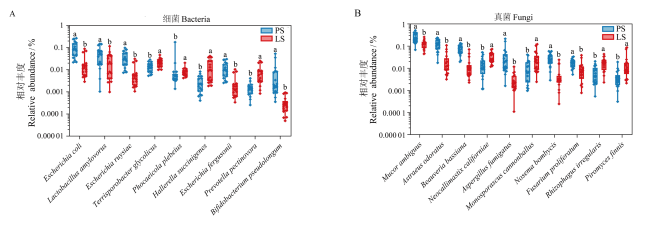
为了进一步揭示妊娠母猪和哺乳母猪粪便中细菌和真菌群落的结构差异,通过LEfSe分析筛选出相对丰度前9个差异细菌和前10个差异真菌(图4)。在细菌界中,妊娠母猪粪便中大肠杆菌(Escherichia coli)、嗜淀粉乳杆菌(Lactobacillus amylovorus)、鲁普氏埃希菌(Escherichia ruysiae)、弗格森埃希氏菌(Escherichia fergusonii)、假长双歧杆菌(Bifidobacterium pseudolongum)的相对丰度显著高于哺乳母猪(P<0.05),而乙二醇土孢菌(Terrisporobacter glycolicus)、平民海杆菌(Phocaeicola plebeius)、产琥珀酸哈勒氏菌(Hallerella succinigenes)、嗜果胶普雷沃氏菌(Prevotella pectinovora)的相对丰度显著低于哺乳母猪(P<0.05)。
图4 妊娠母猪和哺乳母猪粪便中差异细菌和差异真菌的相对丰度

Escherichia coli:大肠杆菌;Lactobacillus amylovorus:嗜淀粉乳杆菌;Escherichia ruysiae:鲁普氏埃希菌;Terrisporobacter glycolicus:乙二醇土孢菌;Phocaeicola plebeius:平民海杆菌;Hallerella succinigenes:产琥珀酸哈勒氏菌;Escherichia fergusonii:弗格森埃希氏菌;Prevotella pectinovora:嗜果胶普雷沃氏菌;Bifidobacterium pseudolongum:假长双歧杆菌;Mucor ambiguus:歧根毛霉;Astraeus odoratus:香星裂壳菌;Beauveria bassiana:球孢白僵菌;Neocallimastix californiae:加州新美鞭菌;Aspergillus fumigatus:烟曲霉;Monosporascus cannonballus:炮弹单孢囊菌;Nosema bombycis:家蚕微孢子虫;Fusarium proliferatum:增殖镰刀菌;Rhizophagus irregularis:异形根孢囊霉;Piromyces finnis:芬兰梨囊菌。

数据柱标不同小写字母表示差异显著(P<0.05)。

Fig.4 Relative abundances of differential bacteria and differential fungi in feces of pregnant sows and lactating sows

Value columns with different small letters mean significant difference (P<0.05).

在真菌界中,妊娠母猪分别中歧根毛霉(Mucor ambiguus)、香星裂壳菌(Astraeus odoratus)、球孢白僵菌(Beauveria bassiana)、烟曲霉(Aspergillus fumigatus)、家蚕微孢子虫(Nosema bombycis)、串珠镰刀菌(Fusarium proliferatum)的相对丰度显著高于哺乳母猪(P<0.05),而加州新美鞭菌(Neocallimastix californiae)、炮弹单孢囊菌(Monosporascus cannonballus)、异形根孢囊霉(Rhizophagus irregularis)、芬兰梨囊菌(Piromyces finnis)的相对丰度显著低于哺乳母猪(P<0.05)。

2.6 妊娠母猪和哺乳母猪粪便中细菌和真菌的相关性分析

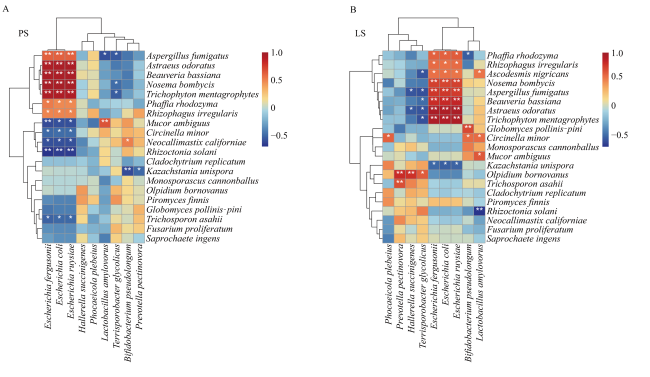
基于Spearman相关系数(|r|>0.6、P<0.05)分别对妊娠母猪和哺乳母猪粪便中细菌和真菌进行相关性分析(图5),结果发现妊娠母猪和哺乳母猪粪便中Escherichia fergusonii均与Nosema bombycisAstraeus odoratusBeauveria bassiana和须癣毛癣菌(Trichophyton mentagrophytes)呈极显著正相关(P<0.01),与燕麦镰孢菌(Fusarium avenaceum)呈极显著负相关(P<0.01)。不同的是,妊娠母猪粪便中Lactobacillus amylovorusMucor ambiguus呈极显著正相关(P<0.01),而与Aspergillus fumigatus呈显著负相关(P<0.05);哺乳母猪粪便中Lactobacillus amylovorus与黑瓶束盘菌(Ascodesmis nigricans)呈显著正相关(P<0.05),而与立枯丝核菌(Rhizoctonia solani)呈显著极负相关(P<0.01)。由此可见,从妊娠期到哺乳期,母猪肠道菌群的互作关系发生结构性变化,妊娠期表现为以Lactobacillus amylovorus为中心的复杂互作网络,与其维持免疫与代谢稳态的生理状态相符。哺乳期则呈现互作简化、核心菌关联减少的特征,反映出菌群功能向能量与营养代谢集中的适应性转变。这一变化与母猪从妊娠维持到泌乳供能的繁殖生理阶段转换相一致。
图5 妊娠母猪和哺乳母猪粪便中细菌和真菌的相关性热图

Terrisporobacter glycolicus:乙二醇土孢菌;Hallerella succinigenes:产琥珀酸哈勒氏菌;Prevotella pectinovora:嗜果胶普雷沃氏菌;Lactobacillus amylovorus:嗜淀粉乳杆菌;Phocaeicola plebeius:平民海杆菌;Bifidobacterium pseudolongum:假长双歧杆菌;Escherichia fergusonii:弗格森埃希氏菌;Escherichia coli:大肠杆菌;Escherichia ruysiae:鲁普氏埃希菌;Mucor ambiguus:歧根毛霉;Fusarium proliferatum:增殖镰刀菌;Aspergillus fumigatus:烟曲霉;Trichophyton mentagrophytes:须癣毛癣菌;Phaffia rhodozyma:红法夫酵母;Beauveria bassiana:球孢白僵菌;Astraeus odoratus:香星裂壳菌;Nosema bombycis:家蚕微孢子虫;Olpidium bornovanus:博诺瓦油壶菌;Trichosporon asahii:阿萨希毛孢子菌;Saprochaete ingens:巨大腐殖霉;Circinella minor:小卷霉;Cladochytrium replicatum:复制枝壶菌;Ascodesmis nigricans:黑褐囊霉;Kazachstania unispora:单孢哈萨克酵母;Rhizoctonia solani:立枯丝核菌;Neocallimastix californiae:加州新美鞭菌;Globomyces pollinis-pini:松花粉球孢菌;Piromyces finnis:芬兰梨囊菌;Monosporascus cannonballus:炮弹单孢囊菌;Rhizophagus irregularis:不规则根孢菌。

*表示显著相关(P<0.05),**表示极显著相关(P<0.01)。

Fig.5 Heatmap of fecal bacterial and fungal correlations of pregnant sows and lactating sows

* indicated significant correlation (P<0.05), and ** indicated extremely significant correlation (P<0.05).

2.7 妊娠母猪和哺乳母猪粪便细菌与真菌的关联分析

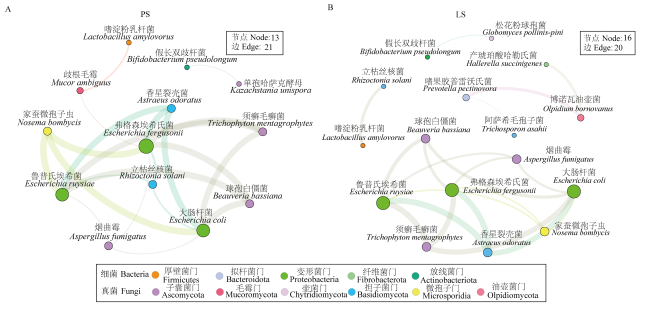
为了探究妊娠母猪和哺乳母猪粪便细菌和真菌之间的互作关系,基于Spearman相关系数(|r|>0.6、P<0.01)对筛选出的细菌和真菌分别构建互作网络图(图6),发现妊娠母猪中细菌与真菌的连接度最高,表明母猪在妊娠期细菌和真菌的互作效应较强。妊娠母猪中互作关系分为2个集群,Lactobacillus amylovorus通过2个节点(Mucor ambiguusEscherichia fergusonii)与Nosema bombycisRhizophagus irregularisAspergillus fumigatus等发生互作关系。哺乳母猪中互作关系分为4个集群,Lactobacillus amylovorus的集群中,其仅与Rhizoctonia solani发生互作关系。这与相关性分析结果一致。
图6 妊娠母猪和哺乳母猪粪便细菌和真菌互作网络分析

Fig.6 Interaction network analysis of fecal bacteria and fungi between pregnant sows and lactating sows

3 讨论

粪便微生物菌群与宿主的健康密切相关,参与机体的各种代谢过程[5,16]。妊娠改变了母体的生理状态,导致肠道菌群也随之发生动态变化[4,17]。值得注意的是,妊娠期与哺乳期饲粮配方存在差异,这也会影响菌群的结构与功能。研究发现,妊娠期间母猪粪便的细菌多样性逐渐降低[17],这与本研究中哺乳母猪粪便细菌和真菌的Simpson指数显著高于妊娠母猪的结果相似,表明哺乳母猪菌群多样性提升可能是母猪饲粮差异与生理代谢转变共同作用的结果[18-19]。细菌界中,通过粪便结构分析发现Firmicutes和Bacteroidota是母猪粪便中的优势细菌门,这与Liu等[7,10]的研究结果一致。妊娠母猪Spirochaetota的相对丰度显著高于哺乳母猪,其能量需求低,饲粮含更多结构性碳水化合物(纤维素、木质素等),产生SCFA供能,维持妊娠期特定生理状态[20]。同时妊娠期饲粮中较高水平的不溶性纤维可能为Spirochaetota等纤维降解菌提供了特异性底物,这种纤维特性与菌群结构的适配性可能是维持妊娠期能量稳态的关键[21-22]。相关研究表明,Treponema是重要的结构性碳水化合物降解菌,并与妊娠期存在显著相关性[23],这与本研究结果一致。值得注意的是,Spirochaetota与Treponema的协同作用可能共同促进了妊娠期纤维素的降解效率,形成了针对结构性纤维的高效降解体系。哺乳母猪粪便中Bacteroidota的相对丰度显著高于妊娠母猪,因其需要大量能量维持泌乳,饲粮富含易发酵碳水化合物(单糖、双糖等)与高蛋白质原料(豆粕26.5%),而Bacteroidota能够编码糖类结合脂蛋白,并表达蛋白酶,协同降解淀粉与蛋白质[18],可满足宿主的高能量需求。哺乳母猪中Prevotella为优势菌属[21],这与高水平碳水化合物有关[20]。研究表明,摄入膳食纤维会增加肠道内Prevotella的相对丰度,并通过增加糖原储存改善葡萄糖代谢[22]。本试验结果表明,在真菌界中,通过粪便真菌结构分析发现Ascomycota和Basidiomycota是母猪粪便中的优势真菌门,这与前人的研究结果[11,24]一致;哺乳母猪粪便中Chytridiomycota的相对丰度显著高于妊娠母猪,可能与哺乳期饲粮纤维水平变化有关,虽然其小麦麸含量相比于妊娠期下降,但可能导致微生态竞争格局,使宿主更加需要该菌分泌的多种碳水化合物活性酶,补偿纤维总量降低的能量缺口[25];在属水平上,哺乳母猪粪便中MucorAstraeusBeauveriaAspergillus的相对丰度显著低于妊娠母猪,而GlobomycesNeocallimastix的相对丰度显著高于妊娠母猪,这与既往研究中Aspergillus在妊娠母猪粪便中相对丰度较高的研究结果[26]一致。因此,妊娠期与哺乳期饲粮结构、采食量的显著差异,很可能是驱动本研究观察到粪便菌群结构变化的关键因素。哺乳期饲粮的蛋白质与易发酵碳水化合物比例更高,且采食量大幅增加,这可能直接影响了与淀粉、蛋白质降解功能相关菌群的富集,如SpirochaetotaFaecousia。相反,妊娠期高纤维、限饲的饲粮模式,则更利于Proteobacteria和Prevotella等纤维降解菌的生态位形成。
互作网络分析显示,妊娠期细菌与真菌互作效应强于哺乳期,肠道微生物通过互利或偏害共生等方式形成复杂的微生物互作网络。本试验中,妊娠期关键互作菌Lactobacillus amylovorus的相对丰度显著高于哺乳期,该菌参与氨基酸代谢、促进碳水化合物的利用[27-28],还能抑制肠道病原菌[29]Aspergillus fumigatus威胁免疫低下个体,产生肺部肿大等病变[30]。本研究中,妊娠母猪粪便中Lactobacillus amylovorusAspergillus fumigatus呈显著负相关,哺乳母猪粪便中Lactobacillus amylovorusAscodesmis nigricans呈显著正相关,表明母猪妊娠期肠道菌群侧重抗菌免疫,哺乳期侧重物质的吸收利用,与本课题组前期研究结果[26]一致。此外,妊娠母猪粪便中细菌与真菌之间的互作关系更为复杂,核心菌株Lactobacillus amylovorus与多个真菌节点存在显著关联,表明其在妊娠期可能通过抑制病原真菌维护肠道健康,而哺乳期互作网络简化,Lactobacillus amylovorus的互作对象减少,反映出该阶段微生物群落的功能重心转向营养代谢与能量获取,这与前人研究结果[31]一致。综上所述,母猪繁殖周期中粪便细菌和真菌结构差异显著,这种差异源头可能与宿主繁殖生理阶段转变及饲粮营养输入协同驱动的微生物群落功能适配。妊娠期以能量储备和免疫稳态为核心需求,菌群结构倾向于纤维降解与免疫调节,而哺乳期转向高产奶所需的高效能量代谢,菌群则适配为以快速利用营养底物、高效供能为主。这一互作网络的阶段性转变表明,肠道菌群通过自身结构的适应性变化,响应了宿主从妊娠到哺乳的生理变迁,为探索母猪生理阶段肠道微生态适应机制提供理论参考。

4 结论

妊娠母猪和哺乳母猪粪便微生物α多样性和β多样性差异显著,两者细菌与真菌群落结构呈现明显分离。细菌方面,妊娠母猪粪便中以TreponemaClostridiumEscherichiaLactobacillus的相对丰度较高,而哺乳期母猪粪便中以PrevotellaFaecousia的相对丰度较高;真菌方面,妊娠母猪粪便中以MucorAstraeusBeauveriaAspergillus的相对丰度较高,哺乳母猪粪便中以GlobomycesNeocallimastix的相对丰度较高。相关性分析表明,妊娠期菌群互作更强,表明母猪生理阶段与饲粮模式是调控肠道微生态的关键。
[1]
RIAZ RAJOKA M S, SHI J L, MEHWISH H M, et al. Interaction between diet composition and gut microbiota and its impact on gastrointestinal tract health[J]. Food Science and Human Wellness, 2017, 6(3):121-130.

DOI

[2]
SONNENBURG J L, BÄCKHED F. Diet-microbiota interactions as moderators of human metabolism[J]. Nature, 2016, 535(7610):56-64.

DOI

[3]
WOO V, ALENGHAT T. Epigenetic regulation by gut microbiota[J]. Gut Microbes, 2022, 14(1):2022407.

DOI

[4]
MU Q H, CABANA-PUIG X, MAO J D, et al. Pregnancy and lactation interfere with the response of autoimmunity to modulation of gut microbiota[J]. Microbiome, 2019, 7(1):105.

DOI PMID

[5]
REN R C, ZHANG X J, LOU F F, et al. Intestinal fungi biogeography,succession and its association with diarrhea in pigs[J]. Journal of Animal Science and Biotechnology, 2025, 16(1):80.

DOI

[6]
FENG Y Y, WU H, FENG L H, et al. Maternal F-53B exposure during pregnancy and lactation induced glucolipid metabolism disorders and adverse pregnancy outcomes by disturbing gut microbiota in mice[J]. Science of the Total Environment, 2024, 915:170130.

DOI

[7]
MA L Y, TAO S Y, SONG T X, et al. Clostridium butyricum and carbohydrate active enzymes contribute to the reduced fat deposition in pigs[J]. iMeta, 2024, 3(1):e160.

DOI

[8]
XIE P F, HU C J, AZAD M A K, et al. Dynamic alteration in the gut microbiota and metabolome of Huanjiang mini-pigs during pregnancy[J]. BMC Veterinary Research, 2022, 18(1):385.

DOI

[9]
HE J W, GUO H D, ZHENG W J, et al. Heat stress affects fecal microbial and metabolic alterations of primiparous sows during late gestation[J]. Journal of Animal Science and Biotechnology, 2019, 10(1):84.

DOI

[10]
LIU H B, HOU C L, LI N, et al. Microbial and metabolic alterations in gut microbiota of sows during pregnancy and lactation[J]. The FASEB Journal, 2019, 33(3):4490-4501.

DOI

[11]
SOKOL H, LEDUCQ V, ASCHARD H, et al. Fungal microbiota dysbiosis in IBD[J]. Gut, 2017, 66(6):1039-1048.

DOI PMID

[12]
LI J Y, CHEN D W, YU B, et al. The fungal community and its interaction with the concentration of short-chain fatty acids in the faeces of Chenghua,Yorkshire and Tibetan pigs[J]. Microbial Biotechnology, 2020, 13(2):509-521.

DOI

[13]
PONOMAROVA O, GABRIELLI N, SÉVIN D C, et al. Yeast creates a niche for symbiotic lactic acid bacteria through nitrogen overflow[J]. Cell Systems, 2017, 5(4):345-357.e6.

DOI PMID

[14]
VAN LEEUWEN P T, VAN DER PEET J M, BIKKER F J, et al. Interspecies interactions between Clostridium difficile and Candida albicans[J]. mSphere, 2016, 1(6):e00187-16.

[15]
SOVRAN B, PLANCHAIS J, JEGOU S, et al. Enterobacteriaceae are essential for the modulation of colitis severity by fungi[J]. Microbiome, 2018, 6(1):152.

DOI PMID

[16]
WEN Y, LIU Q, ZENG H B, et al. Age-specific reference intervals for plasma amino acids and their associations with nutrient intake in the Chinese pediatric population[J]. iMeta, 2025, 4(3):e70051.

DOI

[17]
GAUKROGER C H, EDWARDS S A, WALSHAW J, et al. Shifting sows:longitudinal changes in the periparturient faecal microbiota of primiparous and multiparous sows[J]. Animal, 2021, 15(3):100135.

DOI

[18]
FOLEY M H, COCKBURN D W, KOROPATKIN N M. The Sus operon:a model system for starch uptake by the human gut Bacteroidetes[J]. Cellular and Molecular Life Sciences, 2016, 73(14):2603-2617.

DOI

[19]
HESS M, SCZYRBA A, EGAN R, et al. Metagenomic discovery of biomass-degrading genes and genomes from cow rumen[J]. Science, 2011, 331(6016):463-467.

DOI PMID

[20]
LAMENDELLA R, SANTO DOMINGO J W, GHOSH S, et al. Comparative fecal metagenomics unveils unique functional capacity of the swine gut[J]. BMC Microbiology, 2011, 11(1):103.

DOI

[21]
JIANG Q, ADEBOWALE T O, TIAN J Q, et al. Effects of dietary alpha-ketoglutarate on bacteria profiles in the faeces of lactating sows and their suckling piglets[J]. Archives of Animal Nutrition, 2020, 74(1):39-56.

DOI PMID

[22]
KOVATCHEVA-DATCHARY P, NILSSON A, AKRAMI R, et al. Dietary fiber-induced improvement in glucose metabolism is associated with increased abundance of Prevotella[J]. Cell Metabolism, 2015, 22(6):971-982.

DOI

[23]
SELVARAJAH S, RAN S L, ROBERTS N W, et al. Leptospirosis in pregnancy:a systematic review[J]. PLoS Neglected Tropical Diseases, 2021, 15(9):e0009747.

DOI

[24]
SU J W, HOU X W, LIU S, et al. Dynamic characterization of the changes in intestinal fungi and fecal metabolites during the reproductive cycle of sows[J]. Veterinary Research Communications, 2025, 49(2):116.

DOI

[25]
LANGE L, BARRETT K, PILGAARD B, et al. Enzymes of early-diverging,zoosporic fungi[J]. Applied Microbiology and Biotechnology, 2019, 103(17):6885-6902.

DOI

[26]
任若琛, 肖英平, 李阳, 等. 公猪和不同生理阶段母猪粪便真菌结构多样性分析[J]. 中国饲料, 2024(13):62-69.

REN R C, XIAO Y P, LI Y, et al. Analysis of fungal structural diversity in feces of boars and sows at different physiological phases[J]. China Feed, 2024(13):62-69. (in Chinese)

[27]
JIANG M Z, LIU C, XU C, et al. Gut microbial interactions based on network construction and bacterial pairwise cultivation[J]. Science China Life Sciences, 2024, 67(8):1751-1762.

DOI

[28]
JING Y J, MU C L, WANG H S, et al. Amino acid utilization allows intestinal dominance of Lactobacillus amylovorus[J]. The ISME Journal, 2022, 16(11):2491-2502.

DOI

[29]
HYNÖNEN U, KANT R, LÄHTEINEN T, et al. Functional characterization of probiotic surface layer protein-carrying Lactobacillus amylovorus strains[J]. BMC Microbiology, 2014, 14(1):199.

DOI

[30]
MATEOS-HERNÁNDEZ L, RISCO-CASTILLO V, TORRES-MARAVILLA E, et al. Gut microbiota abrogates anti-α-gal IgA response in lungs and protects against experimental Aspergillus infection in poultry[J]. Vaccines, 2020, 8(2):285.

DOI

[31]
FU Y Q, GOU W L, WU P, et al. Landscape of the gut mycobiome dynamics during pregnancy and its relationship with host metabolism and pregnancy health[J]. Gut, 2024, 73(8):1302-1312.

DOI PMID

文章导航

/