研究论文

饲粮中添加甜叶菊绿原酸对热应激黄羽肉鸡生长发育、肉品质、抗氧化能力及肠道形态的影响

  • 郭旭明 , 1, 2 ,
  • 陈静龙 2 ,
  • 邵丹 2 ,
  • 陶诗煜 1 ,
  • 施寿荣 , 2, *
展开
  • 1 华中农业大学动物科学技术学院, 武汉 430070
  • 2 江苏省家禽科学研究所, 扬州 225125
*施寿荣,研究员,博士生导师,E-mail:

郭旭明(2001—),男,山西忻州人,硕士研究生,研究方向为家禽营养与饲料科学。E-mail:

收稿日期: 2025-08-29

  网络出版日期: 2026-03-16

基金资助

江苏省科技项目-青年基金项目(BK20230728)

江苏省科技项目-青年基金项目(BK20220706)

扬州市科技计划项目-创新能力建设计划项目-市级重点实验室(YZ2024242)

扬州市科技计划(YZ2024080)

Effects of Stevia Chlorogenic Acid in Diets on Growth and Development, Meat Quality, Antioxidant Capacity and Intestinal Morphology of Yellow-Feathered Broilers under Heat Stress

  • GUO Xuming , 1, 2 ,
  • CHEN Jinglong 2 ,
  • SHAO Dan 2 ,
  • TAO Shiyu 1 ,
  • SHI Shourong , 2, *
Expand
  • 1 College of Animal Science and Technology, Huazhong Agricultural University, Wuhan 430070, China
  • 2 Jiangsu Institute of Poultry Sciences, Yangzhou 225125, China
*professor, E-mail:

Received date: 2025-08-29

  Online published: 2026-03-16

摘要

本试验旨在研究饲粮中添加甜叶菊绿原酸对热应激黄羽肉鸡生长发育、肉品质、抗氧化能力及肠道形态的影响。选取180只1日龄雄性快速型黄羽肉鸡,随机分为3组,每组6个重复,每个重复10只。对照组(CON组)和热应激组(HS组)饲喂基础饲粮,热应激+甜叶菊绿原酸组(SCGA组)在基础饲粮中添加100 mg/kg甜叶菊绿原酸。肉鸡饲喂至39日龄时,预饲喂7 d,CON组维持常温,HS组和SCGA组进行14 d的循环热应激处理。结果表明:1)与CON组相比,HS组的终末体重、平均日增重(ADG)、平均日采食量(ADFI)、法氏囊指数和脾脏指数显著降低(P<0.05),热应激处理第4、7、10和14天直肠温度显著升高(P<0.05),胸肌红度值、24 h pH和血清葡萄糖(GLU)含量显著降低(P<0.05),胸肌亮度值和血清谷草转氨酶(AST)活性显著升高(P<0.05),肝脏总胆固醇(TC)含量和总抗氧化能力(T-AOC)显著升高(P<0.05),回肠长度以及空肠和回肠绒毛高度和绒毛高度/隐窝深度(V/C)显著降低(P<0.05),空肠和回肠隐窝深度显著升高(P<0.05)。2)与HS组相比,SCGA组的热应激处理第10和14天直肠温度和胸肌24 h pH显著降低(P<0.05),胸肌红度值和肝脏指数显著升高(P<0.05),血清T-AOC显著降低(P<0.05),肝脏T-AOC和血清丙二醛(MDA)含量显著升高(P<0.05),回肠隐窝深度显著降低(P<0.05),回肠长度、空肠绒毛高度和回肠V/C显著升高(P<0.05)。综上所述,饲粮中添加甜叶菊绿原酸可以提高热应激黄羽肉鸡肉品质以及肝脏发育和抗氧化能力,缓解热应激导致的肠道形态损伤。

本文引用格式

郭旭明 , 陈静龙 , 邵丹 , 陶诗煜 , 施寿荣 . 饲粮中添加甜叶菊绿原酸对热应激黄羽肉鸡生长发育、肉品质、抗氧化能力及肠道形态的影响[J]. 动物营养学报, 2026 , 38(3) : 1911 -1923 . DOI: 10.12418/CJAN2026.154

Abstract

This experiment was conducted to investigate the effects of stevia chlorogenic acid in diets on growth and development, meat quality, antioxidant capacity and intestinal morphology of yellow-feathered broilers under heat stress. A total of 180 one-day-old male rapidly yellow-feathered broilers were randomly divided into 3 groups with 6 replicates in each group and 10 birds in each replicate. The control group (CON group) and heat stress group (HS group) were fed a basal diet, and the heat stress+stevia chlorogenic acid group (SCGA group) was fed the basal diet supplemented with 100 mg/kg stevia chlorogenic acid. When broilers were feeding to 39 days of age, pre-feeding 7 days, the CON group was maintained at room temperature, while the HS group and SCGA group underwent a 14 days cyclic heat stress treatment. The results showed as follows: 1) compared with the CON group, the final body weight, average daily gain (ADG), average daily feed intake (ADFI), bursa of Fabricius index and spleen index of the HS group were significantly decreased (P<0.05), the rectal temperature on days 4, 7, 10 and 14 of heat stress treatment were significantly increased (P<0.05), the redness value and 24 h pH of breast muscle and serum glucose (GLU) content were significantly decreased (P<0.05), the breast muscle lightness value and serum aspartate aminotransferase (AST) activity were significantly increased (P<0.05), the liver total cholesterol (TC) and total antioxidant capacity (T-AOC) were significantly increased (P<0.05), the ileal length and jejunal and ileal villus height and villus height to crypt depth ratio (V/C) were significantly decreased (P<0.05), and the jejunal and ileal crypt depth were significantly increased (P<0.05). 2) Compared with the HS group, the rectal temperature on days 10 and 14 of heat stress treatment and breast muscle 24 h pH of the SCGA group were significantly decreased (P<0.05), the breast muscle redness value and liver index were significantly increased (P<0.05), the serum T-AOC was significantly decreased (P<0.05), the liver T-AOC and serum malondialdehyde (MDA) content were significantly increased (P<0.05), the ileal crypt depth was significantly decreased (P<0.05), and the ileal length, jejunal villus height and ileal V/C were significantly increased (P<0.05). In conclusion, dietary supplemented with stevia chlorogenic acid can improve the meat quality and liver development and antioxidant capacity, and alleviate the heat stress-induced intestinal morphological damage of yellow-feathered broilers.

近年来,全球温度升高已然成为影响家禽养殖最为严重的环境因素之一。家禽由于全身覆羽毛、缺乏汗腺等自身特点,对高温环境更为敏感[1]。当饲养环境温度过高时,肉鸡会出现高温应激现象,饮水量和呼吸频率明显增加,采食量减少,行为发生改变[2]。热应激条件下,肉鸡机体内氧化还原反应失衡,从而导致氧化损伤和免疫功能受损,诱发肠道炎症,严重影响肉鸡的健康和生长性能[3]。为了行业的可持续发展,通过调控饲料营养缓解热应激的不良影响,对于家禽养殖具有重要意义。
甜叶菊(Stevia rebaudiana)属于菊科、甜叶菊属的多年生草本植物,因其主要的甜味化合物甜菊糖苷而广泛种植[4]。除了甜菊糖苷,甜叶菊提取物中还含有丰富的多酚类活性物质,其中主要成分为绿原酸(chlorogenic acid,CGA),包括绿原酸、异绿原酸和其他羟基肉桂酸,具有优异的抗氧化活性[5]。绿原酸广泛存在于许多植物和中草药中,作为一类天然的酚酸类化合物,在化学结构上具有邻位酚羟基,表现出显著的药理特性以及较强的抗氧化活性[6]。多项研究表明,绿原酸在抗炎、抑菌、抗氧化以及调节机体糖、脂代谢等方面发挥着积极作用,具有广泛的应用前景[7-9]。相关研究显示,饲粮中的绿原酸能够通过增强肉鸡组织器官的抗氧化能力,改善氧化应激导致的生长性能下降和肠道健康损伤[10]。此外,绿原酸作为抗应激饲料添加剂,可显著提高肉鸡胸肌的氧化稳定性,缓解氧化应激导致的肉品质下降[11]。然而,关于甜叶菊绿原酸(stevia chlorogenic acid,SCGA)对热应激黄羽肉鸡的影响知之甚少。因此,本试验旨在研究甜叶菊绿原酸对热应激黄羽肉鸡生长发育、肉品质、血清和肝脏生化指标、抗氧化能力及肠道形态的影响,为其作为饲料添加剂缓解家禽热应激损伤提供理论依据。

1 材料与方法

1.1 试验材料

1日龄雄性快速型黄羽肉鸡(青脚麻鸡),购自江苏立华牧业股份有限公司。甜叶菊绿原酸,其中CGA含量为21.00%,总糖含量为20.28%,水分含量为5.00%,其他成分含量为53.72%。

1.2 试验设计

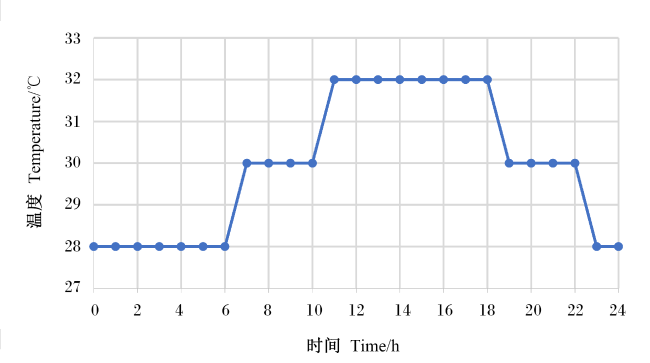
本试验所有程序均经江苏省家禽科学研究所动物伦理委员会批准(批准号:20230109)。选择体重相近的180只1日龄雄性快速型黄羽肉鸡,随机分为3组,分别为对照组(CON组)、热应激组(HS组)和热应激+甜叶菊绿原酸组(SCGA组),每组6个重复,每个重复10只。CON和HS组饲喂基础饲粮,SCGA组在基础饲粮中添加100 mg/kg甜叶菊绿原酸。肉鸡饲喂至39日龄时,预饲喂7 d,随后进行14 d的循环热应激处理。CON组维持常温[(26±1) ℃],HS组和SCGA组进行循环热应激处理,设置程序为:00:00—06:00和22:00—24:00,(28±1) ℃,共8 h;06:00—10:00和18:00—22:00,(30±1) ℃,共8 h;10:00—18:00,(32±1) ℃,共8 h,过渡阶段1 h内逐步升温或降温,循环热应激程序设定见图1
图1 循环热应激程序设定

Fig.1 Cyclic heat stress program setting

基础饲粮分为3个阶段(1~14日龄、15~35日龄、36~60日龄),参照《黄羽肉鸡营养需要量》(NY/T 3645—2020)配制并制粒,基础饲粮组成及营养水平见表1
表1 基础饲粮组成及营养水平(风干基础)

Table 1 Composition and nutrient levels of basal diets (air-dry basis)

项目
Items
1~14日龄
1 to 14 days of age
15~35日龄
15 to 35 days of age
36~60日龄
36 to 60 days of age
原料 Ingredients
玉米 Corn 62.70 64.74 67.35
豆粕 Soybean meal 29.80 26.79 22.70
玉米蛋白粉 Corn gluten meal 2.80 2.90 3.00
豆油 Soybean oil 0.80 1.85 3.50
石粉 Limestone 1.62 1.40 1.30
磷酸氢钙 CaHPO4 1.00 0.90 0.78
蛋氨酸 Met 0.24 0.28 0.25
赖氨酸 Lys 0.25 0.32 0.32
苏氨酸 Thr 0.14 0.17 0.15
植酸酶 Phytase 0.03 0.03 0.03
氯化胆碱 Choline chloride 0.09 0.09 0.09
微量元素预混料 Trace mineral premix1) 0.20 0.20 0.20
维生素预混料 Vitamin premix2) 0.03 0.03 0.03
食盐 NaCl 0.30 0.30 0.30
合计 Total 100.00 100.00 100.00
营养水平 Nutrient levels3)
代谢能 ME/(MJ/kg) 12.11 12.46 13.00
粗蛋白质 CP 20.50 19.53 17.96
钙 Ca 0.83 0.72 0.66
总磷 TP 0.45 0.43 0.41
非植酸磷 NPP 0.33 0.31 0.28
赖氨酸 Lys 1.09 1.09 1.00
蛋氨酸 Met 0.53 0.55 0.51
蛋氨酸+半胱氨酸 Met+Cys 0.80 0.81 0.75

1)微量元素预混料为每千克饲粮提供 Trace mineral premix provided the following per kg of diets: Fe 80.00 mg,Cu 8.00 mg,Mn 100.00 mg,Zn 80 mg,I 0.70 mg,Se 0.30 mg。

2)维生素预混料为每千克饲粮提供 Vitamin premix provided the following per kg of diets: VA 8 000 IU,VD3 1 000 IU,VE 20 IU,VK3 0.50 mg,VB1 2.00 mg,VB2 8.00 mg,VB6 3.50 mg,VB12 10.00 μg,烟酸 nicotinic acid 35.00 mg,泛酸钙 calcium pantothenate 10.00 mg,叶酸 folic acid 0.55 mg,生物素 biotin 0.18 mg。

3)代谢能、非植酸磷和氨基酸为计算值,计算方法参照NY/T 3645—2020;粗蛋白质、钙、总磷为实测值,测定方法分别参照GB/T 6432—2018、GB/T 6436—2018、GB/T 6437—2018。ME, NPP and amino acids were calculated values, and the calculation methods referred to NY/T 3645—2020; CP, Ca and TP were measured values, and the determination methods referred to GB/T 6432—2018, GB/T 6436—2018 and GB/T 6437—2018, respectively.

1.3 饲养管理

试验地点为江苏省家禽科学研究所仪征基地,动物养殖在营养代谢环控仓(北京库蓝科技有限公司)中进行,采用3层笼养,鸡笼规格为100 cm×80 cm×45 cm,保证饲养密度在0.1 m2/只左右,自由采食和饮水,24 h光照,相对湿度维持在(60±5)%。

1.4 样品采集及处理

试验结束时,各重复按平均体重选取试验鸡各1只,翅下静脉采集血液于促凝管中,静置2 h,于冷冻离心机(DL-5M,湖南湘仪实验室仪器开发有限公司)中2 060×g离心10 min,收集血清,用于检测血清生化和抗氧化指标。肉鸡处死后,采集肝脏、脾脏、胸腺、法氏囊、腹脂、睾丸、胸肌等器官,称重,用以计算器官指数;剪取十二指肠、空肠、回肠,用于检测肠道长度和形态;采集肝脏和空肠黏膜样品,置于液氮保存,用于检测肝脏生化和抗氧化指标以及空肠抗氧化指标。

1.5 指标检测

1.5.1 生长性能

于入舍前和循环热应激结束后,称量试验鸡体重;同时每日定时投喂饲粮,并记录每日采食量,计算试验期每只试验鸡的平均日增重(ADG)、平均日采食量(ADFI)、料重比(F/G)和死亡率。

1.5.2 直肠温度

在循环热应激处理第1、4、7、10和14天10:00,从每个重复中随机选取1只试验鸡,使用兽用电子体温计(32~44 ℃,河北易牧宝科技有限公司)测定其直肠温度。

1.5.3 肉品质

肉鸡屠宰后剖取左侧胸肌并称重,在4 ℃下保存,测定胸肌24 h的pH、失水率、剪切力和肉色[亮度(L*)、红度(a*)、黄度(b*)值]。
pH:使用德图半固体pH计(205-pH2,Testo公司,德国)分别对屠宰后24 h的胸肌样品进行pH检测,每个样品测定3次,结果取平均值。
失水率:采用滤纸挤压法测定。从每个样品中剪取5 g左右的胸肌样品,称重(m1),随后用滤纸将胸肌样品包裹好,使用压力机(YYW-2,南京土壤仪器厂有限公司)以35 kg压力持续挤压5 min,取出样品并称重(m2),按下式计算失水率:
失水率(%)=[(m1-m2)/m1]×100。
剪切力:取屠宰后的胸肌样品,用塑料袋包装后放置于80 ℃恒温水浴锅进行加热,当肉品中心温度达到75 ℃时取出,冷却至室温;然后沿肌纤维方向修成长5.0 cm、宽1.0 cm、高0.5 cm的长条,使用嫩度仪(TA-SR01,济南莱博质研仪器设备有限公司)进行测定,每个样品测定3次,结果取平均值。
肉色:将胸肌样品摆放平整,使用全自动色差仪(CR-400,Konica Minolta公司,日本)贴紧胸肌表面,在相同的位置连续测量3次,结果取平均值。

1.5.4 器官指数

器官指数计算公式如下:
器官指数(g/kg)=器官重量(g)/活鸡体重(kg)。

1.5.5 血清和肝脏生化指标

使用全自动血液生化分析仪(BS280,深圳迈瑞生物医疗电子股份有限公司)测定血清谷丙转氨酶(ALT)、谷草转氨酶(AST)活性及总胆固醇(TC)、甘油三酯(TG)、葡萄糖(GLU)、钠(Na)和氯(Cl)含量。
使用试剂盒(南京建成生物工程研究所)测定肝脏TC(货号A111-1-1)和TG(货号A110-1-1)含量。

1.5.6 血清、肝脏和空肠抗氧化指标

使用试剂盒(南京建成生物工程研究所)测定血清、肝脏和空肠谷胱甘肽过氧化物酶(GSH-Px,货号A005-1-2)、超氧化物歧化酶(SOD,货号A001-1-2)活性以及总抗氧化能力(T-AOC,货号A015-2-1)和丙二醛(MDA,货号A003-1-2)含量。

1.5.7 肠道长度和形态

剪取十二指肠、空肠、回肠后,测量其长度。十二指肠、空肠、回肠组织经4%多聚甲醛固定后,制备成石蜡切片并进行苏木精-伊红(HE)染色,在光学显微镜(DM-1000,Leica Microsystems Inc公司,德国)下测量绒毛高度、隐窝深度,并计算绒毛高度/隐窝深度(V/C)。

1.6 数据统计与分析

数据经Excel 2021进行统计和简单处理后,使用SPSS 27.0软件进行单因素方差分析(one-way ANOVA),并采用LSD法进行比较(CON组vs. HS组、HS组vs. SCGA组),结果以平均值±标准误表示,P<0.05为显著差异。

2 结果

2.1 饲粮中添加甜叶菊绿原酸对热应激黄羽肉鸡生长性能的影响

表2所示,与CON组相比,HS组的终末体重、ADG和ADFI均显著降低(P<0.05)。与HS组相比,SCGA组的终末体重、ADG、ADFI和F/G均无显著差异(P>0.05)。
表2 饲粮中添加甜叶菊绿原酸对热应激黄羽肉鸡生长性能的影响

Table 2 Effects of dietary stevia chlorogenic acid on growth performance of yellow-feathered broilers under heat stress

项目
Items
组别 Groups PP-value
CON HS SCGA P1 P2
终末体重 FBW/g 2 873.33±21.26 2 563.66±42.30 2 464.72±29.59 <0.001 0.058
平均日增重 ADG/g 67.14±0.74 54.24±2.43 55.20±2.17 <0.001 0.737
平均日采食量 ADFI/g 165.36±0.65 141.99±4.06 144.05±1.63 0.006 0.958
料重比 F/G 2.46±0.03 2.63±0.06 2.61±0.08 0.116 0.994
死亡率 Mortality/% 0.00 3.70 1.85

P1表示CON组与HS组之间的P值,P2表示HS组与SCGA组之间的P值。下表同。

The P1 represented the P-value between the CON group and the HS group, and the P2 represented the P-value between the HS group and the SCGA group. The same as below.

2.2 饲粮中添加甜叶菊绿原酸对热应激黄羽肉鸡直肠温度的影响

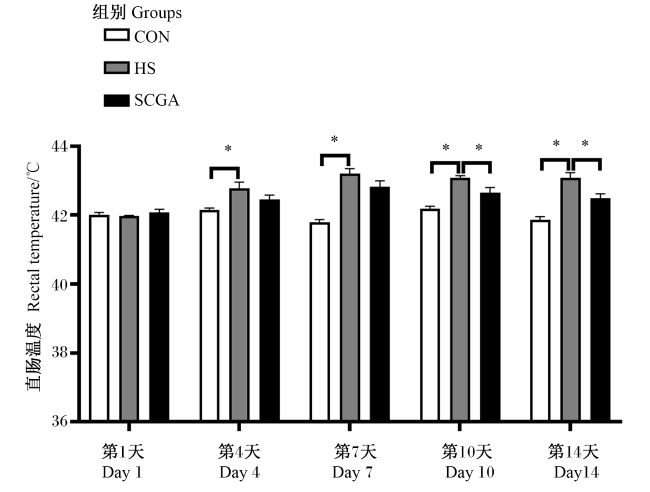
图2所示,与CON组相比,HS组在热应激处理第4、7、10和14天的直肠温度均显著升高(P<0.05)。而与HS组相比,SCGA组在热应激处理第10和14天的直肠温度均显著降低(P<0.05)。
图2 饲粮中添加甜叶菊绿原酸对热应激状态下黄羽肉鸡直肠温度的影响

数据柱形标注*表示差异显著(P<0.05)。

Fig.2 Effects of dietary stevia chlorogenic acid on rectal temperature of yellow-feathered broilers under heat stress

Value columns with * mean significant difference (P<0.05).

2.3 饲粮中添加甜叶菊绿原酸对热应激黄羽肉鸡肉品质的影响

表3所示,与CON组相比,HS组的胸肌亮度值显著升高(P<0.05),胸肌红度值和24 h pH显著降低(P<0.05)。与HS组相比,SCGA组的胸肌红度值显著升高(P<0.05),胸肌24 h pH显著降低(P<0.05)。
表3 饲粮中添加甜叶菊绿原酸对热应激黄羽肉鸡肉品质的影响

Table 3 Effects of dietary stevia chlorogenic acid on meat quality of yellow-feathered broilers under heat stress

项目
Items
组别 Groups PP-value
CON HS SCGA P1 P2
系水力 Water-holding capacity/% 32.54±1.70 30.37±1.13 29.69±1.10 0.269 0.725
剪切力 Shear force/kgf 2.86±0.23 3.22±0.40 2.87±0.15 0.370 0.388
亮度 L* 53.44±0.39 56.28±0.70 56.48±1.17 0.039 0.866
红度 a* 6.84±0.13 4.79±0.29 5.59±0.19 <0.001 0.022
黄度 b* 8.32±0.83 9.63±0.43 9.67±0.12 0.491 1.000
24 h pH 6.31±0.01 6.25±0.01 6.15±0.01 <0.001 <0.001

2.4 饲粮中添加甜叶菊绿原酸对热应激黄羽肉鸡器官指数的影响

表4所示,与CON组相比,HS组的脾脏指数和法氏囊指数显著降低(P<0.05)。与HS组相比,SCGA组的肝脏指数显著升高(P<0.05)。
表4 饲粮中添加甜叶菊绿原酸对热应激黄羽肉鸡器官指数的影响

Table 4 Effects of dietary stevia chlorogenic acid on organ indexes of yellow-feathered broilers under heat stress

项目
Items
组别 Groups PP-value
CON HS SCGA P1 P2
肝脏指数Liver index 15.42±0.30 14.76±0.39 16.37±0.25 0.159 0.004
脾脏指数 Spleen index 1.48±0.09 1.19±0.07 1.18±0.13 0.032 0.903
胸腺指数 Thymus index 2.68±0.34 2.12±0.32 2.31±0.44 0.238 0.741
法氏囊指数 Bursa of Fabricius index 1.64±0.18 1.02±0.11 1.08±0.16 0.007 0.815
腹脂指数 Abdominal fat index 18.60±1.35 17.86±1.36 13.40±1.93 0.715 0.056
睾丸指数 Testicles index 0.85±0.15 1.75±0.52 0.85±0.22 0.364 0.382
胸肌指数 Breast index 62.47±1.28 60.69±1.25 58.36±0.91 0.297 0.287

2.5 饲粮中添加甜叶菊绿原酸对热应激黄羽肉鸡肝脏生化指标的影响

表5所示,与CON组相比,HS组的肝脏TC含量显著升高(P<0.05)。与HS组相比,SCGA组的肝脏生化指标均无显著差异(P>0.05)。
表5 饲粮中添加甜叶菊绿原酸对热应激黄羽肉鸡肝脏生化指标的影响

Table 5 Effects of dietary stevia chlorogenic acid on liver biochemical indexes of yellow-feathered broilers under heat stress mol/g prot

项目
Items
组别 Groups PP-value
CON HS SCGA P1 P2
甘油三酯 TG 0.065±0.003 0.085±0.009 0.087±0.005 0.057 0.798
总胆固醇 TC 0.077±0.003 0.103±0.011 0.088±0.005 0.023 0.153

2.6 饲粮中添加甜叶菊绿原酸对热应激黄羽肉鸡血清生化指标的影响

表6所示,与CON组相比,HS组的血清AST活性显著升高(P<0.05),血清GLU含量显著降低(P<0.05)。与HS组相比,SCGA组的血清生化指标均无显著差异(P>0.05)。
表6 饲粮中添加甜叶菊绿原酸对热应激黄羽肉鸡血清生化指标的影响

Table 6 Effects of dietary stevia chlorogenic acid on serum biochemical indexes of yellow-feathered broilers under heat stress

项目
Items
组别 Groups PP-value
CON HS SCGA P1 P2
谷丙转氨酶 ALT/(U/L) 3.72±0.23 3.57±0.28 3.60±0.11 0.643 0.921
谷草转氨酶 AST/(U/L) 230.85±8.68 274.94±6.80 261.37±12.98 0.010 0.371
总胆固醇 TC/(mmol/L) 3.02±0.09 3.09±0.10 2.94±0.16 0.663 0.390
甘油三酯 TG/(mmol/L) 0.36±0.04 0.33±0.01 0.32±0.02 0.541 0.636
葡萄糖 GLU/(mmol/L) 12.84±0.11 11.76±0.29 11.73±0.29 0.007 0.928
钠 Na/(mmol/L) 45.41±0.99 46.40±1.52 44.89±0.65 0.540 0.355
氯 Cl/(mmol/L) 98.72±0.68 99.69±0.57 98.94±0.88 0.377 0.469

2.7 饲粮中添加甜叶菊绿原酸对热应激黄羽肉鸡血清、肝脏和空肠抗氧化指标的影响

表7所示,与CON组相比,HS组的肝脏T-AOC显著升高(P<0.05)。与HS组相比,SCGA组的肝脏T-AOC和血清MDA含量显著升高(P<0.05),血清T-AOC显著降低(P<0.05)。
表7 饲粮中添加甜叶菊绿原酸对热应激黄羽肉鸡血清、肝脏和空肠抗氧化指标的影响

Table 7 Effects of dietary stevia chlorogenic acid on serum, liver and jejunum antioxidant indexes of yellow-feathered broilers under heat stress

项目
Items
组别 Groups PP-value
CON HS SCGA P1 P2
谷胱甘肽过
氧化物酶
GSH-Px
血清 Serum/(U/mL) 2 617.339±139.829 2 839.657±132.318 2 568.669±140.527 0.241 0.202
肝脏 Liver/(U/mg prot) 18.744±0.804 18.645±1.165 19.152±1.164 0.944 0.755
空肠 Jejunum/(U/mg prot) 42.484±7.917 41.901±6.645 59.199±13.188 0.961 0.197
超氧化物
歧化酶
SOD
血清 Serum/(U/mL) 90.340±15.238 99.551±11.681 105.570±16.746 0.635 0.776
肝脏 Liver/(U/mg prot) 242.002±9.476 217.546±9.843 205.258±6.929 0.061 0.388
空肠 Jejunum/(U/mg prot) 397.060±12.500 439.492±18.153 413.282±14.999 0.053 0.280
总抗氧化能力
T-AOC
血清 Serum/(mmol/L) 0.494±0.016 0.531±0.017 0.438±0.013 0.096 <0.001
肝脏 Liver/(mmol/mg prot) 0.217±0.008 0.255±0.006 0.281±0.006 <0.001 0.016
空肠 Jejunum/(mmol/mg prot) 0.198±0.005 0.206±0.010 0.197±0.009 0.505 0.501
丙二醛
MDA
血清 Serum/(nmol/mL) 2.382±0.512 1.929±0.318 3.480±0.522 0.458 0.029
肝脏 Liver/(nmol/mg prot) 0.963±0.286 1.817±0.485 1.498±0.295 0.106 0.594
空肠 Jejunum/(nmol/mg prot) 1.661±0.233 2.328±0.418 1.560±0.258 0.151 0.131

2.8 饲粮中添加甜叶菊绿原酸对热应激黄羽肉鸡肠道长度的影响

表8所示,与CON组相比,HS组的回肠长度显著降低(P<0.05)。与HS组相比,SCGA组的回肠长度显著升高(P<0.05)。
表8 饲粮中添加甜叶菊绿原酸对热应激黄羽肉鸡肠道长度的影响

Table 8 Effects of dietary stevia chlorogenic acid on intestinal length of yellow-feathered broilers under heat stresscm

项目
Items
组别 Groups PP-value
CON HS SCGA P1 P2
十二指肠 Duodenum 26.90±0.49 26.00±2.06 31.00±1.41 0.969 0.214
空肠 Jejunum 63.50±1.93 57.33±3.03 60.42±1.39 0.069 0.342
回肠 Ileum 65.58±1.10 59.25±2.61 66.10±0.33 0.020 0.017

2.9 饲粮中添加甜叶菊绿原酸对热应激黄羽肉鸡肠道形态的影响

表9图3所示,与CON组相比,HS组的空肠和回肠绒毛高度和V/C显著降低(P<0.05),空肠和回肠隐窝深度显著升高(P<0.05)。与HS组相比,SCGA组的空肠绒毛高度和回肠V/C显著升高(P<0.05),回肠隐窝深度显著降低(P<0.05)。
表9 饲粮中添加甜叶菊绿原酸对热应激黄羽肉鸡肠道形态的影响

Table 9 Effects of dietary stevia chlorogenic acid on intestinal morphology of yellow-feathered broilers under heat stress

项目
Items
组别 Groups PP-value
CON HS SCGA P1 P2
十二指肠
Duodenum
绒毛高度 VH/μm 1 665.14±106.28 1 685.80±122.06 2 026.15±132.08 0.898 0.103
隐窝深度 CD/μm 218.21±7.48 243.46±13.93 255.26±57.02 0.387 0.997
绒毛高度/隐窝深度 V/C 7.92±0.54 7.41±0.47 9.11±1.59 0.590 0.157
空肠
Jejunum
绒毛高度 VH/μm 1 607.69±56.50 1 422.15±57.02 1 610.83±52.14 0.035 0.033
隐窝深度 CD/μm 171.31±7.30 202.27±2.30 201.67±13.00 0.037 0.966
绒毛高度/隐窝深度 V/C 9.13±0.54 7.21±0.40 8.24±0.36 0.010 0.147
回肠
Ileum
绒毛高度 VH/μm 1 394.02±83.92 1 057.53±48.79 1 131.10±48.66 0.002 0.405
隐窝深度 CD/μm 127.61±6.48 188.41±9.38 155.48±9.29 <0.001 0.017
绒毛高度/隐窝深度 V/C 9.93±0.96 5.63±0.36 7.83±0.17 0.015 0.012
图3 饲粮中添加甜叶菊绿原酸对热应激黄羽肉鸡肠道形态的影响

Fig.3 Effects of dietary stevia chlorogenic acid on intestinal morphology of yellow-feathered broilers under heat stress (50×)

3 讨论

3.1 饲粮中添加甜叶菊绿原酸对热应激黄羽肉鸡生长发育和直肠温度的影响

温度是影响家禽生长性能的主要环境因素,在高温环境下,呼吸频率增加,肉鸡饮水和采食量减少,而体内营养物质利用受限,生长速率受到抑制,生长性能降低[12]。体重的减少与采食量息息相关。Wang等[13]在热应激肉鸡的研究中发现,将28日龄的黄羽肉鸡暴露于高温环境下14 d之后,肉鸡的体重、ADG和ADFI显著低于常温对照组,热应激严重影响了肉鸡的健康和生长性能。研究表明,21日龄的罗斯(Ross)308肉鸡和科宝(Cobb)肉鸡在热应激条件下饲养14 d之后,ADG和ADFI显著降低,F/G和直肠温度显著升高,生长性能受到负面影响[14]。Li等[15]研究也显示,经热应激处理后肉鸡体温上升,直肠温度显著升高。在本研究中,HS组黄羽肉鸡经过14 d的循环热应激处理,终末体重、ADG和ADFI均显著降低,F/G和直肠温度显著升高,肉鸡死亡率增加,与上述研究结果一致,即热应激导致肉鸡生长性能下降。而饲粮中添加100 mg/kg甜叶菊绿原酸未显著影响热应激黄羽肉鸡的生长性能,这可能与其添加量有关。饲粮中添加不同剂量的甜叶菊绿原酸对家禽生长性能的影响已有报道。Liu等[16]研究表明,基础饲粮中添加100 mg/kg甜叶菊绿原酸显著升高了黄羽肉鸡的ADG,并降低了ADFI和F/G;而当添加量高达300 mg/kg时,体重和ADG显著降低。Zhao等[17]研究发现,饲喂添加500 mg/kg杜仲叶绿原酸的饲粮对热应激Ross 308肉鸡的生长性能无显著影响,而饲喂添加1 000 mg/kg杜仲叶绿原酸饲粮的肉鸡表现出更高的ADG以及更低的F/G。先前的研究也发现,基础饲粮中添加120 mg/kg甜叶菊绿原酸对产蛋后期蛋鸡的生产性能无显著影响[18]。不同添加量不同来源的绿原酸对家禽生长性能的影响不尽相同,可能与绿原酸有效成分的差异有关。
此外,热应激也会影响肉鸡的器官发育。法氏囊和脾脏是家禽重要的免疫器官,参与机体内的细胞和体液免疫。当肉鸡受到热应激时,法氏囊和脾脏的重量减少,器官指数降低[19]。He等[20]在研究热应激对黄羽肉鸡脾脏先天免疫和炎症反应的影响时发现,对28日龄的黄羽肉鸡进行为期14 d的热应激处理后,肉鸡的法氏囊指数和脾脏指数显著降低,先天免疫反应受到影响。本研究中,与CON组相比,HS组的法氏囊指数和脾脏指数显著降低,这表明热应激对免疫器官造成了损害。同时,肉鸡肝脏TC含量显著升高,热应激导致了肝脏脂质代谢紊乱。本试验中,饲喂饲粮中添加甜叶菊绿原酸饲粮的肉鸡肝脏器官指数显著升高。周思源等[21]研究发现,饲粮中添加异绿原酸对Cobb肉鸡胸腺、脾脏、法氏囊等免疫器官指数均无显著影响。Lu等[22]研究发现,7 d的热应激处理显著升高了爱拔益加(AA)肉鸡肝脏TG、TC含量。肝脏是机体重要的代谢器官,绿原酸在治疗代谢功能障碍相关肝病方面发挥着重要作用[23]。本研究结果显示,甜叶菊绿原酸对肉鸡的免疫器官发育无显著影响,可能通过其代谢途径作用于肝脏。

3.2 饲粮中添加甜叶菊绿原酸对热应激黄羽肉鸡血清生化指标的影响

血清生化指标反映着动物的健康和代谢状态。当肝脏组织细胞受到损伤时,ALT、AST、碱性磷酸酶(ALP)等酶释放到血液中,导致这些酶活性异常,较高的ALT、AST、ALP活性常标志着肝脏的损伤[24]。Luo等[25]研究表明,14和21 d的循环热应激处理降低了AA肉鸡的血清总蛋白(TP)和GLU含量,导致血清TG和TC含量以及乳酸脱氢酶(LDH)和AST活性显著升高。Wang等[13]的研究中也观察到了同样的结果,即热应激处理显著升高了血清AST、ALT、LDH活性,降低了血清ALP活性和GLU含量。本研究发现,14 d的循环热应激处理显著升高了肉鸡血清AST活性,并显著降低血清GLU含量,这表明热应激期间肉鸡机体内糖代谢发生变化,肝脏受到损伤。孟洪令等[26]在绿原酸对免疫应激肉鸡肝脏损伤缓解作用的研究中发现,饲粮中添加500和750 mg/kg的绿原酸均可使AA肉鸡血清ALT、AST活性恢复至对照组水平。而在Shi等[27]的研究中,灌胃45 mg/kg的绿原酸对镉中毒三黄鸡血清AST、ALP等生化指标无治疗效果。绿原酸作为酚酸类化合物,可通过多种代谢途径调节组织细胞的糖、脂代谢[28]。本研究中,饲粮中添加甜叶菊绿原酸对热应激肉鸡血清生化指标均无显著影响,这可能是由于试验处理、绿原酸添加量以及肉鸡品种不同导致的。

3.3 饲粮中添加甜叶菊绿原酸对热应激黄羽肉鸡肉品质的影响

目前常用肉的嫩度、肉色、系水力以及pH等指标反映肉品质,而热应激不仅会影响家禽肌肉的生长,还会损伤肉鸡肉品质,导致鸡肉红度值和pH显著降低,亮度值和滴水损失显著升高[29]。Lu等[30]研究发现,经过14 d循环热应激处理,AA肉鸡胸肌的剪切力和24 h pH显著低于常温对照组,亮度值和滴水损失显著升高,热应激通过增加糖酵解和脂肪沉积降低肉品质。与以往的研究一致,本研究中14 d的循环热应激处理导致了黄羽肉鸡胸肌亮度值显著升高,红度值和24 h pH显著降低,胸肌肉品质下降。饲粮中添加甜叶菊绿原酸改善了热应激肉鸡的胸肌肉色,24 h pH显著降低。相关研究显示,饲粮中添加400和600 mg/kg的金银花绿原酸显著升高了Ross 308肉鸡胸肌的红度值,降低了失水率,而对胸肌的24 h pH无显著影响[31]。Zhang等[32]研究结果显示,在免疫应激的Cobb肉鸡基础饲粮中添加500和750 mg/kg的绿原酸后,肉鸡胸肌的红度值和24 h pH显著升高,肉品质得到改善。肌红蛋白是肌肉中决定肉色的主要蛋白质,当肌红蛋白被氧化为高铁肌红蛋白时,肌肉肉色变深,红度和黄度值增加[33]。绿原酸作为一类天然抗氧化剂,可能通过发挥其抗氧化活性延缓热应激肉鸡胸肌高铁肌红蛋白的生成,从而提高肌肉的红度值。此外,pH反映了胴体糖酵解的速率,机体死亡后激发糖酵解途径,肌肉乳酸含量增加导致pH降低[34]。甜叶菊绿原酸可能促进了热应激黄肉鸡胸肌的糖酵解,从而影响pH。

3.4 饲粮中添加甜叶菊绿原酸对热应激黄羽肉鸡氧化应激的影响

正常情况下,机体内的氧化还原系统保持平衡的状态,而热应激会促进活性氧(ROS)过量生成和脂质过氧化,导致机体抗氧化能力失调,从而引发组织细胞的氧化损伤,严重影响肉鸡养殖的经济效益[35]。研究表明,抗氧化酶活性的差异变化与热应激的强度和持续时间息息相关。Tan等[36]在研究不同急性热应激对肉鸡氧化功能的影响中发现,3 h急性热应激显著升高了血清和肝脏SOD、过氧化氢酶(CAT)和GSH-Px等抗氧化酶活性和MDA含量,并以温度依赖性发生变化;而21 d持续热应激显著降低肉鸡血清GSH-Px、CAT活性以及T-AOC水平,显著升高了血清MDA含量[37]。相关研究显示,当基础饲粮中甜叶菊绿原酸的添加量超过200 mg/kg后,肉鸡血清T-AOC显著降低,血清MDA含量有所升高[16]。绿原酸由于其酚羟基结构能够消除羟基自由基和超氧阴离子的活性,具有很强的抗氧化作用[38]。Zha[39]等研究发现,饲粮中添加绿原酸显著升高了Ross 308肉鸡血清和回肠T-AOC,并降低了回肠MDA含量;当绿原酸添加量为1 000 mg/kg时,肝脏T-AOC显著增加。本研究结果显示,与CON组相比,HS组黄羽肉鸡肝脏T-AOC显著升高;与HS组相比,SCGA组黄羽肉鸡血清T-AOC显著降低,肝脏T-AOC和血清MDA含量显著升高。本试验结果与上述研究结果存在差异,原因可能与试验处理和绿原酸添加量不同有关,低剂量绿原酸经吸收后进入肝脏并激活其抗氧化系统,之后代谢产物通过循环进入血液,在特定环境中刺激了氧化还原反应。综上所述,饲粮中添加甜叶菊绿原酸提高了热应激黄羽肉鸡肝脏抗氧化能力,而对血清抗氧化指标产生了负面影响。

3.5 饲粮中添加甜叶菊绿原酸对热应激黄羽肉鸡肠道形态的影响

肠道作为机体营养物质消化吸收的主要场所,维持正常的形态结构对于肉鸡的肠道健康和生长发育至关重要。肠道被认为是热应激反应的主要靶器官之一,大量研究显示,热应激会缩短肉鸡肠道长度,降低绒毛高度,增加隐窝深度,导致V/C降低,肠黏膜结构被破坏,对肉鸡肠道的营养吸收和消化产生负面影响[40-41]。Lan等[42]研究结果显示,14 d的循环热应激处理显著降低了黄羽肉鸡十二指肠、空肠、回肠的相对长度和绒毛高度以及回肠V/C,抑制了肠道发育,并造成肉鸡肠道形态的损伤。Song等[43]对21日龄的Ross 308肉鸡进行为期21 d的循环热应激处理后,肉鸡空肠绒毛高度和回肠V/C显著降低,隐窝深度显著升高。本研究中,与CON组相比,HS组的回肠长度以及空肠和回肠的绒毛高度和V/C显著降低,空肠和回肠隐窝深度显著升高,与上述研究结果一致;与HS组相比,SCGA组的回肠长度以及空肠绒毛高度和回肠V/C显著升高,回肠隐窝深度显著降低。相关研究显示,饲粮中添加500 mg/kg的绿原酸可通过增加十二指肠、空肠和回肠的绒毛高度和V/C,并减少隐窝深度,从而缓解坏死性肠炎肉鸡的肠道损伤[44]。Liu等[45]在绿原酸的研究中发现,在饲粮中添加500 mg/kg绿原酸后,Cobb肉鸡空肠绒毛高度和回肠V/C显著升高,而隐窝深度显著降低,绿原酸改善了地塞米松诱导的空肠肠道损伤。以上结果表明,饲粮中添加甜叶菊绿原酸可缓解热应激导致的黄羽肉鸡肠道形态损伤。

4 结论

热应激导致黄羽肉鸡的体温升高,生长性能和肉品质下降,免疫器官发育受到影响,抗氧化能力下降,肠道形态受损。饲喂添加100 mg/kg甜叶菊绿原酸的饲粮后,热应激黄羽肉鸡的生长性能未得到改善,肝脏发育和抗氧化能力得到提高,胸肌肉品质和肠道健康得到改善,但血清的氧化应激加剧,这可能与甜叶菊绿原酸的添加量有关。
[1]
ZHANG C, ZHAO X H, YANG L, et al. Resveratrol alleviates heat stress-induced impairment of intestinal morphology,microflora,and barrier integrity in broilers[J]. Poultry Science, 2017, 96(12):4325-4332.

DOI

[2]
LARA L J, ROSTAGNO M H. Impact of heat stress on poultry production[J]. Animals, 2013, 3(2):356-369.

DOI PMID

[3]
HU R Z, HE Y J, AROWOLO M A, et al. Polyphenols as potential attenuators of heat stress in poultry production[J]. Antioxidants, 2019, 8(3):67.

DOI

[4]
LEMUS-MONDACA R, VEGA-GÁLVEZ A, ZURA-BRAVO L, et al. Stevia rebaudiana Bertoni,source of a high-potency natural sweetener:a comprehensive review on the biochemical,nutritional and functional aspects[J]. Food Chemistry, 2012, 132(3):1121-1132.

DOI

[5]
MYINT K Z, WU K, XIA Y M, et al. Polyphenols from Stevia rebaudiana (Bertoni) leaves and their functional properties[J]. Journal of Food Science, 2020, 85(2):240-248.

DOI

[6]
LIANG N J, KITTS D D. Role of chlorogenic acids in controlling oxidative and inflammatory stress conditions[J]. Nutrients, 2015, 8(1):16.

DOI

[7]
GAO W Y, WANG C H, YU L, et al. Chlorogenic acid attenuates dextran sodium sulfate-induced ulcerative colitis in mice through MAPK/ERK/JNK pathway[J]. BioMed Research International, 2019, 2019(1):6769789.

[8]
LE Y J, HE L Y, LI S, et al. Chlorogenic acid exerts antibacterial effects by affecting lipid metabolism and scavenging ROS in Streptococcus pyogenes[J]. FEMS Microbiology Letters, 2022, 369(1):fnac061.

[9]
BASSOLI B K, CASSOLLA P, BORBA-MURAD G R, et al. Chlorogenic acid reduces the plasma glucose peak in the oral glucose tolerance test:effects on hepatic glucose release and glycaemia[J]. Cell Biochemistry and Function, 2008, 26(3):320-328.

DOI

[10]
LIU H W, LI X M, SHI S Y, et al. Chlorogenic acid improves growth performance and intestinal health through autophagy-mediated nuclear factor erythroid 2-related factor 2 pathway in oxidatively stressed broilers induced by dexamethasone[J]. Poultry Science, 2022, 101(9):102036.

DOI

[11]
ZHANG K, LI X M, ZHAO J S, et al. Protective effects of chlorogenic acid on the meat quality of oxidatively stressed broilers revealed by integrated metabolomics and antioxidant analysis[J]. Food & Function, 2022, 13(4):2238-2252.

[12]
ZEITZ J O, FLEISCHMANN A, EHBRECHT T, et al. Effects of supplementation of DL-methionine on tissue and plasma antioxidant status during heat-induced oxidative stress in broilers[J]. Poultry Science, 2020, 99(12):6837-6847.

DOI PMID

[13]
WANG M C, ZHANG J K, HUANG X Q, et al. Effects of dietary macleaya cordata extract on growth performance,biochemical indices,and intestinal microbiota of yellow-feathered broilers subjected to chronic heat stress[J]. Animals, 2022, 12(17):2197.

DOI

[14]
EL-NAGGAR K, EL-KASSAS S, ABDO S E, et al. Role of gamma-aminobutyric acid in regulating feed intake in commercial broilers reared under normal and heat stress conditions.[J]. Journal of Thermal Biology, 2019, 84:164-175.

DOI

[15]
LI Q F, OUYANG J X, DENG C X, et al. Effects of dietary tryptophan supplementation on rectal temperature,humoral immunity,and cecal microflora composition of heat-stressed broilers[J]. Frontiers in Veterinary Science, 2023, 10:1247260.

DOI

[16]
LIU X B, JING Y D, LI Z, et al. Effects of dietary stevia extract supplementation on growth performance,serum biochemical indices,and intestinal health of yellow-feathered broilers[J]. Journal of Animal Science, 2024,102:skae245.

[17]
ZHAO J S, DENG W, LIU H W. Effects of chlorogenic acid-enriched extract from Eucommia ulmoides leaf on performance,meat quality,oxidative stability,and fatty acid profile of meat in heat-stressed broilers[J]. Poultry Science, 2019, 98(7):3040-3049.

DOI

[18]
肖蕴祺, 张珊, 沈一茹, 等. 甜叶菊绿原酸和染料木素对产蛋后期蛋鸡生产性能、蛋品质、卵泡发育和抗氧化性能的影响[J]. 中国家禽, 2025, 47(2):46-52.

XIAO Y Q, ZHANG S, SHEN Y R, et al. Effects of stevia chlorogenic acid and genistein on prouduction performance,egg quality,follicle development and antioxidant properties of laying hens in late laying period[J]. China Poultry, 2025, 47(2):46-52. (in Chinese)

[19]
LIU L L, HE J H, XIE H B, et al. Resveratrol induces antioxidant and heat shock protein mRNA expression in response to heat stress in black-boned chickens[J]. Poultry Science, 2014, 93(1):54-62.

DOI PMID

[20]
HE S P, YU Q F, HE Y J, et al. Dietary resveratrol supplementation inhibits heat stress-induced high-activated innate immunity and inflammatory response in spleen of yellow-feather broilers[J]. Poultry Science, 2019, 98(12):6378-6387.

DOI PMID

[21]
周思源, 江皓天, 赵紫茵, 等. 异绿原酸对肉鸡生长性能、肠道结构、免疫性能及微生物多样性的影响[J]. 饲料研究, 2024, 47(9):54-60.

ZHOU S Y, JIANG H T, ZHAO Z Y, et al. Effects of isochlorogenic acid on growth performance,intestinal structure,immune performance,and microbial diversity of broilers[J]. Feed Research, 2024, 47(9):54-60. (in Chinese)

[22]
LU Z, HE X F, MA B B, et al. Increased fat synthesis and limited apolipoprotein B cause lipid accumulation in the liver of broiler chickens exposed to chronic heat stress[J]. Poultry Science, 2019, 98(9):3695-3704.

DOI PMID

[23]
ZIÓŁKIEWICZ A, NIZIÑSKI P, SOJA J, et al. Potential of chlorogenic acid in the management of metabolic dysfunction-associated steatotic liver disease (MASLD):animal studies and clinical trials-a narrative review[J]. Metabolites, 2024, 14(6):346.

DOI

[24]
HAN C, WEI Y Y, WANG X, et al. Protective effect of Salvia miltiorrhiza polysaccharides on liver injury in chickens[J]. Poultry Science, 2019, 98(9):3496-3503.

DOI

[25]
LUO J X, SONG J, LIU L Z, et al. Effect of epigallocatechin gallate on growth performance and serum biochemical metabolites in heat-stressed broilers[J]. Poultry Science, 2018, 97(2):599-606.

DOI PMID

[26]
孟洪令, 孙喜伟, 张语涵, 等. 绿原酸对免疫应激肉鸡肝脏和肠道损伤缓解作用研究[J]. 中国家禽, 2024, 46(10):56-63.

MENG H L, SUN X W, ZHANG Y H, et al. Study on the alleviating effect of chlorogenic acid on immune stress-induced liver and intestinal damage in broiler chickens[J]. China Poultry, 2024, 46(10):56-63. (in Chinese)

[27]
SHI J B, CHANG X C, ZOU H, et al. Protective effects of α-lipoic acid and chlorogenic acid on cadmium-induced liver injury in three-yellow chickens[J]. Animals, 2021, 11(6):1606.

DOI

[28]
BECERRA SANCHEZ M, MIRANDA-PEREZ E, GOMEZ VERJAN J C, et al. Potential of the chlorogenic acid as multitarget agent:insulin-secretagogue and PPAR α/γ dual agonist[J]. Biomedecine & Pharmacotherapy, 2017, 94:169-175.

[29]
CHEN Y P, CHENG Y F, DU M F, et al. Protective effects of dietary synbiotic supplementation on meat quality and oxidative status in broilers under heat stress[J]. Environmental Science and Pollution Research, 2021, 28(23):30197-30206.

DOI

[30]
LU Z, HE X F, MA B B, et al. Chronic heat stress impairs the quality of breast-muscle meat in broilers by affecting redox status and energy-substance metabolism[J]. Journal of Agricultural and Food Chemistry, 2017, 65(51):11251-11258.

DOI PMID

[31]
王琳燚, 徐彬, 王丁, 等. 金银花提取物对肉鸡生产性能、屠宰性能、肉品质和抗氧化性能的影响[J]. 河南农业科学, 2022, 51(10):134-141.

WANG L Y, XU B, WANG D, et al. Effects of extract from Lonicera japonica Thunb. on the production performance,slaughter characters,meat quality and antioxidant capacity of broilers[J]. Journal of Henan Agricultural Sciences, 2022, 51(10):134-141. (in Chinese)

[32]
ZHANG K, MENG H L, DU M M, et al. Quantitative phosphoproteomics analysis reveals the protective mechanism of chlorogenic acid on immunologically stressed broiler meat quality[J]. Journal of Agricultural and Food Chemistry, 2024, 72(9):5062-5072.

DOI

[33]
MANCINI R A, HUNT M C. Current research in meat color[J]. Meat Science, 2005, 71(1):100-121.

DOI PMID

[34]
HUANG S C, CAO Q Q, CAO Y B, et al. Morinda officinalis polysaccharides improve meat quality by reducing oxidative damage in chickens suffering from tibial dyschondroplasia[J]. Food Chemistry, 2021, 344:128688.

DOI

[35]
YANG L, TAN G Y, FU Y Q, et al. Effects of acute heat stress and subsequent stress removal on function of hepatic mitochondrial respiration,ROS production and lipid peroxidation in broiler chickens[J]. Comparative Biochemistry and Physiology Part C:Toxicology & Pharmacology, 2010, 151(2):204-208.

DOI

[36]
TAN G Y, YANG L, FU Y Q, et al. Effects of different acute high ambient temperatures on function of hepatic mitochondrial respiration,antioxidative enzymes,and oxidative injury in broiler chickens[J]. Poultry Science, 2010, 89(1):115-122.

DOI PMID

[37]
HU H, BAI X, XU K X, et al. Effect of phloretin on growth performance,serum biochemical parameters and antioxidant profile in heat-stressed broilers[J]. Poultry Science, 2021, 100(8):101217.

DOI

[38]
MIAO M S, XIANG L L. Pharmacological action and potential targets of chlorogenic acid[J]. Advances in Pharmacology, 2020, 87:71-88.

[39]
ZHA P P, WEI L Y, LIU W H, et al. Effects of dietary supplementation with chlorogenic acid on growth performance,antioxidant capacity,and hepatic inflammation in broiler chickens subjected to diquat-induced oxidative stress[J]. Poultry Science, 2023, 102(3):102479.

DOI

[40]
PENG X Y, XING T, LI J L, et al. Guanidinoacetic acid supplementation improves intestinal morphology,mucosal barrier function of broilers subjected to chronic heat stress[J]. Journal of Animal Science, 2023,101:skac355.

[41]
WU Q J, LIU N, WU X H, et al. Glutamine alleviates heat stress-induced impairment of intestinal morphology,intestinal inflammatory response,and barrier integrity in broilers[J]. Poultry Science, 2018, 97(8):2675-2683.

DOI

[42]
LAN R X, LI Y X, CHANG Q Q, et al. Dietary chitosan oligosaccharides alleviate heat stress-induced intestinal oxidative stress and inflammatory response in yellow-feather broilers[J]. Poultry Science, 2020, 99(12):6745-6752.

DOI PMID

[43]
SONG J, XIAO K, KE Y L, et al. Effect of a probiotic mixture on intestinal microflora,morphology,and barrier integrity of broilers subjected to heat stress[J]. Poultry Science, 2014, 93(3):581-588.

DOI

[44]
ZHANG X H, ZHAO Q Q, CI X T, et al. Evaluation of the efficacy of chlorogenic acid in reducing small intestine injury,oxidative stress,and inflammation in chickens challenged with Clostridium perfringens type A[J]. Poultry Science, 2020, 99(12):6606-6618.

DOI

[45]
LIU H W, LI X M, ZHANG K, et al. Integrated multi-omics reveals the beneficial role of chlorogenic acid in improving the growth performance and immune function of immunologically stressed broilers[J]. Animal Nutrition, 2023, 14:383-402.

DOI PMID

文章导航

/