研究论文

大麦饲粮添加复合酶制剂对肉鸭生长性能、屠宰性能和肠道健康的影响

  • 吕尊周 , 1, 2 ,
  • 吕孝国 1, 2, * ,
  • 安沙 1, 2 ,
  • 王月 1, 2 ,
  • 冯好民 1, 2 ,
  • 王正国 1, 2 ,
  • 张遨然 1, 2 ,
  • 唐静 3 ,
  • 燕磊 , 1, 2, ** ,
  • 禹爱兵 , 1, 2, **
展开
  • 1 山东新希望六和集团有限公司, 青岛市动物饲料安全重点实验室, 青岛 266061
  • 2 新希望六和股份有限公司, 动物营养与饲料高效利用四川省重点实验室, 成都 610023
  • 3 中国农业科学院北京畜牧兽医研究所, 北京 100193
**燕 磊,研究员,E-mail: ;
禹爱兵,E-mail:

*同等贡献作者

吕尊周(1986—),男,山东嘉祥人,高级畜牧师,硕士,从事家禽营养方向研究。E-mail:

收稿日期: 2025-07-25

  网络出版日期: 2026-03-16

基金资助

国家重点研发计划项目(2022YFD1300600)

Effects of Barley-Based Diets Supplemented with Enzyme Blend on Growth Performance, Slaughter Performance and Intestinal Health of Meat-Type Ducks

  • LYU Zunzhou , 1, 2 ,
  • LYU Xiaoguo 1, 2, * ,
  • AN Sha 1, 2 ,
  • WANG Yue 1, 2 ,
  • FENG Haomin 1, 2 ,
  • WANG Zhengguo 1, 2 ,
  • ZHANG Aoran 1, 2 ,
  • TANG Jing 3 ,
  • YAN Lei , 1, 2, ** ,
  • YU Aibing , 1, 2, **
Expand
  • 1 Qingdao Key Laboratory of Animal Feed Safety, Shandong New Hope Liuhe Group Co., Ltd., Qingdao 266061, China
  • 2 Sichuan Provincial Key Laboratory of Animal Nutrition and Feed Efficient Utilization, New Hope Liuhe Co., Ltd., Chengdu 610023, China
  • 3 Institute of Animal Sciences, Chinese Academy of Agricultural Sciences, Beijing 100193, China
**YAN Lei, professor, E-mail: ;
YU Aibing, E-mail:

*Contributed equally

Received date: 2025-07-25

  Online published: 2026-03-16

摘要

本试验基于酶水解物总能体系,探讨不同大麦添加水平饲粮补充复合酶制剂对樱桃谷肉鸭生长性能、屠宰性能和肠道健康的影响。试验选用初始体重[(53.44±0.47) g]相近的1日龄樱桃谷肉鸭公雏992只,随机分为4个组,每组4个重复,每个重复62只鸭。采用2×2双因素随机试验设计,其中饲粮大麦的添加水平分别为20%和40%,复合酶制剂的添加水平分别为0和0.5 g/kg。T1组饲喂20%大麦饲粮+0复合酶制剂,T2组饲喂40%大麦饲粮+0复合酶制剂,T3组饲喂20%大麦饲粮+0.5 g/kg复合酶制剂,T4组饲喂40%大麦饲粮+0.5 g/kg复合酶制剂。试验期37 d。结果表明:1)生长性能显示,与饲喂20%大麦饲粮相比,40%大麦饲粮显著提高了16~37日龄和1~37日龄肉鸭的料肉比(F/G)(P<0.05),显著降低了16~37日龄和1~37日龄肉鸭的育肥指数(P<0.05);与不添加复合酶制剂相比,大麦饲粮添加0.5 g/kg复合酶制剂显著提高了1~15日龄、16~37日龄和1~37日龄肉鸭的平均日增重(ADG)和育肥指数及15、37日龄体重(P<0.05),显著降低了1~15日龄、16~37日龄和1~37日龄肉鸭的F/G(P<0.05)。2)屠宰性能显示,与饲喂20%大麦饲粮相比,40%大麦饲粮显著提高了腹脂的相对重量(P<0.05)。3)肠道发育结果表明,与饲喂20%大麦饲粮相比,40%大麦饲粮显著提高了空肠的相对重量(P<0.05);与不添加复合酶制剂相比,大麦饲粮添加0.5 g/kg复合酶制剂显著降低了十二指肠的相对重量和单位长度重量(P<0.05)。4)盲肠菌群结构和功能结果表明,饲粮大麦添加水平和复合酶制剂添加水平均对盲肠菌群的Chao1、Observed species、Shannon和Simpson指数有显著影响(P<0.05);在门水平上,与饲喂20%大麦饲粮相比,40%大麦饲粮显著提高了盲肠放线菌门(Actinobacteria)相对丰度(P<0.05);与不添加复合酶制剂相比,大麦饲粮添加0.5 g/kg复合酶制剂显著提高了盲肠Actinobacteria相对丰度(P<0.05),显著降低了厚壁菌门(Firmicutes)相对丰度(P<0.05)。在属水平上,与不添加复合酶制剂相比,大麦饲粮添加0.5 g/kg复合酶制剂显著降低了盲肠拟杆菌属(Bacteroides)相对丰度(P<0.05),显著提高了普雷沃氏菌属(Prevotella)相对丰度(P<0.05)。综上所述,在高水平(40%)大麦饲粮中添加复合酶制剂可以有效改善肉鸭的生长性能,并重塑其肠道菌群结构。

本文引用格式

吕尊周 , 吕孝国 , 安沙 , 王月 , 冯好民 , 王正国 , 张遨然 , 唐静 , 燕磊 , 禹爱兵 . 大麦饲粮添加复合酶制剂对肉鸭生长性能、屠宰性能和肠道健康的影响[J]. 动物营养学报, 2026 , 38(3) : 1962 -1976 . DOI: 10.12418/CJAN2026.158

Abstract

This experiment aimed to investigate the effects of supplementing an enzyme blend to diets with different barley supplementation levels, based on the enzyme hydrolysate gross energy (EHGE) system, on the growth performance, slaughter performance and intestinal health of Cherry Valley meat-type ducks. A total of 992 one-day-old male Cherry Valley ducklings with an initial body weight of (53.44±0.47) g were randomly assigned to 4 groups with 4 replicates per group, and 62 ducks per replicate. A 2×2 factorial randomized design was used, with dietary barley supplementation levels at 20% and 40%, and enzyme blend supplementation levels at 0 and 0.5 g/kg. Group T1 received a 20% barley diet without the enzyme blend, group T2 received a 40% barley diet without the enzyme blend, group T3 received a 20% barley diet+0.5 g/kg enzyme blend, and group T4 received a 40% barley diet+0.5 g/kg enzyme blend. The trial lasted for 37 days. The results showed as follows: 1) regarding growth performance, compared with the 20% barley diet, the 40% barley diet significantly increased the feed-to-gain ratio (F/G) during 16 to 37 and 1 to 37 days of age (P<0.05), and significantly decreased the fattening index during the same periods (P<0.05). Compared with no enzyme supplementation, adding 0.5 g/kg of the enzyme blend to the barley-based diets significantly increased the average daily gain (ADG) and fattening index during 1 to 15, 16 to 37 and 1 to 37 days of age, as well as body weight at 15 and 37 days of age (P<0.05), while significantly reducing F/G during these periods (P<0.05). 2) For slaughter performance, the 40% barley diet significantly increased the relative weight of abdominal fat compared to the 20% barley diet (P<0.05). 3) Intestinal development results indicated that the 40% barley diet significantly increased the relative weight of jejunum (P<0.05). Enzyme blend supplementation significantly reduced both the relative weight and the weight per unit length of duodenum (P<0.05). 4) Analysis of cecal microbiota structure and function revealed that both barley supplementation level and enzyme blend supplementation level significantly affected the Chao1, Observed species, Shannon and Simpson indices of the cecal microbiota (P<0.05). At the phylum level, the 40% barley diet significantly increased the relative abundance of Actinobacteria (P<0.05). Enzyme blend supplementation significantly increased the relative abundance of Actinobacteria and decreased that of Firmicutes (P<0.05). At the genus level, enzyme blend supplementation significantly reduced the relative abundance of Bacteroides while increased that of Prevotella (P<0.05). In conclusion, supplementing an enzyme blend to high-level (40%) barley-based diets can effectively improve the growth performance of meat-type ducks and reshape their intestinal microbiota structure.

在饲料原料供需缺口日益扩大的背景下,中国不可避免地依赖进口原料,尤其是进口大豆,确保粮食安全已成为亟待解决的问题。大麦因具有显著的耐盐碱、耐旱、耐储藏等特性,成为人类和动物营养中重要的能量来源[1]。然而,大麦中丰富的非淀粉多糖(non-starch polysaccharides,NSPs)及其较低的代谢能水平,限制了其在禽类饲粮中的广泛应用[2]。大麦胚乳细胞壁或层中的主要NSPs是β-葡聚糖和阿拉伯木聚糖,这些可溶性NSPs会增加食糜黏度,导致营养物质消化率下降[3]。然而,随着现代动物营养学和饲料科学的不断发展,各类酶制剂在饲料生产中的应用日益成熟,高产作物大麦也因此得以在畜牧业和农业中广泛应用[4]。Jamroz等[5]研究发现,当肉鸡和肉鸭饲喂含40%大麦(含137 g/kg NSPs)的饲粮时,由摄入的NSPs产生的能量估算分别约为2.8(鸡)和3.2 kJ/g(鸭),这些数值仅占代谢能的大约3.5%,是基于未消化的NSPs含量及肠道内短链脂肪酸(SCFA)的产量计算得出的。Perera等[6]发现,随着饲粮中大麦添加比例从0增加到26%,肉鸡的平均日增重(ADG)和氮校正表观代谢能均逐渐增加,此外,大麦的添加还导致肌胃相对重量增加。然而,Chen等[7]研究表明,饲粮中添加高水平大麦(45%~60%)显著降低了蛋鸭的产蛋性能,而饲粮补充β-葡聚糖酶显著提高了蛋鸭的产蛋性能以及十二指肠消化液中胰凝乳蛋白酶和淀粉酶的活性。类似地,还有多项研究指出,当饲粮中大麦添加水平低于25%时,家禽生长性能未见不良影响;而当大麦添加水平高于45%时则被证明会不同程度地降低家禽的ADG、饲料转化率和胴体重,当添加外源酶制剂可以显著缓解这种现象[8-10]。上述研究均表明,大麦在家禽养殖中具有较大的应用潜力,然而由于家禽消化利用NSPs的能力有限,若添加较高水平的大麦可能对家禽生产性能产生负面影响,此时可以通过添加外源酶制剂来减轻这些不利影响。
目前,国内外尚缺乏普遍接受的鸭饲料生物效能评价标准。利用体外技术测定的饲料原料的酶水解物总能(enzyme hydrolysate gross energy,EHGE),因其与表观代谢能表现出强相关性,成为一种能够更快、更准确评估饲粮能量价值进而预测家禽有效能值的新方法[11]。因此,本试验基于EHGE体系,探讨大麦饲粮中添加复合酶制剂对肉鸭生长性能、屠宰性能、肠道发育及盲肠菌群结构和功能的影响,以期为肉鸭饲粮中大麦的高效应用提供理论依据。

1 材料与方法

1.1 试验材料

本试验所用大麦为去壳大麦;复合酶制剂由葡聚糖酶(4 200 U/g)、木聚糖酶(35 000 U/g)、甘露聚糖酶(500 U/g)、纤维素酶(1 500 U/g)、淀粉酶(3 500 U/g)和蛋白酶(5 000 U/g)组成。

1.2 试验设计和饲粮

本试验由中国农业科学院北京畜牧兽医研究所动物试验福利伦理委员会批准(批准编号:IAS2023-11)。试验选用初始体重[(53.44±0.47) g]相近的1日龄樱桃谷肉鸭公雏992只,随机分为4个组,每组4个重复,每个重复62只鸭。采用2×2双因素随机试验设计,其中饲粮大麦的添加水平分别为20%和40%,复合酶制剂的添加水平分别为0和0.5 g/kg。T1组饲喂20%大麦饲粮+0复合酶制剂,T2组饲喂40%大麦饲粮+0复合酶制剂,T3组饲喂20%大麦饲粮+0.5 g/kg复合酶制剂,T4组饲喂40%大麦饲粮+0.5 g/kg复合酶制剂。试验期37 d。
肉鸭在1~15日龄和16~37日龄分别饲喂3.0和4.5 mm的颗粒料。基于主要原料(玉米、去壳大麦、小麦粉、豆粕、玉米干酒糟及其可溶物、麸皮、葵花籽粕、花生粕、玉米蛋白粉和面粉)EHGE及粗蛋白质、钙和总磷水平的实测值设计饲粮配方,T1和T2组试验饲粮的营养水平和饲养阶段划分参照《鸭饲养标准》(T/CAAA 053—2020)确定,试验饲粮组成及营养水平见表1。T3和T4组试验饲粮分别在T1和T2组试验饲粮中添加0.5 g/kg复合酶制剂。试验饲粮EHGE参照《鸭饲养标准》(T/CAAA 053—2020)计算,其他常规营养水平均参照国家标准进行测定,其中,粗蛋白质、钙和总磷水平的测定方法分别参照GB/T 6432—2018、GB/T 6436—2018和GB/T 6437—2018。
表1 T1和T2组试验饲粮组成及营养水平(风干基础)

Table 1 Composition and nutrient levels of experimental diets in groups T1 and T2 (air-dry basis)

项目
Items
1~15日龄 1 to 15 days of age 16~37日龄 16 to 37 days of age
20%大麦
20% barley
40%大麦
40% barley
20%大麦
20% barley
40%大麦
40% barley
原料 Ingredients
玉米 Corn 22.31 4.50 26.07 7.96
去壳大麦 Barley (husked) 20.00 40.00 20.00 40.00
小麦粉 Wheat flour 20.00 20.00
豆粕 Soybean meal (43% CP) 8.06 5.66 2.18
玉米干酒糟及其可溶物 Corn DDGS 10.00 10.00 10.00 10.00
麸皮 Bran 6.00 6.00
葵花籽粕 Sunflower seed meal 5.00 5.00 5.00 5.00
花生粕 Peanut meal 4.00 4.00 4.20 4.20
玉米蛋白粉 Corn gluten meal 4.00 4.00
面粉 Flour 20.00 20.00
大豆油 Soybean oil 0.15 0.31 4.48 4.72
石粉 Limestone 1.67 1.67 1.41 1.41
L-赖氨酸硫酸盐 L-lysine sulfate (70%) 0.92 0.97 1.06 1.11
磷酸氢钙 CaHPO4 0.83 0.82 0.64 0.63
氯化钠 NaCl 0.30 0.30 0.26 0.26
DL-蛋氨酸 DL-methionine (98%) 0.26 0.27 0.20 0.21
预混料 Premix1) 0.50 0.50 0.50 0.50
合计 Total 100.00 100.00 100.00 100.00
营养水平 Nutrient levels2)
酶水解物总能 EHGE/(MJ/kg) 11.99 11.99 14.23 14.23
粗蛋白质 CP 19.17 18.72 18.66 18.51
钙 Ca 0.85 0.85 0.70 0.70
总磷 TP 0.69 0.68 0.51 0.50

1)预混料为每千克饲粮提供 The premix provided the following per kg of diets:Cu 8 mg,Fe 60 mg,Mn 80 mg,Zn 60 mg,I 3 mg,Se 0.25 mg,VA 6 000 IU,VD3 2 000 IU,VE 15 IU,VK3 2.0 mg,VB1 1.5 mg,VB2 10 mg,烟酸 niacin 60 mg,泛酸 pantothenic acid 10 mg,VB6 3 mg,生物素 biotin 0.15 mg,叶酸 folic acid 1 mg,VB12 0.02 mg。

2)酶水解物总能为计算值,其余为实测值。EHGE was a calculated value, while the others were measured values.

1.3 饲养管理

第1天入雏温度保持在30 ℃,每周逐渐降低2 ℃,直至21 ℃后一直保持在该水平。整个试验期间,试验鸭均可自由采食和饮水。日常的饲养管理按育种公司推荐肉鸭饲养管理程序进行,免疫程序按常规进行。鸭舍内温度、湿度、光照、卫生等条件均符合《实验动物 环境及设施》(GB 14925—2023)要求。

1.4 样品采集和指标测定

1.4.1 生长性能

试验期间分别于1、15和37日龄记录每重复体重和采食量,每天记录死淘情况。计算1~15日龄、16~37日龄和1~37日龄的ADG、平均日采食量(ADFI)、料重比(F/G)、育肥指数和成活率。其中,育肥指数计算公式如下:
育肥指数=10×[(ADG×成活率)/(F/G)]。

1.4.2 屠宰性能

试验结束后,于37日龄每重复随机选取2只接近该每重复平均体重的试验鸭,经二氧化碳(CO2)致窒昏后切断颈静脉放血处死,湿法拔毛后进行屠宰分割。屠宰性能的测定方法参考《家禽生产性能名词术语和度量计算方法》(NY/T 823—2020)进行,先测定屠宰重和全净膛重,再分别记录胸肌、大腿、翅膀、腹脂、肌胃、腺胃和肝脏的重量,计算屠宰率和全净膛率以及各器官的相对重量。

1.4.3 肠道发育及病变评分

屠宰后分离十二指肠、空肠和回肠,分别测定十二指肠、空肠和回肠的长度,去除内容物后,分别对各肠段称重,计算各肠段的相对重量和单位长度重量,计算公式如下:
肠段的相对重量(g/kg)=肠段重量/宰前体重;
肠段的单位长度重量(g/cm)=肠段重量/肠段长度。
参照Kang等[12]和Liu等[13]的方法进行肠道病变评分,查看整个肠道的病变程度,评分范围为0~3分。分数越高,表示病变程度越重。

1.4.4 盲肠微生物组测序和生物信息学分析

屠宰后,收集试验鸭盲肠内容物(每个处理共8只鸭,每个重复2只)于5 mL无菌管中,液氮速冻后-80 ℃保存,用于分析肠道菌群多样性。采用OMEGA Soil DNA Kit (产品编号D5635-02,美国Omega Bio-Tek公司)试剂盒提取核酸。对抽提完成的DNA经0.8%琼脂糖凝胶电泳进行分子大小判断,利用Nanodrop超微量分光光度计(美国Thermo Fisher Scientific公司)对DNA进行定量。PCR扩增选用针对细菌16S rRNA基因V3~V4可变区特异性引物:338F (5'-ACTCCTACGGGAGGCAGCA-3')与806R (5'-GGACTACHVGGGTWTCTAAT-3')。在配制完PCR反应体系后,利用PCR仪(MiniAmp Plus,美国Thermo Fisher Scientific公司)进行扩增,以实现目标DNA片段的大量富集。扩增产物经2%琼脂糖凝胶电泳检测后,切取目的条带,然后用Axygen凝胶回收试剂盒纯化。利用Illumina公司的低通量版全基因组DNA文库构建试剂盒TruSeq Nano DNA LT Library Prep Kit进行建库,原始数据经质控后,导入QIIME2 2022流程进行微生物组生物学信息分析,统计操作分类单元(OTU)丰度、α和β多样性、物种丰富度,并通过KEGG功能预测获得代谢通路信息。

1.5 数据统计分析

试验数据先通过Excel 2021进行整理和初步计算,再采用SPSS 22.0统计软件进行双因素方差分析,分析大麦添加水平和复合酶制剂添加水平的主效应及其交互作用,P<0.05表示差异显著。

2 结果与分析

2.1 大麦饲粮添加复合酶制剂对肉鸭生长性能的影响

表2所示,饲粮大麦添加水平对1~15日龄、16~37日龄和1~37日龄肉鸭的ADG、ADFI和成活率及15、37日龄体重均未产生显著影响(P>0.05);与饲喂20%大麦饲粮相比,40%大麦饲粮显著提高了16~37日龄和1~37日龄肉鸭的F/G(P<0.05),显著降低了16~37日龄和1~37日龄肉鸭的育肥指数(P<0.05)。与不添加复合酶制剂相比,大麦饲粮添加0.5 g/kg复合酶制剂显著提高了1~15日龄、16~37日龄和1~37日龄肉鸭的ADG和育肥指数及15、37日龄体重(P<0.05),显著降低了1~15日龄、16~37日龄和1~37日龄肉鸭的F/G(P<0.05),对ADFI和成活率没有显著影响(P>0.05)。饲粮大麦添加水平和复合酶制剂添加水平对1~15日龄肉鸭的ADG、ADFI和育肥指数及15日龄体重有显著的交互作用(P<0.05),对16~37日龄和1~37日龄肉鸭的生长性能指标均未产生显著交互作用(P>0.05)。
表2 大麦饲粮添加复合酶制剂对肉鸭生长性能的影响

Table 2 Effects of barley-based diets supplemented with enzyme blend on growth performance of meat-type ducks

项目
Items
组别
Groups
大麦添加水平
Supplementation
level of barley/%
复合酶制剂添加水平
Supplementation level
of enzyme
blend/(g/kg)
PP-value
T1 T2 T3 T4 20 40 0 0.5 大麦添
加水平
Supplementation
level of
barley
复合酶制剂
添加水平
Supplementation
level of enzyme
blend
交互作用
Interaction
平均日增重 ADG/(g/d)
1~15日龄
1 to 15 days of age
53.0
±0.6a
51.2
±0.6b
53.9
±0.9a
54.6
±1.6a
53.5
±0.9
52.9
±2.1
52.1
±1.1b
54.3
±1.3a
0.291 0.001 0.029
16~37日龄
16 to 37 days of age
113.9
±1.0
112.0
±1.1
116.4
±3.0
116.3
±1.2
115.2
±2.5
114.1
±2.6
112.9
±1.4b
116.4
±2.2a
0.277 0.002 0.341
1~37日龄
1 to 37 days of age
89.2
±0.4
87.3
±0.6
91.1
±2.0
91.3
±1.4
90.1
±1.7
89.3
±2.3
88.3
±1.1b
91.2
±1.6a
0.211 0.001 0.127
料重比 F/G
1~15日龄
1 to 15 days of age
1.323
±0.012
1.353
±0.008
1.300
±0.020
1.298
±0.019
1.311
±0.019
1.325
±0.032
1.338
±0.018a
1.299
±0.018b
0.101 <0.001 0.061
16~37日龄
16 to 37 days of age
1.842
±0.007
1.860
±0.013
1.784
±0.020
1.812
±0.010
1.813
±0.034b
1.836
±0.028a
1.851
±0.014a
1.798
±0.021b
0.005 <0.001 0.501
1~37日龄
1 to 37 days of age
1.717
±0.008
1.740
±0.009
1.668
±0.014
1.686
±0.009
1.692
±0.028b
1.713
±0.030a
1.728
±0.014a
1.677
±0.015b
0.002 <0.001 0.654
平均日采食量 ADFI/(g/d)
1~15日龄
1 to 15 days of age
70.1
±0.6
69.3
±0.5
70.1
±0.7
70.9
±1.1
70.1
±0.6
70.0
±1.1
69.7
±0.7
70.5
±0.9
0.902 0.057 0.049
16~37日龄
16 to 37 days of age
209.7
±1.7
208.2
±3.0
207.7
±3.7
210.8
±2.8
208.7
±2.9
209.5
±3.0
209.0
±2.4
209.2
±3.4
0.594 0.853 0.143
1~37日龄
1 to 37 days of age
153.1
±1.0
151.9
±1.8
151.9
±2.4
153.9
±2.1
152.5
±1.8
152.9
±2.1
152.5
±1.5
152.9
±2.3
0.682 0.668 0.111
育肥指数 Fattening index
1~15日龄
1 to 15 days of age
400.8
±7.7a
378.5
±5.9b
413.3
±15.8a
421.0
±18.2a
406.9
±13.4
399.7
±25.9
389.6
±13.6b
417.0
±16.3a
0.287 0.001 0.040
16~37日龄
16 to 37 days of age
618.5
±6.6
602.0
±6.1
652.8
±23.8
631.5
±14.5
635.6
±24.6a
616.7
±19.0b
610.0
±10.5b
642.3
±21.6a
0.024 0.001 0.747
1~37日龄
1 to 37 days of age
519.8
±3.1
502.0
±2.2
544.3
±19.4
533.0
±14.0
531.9
±18.4a
517.4
±18.8b
510.7
±9.7b
538.5
±16.7a
0.032 0.001 0.612
成活率 Survival rate/%
1~15日龄
1 to 15 days of age
100.0
±0.0
100.0
±0.0
99.6
±0.8
100.0
±0.0
99.8
±0.6
100.0
±0
100.0
±0
99.8
±0.6
0.337 0.337 0.337
16~37日龄
16 to 37 days of age
100.0
±0.0
100.0
±0.0
100.0
±0.0
98.4
±2.3
100.0
±0
99.2
±1.7
100.0
±0
99.2
±1.7
0.183 0.183 0.183
1~37日龄
1 to 37 days of age
100.0
±0.0
100.0
±0.0
99.6
±0.8
98.4
±2.3
99.8
±0.6
99.2
±1.7
100.0
±0
99.0
±1.7
0.337 0.121 0.337
体重 BW/g
15日龄
15 days of age
848.5
±9.7a
821.0
±8.4b
862.0
±14.0a
872.3
±23.2a
855.3
±13.5
846.7
±32.0
834.7
±17.0b
867.3
±18.7a
0.275 0.001 0.029
37日龄
37 days of age
3 353.3
±14.1
3 283.8
±24.3
3 424.3
±74.5
3 431.3
±49.7
3 388.8
±62.3
3 357.5
±86.8
3 318.5
±41.5b
3 427.8
±58.7a
0.206 0.001 0.126

同行数据肩标无字母或相同字母表示差异不显著(P>0.05),不同小写字母表示差异显著(P<0.05)。下表同。

In the same row, values with no letter or the same letter superscripts mean no significant difference (P>0.05), while with different small letter superscripts mean significant difference (P<0.05). The same as below.

2.2 大麦饲粮添加复合酶制剂对肉鸭屠宰性能的影响

表3所示,饲粮大麦添加水平对屠宰率、全净膛率以及胸肌、大腿、翅膀、肌胃、腺胃和肝脏的相对重量均未产生显著影响(P>0.05);与饲喂20%大麦饲粮相比,40%大麦饲粮显著提高了腹脂的相对重量(P<0.05)。与不添加复合酶制剂相比,大麦饲粮添加0.5 g/kg复合酶制剂对屠宰率、全净膛率以及各器官的相对重量均无显著影响(P>0.05)。饲粮大麦添加水平和复合酶制剂添加水平对屠宰率、全净膛率以及各器官的相对重量均未产生显著交互作用(P>0.05)。
表3 大麦饲粮添加复合酶制剂对肉鸭屠宰性能的影响

Table 3 Effects of barley-based diets supplemented with enzyme blend on slaughter performance of meat-type ducks

项目
Items
组别
Groups
大麦添加水平
Supplementation
level of barley/%
复合酶制剂添加水平
Supplementation level
of enzyme
blend/(g/kg)
PP-value
T1 T2 T3 T4 20 40 0 0.5 大麦添
加水平
Supplementation
level of
barley
复合酶制
剂添加水平
Supplementation
level of enzyme
blend
交互作用
Interaction
屠宰率
Dressing percentage/%
85.25±2.98 85.68±3.68 83.41±3.33 85.57±1.38 84.33±3.20 85.62±2.69 85.46±3.24 84.49±2.70 0.228 0.362 0.419
全净膛率
Eviscerated yield/%
74.89±3.04 75.35±3.79 73.68±2.72 75.83±1.37 74.28±2.85 75.59±2.76 75.12±3.32 74.75±2.36 0.208 0.721 0.412
相对重量 Relative weight/%
胸肌 Breast muscle 16.34±1.21 17.24±1.72 17.70±1.73 16.57±1.59 17.02±1.60 16.91±1.64 16.79±1.51 17.14±1.71 0.841 0.542 0.079
大腿 Thigh 23.88±1.65 22.67±1.04 22.99±1.11 23.10±1.10 23.43±1.43 22.88±1.06 23.27±1.47 23.04±1.07 0.226 0.605 0.148
翅膀 Wing 10.90±0.63 10.77±0.48 10.85±0.90 11.31±1.05 10.88±0.75 11.04±0.84 10.84±0.55 11.08±0.97 0.567 0.398 0.309
腹脂 Abdominal fat 1.20±0.36 1.24±0.24 0.97±0.27 1.36±0.23 1.08±0.32b 1.30±0.23a 1.22±0.29 1.17±0.31 0.036 0.604 0.093
肌胃 Gizzard 2.17±0.24 2.07±0.41 2.12±0.28 2.24±0.22 2.14±0.25 2.15±0.33 2.12±0.33 2.18±0.25 0.938 0.571 0.284
腺胃 Proventriculus 0.42±0.09 0.39±0.06 0.47±0.16 0.47±0.11 0.44±0.13 0.43±0.09 0.40±0.07 0.47±0.13 0.675 0.101 0.723
肝脏 Liver 2.68±0.51 2.44±0.33 2.38±0.41 2.58±0.48 2.53±0.48 2.51±0.41 2.56±0.44 2.48±0.44 0.880 0.606 0.164

2.3 大麦饲粮添加复合酶制剂对肉鸭肠道发育和病变评分的影响

表4所示,饲粮大麦添加水平对十二指肠和回肠的相对重量,各肠段的单位长度重量以及肠道病变评分均未产生显著影响(P>0.05);与饲喂20%大麦饲粮相比,40%大麦饲粮显著提高了空肠的相对重量(P<0.05)。与不添加复合酶制剂相比,大麦饲粮添加0.5 g/kg复合酶制剂显著降低了十二指肠的相对重量和单位长度重量(P<0.05),对空肠、回肠的相对重量和单位长度重量以及肠道病变评分没有显著影响(P>0.05)。饲粮大麦添加水平和复合酶制剂添加水平对各肠段的相对重量和单位长度重量以及肠道病变评分均未产生显著交互作用(P>0.05)。
表4 大麦饲粮添加复合酶制剂对肉鸭肠道发育和病变评分的影响

Table 4 Effects of barley-based diets supplemented with enzyme blend on intestinal development and lesion score of meat-type ducks

项目
Items
组别
Groups
大麦添加水平
Supplementation
level of barley/%
复合酶制剂
添加水平
Supplementation
level of enzyme
blend/(g/kg)
PP-value
T1 T2 T3 T4 20 40 0 0.5 大麦添
加水平
Supplementation
level of
barley
复合酶制
剂添加水平
Supplementation
level of enzyme
blend
交互作用
Interaction
相对肠重 Relative weight of intestine/(g/kg)
十二指肠 Duodenum 0.34±0.08 0.37±0.04 0.26±0.04 0.29±0.03 0.30±0.07 0.33±0.05 0.36±0.06a 0.27±0.03b 0.176 <0.001 0.972
空肠 Jejunum 8.92±1.39 9.63±1.13 8.44±0.48 9.64±1.71 8.68±1.03b 9.63±1.40a 9.27±1.28 9.04±1.36 0.042 0.604 0.591
回肠 Ileum 8.37±1.11 9.71±1.14 8.76±1.12 8.68±0.80 8.57±1.10 9.19±1.09 9.04±1.29 8.72±0.94 0.102 0.390 0.066
单位长度肠重 Intestine weight per unit length/(g/cm)
十二指肠 Duodenum 0.34±0.06 0.35±0.05 0.29±0.03 0.30±0.04 0.31±0.06 0.33±0.05 0.35±0.06a 0.29±0.03b 0.386 0.002 0.970
空肠 Jejunum 0.34±0.05 0.36±0.04 0.35±0.02 0.38±0.06 0.34±0.03 0.37±0.05 0.35±0.04 0.36±0.05 0.061 0.290 0.722
回肠 Ileum 0.33±0.05 0.37±0.03 0.37±0.06 0.39±0.05 0.35±0.06 0.38±0.04 0.35±0.05 0.38±0.05 0.114 0.114 0.442
肠道病变评分
Intestinal lesion score
0.47±0.21 0.49±0.20 0.50±0.49 0.32±0.16 0.49±0.36 0.40±0.19 0.48±0.20 0.41±0.37 0.434 0.514 0.363

2.4 大麦饲粮添加复合酶制剂对肉鸭盲肠菌群结构和功能的影响

2.4.1 盲肠菌群的多样性

经盲肠菌群α多样性分析,由表5可知,与饲喂20%大麦饲粮相比,40%大麦饲粮显著降低了盲肠菌群的丰富度指数(Chao1、Observed species指数)与多样性指数(Shannon、Simpson指数)(P<0.05);同时,与不添加复合酶制剂相比,大麦饲粮添加0.5 g/kg复合酶制剂同样显著降低了的丰富度与多样性指数(P<0.05)。此外,饲粮大麦添加水平和复合酶制剂添加水平对盲肠菌群的Observed species指数有显著的交互作用(P<0.05)。说明提高饲粮大麦添加水平或者复合酶制剂添加水平后盲肠菌群的物种丰富度和多样性均下降,菌群结构趋于特异化,复合酶制剂强化了40%大麦饲粮对盲肠菌群结构的塑造作用。
表5 大麦饲粮添加复合酶制剂对肉鸭盲肠菌群α多样性的影响

Table 5 Effects of barley-based diets supplemented with enzyme blend on α diversity of cecal microbiota of meat-type ducks

项目
Items
组别
Groups
大麦添加水平
Supplementation
level of barley/%
复合酶制剂添加水平
Supplementation
level of enzyme
blend/(g/kg)
PP-value
T1 T2 T3 T4 20 40 0 0.5 大麦添
加水平
Supplementation
level of
barley
复合酶制
剂添加水平
Supplementation
level of enzyme
blend
交互作用
Interaction
Chao1指数
Chao1 index
577.28
±72.90
571.93
±99.85
567.02
±96.38
437.58
±84.94
572.15
±82.73a
504.76
±113.29b
574.61
±84.50a
502.30
±110.32b
0.041 0.029 0.059
Observed species指数
Observed species index
565.00
±70.13a
562.50
±95.49a
555.95
±91.79a
423.50
±82.87b
560.48
±79.05a
493.00
±112.31b
563.75
±80.95a
489.73
±108.69b
0.034 0.021 0.041
Shannon指数
Shannon index
7.23
±0.41
7.03
±0.45
6.83
±0.56
6.00
±0.34
7.03
±0.52a
6.51
±0.66b
7.13
±0.43a
6.41
±0.62b
0.003 <0.001 0.057
Simpson指数
Simpson index
0.98
±0.01
0.97
±0.01
0.97
±0.01
0.94
±0.02
0.98
±0.01a
0.96
±0.02b
0.98
±0.01a
0.96
±0.02b
0.002 <0.001 0.087
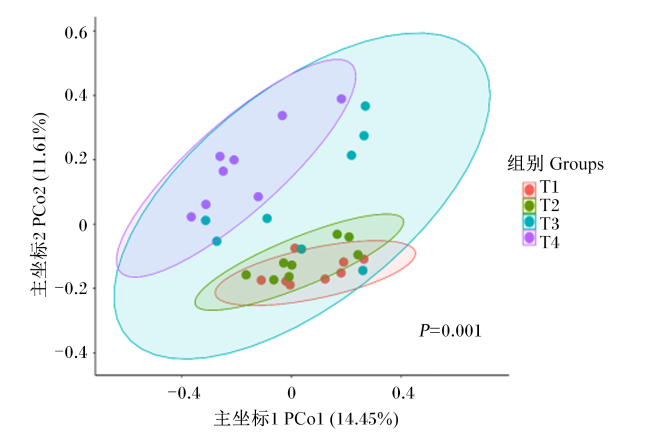
经盲肠菌群的β多样性分析,由图1所示,T1组与T2组椭圆重叠且范围小,表示组内样本聚集性强、相似度高;T3组与T4组椭圆范围更大,组内样本的差异相对更明显。尽管Bray-Curtis置信椭圆存在部分重叠,但T4组与其他组分离明显,椭圆几乎无重叠,说明T4组样本与其他组的差异明显,与饲喂20%大麦饲粮或者不添加复合酶制剂相比,40%大麦饲粮中添加复合酶制剂会显著改变盲肠微生物群落结构(P<0.05)。
图1 主坐标分析图

Fig.1 PCoA diagram

2.4.2 盲肠菌群在门和属水平上的物种丰富度

表6所示,在门水平上,盲肠菌群的前5个优势门分别是拟杆菌门(Bacteroidetes)、厚壁菌门(Firmicutes)、放线菌门(Actinobacteria)、脱铁杆菌门(Deferribacterota)和变形菌门(Proteobacteria)。饲粮大麦添加水平对盲肠Bacteroidetes、Firmicutes、Deferribacterota和Proteobacteria相对丰度均未产生显著影响(P>0.05);与饲喂20%大麦饲粮相比,40%大麦饲粮显著提高了盲肠Actinobacteria相对丰度(P<0.05)。与不添加复合酶制剂相比,大麦饲粮添加0.5 g/kg复合酶制剂显著提高了盲肠Actinobacteria相对丰度(P<0.05),显著降低了Firmicutes相对丰度(P<0.05),对盲肠Bacteroidetes、Deferribacterota和Proteobacteria相对丰度没有显著影响(P>0.05)。饲粮大麦添加水平和复合酶制剂添加水平对盲肠菌群优势类群的前5个门相对丰度均未产生显著交互作用(P>0.05)。
表6 大麦饲粮添加复合酶制剂对肉鸭盲肠菌群在门水平上相对丰度的影响(前5)

Table 6 Effects of barley-based diets supplemented with enzyme blend on the relative abundance of cecal microbiota at the phylum level of meat-type ducks (top 5)

项目
Items
组别
Groups
大麦添加水平
Supplementation level
of barley/%
复合酶制剂添加水平
Supplementation
level of enzyme
blend/(g/kg)
PP-value
T1 T2 T3 T4 20 40 0 0.5 大麦添
加水平
Supplementation
level of
barley
复合酶制剂
添加水平
Supplementation
level of enzyme
blend
交互作用
Interaction
拟杆菌门 Bacteroidetes 43.94±4.82 43.79±8.08 45.65±9.16 47.66±12.86 44.79±7.13 45.73±10.57 43.86±6.43 46.65±10.84 0.776 0.398 0.741
厚壁菌门 Firmicutes 44.70±7.95 45.67±6.93 39.09±5.71 33.59±5.65 41.90±7.29 39.63±8.73 45.19±7.22a 36.34±6.18b 0.342 0.001 0.178
放线菌门 Actinobacteria 2.48±0.75 3.86±2.50 4.45±2.38 10.18±6.51 3.47±1.99b 7.02±5.78a 3.17±1.92b 7.32±5.59a 0.011 0.004 0.108
脱铁杆菌门 Deferribacterota 4.77±5.13 2.72±4.60 7.73±5.36 5.69±10.63 6.25±5.29 4.20±8.06 3.74±4.83 6.71±8.20 0.408 0.233 0.999
变形菌门 Proteobacteria 2.85±2.14 2.74±2.66 2.22±2.37 2.09±1.82 2.54±2.21 2.41±2.23 2.79±2.33 2.16±2.05 0.880 0.434 0.987
表7所示,在属水平上,盲肠菌群的前5个优势菌属分别是拟杆菌属(Bacteroides)、普雷沃氏菌属(Prevotella)、黏螺菌属(Mucispirillum)、瘤胃球菌属(Ruminococcus)和普拉梭菌属(Faecalibacterium)。饲粮大麦添加水平对盲肠这5个优势菌属相对丰度均未产生显著影响(P>0.05)。与不添加复合酶制剂相比,大麦饲粮添加0.5 g/kg复合酶制剂显著降低了盲肠Bacteroides相对丰度(P<0.05),显著提高了Prevotella相对丰度(P<0.05),对盲肠MucispirillumRuminococcusFaecalibacterium相对丰度没有显著影响(P>0.05)。饲粮大麦添加水平和复合酶制剂添加水平对盲肠这5个优势菌属相对丰度均未产生显著交互作用(P>0.05)。
表7 大麦饲粮添加复合酶制剂对肉鸭盲肠菌群在属水平上相对丰度的影响(前5)

Table 7 Effects of barley-based diets supplemented with enzyme blend on the relative abundance of cecal microbiota at the genus level of meat-type ducks (top 5)

项目
Items
组别
Groups
大麦添加水平
Supplementation
level of barley/%
复合酶制剂添加水平
Supplementation level
of enzyme blend/(g/kg)
PP-value
T1 T2 T3 T4 20 40 0 0.5 大麦添
加水平
Supplementation
level of barley
复合酶制剂添加水平
Supplementation
level of enzyme
blend
交互作用
Interaction
拟杆菌属 Bacteroides 27.06±6.22 27.37±9.51 20.07±7.80 18.08±9.77 23.56±7.72 22.73±10.48 27.22±7.77a 19.07±8.61b 0.781 0.011 0.705
普雷沃氏菌属 Prevotella 3.55±2.28 6.45±4.17 15.95±12.98 20.85±16.66 9.75±11.05 13.65±13.89 5.00±3.58b 18.40±14.65a 0.317 0.002 0.795
黏螺菌属 Mucispirillum 4.77±5.13 2.72±4.60 7.73±5.36 5.69±10.63 6.25±5.29 4.20±8.06 3.74±4.83 6.71±8.20 0.408 0.233 0.999
瘤胃球菌属 Ruminococcus 3.73±2.03 4.55±1.12 3.56±1.27 2.93±1.18 3.64±1.64 3.74±1.40 4.14±1.64 3.24±1.23 0.854 0.091 0.166
普拉梭菌属 Faecalibacterium 3.03±1.47 3.78±2.49 2.05±1.81 2.71±1.59 2.54±1.67 3.24±2.09 3.40±2.01 2.38±1.68 0.300 0.135 0.942

2.4.3 KEGG预测盲肠菌群代谢功能

表8所示,在KEGG二级通路中,组间存在显著差异的7条通路分别是细胞过程-细胞生长与死亡、遗传信息处理-复制与修复、遗传信息处理-翻译、人类疾病-耐药性、代谢-脂质代谢以及代谢-核苷酸代谢。与饲喂20%大麦饲粮相比,40%大麦饲粮显著上调遗传信息处理-翻译通路和代谢-核苷酸代谢通路的相对丰度(P<0.05);饲粮大麦添加水平对其他5条通路的相对丰度均未产生显著影响(P>0.05)。与不添加复合酶制剂相比,大麦饲粮添加0.5 g/kg复合酶制剂显著下调了细胞过程-细胞生长与死亡、遗传信息处理-复制与修复、遗传信息处理-翻译以及代谢-核苷酸代谢的相对丰度(P<0.05),显著降低了人类疾病-耐药性、代谢-脂质代谢的相对丰度(P<0.05)。饲粮大麦添加水平和复合酶制剂添加水平对这7条通路的相对丰度均未产生显著交互作用(P>0.05)。
表8 大麦饲粮添加复合酶制剂对肉鸭盲肠菌群代谢功能(基于KEGG预测)的影响

Table 8 Effects of barley-based diets supplemented with enzyme blend on the metabolic functions of cecal microbiota at the genus level of meat-type ducks (based on KEGG prediction)

项目
Items
组别
Groups
大麦添加水平
Supplementation level
of barley/%
复合酶制剂添加水平
Supplementation level of
enzyme blend/(g/kg)
PP-value
T1 T2 T3 T4 20 40 0 0.5 大麦添
加水平
Supplementation
level of barley
复合酶制剂添加水平
Supplementation
level of enzyme
blend
交互作用
Interaction
细胞过程-细胞生长和死亡
Cellular processes-cell growth and death
611±11 615±11 629±23 647±25 612±19 631±24 613±10b 638±25a 0.099 0.001 0.302
遗传信息处理-复制与修复
Genetic information processing-
replication and repair
2 350±24 2 361±22 2 400±68 2 447±82 2 375±55 2 404±73 2 355±23b 2 423±76a 0.154 0.002 0.375
遗传信息处理-翻译
Genetic information processing-translation
1 262±20 1 268±25 1 290±38 1 337±38 1 276±32b 1 302±47a 1 265±21b 1 314±44a 0.024 0.001 0.076
人类疾病-耐药性
Human diseases-drug resistance
59±21 61±15 54±8 36±4 57±15 49±16 60±17a 45±10b 0.095 0.005 0.053
代谢-脂代谢
Metabolism-lipid metabolism
2 240±89 2 162±132 2 045±124 1 975±201 2 142±145 2 069±190 2 201±115a 2 010±165b 0.156 0.001 0.933
代谢-核苷酸代谢
Metabolism-nucleotide metabolism
789±14 798±13 799±21 824±29 794±18b 811±25a 794±13b 812±27a 0.026 0.019 0.250

3 讨论

3.1 大麦饲粮添加复合酶制剂对肉鸭生长性能的影响

大麦蛋白质含量虽高于玉米,但其富含可溶性NSPs,尤其是β-葡聚糖,会降低家禽营养消化率与饲料效率[14-15]。Sharifi等[16]研究表明,饲粮中按照递增比例(0、10%、20%、30%)添加脱壳大麦,可显著降低1~49日龄家禽的采食量、增重及饲料转化率。然而本试验结果表明,与饲喂20%大麦饲粮相比,40%大麦饲粮对1~15日龄肉鸭生长性能没有显著影响,但显著提高了16~37日龄和1~37日龄肉鸭的F/G,显著降低了16~37日龄和1~37日龄肉鸭的育肥指数,这可能源于大麦中NSPs的负面效应在养殖后期产生了累积作用。尽管有研究指出成年家禽对含大麦饲粮中NSPs的耐受性优于幼禽[17],但本试验结果与Perera等[18]报道一致,即即使对于生长后期肉鸭,使用高添加水平(30%以上)的大麦依然会导致生长性能降低。究其原因,可溶性NSPs在消化道内形成高分子黏性聚合物,导致回肠养分消化率下降,这正是大麦在家禽饲粮中应用受限的关键原因[19-20]
研究表明,外源添加蛋白酶与β-葡聚糖酶可有效缓解大麦NSPs的负面效应[21-22]。本试验结果表明,复合酶制剂显著提高了1~15日龄、16~37日龄和1~37日龄肉鸭的生长性能,这与预期一致。该结果部分佐证了Kang等[23]的研究,β-葡聚糖酶改善了大麦饲粮肉鸭生长表现。通过复合酶制剂提高饲料利用效率的机制在于,β-葡聚糖酶可降解β-葡聚糖,减少食糜黏度,利于营养物质的消化吸收,从而改善生长性能[24-25]。Li等[26]报道,酶制剂可显著提高鸭的增重,但Sharifi等[16]发现酶制剂对肉鸡各阶段增重、采食量及饲料转化率均无显著影响。此类差异可能与动物种类、酶制剂组成及添加水平等因素相关。

3.2 大麦饲粮添加复合酶制剂对肉鸭屠宰性能和肠道发育的影响

Sharifi等[16]研究表明,饲粮中添加30%脱壳大麦及酶制剂补充对家禽屠宰率和腹脂率无显著影响。本试验结果表明,与饲喂20%大麦饲粮相比,40%大麦饲粮显著提高了腹脂的相对重量;饲粮大麦添加水平和复合酶制剂添加水平对其他肉鸭屠宰性能均无显著影响。该现象可能与胆汁酸盐过度解离及脂肪消化障碍相关,胆汁酸盐对饱和脂肪乳化至关重要[27],可溶性NSPs通过物理结合与胆汁酸盐形成复合物,降低胆汁酸盐的乳化能力,阻碍其对脂类的乳化作用,从而影响胆固醇代谢和脂质吸收[28-29]
本试验结果表明,饲粮大麦添加水平对十二指肠和回肠相对重量无显著影响,但与饲喂20%大麦饲粮相比,40%大麦饲粮显著提高了空肠的相对重量,这与Perera等[19]及Yu等[30]报道一致。其机制可能是大麦抗营养因子引发消化器官代偿性增生,导致空肠相对重量增加。此外,本试验结果表明,与不添加复合酶制剂相比,大麦饲粮添加0.5 g/kg复合酶制剂显著降低了十二指肠的相对重量和单位长度重量,可能是复合酶制剂分解了部分NSPs,从而降低了消化道代偿性负荷,缓解了增生,但其机理仍需进一步研究。

3.3 大麦饲粮添加复合酶制剂对肉鸭盲肠菌群结构和功能的影响

作为消化道主要发酵场所,盲肠内定植的复杂微生物群落对肉鸭健康与肠道发育至关重要[31],理想肠道菌群的稳态需要依赖适度的多样性来维持,而非简单遵循“多样性越高越好”的原则[32]。大麦作为核心碳水化合物来源,其抗营养成分可抑制特定微生物的增殖,从而显著影响菌群的整体多样性与丰度[33]。而外源酶制剂促进饲粮多糖的降解与利用,可能导致原本依赖这些大分子营养物质的微生物群落丰度降低[34],这可能是饲粮高添加水平大麦或复合酶制剂后盲肠OTU数目、丰富度及多样性指数下降的主要原因。
研究报道,肉鸭盲肠优势类群主要由Bacteroidetes、Firmicutes和Proteobacteria构成[35],这与本试验结果高度一致,表明饲粮大麦添加水平或复合酶制剂添加水平未改变盲肠菌群基本结构。本试验结果表明,与饲喂20%大麦饲粮相比,40%大麦饲粮显著提高了盲肠Actinobacteria相对丰度,而Actinobacteria可以通过分泌纤维素酶、几丁质酶、木聚糖酶和果胶酶等内源性酶,高效降解未消化饲粮组分[36]。值得注意的是,研究发现,酶制剂添加组中Prevotella相对丰度也显著升高,该菌以其强大的多糖/寡糖降解能力闻名[37]ActinobacteriaPrevotella之间可能存在的协同作用,部分解释了酶制剂改善生长性能的机制。此外,本试验中,KEGG功能预测显示,细胞过程、遗传信息处理及代谢等的相关通路相对丰度发生变化,从分子层面进一步证实了酶制剂通过强化肉鸭代谢效能,最终提升其生长性能。

4 结论

综上所述,饲粮中添加40%大麦会对肉鸭生长性能产生负面影响,而添加复合酶制剂则能通过提高饲料效率、改变盲肠菌群结构,并调控菌群的代谢与细胞过程相关通路,综合提升肉鸭的生长性能。
[1]
GAO Y J, PERSSON D P, VINCZE E, et al. Modification of storage proteins in the barley grain increases endosperm zinc and iron under both normal and elevated atmospheric CO2[J]. Physiologia Plantarum, 2022, 174(1):e13624.

DOI

[2]
MENG G, RASMUSSEN S K, CHRISTENSEN C S L, et al. Molecular breeding of barley for quality traits and resilience to climate change[J]. Frontiers in Genetics, 2022, 13:1039996.

DOI

[3]
NGUYEN H T, BEDFORD M R, WU S B, et al. Soluble non-starch polysaccharide modulates broiler gastrointestinal tract environment[J]. Poultry Science, 2021, 100(8):101183.

DOI

[4]
SMEETS N, NUYENS F, VAN CAMPENHOUT L, et al. Interactions between the concentration of non-starch polysaccharides in wheat and the addition of an enzyme mixture in a broiler digestibility and performance trial[J]. Poultry Science, 2018, 97(6):2064-2070.

DOI PMID

[5]
JAMROZ D, JAKOBSEN K, BACH KNUDSEN K E, et al. Digestibility and energy value of non-starch polysaccharides in young chickens,ducks and geese,fed diets containing high amounts of barley[J]. Comparative Biochemistry and Physiology.Part A,Molecular & Integrative Physiology, 2002, 131(3):657-668.

[6]
PERERA W N U, ABDOLLAHI M R, ZAEFARIAN F, et al. Barley,an undervalued cereal for poultry diets:limitations and opportunities[J]. Animals, 2022, 12(19):2525.

DOI

[7]
CHEN W, WANG S, XU R S, et al. Effects of dietary barley inclusion and glucanase supplementation on the production performance,egg quality and digestive functions in laying ducks[J]. Animal Nutrition, 2021, 7(1):176-184.

DOI

[8]
FARRAN M T, BARBOUR G W, USAYRAN N N, et al. Performance and carcass quality of broiler chickens fed a corn-soybean meal diet containing graded barley levels without or with enzyme[J]. Journal of Poultry Science, 2010, 47(1):34-40.

DOI

[9]
KWIECIEN M, WINIARSKA M A. Effect of hulless barley on body weight and chemical composition of hearts and livers in broiler chickens[J]. Medycyna Weterynaryjna, 2010, 66(1):41-44.

[10]
JACOB J P, PESCATORE A J. Using barley in poultry diets—a review[J]. The Journal of Applied Poultry Research, 2012, 21(4):915-940.

DOI

[11]
WEI J, XIE M, TANG J, et al. The feasibility of enzyme hydrolysate gross energy for formulating duck feeds[J]. Poultry Science, 2020, 99(8):3941-3947.

DOI PMID

[12]
KANG Q, VAHL C I, FAN H H, et al. Statistical analyses of chicken intestinal lesion scores in battery cage studies of anti-coccidial drugs[J]. Veterinary Parasitology, 2019, 272:83-94.

DOI PMID

[13]
LIU D, GUO S S, GUO Y M. Xylanase supplementation to a wheat-based diet alleviated the intestinal mucosal barrier impairment of broiler chickens challenged by Clostridium perfringens[J]. Avian Pathology, 2012, 41(3):291-298.

DOI

[14]
KARUNARATNE N D, NEWKIRK R W, AMES N P, et al. Effects of exogenous β-glucanase on ileal digesta soluble β-glucan molecular weight,digestive tract characteristics,and performance of coccidiosis vaccinated broiler chickens fed hulless barley-based diets with and without medication[J]. PLoS One, 2021, 16(5):e0236231.

DOI

[15]
KNUDSEN K E B. Fiber and nonstarch polysaccharide content and variation in common crops used in broiler diets[J]. Poultry Science, 2014, 93(9):2380-2393.

DOI PMID

[16]
SHARIFI S D, SHARIATMADARI F, YAGHOBFAR A. Effects of inclusion of hull-less barley and enzyme supplementation of broiler diets on growth performance, nutrient digestion and dietary metabolisable energy content[J]. Journal of Central European Agriculture, 2012, 13(1):193-207.

DOI

[17]
SVIHUS B, GULLORD M. Effect of chemical content and physical characteristics on nutritional value of wheat,barley and oats for poultry[J]. Animal Feed Science and Technology, 2002, 102(1/4):71-92.

DOI

[18]
PERERA W N U, ABDOLLAHI M R, ZAEFARIAN F, et al. Influence of inclusion level of barley in wheat-based diets and supplementation of carbohydrase on growth performance,nutrient utilisation and gut morphometry in broiler starters[J]. British Poultry Science, 2019, 60(6):736-748.

DOI

[19]
PERERA W N U, ABDOLLAHI M R, ZAEFARIAN F, et al. The effect of graded inclusions of waxy starch hull-less barley and a multi-component exogenous carbohydrase on the growth performance,nutrient digestibility and intestinal morphometry of broiler chickens[J]. British Poultry Science, 2020, 61(4):442-453.

DOI

[20]
SLOMINSKI B A. Recent advances in research on enzymes for poultry diets[J]. Poultry Science, 2011, 90(9):2013-2023.

DOI PMID

[21]
JOZEFIAK D, RUTKOWSKI A, KACZMAREK S, et al. Effect of β-glucanase and xylanase supplementation of barley-and rye-based diets on caecal microbiota of broiler chickens[J]. British Poultry Science, 2010, 51(4):546-557.

DOI

[22]
KARUNARATNE N D, Newkirk R W, VAN Kessel A G, et al. Hulless barley and beta-glucanase levels in the diet affect the performance of coccidiosis-challenged broiler chickens in an age-dependent manner[J]. Poultry Science, 2021, 100(2):776-787.

DOI PMID

[23]
KANG P, HOU Y Q, TOMS D, et al. Effects of enzyme complex supplementation to a paddy-based diet on performance and nutrient digestibility of meat-type ducks[J]. Asian-Australasian Journal of Animal Sciences, 2013, 26(2):253-259.

DOI PMID

[24]
PENG R H, ZHANG W H, WANG Y, et al. Genetic engineering of complex feed enzymes into barley seed for direct utilization in animal feedstuff[J]. Plant Biotechnology Journal, 2023, 21(3):560-573.

DOI

[25]
LI Z, DONG Y, XIAO X, et al. Mechanism by which β-glucanase improves the quality of fermented barley flour-based food products[J]. Food Chemistry, 2020, 311:126026.

DOI

[26]
LI Y X, ZHOU J, GUO T, et al. Effects of adding a kind of compound bio-enzyme to the diet on the production performance,serum immunity,and intestinal health of Pekin ducks[J]. Poultry Science, 2025, 104(1):104506.

DOI

[27]
ŁOZIŃSKA N, MALDONADO-VALDERRAMA J, DEL CASTILLO-SANTAELLA T, et al. Bile conjugation and its effect on in vitro lipolysis of emulsions[J]. Food Research International, 2024, 184:114255.

DOI

[28]
HUANG S M, PANG D R, LI X, et al. A sulfated polysaccharide from Gracilaria Lemaneiformis regulates cholesterol and bile acid metabolism in high-fat diet mice[J]. Food & Function, 2019, 10(6):3224-3236.

[29]
WAN X Z, AI C, CHEN Y H, et al. Physicochemical characterization of a polysaccharide from green microalga Chlorella pyrenoidosa and its hypolipidemic activity via gut microbiota regulation in rats[J]. Journal of Agricultural and Food Chemistry, 2020, 68(5):1186-1197.

DOI

[30]
YU B, SUN Y M, CHIOU P W S. Effects of glucanase inclusion in a de-hulled barley diet on the growth performance and nutrient digestion of broiler chickens[J]. Animal Feed Science and Technology, 2002, 102(1/2/3/4):35-52.

DOI

[31]
DI MARCANTONIO L, MAROTTA F, VULPIANI M P, et al. Investigating the cecal microbiota in broiler poultry farms and its potential relationships with animal welfare[J]. Research in Veterinary Science, 2022, 144:115-125.

DOI PMID

[32]
DUCATELLE R, GOOSSENS E, DE MEYER F, et al. Biomarkers for monitoring intestinal health in poultry:present status and future perspectives[J]. Veterinary Research, 2018, 49(1):43.

DOI

[33]
PAN L, FAROUK M H, QIN G X, et al. The influences of soybean agglutinin and functional oligosaccharides on the intestinal tract of monogastric animals[J]. International Journal of Molecular Sciences, 2018, 19(2):554.

DOI

[34]
BEDFORD M R, APAJALAHTI J H. The role of feed enzymes in maintaining poultry intestinal health[J]. Journal of the Science of Food and Agriculture, 2022, 102(5):1759-1770.

DOI

[35]
LIANG Y R, CHANG Y Q, XIE Y Q, et al. Dietary ethylenediamine dihydroiodide mitigated Escherichia coli O78-induced immune and intestinal damage of ducks via suppression of NF-κB signal[J]. Poultry Science, 2024, 103(5):103610.

DOI

[36]
PINNELL L J, DUNFORD E, RONAN P, et al. Recovering glycoside hydrolase genes from active tundra cellulolytic bacteria[J]. Canadian Journal of Microbiology, 2014, 60(7):469-476.

DOI PMID

[37]
DAHL W J, RIVERO MENDOZA D, LAMBERT J M. Diet,nutrients and the microbiome[J]. Progress in Molecular Biology and Translational Science, 2020, 171:237-263.

文章导航

/