研究论文

菊芋饲料对陕北白绒山羊瘤胃体外发酵参数、酶活性和微生物数量的影响

  • 李陇平 , 1, 2, * ,
  • 张鹏 3 ,
  • 李托 1, 2 ,
  • 任渊章 4 ,
  • 吴鑫 5 ,
  • 韩世洁 6
展开
  • 1 榆林学院陕西省陕北绒山羊工程技术研究中心, 榆林 719000
  • 2 榆林学院现代农学院, 榆林 719000
  • 3 绥德县薛家峁镇农牧综合服务站, 绥德 718000
  • 4 绥德县畜牧兽医服务中心, 绥德 718000
  • 5 定边县动物疫病预防控制中心, 定边 718600
  • 6 榆林市横山区畜牧兽医技术推广站, 横山 719199
*李陇平,副教授,硕士生导师,E-mail:

李陇平(1985—),男,陕西陇县人,副教授,博士,主要从事动物营养调控、饲料资源开发利用和牛羊健康养殖技术研究。E-mail:

收稿日期: 2025-08-14

  网络出版日期: 2026-03-16

基金资助

榆林市科技局产学研项目(2023-CXY-174)

榆林市科技局产学研项目(2025-CXY-133)

榆林市横山区发展改革和科技局重点科技计划项目(YF2025-06)

Effects of Jerusalem Artichoke Feed on Rumen Fermentation Parameters, Enzyme Activities and Microbiota Count of Shaanbei White Cashmere Goats in Vitro

  • LI Longping , 1, 2, * ,
  • ZHANG Peng 3 ,
  • LI Tuo 1, 2 ,
  • REN Yuanzhang 4 ,
  • WU Xin 5 ,
  • HAN Shijie 6
Expand
  • 1 Shaanxi Province Engineering & Technology Research Center of Shaanbei Cashmere Goat, Yulin University, Yulin 719000, China
  • 2 College of Advanced Agricultural Sciences, Yulin University, Yulin 719000, China
  • 3 Suide County Xuejiamao Town Comprehensive Agriculture and Animal Husbandry Service Station, Suide 718000, China
  • 4 Suide County Animal Husbandry and Veterinary Service Center, Suide 718000, China
  • 5 Dingbian County Animal Disease Prevention and Control Center, Dingbian 718600, China
  • 6 Animal Husbandry and Veterinary Technology Promotion Station in Hengshan District of Yulin City, Hengshan 719199, China
*associate professor, E-mail:

Received date: 2025-08-14

  Online published: 2026-03-16

摘要

本试验旨在研究菊芋秸秆(JAS)和菊芋全粉(JAP)对陕北白绒山羊瘤胃体外发酵参数、酶活性和微生物数量的影响。采用瘤胃体外发酵试验方法,在发酵底物(粗精比70∶30)中分别添加0(对照)、5%、10%、15%和20% JAS,以及0(对照)、1%、2%、4%、6%、8%和10% JAP,体外发酵72 h。结果表明:1)15% JAS添加组72 h累计产气量、慢速发酵部分产气量(b)和潜在产气量(a+b)最高,显著高于其他各组(P<0.05)。8% JAP添加组72 h累计产气量和潜在产气量最高,显著高于其他各组(P<0.05)(10% JAP添加组潜在产气量除外);2%和4% JAP添加组甲烷含量较低,显著低于其他组(P<0.05)。2)15% JAS添加组和8% JAP添加组体外干物质降解率和微生物蛋白含量均显著高于其他各组(P<0.05);发酵液pH随JAS和JAP添加水平的提高呈现线性降低(P<0.05)。3)15% JAS添加组乙酸、丙酸和总挥发性脂肪酸含量显著高于其他各组(P<0.05);15%和20% JAS添加组丁酸含量显著高于其他组(P<0.05),乙酸/丙酸值显著低于其他组(P<0.05)。8% JAP添加组丙酸含量最高,对照组丙酸含量显著低于其他各组(P<0.05);8% JAP添加组乙酸/丙酸值显著低于其他各组(P<0.05)。4)与对照组相比,各JAS添加组纤维素酶活性均显著提高(P<0.05),2%~10% JAP添加组α-淀粉酶活性显著提高(P<0.05),各JAS和JAP添加组胰蛋白酶活性均显著降低(P<0.05)。5)不同菊芋饲料添加水平对瘤胃体外发酵影响的综合评定结果显示,JAS添加水平中多项组合效应指数(MFAEI)以15%最高(0.390 8),JAP添加水平中MFAEI以8%最高(0.302 1)。6)与对照组相比,15% JAS添加组细菌、真菌、原虫、产甲烷菌、白色瘤胃球菌、黄色瘤胃球菌、溶纤维丁酸弧菌、产琥珀酸丝状杆菌、嗜淀粉瘤胃杆菌、栖瘤胃普雷沃氏菌和双歧杆菌数量均显著提高(P<0.05),8% JAP添加组溶纤维丁酸弧菌、嗜淀粉瘤胃杆菌、栖瘤胃普雷沃氏菌、乳酸杆菌和双歧杆菌数量均显著提高(P<0.05)。综上所述,根据瘤胃体外发酵试验结果,陕北白绒山羊饲粮中JAS和JAP适宜添加水平分别为15%和8%。

本文引用格式

李陇平 , 张鹏 , 李托 , 任渊章 , 吴鑫 , 韩世洁 . 菊芋饲料对陕北白绒山羊瘤胃体外发酵参数、酶活性和微生物数量的影响[J]. 动物营养学报, 2026 , 38(3) : 2277 -2293 . DOI: 10.12418/CJAN2026.182

Abstract

This experiment was conducted to investigate the effects of Jerusalem artichoke straw (JAS) and Jerusalem artichoke powder (JAP) on rumen fermentation parameters, enzyme activities and microbiota count of Shaanbei white cashmere goats in vitro. A rumen in vitro fermentation method was adopted and supplemented with 0 (control), 5%, 10%, 15% and 20% JAS, as well as 0 (control), 1%, 2%, 4%, 6%, 8% and 10% JAP in the fermentation substrates with a forage to concentrate ratio of 70∶30, respectively, and the in vitro fermentation lasted for 72 hours. The results showed as follows: 1) the 72-hour cumulative gas production, gas production of slow fermentation section (b) and potential gas production (a+b) in 15% JAS supplemental group were the highest, which were significantly higher than those in the other groups (P<0.05). The 72-hour cumulative gas production and potential gas production in 8% JAP supplemental group were the highest, which were significantly higher than those in the other groups except for the potential gas production in 10% JAP supplemental group (P<0.05). The methane content in 2% and 4% JAP supplemental groups was lower, which was significantly lower than that in the other groups (P<0.05). 2) The in vitro dry matter degradation rate and microbial protein content in 15% JAS supplemental group and 8% JAP supplemental group were significantly higher than those in the other groups (P<0.05); the pH in fermentation broth was linearly decreased with the increase of JAS and JAP supplemental level (P<0.05). 3) The contents of acetate, propionate and total volatile fatty acids in 15% JAS supplemental group were significantly higher than those in the other groups (P<0.05). The butyrate content in 15% and 20% JAS supplemental group was significantly higher than that in the other groups (P<0.05), while the acetate to propionate ratio was significantly lower than that in the other groups (P<0.05). The propionate content in 8% JAP supplemental group was the highest, and the propionate content in the control group was significantly lower than that in the other groups (P<0.05). The acetate to propionate ratio in 8% JAP supplemental group was significantly lower than that in the other groups (P<0.05). 4) Compared with the control group, the cellulase activity in each JAS supplemental group was significantly increased (P<0.05), the α-amylase activity in 2% to 10% JAP supplemental groups was significantly increased (P<0.05), and the trypsin activity in all JAS and JAP supplemental groups was significant decreased (P<0.05). 5) The results of comprehensive evaluation of effects of Jerusalem artichoke feed supplemental level on rumen in vitro fermentation showed that the multiple-factors associative effects index (MFAEI) of JAS was highest at 15% (0.390 8), and the MFAEI of JAP was highest at 8% (0.302 1). 6) Compared with the control group, the numbers of bacteria, fungi, protozoa, methanogens, Ruminococcus albus, Ruminococcus flavefaciens, Butyrivibrio fibrisolvens, Fibrobacter succinogenes, Ruminobacter amylophilus, Prevotella ruminicola and Bifidobacterium in 15% JAS supplemental group were all significantly increased (P<0.05), and the numbers of Butyrivibrio fibrisolvens, Ruminobacter amylophilus, Prevotella ruminicola, Lactobacillus and Bifidobacterium in 8% JAP supplemental group were all significantly increased (P<0.05). In conclusion, based on the results of rumen in vitro fermentation experiment, the appropriate supplemental levels of JAS and JAP in the diet for Shaanbei white cashmere goats are 15% and 8%, respectively.

菊芋(Jerusalem artichoke,Helianthus tuberosus)具有耐寒、耐旱、易于种植和适应性强的特点,且生物产量高[1]。采收良好的菊芋秸秆(Jerusalem artichoke straw,JAS)粗蛋白质、粗纤维和钙含量可媲美苜蓿干草、黑麦草和玉米秸秆等常用饲草料[2]。除此之外,菊芋中多糖、黄酮类生物活性物质含量丰富,具有抗氧化、抗炎和促生长功能[3]。陕北白绒山羊是陕西省自主培育的绒肉兼用型品种,年均饲养量近1 000万只,是陕北地区畜牧业发展的支柱产业[4]。但是,随着规模化、集约化和舍饲圈养强化育肥等高产养殖模式的发展,如何通过改善羔羊亚健康提高其生产效率和绒肉品质成为陕北白绒山羊产业可持续发展的关键[5]。榆林位于陕西省最北部,气温四季分明、日差较大,独特的地理环境和气候条件有利于菊芋块茎膨大和干物质积累。充分发挥陕北地区地理和资源优势,研发陕北白绒山羊菊芋饲料,是助推陕北白绒山羊健康养殖的有效途径[6]。研究表明,菊芋粉能显著提高犊牛平均日增重和体重[7];菊芋茎秆可以改善奶牛机体抗氧化能力,提高乳脂率和乳品质[8];菊粉可改善奶牛乳房炎[9];菊芋全粉(Jerusalem artichoke powder,JAP)可提高波尔山羊饲料利用率[10],且菊芋茎叶青贮替代30%苜蓿对绵羊生长性能无不利影响[11]。然而,关于菊芋饲料在陕北白绒山羊养殖中的研究鲜有报道。因此,本试验通过瘤胃体外发酵产气试验,研究添加不同水平JAS和JAP对陕北白绒山羊瘤胃体外发酵参数、酶活性和微生物数量的影响,以明确JAS和JAP在陕北白绒山羊饲粮中的适宜添加水平,为研发陕北白绒山羊菊芋饲料提供基础。

1 材料与方法

1.1 试验材料

1.1.1 JAS

JAS采集于榆林某菊芋种植基地,自然晾干后粉碎保存。JAS营养成分含量为:吸附水7.31%,粗脂肪2.63%,粗蛋白质7.15%,粗纤维49.23%,粗灰分11.39%,中性洗涤纤维59.70%,酸性洗涤纤维37.61%,钙2.62%,总磷0.28%。

1.1.2 JAP

采集榆林某菊芋种植基地的菊芋地下块茎去掉泥土后带回实验室,用清水清洗干净,切成薄片,65 ℃烘干后粉碎,制成淡黄色的JAP。JAP营养成分含量为:初水分78.68%,吸附水8.67%,粗脂肪0.04%,粗蛋白质11.37%,粗纤维2.77%,粗灰分4.61%,钙0.31%,总磷0.09%。

1.2 试验动物和饲养管理

瘤胃液供体动物为4只3周岁、体重为(46.00±4.08) kg的陕北白绒山羊母羊。基础饲粮参照《肉羊营养需要量》(NY/T 816—2021)[12]及本课题组前期研究[13]配制,饲粮组成及营养水平参照本课题组之前的研究[14]。试验动物自由饮水,每天饲喂2次(08:30和18:00)。本试验经榆林学院实验动物福利与伦理委员会批准,批准编号为No.YLU2023-2。

1.3 试验设计

本试验JAS设置4个添加水平,JAP设置6个添加水平。采用单因素完全随机试验设计,JAS组分别在基础饲粮中添加0(对照)、5%、10%、15%和20%的JAS作为发酵底物,JAP组分别在基础饲粮中添加0(对照)、1%、2%、4%、6%、8%和10%的JAP作为发酵底物,每个处理6个平行,同时设6个空白对照,进行72 h体外发酵培养。

1.4 瘤胃体外发酵试验

1)发酵底物。取200 mg饲粮样品装入尼龙袋(4.0 cm×1.5 cm,孔径48 μm)后,放入玻璃注射器底部,并在玻璃注射器内壁均匀涂抹凡士林以防漏气。
2)瘤胃液采集。参照本课题组之前的研究方法[15],采用胃管式瘤胃液采样管经口腔采集瘤胃液20 mL,4层纱布过滤后备用。
3)培养液配制。采用Menke等[16]的方法配制人工瘤胃缓冲液,与采集的瘤胃液按体积比2∶1混合作为培养液。将装有饲粮样品的玻璃注射器提前39 ℃预热,加入30 mL培养液,排尽玻璃注射器里面的空气,记录玻璃注射器初始刻度后于39 ℃人工培养箱中振荡培养。

1.5 样品采集及指标测定

1.5.1 常规营养成分含量测定

饲料干物质含量参照GB/T 6435—2014采用105 ℃烘箱干燥法测定;粗脂肪含量参照GB/T 6433—2006采用索式抽提法测定;粗灰分含量参照GB/T 6438—2007采用550 ℃灼烧法测定;粗蛋白质含量根据凯氏定氮法采用全自动凯氏定氮仪(K9860,济南海能仪器有限公司)测定;钙含量参照GB/T 6436—2018采用乙二胺四乙酸二钠(EDTA)络合滴定法测定;总磷含量参照GB/T 6437—2018采用比色法测定;依据Van Soest等[17]的方法测定中性洗涤纤维和酸性洗涤纤维含量。

1.5.2 产气量及其产气参数计算

分别在体外发酵培养的0、2、4、6、8、12、24、48、60和72 h各时间点,记录产气量。培养72 h后将玻璃注射器立即取出放入冰水中终止发酵。
产气量计算公式如下:
GPt=$\frac{200}{W}$×[(Vt-V0)-GP空白]。
式中:GPt代表样品在t时刻的累计产气量(mL);Vt代表样品发酵t时刻玻璃注射器的刻度读数(mL);V0代表样品在开始培养时玻璃注射器的刻度读数(mL);W代表样品重量(mg);GP空白代表空白对照在t时刻的产气量,计算方法同GPt
产气参数根据Ørskov等[18]的动态发酵模型计算,公式如下:
GPt=a+b(1-e-ct)。
式中:GPt代表样品t时刻累计产气量(mL);a代表快速发酵部分产气量(mL);b代表慢速发酵部分产气量(mL);c代表产气速率(%/h);a+b代表潜在产气量(mL)。
依据非线性最小二乘法分别拟合abc值。

1.5.3 体外干物质降解率(in vitro dry matter degradation rate,IVDMD)测定

发酵剩余残渣于烘箱65 ℃恒重后称重,计算IVDMD,公式如下:
IVDMD=100×(发酵前样品干物质含量-发酵后残渣干物质含量)/发酵前样品干物质含量。

1.5.4 瘤胃体外发酵参数测定

试验结束后,采用PHB-4型雷磁便携式pH计立即测定发酵液pH;发酵液氨态氮(NH3-N)含量参照团体标准T/NAIA 004—2020采用碱性次氯酸-苯酚分光光度法(722型分光光度计)测定;发酵液中挥发性脂肪酸包括乙酸、丙酸、丁酸、戊酸、异丁酸、异戊酸和总挥发性脂肪酸(TVFA)含量按照团体标准T/NAIA 005—2020采用气相色谱仪(磐诺GC-1949)测定;发酵液微生物蛋白(MCP)含量采用考马斯亮蓝比色法测定[19]

1.5.5 混合气体中甲烷(CH4)含量测定

试验结束后,用0.5 L铝箔气体采气袋(BKMAM)收集发酵产生的所有气体,用气相色谱仪(磐诺GC-1949)测定发酵72 h内产生气体中的CH4含量。

1.5.6 发酵液酶活性测定

发酵液中α-淀粉酶、脂肪酶、胰蛋白酶、果胶酶和纤维素酶活性分别使用南京建成生物工程研究所生产的α-淀粉酶测试盒(C016-1-1)、脂肪酶测定试剂盒(A054-1-1)、胰蛋白酶测试盒(A080-2-1)、果胶酶测试盒(A140-1-1)和纤维素酶测试盒(A138-1-1)进行测定。

1.5.7 菊芋饲料添加水平对瘤胃体外发酵影响的综合评定

根据卢德勋提出的评估反刍动物饲料间组合效应的方法[20],对不同菊芋饲料添加水平对瘤胃体外发酵指标影响的组合效应进行综合评定。以未添加菊芋饲料的处理为对照组,采用单项组合效应指数(SFAEI)和多项组合效应指数(MFAEI)评价不同菊芋饲料添加水平下瘤胃体外发酵参数,包括pH、产气量、IVDMD以及NH3-N、MCP和TVFA含量。
SFAEI计算公式如下:
$\mathrm{S}\mathrm{F}\mathrm{A}\mathrm{E}\mathrm{I}=\frac{\left[{{\sum }^{n}}_{n=1}\right({A}_{2}-{A}_{1}\left)\right]/n}{{A}_{3}}\mathrm{。}$
式中:A1为对照组各个培养时间点各指标数值;A2分别为JAS添加水平为5%、10%、15%和20%试验组各个培养时间点各指标数值,或JAP添加水平为1%、2%、4%、6%、8%和10%试验组各个培养时间点各指标数值;A3为每个时间点A2总和的平均值;n为时间点数。
MFAEI等于各指标SFAEI的加和值。

1.5.8 发酵液微生物数量

1)发酵液微生物基因组DNA提取和引物
采用Omega磁珠粪便基因组DNA提取试剂盒(D4015-01)提取发酵液微生物总DNA;采用超微量核酸蛋白测定仪(OPTIZEN NanoQ Plus)测定DNA浓度,并通过2%琼脂糖凝胶电泳检测DNA质量。利用实时荧光定量PCR(qRT-PCR)技术测定微生物数量,具体引物参照之前的报道[21-22],引物序列委托北京奥科鼎盛生物科技有限公司合成。
2)标准质粒制备
分别采用菌种特异性引物,以发酵液微生物基因组DNA为模板,普通PCR扩增其特异性片段,利用EasyPure® Quick Gel Extraction Kit(EG101-01,北京全式金生物技术股份有限公司)回收PCR扩增产物并连接T载体(pEASY®-T5 Zero Cloning Kit基因克隆试剂盒,CT501-01,北京全式金生物技术股份有限公司)。挑选阳性克隆子测序鉴定,利用质粒小提试剂盒(EasyPure® Plasmid MiniPrep Kit,EM101-02,北京全式金生物技术股份有限公司)提取含有目的片段的标准质粒,并测定标准质粒DNA浓度。
3)标准曲线制备
将制备好的标准质粒分别10倍梯度稀释(101~108)后作为模版,利用qRT-PCR仪(FTC-3000P,Funglyn Biotech,加拿大)进行qRT-PCR扩增;反应结束后,以质粒拷贝数的对数值为横坐标、标准质粒qRT-PCR扩增得到的Ct值为纵坐标绘制标准曲线。
质粒拷贝数的计算公式如下:
质粒拷贝数(拷贝数/μL)=[C×6.02×1023(拷贝数/mol)]/{S×660[μg/(mol·bp)]}。
式中:C表示标准品浓度(ng/μL);S表示待测细菌基因组DNA定量PCR产物的碱基数(bp)。
4)qRT-PCR反应
分别采用不同菌种的特异性引物,以各个组发酵液微生物基因组DNA为模板进行qRT-PCR扩增得到Ct值,代入相应的标准曲线,对比标准曲线进行绝对定量分析,每个样品3个重复。采用PerfectStart® Green qPCR SuperMix(+Universal Passive Reference Dye)(AQ602,TransGen Biotech)配制20.0 μL反应体系,其中包括10.0 μL的2×PerfectStart® Green qPCR SuperMix(+Universal Passive Reference Dye),各0.5 μL的正向和反向引物,1.0 μL微生物基因组DNA,8.0 μL Nuclease-Free Water。扩增程序为:94 ℃预变性30 s;94 ℃变性20 s,60 ℃ 15 s,72 ℃延伸10 s;45个循环。使用仪器默认熔解曲线采集程序:94 ℃ 90 s,60 ℃ 3 min,94 ℃ 10 s。

1.6 数据统计分析

试验数据采用SPSS 20进行单因素方差分析(one-way ANOVA),若存在显著差异(P<0.05)则利用LSD法对组间差异进行多重比较,采用正交多项式对比法确定JAS和JAP添加水平的线性和二次效应;结果数据采用平均值和均值标准误(SEM)表示,P<0.05表示差异显著,P<0.01表示差异极显著。

2 结果与分析

2.1 菊芋饲料对瘤胃体外发酵产气量、产气参数和CH4含量的影响
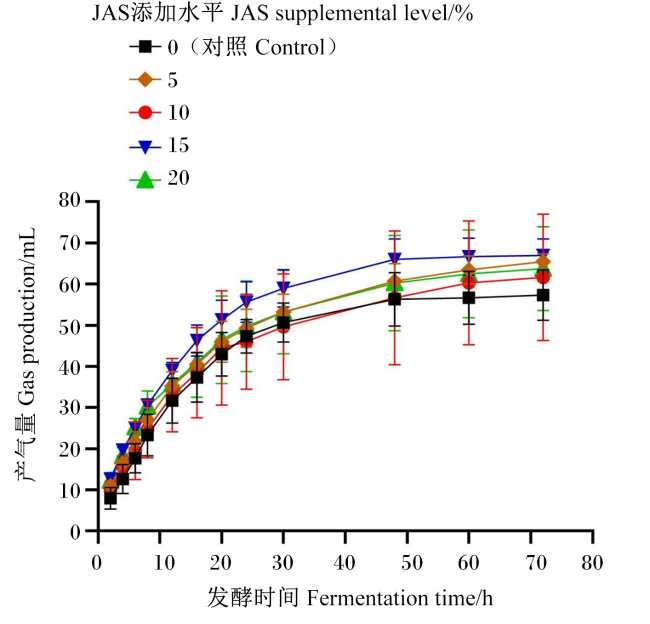
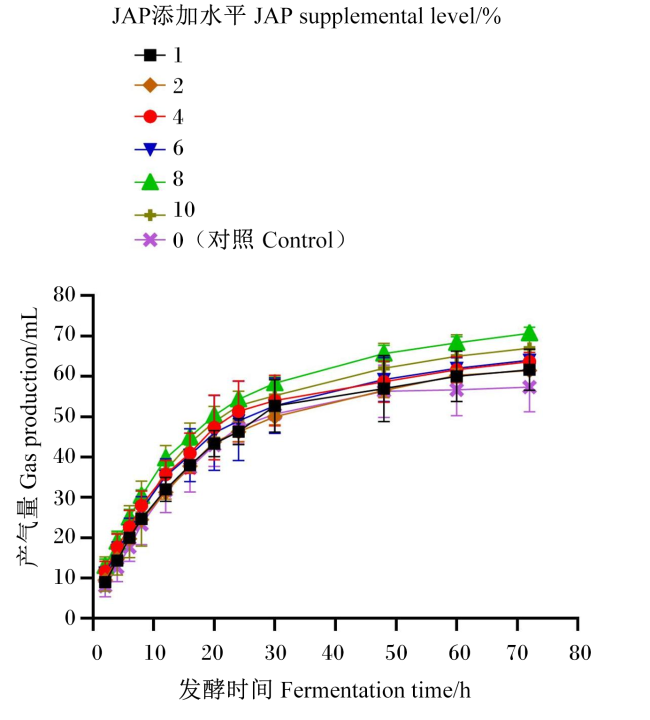
图1图2所示,72 h内发酵体系产气量均呈递增趋势,其中0~30 h产气量增速较快,30~48 h后增速逐渐变得平缓,直至72 h基本不再增加。JAS发酵体系72 h累计产气量由高到低依次为15%、5%、20%、10%和0添加组;JAP发酵体系72 h累计产气量由高到低依次为8%、10%、6%、4%、1%、2%和0添加组。
图1 JAS体外发酵产气量(风干基础)

Fig.1 Gas production from in vitro fermentation of JAS (air-dry basis)

图2 JAP体外发酵产气量(风干基础)

Fig.2 Gas production from in vitro fermentation of JAP (air-dry basis)

表1可知,随着JAS添加水平的提高,发酵体系72 h累计产气量、慢速发酵部分产气量(b)和潜在产气量(a+b)均呈现先升高后降低的二次变化(P<0.05),且15% JAS添加组显著高于其他各组(P<0.05)。
表1 JAS对瘤胃体外发酵产气量、产气参数和CH4含量的影响

Table 1 Effects of JAS on rumen in vitro fermentation gas production, gas production parameters and CH4 content

项目
Items
JAS添加水平 JAS supplemental level/% 均值
标准误
SEM
PP-value
0(对照
Control)
5 10 15 20 处理
Treatment
线性
Linear
二次
Quadratic
72 h累计产气量
Cumulative gas production of
72 h/mL
54.50c 60.75b 56.00c 65.00a 60.25b 1.970 0.035 0.794 0.041
a/mL 2.07 4.71 3.43 4.56 6.44 0.880 0.123 0.186 0.126
b/mL 58.91b 61.23b 59.72b 63.47a 58.29b 2.180 0.025 0.713 0.027
c/(%/h) 0.07 0.06 0.05 0.07 0.06 0.003 0.467 0.174 0.959
a+b/mL 60.99c 65.94b 63.14b 68.03a 64.73b 2.024 0.023 0.386 0.017
甲烷含量CH4 content/% 10.18 10.43 9.53 9.92 10.72 1.970 0.605 0.605 0.585

a代表快速发酵部分产气量,b代表慢速发酵部分产气量,c代表产气速率,a+b代表潜在产气量。表2同。

同行数据肩标不同大写字母表示差异极显著(P<0.01),不同小写字母表示差异显著(P<0.05),相同小写字母或无字母表示差异不显著(P>0.05)。表2表8以及表11表12同。

a represents gas production of rapid fermentation section, b represents gas production of slow fermentation section, c represents gas production rate, and a+b represents potential gas production. The same as Table 2.

In the same row, values with different capital letter superscripts indicate extremely significant difference (P<0.01), and with different small letter superscripts indicate significant difference (P<0.05), while with the same small letter or no letter superscripts indicate no significant difference (P>0.05). The same as Table 2 to Table 8, as well as Table 11 and Table 12.

表2可知,随着JAP添加水平的提高,发酵体系72 h累计产气量、潜在产气量和CH4含量均呈现先升高后降低的二次变化(P<0.05),且8% JAP添加组72 h累计产气量高于其他各组(P<0.05),潜在产气量显著高于除10% JAP添加组外的其他组(P<0.05);2%和4% JAP添加组CH4含量较低,显著低于其他组(P<0.05)。
表2 JAP对瘤胃体外发酵产气量、产气参数和CH4含量的影响

Table 2 Effects of JAP on rumen in vitro fermentation gas production, gas production parameters and CH4 content

项目
Items
JAP添加水平 JAP supplemental level/% 均值
标准误
SEM
PP-value
0(对照
Control)
1 2 4 6 8 10 处理
Treatment
线性
Linear
二次
Quadratic
72 h累计产气量
Cumulative gas
production of 72 h/mL
54.50d 57.75d 56.50d 59.00c 59.25c 65.50a 62.00b 1.011 0.037 0.356 0.017
a/mL 2.07 2.28 3.38 4.52 4.39 6.04 5.12 0.570 0.565 0.608 0.080
b/mL 58.91 59.80 58.66 59.08 62.77 64.51 64.27 5.892 0.133 0.190 0.135
c/(%/h) 0.07 0.06 0.06 0.06 0.06 0.06 0.06 0.002 0.927 0.417 0.658
a+b/mL 60.99d 62.08c 62.04c 63.59c 67.16b 70.55a 69.39a 6.099 0.041 0.167 0.023
甲烷含量
CH4 content/%
10.18a 10.09a 9.76b 8.96b 10.83a 10.95a 10.79a 0.179 0.016 0.050 0.012

2.2 菊芋饲料对瘤胃体外发酵参数和IVDMD的影响

表3可知,瘤胃体外发酵IVDMD和MCP含量均随JAS添加水平的提高呈现先升高后降低的二次变化(P<0.05),且15% JAS添加组显著高于其他各组(P<0.05);pH随JAS添加水平的提高呈现线性降低(P<0.05),且对照组和5% JAS添加组显著高于其他组(P<0.05)。
表3 JAS对瘤胃体外发酵参数和IVDMD的影响

Table 3 Effects of JAS on rumen in vitro fermentation parameters and IVDMD

项目
Items
JAS添加水平 JAS supplemental level/% 均值
标准误
SEM
PP-value
0(对照
Control)
5 10 15 20 处理
Treatment
线性
Linear
二次
Quadratic
体外干物质降解率
IVDMD/%
29.90c 32.99b 30.87c 34.06a 29.83c 0.013 0.027 0.361 0.018
pH 6.84a 6.84a 6.77b 6.76b 6.73c 0.015 0.034 0.011 0.693
氨态氮 NH3-N/(mg/dL) 29.99 26.53 31.55 27.70 30.27 0.860 0.369 0.362 0.567
微生物蛋白 MCP/(g/L) 0.08c 0.10b 0.12b 0.14a 0.10b 0.007 0.013 0.100 0.048
表4可知,瘤胃体外发酵IVDMD和MCP含量随JAP添加水平的提高呈现先升高后降低的二次变化(P<0.05),且8% JAP添加组IVDMD极显著高于其他各组(P<0.01),MCP含量显著高于其他各组(P<0.05);pH随JAP添加水平的提高呈现线性降低(P<0.05),且对照组、1% JAP添加组和2% JAP添加组显著高于其他组(P<0.05)。
表4 JAP对瘤胃体外发酵参数和IVDMD的影响

Table 4 Effects of JAP on rumen in vitro fermentation parameters and IVDMD

项目
Items
JAP添加水平 JAP supplemental level/% 均值
标准误
SEM
PP-value
0(对照
Control)
1 2 4 6 8 10 处理
Treatment
线性
Linear
二次
Quadratic
体外干物质
降解率
IVDMD/%
29.90De 36.87Cd 39.04Bb 38.16Bc 40.31Bb 44.05Aa 37.14Bc 0.009 0.002 <0.001 0.046
pH 6.84a 6.87a 6.86a 6.65c 6.79b 6.77b 6.78b 0.026 0.022 0.042 0.088
氨态氮
NH3-N/(mg/dL)
29.99 27.72 25.82 24.23 25.15 26.40 27.71 0.890 0.716 0.342 0.123
微生物蛋白
MCP/(g/L)
0.08d 0.09c 0.09c 0.11b 0.10c 0.14a 0.09c 0.007 0.037 0.855 0.031

2.3 菊芋饲料对瘤胃体外发酵挥发性脂肪酸组成的影响

表5可知,瘤胃体外发酵乙酸、丙酸和TVFA含量随JAS添加水平的提高呈现先升高后降低的二次变化(P<0.05);其中,15% JAS添加组乙酸和丙酸含量显著高于其他各组(P<0.05),TVFA含量极显著高于其他各组(P<0.01)。瘤胃体外发酵丁酸含量随JAS添加水平的提高呈现先降低后升高的二次变化(P<0.05),且15%和20% JAS添加组丁酸含量显著高于其他组(P<0.05)。瘤胃体外发酵乙酸/丙酸值随JAS添加水平的提高呈现线性降低(P<0.05),其中15%和20% JAS添加组乙酸/丙酸值显著低于其他组(P<0.05)。
表5 JAS对瘤胃体外发酵挥发性脂肪酸组成的影响

Table 5 Effects of JAS on rumen in vitro fermentation volatile fatty acid composition

项目
Items
JAS添加水平 JAS supplemental level/% 均值
标准误
SEM
PP-value
0(对照
Control)
5 10 15 20 处理
Treatment
线性
Linear
二次
Quadratic
乙酸 Acetate/(mmol/L) 39.61d 39.41d 41.66c 43.18a 42.12b 0.742 0.039 0.791 0.048
丙酸 Propionate/(mmol/L) 11.99d 12.05d 12.07c 12.92a 12.65b 0.255 0.015 0.347 0.012
丁酸 Butyrate/(mmol/L) 7.33b 6.98c 7.32b 7.49a 7.52a 0.102 0.012 0.240 0.018
戊酸 Valerate/(mmol/L) 0.89 0.78 0.85 0.92 0.85 0.023 0.383 0.174 0.330
异丁酸
Isobutyrate/(mmol/L)
0.50 0.42 0.46 0.57 0.47 0.027 0.507 0.360 0.356
异戊酸
Isovalerate/(mmol/L)
0.71 0.74 0.86 1.04 0.82 0.057 0.391 0.795 0.085
乙酸/丙酸
Acetate/propionate
3.16b 3.24a 3.19b 3.11c 3.08c 0.026 0.029 0.013 0.131
总挥发性脂肪酸
TVFA/(mmol/L)
61.04Dd 61.11Cc 64.22Bb 67.12Aa 65.42Bb 2.420 <0.001 <0.001 <0.001
表6可知,瘤胃体外发酵丙酸含量和乙酸/丙酸值随JAP添加水平的提高呈现先升高后降低的二次变化(P<0.05),其中8% JAP添加组丙酸含量最高,对照组丙酸含量显著低于其他各组(P<0.05);8% JAP添加组乙酸/丙酸值最低,显著低于其他各组(P<0.05)。
表6 JAP对瘤胃体外发酵挥发性脂肪酸组成的影响

Table 6 Effects of JAP on rumen in vitro fermentation volatile fatty acid composition

项目
Items
JAP添加水平 JAP supplemental level/% 均值
标准误
SEM
PP-value
0(对照
Control)
1 2 4 6 8 10 处理
Treatment
线性
Linear
二次
Quadratic
乙酸
Acetate/
(mmol/L)
39.61 39.65 41.32 39.29 40.03 40.09 41.34 0.369 0.681 0.894 0.836
丙酸
Propionate/
(mmol/L)
11.99c 12.54b 12.39b 12.24b 12.73a 12.97a 12.85a 0.102 0.024 0.046 0.037
丁酸
Butyrate/
(mmol/L)
7.33 6.78 7.33 7.08 7.29 7.19 7.51 0.095 0.549 0.128 0.553
戊酸
Valerate/
(mmol/L)
0.89 0.77 0.83 0.78 0.79 0.79 0.79 0.014 0.199 0.091 0.174
异丁酸
Isobutyrate/
(mmol/L)
0.50 0.44 0.44 0.44 0.43 0.44 0.44 0.009 0.287 0.098 0.105
异戊酸
Isovalerate/
(mmol/L)
0.71 0.77 0.79 0.78 0.79 0.77 0.76 0.017 0.916 0.345 0.357
乙酸/丙酸
Acetate/
propionate
3.16c 3.31a 3.27b 3.24b 3.17c 3.13d 3.19c 0.026 0.045 0.103 0.033
总挥发性脂肪酸
TVFA/
(mmol/L)
61.04 61.59 63.44 60.75 61.58 62.14 63.82 0.550 0.626 0.478 0.718

2.4 菊芋饲料对瘤胃体外发酵酶活性的影响

表7可知,瘤胃体外发酵胰蛋白酶活性随JAS添加水平的提高呈现线性降低(P<0.05),且各JAS添加组均显著低于对照组(P<0.05)。瘤胃体外发酵纤维素酶活性随JAS添加水平的提高呈现先升高后降低的二次变化(P<0.05),且10%和15% JAS添加组显著高于其他组(P<0.05);15% JAS添加组纤维素酶活性最高,但与10% JAS添加组相比无显著差异(P>0.05)。各组间瘤胃体外发酵α-淀粉酶、脂肪酶和果胶酶活性均无显著差异(P>0.05)。
表7 JAS对瘤胃体外发酵酶活性的影响

Table 7 Effects of JAS on rumen in vitro fermentation enzyme activities

项目
Items
JAS添加水平 JAS supplemental level/% 均值
标准误
SEM
PP-value
0(对照
Control)
5 10 15 20 处理
Treatment
线性
Linear
二次
Quadratic
α-淀粉酶
α-amylase/(U/dL)
12.21 13.48 16.91 15.10 15.44 0.550 0.433 0.488 0.351
脂肪酶 Lipase/(U/mL) 1.20 1.36 0.92 1.02 1.08 0.090 0.063 0.804 0.205
胰蛋白酶 Trypsin/(U/mL) 45.47a 35.97b 28.28c 25.72c 22.93d 1.860 0.019 0.013 0.599
纤维素酶
Cellulase/(U/104 cells)
19.28d 76.01c 117.61a 126.31a 102.49b 6.450 0.026 0.263 0.047
果胶酶
Pectinase/(U/mL)
0.32 0.67 0.16 0.59 0.47 0.071 0.160 0.425 0.059
表8可知,瘤胃体外发酵α-淀粉酶活性随JAP添加水平的提高呈现先升高后降低的二次变化(P<0.05),且8% JAP添加组显著高于其他各组(P<0.05)。瘤胃体外发酵胰蛋白酶活性随JAP添加水平的提高呈现线性降低(P<0.05),且对照组极显著高于其他各组(P<0.01)。各组间瘤胃体外发酵脂肪酶、纤维素酶和果胶酶活性均无显著差异(P>0.05)。
表8 JAP对瘤胃体外发酵酶活性的影响

Table 8 Effects of JAP on rumen in vitro fermentation enzyme activities

项目
Items
JAP添加水平 JAP supplemental level/% 均值
标准误
SEM
PP-value
0(对照
Control)
1 2 4 6 8 10 处理
Treatment
线性
Linear
二次
Quadratic
α-淀粉酶
α-amylase/
(U/dL)
12.21d 12.18d 13.11c 13.44c 14.58b 15.59a 14.01b 0.580 0.028 0.199 0.037
脂肪酶
Lipase/(U/mL)
1.20 1.68 1.38 1.18 1.42 1.07 1.23 0.084 0.601 0.144 0.364
胰蛋白酶
Trypsin/(U/mL)
45.47Aa 45.44Bb 44.67Bb 43.12Bc 42.31Bc 38.56Cd 16.54De 3.530 0.001 0.001 0.056
纤维素酶
Cellulase/
(U/104 cells)
19.28 17.63 17.32 19.67 15.39 13.28 13.07 2.060 0.620 0.224 0.596
果胶酶
Pectinase/
(U/mL)
0.32 0.33 0.39 0.43 0.33 0.35 0.46 0.041 0.209 0.169 0.066

2.5 菊芋饲料添加水平对瘤胃体外发酵影响的综合评定

表9可知,JAS添加水平对陕北白绒山羊瘤胃体外发酵影响的综合评定结果显示,MFAEI以15% JAS添加组最高,为0.390 8,因此JAS的适宜添加水平为15%。
表9 JAS添加水平对瘤胃体外发酵影响的综合评定

Table 9 Comprehensive evaluation of effects of JAS supplemental level on rumen in vitro fermentation

项目
Items
JAS添加水平 JAS supplemental level/%
5 10 15 20
单项组合效应指数 SFAEI
pH 0.000 4 -0.010 4 -0.010 4 -0.015 2
产气量 Gas production 0.072 7 -0.251 9 0.049 2 0.065 0
体外干物质降解率 IVDMD 0.019 5 0.054 7 0.112 7 -0.110 8
氨态氮 NH3-N -0.130 7 0.049 2 -0.082 9 0.008 9
微生物蛋白 MCP -0.080 9 0.078 8 0.239 8 -0.068 6
总挥发性脂肪酸 TVFA -0.024 6 0.040 9 0.082 4 0.058 6
多项组合效应指数 MFAEI -0.143 6 -0.038 7 0.390 8 -0.062 1
表10可知,JAP添加水平对陕北白绒山羊瘤胃体外发酵影响的综合评定结果显示,MFAEI以8% JAP添加组最高,为0.302 1,因此JAP的适宜添加水平为8%。
表10 JAP添加水平对瘤胃体外发酵影响的综合评定

Table 10 Comprehensive evaluation of effects of JAP supplemental level on rumen in vitro fermentation

项目
Items
JAP添加水平 JAP supplemental level/%
1 2 4 6 8 10
单项组合效应指数 SFAEI
pH 0.005 5 -0.006 7 -0.028 6 -0.007 4 0.004 3 -0.009 9
产气量 Gas production 0.011 7 0.142 1 -0.179 8 0.049 2 0.002 9 0.091 4
体外干物质降解率 IVDMD 0.322 7 0.165 5 0.184 1 0.239 8 0.205 4 0.172 7
氨态氮 NH3-N -0.082 3 -0.136 1 -0.238 2 -0.192 8 -0.157 3 -0.082 5
微生物蛋白 MCP -0.176 1 -0.206 5 -0.449 6 -0.168 7 0.217 6 -0.102 1
总挥发性脂肪酸 TVFA -0.019 7 0.008 8 -0.013 8 -0.000 2 0.029 2 0.034 9
多项组合效应指数 MFAEI 0.061 8 -0.032 9 -0.725 9 -0.080 1 0.302 1 0.104 5

2.6 菊芋饲料对瘤胃体外发酵微生物数量的影响

表11可知,随着JAS添加水平的提高,瘤胃体外发酵细菌、真菌、原虫、产甲烷菌、白色瘤胃球菌、黄色瘤胃球菌、溶纤维丁酸弧菌、产琥珀酸丝状杆菌、嗜淀粉瘤胃杆菌、栖瘤胃普雷沃氏菌和双歧杆菌数量均呈现先升高后降低的二次变化(P<0.05)。其中,10%和15% JAS添加组细菌、真菌、原虫、产甲烷菌、溶纤维丁酸弧菌、产琥珀酸丝状杆菌和栖瘤胃普雷沃氏菌数量显著高于其他组(P<0.05);15% JAS添加组白色瘤胃球菌和黄色瘤胃球菌数量显著高于其他各组(P<0.05);10%和15% JAS添加组嗜淀粉瘤胃杆菌数量极显著高于其他组(P<0.01);15%和20% JAS添加组双歧杆菌数量显著高于其他组(P<0.05)。
表11 JAS对瘤胃体外发酵微生物数量的影响

Table 11 Effects of JAS on rumen in vitro fermentation microbiota count

项目
Items
JAS添加水平 JAS supplemental level/% 均值
标准误
SEM
PP-value
0(对照
Control)
5 10 15 20 处理
Treatment
线性
Linear
二次
Quadratic
细菌 Bacteria/×1010 2.79c 3.28b 4.27a 4.16a 2.46c 0.458 0.037 0.216 0.045
真菌 Fungi/×106 3.12c 3.64b 4.77a 4.37a 3.23b 0.311 0.032 0.672 0.037
原虫 Protozoa/×107 1.02c 1.12b 2.16a 2.25a 0.96c 0.043 0.016 0.726 0.031
产甲烷菌
Methanogens/×108
3.76b 3.63b 4.17a 4.26a 3.41b 0.773 0.017 0.654 0.047
白色瘤胃球菌
Ruminococcus albus/×106
1.26d 1.31c 1.46b 1.74a 1.15d 0.279 0.010 0.272 0.011
黄色瘤胃球菌
Ruminococcus flavefaciens/
×107
1.15d 1.37c 1.50b 1.84a 1.13d 0.241 0.039 0.374 0.013
溶纤维丁酸弧菌
Butyrivibrio fibrisolvens/
×106
1.12c 1.16c 1.87a 1.61a 1.36b 0.176 0.043 0.657 0.026
产琥珀酸丝状杆菌
Fibrobacter succinogenes/
×107
3.47d 3.87b 5.46a 4.79a 3.27c 0.586 0.012 0.454 0.029
嗜淀粉瘤胃杆菌
Ruminobacter amylophilus/
×107
1.16Cd 1.49Bc 2.11Aa 1.97Ab 1.32Bc 0.162 <0.001 0.547 <0.001
栖瘤胃普雷沃氏菌
Prevotella ruminicola/
×109
1.01b 1.13b 1.57a 1.48a 0.93b 0.173 0.037 0.381 0.042
乳酸杆菌
Lactobacillus/×108
4.12 4.08 4.18 4.45 4.57 0.641 0.776 0.455 0.326
双歧杆菌
Bifidobacterium/×108
3.27b 4.26b 4.31b 4.76a 4.67a 0.365 0.027 0.136 0.042
表12可知,随着JAP添加水平的提高,瘤胃体外发酵溶纤维丁酸弧菌、嗜淀粉瘤胃杆菌和栖瘤胃普雷沃氏菌数量均呈现先升高后降低的二次变化(P<0.05);其中,8% JAP添加组嗜淀粉瘤胃杆菌数量极显著高于其他各组(P<0.01),溶纤维丁酸弧菌和栖瘤胃普雷沃氏菌数量显著高于其他各组(P<0.05)。瘤胃体外发酵乳酸杆菌和双歧杆菌数量随JAP添加水平的提高呈现线性升高(P<0.05);其中,8%和10% JAP添加组乳酸杆菌数量显著高于其他组(P<0.05),10% JAP添加组双歧杆菌数量显著高于其他各组(P<0.05)。
表12 JAP对瘤胃体外发酵微生物数量的影响

Table 12 Effects of JAP on rumen in vitro fermentation microbiota count

项目
Items
JAP添加水平 JAP supplemental level/% 均值
标准误
SEM
PP-value
0(对照
Control)
1 2 4 6 8 10 处理
Treatment
线性
Linear
二次
Quadratic
细菌
Bacteria/×1010
2.79 2.97 2.69 2.71 3.15 3.26 2.84 0.547 0.056 0.216 0.068
真菌
Fungi/×106
3.12 3.32 3.35 3.64 3.63 4.05 3.36 0.214 0.231 0.628 0.335
原虫
Protozoa/×107
1.02 1.06 1.24 1.35 1.32 1.39 1.56 0.463 0.106 0.721 0.112
产甲烷菌
Methanogens/×108
3.76 4.21 4.35 4.41 4.37 4.49 4.27 0.321 0.069 0.214 0.073
白色瘤胃球菌
Ruminococcus
albus/×106
1.26 1.29 1.54 1.25 1.47 1.76 1.42 0.214 0.075 0.127 0.068
黄色瘤胃球菌
Ruminococcus
flavefaciens/×107
1.15 1.24 1.35 1.39 1.41 1.42 1.46 0.147 0.068 0.102 0.074
溶纤维丁酸弧菌
Butyrivibrio
fibrisolvens/×106
1.12f 1.29e 1.45d 1.79c 2.01b 2.75a 1.31e 0.170 0.035 0.651 0.015
产琥珀酸丝状杆菌
Fibrobacter
succinogenes/×107
3.47 3.65 3.59 4.18 4.21 3.71 3.76 0.672 0.112 0.534 0.129
嗜淀粉瘤胃杆菌
Ruminobacter
amylophilus/×107
1.16Ee 1.37Dd 1.96Cc 2.01Cc 2.46Bb 2.95Aa 2.42Bb 0.251 <0.001 0.343 <0.001
栖瘤胃普雷沃氏菌
Prevotella
ruminicola/×109
1.01e 1.26d 1.47c 1.51bc 1.53b 1.92a 1.67b 0.173 0.037 0.271 0.041
乳酸杆菌
Lactobacillus/×108
4.12c 4.57c 4.69c 5.37b 5.79b 6.67a 6.72a 0.275 0.013 0.046 0.175
双歧杆菌
Bifidobacterium/×108
3.27e 3.31e 3.79d 4.21c 4.38c 5.25b 5.47a 0.153 0.025 0.042 0.216

3 讨论

3.1 菊芋饲料对陕北白绒山羊瘤胃体外发酵产气指标的影响

体外发酵产气量反映饲料利用效率[23]。本研究发现,随着发酵时间的延长,产气量不断上升(30 h以内),直至变得平缓(30~72 h),说明发酵刚开始瘤胃微生物在较短时间里大量发酵底物,产气量累计较快,之后发酵底物逐渐变少,产气量变得平缓[24]。本研究发现,15% JAS添加组和8% JAP添加组72 h累计产气量分别最高,其中15% JAS添加组慢速发酵部分产气量和潜在产气量均显著高于其他各组,8%和10% JAP添加组潜在产气量显著高于其他组,且10%和15% JAS添加组以及4% JAP添加组CH4含量较低,20% JAS添加组和6% JAP添加组CH4含量较高。产生CH4不仅造成饲粮营养物质的浪费,而且还污染环境[25]。李陇平等[14]针对陕北白绒山羊瘤胃体外发酵产气试验的研究发现,JAS体外发酵具有较高的累计产气量,而CH4含量较低,提示JAS的可发酵养分利用率较高,且适宜添加水平的JAS有利于降低CH4的产生。结合本研究结果,15% JAS添加组产气量最高,且CH4含量较低。另外,产气量与IVDMD之间存在显著正相关[26],本研究发现15% JAS添加组IVDMD显著高于其他各组,8% JAP添加组IVDMD极显著高于其他各组,这一结果与累计产气量试验结果一致,说明饲粮中添加15% JAS或8% JAP提高了营养物质的利用效率。

3.2 菊芋饲料对陕北白绒山羊瘤胃体外发酵参数的影响

pH是反映瘤胃健康的重要指标之一[27]。本研究中,随着JAS和JAP添加水平的提高以及发酵时间的延长,pH呈现逐渐降低的变化趋势,pH降低的原因是发酵体系产生较多挥发性脂肪酸和产气导致,这与之前的研究结果[28]一致。产气量和挥发性脂肪酸含量提高的原因可能与JAP的高溶解性以及JAS含较高含量的可溶性膳食纤维相关[29]。研究表明,菊粉瘤胃体外发酵产气速率可媲美淀粉,但弱于蔗糖和葡萄糖[30],且菊粉可增加瘤胃可发酵碳水化合物[31],从而提高瘤胃TVFA含量[32],这与本研究结果一致。NH3-N反映瘤胃氮素分解与利用之间的平衡状态[33],瘤胃适宜NH3-N含量有利于MCP合成,促进瘤胃健康。本研究发现,随着JAS和JAP添加水平的提高,瘤胃体外发酵NH3-N含量整体上呈现降低的变化趋势,这可能与瘤胃微生物利用菊粉供其自身生长繁殖,促进了氮的利用,从而造成瘤胃NH3-N含量较低。此外,菊芋饲料促进了瘤胃MCP的合成,从而提高了瘤胃微生物对NH3-N的利用效率,这与Umucalilar等[34]、Ārne等[35]、汪悦[36]及Zhao等[30]的研究结果一致。同时,JAS提高乙酸和丁酸含量;JAP提高丙酸含量,降低乙酸/丙酸值,说明JAS有利于瘤胃乙酸型发酵,JAP有利于瘤胃丙酸型发酵。瘤胃乙酸和丁酸含量提高的原因可能是JAS中碳水化合物的代谢提高了乙酰辅酶A含量[37],瘤胃微生物进一步利用乙酰辅酶A产生乙酸和丁酸。菊粉含有较高含量的果糖,瘤胃微生物利用果糖合成大量丙酮酸,丙酮酸最终转化为丙酸[34,38]。本研究根据评估反刍动物饲料间组合效应的方法[39-40],发现不同添加水平JAS的MFAEI以15%最高,不同添加水平JAP的MFAEI以8%最高。综合来看,结合本研究关于陕北白绒山羊瘤胃体外发酵产气试验结果表明,JAS和JAP的适宜添加水平分别为15%和8%。

3.3 菊芋饲料对陕北白绒山羊瘤胃体外发酵酶活性的影响

瘤胃微生物可以产生酶以降解饲粮[41]。瘤胃纤维素酶和果胶酶活性反映瘤胃纤维分解菌活力和数量以及饲粮纤维类养分的瘤胃利用情况[42],α-淀粉酶、胰蛋白酶和脂肪酶分别反映瘤胃淀粉分解菌、蛋白质分解菌和脂肪分解菌活力以及淀粉、蛋白质和脂肪等养分的瘤胃利用情况[43]。本研究发现,瘤胃体外发酵纤维素酶活性随JAS添加水平提高而有所提高,说明添加JAS有利于纤维分解菌的生长和繁殖,从而加快瘤胃微生物对纤维类养分的利用,促进瘤胃中乙酸的生成,这与之前关于JAS导致瘤胃乙酸型发酵的结果一致。胰蛋白酶活性随JAS和JAP添加水平的提高而显著降低,说明添加JAS和JAP不利于蛋白质分解菌的生长和繁殖,降低了饲粮蛋白质的降解,使得瘤胃NH3-N含量降低,并导致pH降低,促进了瘤胃微生物利用NH3-N合成MCP,最终导致整个发酵体系中MCP含量升高,这与前文关于瘤胃体外发酵参数的研究结果一致。α-淀粉酶活性随JAP添加水平的提高呈现显著升高的变化,表明添加JAP有利于淀粉分解菌的生长和繁殖,有助于淀粉的利用,促进瘤胃产生较多丙酸,这与前文JAP有助于促进瘤胃丙酸型发酵的研究结果一致。此外,本研究发现,JAP有降低纤维素酶活性的趋势,可能与菊粉对瘤胃黄色瘤胃球菌和琥珀酸纤维杆菌等纤维降解菌的抑制作用相关[44]

3.4 菊芋饲料对陕北白绒山羊瘤胃体外发酵微生物数量的影响

白色瘤胃球菌、黄色瘤胃球菌、溶纤维丁酸弧菌和产琥珀酸丝状杆菌是瘤胃主要的纤维素分解菌[45-46]。本研究发现,添加JAS提高了真菌、白色瘤胃球菌、黄色瘤胃球菌、产琥珀酸丝状杆菌和溶纤维丁酸弧菌数量,这一结果与前文关于乙酸含量提高的结果相一致,这些微生物通过分泌纤维素酶降解饲粮纤维养分以产生乙酸[47-48];添加JAP提高了嗜淀粉瘤胃杆菌、栖瘤胃普雷沃氏菌和溶纤维丁酸弧菌数量,这一结果与前文关于α-淀粉酶活性和丙酸含量提高的结果相一致,这些微生物通过分泌α-淀粉酶利用淀粉,生成丙酸[46]。瘤胃乙酸和丁酸发酵过程中产生的氢气和二氧化碳在产甲烷菌的作用下进行还原反应生成CH4[49]。本试验中,JAP提高了丙酸含量,利用了较多氢,降低了CH4生成;而JAP对产甲烷菌数量没有显著影响,暗示丙酸型发酵由于产生的氢气少而利用的氢气多,可能抑制了某些产甲烷菌的生长和活力,最终导致CH4生成减少。而乙酸和丁酸型发酵能够产生较多的氢气,为瘤胃产甲烷菌利用氢气生成CH4提供物质条件[49],这与添加JAS导致乙酸和丁酸含量以及产甲烷菌数量升高的结果一致。这也与之前研究报道[7,35]中关于菊芋具有降低瘤胃NH3-N和CH4产生,提高MCP和体重的结果一致。菊芋饲料含有较多的低聚果糖,具有促进有益菌生长的功能[50],本研究发现添加菊芋饲料提高了双歧杆菌和乳酸杆菌数量,可能与其含有较多的低聚果糖有关,这与Van Loo[51]的研究结果一致。

4 结论

根据瘤胃体外发酵试验结果,陕北白绒山羊饲粮中JAS和JAP适宜添加水平分别为15%和8%。
[1]
杨在宾, 杨立杰, 姜淑贞, 等. 菊芋生长后期生物产量及营养价值[J]. 草业科学, 2018, 35(1):140-145.

YANG Z B, YANG L J, JIANG S Z, et al. Effect of Helianthus tuberosus late growth stage of on biological yield and nutritional value[J]. Pratacultural Science, 2018, 35(1):140-145. (in Chinese)

[2]
汪悦, 刘君, 晏国生, 等. 菊芋作为饲料原料的品种选育、营养价值及其饲用效果研究进展[J]. 中国饲料, 2020(19):106-114.

WANG Y, LIU J, YAN G S, et al. The research progress on variety breeding,nutritional value and feeding effect of Jerusalem artichoke as feedstuff[J]. China Feed, 2020(19):106-114. (in Chinese)

[3]
汪悦, 薛夫光, 蒋林树, 等. 菊芋饲料的营养价值、生物活性及其对动物生理功能的调控作用[J]. 动物营养学报, 2020, 32(2):497-507.

DOI

WANG Y, XUE F G, JIANG L S, et al. Nutritional value and biological activity of Jerusalem artichoke feed and its regulation effects on animal physiological function[J]. Chinese Journal of Animal Nutrition, 2020, 32(2):497-507. (in Chinese)

[4]
李陇平, 张宸, 李托, 等. 陕北白绒山羊断奶公羔的消化能需求量研究[J]. 西北农林科技大学学报(自然科学版), 2022, 50(7):26-34.

LI L P, ZHANG C, LI T, et al. Dietary digestive energy requirement of weaned male lambs of Shaanbei white cashmere goats[J]. Journal of Northwest A&F University (Natural Science Edition), 2022, 50(7):26-34. (in Chinese)

[5]
马彩英. 陕北白绒山羊养殖小区种养一体化模式研究与实践——以陕西榆林市横山区马家梁养殖小区为例[D].硕士学位论文. 杨凌: 西北农林科技大学, 2019.

MA C Y. Study on the optimum model of planting and breeding balance structure of Majialiang and northern Shanbei white cashmere goat breeding specialized cooperatives[D].Master’s Thesis. Yangling: Northwest A&F University, 2019. (in Chinese)

[6]
晓敏, 弓剑. 菊芋资源在反刍动物饲粮中的应用现状[J]. 中国饲料, 2022(17):117-122.

XIAO M, GONG J. Application status of Jerusalem artichoke resources in ruminant diet[J]. China Feed, 2022(17):117-122. (in Chinese)

[7]
JONOVA S, ILGAZA A, GRINFELDE I, et al. Impact of the flour of Jerusalem artichoke on the production of methane and carbon dioxide and growth performance in calves[J]. Veterinary World, 2018, 11(11):1532-1538.

DOI

[8]
杨立杰, 杨在宾, 姜淑贞, 等. 菊芋茎秆对荷斯坦奶牛泌乳性能及抗氧化能力的影响[J]. 饲料工业, 2017, 38(13):47-50.

YANG L J, YANG Z B, JIANG S Z, et al. The effects of Helianthus tuberosus on milk performance and oxidation resistance of Holstein-Friesian[J]. Feed Industry, 2017, 38(13):47-50. (in Chinese)

[9]
WANG Y, NAN X M, ZHAO Y G, et al. Dietary supplementation with inulin improves lactation performance and serum lipids by regulating the rumen microbiome and metabolome in dairy cows[J]. Animal Nutrition, 2021, 7(4):1189-1204.

DOI PMID

[10]
潘黎. 菊芋全粉对育肥羊生产性能、胃肠道微生物组和代谢组的影响研究[D].硕士学位论文. 泰安: 山东农业大学, 2022.

PAN L. Effects of Jerusalem artichoke powder on performance,gastrointestinal microbiome and metabolome in fattening lambs[D].Master’s Thesis. Tai’an: Shandong Agricultural University, 2022. (in Chinese)

[11]
PAPI N, KAFILZADEH F, FAZAELI H. Effects of incremental substitution of maize silage with Jerusalem artichoke silage on performance of fat-tailed lambs[J]. Small Ruminant Research, 2017, 147:56-62.

DOI

[12]
中华人民共和国农业农村部. 肉羊营养需要量:NY/T816—2021[S]. 北京: 中国农业出版社, 2021.

Ministry of Agriculture of the People’s Republic of China. Nutrientrequirementsofmeat-typesheepandgoat:NY/T816—2021[S]. Beijing: China Agricultural Press, 2021. (in Chinese)

[13]
李托, 屈雷, 朱海鲸, 等. 高羊毛氨酸硒对陕北白绒山羊羯羊生长性能、血液指标、瘤胃发酵、营养物质表观消化率及氮代谢的影响[J]. 动物营养学报, 2022, 34(12):7909-7922.

DOI

LI T, QU L, ZHU H J, et al. Effects of selenohomolanthionine on growth performance,blood indices,ruminal fermentation,nutrient apparent digestibility and nitrogen metabolism of Shaanbei white gashmere wether goats[J]. Chinese Journal of Animal Nutrition, 2022, 34(12):7909-7922. (in Chinese)

[14]
李陇平, 吴仪, 王旭辉, 等. 陕北白绒山羊几种非常规饲料营养成分、体外发酵参数和酶活性研究[J]. 动物营养学报, 2025, 37(1):603-616.

DOI

LI L P, WU Y, WANG X H, et al. Study on nutritional composition,in vitro fermentation parameters and enzyme activity of several unconventional feeds for Shaanbei white cashmere goats[J]. Chinese Journal of Animal Nutrition, 2025, 37(1):603-616. (in Chinese)

[15]
李陇平, 李托, 曹培文, 等. 饲粮不同能量水平对陕北白绒山羊断奶公羔瘤胃发酵特性和微生物组成的影响[J]. 畜牧兽医学报, 2024, 55(7):3011-3023.

DOI

LI L P, LI T, CAO P W, et al. Effects of diets with different energy levels on rumen fermentation characteristics and microbial composition of weaned male Shaanbei white cashmere goats[J]. Acta Veterinaria et Zootechnica Sinica, 2024, 55(7):3011-3023. (in Chinese)

[16]
MENKE K H, RAAB L, SALEWSKI A, et al. The estimation of the digestibility and metabolizable energy content of ruminant feedingstuffs from the gas production when they are incubated with rumen liquor in vitro[J]. The Journal of Agricultural Science, 1979, 93(1):217-222.

DOI

[17]
VAN SOEST P J, ROBERTSON J B, Lewis B A. Methods for dietary fiber,neutral detergent fiber,and nonstarch polysaccharides in relation to animal nutrition[J]. Journal of Dairy Science, 1991, 74(10):3583-3597.

DOI

[18]
ØRSKOV E R, MCDONALD I. The estimation of protein degradability in the rumen from incubation measurements weighted according to rate of passage[J]. The Journal Agricultural Science, 1979, 92(2):499-503.

DOI

[19]
白齐昌. 沙棘黄酮对绵羊生长性能、消化代谢、瘤胃发酵及血液指标的影响[D].硕士学位论文. 太谷: 山西农业大学, 2020.

BAI Q C. Effects of dietary different supplement levels of seabuckthorn flavones on growth performance,digestion metabolism,rumen fermentation and blood index in sheep[D].Master’s Thesis. Taigu: Shanxi Agricultural University, 2020. (in Chinese)

[20]
张子仪. 中国饲料学[M]. 北京: 中国农业出版社, 2000:289-294.

ZHANG Z Y. Chinese feed science[M]. Beijing: China Agriculture Press, 2000:289-294. (in Chinese)

[21]
任娜, 郝小燕, 张暄梓, 等. 核黄素对绵羊瘤胃体外发酵参数、酶活性和菌群数量的影响[J]. 动物营养学报, 2022, 34(11):7240-7248.

DOI

REN N, HAO X Y, ZHANG X Z, et al. Effects of riboflavin on rumen fermentation parameters,enzyme activities and microflora numbers of sheep in vitro[J]. Chinese Journal of Animal Nutrition, 2022, 34(11):7240-7248. (in Chinese)

DOI

[22]
谢童, 董涛, 王伟唯, 等. 复合乳酸菌制剂对黄羽肉鸡生长性能、胃肠道pH、肠道形态和盲肠微生物的影响[J]. 动物营养学报, 2022, 34(1):254-263.

DOI

XIE T, DONG T, WANG W W, et al. Effects of compound Lactobacillus preparation on growth performance,gastrointestinal pH,intestinal morphology and cecal microorganism of yellow-feathered broilers[J]. Chinese Journal of Animal Nutrition, 2022, 34(1):254-263. (in Chinese)

[23]
袁玖, 唐德富, 万欣杰, 等. 体外产气法研究葵花籽壳、打瓜籽壳、花生壳与苜蓿不同配比饲粮的组合效应[J]. 动物营养学报, 2019, 31(4):1765-1772.

YUAN J, TANG D F, WAN X J, et al. Associative effects of diets with different ratios of sunflower seed shell,watermelon seed shell or peanut shell to alfalfa by gas production method in vitro[J]. Chinese Journal of Animal Nutrition, 2019, 31(4):1765-1772. (in Chinese)

[24]
MCDONALD P, EDWARDS R A. The influence of conservation methods on digestion and utilization of forages by ruminants[J]. Proceedings of the Nutrition Society, 1976, 35(2):201-211.

PMID

[25]
TSETEN T, SANJORJO R A, KWON M, et al. Strategies to mitigate enteric methane emissions from ruminant animals[J]. Journal of Microbiology and Biotechnology, 2022, 32(3):269-277.

DOI PMID

[26]
LEI Y G, LI X Y, WANG Y Y, et al. Determination of ruminal dry matter and crude protein degradability and degradation kinetics of several concentrate feed ingredients in cashmere goat[J]. Journal of Applied Animal Research, 2018, 46(1):134-140.

DOI

[27]
GOLDER H M, LEAN I J. Invited review:ruminal acidosis and its definition—a critical review[J]. Journal of Dairy Science, 2024, 107(12):10066-10098.

DOI

[28]
WINICHAYAKUL S, BEECHEY-GRADWELL Z, MUETZEL S, et al. In vitro gas production and rumen fermentation profile of fresh and ensiled genetically modified high-metabolizable energy ryegrass[J]. Journal of Dairy Science, 2020, 103(3):2405-2418.

DOI

[29]
GOLDER H M, CELI P, RABIEE A R, et al. Effects of grain,fructose,and histidine on ruminal pH and fermentation products during an induced subacute acidosis protocol[J]. Journal of Dairy Science, 2012, 95(4):1971-1982.

DOI

[30]
ZHAO X H, GONG J M, ZHOU S, et al. The effect of starch,inulin,and degradable protein on ruminal fermentation and microbial growth in rumen simulation technique[J]. Italian Journal of Animal Science, 2014, 13(1):189-195.

[31]
TIAN K, LIU J H, SUN Y W, et al. Effects of dietary supplementation of inulin on rumen fermentation and bacterial microbiota,inflammatory response and growth performance in finishing beef steers fed high or low-concentrate diet[J]. Animal Feed Science and Technology, 2019, 258:114299.

DOI

[32]
ÖZTÜRK H. Effects of inulin on rumen metabolism in vitro[J]. Ankara Üniversitesi Veteriner Fakültesi Dergisi, 2008, 55(2):79-82.

[33]
李陇平, 李托, 朱海鲸, 等. 饲粮不同消化能水平对25-35 kg陕北白绒山羊公羔生长性能、营养物质表观消化率和血清生化指标的影响[J]. 动物营养学报, 2021, 33(11):6277-6289.

DOI

LI L P, LI T, ZHU H J, et al. Effects of dietary different digestive energy levels on growth performance,nutrient apparent digestibility and serum biochemical indices of 25 to 35 kg male Shaanbei white cashmere goats[J]. Chinese Journal of Animal Nutrition, 2021, 33(11):6277-6289. (in Chinese)

[34]
UMUCALILAR H D, GÜLŞEN N, HAYIRLI A, et al. Potential role of inulin in rumen fermentation[J]. Revue de Medecine Veterinaire, 2010, 161(1):3-9.

[35]
ĀRNE A, ILGAŽA A. Different dose inulin feeding effect on calf digestion canal state and development[J]. Research for Rural Development, 2016, 1:116-119.

[36]
汪悦. 基于胃肠道菌群及代谢物结构探究菊粉对奶牛亚临床乳房炎的调控机制[D].博士学位论文. 杨凌: 西北农林科技大学, 2022.

WANG Y. Exploring the regulatory mechanisms of inulin supplementation on subclinical mastitis in dairy cows based on the profile of gastrointestinal microbiota and metabolites[D].Ph.D. Thesis. Yangling: Northwest A&F University, 2022. (in Chinese)

[37]
LIN Z J, ZHANG B, LIU X Q, et al. Effects of chicory inulin on serum metabolites of uric acid,lipids,glucose,and abdominal fat deposition in quails induced by purine-rich diets[J]. Journal of Medicinal Food, 2014, 17(11):1214-1221.

DOI

[38]
MCCORMICK M E, REDFEARN D D, WARD J D, et al. Effect of protein source and soluble carbohydrate addition on rumen fermentation and lactation performance of Holstein cows[J]. Journal of Dairy Science, 2001, 84(7):1686-1697.

DOI PMID

[39]
王旭. 利用GI技术对粗饲料进行科学搭配及绵羊日粮配方系统优化技术的研究[D].硕士学位论文. 呼和浩特: 内蒙古农业大学, 2003.

WANG X. A technique for formulation of mixed forages by grading index and systematic optimization of sheep ration based on the technique[D].Master’s Thesis. Hohhot: Inner Mongolia Agricultural University, 2003. (in Chinese)

[40]
张吉鹍, 邹庆华, 李龙瑞. 饲料间的组合效应及其在粗饲料科学搭配上的应用[J]. 饲料广角, 2003(21):26-30.

ZHANG J K, ZOU Q H, LI L R. The combination effect of feed and its application in the scientific combination of roughage[J]. Feed China, 2003(21):26-30. (in Chinese)

[41]
张春梅, 周力, 桂林生, 等. 不同精粗比全混合日粮对黑藏羊瘤胃发酵参数、抗氧化能力及消化酶活性的影响[J]. 饲料研究, 2021, 44(17):1-4.

ZHANG C M, ZHOU L, GUI L S, et al. Effect of different concentrate to forage ratio total mixed rations on rumen fermentation parameters,antioxidant capacity and digestive enzyme activities of black Tibetan sheep[J]. Feed Research, 2021, 44(17):1-4. (in Chinese)

[42]
杨璐玲, 吕永艳, 张杰杰, 等. 啤酒糟对瘤胃发酵参数及纤维素酶活性的影响[J]. 动物营养学报, 2013, 25(10):2414-2421.

DOI

YANG L L, LYU Y Y, ZHANG J J, et al. Effects of brewer’s grains on fermentation parameters and cellulase activity in rumen[J]. Chinese Journal of Animal Nutrition, 2013, 25(10):2414-2421. (in Chinese)

[43]
杨宝钰, 王娇, 颜轶男, 等. 奶牛瘤胃pH、消化酶活性及原虫数量的日动态变化研究[J]. 动物营养学报, 2021, 33(3):1534-1544.

DOI

YANG B Y, WANG J, YAN Y N, et al. Daily dynamic changes of rumen pH,digestive enzyme activities and protozoa number in dairy cows[J]. Chinese Journal of Animal Nutrition, 2021, 33(3):1534-1544. (in Chinese)

[44]
BIGGS D R, HANCOCK K R. In vitro digestion of bacterial and plant fructans and effects on ammonia accumulation in cow and sheep rumen fluids[J]. Journal of General and Applied Microbiology, 1998, 44(2):166-171.

[45]
KOIKE S, KOBAYASHI Y. Development and use of competitive PCR assays for the rumen cellulolytic bacteria:Fibrobacter succinogenes,Ruminococcus albus and Ruminococcus flavefaciens[J]. FEMS Microbiology Letters, 2001, 204(2):361-366.

DOI

[46]
冯仰廉. 反刍动物营养学[M]. 北京: 科学出版社, 2004.

FENG Y L. Ruminant nutrition[M]. Beijing: Science Press, 2004. (in Chinese)

[47]
FLINT H J. The rumen microbial ecosystem—some recent developments[J]. Trends in Microbiology, 1997, 5(12):483-488.

DOI

[48]
AKIN D E, BORNEMAN W S. Role of rumen fungi in fiber degradation[J]. Journal of Dairy Science, 1990, 73(10):3023-3032.

PMID

[49]
陈代文, 余冰. 动物营养学[M]. 北京: 中国农业出版社, 2020.

CHEN D W, YU B. Animal nutrition[M]. Beijing: China Agriculture Press, 2020. (in Chinese)

[50]
DE GODOY M R C, BAUER L L, PARSONS C M, et al. Select corn coproducts from the ethanol industry and their potential as ingredients in pet foods[J]. Journal of Animal Science, 2009, 87(1):189-199.

DOI PMID

[51]
VAN LOO J. How chicory fructans contribute to zootechnical performance and well-being in livestock and companion animals[J]. Journal of Nutrition, 2007, 137(Suppl.11):2594S-2597S.

文章导航

/