

肠道微生物构成了机体内最复杂、最庞大的微生态系统,远超机体自身细胞的总和[1],其中细菌为主要组成部分[2]。肠道菌群在调节宿主的免疫反应[3]、参与能量代谢[4]、维持肠黏膜细胞形态和功能[5]上发挥重要作用,与宿主的健康密切相关,被喻为“被遗忘的器官”[6]。肠道菌群与宿主栖息地[7]、社会行为[8]、饮食[9]及系统发育[10]等多种因素有关。因此,不同食性的动物其肠道菌群可能具有不同特征。
非人灵长类是与人类亲缘关系最近的动物,其中许多为珍稀、濒危物种,如川金丝猴、黑叶猴等,具有极高的生态地位,有关它们的健康研究备受学者的关注。非人灵长类食性差异较大,根据食谱及食物选择比例可将其分为叶食性、果食性和虫食性灵长类[11],如疣猴亚科的川金丝猴作为典型的食叶猴,树叶在其食物中的占比可高达77.5%[12],长臂猿则以食物中高比例的水果被认为是典型的果食性灵长类[13]。已有的研究表明,与食性相适应,不同食性非人灵长类胃肠道在形态学方面存在显著差异[11],但目前有关它们肠道菌群差异的报道较少,多集中在某单一物种,尤其是野外与圈养条件下的对比研究[14-15]。因此,通过对圈养叶食性和果食性灵长类肠道菌群差异进行研究,了解食性对非人灵长类肠道菌群的影响,从微观角度探讨生活环境相似的条件下非人灵长类食性适应机制,有助于饲养管理措施的完善,并为开发适合不同食性的非人灵长类微生态制剂提供理论依据。
1 材料与方法
1.1 研究对象
以杭州动物园中饲养的6种灵长类动物为研究对象,结合野外种群的采食特性,划分为叶食性灵长组和果食性灵长组。其中,叶食性灵长组包括川金丝猴、东非黑白疣猴和黑叶猴,均为典型的食叶猴;果食性灵长组包括德氏长尾猴、非洲绿猴和北黄颊长臂猿,食物中水果占比较高(表1)。日常饲养时叶食性灵长类食物以充足的新鲜树叶为主,每日09:00和15:00分别投喂新鲜树叶水蜡和冬青,10:00和16:00再辅以少量的馒头、玉米、窝窝头、苹果、梨、胡萝卜、黄瓜和油麦菜;每日对果食性灵长类喂食2次(10:00和16:00),食物由馒头、玉米、窝窝头、苹果、梨、香蕉、橙子、提子、红枣、猕猴桃、胡萝卜、黄瓜和油麦菜组成。
表1 采集粪便样本动物的信息Table 1 Information on animals from which fecal samples were collected |
| 物种 Species | 食性 Dietary pattern | 圈养种 群数量 Number of captive populations | 采集到粪样的 个体量 Number of sampled individuals | 呼名 Name | 性别 Gender | 年龄 Age | 样品编号 Sample ID |
|---|---|---|---|---|---|---|---|
| 川金丝猴 Rhinopithecus roxellana | 叶食性 | 15 | 5 | 雅虎 | 雄性 | 15 | A1 |
| 11-7 | 雄性 | 14 | A2 | ||||
| 雅安 | 雌性 | 9 | A3 | ||||
| 沪平 | 雌性 | 9 | A4 | ||||
| 安木兮 | 雄性 | 2 | A5 | ||||
| 东非黑白疣猴 Colobus guereza | 叶食性 | 5 | 5 | 津二 | 雄性 | 10 | B1 |
| 京四 | 雌性 | 10 | B2 | ||||
| 京豆 | 雄性 | 5 | B3 | ||||
| 京喜 | 雄性 | 3 | B4 | ||||
| 京天 | 雄性 | 2 | B5 | ||||
| 黑叶猴 Trachypithecus francoisi | 叶食性 | 3 | 3 | 大杭 | 雄性 | 25 | C1、C2 C3、C5 C4 |
| 小黑 | 雌性 | 13 | |||||
| 康康 | 雄性 | 3 | |||||
| 德氏长尾猴 Cercopithecus neglectus | 果食性 | 5 | 5 | 波波 | 雄性 | 10 | D1 |
| 诗诗 | 雌性 | 10 | D2 | ||||
| 朵朵 | 雌性 | 4 | D3 | ||||
| 壮壮 | 雄性 | 3 | D4 | ||||
| 跳跳 | 雄性 | 2 | D5 | ||||
| 非洲绿猴 Chlorocebus sabaeus | 果食性 | 4 | 4 | 卡飞 | 雄性 | 7 | E1 |
| 高高 | 雄性 | 7 | E2 | ||||
| 奶茶 | 雌性 | 7 | E3、E5 | ||||
| 茶山 | 雄性 | 2 | E4 | ||||
| 北黄颊长臂猿 Nomascus annamensis | 果食性 | 12 | 5 | 元公 | 雄性 | 25 | F1 |
| 大子 | 雄性 | 15 | F2 | ||||
| 元二 | 雌性 | 25 | F3 | ||||
| 土豆 | 雌性 | 9 | F4 | ||||
| 晨曦 | 雄性 | 4 | F5 |
1.2 样品采集
于2025年3月采集每种灵长类动物各5份新鲜粪便样品,在观察到动物排出粪便后,立即使用一次性无菌粪便采集器采集粪便中心样本,置于干冰中,转移至-80 ℃冰箱保存。由于种群数量限制,其中“大杭”、“小黑”和“奶茶”3只个体均采集了2份粪便样品,其余个体均采集1份粪便样品。采样近3个月以来动物个体均处于健康状态。
1.3 粪便样品DNA提取及扩增
使用QIAamp Fast DNA Stool Mini Kit(Qiagen,德国)试剂盒提取粪便样品DNA。针对细菌16S rDNA V3~V4可变区约468 bp的片段进行PCR扩增,使用的上游引物为338F(5'-ACTCCTACGGGAGGCAGCA-3')、下游引物为806R(5'-GGACTACHVGGGTWTCTAAT-3'),barcode为6个碱基的寡核苷酸序列。PCR扩增产物的建库及测序在上海美吉生物医药科技有限公司进行,采用Illumina NextSeq 2000 PE300平台进行双端测序。
1.4 数据分析
对NextSeq 2000测序得到的双端序列,使用fastp(version 0.19.6)软件过滤reads尾部质量值20以下的碱基,设置50 bp的窗口。使用FLASH(version 1.2.11)软件根据PE reads之间的overlap关系对序列进行拼接,最小overlap长度为10 bp,overlap区允许的最大错配比率为0.2。根据序列两端的barcode和引物区分样品,并调整序列方向。对质控拼接之后的优化序列,使用QIIME2(version 2024)流程中的DADA2插件进行降噪处理,生成扩增子序列变体(amplicon sequence variant,ASV)。为避免测序深度对群落的影响,将所有样品序列进行抽平。基于Sliva16S rRNA基因数据库(version 138.2),使用QIIME2中的Naive bayes分类器对ASV进行物种信息注释,置信度设置为0.7。
所有的数据分析均在美吉生物云平台(http://cloud.majorbio.com)上进行。利用Mothur (version 1.30.2)绘制稀释曲线,并进行α多样性分析,α多样性分析包括Chao指数、Ace指数、Sobs指数和Shannon指数的计算。使用Vegan包(version 2.4.3)进行β多样性分析,包括基于Bray-Curtis距离矩阵的主坐标分析(PCoA)[16]、非度量多维尺度分析(NMDS)[17]和基于unweighted UniFrac距离的UPGMA聚类树分析[18],使用Adonis分析[19]比较组间差异。利用Python(version 2.7.10)进行肠道菌群分类学组成分析。组间肠道菌群丰度差异分析和α多样性差异分析使用Wilcoxon秩和检验,显著性水平设定为0.05。进行线性辨别分析(LDA)效应大小分析(LEfSe)[20](http://huttenhower.sph.harvard.edu/LEfSe)以确定组间差异菌群(LDA得分>3.5,P<0.05)。使用randomForest包进行随机森林分析[21]以获得标志性物种的物种重要性排序。使用PICRUSt2[22](version 2.2.0-b)将16S rDNA扩增子序列比对到KEGG数据库进行功能注释。
2 结果与分析
2.1 测序数据
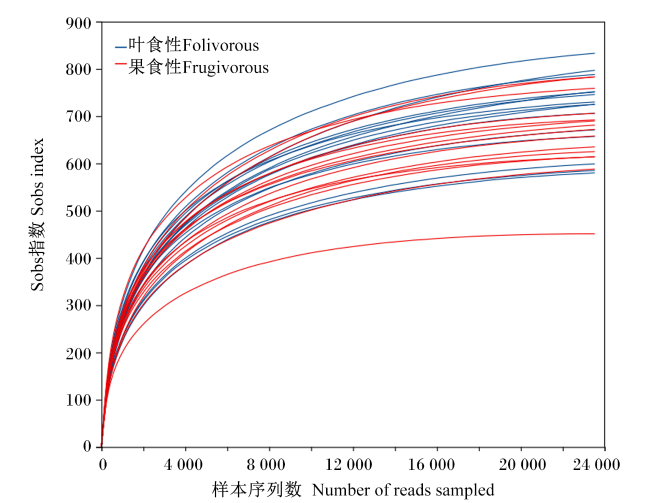
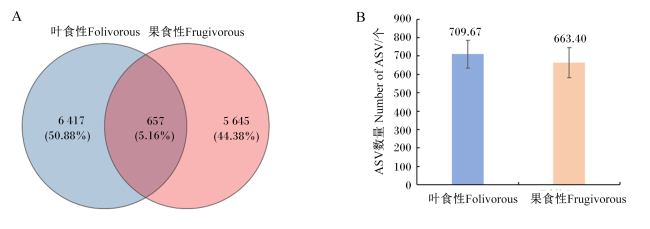
2.2 肠道菌群多样性
2.2.1 α多样性分析
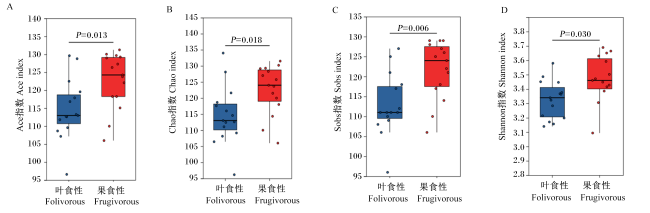
α多样性分析反映了肠道菌群的丰富度和多样性:ACE指数、Chao指数和Sobs指数越大,菌群物种丰富度越高;Shannon指数越大,菌群多样性越高。α多样性分析结果显示,果食性灵长类肠道菌群Ace指数(P=0.013)、Chao指数(P=0.018)、Sobs指数(P=0.006)和Shannon指数(P=0.030)均显著高于叶食性灵长类(图3),表明果食性灵长类肠道菌群的丰富度和多样性显著高于叶食性灵长类。
2.2.2 β多样性分析
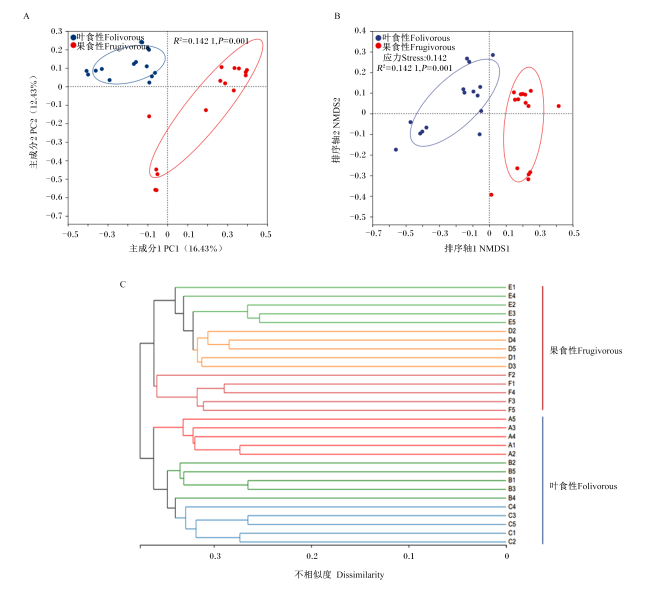
2.3 肠道菌群组成
30个粪便样品共注释到17个门、27个纲、60个目、107个科、294个属、609个种的肠道细菌。
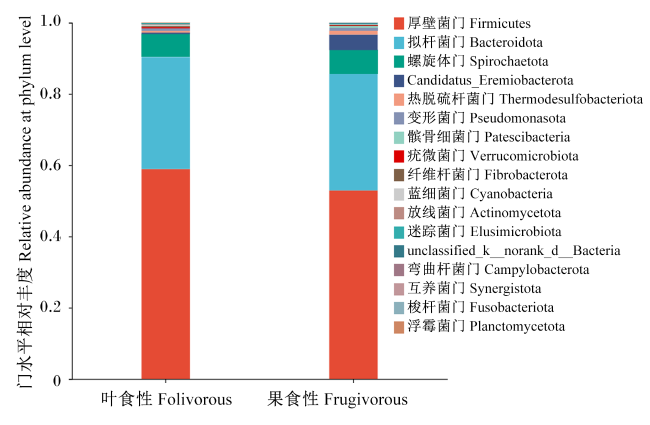
在门水平上,叶食性和果食性灵长类肠道菌群组成相似,均以厚壁菌门(Firmicutes)、拟杆菌门(Bacteroidota)和螺旋体门(Spirochaetota)为优势菌门,三者在叶食性灵长类肠道菌群中的平均相对丰度分别为58.90%、31.43%和6.45%,在果食性灵长类中则分别为52.90%、32.67%和6.71%,三者平均相对丰度之和占全部菌门的90%以上,是肠道菌群的核心菌门(图5)。此外,果食性灵长类肠道菌群还具有较高相对丰度的Candidatus_Eremiobacterota(4.35%),Wilcoxon秩和检验表明其相对丰度显著高于叶食性灵长类(P=0.004)。
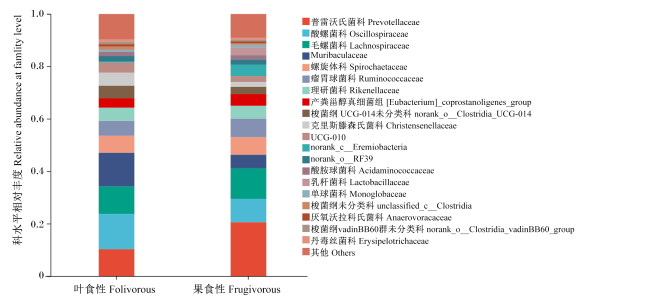
在科水平上,叶食性和果食性灵长类肠道菌群组成存在较大差异,叶食性灵长类肠道菌群中颤螺菌科(Oscillospiraceae)(13.49%)、Muribaculaceae(12.86%)、毛螺菌科(Lachnospiraceae)(10.50%)、普雷沃氏菌科(Prevotellaceae)(10.25%)和螺旋体科(Spirochaetaceae)(6.45%)占优势;果食性灵长类前5的肠道菌群中的优势菌科依次是普雷沃氏菌科(20.59%)、毛螺菌科(11.65%)、颤螺菌科(8.90%)、瘤胃球菌科(Ruminococcaceae)(7.06%)和螺旋体科(6.71%)(图6)。优势菌科中,叶食性灵长类颤螺菌科(P=0.026)和Muribaculaceae(P=0.011)的相对丰度显著高于果食性灵长类,而普雷沃氏菌科的相对丰度显著低于果食性灵长类(P=0.034)。
在属水平上,叶食性灵长类肠道菌群中排在前5的优势菌属为norank_f__Muribaculaceae(12.85%)、UCG-005(7.42%)、密螺旋体属(Treponema)(6.43%)、毛螺菌科未分类属(unclassfied_f__Lachnospiraceae)(6.38%)和克里斯滕森氏菌科R-7群(Christensenellaceae_R-7_group)(4.87%),约占全部菌属的38%;果食性灵长类肠道菌群中相对丰度较高的5个菌属依次是普雷沃氏菌属(Prevotella)(10.69%)、密螺旋体属(6.69%)、norank_f__Muribaculaceae(4.93%)、产粪甾醇真细菌组未分类属(norank_f__[Eubacterium]_coprostanoligenes_group)(4.41%)和norank_c__Eremiobacteria(4.35%),其余菌属占比均不超过4.00%(图7)。优势菌属在不同食性灵长类间具有差异:叶食性灵长类norank_f__Muribaculaceae(P=0.008)、UCG-005(P=0.001)和克里斯滕森氏菌科R-7群(P=0.002)的相对丰度显著高于果食性灵长类,普雷沃氏菌属的相对丰度则显著低于果食性灵长类(P=0.001)。
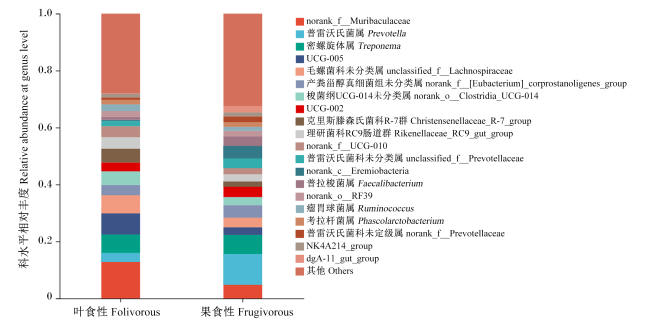
总的来说,叶食性和果食性灵长类肠道菌群组成在科、属水平上差异显著,形成了各自独特的菌群结构。
2.4 肠道菌群组成差异分析
LEfSe分析(图8)显示,2组灵长类肠道菌群在不同分类学水平上共检测到相对丰度存在显著差异的42个微生物标志物(LDA得分>3.5,P<0.05)。叶食性灵长类主要富集到梭菌纲(Clostrida)、梭菌纲UCG-014(Clostrida_UCG-014)及其从属的部分未分类菌;Muribaculaceae和norank_f__Muribaculaceae;克里斯滕森氏菌目(Christensenellales)、克里斯滕森氏菌科和克里斯滕森氏菌科R-7群;拟杆菌科(Bacteroidaceae)和拟杆菌属(Bacteroides)等23个类群。果食性灵长类主要富集到普雷沃氏菌科和普雷沃氏菌属;Candidatus_Eremiobacterota及其从属的部分未分类菌;乳杆菌目(Lactobacillales)、乳杆菌科(Lactobacillaceae)和联合乳杆菌属(Ligilactobacillus)等19个类群。采用随机森林模型获得标志性物种,模型曲线下面积(AUC)验证表明重要性排名前25的差异菌属为叶食性和果食性灵长类肠道菌群的理想标志物(图9-A)。重要性排名前25同时在LEfSe分析中也富集到的菌属有5个,分别为联合乳杆菌属、戴阿利斯特杆菌属(Dialister)、普雷沃氏菌属、拟杆菌属和Leyella(图9-B),除拟杆菌属外,其余4个菌属均在果食性灵长类中富集,这5个菌属或许可作为叶食性和果食性灵长类肠道菌群的理想标志物。
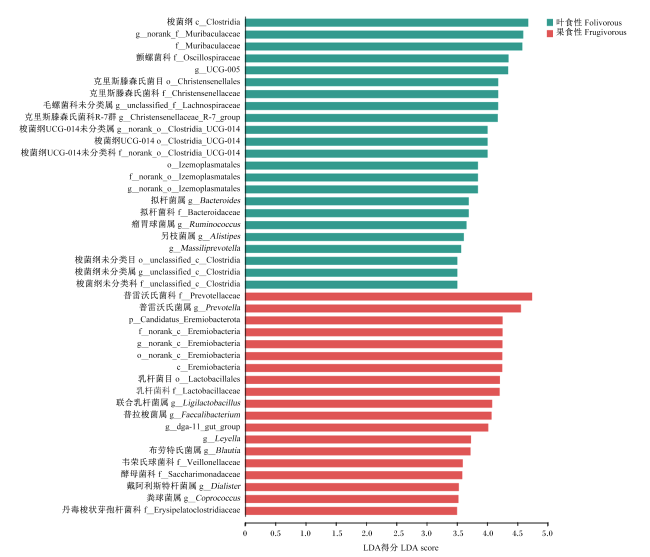
图8 叶食性和果食性灵长类肠道菌群LEfSe分析Fig.8 LEfSe analysis of gut microbiota of folivorous and frugivorous primates |
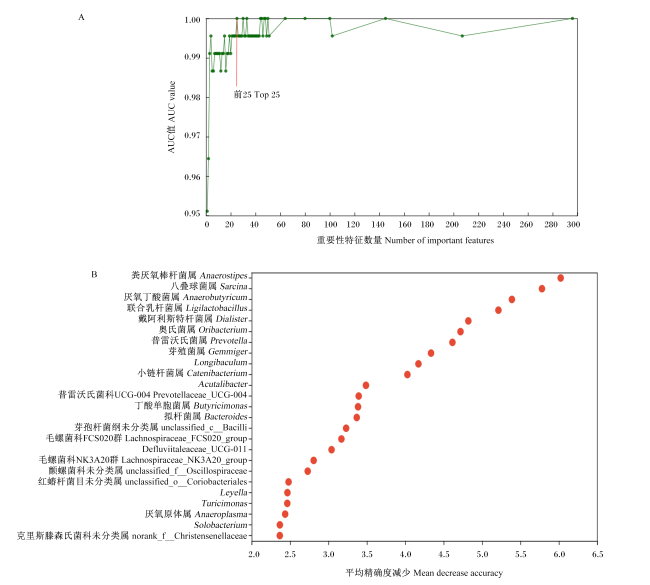
图9 随机森林模型筛选叶食性和果食性灵长类肠道菌群标志物A:随机森林模型AUC验证;B:随机森林模型排名前25的差异菌属为叶食性和果食性灵长类的理想标志物。 Fig.9 Identification of gut microbial markers of folivorous and frugivorous primates using random forest models A: AUC validation was performed on the random forest model; B: top 25 differentially bacterial genera were selected as the optimal markers set based on random forest between folivorous and frugivorous primates. |
2.5 肠道菌群代谢通路预测
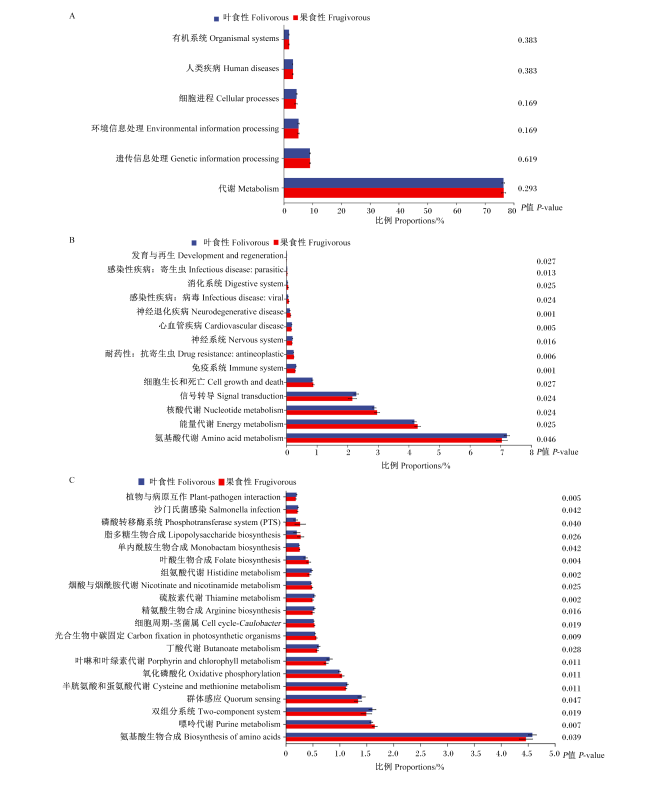
基于16S rDNA测序结果进行KEGG功能注释,获得ASV在KEGG各功能水平的注释信息及各功能在不同样本中的丰度信息。在KEGG代谢通路一级水平(level 1)上,2种食性灵长类肠道菌群在代谢、遗传信息处理和环境信息处理3个通路上丰度较高,但2种食性灵长类间差异不显著(P>0.05)(图10-A)。在KEGG代谢通路二级水平(level 2)上,2种食性灵长类代谢通路丰度分布差异较大,在46个通路中的14个通路的丰度表现出显著差异(P<0.05),其中叶食性灵长类在氨基酸代谢等6个通路上的丰度显著高于果食性灵长类(P<0.05),而在能量代谢和核酸代谢等8个通路上的丰度显著低于果食性灵长类(P<0.05)(图10-B)。在KEGG代谢通路三级水平(level 3)上,2种食性灵长类在331个通路中有81个通路的丰度存在显著差异(P<0.05),丰度排在前20的差异通路中,叶食性灵长类在氨基酸代谢方面如半胱氨酸和蛋氨酸代谢、精氨酸生物合成和组氨酸代谢相关通路的丰度更高(P<0.05);此外,2种食性灵长类在辅助因子和维生素代谢方面也表现出显著差异:叶食性灵长类卟啉和叶绿素代谢、硫胺酸代谢的通路丰度显著高于果食性灵长类(P<0.05),烟酸与烟酰胺代谢、叶酸生物合成的通路丰度显著低于果食性灵长类(P<0.05)(图10-C);特别地,叶食性灵长类肠道菌群中丁酸代谢通路丰度较果食性灵长类显著增加(P<0.05)(图10-C),丁酸作为短链脂肪酸的重要成员与植物纤维的摄入密切相关,从而与以树叶为主食的食性相吻合。
3 讨论
3.1 果食性灵长类具有更高的肠道菌群多样性
食物组成是影响宿主肠道菌群多样性的重要因素[23]。McKenney等[24]发现,叶、果均食的阿拉伯狒狒(Papio hamadryas)肠道菌群多样性高于叶食性的西部低地大猩猩(Gorilla gorilla gorilla)和果食性的黑猩猩(Pan troglodytes),这可能是由于阿拉伯狒狒具有更多的食物来源。Mo等[14]研究表明,圈养环境下增加糕饼、水果、坚果等食物,圈养黑叶猴肠道菌群多样性显著高于野外个体。更加丰富的食物组成可为肠道微生物创造多样化的代谢生态位,从而有助于增加微生物的多样性[25]。本研究中果食性灵长类肠道菌群物种丰富度(Ace指数、Chao指数和Sobs指数)和多样性(Shannon指数)显著高于叶食性灵长类,这可能是因为果食性灵长类的食物种类更加丰富。Amato等[26]认为物种系统发育也会影响肠道菌群多样性,灵长类4个进化分支即狐猴、新大陆猴、旧大陆猴和猿的肠道菌群丰富度和多样性表现出显著差异。本研究中除北黄颊长臂猿外其余灵长类均为旧大陆猴,北黄颊长臂猿作为研究对象中唯一的猿,或许增加了本研究中果食性灵长类肠道菌群的多样性。
3.2 不同食性非人灵长类具有各自独特的肠道菌群结构
不同的饮食习惯构成不同的肠道菌群结构。叶食性灵长类食物以树叶为主,树叶中富含大量的纤维素和半纤维素,这些结构性碳水化合物不能被宿主自身的酶类消化,而是通过肠道微生物将它们分解并产生能够吸收的挥发性短链脂肪酸(SCFAs),为宿主提供能量补偿[31]。本研究中叶食性灵长类肠道菌群中相对丰度排在前5的优势菌属为norank_f__Muribaculaceae、UCG-005、密螺旋体属、毛螺菌科未分类属和克里斯滕森氏菌科R-7群,与Xi等[30]报道的仰鼻猴肠道菌群优势菌属结构相似,这可能是由于食性相同。本研究中的LEfSe分析进一步显示,包括norank_f__Muribaculaceae、UCG-005、毛螺菌科未分类属和克里斯滕森氏菌科R-7群等在内的纤维降解菌在叶食性灵长类肠道菌群中显著富集。norank_f__Muribaculaceae在牦牛瘤胃菌群中丰度增加有助于提高牦牛生长性能和饲料纤维的消化率[32];克里斯滕森氏菌科R-7群常位于宿主肠道及黏膜上,在纤维素的降解和氨基酸、多肽、脂质等物质的代谢上具有重要的作用,该菌属在贵州仰鼻猴(Rhinopithecus brelichi)野生猴群中的相对丰度显著高于圈养个体[15]。
果食性灵长类食物中水果占比较高,成熟水果中富含可溶性糖类,易于在小肠处消化吸收,到达大肠通过菌群发酵的纤维素含量较低[33]。李依蒙等[34]关于海南长臂猿(Nomascus hainanus)肠道菌群中普雷沃氏菌属、真杆菌属(Eubacterium)等为优势菌属的报道,与本研究中果食性灵长类肠道菌群优势菌属具有一定的相似性。普雷沃氏菌属分泌的酶能够降解纤维素和木聚糖,其显著富集在缓解糖和脂代谢紊乱方面起着重要作用[35]。已有研究表明,普雷沃氏菌属的相对丰度与高比例碳水化合物和简单糖的摄入呈正相关[36],例如,随着食果季节的来临,普雷沃氏菌属在野外西部低地大猩猩[33]和维氏冕狐猴(Propithecus verreauxi)[37]肠道菌群中的相对丰度显著增加,与本研究中果食性灵长类肠道菌群中普雷沃氏菌属显著富集的结果一致。本研究中,LEfSe分析表明,除优势菌普雷沃氏菌科和普雷沃氏菌属外,果食性灵长类还富集到乳杆菌目、乳杆菌科和乳杆菌属等类群。乳杆菌可以使糖类发酵产生乳酸,进而改善肠道的免疫屏障,是重要的益生菌,食物中的低聚果糖能促进乳杆菌丰度的增加[38]。赵俊松等[39]通过对比发现,普拉梭菌属(Faecalibacterium)、布劳特氏菌属(Blautia)和戴阿利斯特杆菌属为藏酋猴(Macaca thibetana)、恒河猴和食蟹猴(Macaca fascicularis)肠道菌群共有菌属,本研究中果食性灵长类肠道菌群中也富集到这些菌属,表明本研究中的果食性灵长类食物组成与猕猴属动物相近,水果占比较高。普拉梭菌属[3]、布劳特氏菌属[40]和戴阿利斯特杆菌属[41]均为短链脂肪酸生产者,它们能够帮助果食性灵长类分解食物中的植物纤维,保护宿主免受炎症和非感染性的结肠疾病[3]。目前的研究揭示Candidatus_Eremiobacterota通常在贫瘠的环境中存在,具有耐酸适应性[42],其在本研究中的果食性灵长类肠道中富集,可能是因为动物接触到环境中的此类菌而进入体内[43],表明果食性灵长类与其生活环境间存在较为密切的生态相互作用,具体的相关性需要进一步的研究确定。总的来说,叶食性和果食性灵长类形成了与食性紧密相关的独特的肠道菌群结构,从而有助于达到功能平衡。
3.3 食性对肠道菌群代谢通路的影响
不同的食性将直接或间接影响不同物种的代谢水平。PICRUSt2功能预测发现,非人灵长类肠道菌群与代谢相关的通路丰度最高,表明营养物质的消化吸收是肠道菌群主要的生物功能。本研究中2种食性灵长类存在差异的代谢通路中,叶食性灵长类在氨基酸代谢方面如精氨酸生物合成、半胱氨酸和蛋氨酸代谢、组氨酸代谢相关通路丰度更高,这或许是因为采食的树叶中富含相关氨基酸[44],从而增加了叶食性灵长类相关氨基酸代谢功能的细菌丰度。此外,叶食性灵长类精氨酸生物合成通路丰度显著增加,与Amato等[26]相关研究结果一致,可能是由于机体对精氨酸需求量较大,精氨酸作为动物细胞中用途最广泛的氨基酸之一,不仅是合成蛋白质的前体,也是合成多胺、脯氨酸和谷氨酸等物质的前体[45],日常饲养时或许可为叶食性灵长类适量补充富含该营养素的食物如花生等坚果。2种食性灵长类在维生素代谢方面也表现出显著差异,如果食性灵长类叶酸生物合成、烟酸与烟酰胺代谢的通路丰度显著增加。叶酸是一种B族维生素,能够促进核苷酸生物合成,确保基因组稳定性并防止癌变[46]。肠道菌群是宿主维生素的提供者,如乳杆菌可促进B族维生素叶酸和核黄素的生物合成[47]。果食性灵长类食物中的低聚果糖能够促进乳杆菌的增殖[38],从而可能增加了其叶酸生物合成通路丰度,该现象在Amato等[26]的相关研究中也有报道。此外,有学者发现果多糖不仅能调控维生素代谢通路,还可促使形成肠道微生物稳态,改善肠道菌群失调,从而起到肠道黏膜屏障的保护作用[48]。
本研究存在的不足之处:1)由于饲养的部分灵长类动物种群数量限制,其中3只动物个体采集了2次粪便样品,可能会对结果的准确性产生一定影响,后续可通过扩大种群规模增加样本量,使结果更具代表性;2)使用PICRUSt2软件将16S rDNA扩增子序列比对到KEGG数据库进行功能注释,只预测了微生物功能,后续可通过宏基因组测序获得更准确的功能信息。
4 结论
对圈养叶食性和果食性灵长类肠道菌群多样性、组成和功能的特征与差异的分析表明,食性对非人灵长类肠道菌群有显著影响,肠道菌群进化出了与宿主食性相适应的结构。
 京公网安备 11010802041926号


