研究论文

不同物候期放牧育成马后肠道菌群组成及差异分析

  • 杨风萍 , 1, 2 ,
  • 俄广旭 1 ,
  • 黄丹 1 ,
  • 张延龙 1 ,
  • 郭雪峰 , 1, 3, 4, *
展开
  • 1 塔里木大学动物科学与技术学院, 阿拉尔 843300
  • 2 塔城职业技术学院, 塔城 834700
  • 3 塔里木畜牧科技兵团重点实验室, 阿拉尔 843300
  • 4 农业农村部环塔里木畜草资源利用重点实验室, 阿拉尔 843300
*郭雪峰,教授,博士生导师,E-mail:

杨风萍(1989—),女,新疆塔城人,讲师,硕士,从事动物营养学与肠道微生物研究。E-mail:

Office editor: 靳爽

收稿日期: 2025-09-09

  网络出版日期: 2026-04-14

基金资助

2024年度塔城地区本级科技计划(指导性)项目(2024DE1069)

Composition and Differential Analysis of Hindgut Microbiota of Grazing Growing Horses in Different Phenological Periods

  • YANG Fengping , 1, 2 ,
  • E Guangxu 1 ,
  • HUANG Dan 1 ,
  • ZHANG Yanlong 1 ,
  • GUO Xuefeng , 1, 3, 4, *
Expand
  • 1 Faculty of Animal Science and Technology, Tarim University, Aral 843300, China
  • 2 Tacheng Institute of Vocational Technology, Tacheng 834700, China
  • 3 Key Laboratory of Tarim Animal Husbandry Science and Technology Corps, Aral 843300, China
  • 4 Key Laboratory of Utilization of Livestock and GrassResources in Huantarim, Ministry of Agriculture and Rural Affairs, Aral 843300, China
*professor, E-mail:

Received date: 2025-09-09

  Online published: 2026-04-14

摘要

本试验旨在研究不同牧草物候期(幼嫩期、旺盛期、枯草期)对放牧育成马后肠道菌群结构及功能的影响。分别于幼嫩期、旺盛期和枯草期采集牧草样品,测定常规营养成分含量。选取5匹体重(270±50) kg、年龄(3±1)岁且含哈萨克马血统的杂交育成马,分别于幼嫩期、旺盛期、枯草期连续3 d无菌采集粪便样品,采用16S rDNA高通量测序技术进行粪便菌群分析。结果表明:1)随着牧草从幼嫩期、旺盛期进入枯草期,粗蛋白质含量逐渐降低,粗脂肪含量先升高后降低,粗灰分、中性洗涤纤维、酸性洗涤纤维和酸性洗涤木质素含量逐渐升高。2)旺盛期后肠道菌群操作分类单元(OTU)数量最高,且ACE指数和Chao1指数显著高于幼嫩期和枯草期(P<0.05)。门水平上,与枯草期相比,旺盛期疣微菌门(Verrucomicrobia)相对丰度显著提高(P<0.05),但枯草期厚壁菌门(Firmicutes)与拟杆菌门(Bacteroidota)比值(F/B)高于旺盛期。科水平上,与旺盛期相比,枯草期未培养瘤胃细菌(uncultured_rumen_bacterium)相对丰度极显著降低(P<0.01),幼嫩期未培养瘤胃细菌相对丰度显著降低(P<0.05);幼嫩期颤螺旋菌科(Oscillospiraceae)相对丰度极显著高于旺盛期和枯草期(P<0.01);枯草期莫拉菌科(Moraxellaceae)相对丰度显著高于幼嫩期和旺盛期(P<0.05),乳杆菌科(Lactobacillaceae)相对丰度极显著高于幼嫩期和旺盛期(P<0.01)。属水平上,与旺盛期相比,枯草期未培养瘤胃细菌相对丰度极显著降低(P<0.01),幼嫩期未培养瘤胃细菌相对丰度显著降低(P<0.05);幼嫩期和旺盛期克里斯滕森菌科R-7群(Christensenellaceae_R-7_group)相对丰度显著降低(P<0.05)。后肠道菌群功能预测结果显示,枯草期外源生物降解和代谢、脂类代谢、信号转导、免疫疾病相关代谢通路相对丰度均显著高于旺盛期(P<0.05)。综上所述,不同物候期显著影响放牧育成马后肠道菌群的结构和多样性,菌群通过改变多种代谢途径,适应环境的变化。

本文引用格式

杨风萍 , 俄广旭 , 黄丹 , 张延龙 , 郭雪峰 . 不同物候期放牧育成马后肠道菌群组成及差异分析[J]. 动物营养学报, 2026 , 38(4) : 2836 -2848 . DOI: 10.12418/CJAN2026.229

Abstract

This experiment was conducted to investigate the effects of different forage phenological periods (tender period, vigorous period, withered period) on the structure and function of hindgut microbiota in grazing growing horses. Forage samples were collected in the tender period, vigorous period and withered period, respectively, and the contents of conventional nutritional components were determined. Five crossbred growing horses with Kazakh horse lineage, with a body weight of (270±50) kg and an age of (3±1) years were selected. Fecal samples were collected aseptically for 3 consecutive days at each of the three phenological periods, and the fecal microflora was analyzed by 16S rDNA high-throughput sequencing technology. The results showed as follows: 1) with the transition of forage from the tender period to the vigorous period and then to the withered period, the crude protein content decreased gradually, the ether extract content increased first and then decreased, while the contents of crude ash, neutral detergent fiber, acid detergent fiber and acid detergent lignin increased gradually. 2) The number of operational taxonomic units (OTU) of hindgut microbiota was the highest in the vigorous period, and the ACE index and Chao1 index were significantly higher than those in the tender period and withered period (P<0.05). At the phylum level, the relative abundance of Verrucomicrobia in the vigorous period was significantly higher than that in the withered stage (P<0.05), while the ratio of Firmicutes to Bacteroidota (F/B) in the withered period was higher than that in the vigorous period. At the family level, the relative abundance of uncultured_rumen_bacterium in the withered period was extremely significantly lower than that in the vigorous period (P<0.01), and that in the tender period was significantly lower (P<0.05). The relative abundance of Oscillospiraceae in the tender period was extremely significantly higher than that in the vigorous period and withered period (P<0.01). The relative abundance of Moraxellaceae in the withered period was significantly higher than that in the tender period and vigorous period (P<0.05), and the relative abundance of Lactobacillaceae was extremely significantly higher (P<0.01). At the genus level, the relative abundance of uncultured_rumen_bacterium in the withered period was extremely significantly lower than that in the vigorous period (P<0.01), and that in the tender period was significantly lower (P<0.05). The relative abundance of Christensenellaceae_R-7_group in the tender period and vigorous period was significantly lower than that in the withered period (P<0.05). The functional prediction results of hindgut microbiota showed that the relative abundances of metabolic pathways related to xenobiotic biodegradation and metabolism, lipid metabolism, signal transduction and immune diseases in the withered period were significantly higher than those in the vigorous period (P<0.05). In conclusion, different phenological periods significantly affect the structure and diversity of hindgut microbiota in grazing growing horses, and the microbiota adapts to environmental changes by altering a variety of metabolic pathways.

马是单胃草食动物,其盲肠具备类似反刍动物瘤胃的功能,被誉为“发酵罐”[1]。盲肠微生物与动物能量摄取、免疫调节密切相关,其群落结构易受生存环境、食性、季节等因素影响。其中,食性是影响动物肠道微生物结构的主要因素[2],不同食性结构对应不同的肠道菌群组成[3-4]。研究表明,塔里木马鹿短时间内采食纤维含量较高的饲粮会导致肠道厚壁菌门(Firmicutes)数量增加[5];将高纤维饲粮换成高淀粉饲粮后,马肠道微生物生态系统会发生显著变化[6-7];补喂发酵豆粕可有效提升马驹的消化能力,并促进肠道菌群的稳定性[8]。此外,动物肠道微生物组成与品种和肠道部位有关,例如天山马鹿肠道菌群多样性和丰度高于塔里木马鹿[9],断奶马驹小肠不同分段中菌群结构存在差异,其中前段以厚壁菌门为主,后段则以厚壁菌门和变形菌门(Proteobacteria)为主[10]。而Antwis等[11]和Ericsson等[12]均认为性别对动物肠道菌群结构无显著影响。饲养模式与放牧季节同样会影响马匹肠道菌群特征。研究发现,冬季放牧组马匹肠道菌群多样性高于圈养组[13];哈萨克马冬季肠道菌群丰富度极显著高于夏季[14]。马的采食范围广泛,可采食禾本科、豆科、菊科、莎草科等多种牧草。牧草种类及其比例会随地域、季节和气候的变化而变化,而不同物候期食性选择对放牧马后肠道菌群组成的影响尚不明确。因此,本试验旨在分析不同物候期牧草的营养成分差异,并比较相应物候期下育成马后肠道微生物的群落特征,以期为放牧马的饲养管理提供科学依据。

1 材料与方法

1.1 伦理声明

本试验所有程序均获得塔里木大学科技伦理委员会批准,批准编号为B20251014001。

1.2 试验场地

试验地点位于新疆塔城地区库鲁斯台草原腹地莫因塔勒村,地处东经83°17'26″,北纬46°24'42″,海拔400~600 m。该地区属温带大陆性干旱气候,无霜期126 d,冬季持续时间长达半年;年平均日照时数2 750.4 h,年平均气温6.5 ℃,极端高温可达41 ℃,极端低温可达-45 ℃,全年≥10 ℃积温为3 142 ℃;年平均降雨量260~280 mm,年蒸发量1 608 mm,平均湿度50%~70%[15]。天然草场常见植被包括芨芨草(Achnatherum splendens)、冰草(Agropyron cristatum)、早熟禾(Poa annua)等。

1.3 试验设计

根据季节变化及牧草不同生长阶段分为3个物候期:牧草幼嫩期(4—5月)、旺盛期(6—9月)、枯草期(10—3月)。从自然放牧马群中选取5匹体重(270±50) kg、年龄(3±1)岁且含有哈萨克马血统的杂交育成马(性别未作限制,1匹公马,4匹母马)作为研究对象。试验马匹全年在天然草场上放牧,自由饮水,冬季采食积雪。在严寒冬季,每10~15 d补饲1次青干草,青干草来源于夏季收割的附近无牧区草场,其牧草种类与放牧时日常采食的牧草一致。

1.4 样品采集

1.4.1 牧草样品

分别于幼嫩期(5月12日)、旺盛期(8月3日)和枯草期(翌年1月16日)进行牧草采样。在放牧草场上随机选取10个1 m2以上的不同部位采样点,采集各物候期内试验马匹采食的牧草样本,每种牧草采样量为100~200 g,确保样品完整、具有代表性。采集后的牧草样品立即测定初重,后制成风干样用于营养成分测定。

1.4.2 粪便样品

粪便样品采集时间与对应物候期牧草采样时间同步,分别于幼嫩期(5月10—12日)、旺盛期(8月1—3日)、枯草期(翌年1月14—16日)连续3 d对5匹试验马进行无菌粪便采集,共获得15份粪便样品。粪便样品用5 mL无菌冻存管分装后存入液氮罐,随后立即转移至-80 ℃冰箱中保存备用。

1.5 指标测定

1.5.1 牧草营养成分测定

分别参照GB/T 6432—2018、GB/T 6435—2014、GB/T 6433—2025、GB/T 6438—2007、GB/T 20806—2022、NY/T 1459—2007和GB/T 20805—2006的方法测定牧草干物质(DM)、粗蛋白质(CP)、粗脂肪(EE)、粗灰分(Ash)、中性洗涤纤维(NDF)、酸性洗涤纤维(ADF)和酸性洗涤木质素(ADL)含量。

1.5.2 后肠道菌群16S rDNA基因测序

粪便样品送至西安擎科生物科技有限公司进行16S rDNA基因测序。提取样品总DNA后进行PCR扩增,扩增完成后构建测序文库进行测,测序方法参照刘畅等[16]进行。对测序获得的高质量环形一致性测序(CCS)序列,利用VSEARCH软件在97%相似性水平下进行操作分类单元(OTU)聚类与低丰度过滤,并完成物种注释与分类。采用QIIME软件计算α多样性指数;基于R语言进行主坐标分析(PCoA),以评估β多样性差异;运用Tax4Fun软件对微生物群落进行功能预测分析。

1.6 统计与分析

采用SPSS 26.0软件对试验数据进行单因素方差分析(one-way ANOVA),差异显著时进一步采用Duncan氏法进行组间多重比较,P<0.05表示差异显著,P<0.01表示差异极显著。采用GraphPad Prism 10.0软件作图。

2 结果与分析

2.1 不同物候期牧草的营养成分

表1可知,不同物候期牧草营养成分存在差异。幼嫩期牧草CP含量(16.20%)最高,EE、Ash、ADF、NDF和ADL含量最低;旺盛期牧草EE含量(12.69%)最高;枯草期牧草DM、Ash、ADF、NDF和ADL含量最高,分别为96.51%、28.84%、33.65%、54.03%和13.07%。
表1 不同物候期牧草的营养成分(风干基础)

Table 1 Nutrient composition of forage grass in different phenological periods (air-dry basis) %

项目
Items
幼嫩期
Tender period
旺盛期
Vigorous period
枯草期
Withered period
干物质DM 94.85±0.07 94.48±0.08 96.51±0.16
粗脂肪EE 7.81±0.58 12.69±0.29 8.16±1.42
粗蛋白质CP 16.20±0.33 15.05±0.13 6.53±0.10
粗灰分Ash 11.07±0.01 12.62±0.06 28.84±0.01
中性洗涤纤维NDF 40.79±14.27 51.11±18.80 54.03±16.38
酸性洗涤纤维ADF 22.86±6.59 28.98±10.01 33.65±10.16
酸性洗涤木质素ADL 2.53±0.59 7.76±5.83 13.07±5.36

2.2 不同物候期放牧育成马后肠道菌群OTU数量分析

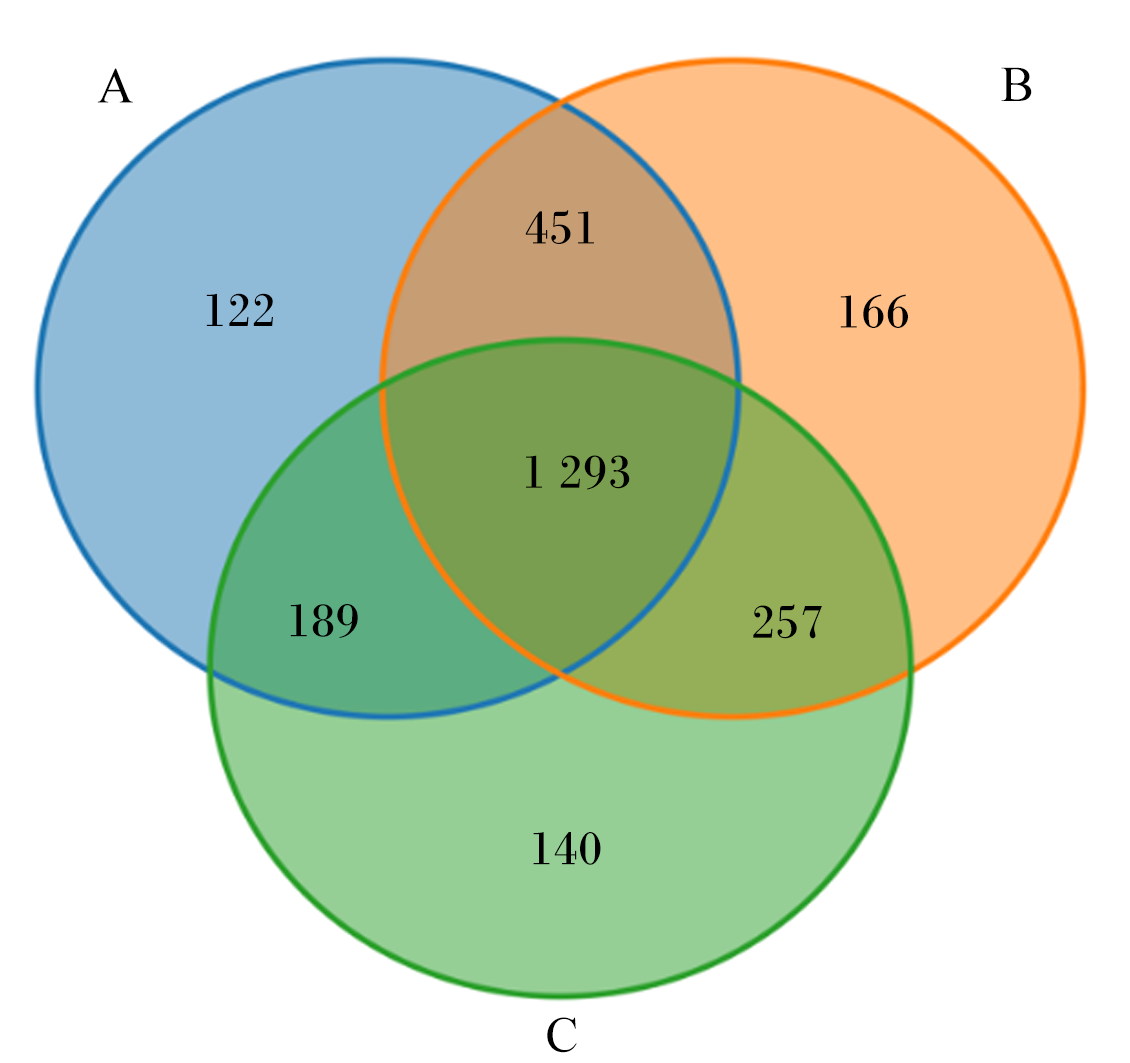
通过PacBioSequelⅡ对粪便微生物16SrDNA基因进行测序,共测得199 881条原始序列,经拼接和质控后平均得到181 929条有效序列。结果表明,不同物候期后肠道菌群的OTU数存在差异(图1)。幼嫩期、旺盛期和枯草期的总OTU数分别为2 055、2 167和1 879个,各自特有的OTU数分别为122、166和140个,3个时期共有的OTU数为1 293个,占所有OTU总数的49.39%。幼嫩期与旺盛期特有OTU数分别为311和423个,共有OTU数为1 744个;旺盛期与枯草期特有OTU数分别为617和329个,共有OTU数为1 550个;幼嫩期与枯草期特有OTU数分别为573和397个,共有OTU数为1 482个。上述结果表明,旺盛期的OTU数最多,群落丰富度最高;枯草期的OTU数最少,丰富度最低。
图1 后肠道菌群OTU数

A、B、C分别表示幼嫩期、旺盛期、枯草期。下图同。

Fig.1 OTU count of hindgut microbiota

A, B and C represented the tender period, vigorous period and withered period, respectively. The same as below.

2.3 不同物候期放牧育成马后肠道菌群多样性分析

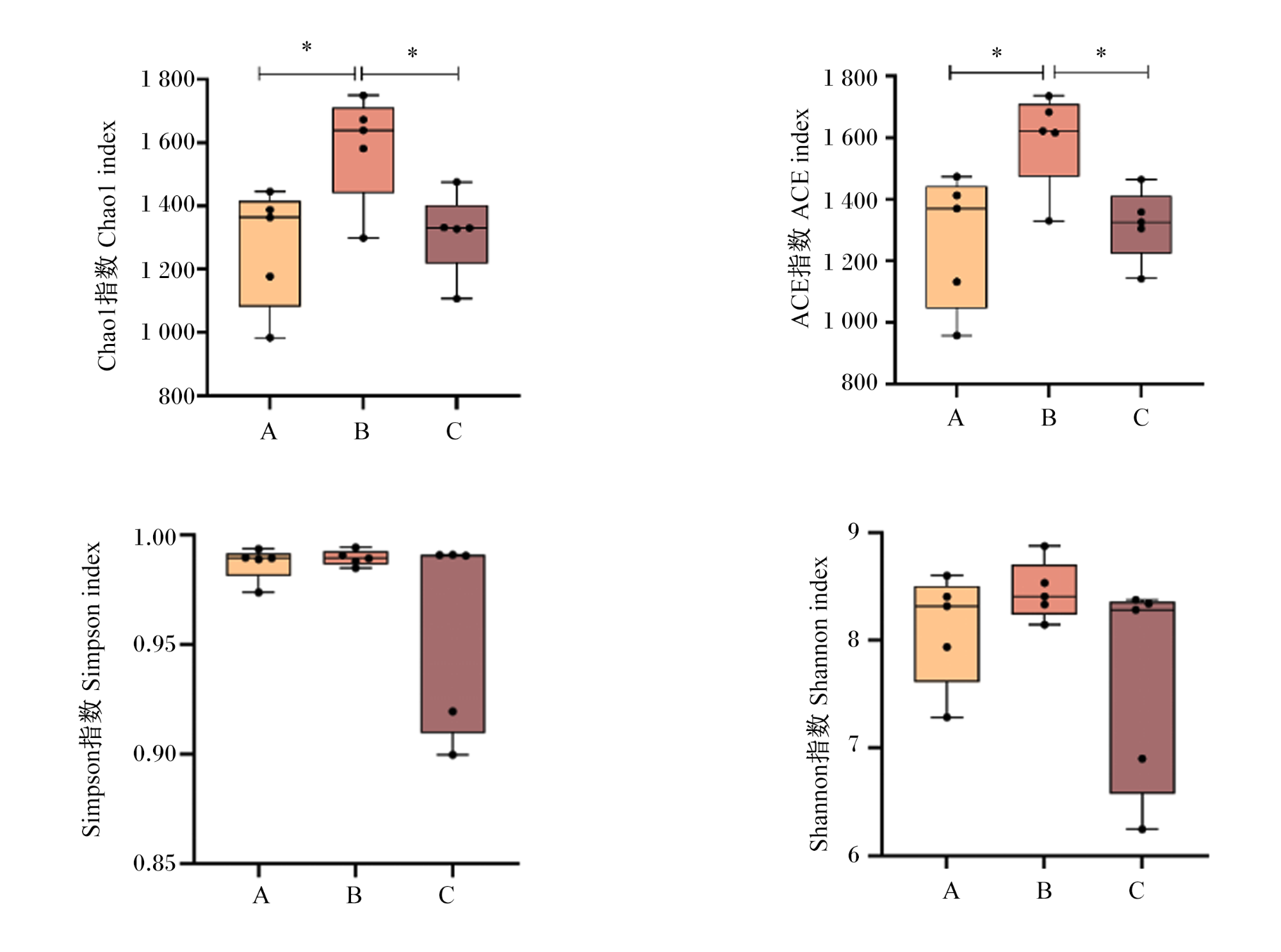
后肠道菌群α多样性分析结果如图2所示。旺盛期ACE指数和Chao1指数显著高于幼嫩期和枯草期(P<0.05),Simpson指数和Shannon指数也高于其他2个时期,但差异不显著(P>0.05)。
图2 后肠道菌群α多样性分析

*表示差异显著(P<0.05),**表示差异极显著(P<0.01)。图6同。

Fig.2 α-diversity analysis of hindgut microbiota

* indicated significant difference (P<0.05), ** indicated extremely significant difference (P<0.01). The same as Fig.6.

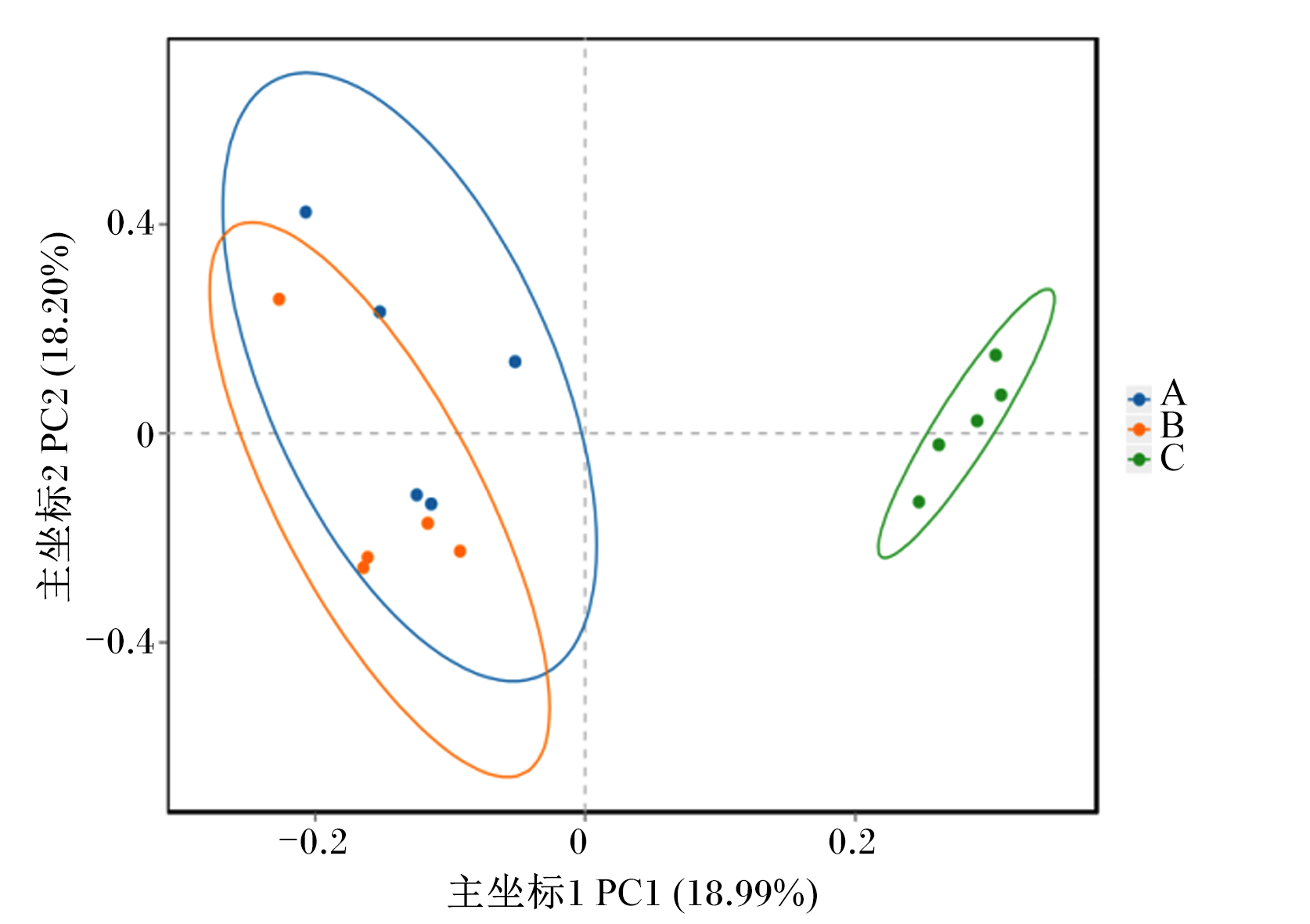
β多样性可反映不同样本间的微生物群落结构差异。PCoA结果(图3)表明,各时期内样本的聚合度较好。其中,枯草期菌群聚类在第1、4象限,而幼嫩期和旺盛期菌群则聚类于第2、3象限,枯草期与幼嫩期和旺盛期之间存在明显分离。以上结果说明,不同物候期会影响放牧育成马后肠道菌群多样性。
图3 后肠道菌群PCoA

Fig.3 PCoA of hindgut microbiota

2.4 不同物候期放牧育成马后肠道菌群结构比较

在15个粪便样本中共鉴定出24个门,42个纲,92个目,174个科,318个属,428个种。
在门水平上,放牧育成马后肠道优势菌群为厚壁菌门、拟杆菌门(Bacteroidota)、疣微菌门(Verrucomicrobiota)和变形菌门,其总相对丰度超过90%。表2列出了相对丰度排名前5的菌门。其中,与枯草期相比,旺盛期疣微菌门相对丰度显著提高(P<0.05);不同物候期厚壁菌门、拟杆菌门、变形菌门及放线菌门(Actinobacteriota)相对丰度差异均不显著(P>0.05)。此外,枯草期厚壁菌门/拟杆菌门比值(F/B)高于旺盛期。
表2 门水平相对丰度排名前5物种分析

Table 2 Analysis of top 5 species in relative abundance at phylum level

项目
Items
幼嫩期
Tender period
旺盛期
Vigorous period
枯草期
Withered period
均值标准误
SEM
P
P-value
厚壁菌门Firmicutes/% 67.69 47.06 61.08 4.926 0.230
拟杆菌门Bacteroidota/% 16.69 21.13 19.60 2.669 0.880
疣微菌门Verrucomicrobia/% 9.11ab 25.34a 1.33b 4.029 0.031
变形菌门Proteobacteria/% 1.57 1.87 15.14 2.755 0.059
放线菌门Actinobacteriota/% 0.85 1.56 1.36 0.426 0.809
厚壁菌门/拟杆菌门F/B 4.05 2.23 3.12

同行数据肩标无字母或相同小写字母表示差异不显著(P>0.05),不同小写字母表示差异显著(P<0.05),不同大写字母表示差异极显著(P<0.01)。下表同。

In the same row, values with no letter or the same small letter superscripts mean no significant difference (P>0.05), while with different small letter superscripts mean significant difference (P<0.05), and with different capital letter superscripts mean extremely significant difference (P<0.01). The same as below.

在科水平上,毛螺菌科(Lachnospiraceae)、未培养瘤胃细菌(uncultured_rumen_bacterium)、理研菌科(Rikenellaceae)、颤螺旋菌科(Oscillospiraceae)、厌氧噬菌体科(Anaerovoracaceae)等是放牧育成马后肠道菌群中的优势菌科。表3列出了相对丰度排名前10的菌科。其中,与旺盛期相比,枯草期未培养瘤胃细菌相对丰度极显著降低(P<0.01),幼嫩期未培养瘤胃细菌相对丰度显著降低(P<0.05);幼嫩期颤螺旋菌科相对丰度极显著高于旺盛期和枯草期(P<0.01),UCG-010相对丰度显著高于枯草期(P<0.05);枯草期莫拉菌科(Moraxellaceae)相对丰度显著高于幼嫩期和旺盛期(P<0.05),乳杆菌科(Lactobacillaceae)相对丰度极显著高于幼嫩期和旺盛期(P<0.01)。
表3 科水平相对丰度排名前10物种分析

Table 3 Analysis of top 10 species in relative abundance at family level %

项目
Items
幼嫩期
Tender period
旺盛期
Vigorous period
枯草期
Withered period
均值标准误
SEM
P
P-value
毛螺菌科Lachnospiraceae 18.31 14.53 22.94 1.858 0.186
未培养瘤胃细菌
Uncultured_rumen_bacterium
13.34ABb 26.49Aa 3.92Bb 3.349 0.009
理研菌科Rikenellaceae 6.93 9.95 8.71 1.521 0.747
颤螺旋菌科Oscillospiraceae 10.45Aa 4.42Bb 5.28Bb 0.961 0.008
厌氧噬菌体科Anaerovoracaceae 5.83 4.67 4.12 1.207 0.865
莫拉菌科Moraxellaceae 0.06b 0.00b 14.33a 2.869 0.048
P_251_o5 4.98 3.48 6.17 1.031 0.603
UCG-010 5.33a 3.27ab 2.10b 0.543 0.034
瘤胃球菌科Ruminococcaceae 3.56 2.03 1.05 0.541 0.164
乳杆菌科Lactobacillaceae 1.27Bb 1.79Bb 4.88Aa 0.563 0.006
在属水平上,未培养瘤胃细菌、理研菌科RC9肠道群(Rikenellaceae_RC9_gut_group)、未分类毛螺菌科(unclassified_Lachnospiraceae)和未分类p_251_o5(unclassified_p_251_o5)等是放牧育成马后肠道菌群中的优势菌属。表4列出了相对丰度排名前7的菌属。其中,与旺盛期相比,枯草期未培养瘤胃细菌相对丰度极显著降低(P<0.01),幼嫩期未培养瘤胃细菌相对丰度显著降低(P<0.05);与枯草期相比,幼嫩期和旺盛期克里斯滕森菌科R-7群(Christensenellaceae_R-7_group)相对丰度显著降低(P<0.05),幼嫩期未分类UCG-010(unclassified_UCG-010)相对丰度显著提高(P<0.05)。
表4 属水平相对丰度排名前7物种分析

Table 4 Analysis of top 7 species in relative abundance at genus level %

项目
Items
幼嫩期
Tender period
旺盛期
Vigorous period
枯草期
Withered period
均值标准误
SEM
P
P-value
未培养瘤胃细菌
Uncultured_rumen_bacterium
14.62ABb 27.93Aa 4.26Bb 3.401 0.006
理研菌科RC9肠道群
Rikenellaceae_RC9_gut_group
6.78 9.65 8.62 1.511 0.764
未分类毛螺菌科
Unclassified_Lachnospiraceae
6.47 6.23 8.22 0.790 0.083
未分类p_251_o5
Unclassified_p_251_o5
4.98 3.48 6.17 1.031 0.603
未分类UCG-010
Unclassified_UCG-010
4.90a 2.87ab 1.96b 0.507 0.039
NK4A214群NK4A214_group 5.34 2.68 3.08 0.553 0.099
克里斯滕森菌科R-7群
Christensenellaceae_R-7_group
2.10b 1.82b 5.56a 0.661 0.021

2.5 后肠道菌群标志物种筛选

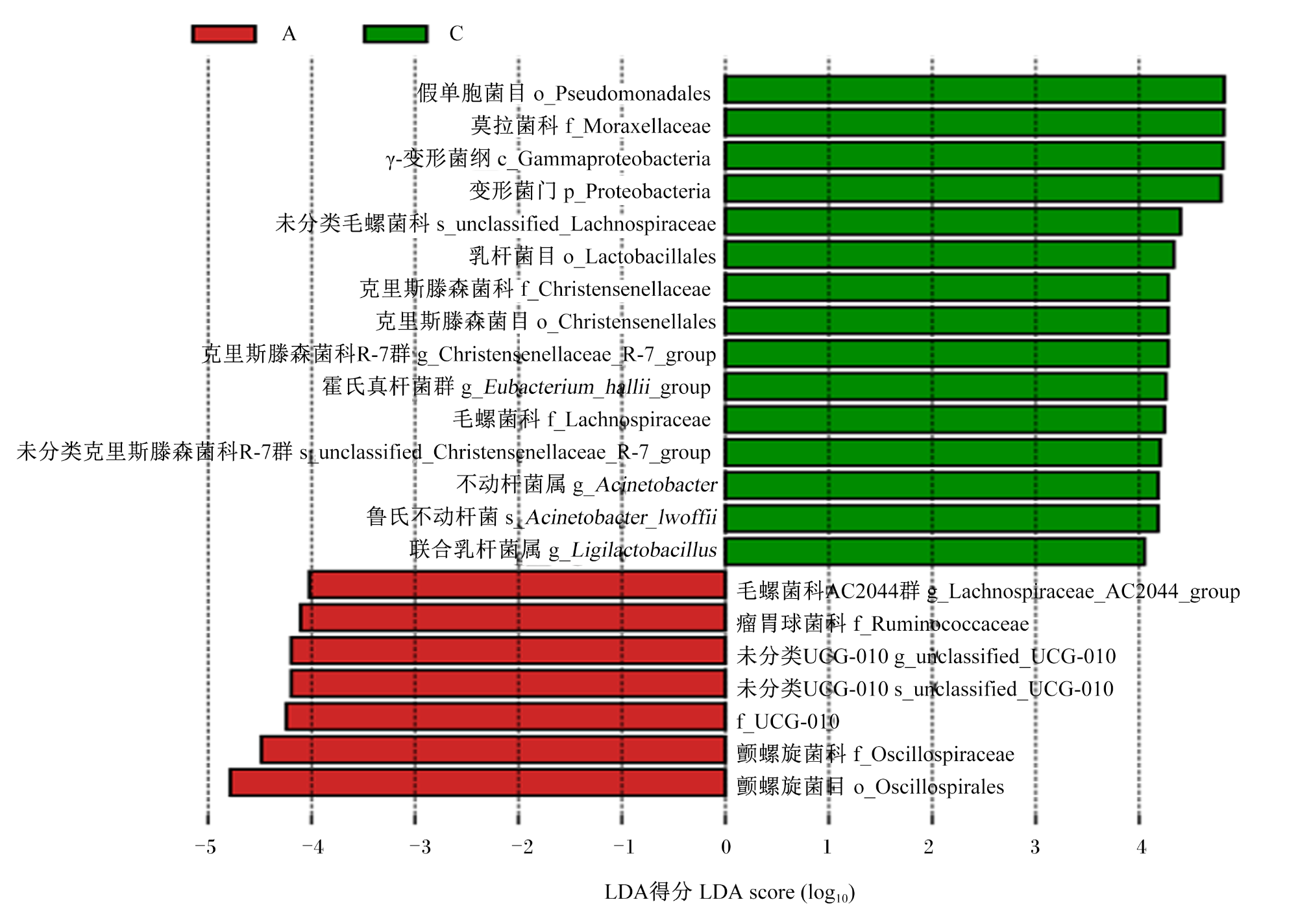
通过线性判别分析(LDA)效应大小(LEfSe)分析,在LDA得分>4的阈值下,幼嫩期后肠道菌群共鉴定出7个标志物种,枯草期共鉴定出15个标志物种(图4)。幼嫩期标志物种包括颤螺旋菌目(Oscillospirales)、瘤胃球菌科(Ruminococcaceae)、UCG?偉c010、毛螺菌科AC2044群(Lachnospiraceae_AC2044_group)等,枯草期标志物种包括假单胞菌目(Pseudomonadales)、莫拉菌科、γ-变形菌纲(Gammaproteobacteria)、未分类毛螺菌科、乳杆菌目(Lactobacillales)、克里斯滕森菌科(Christensenellaceae)、不动杆菌属(Acinetobacter)等。
图4 后肠道菌群LEfSe分析

Fig.4 LEfSe analysis of hindgut microbiota

2.6 基因功能预测分析

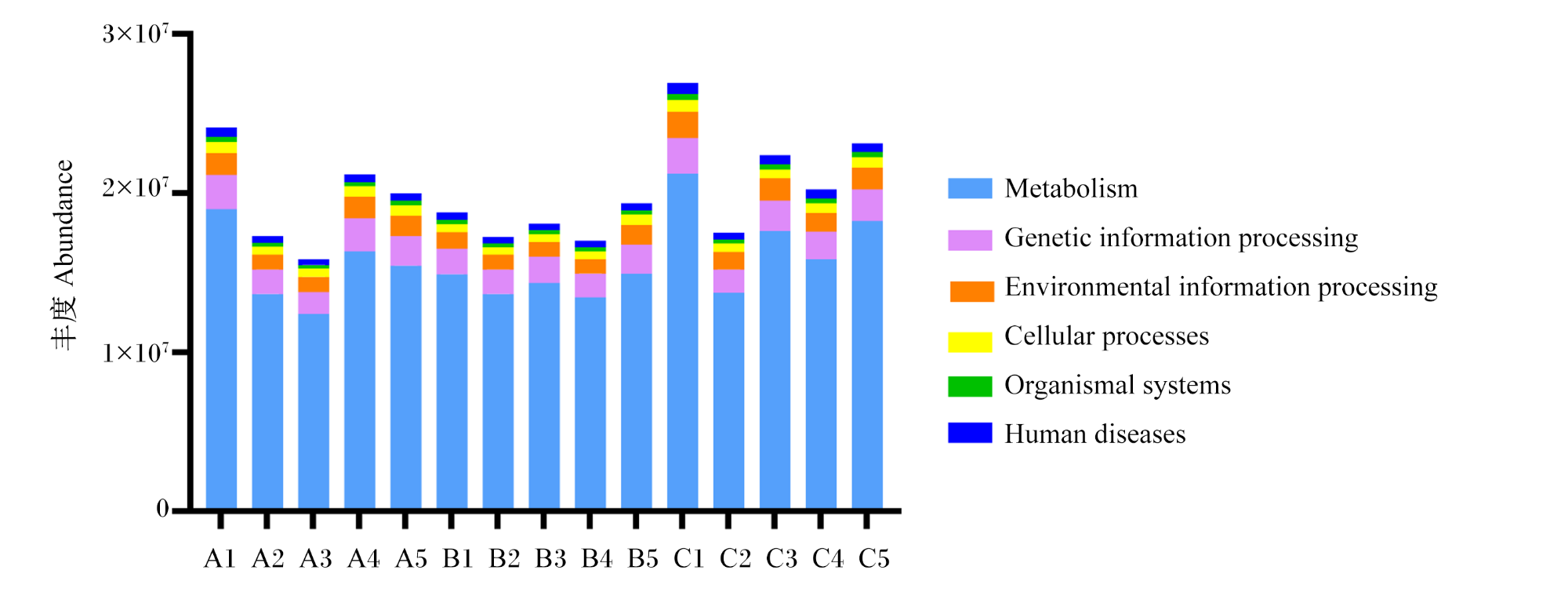
基于序列功能预测分析,对放牧育成马后肠道菌群KEGG代谢通路进行组成及差异分析。由图5可知,在1级KEGG代谢通路中,绝大多数功能序列分布于代谢(metabolism,78.49%)通路,随后依次为遗传信息处理(genetic information processing,8.89%)、环境信息处理(environmental information processing,5.85%)和细胞过程(cellular processes,2.96%),人类疾病(human diseases,2.43%)与有机系统(organismal systems,1.39%)所占比例最低。
图5 KEGG代谢通路堆积柱状图(1级)

A1、A2、A3、A4、A5分别为幼嫩期的5个样本;B1、B2、B3、B4、B5分别为旺盛期的5个样本;C1、C2、C3、C4、C5分别为枯草期的5个样本。A1, A2, A3, A4 and A5 represented the 5 samples in tender period, respectively; B1, B2, B3, B4 and B5 represented the 5 samples in vigorous period, respectively; C1, C2, C3, C4 and C5 represent the 5 samples in withered period, respectively.

Metabolism:代谢;Genetic information processing:遗传信息处理;Environmental information processing:环境信息处理;Cellular processes:细胞过程;Organismal systems:有机系统;Human diseases:人类疾病。下图同 the same as below。

Fig.5 Stacking histogram diagram of KEGG metabolic pathways (level 1)

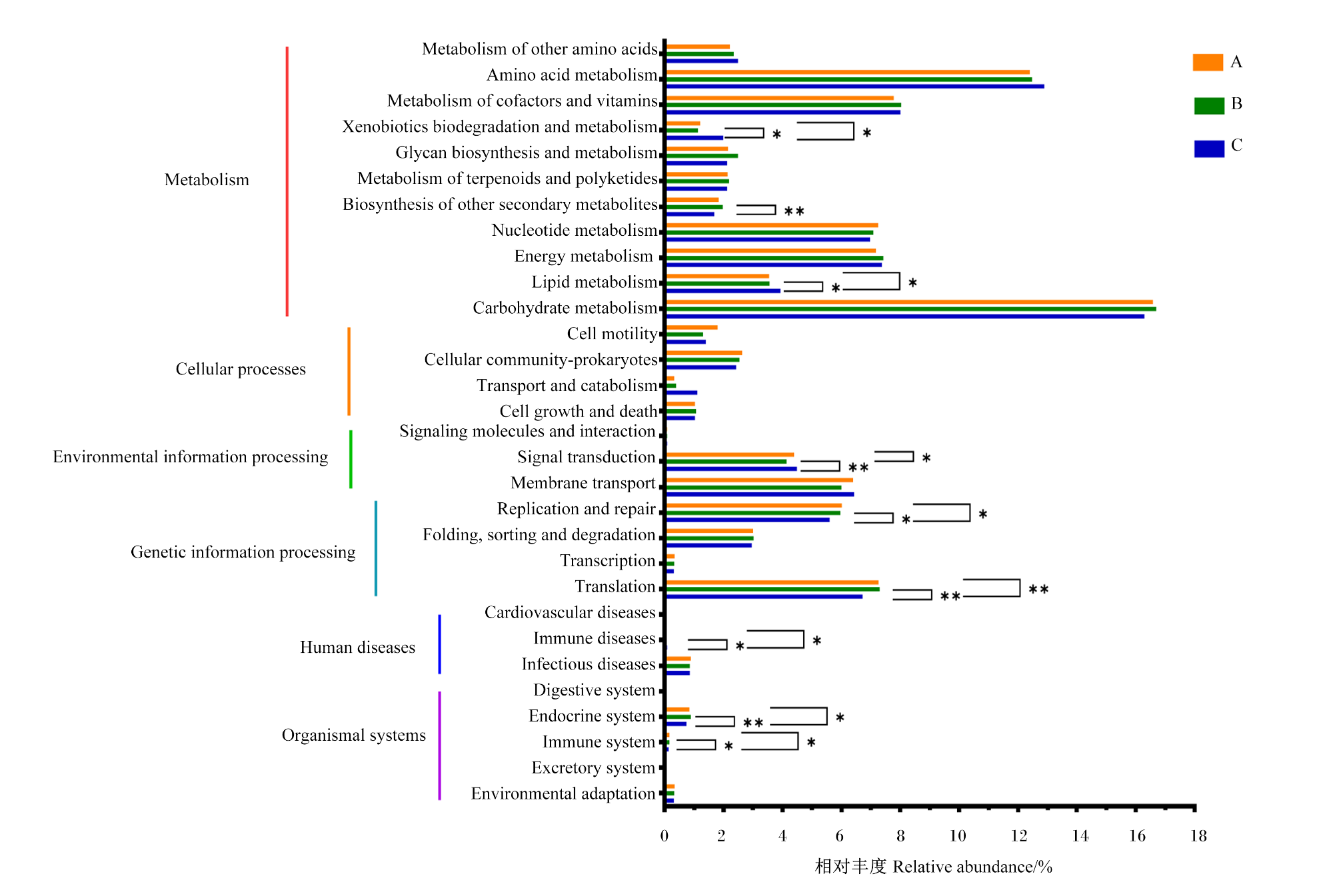
进一步将功能基因注释到2级KEGG功能通路(图6)。结果表明,3个物候期(幼嫩期、旺盛期、枯草期)代谢通路下占比最高的类别均为碳水化合物代谢(carbohydrate metabolism,16.59% vs. 16.70% vs. 16.30%),其次为氨基酸代谢(amino acid metabolism,12.40% vs. 12.48% vs. 12.89%)、辅助因子和维生素代谢(metabolism of cofactors and vitamins,7.79% vs. 8.03% vs. 8.00%)、能量代谢(energy metabolism,7.17% vs. 7.43% vs. 7.38%)、核苷酸代谢(nucleotide metabolism,7.25% vs. 7.10% vs. 6.98%)、脂类代谢(lipid metabolism,3.54% vs. 3.57% vs. 3.94%)及其他氨基酸代谢(metabolism of other amino acids,2.21% vs. 2.35% vs. 2.50%)等。差异分析结果表明,脂类代谢、免疫疾病(immune diseases)、外源生物降解与代谢(xenobiotics biodegradation and metabolism)在枯草期显著富集(P<0.05),免疫系统(immune system)和复制与修复(replication and repair)在幼嫩期显著富集(P<0.05)。旺盛期与枯草期间有4条通路存在极显著差异(P<0.01),包括其他次级代谢产物的生物合成(biosynthesis of other secondary metabolites)、信号转导(signal transduction)、翻译(translation)和内分泌系统(endocrine system),其中信号转导在枯草期极显著富集(P<0.01),其他次级代谢产物的生物合成、翻译、内分泌系统在旺盛期极显著富集(P<0.01)。
图6 KEGG代谢通路条形图(2级)

Metabolism of other amino acids:其他氨基酸代谢;Amino acid metabolism:氨基酸代谢;Metabolism of cofactors and vitamins:辅助因子和维生素代谢;Xenobiotics biodegradation and metabolism:外源生物降解与代谢;Glycan biosynthesis and metabolism:聚糖生物合成与代谢;Metabolism of terpenoids and polyketides:萜类和聚酮类代谢;Biosynthesis of other secondary metabolites:其他次级代谢产物的生物合成;Nucleotide metabolism:核苷酸代谢;Energy metabolism:能量代谢;Lipid metabolism:脂类代谢;Carbohydrate metabolism:碳水化合物代谢;Cell motility:细胞运动;Cellular community-prokaryotes:细胞群落-原核生物;Transport and catabolism:运输与分解代谢;Cell growth and death:细胞生长与死亡;Signaling molecules and interaction:信号分子与相互作用;Signal transduction:信号转导;Membrane transport:膜转运;Replication and repair:复制与修复;Folding, sorting and degradation:折叠、分选与降解;Transcription:转录;Translation:翻译;Cardiovascular diseases:心血管疾病;Immune diseases:免疫疾病;Infectious diseases:感染性疾病;Digestive system:消化系统;Endocrine system:内分泌系统;Immune system:免疫系统;Excretory system:排泄系统;Environmental adaptation:环境适应。

Fig.6 Bar chart of KEGG metabolic pathways (level 2)

3 讨论

3.1 不同物候期牧草营养成分含量的比较

牧草的营养价值直接影响放牧马的生长发育,其中CP、EE、粗纤维(CF)等是衡量牧草营养价值的常用指标[17]。通常CP含量越高、CF含量越低,牧草品质越好[18],且牧草品质会受季节变化影响[19]。本研究发现,随着牧草从幼嫩期、旺盛期进入枯草期,CP含量逐渐降低,EE含量先升高后降低,ADL、NDF和ADF含量逐渐升高,这与前人研究结果[20]基本一致。幼嫩期与旺盛期牧草营养价值较高且适口性佳,而枯草期牧草逐渐枯萎,纤维含量增加,营养品质下降。这种营养品质的变化可能会影响放牧马的采食率[18]

3.2 不同物候期放牧育成马后肠道菌群多样性分析

肠道微生物在动物生长发育过程中发挥着重要作用[21],可参与宿主代谢、免疫调节、消化吸收等生理过程[22],其群落结构受多种因素影响。邢振存[23]研究表明,干草组蒙古马肠道真菌群落多样性高于青草组;周军等[24]研究表明,青草组哈萨克马粪便菌群群落多样性略高于干草组,提示品种及饲草类型会影响马肠道菌群多样性。高雪丽等[13]报道,枯草季放牧自由采食干草组与圈养补饲青干草组马匹肠道菌群丰度无显著差异,说明枯草季补饲青干草对肠道菌群结构无明显影响。本研究中,牧草旺盛期马后肠道菌群物种多样性显著高于枯草期和幼嫩期,表明放牧马匹采食牧草的种类与数量可影响肠道菌群多样性,其是否由牧草种类多样性升高所介导,仍有待进一步研究验证。

3.3 不同物候期放牧育成马后肠道菌群结构分析

马肠道菌群结构受多种因素影响。研究表明,饲粮中添加鞣花酸可显著提高马驹肠道中拟杆菌门的相对丰度[25];冬季马肠道厚壁菌门相对丰度显著高于夏季[14];纯种马肠道细菌群落以厚壁菌门、拟杆菌门、变形杆菌门和放线菌门为优势菌门[26]。本研究发现,放牧马后肠道菌群优势菌门与前人研究基本一致,但增加了疣微菌门,推测与牧草差异有关。由于本试验开展过程中马群需进行放牧转场,因此仅选取年龄、体重、健康状态相近且留在固定草场的5匹放牧马为研究对象,样本量偏小,存在一定局限性,可能影响结果的代表性,后续需扩大样本量进一步验证结果的可靠性。
厚壁菌门可将纤维素分解为挥发性脂肪酸[27];拟杆菌门可降解牧草中的蛋白质、纤维素,参与丙酸盐和碳水化合物的合成[28-29]。本研究中,3个物候期马后肠道厚壁菌门、拟杆菌门、变形菌门、放线菌门相对丰度虽存在波动,但差异不显著,表明放牧马肠道菌群结构可随牧草物候期变化产生适应性调节。F/B是评估肠道菌群状态的重要指标,该比值与肠道菌群从饲粮中获取能量的效率呈正相关[30]。高雪丽[14]研究发现,冬季哈萨克马肠道F/B显著高于夏季,本试验中枯草期马后肠道F/B高于旺盛期,与上述研究结果一致。枯草期F/B较高,表明马匹从此时期牧草中获取能量的效率优于旺盛期,这可能与枯草期可利用牧草资源匮乏、饲草能量水平较低,肠道菌群需从有限饲草中最大限度摄取能量以满足机体需求有关[3]
变形菌门可以维持肠道菌群结构的稳定性,是反映哺乳动物肠道健康状况的关键指标[31],其中假单胞菌对木质素的消化起重要作用[32]。本研究中,随牧草物候期推移,牧草ADL含量从2.53%上升至13.07%,变形菌门的相对丰度也由1.57%逐渐升高到15.14%,证明放牧马枯草期肠道菌群需富集大量变形菌门来提高木质素的消化率。本研究结果表明,旺盛期马后肠道疣微菌门相对丰度显著高于枯草期,牧草旺盛期新鲜度、营养丰富度优于枯草期,表明放牧马肠道菌群结构会随牧草物候期变化发生相应改变。
毛螺菌科属于厚壁菌门,可参与多种碳水化合物的代谢,能够将纤维素等多糖分解为短链脂肪酸,为宿主提供能量,同时还可调节肠道上皮细胞功能、维持肠道屏障完整性[33]。本研究中,放牧马后肠道毛螺菌科的相对丰度在3个物候期均保持较高水平,且组间无显著差异,提示不同物候期放牧马对牧草中碳水化合物的代谢能力较为稳定。颤螺旋菌科也属于厚壁菌门,可产生丁酸盐等短链脂肪酸为宿主供能[34],且与代谢性疾病呈负相关[35],在维持肠道功能和健康方面发挥重要作用[36]。瘤胃球菌科同样属于厚壁菌门,尽管在3个物候期的相对丰度均较低,但被认为是马后肠道的核心菌群[37],可参与植物细胞壁的降解[38]。本试验中,3个时期该菌科相对丰度无显著差异,表明不同物候期放牧马对纤维物质的代谢速率相似。本研究发现,枯草期放牧马后肠道乳杆菌科相对丰度极显著高于其他2个物候期。枯草期牧草营养价值较低,而研究表明乳酸杆菌可促进多种营养物质的消化吸收,并合成多种维生素供机体利用[39],提示枯草期放牧马需富集大量乳酸杆菌以提升营养物质的消化吸收效率。研究表明,克里斯滕森氏菌属可参与纤维素等结构性碳水化合物[40]及脂类代谢[41]。本研究结果表明,枯草期放牧马后肠道克里斯滕森菌科R-7群相对丰度显著高于其他2个物候期,提示在枯草期牧草匮乏且环境寒冷的条件下,放牧马可通过富集该菌属以增强结构性碳水化合物和脂类代谢,从而满足自身能量与营养需求。综上所述,随着牧草物候期的变化,放牧马肠道菌群会做出相应的适应性调整。

3.4 不同物候期放牧育成马后肠道菌群标志物种及基因功能预测

本研究中,牧草幼嫩期放牧马后肠道菌群共鉴定出7个标志物种,枯草期鉴定出15个标志物种。幼嫩期标志物种包括颤螺旋菌目、瘤胃球菌科、毛螺菌科AC2044群等,均与碳水化合物发酵与纤维素降解有关[33,38]。高雪丽[14]在放牧哈萨克马粪便菌群标志物种中也发现瘤胃球菌、粪球菌、普雷沃氏菌等与纤维素降解相关的类群,Daly等[42]也得到了类似的研究结果。枯草期粪便菌群标志物种主要有假单胞菌目、莫拉菌科、克里斯滕森菌科、不动杆菌属等,与木质素的消化和脂类代谢有关[32,41]。Fang等[43]发现大熊猫肠道优势菌门为变形菌门(相对丰度53%),其中假单胞菌属有助于木质素的氧化;Ang等[44]发现克里斯滕森氏菌可调控肠道脂质代谢,与宿主体脂水平相关。上述研究结果为筛选不同物候期放牧马肠道菌群的标志物种提供了重要的理论依据。
本研究发现,不同物候期放牧马后肠道菌群功能富集于碳水化合物和氨基酸代谢等途径,该发现与Baniel等[45]在狮尾狒中的研究结果相呼应——狮尾狒在低温旱季摄食干草时,其肠道菌群同样表现出朝向能量、氨基酸和脂类代谢的功能性适应。本研究中,与旺盛期相比,枯草期放牧马后肠道菌群的基因功能在外源生物降解与代谢、脂类代谢、信号转导、免疫疾病相关代谢通路中显著富集。其原因可能是肠道菌群为适应枯草期温度降低、牧草种类减少以及营养价值下降的环境,增加了相关基因的丰度以提升对牧草中营养成分的吸收效率,并更高效地分解利用枯草中的脂类以维持自身体温[13],同时降低疾病风险。结合枯草期后肠道菌群中克里斯滕森菌科显著富集,且脂类代谢基因功能显著富集的结果,提示该菌在放牧马肠道脂类代谢中起核心作用。这种代谢途径的变化也反映出放牧马肠道菌群对于寒冷环境、食物匮乏的适应性调节,而牧草旺盛期后肠道菌群基因功能在其他次级代谢产物的生物合成、内分泌系统、翻译相关代谢通路中显著富集,其原因可能与该时期牧草饮食多样化以及营养摄入充足有关[46-47]。这说明在旺盛期高营养摄入量的前提下,放牧马后肠道菌群的代谢活动也更为活跃。

4 结论

本研究通过16S rDNA高通量测序分析发现,牧草旺盛期放牧育成马后肠道菌群的多样性和丰度均高于幼嫩期和枯草期。在菌群组成上,变形菌门相对丰度在枯草期达到最高,而疣微菌门相对丰度在旺盛期最高。基因功能预测分析显示,枯草期后肠道菌群的代谢功能更倾向于氨基酸和脂类代谢途径。综上所述,随着牧草物候期的更替,放牧育成马后肠道菌群的多样性及组成结构均发生变化,并进一步调控了氨基酸和脂类等相关代谢途径,提示牧草物候期可驱动放牧马肠道菌群的适应性调整。
[1]
赵林波, 白天天, 崔浩然, 等. 马属动物盲肠微生物菌群研究进展[J]. 动物营养学报, 2021, 33(11):6093-6103.

DOI

ZHAO L B, BAI T T, CUI H R, et al. Research progress of cecum microbial flora in equine[J]. Chinese Journal of Animal Nutrition, 2021, 33(11):6093-6103. (in Chinese)

[2]
BULMER L S, MURRAY J A, BURNS N M, et al. High-starch diets alter equine faecal microbiota and increase behavioural reactivity[J]. Scientific Reports, 2019, 9(1):18621.

DOI PMID

[3]
张丽娇, 迪拉拉·托留, 徐文轩, 等. 帕米尔盘羊食性与肠道微生物季节变化特征[J]. 生态学报, 2025, 45(2):629-643.

ZHANG L J, TUOLIU D, XU W X, et al. The seasonal variation characteristics of diet and gut microbiota in Marco polo sheep (Ovis ammon polii)[J]. Acta Ecologica Sinica, 2025, 45(2):629-643. (in Chinese)

[4]
LV W B, LIU X, SHA Y Z, et al. Rumen fermentation-microbiota-host gene expression interactions to reveal the adaptability of Tibetan sheep in different periods[J]. Animals, 2021, 11(12):3529.

DOI

[5]
祁程, 姜李欢, 阿卜杜萨拉木·努尔麦麦提, 等. 基于SMRT测序技术的塔里木马鹿冬季肠道菌群多样性分析[J]. 野生动物学报, 2024, 45(1):58-66.

QI C, JIANG L H, NURMAMATI A, et al. Analysis of gut microbiota diversity of Tarim red deer in winter based on the SMRT sequencing[J]. Chinese Journal of Wildlife, 2024, 45(1):58-66. (in Chinese)

[6]
GRIMM P, PHILIPPEAU C, JULLIAND V. Faecal parameters as biomarkers of the equine hindgut microbial ecosystem under dietary change[J]. Animal, 2017, 11(7):1136-1145.

DOI PMID

[7]
FERNANDES K A, KITTELMANN S, ROGERS C W, et al. Faecal microbiota of forage-fed horses in New Zealand and the population dynamics of microbial communities following dietary change[J]. PLoS One, 2014, 9(11):e112846.

DOI

[8]
钟浩杰, 姚新奎, 孟军, 等. 补喂发酵豆粕对伊犁马驹肠道菌群的影响[J]. 中国饲料, 2024(3):137-142.

ZHONG H J, YAO X K, MENG J, et al. Effects of supplementary feeding fermented soybean meal on intestinal microflora of Yili foals[J]. China Feed, 2024(3):137-142. (in Chinese)

[9]
徐尚华, 吴家慧, 张宝峰, 等. 圈养条件下新疆马鹿两个亚种的肠道菌群比较分析[J]. 微生物学杂志, 2023, 43(5):28-37.

XU S H, WU J H, ZHANG B F, et al. Comparative analysis of intestinal microbial population of two subspecies of captive red deer (Cervus elaphus) in Xinjiang[J]. Journal of Microbiology, 2023, 43(5):28-37. (in Chinese)

[10]
李佳豪, 李倩, 陈晖, 等. 断奶马驹小肠菌群多样性分析[J]. 动物营养学报, 2023, 35(9):5860-5869.

DOI

LI J H, LI Q, CHEN H, et al. Analysis of small intestinal microflora diversity of weaned foals[J]. Chinese Journal of Animal Nutrition, 2023, 35(9):5860-5869. (in Chinese)

DOI

[11]
ANTWIS R E, LEA J M D, UNWIN B, et al. Gut microbiome composition is associated with spatial structuring and social interactions in semi-feral welsh mountain ponies[J]. Microbiome, 2018, 6(1):207.

DOI PMID

[12]
ERICSSON A C, JOHNSON P J, LOPES M A, et al. A microbiological map of the healthy equine gastrointestinal tract[J]. PLoS One, 2016, 11(11):e0166523.

DOI

[13]
高雪丽, 李蒙蒙, 加尔恒·别建汗, 等. 冬季不同饲养模式下哈萨克马肠道菌群多样性研究[J]. 畜牧兽医学报, 2022, 53(10):3490-3499.

DOI

GAO X L, LI M M, BIEJIANHAN J, et al. The diversity of gut microbiota of Kazakh horses under different feeding modes in winter[J]. Acta Veterinaria et Zootechnica Sinica, 2022, 53(10):3490-3499. (in Chinese)

DOI

[14]
高雪丽. 新疆地方品种马肠道菌群多样性研究[D]. 硕士学位论文. 乌鲁木齐: 新疆农业大学, 2022.

GAO X L. Study on the diversity of intestinal flora of Xinjiang local horse breeds[D]. Master’s Thesis. Urumqi: Xinjiang Agricultural University, 2022. (in Chinese)

[15]
朱玉华. 新疆库鲁斯台草原植被数量特征研究[J]. 环境影响评价, 2019, 41(2):44-47.

ZHU Y H. Study on the quantitative characteristics of vegetation in Xinjiang Kulusitai grassland[J]. Environmental Impact Assessment, 2019, 41(2):44-47. (in Chinese)

[16]
刘畅, 何倩倩, 尹志刚, 等. 基于16S rDNA高通量测序探讨山豆根致大鼠肾毒性的肠道菌群变化[J]. 中国微生态学杂志, 2025, 37(2):125-132.

LIU C, HE Q Q, YIN Z G, et al. Changes of gut microbiota in rats with nephrotoxicity induced by Sophorae tonkinensis radix et rhizoma based on 16S rDNA sequencing[J]. Chinese Journal of Microecology, 2025, 37(2):125-132. (in Chinese)

[17]
刘程, 李慧, 黄晶, 等. 天然草地牧草营养变化及羔羊消化代谢、能量需求的研究[J]. 草地学报, 2023, 31(11):3415-3422.

DOI

LIU C, LI H, HUANG J, et al. Study on the changes of forage nutrient and the digestive metabolism and energy requirements of lambs in native grassland[J]. Acta Agrestia Sinica, 2023, 31(11):3415-3422. (in Chinese)

DOI

[18]
张艳, 黄龙, 李勋. 高冰草不同物候期淀粉及三大营养成分研究[J]. 安徽农业科学, 2022, 50(24):30-32,65.

ZHANG Y, HUANG L, LI X. Study on starch and three nutrient components of Agropyron elongatum at different phenological stages[J]. Journal of Anhui Agricultural Sciences, 2022, 50(24):30-32,65. (in Chinese)

[19]
于璐, 王迅, 柴沙驼, 等. 基于高分卫星遥感的天然草地牧草营养含量季节动态反演的研究[J]. 草地学报, 2020, 28(2):547-557.

DOI

YU L, WANG X, CHAI S T, et al. Seasonal dynamic inversion of natural grassland forage content based on high-resolution satellite remote sensing[J]. Acta Agrestia Sinica, 2020, 28(2):547-557. (in Chinese)

DOI

[20]
李宇宇, 格根图, 王伟, 等. 典型草原打草场主要牧草生产特性、营养成分及饲用价值评价[J]. 饲料工业, 2020, 41(9):44-48.

LI Y Y, GE G T, WANG W, et al. Evaluation of production characteristics,nutritional composition and forage value of main forage in typical grassland pastures[J]. Feed Industry, 2020, 41(9):44-48. (in Chinese)

[21]
杨钒, 罗阳, 李剑波, 等. 湘西黄牛不同胃肠道段微生物菌群组成的比较特征研究[J/OL]. 吉林农业大学学报, 2024:1-19(2024-05-19)[2025-09-01]. https://link.cnki.net/urlid/22.1100.S.20240517.1644.002.html.

YANG F, LUO Y, LI J B, et al. Comparative characteristics of microbial community composition in different gastrointestinal segments of Xiangxi yellow cattle[J/OL]. Journal of Jilin Agricultural University, 2024:1-19(2024-05-19)[2025-09-01]. https://link.cnki.net/urlid/22.1100.S.20240517.1644.002.html. (in Chinese)

[22]
张建强, 苏少锋, 陶金山, 等. 益生菌在马属动物中的应用及研究进展[J]. 畜牧与饲料科学, 2022, 43(4):39-47.

ZHANG J Q, SU S F, TAO J S, et al. Application and research progress of probiotics in equine animals[J]. Animal Husbandry and Feed Science, 2022, 43(4):39-47. (in Chinese)

[23]
邢振存. 蒙古马和纯血马肠道真菌多样性初步研究及分析[D]. 硕士学位论文. 呼和浩特: 内蒙古农业大学, 2016.

XING Z C. Mongolian horse and thoroughbred intestinal fungal diversity preliminary research and analysis[D]. Master’s Thesis. Hohhot: Inner Mongolia Agricultural University, 2016. (in Chinese)

[24]
周军, 朱建平, 张建光, 等. 不同饲草对哈萨克马肠道微生物的影响[J]. 饲料研究, 2024, 47(17):78-83.

ZHOU J, ZHU J P, ZHANG J G, et al. Effects of different forage on intestinal microorganisms of Kazakh horse[J]. Feed Research, 2024, 47(17):78-83. (in Chinese)

[25]
WEN X H, LUO S J, LV D H, et al. Variations in the fecal microbiota and their functions of thoroughbred,mongolian,and hybrid horses[J]. Frontiers in Veterinary Science, 2022, 9:920080.

DOI

[26]
杨帆, 陈开旭, 郭翠洁, 等. 补喂鞣花酸对哺乳中后期纯血马马驹粪便菌群多样性的影响[J]. 中国畜牧兽医, 2023, 50(11):4482-4490.

DOI

YANG F, CHEN K X, GUO C J, et al. The effect of supplementing ellagic acid on the diversity of fecal microbiota in pure-blooded foals in the middle and late stages of lactation[J]. China Animal Husbandry & Veterinary Medicine, 2023, 50(11):4482-4490. (in Chinese)

[27]
CHONG R, CHENG Y Y, HOGG C J, et al. Marsupial gut microbiome[J]. Frontiers in Microbiology, 2020, 11:1058.

DOI PMID

[28]
YAN L P, TANG L P, ZHOU Z C, et al. Metagenomics reveals contrasting energy utilization efficiencies of captive and wild camels (Camelus ferus)[J]. Integrative Zoology, 2022, 17(3):333-345.

DOI

[29]
白天天. 屎肠球菌筛选及其对绵羊营养物质消化、瘤胃发酵和免疫的影响[D]. 硕士学位论文. 阿拉尔: 塔里木大学, 2022.

BAI T T. Screening of Enterococcus faecium and its effects on nutrient digestion,rumen fermentation and immunity in sheep[D]. Master’s Thesis. Alaer: Tarim University, 2022. (in Chinese)

[30]
SUN G L, XIA T, WEI Q G, et al. Analysis of gut microbiota in three species belonging to different genera (Hemitragus,Pseudois,and Ovis) from the subfamily caprinae in the absence of environmental variance[J]. Ecology and Evolution, 2021, 11(17):12129-12140.

DOI

[31]
郭仕辉, 余永涛, 万佳宏, 等. 变形菌门与哺乳动物结肠肠道菌群失调相关研究进展[J]. 中国微生态学杂志, 2022, 34(4):479-484.

GUO S H, YU Y T, WAN J H, et al. Progress in research on the relationship between proteobacteria and the imbalance of mammalian colonic intestinal flora[J]. Chinese Journal of Microecology, 2022, 34(4):479-484. (in Chinese)

[32]
王海娟, 潘渠. 大熊猫肠道正常菌群降解纤维素的机制[J]. 中国微生态学杂志, 2014, 26(2):225-228.

WANG H J, PAN Q. The mechanism of cellulose metabolism by the giant panda gut microbiome[J]. Chinese Journal of Microecology, 2014, 26(2):225-228. (in Chinese)

[33]
LIN X Q, HU T Y, WU Z N, et al. Isolation of potentially novel species expands the genomic and functional diversity of Lachnospiraceae[J]. iMeta, 2024, 3(2):e174.

DOI

[34]
KOH A, DE VADDER F, KOVATCHEVA-DATCHARY P, et al. From dietary fiber to host physiology:short-chain fatty acids as key bacterial metabolites[J]. Cell, 2016, 165(6):1332-1345.

DOI

[35]
WATERS J L, LEY R E. The human gut bacteria Christensenellaceae are widespread,heritable,and associated with health[J]. BMC Biology, 2019, 17(1):83.

DOI

[36]
GOPHNA U, KONIKOFF T, NIELSEN H B. Oscillospira and related bacteria-from metagenomic species to metabolic features[J]. Environmental Microbiology, 2017, 19(3):835-841.

DOI

[37]
李晓斌. 3-6月龄伊犁马肠道菌群多样性及补喂益生菌调控作用的研究[D]. 博士学位论文. 乌鲁木齐: 新疆农业大学, 2017.

LI X B. Study on intestinal flora diversity and regulation of supplement feeding probiotics of 3-6-month-old Yili horse[D]. Ph.D.Thesis. Urumqi: Xinjiang Agricultural University, 2017. (in Chinese)

[38]
CHRISTOPHERSON M R, DAWSON J A, STEVENSON D M, et al. Unique aspects of fiber degradation by the ruminal ethanologen Ruminococcus albus 7 revealed by physiological and transcriptomic analysis[J]. BMC Genomics, 2014, 15(1):1066.

DOI

[39]
CAPOZZI V, RUSSO P, DUEÑAS M T, et al. Lactic acid bacteria producing B-group vitamins:a great potential for functional cereals products[J]. Applied Microbiology and Biotechnology, 2012, 96(6):1383-1394.

DOI

[40]
陈烨馨, 谢梦圆, 李文豪, 等. 牛轮状病毒和志贺菌阳性犊牛腹泻粪便样本中肠道菌群的分析[J]. 畜牧兽医学报, 2023, 54(4):1624-1631.

DOI

CHEN Y X, XIE M Y, LI W H, et al. Analysis of intestinal flora in faecal samples from rotavirus and Shigella positive calves with diarrhoea[J]. Acta Veterinaria et Zootechnica Sinica, 2023, 54(4):1624-1631. (in Chinese)

[41]
卫孟瑶, 李发亮, 莫家远, 等. 巴马香猪不同生长阶段肠道微生物的变化[J]. 中国畜牧杂志, 2025, 61(4):128-136.

WEI M Y, LI F L, MO J Y, et al. Changes in gut microbiota of Bama miniature pigs at different growth stages[J]. Chinese Journal of Animal Science, 2025, 61(4):128-136. (in Chinese)

[42]
DALY K, PROUDMAN C J, DUNCAN S H, et al. Alterations in microbiota and fermentation products in equine large intestine in response to dietary variation and intestinal disease[J]. British Journal of Nutrition, 2012, 107(7):989-995.

DOI

[43]
FANG W, FANG Z M, ZHOU P, et al. Evidence for lignin oxidation by the giant panda fecal microbiome[J]. PLoS One, 2012, 7(11):e50312.

DOI

[44]
ANG W S, LAW J W F, LETCHUMANAN V, et al. A keystone gut bacterium Christensenella minuta-a potential biotherapeutic agent for obesity and associated metabolic diseases[J]. Foods, 2023, 12(13):2485.

DOI

[45]
BANIEL A, AMATO K R, BEEHNER J C, et al. Seasonal shifts in the gut microbiome indicate plastic responses to diet in wild geladas[J]. Microbiome, 2021, 9(1):26.

DOI PMID

[46]
LI G L, SHI C, SONG Y R, et al. The role transition of dietary species richness in modulating the gut microbial assembly and postweaning performance of a generalist herbivore[J]. mSystems, 2021, 6(6):e0097921.

DOI

[47]
郭金昊. 东北马鹿肠道微生物与取食营养变化的关系及响应机制研究[D]. 博士学位论文. 哈尔滨: 东北林业大学, 2024.

GUO J H. The relationship and response mechanism between gut microbes and feeding nutrition in red deer[D]. Ph.D.Thesis. Harbin: Northeast Forestry University, 2024. (in Chinese)

文章导航

/