研究论文

4种中草药原药及其药渣的营养价值、体外瘤胃发酵特性与古菌区系的对比分析

  • 玄天宝 , 1 ,
  • 李泰霖 1 ,
  • 郑廷钫 1 ,
  • 包文君 2 ,
  • 张晗硕 1 ,
  • 刘家齐 1 ,
  • 刘通 1 ,
  • 麻阳 1 ,
  • 王静 1 ,
  • 秦炜赜 , 1, *
展开
  • 1 内蒙古民族大学动物科技学院, 通辽 028000
  • 2 通辽市海邻生物科技有限公司, 通辽 028000
*秦炜赜,副教授,硕士生导师,E-mail:

玄天宝(2001—),女,内蒙古通辽人,硕士研究生,从事反刍动物营养与消化道微生物研究。E-mail:

Office editor: 陈燕

收稿日期: 2025-09-08

  网络出版日期: 2026-04-14

基金资助

国家自然科学基金项目(31960679)

内蒙古自然科学基金项目(2021LHMS03011)

内蒙古关键技术攻关项目(2021GG0006)

中央引导地方科技发展资金(2024ZY0046)

Comparative Analysis of Nutritional Value, in Vitro Rumen Fermentation Characteristics and Archaeal Communities of Four Raw Chinese Medicinal Herbs and Their Residues

  • XUAN Tianbao , 1 ,
  • LI Tailin 1 ,
  • ZHENG Tingfang 1 ,
  • BAO Wenjun 2 ,
  • ZHANG Hanshuo 1 ,
  • LIU Jiaqi 1 ,
  • LIU Tong 1 ,
  • MA Yang 1 ,
  • WANG Jing 1 ,
  • QIN Weize , 1, *
Expand
  • 1 College of Animal Science and Technology, Inner Mongolia Minzu University, Tongliao 028000, China
  • 2 Tongliao Ocean Biotechnology Co., Ltd., Tongliao 028000, China
*associate professor, E-mail:

Received date: 2025-09-08

  Online published: 2026-04-14

摘要

本试验旨在应用康奈尔净碳水化合物-蛋白质体系(CNCPS)和体外瘤胃发酵技术,进行4种中草药的原药及其药渣的营养价值、瘤胃发酵特性与古菌区系的对比分析。采用2×4双因素试验设计,选取4种中草药品种[五倍子(GC)、金银花(LJ)、薄荷(MH)和桔梗(PG)],每种中草药品种采用原药和药渣2种形式,共设置8个组,每组10个重复,分别测定各组常规营养成分和CNCPS组分含量,然后进行体外瘤胃发酵试验。结果显示:1)与原药相比,药渣非结构性碳水化合物(CNSC)、快速降解碳水化合物(CA)、中速降解碳水化合物(CB1)和中速降解蛋白质(PB2)含量显著降低(P<0.05),碳水化合物(CHO)、慢速降解碳水化合物(CB2)、不可降解碳水化合物(CC)和不可降解蛋白质(PC)含量显著提高(P<0.05);对比各中草药品种,PG的CNSC和CA含量显著高于其他品种(P<0.05),CB2、CC及PC含量显著低于其他品种(P<0.05)。2)与原药相比,药渣干物质降解率(DMD)、中性洗涤纤维降解率(NDFD)及氨态氮(NH3-N)、总挥发性脂肪酸(TVFA)和丙酸含量显著降低(P<0.05),乙酸含量和乙酸/丙酸显著提高(P<0.05);对比各中草药品种,PG的总产气量、甲烷(CH4)产量和DMD均显著高于其他品种(P<0.05)。3)与原药相比,药渣体外瘤胃古菌中甲烷短杆菌属(Methanobrevibacter)相对丰度显著提高(P<0.05),候选甲烷嗜甲基菌属(Candidatus Methanomethylophilus)相对丰度显著降低(P<0.05)。4)Methanobrevibacter相对丰度与CH4产量呈显著正相关(P<0.05),与NH3-N和木犀草苷含量呈显著负相关(P<0.05),Candidatus Methanomethylophilus相对丰度与NH3-N和木犀草苷含量呈极显著正相关(P<0.01),与CH4产量及丁酸和没食子酸含量呈显著负相关(P<0.05)。综上所述,中草药药渣的营养价值低于原药,但CH4产量无显著差异;PG的瘤胃易降解部分含量最高,营养价值最优,但其CH4减排潜力相对有限。

本文引用格式

玄天宝 , 李泰霖 , 郑廷钫 , 包文君 , 张晗硕 , 刘家齐 , 刘通 , 麻阳 , 王静 , 秦炜赜 . 4种中草药原药及其药渣的营养价值、体外瘤胃发酵特性与古菌区系的对比分析[J]. 动物营养学报, 2026 , 38(4) : 3104 -3121 . DOI: 10.12418/CJAN2026.249

Abstract

This experiment aimed to compare the nutritional value, rumen fermentation characteristics, and archaeal communities of four raw Chinese medicinal herbs and their residues using the Cornell net carbohydrate and protein system (CNCPS) and in vitro rumen fermentation technology. A 2 × 4 factorial design was adopted, with four Chinese medicinal herb species [Galla chinensis (GC), Lonicera japonica (LJ), Mentha haplocalyx (MH), and Platycodon grandiflorum (PG)] and two forms [raw herb (RH) and herbal residue (HR)], resulting in eight groups with ten replicates each. Conventional nutrient contents and CNCPS fractions were determined for each group, followed by in vitro rumen fermentation test. The results showed as follows: 1) compared with RH, HR had significantly lower contents of non-structural carbohydrates (CNSC), rapidly degradable carbohydrates (CA), intermediately degradable carbohydrates (CB1) and intermediately degradable protein (PB2) (P<0.05), while the contents of carbohydrates (CHO), slowly degradable carbohydrates (CB2), undegradable carbohydrates (CC) and undegradable protein (PC) were significantly higher (P<0.05). Among the herb species, PG exhibited significantly higher CNSC and CA contents (P<0.05), and significantly lower CB2, CC and PC contents (P<0.05) compared to the other species. Furthermore, HR resulted in significantly lower dry matter degradability (DMD), neutral detergent fiber degradability (NDFD), ammonia nitrogen (NH3-N) concentration, total volatile fatty acids (TVFA) concentration and propionate proportion (P<0.05), while significantly increasing the acetate proportion and the acetate to propionate ratio (P<0.05). Compared to other species, PG showed significantly higher total gas production, methane (CH4) production and DMD (P<0.05). Regarding the archaeal community, HR significantly increased the relative abundance of Methanobrevibacter (P<0.05) and significantly decreased the relative abundance of Candidatus Methanomethylophilus (P<0.05) compared to RH. Correlation analysis revealed that Methanobrevibacter relative abundance was significantly positively correlated with CH4 production (P<0.05) and significantly negatively correlated with NH3-N and luteoloside contents (P<0.05). Candidatus Methanomethylophilus relative abundance was extremely significantly positively correlated with NH3-N and luteoloside contents (P<0.01), and significantly negatively correlated with CH4 production, butyrate and gallic acid contents (P<0.05). In conclusion, the nutritional value of Chinese medicinal herb residues is lower than that of the raw herbs, but CH4 production from residues shows no significant difference. Among the species tested, PG possesses the highest content of rumen-degradable fractions and the best nutritional value, although its potential for mitigating CH4 emission appears limited.

反刍动物瘤胃发酵过程中会产生大量的甲烷(CH4),这一过程不仅显著加剧气候变暖,还会造成2%~12%饲粮能量浪费[1]。因此,降低瘤胃CH4排放已成为全球研究热点。近年来,生物活性物质作为一种安全有效的CH4抑制剂在畜牧养殖行业中备受关注。研究表明,植物单宁可与甲烷菌或纤维分解菌的细胞膜蛋白结合形成酚羟基复合物,破坏细胞膜结构,其既可直接抑制甲烷菌的活性,又可降低纤维分解菌的氢气(H2)生成量,从而使瘤胃CH4排放量减少10%~30%[2-3];植物精油则可以通过破坏微生物细胞膜磷脂双分子层稳定性[4],抑制甲烷球菌属(Methanococcus)相对丰度及瘤胃原虫数量[5-6],有效减少瘤胃CH4排放量。此外,皂苷可与原虫体表面的甾醇结合,通过改变细胞渗透性使其裂解,减少原虫数量,从而减少CH4排放量[7]。研究报道,发酵液中添加0.50 g/L皂苷可使原虫数量减少约50%,对应CH4产量减少29%[8-9]。另外,有机酸类化合物如绿原酸(chlorogenic acid)可以调控瘤胃发酵模式,通过上调参与丙酸代谢的相关蛋白表达、影响普雷沃氏菌等丙酸生成菌的脂肪酸合成代谢,推动瘤胃发酵由乙酸型向丙酸型转变,从而降低CH4产量[10]。李晓鹏等[11]研究初步证实,基础饲粮中添加20 g/d绿原酸可显著提高丙酸含量并降低CH4排放量5.7%。
在现如今畜牧业“禁抗”背景下,中草药凭借其丰富的生物活性成分展现出作为饲料添加剂的巨大潜力[12]。随着中医药产业的快速发展,我国每年产生的中草药及其加工副产物[如药渣(herb residues,HR)]总量已超过1亿t[13]。此外,研究发现,药渣中仍含有约40%的生物活性成分,且富含粗蛋白质(CP)、粗脂肪(EE)等营养成分[14-15]。然而,受单胃动物消化系统结构与功能的限制,其对高纤维素含量类物质难以实现高效利用,而反刍动物凭借其独特的瘤胃微生物生态系统,能够高效降解并利用植物中的纤维素与半纤维素,因此中草药及其药渣在反刍动物饲养中具有明显优势。由于目前相关研究大多集中在生物活性成分的作用方面,而较少将其视为非常规饲料原料进行系统的营养评价,特别是对其碳水化合物(CHO)和蛋白质组分、瘤胃发酵特性以及微生物区系的研究仍显不足。
本试验选取五倍子(Galla chinensis,GC)、金银花(Lonicera japonica,LJ)、薄荷(Mentha haplocalyx,MH)和桔梗(Platycodon grandiflorum,PG)这4种中草药原药(raw herbs,RH)及其药渣作为研究对象。该4种中草药覆盖了单宁、皂苷、有机酸与挥发油等特征生物活性成分,这些生物活性成分能够通过抑制甲烷菌活性、调节微生物区系以及优化发酵末端产物等多路径协同调控瘤胃发酵,兼具营养供给与功能调控的双重价值。本试验采用康奈尔净碳水化合物-蛋白质体系(Cornell net carbohydrate and protein system,CNCPS)结合体外瘤胃发酵技术,初步对上述4种中草药原药及其药渣的营养价值、瘤胃发酵特性与古菌区系进行对比分析,评估其作为反刍动物非常规饲料的应用潜力,以期为中草药及其药渣的科学利用提供理论依据。

1 材料与方法

1.1 试验材料

试验所用4种中草药均采购自内蒙古自治区通辽市某医院中药房,包括GC、LJ、MH和PG。将每种中草药平均分为2份:一份为原药,保持中草药不变;另一份参照姚梓平等[16]的方法处理为药渣。药渣具体处理方法如下:准确称取200 g中草药样品,按料液比1∶8(g/mL)加入1 600 mL纯水,浸泡30 min后于电热套中加热至沸腾,保持微沸状态继续煎煮30 min;煎煮完成后,用4层灭菌纱布过滤分离药渣,并用适量纯水冲洗药渣2次,挤干后与中草药一并置于65 ℃鼓风干燥箱中烘干至恒重;所有样品粉碎后过40目筛,于密封袋中保存备用。4种中草药原药及其药渣的主要生物活性成分含量分别参照谭玲玲等[17]、吕翔等[18]、李冬玲[19]以及林慧彬等[20]的方法进行测定,其测定结果见表1
表1 4种中草药原药及其药渣的主要生物活性成分及含量(干物质基础)

Table 1 Main bioactive components and their contents in four kinds of raw Chinese medicinal herbs and their residues (DM basis) mg/g

项目
Items
主要活性成分
Main active ingredients
含量Content
原药Raw herb 药渣Herb residue

五倍子Galla chinensis
没食子酸Gallic acid 56.11 14.03
鞣花酸Ellagic acid 9.62 2.96
金银花Lonicera japonica 绿原酸Chlorogenic acid - 13.58
芳樟醇Linalool 1.49 -
木犀草苷Luteoloside 1.62 0.52
薄荷Mentha haplocalyx 薄荷醇Menthol 7.42 1.02
薄荷酮Menthone 0.48 0.04
橙皮苷Hesperidin 5.46 1.07
桔梗Platycodon grandiflorum 桔梗皂苷Platycodin 84.12 19.86
槲皮素Quercetin 0.02 -
山奈酚Kaempferol 2.82 0.21

“-”表示未检出。

“-” indicated not detected.

1.2 试验设计

采用2×4双因素试验设计,选取4种中草药品种(GC、LJ、MH和PG),每种中草药品种采用原药和药渣2种形式,共设置8个组,分别为五倍子原药(raw Galla chinensis,RGC)、五倍子药渣(Galla chinensis residue,GCR)、金银花原药(raw Lonicera japonica,RLJ)、金银花药渣(Lonicera japonica residue,LJR)、薄荷原药(raw Mentha haplocalyx,RMH)、薄荷药渣(Mentha haplocalyx residue,MHR)、桔梗原药(raw Platycodon grandiflorum,RPG)和桔梗药渣(Platycodon grandiflorum residue,PGR)组,每组10个重复。首先分别测定各组常规营养成分和CNCPS组分含量,然后进行体外瘤胃发酵试验。

1.3 供体动物与饲养管理

本次试验方案及试验动物操作程序均经内蒙古民族大学动物福利伦理委员会批准(批准编号:NMD-DW-2024-12-02)。选用3头体重[(440.26±6.96) kg]相近、健康状况良好的西门塔尔阉牛(装有永久性瘤胃瘘管)作为瘤胃液供体动物。饲养试验共7 d,第1~4天为适应期(稳定瘤胃内环境),第5~7天为瘤胃液采集期,采集的瘤胃液用于后续体外瘤胃发酵试验。饲养试验期间,每天08:00和18:00分2次饲喂,自由饮水。参考我国《肉牛饲养标准》[21]配制基础饲粮,饲粮组成及营养水平见表2
表2 基础饲粮组成及营养水平(干物质基础)

Table 2 Composition and nutrient levels of the basal diet (DM basis) %

项目Items 含量Content
原料Ingredients
玉米秸秆Corn straw 70.00
玉米Corn 16.26
麦麸Wheat bran 2.10
玉米胚芽粕Corn germ meal 3.20
豆粕Soybean meal 2.60
食盐NaCl 0.80
小苏打NaHCO3 0.70
碳酸钙CaCO3 0.26
磷酸氢钙CaHPO4 0.08
预混料Premix1) 4.00
合计Total 100.00
营养水平Nutrient levels2)
综合净能NEmf/(MJ/kg) 6.35
粗蛋白质CP 12.13
中性洗涤纤维NDF 34.85
酸性洗涤纤维ADF 22.04
钙Ca 0.43
磷P 0.35

1)预混料为每千克饲粮提供 Premix provided the following per kg of the diet:VA 3 600 U,VD3 1 200 U,VE 200 U,Cu 15 mg,Fe 65 mg,Mn 25 mg,Zn 30 mg,Se 0.1 mg,Co 1 mg。
2)综合净能为计算值,其余为实测值。NEmf was a calculated value, while the others were measured values.

1.4 体外发酵试验

饲养试验第5~7天,每天晨饲前2 h收集3头供体牛瘤胃液,经12层无菌纱布过滤并等比例混合后,置于预先充满二氧化碳(CO2)且预热至39 ℃的保温瓶中,立即封口并迅速带回实验室,将瘤胃液与人工瘤胃缓冲液(参照Menke等[22]方法配制)按体积比1∶2混合,混合过程持续通入CO2,以保持厌氧状态。随后,向预先装有1 g发酵底物的120 mL发酵瓶中加入80 mL上述混合培养液,同时持续通入CO2维持厌氧环境。立即密封,并通过硅胶软管外接300 mL铝箔气体采集袋以实时收集发酵气体。最后,将发酵瓶置于恒温振荡培养箱(DQHZ-2001A,上海一恒科学仪器有限公司)中,于39 ℃条件下140×g离心振荡培养24 h。在相同条件下重复进行体外试验3次,每次试验每组设置10个平行(5个平行用于测定瘤胃发酵参数、产气量和古菌区系;另5个平行用于测定营养物质降解率),额外设3个空白发酵瓶(不添加发酵底物)以消除产气量误差。

1.5 样品采集与测定

1.5.1 饲粮常规营养成分与中草药原药及其药渣的常规营养成分和CNCPS组分含量测定

参照AOAC(2005)[23]方法测定样品中EE、粗灰分(Ash)和CP含量;应用Van Soest等[24]方法测定样品的酸性洗涤纤维(ADF)、中性洗涤纤维(NDF)、酸性洗涤木质素(ADL)、中性洗涤不溶蛋白质(NDIP)、酸性洗涤不溶蛋白质(ADIP)含量;钙和磷含量分别按照GB/T 6436—2018[25]和GB/T 6437—2018[26]方法测定;非蛋白氮(NPN)采用三氯乙酸法[27]测定;可溶性粗蛋白质(SCP)参照Krishnamoorthy等[28]方法测定;淀粉含量按照GB/T 20194—2018《动物饲料中淀粉含量的测定旋光法》[29]测定。根据Sniffen等[30]方法计算中草药原药及其药渣的CNCPS组分含量,包括CHO、非结构性碳水化合物(CNSC)、快速降解碳水化合物(CA)、中速降解碳水化合物(CB1)、慢速降解碳水化合物(CB2)、不可降解碳水化合物(CC)、非蛋白氮(PA)、快速降解蛋白质(PB1)、中速降解蛋白质(PB2)、慢速降解蛋白质(PB3)及不可降解蛋白质(PC)含量。

1.5.2 瘤胃发酵参数、产气量和营养物质降解率测定

发酵24 h后,将发酵瓶放入冰水浴中终止发酵。先用便携式pH计(SX-620,上海三信沛瑞仪器科技有限公司)测量发酵液的pH。然后充分振荡混匀,取20 mL发酵液均分至2个离心管中,-20 ℃保存,分别参照Li等[31]和冯宗慈等[32]方法测定总挥发性脂肪酸(TVFA)和氨态氮(NH3-N)含量;另取20 mL发酵液保存于-80 ℃超低温冰箱,用于后续微生物区系分析。同时,用玻璃注射器(100 mL,HFT000025,德国 Häberle)抽取气体记录总产气量并将气体转移至集气袋中保存,用于后续CH4产量和H2产量测定。干物质降解率(DMD)、中性洗涤纤维降解率(NDFD)、CH4产量和H2产量的测定均参考Xuan等[33]的方法进行。

1.5.3 瘤胃微生物区系的测定

将体外发酵样本委托上海派森诺基因科技有限公司进行高通量测序。使用E.Z.N.A® Soil DNA Kit DNA 抽提试剂盒(美国Omega公司)提取微生物群落总DNA,选用引物524F10extF(5'-TGYCAGCCGCCGCGGTAA-3')和Arch958R-modR(5'-YCCGGCGTTGAVTCCAATT-3'),对16S rDNA基因的V4~V5可变区进行PCR扩增。对扩增产物进行纯化回收后,在Illumina平台上进行双端测序。利用QIIME2软件分析测序数据,通过DADA2算法进行序列质量控制,包括质量过滤、降噪、序列合并以及嵌合体去除,并生成扩增子序列变体(amplicon sequence variant,ASV),基于SILVA 138数据库对ASV序列进行物种注释。随后,对ASV丰度表进行随机抽平,随机抽平的深度设定为最低样本序列数的95%,以用于后续古菌菌群结构与多样性分析。

1.6 数据处理与统计

试验数据经Excel 2021进行初步处理后,使用SAS 9.4软件中混合模型进行统计分析,模型包括煎煮、中草药品种以及二者间的交互效应。P<0.05表示差异显著,P>0.05表示差异不显著,结果用平均值和均值标准误(SEM)表示。

2 结果与分析

2.1 不同中草药原药及其药渣常规营养成分和CNCPS组分对比分析

表3可知,除NDF与SCP外,煎煮与中草药品种对其他营养成分含量均具有显著交互效应(P<0.05)。与原药相比,药渣CP、NDF、ADL、ADF、ADIP、NDIP、SCP及NPN含量显著提高(P<0.05),而EE、Ash和淀粉含量显著降低(P<0.05)。对比各中草药品种,LJ的CP、ADIP、NDIP和NPN含量显著高于其他品种(P<0.05);GC的EE和淀粉含量显著高于其他品种(P<0.05);MH的NDF和ADF含量显著高于其他品种(P<0.05);PG的Ash含量显著高于其他品种(P<0.05),但ADF、ADL和NDF含量均显著低于其他品种(P<0.05)。
表3 不同中草药原药及其药渣常规营养成分对比分析(干物质基础)

Table 3 Comparative analysis of conventional nutrient components between different raw Chinese medicinal herbs and their residues (DM basis) %

项目
Items
粗蛋
白质
CP
粗脂肪
EE
粗灰分
Ash
中性洗
涤纤维
NDF
酸性洗
涤木质素
ADL
酸性洗
涤纤维
ADF
酸性洗涤
不溶蛋白质
ADIP
中性洗涤
不溶蛋白质
NDIP
可溶性
粗蛋白质
SCP
非蛋白氮
NPN
淀粉
Starch
组别Groups
五倍子原药RGC 3.17g 17.14a 6.56c 21.77 5.35e 10.45g 0.93c 5.91cd 1.70 1.70e 10.79a
金银花原药RLJ 15.56b 4.28e 6.45c 41.27 17.41c 26.09d 4.89b 7.73c 6.39 9.96b 2.37c
薄荷原药RMH 12.62c 8.30c 11.84b 55.43 16.86c 46.60c 3.49bc 4.69cde 6.53 7.57bc 0.84f
桔梗原药RPG 4.74f 17.44a 23.87a 11.71 1.98f 8.54g 0.42c 0.86e 3.65 3.40de 1.46de
五倍子药渣GCR 8.64e 14.75b 1.76c 38.68 13.64d 22.97e 5.15b 6.04cd 5.03 5.87cd 3.69b
金银花药渣LJR 24.19a 6.69d 3.15c 61.12 29.66a 52.48b 13.81a 16.86a 7.89 15.50a 1.76d
薄荷药渣MHR 12.55c 1.51f 3.03c 77.07 26.53b 69.15a 5.69b 12.07b 7.58 8.05bc 1.18e
桔梗药渣PGR 10.83d 5.63de 2.57c 24.96 7.69e 18.67f 1.15c 2.66de 8.31 7.35bc 2.26c
均值标准误SEM 0.212 0.522 1.105 1.933 0.933 0.962 0.859 0.996 1.472 0.847 0.114
煎煮效应Decoction effect
原药RH 9.02b 11.79a 12.18a 32.54b 10.40b 22.92b 2.43b 4.79b 4.57b 5.66b 3.86a
药渣HR 14.05a 7.14b 2.63b 50.46a 19.37a 40.82a 6.44a 9.41a 7.20a 9.20a 2.22b
品种效应Species effect
五倍子GC 5.90d 15.94a 4.16c 30.22c 9.50b 16.71c 3.04b 5.97c 3.37 3.79c 7.25a
金银花LJ 19.87a 5.49c 4.80c 51.19b 23.54a 39.28b 9.35a 12.30a 7.14 12.73a 2.06b
薄荷MH 12.59b 4.91c 7.44b 66.25a 21.70a 57.87a 4.59b 8.38b 7.05 7.81b 1.01c
桔梗PG 7.78c 11.53b 13.22a 18.33d 4.83c 13.61d 0.78c 1.76d 5.98 5.38c 1.86c
PP-value
煎煮效应Decoction effect <0.001 <0.001 <0.001 <0.001 <0.001 <0.001 <0.001 <0.001 0.018 <0.001 <0.001
品种效应Species effect <0.001 <0.001 <0.001 <0.001 <0.001 <0.001 <0.001 <0.001 0.058 <0.001 <0.001
交互效应Interaction effect <0.001 <0.001 <0.001 0.174 0.015 <0.001 <0.001 0.003 0.595 0.040 <0.001

同列数据肩标不同字母表示差异显著(P<0.05),相同字母或无字母表示差异不显著(P>0.05)。下表同。

In the same column, values with different letter superscripts mean significant difference (P<0.05), while with the same or no letter superscripts mean insignificant difference (P>0.05). The same as below.

表4可知,除PA和PB1外,煎煮与中草药品种对其他CNCPS组分含量均具有显著交互效应(P<0.05)。
表4 不同中草药原药及其药渣的CNCPS组分对比分析

Table 4 Comparative analysis of CNCPS components in different raw Chinese medicinal herbs and their residues

项目
Items
碳水
化合物
CHO/%
DM
非结构
性碳水
化合物
CNSC/%
CHO
快速降解
碳水
化合物
CA/%
CHO
中速降解
碳水
化合物
CB1/%
CHO
慢速降解
碳水
化合物
CB2/%
CHO
不可降解
碳水
化合物
CC/%
CHO
非蛋白氮
PA/%
CP
快速降解
蛋白质
PB1/%
CP
中速降解
蛋白质
PB2/%
CP
慢速降解
蛋白质
PB3/%
CP
不可降解
蛋白质
PC/%
CP
组别Groups
五倍子原药RGC 73.13b 70.32a 70.18a 0.15a 29.50d 0.18ef 0.005 0.55 98.53b 0.62a 0.30b
金银花原药RLJ 73.71b 44.06b 44.03b 0.03c 55.37c 0.57c 0.006 0.40 99.09a 0.19b 0.31b
薄荷原药RMH 67.23c 17.55c 17.54c 0.01d 81.85b 0.60c 0.006 0.51 99.11a 0.10b 0.28b
桔梗原药RPG 53.95d 78.31a 78.28a 0.03c 21.60d 0.09f 0.007 0.76 99.05a 0.09b 0.09c
五倍子药渣GCR 74.86b 48.38b 48.33b 0.05b 51.18c 0.44d 0.007 0.57 98.72ab 0.10b 0.60a
金银花药渣LJR 65.96c 7.59d 7.57d 0.03c 91.33a 1.08a 0.006 0.32 98.98a 0.13b 0.57a
薄荷药渣MHR 82.90a 7.17d 7.16d 0.01d 92.06a 0.77b 0.006 0.60 98.43b 0.51a 0.45a
桔梗药渣PGR 80.98a 69.20a 69.17a 0.03c 30.57d 0.23e 0.007 0.76 98.99a 0.14b 0.11c
均值标准误SEM 1.218 2.603 2.600 0.003 2.593 0.030 0.001 0.093 0.097 0.042 0.043
煎煮效应Decoction effect
原药RH 67.01b 52.56a 52.51a 0.05a 47.08b 0.36b 0.006 0.56 98.95a 0.25 0.24b
药渣HR 76.17a 33.09b 33.06b 0.03b 66.29a 0.63a 0.007 0.56 98.77b 0.22 0.43a
品种效应Species effect
五倍子GC 73.99a 59.35b 59.25b 0.10a 40.34c 0.31c 0.006 0.56ab 98.62b 0.36a 0.45a
金银花LJ 69.84b 25.83c 25.80c 0.03b 73.35b 0.82a 0.006 0.36b 99.04a 0.16b 0.44a
薄荷MH 75.07a 12.36d 12.35d 0.01c 86.95a 0.68b 0.006 0.55ab 98.77b 0.30a 0.37a
桔梗PG 67.47b 73.75a 73.73a 0.03b 26.09d 0.16d 0.007 0.76a 99.02a 0.12b 0.10b
PP-value
煎煮效应Decoction effect <0.001 <0.001 <0.001 <0.001 <0.001 <0.001 0.467 0.921 0.024 0.352 <0.001
品种效应Species effect <0.001 <0.001 <0.001 <0.001 <0.001 <0.001 0.610 0.003 0.001 <0.001 <0.001
交互效应Interaction effect <0.001 <0.001 <0.001 <0.001 <0.001 <0.001 0.635 0.839 0.002 <0.001 0.017
与原药相比,药渣CNSC、CA、CB1及PB2含量显著降低(P<0.05);而CHO、CB2、CC和PC含量显著提高(P<0.05)。此外,对比各中草药品种,GC和MH的CHO和PB3含量显著高于PG和LJ(P<0.05),PB2含量显著低于PG和LJ(P<0.05);PG的CNSC和CA含量显著高于其他品种(P<0.05),CB2、CC及PC含量显著低于其他品种(P<0.05)。

2.2 不同中草药原药及其药渣体外瘤胃发酵特性对比分析

表5可知,煎煮和中草药品种对总产气量、H2产量、DMD和NDFD均具有显著交互效应(P<0.05)。与原药相比,药渣总产气量、DMD和NDFD显著降低(P<0.05)。另外,对比各中草药品种,LJ的NDFD显著高于其他品种(P<0.05);PG的总产气量、CH4产量和DMD均显著高于其他品种(P<0.05)。
表5 不同中草药原药及其药渣体外产气量和营养物质降解率对比分析

Table 5 Comparative analysis of gas production and nutrient degradation rates in different raw Chinese medicinal herbs and their residues in vitro

项目
Items
总产气量
Total gas
production/mL
甲烷产量
Methane
production/mL
氢气产量
Hydrogen
production/mL
干物质
降解率
DMD/%
中性洗涤纤维
降解率
NDFD/%
组别Groups
五倍子原药RGC 84.40f 7.81 0.04b 77.50c 51.50c
金银花原药RLJ 153.80b 5.72 0.12ab 87.37b 68.37a
薄荷原药RMH 105.20e 4.89 0.28ab 63.03d 44.03d
桔梗原药RPG 144.20c 15.64 0.16ab 96.07a 61.07b
五倍子药渣GCR 50.00h 6.03 0.03b 46.58e 25.58e
金银花药渣LJR 115.40d 10.09 0.07b 75.35c 63.35ab
薄荷药渣MHR 70.40g 6.66 0.05b 26.67f 14.67f
桔梗药渣PGR 164.80a 13.46 0.35a 83.32b 53.32c
均值标准误SEM 2.907 1.266 0.064 1.777 1.835
煎煮效应Decoction effect
原药RH 121.90a 8.51 0.15 80.99a 56.24a
药渣HR 100.15b 9.06 0.12 57.98b 39.23b
品种效应Species effect
五倍子GC 67.20d 6.92b 0.03b 62.04c 38.54c
金银花LJ 134.60b 7.91b 0.10b 81.36b 65.86a
薄荷MH 87.80c 5.67b 0.18ab 44.85d 29.35d
桔梗PG 154.50a 14.43a 0.26a 89.70a 57.20b
PP-value
煎煮效应Decoction effect <0.001 0.569 0.563 <0.001 <0.001
品种效应Species effect <0.001 <0.001 0.017 <0.001 <0.001
交互效应Interaction effect <0.001 0.059 0.018 <0.001 <0.001
表6可知,煎煮和中草药品种对所有体外瘤胃发酵参数指标均具有显著交互效应(P<0.05)。与原药相比,药渣pH、乙酸含量及乙酸/丙酸显著提高(P<0.05),而NH3-N、TVFA和丙酸含量显著降低(P<0.05)。此外,对比各中草药品种,GC和MH的pH显著高于LJ和PG(P<0.05),而TVFA含量显著低于LJ和PG(P<0.05);GC的丁酸和异丁酸含量及乙酸/丙酸显著高于其他组(P<0.05);LJ的丙酸含量显著高于其他品种(P<0.05);MH的乙酸含量显著高于其他品种(P<0.05);PG的戊酸含量最高,但与GC无显著差异(P>0.05)。
表6 不同中草药原药及其药渣体外瘤胃发酵参数对比分析

Table 6 Comparative analysis of rumen fermentation parameters in different raw Chinese medicinal herbs and their residues in vitro

项目
Items
pH 氨态氮
NH3-N/
(mg/dL)
总挥发性
脂肪酸
TVFA/
(mmol/L)
乙酸
Acetate/
%
丙酸
Propionate/
%
丁酸
Butyrate/
%
异丁酸
Isobutyrate/
%
戊酸
Pentanoate/
%
乙酸/丙酸
Acetate/
propionate
组别Groups
五倍子原药RGC 6.63a 16.05ab 75.96d 49.12a 24.01f 22.92a 1.02a 2.93bc 2.05a
金银花原药RLJ 5.86d 20.80a 172.57a 45.33d 35.20a 16.54d 0.57de 2.36c 1.29e
薄荷原药RMH 6.41b 18.22a 128.63b 49.89a 28.57d 18.03cd 0.68c 2.83bc 1.75c
桔梗原药RPG 6.11c 17.35a 140.60b 44.70d 30.21c 21.00b 0.65cd 3.45a 1.48d
五倍子药渣GCR 6.71a 15.61ab 67.51d 49.34a 24.04f 22.67a 0.97a 2.98b 2.05a
金银花药渣LJR 6.20c 11.85b 140.70b 47.46b 31.66b 17.71cd 0.62cd 2.56bc 1.50d
薄荷药渣MHR 6.75a 11.13b 100.73c 50.19a 27.32e 19.12c 0.85b 2.52bc 1.84b
桔梗药渣PGR 5.80d 11.38b 161.52a 46.35c 31.73b 18.60c 0.51e 2.80bc 1.46d
均值标准误SEM 0.066 1.335 5.725 0.302 0.335 0.432 0.024 0.131 0.019
煎煮效应Decoction effect
原药RH 6.25b 18.11a 129.44a 47.26b 29.50a 19.62 0.73 2.89 1.64b
药渣HR 6.37a 12.49b 117.62b 48.33a 28.69b 19.52 0.74 2.71 1.71a
品种效应Species effect
五倍子GC 6.67a 15.83 70.68c 49.25b 24.03d 22.77a 0.99a 2.96a 2.05a
金银花LJ 6.03b 16.32 156.63a 46.39c 33.43a 17.12d 0.59c 2.46b 1.39d
薄荷MH 6.58a 14.67 114.68b 50.04a 27.95c 18.58c 0.76b 2.67b 1.79b
桔梗PG 5.96b 14.37 151.06a 45.52d 30.97b 19.80b 0.58c 3.12a 1.47c
PP-value
煎煮效应
Decoction effect
0.020 <0.001 0.010 <0.001 0.003 0.761 0.760 0.080 <0.001
品种效应
Species
effect
<0.001 0.420 <0.001 <0.001 <0.001 <0.001 <0.001 <0.001 <0.001
交互效应
Interaction effect
<0.001 0.020 <0.001 <0.001 <0.001 <0.001 <0.001 0.016 <0.001

2.3 不同中草药原药及其药渣体外瘤胃发酵古菌区系对比分析

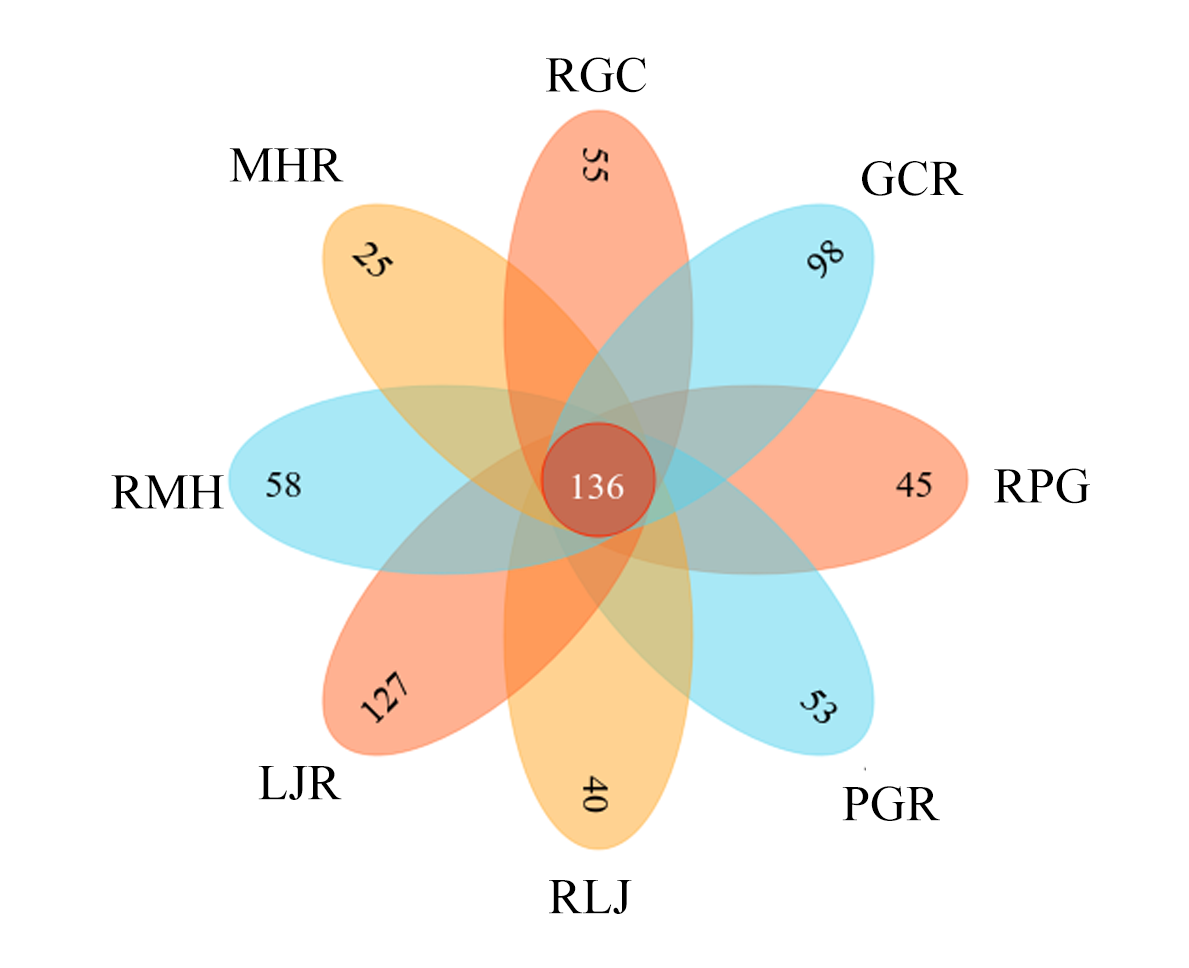
图1可知,本试验共鉴别出637个ASV,其中,8组共有ASV为136个,RGC组独有ASV为55个,GCR组独有ASV为98个,RPG组独有ASV为45个,PGR组独有ASV为53个,RLJ组独有ASV为40个,LJR组独有ASV为127个,RMH组独有ASV为58个,MHR组独有ASV为25个。
图1 古菌韦恩图

RGC:五倍子原药;RLJ:金银花原药;RMH:薄荷原药;RPG:桔梗原药;GCR:五倍子药渣;LJR:金银花药渣;MHR:薄荷药渣;PGR:桔梗药渣。下图同。The same as below.

Fig.1 Archaeal Venn diagrams

表7可知,瘤胃古菌α多样性分析结果表明,煎煮与中草药品种对古菌的Chao1指数、Goods coverage指数以及Observed species指数存在显著交互效应(P<0.05)。与原药相比,药渣古菌的Chao1指数显著提高(P<0.05),而Goods coverage指数显著降低(P<0.05)。另外,对比各中草药品种,GC的Chao1指数和Observed species指数显著高于PG(P<0.05),Goods coverage指数显著低于其他品种(P<0.05)。
表7 古菌α多样性分析

Table 7 Analysis of archaeal α diversity

项目
Items
Chao1指数
Chao1 index
Goods coverage指数
Goods coverage index
Observed species指数
Observed species index
Shannon指数
Shannon index
组别Groups
五倍子原药RGC 637.93a 0.994 5c 394.23ab 4.83
金银花原药RLJ 368.48bc 0.997 3ab 273.80ab 4.60
薄荷原药RMH 574.02ab 0.995 1bc 389.00ab 4.65
桔梗原药RPG 312.33c 0.997 7a 223.03b 4.89
五倍子药渣GCR 666.92a 0.994 1c 428.53a 4.91
金银花药渣LJR 730.95a 0.993 4c 449.67a 4.68
薄荷药渣MHR 389.75bc 0.997 0ab 264.23ab 4.74
桔梗药渣PGR 544.27ab 0.995 4abc 343.57ab 4.92
均值标准误SEM 52.955 0.000 58 39.134 0.138
煎煮效应Decoction effect
原药RH 473.19b 0.996 1a 320.02 4.74
药渣HR 582.97a 0.995 0b 371.50 4.81
中草药品种效应Herbal species effect
五倍子GC 652.42a 0.994 3b 411.38a 4.87
金银花LJ 549.72ab 0.995 3a 361.73ab 4.64
薄荷MH 481.88b 0.996 0a 326.62ab 4.70
桔梗PG 428.30b 0.996 5a 283.30b 4.90
PP-value
煎煮效应Decoction effect 0.010 0.011 0.081 0.990
中草药品种效应Herbal species effect 0.004 0.008 0.030 0.488
交互效应Interaction effect 0.001 0.001 0.008 0.204
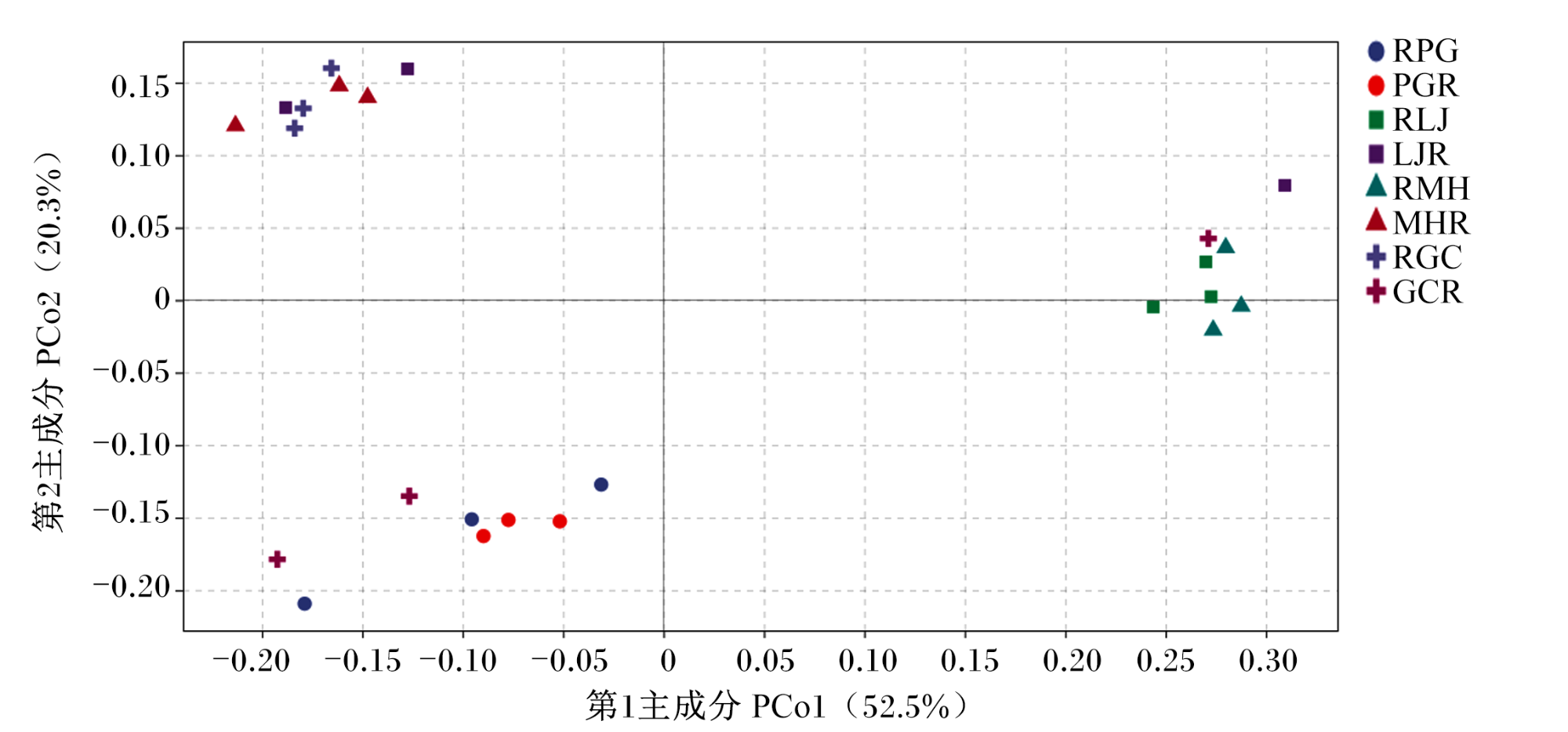
图2所示,瘤胃古菌β多样性分析结果表明,第1主成分(PCo1)和第2主成分(PCo2)的贡献率分别为52.5%和20.3%,其中RGC组、MHR组与LJR组投影明显重叠,PGR组、RPG组与GCR组投影明显重叠,RMH组与RLJ组投影明显重叠。
图2 古菌β多样性分析

Fig.2 Analysis of archaeal β diversity

表8可知,煎煮与中草药品种对候选甲烷嗜甲基菌属(Candidatus Methanomethylophilus)相对丰度具有显著交互效应(P<0.05)。与原药相比,药渣甲烷短杆菌属(Methanobrevibacter)的相对丰度显著提高(P<0.05),Candidatus Methanomethylophilus相对丰度显著降低(P<0.05)。此外,对比各中草药品种,LJ的Candidatus Methanomethylophilus相对丰度显著高于GC和PG(P<0.05)。
表8 古菌相对丰度分析

Table 8 Analysis of relative abundance of archaea

项目
Items
甲烷短杆菌属
Methanobrevi-
bacter
甲烷球形菌属
Methanosphaera
候选甲烷枝
原体菌属
Candidatus
Methanoplasma
候选甲烷嗜
甲基菌属
Candidatus
Methanomethy-
lophilus
甲烷八叠球菌属
Methanosarcina
甲烷丝菌属
Methanothrix
甲烷马
赛球菌属
Methanomassi-
liicoccus
甲烷微菌属
Methanomic-
robium
甲烷规则菌属
Methanoregula
甲烷杆菌属
Methanoba-
cterium
组别Groups
五倍子原药RGC 0.88 0.08 0.03 0.00b 3.05×10⁻⁵ 6.13×10⁻⁶ 3.66×10⁻⁶
金银花原药RLJ 0.82 0.06 0.03 0.08a 5.72×10⁻⁵
薄荷原药RMH 0.83 0.05 0.04 0.06a
桔梗原药RPG 0.87 0.07 0.02 0.03b
五倍子药渣GCR 0.88 0.06 0.03 0.02b
金银花药渣LJR 0.89 0.06 0.02 0.02b 6.50×10⁻⁵
薄荷药渣MHR 0.85 0.08 0.05 0.02b 5.36×10⁻⁶
桔梗药渣PGR 0.89 0.09 0.01 0.02b
均值标准误SEM 0.021 0.013 0.011 0.010
煎煮效应Decoction effect
原药RH 0.85b 0.07 0.03 0.04a 3.92×10⁻⁴ 1.50×10⁻⁴ 7.63×10⁻⁶ 1.63×10⁻⁴ 8.97×10⁻⁵ 1.24×10⁻⁵
药渣HR 0.88a 0.07 0.03 0.02b 1.87×10⁻³ 2.34×10⁻⁴ 2.95×10⁻⁴ 1.34×10⁻⁶ 1.63×10⁻⁵
中草药品种效应Herbal species effect
五倍子GC 0.88 0.07 0.03 0.01b 1.21×10⁻³ 1.03×10⁻⁴ 1.53×10⁻⁵ 3.07×10⁻⁶ 1.68×10⁻⁴ 1.84×10⁻⁵
金银花LJ 0.86 0.06 0.03 0.05a 5.18×10⁻⁴ 2.86×10⁻⁴ 1.66×10⁻⁴ 6.35×10⁻⁶ 3.89×10⁻⁵
薄荷MH 0.84 0.06 0.04 0.04a 1.75×10⁻³ 6.26×10⁻⁴ 1.57×10⁻⁴ 2.68×10⁻⁶
桔梗PG 0.88 0.08 0.02 0.02b 1.04×10⁻³ 1.04×10⁻⁴ 5.91×10⁻⁴ 5.05×10⁻⁶
PP-value
煎煮效应Decoction effect 0.041 0.491 0.491 0.002 0.145 0.721 0.345 0.112 0.309 0.815
中草药品种效应
Herbal species effect
0.161 0.077 0.089 0.009 0.840 0.225 0.411 0.459 0.443 0.317
交互效应Interaction effect 0.297 0.102 0.788 0.006 0.747 0.974 0.426 0.459 0.433 0.326

2.4 体外瘤胃发酵参数和中草药生物活性成分含量与瘤胃古菌区系的相关性分析

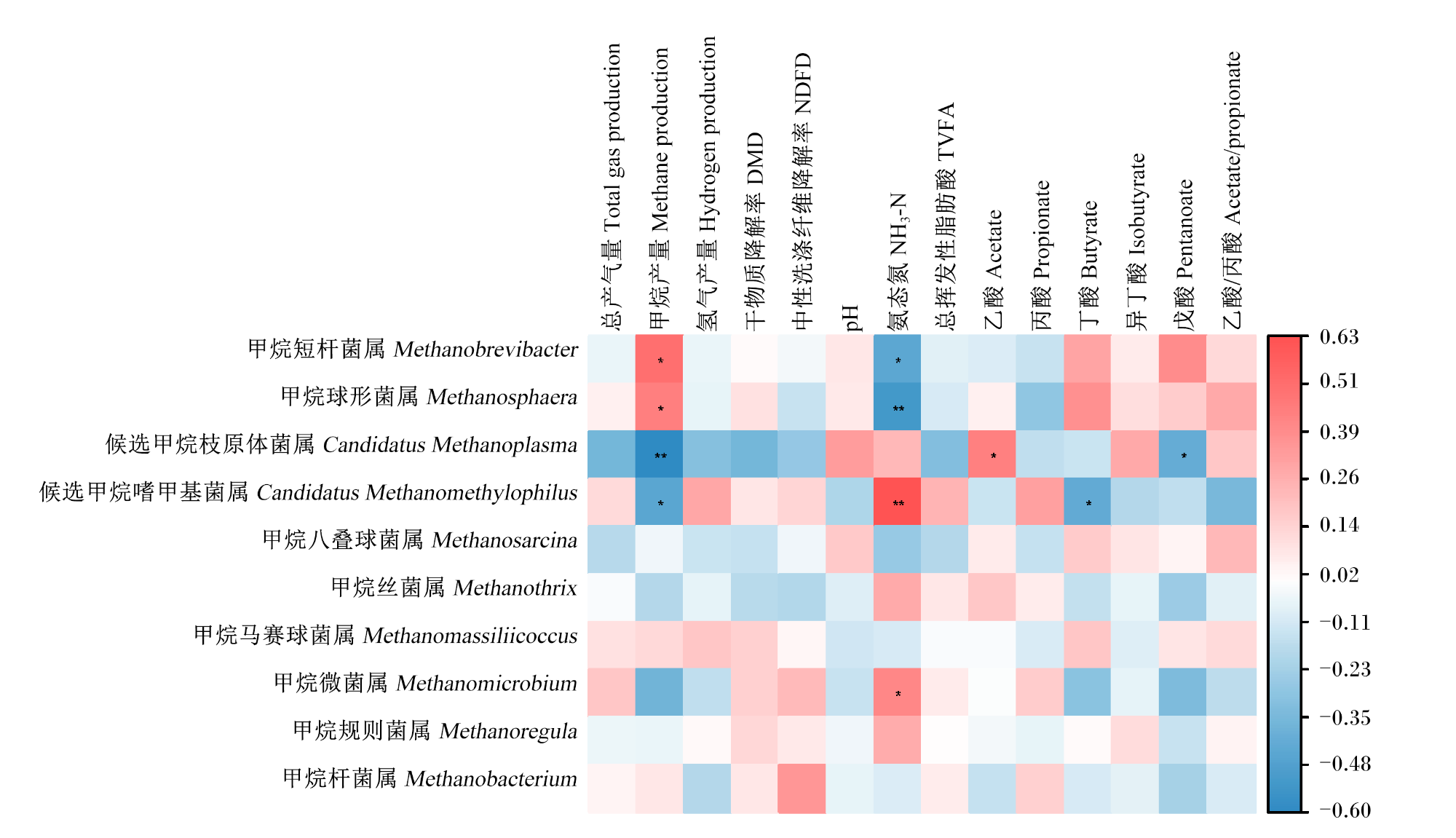
图3可知,体外瘤胃发酵参数与瘤胃古细菌区系的Spearman相关性分析显示,CH4产量与Methanobrevibacter和甲烷球形菌属(Methanosphaera)相对丰度呈显著正相关(P<0.05),而与候选甲烷枝原体菌属(Candidatus Methanoplasma)相对丰度呈极显著负相关(P<0.01),与Candidatus Methanomethylophilus相对丰度呈显著负相关(P<0.05)。NH3-N含量与Methanobrevibacter相对丰度呈显著负相关(P<0.05),与Methanosphaera相对丰度呈极显著负相关(P<0.01),与Candidatus Methanomethylophilus相对丰度呈极显著正相关(P<0.01),与甲烷微菌属(Methanomicrobium)相对丰度呈显著正相关(P<0.05)。乙酸含量与Candidatus Methanoplasma相对丰度呈显著正相关(P<0.05),丁酸含量与Candidatus Methanomethylophilus相对丰度呈显著负相关(P<0.05),戊酸含量与Candidatus Methanoplasma相对丰度呈显著负相关(P<0.05)。
图3 瘤胃古菌(属水平)与瘤胃发酵参数的相关性热图

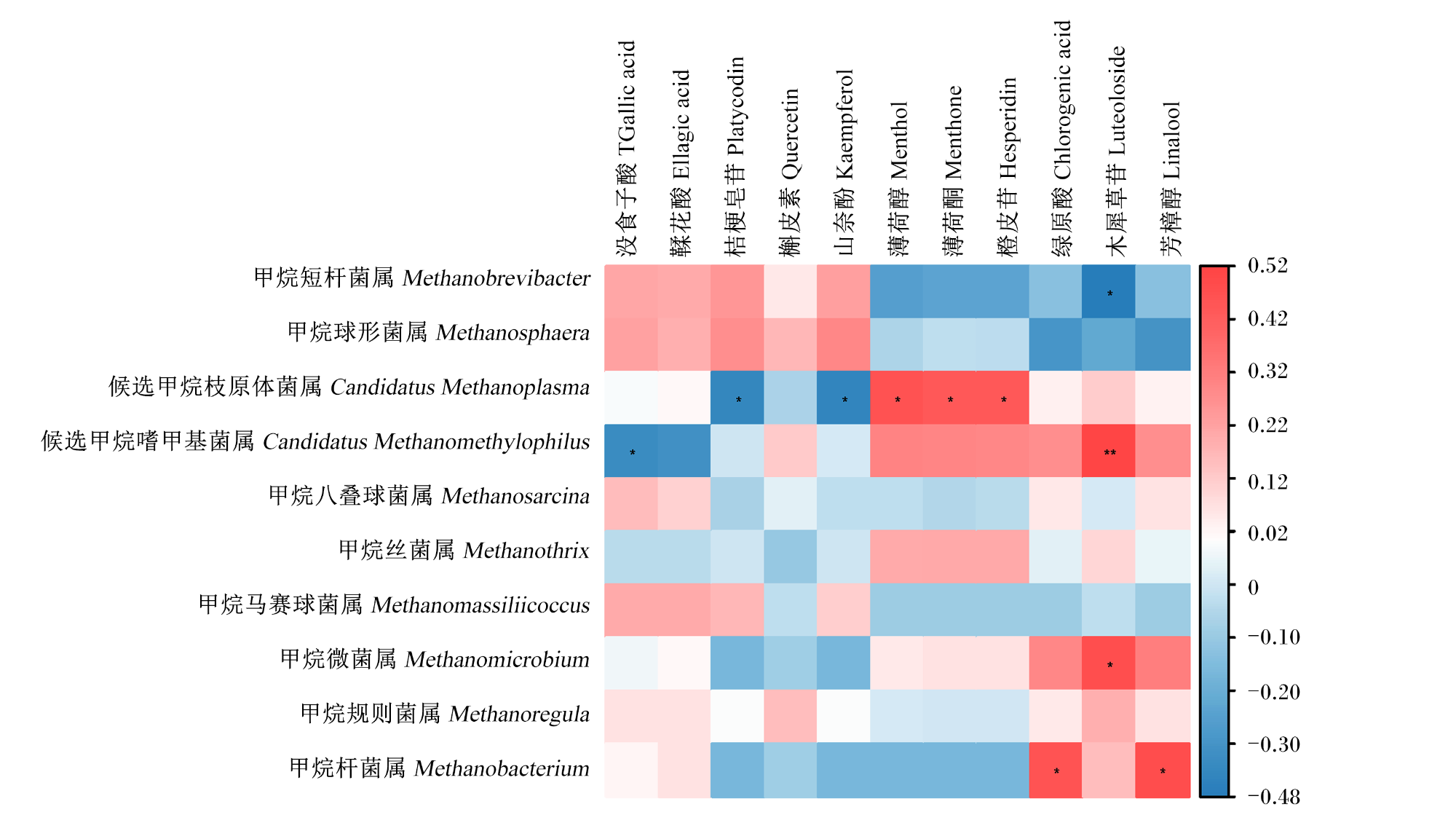
“*”表示显著相关(P<0.05),“**”表示极显著相关(P<0.01)。图4同。

Fig.3 Heatmap of correlation between rumen archaea (at genus level) and rumen fermentation parameters

“*” indicated a significant correlation (P<0.05), and “**” indicated an extremely significant correlation (P<0.01). The same as Fig.4.

图4可知,中草药生物活性成分含量与瘤胃古菌区系的Spearman相关性分析显示,Methanobrevibacter相对丰度与木犀草苷(luteoloside)含量呈显著负相关(P<0.05);Candidatus Methanoplasma相对丰度与桔梗皂苷(platycodin)和山奈酚(kaempferol)含量均呈显著负相关(P<0.05),而与薄荷醇(menthol)、薄荷酮(menthone)和橙皮苷(hesperidin)含量呈显著正相关(P<0.05);Candidatus Methanomethylophilus相对丰度与没食子酸(gallic acid)含量呈显著负相关(P<0.05),与luteoloside含量呈极显著正相关(P<0.01);Methanomicrobium相对丰度与luteoloside含量呈显著正相关(P<0.05);Methanobacterium相对丰度与chlorogenic acid和芳樟醇(linalool)含量呈显著正相关(P<0.05)。
图4 瘤胃古菌(属水平)与中草药生物活性成分含量的相关性热图

Fig.4 Heatmap of correlation between rumen archaea (at genus level) and bioactive component contents of Chinese medicinal herbs

3 讨论

3.1 中草药原药及其药渣营养成分组成对比分析

本试验中,与原药相比,药渣Ash、EE、淀粉、CNSC、CA、CB1及PB2含量显著降低,而NDF、ADL、ADF、ADIP、NDIP、SCP、NPN、CC、CB2和PC含量显著提高。这可能是由于煎煮过程促使易溶性营养成分溶出,致使药渣中结构性组分相对含量显著提升[34-35]。同时,药渣增加的NDIP、ADIP和PC组分含量实质上是纤维紧密结合的热损伤蛋白质,难以被瘤胃微生物及肠道消化酶降解[36]。此外,不同来源中草药因其药用部位和组织结构的差异,其原药及其药渣营养组分含量存在明显差异,如以花茎叶入药的中草药通常富含纤维性物质成分[37];根部入药的中草药,因其低温抗逆和储存需求会积累更多可溶性糖和蛋白质[38-39];而特定结构中草药(如虫瘿组织)则富含较高的EE、淀粉及单宁含量[40]。结合本试验结果表明,尽管中草药来源不同,但煎煮后的中草药营养成分组成主要以结构性碳水化合物和难降解CP为主,为评估药渣作为反刍动物饲料原料的可行性提供了核心依据。

3.2 中草药原药及其药渣体外瘤胃发酵特性对比分析

饲料体外消化率是评定反刍动物瘤胃微生物发酵的重要指标。本试验中,与原药相比,药渣DMD和NDFD显著降低,这可能与结构性营养物质组分含量增加密切相关。这些组分可形成物理屏障,阻碍瘤胃微生物对发酵底物的接触与附着,从而减缓降解速率[41]。此外,研究报道证实营养物质降解率通常与气体、TVFA和NH3-N等物质的生成量成正比[42]。对应本试验结果,与原药相比,药渣NH3-N、TVFA和丙酸含量显著降低,这与DMD和NDFD下降的结果相符。饲粮中CHO在瘤胃内主要发酵产物是挥发性脂肪酸,而瘤胃pH是衡量瘤胃内有机酸积累的关键指标,并且高淀粉型饲粮倾向于丙酸生成型发酵模式,相反则趋向于乙酸型发酵[43]。本试验中,药渣TVFA含量下降导致发酵液的pH升高,但始终维持在5.80~6.75的正常范围内。同时,与原药相比,药渣乙酸含量显著提高,而丙酸含量显著降低,使乙酸/丙酸提高。这可能归结为药渣的淀粉等CNSC含量减少,促使发酵模式转变为乙酸型。另有研究表明,皂苷、单宁、精油和有机酸等生物活性成分可通过调控瘤胃微生物群落结构,抑制瘤胃CH4生成[44-45],或影响挥发性脂肪酸组成比例[46]
本试验中,不同品种中草药原药及其药渣在CH4产量、挥发性脂肪酸各组分比例上呈现明显差异,推测与其含有的特定生物活性成分及其对瘤胃微生物的调控效应密切相关。从具体调控机制来看,单宁和精油可通过调控CH4合成底物(乙酸)的生成量,达到减少CH4排放量的目的[47-48],并且乙酸减少还伴随着丁酸含量的代偿性增加,以维持瘤胃微生物代谢平衡[49];而chlorogenic acid则可能通过促进丙酸生成途径来竞争性抑制CH4合成[10]。上述试验结果表明,药渣在提供基础营养成分的同时,其生物活性成分也可能对瘤胃发酵模式产生细微调控作用。这些研究发现不仅揭示了生物活性成分对瘤胃发酵模式和CH4生成具有潜在的修饰效应,更为后续深入分析生物活性成分与瘤胃发酵的内在关联、优化药渣饲料化利用提供了数据支撑。

3.3 中草药原药及其药渣体外瘤胃古菌区系对比分析

本试验中,与原药相比,药渣体外瘤胃古菌的Chao1指数显著增加,推测其原因可能是煎煮过程导致植物细胞壁破裂,形成更为发达的微孔结构,从而为微生物的定植和营养物质扩散提供了更有利的微生态环境[50],最终促进了古菌群落多样性增加。微生物群落的多样性除受底物类型的影响外,还与生物活性成分有关[51]。基于β多样性分析,除GC外,其余3种中草药煎煮前后样本在坐标轴上投影明显分离,这可能与煎煮后其生物活性成分的流失有关。相反GC原药及其药渣的投影明显重叠,表明二者的古菌群落结构无显著差异。这一现象归因于GC中富含热稳定性较强的单宁酸[52],推测煎煮处理后GC中部分单宁酸未分解流失,因此仍可维持古菌群落结构相对稳定。
本试验中,与原药相比,药渣Candidatus Methanomethylophilus相对丰度显著降低,Methanobrevibacter的相对丰度显著提高。研究表明,Candidatus Methanomethylophilus是一种H2依赖性甲基营养型产甲烷菌,其底物主要来源于果胶降解[53],对应Candidatus Methanomethylophilus的相对丰度下降与CA含量降低趋势相符。同时,基于瘤胃微生态平衡理论[54],Methanobrevibacter相对丰度显著提高,也可能是因为Candidatus Methanomethylophilus相对丰度急剧下降所致,这或许是本试验中煎煮处理后未观察到CH4产量出现显著改变的原因。

3.4 体外瘤胃发酵参数和中草药生物活性成分与瘤胃古菌区系的相关性分析

基于体外瘤胃发酵参数与瘤胃古菌区系的Spearman相关性分析结果表明,氢营养型甲烷菌[55](MethanobrevibacterMethanosphaera)的相对丰度与NH3-N含量呈显著或极显著负相关,与CH4产量呈显著正相关。相反,甲基营养型产甲烷菌[56](Candidatus Methanomethylophilus)的相对丰度与NH3-N含量呈极显著正相关,与CH4产量呈显著负相关。这说明不同种类古菌CH4的生成效率存在差异,这种差异导致了其生态位的竞争。Czerkawski等[57]研究表明,NH3-N在合成微生物蛋白过程中会消耗H2,能与产甲烷菌形成竞争。说明Candidatus Methanomethylophilus或许主要通过利用甲基类化合物进行CH4合成,从而减少对H2的依赖。进一步分析显示,Candidatus Methanoplasma的相对丰度与乙酸含量呈显著正相关,而与CH4产量呈极显著负相关。提示该菌可能与产乙酸菌之间存在互惠共生关系,破坏了瘤胃微生态间的互营平衡,最终导致发酵模式从丙酸型向乙酸型转变。
中草药生物活性成分含量与瘤胃古菌区系的Spearman相关性分析显示,Methanobrevibacter的相对丰度与luteoloside含量呈显著负相关。luteoloside作为黄酮类化合物,可抑制部分革兰氏阳性菌、调节乙酸/丙酸并降低CH4生成量[58-59]。推测luteoloside可能通过破坏古菌细胞膜的完整性,从而特异性抑制其生长代谢[60]。相反,Candidatus MethanomethylophilusMethanomicrobium的相对丰度均与luteoloside呈显著正相关,这种差异化响应表明甲基营养型甲烷菌依赖甲基化合物而非氢代谢途径,其相对丰度变化与氢营养型甲烷菌群常呈相反趋势[58]。同时,Candidatus Methanoplasma的相对丰度与platycodin和kaempferol含量呈显著负相关,而与menthol、menthone及hesperidin含量显著正相关。这说明不同活性成分对同一古菌类群可产生相反的调控作用。相关研究报道表明,platycodin可通过破坏细胞膜结构,抑制微生物生长[61],kaempferol则可干扰能量代谢[62]。而萜类成分(如menthol和menthone)可能会通过调节膜通透性促进某些古菌生长[63]。此外,Methanobacterium的相对丰度与chlorogenic acid和linalool含量呈显著正相关,提示酚酸与萜类物质可能具有协同调控瘤胃氧化还原环境的功效,从而为该类古菌创造更适宜的生长条件[11]
本试验采用的体外瘤胃发酵系统难以完全模拟体内复杂的动态生理环境,因此试验结果在推断体内实际效应时存在一定局限性。未来研究建议通过体内试验进一步验证煎煮处理对反刍动物生产性能、养分代谢及CH4排放的综合影响,并结合煎煮时间、温度等工艺参数的系统优化,寻求中草药活性成分保留与瘤胃降解特性改善之间的平衡点。

4 结论

综上所述,煎煮效应在提高中草药过瘤胃蛋白比例的同时,也改变了除GC外其余中草药的体外瘤胃古菌群落结构,但其对CH4产量未产生显著影响。此外,PG虽含有较高的快速降解组分,但其生物活性成分对CH4排放的抑制作用相对较弱。LJ中的luteoloside可能直接抑制Methanobrevibacter的生长,为中草药定向调控瘤胃CH4生成提供了潜在靶点。
[1]
JOHNSON K A, JOHNSON D E. Methane emissions from cattle[J]. Journal of Animal Science, 1995, 73(8):2483-2492.

DOI PMID

[2]
尚子忆, 刘海英, 豆兴堂, 等. 单宁调控反刍动物瘤胃甲烷排放的研究进展[J]. 中国畜牧杂志, 2024, 60(10):62-66.

SHANG Z Y, LIU H Y, DOU X T, et al. Research progress on tannin regulation of rumen methane emission in ruminants[J]. Chinese Journal of Animal Science, 2024, 60(10):62-66. (in Chinese)

[3]
SMITH A H, ZOETENDAL E, MACKIE R I. Bacterial mechanisms to overcome inhibitory effects of dietary tannins[J]. Microbial Ecology, 2005, 50(2):197-205.

DOI PMID

[4]
WALLACE R J, ARTHAUD L, NEWBOLD C J. Influence of Yucca shidigera extract on ruminal ammonia concentrations and ruminal microorganisms[J]. Applied and Environmental Microbiology, 1994, 60(6):1762-1767.

DOI

[5]
KALA A, KAMRA D N, AGARWAL N, et al. Insights into metatranscriptome,and CAZymes of buffalo rumen supplemented with blend of essential oils[J]. Indian Journal of Microbiology, 2020, 60(4):485-493.

DOI

[6]
张奥, 赵玉超, 白萨茹拉, 等. 植物精油降低反刍动物瘤胃甲烷产量的研究进展[J]. 动物营养学报, 2024, 36(3):1399-1412.

DOI

ZHANG A, ZHAO Y C, BAI S R L, et al. Research progress on reducing ruminal methane production of ruminants by plant essential oils[J]. Chinese Journal of Animal Nutrition, 2024, 36(3):1399-1412. (in Chinese)

DOI

[7]
WINA E, MUETZEL S, BECKER K. The impact of saponins or saponin-containing plant materials on ruminant production—a review[J]. Journal of Agricultural and Food Chemistry, 2005, 53(21):8093-8105.

DOI

[8]
严淑红, 赵士萍, 蒋琦晖, 等. 茶皂素对奶牛瘤胃发酵及瘤胃微生物区系的影响[J]. 动物营养学报, 2016, 28(8):2485-2496.

DOI

YAN S H, ZHAO S P, JIANG Q H, et al. Effects of tea saponin on rumen fermentation and rumen microflora of dairy cows[J]. Chinese Journal of Animal Nutrition, 2016, 28(8):2485-2496. (in Chinese)

[9]
GUYADER J, EUGÈNE M, DOREAU M, et al. Tea saponin reduced methanogenesis in vitro but increased methane yield in lactating dairy cows[J]. Journal of Dairy Science, 2017, 100(3):1845-1855.

DOI

[10]
朱喜锋, 陈严轩, 邱建强, 等. 绿原酸的生物活性及其在动物生产中的应用研究进展[J]. 动物营养学报, 2024, 36(3):1389-1398.

DOI

ZHU X F, CHEN Y X, QIU J Q, et al. Research progress on bioactivity of chlorogenic acid and its application in animal production[J]. Chinese Journal of Animal Nutrition, 2024, 36(3):1389-1398. (in Chinese)

DOI

[11]
李晓鹏, 刘云龙, 崔甲军, 等. 基于GreenFeed系统研究绿原酸对泌乳中后期奶牛瘤胃甲烷排放、发酵参数和生产性能的影响[J]. 中国农业科学, 2025, 58(14):2904-2913.

DOI

LI X P, LIU Y L, CUI J J, et al. Effects of chlorogenic acid on rumen methane emission,fermentation parameters and performance of late lactating cows based on the GreenFeed system[J]. Scientia Agricultura Sinica, 2025, 58(14):2904-2913. (in Chinese)

[12]
孙宇, 杨文慧, 郭延生. 中草药调控反刍动物瘤胃菌群代谢的研究进展[J]. 动物营养学报, 2025, 37(2):771-777.

DOI

SUN Y, YANG W H, GUO Y S. Research progress on regulation of rumen microbiota metabolism in ruminants by traditional Chinese herbs[J]. Chinese Journal of Animal Nutrition, 2025, 37(2):771-777. (in Chinese)

DOI

[13]
段金廒, 唐志书, 吴启南, 等. 中药资源产业化过程循环利用适宜技术体系创建及其推广应用[J]. 中国现代中药, 2019, 21(1):20-28.

DUAN J A, TANG Z S, WU Q N, et al. Establishment of technical system for resource recycling utilization during industrialization process of Chinese medicinal materials and its application[J]. Modern Chinese Medicine, 2019, 21(1):20-28. (in Chinese)

[14]
刘梦佳, 杨茂华, 刘新育, 等. 中药渣处理及其生命周期分析的研究进展[J]. 时珍国医国药, 2021, 32(7):1714-1717.

LIU M J, YANG M H, LIU X Y, et al. Research progress on treatment and life cycle analysis of traditional Chinese medicine residue[J]. Lishizhen Medicine and Materia Medica Research, 2021, 32(7):1714-1717. (in Chinese)

[15]
彭苏, 崔艺燕, 尹福泉, 等. 中草药废弃物的营养价值、活性物质与生物学功能及在猪生产上的应用研究进展[J]. 中国畜牧杂志, 2023, 59(3):33-39.

PENG S, CUI Y Y, YIN F Q, et al. Advances in nutritional value and bioactivity of Chinese herbal medicine waste and its application in pig production[J]. Chinese Journal of Animal Science, 2023, 59(3):33-39. (in Chinese)

[16]
姚梓平, 傅延龄. 关于我国当前中药煎煮方法若干问题的讨论[J]. 中华中医药杂志, 2024, 39(10):5572-5574.

YAO Z P, FU Y L. Discussion on some problems of traditional Chinese medicine decocting methods in China[J]. China Journal of Traditional Chinese Medicine and Pharmacy, 2024, 39(10):5572-5574. (in Chinese)

[17]
谭玲玲, 侯晓敏, 胡正海. 不同产地桔梗药材中桔梗总皂苷和桔梗皂苷D的测定[J]. 中草药, 2015, 46(11):1682-1684.

TAN L L, HOU X M, HU Z H. Determination of platycodin in Platycodi Radix from different habitats[J]. Chinese Traditional and Herbal Drugs, 2015, 46(11):1682-1684. (in Chinese)

[18]
吕翔, 杨子祥, 李杨, 等. 五倍子单宁含量测定方法的比较研究[J]. 西南农业学报, 2012, 25(3):1080-1084.

LV X, YANG Z X, LI Y, et al. Comparison of determination methods in tannin content of Chinese gallnuts[J]. Southwest China Journal of Agricultural Sciences, 2012, 25(3):1080-1084. (in Chinese)

[19]
李冬玲. 不同来源药用菊花挥发油和总黄酮含量的比较分析[J]. 安徽农业科学, 2010, 38(7):3444-3446.

LI D L. Comparative analysis on essential oil and total flavonoids of medicinal chrysanthemum from different original locations and species[J]. Journal of Anhui Agricultural Sciences, 2010, 38(7):3444-3446. (in Chinese)

[20]
林慧彬, 彭延弟, 管仁伟, 等. 不同种质金银花绿原酸含量比较研究[J]. 时珍国医国药, 2015, 26(7):1755-1756.

LIN H B, PENG Y D, GUAN R W, et al. Comparative study of the content of chlorogenic acid in different germplasms of Lonicerae japonicae Flos[J]. Lishizhen Medicine and Materia Medica Research, 2015, 26(7):1755-1756. (in Chinese)

[21]
中华人民共和国农业部. 肉牛饲养标准:NY/T 815—2004[S]. 北京: 中国农业出版社, 2004.

Ministry of Agriculture of the People’s Republic of China. Feeding standard of beef cattle:NY/T 815—2004[S]. Beijing: China Agriculture Press, 2004.

[22]
MENKE K H, RAAB L, SALEWSKI A, et al. The estimation of the digestibility and metabolizable energy content of ruminant feeding stuffs from the gas production when they are incubated with rumen liquor in vitro[J]. The Journal of Agricultural Science, 1979, 93(1):217-222.

DOI

[23]
AOAC. Official method of analysis of AOAC International[S]. 18th ed. Gaithersburg,MD: Association of Official Analytical Chemists, 2005.

[24]
VAN SOEST P J, ROBERTSON J B, LEWIS B A. Methods for dietary fiber,neutral detergent fiber,and nonstarch polysaccharides in relation to animal nutrition[J]. Journal of Dairy Science, 1991, 74(10):3583-3597.

DOI

[25]
国家市场监督管理总局,中国国家标准化管理委员会. 饲料中钙的测定:GB/T 6436—2018[S]. 北京: 中国标准出版社, 2018.

State Administration for Market Regulation,Standardization Administration of the People’s Republic of China. Determination of calcium in feeds:GB/T 6436—2018[S]. Beijing: Standards Press of China, 2018. (in Chinese)

[26]
国家市场监督管理总局,中国国家标准化管理委员会. 饲料中总磷的测定分光光度法:GB/T 6437—2018[S]. 北京: 中国标准出版社, 2018.

State Administration for Market Regulation,Standardization Administration of the People’s Republic of China. Determination of phosphorus in feeds—spectrophotometry:GB/T 6437—2018[S]. Beijing: Standards Press of China, 2018. (in Chinese)

[27]
LICITRA G, HERNANDEZ T M, VAN SOEST P J. Standardization of procedures for nitrogen fractionation of ruminant feeds[J]. Animal Feed Science and Technology, 1996, 57(4):347-358.

DOI

[28]
KRISHNAMOORTHY U, SNIFFEN C J, STERN M D, et al. Evaluation of a mathematical model of rumen digestion and an in vitro simulation of rumen proteolysis to estimate the rumen-undegraded nitrogen content of feedstuffs[J]. British Journal of Nutrition, 1983, 50(3):555-568.

DOI

[29]
中华人民共和国国家市场监督管理总局,中国国家标准化管理委员会. 动物饲料中淀粉含量的测定旋光法:GB/T 20194—2018[S]. 北京: 中国标准出版社, 2018.

State Administration for Market Regulation of the People’s Republic of China,Standardization Administration of the People’s Republic of China. Determination of starch in feeds—polarimetry:GB/T 20194—2018[S]. Beijing: Standards Press of China, 2018. (in Chinese)

[30]
SNIFFEN C J, O’CONNOR J D, VAN SOEST P J, et al. A net carbohydrate and protein system for evaluating cattle diets:Ⅱ.Carbohydrate and protein availability[J]. Journal of Animal Science, 1992, 70(11):3562-3577.

DOI

[31]
LI X Z, YAN C G, CHOI S H, et al. Effects of addition level and chemical type of propionate precursors in dicarboxylic acid pathway on fermentation characteristics and methane production by rumen microbes in vitro[J]. Asian-Australasian Journal of Animal Sciences, 2009, 22(1):82-89.

DOI

[32]
冯宗慈, 高民. 通过比色测定瘤胃液氨氮含量方法的改进[J]. 畜牧与饲料科学, 2010, 31(6/7):37.

FENG Z C, GAO M. The method of determining ammonia nitrogen in rumen liquid was improved by colorimetry[J]. Animal Husbandry and Feed Science, 2010, 31(6/7):37. (in Chinese)

[33]
XUAN T B, ZHENG T F, LI T Y, et al. The effects of different doses of 3-NOP on ruminal fermentation parameters,methane production,and the microbiota of lambs in vitro[J]. Fermentation, 2024, 10(9):440.

DOI

[34]
KAUR P, KAUR H, AGGARWAL R, et al. Effect of cooking and storage temperature on resistant starch in commonly consumed Indian wheat products and its effect upon blood glucose level[J]. Frontiers in Nutrition, 2023, 10:1284487.

DOI

[35]
万美娇, 田秀娥, 王永军, 等. 水煮和提取处理对中草药常规营养成分的影响[J]. 畜牧与饲料科学, 2018, 39(5):11-15.

WANG M J, TIAN X E, WANG Y J, et al. Effects of water boiling and extracting treatments on normal nutritional components of Chinese herbal medicine[J]. Animal Husbandry and Feed Science, 2018, 39(5):11-15. (in Chinese)

[36]
李昕, 徐宏建, 王楠, 等. 不同热处理豆渣中蛋白质分子结构与其营养价值及瘤胃降解特性的相关性研究[J]. 动物营养学报, 2019, 31(1):395-408.

LI X, XU H J, WANG N, et al. Correlation of protein molecular structure,its nutritional value and ruminal degradation characteristics in different heat treated okara[J]. Chinese Journal of Animal Nutrition, 2019, 31(1):395-408. (in Chinese)

[37]
黄成, 李来庚. 植物细胞壁研究与生物质改造利用[J]. 科学通报, 2016, 61(34):3623-3629.

HUANG C, LI L G. Understanding of plant cell wall biosynthesis for utilization of lignocellulosic biomass resources[J]. Chinese Science Bulletin, 2016, 61(34):3623-3629. (in Chinese)

[38]
史月龙, 袁凌峰, 杨艳, 等. 桔梗林下高效栽培技术要点[J]. 世界热带农业信息, 2022(8):7-9.

SHI Y L, YUAN L F, YANG Y, et al. High-efficiency cultivation techniques of Platycodon grandiflorum under forest[J]. World Tropical Agriculture Information, 2022(8):7-9. (in Chinese)

[39]
KUTSUNO T, CHOWHAN S, KOTAKE T, et al. Temporal cell wall changes during cold acclimation and deacclimation and their potential involvement in freezing tolerance and growth[J]. Physiologia Plantarum, 2023, 175(1):e13837.

DOI

[40]
WANG Y Q, SUN H, HE X, et al. Phytochemical analysis,antioxidant and enzyme-inhibitory activities,and multivariate analysis of insect gall extracts of Picea koraiensis Nakai[J]. Molecules, 2023, 28(16):6021.

DOI

[41]
任丽娟, 卜登攀, 王建平, 等. 全株玉米青贮中性洗涤纤维降解率的影响因素:以宁夏地区正大12为例[J]. 草业科学, 2020, 37(12):2584-2593.

REN L J, BU D P, WANG J P, et al. Analysis of factors influencing the degradation rate of neutral detergent fiber in whole-plant corn silage:taking Zhengda 12 in Ningxia as an example[J]. Pratacultural Science, 2020, 37(12):2584-2593. (in Chinese)

[42]
马秀莲, 姜菲, 高彦华, 等. 不同粗饲料组合添加支链挥发性脂肪酸对牦牛体外瘤胃发酵特性的影响[J]. 动物营养学报, 2023, 35(11):7270-7283.

DOI

MA X L, JIANG F, GAO Y H, et al. Effects of different roughage combinations supplemented with branched-chain volatile fatty acids on rumen fermentation characteristics of yaks in vitro[J]. Chinese Journal of Animal Nutrition, 2023, 35(11):7270-7283. (in Chinese)

[43]
毛宏祥, 陆相龙, 金宜全, 等. 反刍家畜瘤胃挥发性脂肪酸生成及模型研究进展[J]. 中国畜牧杂志, 2019, 55(8):35-40.

MAO H X, LU X L, JIN Y Q, et al. Research progress on the mechanism and models of rumen volatile fatty acids in ruminant animals[J]. Chinese Journal of Animal Science, 2019, 55(8):35-40. (in Chinese)

[44]
KU-VERA J C, JIMÉNEZ-OCAMPO R, VALENCIA-SALAZAR S S, et al. Role of secondary plant metabolites on enteric methane mitigation in ruminants[J]. Frontiers in Veterinary Science, 2020, 7:584.

DOI

[45]
DONG H X, ZHANG X T, LI S S, et al. Effect of fumarate and live yeast on ruminal fermentation,methane emissions,and blood metabolites in dairy goats[J]. Journal of Dairy Science, 2025, 108(10):10855-10868.

DOI

[46]
PARK M, CHO S, JEON E, et al. Development of volatile fatty acid and methane production prediction model using ruminant nutrition comparison of algorithms[J]. Fermentation, 2024, 10(8):410.

DOI

[47]
陈亮, 唐祎凡, 陈鸿翼, 等. 反刍动物瘤胃甲烷减排的微生物调控路径[J]. 中国科学(生命科学), 2025, 55(3):529-543.

CHEN L, TANG Y F, CHEN H Y, et al. Microbial regulatory pathways of methane emission reduction in the rumen of ruminants[J]. Scientia Sinica Vitae, 2025, 55(3):529-543. (in Chinese)

DOI

[48]
白金妮, 张雯晶, 卢娜, 等. 水解单宁的生物活性及其在反刍动物生产中的应用[J]. 动物营养学报, 2024, 36(3):1426-1435.

DOI

BAI J N, ZHANG W J, LU N, et al. Bioactivity of hydrolyzable tannins and their application in ruminant production[J]. Chinese Journal of Animal Nutrition, 2024, 36(3):1426-1435. (in Chinese)

DOI

[49]
GIRALDO L A, RANILLA M J, TEJIDO M L, et al. Influence of exogenous fibrolytic enzymes and fumarate on methane production,microbial growth and fermentation in rusitec fermenters[J]. British Journal of Nutrition, 2007, 98(4):753-761.

DOI

[50]
王红梅, 母宇辉, 宋跃君, 等. 膨化预处理对菌酶协同发酵玉米秸秆微贮饲料发酵品质和营养价值的影响[J]. 动物营养学报, 2025, 37(4):2739-2749.

DOI

WANG H M, MU Y H, SONG Y J, et al. Effects of extrusion pretreatment on fermentation quality and nutritional value of corn stalk microbial ensilage by bacteria-enzyme cooperative fermentation[J]. Chinese Journal of Animal Nutrition, 2025, 37(4):2739-2749. (in Chinese)

DOI

[51]
刘尚, 李琪, 王成杰, 等. 植物次生代谢物对反刍动物瘤胃发酵、甲烷产量和瘤胃微生物影响的研究进展[J]. 草原与草业, 2023, 35(2):1-6.

LIU S, LI Q, WANG C J, et al. Research progress on the effects of plant secondary metabolites on rumen fermentation,methane production,and rumen microorganisms in ruminants[J]. Grassland and Prataculture, 2023, 35(2):1-6. (in Chinese)

[52]
HE T F, YI G, LI J G, et al. Dietary supplementation of tannic acid promotes performance of beef cattle via alleviating liver lipid peroxidation and improving glucose metabolism and rumen fermentation[J]. Antioxidants, 2023, 12(9):1774.

DOI

[53]
NOEL S J, HØJBERG O, URICH T, et al. Draft genome sequence of “Candidatus Methanomethylophilus” sp. 1R26,enriched from bovine rumen,a methanogenic archaeon belonging to the Methanomassiliicoccales order[J]. Genome Announcements, 2016, 4(1):e01734-15.

[54]
SÖLLINGER A, URICH T. Methylotrophic methanogens everywhere-physiology and ecology of novel players in global methane cycling[J]. Biochemical Society Transactions, 2019, 47(6):1895-1907.

DOI

[55]
JANSSEN P H, KIRS M. Structure of the archaeal community of the rumen[J]. Applied and Environmental Microbiology, 2008, 74(12):3619-3625.

DOI PMID

[56]
BORREL G, PARISOT N, HARRIS H M B, et al. Comparative genomics highlights the unique biology of methanomassiliicoccales,a thermoplasmatales-related seventh order of methanogenic archaea that encodes pyrrolysine[J]. BMC Genomics, 2014, 15(1):679.

DOI

[57]
CZERKAWSKI J W. An introduction to rumen studies[M]. Oxford: Pergamon Press, 1986.

[58]
ARNDT C, HRISTOV A N, PRICE W J, et al. Full adoption of the most effective strategies to mitigate methane emissions by ruminants can help meet the 1.5 ℃ target by 2030 but not 2050[J]. Proceedings of the National Academy of Sciences, 2022, 119(20):e2111294119.

DOI

[59]
MA T, CHEN D D, TU Y, et al. Dietary supplementation with mulberry leaf flavonoids inhibits methanogenesis in sheep[J]. Animal Science Journal, 2017, 88(1):72-78.

DOI PMID

[60]
PATRA A K, SAXENA J. Dietary phytochemicals as rumen modifiers:a review of the effects on microbial populations[J]. Antonie Van Leeuwenhoek, 2009, 96(4):363-375.

DOI

[61]
GUO Y Q, LIU J X, LU Y, et al. Effect of tea saponin on methanogenesis,microbial community structure and expression of mcrA gene,in cultures of rumen microorganisms[J]. Letters in Applied Microbiology, 2008, 47(5):421-426.

DOI

[62]
CIESLAK A, ZMORA P, PERS-KAMCZYC E, et al. Effects of tannins source (Vaccinium vitis idaea L.) on rumen microbial fermentation in vivo[J]. Animal Feed Science and Technology, 2012, 176(1/4):102-106.

DOI

[63]
KAMRA D N, AGARWAL N, CHAUDHARY L C. Inhibition of ruminal methanogenesis by tropical plants containing secondary compounds[J]. International Congress Series, 2006, 1293:156-163.

DOI

文章导航

/