综述

芽孢杆菌在饲料霉菌毒素脱毒中的应用及机制研究进展

  • 段滔 ,
  • 王若菲 ,
  • 丁励 ,
  • 周盼 , *
展开
  • 西南科技大学生命科学与农林学院, 绵阳 621010
*周 盼,讲师,硕士生导师,E-mail:

段 滔(2001—),男,四川遂宁人,硕士研究生,研究方向为动物营养与饲料加工。E-mail:

Office editor: 靳爽

收稿日期: 2025-09-16

  网络出版日期: 2026-04-14

基金资助

国家重点研发计划项目(2023YFD1300802)

四川省科技厅项目(2022NSFSC1778)

Research Progress on Application and Mechanism of Bacillus in Detoxification of Mycotoxins in Feed

  • DUAN Tao ,
  • WANG Ruofei ,
  • DING Li ,
  • ZHOU Pan , *
Expand
  • College of Life Science and Agri-Forestry, Southwest University of Science and Technology, Mianyang 621010, China
*lecturer, E-mail:

Received date: 2025-09-16

  Online published: 2026-04-14

摘要

霉菌毒素是由镰刀菌属、曲霉菌属等真菌产生的有毒次级代谢产物,广泛污染饲料原料,严重威胁动物健康与畜产品安全。传统物理和化学脱毒方法(如添加吸附剂、物理加工、化学反应等)虽可在一定程度上破坏毒素分子结构,但普遍存在脱毒效率低、营养成分损失及潜在残留风险等问题。近年来,生物脱毒技术因其高效性、安全性与环境友好性等优势成为研究热点。其中,芽孢杆菌凭借其分布广泛、抗逆性强及代谢多样等特性,在霉菌毒素降解领域展现出广泛应用潜力。尽管已有大量研究总结了霉菌毒素的生物降解方法,但针对芽孢杆菌在饲料霉菌毒素脱毒中的具体应用及其作用机制的系统梳理仍相对有限。本文系统综述了饲料中常见霉菌毒素(如黄曲霉毒素B1、玉米赤霉烯酮、脱氧雪腐镰刀菌烯醇、赭曲霉毒素A和伏马毒素)的毒性特征及现有脱毒方法的优缺点,重点总结了芽孢杆菌对多种霉菌毒素的降解效率与作用机制,以期为高效脱霉菌株的选育、芽孢杆菌类脱霉剂的开发及其在饲料中的安全应用提供参考。

本文引用格式

段滔 , 王若菲 , 丁励 , 周盼 . 芽孢杆菌在饲料霉菌毒素脱毒中的应用及机制研究进展[J]. 动物营养学报, 2026 , 38(4) : 2520 -2533 . DOI: 10.12418/CJAN2026.203

Abstract

Mycotoxins are toxic secondary metabolites produced by fungi such as Fusarium spp. and Aspergillus spp. They widely contaminate feed materials, posing serious threats to animal health and livestock product safety. Traditional physical and chemical detoxification methods(e.g., adsorbents, physical processing, chemical reactions) can partially disrupt toxin molecular structures but are limited by low efficiency, nutrient loss and potential residue risks. In recent years, biological detoxification has emerged as a research hotspot due to its advantages of high efficiency, safety and environmental friendliness. Among microbial agents, Bacillus show broad potential in mycotoxin degradation owing to their wide distribution, high stress tolerance and diverse metabolic capabilities. Although many studies have summarized the biodegradation methods for mycotoxins, systematic reviews focusing specifically on the application and mechanisms of Bacillus in the detoxification of mycotoxins in feed remain relatively limited. This paper systematically reviews the toxicological characteristics of common mycotoxins found in feed (e.g., aflatoxin B1, zearalenone, deoxynivalenol, ochratoxin A and fumonisin) and the advantages and disadvantages of existing detoxification methods. It focuses on summarizing the degradation efficiency and mechanisms of action of Bacillus against various mycotoxins, aiming to provide a reference for the screening of highly efficient detoxifying strains, the development of Bacillus-based detoxifying agents, and their safe application in feed.

霉菌毒素是镰刀菌属、曲霉菌属等真菌在生长繁殖过程中产生的一类有毒次级代谢产物[1-2]。霉菌毒素污染在饲料原料及配合饲料中普遍存在,呈现出高检出率和复合污染的特征。据统计,全球60%~80%的农作物均受到霉菌毒素污染[3]。动物摄入被污染的饲料后,不仅会损害肝脏、肾脏等器官功能,还可通过畜产品残留对人类健康构成潜在威胁[4-5]。饲料霉菌毒素污染已成为制约畜牧业可持续发展的重要因素,因此开发高效、安全的脱毒技术成为饲料与养殖行业的迫切需求。随着微生物制剂在养殖业中的广泛应用,其在饲料质量与安全防控方面的研究也逐渐深入。其中,芽孢杆菌因分布广泛、抗逆性强、稳定性高等特点,被广泛应用于饲料霉菌毒素的防治研究[6]。本文系统介绍了饲料中常见霉菌毒素的种类及其降解方法,重点综述了芽孢杆菌对霉菌毒素的降解效率与作用机制,以期为芽孢杆菌类脱霉剂的开发、高效降解菌株的筛选及其在饲料中的安全应用提供参考。

1 饲料中常见霉菌毒素种类

霉菌毒素种类繁多,目前已知的有300余种。在饲料及饲料原料中常见的霉菌毒素包括黄曲霉毒素B1(aflatoxin B1,AFB1)、玉米赤霉烯酮(zearalenone,ZEN)、赭曲霉毒素A(ochratoxin A,OTA)、脱氧雪腐镰刀菌烯醇(deoxynivalenol,DON)和伏马毒素(fumonisin,FB)等[7]

1.1 AFB1

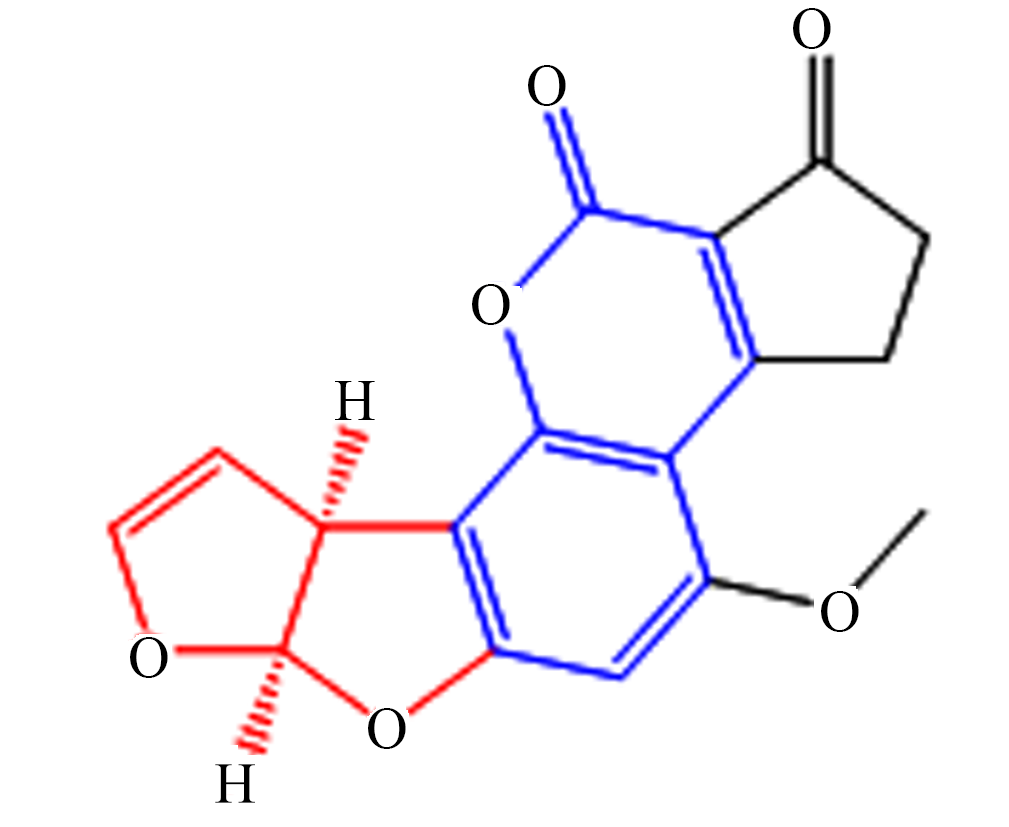
黄曲霉毒素(AF)是由黄曲霉和寄生曲霉产生的次生代谢产物,常见类型包括AFB1、AFB2、AFM1、AFM2、AFG1和AFG2等,其中AFB1存在最为广泛且毒性最强[8]。AFB1的分子式为C17H13O6,化学结构式如图1所示。双呋喃环结构是其主要的毒性基团,香豆素环结构则介导其强致癌性[9]。多项研究表明,谷物、玉米及各类饼粕产品极易受到AFB1污染,且污染率因地区和原料类型不同而存在较大差异。其中玉米的污染率普遍在20%~50%,部分高温高湿地区可超过70%[10-12]。鉴于AFB1对动物及人体肝脏的强危害性,世界卫生组织(World Health Organization,WHO)已将其列为ⅠA级危险物,国际癌症研究机构(International Agency for Research on Cancer,IARC)将其列为Ⅰ类致癌物[13]
图1 AFB1化学结构式

红色为双呋喃环,蓝色为香豆素环。

Fig.1 Chemical structure formula of AFB1

Red indicates the difuran ring, and blue indicates the coumarin ring.

1.2 ZEN

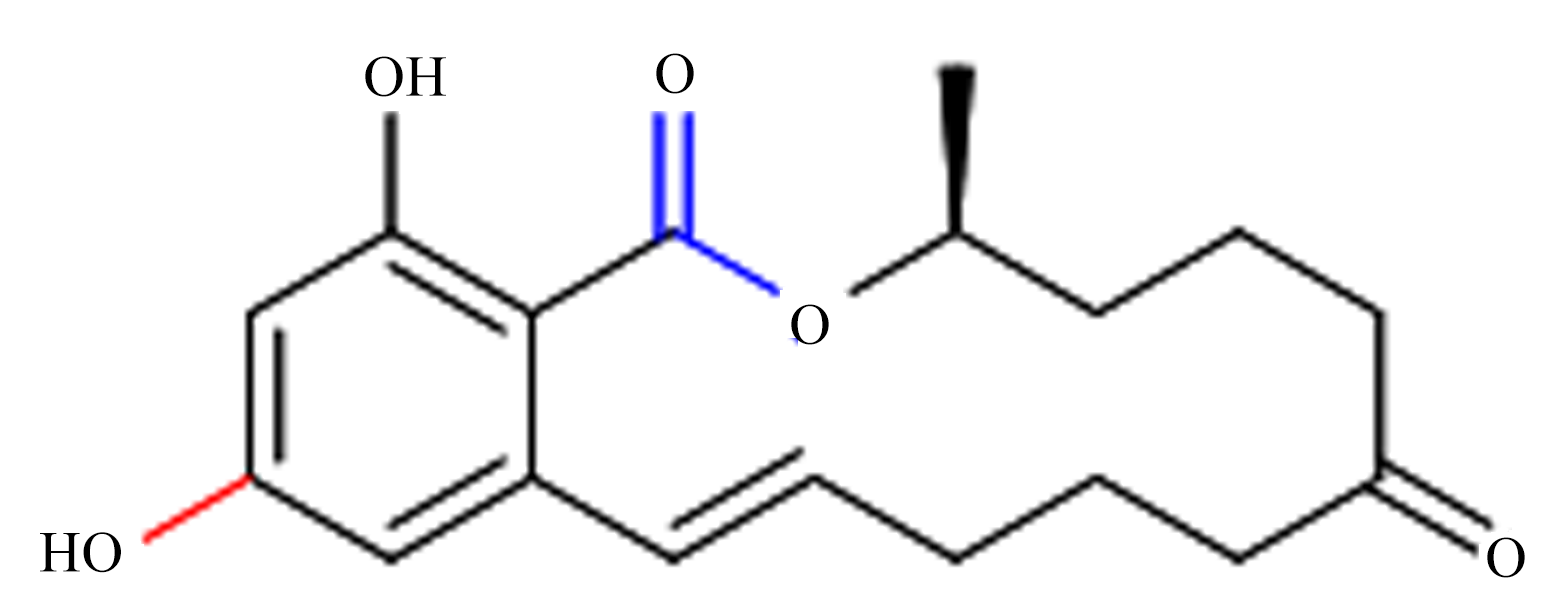
ZEN是由镰刀菌属代谢产生的具有雌激素作用的毒素,其分子式为C18H22O5,化学结构式如图2所示。ZEN的主要毒性基团包括内酯环和苯环上的C-4游离酚羟基。由于ZEN的结构与雌二醇相似,其C-4羟基可直接竞争性结合雌激素受体,从而对动物生殖系统造成损害[14]。除生殖毒性外,ZEN还会对动物产生细胞毒性、免疫毒性及遗传毒性等多种毒性作用[15]。在饲料原料中,玉米及其副产物最易受到ZEN污染,同时该毒素也广泛分布于小麦、高粱等谷物中。调查显示,我国多个省份超20 000份饲料样本中,ZEN检出率高达85.0%~100.0%[16-17]
图2 ZEN化学结构式

红色为C-4游离酚羟基,蓝色为内酯环。

Fig.2 Chemical structure formula of ZEN

Red indicates the free phenolic hydroxyl group at C-4, and blue indicates the lactone ring.

1.3 OTA

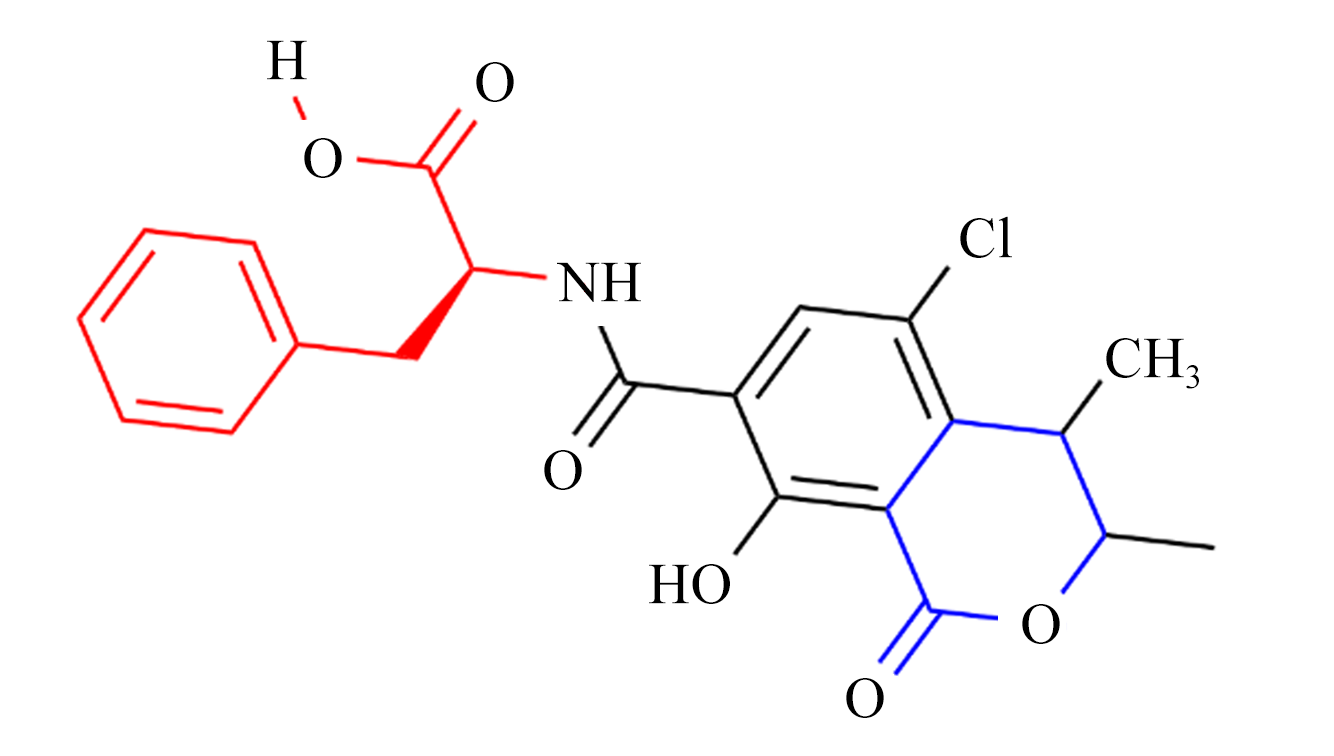
OTA是赭曲霉、黑曲霉及青霉菌属等真菌产生的次生代谢产物,其分子式为C20H18CINO6,化学结构式如图3所示。OTA的主要毒性结构为异香豆素部分与苯丙氨酸部分的羧基,其分子上的氯原子还可增强毒性[18]。在机体中,OTA的主要毒性作用靶器官是肝脏和肾脏,其不仅能够抑制葡萄糖代谢,还可以与血浆蛋白高度结合形成难降解的物质,从而对机体产生持续毒性作用[19-20]。OTA广泛污染谷物及其副产品、肉类、乳制品、干果和配合饲料等。据报道,湿热地区谷物类饲料OTA污染率可达40%以上[21-22]。鉴于其致癌性,IARC已将其列为Ⅰ类致癌物[23]
图3 OTA化学结构式

红色为L-苯丙氨酸部分,蓝色为异香豆素部分。

Fig.3 Chemical structure formula of OTA

Red indicates the L-phenylalanine moiety, and blue indicates the isocoumarin moiety.

1.4 DON

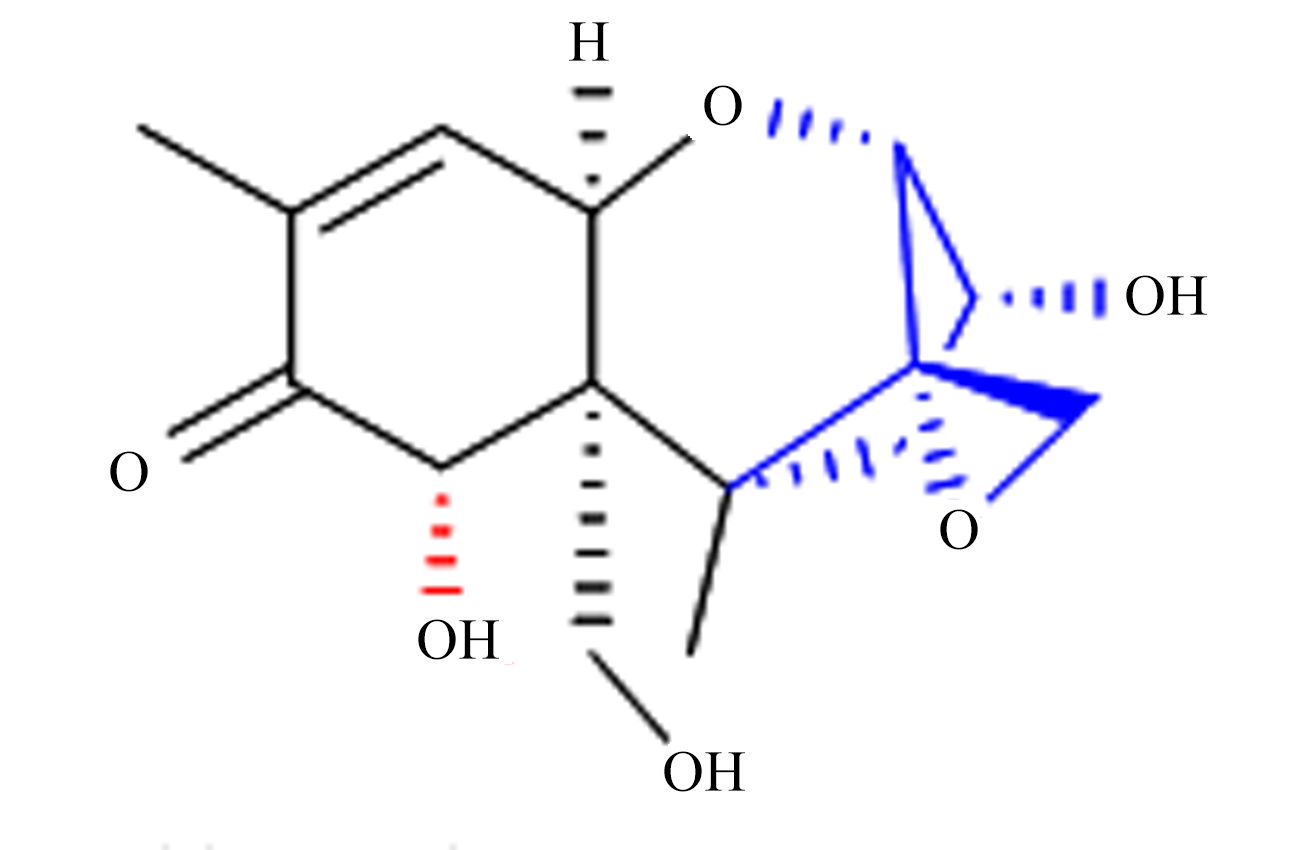
DON由孢子丝核镰刀菌和梨孢镰刀菌等真菌产生,因可引发猪呕吐反应,又名呕吐毒素,其分子式为C15H20O6,化学结构式如图4所示。DON的主要毒性结构为12,13-环氧环与C-3羟基,且12,13-环氧环是其毒性的必需基团[24]。在机体内,DON通过抑制蛋白质合成和干扰细胞膜完整性等途径,损害胃肠道细胞和淋巴细胞的正常功能,从而破坏肠道内稳态并引发免疫功能障碍[25-27]。DON是小麦及其副产品中检出率最高且危害最严重的真菌毒素之一。多项调查结果表明,在小麦、大麦和玉米等多种饲料原料中均可检测到DON,检出率高达96.4%~100.0%[28-30]
图4 DON化学结构式

红色为C-3羟基,蓝色为12,13-环氧环。

Fig.4 Chemical structure formula of DON

Red indicates the hydroxyl group at C-3, and blue indicates the 12,13-epoxy ring.

1.5 FB

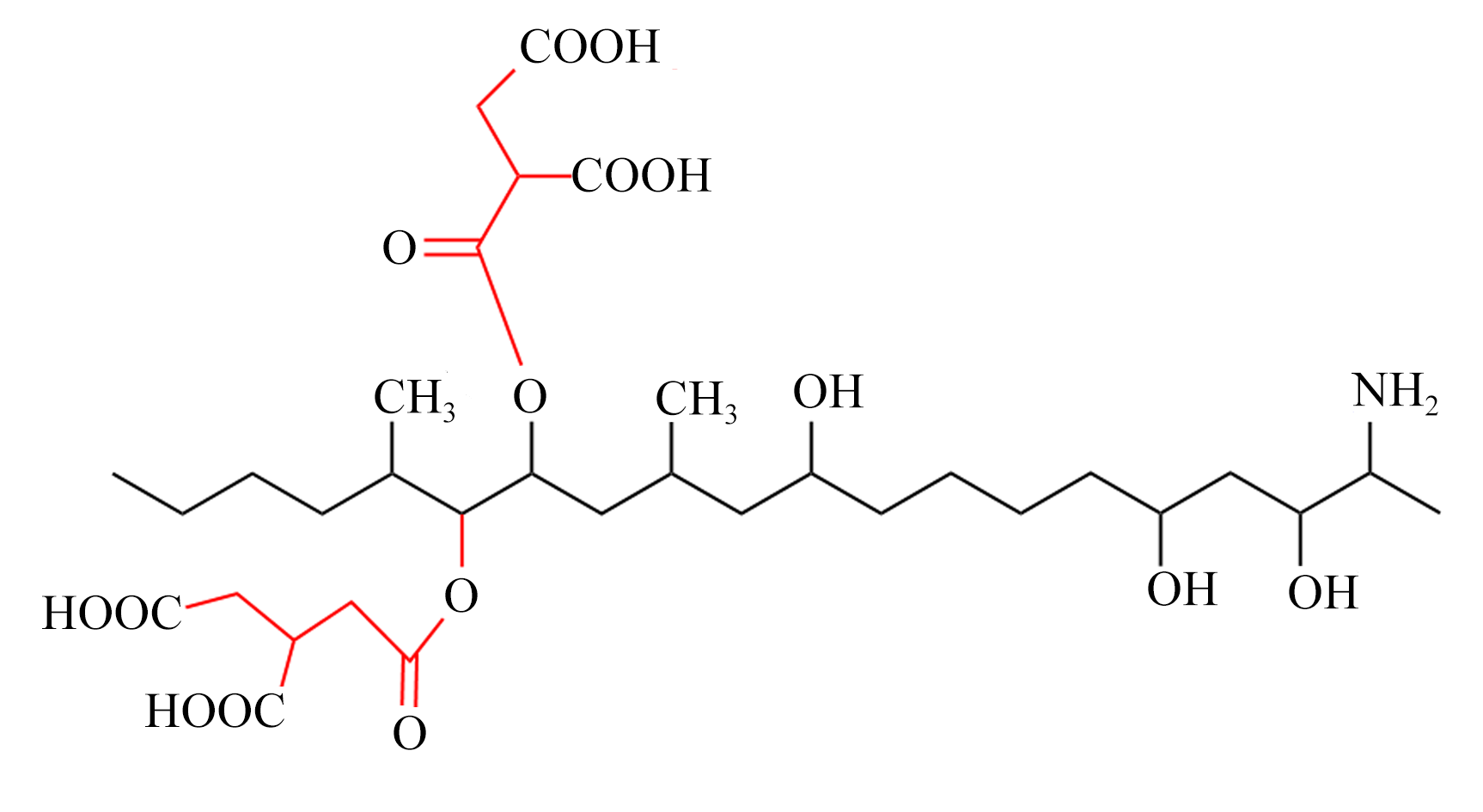
FB是由串珠镰刀菌和轮枝镰刀菌等镰刀菌属产生的次生代谢产物,有伏马毒素B1(FB1)、伏马毒素B2(FB2)和伏马毒素B3(FB3)等形式,其中FB1被认为是毒性最强的镰刀菌毒素之一[31]。FB的分子式为C34H59NO15,化学结构式如图5所示。其主要毒性结构为C-2位氨基与三羧酸侧链[32]。FB可侵害动物肝脏、肾脏和肠道等器官,通过诱发氧化应激反应阻碍其生长发育,并具有强致癌性[33-34]。其主要污染玉米及其副产物,以及燕麦、大麦和小麦等谷物[35]。多地调查结果显示,不同饲料样品均存在一定程度的FB污染,其中FB1和FB2的最高检出率分别可达96.7%和98.3%[36-37]
图5 FB化学结构式

红色为三羧酸侧链酯键,蓝色为C-2位游离氨基。

Fig.5 Chemical structure formula of FB

Red indicates the tricarboxylic acid side chain ester linkages, and blue indicates the free amino group at position C-2.

2 饲料霉菌毒素的脱毒方法

饲料中的霉菌毒素具有较高的热稳定性,传统处理方法难以有效降解毒素,反而可能破坏饲料中的营养成分,降低其饲用价值[38]。因此,开发高效、安全的霉菌毒素脱毒技术具有重要意义。目前常用的霉菌毒素脱毒方法分为物理脱毒法、化学脱毒法和生物脱毒法3类。

2.1 物理脱毒法

由于霉菌毒素具有较高的热稳定性,常规物理脱毒方法(如水洗、加热以及吸附剂吸附等)难以实现有效脱毒,因此当前研究多集中于采用蒙脱石、活性炭和沸石等吸附剂对饲料中的霉菌毒素进行物理去除。以蒙脱石为例,其拥有高比表面积和强吸附能力,被广泛用于吸附重金属及霉菌毒素等污染物[39]。天然蒙脱石对AFB1、FB、ZEN和DON等有一定的脱毒作用,并可降低其在动物组织中的残留[40-41]。然而,天然蒙脱石对ZEN和DON等极性较弱毒素的吸附能力有限[42]。因此,常通过有机改性、无机改性和复合改性等手段提升蒙脱石的吸附性能[43]。例如,Olopade等[44]报道,经钠离子改性后,蒙脱石对T-2毒素的吸附率从48%提高至66%。张立阳等[45]研究发现,载金属离子和季铵盐改性均能显著增强蒙脱石的脱毒能力,其中季铵盐改性蒙脱石对AFB1的吸附率可达98%以上。改性蒙脱石除具备优良的抗菌活性和吸附性能外,还对动物生长具有一定促进作用[46]。蔡孟君[47]研究发现,与天然蒙脱石相比,载铜蒙脱石对AFB1和DON的吸附率进一步提高;且添加至仔猪饲粮后可降低仔猪腹泻率,改善其生长性能、免疫功能和抗氧化能力。综上所述,改性蒙脱石等物理吸附剂在霉菌毒素脱毒中表现出良好的应用潜力,兼具减毒、促生长和增强免疫等多重功能。然而,其大规模应用仍面临一系列挑战,未来需进一步探索复合毒素的协同吸附机制、长期饲喂安全性以及低成本、规模化的改性工艺。

2.2 化学脱毒法

化学脱毒法主要利用碱化、酸化或臭氧处理等手段,将霉菌毒素降解或转化为无毒或弱毒的产物。传统化学脱毒方法(如利用化学试剂)虽可部分降解霉菌毒素,但受限于操作安全性、处理效果及潜在残留等问题,在实际生产中应用较少[48-49]。当前研究更多聚焦于新型化学脱毒剂,其中腐殖酸钠、臭氧和氨水等显示出较好的应用潜力[50]。腐殖酸钠被证实可以改善动物生长性能,并对重金属和真菌毒素等有害物质具有一定的吸附能力[51]。叶盛群[52]研究显示,腐殖酸钠对自然霉变玉米中常见的AFB1、ZEN和DON均具脱毒效果,在人工胃液中的去除率分别为25.00%、23.69%和10.27%,在人工肠液中则分别达到52.32%、38.66%和14.41%。此外,氨气熏蒸法不仅对饲料营养价值破坏小、成本较低,也适用于大规模处理。陈志娟等[53]报道,在温度37 ℃、氨气体积分数7.05%、氨熏96 h的条件下,霉变玉米中AFB1的降解率可达92%。尽管新型化学法在安全性与脱毒效能上优于传统方法,但与物理或生物法相比,仍面临化学物质残留风险较高、适用性较窄以及环境可持续性不足等瓶颈问题,其广泛应用仍需进一步探索与优化。

2.3 生物脱毒法

与传统物理和化学方法相比,生物脱毒法凭借其高效、安全及环保等优势,已成为当前霉菌毒素脱毒研究的热点。该方法主要通过微生物或其代谢产物作用于霉菌毒素分子的关键基团,将其转化为无毒或低毒的代谢产物,从而显著降低其对动物和人类的危害。
大量研究表明,多种微生物及其代谢产物(包括细菌、真菌及酶制剂)能够有效吸附或降解霉菌毒素[54-56]。例如,Sangmanee等[57]采用微量稀释法评估了源自发酵米粉的植物乳杆菌(Lactobacillus plantarum)K35的抗真菌活性,发现其可显著抑制黄曲霉的生长。Wang等[55]从鸡大肠消化物中分离出一株赖氨酸芽孢杆菌(Lysinibacillus lysinolyticus),其对ZEN的降解率超过90%。此外,部分真菌如酵母和曲霉也显示出抑制霉菌毒素生成并降解其毒性的能力。李梦珂等[58]报道,黑曲霉培养物对AFB1和ZEN的同步降解率分别达到71.54%和98.28%。邵春山等[59]以DON为唯一碳源分离得到一株毕赤酵母菌(Komagataella phaffii)MC-1,对DON的降解率为54.76%。在酶制剂方面,漆酶和锰过氧化物酶等因其高特异性、高效力及环境友好特性,展现出良好的应用潜力。谷晓丹[60]研究发现,漆酶Lac-W可广谱降解包括AFB1在内的6种霉菌毒素,降解率为12%~93%,尤以对AFB1的降解率最高。基于此,利用微生物降解霉菌毒素是一种具有广阔应用前景的防控策略。在众多微生物中,芽孢杆菌属因其高效降解特性成为当前研究的重点对象。

3 芽孢杆菌降解饲料中霉菌毒素的作用效果及机制

3.1 芽孢杆菌对不同种类霉菌毒素的降解作用

芽孢杆菌属是一类好氧或兼性厌氧的革兰氏阳性细菌,广泛分布于土壤、水、空气及动物肠道等环境中,具有较强的抗逆性[61]。该菌属常见菌种包括枯草芽孢杆菌(Bacillus subtilis)、地衣芽孢杆菌(Bacillus licheniformis)和蜡样芽孢杆菌(Bacillus cereus)等。芽孢杆菌属不仅可通过营养物质与空间竞争、诱导植物系统抗性等方式抑制病原真菌,还能分泌多种生物活性物质(如抗菌肽、细胞壁降解酶和环状脂肽类抗生素),直接抑制或杀伤产毒真菌,因此在食品、医疗和畜牧领域具有广泛的应用价值[62-63]
研究表明,常见的霉菌毒素如AFB1、ZEN、DON和OTA等均可被至少1种芽孢杆菌降解,其中AFB1与ZEN是主要的靶向毒素[64]。例如,地衣芽孢杆菌QT338和暹罗芽孢杆菌(Bacillus siamensis)DY3123对AFB1的降解率均超过90%[65-66];而ZEN可被贝莱斯芽孢杆菌(Bacillus velezensis)2X-7、斯氏芽孢杆菌(Bacillus spizizenii)B73和斯氏芽孢杆菌YQ-1高效降解,降解率分别达到98.30%、99.30%和99.07%[67-69]。在众多芽孢杆菌中,枯草芽孢杆菌作为脱霉剂的研究最为广泛,目前已有80余个菌株被鉴定具有霉菌毒素降解能力;此外,贝莱斯芽孢杆菌、蜡样芽孢杆菌和地衣芽孢杆菌等也是当前研究的重点[64]
饲料中的霉菌毒素常以复合形式存在,其协同毒性远高于单一毒素,因此近年来芽孢杆菌对复合毒素的降解能力备受关注。曹艳子等[70]利用自主分离的贝莱斯芽孢杆菌BSL-1进行降解试验,发现其发酵液原液对FB、DON、AFB1、ZEN和OTA均具降解能力,其中对AFB1和ZEN的降解率分别为50.60%和62.04%。Riahi等[71]研制了一种由枯草芽孢杆菌和地衣芽孢杆菌等组成的复合脱霉剂,可缓解OTA和T-2毒素对肉鸡生长性能的负面影响。Kumar等[72]则利用白芽孢杆菌(Bacillu albus)YUN5的无细胞上清液同步降解AFB1和AFG1,最高降解率分别为76.28%和98.98%。这些结果表明,芽孢杆菌在降解多种霉菌毒素方面表现出良好的广谱潜力。然而,由于多数芽孢杆菌缺乏对FB或T-2毒素等特定霉菌毒素的高效专一酶降解途径,单一菌株的降解能力仍有限。因此,在实际应用中多采用复合脱毒策略,例如将芽孢杆菌与蒙脱石等吸附剂、特定酶制剂复配,或整合物理、化学及生物脱毒方法,以全面提升脱毒效率。表1列举了其他研究中常用作脱霉剂的芽孢杆菌及其对多种霉菌毒素的降解效果。
表1 常见芽孢杆菌菌种对不同种类霉菌毒素的降解效果

Table 1 Degradation efficiency of common Bacillus species against different types of mycotoxins

芽孢杆菌菌种
Bacillus species
菌株编号
Strain numbers
降解霉菌毒素种类
Degraded mycotoxin species
降解率
Degradation rate/%
参考文献
References
枯草芽孢杆菌
Bacillus subtilis
JSW-1 AFB1 67.2 [73]
ZENL09 ZEN 87.0 [74]
KU-153 OTA 90.0 [75]
GMb2 DON 75.7 [76]
BIOUFLA2 FB1 40.0 [77]
贝莱斯芽孢杆菌
Bacillus velezensis
IS-6 AFB1 58.0 [78]
IS-6 ZEN 68.0 [78]
IS-6 OTA 89.0 [78]
E2 DON 31.0 [79]

蜡样芽孢杆菌
Bacillus cereus
XSWW9 AFB1 86.7 [80]
BC7 ZEN 100.0 [81]
地衣芽孢杆菌
Bacillus licheniformis
S51 AFB1 61.3 [82]
ANSB821 ZEN 90.0 [83]
DTM06 OTA 40.3 [84]
YB9 DON 82.7 [85]

AFB1:黄曲霉毒素B1 aflatoxin B1;ZEN:玉米赤霉烯酮 zearalenone;OTA:赭曲霉毒素A ochratoxin A;DON:脱氧雪腐镰刀菌烯醇 deoxynivalenol;FB1:伏马毒素B1 fumonisin B1

3.2 芽孢杆菌的脱毒作用机制

芽孢杆菌对霉菌毒素的脱毒作用机制主要包括吸附与降解2种方式(图6),其吸附机制依赖于细胞壁与霉菌毒素之间的非共价键结合。芽孢杆菌的细胞壁是由肽聚糖构成的多层网状结构,具有高比表面积和丰富的微孔通道,为物理吸附提供了结构基础[86]。为探究该机制,当前研究通常将菌液分离为不同组分(如灭活菌体、上清液等),并分别与霉菌毒素进行共培养。研究表明,部分芽孢杆菌以吸附作用为主要脱毒方式。例如,张家林[87]比较了贝莱斯芽孢杆菌CBMB205的灭活菌体(以吸附为主)、细胞壁组分(以吸附为主)及上清液(以酶降解为主)对AFB1和ZEN的脱除效果,发现细胞壁组分的脱毒效率显著高于其他组分,表明该菌株对这2种毒素的脱除以细胞壁吸附为主导机制。姜富贵等[88]也报道,纳豆枯草芽孢杆菌(Bacillus subtilis natto)对AFB1具有一定的物理吸附作用,最大吸附率可达17.76%。然而,多数研究显示,芽孢杆菌的上清液组分往往表现出更显著的脱毒效果[6,89-90],提示在芽孢杆菌属微生物的脱毒过程中,生物降解(尤其是胞外酶介导的降解)是其发挥高效脱毒功效的主要机制。
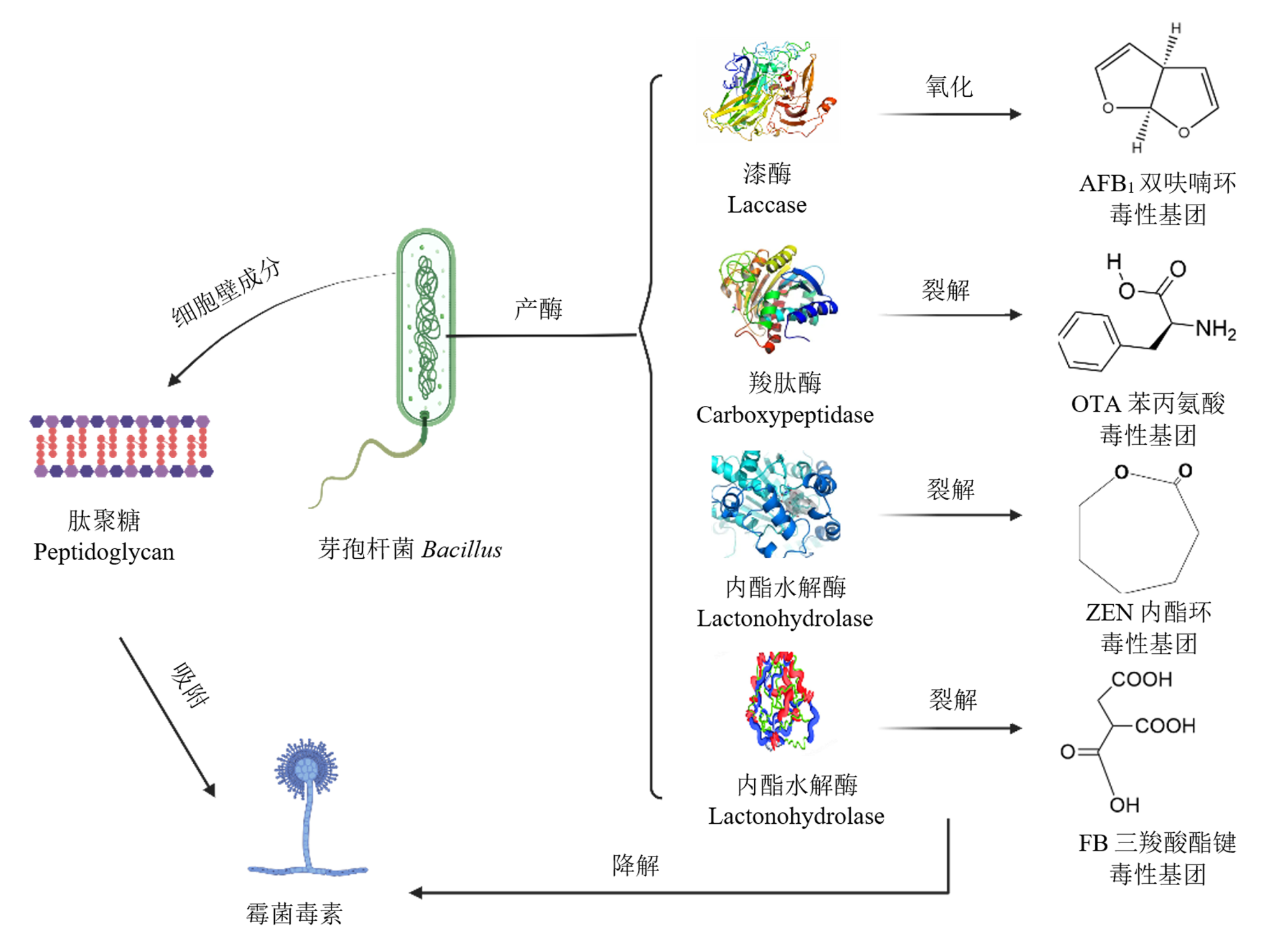
图6 芽孢杆菌对部分霉菌毒素的脱毒作用机制

AFB1:黄曲霉毒素B1 aflatoxin B1;ZEN:玉米赤霉烯酮 zearalenone;OTA:赭曲霉毒素A ochratoxin A;FB:伏马毒素 fumonisin。

Fig.6 Detoxification mechanisms of Bacillus against partial mycotoxins

降解是指益生菌通过其分泌的代谢产物(如酶)将毒素分解或转化为低毒或无毒产物的过程。在芽孢杆菌中,介导这一过程的关键酶主要包括漆酶、酯酶、磷酸转移酶、羧肽酶和过氧化物酶等[91-95]。这些酶可通过多种分子机制高效降解霉菌毒素,例如裂解酯键、打开环氧结构或在毒素核心骨架上引入官能团等,从而显著降低其毒性。Xiong等[96]发现,源自解淀粉芽孢杆菌(Bacillus amyloliquefaciens)B10的漆酶对AFB1的降解率可达79.3%,其机制在于漆酶活性位点的氨基酸残基可氧化AFB1的毒性关键部分——呋喃环末端,并添加羟基官能团,从而降低其毒性。González等[97]报道,源于芽孢杆菌的AHL内酯酶能够水解AFB1内酯环中的酯键,破坏其毒性基团。Xu等[98]研究表明,枯草芽孢杆菌CW14主要通过其D-丙氨酸羧肽酶A(DacA)裂解OTA的酰胺键,移除毒性基团L-苯丙氨酸,生成低毒产物赭曲霉毒素α(OTα)。Shi等[99]发现,枯草芽孢杆菌YT-4分泌的内酯水解酶可裂解ZEN的内酯环酯键,生成无雌激素活性的代谢物。Duviick等[100]则证实,源自解淀粉芽孢杆菌的羧酸酯酶能水解FB1的三羧酸侧链酯键,使其完全丧失神经毒性。
需指出的是,芽孢杆菌对霉菌毒素的脱除通常是酶降解与物理吸附协同作用的结果。例如,张家林[87]在研究贝莱斯芽孢杆菌CBMB205和暹罗芽孢杆菌KCTC 13613时发现,两者对AFB1、ZEN和DON兼具吸附与酶降解能力。李根[101]也报道,饲料类芽孢杆菌(Paenibacillus pabuli)E1除可分泌N-酰基高丝氨酸内酯酶破坏AFB1的呋喃环结构实现降解外,其细胞壁同时对AFB1具有一定的吸附作用。

3.3 芽孢杆菌相关脱霉剂在动物生产上的应用

鉴于微生物对霉菌毒素的良好降解效果,以及全面禁抗背景下对抗生素替代品的迫切需求,以芽孢杆菌制剂为代表的微生物制剂展现出巨大应用潜力。研究表明,芽孢杆菌具有调节动物肠道微生态平衡、促进营养物质消化与吸收、增强动物免疫功能,以及提高动物生产性能等益生效应[102]。在实际应用中,多项研究证实了芽孢杆菌制剂的有效性。例如,肖丹等[103]在艾维茵肉鸡试验中发现,枯草芽孢杆菌制剂不仅可降低黄曲霉毒素在机体内的残留,还能缓解AFB1引起的生长抑制、免疫器官损伤和抗氧化能力下降。林洋等[104]报道,饲喂贝莱斯芽孢杆菌制剂可减少肉鸡粪便中AFB1、FB、DON和ZEN的排泄量,同时显著提高肉鸡的试验末体重,降低死淘率和料重比。Zhou等[105]研究发现,枯草芽孢杆菌ANSB01G能够缓解ZEN对妊娠母猪造成的生殖激素紊乱、阴户肿胀、器官损伤及细胞凋亡等负面影响。但需要注意的是,并非所有芽孢杆菌均为益生菌,部分菌株如某些蜡样芽孢杆菌可能引起恶心、呕吐等轻微中毒症状,甚至导致严重的心内膜炎或脓毒症等并发症[106]。因此,系统评估芽孢杆菌制剂的安全性并深入研究其对动物生产性能的影响,是推动其在养殖业中广泛应用的重要前提。
除体内试验外,细胞毒性试验和饲粮营养成分分析也常用于评估芽孢杆菌的脱毒效果及安全性。Guo等[107]发现,在肉鸡饲粮中添加含枯草芽孢杆菌CGMCC1.0504的复合益生菌,可改善肉鸡肠道菌群,缓解霉菌毒素对其生产性能的不利影响,并减轻AFB1与ZEN对肝细胞的毒性作用。王睿等[108]研究表明,地衣芽孢杆菌不仅能有效降低玉米青贮饲料中DON、FB和AFB1的含量,还可提高饲料粗脂肪含量,降低中性洗涤纤维和酸性洗涤纤维含量。石楠等[109]利用蜡样芽孢杆菌BT-1对霉变玉米进行体外发酵,结果显示,AFB1、DON和ZEN的脱毒率分别达到67.59%、73.03%和65.71%,且对青贮饲料和玉米籽粒的营养成分含量无显著负面影响。这些结果突显了芽孢杆菌在脱除霉菌毒素的同时,兼具保持甚至改善饲料营养价值的双重优势。

3.4 芽孢杆菌脱毒应用的挑战

尽管芽孢杆菌在饲料霉菌毒素脱毒方面展现出广阔的应用前景,其实际推广仍面临一系列挑战。首先,不同菌株的降解谱相对狭窄,对部分毒素的降解效率仍不理想;此外,在多种毒素共存的复杂基质中,其降解效率往往进一步下降。如Hassan等[110]研究发现,巨大芽孢杆菌(Priestia megaterium)BM344-1对ZEN的降解率接近100%,但对FB1和FB2的降解率仅为14%和12%;尤其在ZEN、T-2毒素、FB1和FB2混合污染的条件下,其对ZEN和T-2毒素的降解效率更是被严重抑制。其次,关键降解酶及其分子机制尚未完全阐明,制约了针对性的菌株改造与功能强化[111]。同时,现有研究中仍相对缺乏对芽孢杆菌降解霉菌毒素后代谢产物的系统毒理学评估。如AFB1的代谢产物AFB2a、ZEN的代谢产物α-玉米赤霉烯醇虽较原始毒素毒性降低,但仍可能引发氧化应激、DNA损伤或雌激素样反应等潜在危害[112-113]。此外,部分菌株的生物安全性、工业化制剂的稳定性与生产成本等问题也亟待解决。

4 小结与展望

饲料中常见的霉菌毒素(如AFB1、ZEN、DON、OTA和FB等)不仅严重威胁动物和人类健康,也制约着畜牧业的可持续发展。虽然物理和化学脱毒方法可在一定程度上降低霉菌毒素的毒性,但存在营养物质损失、成本较高和易造成二次污染等问题,难以满足当前饲料工业对绿色、安全与高效生产的需要。因此,生物脱毒技术逐渐成为霉菌毒素治理的研究和应用热点。近年来,大量研究证实多种芽孢杆菌菌株对上述霉菌毒素具有显著的降解能力,其作用机制主要包括酶促降解与细胞吸附。其中,漆酶、酯酶、磷酸转移酶等代谢酶类能够定向破坏毒素的关键毒性结构,并将其转化为低毒或无毒的产物,表现出良好的应用潜力。在动物生产上,部分芽孢杆菌不仅能有效降解毒素,还可改善动物肠道菌群、增强机体免疫力以及缓解毒素引发的器官损伤,展现出其作为安全脱霉剂的极大潜力。然而,该技术目前仍面临一些挑战,包括菌株降解谱窄、对某些毒素降解效率不高、作用机制尚未完全明晰等。今后的研究应致力于筛选广谱高效菌株、解析关键代谢途径及功能酶基因、评估复合毒素条件下的降解稳定性与安全性,并推动其与物理、化学方法的协同使用,以实现多种霉菌毒素的高效协同脱除,为保障饲料安全与畜禽健康提供更加可靠的技术支撑和解决方案。
[1]
JARVIS B B, MILLER J D. Mycotoxins as harmful indoor air contaminants[J]. Applied Microbiology and Biotechnology, 2005, 66(4):367-372.

PMID

[2]
SUN Z, YOU Y X, XU H D, et al. Food-grade expression of two laccases in Pichia pastoris and study on their enzymatic degradation characteristics for mycotoxins[J]. Journal of Agricultural and Food Chemistry, 2024, 72(16):9365-9375.

[3]
ESKOLA M, KOS G, ELLIOTT C T, et al. Worldwide contamination of food-crops with mycotoxins:validity of the widely cited ‘FAO estimate’ of 25%[J]. Critical Reviews in Food Science and Nutrition, 2020, 60(16):2773-2789.

DOI

[4]
YU Z, ZHANG Z, TEAME T, et al. Yeast cell wall extract as a strategy to mitigate the effects of aflatoxin B1 and deoxynivalenol on liver and intestinal health,and gut microbiota of largemouth bass (Micropterus salmoides)[J]. Aquaculture, 2025, 597:741917.

DOI

[5]
LEŠIĆ T, PLEADIN J, KUDUMIJA N, et al. Mycotoxin residues in chicken breast muscle and liver[J]. Foods, 2025, 14(12):2017.

DOI

[6]
GRECO D, D’ASCANIO V, SANTOVITO E, et al. Unlocking the potential of Bacillus subtilis:a comprehensive study on mycotoxin decontamination,mechanistic insights,and efficacy assessment in a liquid food model[J]. Foods, 2025, 14(3):360.

DOI

[7]
王晓璐, 罗会颖, 姚斌. 饲料霉菌毒素的生物降解研究进展[J]. 动物营养学报, 2022, 34(10):6152-6159.

DOI

WANG X L, LUO H Y, YAO B. Advances in research on biodegradation of mycotoxins in feed[J]. Chinese Journal of Animal Nutrition, 2022, 34(10):6152-6159. (in Chinese)

DOI

[8]
ARIMBOOR R. Metabolites and degradation pathways of microbial detoxification of aflatoxins:a review[J]. Mycotoxin Research, 2024, 40(1):71-83.

DOI

[9]
XU X P, LIN P L, LU Y M, et al. Degradation and detoxification of aflatoxin B1 by two peroxidase enzymes from Irpex lacteus F17[J]. Bioprocess and Biosystems Engineering, 2025, 48(4):693-704.

DOI

[10]
JALLOW A, XIE H L, TANG X Q, et al. Worldwide aflatoxin contamination of agricultural products and foods:from occurrence to control[J]. Comprehensive Reviews in Food Science and Food Safety, 2021, 20(3):2332-2381.

DOI

[11]
COPPA C F S C, CIRELLI A C, GONÇALVES B L, et al. Dietary exposure assessment and risk characterization of mycotoxins in lactating women:case study of São Paulo state,Brazil[J]. Food Research International, 2020, 134:109272.

DOI

[12]
SCHABO D C, MARTINS L M, MACIEL J F, et al. Production of aflatoxin B1 and B2 by Aspergillus flavus in inoculated wheat using typical craft beer malting conditions[J]. Food Microbiology, 2020, 89:103456.

DOI

[13]
LI C C, LIU X D, WU J, et al. Research progress in toxicological effects and mechanism of aflatoxin B1 toxin[J]. PeerJ, 2022, 10:e13850.

DOI

[14]
TAKEMURA H, SHIM J Y, SAYAMA K, et al. Characterization of the estrogenic activities of zearalenone and zeranol in vivo and in vitro[J]. The Journal of Steroid Biochemistry and Molecular Biology, 2007, 103(2):170-177.

DOI

[15]
GRÜMPEL-SCHLÜTER A, KERSTEN S, KLUESS J, et al. Effect of zearalenone in sugar beet products on zootechnical and reproductive performance and lesions of sows and piglets[J]. Mycotoxin Research, 2025, 41(1):47-61.

DOI

[16]
ZHAO L, ZHANG L, XU Z J, et al. Occurrence of aflatoxin B1,deoxynivalenol and zearalenone in feeds in China during 2018—2020[J]. Journal of Animal Science and Biotechnology, 2021, 12(1):74.

DOI

[17]
LIU M, XIA Z Y, ZHANG Y, et al. Contamination of aflatoxin B1,deoxynivalenol and zearalenone in feeds in China from 2021 to 2024[J]. Journal of Animal Science and Biotechnology, 2025, 16(1):66.

DOI

[18]
XIAO H, MADHYASTHA S, MARQUARDT R R, et al. Toxicity of ochratoxin A,its opened lactone form and several of its analogs:structure-activity relationships[J]. Toxicology and Applied Pharmacology, 1996, 137(2):182-192.

DOI

[19]
刘城, 彭馨, 姜夏雨, 等. 胚蛋注射赭曲霉毒素A对雏鸭出雏质量、空肠形态和空肠炎性因子的影响[J]. 中国畜牧杂志, 2025, 61(5):326-331.

LIU C, PENG X, JIANG X Y, et al. Effects of in ovo injection of ochratoxin A on hatchling quality,jejunal morphology and jejunal inflammatory factors in ducklings[J]. Chinese Journal of Animal Science, 2025, 61(5):326-331. (in Chinese)

[20]
郇佳欣. Zn-MOF固定脂肪酶及其对赭曲霉毒素A的降解研究[D]. 硕士学位论文. 杨凌: 西北农林科技大学, 2025.

HUAN J X. Study on lipase immobilization via Zn-MOF for ochratoxin A detoxification[D]. Master’s Thesis. Yangling: Northwest A&F University, 2025.

[21]
TABARANI A, ZINEDINE A, ROCHA J M, et al. Comparative study of ochratoxin A exposure through the intake of cereal products in two climatic Moroccan regions[J]. Toxins, 2023, 15(7):452.

DOI

[22]
赵伟, 厉学武, DESSALEGN LAMESGEN, 等. 我国饲料原料和配合饲料中T-2毒素、赭曲霉毒素A和伏马毒素的污染研究[J]. 动物营养学报, 2024, 36(4):2690-2698.

DOI

ZHAO W, LI X W, DESSALEGN L, et al. A study of contamination of T-2 toxin,ochratoxin A and fumonisin in feed ingredients and compound feed in China[J]. Chinese Journal of Animal Nutrition, 2024, 36(4):2690-2698. (in Chinese)

DOI

[23]
RINGOT D, CHANGO A, SCHNEIDER Y J, et al. Toxicokinetics and toxicodynamics of ochratoxin A,an update[J]. Chemico-Biological Interactions, 2006, 159(1):18-46.

DOI

[24]
ZHOU T, HE J, GONG J. Microbial transformation of trichothecene mycotoxins[J]. World Mycotoxin Journal, 2008, 1(1):23-30.

DOI

[25]
LONGOBARDI C, DAMIANO S, VACCARO E, et al. Protective effects of a red orange and lemon extract (RLE) on the hepatotoxicity induced by ochratoxin A in rats[J]. Antioxidants, 2024, 13(3):289.

DOI

[26]
PAPATSIROS V G, ELIOPOULOS C, VOULGARAKIS N, et al. Effects of a multi-component mycotoxin-detoxifying agent on oxidative stress,health and performance of sows[J]. Toxins, 2023, 15(9):580.

DOI

[27]
邵慧丽. 臭氧处理对呕吐毒素污染小麦品质及安全性的影响[D]. 硕士学位论文. 无锡: 江南大学, 2016.

SHAO H L. Effect of ozone treatment on the quality and safety of deoxynivalenol-contaminated wheat[D]. Master’s Thesis. Wuxi: Jiangnan University, 2016. (in Chinese)

[28]
LI F L, XIE J, WANG S, et al. Direct qualitative and quantitative determination methodology for massive screening of DON in wheat flour based on multi-molecular infrared spectroscopy (MM-IR) with 2T-2DCOS[J]. Talanta, 2021, 234:122653.

DOI

[29]
张雷. 呕吐毒素危害断奶仔猪生长性能和肠道健康的机制研究[D]. 博士学位论文. 武汉: 华中农业大学, 2022.

ZHANG L. Mechanism of DON’s damage to growth performance and intestinal health of weaned piglets[D]. Ph.D.Thesis. Wuhan: Huazhong Agricultural University, 2022. (in Chinese)

[30]
陈亚军, 李芳, 王韫, 等. 北京市场饲料原料及全价饲料中蜡样芽孢杆菌、烟曲霉菌和3种霉菌毒素情况调查[J]. 中国饲料, 2023(4):88-91.

CHEN Y J, LI F, WANG Y, et al. Investigation on Bacillus cereus,Aspergillus fumigatus and three mycotoxins in feed materials and full feed in Beijing market[J]. China Feed, 2023(4):88-91. (in Chinese)

[31]
CHEN J, LI Z M, CHENG Y, et al. Sphinganine-analog mycotoxins (SAMs):chemical structures,bioactivities,and genetic controls[J]. Journal of Fungi, 2020, 6(4):312.

DOI

[32]
ABBAS H K, GELDERBLOM W C, CAWOOD M E, et al. Biological activities of fumonisins,mycotoxins from Fusarium moniliforme,in jimsonweed (Datura stramonium L.) and mammalian cell cultures[J]. Toxicon, 1993, 31(3):345-353.

DOI

[33]
YANG C W, SONG G, LIM W. Effects of mycotoxin-contaminated feed on farm animals[J]. Journal of Hazardous Materials, 2020, 389:122087.

DOI

[34]
GAO Z C, LUO K X, ZHU Q X, et al. The natural occurrence,toxicity mechanisms and management strategies of fumonisin B1:a review[J]. Environmental Pollution, 2023, 320:121065.

DOI

[35]
VANARA F, SCARPINO V, BLANDINO M. Fumonisin distribution in maize dry-milling products and by-products:impact of two industrial degermination systems[J]. Toxins, 2018, 10(9):357.

DOI

[36]
谭莉, 孟繁磊, 范宏, 等. 超高效液相色谱-串联质谱法同时测定玉米中9种真菌毒素[J]. 食品工业科技, 2021, 42(7):240-245.

TAN L, MENG F L, FAN H, et al. Determination of 9 kinds of mycotoxins in maize by ultra performance liquid chromatography-tandem mass spectrometry[J]. Science and Technology of Food Industry, 2021, 42(7):240-245. (in Chinese)

[37]
LI T T, LI J J, WANG J S, et al. The occurrence and management of fumonisin contamination across the food production and supply chains[J]. Journal of Advanced Research, 2024, 60:13-26.

DOI

[38]
SANI A M, AZIZI E G, SALEHI E A, et al. Reduction of aflatoxin in rice by different cooking methods[J]. Toxicology and Industrial Health, 2014, 30(6):546-550.

DOI PMID

[39]
刁亚南, 朱连勤, 陈甫, 等. 十六烷基三甲基溴化铵改性蒙脱石的制备与表征及其体外吸附霉菌毒素的效果[J]. 动物营养学报, 2020, 32(11):5388-5396.

DOI

DIAO Y N, ZHU L Q, CHEN F, et al. Preparation,characterization and adsorption to mycotoxin in vitro of organic modified montmorillonite[J]. Chinese Journal of Animal Nutrition, 2020, 32(11):5388-5396. (in Chinese)

[40]
王晓娟, 夏睿, 邢磊. 载铜蒙脱石对3种常见霉菌毒素脱毒效果的研究[J]. 饲料研究, 2020, 43(2):70-74.

WANG X J, XIA R, XING L. Study on the detoxification effect of copper bearing montmorillonite on three common mycotoxins[J]. Feed Research, 2020, 43(2):70-74. (in Chinese)

[41]
柏梁耀. 残次枣不同脱毒处理对肉兔生长性能、血液生化及屠宰性能的影响[D]. 硕士学位论文. 阿拉尔: 塔里木大学, 2023.

BAI L Y. Effects of different detoxification treatments on growth performance,blood biochemistry and slaughter performance of meat rabbit[D]. Master’s Thesis. Alaer: Tarim University, 2023. (in Chinese)

[42]
MAO J Q, ZHOU Y, LV G L, et al. Simultaneous detoxification of aflatoxin B1,zearalenone and deoxynivalenol by modified montmorillonites[J]. Molecules, 2022, 27(1):315.

DOI

[43]
肖莎. 蒙脱石基复合霉菌毒素吸附材料的制备与作用机理[D]. 硕士学位论文. 绵阳: 西南科技大学, 2024.

XIAO S. Preparation and mechanism of montmorillonite-based composite mycotoxin adsorbent material[D]. Master’s Thesis. Mianyang: Southwest University of Science and Technology, 2024. (in Chinese)

[44]
OLOPADE B K, ORANUSI S U, NWINYI O C, et al. Decontamination of T-2 toxin in maize by modified montmorillonite clay[J]. Toxins, 2019, 11(11):616.

DOI

[45]
张立阳, 赵雪娇, 刘帅, 等. 蒙脱石改性前后对3种常见霉菌毒素的吸附效果及结构表征[J]. 中国畜牧杂志, 2019, 55(3):86-90.

ZHANG L Y, ZHAO X J, LIU S, et al. Adsorption capacity to three common mycotoxins and structural characterization of montmorillonite before and after modification[J]. Chinese Journal of Animal Science, 2019, 55(3):86-90. (in Chinese)

[46]
WANG Q, ZHAN X L, WANG B K, et al. Modified montmorillonite improved growth performance of broilers by modulating intestinal microbiota and enhancing intestinal barriers,anti-inflammatory response,and antioxidative capacity[J]. Antioxidants, 2022, 11:1799.

DOI

[47]
蔡孟君. 载铜蒙脱石的制备工艺、抑菌性能及其在断奶猪上的应用效果研究[D]. 硕士学位论文. 合肥: 安徽农业大学, 2023.

CAI M J. Study on the preparation technology,antibacterial properties of copper-loaded montmorillonite and its application in weaned pigs[D]. Master’s Thesis. Hefei: Anhui Agricultural University, 2023. (in Chinese)

[48]
VOSS K A, RILEY R T, MOORE N D, et al. Alkaline cooking (nixtamalisation) and the reduction in the in vivo toxicity of fumonisin-contaminated corn in a rat feeding bioassay[J]. Food Additives & Contaminants:Part A, 2013, 30(8):1415-1421.

[49]
AIKO V, EDAMANA P, MEHTA A. Decomposition and detoxification of aflatoxin B1 by lactic acid[J]. Journal of the Science of Food and Agriculture, 2016, 96(6):1959-1966.

DOI

[50]
MAGUEY-GONZÁLEZ J A, NAVA-RAMÍREZ M D J, GÓMEZ-ROSALES S, et al. Evaluation of the efficacy of humic acids to counteract the toxic effects of aflatoxin B1 in turkey poults[J]. Frontiers in Veterinary Science, 2023, 10:1276754.

DOI

[51]
HAUS M, ŽATKO D, VAŠKOVÁ J, et al. The effect of humic acid in chronic deoxynivalenol intoxication[J]. Environmental Science and Pollution Research, 2021, 28(2):1612-1618.

DOI

[52]
叶盛群. 腐殖酸钠去除霉菌毒素效果的研究[D]. 硕士学位论文. 雅安: 四川农业大学, 2009.

YE S Q. Study on removal efficacy of mycotoxins by sodium humate[D]. Master’s Thesis. Ya’an: Sichuan Agricultural University, 2009. (in Chinese)

[53]
陈志娟, 刘阳, 邢福国, 等. 氨气熏蒸降解玉米中黄曲霉毒素B1的条件优化[J]. 食品科学, 2010, 31(8):33-37.

DOI

CHEN Z J, LIU Y, XING F G, et al. Optimization of ammonia fumigation for degradation of aflatoxin B1 in maize[J]. Food Science, 2010, 31(8):33-37. (in Chinese)

[54]
NEŠIĆ K, HABSCHIED K, MASTANJEVIĆ K. Possibilities for the biological control of mycotoxins in food and feed[J]. Toxins, 2021, 13(3):198.

DOI

[55]
WANG J Q, YANG F, YANG P L, et al. Microbial reduction of zearalenone by a new isolated Lysinibacillus sp.ZJ-2016-1[J]. World Mycotoxin Journal, 2018, 11(4):571-578.

DOI

[56]
HE C, LI Q, XIAO H D, et al. Effects of mixing ratio and lactic acid bacteria preparation on the quality of whole-plant quinoa and whole-plant corn or stevia powder mixed silage[J]. Microorganisms, 2025, 13(1):78.

DOI

[57]
SANGMANEE P, HONGPATTARAKERE T. Inhibitory of multiple antifungal components produced by Lactobacillus plantarum K35 on growth,aflatoxin production and ultrastructure alterations of Aspergillus flavus and Aspergillus parasiticus[J]. Food Control, 2014, 40:224-233.

DOI

[58]
李梦珂, 盛海, 刘超齐, 等. 黑曲霉培养物对黄曲霉毒素B1和玉米赤霉烯酮的同步降解[J]. 饲料工业, 2025, 46(5):133-136.

LI M K, SHENG H, LIU C Q, et al. Synchronous degradation of aflatoxin B1 and zearalenone by Aspergillus niger culture[J]. Feed Industry, 2025, 46(5):133-136. (in Chinese)

[59]
邵春山, 余祖华, 廖成水, 等. 一株毕赤酵母菌MC-1降解呕吐毒素、生物学特性及初步应用[J]. 中国饲料, 2023(3):37-43.

SHAO C S, YU Z H, LIAO C S, et al. Degradation of deoxynivalenol by a strain of Pichia pastoris MC-1,biological characteristics and preliminary application[J]. China Feed, 2023(3):37-43. (in Chinese)

[60]
谷晓丹. 漆酶Lac-W广谱高效降解饲料中六种主要霉菌毒素的研究[D]. 硕士学位论文. 郑州: 河南农业大学, 2023.

GU X D. Broad-spectrum and efficient degradation of six major mycotoxins in feed by laccase Lac-W[D]. Master’s Thesis. Zhengzhou: Henan Agricultural University, 2023. (in Chinese)

[61]
LI Z, ZHENG M Z, ZHENG J S, et al. Bacillus species in food fermentations:an underappreciated group of organisms for safe use in food fermentations[J]. Current Opinion in Food Science, 2023, 50:101007.

DOI

[62]
MENG D, XU K Z, LIU J B, et al. Biodegradation of zearalenone by a novel Bacillus strain X13 isolated from volcanic rock soil using the mycotoxin as the sole carbon source[J]. Microorganisms, 2025, 13(8):1954.

DOI

[63]
ZHANG X P, AL-DOSSARY A, HUSSAIN M, et al. Applications of Bacillus subtilis spores in biotechnology and advanced materials[J]. Applied and Environmental Microbiology, 2020, 86(17):e01096-20.

[64]
NGUYEN T, CHEN X J, MA L L, et al. Mycotoxin biodegradation by Bacillus bacteria—a review[J]. Toxins, 2024, 16(11):478.

DOI

[65]
刘蓓, 董雯雯, 肖雅清, 等. 降解黄曲霉毒素B1芽孢杆菌的分离鉴定及其特性研究[J]. 山东农业科学, 2024, 56(12):105-112.

LIU B, DONG W W, XIAO Y Q, et al. Isolation and identification of Bacillus degrading aflatoxin B1 and its characterization[J]. Shandong Agricultural Sciences, 2024, 56(12):105-112. (in Chinese)

[66]
倪正, 张黎黎. 暹罗芽孢杆菌DY3123的分离、鉴定及其降解黄曲霉毒素B1的效果研究[J]. 食品与生物技术学报, 2024, 43(12):71-80.

NI Z, ZHANG L L. Isolation,identification of Bacillus siamensis DY3123 and its degradation effect on aflatoxin B1[J]. Journal of Food Science and Biotechnology, 2024, 43(12):71-80. (in Chinese)

[67]
王刘庆, 张晓, 姜皓云, 等. 芽孢杆菌2X-7对ZEN毒素的降解与应用[J]. 核农学报, 2025, 39(3):469-477.

DOI

WANG L Q, ZHANG X, JIANG H Y, et al. Degradation of zearalenone by Bacillus sp.2X-7 and its application[J]. Journal of Nuclear Agricultural Sciences, 2025, 39(3):469-477. (in Chinese)

[68]
LIU X, WU N, ZHANG M Y, et al. Isolation and characterization of the zearalenone-degrading strain,Bacillus spizizenii B73,inspired by esterase activity[J]. Toxins, 2023, 15(8):488.

DOI

[69]
周于群. 枯草芽孢杆菌GDMCC 1.3763催化玉米赤霉烯酮的脱毒研究[D]. 硕士学位论文. 广州: 华南理工大学, 2023.

ZHOU Y Q. Study on detoxification of zearalenone transformed by Bacillus subtilis GDMCC 1.3763[D]. Master’s Thesis. Guangzhou: South China University of Technology, 2023. (in Chinese)

[70]
曹艳子, 王效禹, 顾艳丽, 等. 贝莱斯芽孢杆菌生物学特性及体外降解霉菌毒素研究[J]. 饲料工业, 2023, 44(23):84-91.

CAO Y Z, WANG X Y, GU Y L, et al. Biological characteristics and in vitro mycotoxin degradation of Bacillus velezensis[J]. Feed Industry, 2023, 44(23):84-91. (in Chinese)

[71]
RIAHI I, RAMOS A J, RAJ J, et al. Effect of a mycotoxin binder (MMDA) on the growth performance,blood and carcass characteristics of broilers fed ochratoxin A and T-2 mycotoxin contaminated diets[J]. Animals, 2021, 11(11):3205.

DOI

[72]
KUMAR V, BAHUGUNA A, LEE J S, et al. Degradation mechanism of aflatoxin B1 and aflatoxin G1 by salt tolerant Bacillus albus YUN5 isolated from ‘doenjang’,a traditional Korean food[J]. Food Research International, 2023, 165:112479.

DOI

[73]
XIA X S, ZHANG Y, LI M Y, et al. Isolation and characterization of a Bacillus subtilis strain with aflatoxin B1 biodegradation capability[J]. Food Control, 2017, 75:92-98.

DOI

[74]
XIANG M X, LIU P, ZHANG H, et al. In vitro degradation of zearalenone by culture supernatant of Bacillus subtilis[J]. Food and Bioprocess Technology, 2024, 17(8):2206-2215.

DOI

[75]
SHUKLA S, PARK J H, CHUNG S H, et al. Ochratoxin A reduction ability of biocontrol agent Bacillus subtilis isolated from Korean traditional fermented food kimchi[J]. Scientific Reports, 2018, 8(1):8039.

DOI

[76]
张志强. 组合益生菌发酵降解DDGS中呕吐毒素的研究[D]. 硕士学位论文. 大连: 大连理工大学, 2023.

ZHANG Z Q. The deoxynivalenol in DDGS is degraded by combining probiotic fermentation[D]. Master’s Thesis. Dalian: Dalian University of Technology, 2023. (in Chinese)

[77]
GUIMARÃES R A, ZANOTTO E, PERRONY P E P, et al. Integrating a chemical fungicide and Bacillus subtilis BIOUFLA2 ensures leaf protection and reduces ear rot (Fusarium verticillioides) and fumonisin content in maize[J]. Journal of Phytopathology, 2021, 169(3):139-148.

DOI

[78]
JAHAN I. 贝莱斯芽孢杆菌IS-6广谱降解真菌毒素的机制分析及降解酶的功能验证[D]. 博士学位论文. 北京: 中国农业科学院, 2023.

JAHAN I. Bacillus velezensis IS-6 broad-spectrum mechanism analysis of degrading mycotoxins and functional verification of degrading enzymes[D]. Ph.D.Thesis. Beijing: Chinese Academy of Agricultural Sciences, 2023. (in Chinese)

[79]
MA J N, GAO C, LIN M W, et al. Control of Fusarium head blight of wheat with Bacillus velezensis E2 and potential mechanisms of action[J]. Journal of Fungi, 2024, 10(6):390.

DOI

[80]
XUE G L, QU Y J, WU D, et al. Biodegradation of aflatoxin B1 in the baijiu brewing process by Bacillus cereus[J]. Toxins, 2023, 15(1):65.

DOI

[81]
WANG Y, ZHANG J, WANG Y L, et al. Isolation and characterization of the Bacillus cereus BC7 strain,which is capable of zearalenone removal and intestinal flora modulation in mice[J]. Toxicon, 2018, 155:9-20.

DOI

[82]
DONG W W, LIU M C, LIU B, et al. Isolation of Bacillus licheniformis and its protective effect on liver oxidative stress and apoptosis induced by aflatoxin B1[J]. Poultry Science, 2024, 103(10):104079.

DOI

[83]
GUO Y P, WANG Y N, LIU Y R, et al. Detoxification of the mycoestrogen zearalenone by Bacillus licheniformis spore CotA laccase and application of immobilized laccase in contaminated corn meal[J]. LWT, 2022, 163:113548.

DOI

[84]
ZHAO Z J, LOU Y G, SHUI Y C, et al. Ochratoxigenic fungi in post-fermented tea and inhibitory activities of Bacillus spp. from post-fermented tea on ochratoxigenic fungi[J]. Food Control, 2021, 126:108050.

DOI

[85]
WANG S W, HOU Q Q, GUO Q Q, et al. Isolation and characterization of a deoxynivalenol-degrading bacterium Bacillus licheniformis YB9 with the capability of modulating intestinal microbial flora of mice[J]. Toxins, 2020, 12(3):184.

DOI

[86]
VERAS F F, SILVEIRA R D, WELKE J E. Bacillus spp. as a strategy to control fungi and mycotoxins in food[J]. Current Opinion in Food Science, 2023, 52:101068.

DOI

[87]
张家林. 脱霉菌毒素芽孢杆菌的筛选及其复合制剂脱霉效果研究[D]. 硕士学位论文. 长春: 吉林农业大学, 2024.

ZHANG J L. Screening of mycotoxin-detoxifying Bacillus and investigation of the antifungal effect of its compound preparation[D]. Master’s Thesis. Changchun: Jilin Agricultural University, 2024. (in Chinese)

[88]
姜富贵, 韩红, 陈雪梅, 等. 乳酸菌和纳豆芽孢杆菌对黄曲霉毒素B1和伏马毒素B1的吸附作用研究[J]. 山东农业科学, 2018, 50(1):127-130,137.

JIANG F G, HAN H, CHEN X M, et al. Adsorption research of Lactobacillus and Bacillus natto on aflatoxin B1 and fumonision B1[J]. Shandong Agricultural Sciences, 2018, 50(1):127-130,137. (in Chinese)

[89]
ADÁCSI C, KOVÁCS S, PÓCSI I, et al. Elimination of deoxynivalenol,aflatoxin B1,and zearalenone by Gram-positive microbes (Firmicutes)[J]. Toxins, 2022, 14(9):591.

DOI

[90]
CHEN G J, FANG Q A, LIAO Z L, et al. Detoxification of aflatoxin B1 by a potential probiotic Bacillus amyloliquefaciens WF2020[J]. Frontiers in Microbiology, 2022, 13:891091.

DOI

[91]
YANG S B, ZHENG H C, XU J Y, et al. New biotransformation mode of zearalenone identified in Bacillus subtilis Y816 revealing a novel ZEN conjugate[J]. Journal of Agricultural and Food Chemistry, 2021, 69(26):7409-7419.

DOI

[92]
BIAN L Y, ZHENG M X, CHANG T T, et al. Degradation of aflatoxin B1 by recombinant laccase extracellular produced from Escherichia coli[J]. Ecotoxicology and Environmental Safety, 2022, 244:114062.

DOI

[93]
乐琛. 芽孢杆菌来源的漆酶CotA的理性设计及其在霉菌毒素降解领域中的应用[D]. 硕士学位论文. 武汉: 武汉轻工大学, 2024.

LE C. Rational design of Bacillus-derived laccase CotA and its application in the field of mycotoxin degradation[D]. Master’s Thesis. Wuhan: Wuhan Polytechnic University, 2024. (in Chinese)

[94]
LIU Y R, GUO Y P, LIU L M, et al. Improvement of aflatoxin B1 degradation ability by Bacillus licheniformis CotA-laccase Q441A mutant[J]. Heliyon, 2023, 9(11):e22388.

DOI

[95]
CHENG C M, PATEL A K, SINGHANIA R R, et al. Heterologous expression of bacterial CotA-laccase,characterization and its application for biodegradation of malachite green[J]. Bioresource Technology, 2021, 340:125708.

DOI

[96]
XIONG D W, WEN J, LU G, et al. Isolation,purification,and characterization of a laccase-degrading aflatoxin B1 from Bacillus amyloliquefaciens B10[J]. Toxins, 2022, 14(4):250.

DOI

[97]
GONZÁLEZ PEREYRA M L, MARTÍNEZ M P, CAVAGLIERI L R. Presence of aiiA homologue genes encoding for N-acyl homoserine lactone-degrading enzyme in aflatoxin B1-decontaminating Bacillus strains with potential use as feed additives[J]. Food and Chemical Toxicology, 2019, 124:316-323.

DOI

[98]
XU X G, PANG M, LIU J W, et al. Genome mining reveals the genes of carboxypeptidase for OTA-detoxification in Bacillus subtilis CW14[J]. International Journal of Biological Macromolecules, 2021, 186:800-810.

DOI

[99]
SHI J H, MWABULILI F, XIE Y L, et al. Characterization,structural analysis,and thermal stability mutation of a new zearalenone-degrading enzyme mined from Bacillus subtilis[J]. Journal of Agricultural and Food Chemistry, 2024, 72(6):3025-3035.

DOI

[100]
DUVIICK J P, RISSER P G, JACOBSEN B J, et al. Detoxification of mycotoxins in planta as a strategy for improving grain quality and disease resistance[J]. Proceedings of the National Academy of Sciences of the United States of America, 1998, 95(15):8744-8749.

[101]
李根. DDGS中黄曲霉毒素B1降解菌筛选及安全性和降解效果评价[D]. 博士学位论文. 大连: 大连理工大学, 2024.

LI G. Screening of aflatoxin B1-degrading bacteria in DDGS and evaluation of its safety and degradation effect[D]. Ph.D.Thesis. Dalian: Dalian University of Technology, 2024. (in Chinese)

[102]
ZOU X Y, ZHANG M, TU W J, et al. Bacillus subtilis inhibits intestinal inflammation and oxidative stress by regulating gut flora and related metabolites in laying hens[J]. Animal, 2022, 16(3):100474.

DOI

[103]
肖丹, 赵怡, 杨桂林, 等. 霉菌毒素分解酶枯草杆菌制剂对日粮含AFB1的艾维茵肉鸡的解毒效果研究[J]. 中国预防兽医学报, 2019, 41(5):514-519.

XIAO D, ZHAO Y, YANG G L, et al. Antidotal effect of Bacillus subtilis and mycotoxins enzyme compound preparation on avian broilers fed with diets containing aflatoxin B1[J]. Chinese Journal of Preventive Veterinary Medicine, 2019, 41(5):514-519. (in Chinese)

[104]
林洋, 秦淑杰, 崔亚微, 等. 贝莱斯芽孢杆菌对肉鸡生产性能及霉菌毒素代谢的影响[J]. 安徽农业科学, 2023, 51(18):103-106,114.

LIN Y, QIN S J, CUI Y W, et al. Effects of Bacillus velezensis on the production performance and mycotoxin metabolism in broilers[J]. Journal of Anhui Agricultural Sciences, 2023, 51(18):103-106,114. (in Chinese)

[105]
ZHOU J C, ZHAO L H, HUANG S M, et al. Zearalenone toxicosis on reproduction as estrogen receptor selective modulator and alleviation of zearalenone biodegradative agent in pregnant sows[J]. Journal of Animal Science and Biotechnology, 2022, 13(1):36.

DOI PMID

[106]
ENOSI TUIPULOTU D, MATHUR A, NGO C, et al. Bacillus cereus:epidemiology,virulence factors,and host-pathogen interactions[J]. Trends in Microbiology, 2021, 29(5):458-471.

DOI

[107]
GUO H W, CHANG J, WANG P, et al. Effects of compound probiotics and aflatoxin-degradation enzyme on alleviating aflatoxin-induced cytotoxicity in chicken embryo primary intestinal epithelium,liver and kidney cells[J]. AMB Express, 2021, 11(1):35.

DOI

[108]
王睿, 何金童, 程雨辰, 等. 地衣芽孢杆菌对玉米青贮发酵品质的调控研究[J]. 中国畜牧兽医, 2025, 52(3):1070-1079.

DOI

WANG R, HE J T, CHENG Y C, et al. Study on regulating the fermentaiton quality of corn silage by Bacillus licheniformis[J]. China Animal Husbandry & Veterinary Medicine, 2025, 52(3):1070-1079. (in Chinese)

[109]
石楠, 张桂杰. 不同蜡样芽孢杆菌对玉米籽粒中黄曲霉毒素B1、玉米赤霉烯酮和呕吐毒素脱毒效果及营养成分评价[J]. 饲料工业, 2022, 43(23):38-43.

SHI N, ZHANG G J. Effect evaluation of different Bacillus cereus strains on aflatoxin B1,zearalenone and deoxynivalenol degradation and nutrient contents in com grains[J]. Feed Industry, 2022, 43(23):38-43. (in Chinese)

[110]
HASSAN Z U, AL THANI R, ALSAFRAN M, et al. Selection of Bacillus spp. with decontamination potential on multiple Fusarium mycotoxins[J]. Food Control, 2021, 127:108119.

DOI

[111]
SUN H Y, HE Z Q, XIONG D W, et al. Mechanisms by which microbial enzymes degrade four mycotoxins and application in animal production:a review[J]. Animal Nutrition, 2023, 15:256-274.

DOI

[112]
KIBUGU J, MUNGA L, MBURU D, et al. Dietary mycotoxins:an overview on toxicokinetics,toxicodynamics,toxicity,epidemiology,detection,and their mitigation with special emphasis on aflatoxicosis in humans and animals[J]. Toxins, 2024, 16(11):483.

DOI

[113]
YU M, OSKARSSON A, ALEXANDER J, et al. Estrogenic,androgenic,and genotoxic activities of zearalenone and deoxynivalenol in in vitro bioassays including exogenous metabolic activation[J]. Mycotoxin Research, 2024, 40(3):331-346.

DOI

文章导航

/