综述

动物肠神经系统对肠道功能的调控作用及机制

  • 于晓蕾 ,
  • 汪骏峰 ,
  • 江青艳 ,
  • 王松波 , *
展开
  • 华南农业大学动物科学学院, 广东省动物营养调控重点实验室, 广州 510642
*王松波,教授,博士生导师,E-mail:

于晓蕾(2001—),女,山东烟台人,硕士,从事肠神经对肠道的调控功能研究。E-mail:

Office editor: 武海龙

收稿日期: 2025-10-11

  网络出版日期: 2026-05-14

基金资助

国家自然科学基金项目(32573307)

Regulatory Role and Mechanisms of Animal Enteric Nervous System on Intestinal Function

  • YU Xiaolei ,
  • WANG Junfeng ,
  • JIANG Qingyan ,
  • WANG Songbo , *
Expand
  • Guangdong Provincial Key Laboratory of Animal Nutrition Control, College of Animal Science, South China Agricultural University, Guangzhou 510642, China
*professor, E-mail:

Received date: 2025-10-11

  Online published: 2026-05-14

摘要

动物肠道的消化吸收、屏障和免疫等功能的稳态对于动物的生长发育和机体健康具有重要意义。动物肠道功能的稳态受到神经、体液等多种途径的调控,其中肠神经系统(ENS)是由胞体位于消化道壁内,由神经元和神经胶质细胞组成的具有自主功能的复杂神经网络,被称作“第二大脑”。研究表明,ENS在动物肠道的消化吸收、屏障和免疫等功能中发挥重要的调控作用。本文首先介绍了ENS的概念、组成及分布,并系统总结ENS中不同种类肠神经元和神经递质的分类,以及ENS对肠道的消化吸收、屏障和免疫的调控作用及机制,以期为提高动物肠道对营养物质的消化吸收效率、促进生长发育和机体健康提供新的参考。

本文引用格式

于晓蕾 , 汪骏峰 , 江青艳 , 王松波 . 动物肠神经系统对肠道功能的调控作用及机制[J]. 动物营养学报, 2026 , 38(5) : 3271 -3279 . DOI: 10.12418/CJAN2026.261

Abstract

Functions such as digestion and absorption, barrier function and immunity in the animal intestine, with their homeostasis, are crucial for the animal’s growth, development and health. The homeostasis of animal intestinal function is regulated by various pathways such as neural and humoral regulation. Among these, the enteric nervous system (ENS), which is a complex autonomous neural network composed of neurons with cell bodies located in the gastrointestinal wall and surrounding glial cells, is referred to as the “second brain”. Recent studies have shown that the ENS plays a crucial regulatory role in digestive absorption, barrier function and immune responses in the animal intestine. This article first introduces the concept, composition and distribution of the ENS, and systematically summarizes the regulatory roles and mechanisms of different types of enteric neurons and their neurotransmitters in intestinal digestion, absorption, barrier function and immunity. The aim is to provide new insights for improving the efficiency of nutrient digestion and absorption from feed, promoting animal growth, and enhancing overall health.

动物肠道的稳态不仅是维持动物整体健康状态的重要基础,更是能够直接影响动物的生长发育,肠道功能的调控涉及营养物质的消化吸收和肠道屏障的完整性等多种功能,这些关键功能的协调与平衡受到神经、体液、免疫系统以及肠道微生物代谢产物等多种途径的精细调控[1-2],肠神经系统(enteric nervous system,ENS)在这一复杂的调控网络中扮演着尤为关键的角色。ENS是由消化道壁内的神经元和神经胶质细胞组成的具有自主功能的消化道神经网络,能够独立感知、整合和调控肠道的消化吸收、屏障及免疫等多种生理过程,被称作“第二大脑”[3]。最新研究借助单细胞转录组学[4]、光遗传学[5]等技术,揭示了ENS在肠道多种功能中发挥着重要调控作用。
本文首先介绍ENS的概念、组成及分布,详细描述ENS中神经元和神经递质的分类,并系统总结ENS对肠道的消化吸收、屏障和免疫的调控作用及机制,为全面认识ENS在动物肠道功能中发挥的关键作用,提高肠道对营养物质的消化吸收效率、促进动物生长发育提供新的参考。

1 ENS的概念、组成与分布

1.1 ENS的概念、数量与组成
ENS是由消化道壁内的神经元和神经胶质细胞组成的具有自主功能的复杂神经网络,能够独立感知、整合和调控肠道的消化吸收、屏障及免疫等多种生理过程,被称作“第二大脑”。肠神经元和神经胶质细胞的数量与分布既因物种差异而大不相同,又受个体自身多种因素影响而动态变化,在肠道微环境的调节中发挥重要调控作用。不同物种肠道神经元的数量存在巨大差距,人类的肠道神经元数量极为庞大,超过1.68亿,小鼠的肠道神经元数量仅为260万[6],但二者的神经元密度相当,肠道神经元数量的差异是由于体型和肠道长度的影响,哺乳动物的神经元密度可能相对固定,猪回肠的肌间神经丛神经节密度约为35个/mm2,每个神经节中有10~15个肠神经元,黏膜下神经神经节密度约为25个/mm2,每个神经节中有5~10个肠神经元[7]。即使是同一个体,肠道神经元的数量与分布也并非一成不变,生长发育、饮食结构和疾病等因素都会改变肠道神经元密度,糖尿病能直接降低小肠的胆碱能神经元数量而减弱肠动力,引发便秘或其他肠道功能障碍,为了应对这种功能受损,机体的结肠神经元密度会出现代偿性增加[8]
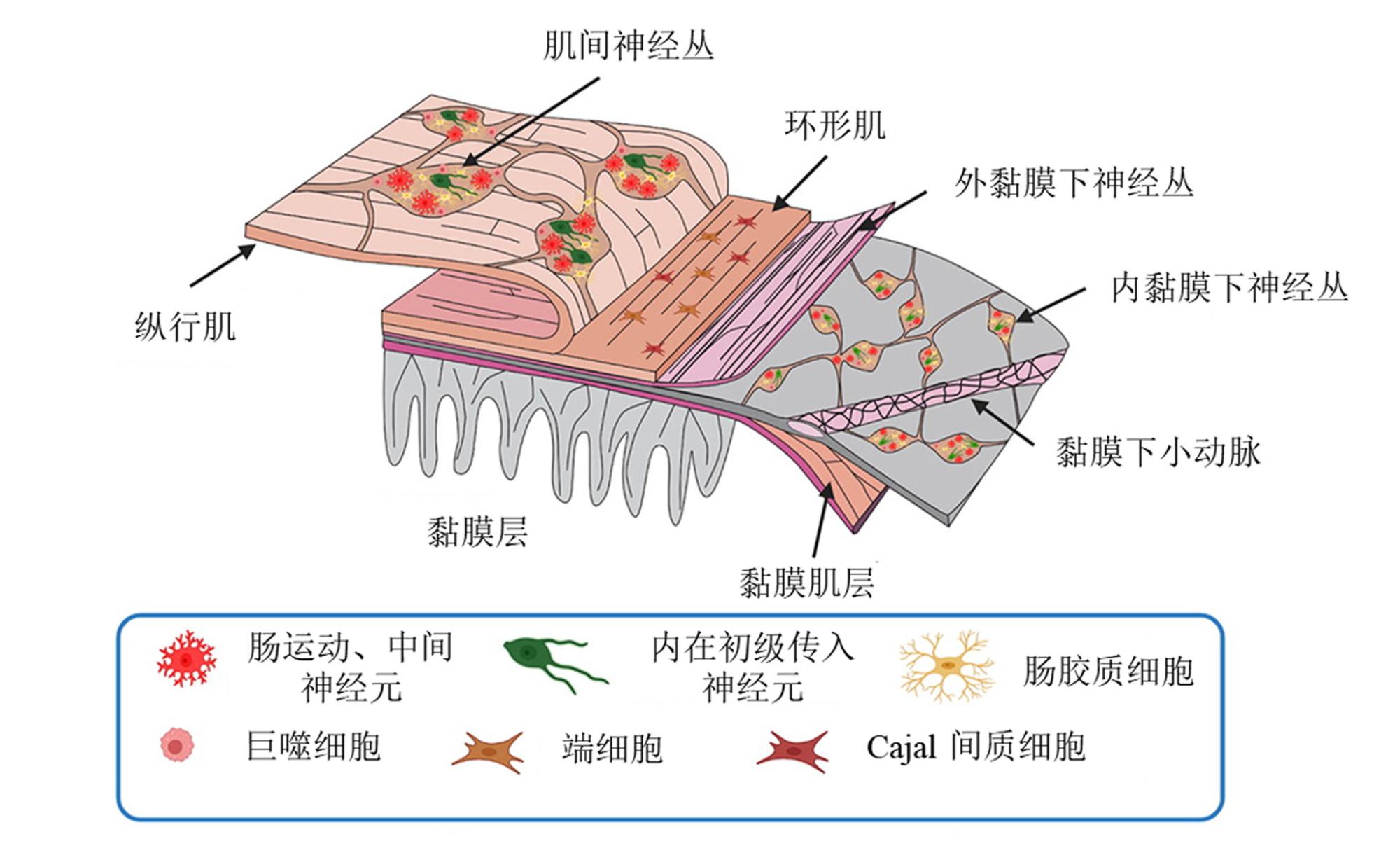
ENS主要由2个薄层状的肠神经丛组成:肌间神经丛(奥尔巴赫神经丛)和黏膜下神经丛(迈斯纳神经丛)[8],ENS的组成与结构如图1所示。多种神经元及胶质细胞聚集成神经节,呈网络状分布于肌间神经丛和黏膜下神经丛。肌间神经丛位于环形肌层与纵行肌层中间,直接支配肠道平滑肌,调节其收缩和舒张,从而控制食物在肠道内的推进[9]。黏膜下神经丛分布在黏膜下层,猪、人类等大型哺乳动物的黏膜下神经丛可以分为内黏膜下神经丛和外黏膜下神经丛[10-11],外黏膜下神经丛紧邻环肌层的内侧,内黏膜下神经丛位于更靠近黏膜肌层的位置[3]。常见的模式动物小鼠、豚鼠等动物的黏膜下神经丛发育为单层,黏膜下神经丛主要控制肠道的分泌、免疫和血管功能[12-13]。这种复杂的网络结构使ENS能够感知和控制肠壁各层的活动,协调肠道消化吸收、屏障和免疫等多种功能,直接影响机体健康,并与多种肠道及神经系统疾病密切相关[14],可能关系到动物的饲料利用效率和生长速度。
图1 ENS的组成与结构

Fig.1 Composition and structure of ENS[3]

1.2 ENS的分布及其与中枢神经的关系

ENS在消化道内广泛分布,可以从口腔一直延伸到肛门,但其密度和复杂性在不同部位有所不同,神经元在纵向上呈现功能极化,口侧和肛侧神经元具有不同的神经递质表型。黏膜下神经丛主要存在于小肠和结肠,在食管和胃中较少,肌间神经丛沿整个消化道连续分布,神经元密度较高,小肠ENS最为发达和复杂[15]。ENS的广泛分布保证了肠道环周收缩和局部分泌的协调与一致性,是蠕动波传播和神经回路形成的基础。
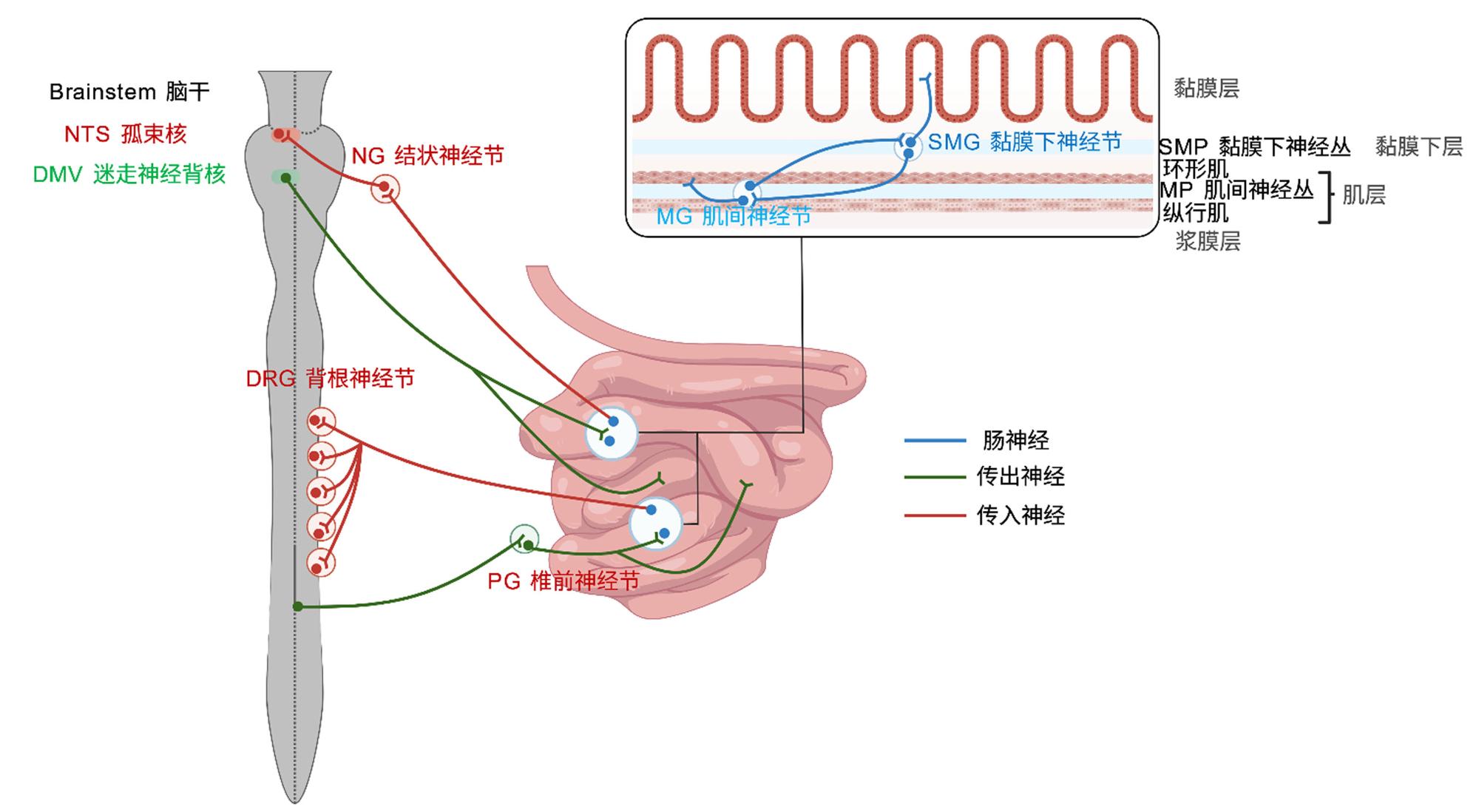
ENS经过交感神经系统和副交感神经系统与中枢神经系统(central nervous system,CNS)建立神经信号的交流。传统观点认为,胞体位于肠壁内的神经元是迷走神经的节后神经元,属于副交感神经系统的一部分[16]。然而越来越多的研究发现,无论切断迷走神经还是交感神经与中枢的连接都不能使肠道完全失去神经支配,离体肠段在黏膜刺激或扩张下仍可诱发极化反射[17],这证明胞体在肠道内的神经元具有一定的自主功能,可以独立于CNS支配肠道功能,这些肠壁内的神经元属于ENS。ENS与CNS的神经传导关系如图2所示,ENS受到由迷走神经背核(dorsal motor nucleus of vagus,DMV)发出的迷走节前神经和来自椎前神经节(prevertebral ganglia,PG)的交感节后神经的传出神经的支配。动物肠道微环境变化引发的ENS神经冲动可以经过结状神经节(nodose ganglion,NG)换元传入脑干的孤束核(nucleus tractus solitarius,NTS)或直接从脊髓传入神经到达脊髓胸段的背根神经节(dorsal root ganglion,DRG)。同时作为肠道壁内的自主神经网络,即使完全排除CNS的神经支配,ENS仍然能够依靠肌间神经丛和黏膜下神经丛中的神经元独立地感知、处理并响应环境刺激,控制肠道的运动和分泌等功能[18]
图2 ENS与CNS的神经传导关系

Fig.2 Nerve conduction relationship between ENS and CNS

2 ENS中神经元和神经递质的分类

2.1 ENS中神经元的分类

ENS中神经元具有多样性,根据形态学特征、神经冲动的传导方向和电生理特点可以划分为不同的亚群。根据形态学特征,ENS中神经元可以分为单轴突的Dogiel Ⅰ型神经元、多个轴突的Dogiel Ⅱ型神经元[19];根据神经冲动的传导方向,神经元可分为内在初级传入神经元(intrinsic primary afferent neuron,IPAN)、中间神经元和运动神经元[20];根据神经元的电生理特点可以分为产生短时程后超极化电位的慢后超极化神经元(S型神经元)和产生长时程后超极化电位的后超极化神经元(AH型神经元)。
ENS神经元的不同分类方法之间存在关联,神经元的形态和电生理特点与其在肠道发挥的功能及神经冲动的传导有关。IPAN最常见的形态是Dogiel Ⅱ型,通过多个轴突广泛接收肠道内的化学、机械信号[21],作为AH型神经元,IPAN长时程的后超极化电位主要依赖钙离子(Ca2+)激活钾离子(K+)通道,可以适应高频刺激起到过滤冗余信号的作用。中间神经元和运动神经元大部分为Dogiel Ⅰ型神经元[9],中间神经元能够整合来自多个IPAN的信息,向各肠段的运动神经元发出不同的神经信号[22],兴奋性和抑制性运动神经元负责将神经信号传递到肠道多种靶细胞[23],从而调节肠道消化吸收、屏障和免疫功能。在完整的肠神经回路中,IPAN、中间神经元和运动神经元组成的局部回路是ENS独立完成反射的结构基础[24-25]

2.2 ENS中神经递质分类及其功能

ENS中神经递质具有多样性,同一递质的多种受体亚型共存,从黏膜到肌层全层分布,同一受体在不同部位功能不同[26],影响肠道运动、分泌、血流和免疫多种功能,表1归纳ENS中主要的神经递质及功能。
表1 ENS中主要的神经递质及功能

Table 1 Major neurotransmitters and functions in ENS

神经递质
Neurotransmitters
分类
Type
功能
Function
来源
Source
受体类型
Receptor type
靶细胞
Target cell
参考文献
References
乙酰胆碱
Ach
胆碱类 促进肠道蠕动,激活黏膜分泌 胆碱能神经元 nAChR和
mAChR
平滑肌细胞、肠上皮
细胞、巨噬细胞
[4,27-28]
一氧化氮
NO
嘌呤类 平滑肌松弛,抑制蠕动 氮能神经元 sGC 平滑肌细胞、
Cajal间质细胞
[29-30]
血管活性肠肽
VIP
多肽类 抑制肠道LGR5+上皮干细胞增殖及分泌型
谱系分化,通过IL-25-ILC2-IL-13轴
调控肠道2型免疫稳态
抑制性运动神经元 VPAC1和
VPAC2
肠道上皮细胞、2型
固有淋巴样细胞
[13]
5-羟色胺
5-HT
单胺类 调节肠蠕动和分泌,影响免疫反应 肠嗜铬细胞、
肠神经元
5-HT1-7R 平滑肌细胞、
神经元、T细胞
[4]
降钙素基因相关肽
CGRP
多肽类 参与疼痛、炎症调节,维持胃肠道
生理稳态,诱导黏液分泌
CGRP神经元、
V感觉神经元
CLR/RAMP1 ILC2s、杯状细胞 [31]
三磷酸腺苷
ATP
嘌呤类 参与肠神经元与神经胶质细胞的通讯。 嘌呤能神经元 P2X和P2Y 平滑肌细胞、
肠胶质细胞
[32-34]
γ-氨基丁酸
GABA
氨基酸类 抑制3型固有淋巴样细胞增殖与
IL-17A产生,维持肠道免疫稳态
肠神经元、肠内
分泌细胞、肠道微生物
GABAA 神经元、3型固有淋巴样
细胞、平滑肌细胞
[35-36]
P物质
SP
神经肽类 感觉神经肽,促进炎症
反应,增强痛觉传递
感觉神经元、免疫细胞 NK1R 肠上皮细胞、胶质细胞 [37]

IL-25-ILC2-IL-13:白细胞介素-25-2型固有淋巴细胞-白细胞介素-13 interleukin-25-group 2 innate lymphoid cell-interleukin-13;IL-17A:白细胞介素-17A interleukin-17A;CGRP:降钙素基因相关肽 calcitonin gene-related peptide;nAChR:烟碱型乙酰胆碱受体 nicotinic acetylcholine receptor;mAChR:毒蕈碱型乙酰胆碱受体 muscarinic acetylcholine receptor;sGC:可溶性鸟苷酸环化酶 soluble guanylate cyclase;VPAC1:血管活性肠肽受体1 vasoactive intestinal peptide receptor 1;VPAC2:血管活性肠肽受体2 vasoactive intestinal peptide receptor 2;5-HT1-7R:5-羟色胺1-7受体 5-hydroxytryptamine 1-7 receptor;CLR/RAMP1:降钙素受体样受体/受体活性修饰蛋1 calcitonin receptor-like receptor/receptor activity-modifying protein 1;P2X:嘌呤能2X受体 purinergic 2X receptor;P2Y:嘌呤能2Y受体 purinergic 2Y receptor;GABAA:A型γ-氨基丁酸受体 gamma-aminobutyric acid type A receptor;NK1R:神经激肽1受体 neurokinin 1 receptor。

3 ENS对肠道消化吸收的调控作用及机制

3.1 肠道营养感知

ENS可以通过接收肠内分泌细胞(enteroendocrine cells,EECs)的信号间接感知肠道内的营养。EECs的细胞游离面顶端穿过上皮细胞层伸入肠腔内,细胞基底部则埋于基底膜上[38],十二指肠的EECs的胞质突起为神经足,直接与ENS形成突触连接[39],EECs可以感知管腔侧和基底侧的信号,合成和分泌多种肽类激素,细胞的分泌小泡中贮存5-羟色胺(5-HT)、谷氨酸等多种神经递质和神经肽,肠神经元上广泛表达包括5-HT4受体在内的相应受体以接受EECs释放的神经递质[40]。有研究发现,在原代肠神经元体外培养模型中,葡萄糖和油酸可以直接激活小鼠近端黏膜下层的胆碱能神经元,并且肥胖会降低肠道神经元对营养物质的响应,来自肥胖小鼠的黏膜下神经元的活性较低[41]。然而最新研究发现,在保留肠壁所有结构的全层组织培养中,黏膜下神经元不直接对营养物质敏感,而是通过EECs感受肠腔的K+浓度或营养物质释放5-HT激活更深层的肌间神经元,然后兴奋信号再传递至黏膜下神经元[42],表明EECs可能是肠道化学信号感知的关键起点。

3.2 肠道营养吸收

ENS影响肠道对营养物质的吸收和转运,特定神经元的激活与淋巴流动和肠上皮细胞的关键转运蛋白的表达有关。葡萄糖、氨基酸和短链脂肪酸等通过肠绒毛的柱状上皮细胞进入血液,长链脂肪酸则进入淋巴系统,完整的ENS可以保证胰高血糖素样肽-2(glucagon-like peptide 2,GLP-2)增强肠绒毛的乳糜管收缩,从而促进脂质运输[25]。在肠道中GLP-2受体与一氧化氮合酶(NOS)神经元、血管活性肠肽(VIP)神经元共定位[43],葡萄糖转运过程中,肠上皮L细胞感知肠腔糖分分泌GLP-2,会激活ENS神经元释放VIP,经环磷酸腺苷(cAMP)信号增强相邻肠上皮细胞基地侧膜钠-葡萄糖共转运蛋白的表达,促进肠上皮细胞对葡萄糖的转运。相应地,NOS神经元的GLP-2受体受到激活释放一氧化氮(NO),进而激活环磷酸鸟苷(cGMP)-蛋白激酶G(PKG)依赖的信号通路,最终促进饮食脂质吸收和肠源性乳糜微粒的分泌[44]。此外,肠神经元表达游离脂肪酸受体2和游离脂肪酸受体3[45],肠道微生物发酵产生的大量短链脂肪酸能够激活肠神经元,经感觉传入神经上行至CNS,影响肠道代谢调控[46]。ENS既可以直接支配肠道营养物质的吸收,也接收来自CNS的肠道调控信号,同时ENS可以整合肠道信号向中枢传递。

3.3 肠道运动

ENS复杂的神经网络能够调控小肠蠕动的方向和频率,协调肠神经元与肠道平滑肌等细胞完成肠道营养物质的机械性消化。肠道运动的起搏点是Cajal间质细胞(interstitial cells of Cajal,ICC),ICC分布在肌层并与肌间神经丛神经元、平滑肌细胞紧密相连。ICC产生周期性的去极化慢波电位,通过缝隙连接传播到邻近的平滑肌细胞,慢波本身不直接引起收缩,但为平滑肌细胞产生动作电位锋电位收缩提供基础,肠段有节律和方向的收缩波形成蠕动,向后推进食糜[47]。值得注意的是,ENS具有直接的机械敏感性,肠神经元表达的机械力敏感蛋白Piezo1能够直接感知肠道内的机械力变化,Piezo1缺失显著减缓肠道的蠕动频率[48]。因此,ENS是肠道蠕动频率的重要调控者。肠道蠕动方向的协调需要ENS中间神经元的参与,感觉神经元的机械力受体感受肠腔信号释放神经递质乙酰胆碱(Ach),通过兴奋性中间神经元将信号向口腔方向上行传递,增强上游肠段环形肌的收缩,同时通过特定的下行中间神经元将抑制信号向肛门方向传递,舒张后方肠段的环形肌,上游肠道收缩的挤压将食糜向后方舒张肠段推进[49]。随着食糜向后移动,肠神经元产生新的感觉信号,反射沿肠道向下传播形成连续的蠕动波。最新的研究发现,囊泡谷氨酸转运体(vesicular glutamate transporters 2,VGLUT2)中间神经元在结肠中存在特殊的环形投射,通过光遗传技术特异性激活VGLUT2中间神经元能够直接引发结肠推进性蠕动,并且VGLUT2中间神经元的纵向投射距离很长,可以整合长距离的肠道信号,实现跨肠段协同运动[22]

4 ENS对肠道屏障功能的调控作用及机制

ENS可调控肠道干细胞的分化和黏液的分泌维持肠道屏障功能,同时肠神经元也受到肠道菌群及其代谢产物的影响。单层上皮细胞及其紧密连接构成的物理屏障依靠肠道干细胞的快速分化更新,在损伤模型中,神经递质VIP能显著缓解上皮损伤、减少细胞凋亡、促进细胞增殖与存活,并增强分泌细胞分化,从而加速肠道上皮的再生修复,维持肠道屏障完整性[50]。肠道中降钙素基因相关肽(CGRP)神经元的数量与杯状细胞分泌黏液呈正相关,敲除肠神经元发育关键基因延伸因子复合物1(Elp1),发现CGRP神经元数量减少,黏液层的组织结构变得松散不规则,肠道对病原菌和有害物质的化学屏障功能受到损伤[51]。此外,ENS的完整系也受到肠道菌群的影响,肠道菌群代谢产物脂多糖和短链脂肪酸具有保护肠神经元的作用,肠道菌群平衡是神经元发生和维持肠神经元存活的必要条件[52]

5 ENS对肠道免疫功能的调控作用及机制

5.1 肠神经元与免疫细胞之间的通讯

肠神经元与免疫细胞之间的双向交流对于调节肠道免疫功能至关重要。寄生虫感染可引起ENS神经元形态改变、免疫细胞浸润及组织重构,提示ENS可能在感染过程中参与免疫调节[53],肠神经元释放的神经介素U上调白细胞介素(IL)-5、IL-13的水平,这2种炎症细胞因子有助于机体产生免疫反应,防御寄生虫的感染[54]。肠道将痛觉神经信号与免疫抑制功能直接关联,瞬态感受器电位香草酸受体1(Trpv1)伤害感受神经元通过CGRP-受体活性修饰蛋1(RAMP1)信号抑制肠道Treg细胞的增殖[55],肠道Treg细胞是参与抑制炎症反应的重要免疫细胞,肠神经元分泌的细胞因子能够调节Treg细胞的分化过程,参与炎症敏感性的调节[56],IL-4和IL-13可直接作用于肠道内在的初级感觉神经元,通过信号转导及转录激活因子6(STAT6)信号通路上调神经调节肽U(NMU)和CGRPβ的表达,这些神经肽进而调控2型天然淋巴样细胞、巨噬细胞等免疫细胞的功能,形成一条双向的神经-免疫反馈环路,对于协调有效的宿主防御及调节局部组织免疫反应至关重要[57]。复杂的神经-免疫网络确保了肠道在面对不断变化的微环境时能够维持功能稳态,对机体整体健康具有重要意义。

5.2 ENS参与炎症反应

肠神经元介导迷走神经在肠道内的胆碱能抗炎通路。胆碱能抗炎通路是神经免疫调节的核心机制,通过迷走神经释放ACh,作用于巨噬等免疫细胞表面的α7烟碱型乙酰胆碱受体(α7nAChR),抑制促炎细胞因子的释放[5]。研究表明,迷走神经传出纤维与肌层巨噬细胞(muscularis macrophages,MMs)不存在直接的物理连接,可能通过间接方式激活α7nAChR[58],而迷走神经与肠道内的胆碱能肠肌神经元有直接的相互作用,这些肠神经元能够将神经末梢投射至靠近MMs的位置,甚至ENS神经节内部发现存在MMs,这表明肠神经元在迷走神经激活的肠道胆碱能抗炎通路中不可或缺[5]。肠神经元介导的胆碱能抗炎通路可精准、快速地下调肿瘤坏死因子-α(TNF-α)、IL-1β和IL-6等促炎细胞因子的释放,从而实现对全身性炎症反应的反射性抑制。

6 小结与展望

本文介绍了ENS的概念、组成及分布,综述了ENS中不同种类肠神经元及其神经递质的分类,并系统总结了ENS调控肠道消化吸收、屏障和免疫功能的作用机制。对ENS的深入研究与机制探索将为提高畜禽养殖的饲料利用率提供新思路。未来需要进一步研究肠神经元不同亚群在肠道功能调控中的具体机制及ENS对肠道整体的协调作用,探索以ENS为靶点的新型饲料添加剂的应用,提高畜禽生长性能,改善肠道健康。
[1]
WANG Z X, SHAO D, WU S, et al. Heat stress-induced intestinal barrier damage and dimethylglycine alleviates via improving the metabolism function of microbiota gut brain axis[J]. Ecotoxicology and Environmental Safety, 2022, 244:114053.

DOI

[2]
SUN N, CAO L S, XIA W Y, et al. Gut sensory neurons as regulators of neuro-immune-microbial interactions:from molecular mechanisms to precision therapy for IBD/IBS[J]. Journal of Neuroinflammation, 2025, 22(1):172.

DOI

[3]
SHARKEY K A, MAWE G M. The enteric nervous system[J]. Physiological Reviews, 2023, 103(2):1487-1564.

DOI

[4]
SHI D, REDDY P, MARRIN M, et al. Properties and functions of transcriptionally distinct enteric neurons[J]. Cell, 2025, 188(26):7571-7590.e35.

DOI

[5]
RAHMAN A A, STAVELY R, PAN W K, et al. Optogenetic activation of cholinergic enteric neurons reduces inflammation in experimental colitis[J]. Cellular and Molecular Gastroenterology and Hepatology, 2024, 17(6):907-921.

DOI

[6]
MICHEL K, KUCH B, DENGLER S, et al. How big is the little brain in the gut?Neuronal numbers in the enteric nervous system of mice,guinea pig,and human[J]. Neurogastroenterology and Motility, 2022, 34(12):e14440.

DOI

[7]
HERRERA MILLAR V R, SERGIO M, PALUS K, et al. Impact of ammonia exposure on the enteric nervous system in the ileum of pigs from birth[J]. Neurogastroenterology & Motility, 2025, 37(11):e70156.

[8]
GIMENES G M, PEREIRA J N B, BORGES DA SILVA E, et al. Intestinal motility dysfunction in Goto-Kakizaki rats:role of the myenteric plexus[J]. Cells, 2024, 13(19):1626.

DOI

[9]
PEREZ-MEDINA A, GALLIGAN J J. Nitrergic and purinergic nerves in the small intestinal myenteric plexus and circular muscle of mice and guinea pigs[J]. Advances in Experimental Medicine and Biology, 2022, 1383:33-43.

[10]
GAŁECKA I, SZYRYŃSKA N, CAŁKA J. Influence of polyethylene terephthalate (PET) microplastic on selected active substances in the intramural neurons of the porcine duodenum[J]. Particle and Fibre Toxicology, 2024, 21(1):5.

DOI PMID

[11]
MICHEL K, KRÜGER D, SCHÄUFFELE S, et al. Fast synaptic excitatory neurotransmission in the human submucosal plexus[J]. Neurogastroenterology and Motility, 2021, 33(8):e14164.

DOI

[12]
KOLLMANN P, ELFERS K, MAURER S, et al. Submucosal enteric neurons of the cavine distal colon are sensitive to hypoosmolar stimuli[J]. The Journal of Physiology, 2020, 598(23):5317-5332.

DOI

[13]
JAKOB M O, STERCZYK N, BOULEKOU S, et al. Enteric nervous system-derived VIP restrains differentiation of LGR5+ stem cells toward the secretory lineage impeding type 2 immune programs[J]. Nature Immunology, 2025, 26(12):2227-2243.

DOI

[14]
WANG X T, ZHANG W, WANG H H, et al. Dietary modulation of the enteric nervous system:from molecular mechanisms to therapeutic applications[J]. Nutrients, 2025, 17(22):3519.

DOI

[15]
CAVIN J B, WONGKRASANT P, GLOVER J B, et al. Intestinal distension orchestrates neuronal activity in the enteric nervous system of adult mice[J]. The Journal of Physiology, 2023, 601(7):1183-1206.

DOI

[16]
STEBBING M J, SHAFTON A D, DAVEY C E, et al. A ganglionic intestinointestinal reflex activated by acute noxious challenge[J]. American Journal of Physiology:Gastrointestinal and Liver Physiology, 2024, 326(4):G360-G373.

[17]
MERCADO-PEREZ A, BEYDER A. Gut feelings:mechanosensing in the gastrointestinal tract[J]. Nature Reviews Gastroenterology & Hepatology, 2022, 19(5):283-296.

[18]
FUNG C, VANDEN BERGHE P. Functional circuits and signal processing in the enteric nervous system[J]. Cellular and Molecular Life Sciences, 2020, 77(22):4505-4522.

DOI

[19]
CARBONE S E, JOVANOVSKA V, NURGALI K, et al. Human enteric neurons:morphological,electrophysiological,and neurochemical identification[J]. Neurogastroenterology and Motility, 2014, 26(12):1812-1816.

DOI

[20]
GOMEZ-FRITTELLI J, DEVIENNE G F, TRAVIS L, et al. Synaptic cell adhesion molecule Cdh6 identifies a class of sensory neurons with novel functions in colonic motility[J]. eLife, 2025, 13:RP101043.

[21]
GUIMARÃES DE SOUZA MELO C, NICOLAI E N, ALCAINO C, et al. Identification of intrinsic primary afferent neurons in mouse jejunum[J]. Neurogastroenterology and Motility, 2020, 32(12):e13989.

DOI

[22]
HAMNETT R, BENDRICK J L, SAHA Z, et al. Enteric glutamatergic interneurons regulate intestinal motility[J]. Neuron, 2025, 113(7):1019-1035.e6.

DOI PMID

[23]
NI BHRAONAIN E P, TURNER J A, HANNIGAN K I, et al. Immunohistochemical characterization of interstitial cells and their spatial relationship to motor neurons within the mouse esophagus[J]. Cell and Tissue Research, 2025, 399(1):61-84.

DOI PMID

[24]
SHARKEY K A. Emerging roles for enteric glia in gastrointestinal disorders[J]. The Journal of Clinical Investigation, 2015, 125(3):918-925.

DOI

[25]
SYED-ABDUL M M, TIAN L L, SAMUEL T, et al. Glucagon-like-peptide-2 stimulates lacteal contractility and enhances chylomicron transport in the presence of an intact enteric nervous system[J]. Gastro Hep Advances, 2024, 3(7):954-964.

DOI

[26]
JAYAWARDENA D, GUZMAN G, GILL R K, et al. Expression and localization of VPAC1,the major receptor of vasoactive intestinal peptide along the length of the intestine[J]. American Journal of Physiology:Gastrointestinal and Liver Physiology, 2017, 313(1):G16-G25.

[27]
WANG D N, JIAO S Y, GUO Q Q, et al. Lycopene regulates intestinal dysmotility and behavioral disorders by regulating enteric neurons and the cholinergic system[J]. Food & Function, 2025, 16(13):5363-5379.

[28]
DHAWAN S, HIEMSTRA I H, VERSEIJDEN C, et al. Cholinergic receptor activation on epithelia protects against cytokine-induced barrier dysfunction[J]. Acta Physiologica, 2015, 213(4):846-859.

DOI

[29]
YARANDI S S, KULKARNI S, SAHA M, et al. Intestinal bacteria maintain adult enteric nervous system and nitrergic neurons via Toll-like receptor 2-induced neurogenesis in mice[J]. Gastroenterology, 2020, 159(1):200-213.e8.

DOI PMID

[30]
GRONEBERG D, KÖNIG P, KOESLING D, et al. Nitric oxide-sensitive guanylyl cyclase is dispensable for nitrergic signaling and gut motility in mouse intestinal smooth muscle[J]. Gastroenterology, 2011, 140(5):1608-1617.

DOI PMID

[31]
YANG D P, JACOBSON A, MEERSCHAERT K A, et al. Nociceptor neurons direct goblet cells via a CGRP-RAMP1 axis to drive mucus production and gut barrier protection[J]. Cell, 2022, 185(22):4190-4205.e25.

DOI PMID

[32]
ENGEVIK K A, SCRIBANO F J, GEBERT J T, et al. Distribution of P2Y and P2X purinergic receptor expression within the intestine[J]. American Journal of Physiology:Gastrointestinal and Liver Physiology, 2024, 326(2):G107-G119.

[33]
MOZEL S, ARCISZEWSKI M B. Immunodetection of P2X2 receptor in enteric nervous system neurons of the small intestine of pigs[J]. Animals, 2022, 12(24):3576.

DOI

[34]
HENDLER B J, MCCLAIN J L, ZILLI A, et al. Purinergic P2Y1 and P2Y12 receptors control enteric nervous system activity through neuro-glia-macrophage crosstalk[J]. Purinergic Signalling, 2025, 21(5):1033-1048.

DOI

[35]
LIU J Q, ZHANG P, ZHENG Z F, et al. GABAergic signaling between enteric neurons and intestinal smooth muscle promotes innate immunity and gut defense in Caenorhabditis elegans[J]. Immunity, 2023, 56(7):1515-1532.e9.

DOI

[36]
LIU N, HE J C, YANG Y M, et al. Enteric GABAergic neuron-derived γ-aminobutyric acid initiates expression of Igfbp7 to sustain ILC3 homeostasis[J]. Nature Immunology, 2025, 26(3):404-415.

DOI PMID

[37]
DELVALLE N M, DHARSHIKA C, MORALES-SOTO W, et al. Communication between enteric neurons,glia,and nociceptors underlies the effects of tachykinins on neuroinflammation[J]. Cellular and Molecular Gastroenterology and Hepatology, 2018, 6(3):321-344.

DOI

[38]
BARTON J R, LONDREGAN A K, ALEXANDER T D, et al. Intestinal neuropod cell GUCY2C regulates visceral pain[J]. The Journal of Clinical Investigation, 2023, 133(4):e165578.

DOI

[39]
SALAZAR V, BOLAÑOS P, DEL CASTILLO J R. Enteric nervous system:identification of a novel neuronal sensory network in the duodenal epithelium[J]. Journal of Histochemistry & Cytochemistry, 2023, 71(11):601-630.

DOI

[40]
HURD M, HAAG M M, KWASNIK M J, et al. Protective actions of a luminally acting 5-HT4 receptor agonist in mouse models of colitis[J]. Neurogastroenterology & Motility, 2023, 35(11):e14673.

[41]
SUNDARESAN S, GRANDBERRY A, RAJESH N, et al. Diet-induced obesity differentially regulates intestinal nutrient sensing by enteric neurons:evidence of direct neuronal activation by luminal nutrients[J]. Current Developments in Nutrition, 2024, 8(S2):103572.

DOI

[42]
FUNG C, VENNEMAN T, HOLLAND A M, et al. Nutrients activate distinct patterns of small-intestinal enteric neurons[J]. Nature, 2025, 644(8078):1069-1077.

DOI

[43]
GUAN X F, KARPEN H E, STEPHENS J, et al. GLP-2 receptor localizes to enteric neurons and endocrine cells expressing vasoactive peptides and mediates increased blood flow[J]. Gastroenterology, 2006, 130(1):150-164.

DOI PMID

[44]
GRANDE E M, RAKA F, HOFFMAN S, et al. GLP-2 regulation of dietary fat absorption and intestinal chylomicron production via neuronal nitric oxide synthase (nNOS) signaling[J]. Diabetes, 2022, 71(7):1388-1399.

DOI PMID

[45]
BARKI N, BOLOGNINI D, BÖRJESSON U, et al. Chemogenetics defines a short-chain fatty acid receptor gut-brain axis[J]. eLife, 2022, 11:e73777.

DOI

[46]
COOK T M, GAVINI C K, JESSE J, et al. Vagal neuron expression of the microbiota-derived metabolite receptor,free fatty acid receptor (FFAR3),is necessary for normal feeding behavior[J]. Molecular Metabolism, 2021, 54:101350.

DOI

[47]
HWANG S J, KWON J G, BECKETT E A H, et al. Functional roles of interstitial cells of cajal in the GI tract of rats[J]. American Journal of Physiology:Gastrointestinal and Liver Physiology, 2025, 328(6):G677-G695.

[48]
XIE Z L, ROSE L, FENG J, et al. Enteric neuronal Piezo1 maintains mechanical and immunological homeostasis by sensing force[J]. Cell, 2025, 188(9):2417-2432.e19.

DOI

[49]
SPENCER N J, TRAVIS L, WIKLENDT L, et al. Long range synchronization within the enteric nervous system underlies propulsion along the large intestine in mice[J]. Communications Biology, 2021, 4(1):955.

DOI PMID

[50]
AGIBALOVA T, HEMPEL A, MAURER H C, et al. Vasoactive intestinal peptide promotes secretory differentiation and mitigates radiation-induced intestinal injury[J]. Stem Cell Research & Therapy, 2024, 15(1):348.

[51]
CHAVERRA M, CHENEY A M, SCHEEL A, et al. ELP1,the gene mutated in familial dysautonomia,is required for normal enteric nervous system development and maintenance and for gut epithelium homeostasis[J]. The Journal of Neuroscience, 2024, 44(37):e2253232024.

DOI

[52]
VICENTINI F A, KEENAN C M, WALLACE L E, et al. Intestinal microbiota shapes gut physiology and regulates enteric neurons and glia[J]. Microbiome, 2021, 9(1):210.

DOI PMID

[53]
ALVES DOS SANTOS A G, LIMA DA SILVA M G, CARNEIRO E L, et al. A new target organ of Leishmania (viannia) braziliensis chronic infection:the intestine[J]. Frontiers in Cellular and Infection Microbiology, 2021, 11:687499.

DOI

[54]
JACOBSON A, YANG D P, VELLA M, et al. The intestinal neuro-immune axis:crosstalk between neurons,immune cells,and microbes[J]. Mucosal Immunology, 2021, 14(3):555-565.

DOI

[55]
ZHU Y Y, MEERSCHAERT K A, GALVAN-PENA S, et al. A chemogenetic screen reveals that Trpv1-expressing neurons control regulatory T cells in the gut[J]. Science, 2024, 385(6708):eadk1679.

[56]
YANG D P, ALMANZAR N, CHIU I M. The role of cellular and molecular neuroimmune crosstalk in gut immunity[J]. Cellular & Molecular Immunology, 2023, 20(11):1259-1269.

[57]
BARILLA R M, BERARD C, SUN L Y, et al. Type 2 cytokines act on enteric sensory neurons to regulate neuropeptide-driven host defense[J]. Science, 2025, 389(6757):260-267.

DOI

[58]
CAILOTTO C, GOMEZ PINILLA P J, VAN DER VLIET J, et al. Immunohistochemical study evaluating the vagal innervation of intestinal resident macrophages[J]. Gastroenterology, 2011, 140(5 S1):S-370.

文章导航

/