研究论文

饲粮精氨酸水平对哺乳期种鸽肠道形态、卵泡发育和机体代谢的影响

  • 陈武昊 , 1 ,
  • 郑世奇 1, * ,
  • 李梓莹 1 ,
  • 莫双彦 1 ,
  • 谭国华 1 ,
  • 张妍璘 1 ,
  • 张薇 1 ,
  • 苟钟勇 2 ,
  • 王志博 3 ,
  • 黄燕华 1 ,
  • 燕凯 , 1, ** ,
  • 彭杰 , 1, **
展开
  • 1 仲恺农业工程学院, 健康养殖创新研究院, 广州 510225
  • 2 广东省农业科学院动物科学研究所, 猪禽种业全国重点实验室,农业农村部华南动物营养与饲料重点实验室,广东省畜禽育种与营养研究重点实验室, 广州 510640
  • 3 吉林市永吉县农业综合行政执法大队, 吉林 132100
**燕 凯,讲师,硕士生导师,E-mail: ;
彭 杰,副教授,硕士生导师,E-mail:

*同等贡献作者

陈武昊(2001—),男,江西南昌人,硕士研究生,兽医专业。E-mail:

Office editor: 武海龙

收稿日期: 2025-09-26

  网络出版日期: 2026-05-14

基金资助

广东省重点领域研发计划(2020B0202080002)

兴宁市肉鸽产业园技术服务“揭榜挂帅”项目(D122222G904)

Effects of Dietary Arginine Level on Intestinal Morphology, Follicular Development and Body Metabolism of Breeding Pigeons during Lactation

  • CHEN Wuhao , 1 ,
  • ZHENG Shiqi 1 ,
  • LI Ziying 1 ,
  • MO Shuangyan 1 ,
  • TAN Guohua 1 ,
  • ZHANG Yanlin 1 ,
  • ZHANG Wei 1 ,
  • GOU Zhongyong 2 ,
  • WANG Zhibo 3 ,
  • HUANG Yanhua 1 ,
  • YAN Kai , 1, ** ,
  • PENG Jie , 1, **
Expand
  • 1 Healthy Breeding Innovation Research Institute, Zhongkai Institute of Agricultural Engineering, Guangzhou 510225, China
  • 2 Guangdong Provincial Key Laboratory of Livestock and Poultry Breeding and Nutritional Research, South China Key Laboratory of Animal Nutrition and Feed, Ministry of Agriculture and Rural Affairs, National Key Laboratory of Swine and Poultry Breeding, Institute of Animal Science, Guangdong Academy of Agricultural Sciences, Guangzhou 510640, China
  • 3 Jilin Yongji County Agricultural Comprehensive Administrative Law Enforcement Brigade, Jilin 132100, China
**YAN Kai, lecturer, E-mail: ;
PENG Jie, associate professor, E-mail:

*Contributed equally

Received date: 2025-09-26

  Online published: 2026-05-14

摘要

本试验旨在探究饲粮精氨酸水平对哺乳期种鸽肠道形态、卵泡发育和机体代谢的影响。选取12~16月龄、体重和繁殖性能相近的欧洲米玛斯种鸽120对,随机分为2组,每组10个重复,每个重复6对种鸽。试验采用“2+4”带仔模式。2组种鸽分别饲喂精氨酸水平为0.58%(对照组)和1.18%(试验组)的试验饲粮。试验期包括17 d孵化期和7 d哺乳期。结果表明:1)饲粮精氨酸水平对种鸽回肠绒毛长度、隐窝深度和绒隐比无显著影响(P>0.05)。雌鸽的回肠绒隐比显著高于雄鸽(P<0.05)。2)与饲粮0.58%精氨酸水平相比,饲粮1.18%精氨酸水平能够极显著提高回肠过氧化氢酶(CAT)活性(P<0.01),极显著降低回肠总超氧化物歧化酶(T-SOD)活性和过氧化氢(H2O2)含量(P<0.01)。雌鸽回肠丙二醛(MDA)、H2O2含量和T-SOD、CAT活性显著或极显著低于雄鸽(P<0.05或P<0.01)。精氨酸水平与性别对回肠CAT活性存在极显著交互作用(P<0.01)。3)饲粮精氨酸水平对雌鸽卵巢重、黄卵泡数量、白卵泡数量、白卵泡平均直径均无显著影响(P>0.05)。4)与饲粮0.58%精氨酸水平相比,饲粮1.18%精氨酸水平能够显著或极显著提高血浆尿素氮(UN)、总蛋白(TP)含量和CAT活性(P<0.05或P<0.01)。雌鸽血浆CAT、谷丙转氨酶(ALT)活性和甘油三酯(TG)含量显著或极显著高于雄鸽(P<0.05或P<0.01),血浆总胆固醇(T-CHO)含量显著低于雄鸽(P<0.05)。5)饲粮精氨酸水平对肝脏和卵巢生化指标均无显著影响(P>0.05)。由此可见,饲粮精氨酸水平虽未影响哺乳期种鸽的肠道形态和卵泡发育,但可有效改善机体代谢和抗氧化功能。尽管在部分指标上观察到性别差异,但精氨酸的总体有益效应在雌鸽和雄鸽中均有所体现。

本文引用格式

陈武昊 , 郑世奇 , 李梓莹 , 莫双彦 , 谭国华 , 张妍璘 , 张薇 , 苟钟勇 , 王志博 , 黄燕华 , 燕凯 , 彭杰 . 饲粮精氨酸水平对哺乳期种鸽肠道形态、卵泡发育和机体代谢的影响[J]. 动物营养学报, 2026 , 38(5) : 3458 -3470 . DOI: 10.12418/CJAN2026.276

Abstract

The purpose of this study was to investigate the effects of dietary arginine level on intestinal morphology, follicular development and body metabolism of breeding pigeons during lactation. A total of 120 pairs 12 to 16-month-old European Mimas breeding pigeons with similar body weight and reproductive performance were selected and randomly divided into 2 groups with 10 replicates in each group and 6 pairs in each replicate. The “2+4” lactating pattern was adopted. The breeding pigeon in 2 group were fed experimental diets which the arginine levels were 0.58% (control group) and 1.18% (experimental group). The experimental period included 17-day incubation period and 7-day lactation period. The results showed as follows: 1) dietary arginine level had no significant effects on villus length, crypt depth and villus length/crypt depth in ileum of breeding pigeons (P>0.05). The villus length/crypt depth in ileum of female pigeons was significantly higher than that of male pigeons (P<0.05). 2) Compared with dietary 0.58% arginine level, the dietary 1.18% arginine level extremely significantly increased the ileal catalase (CAT) activity (P<0.01), and extremely significantly decreased the ileal total superoxide dismutase (T-SOD) activity and hydrogen peroxide (H2O2) content (P<0.01). The ileal malondialdehyde (MDA), H2O2 contents and T-SOD, CAT activities of female pigeons were significantly or extremely significantly lower than that of male pigeons (P<0.05 or P<0.01). There was a extremely significant interaction between dietary arginine level and gender on ileal CAT activity (P<0.01). 3) Dietary arginine level had no significant effects on ovary weight, number of yellow follicles, number of white follicles and white follicle average diameter of female pigeons (P>0.05). 4) Compared with dietary 0.58% arginine level, the dietary 1.18% arginine level significantly or extremely significantly increased the plasma urea nitrogen (UN), total protein (TP) contents and CAT activity (P<0.05 or P<0.01). The plasma CAT, alanine aminotransferase (ALT) activities and triglyceride (TG) content of female pigeons were significantly or extremely significantly higher than those of male pigeons (P<0.05 or P<0.01), while the plasma total cholesterol (T-CHO) content was significantly lower than that of male pigeons (P<0.05). 5) Dietary arginine level had no significant effects on the liver and ovary biochemical indexes (P>0.05). In conclusion, although dietary arginine level does not affect the intestinal morphology and follicular development of breeding pigeons during lactation, it can effectively improve the body metabolism and antioxidant function. Although gender differences are observed in some indexes, the overall beneficial effects of arginine were reflected in both female pigeons and male pigeons.

鸽肉是低脂肪、高蛋白质的优质肉类,富含异亮氨酸、苏氨酸、赖氨酸等多种必需氨基酸[1]。此外,鸽肉亦被认为具有一定的食补价值[2]。我国肉鸽养殖业现已成为继鸡、鸭、鹅后的第四大家禽产业,但肉鸽营养需要量研究仍十分有限,目前仅有蛋氨酸、赖氨酸、亮氨酸、色氨酸、蛋白质等需要量研究报道[3-7]。研究表明,通过精准调整饲粮能量和蛋白质水平,可有效改善种鸽的繁殖性能及乳鸽的生长速度,如在夏季补充18%粗蛋白质和12.8 MJ/kg代谢能的饲粮,以及冬季补充16.5%粗蛋白质和12.2 MJ/kg代谢能的饲粮,均能够通过改善种鸽和乳鸽的糖、脂代谢及氧化应激,提高种鸽的繁殖性能和乳鸽的生长速度[8-9]。此外,特定氨基酸的补充也被证实可通过调节相关信号通路,促进鸽乳分泌、提升鸽乳品质及种鸽产蛋效率。Xie等[5]研究发现,饲粮中添加0.15%~0.45%的亮氨酸可通过哺乳动物雷帕霉素靶蛋白(mTOR)信号通路促进鸽乳分泌,降低种鸽哺乳期体重损失。Jiang等[10]研究发现,饲粮中添加0.3%的蛋氨酸可显著提升乳鸽的屠宰性状、肌肉品质及抗氧化能力。Chang等[11]研究发现,饲粮中添加0.78%的赖氨酸可显著提升蛋鸽的产蛋效率,改善蛋黄色泽,促进营养物质代谢利用。这些发现凸显了营养平衡对种鸽繁殖体系高效运转的重要性。
精氨酸是禽类的必需氨基酸,无法自身合成,必须从饲粮中获取。在肠道健康方面,精氨酸不仅能促进雏鸡小肠发育[12],还在肠道损伤或感染状态下表现出保护效应[13]。在繁殖调控方面,精氨酸作为一氧化氮(NO)合成的前体,可通过NO介导的血管舒张与信号传导影响生殖器官血流与细胞功能,进而促进卵泡发育与精子发生[14]。研究表明,补充精氨酸可提高蛋种鸭的输卵管发育及大白卵泡数量[15],并能改善母马妊娠率及精子保存活力[16-17]。在机体代谢与抗氧化方面,精氨酸可通过激活核因子E2相关因子2(Nrf2)、mTOR等信号通路,增强机体的抗氧化能力并促进蛋白质合成[18-19]。例如,在攸县麻鸭饲粮中补充精氨酸可显著提升肝脏抗氧化酶活性[20]。本课题组前期研究表明,饲粮中1.18%的精氨酸水平可有效改善种鸽繁殖性能[21]。然而,精氨酸对哺乳期种鸽肠道形态、卵泡发育和机体代谢的改善作用尚未可知。在种鸽哺乳期间,雌鸽氧化应激水平显著高于雄鸽,且哺乳期第7天是种鸽代谢负荷最重、鸽乳分泌最旺盛的关键阶段[22]。因此,本试验旨在探讨饲粮精氨酸水平对哺乳期种鸽(重点关注哺乳期第7天)肠道形态、卵泡发育和机体代谢的影响,以期为精氨酸在肉鸽精准营养中的应用提供理论依据。

1 材料与方法

1.1 试验设计

所有试验程序均获得了仲恺农业工程学院动物管理和伦理委员会批准(批准文号ZHKUMO-2022-057)。
选取12~16月龄、体重和繁殖性能相近的欧洲米玛斯种鸽120对,随机分为2组,每组10个重复,每个重复6对种鸽。试验采用“2+4”带仔模式,即1对种鸽哺育4只乳鸽。2组种鸽分别饲喂精氨酸水平为0.58%(对照组)和1.18%(试验组)的全价颗粒试验饲粮,其中精氨酸水平差异通过调整精氨酸的添加量实现,同时使用沸石粉平衡配比。试验期包括孵化期17 d和哺乳期7 d,共计24 d。试验饲粮组成及营养水平见表1
表1 试验饲粮组成及营养水平(风干基础)

Table 1 Composition and nutrient levels of experimental diets (air-dry basis)%

项目
Items
精氨酸水平
Arginine level/%
0.58 1.18
原料 Ingredients
玉米 Corn 60.00 60.00
玉米蛋白粉 Corn gluten meal 16.50 16.50
小麦 Wheat 15.50 15.50
大豆油 Soybean oil 1.40 1.40
磷酸二氢钙 Ca(H2PO4)2 3.50 3.50
预混料 Premix1) 1.00 1.00
食盐 NaCl 0.40 0.40
赖氨酸 Lysine (79.2%) 0.82 0.82
精氨酸 Arginine (98.5%) 0.61
色氨酸 Tryptophan (98.5%) 0.08 0.08
沸石粉 Zeolite powder 0.80 0.19
合计 Total 100.00 100.00
营养水平 Nutrient levels2)
粗蛋白质 Crude protein 18.12 18.64
粗纤维 Crude fibre 1.89 1.65
粗灰分 Crude ash 4.77 4.41
粗脂肪 Crude lipid 4.25 4.65
代谢能 Metabolic energy/(MJ/kg) 12.80 12.80
钙 Calcium 0.82 0.76
总磷 Total phosphorus 0.96 0.94
苯丙氨酸 Phenylalanine 0.94 0.93
蛋氨酸 Methionine 0.35 0.38
半胱氨酸 Cystine 0.42 0.41
精氨酸 Arginine 0.60 1.10
赖氨酸 Lysine 0.91 0.94
酪氨酸 Tyrosine 0.74 0.73
亮氨酸 Leucine 2.28 2.27
色氨酸 Tryptophan 0.15 0.14
苏氨酸 Threonine 0.60 0.58
缬氨酸 Valine 0.84 0.85
异亮氨酸 Isoleucine 0.32 0.32
组氨酸 Histidine 0.42 0.41

1)预混料为每千克饲粮提供 The premix provided the following per kg of diets:VA 14 200 IU,VD 3 300 IU,VE 22.50 mg,VK 3.90 mg,VB1 3.00 mg,VB2 9.60 mg,VB6 6.00 mg,烟酸 niacin 60.00 mg,泛酸钙 calcium pantothenate 18.00 mg,叶酸 folic acid 1.50 mg,VB12 0.03 mg,生物素 biotin 0.06 mg,Cu 6.00 mg,Fe 60.00 mg,Zn 58.00 mg,Mn 65.00 mg,I 0.35 mg,Se 0.24 mg。

2)代谢能为计算值,其他营养水平为实测值。Metabolic energy was a calculated value, while the other nutrient levels were measured values.

1.2 饲养管理

试验于2022年7—9月在广东省梅州市金绿现代农业发展有限公司进行。鸽舍环境温度为25~35 ℃,相对湿度为40%~73%。试验期间每对种鸽单笼饲养,提供充足的食物、水源和保健砂(保健砂按1份贝壳粉和2份砂粒配制)。孵化期间,向每对种鸽提供2枚种蛋供其孵化,期间若种蛋破损,及时替换为假蛋,维持种鸽孵化状态稳定。试验期间,每天07:30、11:30、15:00人工定时给种鸽加料加水,当水槽中出现粪便、灰尘以及饲料时,及时更换饮水。

1.3 样品采集及指标测定

1.3.1 饲粮营养成分

饲粮中粗蛋白质含量参照GB/T 6432—2018中方法检测,钙含量参照GB/T 6436—2018中方法检测,总磷含量参照GB/T 6437—2018中方法检测,氨基酸含量参照中方法GB/T 18246—2019检测,粗灰分含量参照GB/T 6438—2007中方法检测,粗脂肪含量参照GB/T 6433—2006中方法检测,粗纤维含量参照GB/T 6434—2022中方法检测。代谢能依据《中国饲料成分及营养价值表(2022年第33版)》计算。

1.3.2 种鸽回肠形态

在哺乳期第6天19:00对种鸽进行禁食12 h后,从每组每个重复至多随机选取1对种鸽,共选取6对种鸽进行屠宰取样。使用颈静脉放血方式处死种鸽,收集约1 cm长的回肠段组织,置于4%福尔马林溶液中固定。随后将样本送往武汉博尔夫生物科技有限公司进行石蜡包埋、切片和苏木精-伊红(HE)染色。使用ImageJ软件统计种鸽回肠的绒毛高度、隐窝深度和绒隐比(绒毛高度/隐窝深度)。

1.3.3 种鸽卵泡发育指标

种鸽进行颈静脉放血处死后,取雌鸽的卵巢称重,分离黄卵泡和白卵泡进行数量统计。黄卵泡和白卵泡根据其形态、大小及血管化程度进行区分:黄卵泡直径大于8 mm、外观呈黄色、富含脂质且血管分布丰富;白卵泡直径小于8 mm、外观呈白色或半透明、血管分布较少[23]。根据上述标准,使用游标卡尺对所有分离的白卵泡进行直径测量,并计算白卵泡平均直径。

1.3.4 种鸽血浆、回肠、卵巢和肝脏生化指标

每组随机挑选6对种鸽,禁食12 h后使用含有肝素钠的采血管从种鸽翼下静脉采集血液,离心后取上层血浆置于-80 ℃冰箱中保存。种鸽进行颈静脉放血处死后,采集回肠上皮黏膜、卵巢和肝脏组织。在采取回肠时首先使用无菌的磷酸盐缓冲液(PBS)冲洗掉肠道内容物,随后轻轻刮取肠道黏膜上皮,置于冻存管并在-80 ℃冰箱中保存。肝脏和卵巢组织各剪取2 g,置于冻存管中,并在-80 ℃冰箱中保存。在检测组织样本的生化指标前,使用碧云天BCA蛋白浓度测定试剂盒测定组织样本的蛋白浓度,并用生理盐水将所有样本的蛋白浓度调整至统一值。
使用南京建成生物工程研究所的试剂盒检测血浆、回肠、卵巢和肝脏生化指标,检测项目包括谷丙转氨酶(alanine aminotransferase,ALT)、谷草转氨酶(aspartate aminotransferase,AST)、总胆固醇(total cholesterol,T-CHO)、甘油三酯(triglyceride,TG)、葡萄糖(glucose,GLU)、总蛋白(total protein,TP)、白蛋白(albumin,ALB)、尿素氮(urea nitrogen,UN)、尿酸(uric acid,UA)、总超氧化物歧化酶(total superoxide dismutase,T-SOD)、过氧化氢酶(catalase,CAT)、丙二醛(malondialdehyde,MDA)、总抗氧化能力(total antioxidant capacity,T-AOC)、过氧化氢(hydrogen peroxide,H2O2)。

1.4 数据分析

采用Excel 2010进行初步记录和处理原始数据,使用SPSS 20.0软件和GraphPad Prism 8.0.2软件对原始数据进行t检验或双因素方差分析;此外,对存在交互作用的数据使用Duncan氏多重比较法进行检验。试验结果以“平均值±标准差”表示,P>0.05表示差异不显著,P<0.05表示差异显著,P<0.01表示差异极显著。

2 结果

2.1 饲粮精氨酸水平对哺乳期种鸽回肠形态的影响

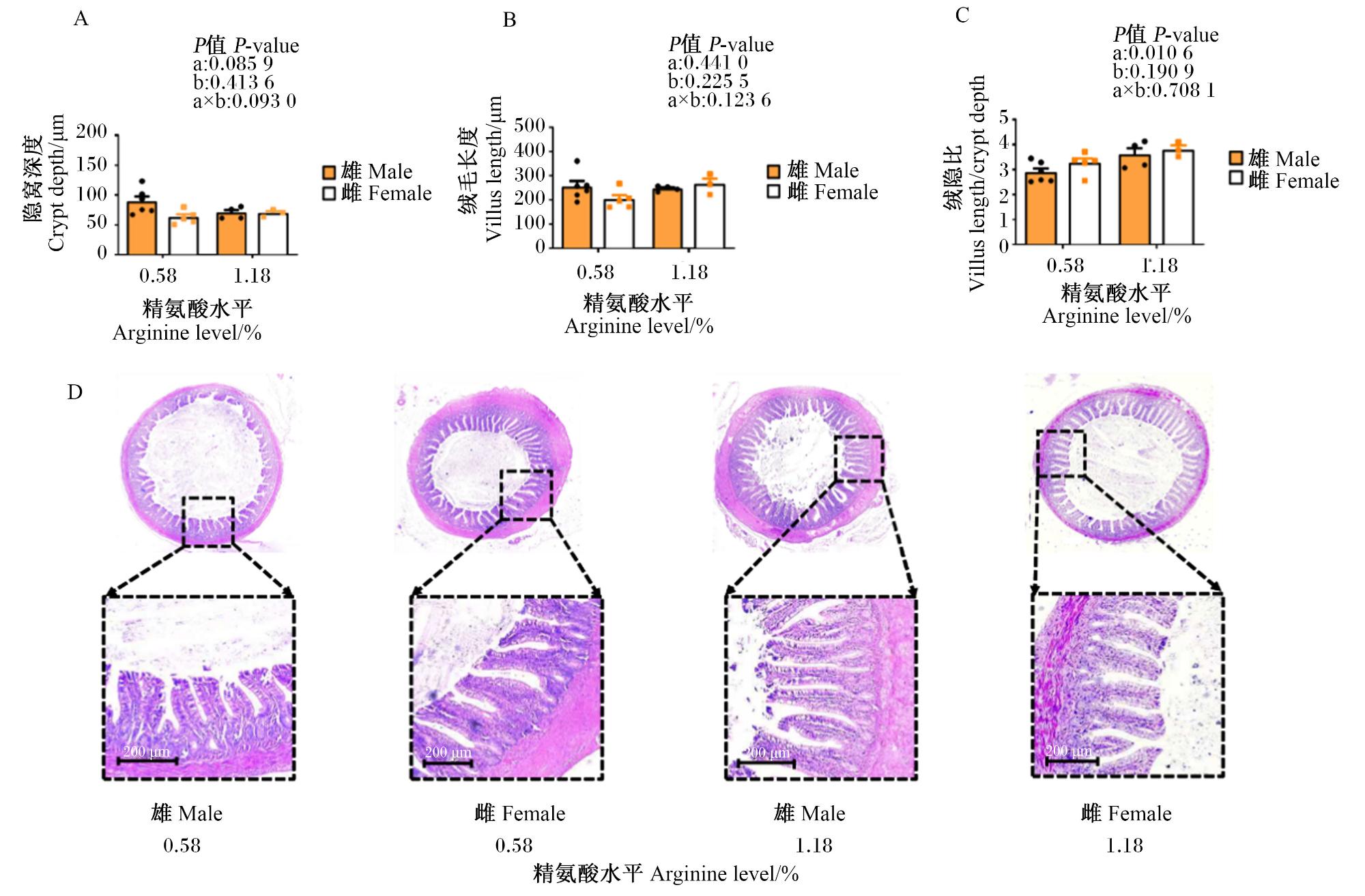
图1可见,饲粮精氨酸水平对种鸽回肠绒毛长度、隐窝深度和绒隐比无显著影响(P>0.05)。在性别上,雌鸽的回肠绒隐比显著高于雄鸽(P<0.05);性别对种鸽回肠绒毛长度、隐窝深度无显著影响(P>0.05)。对于种鸽回肠绒毛长度、隐窝深度和绒隐比,饲粮精氨酸水平与性别之间不存在显著交互作用(P>0.05)。
图1 饲粮精氨酸水平对哺乳期种鸽回肠形态的影响

A:回肠隐窝深度双因素分析;B:回肠绒毛长度双因素分析;C:回肠绒隐比双因素分析;D:回肠HE染色切片观察(100×)。a:性别;b:精氨酸水平;a×b:交互作用。

Fig.1 Effects of dietary arginine level on ileal morphology of breeding pigeons during lactation

A: two-factor analysis of ileal crypt depth; B: two-factor analysis of ileal villus length; C: two-factor analysis of ileal villus length/crypt depth; D: observation of ileal HE staining sections (100×). a: gender; b: arginine level; a×b: interaction.

2.2 饲粮精氨酸水平对哺乳期雌鸽卵泡发育指标的影响

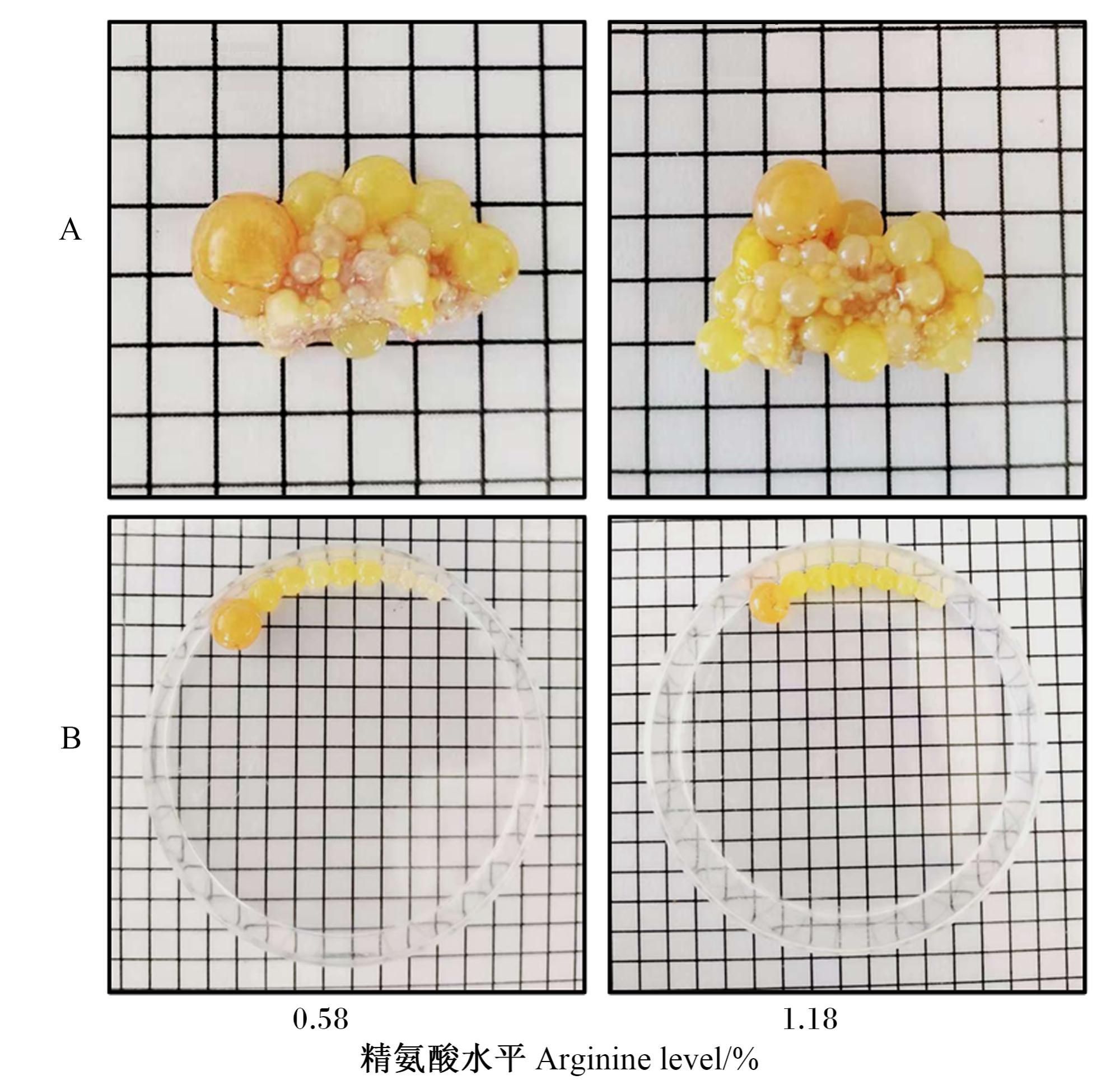
表2图2可知,饲粮精氨酸水平对雌鸽卵巢重、黄卵泡数量、白卵泡数量、白卵泡平均直径均无显著影响(P>0.05)。
表2 饲粮精氨酸水平对哺乳期雌鸽卵泡发育指标的影响

Table 2 Effects of dietary arginine level on follicular development indexes of female pigeons during lactation (n=6)

项目
Items
精氨酸水平 Arginine level/% P
P-value
0.58 1.18
卵巢重 Ovary weight/g 0.82±0.41 0.74±0.28 0.679
黄卵泡数量 Number of yellow follicles/个 0.67±0.52 0.67±0.52 1.000
白卵泡数量 Number of white follicles/个 10.50±4.93 9.00±2.97 0.537
白卵泡平均直径 White follicle average diameter/mm 2.95±0.75 3.08±0.39 0.718
图2 卵巢和卵泡展示图

A:卵巢;B:卵泡。

Fig.2 Display diagram of ovary and follicle

A: ovary; B: follicle.

2.3 饲粮精氨酸水平对哺乳期鸽回肠生化指标的影响

表3可知,与饲粮0.58%精氨酸水平相比,饲粮1.18%精氨酸水平能够极显著提高回肠CAT活性(P<0.01),极显著降低回肠T-SOD活性和H2O2含量(P<0.01);饲粮精氨酸水平对回肠MDA含量和T-AOC无显著影响(P>0.05)。在性别上,雌鸽回肠T-SOD活性显著低于雄鸽(P<0.05),回肠MDA、H2O2含量和CAT活性极显著低于雄鸽(P<0.01);性别对回肠T-AOC无显著差异(P>0.05)。对于回肠CAT活性,精氨酸水平与性别之间存在极显著的交互作用(P<0.01),其中在饲粮1.18%精氨酸水平下雄鸽回肠CAT活性最高,在饲粮0.58%精氨酸水平下雌鸽回肠CAT活性最低;对于回肠T-SOD活性和MDA、H2O2含量及T-AOC,饲粮精氨酸水平与性别之间不存在显著交互作用(P>0.05)。
表3 饲粮精氨酸水平对哺乳期种鸽回肠生化指标的影响

Table 3 Effects of dietary arginine level on ileal biochemical indexes of breeding pigeons during lactation (n=6)

项目
Items
精氨酸水平 Arginine level/% PP-value
0.58 1.18 精氨
酸水平
Arginine
level
性别
Gender
精氨酸水
平×性别
Arginine
level×
gender

Male

Female

Male

Female
丙二醛
MDA/(nmol/mg prot)
1.04±0.43 0.37±0.27 1.08±0.21 0.40±0.11 0.826 0.003 0.959
总抗氧化能力
T-AOC/(nmol/mg prot)
0.75±0.45 0.74±0.28 0.59±0.30 0.57±0.23 0.325 0.928 0.954
总超氧化物歧化酶
T-SOD/(U/mg prot)
344.15±70.85 279.98±30.95 240.62±38.95 173.49±46.85 0.001 0.011 0.948
过氧化氢
H2O2/(mmol/mg prot)
7.59±2.16 4.61±1.67 4.79±1.14 2.08±0.59 0.008 0.005 0.872
过氧化氢酶
CAT/(U/mg prot)
29.79±13.46b 18.26±5.60b 88.08±23.15a 25.50±3.64b 0.001 0.001 0.005

同行数据肩标不同小写字母表示差异显著(P<0.05)。下表同。

Values in the same row with different lowercase letter superscripts mean significant difference (P<0.05). The same as below.

2.4 饲粮精氨酸水平对哺乳期种鸽血浆生化指标的影响

表4可知,与饲粮0.58%精氨酸水平相比,饲粮1.18%精氨酸水平能够极显著提高血浆CAT活性(P<0.01);饲粮精氨酸水平对血浆T-SOD、AST、ALT活性和H2O2、MDA含量及T-AOC无显著影响(P>0.05)。在性别上,雌鸽血浆CAT活性显著高于雄鸽(P<0.05),血浆ALT活性极显著高于雄鸽(P<0.01);性别对血浆T-SOD、AST活性和H2O2、MDA含量及T-AOC无显著影响(P>0.05)。对于血浆MDA含量,精氨酸水平与性别之间存在显著的交互作用(P<0.05),其中在饲粮0.58%精氨酸水平下雌鸽血浆MDA含量显著高于雄鸽(P<0.05),在饲粮1.18%精氨酸水平下雄鸽血浆MDA含量显著高于雌鸽(P<0.05);对于血浆T-SOD、CAT、AST、ALT活性和H2O2含量及T-AOC,饲粮精氨酸水平与性别之间不存在显著交互作用(P>0.05)。
表4 饲粮精氨酸水平对哺乳期种鸽血浆生化指标的影响

Table 4 Effects of dietary arginine level on plasma biochemical indexes of breeding pigeons during lactation (n=6)

项目
Items
精氨酸水平 Arginine level/% PP-value
0.58 1.18 精氨
酸水平
Arginine
level
性别
Gender
精氨酸水
平×性别
Arginine
level×
gender

Male

Female

Male

Female
总超氧化物歧化酶
T-SOD/(U/mL)
63.57±21.05 70.14±7.28 64.89±15.98 73.11±12.84 0.732 0.245 0.895
总抗氧化能力
T-AOC/(U/mL)
2.17±0.51 2.23±0.58 2.20±0.43 1.77±0.42 0.290 0.360 0.242
过氧化氢
H2O2/(mmol/mL)
92.91±20.81 103.81±34.90 100.74±34.14 74.24±21.96 0.365 0.513 0.126
过氧化氢酶
CAT/(U/L)
1.26±0.60 2.29±0.56 2.52±0.66 2.72±0.76 0.004 0.031 0.129
丙二醛
MDA/(nmol/mL)
3.69±0.27b 5.11±1.82a 4.86±1.17a 3.72±0.64b 0.812 0.768 0.012
谷草转氨酶
AST/(U/L)
13.69±3.62 13.02±4.59 15.38±8.20 15.29±7.92 0.458 0.885 0.911
谷丙转氨酶
ALT/(U/L)
2.55±0.76 4.74±1.61 1.14±0.27 4.17±0.57 0.058 0.001 0.339
总胆固醇
T-CHO/(mmol/L)
6.49±1.38 5.75±1.14 6.84±1.34 5.16±0.64 0.796 0.019 0.330
甘油三酯
TG/(mmol/L)
0.92±0.19 1.00±0.35 0.58±0.11 1.23±0.42 0.721 0.030 0.078
葡萄糖
GLU/(mmol/L)
12.56±2.86 11.01±4.50 11.61±2.46 8.10±3.45 0.180 0.084 0.492
总蛋白
TP/(g/L)
31.63±8.56 30.89±5.72 39.68±5.91 38.48±4.72 0.007 0.714 0.931
白蛋白
ALB/(g/L)
14.16±3.05 14.51±4.13 15.99±1.70 13.95±1.23 0.582 0.463 0.302
尿素氮
UN/(mmol/L)
18.69±7.70 17.40±7.75 30.16±13.48 27.91±9.34 0.016 0.675 0.908
尿酸
UA/(mmol/L)
77.36±15.81 69.96±15.85 68.58±12.78 57.91±9.69 0.079 0.124 0.774
与饲粮0.58%精氨酸水平相比,饲粮1.18%精氨酸水平能够极显著提高血浆TP含量(P<0.01),显著提高血浆UN含量(P<0.05);饲粮精氨酸水平对血浆T-CHO、TG、GLU、ALB和UA含量无显著影响(P>0.05)。在性别上,雌鸽血浆T-CHO含量显著低于雄鸽(P<0.05),血浆TG含量显著高于雄鸽(P<0.05);性别对血浆GLU、TP、ALB、UN和UA含量无显著影响(P>0.05)。对于血浆T-CHO、TG、GLU、TP、ALB、UN和UA含量,饲粮精氨酸水平与性别之间不存在显著交互作用(P>0.05)。

2.5 饲粮精氨酸水平对哺乳期种鸽肝脏生化指标的影响

表5可知,饲粮精氨酸水平对肝脏MDA、H2O2含量和CAT、T-SOD活性及T-AOC无显著影响(P>0.05)。性别对肝脏MDA、H2O2含量和CAT、T-SOD活性及T-AOC无显著影响(P>0.05)。对于肝脏MDA、H2O2含量和CAT、T-SOD活性及T-AOC,饲粮精氨酸水平与性别之间不存在显著交互作用(P>0.05)。
表5 饲粮精氨酸水平对哺乳期种鸽肝脏生化指标的影响

Table 5 Effects of dietary arginine level on liver biochemical indexes of breeding pigeons during lactation (n=6)

项目
Items
精氨酸水平 Arginine level/% PP-value
0.58 1.18 精氨
酸水平
Arginine
level
性别
Gender
精氨酸水
平×性别
Arginine
level×
gender

Male

Female

Male

Female
丙二醛
MDA/(nmol/mg prot)
1.72±1.13 2.08±0.66 2.16±0.69 2.15±0.74 0.463 0.603 0.591
总抗氧化能力
T-AOC/(nmol/mg prot)
0.27±0.08 0.41±0.11 0.42±0.16 0.43±0.18 0.129 0.197 0.242
过氧化氢酶
CAT/(U/mg prot)
3.04±0.23 3.01±0.61 3.16±0.42 3.42±0.46 0.176 0.546 0.447
过氧化氢
H2O2/(mmol/mg prot)
2.73±1.07 3.74±0.93 3.42±1.60 3.43±1.38 0.722 0.355 0.359
总超氧化物歧化酶
T-SOD/(U/mg prot)
409.05±49.06 440.19±77.92 407.78±33.40 431.00±46.28 0.815 0.233 0.860
白蛋白
ALB/(g/kg prot)
2.26±1.89 1.38±0.75 1.42±0.94 0.83±0.24 0.146 0.124 0.758
总胆固醇
T-CHO/(mmol/mg prot)
0.02±0.01 0.02±0.02 0.01±0.01 0.01±0.01 0.083 0.670 0.318
甘油三酯
TG/(mmol/mg prot)
0.09±0.01 0.09±0.01 0.10±0.02 0.07±0.01 0.427 0.076 0.064
总蛋白
TP/(g/kg prot)
12.08±1.46 10.98±2.51 11.02±2.41 12.81±1.47 0.645 0.682 0.096
饲粮精氨酸水平对肝脏ALB、T-CHO、TG和TP含量无显著影响(P>0.05)。性别对肝脏ALB、T-CHO、TG和TP含量无显著影响(P>0.05)。对于肝脏ALB、T-CHO、TG和TP含量,饲粮精氨酸水平与性别之间不存在显著交互作用(P>0.05)。

2.6 饲粮精氨酸水平对哺乳期雌鸽卵巢生化指标的影响

表6可知,饲粮精氨酸水平对卵巢T-AOC和H2O2、MDA含量及CAT、T-SOD活性无显著影响(P>0.05)。饲粮精氨酸水平对卵巢ALB、TP、T-CHO和TG含量无显著影响(P>0.05)。
表6 饲粮精氨酸水平对哺乳期雌鸽卵巢生化指标的影响

Table 6 Effects of dietary arginine level on ovary biochemical indexes of female pigeons during lactation (n=6)

项目
Items
精氨酸水平 Arginine level/% P
P-value
0.58 1.18
总抗氧化能力 T-AOC/(nmol/mg prot) 1.70±0.37 3.17±1.49 0.060
过氧化氢 H2O2/(mmol/mg prot) 0.71±0.08 0.73±0.24 0.829
过氧化氢酶 CAT/(U/mg prot) 11.42±3.01 14.84±3.76 0.172
丙二醛 MDA/(nmol/mg prot) 0.77±0.46 0.74±0.42 0.911
总超氧化物歧化酶 T-SOD/(U/mg prot) 353.64±120.17 357.95±110.18 0.950
白蛋白 ALB/(g/kg prot) 0.48±0.20 0.33±0.19 0.208
总蛋白 TP/(g/kg prot) 2.40±0.83 2.37±0.83 0.950
总胆固醇 T-CHO/(mmol/mg prot) 0.10±0.03 0.04±0.02 0.052
甘油三酯 TG/(mmol/mg prot) 0.06±0.03 0.03±0.02 0.085

3 讨论

3.1 饲粮精氨酸水平对哺乳期种鸽回肠形态的影响

在动物生长发育过程中,肠道形态,特别是绒隐比,是评估肠道吸收功能与健康状况的重要指标[24-25]。小肠是营养吸收和屏障防御的关键位点,分布着密集的绒毛、隐窝、杯状细胞以及免疫细胞共同防御病原[26-27]。本试验代表性的采集回肠组织进行检测,以探究饲粮精氨酸水平对肠道健康的潜在影响。本研究发现,饲粮精氨酸水平对哺乳期种鸽回肠绒毛长度、隐窝深度和绒隐比均无显著影响。这与Dai等[28]在健康鸡胚内注射补充精氨酸而未改变回肠形态的结果一致。推测原因可能在于:首先,在健康状态下肠道形态可塑性有限,董信阳[29]报道,鸽回肠在出壳后5 d已基本发育成熟;其次,本试验基础饲粮已有的0.58%精氨酸水平可能已满足种鸽维持正常肠道形态的基本需要。

3.2 饲粮精氨酸水平对哺乳期种鸽卵泡发育指标的影响

本研究表明,饲粮精氨酸水平对哺乳期雌鸽卵巢重、黄卵泡数量、白卵泡数量、白卵泡平均直径均无显著影响。这与苟钟勇等[30]在黄羽肉种鸡上的长期饲喂试验结果相似。然而,该结果与在蛋鸡[31]、五龙鹅[32]等物种上观察到的精氨酸促进卵泡发育的结论有所不同。这种差异可能主要归因于种鸽在哺乳期特殊的生理优先级。哺乳期种鸽处于极高的代谢负荷状态[8],营养和能量资源可能被优先分配给鸽乳合成与自身维持,从而导致用于下一繁殖周期卵泡发育的资源相对受限。Chen等[32]观察到在五龙鹅饲粮中添加1.02%精氨酸后,能带来提高产蛋量及平均蛋重等积极效果,但需持续饲喂17周。而本研究中,干预周期相对较短且处于哺乳高峰期。因此,精氨酸对卵泡发育的促进作用可能取决于物种、生理阶段及干预持续时间。后续研究可通过延长精氨酸干预周期,或在其不同繁殖阶段进行考察,以明确其最佳效应窗口。

3.3 饲粮精氨酸水平对哺乳期种鸽机体代谢的影响

本研究发现,与饲粮0.58%精氨酸水平相比,饲粮1.18%精氨酸水平显著或极显著提高了种鸽血浆TP和UN含量。TP含量升高提示机体蛋白质合成代谢可能增强,而UN作为蛋白质分解终产物,二者同步增加反映了氨基酸周转代谢的加快。这与前人在其他禽类和哺乳动物中补充精氨酸可提高血浆TP和UN含量的研究结果[32-33]一致。然而,与陈莹等[34]研究结果不同,本研究中饲粮精氨酸水平并未显著改变肝脏TG和T-CHO含量。这可能反映了哺乳期种鸽脂代谢途径的特定调节模式。在氧化应激方面,与饲粮0.58%精氨酸水平相比,饲粮1.18%精氨酸水平极显著提高种鸽回肠和血浆CAT活性,极显著降低回肠T-SOD活性和H2O2含量。尽管回肠T-SOD活性下降,但其他氧化应激指标,如回肠MDA含量并未升高。该研究结果表明精氨酸有效改善了机体的抗氧化状态,可能与激活Nrf2等抗氧化信号通路有关[18,35]

3.4 饲粮精氨酸水平与性别因素对哺乳期种鸽的影响

本研究发现,哺乳期种鸽在血浆TG含量、ALT活性和回肠MDA、H2O2含量及肠道形态等多方面存在显著的性别差异,这些差异很可能源于哺乳期雌雄种鸽固有的生理分工与代谢优先级不同。尽管在哺乳期间,双方均参与乳鸽哺育,但雌鸽同时承担着产蛋[36]和鸽乳合成与分泌的任务。雌鸽机体代谢可能与雄鸽表现出特定的性别差异,通过适当提高肠道对营养物质的吸收效率来使机体更快恢复,同时通过加速肝脏代谢,为卵黄发育储备营养,以提高繁殖效率,并保持适度的鸽乳合成与分泌[37]。事实上,已经有研究发现,哺乳期雌鸽体重恢复较雄鸽更快[22,38],这可能是进化造成的结果。因此,营养干预在不同性别上可能存在交互作用,与此一致的是,本研究发现精氨酸对雄鸽回肠CAT活性和血浆MDA含量存在显著影响,但对雌鸽作用有限。此外,有研究发现,雌激素能通过调节一氧化氮合酶(NOS)活性及抗氧化通路敏感性,这也可能造成精氨酸对不同性别种鸽效果存在差异的原因[39-40]。以上结果表明,在制定哺乳期种鸽营养策略时可以考虑性别差异来制定更加个性化的方案,以平衡泌乳与繁殖的需要。

3.5 精氨酸对哺乳期种鸽机体功能的整体调控

近年来,“肠-肝轴”“肠-生殖轴”等概念的提出,揭示了肠道作为核心信号器官调控全身代谢与繁殖的功能[41-44]。精氨酸作为多功能氨基酸,可能通过影响肠道健康,进而经这些轴系间接调控远端器官[45-47]。本研究观察到的“改善代谢与抗氧化功能,但不影响肠道与卵泡形态”的结果,符合“功能调控先于形态改变”的生理适应模式。在哺乳这一营养高需求期,机体可能将有限的资源优先用于维持代谢稳态和抗氧化防御等核心生理功能,而暂缓对组织重塑等“长线投资”的投入[48-51]。在本研究中,试验基础饲粮(0.58%精氨酸水平)可能已满足种鸽肠道与卵巢形态维持的基本需求。而将精氨酸水平提升至1.18%后,则更侧重于优化处于应激状态的机体微环境与功能。精氨酸可通过NOS途径促进NO生成,参与机体抗氧化和抗炎过程[39]。而雌激素可能影响NOS活性及Nrf2信号通路的敏感性,导致不同性别对精氨酸添加的反应出现差异[40]。在本研究中,主要探讨了精氨酸对哺乳期种鸽肠道形态、卵泡发育及机体代谢的影响,未测定哺乳期种鸽相关激素如催乳素、雌二醇、孕酮等水平。而哺乳期是激素波动的剧烈阶段,这些激素的变化可能与肠道功能、卵泡发育及机体代谢密切相关。因此,未来研究还应进一步测定相关激素水平,以更全面地揭示精氨酸对种鸽生理功能的调节机制。

4 结论

饲粮精氨酸水平虽未影响哺乳期种鸽的肠道形态和卵泡发育,但可有效改善机体代谢和抗氧化功能。尽管在部分指标上观察到性别差异,但精氨酸的总体有益效应在雌鸽和雄鸽中均有所体现。这些结果提示,种鸽在哺乳高峰期,机体将有限的营养资源优先配置于维持生存与完成哺育任务的核心功能,而对于繁殖准备的投入相对较少。
[1]
郑素威, 侯浩宾, 李欣, 等. 日龄和性别对鸽肉品质和营养价值的影响研究[J]. 上海农业学报, 2025, 41(4):103-113.

ZHENG S W, HOU H B, LI X, et al. Impact of age and gender on pigeon meat quality and nutritional value[J]. Acta Agriculturae Shanghai, 2025, 41(4):103-113. (in Chinese)

[2]
王翔. 鸽肉营养而且保健[J]. 肉类工业, 2013(10):24.

WANG X. Pigeon meat nutrition and health care[J]. Meat Industry, 2013(10):24. (in Chinese)

[3]
ZHENG S, YAN K, TANG Y, et al. Dietary supplementation with tryptophan improves the production and growth performance of breeding pigeons under 2+4 model[J]. British Poultry Science, 2026, 67(1):113-124.

DOI

[4]
张海鹏, 肖凯歌, 朱俊蓉, 等. 亲鸽饲粮赖氨酸水平对28日龄仔鸽生长性能、免疫功能及免疫相关基因表达的影响[J]. 中国家禽, 2025, 47(11):58-66.

ZHANG H P, XIAO K G, ZHU J R, et al. Effects of dietary lysine level on growth performance,immune function and immune-related gene expression of 28-day-old pigeons[J]. China Poultry, 2025, 47(11):58-66. (in Chinese)

[5]
XIE W Y, FU Z, PAN N X, et al. Leucine promotes the growth of squabs by increasing crop milk protein synthesis through the TOR signaling pathway in the domestic pigeon (Columba livia)[J]. Poultry Science, 2019, 98(11):5514-5524.

DOI PMID

[6]
谢文燕, 潘能霞, 姜世光, 等. 种鸽日粮添加不同来源蛋氨酸对乳鸽羽毛生长和血清生化指标的影响[J]. 饲料工业, 2019, 40(11):54-59.

XIE W Y, PAN N X, JIANG S G, et al. Effects of the breeding pigeon dietary supplementation different sources of methionine on feather growth and serum biochemical parameters of squabs[J]. Feed Industry, 2019, 40(11):54-59. (in Chinese)

[7]
高春起, 王晓慧, 胡小超, 等. 饲粮粗蛋白质水平对乳鸽生长性能、屠宰性能、肉品质及种鸽产蛋性能的影响[J]. 华南农业大学学报, 2016, 37(4):1-6.

GAO C Q, WANG X H, HU X C, et al. Effects of dietary crude protein levels on growth performance,carcass characteristics,meat quality of squabs and laying performance of breeding pigeons[J]. Journal of South China Agricultural University, 2016, 37(4):1-6. (in Chinese)

[8]
PENG J, HUANG W Y, ZHANG W, et al. Effect of different dietary energy/protein ratios on growth performance,reproductive performance of breeding pigeons and slaughter performance,meat quality of squabs in summer[J]. Poultry Science, 2023, 102(7):102577.

DOI

[9]
PENG J, HUANG W Y, LIANG Y A, et al. Optimal dietary energy and protein levels for breeding pigeons in the winter “2+3” lactation pattern[J]. Poultry Science, 2023, 102(10):102964.

DOI

[10]
JIANG S G, PAN N X, CHEN M J, et al. Effects of dietary supplementation with DL-methionine and DL-methionyl-DL-methionine in breeding pigeons on the carcass characteristics,meat quality and antioxidant activity of squabs[J]. Antioxidants, 2019, 8(10):435.

DOI

[11]
CHANG L L, XIE P, BU Z, et al. Effect of dietary lysine level on performance,egg quality and serum biochemical indices of laying pigeons[J]. Journal of Applied Poultry Research, 2018, 27(2):152-158.

DOI

[12]
JUN Y, YANG H M, WANG Z Y, et al. Effects of arginine on the growth performance,hormones,digestive organ development and intestinal morphology in the early growth stage of layer chickens[J]. Italian Journal of Animal Science, 2018, 17(4):1077-1082.

DOI

[13]
ZHANG B B, LV Z P, LI H X, et al. Dietary L-arginine inhibits intestinal Clostridium perfringens colonisation and attenuates intestinal mucosal injury in broiler chickens[J]. The British Journal of Nutrition, 2017, 118(5):321-332.

DOI

[14]
冯梓晏, 车东升, 任娜, 等. 精氨酸对妊娠母猪胎盘屏障转运功能影响的研究进展[J]. 动物营养学报, 2025, 37(10):6489-6500.

DOI

FENG Z Y, CHE D S, REN N, et al. Research progress on effects of arginine on placental barrier transport function in gestating sows[J]. Chinese Journal of Animal Nutrition, 2025, 37(10):6489-6500. (in Chinese)

DOI

[15]
王梦攀, 郑春田, 陈伟, 等. 饲粮L-精氨酸添加水平对蛋种鸭产蛋性能、蛋品质、繁殖性能及血浆、肝脏生化和抗氧化指标的影响[J]. 动物营养学报, 2025, 37(4):2379-2391.

DOI

WANG M P, ZHENG C T, CHEN W, et al. Effects of dietary L-arginine supplemental levels on laying performance,egg quality,reproductive performance and plasma and liver biochemical and antioxidant indices of breeding ducks[J]. Chinese Journal of Animal Nutrition, 2025, 37(4):2379-2391. (in Chinese)

[16]
臧长江, 刘保宣, 院东, 等. 补喂L-精氨酸对返情纯血母马妊娠率及血浆参数的影响[J]. 中国畜牧兽医, 2023, 50(1):125-133.

DOI

ZANG C J, LIU B X, YUAN D, et al. Effect of supplementation with L-arginine on pregnancy rate and plasma parameters of re-service thoroughbred horses[J]. China Animal Husbandry & Veterinary Medicine, 2023, 50(1):125-133. (in Chinese)

[17]
黄智宇, 杨齐心, 杨红文, 等. 精氨酸对不同保存温度的猪精液品质的影响[J]. 现代畜牧科技, 2025(7):59-62.

HUANG Z Y, YANG Q X, YANG H W, et al. Effect of arginine on the quality of pig semen at different storage temperatures[J]. Modern Animal Husbandry Science & Technology, 2025(7):59-62. (in Chinese)

[18]
WANG B, LIU Y, FENG L, et al. Effects of dietary arginine supplementation on growth performance,flesh quality,muscle antioxidant capacity and antioxidant-related signalling molecule expression in young grass carp (Ctenopharyngodon idella)[J]. Food Chemistry, 2015, 167:91-99.

DOI

[19]
KONG X F, TAN B, YIN Y L, et al. L-arginine stimulates the mTOR signaling pathway and protein synthesis in porcine trophectoderm cells[J]. The Journal of Nutritional Biochemistry, 2012, 23(9):1178-1183.

DOI

[20]
舒燕, 邬理洋, 雷平, 等. L-精氨酸对冬季低温下产蛋初期攸县麻鸭产蛋、血液指标和肝脏抗氧化功能的影响[J]. 安徽农业大学学报, 2018, 45(1):30-36.

SHU Y, WU L Y, LEI P, et al. Effects of L-arginine on laying performance,blood biochemical indices and liver antioxidant function of Youxian ducks during the earlier laying period under low-temperature in winter[J]. Journal of Anhui Agricultural University, 2018, 45(1):30-36. (in Chinese)

[21]
ZHANG W, ZHENG S, HUANG W, et al. Arginine requirement of breeding pigeons during incubation and lactation in the 2+4 lactation pattern[J]. British Poultry Science, 2026, 67(1):125-135.

DOI

[22]
PENG J, HUANG W Y, YANG M L, et al. Characteristics of glucolipid metabolism and oxidative stress in breeding pigeons (Columba livia) during lactation[J]. Journal of Animal Physiology and Animal Nutrition, 2024, 108(1):148-162.

DOI

[23]
郭振玉. 产蛋间隔期鸽卵泡发育、生殖激素浓度及相关基因表达的研究[D]. 硕士学位论文. 扬州: 扬州大学, 2023.

GUO Z Y. Study on follicle development,reproductive hormone synthesis and related genes expression patterns in white king pigeons during laying interval[D]. Master’s Thesis. Yangzhou: Yangzhou University, 2023. (in Chinese)

[24]
凌天量, 吕梦绮, 徐倩倩. 乳鸽早期肠道发育及其营养调控研究进展[J]. 中国畜牧杂志, 2025, 61(4):13-22.

LING T L, LV M Q, XU Q Q. Research progress on early intestinal development of pigeon squab and its nutritional manipulation[J]. Chinese Journal of Animal Science, 2025, 61(4):13-22. (in Chinese)

[25]
DOZIER W A, THAXTON J P, PURSWELL J L, et al. Stocking density effects on male broilers grown to 1.8 kilograms of body weight[J]. Poultry Science, 2006, 85(2):344-351.

PMID

[26]
ANWAR S M, ABD-ELHAFEEZ H H, ABDEL-MAKSOUD F M, et al. Morph-anatomic and histochemical study of ileum of goose (Alopochen egyptiacus) with special references to immune cells,mucous and serous goblet cells,telocytes,and dark and light smooth muscle fibers[J]. Microscopy Research and Technique, 2021, 84(6):1328-1347.

DOI

[27]
詹毅. 育雏期红嘴相思鸟十二指肠和回肠的组织形态研究[D]. 硕士学位论文. 雅安: 四川农业大学, 2013.

ZHAN Y. Study on the histological morphology of duodenum and ileum in brooding Acacia erythraea[D]. Master’s Thesis. Ya’an: Sichuan Agricultural University, 2013. (in Chinese)

[28]
DAI D, ZHANG H J, QIU K, et al. Supplemental L-arginine improves the embryonic intestine development and microbial succession in a chick embryo model[J]. Frontiers in Nutrition, 2021, 8:692305.

DOI

[29]
董信阳. 鸽早期小肠发育及碳水化合物对其调控的研究[D]. 博士学位论文. 杭州: 浙江大学, 2013.

DONG X Y. Research on early development of the pigeon small intestine and its regulation by carbohydrates[D]. Ph.D.Thesis. Hangzhou: Zhejiang University, 2013. (in Chinese)

[30]
苟钟勇, 蒋守群, 蒋宗勇, 等. 饲粮精氨酸水平对黄羽肉种鸡产蛋高峰期繁殖性能的影响[J]. 动物营养学报, 2017, 29(6):1904-1912.

GOU Z Y, JIANG S Q, JIANG Z Y, et al. Effects of dietary arginine levels on reproductive performance of Chinese yellow-feather broiler breeders during peak period of laying[J]. Chinese Journal of Animal Nutrition, 2017, 29(6):1904-1912. (in Chinese)

[31]
LI F, NING H, DUAN X, et al. Effect of dietary L-arginine of broiler breeder hens on embryonic development,apparent metabolism,and immunity of offspring[J]. Domestic Animal Endocrinology, 2021, 74:106537.

DOI

[32]
CHEN Y, ZHANG B B, WANG B W, et al. Effects of dietary arginine supplementation on production performance,serum biochemicals,antioxidant capacity,and immunity of laying Wulong geese[J]. Poultry Science, 2023, 102(7):102727.

DOI

[33]
PETERS H, BORDER W A, RÜCKERT M, et al. L-arginine supplementation accelerates renal fibrosis and shortens life span in experimental lupus nephritis[J]. Kidney International, 2003, 63(4):1382-1392.

DOI

[34]
陈莹, 张贝贝, 王宝维, 等. 精氨酸对产蛋期五龙鹅肝脏生化、抗氧化和肠道抗氧化、免疫指标的影响[J]. 饲料研究, 2023, 46(20):30-34.

CHEN Y, ZHANG B B, WANG B W, et al. Effect of arginine on liver biochemistry,antioxidant and intestinal antioxidant and immune indexes of Wulong geese during laying period[J]. Feed Research, 2023, 46(20):30-34. (in Chinese)

[35]
梁化亮. 精氨酸对团头鲂幼鱼生长、营养代谢和免疫功能的影响及作用机制[D]. 博士学位论文. 南京: 南京农业大学, 2019.

LIANG H L. Effects of dietary arginine on growth,nutrient metabolism and immune capacity involved in fuctional mechanism in juvenile blunt snout bream,Megalobrama amblycephala[D]. Ph.D.Thesis. Nanjing: Nanjing Agricultural University, 2019. (in Chinese)

[36]
毛昕妍, 郭振玉, 邓子优, 等. 产蛋间隔期母鸽卵黄前体及其受体基因的表达分析[J]. 畜牧与兽医, 2024, 56(10):8-13.

MAO X Y, GUO Z Y, DENG Z Y, et al. Expression analysis of yolk precursors and receptor genes in female pigeons during egg laying interval[J]. Animal Husbandry & Veterinary Medicine, 2024, 56(10):8-13. (in Chinese)

[37]
万雪萍. 鸽乳脂质形成调控机制的研究[D]. 博士学位论文. 杭州: 浙江大学, 2018.

WAN X P. Research on the regulation mechanism of lipid formation in pigeon milk[D]. Ph.D.Thesis. Hangzhou: Zhejiang University, 2018. (in Chinese)

[38]
XIE P, WANG X P, BU Z, et al. Differential expression of fatty acid transporters and fatty acid synthesis-related genes in crop tissues of male and female pigeons (Columba livia domestica) during incubation and chick rearing[J]. British Poultry Science, 2017, 58(5):594-602.

DOI PMID

[39]
MORRIS S M Jr. Arginine metabolism revisited[J]. The Journal of Nutrition, 2016, 146(12):2579S-2586S.

[40]
NIE X B, XIE R, TUO B G. Effects of estrogen on the gastrointestinal tract[J]. Digestive Diseases and Sciences, 2018, 63(3):583-596.

DOI PMID

[41]
GUO Y J, WANG S W, WU X, et al. Multi-omics reveals the role of arachidonic acid metabolism in the gut-follicle axis for the antral follicular development of Holstein cows[J]. International Journal of Molecular Sciences, 2024, 25(17):9521.

DOI

[42]
KHAN D, OJO O O, WOODWARD O R, et al. Evidence for involvement of GIP and GLP-1 receptors and the gut-gonadal axis in regulating female reproductive function in mice[J]. Biomolecules, 2022, 12(12):1736.

DOI

[43]
MAYER E A, NANCE K, CHEN S. The gut-brain axis[J]. Annual Review of Medicine, 2022, 73:439-453.

DOI

[44]
PABST O, HORNEF M W, SCHAAP F G, et al. Gut-liver axis:barriers and functional circuits[J]. Nature Reviews Gastroenterology & Hepatology, 2023, 20(7):447-461.

[45]
BUIJS N, VERMEULEN M A R, WEEDA V B, et al. Adaptations of arginine’s intestinal-renal axis in cachectic tumor-bearing rats[J]. Nutrition and Cancer, 2015, 67(5):713-720.

DOI

[46]
MARINI J C, AGARWAL U, ROBINSON J L, et al. The intestinal-renal axis for arginine synthesis is present and functional in the neonatal pig[J]. American Journal of Physiology:Endocrinology and Metabolism, 2017, 313(2):E233-E242.

[47]
MISTRY S K, GREENFELD Z, MORRIS S M Jr, et al. The ‘intestinal-renal’ arginine biosynthetic axis in the aging rat[J]. Mechanisms of Ageing and Development, 2002, 123(8):1159-1165.

DOI

[48]
HUANG W C, GUO Y S, GE C Y, et al. Beneficial effects of ε-polylysine on growth performance,antioxidant capacity,intestinal morphology,and gut microbiota in broilers fed a lysine-deficient diet[J]. Poultry Science, 2025, 104(2):104774.

DOI

[49]
ZHANG X, ZHOU S, LIANG Y Y, et al. Effects of Astragalus,Epimedium,and Fructus ligustri lucidi extractive on antioxidant capacity,production performance,and immune mechanism of breeding pigeons under stress[J]. Poultry Science, 2023, 102(2):102350.

DOI

[50]
杨麒. 日粮赖氨酸水平对0-3周龄肉仔鸡生长性能及肠道发育的影响[D]. 硕士学位论文. 哈尔滨: 东北农业大学, 2018.

YANG Q. Effects of dietary lysine levels on growth performance and intestinal development of 0 to 3 weeks old broilers[D]. Master’s Thesis. Harbin: Northeast Agricultural University, 2018. (in Chinese)

[51]
俞清霞. 低蛋白饲粮添加精氨酸对断乳仔猪生长性能、血液抗氧化和免疫指标的影响[J]. 福建畜牧兽医, 2024, 46(5):13-17.

YU Q X. Effects of low-protein diet supplemented with arginine on the growth performance,blood antioxidant and immune indicators of weaned piglets[J]. Fujian Journal of Animal Husbandry and Veterinary Medicine, 2024, 46(5):13-17. (in Chinese)

文章导航

/