研究论文

有机微量元素对哺乳犊牛生长性能和胃肠道微生物区系的影响

  • 牛颂 , 1 ,
  • 方晶子 2 ,
  • 徐焕 2 ,
  • 赵广瑞 1 ,
  • 张亚伟 2 ,
  • 徐明 , 1, *
展开
  • 1 内蒙古农业大学动物科学学院, 呼和浩特 014010
  • 2 长沙兴嘉生物工程股份有限公司, 长沙 410000
*徐 明,教授,博士生导师,E-mail:

牛 颂(2002—),男,内蒙古赤峰人,硕士研究生,研究方向为奶牛生产学。E-mail:

Office editor: 靳爽

收稿日期: 2025-10-10

  网络出版日期: 2026-05-14

基金资助

内蒙古自治区教育厅一流学科科研专项(YLXKZX-NND-007-9)

长沙兴嘉科技创新项目(2024-XJ-01)

Effects of Organic Trace Elements on Growth Performance and Gastrointestinal Microbial Flora of Suckling Calves

  • NIU Song , 1 ,
  • FANG Jingzi 2 ,
  • XU Huan 2 ,
  • ZHAO Guangrui 1 ,
  • ZHANG Yawei 2 ,
  • XU Ming , 1, *
Expand
  • 1 College of Animal Science, Inner Mongolia Agricultural University, Hohhot 014010, China
  • 2 Changsha Xingjia Bioengineering Co., Ltd., Changsha 410000, China
*professor, E-mail:

Received date: 2025-10-10

  Online published: 2026-05-14

摘要

本试验旨在研究开食料中添加有机微量元素对哺乳犊牛生长性能和胃肠道微生物区系的影响。选取76头(16±7)日龄、初始体重(41.85±6.00) kg的健康西门塔尔犊牛,随机分为2组,每组38头,单栏饲养。无机组在开食料中添加1 g/kg无机微量元素预混料,有机组在开食料中添加1 g/kg有机微量元素预混料。2组微量元素添加量一致,均为铜20 mg/kg,铁400 mg/kg,锌120 mg/kg,锰90 mg/kg,硒0.3 mg/kg。试验期69 d,分为2个阶段:第1阶段为第1~34天,第2阶段为第35~69天。结果表明:与无机组相比,有机组犊牛试验第2阶段及全期开食料干物质采食量和平均日增重显著提高(P<0.05);试验全期腹泻率降低18.88%;试验第69天体高与十字部高显著提高(P<0.05)。微生物组成分析结果显示,与无机组相比,有机组直肠微生物中放线菌门(Actinobacteriota)相对丰度显著提高(P<0.05),螺旋体门(Spirochaetota)相对丰度显著降低(P<0.05);纤维降解相关菌属理研菌科RC9肠道群(Rikenellaceae_RC9_gut_group)、瘤胃球菌属(Ruminococcus)及益生菌属奥尔森氏菌属(Olsenella)、拟杆菌属(Bacteroides)相对丰度显著提高(P<0.05),潜在致病菌密螺旋体属(Treponema)相对丰度显著降低(P<0.05)。综上所述,与无机微量元素相比,在开食料中添加有机微量元素可显著促进哺乳犊牛生长,调节肠道菌群结构,改善肠道健康状况。

本文引用格式

牛颂 , 方晶子 , 徐焕 , 赵广瑞 , 张亚伟 , 徐明 . 有机微量元素对哺乳犊牛生长性能和胃肠道微生物区系的影响[J]. 动物营养学报, 2026 , 38(5) : 3480 -3493 . DOI: 10.12418/CJAN2026.278

Abstract

This experiment was conducted to study the effects of adding organic trace elements to starter on growth performance and gastrointestinal microbial flora of suckling calves. A total of 76 healthy Simmental calves with (16±7) days of age and initial body weight of (41.85±6.00) kg were randomly divided into 2 groups with 38 calves in each group, raised in individual pens. The inorganic group was supplemented with 1 g/kg inorganic trace element premix in the starter, while the organic group was supplemented with 1 g/kg organic trace element premix. The addition levels of trace elements in the two groups were consistent: copper 20 mg/kg, iron 400 mg/kg, zinc 120 mg/kg, manganese 90 mg/kg and selenium 0.3 mg/kg. The experimental period was 69 days, divided into 2 phases: the first phase was day 1 to day 34, and the second phase was day 35 to day 69. The results showed that compared with the inorganic group, the starter dry matter intake and average daily gain of the organic group were significantly increased in the second phase and overall phase (P<0.05); the diarrhea rate in the overall phase was decreased by 18.88%; the body height and hip height at day 69 were significantly increased (P<0.05). Microbial composition analysis revealed that compared with the inorganic group, the relative abundance of Actinobacteriota in rectal microbiota was significantly increased (P<0.05), while the relative abundance of Spirochaetota was significantly decreased (P<0.05) in the organic group. The relative abundances of fiber-degrading related genera such as Rikenellaceae_RC9_gut_group and Ruminococcus, as well as probiotic genera such as Olsenella and Bacteroides, were significantly increased (P<0.05), while the relative abundance of the potential pathogen Treponema was significantly decreased (P<0.05) in the organic group. In conclusion, compared with inorganic trace elements, adding organic trace elements to the starter can significantly promote the growth of suckling calves, regulate the intestinal microbial structure, and improve intestinal health.

哺乳期犊牛的健康生长发育是决定其成年后生产性能的重要因素,此时期的营养管理对犊牛消化系统发育、免疫力建立乃至终身生产潜力均具有深远影响[1-2]。开食料作为犊牛由液态食物(乳)向固体饲料过渡的关键载体,其营养配比的合理性,尤其是微量元素的形态选择与生物利用率高低,直接影响犊牛的采食行为、养分吸收效率及整体健康水平[3]
长期以来,犊牛饲粮中普遍添加无机微量元素,但其存在生物利用率低、易与饲粮中其他成分发生拮抗反应、适口性差等问题,一定程度上限制了其生物学功能的发挥[4-5]。近年来,有机微量元素因稳定性高、吸收效率高、抗营养干扰小等优势,在单胃动物生产中已展现出显著的应用效果[6]。研究表明,有机微量元素可提高成年反刍动物的矿物质沉积效率,还可通过减轻无机盐对肠道的直接刺激,进而改善肠道健康[7]
目前,关于有机微量元素对消化系统尚未健全的哺乳犊牛生长性能、腹泻率及肠道微生物生态调节作用的系统研究仍相对有限。因此,本研究旨在通过饲养试验,探究开食料中有机微量元素对哺乳期安格斯犊牛生长性能、腹泻率及胃肠道微生物区系的影响,以期为有机微量元素在犊牛营养中的科学应用提供数据支撑。

1 材料与方法

1.1 伦理声明

动物试验方案已通过内蒙古农业大学实验动物管理与使用委员会审查批准(批准号:NND2024038),试验过程中严格遵循实验动物福利与使用的基本准则。

1.2 试验设计

选取76头(16±7)日龄、初始体重(41.85±6.00) kg的健康西门塔尔犊牛,随机分为2组,每组38头。无机组在开食料中添加1 g/kg无机微量元素预混料,有机组在开食料中添加1 g/kg有机微量元素预混料。该添加水平(1 g/kg)参照复合微量元素预混料产品推荐用量设定,2组开食料中铜、铁、锌、锰、碘、硒等微量元素添加量保持一致,以元素计分别为:铜20 mg/kg,铁400 mg/kg,锌120 mg/kg,锰90 mg/kg,硒0.3 mg/kg,确保微量元素化学形态为组间唯一变量。试验期共69 d,依据哺乳期犊牛生理发育规律及开食料采食模式的自然转变,划分为2个阶段:第1阶段为第1~34天,第2阶段为第35~69天。第1阶段犊牛瘤胃发育尚不完善,开食料采食量较低,营养供给主要依赖液体奶;进入第2阶段后,随着瘤胃微生物区系与消化道功能逐步成熟,犊牛对固体饲料的消化能力显著提升,开食料采食量进入快速增长阶段,成为重要营养来源。
开食料组成及营养水平见表1。其中,粗蛋白质含量采用凯氏定氮法(GB/T 6432—2018)测定;粗灰分含量采用马弗炉灼烧法(GB/T 6438—2007)测定;磷含量采用钒钼酸铵分光光度法(GB/T 6437—2018)测定;样品经微波消解后,采用电感耦合等离子体发射光谱法(GB/T 13885—2017)测定微量元素含量。
表1 开食料组成及营养水平(风干基础)

Table 1 Composition and nutrient levels of starters (air-dry basis)

项目
Items
无机组
Inorganic
group
有机组
Organic
group
原料 Ingredients/(g/kg)
玉米 Corn 320.0 320.0
豆粕 Soybean meal (46% CP) 210.0 210.0
双低菜籽粕
Double-low rapeseed meal
60.0 60.0
发酵豆粕
Fermented soybean meal
29.2 29.2
大豆皮 Soybean hull 100.0 100.0
膨化大豆 Extruded soybean 20.0 20.0
次粉 Wheat middling 100.0 100.0
麸皮 Wheat bran 96.0 96.0
石粉 Limestone 16.0 16.0
磷酸氢钙 CaHPO4 4.0 4.0
食盐 NaCl 4.0 4.0
葡萄糖 Glucose 32.9 32.9
酵母 Yeast 1.0 1.0
香味剂 Flavor agent 0.2 0.2
甜味剂 Sweetener 0.3 0.3
无机微量元素预混料
Inorganic trace element premix1)
1.0
有机微量元素预混料
Organic trace element premix2)
1.0
蒙脱石 Montmorillonite 2.0 2.0
复合维生素预混料
Compound vitamin premix3)
0.3 0.3
麦饭石 Maifanite 2.6 2.6
抗菌肽 Antimicrobial peptide 0.5 0.5
合计 Total 1 000.0 1 000.0
营养水平 Nutrient levels4)
粗蛋白质 CP/% 20.22 20.34
粗灰分 Ash/% 6.18 6.04
磷 P/% 0.36 0.37
铜 Cu/(mg/kg) 20.48 21.12
铁 Fe/(mg/kg) 444.54 422.50
锌 Zn/(mg/kg) 127.72 123.58
锰 Mn/(mg/kg) 92.88 92.42
硒 Se/(mg/kg) 0.30 0.31

1)无机微量元素预混料为每千克开食料提供 The inorganic trace element premix provided the following per kg of the starter:Cu (as copper sulfate) 20 mg,Fe (as ferrous sulfate) 400 mg,Zn (as zinc sulfate) 120 mg,Mn (as manganese sulfate) 90 mg,Se (as sodium selenite) 0.3 mg。

2)有机微量元素预混料为每千克开食料提供 The organic trace element premix provided the following per kg of the starter:Cu (as hydroxy methionine chelate) 20 mg,Fe (as glycine chelate) 400 mg,Zn (as hydroxy methionine chelate) 120 mg,Mn (as hydroxy methionine chelate) 90 mg,Se (as hydroxy methionine chelate) 0.3 mg。

3)复合维生素预混料为每千克开食料提供 The compound vitamin premix provided the following per kg of starters:VA 15 000 IU,VD3 5 000 IU,VE 60 mg,VK3 3 mg,VB1 2 mg,VB2 6 mg,VB6 4 mg,VB12 0.02 mg,VB3 30 mg,泛酸钙 calcium pantothenate 10 mg,叶酸 folic acid 1 mg,生物素 biotin 0.2 mg。

4)实测值。Measured values.

1.3 饲养管理

采用犊牛岛圈舍饲养模式,每个犊牛岛1头犊牛。所有犊牛每天饲喂等量代乳粉,分早晚2次(08:00和16:00)饲喂,每次3~4 L,饲喂时奶温保持在38 ℃。开食料于每天07:00定时添加,供犊牛自由采食。整个试验期间,犊牛可自由饮水。饲养过程中保持牛舍清洁、干燥、通风良好,严格遵循定时、定量饲喂制度,每次喂奶后及时清洗奶桶并定期消毒。圈舍内定期加垫干草,11月份为所有犊牛穿戴马甲以御寒保暖。

1.4 测定指标及方法

1.4.1 开食料干物质采食量

每天记录每头犊牛的开食料投喂量,次日饲喂前收集剩料并称重,按投喂量减去剩料量得出犊牛的实际采食量,并计算干物质采食量。

1.4.2 体重及平均日增重

分别于试验第1、34和69天对所有犊牛进行称重,并计算第1阶段(第1~34天)、第2阶段(第35~69天)及全期(第1~69天)平均日增重。

1.4.3 体尺指标

分别于试验第1、34和69天对所有犊牛进行体尺指标测定,包括体高、十字部高、胸围和体斜长。

1.4.4 粪便评分与腹泻率

每日09:00、14:00及17:00观察并记录每头犊牛粪便情况,粪便评分标准:1分,粪便呈条形或颗粒状;2分,软粪且能成形;3分,稀粪、不成形且粪水无分离;4分,水样稀粪、粪水分离[8]。腹泻判定标准:持续2 d及以上粪便评分≥3分。腹泻率计算公式如下:
腹泻率(%)=100×腹泻头数/总头数。

1.4.5 血清指标

于试验结束时,从每组随机选取10头健康状况良好、体重接近该组平均值的犊牛,采集血样后以2 400×g离心10 min,分离血清,于-20 ℃条件下保存备用。经适当稀释后,采用电感耦合等离子体质谱法测定血清中微量元素(铜、铁、锌、锰、硒)含量。采用南京建成生物工程研究所生产的酶联免疫吸附试验(ELISA)试剂盒测定血清生化、免疫和抗氧化指标。血清生化指标包括白蛋白(albumin,ALB)、总蛋白(total protein,TP)、葡萄糖(glucose,GLU)、总胆红素(total bilirubin,TBIL)含量及谷丙转氨酶(alanine aminotransferase,ALT)、谷草转氨酶(aspartate aminotransferase,AST)、碱性磷酸酶(alkaline phosphatase,ALP)活性;血清免疫指标包括免疫球蛋白G(immunoglobulin G,IgG)和免疫球蛋白A(immunoglobulin A,IgA)含量;血清抗氧化指标包括谷胱甘肽过氧化物酶(glutathione peroxidase,GSH-Px)、超氧化物歧化酶(superoxide dismutase,SOD)、铜锌超氧化物歧化酶(copper/zinc-superoxide dismutase,Cu/Zn-SOD)、过氧化氢酶(catalase,CAT)、铜蓝蛋白活性和丙二醛(malondialdehyde,MDA)含量及总抗氧化能力(total antioxidant capacity,T-AOC)。

1.4.6 胃肠道微生物区系分析

于试验结束时,从每组随机选取10头健康状况良好、体重接近该组平均值的犊牛,采用口腔瘤胃液采样器采集瘤胃内容物样本,同时采集直肠粪便样本,所有样本立即置于液氮中速冻,随后转移至-80 ℃超低温冰箱保存,用于后续微生物基因组DNA的提取。
采用十六烷基三甲基溴化铵法提取犊牛瘤胃与直肠内容物样本的总基因组DNA,利用NanoDrop ND-1000分光光度计结合1%琼脂糖凝胶电泳,分别检测DNA的浓度、纯度及完整性,确保提取质量符合后续建库测序要求。针对微生物16S rRNA基因的V3~V4超可变区进行扩增与测序,扩增引物为338F(5'-ACTCCTACGGGAGGCAGCA-3')和806R(5'-GGACTACHVGGGTWTCTAAT-3'),测序平台为Illumina MiSeq。PCR扩增设置3次重复,反应程序为:95 ℃预变性3 min;95 ℃变性30 s、55 ℃退火30 s、72 ℃延伸45 s,共29个循环;72 ℃终延伸10 min。PCR反应体系包含5×PrimeSTAR缓冲液4 μL、2.5 mmol/L dNTP 2 μL、5 μmol/L正向引物0.8 μL、5 μmol/L反向引物0.8 μL、PrimeSTAR热启动DNA聚合酶0.4 μL、模板DNA 20 ng。PCR产物经2%琼脂糖凝胶电泳检测后,采用DNA纯化试剂盒进行纯化。原始16S rRNA基因序列经拆分、质量过滤后,使用fastp软件与FLASH软件(版本1.2.7, http://ccb.jhu.edu/software/FLASH/)对序列进行标准化质量过滤和控制,先使用Uparse以97%序列相似性为阈值进行操作分类单元(OTUs)聚类,再进一步去重、质控获得扩增子序列变体(ASV),并利用RDP Classifier分类器结合SILVA 138数据库完成物种注释。基于ASV水平的微生物α多样性与β多样性分析均在美吉生物云平台(https://cloud.majorbio.com)完成。

1.5 数据统计与分析

采用SPSS 26.0软件对试验数据进行独立样本t检验,结果以平均值和均值标准误(SEM)表示,P<0.05为差异显著。使用Welch’s t检验进行组间微生物α多样性指数差异比较,使用Wilcoxon秩和检验进行组间胃肠道差异微生物比较,P<0.05为组间显著差异。

2 结果与分析

2.1 有机微量元素对哺乳犊牛开食料干物质采食量、体重及平均日增重的影响

表2可知,试验第1阶段2组犊牛的开食料干物质采食量和平均日增重均无显著差异(P>0.05)。试验第2阶段及全期,有机组犊牛的开食料干物质采食量显著高于无机组(P<0.05),分别提高45.73%和42.96%。有机组犊牛试验第2阶段平均日增重较无机组显著提高9.59%(P<0.05),试验全期平均日增重较无机组显著提高3.39%(P<0.05)。
表2 有机微量元素对哺乳犊牛开食料干物质采食量、体重及平均日增重的影响

Table 2 Effects of organic trace elements on starter dry matter intake, body weight and average daily gain of suckling calves

项目
Items
无机组
Inorganic group
有机组
Organic group
均值标准误
SEM
P
P-value
开食料干物质采食量 Starter DMI/(g/d)
第1阶段 First phase 133.18 126.15 19.700 0.209
第2阶段 Second phase 813.73 1 185.87 92.660 0.006
全期 Overall phase 501.46 716.89 51.610 0.009
体重 Body weight/kg
第1天 Day 1 41.86 42.12 0.902 0.965
第34天 Day 34 67.03 65.69 1.667 0.837
第69天 Day 69 106.78 109.41 2.371 0.125
平均日增重 ADG/(g/d)
第1阶段 First phase 839.03 785.59 37.554 0.591
第2阶段 Second phase 1 078.11 1 181.52 28.311 <0.001
全期 Overall phase 971.31 1 004.24 28.786 0.049

2.2 有机微量元素对哺乳犊牛体尺指标的影响

表3可知,试验第69天有机组犊牛的体高与十字部高显著高于无机组(P<0.05),2组间各时期其余体尺指标均无显著差异(P>0.05)。
表3 有机微量元素对哺乳犊牛体尺指标的影响

Table 3 Effects of organic trace elements on body measurement indices of suckling calvescm

项目
Items
无机组
Inorganic group
有机组
Organic group
均值标准误
SEM
P
P-value
体高 Body height
第1天 Day 1 73.34 73.24 0.544 0.956
第34天 Day 34 79.38 80.35 0.570 0.097
第69天 Day 69 85.68 87.11 0.585 0.018
体斜长 Body length
第1天 Day 1 59.66 60.91 0.955 0.195
第34天 Day 34 67.43 68.91 1.228 0.232
第69天 Day 69 87.87 89.89 1.075 0.063
胸围 Heart girth
第1天 Day 1 82.67 81.94 0.521 0.620
第34天 Day 34 96.24 95.32 0.841 0.768
第69天 Day 69 110.08 110.34 1.296 0.840
十字部高 Hip height
第1天 Day 1 77.80 77.60 0.450 0.510
第34天 Day 34 84.81 85.82 0.591 0.091
第69天 Day 69 91.59 92.82 0.523 0.022

2.3 有机微量元素对哺乳犊牛粪便评分和腹泻率的影响

表4可知,有机组犊牛在各阶段的粪便评分和腹泻率均低于无机组。其中,试验全期有机组犊牛的腹泻率较无机组降低18.88%。
表4 有机微量元素对哺乳犊牛粪便评分和腹泻率的影响

Table 4 Effects of organic trace elements on fecal score and diarrhea rate of suckling calves

项目
Items
无机组
Inorganic group
有机组
Organic group
均值标准误
SEM
P
P-value
粪便评分 Fecal score
第1阶段 First phase 2.05 2.01 0.062 0.265
第2阶段 Second phase 2.17 2.05 0.052 0.106
全期 Overall phase 2.14 2.04 0.050 0.393
腹泻率 Diarrhea rate/%
第1阶段 First phase 30.00 26.84
第2阶段 Second phase 27.82 21.55
全期 Overall phase 28.45 23.08

2.4 有机微量元素对哺乳犊牛血清指标的影响

表5可知,有机组犊牛血清硒含量和GSH-Px活性显著高于无机组(P<0.05),其余指标均无显著差异(P>0.05)。
表5 有机微量元素对哺乳犊牛血清指标的影响

Table 5 Effects of organic trace elements on serum indices of suckling calves

项目
Items
无机组
Inorganic group
有机组
Organic group
均值标准误
SEM
P
P-value
锰 Mn/(μg/dL) 0.40 0.37 0.053 0.792
铁 Fe/(μg/dL) 207.67 144.37 19.861 0.119
铜 Cu/(μg/dL) 54.66 54.92 3.013 0.954
锌 Zn/(μg/dL) 65.99 61.77 7.591 0.517
硒 Se/(μg/dL) 10.53 12.75 0.934 0.019
白蛋白 ALB/(g/L) 32.60 28.67 2.210 0.463
谷丙转氨酶 ALT/(U/L) 14.50 22.43 3.113 0.259
谷草转氨酶 AST/(U/L) 112.05 166.87 18.611 0.169
葡萄糖 GLU/(mmol/L) 5.39 5.36 0.260 0.968
总胆红素 TBIL/(μmol/L) 1.65 1.37 0.230 0.627
总蛋白 TP/(g/L) 100.65 112.43 8.092 0.556
碱性磷酸酶 ALP/(U/L) 305.00 327.67 19.521 0.643
免疫球蛋白G IgG/(mg/mL) 31.44 27.96 2.940 0.635
免疫球蛋白A IgA/(mg/mL) 18.63 17.42 0.523 0.332
谷胱甘肽过氧化物酶 GSH-Px/(U/mL) 342.08 408.59 17.714 0.027
超氧化物歧化酶 SOD/(U/mL) 63.43 58.24 2.020 0.254
铜锌超氧化物歧化酶 Cu/Zn-SOD/(U/mL) 43.18 39.45 1.352 0.207
丙二醛 MDA/(nmol/mL) 1.79 1.18 0.350 0.488
总抗氧化能力 T-AOC/(U/mL) 9.05 10.00 0.870 0.663
铜蓝蛋白 Ceruloplasmin/(U/L) 4.19 5.48 0.633 0.386
过氧化氢酶 CAT/(U/mL) 25.83 27.76 3.401 0.823

2.5 有机微量元素对哺乳犊牛瘤胃微生物区系的影响

2.5.1 α多样性分析
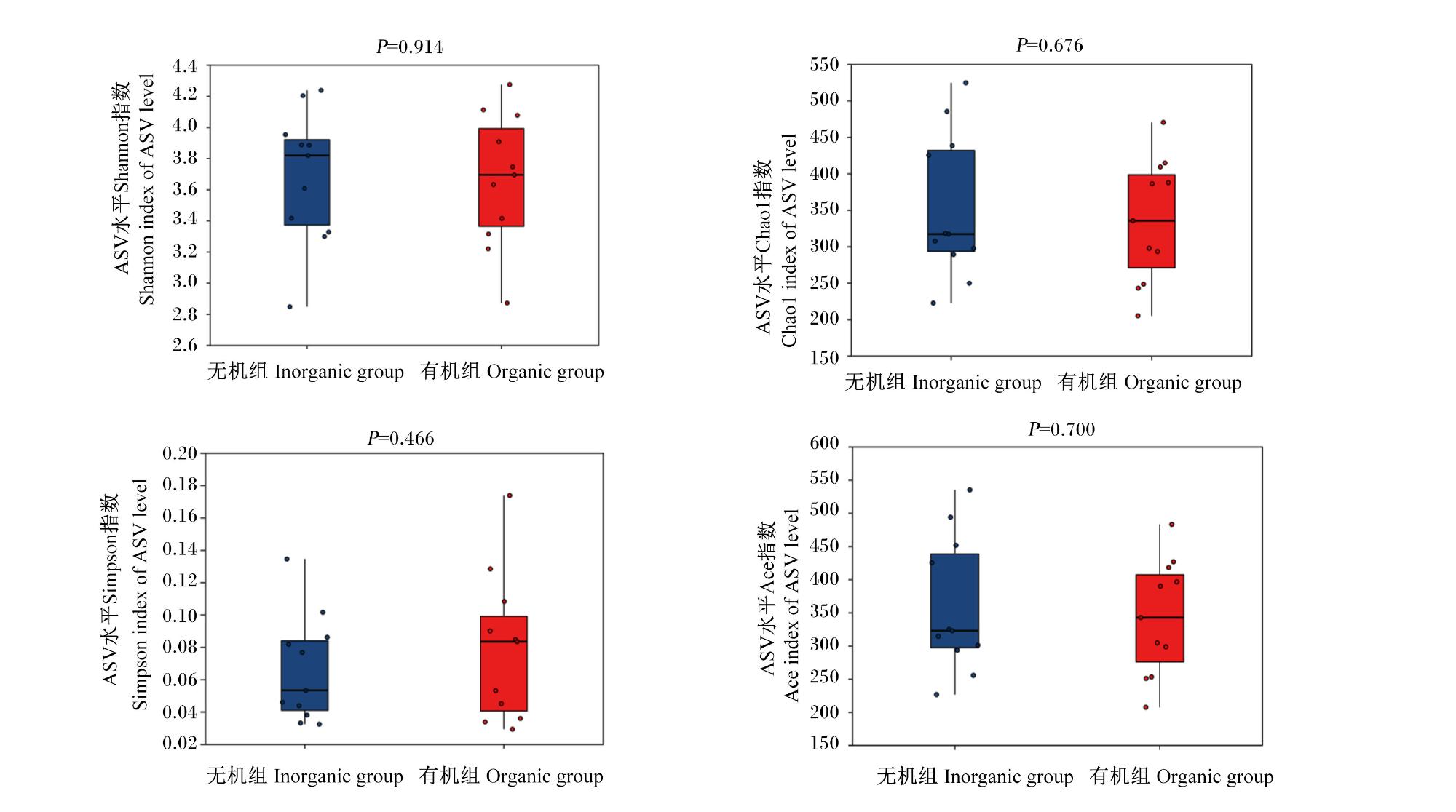
瘤胃微生物群落α多样性分析结果如图1所示。对Ace指数和Chao1指数(物种丰富度)、Shannon指数(物种多样性)及Simpson指数(物种优势度)进行统计分析,结果显示,有机组与无机组犊牛瘤胃微生物α多样性指数均无显著差异(P>0.05)。
图1 有机微量元素对哺乳犊牛瘤胃微生物α多样性的影响

Fig.1 Effects of organic trace elements on ruminal microbiota α-diversity of suckling calves

2.5.2 β多样性分析

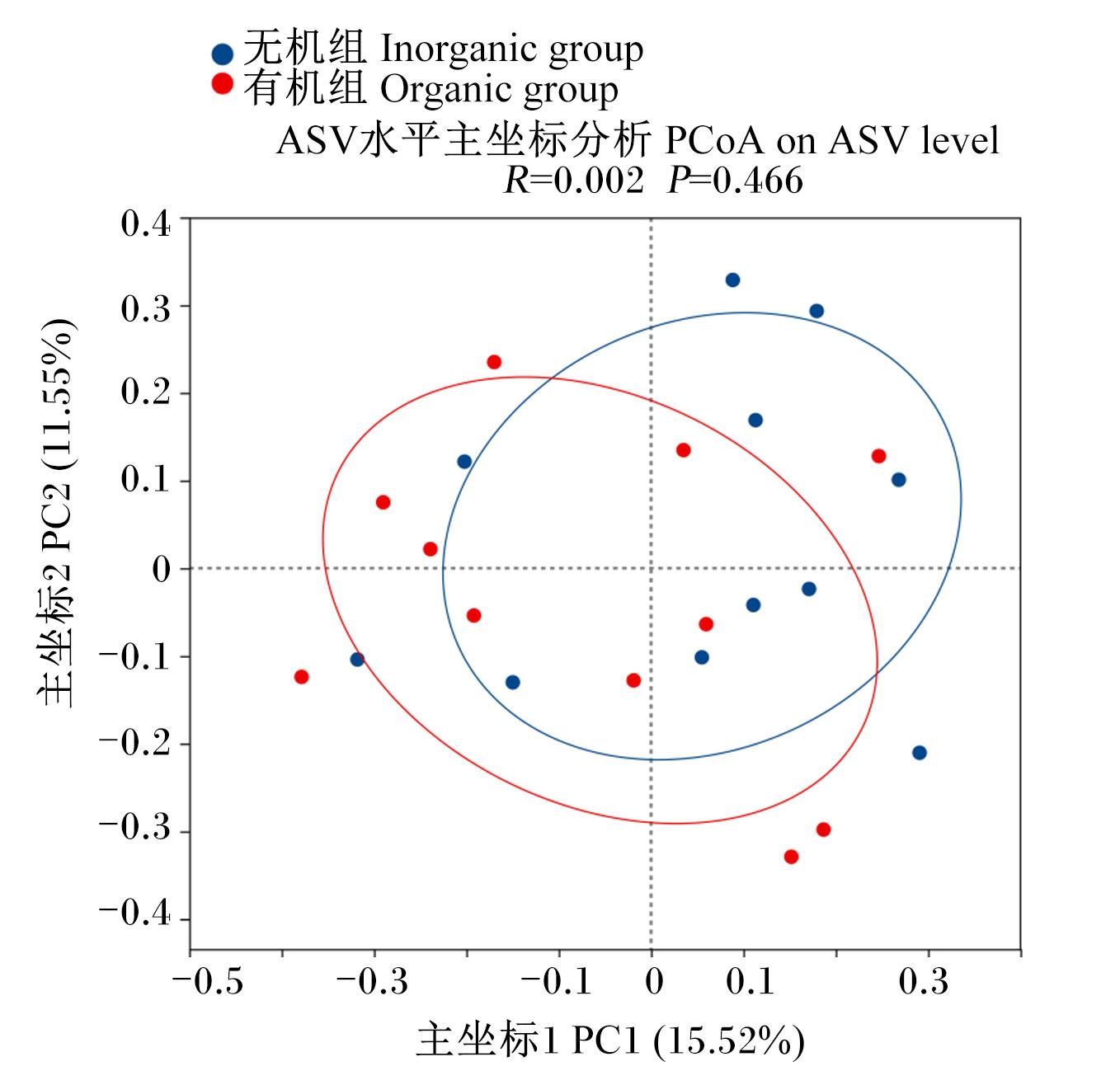
基于Bray-Curtis距离的主坐标分析(PCoA)结果如图2所示,无机组与有机组的样本点分布相互重叠,未呈现出明显的分离趋势。统计检验结果表明,2组犊牛瘤胃微生物群落结构无显著差异(P>0.05),说明开食料中添加不同形态的微量元素未对哺乳犊牛瘤胃微生物群落的整体结构产生显著影响。
图2 有机微量元素对哺乳犊牛瘤胃微生物β多样性的影响

Fig.2 Effects of organic trace elements on ruminal microbiota β-diversity of suckling calves

2.5.3 门水平瘤胃微生物组成

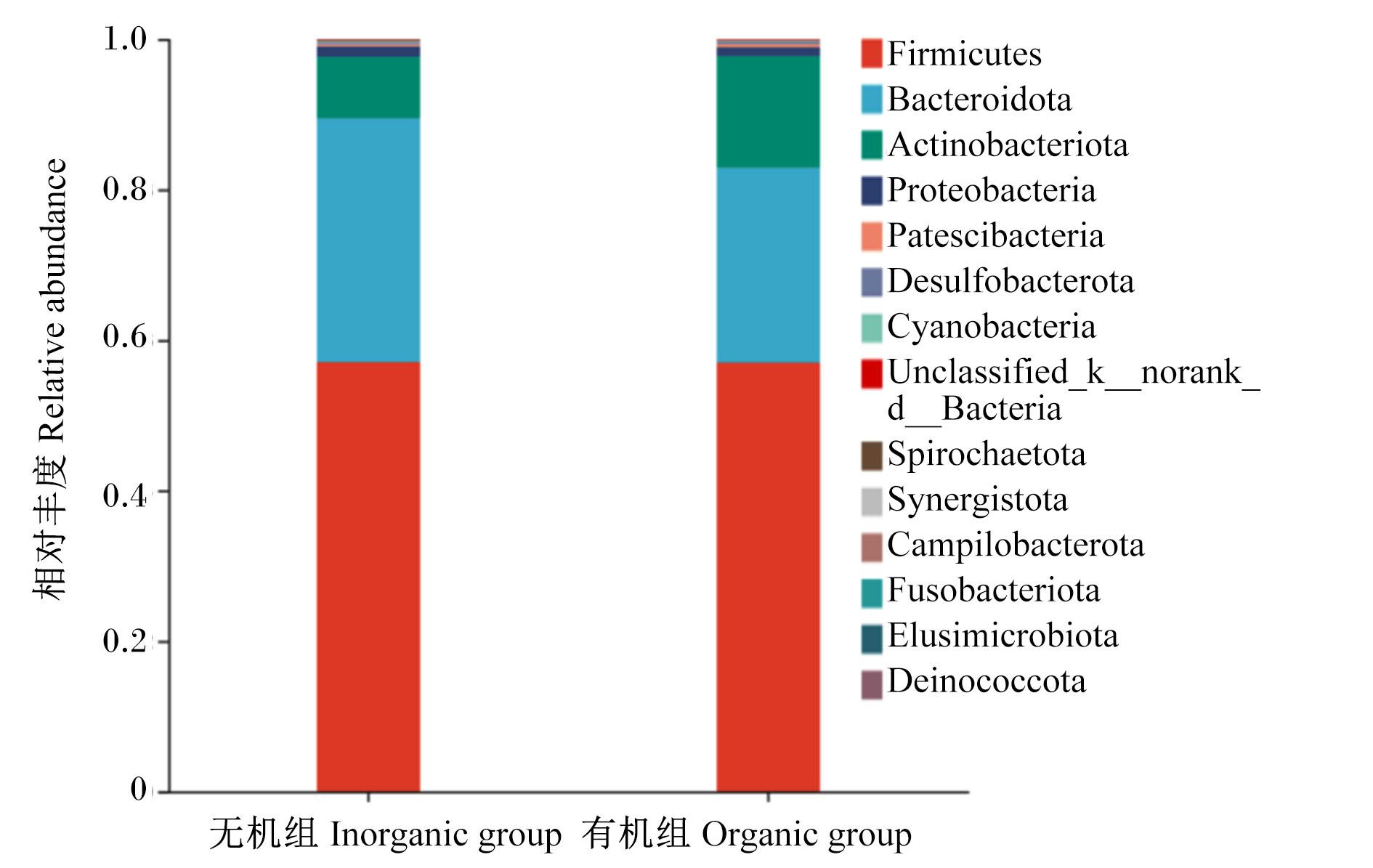
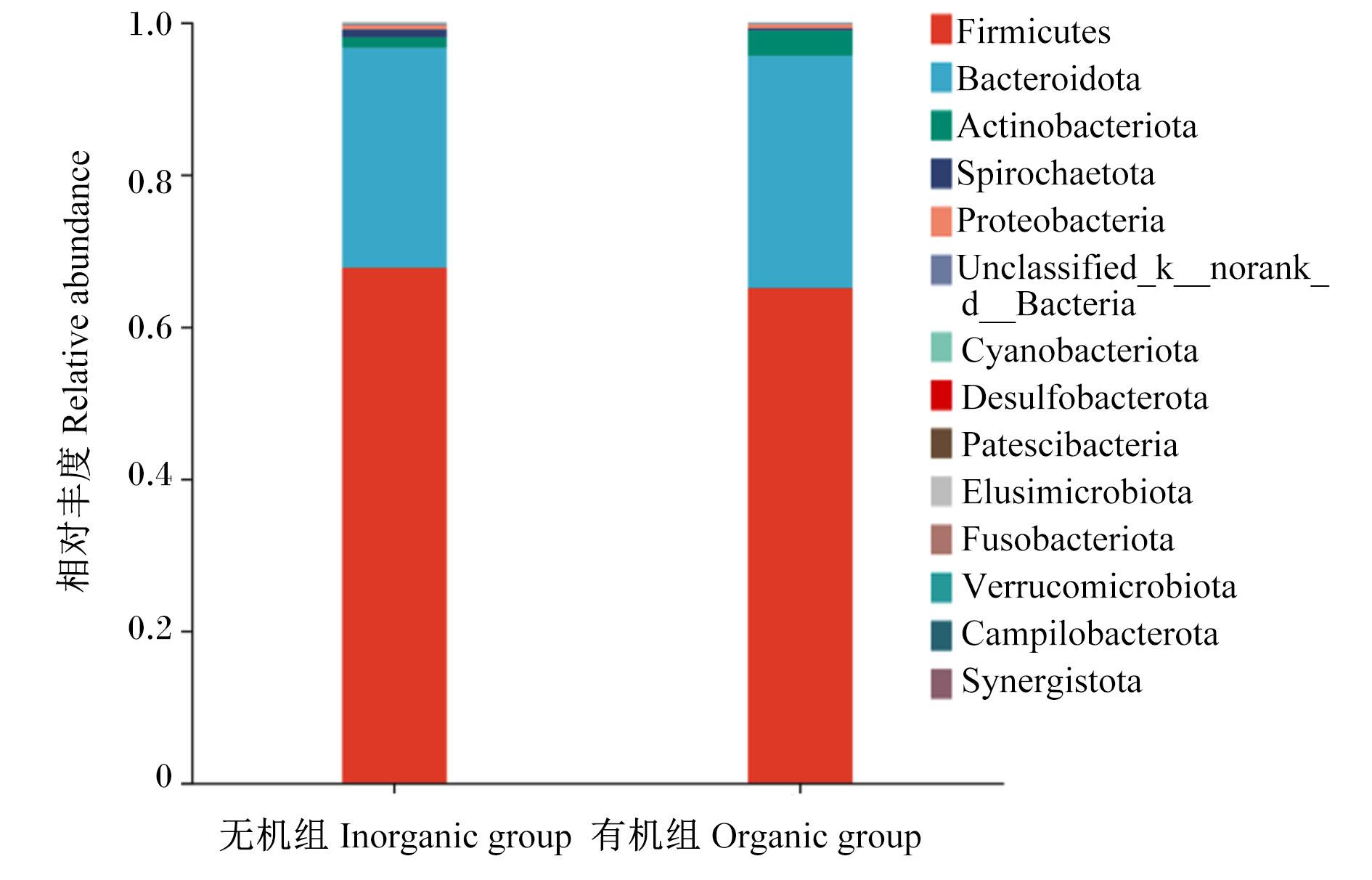
瘤胃微生物在门水平上的群落组成分析结果如图3所示。2组犊牛瘤胃微生物均以厚壁菌门(Firmicutes)和拟杆菌门(Bacteroidota)为绝对优势菌门。次要菌门包括放线菌门(Actinobacteriota)、变形菌门(Proteobacteria)和髌骨细菌门(Patescibacteria)等。由表6可知,有机组与无机组在各主要菌门的相对丰度上均无显著差异(P>0.05)。
图3 有机微量元素对哺乳犊牛瘤胃微生物门水平组成的影响

Firmicutes:厚壁菌门;Bacteroidota:拟杆菌门;Actinobacteriota:放线菌门;Proteobacteria:变形菌门;Patescibacteria:髌骨细菌门;Desulfobacterota:脱硫菌门;Cyanobacteria:蓝细菌门;Unclassified_k_norank_d_Bacteria:未分类界未定级细菌;Spirochaetota:螺旋体门;Synergistota:互养菌门;Campilobacterota:弯曲杆菌门;Fusobacteriota:梭杆菌门;Elusimicrobiota:迷踪菌门;Deinococcota:奇异球菌门。下图同 the same as below。

Fig.3 Effects of organic trace elements on ruminal microbiota composition at phylum level of suckling calves

表6 有机微量元素对哺乳犊牛瘤胃微生物门水平相对丰度的影响(前5)

Table 6 Effects of organic trace elements on relative abundance of ruminal microbiota at phylum level of suckling calves (top 5)%

项目
Items
无机组
Inorganic group
有机组
Organic group
均值标准误
SEM
P
P-value
厚壁菌门 Firmicutes 57.08 57.00 0.018 0.903
拟杆菌门 Bacteroidota 32.39 25.92 0.975 0.087
放线菌门 Actinobacteriota 8.20 14.83 0.989 0.091
变形菌门 Proteobacteria 1.35 1.14 0.032 0.524
髌骨细菌门 Patescibacteria 0.27 0.43 0.024 0.282

2.5.4 属水平瘤胃微生物组成

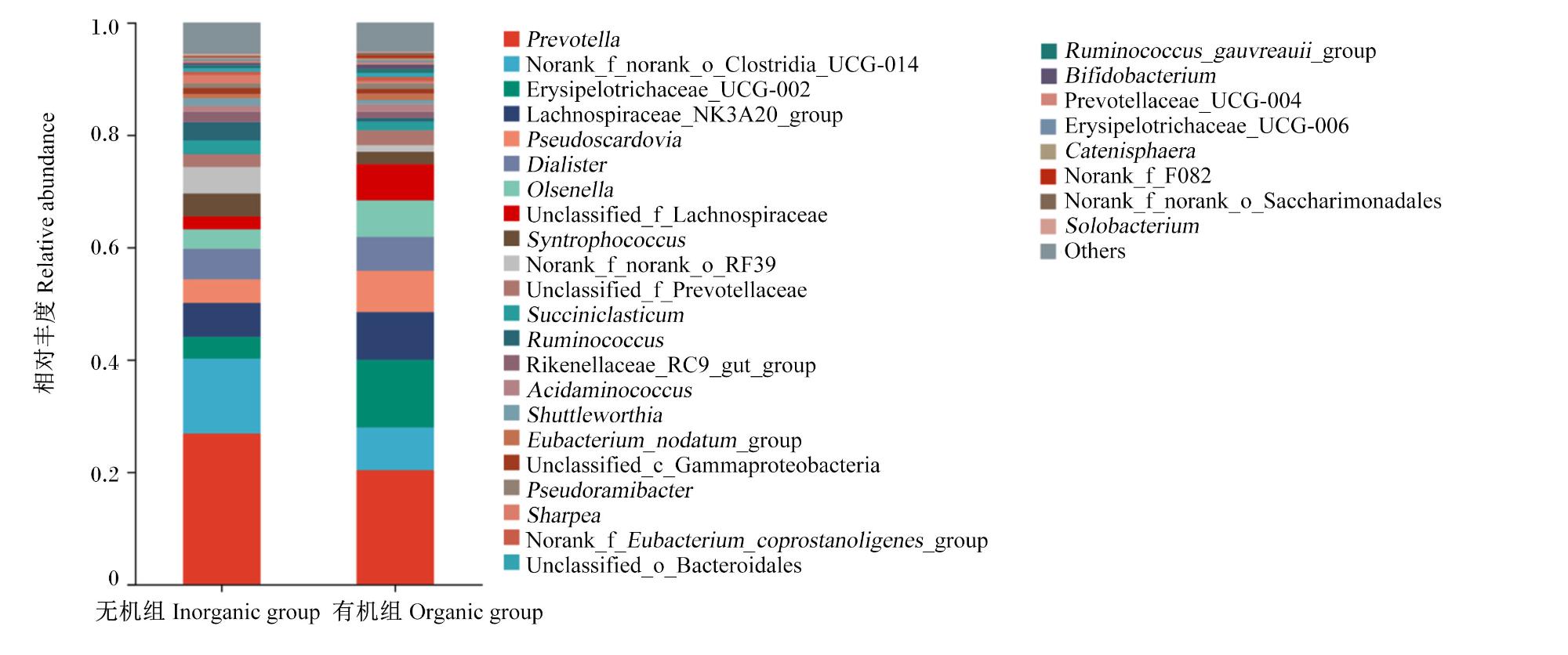
瘤胃微生物在属水平上的群落组成分析结果如图4所示。普雷沃氏菌属(Prevotella)、未定级梭菌纲UCG-014(norank_f_norank_o_Clostridia_UCG-014)、丹毒丝菌科UCG-002(Erysipelotrichaceae_UCG-002)、毛螺菌科NK3A20群(Lachnospiraceae_NK3A20_group)、假斯卡多维亚菌属(Pseudoscardovia)、奥尔森氏菌属(Olsenella)、小杆菌属(Dialister)及未分类毛螺菌科(unclassified_f_Lachnospiraceae)等为2组犊牛瘤胃中的优势菌属。由表7可知,与无机组相比,有机组瘤胃丹毒丝菌科UCG-002相对丰度显著升高(P<0.05),其余核心优势菌属的组间差异均未达到统计学显著水平(P>0.05)。
图4 有机微量元素对哺乳犊牛瘤胃微生物属水平组成的影响

Prevotella:普雷沃氏菌属;Norank_f_norank_o_Clostridia_UCG-014:未定级梭菌纲UCG-014;Erysipelotrichaceae_UCG-002:丹毒丝菌科UCG-002;Lachnospiraceae_NK3A20_group:毛螺菌科NK3A20群;Pseudoscardovia:假斯卡多维亚菌属;Dialister:小杆菌属;Olsenella:奥尔森氏菌属;Unclassified_f_Lachnospiraceae:未分类毛螺菌科;Syntrophococcus:互养球菌属;Norank_f_norank_o_RF39:未定级RF39目未定级科;Unclassified_f_Prevotellaceae:未分类普雷沃氏菌科;Succiniclasticum:解琥珀酸菌属;Ruminococcus:瘤胃球菌属;Rikenellaceae_RC9_gut_group:理研菌科RC9肠道群;Acidaminococcus:氨基酸球菌属;Shuttleworthia:沙特尔沃思氏菌属;Eubacterium_nodatum_group:结状真杆菌群;Unclassified_c_Gammaproteobacteria:未分类γ-变形菌纲;Pseudoramibacter:假拉姆杆菌属;Sharpea:沙普氏菌属;Norank_f_Eubacterium_coprostanoligenes_group:未定级产粪甾醇真杆菌群;Unclassified_o_Bacteroidales:未分类拟杆菌目;Ruminococcus_gauvreauii_group:戈氏瘤胃球菌群;Bifidobacterium:双歧杆菌属;Prevotellaceae_UCG-004:普雷沃氏菌科UCG-004;Erysipelotrichaceae_UCG-006:丹毒丝菌科UCG-006;Catenisphaera:链球状菌属;Norank_f_F082:未定级F082科;Norank_f_norank_o_Saccharimonadales:未定级糖单孢菌目;Solobacterium:莫雷氏菌属;Others:其他。下图同 the same as below。

Fig.4 Effects of organic trace elements on ruminal microbiota composition at genus level of suckling calves

表7 有机微量元素对哺乳犊牛瘤胃微生物属水平相对丰度的影响(前5)

Table 7 Effects of organic trace elements on relative abundance of ruminal microbiota at genus level of suckling calves (top 5)%

项目
Items
无机组
Inorganic group
有机组
Organic group
均值标准误
SEM
P
P-value
普雷沃氏菌属 Prevotella 26.85 20.31 1.952 0.209
未定级梭菌纲UCG-014
Norank_f_norank_o_Clostridia_UCG-014
13.32 7.59 1.764 0.106
丹毒丝菌科UCG-002
Erysipelotrichaceae_UCG-002
3.88 12.04 0.796 0.007
毛螺菌科NK3A20群
Lachnospiraceae_NK3A20_group
6.03 8.52 0.781 0.097
假斯卡多维亚菌属 Pseudoscardovia 4.20 7.35 0.762 0.063

2.6 有机微量元素对哺乳犊牛直肠微生物区系的影响

2.6.1 α多样性分析
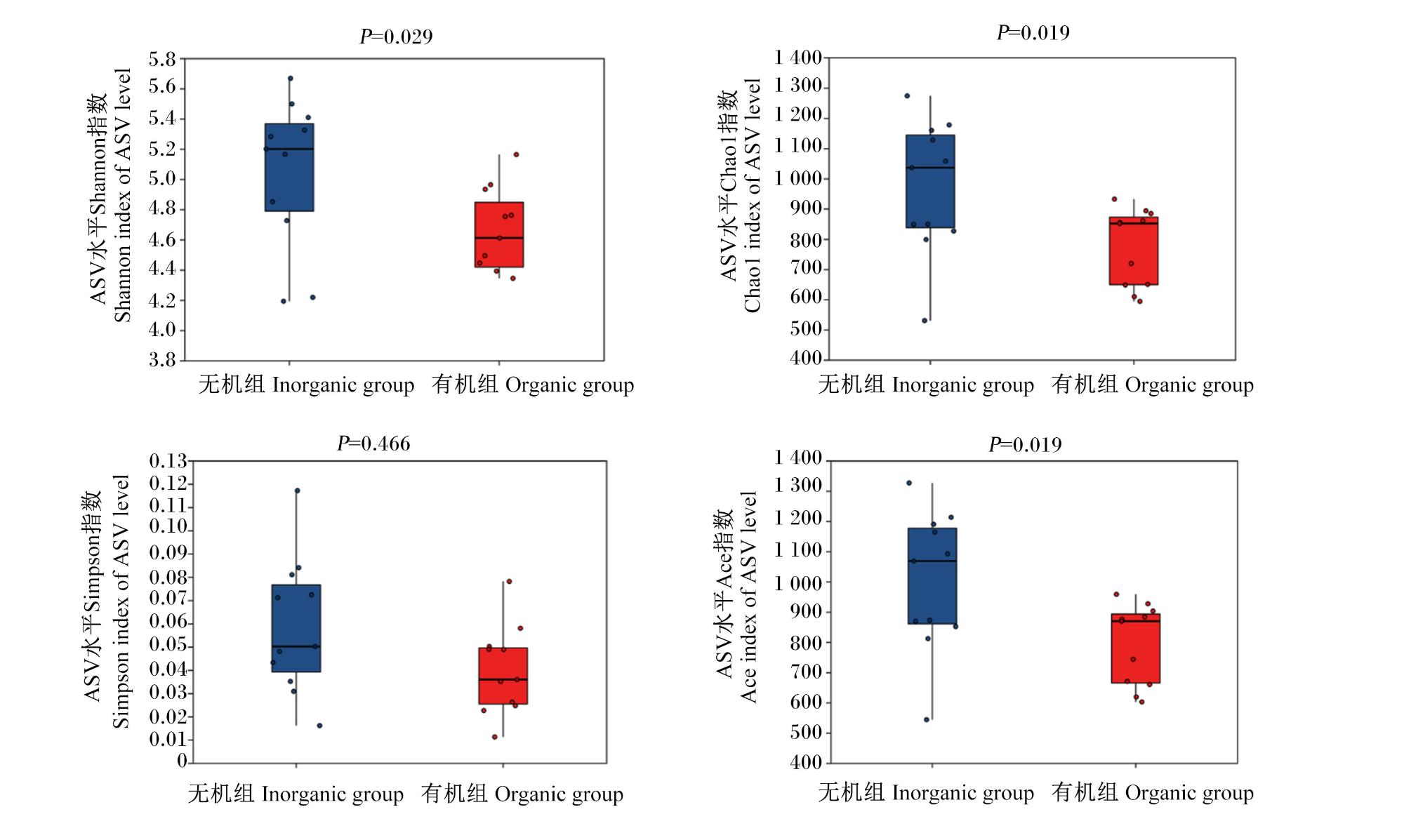
图5可知,与无机组相比,有机组犊牛直肠微生物Shannon指数、Chao1指数、Simpson指数和Ace指数均显著降低(P<0.05)。
图5 有机微量元素对哺乳犊牛直肠微生物α多样性的影响

Fig.5 Effects of organic trace elements on rectal microbiota α-diversity of suckling calves

2.6.2 β多样性分析

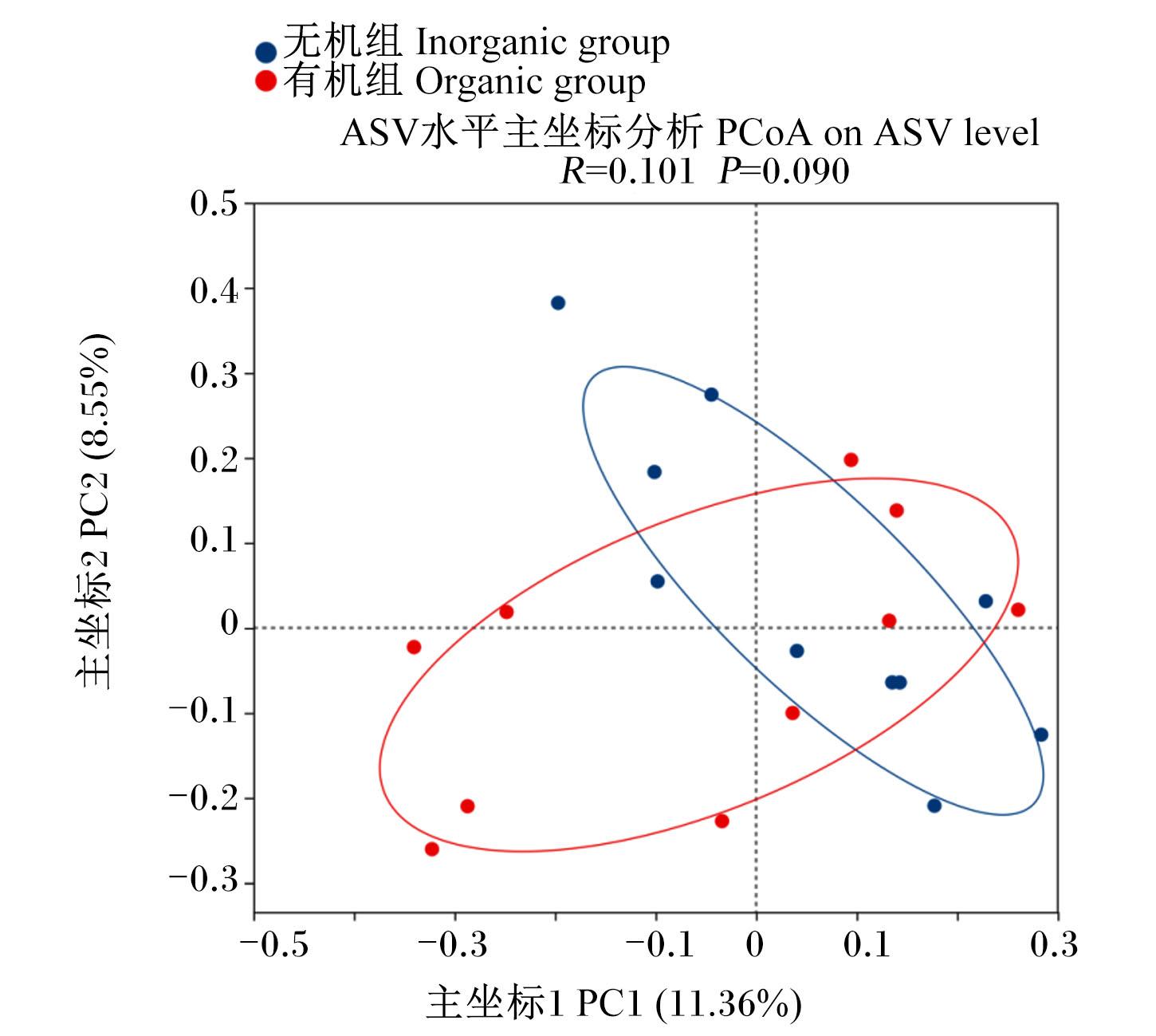
图6可知,2组样本点在坐标空间中呈现高度重叠分布,未呈现出明显的分离趋势,无机组与有机组的微生物群落结构无显著差异(P>0.05)。
图6 有机微量元素对哺乳犊牛直肠微生物β多样性的影响

Fig.6 Effects of organic trace elements on rectal microbiota β-diversity of suckling calves

2.6.3 门水平直肠微生物组成

直肠微生物在门水平上的群落组成分析结果如图7所示。2组犊牛直肠微生物均以厚壁菌门和拟杆菌门为绝对优势菌门,相对丰度合计超过95%。次要菌门包括放线菌门、螺旋体门(Spirochaetota)及变形菌门等。由表8可知,与无机组相比,有机组直肠微生物中放线菌门相对丰度显著提高(P<0.05),与肠道炎症密切相关的螺旋体门相对丰度显著降低(P<0.05),拟杆菌门相对丰度有升高的趋势(P=0.082)。
图7 有机微量元素对哺乳犊牛直肠微生物门水平组成的影响

Verrucomicrobiota:疣微菌门。

Fig.7 Effects of organic trace elements on rectal microbiota composition at phylum level of suckling calves

表8 有机微量元素对哺乳犊牛直肠微生物门水平相对丰度的影响(前5)

Table 8 Effects of organic trace elements on relative abundance of rectal microbiota at phylum level of suckling calves (top 5)%

项目
Items
无机组
Inorganic group
有机组
Organic group
均值标准误
SEM
P
P-value
厚壁菌门 Firmicutes 67.75 65.07 1.124 0.287
拟杆菌门 Bacteroidota 28.92 30.55 0.896 0.082
放线菌门 Actinobacteriota 1.37 3.32 0.215 0.011
螺旋体门 Spirochaetota 1.05 0.26 0.078 0.018
变形菌门 Proteobacteria 0.56 0.55 0.042 0.946

2.6.4 属水平直肠微生物组成

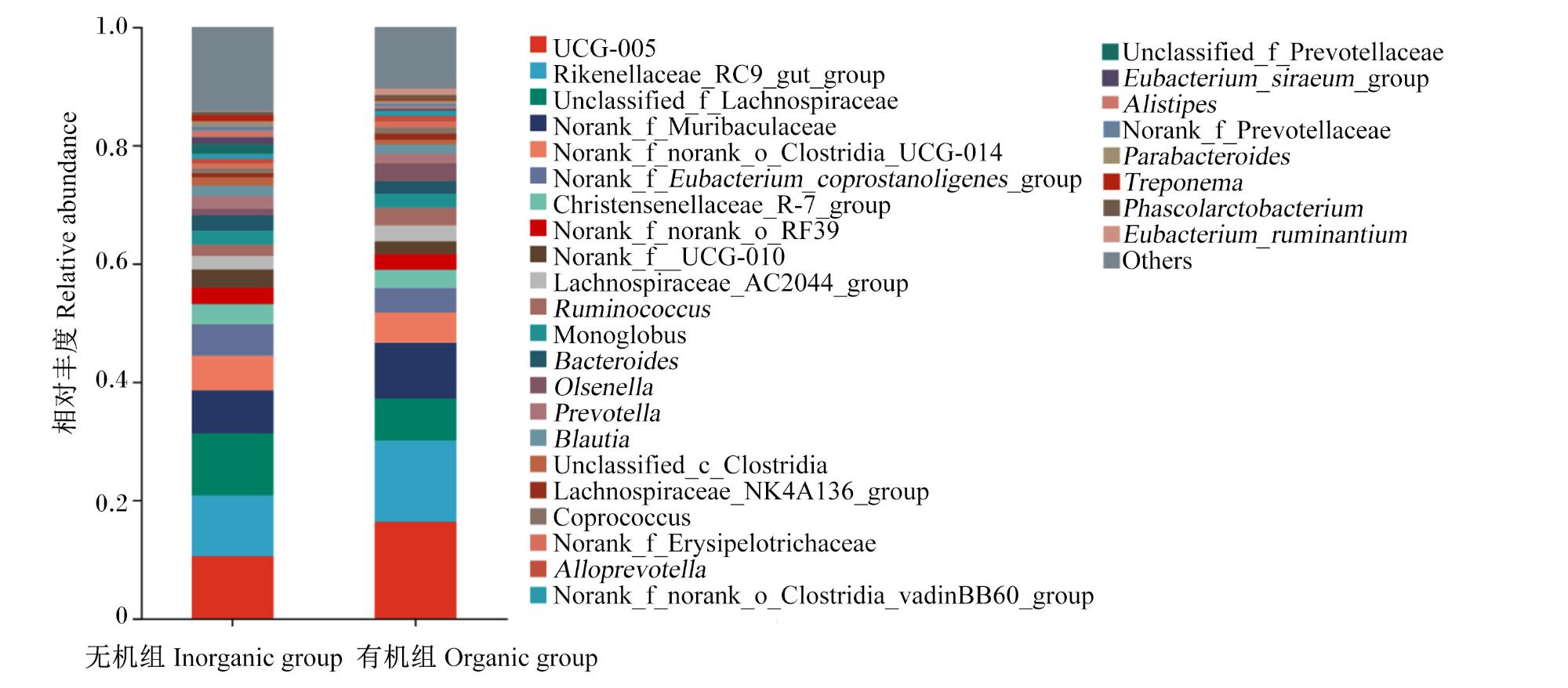
直肠微生物在属水平上的群落组成分析结果如图8所示。2组犊牛直肠微生物的优势菌属组成基本一致,均以UCG-005、理研菌科RC9肠道群(Rikenellaceae_RC9_gut_group)、未分类毛螺菌科(unclassified_f_Lachnospiraceae)及norank_f_Muribaculaceae为优势菌属。由表9可知,与无机组相比,有机组直肠微生物中纤维降解相关菌属理研菌科RC9肠道群、瘤胃球菌属(Ruminococcus)及益生菌属奥尔森氏菌属、拟杆菌属(Bacteroides)相对丰度显著提高(P<0.05),潜在致病菌密螺旋体属(Treponema)、别样杆菌属(Alistipes)及未分类梭菌纲(unclassified_c_Clostridia)相对丰度显著降低(P<0.05)。
图8 有机微量元素对哺乳犊牛直肠微生物属水平组成的影响

Christensenellaceae_R-7_group:克里斯滕森菌科R-7群;Lachnospiraceae_AC2044_group:毛螺菌科AC2044群;Monoglobus:单球菌属;Bacteroides:拟杆菌属;Blautia:布劳特氏菌属;Lachnospiraceae_NK4A136_group:毛螺菌科NK4A136群;Unclassified_c_Clostridia:未分类梭菌纲;Coprococcus:粪球菌属;Norank_f_Erysipelotrichaceae:未定级丹毒丝菌科;Alloprevotella:拟普雷沃氏菌属;Norank_f_norank_o_Clostridia_vadinBB60_group:未定级梭菌纲vadinBB60群;Norank_f_Prevotellaceae:未定级普雷沃氏菌科;Eubacterium_siraeum_group:西雷姆真杆菌群;Alistipes:别样杆菌属;Parabacteroides:副拟杆菌属;Treponema:密螺旋体属;Phascolarctobacterium:考拉杆菌属;Eubacterium_ruminantium:瘤胃真杆菌属。

Fig.8 Effects of organic trace elements on rectal microbiota composition at genus level of suckling calves

表9 有机微量元素对哺乳犊牛直肠差异菌属相对丰度的影响

Table 9 Effects of organic trace elements on relative abundance of rectal differential bacterial genera of suckling calves%

项目
Items
无机组
Inorganic group
有机组
Organic group
均值标准误
SEM
P
P-value
UCG-005 10.52 16.33 0.412 0.014
理研菌科RC9肠道群
Rikenellaceae_RC9_gut_group
10.26 13.74 0.301 0.032
瘤胃球菌属 Ruminococcus 1.92 2.99 0.087 0.010
拟杆菌属 Bacteroides 2.11 2.60 0.082 0.048
奥尔森氏菌属 Olsenella 1.11 3.05 0.079 0.009
未分类梭菌纲 Unclassified_c_Clostridia 1.40 0.79 0.051 0.041
别样杆菌属 Alistipes 1.07 0.35 0.024 0.023
密螺旋体属 Treponema 1.05 0.26 0.018 0.018

3 讨论

研究表明,幼龄反刍动物的瘤胃上皮发育尚未完善、微生物区系稳定性较差,其对微量元素的吸收、转化及利用能力远低于成熟反刍动物[9]。在此阶段,饲粮中的无机微量元素易在瘤胃中发生解离,与饲粮中植酸、纤维等形成不溶性复合物,从而降低其生物可利用性[10-11]。相比之下,有机微量元素凭借其稳定的螯合结构,能够在一定程度上“逃逸”瘤胃环境的降解,更完整地到达后肠道并被有效吸收[12]。本研究中,开食料中添加有机微量元素对犊牛后肠道微生物区系及生长性能的改善作用显著,而对瘤胃微生物群落结构的影响有限,这一结果与哺乳犊牛瘤胃发育尚不健全的生理特点密切相关。因此,在瘤胃功能尚未成熟的犊牛阶段,选择稳定性高、抗干扰能力强的有机微量元素,更有利于实现微量元素的高效利用与肠道健康的精准调控。
本研究结果表明,有机组犊牛直肠微生物α多样性指数较无机组显著降低,结合其他研究结果[13-15],该变化更可能反映了微生物群落的“功能优化”而非“多样性退化”。尽管有机组直肠微生物α多样性下降,但菌群结构呈现良性调整:纤维降解菌(理研菌科RC9肠道群、瘤胃球菌属)和益生菌(奥尔森氏菌属、拟杆菌属)的相对丰度显著升高,而潜在致病菌(如密螺旋体属)相对丰度显著降低。这表明,有机微量元素的添加可能为特定功能菌群创造了更为有利的生态位,使其竞争优势增强,进而抑制了其他非优势或潜在有害菌的定植,从而导致整体物种数量下降,但群落的功能性和稳定性得以提升。该现象符合关键物种主导并提升生态系统功能的生态学理论,即微生物群落的健康与否取决于其核心功能菌群的组成和功能,而非单纯的物种数量[16-17]。这种优化的肠道菌群结构直接驱动了犊牛肠道健康的改善。以纤维降解菌和益生菌为核心功能类群的更健康稳定的肠道微生态环境,对降低犊牛腹泻率起到了关键作用。该微生物层面的优化有效抑制了潜在致病菌的干扰,增强了肠道屏障功能与消化吸收能力,进而为养分高效利用与生长性能提升奠定了生理基础。本研究发现,试验第2阶段及全期,有机组犊牛的开食料干物质采食量显著高于无机组。这一结果是在所有犊牛摄入等量常乳的前提下获得的,排除了液体饲料摄入差异的干扰,从而有力证明了有机微量元素能够通过改善后肠道健康,有效促进哺乳犊牛对固体饲料的主动采食。在试验第1阶段,犊牛营养供给以液体乳为主,消化系统尚处于发育阶段,组间生长性能无显著差异;进入第2阶段后,随着消化系统逐步发育成熟,开食料采食量自然升高并成为主要营养来源。此时,有机组凭借显著更高的开食料干物质采食量,成功转化为显著更高的日增重。对于瘤胃功能尚未健全的哺乳犊牛,营养物质的主要吸收场所为真胃及小肠[18-20]。有机微量元素以稳定的螯合形式存在,可有效避免与饲粮中其他成分的拮抗反应,通过氨基酸或肽的特异性转运途径被小肠黏膜高效吸收[21-23]。这种高效吸收模式大幅减少了流向后肠道的未吸收金属离子,降低了对发育中结肠和直肠黏膜的化学刺激与氧化应激,为有机组犊牛腹泻率的降低提供了核心生理学依据[24],并与开食料干物质采食量和平均日增重的提升结果相互印证。此外,有机组犊牛体高和十字部高的显著增长提示有机微量元素在促进骨骼和软骨发育方面可能具有更高的生物活性,这与有机螯合微量元素可改善成骨细胞活性及代谢酶功能的报道[25]相符。
通过血清指标分析,能够从生理角度阐明犊牛生长性能得以改善的原因[26-27]。本研究中,有机组犊牛血清硒含量显著高于无机组,这是由于有机硒具有更高的生物利用度与吸收效率,能更有效地参与体内硒蛋白合成。相应地,有机组血清GSH-Px活性亦显著升高,进一步印证了有机硒在增强机体抗氧化防御系统中的积极作用。
与直肠微生物响应不同,本研究中瘤胃微生物α多样性、β多样性及各分类水平优势群落的组成未受到微量元素形态的显著影响。这一方面可能与哺乳期犊牛瘤胃发育尚不完善、微生物群落本身波动较大有关;另一方面,也提示有机微量元素的主要作用靶点并非瘤胃,而是后肠道。稳定的螯合结构使有机微量元素能够穿过瘤胃,主要在后肠道消化吸收并发挥其调控作用[28],这与其提高微量元素吸收效率、改善后肠道健康的结果相互印证。
本研究揭示了在哺乳期犊牛开食料中以有机微量元素替代无机微量元素的综合效果。其核心优势在于通过提高微量元素生物利用度,精准靶向后肠道,塑造一个以纤维降解菌和益生菌为主导、更健康稳定的肠道微生态环境。这种肠道微生态的优化,是降低犊牛腹泻率、改善生长性能的重要机制,表明有机微量元素在促进犊牛健康养殖方面具有巨大的应用潜力。

4 结论

与无机微量元素相比,在开食料中添加有机微量元素可通过优化后肠道菌群结构,有效降低哺乳犊牛腹泻率,并显著提高其开食料干物质采食量和平均日增重,促进骨骼发育。
[1]
KHAN M A, WEARY D M, VON KEYSERLINGK M A G. Invited review:effects of milk ration on solid feed intake,weaning,and performance in dairy heifers[J]. Journal of Dairy Science, 2011, 94(3):1071-1081.

DOI

[2]
SOBERON F, VAN AMBURGH M E. Lactation biology symposium:the effect of nutrient intake from milk or milk replacer of preweaned dairy calves on lactation milk yield as adults:a Meta-analysis of current data[J]. Journal of Animal Science, 2013, 91(2):706-712.

DOI

[3]
PANDEY P, KUMAR M, KUMAR V, et al. The dietary supplementation of copper and zinc nanoparticles improves health condition of young dairy calves by reducing the incidence of diarrhoea and boosting immune function and antioxidant activity[J]. Biological Trace Element Research, 2023, 201(8):3791-3803.

DOI

[4]
MILLER W J. Mineral and vitamin nutrition of dairy cattle[J]. Journal of Dairy Science, 1981, 64(6):1196-1206.

PMID

[5]
COSTELLO M, RUBINELLI P, BROWN J, et al. Comparison of yeast-derived commercial feed additives on Salmonella enteritidis survival and microbiota populations in rooster cecal in vitro incubations[J]. PLoS One, 2023, 18(12):e0295657.

DOI

[6]
KHATUN A, CHOWDHURY S D, ROY B C, et al. Comparative effects of inorganic and three forms of organic trace minerals on growth performance,carcass traits,immunity,and profitability of broilers[J]. Journal of Advanced Veterinary and Animal Research, 2019, 6(1):66-73.

[7]
MION B, OGILVIE L, VAN WINTERS B, et al. Effects of replacing inorganic salts of trace minerals with organic trace minerals in the pre- and postpartum diets on mineral status,antioxidant biomarkers,and health of dairy cows[J]. Journal of Animal Science, 2023,101:skad041.

[8]
MAGALHÃES V J A, SUSCA F, LIMA F S, et al. Effect of feeding yeast culture on performance,health,and immunocompetence of dairy calves[J]. Journal of Dairy Science, 2008, 91(4):1497-1509.

DOI

[9]
ZHANG K, ZHANG Y L, QIN J, et al. Early concentrate starter introduction induces rumen epithelial parakeratosis by blocking keratinocyte differentiation with excessive ruminal butyrate accumulation[J]. Journal of Advanced Research, 2024, 66:71-86.

DOI

[10]
ABDOUN K, ALSAGAN A, ALTAHIR O, et al. Cultivation and uses of Moringa oleifera as non-conventional feed stuff in livestock production:a review[J]. Life, 2023, 13(1):63.

DOI

[11]
MUHAMMAD A I, DALIA A A M, HEMLY N I M, et al. Biofortified bacteria:the role of selenium-enriched microorganisms in enhancing animal selenium uptake-a review[J]. Journal of Animal Physiology and Animal Nutrition, 2025, 109(6):1298-1320.

DOI

[12]
JIAO J Z, HUANG J Y, ZHOU C S, et al. Taxonomic identification of ruminal epithelial bacterial diversity during rumen development in goats[J]. Applied and Environment Microbiology, 2015, 81(10):3502-3509.

DOI

[13]
KOENIG J E, SPOR A, SCALFONE N, et al. Succession of microbial consortia in the developing infant gut microbiome[J]. Proceedings of the National Academy of Sciences of the United States of America, 2011, 108(S1):4578-4585.

[14]
XU X Y, ZHOU Z W, ZHOU Z Q, et al. Effect of Lactiplantibacillus plantarum N-1 and isomaltose-oligosaccharide on promoting growth performance and modulating the gastrointestinal microbiota in newborn Hu sheep[J]. Animal Microbiome, 2025, 7(1):25.

DOI

[15]
FERRARIO C, STATELLO R, CARNEVALI L, et al. How to feed the mammalian gut microbiota:bacterial and metabolic modulation by dietary fibers[J]. Frontiers in Microbiology, 2017, 8:1749.

DOI

[16]
WANG X W, SUN Z, JIA H J, et al. Identifying keystone species in microbial communities using deep learning[J]. Nature Ecology & Evolution, 2024, 8(1):22-31.

[17]
JIAO J Y, LIU L, HUA Z S, et al. Microbial dark matter coming to light:challenges and opportunities[J]. National Science Review, 2021, 8(3):nwaa280.

[18]
KERTZ A F, HILL T M, QUIGLEY J D, et al. A 100-year review:calf nutrition and management[J]. Journal of Dairy Science, 2017, 100(12):10151-10172.

DOI

[19]
ANSIA I, STEIN H H, BRØKNER C, et al. Nutrient digestibility and endogenous protein losses in the foregut and small intestine of weaned dairy calves fed calf starters with conventional or enzyme-treated soybean meal[J]. Journal of Dairy Science, 2021, 104(3):2979-2995.

DOI PMID

[20]
BURAKOWSKA K, PENNER G B, FLAGA J, et al. Canola meal or soybean meal as protein source and the effect of microencapsulated sodium butyrate supplementation in calf starter mixture.Ⅱ.Development of the gastrointestinal tract[J]. Journal of Dairy Science, 2021, 104(6):6663-6676.

DOI

[21]
SRIVASTAVA A, DUMPALA R M R, KUMAR P, et al. Chemical and redox speciation of uranyl with three environmentally relevant bifunctional chelates:multi-technique approach combined with theoretical estimations[J]. Inorganic Chemistry, 2022, 61(39):15452-15462.

DOI

[22]
ABU-DIEF A M, EL-KHATIB R M, ALJOHANI F S, et al. Synthesis,structural elucidation,DFT calculation,biological studies and DNA interaction of some aryl hydrazone Cr3+,Fe3+,and Cu2+ chelates[J]. Computational Biology and Chemistry, 2022, 97:107643.

DOI

[23]
WANG S C, WU S J, ZHANG Y W, et al. Effects of different levels of organic trace minerals on oxidative status and intestinal function in weanling piglets[J]. Biological Trace Element Research, 2023, 201(2):720-727.

DOI

[24]
沃野千里. 有机锌源对荷斯坦犊牛生长性能、锌代谢、抗氧化及免疫功能的影响[D]. 硕士学位论文. 北京: 中国农业科学院, 2022.

WO Y Q L. Effects of organic zinc sources on growth performance,zinc metabolism,antioxidant and immune function in Holstein dairy calves[D]. Master’s Thesis. Beijing: Chinese Academy of Agricultural Sciences, 2022. (in Chinese)

[25]
WANG J, HUANG Z W, LI S M, et al. Maternal supplementation of collagen peptide chelated trace elements enhances skeletal muscle development in chicks[J]. Biological Trace Element Research, 2025, 203(7):3860-3869.

DOI

[26]
HUANG W J, YANG J Z, LI X, et al. Organic trace mineral source enhances the bioavailability,health status,and gut microbiota community in white shrimp (Penaeus vannamei)[J]. Biology, 2025, 14(5):540.

DOI

[27]
EID S Y, EMARA S S, SHARAF A K, et al. Immuno-physiological role of exogenous enzymes supplementation in heat stressed growing calves[J]. Scientific Reports, 2024, 14(1):27865.

DOI

[28]
AMMERMAN C B, MILLER S M. Selenium in ruminant nutrition:a review[J]. Journal of Dairy Science, 1975, 58(10):1561-1577.

DOI

文章导航

/