研究论文

不同酶菌混合添加对甘蔗梢青贮水牛体外瘤胃发酵参数及微生物组成的影响

  • 廖品凤 , 1 ,
  • 曾繁泉 1 ,
  • 李孟伟 1 ,
  • 吕韬 1 ,
  • 白海玉 1 ,
  • 王克耀 1 ,
  • 兰海蕉 2 ,
  • 杨承剑 1 ,
  • 彭丽娟 , 1, 3, *
展开
  • 1 广西壮族自治区水牛研究所, 农业农村部(广西)水牛遗传繁育重点实验室, 南宁 530001
  • 2 广西南宁康泰尔生物科技有限公司, 南宁 530001
  • 3 非粮生物质能技术全国重点实验室, 南宁 530001
*彭丽娟,高级畜牧师,E-mail:

廖品凤(1997—),女,广西合浦人,硕士,从事动物营养与饲料科学研究。E-mail:

Office editor: 武海龙

收稿日期: 2025-10-29

  网络出版日期: 2026-05-14

基金资助

国家重点研发计划项目(2024YFD1301304-2)

广西自然科学基金项目(2023GXNSFAA026424)

非粮生物质能技术全国重点实验室开放课题(SKL-NFBET-2026-17)

Effects of Mixed Addition of Different Enzymes and Bacteria on in Vitro Rumen Fermentation Parameters and Microbial Composition of Sugarcane Top Silage in Buffalo

  • LIAO Pinfeng , 1 ,
  • ZENG Fanquan 1 ,
  • LI Mengwei 1 ,
  • LYU Tao 1 ,
  • BAI Haiyu 1 ,
  • WANG Keyao 1 ,
  • LAN Haijiao 2 ,
  • YANG Chengjian 1 ,
  • PENG Lijuan , 1, 3, *
Expand
  • 1 Key Laboratory of Buffalo Genetics, Breeding and Reproduction Technology, Ministry of Agriculture and Rural Affairs (Guangxi), Guangxi Buffalo Research Institute, Nanning 530001, China
  • 2 Guangxi Nanning Kangtel Biotechnology Co., Ltd., Nanning 530001, China
  • 3 State Key Laboratory of Non-Food Biomass Energy Technology, Nanning 530001, China
*senior engineer, E-mail:

Received date: 2025-10-29

  Online published: 2026-05-14

摘要

本试验旨在研究不同酶菌混合添加对甘蔗梢青贮水牛体外瘤胃发酵参数及微生物组成的影响。以植物乳杆菌、戊糖片球菌、纤维素酶、木聚糖酶和葡萄糖氧化酶5种不同的添加剂通过5因素3水平正交设计法混合添加进甘蔗梢青贮,筛选出6个较优的甘蔗梢青贮(T1~T6组)用于水牛瘤胃体外发酵试验。结果表明:1)T3组的产气量显著高于除T4组外的其他各组(P<0.05),T3和T4组的氢气产量显著高于其他各组(P<0.05),T5和T6组的乙酸和总挥发性脂肪酸含量显著高于其他各组(P<0.05),T6组的氨态氮含量显著低于T1、T2和T5组(P<0.05)。2)T4组的厚壁菌门相对丰度显著高于除T5组外的其他各组(P<0.05),T1、T2和T3组的拟杆菌门相对丰度显著高于T4、T5和T6组(P<0.05)。T4组的琥珀酸菌属相对丰度显著高于其他各组(P<0.05),T2组的理研菌科RC9肠道群相对丰度显著高于其他各组(P<0.05),T3组的普雷沃氏菌属相对丰度显著高于其他各组(P<0.05),T4和T6组的反刍杆菌属相对丰度显著高于其他各组(P<0.05)。3)乙酸含量与反刍杆菌属相对丰度呈极显著正相关(P<0.01),氨态氮含量与理研菌科RC9肠道群相对丰度呈显著正相关(P<0.05)。综上所述,不同酶菌混合添加对甘蔗梢青贮体外瘤胃发酵参数及微生物组成有一定的影响,T3组的甘蔗梢青贮瘤胃发酵品质和发酵特性较好。

本文引用格式

廖品凤 , 曾繁泉 , 李孟伟 , 吕韬 , 白海玉 , 王克耀 , 兰海蕉 , 杨承剑 , 彭丽娟 . 不同酶菌混合添加对甘蔗梢青贮水牛体外瘤胃发酵参数及微生物组成的影响[J]. 动物营养学报, 2026 , 38(5) : 3810 -3822 . DOI: 10.12418/CJAN2026.304

Abstract

The aim of this study was to investigate the effects of mixed addition of different enzymes and bacteria on in vitro rumen fermentation parameters and microbial composition sugarcane top silage in buffalo. The 5 different additives of Lactobacillus plantarum, Pediococcus pentosaceus, cellulase, xylanase and glucose oxidase were mixed into sugarcane top silage by a 5-factor and 3-level orthogonal design method, and six better sugarcane top silage (groups T1 to T6) were selected for the in vitro rumen fermentation experiment of buffalo. The results showed as follows: 1) the gas production of T3 group was significantly higher than that of other groups except group T4 (P<0.05), the hydrogen production of groups T3 and T4 was significantly higher than that of other groups (P<0.05), the acetic acid and total volatile fatty acids contents of groups T5 and T6 were significantly higher than those of other groups (P<0.05), and the ammonia nitrogen content of group T6 was significantly lower than that of groups T1, T2 and T5 (P<0.05). 2) The Firmicutes relative abundance of group T4 was significantly higher than that of other groups except group T5 (P<0.05), and the Bacteroidetes relative abundance of groups T1, T2 and T3 was significantly higher than that of other groups T4, T5 and T6 (P<0.05). The Succiniclasticum relative abundance of group T4 was significantly higher than that of other groups (P<0.05), the Rikenellaceae_RC9_gut_group relative abundance of group T2 was significantly higher than that of other groups (P<0.05), the Prevotella relative abundance of group T3 was significantly higher than that of other groups (P<0.05), and the Ruminobacter relative abundance of groups T4 and T6 was significantly higher than that of other groups (P<0.05). 3) The acetic acid content was extremely significantly positively correlated with the Ruminobacter relative abundance (P<0.01), and the ammonia nitrogen content was significantly positively correlated with Rikenellaceae_RC9_gut_group (P<0.05). In conclusion, the mixed addition of different enzymes and bacteria have a certain effect on in vitro rumen fermentation parameters and microbial composition of sugarcane top silage, the rumen fermentation quality and fermentation characteristics of sugarcane top silage of group T3 are better.

甘蔗梢是甘蔗收成后产生的农副产品,含有丰富的碳水化合物和蛋白质,可用于饲喂反刍动物,是奶水牛粗饲料的重要来源。甘蔗梢在冬季大量产生,适口性差,容易霉变和变质,面临资源浪费。青贮可以降低甘蔗梢中的木质纤维素含量,更好地储存和运输,提高适口性,同时减少资源浪费。甘蔗梢青贮技术比较成熟,但存在厌氧菌发酵、酵母生长繁殖问题,导致青贮品质不稳定,因此会通过添加额外的添加剂如微生物制剂、酶制剂等来提高青贮质量。近年来,酶菌联合处理被广泛应用于改善粗饲料的青贮品质和瘤胃降解率。青贮发酵初期接种乳酸菌(lactic acid bacteria,LAB),可使LAB成为青贮中优势菌,LAB快速繁殖且产生大量乳酸,从而建立酸性厌氧环境,抑制梭菌、霉菌等有害微生物繁殖,使得青贮饲料品质有效改善。植物乳杆菌和戊糖片球菌均属于同型发酵LAB,其主要代谢产物是乳酸[1],相比异型发酵LAB,同型发酵LAB产酸速率更高、干物质(dry matter,DM)含量损失更少[2-3]。戊糖片球菌是青贮过程中的固有菌种,能显著提高青贮发酵速率,改善青贮饲料的品质[3-4]。甘蔗梢青贮发酵初期,由于LAB发酵的底物不充足,单独添加LAB制剂效果不够好,因此LAB制剂和酶制剂组合使用,可以促进LAB生长繁殖。纤维素酶不仅能够将纤维素分解为水溶性碳水化合物,为LAB发酵补充底物,还能够降解细胞壁成分,使饲料中的营养成分更易被动物消化吸收[5-6]。木聚糖酶将木聚糖水解为木糖,提高微生物发酵底物浓度,促进微生物发酵以及甘蔗梢青贮发酵,同时降低半纤维素含量,提高青贮饲料纤维利用率[7]。葡萄糖氧化酶能利用氧气将β-D-葡萄糖氧化,生成葡萄酸和过氧化氢,起到酸化、氧化的作用,能促进LAB繁殖,抑制有害菌生长,以保证青贮品质[8-9]
研究表明,纤维素酶和LAB协同处理能够改善苎麻和象草混合青贮的青贮特性[10]。LAB和纤维素酶可以发挥细菌-酶协同作用,形成以LAB为主的共生微生物网络系统[11]。研究表明,酶菌协同处理相比于只添加枯草芽孢杆菌和乳酸杆菌,可以提高水稻秸秆的营养价值,显著增加瘤胃发酵的产气量,显著提高各挥发性脂肪酸(volatile fatty acids,VFA)和总挥发性脂肪酸(total volatile fatty acids,TVFA)产量[12]。研究表明,添加干酪乳杆菌TH14、纤维素酶和糖蜜提高了甘蔗梢青贮的饲料品质,促进了瘤胃气体的产生、体外消化率和瘤胃发酵[13-14]。以上研究表明,酶菌协同在一定程度上可提高青贮品质以及体外发酵品质。然而,关于酶菌混合添加处理的甘蔗梢青贮对水牛瘤胃微生物和发酵特性影响的研究仍较少。因此,本研究通过正交试验筛选出6组较优的甘蔗梢青贮,采用体外瘤胃发酵模型评估其对水牛体外瘤胃发酵参数及微生物组成的影响,以期为甘蔗梢的高效利用和水牛营养调控提供理论依据。

1 材料与方法

1.1 试验设计

试验所用甘蔗梢青贮由广西壮族自治区水牛研究所采用不同酶菌混合处理后所得,采用5因素3水平正交设计(表1),根据正交设计筛选出的6个较优的组合用于甘蔗梢青贮体外瘤胃发酵试验(表2)。瘤胃液采自广西壮族自治区水牛研究所种畜场3只健康状况良好、装有永久瘤胃瘘管的成年母水牛。
表1 甘蔗梢青贮酶菌混合正交设计

Table 1 Orthogonal design of bacteria and enzymes mixture of sugarcane top silage

项目
Items
添加水平 Supplemental level
1 2 3
植物乳杆菌 Lactobacillus plantarum/(CFU/g) 1×10⁵ 1×10⁶ 1×10⁷
戊糖片球菌 Pediococcus pentosaceus/(CFU/g) 1×10⁵ 1×10⁶ 1×10⁷
纤维素酶 Cellulase/(U/g) 1×10⁴ 2×10⁴ 3×10⁴
木聚糖酶 Xylanase/(U/g) 1×10⁴ 2×10⁴ 3×10⁴
葡萄糖氧化酶 Glucose oxidase/% 0.1 0.2 0.3
表2 甘蔗梢青贮体外瘤胃发酵试验设计

Table 2 Experimental design of in vitro rumen fermentation of sugarcane top silage

项目
Items
组别 Groups
T1 T2 T3 T4 T5 T6


添加水平
Supplemental level
植物乳杆菌 Lactobacillus plantarum 3 3 1 1 1 1
戊糖片球菌 Pediococcus pentosaceus 2 1 3 2 3 1
纤维素酶 Cellulase 1 3 2 2 3 3
木聚糖酶 Xylanase 3 2 2 2 3 3
葡萄糖氧化酶 Glucose oxidase 1 3 1 2 3 2

1.2 体外瘤胃发酵

体外培养前1天,向各发酵瓶中准确称取底物1 g(精料∶甘蔗梢青贮风干样=2∶8),每个样品设6个重复,每批次培养设3个空白(即只注入发酵培养液),接种缓冲液40 mL,通入二氧化碳(CO2)2~3 min后密封,放入39 ℃恒温箱保存,缓冲液配制参照甘洁[15]的方法。参照Marrez等[16]的方法,于晨饲前取瘘管牛瘤胃液4层100目尼龙纱布过滤,后按照与缓冲液1∶2的比例接种瘤胃液,全程通CO2保持厌氧环境,39 ℃恒温培养72 h。试验开始后分别记录和收集3、6、9、12、24、36、48、72 h的累积产气量。

1.3 样品采集

发酵结束后,发酵液用100目尼龙纱布过滤,测量滤液pH、VFA含量、氨态氮(NH3-N)含量和微生物多样性。将过滤后残渣与尼龙纱布一起65 ℃烘干,用于干物质消化率(dry matter digestibility,DMD)的测定。

1.4 指标检测

1.4.1 DMD

样品和发酵后残渣中DM含量参照GB/T 6435—2014的方法。DMD计算公式如下:

DMD(%)=[(样品中DM含量-降解后

残渣中DM含量)/样品中DM含量]×100。

1.4.2 发酵参数

pH采用pH计(PH8180-0-00,东莞万创电子制品有限公司)测定;参照Xie等[17]的方法测定,产气量采用注射器直接测量,氢气(H2)、甲烷(CH4)产量采用气相色谱(Agilent 8860,安捷伦科技有限公司)测定;有机酸含量参照Xie等[18]的方法,采用高效液相色谱仪(Agilent 1260,安捷伦科技有限公司)测定;NH3-N含量采用苯酚-次氯酸钠比色法[19]测定。

1.4.3 微生物多样性

发酵液总微生物DNA提取采用CTAB法[20]提取,利用16S V3~V4区的引物(338F:ACTCCTACGGGAGGCAGCAG;806R:GGACTACHVGGGTWTCTAAT)对DNA进行扩增。利用Illumina MiSeq PE300平台(上海美吉生物医药科技有限公司)对提纯、定量的DNA进行测序。使用FASTP软件(version 0.20.0)、FLASH软件(version 1.2.7)、QIIME 2软件(version 2024)对原始序列进行数据处理。使用美吉生物云平台(https://cloud.majorbio.com)对处理后的数据进行生物信息学分析。

1.5 数据统计

采用SPSS 26.0软件进行单因素方差分析,Duncan氏法进行多重比较,结果以“平均值±标准差”表示,P<0.05表示差异显著。

2 结果

2.1 不同酶菌混合添加对甘蔗梢青贮体外瘤胃发酵参数的影响

表3可见,各组之间DMD、CH4产量及丙酸(propionic acid,PA)、丁酸(butyric acid,BA)含量均差异不显著(P>0.05)。T3组的产气量最高,显著高于除T4组外的其他各组(P<0.05)。T3和T4组的H2产量显著高于其他各组(P<0.05)。T1组的pH最高,T4组的pH最低,各组pH均处于正常水平。T5和T6组的TVFA、乙酸(acetic acid,AA)含量显著高于其他各组(P<0.05),且T4组的TVFA、AA含量显著高于T1、T2和T3组(P<0.05)。T6组的NH3-N含量最低,与T3和T4组差异不显著(P>0.05),显著低于T1、T2和T5组(P<0.05)。
表3 不同酶菌混合添加对甘蔗梢青贮体外瘤胃发酵参数的影响

Table 3 Effects of mixed addition of different enzymes and bacteria on in vitro rumen fermentation parameters of sugarcane top silage

项目
Items
组别 Groups P
P-value
T1 T2 T3 T4 T5 T6
干物质消化率
DMD/%
50.59
±1.68
49.03
±1.28
49.84
±1.03
49.17
±1.53
51.36
±1.98
49.72
±1.01
0.146
产气量
Gas/(mL/g)
126.20
±2.95d
127.60
±2.07d
134.00
±2.45a
133.6
±1.95ab
130.80
±1.10bc
128.80
±2.68cd
<0.001
氢气
H2/(mL/g)
3.96
±0.35c
3.06
±0.38d
8.26
±0.81a
7.47
±0.86b
4.50
±0.23c
4.58
±0.26c
<0.001
甲烷
CH4/(mL/g)
26.66
±2.40
27.99
±0.56
28.09
±2.85
28.91
±1.34
26.97
±2.74
26.52
±1.08
0.384
pH 5.83
±0.04a
5.82
±0.03ab
5.75
±0.04abc
5.60
±0.14c
5.63
±0.18bc
5.65
±0.20bc
0.026
乙酸
AA /(mmol/L)
18.31
±0.37c
18.46
±0.43c
19.02
±0.77c
21.26
±1.57b
26.62
±2.34a
25.42
±0.95a
<0.001
丙酸
PA/(mmol/L)
20.34
±0.13
20.17
±0.32
19.83
±0.30
20.15
±0.91
19.98
±0.81
19.97
±0.39
0.742
丁酸
BA/(mmol/L)
6.31
±0.15
6.20
±0.15
6.09
±0.28
6.35
±0.83
6.00
±0.26
5.94
±0.13
0.490
总挥发性脂肪酸
TVFA/(mmol/L)
44.96
±0.61c
44.82
±0.60c
44.93
±0.76c
47.76
±2.94b
52.61
±2.84a
51.34
±1.28a
<0.001
氨态氮
NH3-N/(mg/dL)
39.49
±2.30ab
39.11
±4.93ab
33.64
±3.80bc
33.61
±4.51bc
41.41
±1.32a
28.28
±3.82c
0.001

同行数据肩标无字母或相同字母表示差异不显著(P>0.05),不同小写字母表示差异显著(P<0.05)。下表同。

In the same row, values with no letter or the same letter superscripts mean no significant difference (P>0.05), while with different small letter superscripts mean significant difference (P<0.05). The same as below.

2.2 不同酶菌混合添加对甘蔗梢青贮体外瘤胃发酵微生物组成的影响

2.2.1 α多样性指数

表4可知,各组之间Chao1指数、Ace指数、Shannon指数、Simpson指数和Coverage指数均差异不显著(P>0.05)。本次测序的Coverage指数均大于98%,说明测序结果能够反映样本微生物的真实情况。T1和T3组的Sobs指数显著高于T4组(P<0.05)。
表4 α多样性指数

Table 4 Alpha diversity indexes

项目
Items
组别 Groups P
P-value
T1 T2 T3 T4 T5 T6
Sobs指数
Sobs index
2.21
±0.13a
2.15
±0.13ab
2.28
±0.06a
2.00
±0.06b
2.14
±0.14ab
2.17
±0.17ab
0.040
Chao1指数
Chao1 index (×103)
2.64
±0.12
2.57
±0.13
2.67
±0.06
2.41
±0.08
2.52
±0.15
2.59
±0.21
0.064
Ace指数
Ace index (×103)
2.71
±0.14
2.63
±0.14
2.76
±0.07
2.47
±0.09
2.61
±0.16
2.67
±0.23
0.071
Shannon指数
Shannon index
5.36
±0.28
5.31
±0.38
5.55
±0.22
5.00
±0.26
5.13
±0.42
5.29
±0.34
0.174
Simpson指数
Simpson index
0.04
±0.01
0.04
±0.02
0.03
±0.01
0.06
±0.02
0.05
±0.03
0.04
±0.02
0.426
Coverage指数
Coverage index
98.68
±0.08
98.74
±0.07
98.69
±0.06
98.78
±0.06
98.75
±0.08
98.69
±0.14
0.407

2.2.2 Venn图

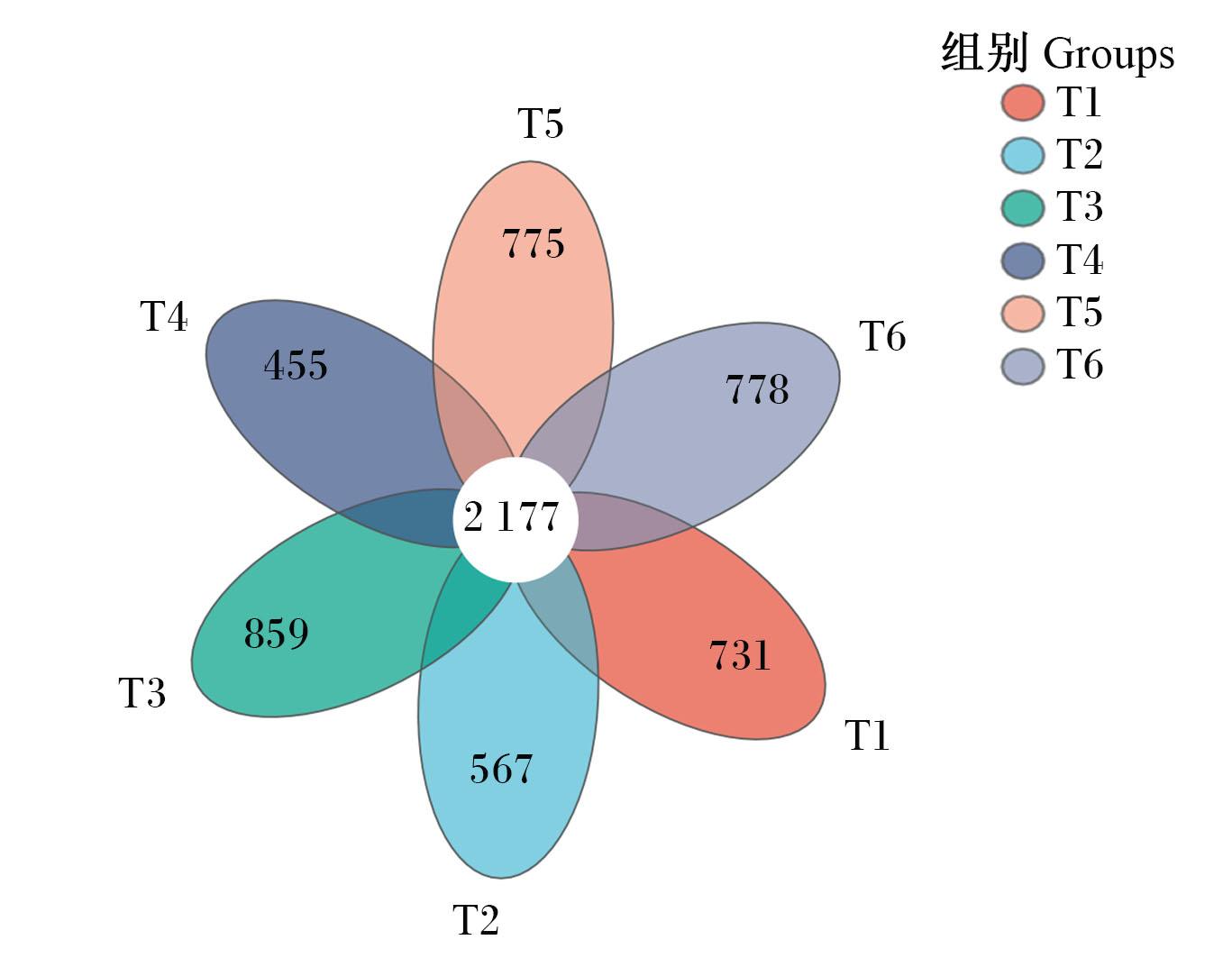
图1可知,6组(T1、T2、T3、T4、T5和T6组)的操作分类单元(OTU)数目分别为2 908、2 744、3 036、2 632、2 952和2 955个;6组共用2 177个OTU,占OTU总数的34.33%;6组独有的OTU数目分别为731、567、859、455、775和778个,分别占OTU总数的11.53%、8.94%、13.54%、7.17%、12.22%和12.27%。
图1 Venn图

Fig.1 Venn diagram

2.2.3 门水平上的微生物组成

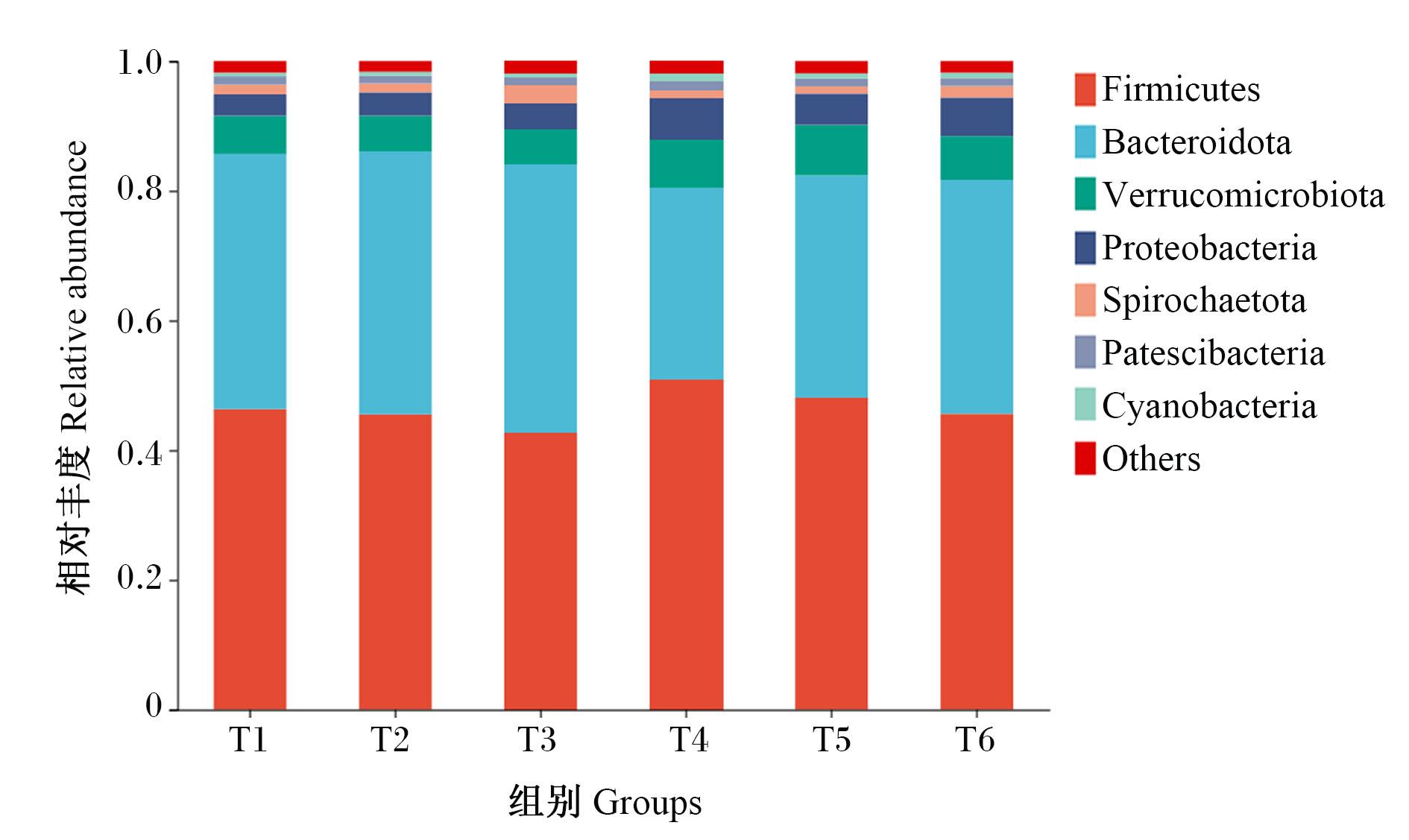
图2可知,在门水平上,主要优势菌群为以下5个菌门:厚壁菌门(Firmicutes)、拟杆菌门(Bacteroidota)、疣微菌门(Verrucomicrobiota)、螺旋体门(Spirochaetota)、变形菌门(Proteobacteria)。由表5可知,T4组的厚壁菌门相对丰度与T5组差异不显著(P>0.05),显著高于T1、T2、T3和T6组(P<0.05)。T1、T2、T3组的拟杆菌门相对丰度显著高于T4、T5和T6组(P<0.05)。T5组的疣微菌门相对丰度与T4组差异不显著(P>0.05),显著高于T1、T2、T3和T6组(P<0.05)。T4、T6组的螺旋体门相对丰度显著高于T1、T2、T3和T5组(P<0.05)。T4组的普雷沃氏菌门相对丰度显著高于其他各组(P<0.05)。
图2 门水平上的微生物相对丰度分布图

Firmicutes:厚壁菌门;Bacteroidota:拟杆菌门;Verrucomicrobiota:疣微菌门;Proteobacteria:变形菌门;Spirochaetota:螺旋体门;Patescibacteria:髌骨菌门;Cyanobacteria:蓝细菌门;Others:其他。

Fig.2 Relative abundance distribution map of microbiota at phylum level

表5 不同酶菌混合添加对甘蔗梢青贮体外瘤胃发酵微生物相对丰度的影响

Table 5 Effects of mixed addition of different enzymes and bacteria on relative abundances of microbiota in in vitro rumen fermentation of sugarcane top silage%

项目
Items
组别 Groups P
P-value
T1 T2 T3 T4 T5 T6
门水平
Phylum level
厚壁菌门
Firmicutes
46.32
±4.62bc
45.50
±2.52bc
42.77
±2.88c
50.91
±0.74a
48.09
±1.92ab
45.61
±2.90bc
0.004
拟杆菌门
Bacteroidota
39.36
±1.29a
40.55
±2.46a
41.39
±1.68a
29.62
±1.88c
34.28
±2.83b
36.06
±2.60b
<0.001
疣微菌门
Verrucomicrobiota
5.88
±0.66cd
5.50
±0.43d
5.37
±1.19d
7.42
±0.37ab
7.78
±0.29a
6.75
±0.92bc
<0.001
螺旋菌门
Spirochaetota
3.30
±0.27c
3.60
±0.27c
3.94
±0.96c
6.31
±0.45a
4.84
±0.57b
5.95
±0.52a
<0.001
普雷沃氏菌门
Proteobacteria
1.28
±0.24b
1.15
±0.10b
1.18
±0.12b
1.51
±0.16a
1.23
±0.12b
1.24
±0.12b
0.015
属水平
Genus level
琥珀酸菌属
Succiniclasticum
22.87
±1.11c
21.78
±0.91c
19.24
±0.59d
29.75
±1.38a
27.56
±2.26b
23.61
±1.77c
<0.001
理研菌科RC9
肠道群
Rikenellaceae_
RC9_gut_group
14.02
±0.48b
16.08
±1.37a
11.59
±0.73c
9.82
±1.04d
13.15
±1.47b
11.34
±0.46c
<0.001
未定级F082
Norank_f_F082
13.53
±1.12ab
13.60
±0.41a
13.14
±0.52ab
9.80
±1.11c
12.03
±0.98b
13.02
±1.70ab
<0.001
普雷沃氏菌属
Prevotella
7.56
±0.88b
6.71
±0.53b
18.14
±0.86a
6.92
±0.42b
5.32
±0.31c
7.27
±0.87b
<0.001
未定级WCHB1-41
Norank_f_norank_o_
WCHB1-41
3.15
±0.08c
3.42
±0.37c
3.08
±0.38c
4.94
±0.58b
5.72
±0.57a
4.53
±0.75b
<0.001
反刍杆菌属
Ruminobacter
2.60
±0.15d
2.84
±0.31cd
3.20
±0.48c
5.38
±0.36a
4.41
±0.47b
5.44
±0.44a
<0.001
克里斯滕森菌科
R-7群
Christensenellaceae_
R-7_group
1.92
±0.08ab
2.15
±0.30a
1.96
±0.19a
1.64
±0.25b
1.98
±0.30a
1.93
±0.11ab
0.042
未定级vadinBE97
Norank_f_vadinBE97
2.35
±0.29a
1.45
±0.28c
1.63
±0.21c
1.96
±0.25b
1.61
±0.23c
1.65
±0.13bc
<0.001
未定级UCG-011
Norank_f_UCG-011
1.83
±0.19a
1.42
±0.21b
1.68
±0.18ab
1.50
±0.19b
1.55
±0.37ab
1.84
±0.13a
0.031
NK4A214群
NK4A214_group
1.44
±0.21
1.51
±0.38
1.57
±0.56
1.26
±0.10
1.48
±0.11
1.45
±0.09
0.681

2.2.4 属水平上的微生物组成

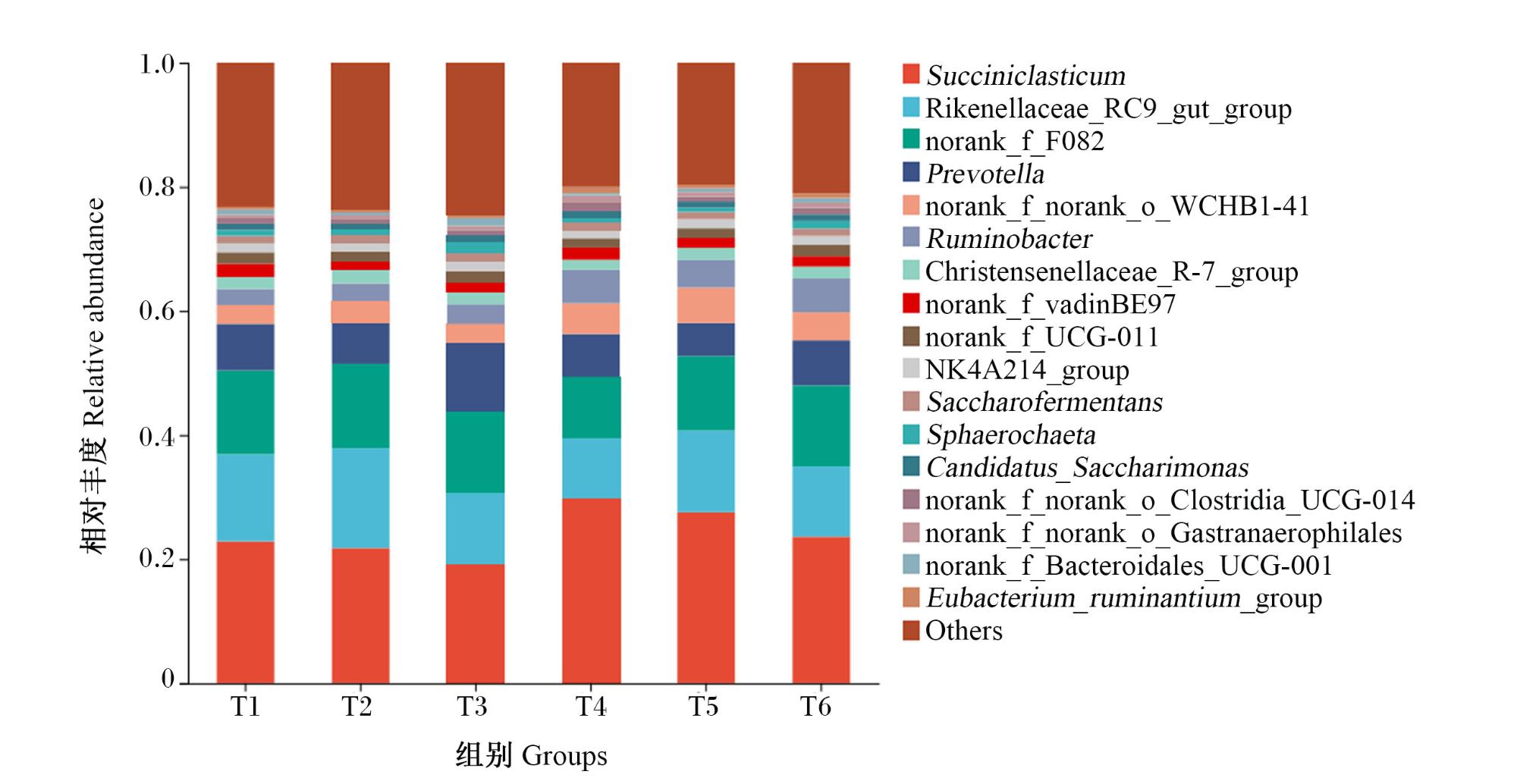
图3可知,在属水平上,瘤胃微生物主要优势菌属有解琥珀酸菌属(Succiniclasticum)、理研菌科RC9肠道群(Rikenellaceae_RC9_gut_group)、未定级F082(norank_f_F082)、普雷沃氏菌属(Prevotella)、未定级WCHB1-41(norank_f_norank_o_WCHB1-41)、反刍杆菌属(Ruminobacter)等17个属。由表5可知,T4组的琥珀酸菌属相对丰度显著高于其他各组(P<0.05),T3组的琥珀酸菌属相对丰度显著低于其他各组(P<0.05)。T2组的理研菌科RC9肠道群相对丰度显著高于其他各组(P<0.05)。T4组的未定级F082相对丰度显著低于其他各组(P<0.05)。T3组的普雷沃氏菌属相对丰度显著高于其他各组(P<0.05),T5组的普雷沃氏菌属相对丰度显著低于其他各组(P<0.05)。T5组的未定级WCHB1-41相对丰度显著高于其他各组(P<0.05)。T4和T6组的反刍杆菌属相对丰度显著高于其他各组(P<0.05)。T4组的克里斯滕森菌科R-7群(Christensenellaceae_R-7_group)相对丰度显著低于T2、T3和T5组(P<0.05)。T1组的未定级vadinBE97(norank_f_vadinBE97)相对丰度显著高于其他各组(P<0.05)。T1和T6组的未定级UCG-011(norank_f_UCG-011)相对丰度显著高于T2和T4组(P<0.05)。
图3 属水平上的微生物相对丰度分布图

Succiniclasticum:琥珀酸菌属;Rikenellaceae_RC9_gut_group:理研菌科RC9肠道群;norank_f_F082:未定级F082;Prevotella:普雷沃氏菌属;norank_f_norank_o_WCHB1-41:未定级WCHB1-41;Ruminobacter:反刍杆菌属;Christensenellaceae_R-7_group:克里斯滕森菌科R-7群;norank_f_vadinBE97:未定级vadinBE97;norank_f_UCG-011:未定级UCG-011;NK4A214_group:NK4A214群;Saccharofermentans:糖发酵菌属;Sphaerochaeta:球孢菌属;Candidatus_Saccharimonas:暂定种糖单孢菌属;norank_f_norank_o_Clostridia_UCG-014:未定级梭菌目UCG-014;norank_f_norank_o_Gastranaerophilales:未定级嗜胃肠厌氧目;norank_f_Bacteroidales_UCG-001:未定级拟杆菌目UCG-001;Eubacterium_ruminantium_group:瘤胃真杆菌属反刍动物群;Others:其他。

Fig.3 Relative abundance distribution map of microbiota at genus level

2.3 体外瘤胃发酵参数与属水平微生物相对丰度的相关性分析

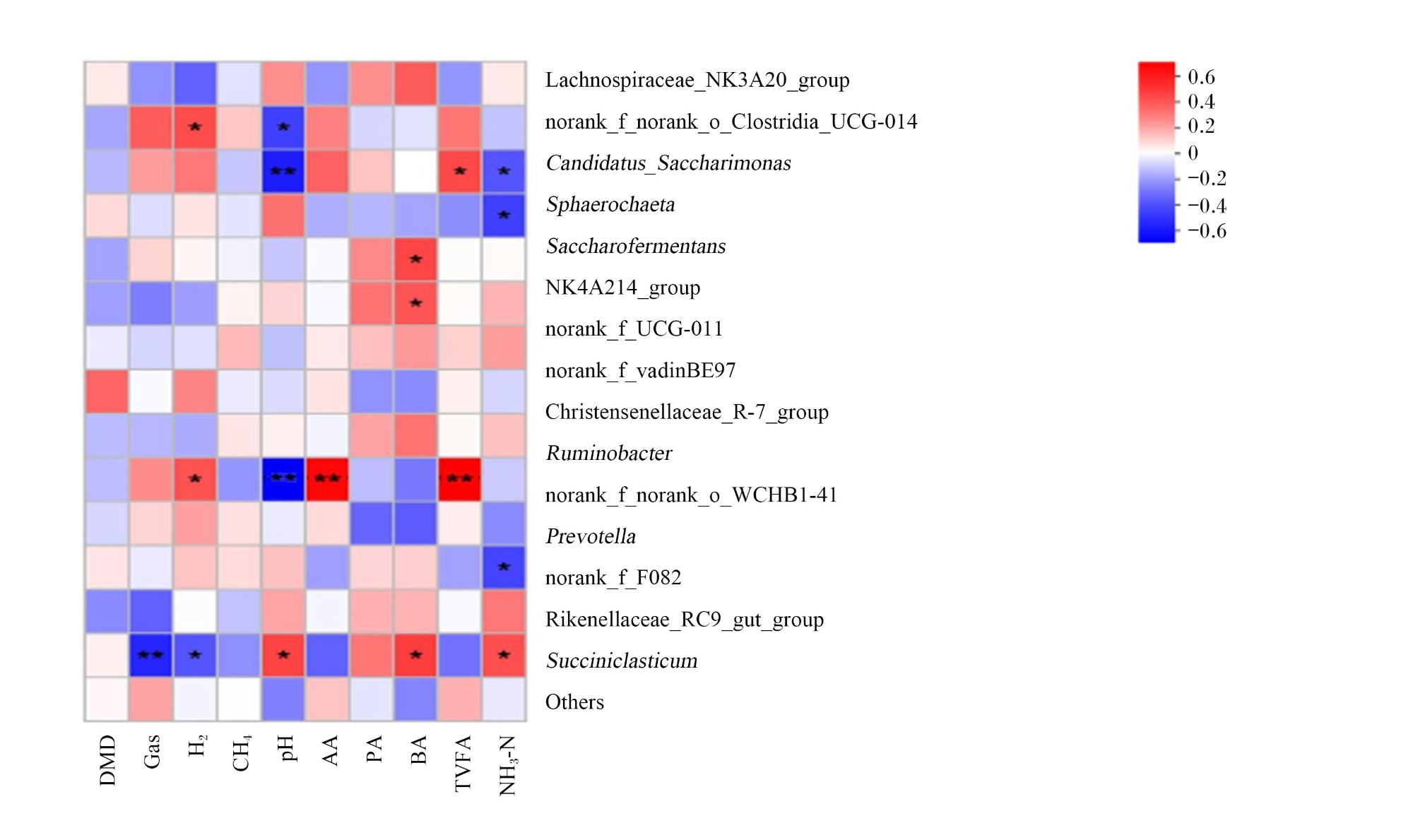
图4可知,产气量与理研菌科RC9肠道群相对丰度呈极显著负相关(P<0.01)。H2产量与未定级梭菌属UCG-014和反刍杆菌属相对丰度呈显著正相关(P<0.05),与理研菌科RC9肠道群相对丰度呈显著负相关(P<0.05)。pH与未定级梭菌属UCG-014相对丰度呈显著负相关(P<0.05),与暂定种糖单孢菌属和反刍杆菌属相对丰度呈极显著负相关(P<0.01),与理研菌科RC9肠道群相对丰度呈显著正相关(P<0.05)。AA含量与反刍杆菌属相对丰度呈极显著正相关(P<0.01)。BA含量与糖发酵菌属、NK4A214群和理研菌科RC9肠道群相对丰度呈显著正相关(P<0.05)。TVFA含量与暂定种糖单孢菌属相对丰度呈显著正相关(P<0.05),与反刍杆菌属相对丰度呈极显著正相关(P<0.01)。NH3-N含量与暂定种糖单孢菌属、球孢菌属和普雷沃氏菌属相对丰度呈显著负相关(P<0.05),与理研菌科RC9肠道群相对丰度呈显著正相关(P<0.05)。
图4 体外瘤胃发酵参数与属水平微生物相对丰度的相关性热图

DMD:干物质消化率 dry matter digestibility;Gas:产气量 gas production;H2:氢气 hydrogen;CH4:甲烷 methane;AA:乙酸 acetic acid;PA:丙酸 propionic acid;BA:丁酸 butyric acid;TVFA:总挥发性脂肪酸 total volatile fatty acids;NH3-N:氨态氮 ammonia nitrogen;Lachnospiraceae_NK3A20_group:毛螺菌科NK3A20群;norank_f_norank_o_Clostridia_UCG-014:未定级梭菌目UCG-014;Candidatus_Saccharimonas:暂定种糖单孢菌属;Sphaerochaeta:球孢菌属;Saccharofermentans:糖发酵菌属;NK4A214_group:NK4A214群;norank_f_UCG-011:未定级UCG-011;norank_f_vadinBE97:未定级vadinBE97;Christensenellaceae_R-7_group:克里斯滕森菌科R-7群;Ruminobacter:反刍杆菌属;norank_f_norank_o_WCHB1-41:未定级WCHB1-41;Prevotella:普雷沃氏菌属;norank_f_F082:未定级F082;Rikenellaceae_RC9_gut_group:理研菌科RC9肠道群;Succiniclasticum:琥珀酸菌属;Others:其他。

*代表显著相关(P<0.05),**代表极显著相关(P<0.01)。* represented significant correlation (P<0.05), and ** represented extremely significant correlation (P<0.01).

Fig.4 Correlation heatmap between in vitro rumen fermentation parameters and relative abundances of microbiota at genus level

3 讨论

3.1 不同酶菌混合添加对甘蔗梢青贮体外瘤胃发酵参数的影响

DMD反映饲料在发酵体系中的降解程度,是评估反刍动物瘤胃利用粗饲料的重要指标[21]。本试验中,甘蔗梢青贮体外发酵的DMD在49.03%~51.36%,各组之间没有显著差异,表明不同酶菌混合添加对甘蔗梢青贮体外发酵的DMD无显著影响。产气量是评价瘤胃发酵体系中饲料利用程度的一项重要参数,可以间接反映出反刍动物对青贮饲料营养物质的消化和降解特性,也可以体现饲料营养价值的高低[22-24]。饲料的营养价值越高,发酵性越强,产气量就越高[25]。本试验中,T1组的产气量最低,可能是植物乳杆菌数量过高,抑制其他瘤胃微生物的活性,降低瘤胃发酵产气量;T3组的产气量最高。然而,有研究发现使用LAB对玉米秸秆青贮的产气量没有影响[26],这可能是本试验中不同酶菌组合的相互作用。纤维素酶通过释放细胞壁化合物来刺激瘤胃微生物的生长,增加纤维分解活性,促进细胞壁的分解,提高碳水化合物和蛋白质的降解速率,从而提高体外发酵产气量[27]。瘤胃内H2主要被甲烷菌用于CH4合成[28],当CH4生成受到抑制后,H2产量往往会显著升高[29],本试验中,T3组的H2产量显著高于其他各组,但各组之间CH4产量没有显著差异,在数值上,H2产量高的组别CH4产量也随之增加。瘤胃内pH正常范围在5.5~7.5[30],本试验中,各组的pH均处于正常的范围内,这是饲料能够在瘤胃中降解利用的前提[31],同时有助于瘤胃微生物的生长繁殖。
瘤胃液的VFA含量取决于发酵底物的来源、微生物种群和瘤胃环境,是评价瘤胃健康和发酵状态的重要指标[32]。本试验中,T5和T6组的AA和TVFA含量显著高于其他各组,而各组之间PA和BA含量无显著差异,这可能是不同组间参与PA、BA生成的底物或者微生物没有差异。NH3-N是饲料中非蛋白氮降解的主要中间产物,其含量越高,蛋白质的分解程度越大,发酵质量越差[33]。而且,NH3-N在动物体内的吸收和利用能力远低于真正的蛋白质,因此NH3-N含量越高,饲料的营养价值就越低[34]。T5组的NH3-N含量最高,其次是T1和T2组,T6组最低,表明T6组具有更强的瘤胃发酵特性。

3.2 不同酶菌混合添加对甘蔗梢青贮体外瘤胃发酵微生物组成的影响

反刍动物瘤胃液中优势菌门为厚壁菌门和拟杆菌门[35]。本研究中,体外发酵后优势菌门与其一致,证明酶菌混合添加后的甘蔗梢青贮不会破坏水牛瘤胃液中优势菌门。瘤胃内纤维物质的降解主要由厚壁菌门微生物参与,部分由拟杆菌门微生物降解[36],而碳水化合物的分解主要由拟杆菌门微生物进行[37]。本研究中,体外发酵后不同组间厚壁菌门和拟杆菌门相对丰度呈现差异,可能是由于甘蔗梢青贮过程中酶菌的添加量不同导致的。此外,普雷沃氏菌门也可以协同降解木质纤维[36]。研究发现,瘤胃拟杆菌门相对丰度与VFA含量呈正相关[38],与pH呈负相关[39]。在属水平上,本研究观察到琥珀酸菌属、理研菌科RC9肠道群、普雷沃氏菌属、反刍杆菌属、克里斯滕森菌科R-7群为优势菌属。据报道,瘤胃内普雷沃氏菌属通常将半纤维素、淀粉、蛋白质、肽和果胶发酵成琥珀酸盐、丙酸盐和乙酸盐[40-41]。反刍杆菌属在瘤胃液中与淀粉的降解相关[42],反刍杆菌属所属的琥珀酸弧菌科是琥珀酸盐的主要生产者[43]。琥珀酸菌属是核心瘤胃微生物群落中的一个组成部分,属于革兰氏阴性菌,具有以琥珀酸盐为底物发酵产生丙酸盐的能力[39,44-45]。在丙酸盐的形成过程中,琥珀酸途径和丙烯酸酯途径可以竞争性地抑制瘤胃中的CH4生成[46]。不同普雷沃菌属的功能差异很大,有些表型会产生大量CH4[47],而其他表型则不会大量产生CH4[48]。在本研究中,普雷沃氏菌属相对丰度与CH4产量没有显著的相关性,而表现出与NH3-N含量有显著的负相关性。理研菌科RC9肠道群属于理研菌科RC9家族,瘤胃中的纤维素水平与理研菌科RC9肠道群的活性有关[49],同时与VFA含量呈负相关[50],这与本试验研究结果一致。克里斯滕森菌科R-7群在碳水化合物和氨基酸降解为乙酸盐和氨方面起着重要作用,AA和BA是发酵终产物[51]。反刍杆菌属相对丰度与H2产量及AA、TVFA含量呈显著或极显著正相关,与pH呈极显著负相关,这与Wei等[52]研究结果一致。本试验中,T3组的普雷沃氏菌属相对丰度最高;T4、T6组的理研菌科RC9肠道群相对丰度较低,反刍杆菌属相对丰度较高,这表明从微生物变化及发酵产物综合分析,T3、T4和T6组的底物发酵品质较好。

4 结论

综上所述,甘蔗梢青贮中添加1×10⁵ CFU/g植物乳杆菌、1×107 CFU/g戊糖片球菌、2×104 U/g纤维素酶、2×104 U/g木聚糖酶和0.1%葡萄糖氧化酶,具有较好的发酵品质和发酵特性。
[1]
苏晓芹, 程雨辰, 张力莉, 等. 微生物添加剂在玉米青贮中的应用研究进展[J]. 饲料研究, 2025, 48(7):161-164.

SU X Q, CHENG Y C, ZHANG L L, et al. Research progress on application of microbial additives in corn silage[J]. Feed Research, 2025, 48(7):161-164. (in Chinese)

[2]
孙向丽, 菅复春, 许来鹏, 等. 布氏乳杆菌和植物乳杆菌对高粱青贮品质的影响[J]. 中国畜牧杂志, 2021, 57(9):159-163.

SUN X L, JIAN F C, XU L P, et al. Effects of Lactobacillus buchneri and Lactobacillus plantarum on the quality of silage sorghum[J]. Chinese Journal of Animal Science, 2021, 57(9):159-163. (in Chinese)

[3]
孙亚楠, 李梅, 刘玉龙, 等. 青贮发酵饲料中三株乳酸菌的生理特性研究[J]. 农产品加工, 2022(10):16-22,25.

SUN Y N, LI M, LIU Y L, et al. Physiological characterization of three strains of lactic acid bacteria[J]. Farm Products Processing, 2022(10):16-22,25. (in Chinese)

[4]
曹振辉, 潘洪彬, 刘永仕, 等. 戊糖片球菌的益生功能及其在动物生产中的应用[J]. 安徽农业科学, 2016, 44(2):73-75.

CAO Z H, PAN H B, LIU Y S, et al. The probiotic function of Pediococcus pentosaceus and its application in animal production[J]. Journal of Anhui Agricultural Sciences, 2016, 44(2):73-75. (in Chinese)

[5]
邓宗澳. 不同添加剂组合使用对甘蔗梢玉米秸秆混合青贮品质的影响[D]. 硕士学位论文. 昆明: 云南农业大学, 2023.

DENG Z A. Effects of different additives on silage quality mixed with sugarcane tip and corn stalks[D]. Master’s Thesis. Kunming: Yunnan Agricultural University, 2023. (in Chinese)

[6]
韩俊伟, 张璐璐, 刘建新. 玉米秸秆饲料化预处理研究进展[J]. 饲料工业, 2025, 46(11):155-160.

HAN J W, ZHANG L L, LIU J X. Research progress on feed pretreatment of corn straw[J]. Feed Industry, 2025, 46(11):155-160. (in Chinese)

[7]
WANG Y, MCALLISTER T A, RODE L M, et al. Effects of an exogenous enzyme preparation on microbial protein synthesis,enzyme activity and attachment to feed in the rumen simulation technique[J]. British Journal of Nutrition, 2001, 85(3):325-332.

DOI

[8]
王鑫, 戴求仲, 林谦, 等. 葡萄糖氧化酶在畜禽饲粮中的应用研究进展[J]. 饲料研究, 2021, 44(5):145-147.

WANG X, DAI Q Z, LIN Q, et al. Application research progress of glucose oxidase in livestock and poultry diet[J]. Feed Research, 2021, 44(5):145-147. (in Chinese)

[9]
赵和平, 孙见, 刘云祥, 等. 葡萄糖氧化酶对全株玉米青贮品质的影响[J]. 中国饲料, 2023(1):78-81,88.

ZHAO H P, SUN J, LIU Y X, et al. Effect of glucose oxidase on the quality of whole-plant corn silage[J]. China Feed, 2023(1):78-81,88. (in Chinese)

[10]
LI M W, HASSAN F, AKHTAR M U, et al. Fibrolytic enzymes and lactic acid bacteria improve the ensiling characteristics of ramie and elephant grass mixed silage[J]. Agriculture, 2024, 14(10):1746.

DOI

[11]
DU Z M, NAKAGAWA A, FANG J C, et al. Cleaner anaerobic fermentation and greenhouse gas reduction of crop straw[J]. Microbiology Spectrum, 2024, 12(7):e0052024.

DOI

[12]
张现东, 李靖, 肖海翔, 等. 不同菌酶处理对水稻秸秆青贮品质和体外发酵特性的影响[J]. 草地学报, 2025, 33(7):2380-2387.

DOI

ZHANG X D, LI J, XIAO H X, et al. Effects of different microbial enzyme treatments on silage quality and in vitro fermentation characteristics of rice straw[J]. Acta Agrestia Sinica, 2025, 33(7):2380-2387. (in Chinese)

[13]
SO S, CHERDTHONG A, WANAPAT M. Improving sugarcane bagasse quality as ruminant feed with Lactobacillus,cellulase,and molasses[J]. Journal of Animal Science and Technology, 2020, 62(5):648-658.

DOI

[14]
SO S, CHERDTHONG A, WANAPAT M, et al. Fermented sugarcane bagasse with Lactobacillus combined with cellulase and molasses promotes in vitro gas kinetics,degradability,and ruminal fermentation patterns compared to rice straw[J]. Animal Biotechnology, 2022, 33(1):116-127.

DOI

[15]
甘洁. 不同品种及生育期玉米秸秆体外发酵特性和尼龙袋降解率的研究[D]. 硕士学位论文. 长沙: 湖南农业大学, 2007.

GAN J. Study on in vitro fermentation characteristics and in situ degradability of different varieties and maturity stages for maize stover[D]. Master’s Thesis. Changsha: Hunan Agricultural University, 2007. (in Chinese)

[16]
MARREZ D A, CIESLAK A, GAWAD R, et al. Effect of freshwater microalgae Nannochloropsis limnetica on the rumen fermentation in vitro[J]. Journal of Animal and Feed Sciences, 2017, 26(4):359-364.

DOI

[17]
XIE H D, ZENG F Q, GUO Y X, et al. Effect of tea seed oil on in vitro rumen fermentation,nutrient degradability,and microbial profile in water buffalo[J]. Microorganisms, 2023, 11(8):1981.

DOI

[18]
XIE H D, PENG L J, LI M W, et al. Effects of mixed sugarcane tops and napiergrass silages on fermentative quality,nutritional value,and milk yield in water buffaloes[J]. Animal Science Journal, 2023, 94(1):e13824.

DOI

[19]
冯宗慈, 高民. 通过比色测定瘤胃液氨氮含量方法的改进[J]. 畜牧与饲料科学, 2010, 31(6/7):37.

FENG Z C, GAO M. Improvement of colorimetric determination of ammonia nitrogen in rumen fluid[J]. Animal Husbandry and Feed Science, 2010, 31(6/7):37. (in Chinese)

[20]
YU Z T, MORRISON M. Improved extraction of PCR-quality community DNA from digesta and fecal samples[J]. BioTechniques, 2004, 36(5):808-812.

DOI PMID

[21]
曾繁泉, 罗鲜青, 杨承剑, 等. 桑叶黄酮对水牛瘤胃体外发酵和微生物多样性的影响研究[J]. 中国饲料, 2025(7):109-115.

ZENG F Q, LUO X Q, YANG C J, et al. Effects of mulberry leaf flavone on rumen fermentation and microbial diversity of buffalo in vitro[J]. China Feed, 2025(7):109-115. (in Chinese)

[22]
GETACHEW G, ROBINSON P H, DEPETERS E J, et al. Relationships between chemical composition,dry matter degradation and in vitro gas production of several ruminant feeds[J]. Animal Feed Science and Technology, 2004, 111(1/4):57-71.

DOI

[23]
郭艳霞, 李孟伟, 唐振华, 等. 硝酸钠和延胡索酸二钠混合物对水牛瘤胃甲烷含量、体外发酵参数、脂肪酸组成和瘤胃微生物数量的影响[J]. 畜牧兽医学报, 2020, 51(10):2599-2608.

DOI

GUO Y X, LI M W, TANG Z H, et al. Effects of sodium nitrate and disodium fumarate mixture on ruminal methane production,fermentation parameters,fatty acids profiles and rumen microbial population in water buffalo in vitro[J]. Acta Veterinaria et Zootechnica Sinica, 2020, 51(10):2599-2608. (in Chinese)

[24]
周苗育, 武伟成, 肖定福, 等. 不同酶制剂组合对水稻秸秆青贮品质和体外瘤胃发酵特性的影响[J]. 动物营养学报, 2023, 35(6):3856-3866.

DOI

ZHOU M Y, WU W C, XIAO D F, et al. Effects of different enzyme preparation combinations on silage quality and in vitro rumen fermentation characteristics of rice straw[J]. Chinese Journal of Animal Nutrition, 2023, 35(6):3856-3866. (in Chinese)

[25]
MENKE K H, RAAB L, SALEWSKI A, et al. The estimation of the digestibility and metabolizable energy content of ruminant feeding stuffs from the gas production when they are incubated with rumen liquor in vitro[J]. The Journal of Agricultural Science, 1979, 93(1):217-222.

DOI

[26]
CONTRERAS-GOVEA F E, MUCK R E, BRODERICK G A, et al. Lactobacillus plantarum effects on silage fermentation and in vitro microbial yield[J]. Animal Feed Science and Technology, 2013, 179(1/2/3/4):61-68.

DOI

[27]
CHEN L, GUO G, YUAN X J, et al. Effects of applying molasses,lactic acid bacteria and propionic acid on fermentation quality,aerobic stability and in vitro gas production of total mixed ration silage prepared with oat-common vetch intercrop on the Tibetan plateau[J]. Journal of the Science of Food and Agriculture, 2016, 96(5):1678-1685.

DOI

[28]
金舒文, 王佳堃. 瘤胃产甲烷菌与其他微生物间的氢传递及其调控研究进展[J]. 中国畜牧杂志, 2019, 55(2):1-6.

JIN S W, WANG J K. Interspecific hydrogen transfer between methanogens and other microorganisms in rumen and its regulation strategies:a review[J]. Chinese Journal of Animal Science, 2019, 55(2):1-6. (in Chinese)

[29]
ZHANG X M, WANG M, YU Q, et al. Liquid hot water treatment of rice straw enhances anaerobic degradation and inhibits methane production during in vitro ruminal fermentation[J]. Journal of Dairy Science, 2020, 103(5):4252-4261.

DOI

[30]
JIAO P X, WEI L Y, WALKER N D, et al. Comparison of non-encapsulated and encapsulated active dried yeast on ruminal pH and fermentation,and site and extent of feed digestion in beef heifers fed high-grain diets[J]. Animal Feed Science and Technology, 2017, 228:13-22.

DOI

[31]
谢华德, 郭艳霞, 彭丽娟, 等. 不同混合比例对象草与甘蔗梢青贮发酵品质及体外干物质消化率的影响[J]. 饲料研究, 2021, 44(12):93-96.

XIE H D, GUO Y X, PENG L J, et al. Effect of different proportion levels on fermentation quality and in vitro ruminal digestion of Napier grass,sugarcane top silage[J]. Feed Research, 2021, 44(12):93-96. (in Chinese)

[32]
BANNINK A, FRANCE J, LOPEZ S, et al. Modelling the implications of feeding strategy on rumen fermentation and functioning of the rumen wall[J]. Animal Feed Science and Technology, 2008, 143(1/4):3-26.

DOI

[33]
KUNG L M Jr, SHAVER R D, GRANT R J, et al. Silage review:interpretation of chemical,microbial,and organoleptic components of silages[J]. Journal of Dairy Science, 2018, 101(5):4020-4033.

DOI

[34]
ZHU Y C, XIONG H M, WEN Z Y, et al. Effects of different concentrations of Lactobacillus plantarum and Bacillus licheniformis on silage quality,in vitro fermentation and microbial community of hybrid Pennisetum[J]. Animals, 2022, 12(14):1752.

DOI

[35]
TONG F, WANG T, GAO N L, et al. The microbiome of the buffalo digestive tract[J]. Nature Communications, 2022, 13(1):823.

DOI PMID

[36]
BAO Y Y, DOLFING J, WANG B Z, et al. Bacterial communities involved directly or indirectly in the anaerobic degradation of cellulose[J]. Biology and Fertility of Soils, 2019, 55(3):201-211.

DOI

[37]
LAPÉBIE P, LOMBARD V, DRULA E, et al. Bacteroidetes use thousands of enzyme combinations to break down glycans[J]. Nature Communications, 2019, 10(1):2043.

DOI PMID

[38]
QIU Q H, GAO C Y, AZIZ UR RAHMAN M, et al. Digestive ability,physiological characteristics,and rumen bacterial community of Holstein finishing steers in response to three nutrient density diets as fattening phases advanced[J]. Microorganisms, 2020, 8(3):335.

DOI

[39]
HOOK S E, STEELE M A, NORTHWOOD K S, et al. Impact of subacute ruminal acidosis (SARA) adaptation and recovery on the density and diversity of bacteria in the rumen of dairy cows[J]. FEMS Microbiology Ecology, 2011, 78(2):275-284.

DOI PMID

[40]
CARBERRY C A, KENNY D A, HAN S, et al. Effect of phenotypic residual feed intake and dietary forage content on the rumen microbial community of beef cattle[J]. Applied and Environmental Microbiology, 2012, 78(14):4949-4958.

DOI PMID

[41]
WANG H B, HE Y, LI H, et al. Rumen fermentation,intramuscular fat fatty acid profiles and related rumen bacterial populations of Holstein bulls fed diets with different energy levels[J]. Applied Microbiology and Biotechnology, 2019, 103(12):4931-4942.

DOI

[42]
ZHAO W, ABDELSATTAR M M, WANG X, et al. In vitro modulation of rumen fermentation by microbiota from the recombination of rumen fluid and solid phases[J]. Microbiology Spectrum, 2023, 11(1):e0338722.

DOI

[43]
MCCABE M S, CORMICAN P, KEOGH K, et al. Illumina MiSeq phylogenetic amplicon sequencing shows a large reduction of an uncharacterised succinivibrionaceae and an increase of the Methanobrevibacter gottschalkii clade in feed restricted cattle[J]. PLoS One, 2015, 10(7):e0133234.

DOI

[44]
PETRI R M, VAHMANI P, YANG H E, et al. Changes in rumen microbial profiles and subcutaneous fat composition when feeding extruded flaxseed mixed with or before hay[J]. Frontiers in Microbiology, 2018, 9:1055.

DOI PMID

[45]
VAN GYLSWYK N O. Succiniclasticum ruminis gen. nov.,sp. nov.,a ruminal bacterium converting succinate to propionate as the sole energy-yielding mechanism[J]. International Journal of Systematic Bacteriology, 1995, 45(2):297-300.

DOI

[46]
WANG K, NAN X M, ZHAO Y G, et al. Effects of propylene glycol on in vitro ruminal fermentation,methanogenesis,and microbial community structure[J]. Journal of Dairy Science, 2021, 104(3):2924-2934.

DOI

[47]
KITTELMANN S, PINARES-PATIÑO C S, SEEDORF H, et al. Two different bacterial community types are linked with the low-methane emission trait in sheep[J]. PLoS One, 2014, 9(7):e103171.

DOI

[48]
DANIELSSON R, DICKSVED J, SUN L, et al. Methane production in dairy cows correlates with rumen methanogenic and bacterial community structure[J]. Frontiers in Microbiology, 2017, 8:226.

DOI PMID

[49]
ZENED A, COMBES S, CAUQUIL L, et al. Microbial ecology of the rumen evaluated by 454 GS FLX pyrosequencing is affected by starch and oil supplementation of diets[J]. FEMS Microbiology Ecology, 2013, 83(2):504-514.

DOI PMID

[50]
WU Z L, ZHANG F S, SU Q, et al. Integrating 16S rRNA sequencing and LC-MS-based metabolomics to evaluate the effects of dietary crude protein on ruminal morphology,fermentation parameter and digestive enzyme activity in Tibetan sheep[J]. Animals, 2024, 14(15):2149.

DOI

[51]
CHEN R L, LI Z X, FENG J, et al. Effects of digestate recirculation ratios on biogas production and methane yield of continuous dry anaerobic digestion[J]. Bioresource Technology, 2020, 316:123963.

DOI

[52]
WEI X, OUYANG K H, LONG T H, et al. Dynamic variations in rumen fermentation characteristics and bacterial community composition during in vitro fermentation[J]. Fermentation, 2022, 8(6):276.

DOI

文章导航

/