综述

基于物种差异的牛与羊甲烷精准减排研究进展

  • 刘嘉甫 ,
  • 张婧兰 ,
  • 何志鹏 ,
  • 胡志勇 , *
展开
  • 山东农业大学动物科技学院, 泰安 271018
* 胡志勇,教授,博士生导师,E-mail:

刘嘉甫(2003—),男,山东泰安人,硕士研究生,研究方向为反刍动物营养与饲料科学。E-mail:

Office editor: 菅景颖

收稿日期: 2025-11-20

  网络出版日期: 2026-07-14

基金资助

国家自然科学基金项目(32172760)

Research Progress in Species-Specific Precision Methane Mitigation for Cattle and Sheep

  • LIU Jiafu ,
  • ZHANG Jinglan ,
  • HE Zhipeng ,
  • HU Zhiyong , *
Expand
  • College of Animal Science and Technology, Shandong Agricultural University, Tai’an 271018, China
* professor, E-mail:

Received date: 2025-11-20

  Online published: 2026-07-14

摘要

反刍动物生产是农业温室气体甲烷的重要排放来源。牛与羊在消化生理、固有的瘤胃发酵特征及主流生产体系方面存在系统性差异,可能导致其甲烷生成特征及对减排技术的响应表现出物种特异性。然而,目前针对牛与羊相同条件下的比较研究仍十分匮乏,现有研究多基于单一物种开展,不同研究间的饲养制度、营养水平、试验方法等混杂因素,使得难以直接界定减排效果异质性中的物种特异性贡献。本文围绕反刍动物甲烷生成的核心途径,系统梳理了牛与羊在生理基础与生产模式上的核心特征,重点总结了3-硝基氧丙醇、脂肪类、单宁、红藻和硝酸盐等5类主流减排添加剂的作用机制、减排效果及安全剂量范围,厘清了现有研究中减排效果差异的潜在来源,并综合已有研究证据,从动物生理特征、生产场景适配性、剂量安全控制等方面对反刍动物甲烷减排研究进展进行了综述,旨在为后续开展基于物种与生产场景适配的牛与羊甲烷减排标准化研究、构建精准减排技术体系提供参考。

本文引用格式

刘嘉甫 , 张婧兰 , 何志鹏 , 胡志勇 . 基于物种差异的牛与羊甲烷精准减排研究进展[J]. 动物营养学报, 2026 , 38(7) : 4906 -4916 . DOI: 10.12418/CJAN2026.393

Abstract

Ruminant production is a major source of agricultural methane emissions. Systematic differences in digestive physiology, inherent rumen fermentation characteristics and dominant production systems between cattle and sheep may lead to species-specific patterns of methane production characteristics and responses to mitigation strategies. However, comparative studies on cattle and sheep under the same conditions are still very scarce. Most existing studies are carried out based on a single species, and confounding factors such as feeding system, nutritional level and experimental methods among different studies make it difficult to directly define the species-specific contribution to the heterogeneity of mitigation effects. Focusing on the core pathways of methanogenesis in ruminants, this review systematically examined the key physiological and production characteristics of cattle and sheep. It summarized the mechanisms of action, mitigation efficacy, and safe dosage ranges of five mainstream mitigation additives: 3-nitrooxypropanol, lipids, tannins, red macroalgae and nitrates. The review clarified the potential sources of variability in mitigation outcomes reported in existing studies. By synthesizing current evidence, it reviewed the research progress in ruminant methane mitigation from the perspectives of animal physiology, production system compatibility, and dose safety control. The purpose of this review is to provide a reference for future standardized research on cattle and sheep methane mitigation that is tailored to species and production scenarios, and to support the development of precision mitigation technology systems.

全球气候变暖已成为人类面临的重大环境挑战,而温室气体的持续排放是导致气候系统失衡的根本原因。其中,畜牧业是人为甲烷排放的重要来源,约占全球总排放量的1/3。反刍动物每年产生约8 000万t甲烷,不仅显著加剧温室效应,还造成饲料能量2%~12%的损失,降低了养殖效率并推高了生产成本[1]。在“碳达峰、碳中和”目标的背景下,推动反刍动物甲烷减排,已成为应对气候变化与促进畜牧业绿色转型的共同需求[2]。近年来,随着基因组学、饲粮精准调控等技术的不断发展,研究人员日益认识到从物种差异出发构建精准甲烷减排策略的重要性:一方面,通过解析不同反刍动物的产甲烷代谢途径及其瘤胃微生物生态结构,可为低甲烷性状的选育和饲养管理的优化提供科学依据[3];另一方面,结合政策导向,开展针对不同反刍动物甲烷排放特征与减排路径的研究,有助于深化对甲烷排放问题的认知,并指导生产实践[4]。本文系统梳理了不同类型反刍动物在微生物群落特征及减排技术响应方面的差异,总结了相关研究进展与主要减排途径,以期为构建高效、精准的甲烷减排体系提供参考。

1 反刍动物甲烷生成机制

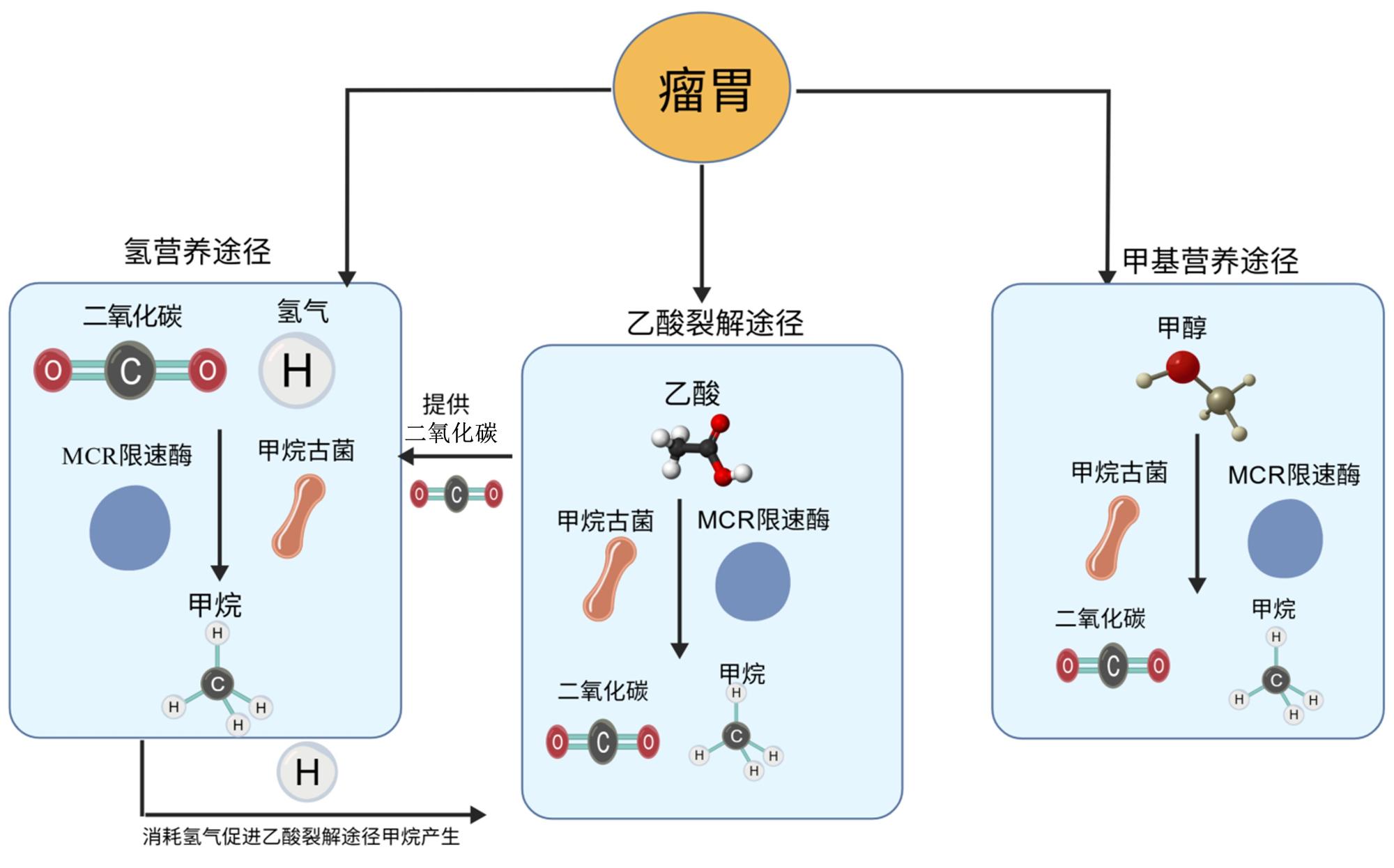
反刍动物排放的甲烷本质上是瘤胃微生物厌氧发酵的副产物,甲烷生成主要通过3种途径实现:氢营养型途径、乙酸裂解途径和甲基营养途径[5],具体如图1所示。其中,氢营养型途径是最主要的产甲烷途径,占比可达70%~80%[6]。该途径以二氧化碳(CO2)为电子受体、氢气(H2)为供体,经过一系列酶促反应最终生成甲烷,其中甲基辅酶M还原酶(methyl-coenzyme M reductase,MCR)是限速酶,也是多种甲烷抑制剂的主要作用靶点[7]。乙酸裂解途径是依赖甲烷八叠球菌等少数菌群,将乙酸转化为甲烷;而甲基营养途径则是利用甲醇、甲胺等含甲基的底物生成甲烷,该途径在甲基营养型菌丰度较高的动物中更为活跃[8]。现有研究提示,在不同反刍动物中3种类产甲烷途径中的贡献比例可能存在差异,这一特征是影响甲烷减排技术效果的潜在内在因素,也为探索物种特异性减排机制提供了理论切入点。
图1 反刍动物甲烷生成流程图

MCR:甲基辅酶M还原酶 methyl-coenzyme M reductase。

Fig.1 Flow chart of methane production in ruminants

2 牛与羊甲烷减排研究进展

反刍动物甲烷排放特征受生理、饲养模式、饲粮等多因素调控,不同物种的排放强度与减排技术响应或存在异质性,厘清其来源对理解减排机制与技术适配性具有重要意义。牛与羊作为主要的反刍家畜,明确其甲烷减排技术效果的影响因素是制定精准策略的前提。例如,王琳等[9]发现中国黄牛与藏羊的区域碳排放强度明显高于欧美品种。已有研究发现,相同饲料添加剂对不同反刍动物的减排效果存在差异,这可能与瘤胃容量、发酵模式及微生物群落结构等生理特征相关。Orzuna-Orzuna等[10]发现高剂量(约40 g/kg DM)单宁对肉牛甲烷排放具有显著抑制作用且不影响生产性能,但是Dos Santos等[11]发现给予绵羊高浓度单宁则可能导致采食量和生长性能下降,而Ngámbi等[12]发现当单宁添加量为40~50 g/kg DM时甲烷排放量达到最低水平,较对照组的减排幅度达51%~60%。既往研究多集中于单一物种或单一减排技术,对不同反刍动物间技术适配性的系统比较与标准化验证相对不足。

2.1 牛甲烷减排研究进展

2.1.1 饲养模式对甲烷排放的影响

在牛的生产体系中,饲养模式是影响甲烷排放的关键因素。当前生产实践中,牛主要分为以高泌乳量为目标的奶牛体系和以生长育肥为目标的肉牛体系,两者在饲养管理方式、饲粮结构及生产周期等方面存在显著差异,由此导致甲烷排放特征呈现出一定差异[13]。从甲烷绝对排放量来看,奶牛由于干物质采食量高、泌乳周期长,其日均甲烷排放量通常高于肉牛。相比之下,肉牛生产周期相对集中,采食量较低,尤其是在自然放牧或半放牧体系下,其日均甲烷绝对排放量整体偏低,这一差异主要源于饲养模式对动物能量摄入水平和瘤胃发酵规模的直接影响[14]表1汇总了奶牛与肉牛在日均甲烷绝对排放量、甲烷排放强度及瘤胃生理特征方面的典型差异。总体来看,奶牛虽然单只个体甲烷排放量较高,但其较高的生产效率在一定程度上稀释了单位产出水平下的排放强度;而肉牛在低投入或放牧体系中具备较低的绝对排放优势,但其单位采食量或单位产品的甲烷排放潜力仍不容忽视。相关研究表明,在评估牛的甲烷减排效果时,结合生产目标,从饲料利用效率和排放强度等角度进行综合分析具有重要意义。这一认识为后续基于饲粮结构调控和饲料添加剂干预的精准减排策略提供了重要前提。
表1 奶牛与肉牛甲烷排放及瘤胃生理特征对比

Table 1 Comparison of methane emission and rumen physiological characteristics between dairy cows and beef cattle

类型
Types
日均甲烷
绝对排放量
DA-MAE/g
甲烷排放强度
MEI/g
瘤胃生理特征
Rumen physiological
characteristics
参考文献
References
奶牛
Dairy cows
250~450 20~28 瘤胃容积大,绝对产气量高,泌乳期瘤胃微生物偏向激活
氨基酸分解与能量代谢通路,适配泌乳营养需求
[15-18]
肉牛
Beef cattle
200~400 16~25 瘤胃容积略小于奶牛,瘤胃优势菌群为纤维分解菌,
侧重粗纤维降解与能量高效获取,适配生长育肥需求
[19-22]

甲烷排放强度是以每千克干物质所产生的甲烷排放量计。表中数据为不同研究条件下的典型范围,具体数值受测定方法、饲粮组成及管理水平等因素影响,仅用于表征不同生产类型的排放特征差异,不直接等同于物种固有遗传差异。表2同。

MEI is measured as the amount of methane produced per kilogram of dry matter intake. The data presented in the table represent typical ranges under different research conditions. Specific values are influenced by factors such as measurement methods, diet composition, and management practices. These data are intended solely to characterize the differences in emission profiles between different production types, and should not be directly equated with inherent genetic differences between species. The same as Table 2.

2.1.2 饲料添加剂对减排效果的影响

在日常生产中使用特定的饲料添加剂可有效缓解牛的甲烷排放。研究表明,在高能量精料饲粮条件下,奶牛对3-硝基氧丙醇(3-nitrooxypropanol,3-NOP)和脂肪类添加剂通常表现出较为稳定的减排响应[23],3-NOP可降低奶牛甲烷排放30%左右[24-26]。Olijhoek等[27]通过对比不同精料比例的饲粮发现,当饲粮中精料占干物质比例高达91%时,荷斯坦奶牛每千克干物质采食量对应的甲烷排放量,相较于精料占干物质比例为49%的基础饲粮降低了48%。
已有研究指出,适量单宁可与瘤胃中蛋白质和甲烷菌结合,抑制产甲烷菌活性,在不影响纤维消化的前提下使肉牛瘤胃甲烷排放降低13%~29%[28],但是Besharati等[29]发现过量的单宁会显著降低肉牛的消化率,在瘤胃适应性较差的品种中更为明显。

2.1.3 饲粮结构优化的减排效应

优化饲粮结构是调控牛甲烷排放的重要技术手段,其减排效果与饲粮精粗比及动物生理特性密切相关。已有研究表明,饲粮精粗比变化可通过调节瘤胃发酵类型(乙酸型与丙酸型)影响甲烷生成,而在不同生产目标条件下,奶牛与肉牛对精粗比调整的减排响应范围存在一定差异。例如,Bosher等[30]发现,对奶牛增喂精料后甲烷排放强度呈显著线性下降,脂肪蛋白质校正奶(fat-protein corrected milk,FPCM)和乳固体总产量(total milk solids production,TMS)随精料比例的提高呈线性上升趋势。体外发酵试验证实,提高饲粮精料比例可通过降低瘤胃产甲烷菌丰度减少甲烷排放量[31],但该减排效应存在剂量阈值,精料占比过高会引发系列生理问题。通过评估产犊前后冬季饲喂草料与精料饲粮对肉牛肠道内甲烷排放、干物质采食量及生长性能的影响发现,精料虽可优化营养管理并减少甲烷排放,但其占比过高会增加瘤胃酸中毒和营养代谢紊乱风险,不利于日常生产[32]。现有研究认为,遗传育种、瘤胃微生物调控及饲养管理等措施在牛甲烷减排中可能具有协同作用[33]。相关研究显示,奶牛的品种类型、生理阶段及胎次等因素与甲烷排放水平存在关联,通过在育种与生产实践中综合考虑这些因素,有助于在不影响生产性能的前提下降低甲烷排放强度[34-36]。通过选择低甲烷排放品种可有效改善生产中甲烷排放量。除前述措施外,还有部分甲烷减排方式在生产中并没有完全推广,例如,Bharanidharan等[37]发现在饲粮中补充硝酸盐能使肉牛的瘤胃甲烷排放量(g/d)平均降低25.4%,且在试验初期不会导致硝酸盐中毒,在整个试验期间也不会对生长性能产生负面影响;Wanapat等[38]在体外发酵条件下发现,高剂量红藻添加可显著抑制产甲烷过程,甲烷产量降幅可达99%,但该结果主要来源于体外或短期试验条件,实际生产体系中的效果仍需进一步验证。虽然硝酸盐和红藻作为奶牛饲料添加剂可在一定程度上降低甲烷排放水平,但由于硝酸盐的潜在毒性和实际操作中的安全性问题[39],红藻在生产实践中的成本问题[40],目前尚未实现大规模推广,其在牛生产体系中应用于甲烷减排的潜力仍有待在长期和实际生产条件下进一步评估。

2.2 羊甲烷减排研究进展

2.2.1 饲养模式对甲烷排放的影响

羊类体型较小、采食灵活,其瘤胃容积、食糜滞留时间等结构特征与牛存在固有差异,现有研究提示,二者的瘤胃代谢途径与微生物群落结构可能存在一定区别,进而导致其对饲粮结构和饲料添加剂的适应性存在潜在差异[41]。绵羊的饲粮以草料为主,山羊摄食偏好灌木、高单宁植物[42]。不同品种羊的饲养模式差异可能影响甲烷减排措施的应用效果。绵羊通常在半集约化或集约化系统中饲养,而山羊更常见于粗放或半粗放饲养系统,由于绵羊的集约化饲养模式,饲料添加剂的利用率更高[43]。羊个体甲烷排放量低[44],但按干物质摄入量(每千克饲粮)或体重单位计算,牛和羊的按单位干物质采食量计的甲烷排放强度相近[45],绵羊与山羊甲烷排放和瘤胃生理特征差异见表2。目前,对于牛甲烷减排的研究远比羊的丰富,然而,我国羊养殖数量庞大且放牧比例高,其甲烷总排放量不可忽视[46],这使得开展针对羊甲烷减排的研究尤为重要。
表2 绵羊与山羊甲烷排放及瘤胃生理特征对比

Table 2 Comparison of methane emission and rumen physiological characteristics between sheep and goats

类型
Types
日均甲烷
绝对排放量
DA-MAE/g
甲烷排放强度
MEI/g
瘤胃生理特征
Rumen physiological
characteristics
参考文献
References
绵羊
Sheep
20~30 16~26 瘤胃容积小,食糜滞留时间短,消化速率快,单位干物质
采食量的甲烷排放强度相对较高,适配集约化饲粮模式
[47-48]
山羊
Goats
15~25 10~20 瘤胃微生物多样性丰富,对高单宁或粗纤维饲粮耐受性强,
粗饲料利用效率高,适配粗放或放牧饲养模式
[49-50]

2.2.2 饲粮添加剂对减排效果的影响

在绵羊生产中,添加饲料添加剂也能有效降低瘤胃甲烷排放[51],绵羊通常采用全混合日粮(total mixed ration,TMR),因此提高TMR中精料比例和添加丙酸促进剂等措施可以显著降低绵羊的甲烷排放。例如,De Nazaré Santos Torres等[52]发现,调整TMR中精粗比并加入脂质可有效减少甲烷排放;山羊对植物次生代谢物(如皂苷、单宁)的耐受性更强,在特定研究条件下显示出较高的减排潜力。例如,Zhang等[53]发现酶转化的苜蓿皂苷可有效降低山羊甲烷排放,提高养分利用率;Boudalia等[54]发现利用多样化饲料资源(如灌木、树叶)可有效降低山羊甲烷排放;但Battelli等[55]发现过量提供单宁类植物可能导致瘤胃发酵受抑,影响山羊日常生产。地方品种羊因采食天然草场,其饲粮受区域生态限制较大,应强调本地化适配。例如,程新东[56]发现添加4%~8%葡萄渣的饲粮可以改变滩羊胃肠道特定菌群丰度和功能,对甲烷减排有着正向作用。此外,由于羊日常生产多为放牧体系,因此羊的甲烷排放监测存在较大难度。Tedeschi等[57]总结了反刍动物甲烷排放的常见测量技术,并提出了每种方式的局限性,这些局限性在羊的放牧体系中尤为明显。

3 牛与羊甲烷精准减排有效措施

反刍动物对减排技术的响应效果,由生理特征、饲养模式、饲粮组成等共同决定,评估其应用潜力需结合生理特征、剂量阈值、生产场景综合分析,不可将效果差异简单归因于物种本身。牛与羊在体型、瘤胃结构、主流饲粮及饲养方式上的系统性特征差异,或共同影响瘤胃发酵与氢代谢途径,使减排措施在二者主流生产体系中呈现不同应用适配性。牛养殖以集约化圈舍为主,饲喂体系标准化程度高,更便于实施精准投喂、剂量可控的减排技术[58]。因此,精准饲粮调控、添加剂干预、遗传改良等技术在牛生产体系中应用条件更成熟[59]。而羊养殖目前仍以放牧或半放牧体系为主,饲粮组成和采食量波动较大,该生产特征在实际应用中限制了部分依赖精准、稳定投喂的甲烷减排技术的推广[60]。与之适配的减排策略包括:推广含单宁或特定挥发油成分的天然减排型牧草品种、阶段性营养补饲干预,以及通过轮牧、采食调控等放牧管理措施优化饲粮组成[61]
除饲养模式外,饲料添加剂的物种适配性是甲烷精准减排的核心技术环节。例如,红藻类添加剂更适合在管理水平较高、饲粮摄入稳定的牛集约化生产体系中应用,但其对成本和管理条件要求较高[62];相比之下,羊对藻类添加剂的减排响应波动较大,该类技术在羊生产体系中的应用需谨慎评估[63]。脂肪类添加剂在牛和羊中均可表现出一定的甲烷减排作用,但其应用效果受剂量和饲粮结构影响[64],虽然牛和羊对脂肪敏感度接近,但羊通常呈现更强的相对减排反应。在实际应用时还应注意高剂量的负面效果,Liu等[65]发现高剂量脂肪会导致反刍动物中性洗涤纤维(neutral detergent fiber,NDF)消化率下降,影响后肠发酵和纤维表观消化率,进而导致采食量和生产性能下降。
单宁通过结合瘤胃中蛋白质与多糖减少可发酵底物,同时直接抑制产甲烷菌与原虫活性实现减排。现有单一物种试验显示,羊对单宁的耐受阈值与减排响应幅度整体高于牛,且单宁可同时改善羊的氮利用效率、发挥抗寄生虫作用[66]。但单宁应用效果受类型、饲粮组成、动物生理阶段影响显著,实际应用需严格控量:低剂量(<1% DM)无稳定减排效果,高剂量(>3% DM)会抑制瘤胃微生物活性,导致采食量下降、纤维消化率降低[67]。肉牛相关研究显示,单宁减排效果随添加剂量波动,当剂量超过5% DM时,会抑制纤维分解菌活性,引发采食量下降、腹泻等不良反应[68]
硝酸盐通过作为竞争氢受体取代CO2而减少甲烷生成,具有较好的可持续性,但过量可引发亚硝酸盐中毒与高铁血红蛋白症[69]。现有牛的相关研究显示,饲粮中硝酸盐添加量低于1% DM时,减排效果微弱(<15%),而添加量超过安全阈值后,潜在中毒风险显著提升,因此实际应用时需对其添加量进行严格限定[70]。现有羊的相关研究表明,硝酸盐在安全剂量内(≤2% DM)对采食量、日增重无显著影响,超过安全剂量则易引发中毒死亡、繁殖障碍,应用时需严控剂量并设置过渡期。为便于将研究结论转化为生产实践中的精准决策,表3汇总了牛与羊在不同添加剂应用中的适宜剂量范围及对应的减排效果。
表3 不同添加剂在牛与羊上的推荐剂量及其减排效果

Table 3 Recommended dosages of different additives and emission reduction effects for cattle and sheep

添加剂
Additives
在牛上的推荐剂量
Recommended dosages
for cattle/% DM
在羊上的推荐剂量
Recommended dosages
for sheep/% DM
在牛上的减排效果
Emission reduction
effects on cattle
在羊上的减排效果
Emission reduction
effects on sheep
参考文献
References
3-硝基氧丙醇
3-NOP
80~100* 55~88* 降低22%~45% 降低15%~35% [24,71-72]
红藻
Red algae
0.2~0.5 0.1~0.3 降低50%~98%(主要来源
于体外或短期高剂量研究)
降低50%~80% [73-74]
脂肪
Fat
3~5(肉牛)
2~3(奶牛)
1.5~4.0 降低10%~20% 降低15%~30% [75-77]
单宁
Tannins
1.5~4.0 1.5~3.0 降低10%~25% 降低20%~40% [78-79]
硝酸盐
Nitrate
1~2(肉牛)
0.8~1.5(奶牛)
1~2 降低15%~25% 降低20%~27% [80-81]

标注*的数据单位为 mg/kg DM

Data marked with * are expressed in mg/kg DM.

4 小结

反刍动物甲烷减排是畜牧业温室气体减排的核心靶点,其减排措施的响应效果与应用潜力由动物生理特征、生产体系、饲养管理共同决定。当前甲烷减排研究多基于单一物种,牛与羊同条件标准化比较研究匮乏,饲养模式、添加剂剂量等混杂因素,导致难以界定减排效果异质性的物种特异性贡献。本文梳理了牛与羊在消化生理、瘤胃发酵及生产体系上的固有差异,解析了其对甲烷生成与减排技术响应的潜在调控机制,汇总了5类主流减排添加剂的作用机制、有效剂量与减排效果,厘清了不同技术在牛与羊主流生产体系中的应用适配性与潜在风险。综合现有研究结果可知,牛的集约化养殖体系更适配精准投喂、剂量可控的减排技术,羊的放牧、半放牧体系更适配天然牧草结合、低管理门槛的干预策略,该适配性差异是生理特征与生产体系共同作用的结果,非单纯的物种差异。未来亟需开展牛与羊同条件比较研究,明确减排技术响应的物种特异性效应与机制,在此基础上构建物种与生产场景适配的精准减排技术体系,实现反刍动物低碳养殖与生产性能提升的协同发展。
[1]
MOSS A R, JOUANY J P, NEWBOLD J. Methane production by ruminants:its contribution to global warming[J]. Annales de Zootechnie, 2000, 49(3):231-253.

DOI

[2]
巢清尘. “碳达峰和碳中和”的科学内涵及我国的政策措施[J]. 环境与可持续发展, 2021, 46(2):14-19.

CHAO Q C. Scientific connotation of “carbon peak and carbon neutrality” and the policy measures of our country[J]. Environment and Sustainable Development, 2021, 46(2):14-19. (in Chinese)

[3]
WALLACE R J, SASSON G, GARNSWORTHY P C, et al. A heritable subset of the core rumen microbiome dictates dairy cow productivity and emissions[J]. Science Advances, 2019, 5(7):eaav8391.

DOI

[4]
DELLA ROSA M M, WAGHORN G C, VIBART R E, et al. An assessment of global ruminant methane-emission measurements shows bias relative to contributions of farmed species,populations and among continents[J]. Animal Production Science, 2022, 63(3):201-212.

DOI

[5]
MARTIN W F. Older than genes:the acetyl CoA pathway and origins[J]. Frontiers in Microbiology, 2020,11:817.

[6]
BERGHUIS B A, YU F B, SCHULZ F, et al. Hydrogenotrophic methanogenesis in archaeal phylum Verstraetearchaeota reveals the shared ancestry of all methanogens[J]. Proceedings of the National Academy of Sciences, 2019, 116(11):5037-5044.

DOI

[7]
RAMÍREZ-AMADOR F, PAUL S, KUMAR A, et al. Structure of the ATP-driven methyl-coenzyme M reductase activation complex[J]. Nature, 2025, 642(8068):814-821.

DOI

[8]
DINH T A, ALLEN K D. Toward the use of methyl-coenzyme M reductase for methane bioconversion applications[J]. Accounts of Chemical Research, 2024, 57(18):2746-2757.

DOI

[9]
王琳, 白梅梅, 魏孔涛, 等. 藏羊和牦牛放牧对青藏高原高寒草甸有机碳储量的影响[J]. 草原与草坪, 2025, 45(1):25-34.

WANG L, BAI M M, WEI K T, et al. Effects of Tibetan sheep and yak grazing on organic carbon storage in alpine meadow of Tibetan plateau[J]. Grassland and Turf, 2025, 45(1):25-34. (in Chinese)

[10]
ORZUNA-ORZUNA J F, DORANTES-ITURBIDE G, LARA-BUENO A, et al. Effects of dietary tannins’ supplementation on growth performance,rumen fermentation,and enteric methane emissions in beef cattle:a Meta-analysis[J]. Sustainability, 2021, 13(13):7410.

DOI

[11]
DOS SANTOS S K, et al.DE FÁTIMA FRANÇA BIZ J,SALGADO J A, Intake and performance of growing lambs supplemented with quebracho tannins[J]. Tropical Animal Health and Production, 2022, 54(1):71.

DOI PMID

[12]
NGÁMBI J W, SELAPA M J, BROWN D, et al. The effect of varying levels of purified condensed tannins on performance,blood profile,meat quality and methane emission in male Bapedi sheep fed grass hay and pellet-based diet[J]. Tropical Animal Health and Production, 2022, 54(5):263.

DOI

[13]
STEPHANSEN R B, MARTIN P, MANZANILLA-PECH C I V, et al. Novel genetic parameters for genetic residual feed intake in dairy cattle using time series data from multiple parities and countries in North America and Europe[J]. Journal of Dairy Science, 2023, 106(12):9078-9094.

DOI PMID

[14]
MA H K, DONG A, XU Y O, et al. Regulatory effects of high concentrate diet synergistically fermented with cellulase and lactic acid bacteria:in vitro ruminal fermentation,methane production,and rumen microbiome[J]. Animal Feed Science and Technology, 2025,319:116194.

[15]
YU G H, BEAUCHEMIN K A, DONG R L. A review of 3-nitrooxypropanol for enteric methane mitigation from ruminant livestock[J]. Animals, 2021, 11(12):3540.

DOI

[16]
MUIZELAAR W, GROOT M, et al.VAN DUINKERKEN G, Safety and transfer study:transfer of bromoform present in Asparagopsis taxiformis to milk and urine of lactating dairy cows[J]. Foods, 2021, 10(3):584.

DOI

[17]
BEAUCHEMIN K A, UNGERFELD E M, ECKARD R J, et al. Review:fifty years of research on rumen methanogenesis:lessons learned and future challenges for mitigation[J]. Animal, 2020, 14(S1):s2-s16.

[18]
LAHART B, BUCKLEY F, HERRON J, et al. Evaluating enteric methane emissions within a herd of genetically divergent grazing dairy cows[J]. Journal of Dairy Science, 2024, 107(1):383-397.

DOI

[19]
VECHI N T, MELLQVIST J, SCHEUTZ C. Quantification of methane emissions from cattle farms,using the tracer gas dispersion method[J]. Agriculture,Ecosystems & Environment, 2022,330:107885.

[20]
BROUCEK J. Production of methane emissions from ruminant husbandry:a review[J]. Journal of Environmental Protection, 2014, 5(15):1482-1493.

DOI

[21]
BANG R, SAMSONSTUEN S, HANSEN B G, et al. Win-win or lose-win? Economic-climatic synergies and trade-offs in dual-purpose cattle systems[J]. Agricultural Systems, 2025,222:104189.

[22]
KEBREAB E, PRESSMAN E M, RAMIREZ-AGUDELO J F, et al. A Meta-analysis of effects of seaweed and other bromoform-containing feed ingredients on methane production,yield,and intensity in cattle[J]. Journal of Dairy Science, 2025, 108(10):11071-11093.

DOI

[23]
包文君, 郑廷钫, 李倜宇, 等. 不同添加量3-NOP对体外瘤胃发酵甲烷产量及甲烷菌区系的影响[J]. 饲料研究, 2023, 46(16):1-7.

BAO W J, ZHENG T F, LI T Y, et al. Effects of different supplemental levels of 3-NOP on in vitro rumen fermentation methane production and methanogenic flora[J]. Feed Research, 2023, 46(16):1-7. (in Chinese)

[24]
KEBREAB E, BANNINK A, PRESSMAN E M, et al. A Meta-analysis of effects of 3-nitrooxypropanol on methane production,yield,and intensity in dairy cattle[J]. Journal of Dairy Science, 2023, 106(2):927-936.

DOI

[25]
MELGAR A, WELTER K C, NEDELKOV K, et al. Dose-response effect of 3-nitrooxypropanol on enteric methane emissions in dairy cows[J]. Journal of Dairy Science, 2020, 103(7):6145-6156.

DOI PMID

[26]
VAN DE GUCHT T, PEIREN N, KINDERMANN M, et al. Effect of 3-nitrooxypropanol supplementation combined with 6-hour grazing on enteric methane emissions and milk production characteristics[J]. Journal of Dairy Science, 2025, 108(11):12148-12163.

DOI PMID

[27]
OLIJHOEK D W, HELLWING A L F, NOEL S J, et al. Feeding up to 91% concentrate to Holstein and Jersey dairy cows:effects on enteric methane emission,rumen fermentation and bacterial community,digestibility,production,and feeding behavior[J]. Journal of Dairy Science, 2022, 105(12):9523-9541.

DOI

[28]
MIN B R, SOLAIMAN S, WALDRIP H M, et al. Dietary mitigation of enteric methane emissions from ruminants:a review of plant tannin mitigation options[J]. Animal Nutrition, 2020, 6(3):231-246.

DOI

[29]
BESHARATI M, MAGGIOLINO A, PALANGI V, et al. Tannin in ruminant nutrition:review[J]. Molecules, 2022, 27(23):8273.

DOI

[30]
BOSHER T, DELLA ROSA M M, KHAN M A, et al. Methane emissions intensity in grazing dairy cows fed graded levels of concentrate pellets[J]. New Zealand Journal of Agricultural Research, 2024, 67(3):296-302.

DOI

[31]
周爽. 发酵全混合日粮降低奶牛瘤胃甲烷产量的研究[D]. 硕士学位论文. 哈尔滨: 东北农业大学, 2021.

ZHOU S. Study on reducing methane production in the rumen of dairy cows by fermented total mixed ration[D]. Master’s Thesis.Harbin: Northeast Agricultural University, 2021. (in Chinese)

[32]
项斌伟, 王兴岗, 张建新. 不同精粗比饲粮对秋季羔羊生长性能、养分表观消化率、瘤胃发酵和血清免疫指标的影响[J]. 饲料研究, 2024, 47(9):31-36.

XIANG B W, WANG X G, ZHANG J X. Study on the effects of diets with different concentrate-to-forage ratios on growth performance,nutrient apparent digestibility,rumen fermentation and serum immune indexes of lambs in autumn[J]. Feed Research, 2024, 47(9):31-36. (in Chinese)

[33]
乌音嘎, 卢宇来, 曾杰, 等. 基于多组学技术探讨奶牛甲烷排放的调控机制与减排策略[J]. 中国畜牧杂志, 2026, 62(4):17-22.

WU Y G, LU Y L, ZENG J, et al. Study on the regulation mechanism and emission reduction strategies of methane emission in dairy cows based on omics technologies[J]. Chinese Journal of Animal Science, 2026, 62(4):17-22. (in Chinese)

[34]
刘卓凡. 不同生理阶段荷斯坦后备奶牛甲烷排放与营养物质消化率的规律研究[D]. 硕士学位论文. 塔里木: 塔里木大学, 2023.

LIU Z F. Study on rumen methane emission rule and nutrient apparent digestibility of Holstein heifers at different physiological stages[D]. Master’s Thesis. Tarim: Tarim University, 2023. (in Chinese)

[35]
刘志豪, 董利锋, 贾鹏, 等. 不同胎次的干奶期奶牛瘤胃温室气体排放量特征及对泌乳性能的影响[J]. 中国畜牧杂志, 2022, 58(10):309-314.

LIU Z H, DONG L F, JIA P, et al. Characteristics of rumen greenhouse gas emissions from dry cows of different parities and their effects on lactation performance[J]. Chinese Journal of Animal Science, 2022, 58(10):309-314. (in Chinese)

[36]
祝伊枭. 不同品种(系)肉用牛瘤胃发酵特性和微生物差异比较研究[D]. 硕士学位论文. 雅安: 四川农业大学, 2022.

ZHU Y X. Differences in rumen fermentation characteristics and microbial community among the different breeds of beef cattle[D]. Master’s Thesis. Ya’an: Sichuan Agricultural University, 2022. (in Chinese)

[37]
BHARANIDHARAN R, TOMPLE B M, LEE J, et al. Effects of dietary supplementation of nitrate on enteric methane production,performance,and rumen microbiome of Hanwoo steers[J]. Journal of Animal Science, 2025,103:skaf109.

[38]
WANAPAT M, PRACHUMCHAI R, DAGAEW G, et al. Potential use of seaweed as a dietary supplement to mitigate enteric methane emission in ruminants[J]. Science of the Total Environment, 2024,931:173015.

[39]
MCGURRIN A, MAGUIRE J, TIWARI B K, et al. Anti-methanogenic potential of seaweeds and seaweed-derived compounds in ruminant feed:current perspectives,risks and future prospects[J]. Journal of Animal Science and Biotechnology, 2023, 14(1):145.

DOI

[40]
RESETARITS H M, DISHON G, AGARWAL V, et al. The effects of temperature and CO2 enrichment on the red seaweed Asparagopsis taxiformis from Southern California with implications for aquaculture[J]. Journal of Phycology, 2024, 60(6):1567-1584.

DOI

[41]
MALIK P K, TRIVEDI S, KOLTE A P, et al. Diversity of rumen microbiota using metagenome sequencing and methane yield in Indian sheep fed on straw and concentrate diet[J]. Saudi Journal of Biological Sciences, 2022, 29(8):103345.

DOI

[42]
宋坤烊. 不同植物提取物对肉羊甲烷排放及瘤胃发酵的影响[D]. 硕士学位论文. 延吉: 延边大学, 2019.

SONG K Y. Effects of different plant extracts on methane emission and rumen fermentation in meat sheep[D]. Master’s Thesis. Yanji: Yanbian University, 2019. (in Chinese)

[43]
QUAIL M R, DAVIES I G, MOORBY J M, et al. Comparative intake,digestibility and enteric methane emissions by growing lambs and goat kids fed a medium digestibility grass nuts diet[J]. Animal, 2025, 19(5):101489.

DOI

[44]
AMMAR H, ABIDI S, AYED M, et al. Estimation of Tunisian greenhouse gas emissions from different livestock species[J]. Agriculture, 2020, 10(11):562.

DOI

[45]
DITTMANN M T, LEIBER F. Effect size and land-requirements of plant-based feeding interventions to reduce methane emissions from cattle and sheep in European subalpine regions[J]. Animal Feed Science and Technology, 2024,308:115884.

[46]
朱兴德. 浅析肉羊养殖存在的问题与改善措施[J]. 畜牧兽医科技信息, 2023(8):146-148.

ZHU X D. Brief analysis of problems in mutton sheep breeding and improvement measures[J]. Chinese Journal of Animal Husbandry and Veterinary Medicine, 2023(8):146-148. (in Chinese)

[47]
BELANCHE A, HRISTOV A N, VAN LINGEN H J, et al. Prediction of enteric methane emissions by sheep using an intercontinental database[J]. Journal of Cleaner Production, 2023,384:135523.

[48]
DE BHOWMICK G, HAYES M. Potential of seaweeds to mitigate production of greenhouse gases during production of ruminant proteins[J]. Global Challenges, 2023, 7(5):2200145.

DOI

[49]
TADESSE D, PUCHALA R, YIRGA H, et al. Determining appropriate numbers and times of daily measurements using GreenFeed system to estimate ruminal methane emission of meat goats[J]. Animals, 2024, 14(6):835.

DOI

[50]
MELGAR A, LAGE C F A, NEDELKOV K, et al. Enteric methane emission,milk production,and composition of dairy cows fed 3-nitrooxypropanol[J]. Journal of Dairy Science, 2021, 104(1):357-366.

DOI

[51]
ÅBY B A, DØNNEM I, JAKOBSEN J, et al. Effects of sheep breed and grass silage quality on voluntary feed intake and enteric methane emissions in adult dry ewes[J]. Small Ruminant Research, 2023,227:107081.

[52]
DE NAZARÉ SANTOS TORRES R, et al.DE MELO COELHO L,PALUDO GHEDINI C, Potential of nutritional strategies to reduce enteric methane emission in feedlot sheep:a meta-analysis and multivariate analysis[J]. Small Ruminant Research, 2023,220:106919.

[53]
ZHANG R, BAO X R, SHI X Q, et al. In vitro evaluation of enzymatically transformed alfalfa saponins on methane reduction,rumen microbes and metabolomics in goats[J]. Animals, 2025, 15(11):1516.

DOI

[54]
BOUDALIA S, SMETI S, DAWIT M, et al. Alternative approaches to feeding small ruminants and their potential benefits[J]. Animals, 2024, 14(6):904.

DOI

[55]
BATTELLI M, COLOMBINI S, CROVETTO G M, et al. Condensed tannins fed to dairy goats:effects on digestibility,milk production,blood parameters,methane emission,and energy and nitrogen balances[J]. Journal of Dairy Science, 2024, 107(6):3614-3630.

DOI

[56]
程新东. 葡萄渣对滩羊生长性能、胃肠道形态功能及菌群结构的影响[D]. 硕士学位论文. 银川: 宁夏大学, 2021.

CHENG X D. Effects of grape pomace on growth performance,the morphological,function and microbiota of the gastrointestinal tract in Tan sheep[D]. Master’s Thesis. Yinchuan: Ningxia University, 2021. (in Chinese)

[57]
TEDESCHI L O, ABDALLA A L, ÁLVAREZ C, et al. Quantification of methane emitted by ruminants:a review of methods[J]. Journal of Animal Science, 2022, 100(7):skac197.

[58]
GREENWOOD P L. Review:an overview of beef production from pasture and feedlot globally,as demand for beef and the need for sustainable practices increase[J]. Animal, 2021, 15(S1):100295.

DOI

[59]
王封霞, 宫玥, 韦子海, 等. 奶牛胃肠道甲烷减排措施研究概述[J]. 中国奶牛, 2024(7):25-29.

WANG F X, GONG Y, WEI Z H, et al. A comprehensive review of scientific studies on strategies for reducing methane emissions in the gastrointestinal tract of dairy cows[J]. China Dairy Cattle, 2024(7):25-29. (in Chinese)

[60]
LARRAZ V, BARRANTES O, REINÉ R. Use of new technologies to determine the locomotion energy expenditure and livestock activity patterns of free-grazing sheep in mountain pastures[J]. Agriculture, 2025, 15(5):448.

DOI

[61]
XIE K L, LIU F Y, ZHANG C, et al. Nitrogen utilisation, energy utilisation and methane emissions of sheep grazing in two types of pasture[J]. Animal, 2023, 17(2):100705.

DOI

[62]
GLASSON C R K, KINLEY R D, DE NYS R, et al. Benefits and risks of including the bromoform containing seaweed Asparagopsis in feed for the reduction of methane production from ruminants[J]. Algal Research, 2022,64:102673.

[63]
LIND V, HAYES M, WATERS S M, et al. Methane emissions and growth rate of lambs fed Laminaria hyperborea supplemented diet[J]. Frontiers in Animal Science, 2025,6:1430709.

[64]
MAIGAARD M, WEISBJERG M R, JOHANSEN M, et al. Effects of dietary fat,nitrate,and 3-nitrooxypropanol and their combinations on methane emission,feed intake,and milk production in dairy cows[J]. Journal of Dairy Science, 2024, 107(1):220-241.

DOI

[65]
LIU S R, WEI Z W, DENG M, et al. Effect of a high-starch or a high-fat diet on the milk performance,apparent nutrient digestibility,hindgut fermentation parameters and microbiota of lactating cows[J]. Animals, 2023, 13(15):2508.

DOI

[66]
EUGÈNE M, KLUMPP K, SAUVANT D. Methane mitigating options with forages fed to ruminants[J]. Grass and Forage Science, 2021, 76(2):196-204.

DOI

[67]
DA SILVA AGUIAR F, BEZERRA L R, CORDÃO M A, et al. Effects of increasing levels of total tannins on intake,digestibility,and balance of nitrogen,water,and energy in hair lambs[J]. Animals, 2023, 13(15):2497.

DOI

[68]
BRUTTI D D, CANOZZI M E A, SARTORI E D, et al. Effects of the use of tannins on the ruminal fermentation of cattle:a Meta-analysis and Meta-regression[J]. Animal Feed Science and Technology, 2023,306:115806.

[69]
BAE B, POPE L, PARK K, et al. Effects of nitrate in combination with lactate on rumen fermentation and methane production in an in vitro batch culture[J]. Animal Bioscience, 2025, 38(8):1672-1679.

DOI

[70]
KALAISELVI G, MUTHURAMALINGAM P, BALAKRISHNAN G, et al. Management of nitrate and nitrite toxicity in ruminants[J]. Asian Journal of Current Research, 2025, 10(2):32-38.

DOI

[71]
PEDRINI C A, MACHADO F S, NIEHUES M B, et al. PSXIV-3 3-nitrooxypropanol dosages to reduce methane emission by feedlot beef cattle[J]. Journal of Animal Science, 2023, 101(S3):556-557.

DOI

[72]
HRISTOV A N, MELGAR A, WASSON D, et al. Symposium review:effective nutritional strategies to mitigate enteric methane in dairy cattle[J]. Journal of Dairy Science, 2022, 105(10):8543-8557.

DOI

[73]
COLIN R L, SPERBER J L, BUSE K K, et al. Effect of an algae feed additive on reducing enteric methane emissions from cattle[J]. Translational Animal Science, 2024,8:txae109.

[74]
ANGELLOTTI M, LINDBERG M, RAMIN M, et al. Asparagopsis taxiformis supplementation to mitigate enteric methane emissions in dairy cows—effects on performance and metabolism[J]. Journal of Dairy Science, 2025, 108(3):2503-2516.

DOI

[75]
TEREFE G, WALELEGNE M. Assessing the impact of climate action mitigation strategies from livestock production: a review—solution for greenhouse gases mitigation[J/OL]. CABI Reviews, 2024.https://doi.org/10.1079/cabireviews.2024.0013.

[76]
DE ONDARZA M B, DE SOUZA V C, KEBREAB E, et al. Understanding potential opportunities and risks associated with feeding supplemental rumen available fats to mitigate enteric methane emissions in lactating dairy cows[J]. Journal of Dairy Science, 2024, 107(10):8072-8083.

DOI PMID

[77]
YANG Z T, ZHENG Y H, LIU S Y, et al. Rumen metagenome reveals the mechanism of mitigation methane emissions by unsaturated fatty acid while maintaining the performance of dairy cows[J]. Animal Nutrition, 2024,18:296-308.

[78]
MAGNANI E, SILVA T H, SAKAMOTO L, et al. Tannin-based product in feedlot diet as a strategy to reduce enteric methane emissions of Nellore cattle finished under tropical conditions[J]. Translational Animal Science, 2023, 7(1):txad048.

[79]
BERÇA A S, TEDESCHI L O, et al.DA SILVA CARDOSO A, Meta-analysis of the relationship between dietary condensed tannins and methane emissions by cattle[J]. Animal Feed Science and Technology, 2023,298:115564.

[80]
HODGE I, QUILLE P, O’CONNELL S. A review of potential feed additives intended for carbon footprint reduction through methane abatement in dairy cattle[J]. Animals, 2024, 14(4):568.

DOI

[81]
DORCA-PREDA T, OLIJHOEK D W, MOGENSEN L, et al. Climate and environmental effects of nutritional mitigation options to reduce enteric methane in dairy cattle:a life cycle assessment[J]. Sustainable Production and Consumption, 2024,47:528-543.

文章导航

/